BY:  JOSE NOE MARIN LEARNING  STYLES
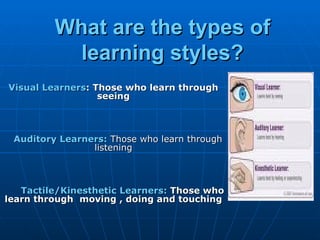
Visual Learners : Those who learn through seeing Auditory Learners:  Those who learn through listening Tactile/Kinesthetic Learners:  Those who learn through  moving , doing and touching What are the types of learning styles?
Auditory Learner Characteristics Auditory learners are those who learn best through hearing things. Look over these traits to see if they sound familiar to you. You may be an auditory learner if you are someone who:
CHARACTERISTICS OF AUDITORY LEARNERS 1. Auditory learners can remember quite accurately details of information they hear during conversations or lectures. 2. They have strong language skills, which include a well-developed vocabulary and an appreciation for words. 3. The strong language skills often lead to strong oral communication skills. They can carry on interesting conversations and can articulate their ideas clearly. 4. Because of a "fine tuned ear," auditory learners may find learning a foreign language to be relatively easy.  5. Auditory learners often have musical talents. They can hear tones, rhythms, and individual notes with their strong auditory skills.
THE AUDITORY LEARNER WILL NEED TO HEAR ALL MATERIAL CLEARLY. The student should position themselves in the classroom or lecture hall so that he/she can hear lectures and review them frequently.  Tape class lecture notes. The student should summarize what he/she has read on tape. Verbally review spelling words and lectures with another person - practice verbal repetition. Read aloud or re-auditorize written material (restate in your own words). Use audio tapes to reinforce textbook material and explain concepts.
THE AUDITORY LEARNER WILL NEED TO HEAR ALL MATERIAL CLEARLY. Form study groups to discuss written material or prepare for upcoming quizzes, mid-terms, or finals. Repeat verbal instructions and write them down. Use a tape recorder for written tests or have them read orally.  Use a finger or a pointer to avoid skipping words or whole lines. Choose interviews, oral report and tests if given the choice as a class assignment.
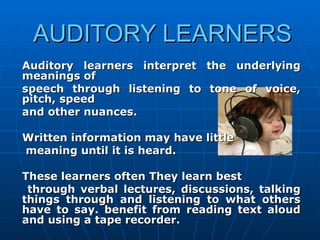
AUDITORY LEARNERS Auditory learners interpret the underlying meanings of  speech through listening to tone of voice, pitch, speed  and other nuances.  Written information may have little meaning until it is heard.  These learners often They learn best through verbal lectures, discussions, talking things through and listening to what others have to say. benefit from reading text aloud and using a tape recorder.
The aural (auditory-musical-rhythmic) learning style The aural (auditory-musical-rhythmic) learning style If you use the aural style, you like to work with sound and music. You have a good sense of pitch and rhythm. You typically can sing, play a musical instrument, or identify the sounds of different instruments. Certain music invokes strong emotions. You notice the music playing in the background of movies, TV shows and other media. You often find yourself humming or tapping a song or jingle, or a theme or jingle pops into your head without prompting.
Auditory Learners Can Benefit from: Using word association to remember facts and lines. Recording lectures. Watching videos. Repeating facts with eyes closed. Participating in group discussions. Using audiotapes for language practice. Taping notes after writing them.

An Auditory Learner Is Someone Who[1]

  • 1.
    BY: JOSENOE MARIN LEARNING STYLES
  • 2.
    Visual Learners :Those who learn through seeing Auditory Learners: Those who learn through listening Tactile/Kinesthetic Learners: Those who learn through moving , doing and touching What are the types of learning styles?
  • 3.
    Auditory Learner CharacteristicsAuditory learners are those who learn best through hearing things. Look over these traits to see if they sound familiar to you. You may be an auditory learner if you are someone who:
  • 4.
    CHARACTERISTICS OF AUDITORYLEARNERS 1. Auditory learners can remember quite accurately details of information they hear during conversations or lectures. 2. They have strong language skills, which include a well-developed vocabulary and an appreciation for words. 3. The strong language skills often lead to strong oral communication skills. They can carry on interesting conversations and can articulate their ideas clearly. 4. Because of a "fine tuned ear," auditory learners may find learning a foreign language to be relatively easy. 5. Auditory learners often have musical talents. They can hear tones, rhythms, and individual notes with their strong auditory skills.
  • 5.
    THE AUDITORY LEARNERWILL NEED TO HEAR ALL MATERIAL CLEARLY. The student should position themselves in the classroom or lecture hall so that he/she can hear lectures and review them frequently. Tape class lecture notes. The student should summarize what he/she has read on tape. Verbally review spelling words and lectures with another person - practice verbal repetition. Read aloud or re-auditorize written material (restate in your own words). Use audio tapes to reinforce textbook material and explain concepts.
  • 6.
    THE AUDITORY LEARNERWILL NEED TO HEAR ALL MATERIAL CLEARLY. Form study groups to discuss written material or prepare for upcoming quizzes, mid-terms, or finals. Repeat verbal instructions and write them down. Use a tape recorder for written tests or have them read orally. Use a finger or a pointer to avoid skipping words or whole lines. Choose interviews, oral report and tests if given the choice as a class assignment.
  • 7.
    AUDITORY LEARNERS Auditorylearners interpret the underlying meanings of speech through listening to tone of voice, pitch, speed and other nuances. Written information may have little meaning until it is heard. These learners often They learn best through verbal lectures, discussions, talking things through and listening to what others have to say. benefit from reading text aloud and using a tape recorder.
  • 8.
    The aural (auditory-musical-rhythmic)learning style The aural (auditory-musical-rhythmic) learning style If you use the aural style, you like to work with sound and music. You have a good sense of pitch and rhythm. You typically can sing, play a musical instrument, or identify the sounds of different instruments. Certain music invokes strong emotions. You notice the music playing in the background of movies, TV shows and other media. You often find yourself humming or tapping a song or jingle, or a theme or jingle pops into your head without prompting.
  • 9.
    Auditory Learners CanBenefit from: Using word association to remember facts and lines. Recording lectures. Watching videos. Repeating facts with eyes closed. Participating in group discussions. Using audiotapes for language practice. Taping notes after writing them.