HIGH FREQUENCY OSCILLATORY
VENTILATION (HFOV)- LETS START
Dr. Hemraj Soni
SMS Medical College and Hospital
Jaipur
 A type of mechanical ventilation that uses a constant
distending pressure (mean airway pressure [MAP]) with
pressure variations oscillating around the MAP at very
high rates (up to 900 cycles per minute).
 It creats small tidal volumes, often less than the dead space.
HFOV may reduce lung injury.
Overcome to convention ventilation……
1. large pressure changes (the difference between PEEP and
PIP) create physiological tidal volumes
2. Gas exchange is dependent on bulk convection (expired gas
exchanged for inspired gas).
3. Ventilator induced lung injury (VILI) and chronic lung disease
(CLD
MECHANISM---
HFOV relies on alternative mechanisms of gas exchange such
as
• molecular diffusion,
• Taylor dispersion,
• turbulence,
• asymmetric velocity profiles,
• Pendelluft,
• cardiogenic mixing and
• collateral ventilation.
ONLY INDICATED AS A RESCUE THERAPY-
 1. Failure of conventional ventilation in the term
infant (Persistent Pulmonary Hypertension of
the Newborn [PPHN], Meconium Aspiration
Syndrome [MAS]).
 2. Air leak syndromes (pneumothorax,
pulmonary interstitial emphysema [PIE])
 3. Failure of conventional ventilation in the
preterm infant (severe RDS, PIE, pulmonary
hypoplasia) or to reduce barotrauma when
conventional ventilator settings are high.
BE CAUTIOUS…..
 not as yet proven to be of benefit in the elective or
rescue treatment of preterm infants with respiratory
dysfunction and may be associated with an
increase in intraventricular haemorrhage.
 high airway pressures may result in impaired
cardiac output causing hypotension requiring
inotropic support or volume expansion
 If there is no improvement with HFOV, consider
reverting to conventional ventilation.
TERMINOLOGY-
 Frequency- High frequency ventilation rate
(Hz = cycles per second)
 MAP- Mean airway pressure (cmH2O)
 Power /Amplitude- delta P or power is the variation
around the MAP
 PLATEAU PRESSURE (Ppause) – The plateau pressure
(PP) is the pressure applied to small airways and alveoli. It is
measured during an inspiratory pause on the ventilator. The
goal plateau pressure is
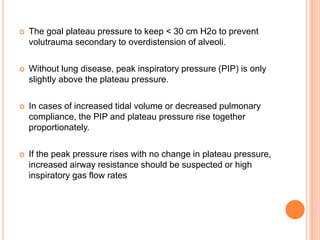
 The goal plateau pressure to keep < 30 cm H2o to prevent
volutrauma secondary to overdistension of alveoli.
 Without lung disease, peak inspiratory pressure (PIP) is only
slightly above the plateau pressure.
 In cases of increased tidal volume or decreased pulmonary
compliance, the PIP and plateau pressure rise together
proportionately.
 If the peak pressure rises with no change in plateau pressure,
increased airway resistance should be suspected or high
inspiratory gas flow rates
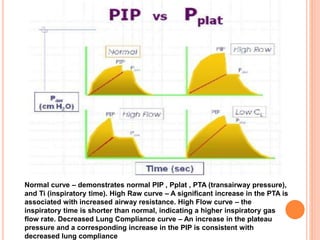
Normal curve – demonstrates normal PIP , Pplat , PTA (transairway pressure),
and Ti (inspiratory time). High Raw curve – A significant increase in the PTA is
associated with increased airway resistance. High Flow curve – the
inspiratory time is shorter than normal, indicating a higher inspiratory gas
flow rate. Decreased Lung Compliance curve – An increase in the plateau
pressure and a corresponding increase in the PIP is consistent with
decreased lung compliance
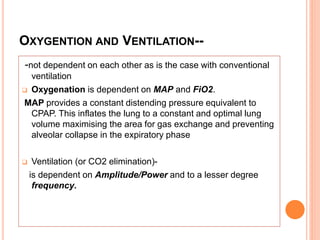
OXYGENTION AND VENTILATION--
-not dependent on each other as is the case with conventional
ventilation
 Oxygenation is dependent on MAP and FiO2.
MAP provides a constant distending pressure equivalent to
CPAP. This inflates the lung to a constant and optimal lung
volume maximising the area for gas exchange and preventing
alveolar collapse in the expiratory phase
 Ventilation (or CO2 elimination)-
is dependent on Amplitude/Power and to a lesser degree
frequency.
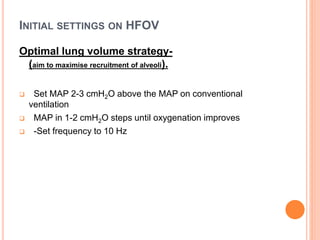
INITIAL SETTINGS ON HFOV
Optimal lung volume strategy-
(aim to maximise recruitment of alveoli).
 Set MAP 2-3 cmH2O above the MAP on conventional
ventilation
 MAP in 1-2 cmH2O steps until oxygenation improves
 -Set frequency to 10 Hz
LOW VOLUME STRATEGY
(AIM TO MINIMISE LUNG TRAUMA)--
 Set MAP equal to the MAP on conventional
ventilation
 Set frequency to 10 Hz
 Adjust amplitude to get an adequate chest wall
vibration.
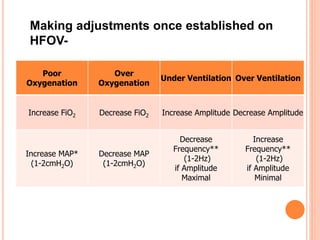
Poor
Oxygenation
Over
Oxygenation
Under Ventilation Over Ventilation
Increase FiO2 Decrease FiO2 Increase Amplitude Decrease Amplitude
Increase MAP*
(1-2cmH2O)
Decrease MAP
(1-2cmH2O)
Decrease
Frequency**
(1-2Hz)
if Amplitude
Maximal
Increase
Frequency**
(1-2Hz)
if Amplitude
Minimal
Making adjustments once established on
HFOV-
CHEST RADIOGRAPH
 Initial chest radiograph at 1-2 hrs to determine the baseline
lung volume on HFOV (aim for 8 ribs).
 A follow-up chest radiograph in 4-6 hours is recommended to
assess the expansion.
 Thereafter repeat chest radiography with acute changes in
patient condition.
WEANING-
 Reduce FiO2 to <40% before weaning MAP (except
when over-inflation is evident).
 Reduce MAP when chest radiograph shows evidence of
over-inflation (>9 ribs).
 Reduce MAP in 1-2cm H2O increments to 8-10 cm H2O.
 In air leak syndromes (low volume strategy), reducing
MAP takes priority over weaning the FiO2.
 Wean the amplitude in 2-4cm H2O increments.
 Do not wean the frequency
 Discontinue weaning when MAP 8-10 cm H2O and Amplitude
20-25
 Extubation-
If infant is stable, oxygenating well and blood gases are
satisfactory then infant could be extubated to CPAP or
switched to conventional ventilation. Discuss with consultant
SUCTIONING-
 Suction is indicated for diminished chest wall movement
(chest wobble), elevated CO2 and/or worsening oxygenation
suggesting airway or ET tube obstruction, or if there are
visible/audible secretions in the airway.
 Avoid in the first 24 hours of HFOV, unless clinically indicated

High frequency oscillatory ventilation- Basics

  • 1.
    HIGH FREQUENCY OSCILLATORY VENTILATION(HFOV)- LETS START Dr. Hemraj Soni SMS Medical College and Hospital Jaipur
  • 2.
     A typeof mechanical ventilation that uses a constant distending pressure (mean airway pressure [MAP]) with pressure variations oscillating around the MAP at very high rates (up to 900 cycles per minute).  It creats small tidal volumes, often less than the dead space. HFOV may reduce lung injury.
  • 3.
    Overcome to conventionventilation…… 1. large pressure changes (the difference between PEEP and PIP) create physiological tidal volumes 2. Gas exchange is dependent on bulk convection (expired gas exchanged for inspired gas). 3. Ventilator induced lung injury (VILI) and chronic lung disease (CLD
  • 4.
    MECHANISM--- HFOV relies onalternative mechanisms of gas exchange such as • molecular diffusion, • Taylor dispersion, • turbulence, • asymmetric velocity profiles, • Pendelluft, • cardiogenic mixing and • collateral ventilation.
  • 5.
    ONLY INDICATED ASA RESCUE THERAPY-  1. Failure of conventional ventilation in the term infant (Persistent Pulmonary Hypertension of the Newborn [PPHN], Meconium Aspiration Syndrome [MAS]).  2. Air leak syndromes (pneumothorax, pulmonary interstitial emphysema [PIE])  3. Failure of conventional ventilation in the preterm infant (severe RDS, PIE, pulmonary hypoplasia) or to reduce barotrauma when conventional ventilator settings are high.
  • 6.
    BE CAUTIOUS…..  notas yet proven to be of benefit in the elective or rescue treatment of preterm infants with respiratory dysfunction and may be associated with an increase in intraventricular haemorrhage.  high airway pressures may result in impaired cardiac output causing hypotension requiring inotropic support or volume expansion  If there is no improvement with HFOV, consider reverting to conventional ventilation.
  • 7.
    TERMINOLOGY-  Frequency- Highfrequency ventilation rate (Hz = cycles per second)  MAP- Mean airway pressure (cmH2O)  Power /Amplitude- delta P or power is the variation around the MAP  PLATEAU PRESSURE (Ppause) – The plateau pressure (PP) is the pressure applied to small airways and alveoli. It is measured during an inspiratory pause on the ventilator. The goal plateau pressure is
  • 8.
     The goalplateau pressure to keep < 30 cm H2o to prevent volutrauma secondary to overdistension of alveoli.  Without lung disease, peak inspiratory pressure (PIP) is only slightly above the plateau pressure.  In cases of increased tidal volume or decreased pulmonary compliance, the PIP and plateau pressure rise together proportionately.  If the peak pressure rises with no change in plateau pressure, increased airway resistance should be suspected or high inspiratory gas flow rates
  • 9.
    Normal curve –demonstrates normal PIP , Pplat , PTA (transairway pressure), and Ti (inspiratory time). High Raw curve – A significant increase in the PTA is associated with increased airway resistance. High Flow curve – the inspiratory time is shorter than normal, indicating a higher inspiratory gas flow rate. Decreased Lung Compliance curve – An increase in the plateau pressure and a corresponding increase in the PIP is consistent with decreased lung compliance
  • 10.
    OXYGENTION AND VENTILATION-- -notdependent on each other as is the case with conventional ventilation  Oxygenation is dependent on MAP and FiO2. MAP provides a constant distending pressure equivalent to CPAP. This inflates the lung to a constant and optimal lung volume maximising the area for gas exchange and preventing alveolar collapse in the expiratory phase  Ventilation (or CO2 elimination)- is dependent on Amplitude/Power and to a lesser degree frequency.
  • 11.
    INITIAL SETTINGS ONHFOV Optimal lung volume strategy- (aim to maximise recruitment of alveoli).  Set MAP 2-3 cmH2O above the MAP on conventional ventilation  MAP in 1-2 cmH2O steps until oxygenation improves  -Set frequency to 10 Hz
  • 12.
    LOW VOLUME STRATEGY (AIMTO MINIMISE LUNG TRAUMA)--  Set MAP equal to the MAP on conventional ventilation  Set frequency to 10 Hz  Adjust amplitude to get an adequate chest wall vibration.
  • 13.
    Poor Oxygenation Over Oxygenation Under Ventilation OverVentilation Increase FiO2 Decrease FiO2 Increase Amplitude Decrease Amplitude Increase MAP* (1-2cmH2O) Decrease MAP (1-2cmH2O) Decrease Frequency** (1-2Hz) if Amplitude Maximal Increase Frequency** (1-2Hz) if Amplitude Minimal Making adjustments once established on HFOV-
  • 14.
    CHEST RADIOGRAPH  Initialchest radiograph at 1-2 hrs to determine the baseline lung volume on HFOV (aim for 8 ribs).  A follow-up chest radiograph in 4-6 hours is recommended to assess the expansion.  Thereafter repeat chest radiography with acute changes in patient condition.
  • 15.
    WEANING-  Reduce FiO2to <40% before weaning MAP (except when over-inflation is evident).  Reduce MAP when chest radiograph shows evidence of over-inflation (>9 ribs).  Reduce MAP in 1-2cm H2O increments to 8-10 cm H2O.  In air leak syndromes (low volume strategy), reducing MAP takes priority over weaning the FiO2.  Wean the amplitude in 2-4cm H2O increments.
  • 16.
     Do notwean the frequency  Discontinue weaning when MAP 8-10 cm H2O and Amplitude 20-25  Extubation- If infant is stable, oxygenating well and blood gases are satisfactory then infant could be extubated to CPAP or switched to conventional ventilation. Discuss with consultant
  • 17.
    SUCTIONING-  Suction isindicated for diminished chest wall movement (chest wobble), elevated CO2 and/or worsening oxygenation suggesting airway or ET tube obstruction, or if there are visible/audible secretions in the airway.  Avoid in the first 24 hours of HFOV, unless clinically indicated