



High-Frequency Oscillation:
New Directions for 2009
Niall D. Ferguson, MD, FRCPC, MSc
Assistant Professor
Interdepartmental Division of Critical Care Medicine
University of Toronto
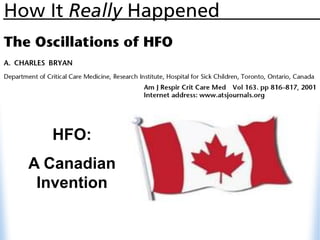
HFO:
A Canadian
Invention
Outline
• Background on HFO
• Ventilator-induced Lung Injury (VILI)
• Implementing HFO to prevent VILI
 Who
 When
 How
 Oxygenation & Recruitment
 Ventilation
 Transition back to CV
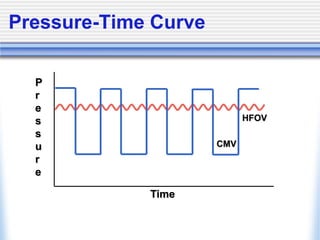
Pressure-Time Curve
CMV
HFOV
P
r
e
s
s
u
r
e
Time
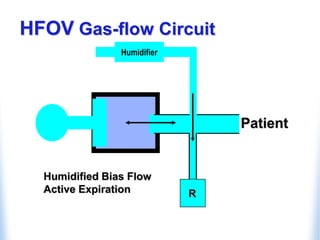
Patient
HFOV Gas-flow Circuit
Humidified Bias Flow
Active Expiration R
Humidifier
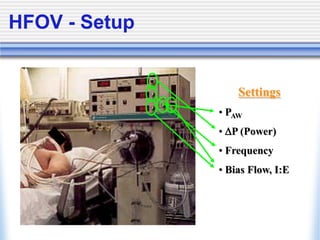
HFOV - Setup
Settings
• PAW
• P (Power)
• Frequency
• Bias Flow, I:E
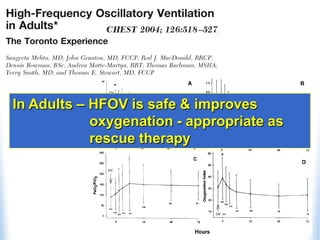
In Adults – HFOV is safe & improves
oxygenation - appropriate as
rescue therapy
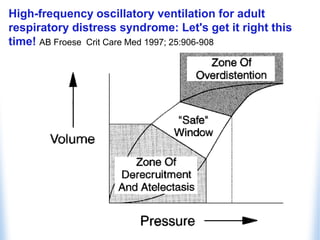
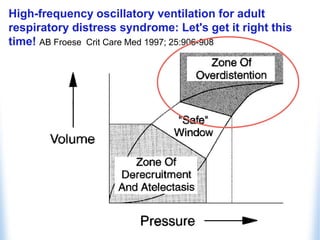
High-frequency oscillatory ventilation for adult
respiratory distress syndrome: Let's get it right this
time! AB Froese Crit Care Med 1997; 25:906-908
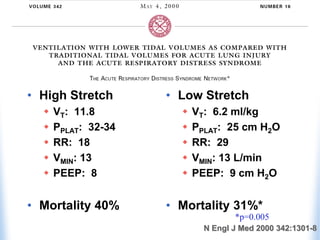
ARDS Network
• High Stretch
 VT: 11.8
 PPLAT: 32-34
 RR: 18
 VMIN: 13
 PEEP: 8
• Mortality 40%
• Low Stretch
 VT: 6.2 ml/kg
 PPLAT: 25 cm H2O
 RR: 29
 VMIN: 13 L/min
 PEEP: 9 cm H2O
• Mortality 31%*
*p=0.005
N Engl J Med 2000 342:1301-8
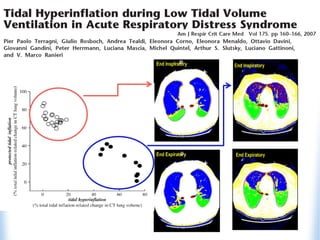
Can We Reduce VILI
any Further?
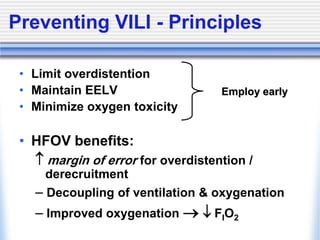
Preventing VILI - Principles
• Limit overdistention
• Maintain EELV
• Minimize oxygen toxicity
• HFOV benefits:
 margin of error for overdistention /
derecruitment
- Decoupling of ventilation & oxygenation
- Improved oxygenation  FIO2
Employ early
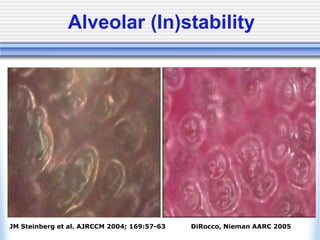
Alveolar (In)stability
JM Steinberg et al. AJRCCM 2004; 169:57-63 DiRocco, Nieman AARC 2005
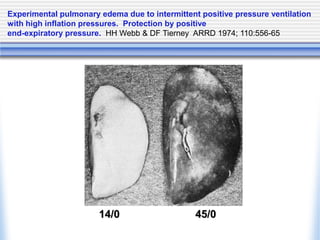
14/0 45/0
Experimental pulmonary edema due to intermittent positive pressure ventilation
with high inflation pressures. Protection by positive
end-expiratory pressure. HH Webb & DF Tierney ARRD 1974; 110:556-65
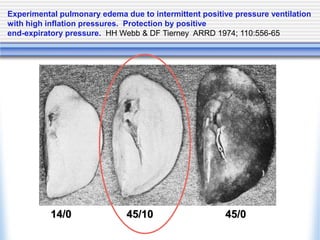
14/0 45/10 45/0
Experimental pulmonary edema due to intermittent positive pressure ventilation
with high inflation pressures. Protection by positive
end-expiratory pressure. HH Webb & DF Tierney ARRD 1974; 110:556-65
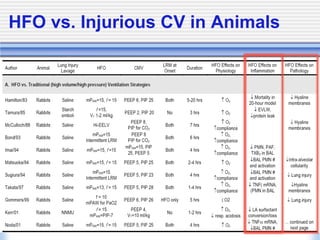
HFO vs. Injurious CV in Animals
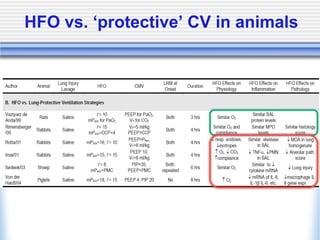
HFO vs. ‘protective’ CV in animals
Outcomes
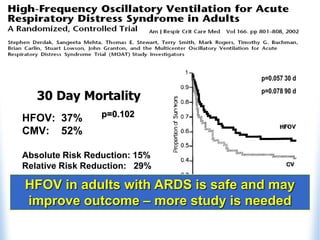
30 Day Mortality
HFOV: 37%
CMV: 52%
Absolute Risk Reduction: 15%
Relative Risk Reduction: 29%
p=0.102
p=0.057 30 d
p=0.078 90 d
HFOV in adults with ARDS is safe and may
improve outcome – more study is needed
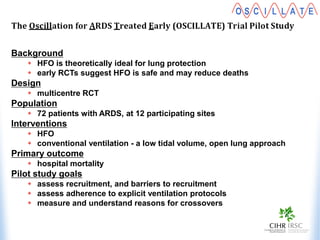
HFO
Background
 HFO is theoretically ideal for lung protection
 early RCTs suggest HFO is safe and may reduce deaths
Design
 multicentre RCT
Population
 72 patients with ARDS, at 12 participating sites
Interventions
 HFO
 conventional ventilation - a low tidal volume, open lung approach
Primary outcome
 hospital mortality
Pilot study goals
 assess recruitment, and barriers to recruitment
 assess adherence to explicit ventilation protocols
 measure and understand reasons for crossovers
Outline
• Ventilator-induced Lung Injury (VILI)
• Background on HFO
• Implementing HFO
 Who
 When
 How
 Oxygenation & Recruitment
 Ventilation
 Transition back to CV
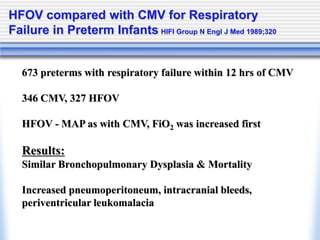
HFOV compared with CMV for Respiratory
Failure in Preterm Infants HIFI Group N Engl J Med 1989;320
673 preterms with respiratory failure within 12 hrs of CMV
346 CMV, 327 HFOV
HFOV - MAP as with CMV, FiO2 was increased first
Results:
Similar Bronchopulmonary Dysplasia & Mortality
Increased pneumoperitoneum, intracranial bleeds,
periventricular leukomalacia
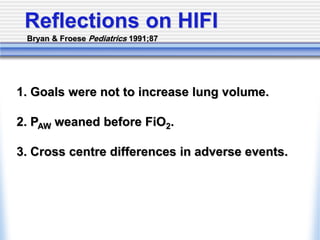
Reflections on HIFI
Bryan & Froese Pediatrics 1991;87
1. Goals were not to increase lung volume.
2. PAW weaned before FiO2.
3. Cross centre differences in adverse events.
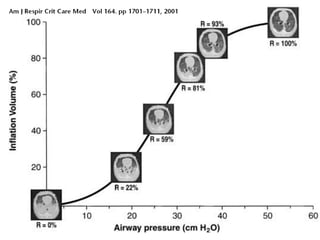
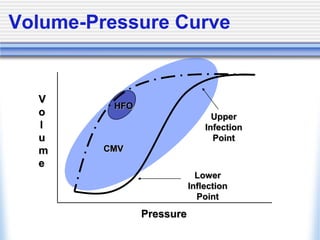
Volume-Pressure Curve
CMV
HFO
V
o
l
u
m
e
Pressure
Lower
Inflection
Point
Upper
Infection
Point
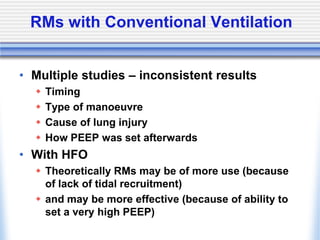
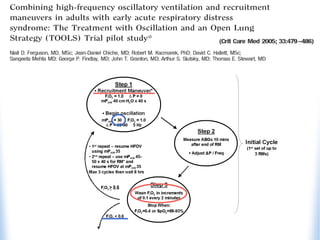
RMs with Conventional Ventilation
• Multiple studies – inconsistent results
 Timing
 Type of manoeuvre
 Cause of lung injury
 How PEEP was set afterwards
• With HFO
 Theoretically RMs may be of more use (because
of lack of tidal recruitment)
 and may be more effective (because of ability to
set a very high PEEP)
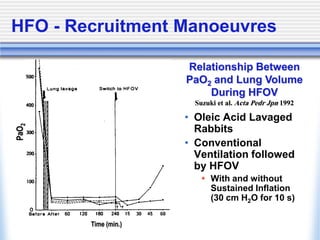
PaO2
Time (min.)
HFO - Recruitment Manoeuvres
• Oleic Acid Lavaged
Rabbits
• Conventional
Ventilation followed
by HFOV
 With and without
Sustained Inflation
(30 cm H2O for 10 s)
Relationship Between
PaO2 and Lung Volume
During HFOV
Suzuki et al. Acta Pedr Jpn 1992
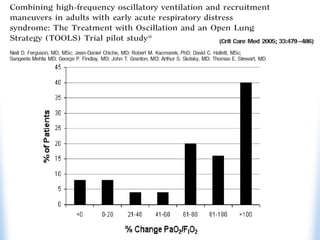
> 0.6
0
100
200
300
400
Standardized CMV HFOV + 1-3 RMs
(1.5 Hours)
PaO2/FIO2
Individual & Mean PaO2/FIO2 Values
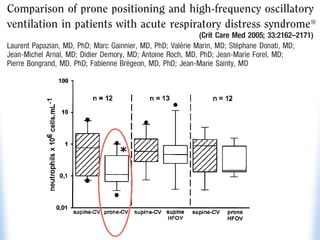
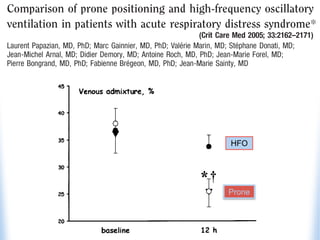
HFO
Prone
Conclusions
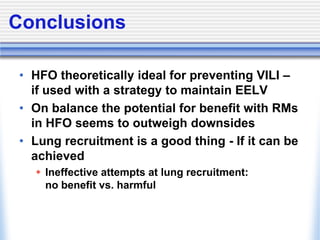
• HFO theoretically ideal for preventing VILI –
if used with a strategy to maintain EELV
• On balance the potential for benefit with RMs
in HFO seems to outweigh downsides
• Lung recruitment is a good thing - If it can be
achieved
 Ineffective attempts at lung recruitment:
no benefit vs. harmful
Outline
• Ventilator-induced Lung Injury (VILI)
• Background on HFO
• Implementing HFO
 Who
 When
 How
 Oxygenation & Recruitment
 Ventilation
 Transition back to CV
High-frequency oscillatory ventilation for adult
respiratory distress syndrome: Let's get it right this
time! AB Froese Crit Care Med 1997; 25:906-908
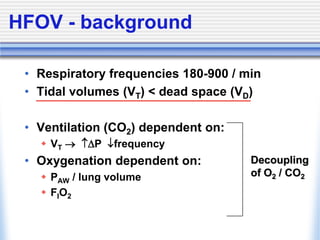
HFOV - background
• Respiratory frequencies 180-900 / min
• Tidal volumes (VT) < dead space (VD)
• Ventilation (CO2) dependent on:
 VT  P frequency
• Oxygenation dependent on:
 PAW / lung volume
 FIO2
Decoupling
of O2 / CO2
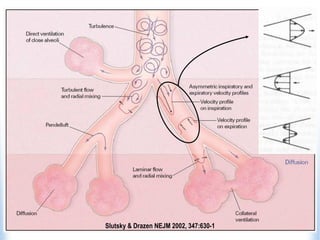
Slutsky & Drazen NEJM 2002, 347:630-1
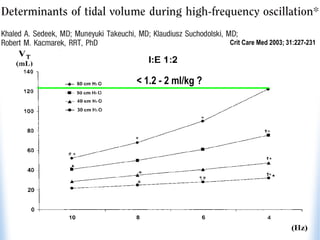
Crit Care Med 2003; 31:227-231
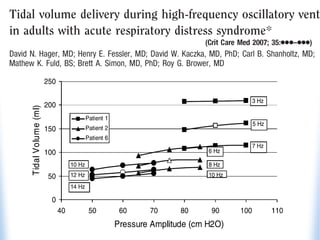
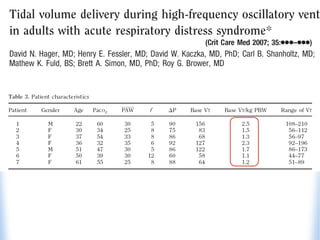
< 1.2 - 2 ml/kg ?
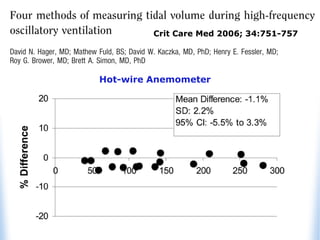
Crit Care Med 2006; 34:751-757
Hot-wire Anemometer
Conclusions
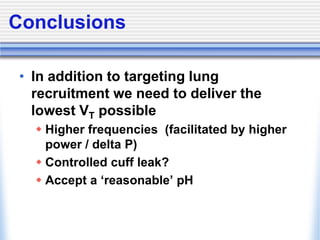
• In addition to targeting lung
recruitment we need to deliver the
lowest VT possible
 Higher frequencies (facilitated by higher
power / delta P)
 Controlled cuff leak?
 Accept a ‘reasonable’ pH
Outline
• Ventilator-induced Lung Injury (VILI)
• Background on HFO
• Implementing HFO
 Who
 When
 How
 Oxygenation & Recruitment
 Ventilation
 Transition back to CV
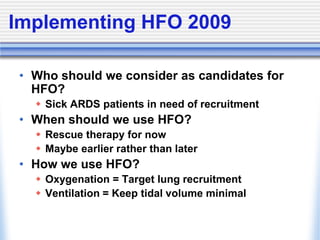
Implementing HFO 2009
• Who should we consider as candidates for
HFO?
 Sick ARDS patients in need of recruitment
• When should we use HFO?
 Rescue therapy for now
 Maybe earlier rather than later
• How we use HFO?
 Oxygenation = Target lung recruitment
 Ventilation = Keep tidal volume minimal
HFO
n.ferguson@utoronto.ca
October 25 – 29, 2009
Metro Toronto Convention Centre
n.ferguson@utoronto.ca

High-Frequency Oscillation: New Directions

  • 1.
    High-Frequency Oscillation: New Directionsfor 2009 Niall D. Ferguson, MD, FRCPC, MSc Assistant Professor Interdepartmental Division of Critical Care Medicine University of Toronto
  • 2.
  • 3.
    Outline • Background onHFO • Ventilator-induced Lung Injury (VILI) • Implementing HFO to prevent VILI  Who  When  How  Oxygenation & Recruitment  Ventilation  Transition back to CV
  • 4.
  • 5.
    Patient HFOV Gas-flow Circuit HumidifiedBias Flow Active Expiration R Humidifier
  • 6.
    HFOV - Setup Settings •PAW • P (Power) • Frequency • Bias Flow, I:E
  • 8.
    In Adults –HFOV is safe & improves oxygenation - appropriate as rescue therapy
  • 9.
    High-frequency oscillatory ventilationfor adult respiratory distress syndrome: Let's get it right this time! AB Froese Crit Care Med 1997; 25:906-908
  • 10.
    ARDS Network • HighStretch  VT: 11.8  PPLAT: 32-34  RR: 18  VMIN: 13  PEEP: 8 • Mortality 40% • Low Stretch  VT: 6.2 ml/kg  PPLAT: 25 cm H2O  RR: 29  VMIN: 13 L/min  PEEP: 9 cm H2O • Mortality 31%* *p=0.005 N Engl J Med 2000 342:1301-8
  • 12.
    Can We ReduceVILI any Further?
  • 13.
    Preventing VILI -Principles • Limit overdistention • Maintain EELV • Minimize oxygen toxicity • HFOV benefits:  margin of error for overdistention / derecruitment - Decoupling of ventilation & oxygenation - Improved oxygenation  FIO2 Employ early
  • 14.
    Alveolar (In)stability JM Steinberget al. AJRCCM 2004; 169:57-63 DiRocco, Nieman AARC 2005
  • 15.
    14/0 45/0 Experimental pulmonaryedema due to intermittent positive pressure ventilation with high inflation pressures. Protection by positive end-expiratory pressure. HH Webb & DF Tierney ARRD 1974; 110:556-65
  • 16.
    14/0 45/10 45/0 Experimentalpulmonary edema due to intermittent positive pressure ventilation with high inflation pressures. Protection by positive end-expiratory pressure. HH Webb & DF Tierney ARRD 1974; 110:556-65
  • 17.
    HFO vs. InjuriousCV in Animals
  • 18.
  • 19.
    Outcomes 30 Day Mortality HFOV:37% CMV: 52% Absolute Risk Reduction: 15% Relative Risk Reduction: 29% p=0.102 p=0.057 30 d p=0.078 90 d HFOV in adults with ARDS is safe and may improve outcome – more study is needed
  • 20.
  • 22.
    Background  HFO istheoretically ideal for lung protection  early RCTs suggest HFO is safe and may reduce deaths Design  multicentre RCT Population  72 patients with ARDS, at 12 participating sites Interventions  HFO  conventional ventilation - a low tidal volume, open lung approach Primary outcome  hospital mortality Pilot study goals  assess recruitment, and barriers to recruitment  assess adherence to explicit ventilation protocols  measure and understand reasons for crossovers
  • 23.
    Outline • Ventilator-induced LungInjury (VILI) • Background on HFO • Implementing HFO  Who  When  How  Oxygenation & Recruitment  Ventilation  Transition back to CV
  • 24.
    HFOV compared withCMV for Respiratory Failure in Preterm Infants HIFI Group N Engl J Med 1989;320 673 preterms with respiratory failure within 12 hrs of CMV 346 CMV, 327 HFOV HFOV - MAP as with CMV, FiO2 was increased first Results: Similar Bronchopulmonary Dysplasia & Mortality Increased pneumoperitoneum, intracranial bleeds, periventricular leukomalacia
  • 25.
    Reflections on HIFI Bryan& Froese Pediatrics 1991;87 1. Goals were not to increase lung volume. 2. PAW weaned before FiO2. 3. Cross centre differences in adverse events.
  • 27.
  • 28.
    RMs with ConventionalVentilation • Multiple studies – inconsistent results  Timing  Type of manoeuvre  Cause of lung injury  How PEEP was set afterwards • With HFO  Theoretically RMs may be of more use (because of lack of tidal recruitment)  and may be more effective (because of ability to set a very high PEEP)
  • 29.
    PaO2 Time (min.) HFO -Recruitment Manoeuvres • Oleic Acid Lavaged Rabbits • Conventional Ventilation followed by HFOV  With and without Sustained Inflation (30 cm H2O for 10 s) Relationship Between PaO2 and Lung Volume During HFOV Suzuki et al. Acta Pedr Jpn 1992
  • 31.
  • 32.
    0 100 200 300 400 Standardized CMV HFOV+ 1-3 RMs (1.5 Hours) PaO2/FIO2 Individual & Mean PaO2/FIO2 Values
  • 34.
  • 35.
    Conclusions • HFO theoreticallyideal for preventing VILI – if used with a strategy to maintain EELV • On balance the potential for benefit with RMs in HFO seems to outweigh downsides • Lung recruitment is a good thing - If it can be achieved  Ineffective attempts at lung recruitment: no benefit vs. harmful
  • 36.
    Outline • Ventilator-induced LungInjury (VILI) • Background on HFO • Implementing HFO  Who  When  How  Oxygenation & Recruitment  Ventilation  Transition back to CV
  • 37.
    High-frequency oscillatory ventilationfor adult respiratory distress syndrome: Let's get it right this time! AB Froese Crit Care Med 1997; 25:906-908
  • 38.
    HFOV - background •Respiratory frequencies 180-900 / min • Tidal volumes (VT) < dead space (VD) • Ventilation (CO2) dependent on:  VT  P frequency • Oxygenation dependent on:  PAW / lung volume  FIO2 Decoupling of O2 / CO2
  • 39.
    Slutsky & DrazenNEJM 2002, 347:630-1
  • 40.
    Crit Care Med2003; 31:227-231 < 1.2 - 2 ml/kg ?
  • 41.
    Crit Care Med2006; 34:751-757 Hot-wire Anemometer
  • 44.
    Conclusions • In additionto targeting lung recruitment we need to deliver the lowest VT possible  Higher frequencies (facilitated by higher power / delta P)  Controlled cuff leak?  Accept a ‘reasonable’ pH
  • 45.
    Outline • Ventilator-induced LungInjury (VILI) • Background on HFO • Implementing HFO  Who  When  How  Oxygenation & Recruitment  Ventilation  Transition back to CV
  • 46.
    Implementing HFO 2009 •Who should we consider as candidates for HFO?  Sick ARDS patients in need of recruitment • When should we use HFO?  Rescue therapy for now  Maybe earlier rather than later • How we use HFO?  Oxygenation = Target lung recruitment  Ventilation = Keep tidal volume minimal
  • 48.
  • 49.
    n.ferguson@utoronto.ca October 25 –29, 2009 Metro Toronto Convention Centre
  • 50.