HIGH FREQUENCY
VENTILATION
Dr. ADHI ARYA
SENIOR RESIDENT –GMCH -32 CHANDIGARH
• INTRODUCTION
• MECHANISM OF VENTILATION
• WHY HFV
• TYPES OF HFV
• USES
• TERMINOLOGY AND SETTINGS( INITIATION AND WEANING OFF)
• MONITORING/ROUTINE CARE ON HFV
• COMPLICATIONS
• EVIDENCE
INTRODUCTION
HFV is a type of mechanical ventilation that uses a constant distending
pressure (mean airway pressure [MAP]) with pressure variations
oscillating around the MAP at very high rates
This creates small tidal volumes, often less than the dead space. HFOV
relies on alternative mechanisms of gas exchange such as molecular
diffusion, Taylor dispersion, turbulence, asymmetric velocity profiles,
Pendelluft, cardiogenic mixing and collateral ventilation
NATURAL HIGH FREQUENCY VENTILATION
• HUMMINGBIRD
• DOG’S PANTING
MECHANISM OF ACTION
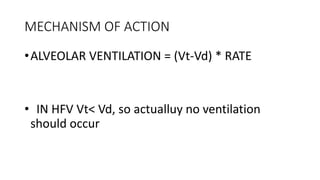
•ALVEOLAR VENTILATION = (Vt-Vd) * RATE
• IN HFV Vt< Vd, so actualluy no ventilation
should occur
HFV Provides augmented gas distribution by means of numerous
gas transport mechanisms.
 Convection ventilation( bulk flow)
 Pendalluft effect
 Taylor dispersion
 Asymmetric velocity profiles
 Cardiogenic Mixing
 Molecular diffusion
 Collateral Ventilation
Convection, Transit Time and Direct
Ventilation
Convection
 is the transport of air flow at a
constant equal velocity that is
parabolic in shape.
TO SHORT PATH LENGTH UNITS
THAT BRANCH OFF FROM
PROXIMAL AIRWAYS
Pendalluft Effect
At the end of expiration:
• Alveoli with short time constants (fast alveoli
units) are empty.
• Alveoli with longer time constants (slow alveoli
units) are still emptying
Asynchronous filling:
• Gases will move from slow units to fast units
because of pressure gradients between the
alveoli.
Asynchronous Filling
Taylor Dispersion
The relationship between:
 Axial velocity profile (Turbulence)
 the diffusion of gases in motion
 and the branching network of the lungs.
Asymmetry
Airflow moving through the airways moves in a u-shape formation. At the center of the lumen air
will move at a faster velocity, than air that is closest to the wall.
Asymmetry
Occurs with rapid respiratory cycles. Gases (O2) at the center of the lumen will advance further into
the lungs as gases (CO2) along the wall of the airway moves out towards the mouth.
• Asymmetrical Velocity Profiles
• Inspiration
• The high frequency bulk flow creates a “bullet” shaped flow profile, with the central molecules
moving further down the airway than those molecules found on the periphery of the airway.
• Expiration
• The velocity profile is blunted so that at the completion of each return, the central molecules
remain further down the airway and the peripheral molecules move towards the mouth of the
airway
Cardiogenic Mixing
As the heart beats the heart provides additional peripheral mixing
by exerting pressure against the lungs during contraction of the
heart.
This pressure promotes the movement of gas flow through the
neighboring parenchymal regions.
Collateral VentilationMolecular Diffusion
Maintaining a constant distending
pressure with HFV within the
lungs along with movement of gas
molecules promotes gas diffusion
across the alveolar membrane, at
a faster rate.
Collateral ventilation increases
with HFV due to connections
between the alveoli
 (Pores of Kohn)
WHY HFV
THEORITICAL ADVANTAGES
• SMALL TIDAL VOLUMES
limits alveolar over distension
• HIGHER MAP
Better alveolar recruitment
• CONSTANT mPaw during inp and exp
preventing end alveolar collapse
Volume
Pressure
Zone of Overdistention
Safe
window
Zone of
Derecruitment
and
atelectasis
Goal is to avoid injury zones
and operate in the safe window
HFOV is used to prevent Ventilator Induced Lung Injury
Pressure and Volume Swings
INJURY
INJURY
CMV
HFOV
 During CMV, there are swings between the zones of
injury from inspiration to expiration.
 During HFOV, the entire cycle operates in the “safe
window” and avoids the injury zones.
TYPES OF HFV
Based on characteristic of exhalation (Active /Passive/ Hybrid )and
source of generation
– 3 types
1. HFPPV
2. HFJV
3. HFOV
USES
1. failure of conventional ventilation in the term infant (Persistent
Pulmonary Hypertension of the Newborn [PPHN], Meconium
Aspiration Syndrome [MAS]).4,5
2. Air leak syndromes (pneumothorax, pulmonary interstitial
emphysema [PIE])7
3. Failure of conventional ventilation in the preterm infant (severe
RDS, PIE, pulmonary hypoplasia) or to reduce barotrauma when
conventional ventilator settings are high.
4. Lung hypoplasia syndromes
TERMINOLOGY
Oxygenation
Depends on
1) MAP
2) Fio2
Ventilation
Depends on
1. amplitude( depth of oscillations around MAP)
2. Frequency
3. Ti
• CMV
ALVEOLAR VENT = FREQ * TV
•HFV
ALV VENT= F*TV2
More TV in 6 Hz Cycle as compared to 8 Hz
INITIAL SETTINGS
DEPENDS ON PATHOLOGY
• OPTIMAL LUNG VOLUME STRATEGY
• LOW VOLUME STRATEGY
• SEVERE RESPIRATORY FAILURE
One-study sites that 50% of infants studied who met the criteria for
ECMO were successfully managed with HFV alone.
• Initially, start with a MAP 2 cm higher than with conventional
ventilation and incrementally increase it. Very high MAPs may be
needed to achieve adequate oxygenation.
• PERSISTENT PULMONARY HYPERTENSION
• Hyperventilate to achieve a PaCO2 of 25-35 Torr with a pH of 7.45-7.55. Some
literature suggests a pH of 7.55-7.65.
• Hyperoxygenate generally by maintaining the FIO2 at 1.0. Increase the MAP to
maintain adequate oxygenation
LUNG HYPOPLASIA SYNDROMES
• Initially use the same MAP as on conventional ventilation then
aggressively increase in 1cm increments to optimum lung volume.
• Adjust the amplitude to give a PaCO2 of 45-50.
• AIR LEAK SYNDROMES
• • Initially set the MAP 1-2 cm H2O below the MAP on conventional
mechanical ventilation.
WEANING
COMPLICATIONS
• HYPOTENSION ( Increased intrathoracic pressure -- decreased VR)
• AIRLEAKS
• IVH/PVL
• NECROTISING TRACHEOBROCHITIS
MONITORING
1. SEDATION
2. AUSCULTATION
3. CXR (1hr after initiation or any change in settings/deterioration)
4. SUCTIONING
5. BP MONITORONG
SUSTAINED INFLATION
lung recruitment maneuver.
• There are several ways in which to perform a SI maneuver.
• In our institution, the piston is paused (thus leaving the patient in CPAP) and the Paw
is increased by 8-10 cm H2O for 30-60 seconds.
• Once the SI maneuver is completed, the piston is restarted.
• Potential complications:
• Pneumothorax
• CV compromise / altered hemodynamics
When To Utilize A SI Maneuver
• When initiating HFOV to recruit lung
• After a disconnect or loss of FRC/Paw
• After suctioning (even with a closed suction system)
• Inability to wean FiO2
• When considering increasing Paw
• A recruitment maneuver may recruit lung allowing you to
maintain the baseline Paw and, thus, not increase support.
EVIDENCE ( should answer these three
questions)
EVIDENCE
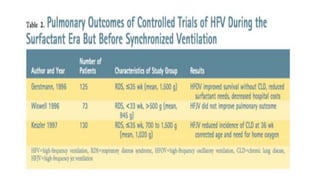
PULMONARY OUTCOMES OF CONTROLLED TRIALS OF HFV
DURING SURFACTANT ERA AND SYNCHRONOSED VENTILATION
AS PRIMARY MODE
• AS A PRIMARY MODE
Elective high frequency ventilation compared to conventional
mechanical ventilation in the early stabilization of infants with
respiratory distress - Cochrane-March 2015
Insufficient evidence exists to support the routine use of high
frequency oscillatory ventilation instead of conventional ventilation for
preterm infants
AS RESCUE THERAPY
• Preterm
Rescue high-frequency jet ventilation versus conventional ventilation
for severe pulmonary dysfunction in preterm infants
Cochrane oct 2015
• Existing evidence does not support the use of rescue high-frequency
jet ventilation compared with conventional mechanical ventilation for
treatment of preterm infants with severe pulmonary problems
AS RESCUE THERAPY
Term
• High frequency oscillatory ventilation versus conventional
ventilation for infants with severe pulmonary dysfunction born at or
near term
cochrane may 2009
There are no data from randomized controlled trials supporting the use
of rescue HFOV in term or near term infants with severe pulmonary
dysfunction.
HFJV VS HFOV
• High frequency jet ventilation versus high frequency oscillatory
ventilation for pulmonary dysfunction in preterm infants
Cochrane database May 2016
• no evidence to support the superiority of HFJV or HFOV as elective or
rescue therapy
HIGH FREQUENCY VENTILATION - NEONATES

HIGH FREQUENCY VENTILATION - NEONATES

  • 1.
    HIGH FREQUENCY VENTILATION Dr. ADHIARYA SENIOR RESIDENT –GMCH -32 CHANDIGARH
  • 2.
    • INTRODUCTION • MECHANISMOF VENTILATION • WHY HFV • TYPES OF HFV • USES • TERMINOLOGY AND SETTINGS( INITIATION AND WEANING OFF) • MONITORING/ROUTINE CARE ON HFV • COMPLICATIONS • EVIDENCE
  • 3.
    INTRODUCTION HFV is atype of mechanical ventilation that uses a constant distending pressure (mean airway pressure [MAP]) with pressure variations oscillating around the MAP at very high rates This creates small tidal volumes, often less than the dead space. HFOV relies on alternative mechanisms of gas exchange such as molecular diffusion, Taylor dispersion, turbulence, asymmetric velocity profiles, Pendelluft, cardiogenic mixing and collateral ventilation
  • 4.
    NATURAL HIGH FREQUENCYVENTILATION • HUMMINGBIRD • DOG’S PANTING
  • 5.
    MECHANISM OF ACTION •ALVEOLARVENTILATION = (Vt-Vd) * RATE • IN HFV Vt< Vd, so actualluy no ventilation should occur
  • 6.
    HFV Provides augmentedgas distribution by means of numerous gas transport mechanisms.  Convection ventilation( bulk flow)  Pendalluft effect  Taylor dispersion  Asymmetric velocity profiles  Cardiogenic Mixing  Molecular diffusion  Collateral Ventilation
  • 7.
    Convection, Transit Timeand Direct Ventilation Convection  is the transport of air flow at a constant equal velocity that is parabolic in shape. TO SHORT PATH LENGTH UNITS THAT BRANCH OFF FROM PROXIMAL AIRWAYS
  • 8.
    Pendalluft Effect At theend of expiration: • Alveoli with short time constants (fast alveoli units) are empty. • Alveoli with longer time constants (slow alveoli units) are still emptying Asynchronous filling: • Gases will move from slow units to fast units because of pressure gradients between the alveoli. Asynchronous Filling
  • 9.
    Taylor Dispersion The relationshipbetween:  Axial velocity profile (Turbulence)  the diffusion of gases in motion  and the branching network of the lungs.
  • 10.
    Asymmetry Airflow moving throughthe airways moves in a u-shape formation. At the center of the lumen air will move at a faster velocity, than air that is closest to the wall. Asymmetry Occurs with rapid respiratory cycles. Gases (O2) at the center of the lumen will advance further into the lungs as gases (CO2) along the wall of the airway moves out towards the mouth.
  • 11.
    • Asymmetrical VelocityProfiles • Inspiration • The high frequency bulk flow creates a “bullet” shaped flow profile, with the central molecules moving further down the airway than those molecules found on the periphery of the airway. • Expiration • The velocity profile is blunted so that at the completion of each return, the central molecules remain further down the airway and the peripheral molecules move towards the mouth of the airway
  • 12.
    Cardiogenic Mixing As theheart beats the heart provides additional peripheral mixing by exerting pressure against the lungs during contraction of the heart. This pressure promotes the movement of gas flow through the neighboring parenchymal regions.
  • 13.
    Collateral VentilationMolecular Diffusion Maintaininga constant distending pressure with HFV within the lungs along with movement of gas molecules promotes gas diffusion across the alveolar membrane, at a faster rate. Collateral ventilation increases with HFV due to connections between the alveoli  (Pores of Kohn)
  • 15.
    WHY HFV THEORITICAL ADVANTAGES •SMALL TIDAL VOLUMES limits alveolar over distension • HIGHER MAP Better alveolar recruitment • CONSTANT mPaw during inp and exp preventing end alveolar collapse
  • 16.
    Volume Pressure Zone of Overdistention Safe window Zoneof Derecruitment and atelectasis Goal is to avoid injury zones and operate in the safe window HFOV is used to prevent Ventilator Induced Lung Injury
  • 17.
    Pressure and VolumeSwings INJURY INJURY CMV HFOV  During CMV, there are swings between the zones of injury from inspiration to expiration.  During HFOV, the entire cycle operates in the “safe window” and avoids the injury zones.
  • 20.
    TYPES OF HFV Basedon characteristic of exhalation (Active /Passive/ Hybrid )and source of generation – 3 types 1. HFPPV 2. HFJV 3. HFOV
  • 22.
    USES 1. failure ofconventional ventilation in the term infant (Persistent Pulmonary Hypertension of the Newborn [PPHN], Meconium Aspiration Syndrome [MAS]).4,5 2. Air leak syndromes (pneumothorax, pulmonary interstitial emphysema [PIE])7 3. Failure of conventional ventilation in the preterm infant (severe RDS, PIE, pulmonary hypoplasia) or to reduce barotrauma when conventional ventilator settings are high. 4. Lung hypoplasia syndromes
  • 23.
  • 24.
  • 25.
    Ventilation Depends on 1. amplitude(depth of oscillations around MAP) 2. Frequency 3. Ti
  • 26.
    • CMV ALVEOLAR VENT= FREQ * TV •HFV ALV VENT= F*TV2
  • 27.
    More TV in6 Hz Cycle as compared to 8 Hz
  • 28.
    INITIAL SETTINGS DEPENDS ONPATHOLOGY • OPTIMAL LUNG VOLUME STRATEGY • LOW VOLUME STRATEGY
  • 29.
    • SEVERE RESPIRATORYFAILURE One-study sites that 50% of infants studied who met the criteria for ECMO were successfully managed with HFV alone. • Initially, start with a MAP 2 cm higher than with conventional ventilation and incrementally increase it. Very high MAPs may be needed to achieve adequate oxygenation.
  • 30.
    • PERSISTENT PULMONARYHYPERTENSION • Hyperventilate to achieve a PaCO2 of 25-35 Torr with a pH of 7.45-7.55. Some literature suggests a pH of 7.55-7.65. • Hyperoxygenate generally by maintaining the FIO2 at 1.0. Increase the MAP to maintain adequate oxygenation
  • 31.
    LUNG HYPOPLASIA SYNDROMES •Initially use the same MAP as on conventional ventilation then aggressively increase in 1cm increments to optimum lung volume. • Adjust the amplitude to give a PaCO2 of 45-50.
  • 32.
    • AIR LEAKSYNDROMES • • Initially set the MAP 1-2 cm H2O below the MAP on conventional mechanical ventilation.
  • 34.
  • 35.
    COMPLICATIONS • HYPOTENSION (Increased intrathoracic pressure -- decreased VR) • AIRLEAKS • IVH/PVL • NECROTISING TRACHEOBROCHITIS
  • 36.
    MONITORING 1. SEDATION 2. AUSCULTATION 3.CXR (1hr after initiation or any change in settings/deterioration) 4. SUCTIONING 5. BP MONITORONG
  • 37.
    SUSTAINED INFLATION lung recruitmentmaneuver. • There are several ways in which to perform a SI maneuver. • In our institution, the piston is paused (thus leaving the patient in CPAP) and the Paw is increased by 8-10 cm H2O for 30-60 seconds. • Once the SI maneuver is completed, the piston is restarted. • Potential complications: • Pneumothorax • CV compromise / altered hemodynamics
  • 38.
    When To UtilizeA SI Maneuver • When initiating HFOV to recruit lung • After a disconnect or loss of FRC/Paw • After suctioning (even with a closed suction system) • Inability to wean FiO2 • When considering increasing Paw • A recruitment maneuver may recruit lung allowing you to maintain the baseline Paw and, thus, not increase support.
  • 39.
    EVIDENCE ( shouldanswer these three questions)
  • 40.
  • 43.
    PULMONARY OUTCOMES OFCONTROLLED TRIALS OF HFV DURING SURFACTANT ERA AND SYNCHRONOSED VENTILATION
  • 45.
    AS PRIMARY MODE •AS A PRIMARY MODE Elective high frequency ventilation compared to conventional mechanical ventilation in the early stabilization of infants with respiratory distress - Cochrane-March 2015 Insufficient evidence exists to support the routine use of high frequency oscillatory ventilation instead of conventional ventilation for preterm infants
  • 46.
    AS RESCUE THERAPY •Preterm Rescue high-frequency jet ventilation versus conventional ventilation for severe pulmonary dysfunction in preterm infants Cochrane oct 2015 • Existing evidence does not support the use of rescue high-frequency jet ventilation compared with conventional mechanical ventilation for treatment of preterm infants with severe pulmonary problems
  • 47.
    AS RESCUE THERAPY Term •High frequency oscillatory ventilation versus conventional ventilation for infants with severe pulmonary dysfunction born at or near term cochrane may 2009 There are no data from randomized controlled trials supporting the use of rescue HFOV in term or near term infants with severe pulmonary dysfunction.
  • 48.
    HFJV VS HFOV •High frequency jet ventilation versus high frequency oscillatory ventilation for pulmonary dysfunction in preterm infants Cochrane database May 2016 • no evidence to support the superiority of HFJV or HFOV as elective or rescue therapy

Editor's Notes

  • #4 In conventional ventilation large pressure changes (the difference between PEEP and PIP) create physiological tidal volumes and gas exchange is dependent on bulk convection (expired gas exchanged for inspired gas). The large pressure changes and volumes associated with conventional ventilation have been implicated in the pathogenesis of ventilator induced lung injury (VILI) and chronic lung disease (CLD
  • #9 On inspiration fast units receive most of ventilation , slow units still slowly, on expiration slow units may still be filling and actually inspires from exhaling fast units this effect is accentuated @ higher frequencies with gas pendeling back and forth between adjacent units
  • #10  taylor --Taylor dispersion is an effect in fluid mechanics in which a shear flow can increase the effective diffusivity of a species. Essentially, the shear acts to smear out the concentration distribution in the direction of the flow, enhancing the rate at which it spreads in that direction Augmented diffusion that occurs because of turbulent flow between the axial and radial gas concentrations in the airways.
  • #11  Asymmetrical Velocity Profiles Inspiration The high frequency bulk flow creates a “bullet” shaped flowprofile, with the central molecules moving further down the airway than those molecules found on the periphery of theairway. Expiration The velocity profile is blunted so that at the completion of Each return, the central molecules remain further down the airway and the peripheral molecules move towards the mouth of the airway
  • #13 DURING INPIRATION GASES AT CENTRE OF LUMEN HIGH PO2 LOW CO2 AND expiratory gases
  • #27 Contrary to increasing freq in CMV on increasing freq in HFV there is not much change in CO2 Because it mainly depeds on TV2 Example comparing 6Hz and 8 Hz
  • #37 1.assess the presence and symmetry of piston sounds. Asymmetry may indicate improper ETT placement, pneumothorax, heterogeneous gross lung disease, or mucus plugging. Pause the piston to perform a cardiac exam and assess heart sounds. With the piston paused you have placed the patient in a CPAP mode and will have maintained Paw. 2.Assess on CXR ETT placement Rib expansion (goal is  9 ribs) Pneumothorax / airleak syndrome Change in lung disease 3. Indications: Routine suctioning to ensure the ETT remains patent Frequency of suctioning varies by institution. Our policy is every 12 to 24 hours and prn. Decreased/absent wiggle Possibly from mucus plugs/secretions Decrease in SpO2 or transcutaneous O2 level Increase in transcutaneous CO2 level Suctioning de-recruits lung volume May be minimized but not fully eliminated with closed suction system. May require a sustained inflation recruitment maneuver following suctioning.
  • #40 4 .COMPARISON OF MODES OF HFV