www.MINEPORTAL.in
ONLINE TEST SERIES FOR
• DGMS COAL/METAL FIRST/SECOND CLASS EXAM
• GATE MINING EXAM
• OVERMAN EXAM TEST
• MINING INSPECTOR EXAMS
• COAL INDIA MTs & OTHER PSUs EXAMS
FREE STUDY MATERIAL & VIDEO LECTURES
MINING JOBS NOTIFICATIONS
www.mineportal.in Call/Whatsapp-8804777500 www.fb.com/mineportal.in
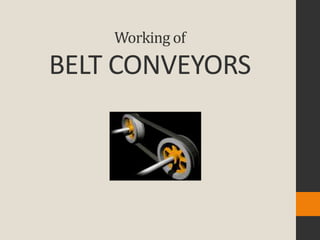
Working of
BELT CONVEYORS
I. Definition
• The belt conveyor is an endless belt in a straight line stretch
between two drums, one driving the system and the other
acting as a return drum.
• Wikipedia States: A conveyor belt (or belt conveyor) consists
of two or more pulleys , with a continuous loop of material -
the conveyor belt - that rotates about them. One or both of
the pulleys are powered, moving the belt and the material on
the belt forward.
II. History
• Primitive conveyor belts were used since the 19th century. In
1892, Thomas Robins began a series of inventions
• In 1901, Sandvik invented and started the production
of steel conveyor belts.
• In 1905 Richard Sutcliffe invented the first conveyor belts for
use in coal mines.
• In 1913, Henry Ford introduced conveyor-belt assembly lines.
• In 1957, the B. F. Goodrich Company patented a conveyor belt
that it went on to produce as the Turnover Conveyor Belt
System.
III. Background
• There are many different kinds of conveyor systems out there.
First what is the basic idea of a conveyor system, how and why
is it used in many of today’s industrial settings.
• A conveyor system is used to get a item for one place to
another, this item can be large, small, irregular shape, light or
heavy. Not only can conveyors move items from one point to
another it can be used in an assembly line so as the product is
going through the conveyor it is being made or assembled.
• Conveyors can move items up an incline or vertically with
another conveyor sandwiches the item in place. These are
versatile tools for production in the industry world if the right
one is implemented for a job.
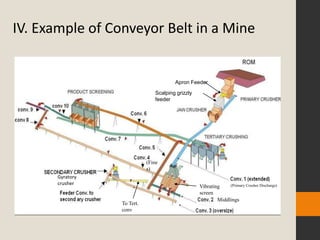
IV. Example of Conveyor Belt in a Mine
Apron Feeder
Scalping grizzly
feeder
(Primary Crusher Discharge)Vibrating
screen
(Fine
s)
Middlings
Gyratory
crusher
To Tert.
conv
V. Description
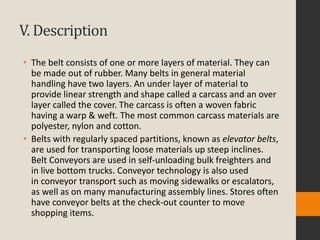
• The belt consists of one or more layers of material. They can
be made out of rubber. Many belts in general material
handling have two layers. An under layer of material to
provide linear strength and shape called a carcass and an over
layer called the cover. The carcass is often a woven fabric
having a warp & weft. The most common carcass materials are
polyester, nylon and cotton.
• Belts with regularly spaced partitions, known as elevator belts,
are used for transporting loose materials up steep inclines.
Belt Conveyors are used in self-unloading bulk freighters and
in live bottom trucks. Conveyor technology is also used
in conveyor transport such as moving sidewalks or escalators,
as well as on many manufacturing assembly lines. Stores often
have conveyor belts at the check-out counter to move
shopping items.
VI. Working principle
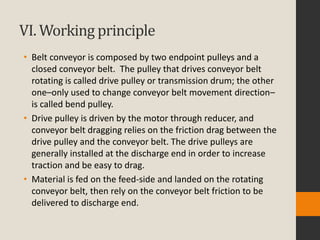
• Belt conveyor is composed by two endpoint pulleys and a
closed conveyor belt. The pulley that drives conveyor belt
rotating is called drive pulley or transmission drum; the other
one–only used to change conveyor belt movement direction–
is called bend pulley.
• Drive pulley is driven by the motor through reducer, and
conveyor belt dragging relies on the friction drag between the
drive pulley and the conveyor belt. The drive pulleys are
generally installed at the discharge end in order to increase
traction and be easy to drag.
• Material is fed on the feed-side and landed on the rotating
conveyor belt, then rely on the conveyor belt friction to be
delivered to discharge end.
VII. Advantages
• Cheapest Method
• Virtually no degradation of product caused by conveying.
• Changes in elevation possible.
• Material visible on the belt while conveying.
• Longer distances can be covered more economically.
• Higher capacity can be handled.
• Belts can be loaded virtually any place along the belt.
• The belt can have "trippers" to unload the belt almost any
place.
• Belt conveyors can have metal separators designed in.
• A wider range of material can be handled.
• It can be horizontal, incline or decline or a combination.
• Belts can have sidewalls added to stop product spillage.
Advantages (Continued)
• Advantages of long transmission distance, large volume and
continuous conveyance.
• Operation reliability.
• Easy to implement automation and centralization control;
especially for high yield and efficient mine.
• The body can flex easily with a belt-warehousing
• Compact structure, light and handy rack and convenient
disassembly.
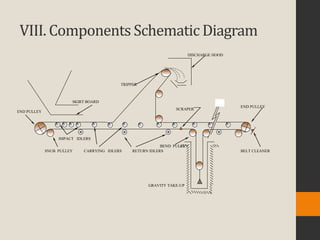
VIII. Components Schematic Diagram
END PULLEY
END PULLEY
SNUB PULLEY
BEND PULLEY
RETURN IDLERSCARRYING IDLERS
GRAVITY TAKE-UP
TRIPPER
SKIRT BOARD
IMPACT IDLERS
DISCHARGE HOOD
SCRAPER
BELT CLEANER
Components List
• Endless Belt- A flat endless belt which continuously travels
and carries on its top surface, the material to be conveyed
• Idler- This component supports the belt.
• Channel Iron- Also known as Angle iron, it is used to mount
the Idler.
• Tension Arrangement- This arrangement is used for keeping
the belt in proper tension, including the loop takeup
arrangement.
• Drums- The drums at the discharge end and tail end over
which the belt passes.
• Drive Head- The Drive Head comprises the electric motor,
coupling, gearing and snub pulley.
IX. Component Description
1. The Belt:
a) The belt is an endless thick flat strip of woven cotton, rayon
or nylon laid up in piles and covered with rubber, plastic or
PVC.
b) Belt having nylon fabric are stronger as they offer high
resistance to longitudinal tearing.
c) The belt conveyor works on a straight roadway which maybe
level, inclined or partially level or inclined.
d) The belt speed varies from 45m/min to 150m/min but a
speed of 45m/min to 60m/min is generally preferred.
e) The belt width varies from 0.6m to 1m in underground coal
mine but surface installations may have belt as wide as 1.2m.
The maximum size is 1.5m.
f) The carrying capacity of a belt conveyor is given by:
T= abv where,
T= the carrying capacity(tonnes/sec)
a= the average cross-sectional area of material(m2)
b= the bulk density(te/m3) ; this relates to density of broken
material including air spaces.
v= speed of the belt conveyor(m/s)
g) Care of the belt
i. Protect the belt from direct sunlight
ii. Do not subject the belt to many bendings
iii. Prevent belt from rubbing against any support or object
iv. The method of feeding onto a belt conveyor must be as
smooth as possible and should be in the direction of belt travel
and at the same speed.
2. IDLERS and the supporting structure:
a) The idler is a long pulley moving on its own axle and ball bearings
b) The idlers are supported on channel iron framework and the members of
such framework are 3-4m long, joined by bolts and nuts.
c) The direction of the idlers, the delivery end drum and the tail end drum
should be at right angle to the direction of belt travel otherwise it results
in spillage of contents.
d) The idlers should be placed at an interval of 1.5-2m.
e) The belts are troughed using a set of 3 idlers at 1 place.
f) Idlers at the transfer point are constructed with thick corrugated rubber
layer to absorb the impact of falling material.
g) Care of idlers- the load should, as far as practicable, be fed onto the belt
centrally in the same direction with speed.
3. Tension arrangement
The belt should be in proper tension and if it is loose or slack, it
will not be able to transmit the power to the belt. For this we
have to do the following arrangement-
a) Tension end of the belt is mounted in a steel framework to
which hooks are fitted for tensioning.
b) Weights are placed on the movable pulley or drum over
which the belt passes to have a more or less permanent
nature of tension.
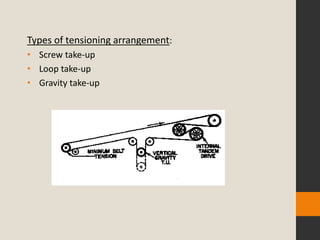
Types of tensioning arrangement:
• Screw take-up
• Loop take-up
• Gravity take-up
4. Drive Head
a) The drive head consists of an electric motor or compressed
air motor, fluid coupling, gear wheels and a drum.
b) The Snub pulleys are used to increase the arc of contact.
c) Usually, one motor drives a belt for a roadway of upto 200m
on the level gradient.
d) The motor used is a squirrel cage type with high torque and
is switched on direct on the line.
e) The drive heads are sometimes provided with sequence
control operation.
X. Classification of Conveyors
1. Based on Trough Design
• Flat belt conveyor
• Semi-Trough conveyor
• Trough conveyor
2. IndustrialClassificationofBeltConveyors
• Slider Bed Conveyor
• Roller Bed Conveyor
• Horizontal Belt Conveyor
• Incline and decline Conveyor
• Brake and Meter Belt Conveyor
• Metal “Piano Hinge” Conveyor
• Wire Mesh belt Conveyor
• Portable Conveyor
XI. Sequence Control
• Sequence Control is a method used in the starting and
stopping of the series of conveyors to avoid the disastrous
situation of pileup and overloading at the transfer point i.e.
discharge end of the inbye conveyor which will overload the
outbye conveyor if the outbye conveyor stops for some reason
but not the feeding inbye conveyor.
• In a sequence control:
a) The inbye conveyor can not be started unless the outbye
receiving conveyor is set in motion and has attained nearly
60-70% of its normal speed.
b) If the outbye conveyor stops for any reason, stalls or slips,
the inbye conveyor automatically stops.
Arrangements for sequence control:
• Automatic sequence control
• Power sequence control
• Pilot sequence control
XII. Disadvantages
• The normal design of a belt conveyor is opened. If your
product needs to be contained, covers and or drip pans can
become expensive and cumbersome.
• If the material is sticky, belt cleaning can be difficult and
generally not very successful.
• There is almost always material carry over from the belt
discharge and this becomes a house keeping problem.
• If the material being conveyed is sticky it will ultimately get
transferred to the return side of the belt and then to the rolls,
idlers and pulleys, then belt tracking can be an on-going issue.
• Odder control is virtually impossible.
Thank You!
Submitted by:
Roll 11108EN036-47

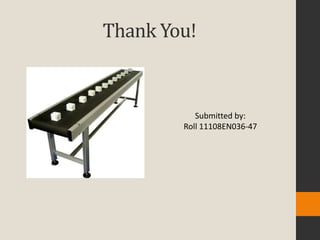
Belt conveyor

  • 1.
    www.MINEPORTAL.in ONLINE TEST SERIESFOR • DGMS COAL/METAL FIRST/SECOND CLASS EXAM • GATE MINING EXAM • OVERMAN EXAM TEST • MINING INSPECTOR EXAMS • COAL INDIA MTs & OTHER PSUs EXAMS FREE STUDY MATERIAL & VIDEO LECTURES MINING JOBS NOTIFICATIONS www.mineportal.in Call/Whatsapp-8804777500 www.fb.com/mineportal.in
  • 2.
  • 3.
    I. Definition • Thebelt conveyor is an endless belt in a straight line stretch between two drums, one driving the system and the other acting as a return drum. • Wikipedia States: A conveyor belt (or belt conveyor) consists of two or more pulleys , with a continuous loop of material - the conveyor belt - that rotates about them. One or both of the pulleys are powered, moving the belt and the material on the belt forward.
  • 4.
    II. History • Primitiveconveyor belts were used since the 19th century. In 1892, Thomas Robins began a series of inventions • In 1901, Sandvik invented and started the production of steel conveyor belts. • In 1905 Richard Sutcliffe invented the first conveyor belts for use in coal mines. • In 1913, Henry Ford introduced conveyor-belt assembly lines. • In 1957, the B. F. Goodrich Company patented a conveyor belt that it went on to produce as the Turnover Conveyor Belt System.
  • 5.
    III. Background • Thereare many different kinds of conveyor systems out there. First what is the basic idea of a conveyor system, how and why is it used in many of today’s industrial settings. • A conveyor system is used to get a item for one place to another, this item can be large, small, irregular shape, light or heavy. Not only can conveyors move items from one point to another it can be used in an assembly line so as the product is going through the conveyor it is being made or assembled. • Conveyors can move items up an incline or vertically with another conveyor sandwiches the item in place. These are versatile tools for production in the industry world if the right one is implemented for a job.
  • 6.
    IV. Example ofConveyor Belt in a Mine Apron Feeder Scalping grizzly feeder (Primary Crusher Discharge)Vibrating screen (Fine s) Middlings Gyratory crusher To Tert. conv
  • 7.
    V. Description • Thebelt consists of one or more layers of material. They can be made out of rubber. Many belts in general material handling have two layers. An under layer of material to provide linear strength and shape called a carcass and an over layer called the cover. The carcass is often a woven fabric having a warp & weft. The most common carcass materials are polyester, nylon and cotton. • Belts with regularly spaced partitions, known as elevator belts, are used for transporting loose materials up steep inclines. Belt Conveyors are used in self-unloading bulk freighters and in live bottom trucks. Conveyor technology is also used in conveyor transport such as moving sidewalks or escalators, as well as on many manufacturing assembly lines. Stores often have conveyor belts at the check-out counter to move shopping items.
  • 8.
    VI. Working principle •Belt conveyor is composed by two endpoint pulleys and a closed conveyor belt. The pulley that drives conveyor belt rotating is called drive pulley or transmission drum; the other one–only used to change conveyor belt movement direction– is called bend pulley. • Drive pulley is driven by the motor through reducer, and conveyor belt dragging relies on the friction drag between the drive pulley and the conveyor belt. The drive pulleys are generally installed at the discharge end in order to increase traction and be easy to drag. • Material is fed on the feed-side and landed on the rotating conveyor belt, then rely on the conveyor belt friction to be delivered to discharge end.
  • 9.
    VII. Advantages • CheapestMethod • Virtually no degradation of product caused by conveying. • Changes in elevation possible. • Material visible on the belt while conveying. • Longer distances can be covered more economically. • Higher capacity can be handled. • Belts can be loaded virtually any place along the belt. • The belt can have "trippers" to unload the belt almost any place. • Belt conveyors can have metal separators designed in. • A wider range of material can be handled. • It can be horizontal, incline or decline or a combination. • Belts can have sidewalls added to stop product spillage.
  • 10.
    Advantages (Continued) • Advantagesof long transmission distance, large volume and continuous conveyance. • Operation reliability. • Easy to implement automation and centralization control; especially for high yield and efficient mine. • The body can flex easily with a belt-warehousing • Compact structure, light and handy rack and convenient disassembly.
  • 11.
    VIII. Components SchematicDiagram END PULLEY END PULLEY SNUB PULLEY BEND PULLEY RETURN IDLERSCARRYING IDLERS GRAVITY TAKE-UP TRIPPER SKIRT BOARD IMPACT IDLERS DISCHARGE HOOD SCRAPER BELT CLEANER
  • 12.
    Components List • EndlessBelt- A flat endless belt which continuously travels and carries on its top surface, the material to be conveyed • Idler- This component supports the belt. • Channel Iron- Also known as Angle iron, it is used to mount the Idler. • Tension Arrangement- This arrangement is used for keeping the belt in proper tension, including the loop takeup arrangement. • Drums- The drums at the discharge end and tail end over which the belt passes. • Drive Head- The Drive Head comprises the electric motor, coupling, gearing and snub pulley.
  • 13.
    IX. Component Description 1.The Belt: a) The belt is an endless thick flat strip of woven cotton, rayon or nylon laid up in piles and covered with rubber, plastic or PVC. b) Belt having nylon fabric are stronger as they offer high resistance to longitudinal tearing. c) The belt conveyor works on a straight roadway which maybe level, inclined or partially level or inclined. d) The belt speed varies from 45m/min to 150m/min but a speed of 45m/min to 60m/min is generally preferred. e) The belt width varies from 0.6m to 1m in underground coal mine but surface installations may have belt as wide as 1.2m. The maximum size is 1.5m.
  • 14.
    f) The carryingcapacity of a belt conveyor is given by: T= abv where, T= the carrying capacity(tonnes/sec) a= the average cross-sectional area of material(m2) b= the bulk density(te/m3) ; this relates to density of broken material including air spaces. v= speed of the belt conveyor(m/s) g) Care of the belt i. Protect the belt from direct sunlight ii. Do not subject the belt to many bendings iii. Prevent belt from rubbing against any support or object iv. The method of feeding onto a belt conveyor must be as smooth as possible and should be in the direction of belt travel and at the same speed.
  • 15.
    2. IDLERS andthe supporting structure: a) The idler is a long pulley moving on its own axle and ball bearings b) The idlers are supported on channel iron framework and the members of such framework are 3-4m long, joined by bolts and nuts. c) The direction of the idlers, the delivery end drum and the tail end drum should be at right angle to the direction of belt travel otherwise it results in spillage of contents. d) The idlers should be placed at an interval of 1.5-2m. e) The belts are troughed using a set of 3 idlers at 1 place. f) Idlers at the transfer point are constructed with thick corrugated rubber layer to absorb the impact of falling material. g) Care of idlers- the load should, as far as practicable, be fed onto the belt centrally in the same direction with speed.
  • 16.
    3. Tension arrangement Thebelt should be in proper tension and if it is loose or slack, it will not be able to transmit the power to the belt. For this we have to do the following arrangement- a) Tension end of the belt is mounted in a steel framework to which hooks are fitted for tensioning. b) Weights are placed on the movable pulley or drum over which the belt passes to have a more or less permanent nature of tension.
  • 17.
    Types of tensioningarrangement: • Screw take-up • Loop take-up • Gravity take-up
  • 18.
    4. Drive Head a)The drive head consists of an electric motor or compressed air motor, fluid coupling, gear wheels and a drum. b) The Snub pulleys are used to increase the arc of contact. c) Usually, one motor drives a belt for a roadway of upto 200m on the level gradient. d) The motor used is a squirrel cage type with high torque and is switched on direct on the line. e) The drive heads are sometimes provided with sequence control operation.
  • 19.
    X. Classification ofConveyors 1. Based on Trough Design • Flat belt conveyor • Semi-Trough conveyor • Trough conveyor
  • 20.
    2. IndustrialClassificationofBeltConveyors • SliderBed Conveyor • Roller Bed Conveyor • Horizontal Belt Conveyor • Incline and decline Conveyor • Brake and Meter Belt Conveyor • Metal “Piano Hinge” Conveyor • Wire Mesh belt Conveyor • Portable Conveyor
  • 21.
    XI. Sequence Control •Sequence Control is a method used in the starting and stopping of the series of conveyors to avoid the disastrous situation of pileup and overloading at the transfer point i.e. discharge end of the inbye conveyor which will overload the outbye conveyor if the outbye conveyor stops for some reason but not the feeding inbye conveyor. • In a sequence control: a) The inbye conveyor can not be started unless the outbye receiving conveyor is set in motion and has attained nearly 60-70% of its normal speed. b) If the outbye conveyor stops for any reason, stalls or slips, the inbye conveyor automatically stops.
  • 22.
    Arrangements for sequencecontrol: • Automatic sequence control • Power sequence control • Pilot sequence control
  • 23.
    XII. Disadvantages • Thenormal design of a belt conveyor is opened. If your product needs to be contained, covers and or drip pans can become expensive and cumbersome. • If the material is sticky, belt cleaning can be difficult and generally not very successful. • There is almost always material carry over from the belt discharge and this becomes a house keeping problem. • If the material being conveyed is sticky it will ultimately get transferred to the return side of the belt and then to the rolls, idlers and pulleys, then belt tracking can be an on-going issue. • Odder control is virtually impossible.
  • 24.