GOVERNMENT POLYTECHNIC, NAGPUR.
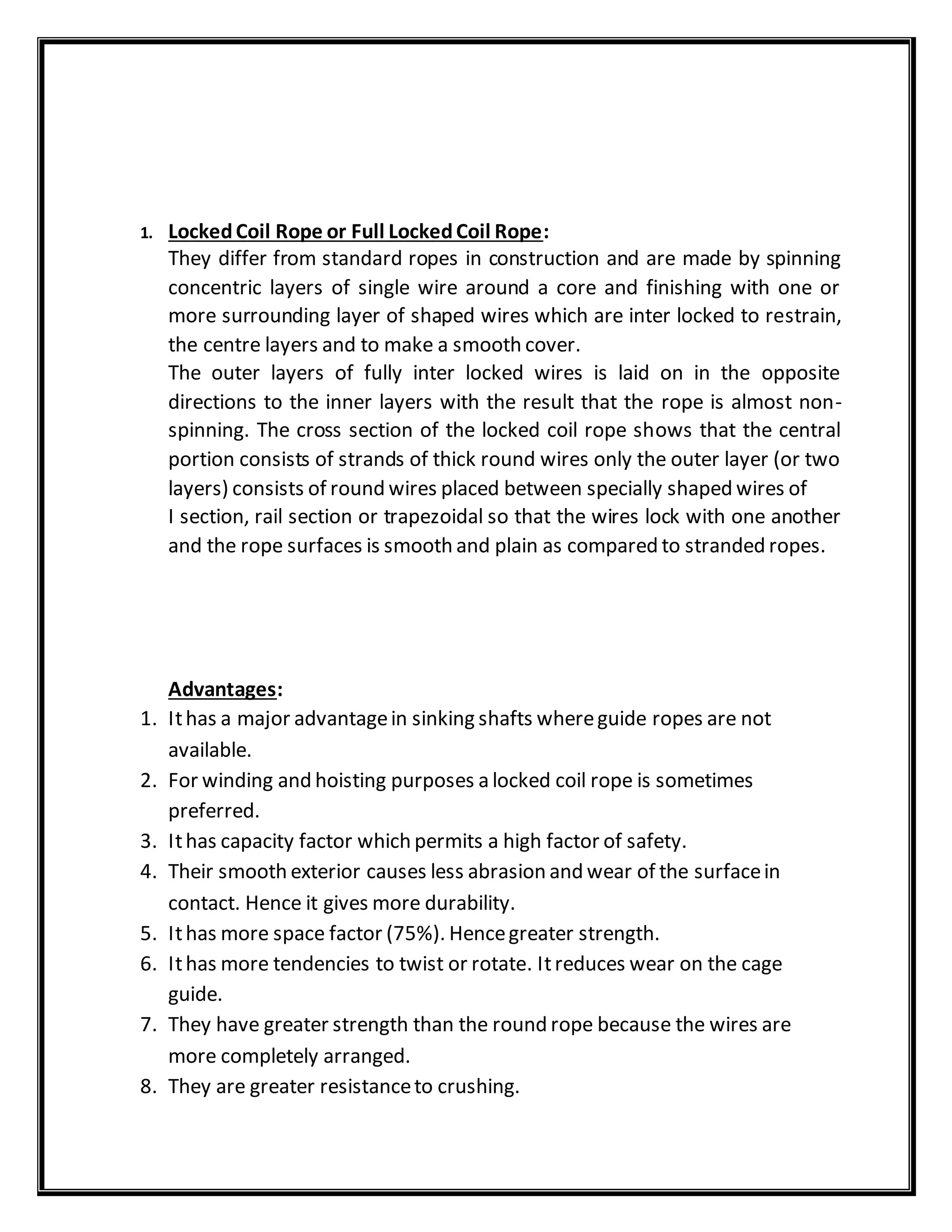
MINING AND MINE SURVEYING
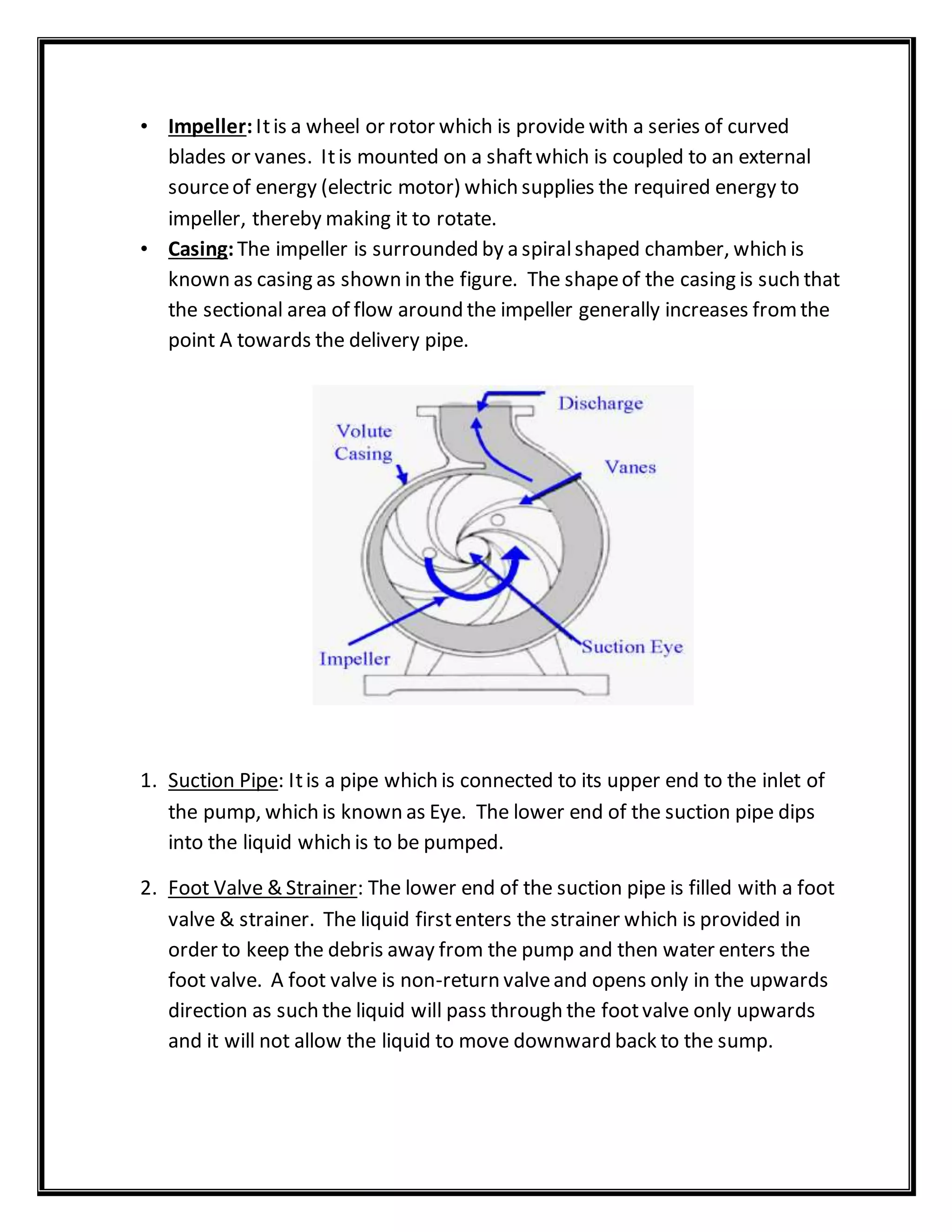
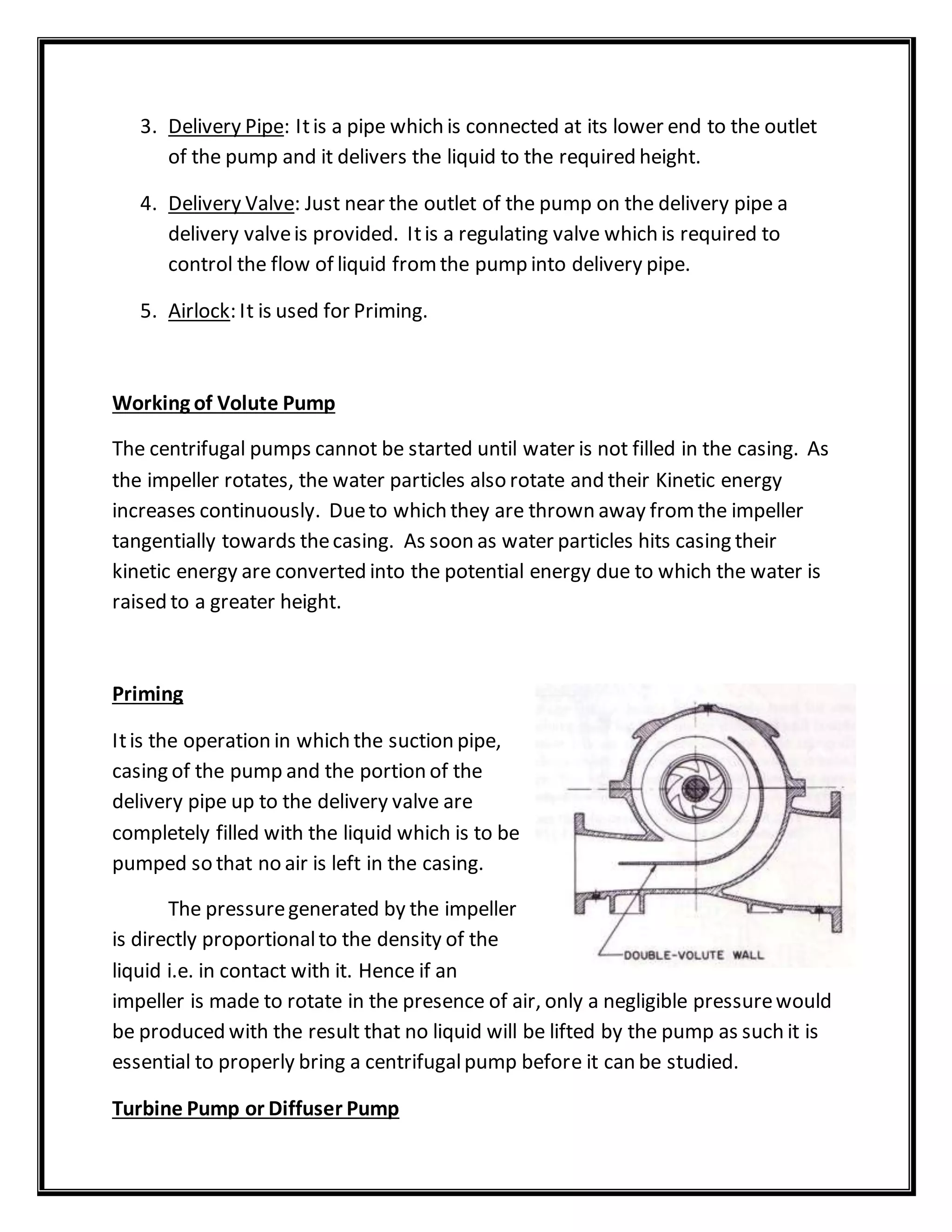
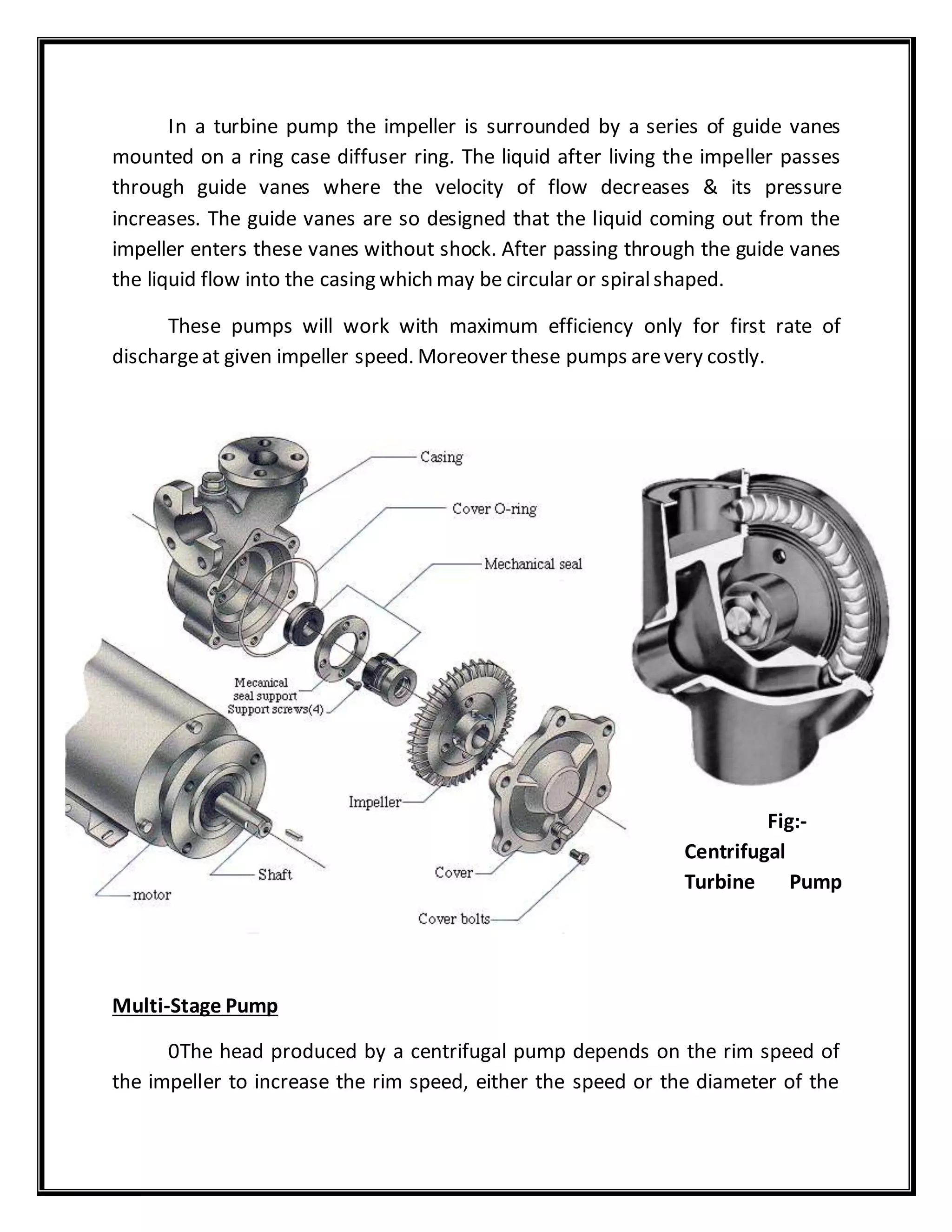
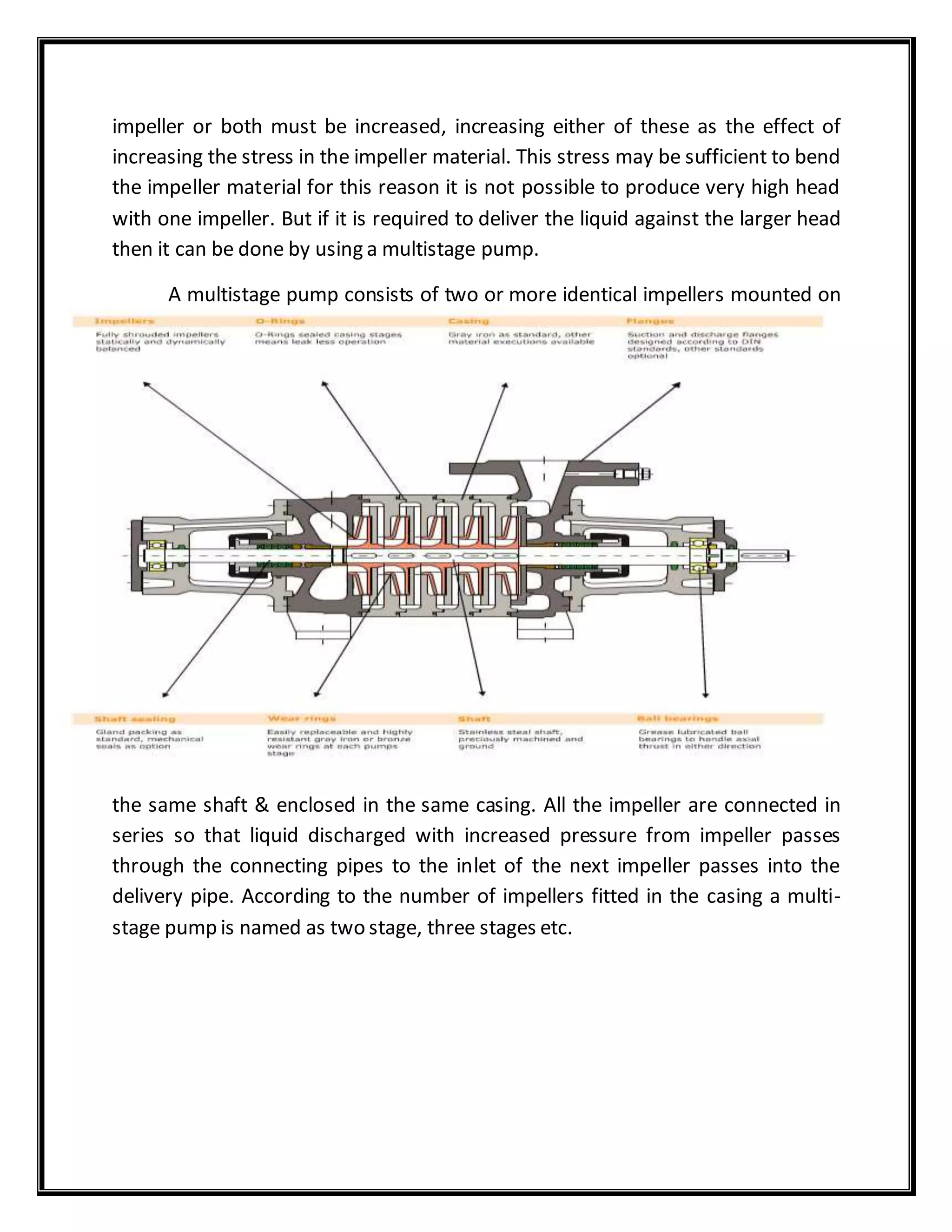
MINE MACHINERY
2018-2019
GUIDED BY :-Mr. B.J. NAIDU SIR
PREPARED BY:-
1) TRANSPORT OF ORE
SHOEB ANSARI
2)WINDING IN SHAFT
ROHAN INDORKAR
3) WIRE ROPES
RATIK MOTILINGE , KAPIL PAPDIKAR
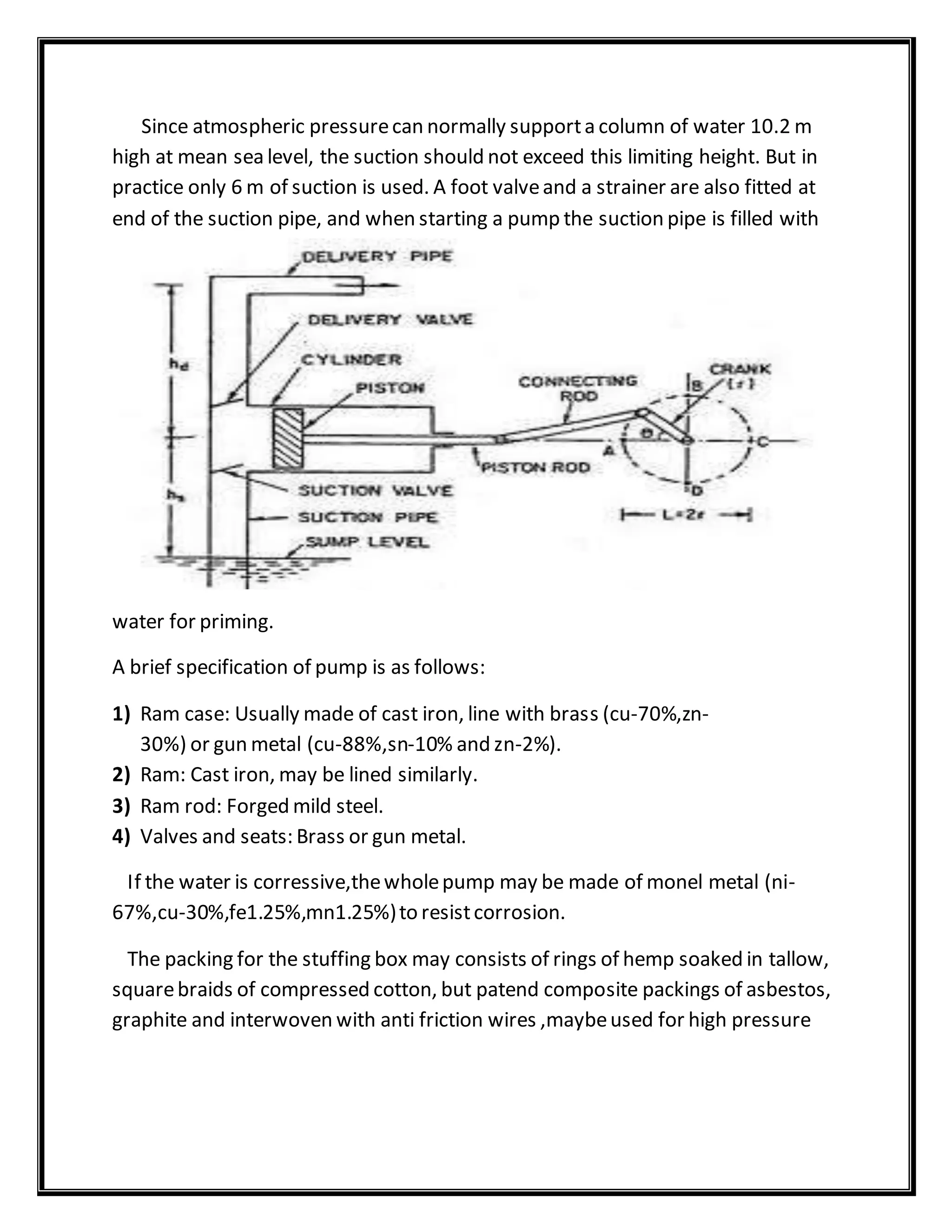
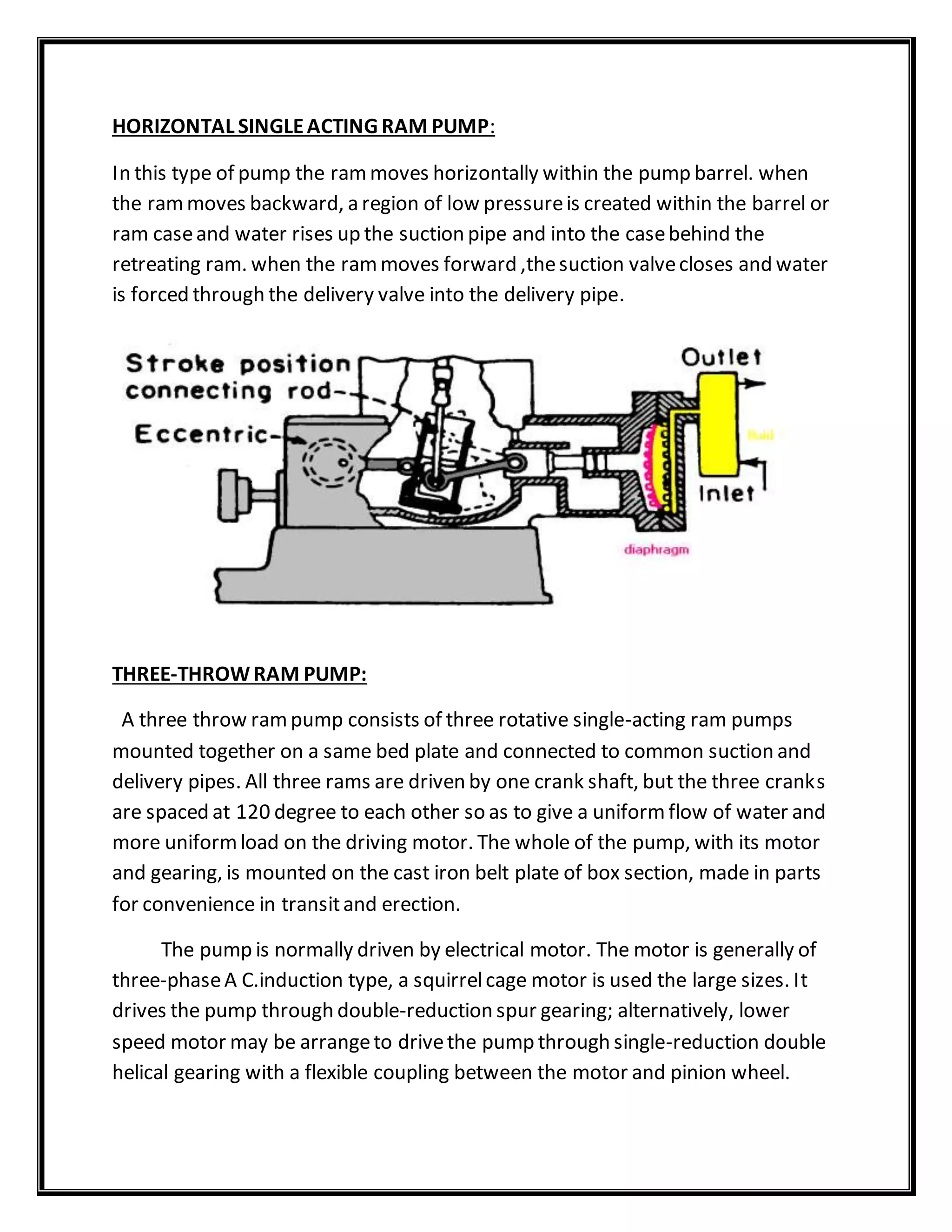
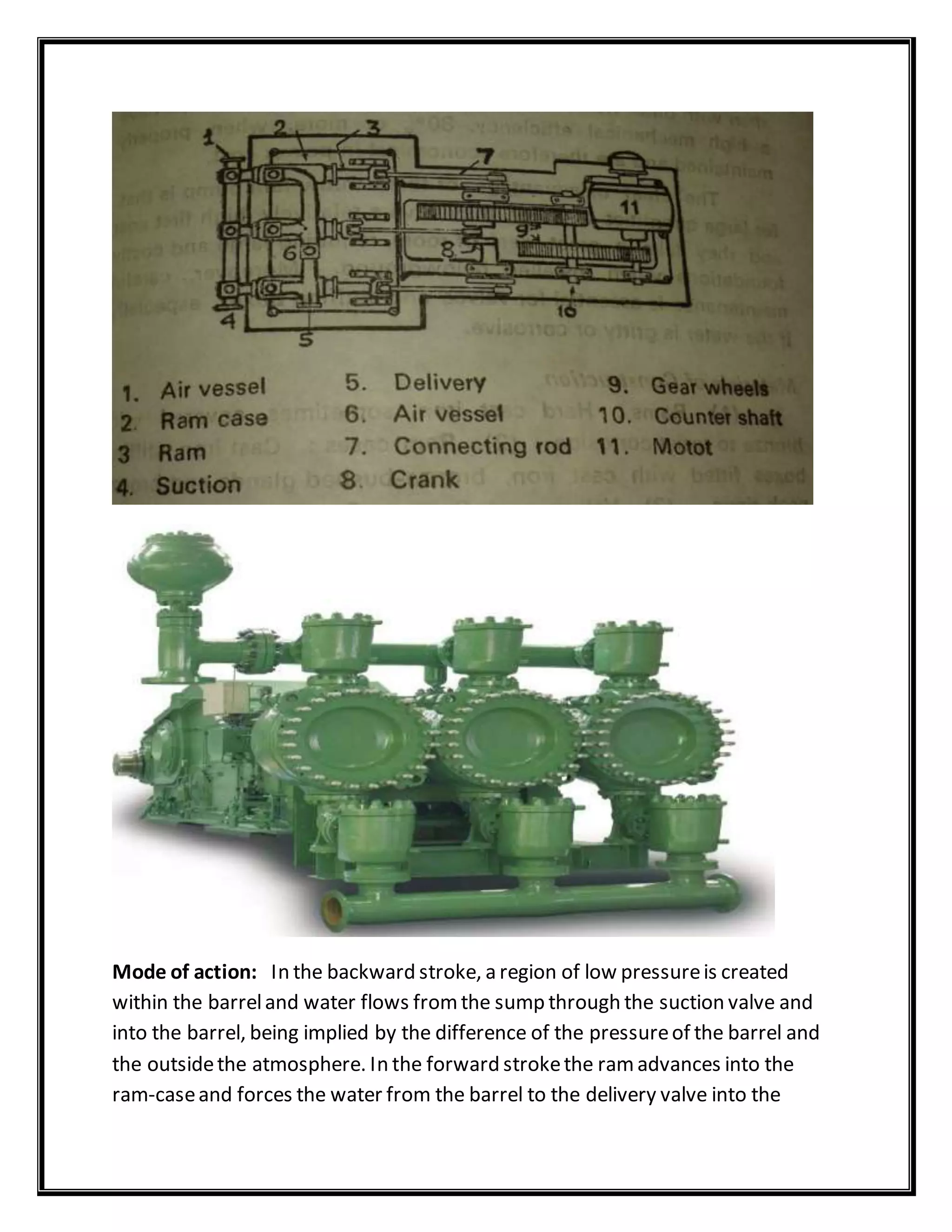
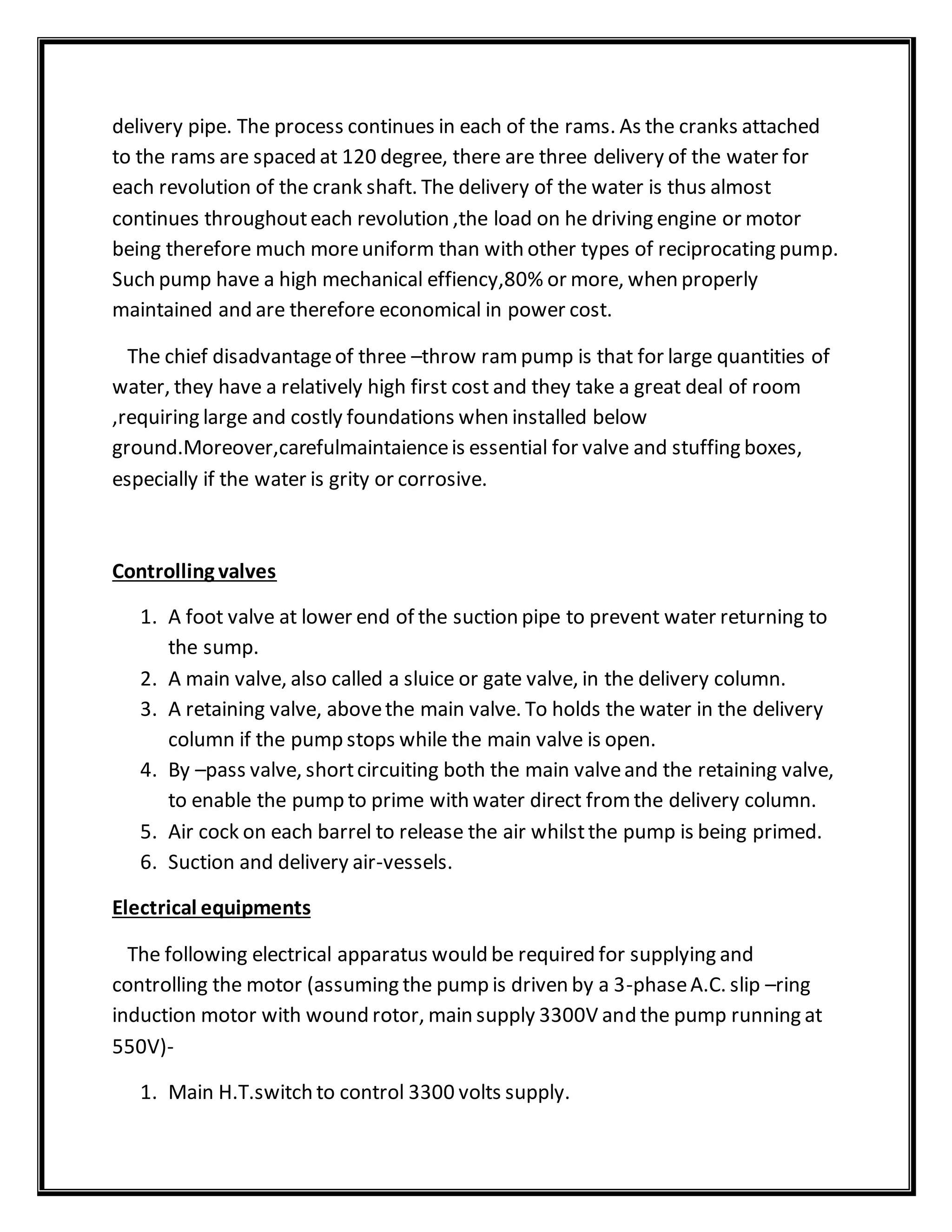
4)MINE PUMPS
DARSHAN FANDI
5) COAL CUTTING MACHINE
PRAFFUL REWATKAR
6) ELECTRIC POWER SUPPLY
ABHISHEK VANJAR, RUSHIKESH LANJEWAR
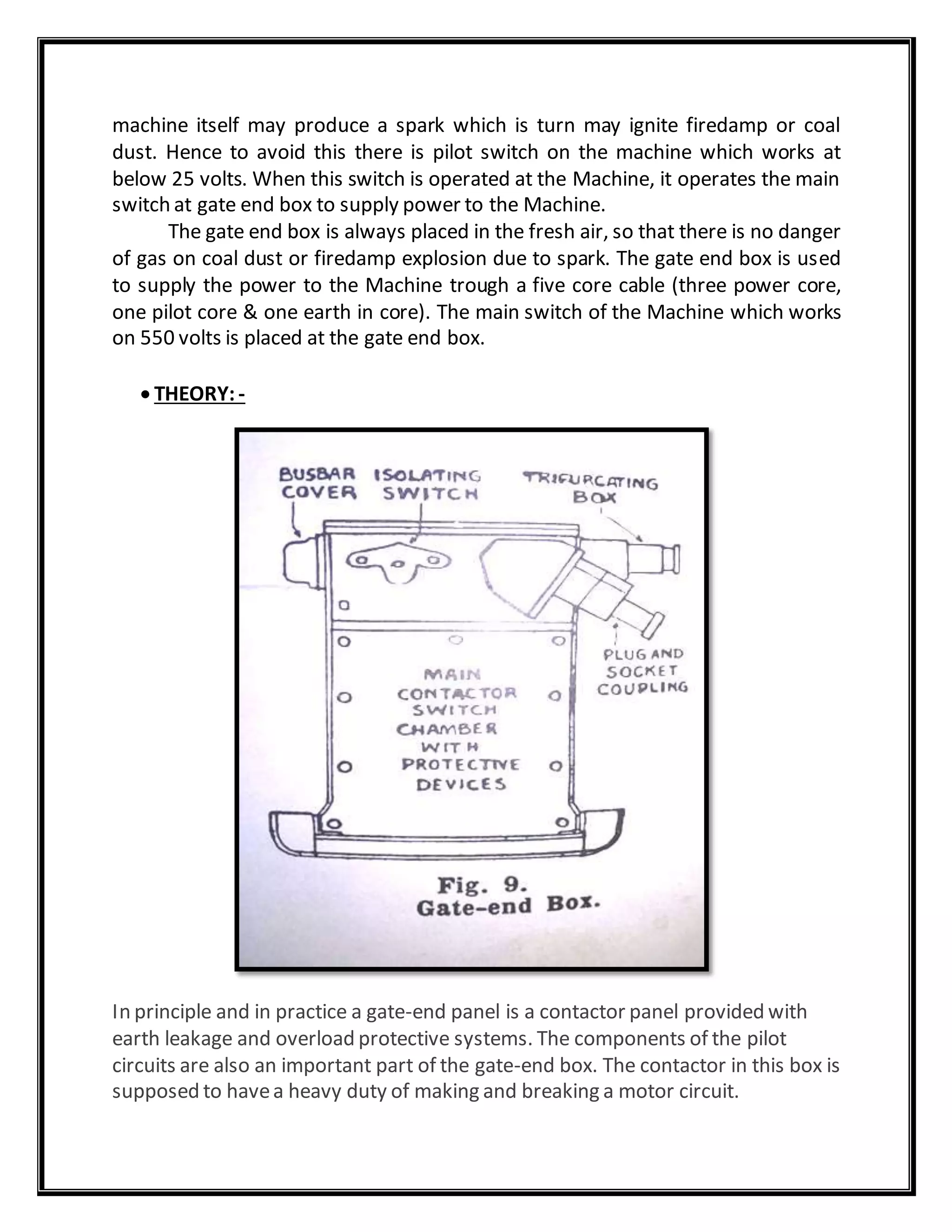
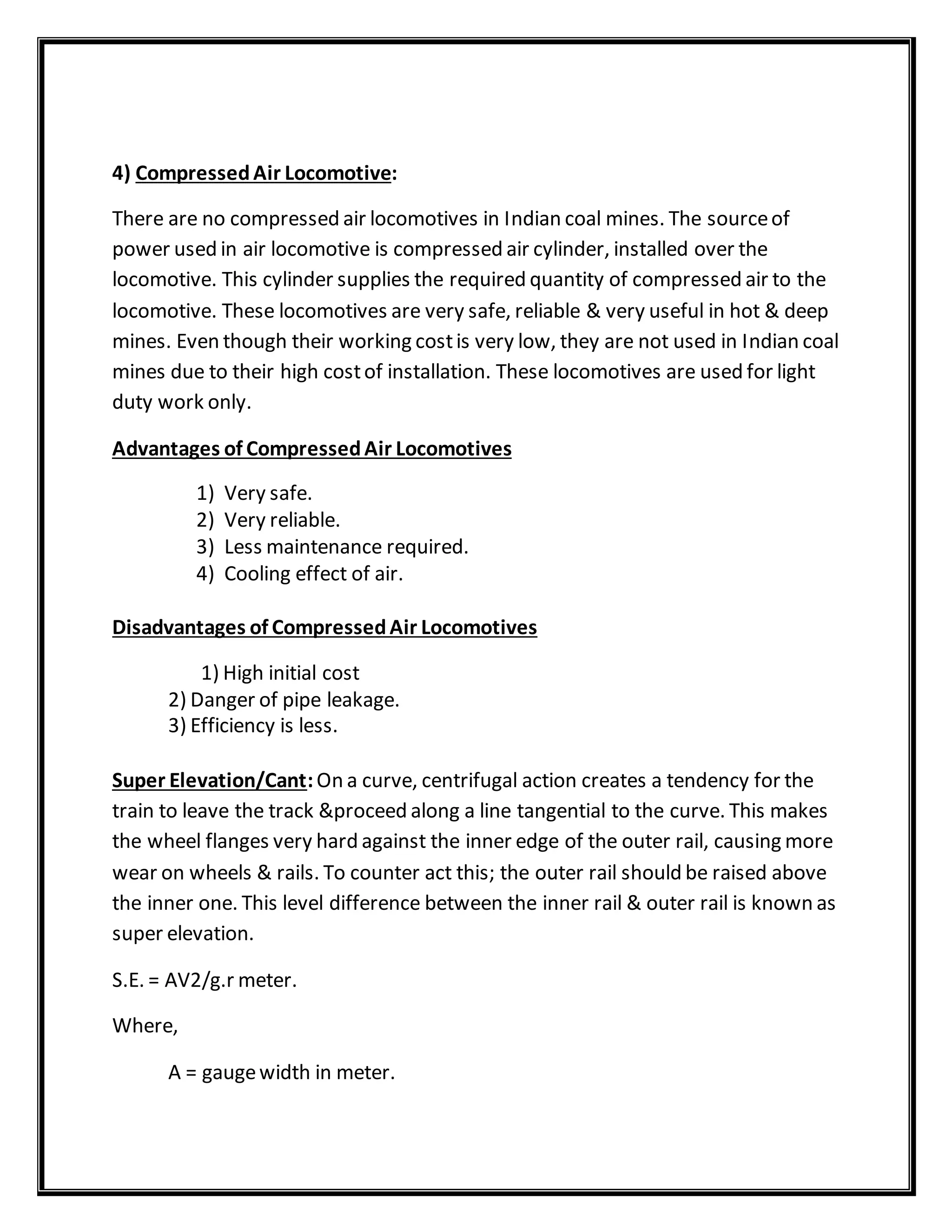
7) GATE END BOX
RITIK THAKUR
CURRICULUM OF MINE MACHINERY
QUESTIONS PAPER
Chapter No. 1
Transport of ore
Questions :-
1)State different types of ropehaulage. Write conditions of applicability
for each haulage.
2) List the various attachment used in endless rope haulage for attaching
the tub with rope. Explain any one of them by drawing the neat sketch.
3) A direct ropehaulage pulls 10 loaded tubs at a time up anincline
dipping at 1 in 8, An empty tub weighs 400 Kgf. and has capacity 900
Kgf. of mineral. Length of roadway covered by the haulage is 600 mt. the
rope diameter is 25 mm. Ropespeed is 12 Km/hr. Coefficient of friction
for the tubs and for rope is 120. Estimate the power required
by the rope and by the engine.
4) Enlist and explain safety devices used on rope hallauge system.
5) State different condition for locomotive hallauge. Explain overhead wire
electrical locomotive.
6) Compare direct rope hallauge with main and tail rope hallauge.
7) State advantages of Aerial ropeway.
8)What are the different types of locomative used in mine? Explain. Any one
of them with neat sketch.
9) Sketch and explain. (Any two)
(i) Backstay
(ii) Monkey catch
(iii) Runway switch
 Ore-AnOre is an occurrenceof rock or sediment that contains sufficient
minerals with economically important elements, (typically metals) that can
be economically extracted fromthe deposit
 Underground transport arrangements are dividedintofurther categories:
1) Underground to surface/main haulage
2) Underground to underground/Gathering haulage
3) surfaceto surface
 Underground to surface arrangementis that which operates between
winding shaft/incline and the main underground loading points. At the
main loading point, the loads are collected fromone, two or more districts
and then transported to the surface.
 Underground to underground arrangementis that which operates
between the working faces and the main loading points situated
underground.
 TYPES OF HAULAGE
1. Rope haulage.
a. Direct rope haulage
i. Single drum direct rope haulage.
ii. Double drumdirect rope haulage.
b. Endless rope haulage
i. Over rope.
ii. Under rope.
c. Main & tail rope haulage.
d. Gravity rope haulage.
2. Conveyor system of haulage.
a. Belt conveyor.
b. Cable belt conveyor.
c. Chain conveyor.
i. Scraper chain conveyor.
ii. Armoured chain conveyor.
iii. Gate end loader.
iv. Mobile stageloader.
v. Pick a back conveyor.
d. Plate conveyor.
e. Disc conveyor.
3. Locomotive haulage.
a. Diesel locomotive.
b. Electric battery locomotive.
c) Electric locomotive
1. Trolley wirelocomotive.
2. Cable reel locomotive.
e. Compressed air locomotive.
f. Electro gyro locomotive.
4. Aerial ropeway
A) Rope Haulages
1) Direct Rope Haulage
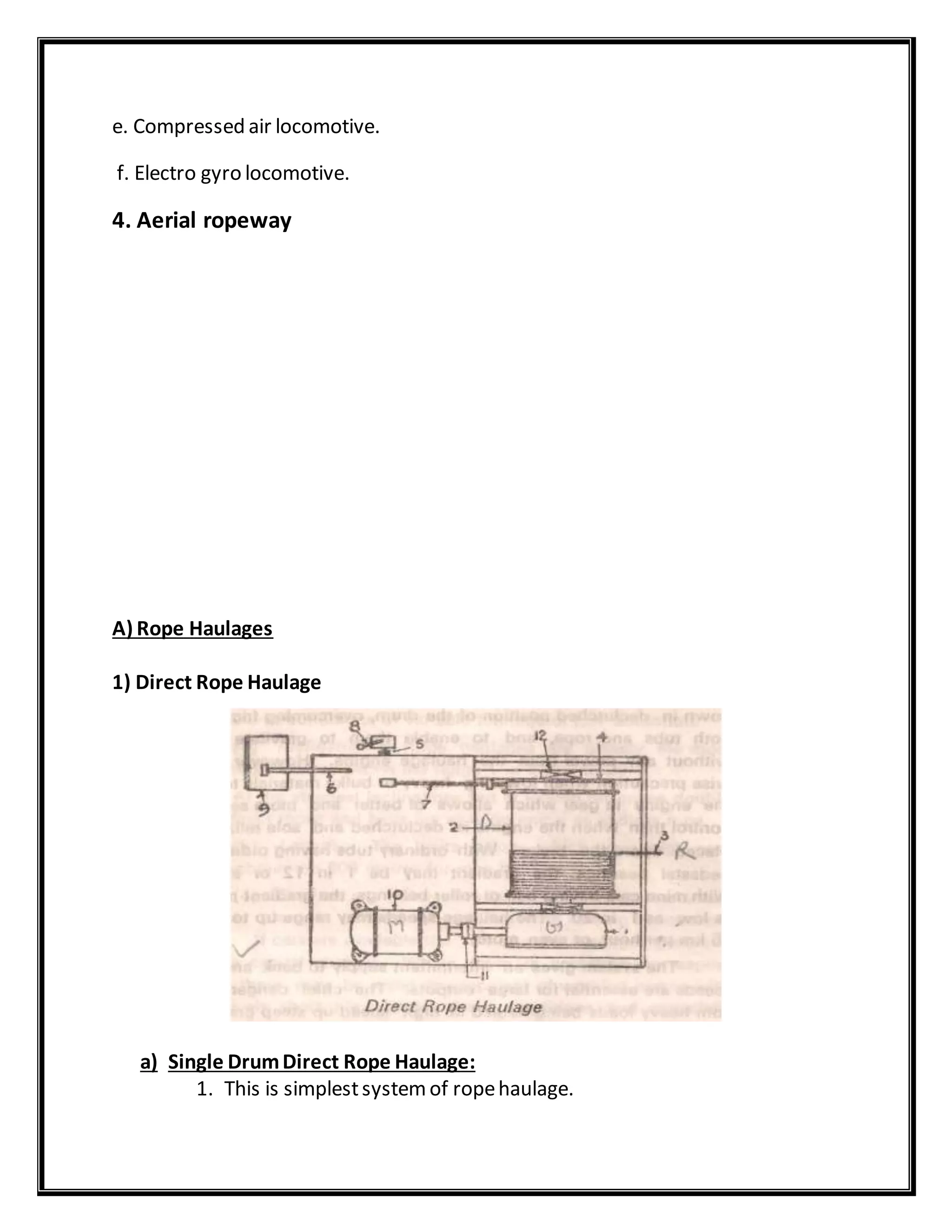
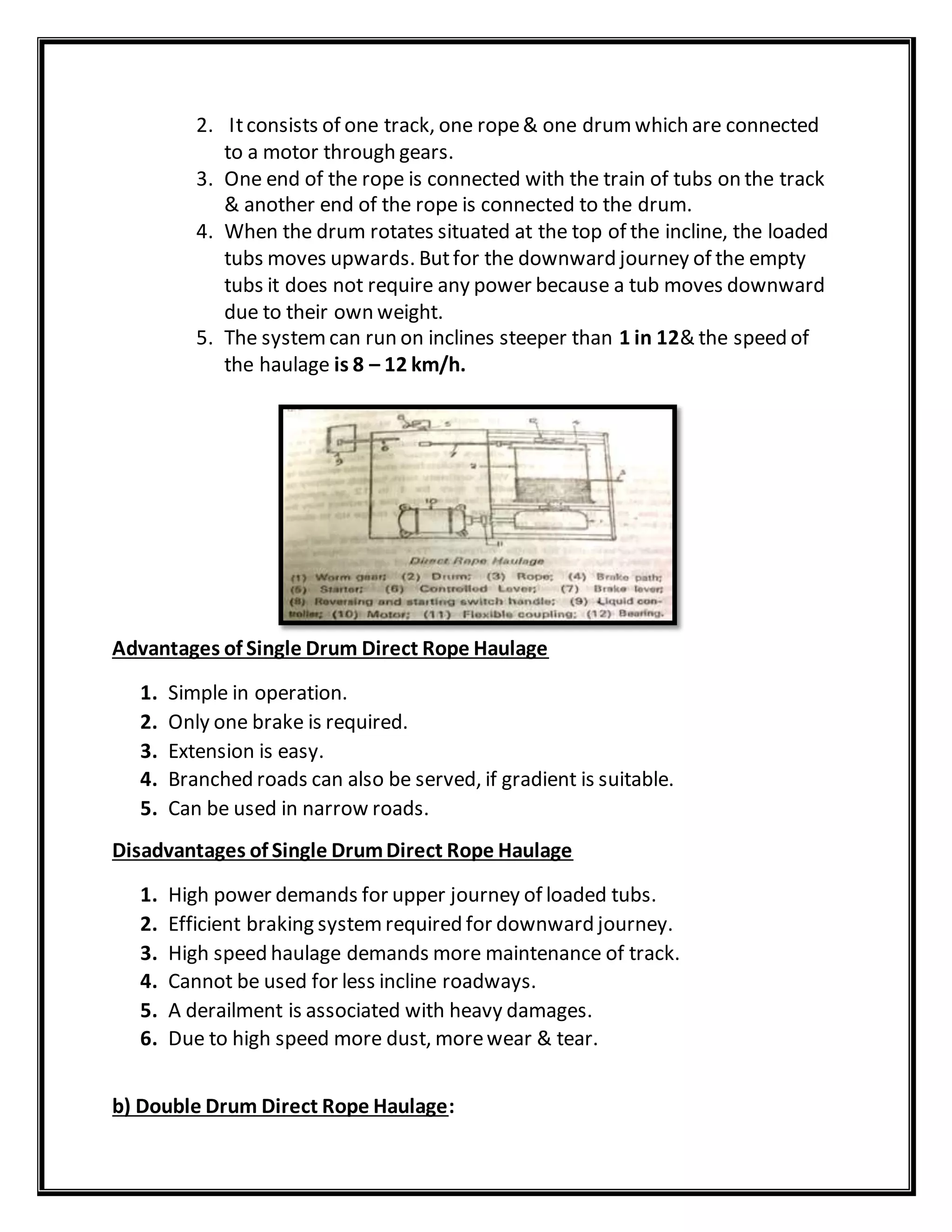
a) Single DrumDirect Rope Haulage:
1. This is simplestsystemof ropehaulage.
2. Itconsists of one track, one rope& one drumwhich are connected
to a motor through gears.
3. One end of the rope is connected with the train of tubs on the track
& another end of the rope is connected to the drum.
4. When the drum rotates situated at the top of the incline, the loaded
tubs moves upwards. Butfor the downward journey of the empty
tubs it does not require any power because a tub moves downward
due to their own weight.
5. The systemcan run on inclines steeper than 1 in 12& the speed of
the haulage is 8 – 12 km/h.
Advantages of Single Drum Direct Rope Haulage
1. Simple in operation.
2. Only one brake is required.
3. Extension is easy.
4. Branched roads can also be served, if gradient is suitable.
5. Can be used in narrow roads.
Disadvantages of Single DrumDirect Rope Haulage
1. High power demands for upper journey of loaded tubs.
2. Efficient braking systemrequired for downward journey.
3. High speed haulage demands more maintenance of track.
4. Cannot be used for less incline roadways.
5. A derailment is associated with heavy damages.
6. Due to high speed more dust, morewear & tear.
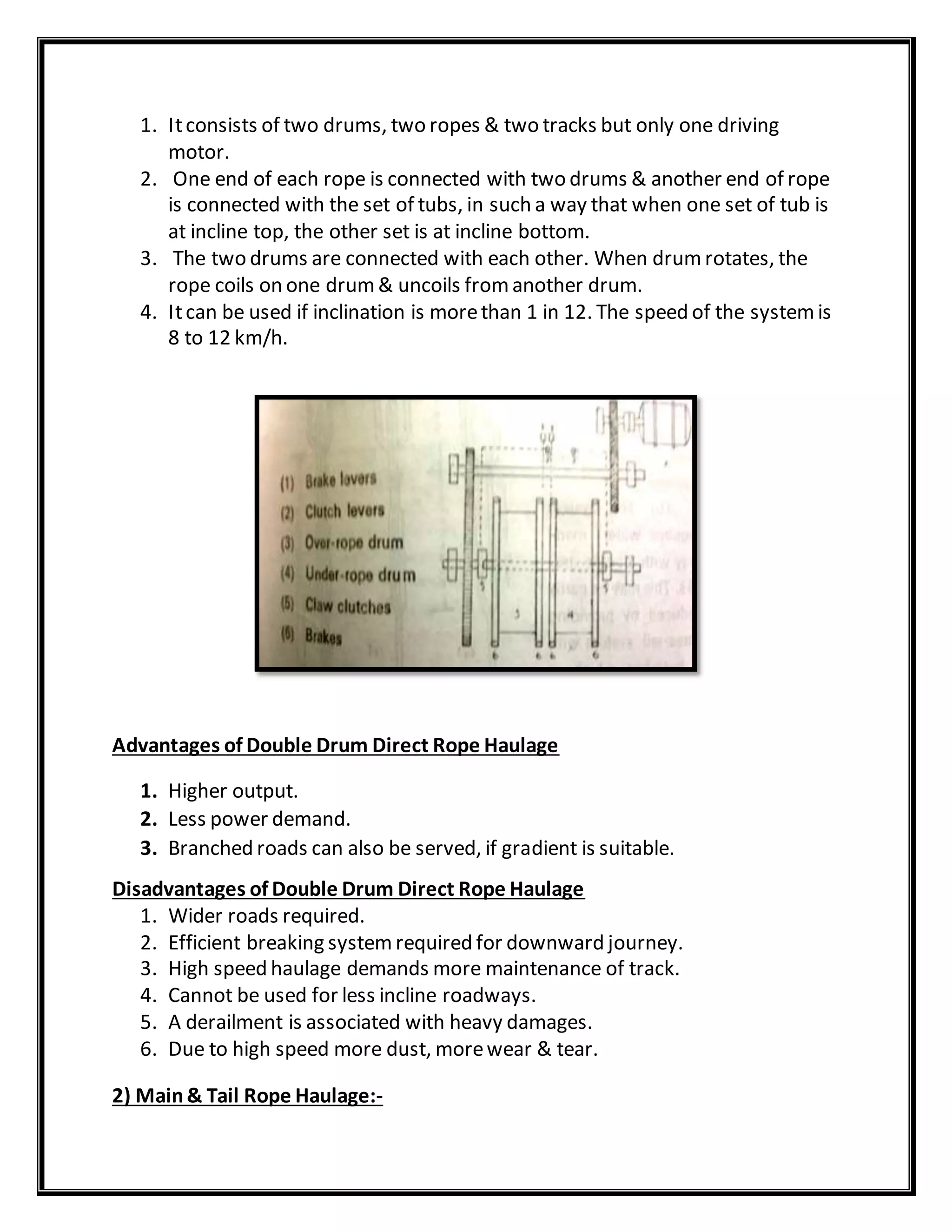
b) Double Drum Direct Rope Haulage:
1. Itconsists of two drums, two ropes & two tracks but only one driving
motor.
2. One end of each rope is connected with two drums & another end of rope
is connected with the set of tubs, in such a way that when one set of tub is
at incline top, the other set is at incline bottom.
3. The two drums are connected with each other. When drumrotates, the
rope coils on one drum& uncoils fromanother drum.
4. Itcan be used if inclination is morethan 1 in 12. The speed of the systemis
8 to 12 km/h.
Advantages of Double Drum Direct Rope Haulage
1. Higher output.
2. Less power demand.
3. Branched roads can also be served, if gradient is suitable.
Disadvantages of Double Drum Direct Rope Haulage
1. Wider roads required.
2. Efficient breaking systemrequired for downward journey.
3. High speed haulage demands more maintenance of track.
4. Cannot be used for less incline roadways.
5. A derailment is associated with heavy damages.
6. Due to high speed more dust, morewear & tear.
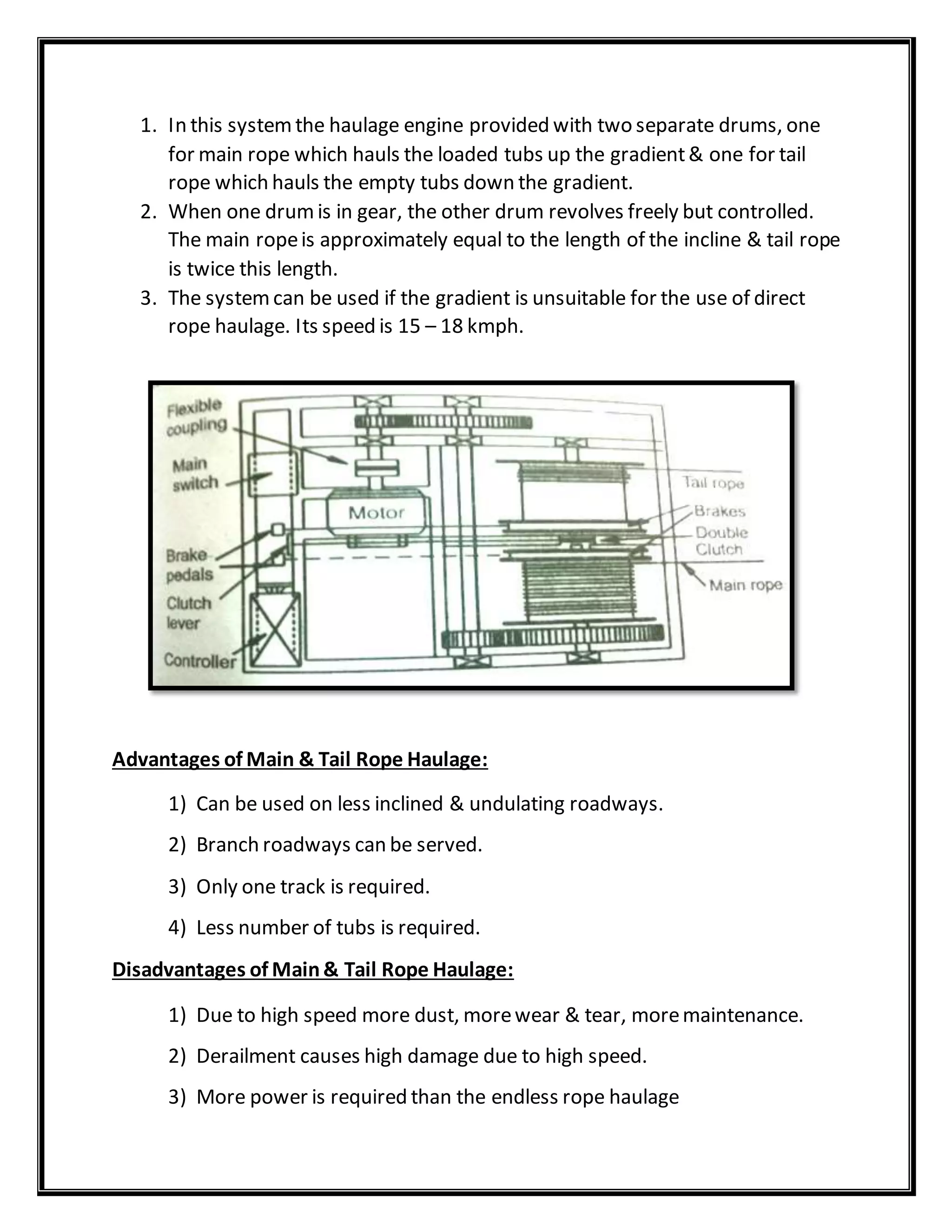
2) Main& Tail Rope Haulage:-
1. In this systemthe haulage engine provided with two separate drums, one
for main rope which hauls the loaded tubs up the gradient& one for tail
rope which hauls the empty tubs down the gradient.
2. When one drumis in gear, the other drum revolves freely but controlled.
The main ropeis approximately equal to the length of the incline & tail rope
is twice this length.
3. The systemcan be used if the gradient is unsuitable for the use of direct
rope haulage. Its speed is 15 – 18 kmph.
Advantages of Main & Tail Rope Haulage:
1) Can be used on less inclined & undulating roadways.
2) Branch roadways can be served.
3) Only one track is required.
4) Less number of tubs is required.
Disadvantages of Main& Tail Rope Haulage:
1) Due to high speed more dust, morewear & tear, moremaintenance.
2) Derailment causes high damage due to high speed.
3) More power is required than the endless rope haulage
3) Endless rope haulage:-
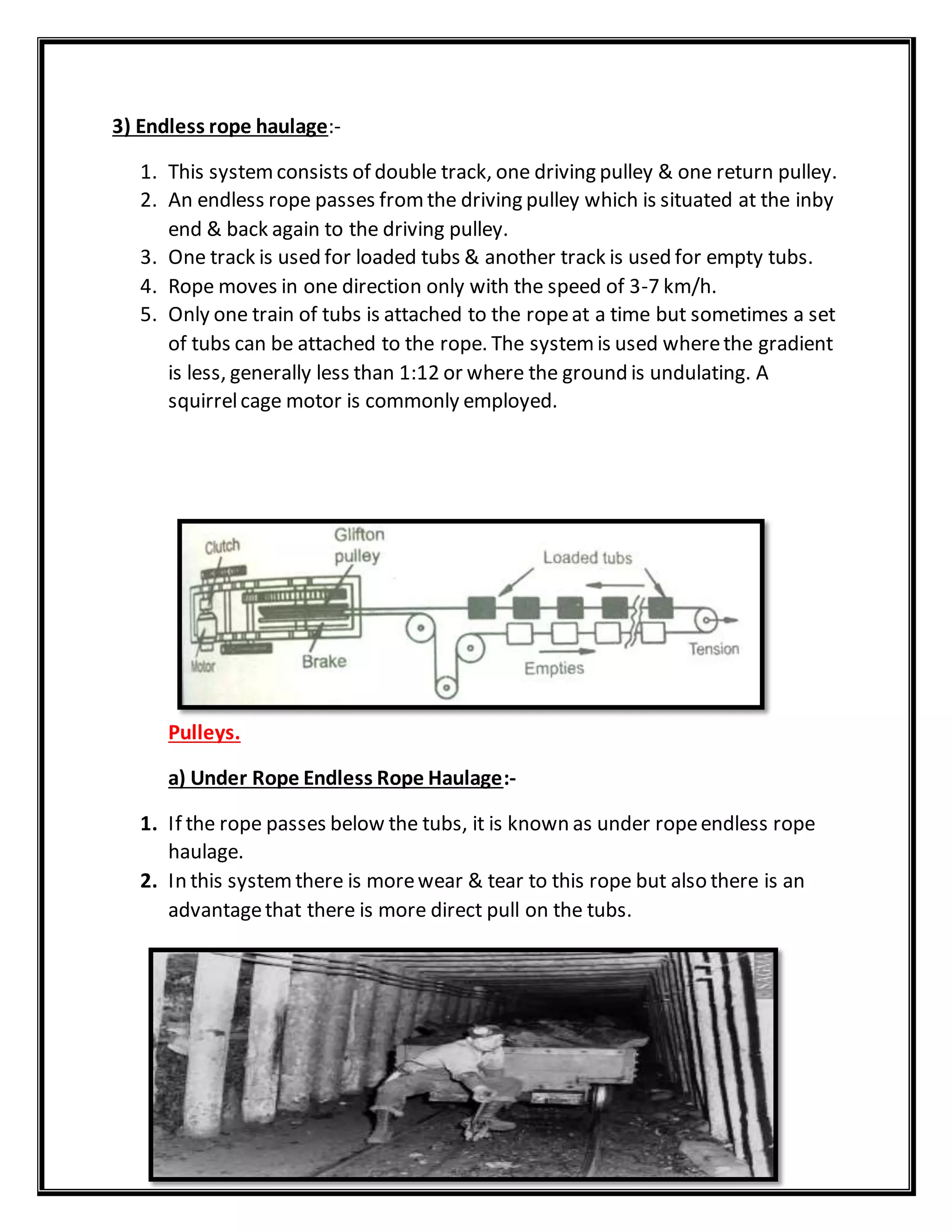
1. This systemconsists of double track, one driving pulley & one return pulley.
2. An endless rope passes fromthe driving pulley which is situated at the inby
end & back again to the driving pulley.
3. One track is used for loaded tubs & another track is used for empty tubs.
4. Rope moves in one direction only with the speed of 3-7 km/h.
5. Only one train of tubs is attached to the ropeat a time but sometimes a set
of tubs can be attached to the rope. The systemis used wherethe gradient
is less, generally less than 1:12 or where the ground is undulating. A
squirrelcage motor is commonly employed.
Pulleys.
a) Under Rope Endless Rope Haulage:-
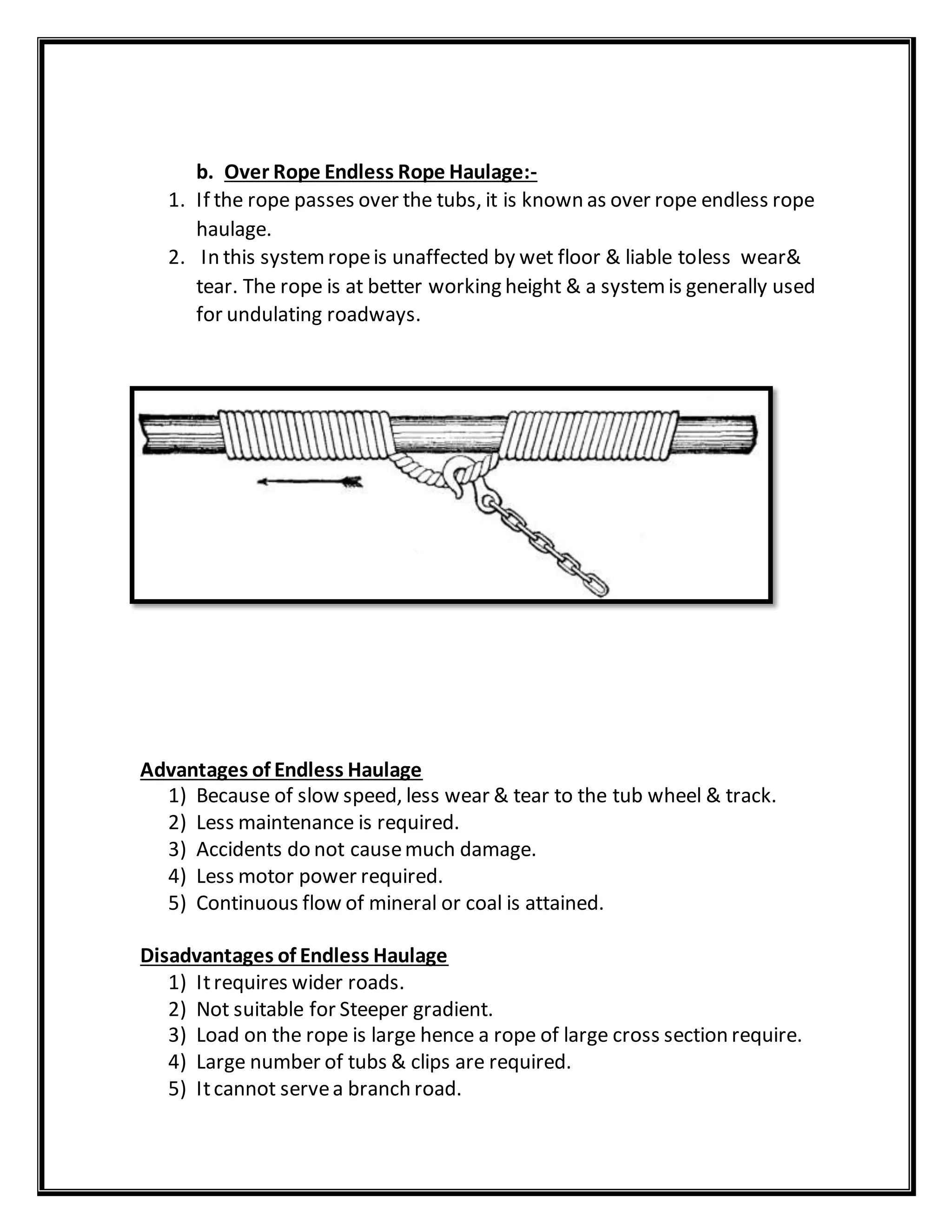
1. If the rope passes below the tubs, it is known as under ropeendless rope
haulage.
2. In this systemthere is morewear & tear to this rope but also there is an
advantagethat there is more direct pull on the tubs.
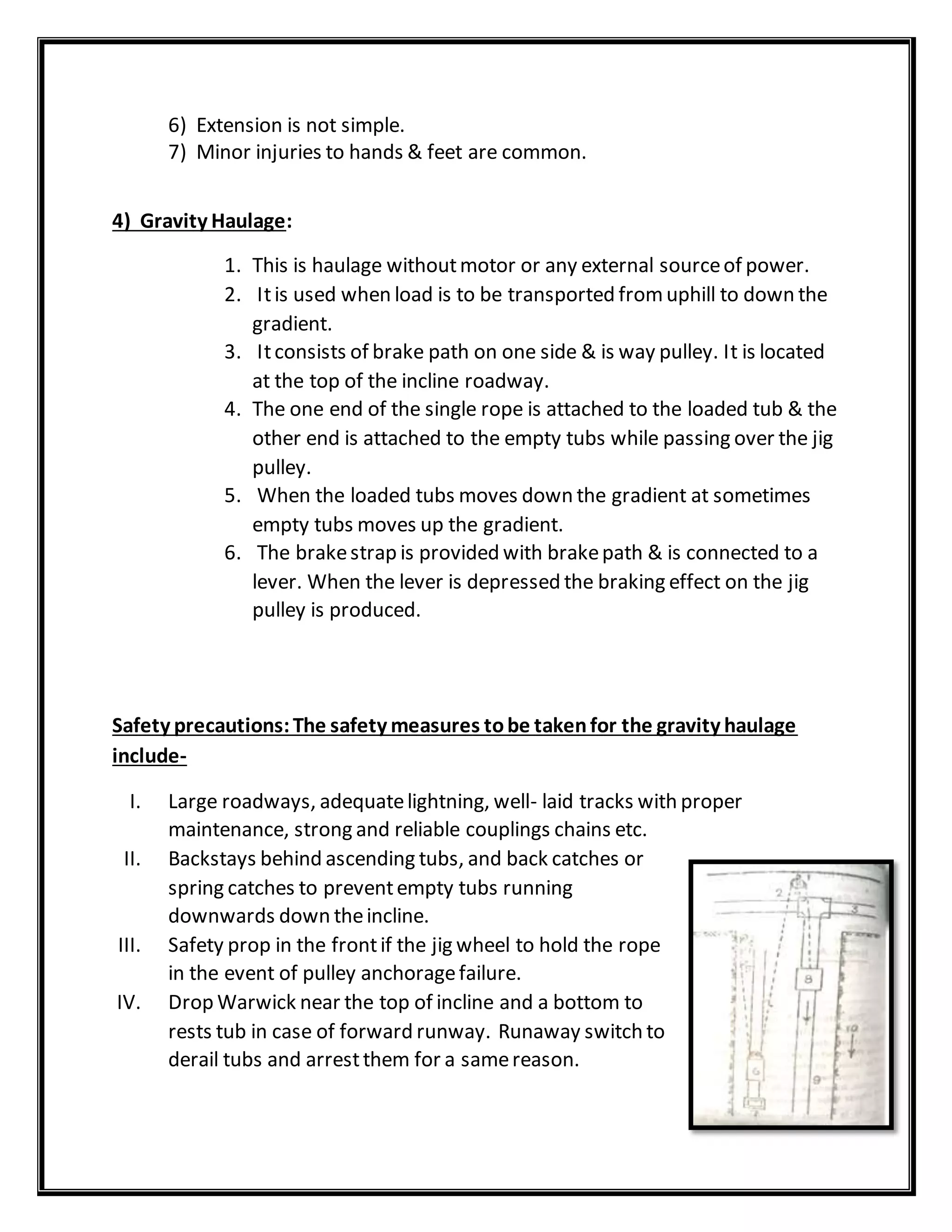
b. Over Rope Endless Rope Haulage:-
1. If the rope passes over the tubs, it is known as over rope endless rope
haulage.
2. In this systemropeis unaffected by wet floor & liable toless wear&
tear. The rope is at better working height & a systemis generally used
for undulating roadways.
Advantages of Endless Haulage
1) Because of slow speed, less wear & tear to the tub wheel & track.
2) Less maintenance is required.
3) Accidents do not causemuch damage.
4) Less motor power required.
5) Continuous flow of mineral or coal is attained.
Disadvantages of Endless Haulage
1) Itrequires wider roads.
2) Not suitable for Steeper gradient.
3) Load on the rope is large hence a rope of large cross section require.
4) Large number of tubs & clips are required.
5) Itcannot servea branch road.
6) Extension is not simple.
7) Minor injuries to hands & feet are common.
4) Gravity Haulage:
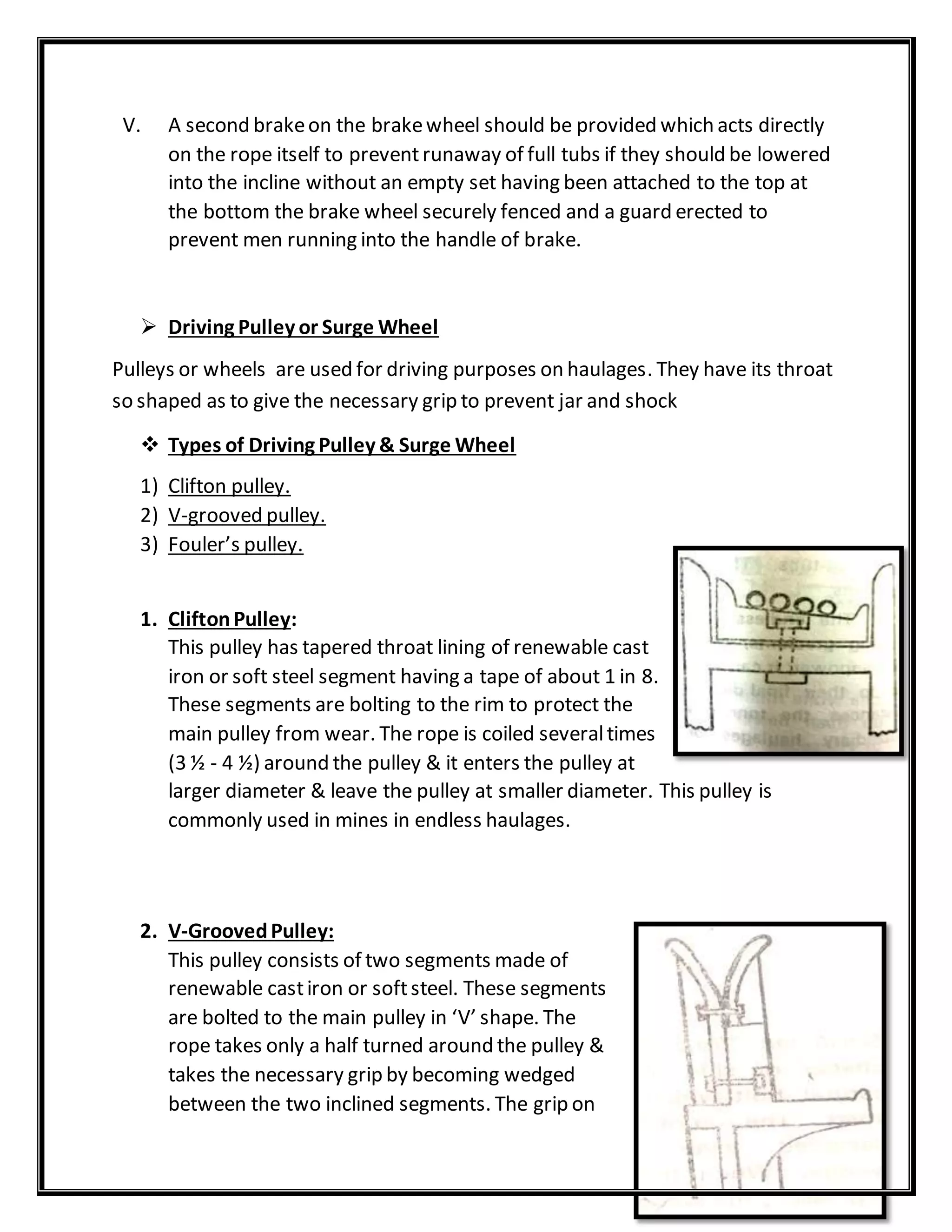
1. This is haulage withoutmotor or any external sourceof power.
2. Itis used when load is to be transported fromuphill to down the
gradient.
3. Itconsists of brake path on one side & is way pulley. It is located
at the top of the incline roadway.
4. The one end of the single rope is attached to the loaded tub & the
other end is attached to the empty tubs while passing over the jig
pulley.
5. When the loaded tubs moves down the gradient at sometimes
empty tubs moves up the gradient.
6. The brakestrap is provided with brakepath & is connected to a
lever. When the lever is depressed the braking effect on the jig
pulley is produced.
Safety precautions:The safety measures tobe takenfor the gravity haulage
include-
I. Large roadways, adequatelightning, well- laid tracks with proper
maintenance, strong and reliable couplings chains etc.
II. Backstays behind ascending tubs, and back catches or
spring catches to preventempty tubs running
downwards down theincline.
III. Safety prop in the frontif the jig wheel to hold the rope
in the event of pulley anchoragefailure.
IV. Drop Warwick near the top of incline and a bottom to
rests tub in case of forward runway. Runaway switch to
derail tubs and arrestthem for a samereason.
V. A second brakeon the brakewheel should be provided which acts directly
on the rope itself to preventrunaway of full tubs if they should be lowered
into the incline without an empty set having been attached to the top at
the bottom the brake wheel securely fenced and a guard erected to
prevent men running into the handle of brake.
 Driving Pulley or Surge Wheel
Pulleys or wheels are used for driving purposes on haulages. They have its throat
so shaped as to give the necessary grip to prevent jar and shock
 Types of Driving Pulley & Surge Wheel
1) Clifton pulley.
2) V-grooved pulley.
3) Fouler’s pulley.
1. CliftonPulley:
This pulley has tapered throat lining of renewable cast
iron or soft steel segment having a tape of about 1 in 8.
These segments are bolting to the rim to protect the
main pulley from wear. The rope is coiled severaltimes
(3 ½ - 4 ½) around the pulley & it enters the pulley at
larger diameter & leave the pulley at smaller diameter. This pulley is
commonly used in mines in endless haulages.
2. V-GroovedPulley:
This pulley consists of two segments made of
renewable castiron or softsteel. These segments
are bolted to the main pulley in ‘V’ shape. The
rope takes only a half turned around the pulley &
takes the necessary grip by becoming wedged
between the two inclined segments. The grip on
the ropeis directly proportionalto the tension in the rope.
3. Fowler’s pulley:
Itconsistof number of bell shaped pivoted segments made of renewable
cast iron or softsteel. These segments are pivoted to the main pulley as
shown in figure, the pressureof the rope on bottom of the segment
towards each other so that they grip the rope in proportion to its tension.
 Rope clips :-
The endless ropes moves at a slow speed over pulleys or rollers situated between
the rails in the haulage way. Special clips are used for detaching tubs or cars to
the moving rope. The design of such clips depends on whether the rope travels
under the tubs, or over the tubs.
 Types of Clips
1) Screw clip.
2) Small-man clip.
3) Lashing chain.
4) Goose neck clip.
5) Cam clip
1. Screwclip:-Itconsists of two jaws i.e. lower jaw & upper jaw. When the
distance between two jaws is enough to accommodate the rope, the
moving rope is placed in between the jaws & the handle operated which
reduces the distance between the two jaws. Hencethe two jaw grips the
load rope, due to this grip as well as tub starts moving with the rope
because the clip is connected to the tub & through a rod or lever.
2. Small man clip: -
Itconsists of two side plates loosely held together by a bolt which has a
spring which keeps the two plates apart. A hand lever pivoted at ‘P’ &
carries a wedge at its upper end. When the hand lever is depressed, the
wedge enters between the two plates to grip the rope. The clip can be
detached automatically fromthe rope by fixing a trite bar to the sleeper
which raises the hand lever to release the rope.
3. Lashing chain-
Itconsists of a chain 2.5 to 3.0 meter long with a hook at each end. One
hook is attached to the tub & other end of the chain is coiled 3 to 4 times
around the rope& the hook is linked to the chain. On undulating roads
chain should be used at both the ends. Generally in this case a set of tubs is
attached with the rope at a time.
4. Goose neck clip-Itconsistof an ‘S’ shaped hook loosely into the holders
mounted on the end of the tub as shown. When the rope is placed in
position in the hook at either end or at both end of the tub, the hook turns
through about 30֯& grips the rope. The grip on the rope is proportionalto
the tension in the rope. But this grip bends the ropewhich reduces the
rope’s life.
5. Cam clip – figure _NITROURKELA
Itconsistof a plate having its one edge bent over to forma grooveinto which the
rope is pressed a gripped by a lever which is pivoted & other end of the lever is
connected to the tub to a chain. The pull on the chain turns the lever to grip the
rope. The grip on the rope is proportionalto the load.
 Tensioning Arrangementsfor rope haulages :-
For the proper working of endless rope haulage a uniformtension should be
maintained in the endless rope. The common practice to ensureproper rope
tension is to pan the rope half turned around the pulley mounted on the tension
which is placed on the rope. Heavy weights are attached to the boggy through
chain & wire rope. This way the weight always acts downwards. Hencea uniform
tension in the ropeis always maintained.
 The methods commonly adapted are:-
1. Fixed tension
2. Mobile tension
3. Gradient operated mobile tension
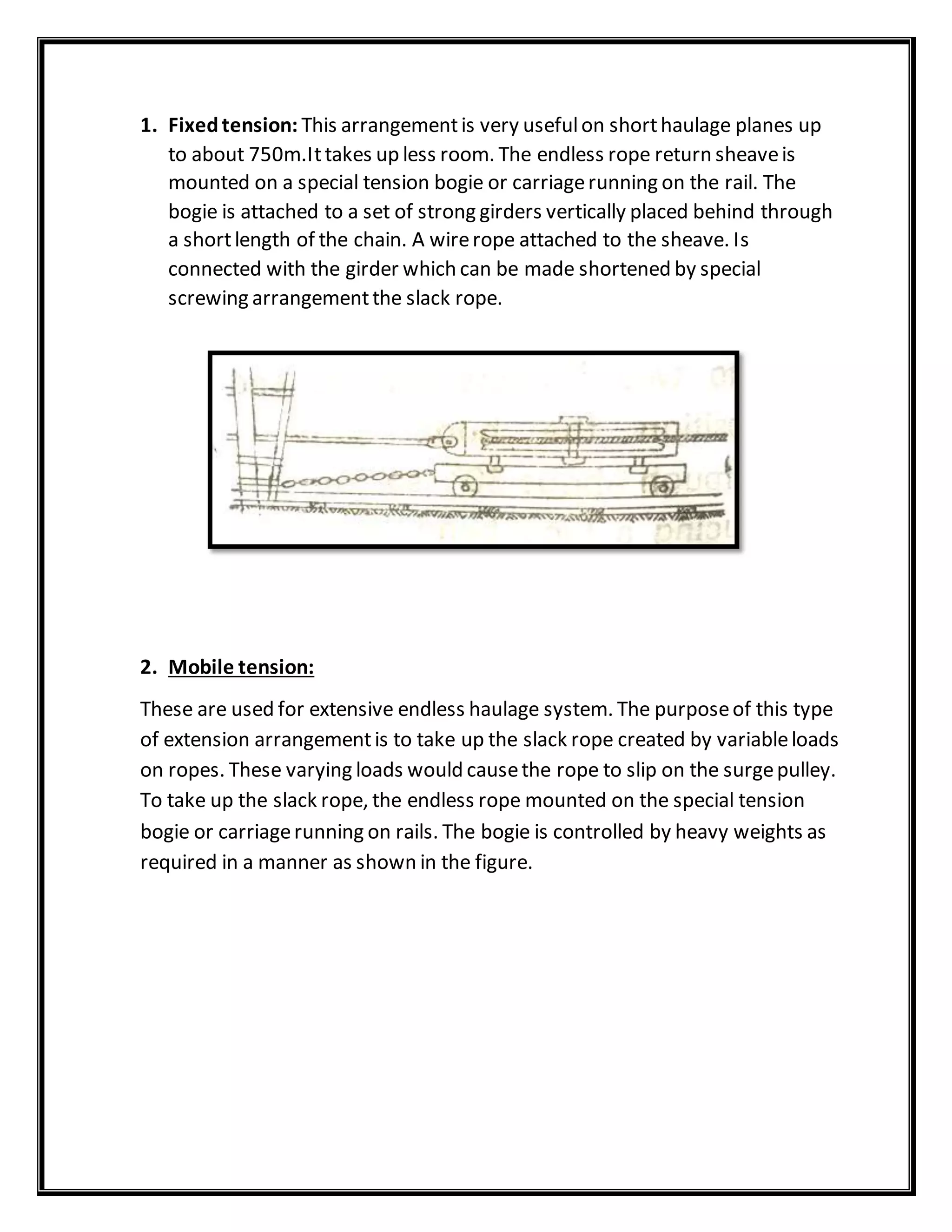
1. Fixedtension: This arrangementis very usefulon shorthaulage planes up
to about 750m.Ittakes up less room. The endless rope return sheaveis
mounted on a special tension bogie or carriagerunning on the rail. The
bogie is attached to a set of strong girders vertically placed behind through
a shortlength of the chain. A wirerope attached to the sheave. Is
connected with the girder which can be made shortened by special
screwing arrangementthe slack rope.
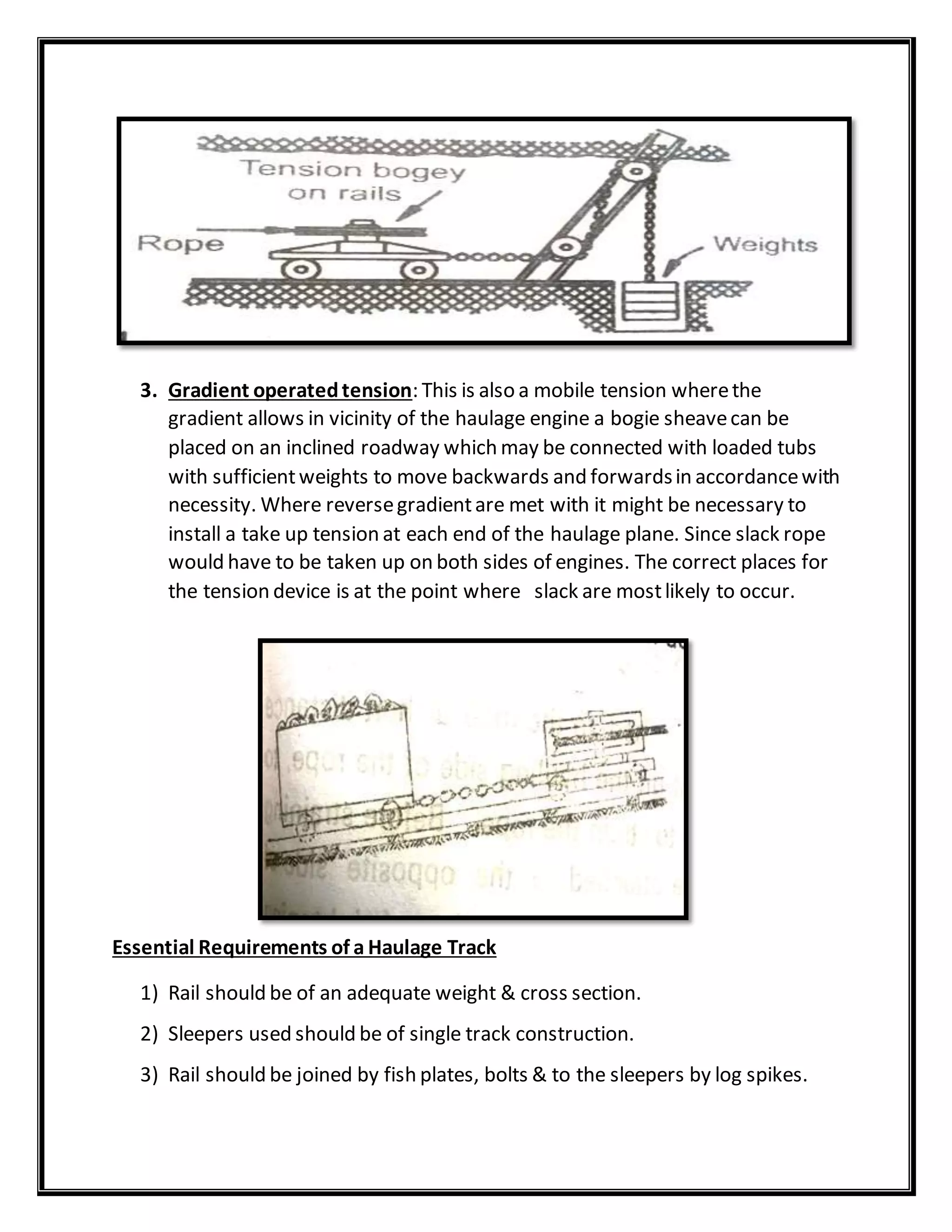
2. Mobile tension:
These are used for extensive endless haulage system. The purposeof this type
of extension arrangementis to take up the slack rope created by variableloads
on ropes. These varying loads would causethe rope to slip on the surgepulley.
To take up the slack rope, the endless rope mounted on the special tension
bogie or carriagerunning on rails. The bogie is controlled by heavy weights as
required in a manner as shown in the figure.
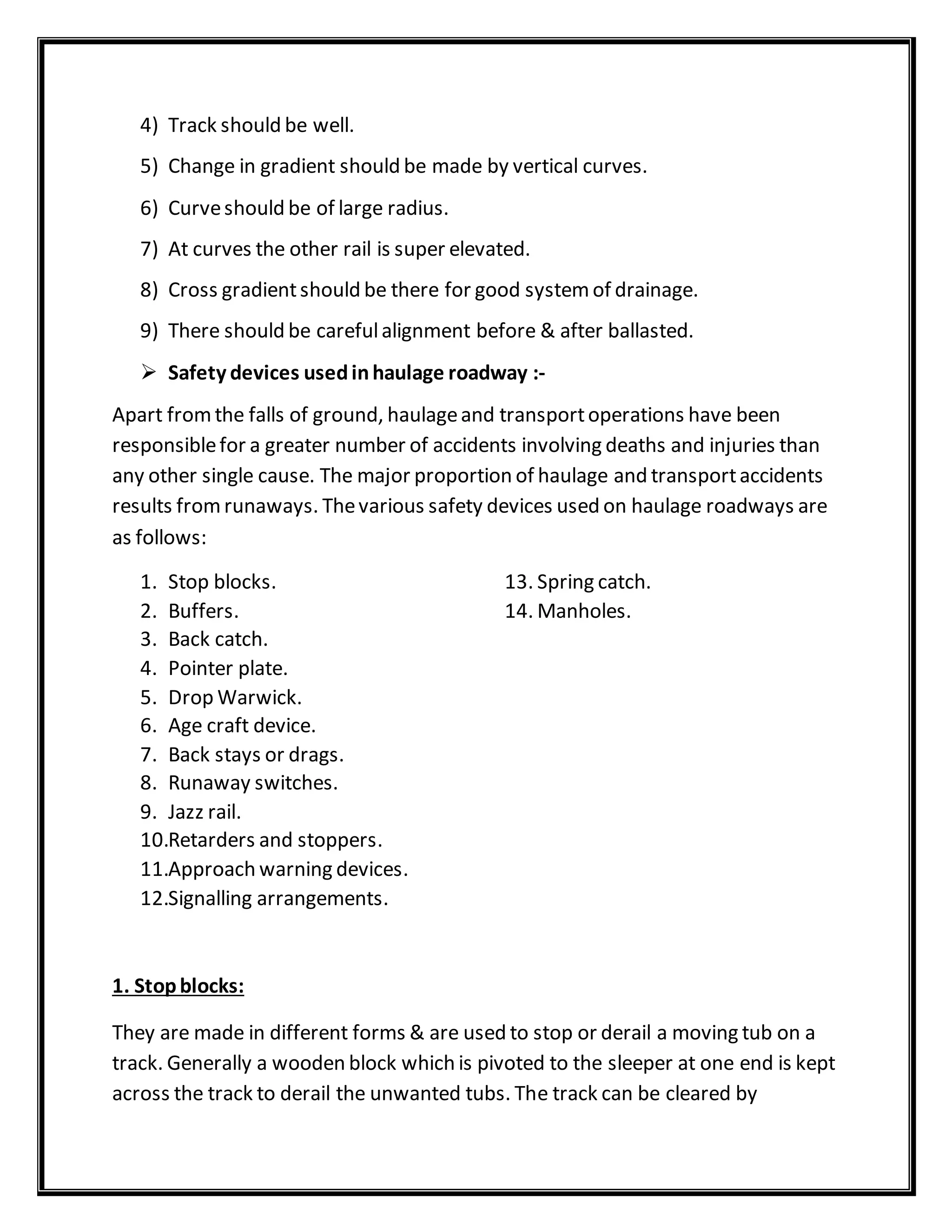
3. Gradient operatedtension: This is also a mobile tension wherethe
gradient allows in vicinity of the haulage engine a bogie sheavecan be
placed on an inclined roadway which may be connected with loaded tubs
with sufficientweights to move backwards and forwardsin accordancewith
necessity. Where reversegradientare met with it might be necessary to
install a take up tension at each end of the haulage plane. Since slack rope
would have to be taken up on both sides of engines. The correct places for
the tension device is at the point where slack are mostlikely to occur.
Essential Requirements of a Haulage Track
1) Rail should be of an adequate weight & cross section.
2) Sleepers used should be of single track construction.
3) Rail should be joined by fish plates, bolts & to the sleepers by log spikes.
4) Track should be well.
5) Change in gradient should be made by vertical curves.
6) Curveshould be of large radius.
7) At curves the other rail is super elevated.
8) Cross gradientshould be there for good systemof drainage.
9) There should be carefulalignment before & after ballasted.
 Safety devices usedinhaulage roadway :-
Apart fromthe falls of ground, haulageand transportoperations have been
responsiblefor a greater number of accidents involving deaths and injuries than
any other single cause. The major proportion of haulage and transportaccidents
results fromrunaways. Thevarious safety devices used on haulage roadways are
as follows:
1. Stop blocks. 13. Spring catch.
2. Buffers. 14. Manholes.
3. Back catch.
4. Pointer plate.
5. Drop Warwick.
6. Age craft device.
7. Back stays or drags.
8. Runaway switches.
9. Jazz rail.
10.Retarders and stoppers.
11.Approach warning devices.
12.Signalling arrangements.
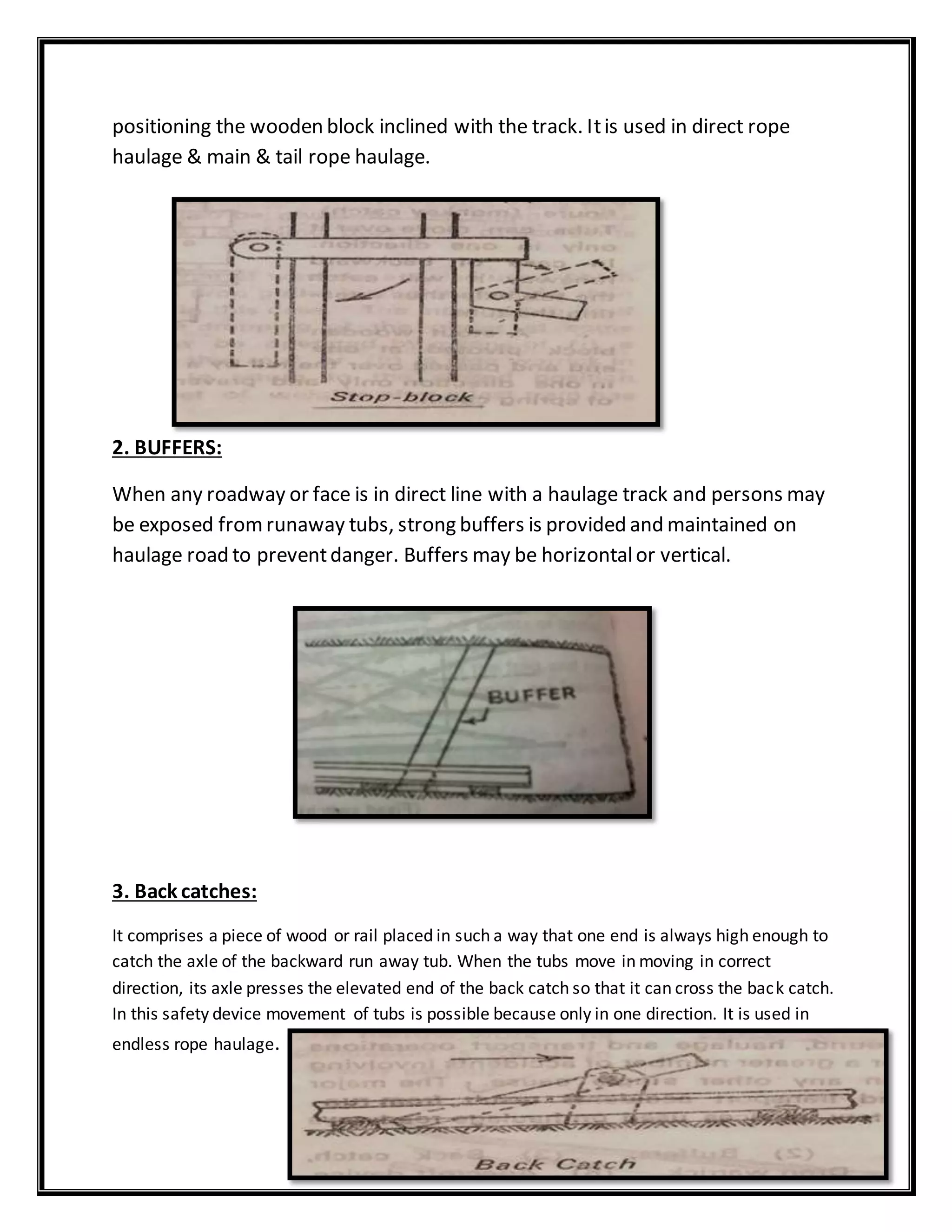
1. Stopblocks:
They are made in different forms & are used to stop or derail a moving tub on a
track. Generally a wooden block which is pivoted to the sleeper at one end is kept
across the track to derail the unwanted tubs. The track can be cleared by
positioning the wooden block inclined with the track. Itis used in direct rope
haulage & main & tail rope haulage.
2. BUFFERS:
When any roadway or face is in direct line with a haulage track and persons may
be exposed fromrunaway tubs, strong buffers is provided and maintained on
haulage road to preventdanger. Buffers may be horizontalor vertical.
3. Back catches:
It comprises a piece of wood or rail placed in such a way that one end is always high enough to
catch the axle of the backward run away tub. When the tubs move in moving in correct
direction, its axle presses the elevated end of the back catch so that it can cross the back catch.
In this safety device movement of tubs is possible because only in one direction. It is used in
endless rope haulage.
4. Pointer plates: This is fitted on the main haulage track to deflect a backward
runaway into the prepared side of the roadway. Thederailed tubs may be
automatically re-railed when drawn forward.
fig
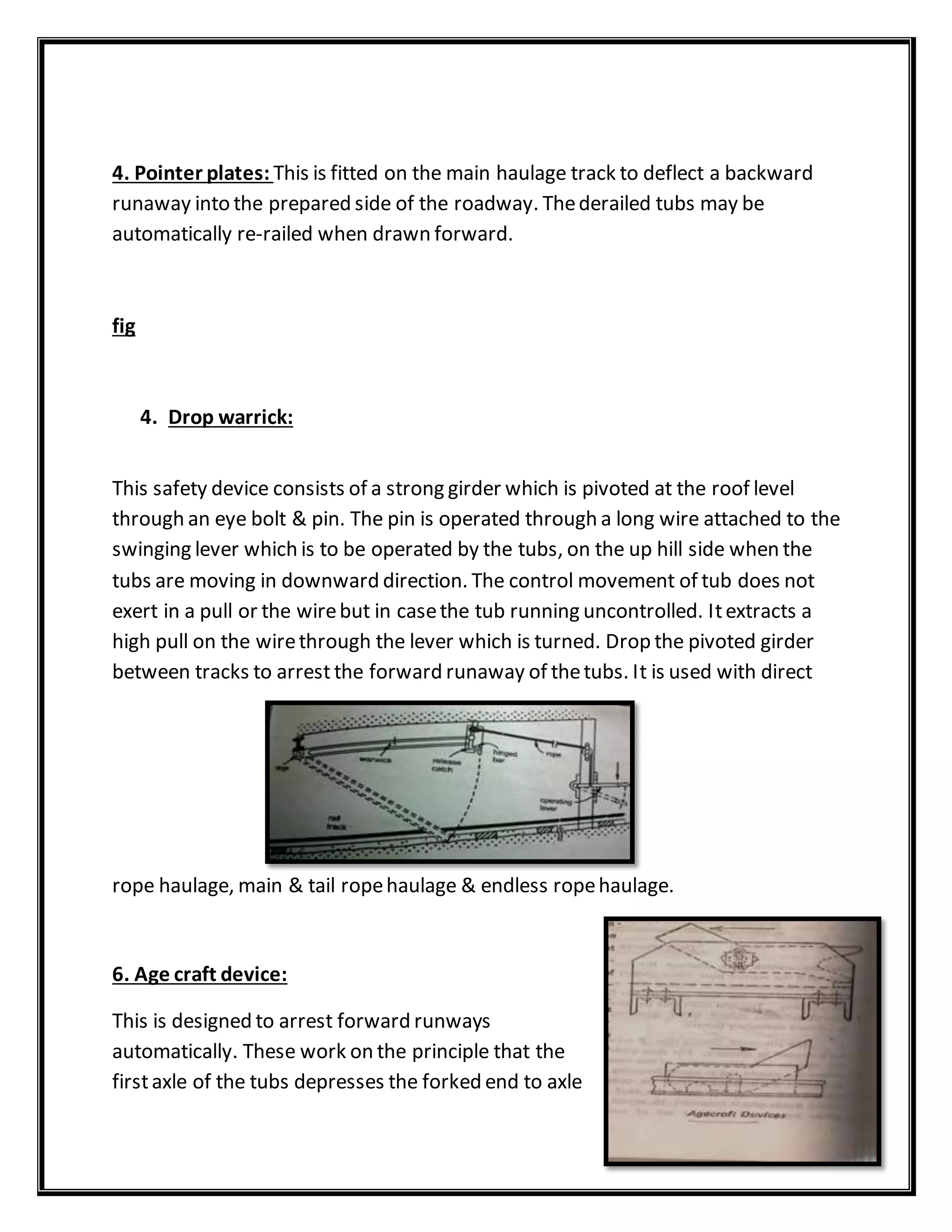
4. Drop warrick:
This safety device consists of a strong girder which is pivoted at the roof level
through an eye bolt & pin. The pin is operated through a long wire attached to the
swinging lever which is to be operated by the tubs, on the up hill side when the
tubs are moving in downward direction. The control movement of tub does not
exert in a pull or the wirebut in casethe tub running uncontrolled. Itextracts a
high pull on the wirethrough the lever which is turned. Drop the pivoted girder
between tracks to arrest the forward runaway of thetubs. It is used with direct
rope haulage, main & tail ropehaulage & endless ropehaulage.
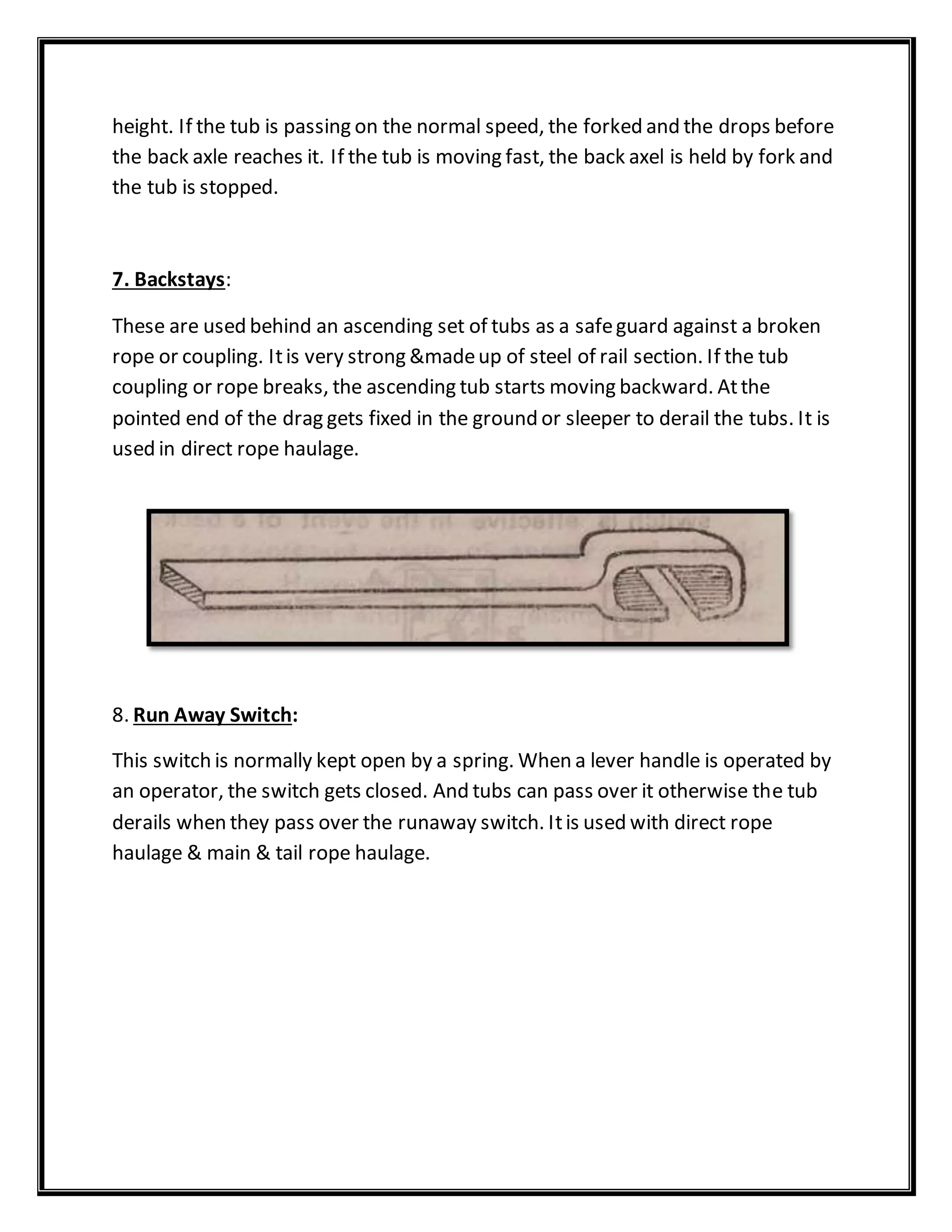
6. Age craft device:
This is designed to arrest forward runways
automatically. These work on the principle that the
firstaxle of the tubs depresses the forked end to axle
height. If the tub is passing on the normal speed, the forked and the drops before
the back axle reaches it. If the tub is moving fast, the back axel is held by fork and
the tub is stopped.
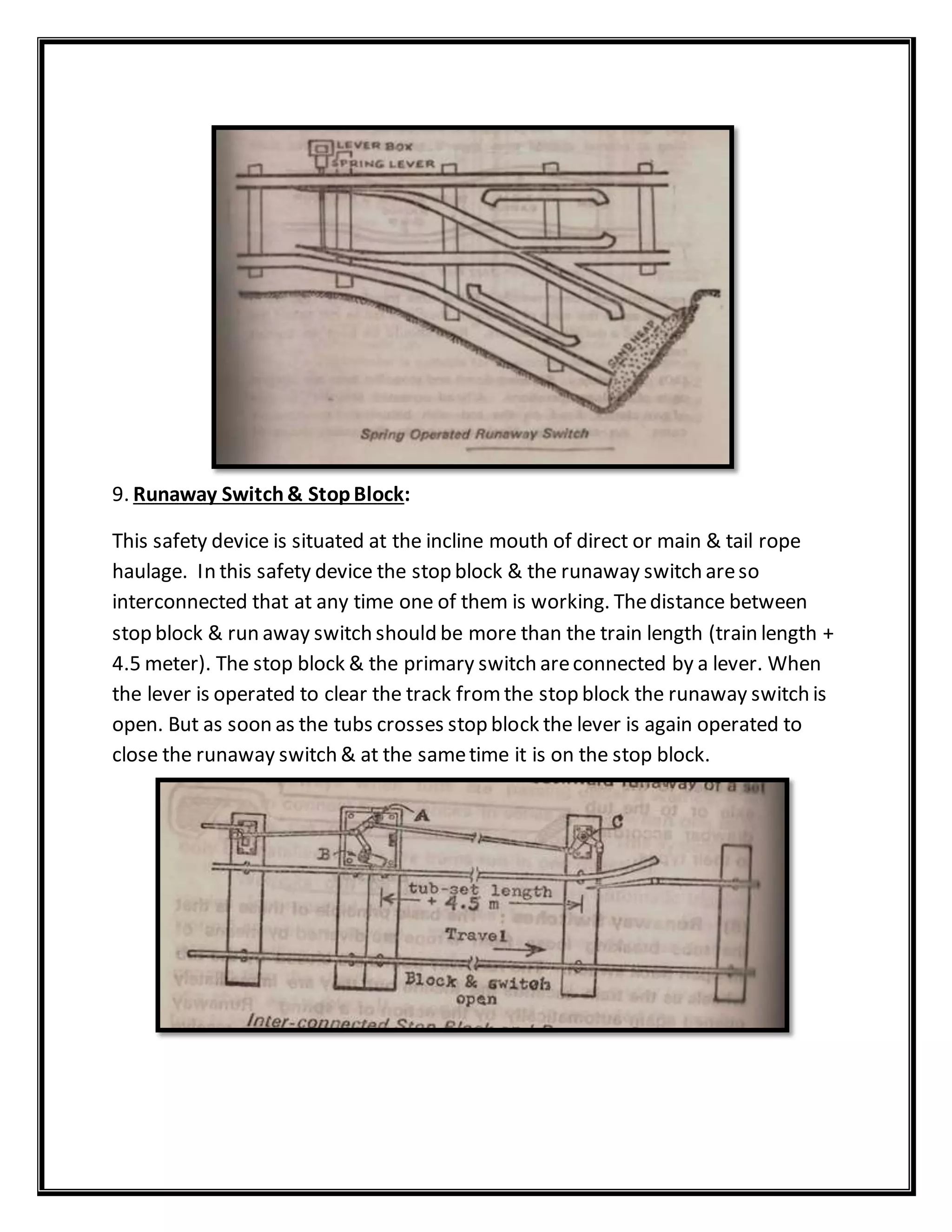
7. Backstays:
These are used behind an ascending set of tubs as a safeguard against a broken
rope or coupling. Itis very strong &madeup of steel of rail section. If the tub
coupling or rope breaks, the ascending tub starts moving backward. Atthe
pointed end of the drag gets fixed in the ground or sleeper to derail the tubs. It is
used in direct rope haulage.
8. Run Away Switch:
This switch is normally kept open by a spring. When a lever handle is operated by
an operator, the switch gets closed. And tubs can pass over it otherwise the tub
derails when they pass over the runaway switch. Itis used with direct rope
haulage & main & tail rope haulage.
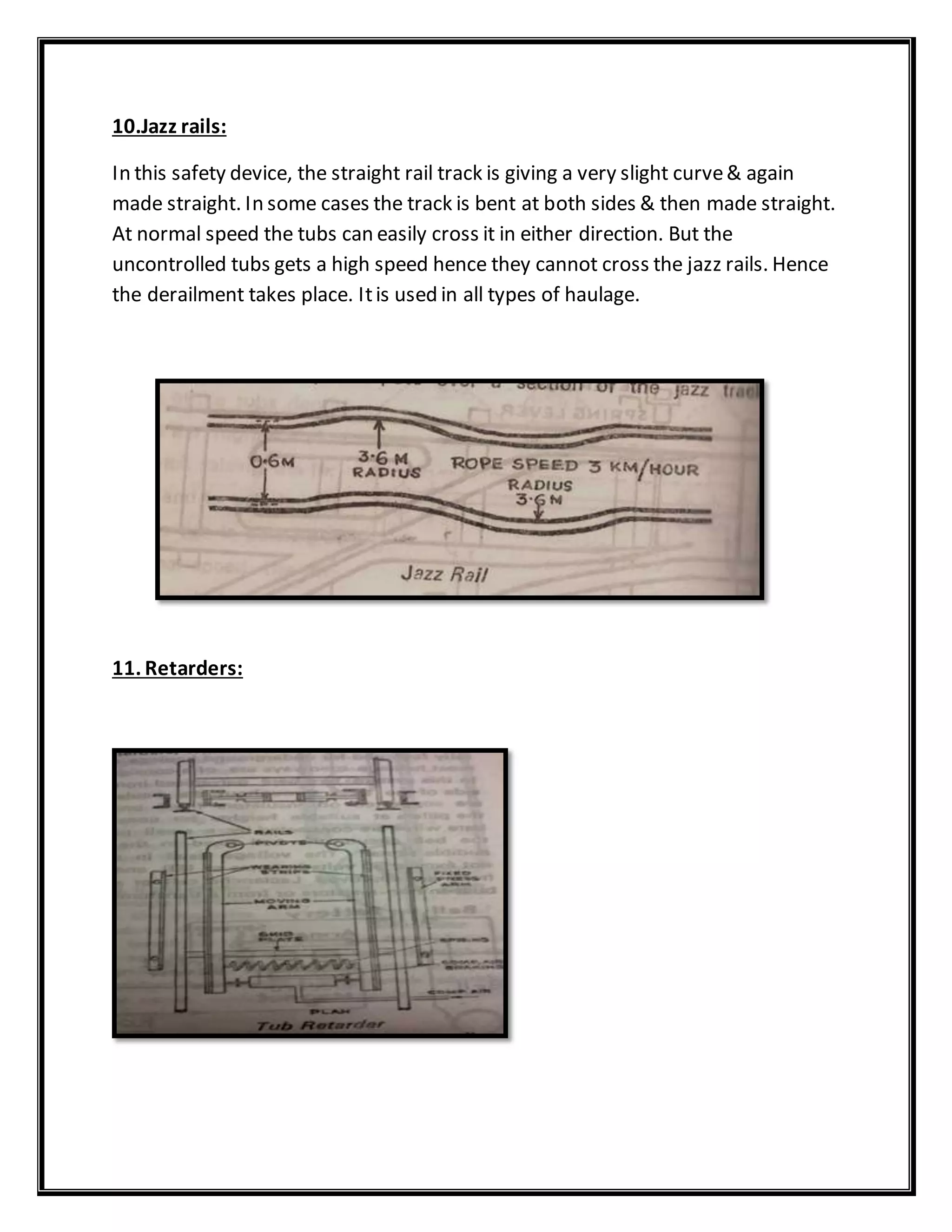
9. Runaway Switch& StopBlock:
This safety device is situated at the incline mouth of direct or main & tail rope
haulage. In this safety device the stop block & the runaway switch areso
interconnected that at any time one of them is working. Thedistance between
stop block & run away switch should be more than the train length (train length +
4.5 meter). The stop block & the primary switch areconnected by a lever. When
the lever is operated to clear the track fromthe stop block the runaway switch is
open. But as soon as the tubs crosses stop block the lever is again operated to
close the runaway switch & at the sametime it is on the stop block.
10.Jazz rails:
In this safety device, the straight rail track is giving a very slight curve& again
made straight. In some cases the track is bent at both sides & then made straight.
At normal speed the tubs can easily cross it in either direction. But the
uncontrolled tubs gets a high speed hence they cannot cross the jazz rails. Hence
the derailment takes place. Itis used in all types of haulage.
11. Retarders:
Slowing down and stopping tubs are integral parts of haulage operation. A hand
operated retarder consists of two planks, lined on the top with belting and
mounted on cams. An end cover plank fastened to the inside faces of planks
serves to hold the plank in position. They are operated by a single lever. When the
cams are fully raised, the tub wheels are lifted clear to the rails and a braking
action is provided on the axle.
The tub retarders represents wasteof energy and should be avoided in planning.
However, the speed movement of tubs required for quick turn over and higher
rising may make its application essential at pit top, pit bottom haul brow heads
etc. There are many types of elaborate designs and manually control. Smooth
breaking may be affected by air or hydraulic breaking.
Fully automatic retarders, which are released by pneumatic cylinder, are widely
used. The device consistof two pairs of hinged bars faced with renewableskid
plates and breaking action effected by movement of two opposing pistons of in a
cylinder containing air. The bars areraised abovethe rail level and grip the
wheels.
When no braking is desired, the value releasing to the atmosphereis opened after
cutting of compressed air supply. A spring draws back the breaking bars to normal
position.
An automatic hydraulic tub retarder is suitable for locomotive haulage or ordinary
rope haulage. The hydraulic pressureis supplied from 1-2 KW eclectically driven
pump. The oncoming tramp is retarded by the tread of the leading wheels
running fixed skids and an inclined hinged platform which acts as a wedge.
12. APPORACH WARNING DEVICE:
Itis sometime necessary to warn man working or travelling in a haulage roadway.
A simple way of operating a warning device in a rope haulage roads is an arm
protruding into the path of oncoming trams which, when deflected closes an
electric circuit connected to a signallamp or a bell. The device is operated by a
lever depressed by tram axle.
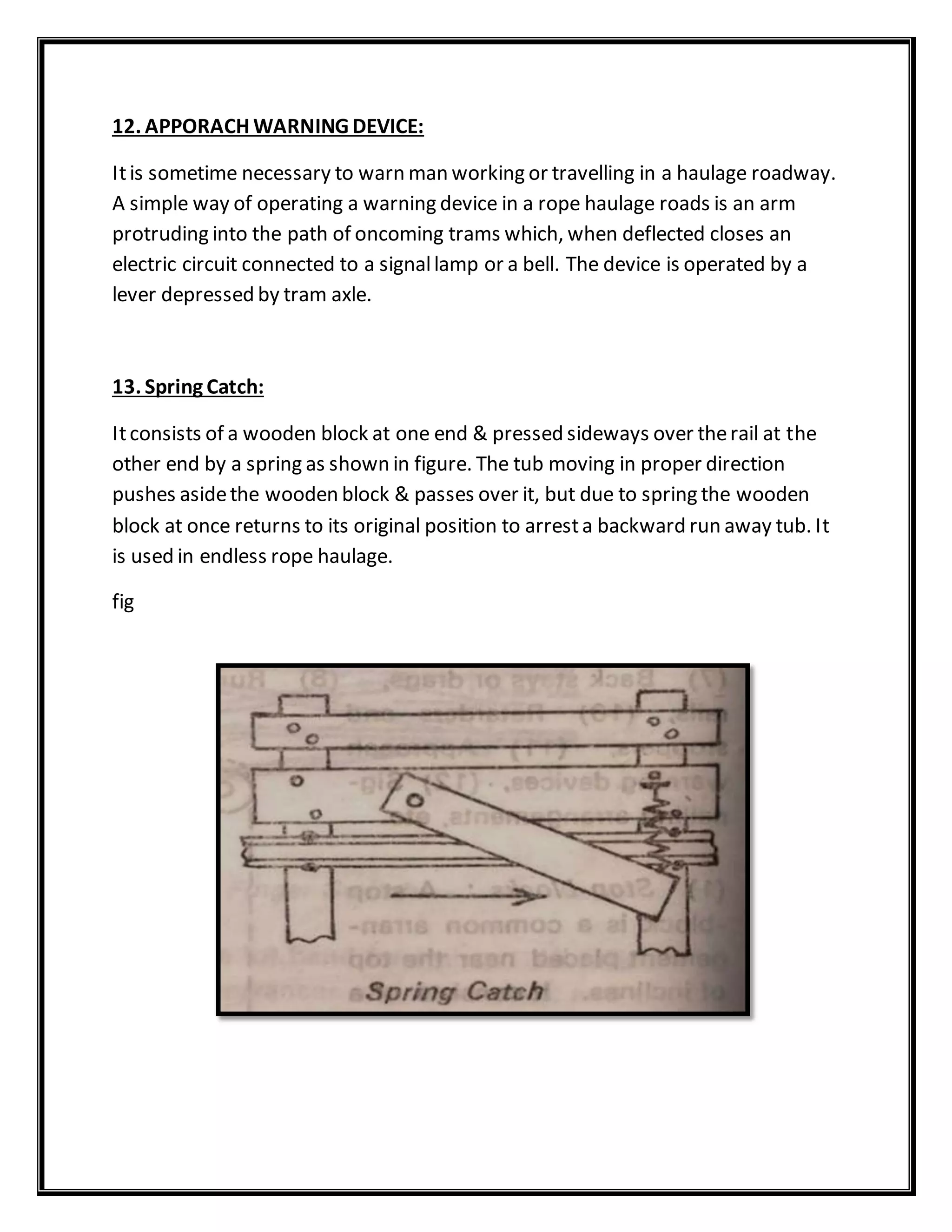
13. Spring Catch:
Itconsists of a wooden block at one end & pressed sideways over therail at the
other end by a spring as shown in figure. The tub moving in proper direction
pushes asidethe wooden block & passes over it, but due to spring the wooden
block at once returns to its original position to arresta backward run away tub. It
is used in endless rope haulage.
fig
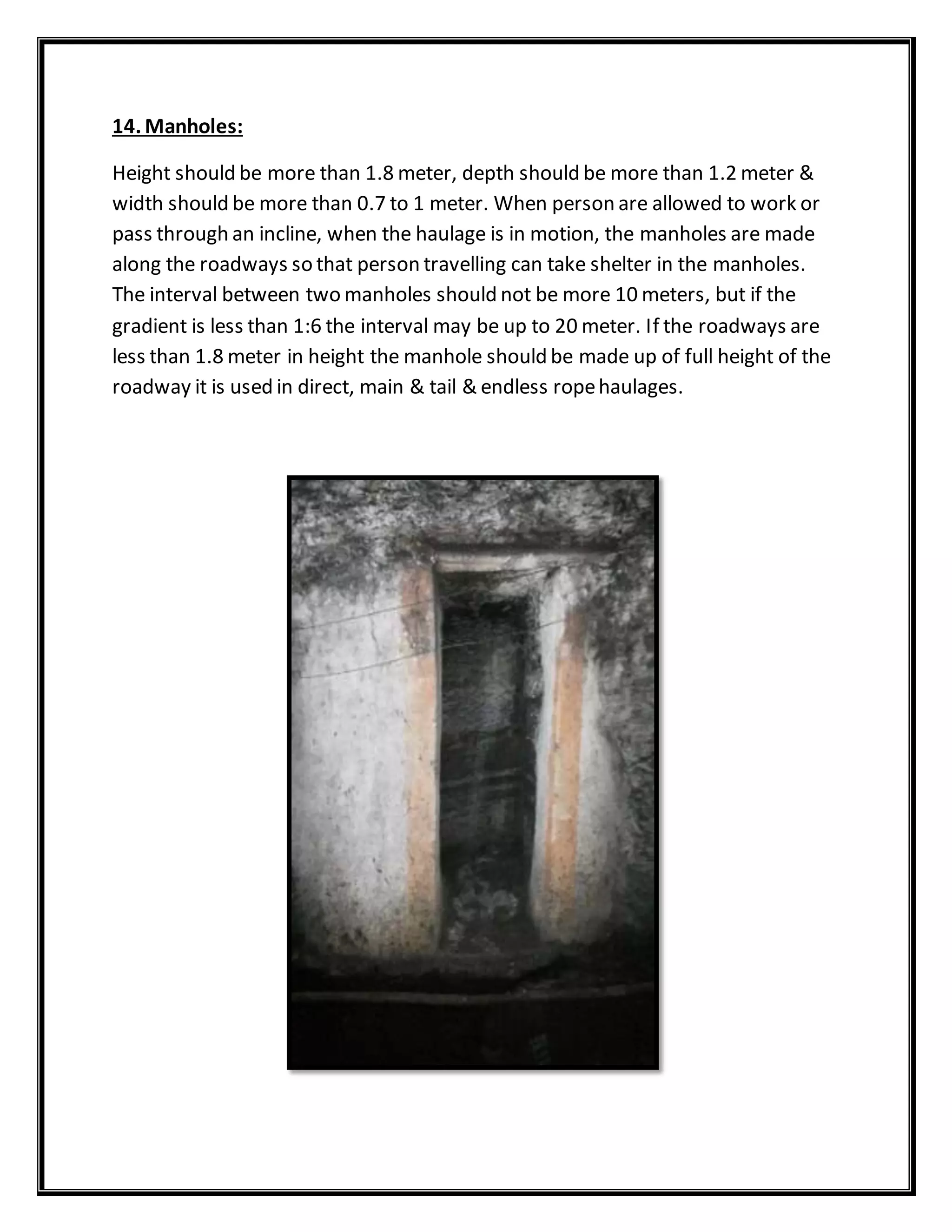
14. Manholes:
Height should be more than 1.8 meter, depth should be more than 1.2 meter &
width should be more than 0.7 to 1 meter. When person are allowed to work or
pass through an incline, when the haulage is in motion, the manholes are made
along the roadways so that person travelling can take shelter in the manholes.
The interval between two manholes should not be more 10 meters, but if the
gradient is less than 1:6 the interval may be up to 20 meter. If the roadways are
less than 1.8 meter in height the manhole should be made up of full height of the
roadway it is used in direct, main & tail & endless ropehaulages.
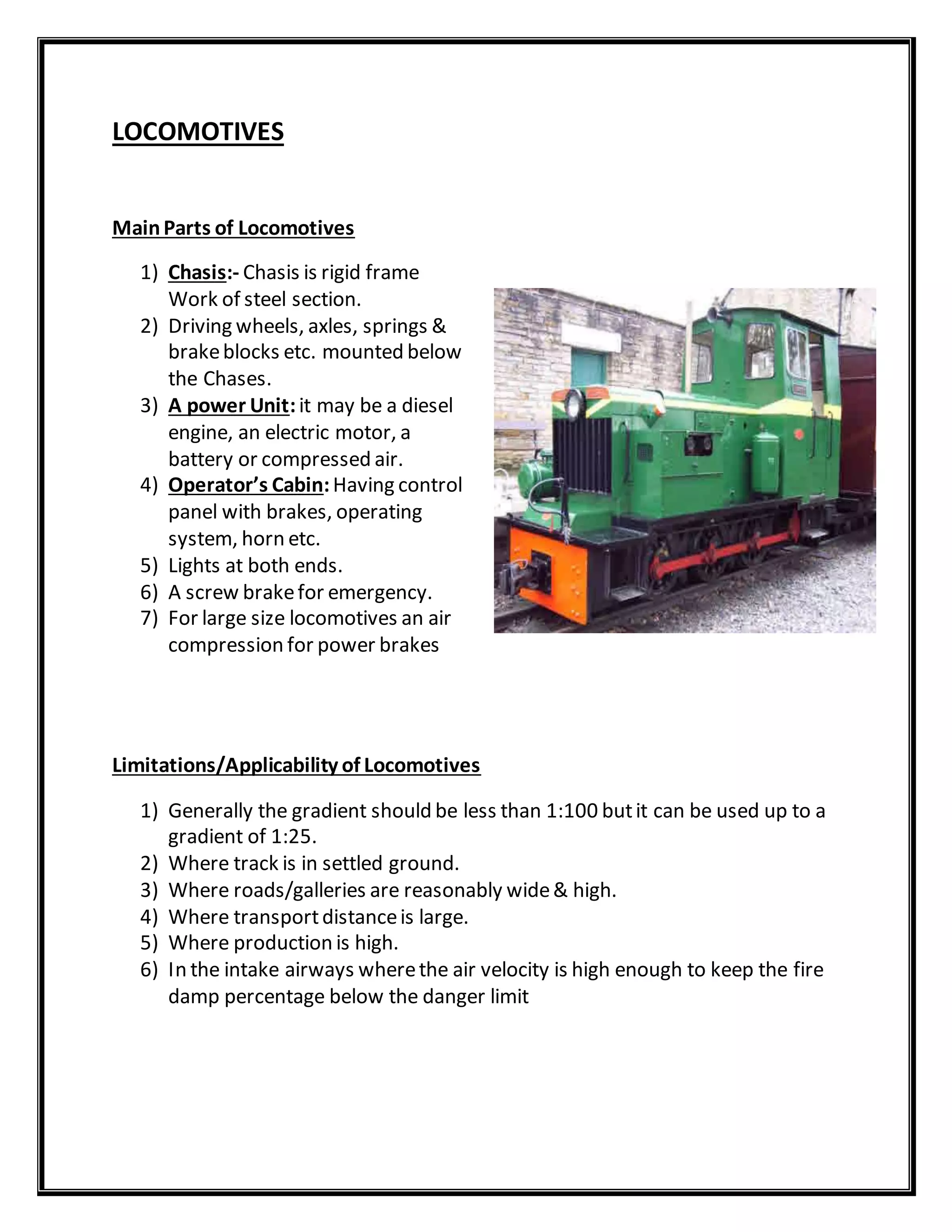
LOCOMOTIVES
MainParts of Locomotives
1) Chasis:- Chasis is rigid frame
Work of steel section.
2) Driving wheels, axles, springs &
brakeblocks etc. mounted below
the Chases.
3) A power Unit:it may be a diesel
engine, an electric motor, a
battery or compressed air.
4) Operator’s Cabin:Having control
panel with brakes, operating
system, horn etc.
5) Lights at both ends.
6) A screw brakefor emergency.
7) For large size locomotives an air
compression for power brakes
Limitations/Applicability of Locomotives
1) Generally the gradient should be less than 1:100 butit can be used up to a
gradient of 1:25.
2) Where track is in settled ground.
3) Where roads/galleries are reasonably wide& high.
4) Where transportdistanceis large.
5) Where production is high.
6) In the intake airways wherethe air velocity is high enough to keep the fire
damp percentage below the danger limit
Locomotive Haulage:
In caseof rope haulage the power to move the load is available fromexternal
fixed motor to the haulage. While in caseof locomotive haulage the driving unit
i.e. locomotive is coupled to a train due to which moresafety can be attained. The
locomotives are very flexible in nature & they can be used for men transportalso.
Types of Locomotive Haulages are:-
1) Diesel locomotive
2) Electric locomotive
1) Over head wire locomotive
2) Trolley wire locomotive
3) Electric battery locomotive
4) Compressed air locomotive
1) Diesel Locomotive: Diesellocomotive are commonly used in number of mines.
Their weight varies from3 tonne to 15 tonne & power from50kw to 75kw. The
power unit is a diesel engine. The locomotives used in underground coalmines
have a power unit in a flame proof enclosureas a safeguard againstignition of
fire damp. In coal mines the diesel locomotives are not allowed wherethe
percentage of inflammable gases is more than 1.25% in the general body of air.
Hence these are generally used in intake roadways. Theexhaust of the diesel
engine includes oxygen, nitrogen, carbon dioxide & small quantities of oxides of
sulphur & nitrogen & other aldehydes which smell badly &causes irritation of the
nose, throat & eyes. To remove these oxides & aldehydes the locomotives are
fitted with exhaustconditioner
Advantages of Diesel Locomotives
1. Cheaper
2. Completely self-controlled
Disadvantages of Diesel Locomotives
1. Danger of fire in handling the diesel.
2. production of poisonous gasses
3. Adds heats to the atmosphere.
4. More maintenance required.
5. More employees required.
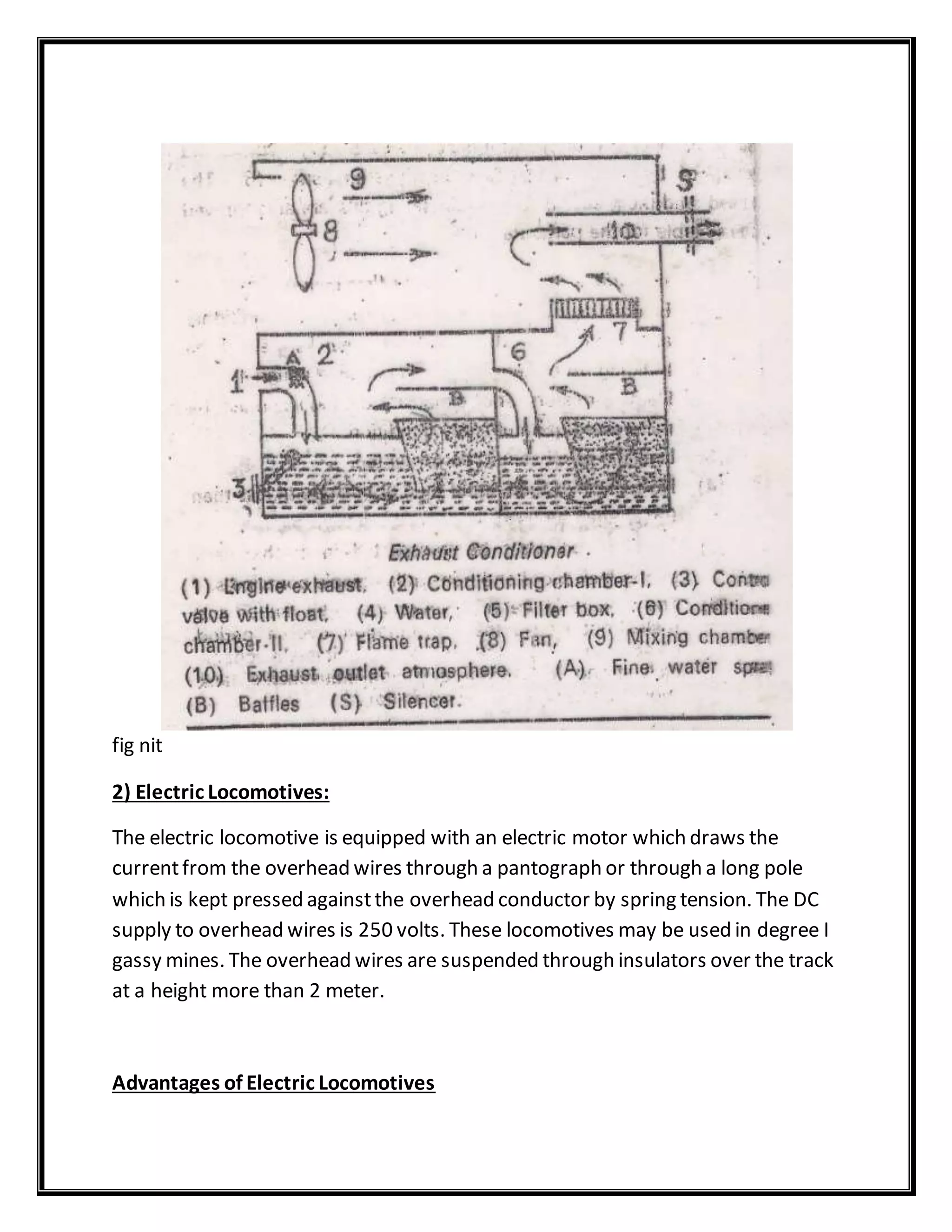
Exhaust Conditioner &Flame Trap: The exhaustgases fromthe engine strikes on
the surfaceof the water in the chamber A. This traps hot particles & washes out
the sulphur oxides &aldehydes. The gases then rise through a flame proof slag
wool which is kept moist by water & thereafter pass through second chamber.
Similar chamber B, where gases are further cooled & filtered beforepassing
through the flame trap. A flame arrester consists of a removablestainless steel
plates 1/2mmapart. Finally gases aremixed with about 30 to 40 times their
volume of fresh air before entering in the atmosphere. In chamber A, a water
level indicator is installed in such a way that if water level falls below certain level,
the brakes areapplied automatically. The exhaust conditioner should be replaced
by a clean set after every 24 hours.
fig nit
2) Electric Locomotives:
The electric locomotive is equipped with an electric motor which draws the
currentfrom the overhead wires through a pantograph or through a long pole
which is kept pressed againstthe overhead conductor by spring tension. The DC
supply to overhead wires is 250 volts. These locomotives may be used in degree I
gassy mines. The overhead wires are suspended through insulators over the track
at a height more than 2 meter.
Advantages of Electric Locomotives
1) More reliable
2) Light weight
3) Less maintenance
4) Good control
5) Small size
6) No exhaust gases
Disadvantages of Electric Locomotives
1. High initial investment
2. Danger of shock & fire
3. Derailment is major problem
types
3)Electric Battery Locomotives:
The power unit of an electric battery locomotive is a DC electric motor which
receives currentfroma storagebattery carried in the locomotive itself. Such
locomotives are for light & medium duties. The batteries are of lead acid type &
each battery consists of a number of 2 volt cells & their no varies from 40 to 70.
The capacity of the battery to work is 8 hours & its charging time is also 8 hour.
Advantages of Battery Locomotives
1) Less maintenance.
2) No poisonous gases.
3) No overheads wire’s problem.
4) Quite in operation.
Disadvantages of Battery Locomotives
1. Hydrogen gas is liberated.
2. Flame proofing is not possible.
3. Overheating of cell may cause sparking or fire.
4. Large cross section.
5. Expensive batteries & less life.
6. Special charging stations involvemore cost.
4) CompressedAir Locomotive:
There are no compressed air locomotives in Indian coal mines. The sourceof
power used in air locomotive is compressed air cylinder, installed over the
locomotive. This cylinder supplies the required quantity of compressed air to the
locomotive. These locomotives are very safe, reliable & very useful in hot & deep
mines. Even though their working costis very low, they are not used in Indian coal
mines due to their high costof installation. These locomotives are used for light
duty work only.
Advantages of CompressedAir Locomotives
1) Very safe.
2) Very reliable.
3) Less maintenance required.
4) Cooling effect of air.
Disadvantages of CompressedAir Locomotives
1) High initial cost
2) Danger of pipe leakage.
3) Efficiency is less.
Super Elevation/Cant:On a curve, centrifugal action creates a tendency for the
train to leave the track &proceed along a line tangential to the curve. This makes
the wheel flanges very hard against the inner edge of the outer rail, causing more
wear on wheels & rails. To counter act this; the outer rail should be raised above
the inner one. This level difference between the inner rail & outer rail is known as
super elevation.
S.E. = AV2/g.r meter.
Where,
A = gaugewidth in meter.
V = velocity in meter/sec.
g = acceleration due to gravity (9.8 meter/sec)
r = radius of curvein meter.
Ideal Gradient:If the Tractive force required to haul the loaded trail down the
gradient is sameas it is required to haul the empty train of the gradient with the
same velocity, this gradient is known as ideal gradient.
Let,
WL = Weight of loaded train.
WE = Weight of empty train
1 in n = Idealgradient
 = coefficient of friction
Case I: Whenloaded trainis moving downward
GL = WL.g.1/n
FL = WL. g. (
TF = FL – GL
TF = WL. g. (- WL.g 1/n-------------------------- (I)
Case II: Whenempty trainis moving upward
GE = WE.g.1/n
FE = WE.g
TF = FE+GL
TF = WE.g (+ WE.g.1/n--------------------------(II)
As per the definition equation (I) =(II)
WL.g. (-WL.g.1/n =WE g + WE g 1/n
WL -WE= WE.1/n + WL.1/n
((WL-WE) = 1/n (WE+WL)
n= (WL+WE)/ ((WL-WE)
Drawbar Pull:This is that part of the Tractive force which remains available for
pulling connected load, hence drawbar pullcan be calculated after deducting
fromthe total Tractive force, the Tractive force required to haul the locomotive
itself.
TF=TM Wloco = kg
TF= TM Wloco. g = N
TM= Coefficient of adhesion
Force= mass X acceleration
(TF+GL+FL=mass X acceleration.
C) Conveyor systemof haulage
1) Belt conveyor
2) Chain conveyor
1) Belt conveyor
The belt conveyor is basically an endless belt in a straightline stretched between
two drums, onedriving the systemand the other acting as a return drum.
In coal mines and other mines of stratified deposits, wherethe underground
mineral if won by longwall method, the transportmedia which often consists of
conveyor.
Layout of face, gate and trunk conveyors ina coal mine
The systemof transport by belt conveyor consists of the following:
1. A flat endless belt which moves continuously and carries at its top surfacethe
material to be conveyed.
2. The idlers which supportthebelt.
3. The structureof channel iron on which the idlers are mounted.
4. The tensioning arrangementfor keeping the belt in proper tension.
5. The drums at the dischargeand tail end over which the belt passes.
6. The drive head which comprises the electric motor, coupling, gearing and snub
pulleys
Arrangement of a belt conveyor
Cross-sectionof belt for conveyor system
Selectionof belt conveyor:
1. Amount of material to be conveyed
2. Continuity of operation needed
3. Size of lumps
4. Distance of transportation
5. Environmental allowance
6. Gradient
7. Method of coal winning, i.e. Longwallor Board and Pillar
8. Capital Available
Advantages:
1. A continuous supply of material.
2. Low operating cost than road transportation system.
3. High rate and speed of supply.
4. Bunding can be done to get fair grade.
5. More efficiency and low cost.
Limitations:
Belt conveyor:
1. Cannot be used for long distances
2. Required high one time capital
3. Lumps should not be of big size.
4. Place should be dry enough and air velocity should not be high
5. Cannot be worked for high inclinations
Factors for designing of belt conveyor: above
1. The averagetonnage (t/h), peak rate (t/min) and frequency of peak rates.
2. Characteristics of the material i.e. density, maximum lump size, nature of
material-dry, wet, sticky, dusty, chemicalaction on belt.
3. Graphical layout of conveyor profile and motive power available (i.e. electric
motor).
4. Operating conditions - hours of working, climatic conditions etc.
5. Suitability of a belt conveyor & width and speed of belt
6. Belt shape.
7. Power and layout required.
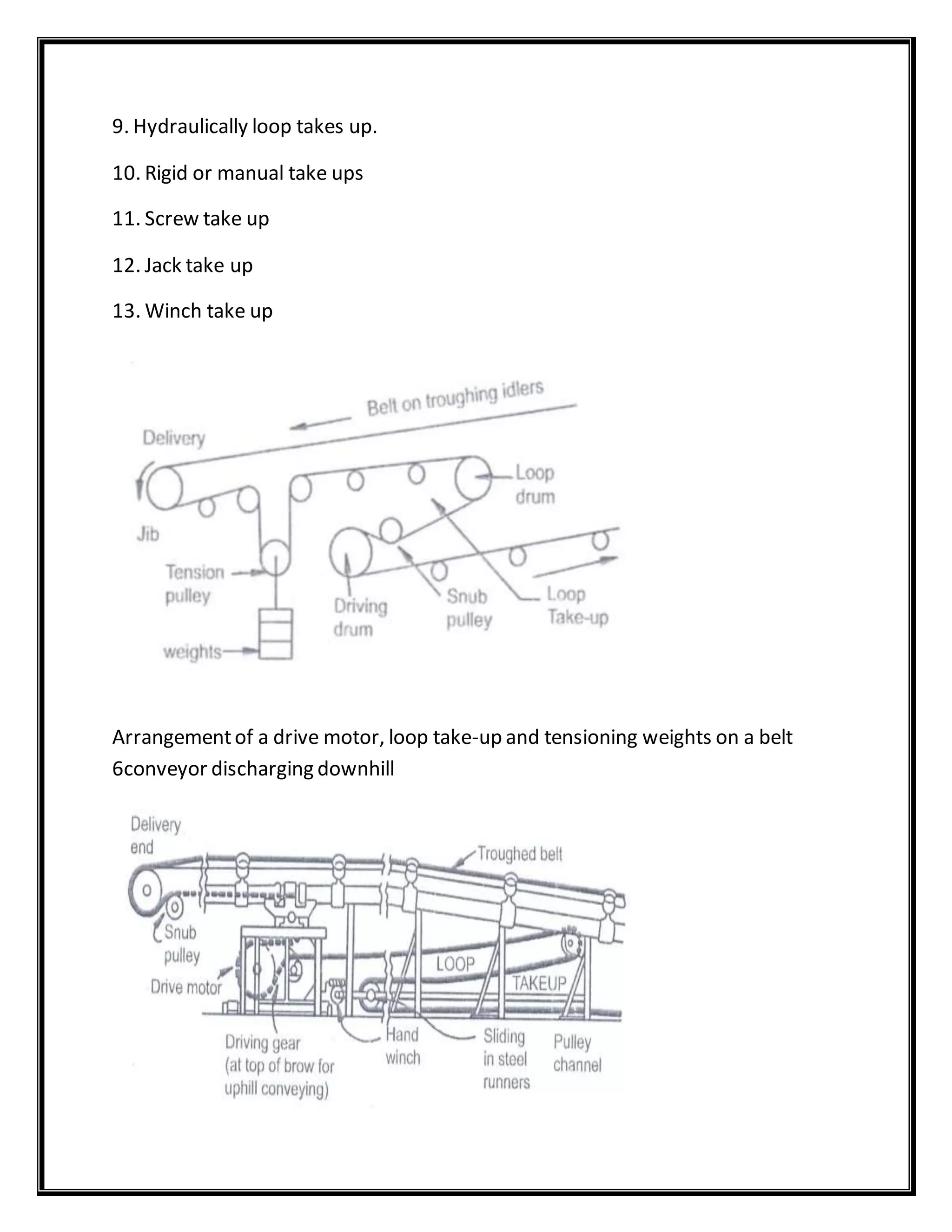
Take- up arrangements (Tensioning device):
Tensioning of the belt is necessary to prevent excessivesagging of the belt or belt
in good contact with the driving drum.
1. Automatic take ups
2. Gravity take ups.
3. Take up pulley with counter weight.
4. Counter weighted loop take.
5. Counterweighted wheel mounted tail end pulley
6. Power take ups
7. Electric motorized winch and load cell loop take up.
8. Pneumatically operated take up
9. Hydraulically loop takes up.
10. Rigid or manual take ups
11. Screw take up
12. Jack take up
13. Winch take up
Arrangementof a drive motor, loop take-up and tensioning weights on a belt
6conveyor discharging downhill
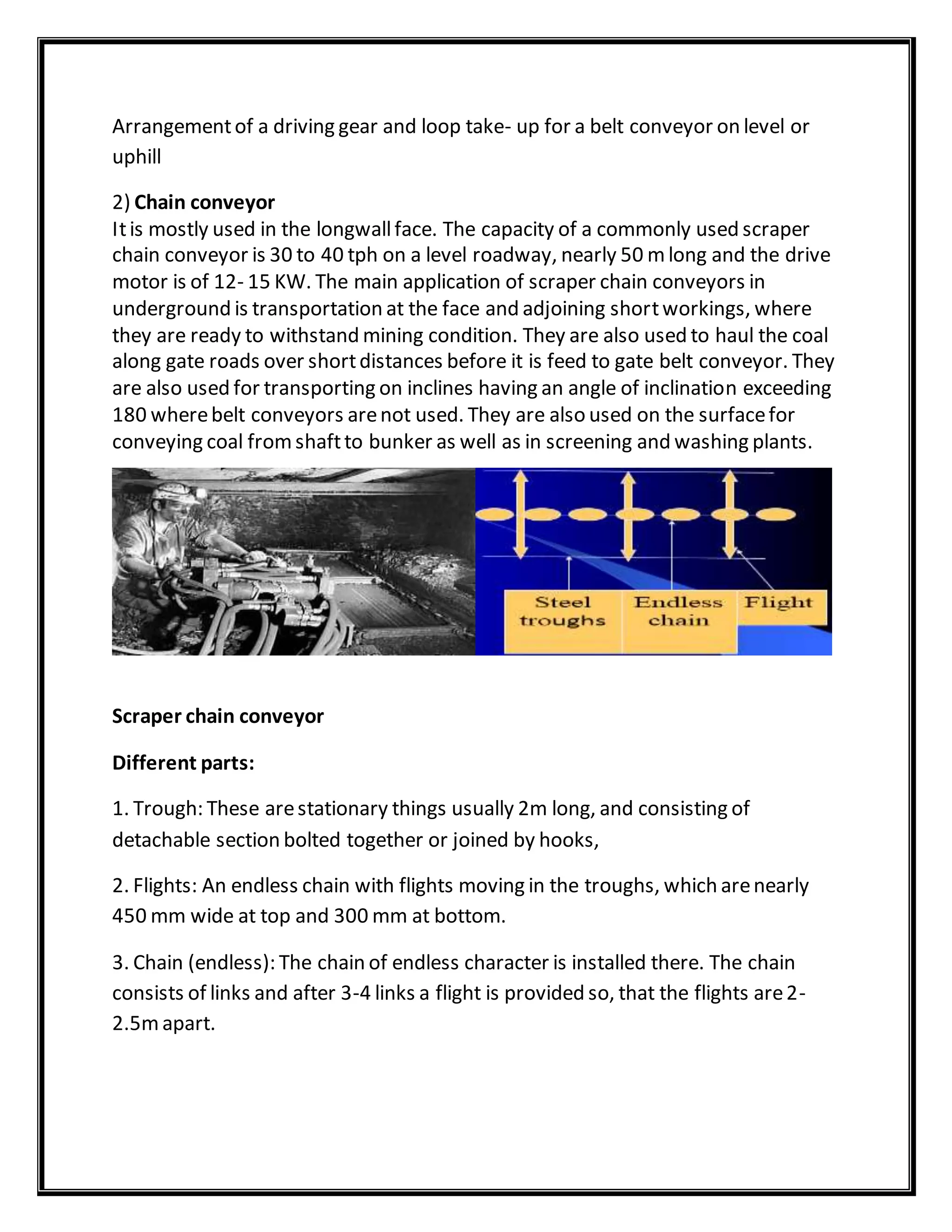
Arrangementof a driving gear and loop take- up for a belt conveyor on level or
uphill
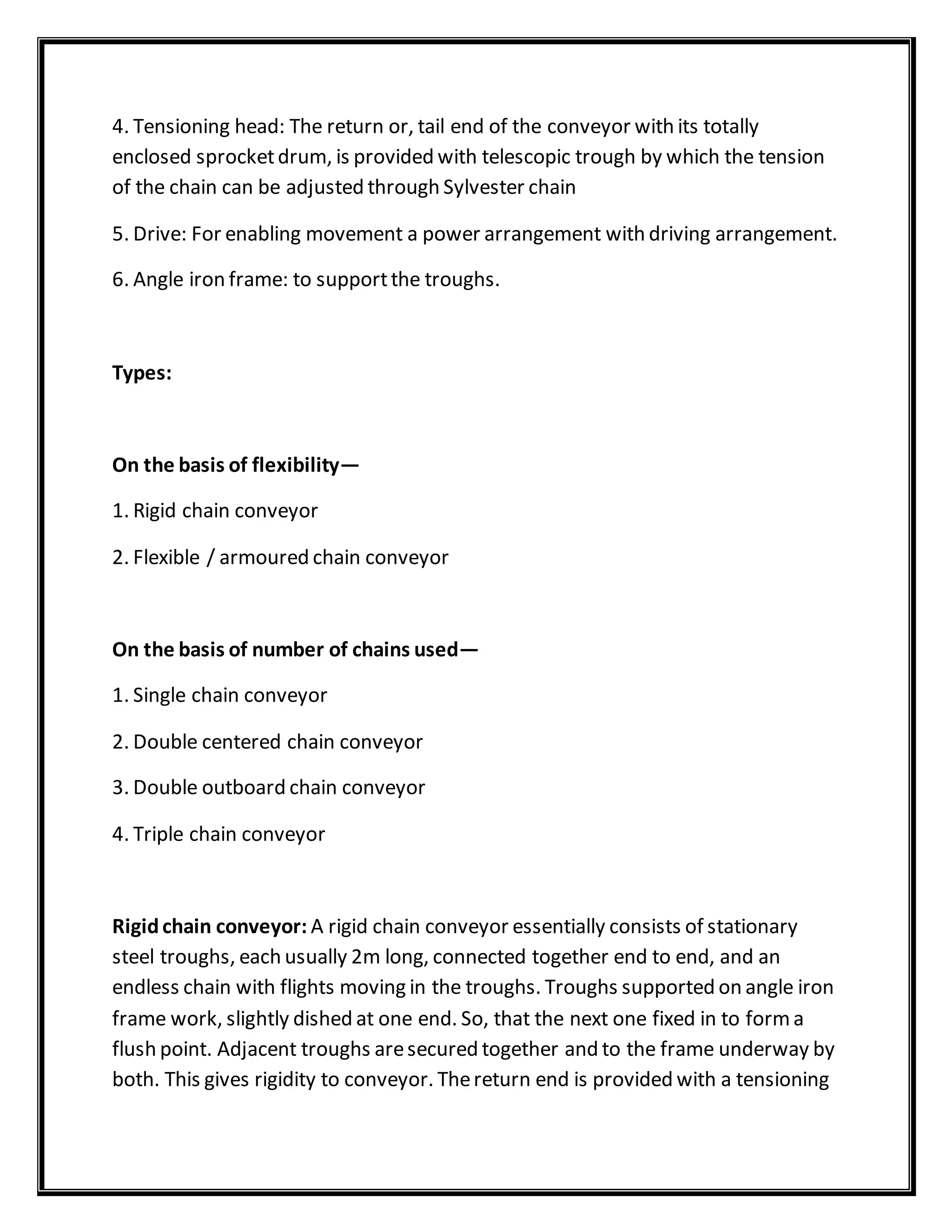
2) Chain conveyor
Itis mostly used in the longwallface. The capacity of a commonly used scraper
chain conveyor is 30 to 40 tph on a level roadway, nearly 50 mlong and the drive
motor is of 12- 15 KW. The main application of scraper chain conveyors in
underground is transportation at the face and adjoining shortworkings, where
they are ready to withstand mining condition. They are also used to haul the coal
along gate roads over shortdistances before it is feed to gate belt conveyor. They
are also used for transporting on inclines having an angle of inclination exceeding
180 wherebelt conveyors arenot used. They are also used on the surfacefor
conveying coal fromshaftto bunker as well as in screening and washing plants.
Scraper chain conveyor
Different parts:
1. Trough: These arestationary things usually 2m long, and consisting of
detachable section bolted together or joined by hooks,
2. Flights: An endless chain with flights moving in the troughs, which arenearly
450 mm wide at top and 300 mm at bottom.
3. Chain (endless): The chain of endless character is installed there. The chain
consists of links and after 3-4 links a flight is provided so, that the flights are2-
2.5mapart.
4. Tensioning head: The return or, tail end of the conveyor with its totally
enclosed sprocketdrum, is provided with telescopic trough by which the tension
of the chain can be adjusted through Sylvester chain
5. Drive: For enabling movement a power arrangement with driving arrangement.
6. Angle iron frame: to supportthe troughs.
Types:
On the basis of flexibility—
1. Rigid chain conveyor
2. Flexible / armoured chain conveyor
On the basis of number of chains used—
1. Single chain conveyor
2. Double centered chain conveyor
3. Double outboard chain conveyor
4. Triple chain conveyor
Rigidchain conveyor: A rigid chain conveyor essentially consists of stationary
steel troughs, each usually 2m long, connected together end to end, and an
endless chain with flights moving in the troughs. Troughs supported on angle iron
frame work, slightly dished at one end. So, that the next one fixed in to forma
flush point. Adjacent troughs aresecured together and to the frame underway by
both. This gives rigidity to conveyor. Thereturn end is provided with a tensioning
arrangement. The capacity is 30- 40 tph on a level roadway, nearly 50mlong and
15KW motor.
Armouredchainconveyor: Used generally on long wall faces, it can be advanced
without dismantling, with hydraulic rams. They can work with lateral or, vertical
undulations, and coal cutting machine and shearers can be mounted on them.
Motor power varies between 30 to 185 KW.Pan width at top varies from750 to
850 mm and pan length from1.3 to 1.8 m. the vertical flexibility of pans is 3-40
and horizontalflexibility is 2-30.Limiting gradient with flights 1 in 1.5 and without
flights 1 in 3.Length may be upto 360 mand capacity is upto 100 tph.
Advantages:
1. Can convey uphill againstrelatively steep (1 in 3 or more) gradient as well as of
downhill gradient.
2. Much stronger and can be roughly handled.
3. Flexible so, as to dismantle, extended or shortened.
Disadvantages:
1. High initial cost.
2. High power consumption
3. Wear and tear more
4. Highly noisy
5. Producing high percentage of fine dust
D) Aerial ropeway
An aerial ropeway is an installation in which transportation of material or men is
effected by moving carriers pulled by ropes suspended abovethe ground.
Types:
On the basis of number of ropes and the mode of transportation, the ropeways
are classified as:
1) Mono-cable Ropeway–the ropeway has a single running endless rope which
both supportand moves the carriers.
2) Bi-cable Ropeway- the ropeway has two fixed track ropes along which the
carriers arehauled by an endless traction rope.
3) Twin-cable Ropeway- the ropeway has two pairs of track ropes to supportthe
carriers and one endless traction rope.
Applicability
Aerial ropeway provides the only economic means of long distance transportover
rough country, hilly and difficult terrain, even it can pass through the congested
areas, marshy lands, nallahs, rivers, forests and importantagriculturalland.
Aerial ropeways havefound wide application in:
1) Transporting and conveying bulk materials between two fixed pts.
2) Aerial dumping of load at any point along the line of route
3) Stocking of materials
4) Dumping of waste materials
5) Transporting of persons in mountainous regions
Advantages:
1) A relatively high transportcapacity (upto 500 t/hr)
2) Regularity of serviceand immunity to all weathers
3) Ability to overcomenatural obstructions (rivers, marshyground etc.)
4) Inherentability to keep the ground freefor other purposes
5) Ability of negotiating steep gradient (70% and over)
6) Possibility of using automation
7) Minimum time lostin transportation
8) Low initial and operating costand shorttime for return on capital
Disadvantages:
1)Fixed location of loading station
2) Susceptibility to damageby string winds.
3) The length of the line and transportcapacity is limited by economic and
technical consideration.
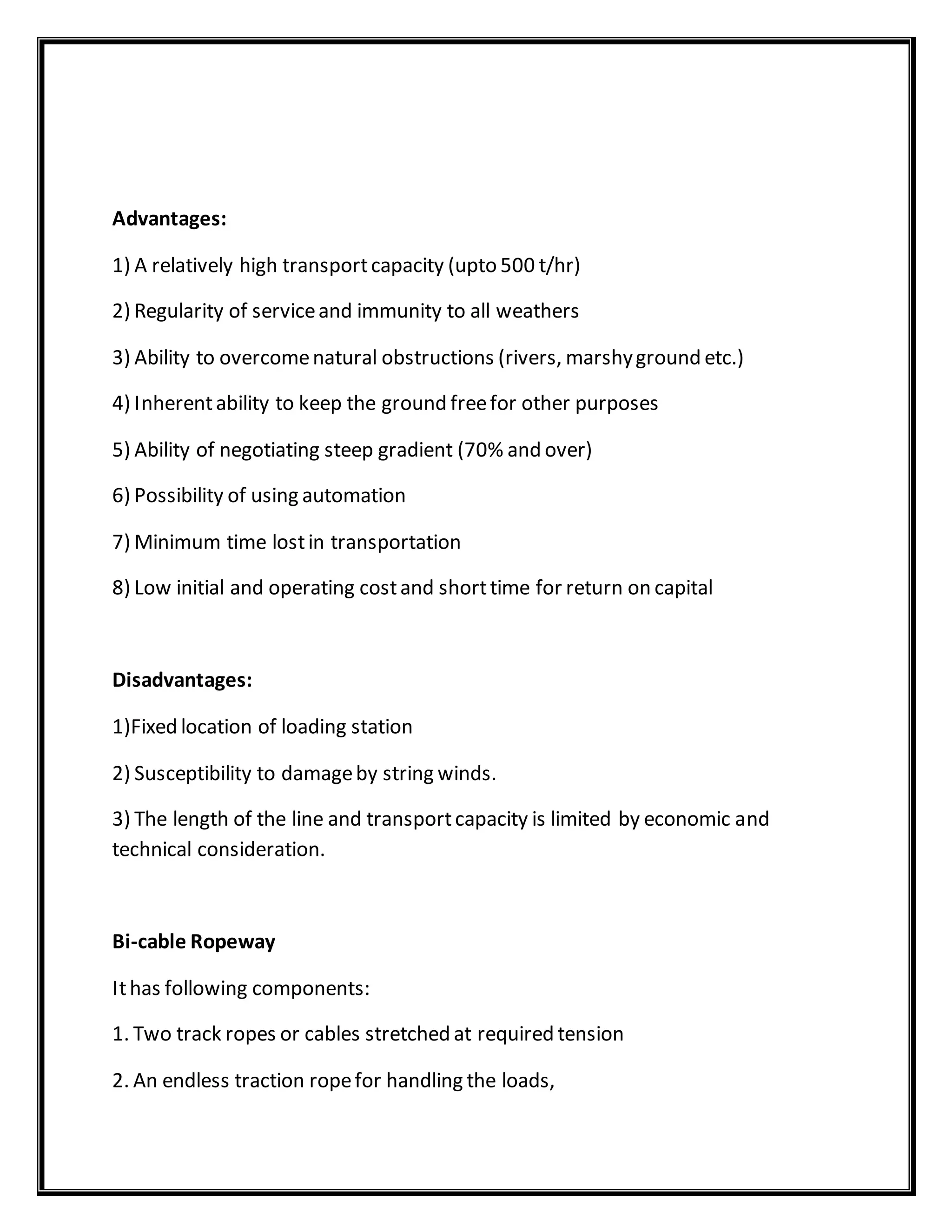
Bi-cable Ropeway
Ithas following components:
1. Two track ropes or cables stretched at required tension
2. An endless traction ropefor handling the loads,
3. Carriers suspended fromthe track ropes and hauled by the traction rope
4.Machinery and other arrangements for loading and unloading carriers,
suspending the track ropes and driving the traction rope.
Bi-cable Ariel ropeway
Scope of applicability and Limitations
a.Bi-cable ropeways aresuitable for capacities 100 to 400 t/hr.
b. lengths up to 6 km in one section of traction rope.
c. For capacities less than 100 t/hr. and distances less than 300 m, bi-cable
ropeway cannotprovidethe desirable economy.
Different parts
Ropes:
Track ropes:
1.Track ropes areusually locked coil ropes made of large sizewires in order to
have longer life.
2. Locked coil ropes provide a smooth surfacefor the movement of carrier wheel
and the surfacewear of it is relatively uniform.
3. The factor of safety for track ropeduring installation should be 3 and must be
withdrawn fromservicewhen it reduces to 2.5.
4. Average life of the rope is 5 to 7 years.
Tractionrope: Traction ropes are Six-strand lang’s lay with fibre core. The rope
diameter varies from12 to 46 mm. The factor of safety should be 5 during
installation and ropes should be withdrawn when it comes down to 4.
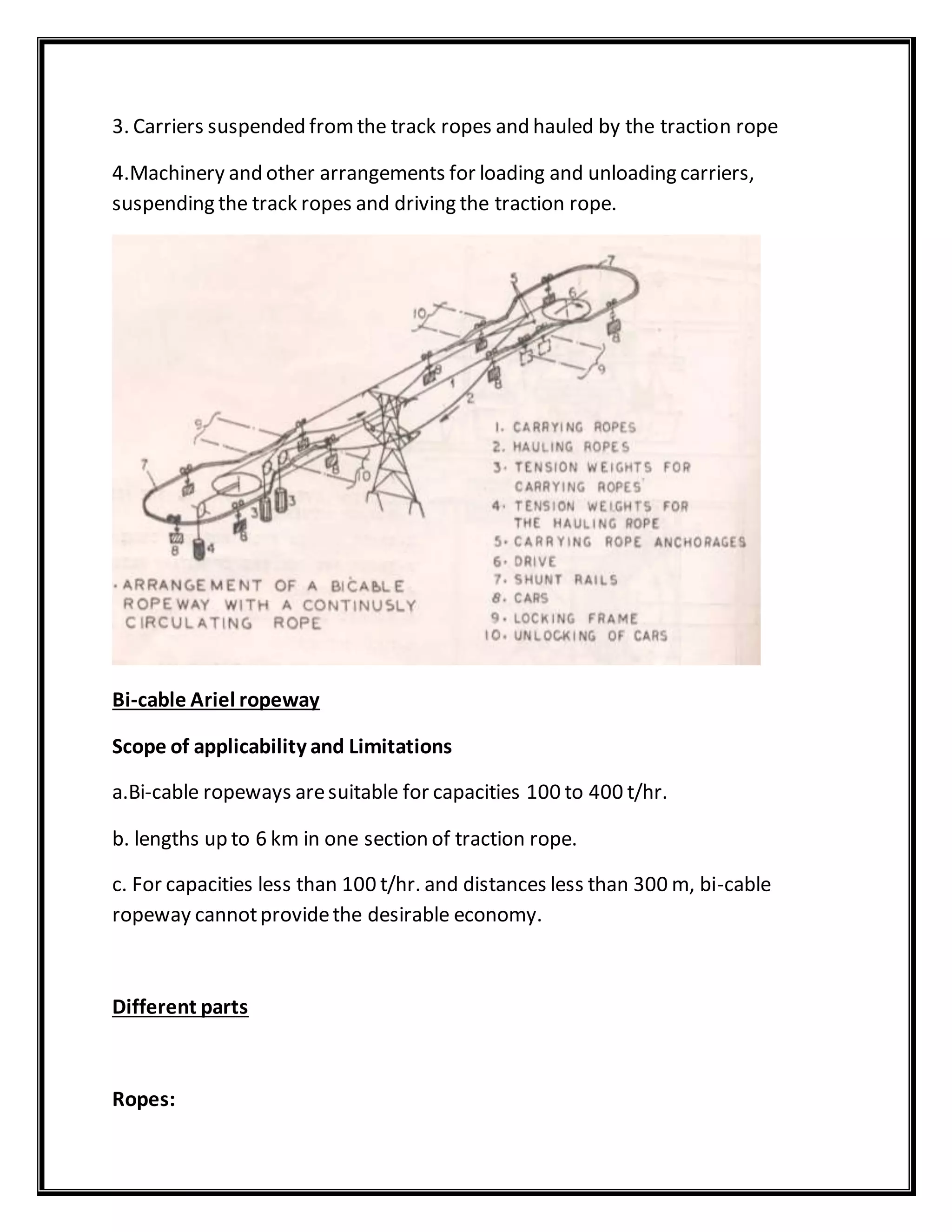
Carriers: A carrier has the carriage, hanger, bucket and grip for traction rope.
Carriageruns on track rope with wheels, and it runs on the track rope, with the
help of wheels (20 – 30 cm/diameter) mounted on it. The number of wheel is 2
for light loads and 4 for medium or heavy loads. The hanger is suspended from
carriageto make its axis vertical. The bucket is supported by the hanger and grip
on carriage. Three types of carriers are commonly used namely rotating carrier,
bottom dischargecarrier and fully enclosed bucket.
Carrier of Bi-Cable Ropeway
Trestles: Thetrestles for bi-cable ropeways providesupportto both the track and
traction ropes. As well as giving necessary profileto the ropeway. Thetrack ropes
rest on the saddles at the top crossbeamand the traction ropeon the sheaves at
the cross beambelow. Trestles are constructed either in steel, reinforced
concrete / timber. The height of the trestles is usually in the shape of a truncated
pyramid. The ht. of the trestles is usually 8 to 12 m on level ground and spaced at
intervals of 100-250 m. Butin a mountainous region, they mustbe as high as 100
m and spaced at 500 mor more. The trestles should be erected on firmground.
Steel trestles of a Bi-cable aerial ropeway
Saddles: These are rolled steel section bent along their longitudinal central line to
allow rope curvatureon the support. The upper part of the saddle is grooved to
accommodate and supportthe track rope. For safety againstunloading of the
rope, the groovedia. should be 1.5 d and the depth of the groove0.8d, whered is
the diameter of the rope.
Stations:
Loading station: Station wherecarriers are loaded are called loading station and
in bi-cable ropeway it is morecomplicated than mono cable ropeway. Atthe
loading stations, the track ropetensioning device is avoided and the end of it is
anchored instead. However the tensioning of the traction rope may be
incorporated. At the entry to station, the carrier leaves the track ropeand rides
on the station rail and while leaving it, rides back on the rope. To facilitate those,
rope deflecting saddles are put at the transition point. The carriers passes through
the arrangementof releasing and gripping of the traction rope movement of the
carrier is controlled manually or by running chain at automatic station.
Unloading station: Itis the discharged end of the rope way. The unloading station
should be sufficiently high enough above the ground level to make possible
unloading by gravity.
Intermediate station: When a bi-cable ropeway has morethan one section,
intermediate stations are provided where it passes fromonesection to another.
Arrangements arethere for tensioning.
Angle station: When it is not possibleto take a straight line route, angle station
are provided to change the direction of route. Here the track ropes of adjacent
arms terminate by means of anchorage or tensioning arrangement.
Chapter 2
Winding In Shaft
Questions :-
1) Compare cage winding with skip winding.
2)Explain:
(i) Triangular distribution plate.
(ii) Briddle chain
(iii) Head gear pulley
(iv) Depth indicator
3) What are the different methods of balancing torque on the winding drum.
Describe bi-cytendroconical drum for winding and state how it helps in
balancing torque.
4)Explain Davies improved Kep gear with neat sketch.
5)Explaininterlockingwedge type capelwithneatsketch.
6) Write the functionof safetyhook.
7) Compare drum windingwithkoepe winding.
8) Explain:
(i) Factor of safety
(ii) Angle of fleet
9) Explain Headgear pulley.
10) What do you mean by Automatic contrivances.
11)List the varioussafetydevicesusedinwinding.Explainanyone.
130Differentiate Rigidguide withFlexible guide.
WINDING:-
The Purpose of Winding is to
1) Hoist the coal or mineral fromunderground to surface.
2) Lowering & rising of men.
3) Transportthe material fromsurfaceto underground
4) Winding is a transport system from surface to underground through shaft
when the mine is dip. It is more or less same as we see a lift in a multiplex
building.
Mainequipment’s usedfor Winding:-
1) Headgear
2) Pulley (headgear pulley)
3) Cage
4) Skip
5) Winding rope
6) Winding drum
7) Guides
8) Keps
9) Suspension gear
10) Electrical motor
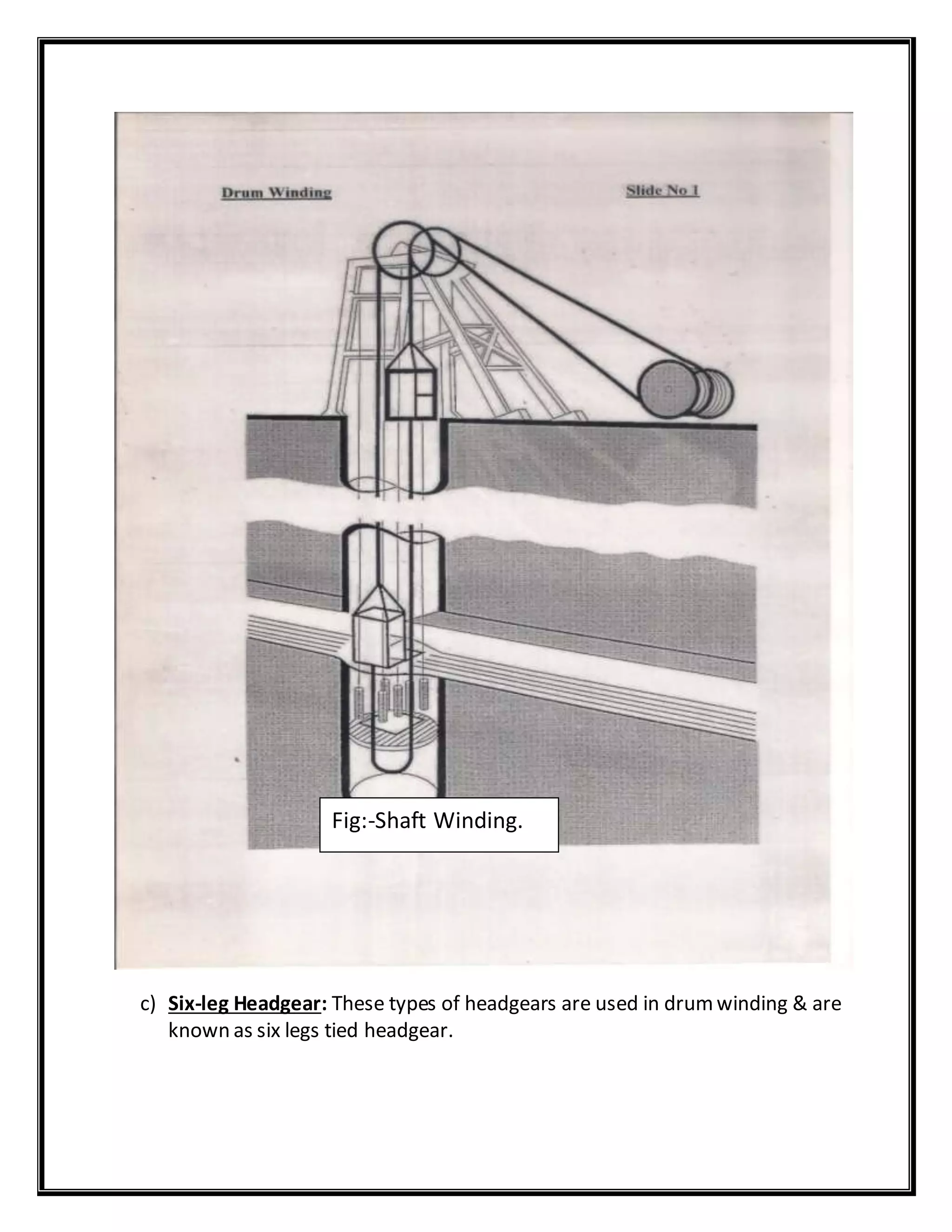
1) Headgear: It is a steel or concrete framework on the mouth of the shaft. The
purposeof headgear is to:-
a) Supportthe headgear pulley, the weight of cage, ropes & rope guides.
b) Guide the cage to banking level.
 The headgear consists of four girders inclined towards the centre of the
shaftat an inclination of1 in8 to 1 in10.
 A network of steel girders joins these four girders to each other. Two real
legs situated towards the winding engine room are connected to the
headgear to prevent its building. This rear legs are also used as ladder way.
 Two headgear pulleys are installed at the top of the headgear & a bell plate
is installed below the headgear pulley.
c) Six-leg Headgear: These types of headgears are used in drumwinding & are
known as six legs tied headgear.
Fig:-Shaft Winding.
d) Four-leg Headgear: This type of headgear is used in friction winding. The
construction is same as that of six-leg type headgear but only the difference
is that it does not havetwo rear legs.
e) Two-leg Headgear: It consists of only two legs inclined towards the shaft.
The headgear pulley is installed on a cross member mounted between two
legs. This type of headgear is not used.
Designof Headgear depends on following parameters
1) Total Static Loads:Weight of cage, rope, pulley, guide rope, tub & mineral.
2) Rate of acceleration & retardation
3) Maximum velocity.
4) Depth of shaft
5) Diameter of shaft
6) Size of cage/Skip
7) Wind pressure.
Heights of Headgear depends on
1) Banking level
2) Height of the cage
3) Cage suspension gear
4) Diameter of headgear pulley
5) Inspection platform
Height of a Headgear
Sr. No. Name of attachment Cage inmeter Skip inmeter
1. Height of cage/skip 1.8 to 6 1.8 to6
2. Suspension gear 3 to 4.5 3 to 4.5
3. Height of banking level 4.5 to 6 6 to 8
4. Over winding distance 1.8 to 7.2 1.8 to7.2
5. Diameter of winding pulley 3.6 to 7.2 3.6 to7.2
6. Inspection platform 3.6 3.6
18.3 to 30.9 19.8 to 32.9
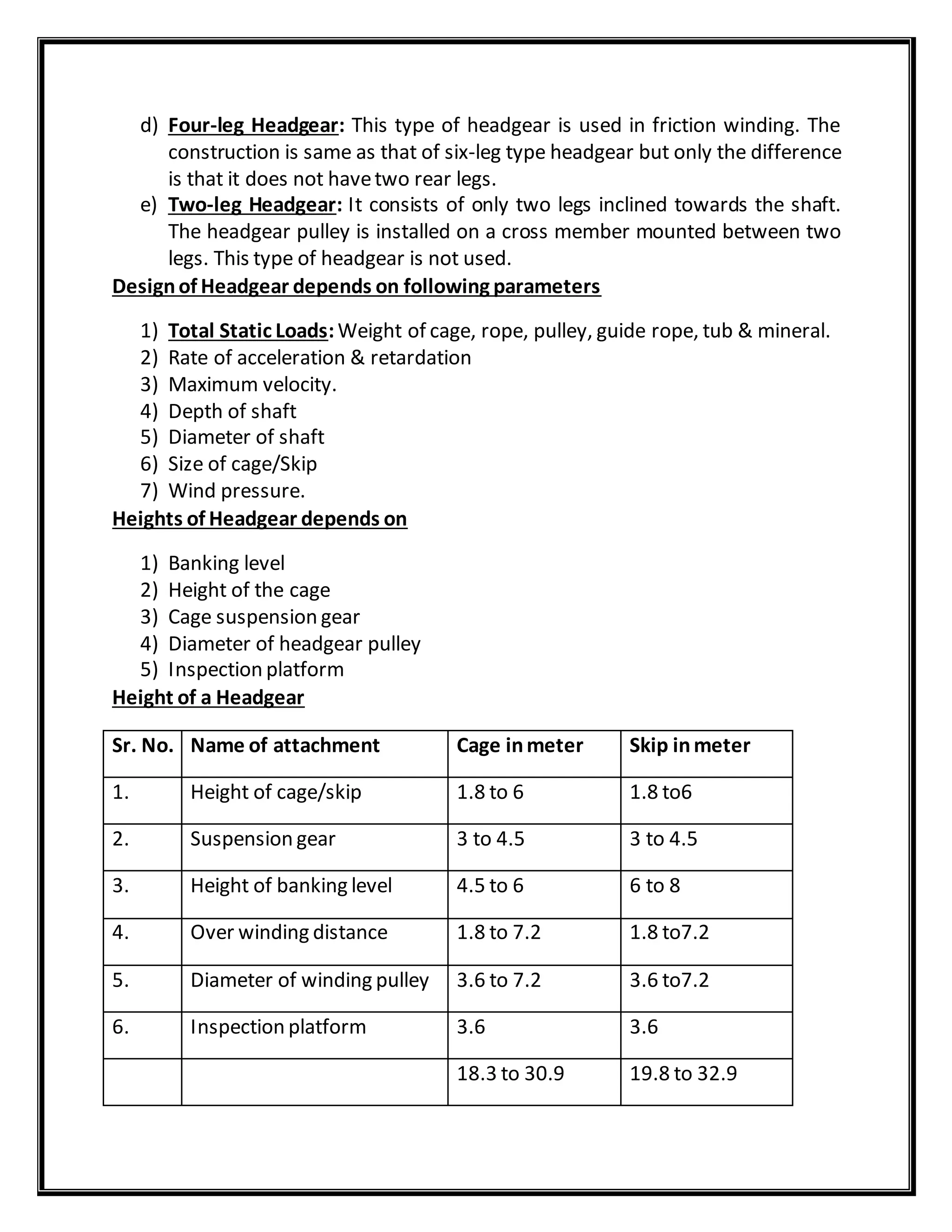
Image reference google images
2) Headgear Pulley: It is made up of hard steel. Its construction should be
such that its weight is less. Its diameter should be such that it should
minimise the bending stresses in the rope.
Generally its diameter is 100 to 120 times diameter of the rope. The
large size pulleys are made in two parts& bolted together.
The groove is made of renewable soft steel & its diameter should be 110% of the
ropes diameter for stranded ropes & 105% for locked coil ropes.
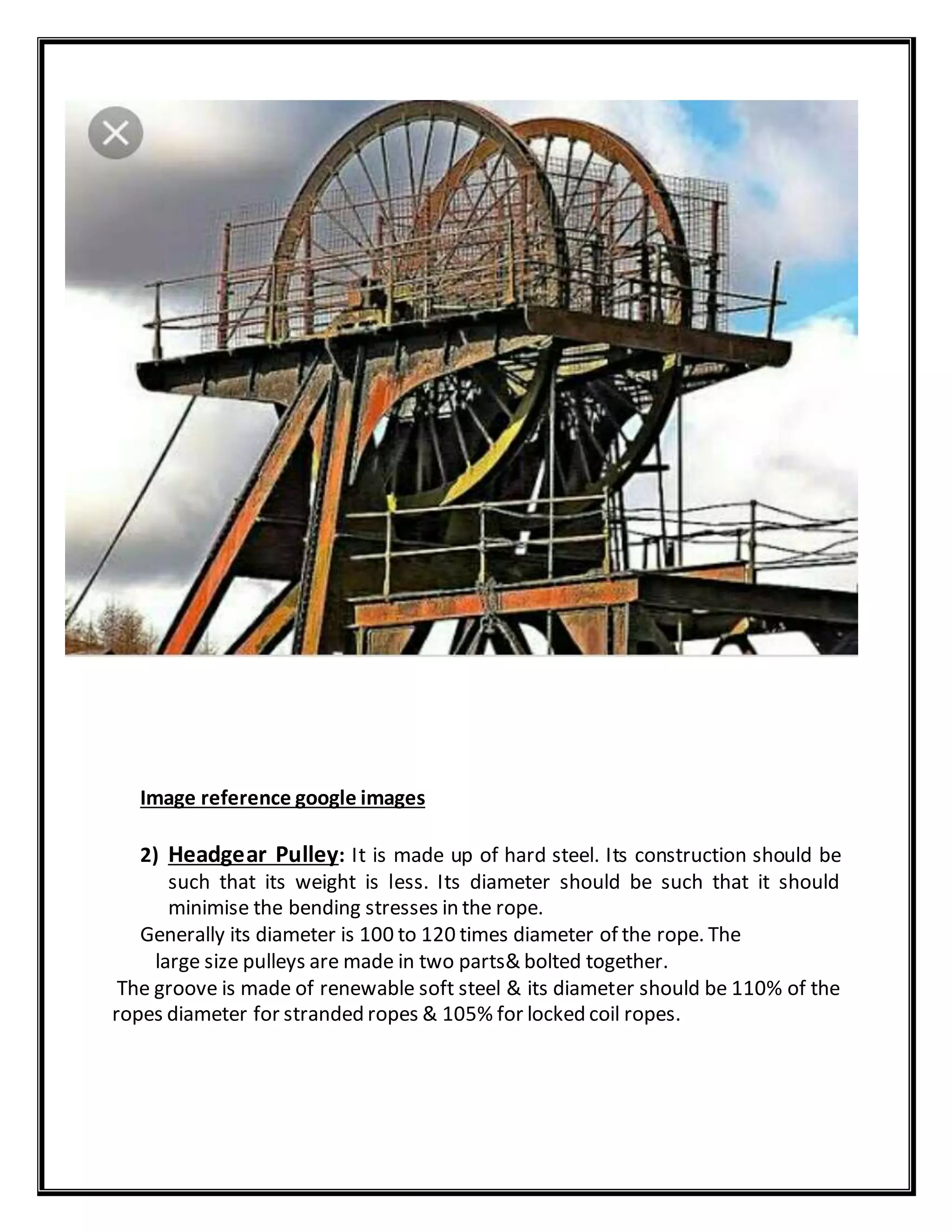
3) Cage: It is a lift like structure suspended from winding rope by means of
suspension gear arrangement. It is used for the transportation of men &
materials. It is made up of steel & very strong in construction. A track is
provided on the floor with catches to prevent the movement of the tubs. It
is open with two sides & provided with collapsible door. Man travelling in
the cage provides a hand bar on the sides for holding. The types of cage are
as follows:
a) Single deck single cage (only one tub).
b) Tandem cage – two tubs or more in one cage.
c) Double deck single cage (one tub on each floor).
d) Double deck tandem cage (two or more tubs on each floor).
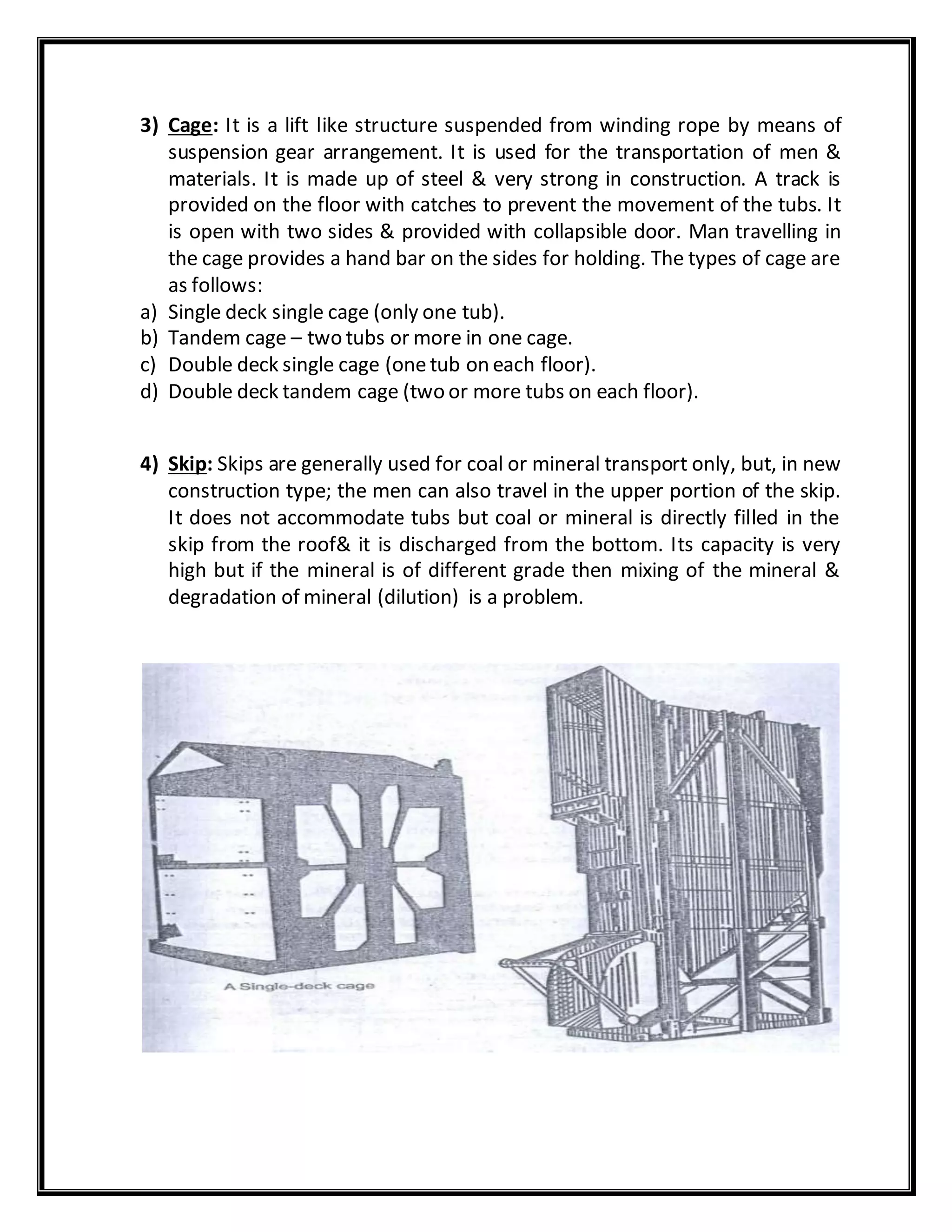
4) Skip: Skips are generally used for coal or mineral transport only, but, in new
construction type; the men can also travel in the upper portion of the skip.
It does not accommodate tubs but coal or mineral is directly filled in the
skip from the roof& it is discharged from the bottom. Its capacity is very
high but if the mineral is of different grade then mixing of the mineral &
degradation of mineral (dilution) is a problem.
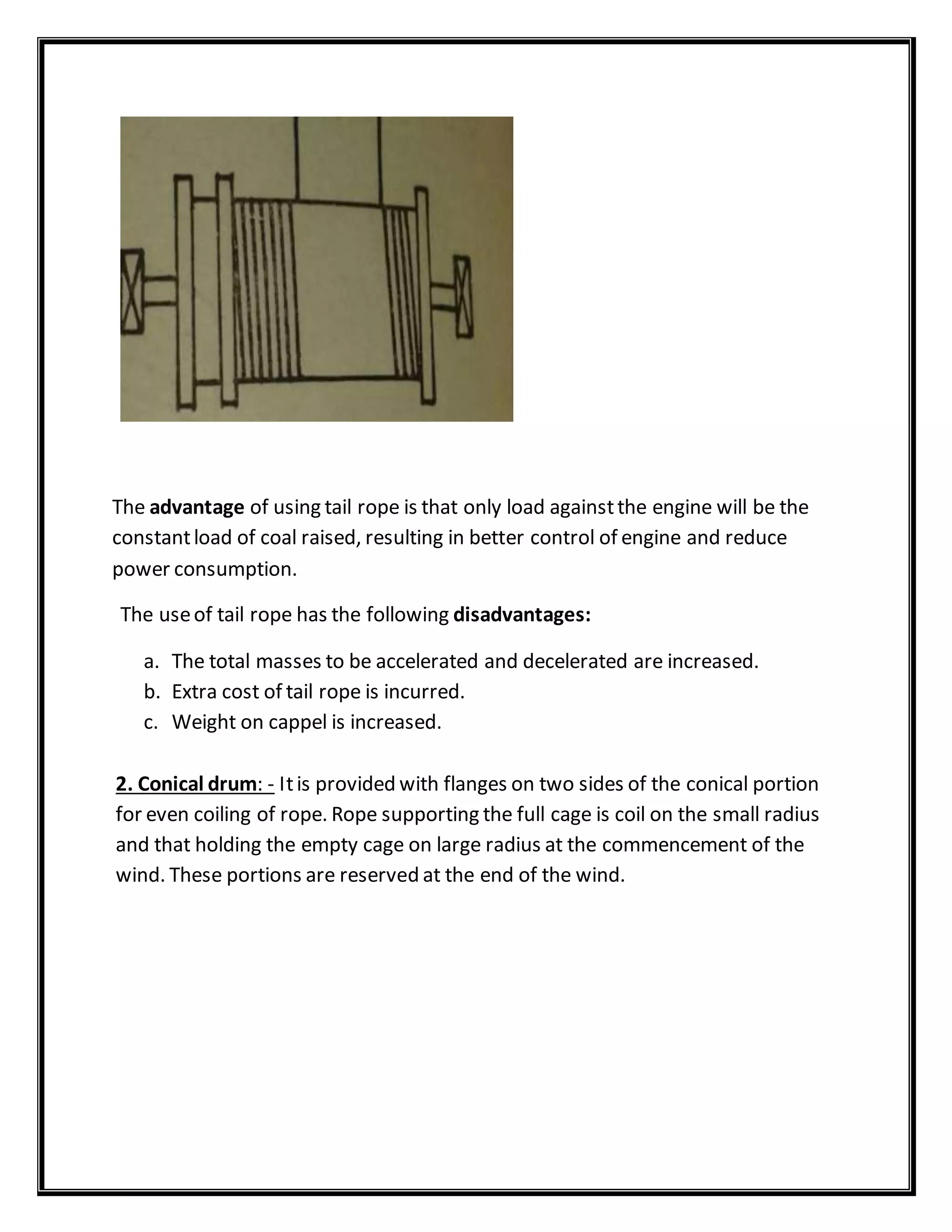
Que. Cage vs. Skip
Cage Skip
1. Ittravels in vertical plane only.
2. Suitable for men & material
transport.
3. Suitable for shallow depths.
4. High headgear is not required.
5. More Manpower is required for
handling of tubs.
6. Suitable for multilevel /multideck
winding.
7. Itcannot be fully automatic.
8. Landing at decking level is
difficult.
9. Low production is obtained.
10.More safe.
11.Itdoes not lead to mixing of
different gradeof ore as
transported by tubs.
1. Ittravels in vertical plane as well
as inclined plane.
2. Suitable for material transport.
But recently men winding is also
possible.
3. Suitable for greater depths.
4. High headgear is required.
5. Less Manpower is required.
6. Not suitable for multilevel
/multideck winding.
7. Itis fully automatic.
8. Landing at decking level is easy.
9. High production is obtained.
10.Safer than Cage.
11.Itmay lead to mixing of different
grade of ore.
5) Winding Ropes:-
Type of Winding Ropes: A rope, which is used for winding, is generally a stranded
rope, fibre core & Lang’s lay construction. This type of rope is having more
flexibility & smooth external surfacethis reduces the wear & tear of the rope.
6) Winding Drum
Drum profile: -The power required for winding resulted in the use of various
drum profiles or shapes in order to afford the efficient design there are four
different shapes of drum used in India these are
1. Cylindrical drum.
2. Conical drum.
3. Cylindro-conical drum.
4. Bi-cylidroconicaldrum.
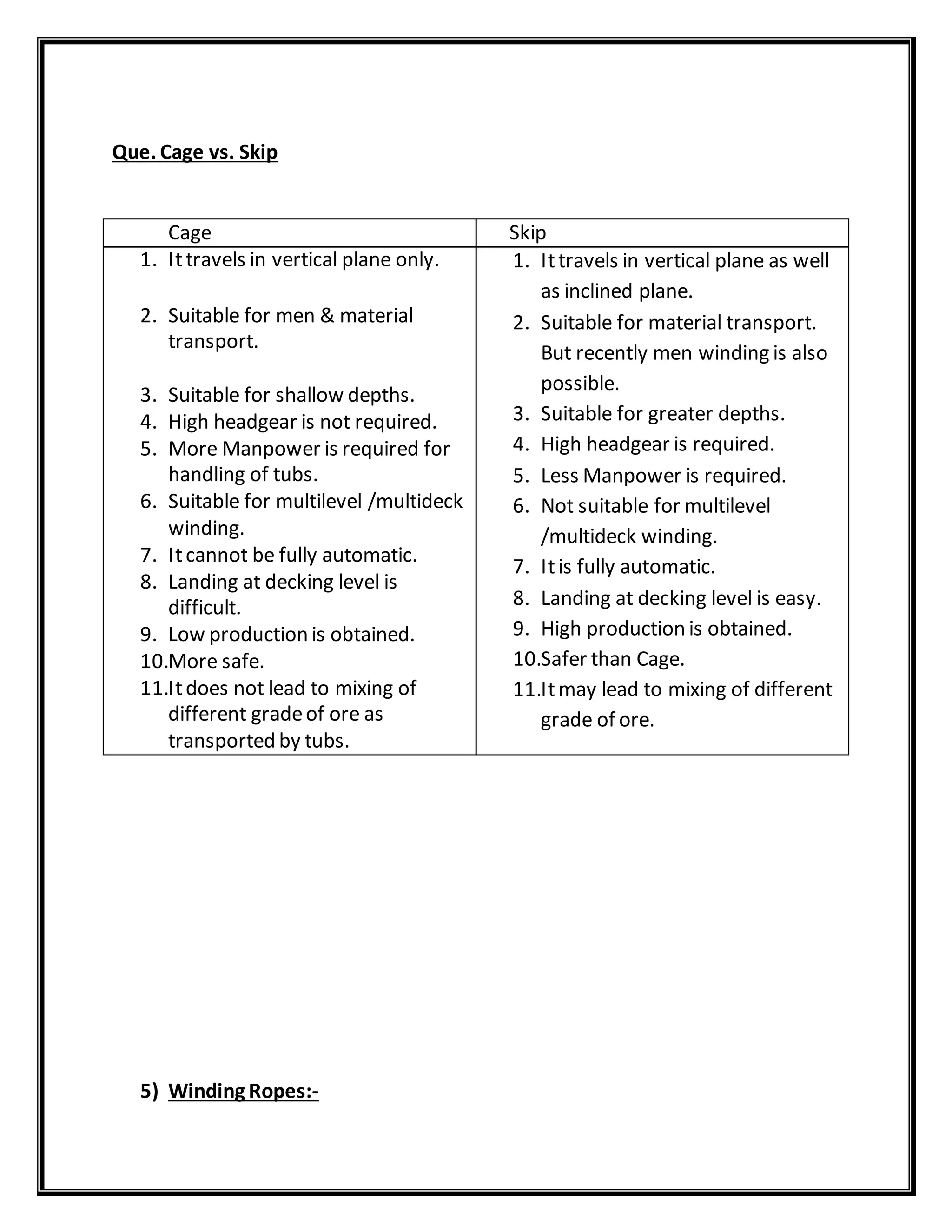
1. Cylindrical drum: - A cylindricalor parallel drumis a simple and robustin
construction. The winding ropes are attached at each end of the drumbarrel, and
arrangeto coil on the drum in the oppositedirection, so that when the drum
rotates one cage will be raised and the other lowered. The rope coiling
underneath the drumis called under lap and the rope coiling over the top of the
drumis the overlap. Itmay be either grooved or plain. Its serious drawback is
that it can be used for shallow shaftonly. In winding fromdeep shaft, the weight
of one winding rope will exceed the weight of coal raised per wind. Thus there
will an excessive load on engine when starting and negative load towards the end
of the wind causing heavy brakewear. This unbalancing of load in cylindrical
drums can be reduced by tail ropes.
The advantage of using tail rope is that only load againstthe engine will be the
constantload of coal raised, resulting in better control of engine and reduce
power consumption.
The useof tail rope has the following disadvantages:
a. The total masses to be accelerated and decelerated are increased.
b. Extra cost of tail rope is incurred.
c. Weight on cappel is increased.
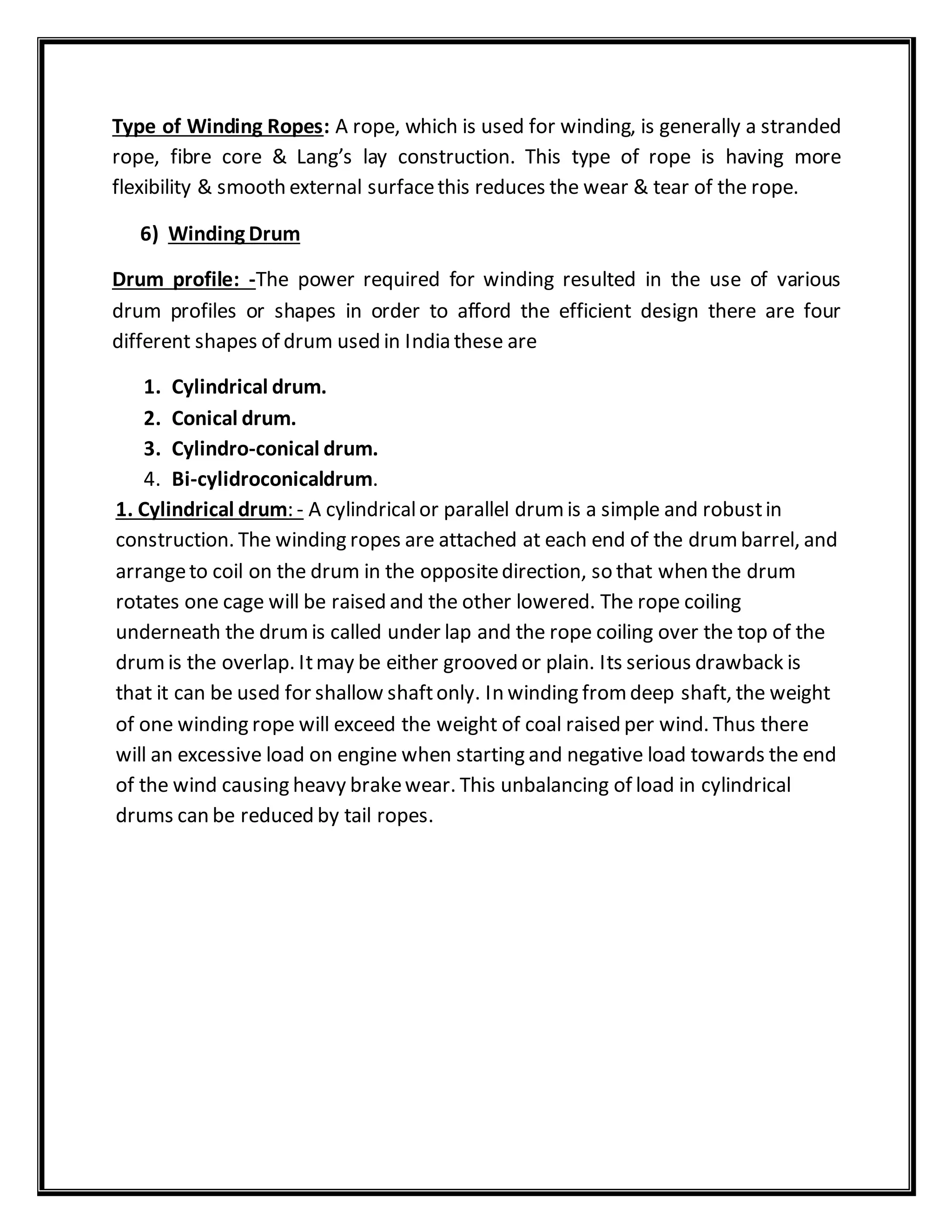
2. Conical drum: - Itis provided with flanges on two sides of the conical portion
for even coiling of rope. Rope supporting the full cage is coil on the small radius
and that holding the empty cage on large radius at the commencement of the
wind. These portions are reserved at the end of the wind.
A conical drumhas the following advantages:-
a. No tail rope is required.
b. At the commencement of wind, torque againstengine, leaving the engine
to accelerate the moving masses and to overcome friction.
c. At end of wind, instead of negative load there will be a positive load
because the descending rope has now come on small diameter, reducing
its toque while the ascending rope is on large diameter and its torque
correspondingly increases.
The disadvantageof conical drum is that only the half width of drum can be used
for coiling at each rope. Hence for deep shaft a huge size of drum will
berequiredwhich may proveprohibitive proposition
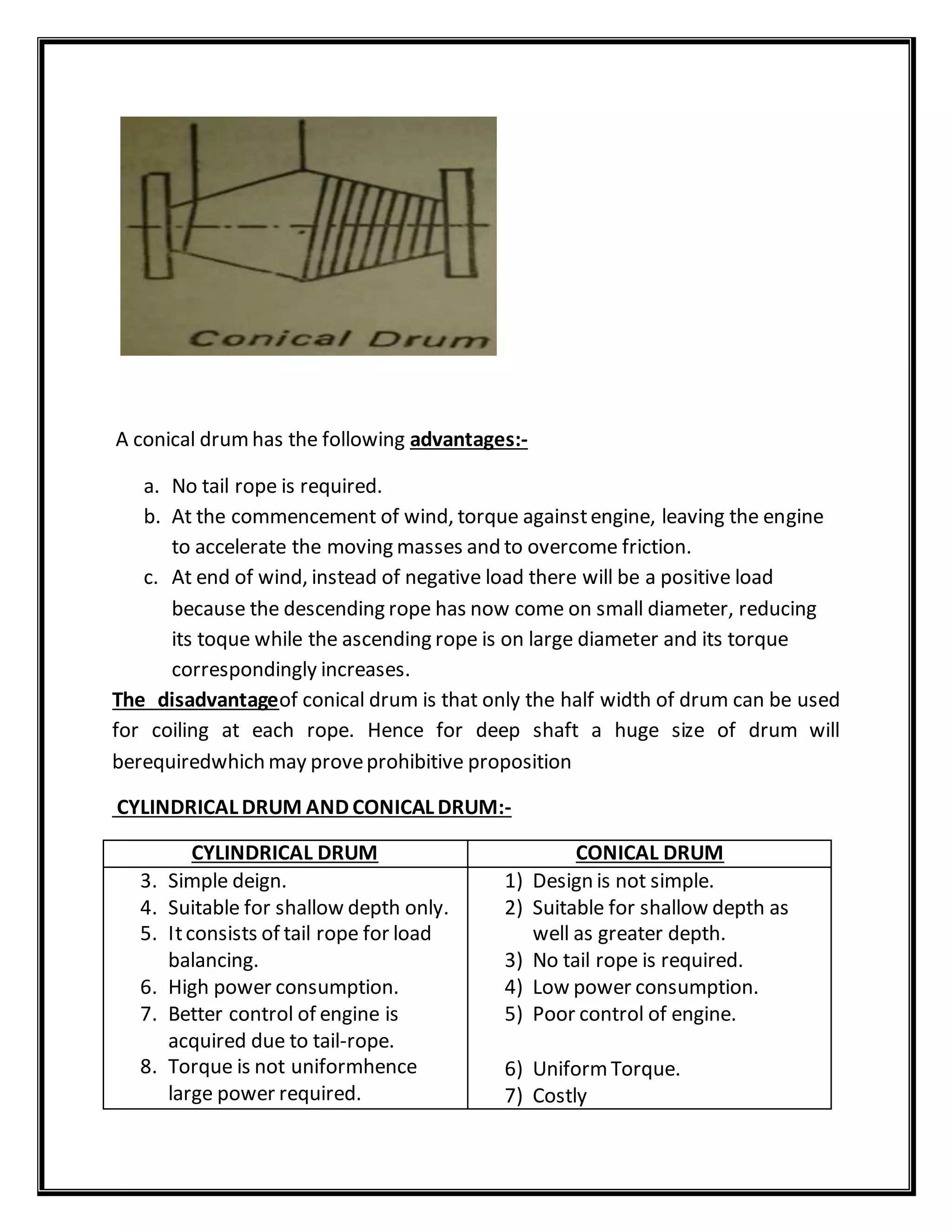
CYLINDRICAL DRUM AND CONICAL DRUM:-
CYLINDRICAL DRUM CONICAL DRUM
3. Simple deign.
4. Suitable for shallow depth only.
5. Itconsists of tail rope for load
balancing.
6. High power consumption.
7. Better control of engine is
acquired due to tail-rope.
8. Torque is not uniformhence
large power required.
1) Design is not simple.
2) Suitable for shallow depth as
well as greater depth.
3) No tail rope is required.
4) Low power consumption.
5) Poor control of engine.
6) UniformTorque.
7) Costly
9. Cheaper than Conical drum.
10.Multilevel winding is possible.
8) Multilevel winding is not
possible.
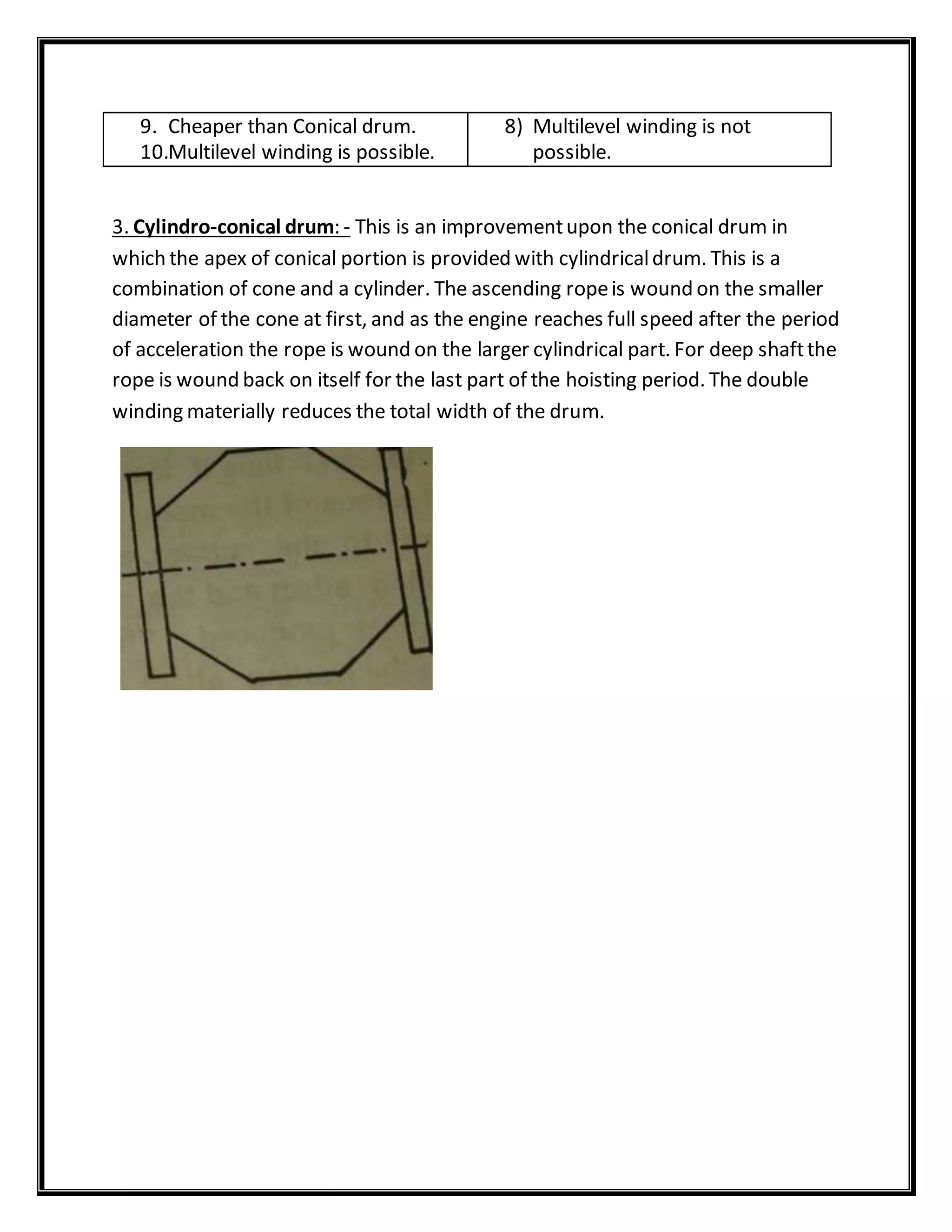
3. Cylindro-conical drum: - This is an improvementupon the conical drum in
which the apex of conical portion is provided with cylindricaldrum. This is a
combination of cone and a cylinder. The ascending ropeis wound on the smaller
diameter of the cone at first, and as the engine reaches full speed after the period
of acceleration the rope is wound on the larger cylindrical part. For deep shaftthe
rope is wound back on itself for the last part of the hoisting period. The double
winding materially reduces the total width of the drum.
A cylindro-conicalhas the followingadvantages
a. The conical section improves the balance of the systemat the beginning of
the wind when the difference between the static torques due to
suspended load is greatest.
b. The parallel or cylindricalsection provides for additional spacefor coiling of
ascending rope, provided that the fleet angle ratio is less than 1 in 40.if the
condition is not obtained, additional capacity of ropes on parallel portion
can be provided by fitting a centre plate to the drumand adopting double
layer coiling
The main disadvantagesarethatthe design is not so simple and the operation is
not so smooth.
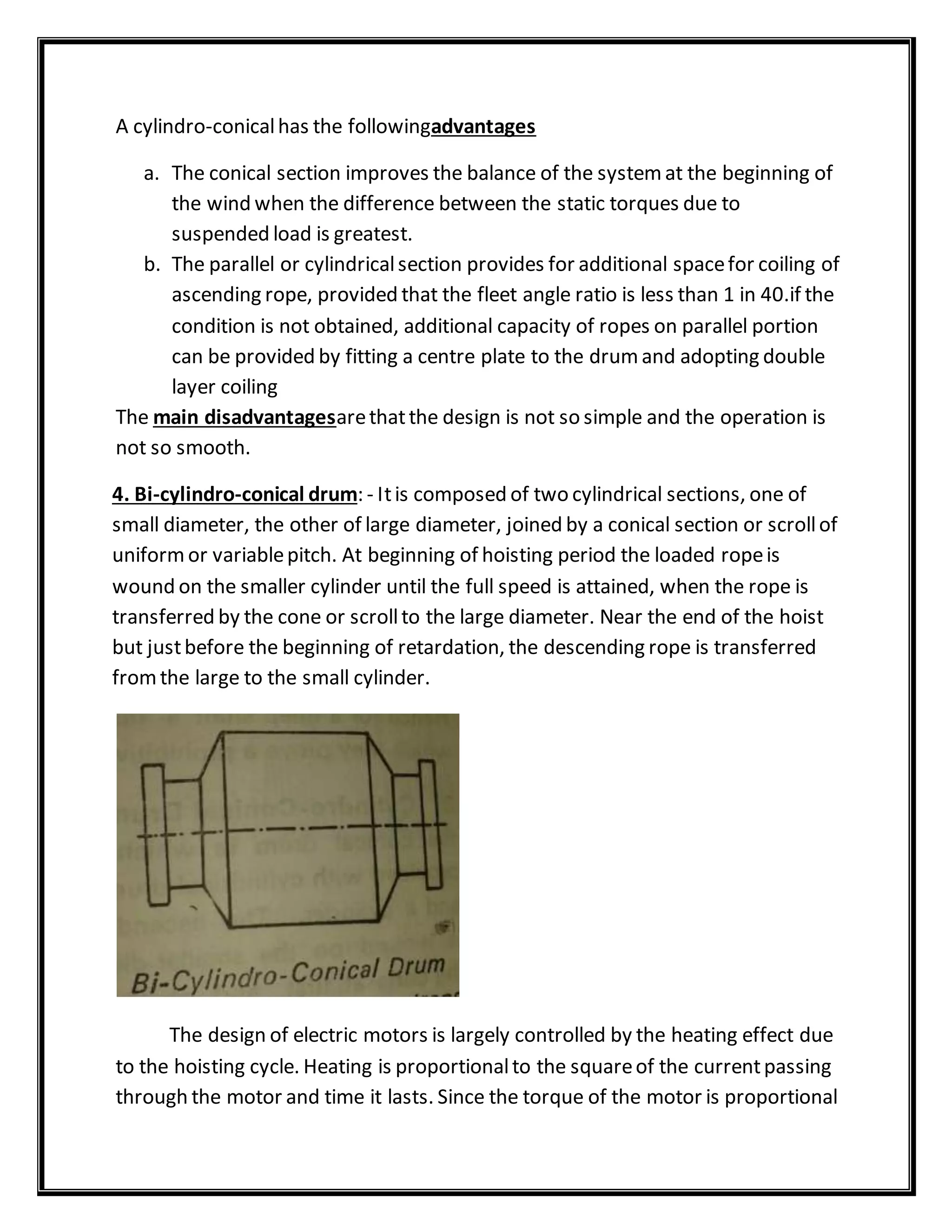
4. Bi-cylindro-conical drum: - Itis composed of two cylindrical sections, one of
small diameter, the other of large diameter, joined by a conical section or scrollof
uniformor variablepitch. At beginning of hoisting period the loaded ropeis
wound on the smaller cylinder until the full speed is attained, when the rope is
transferred by the cone or scrollto the large diameter. Near the end of the hoist
but justbefore the beginning of retardation, the descending rope is transferred
fromthe large to the small cylinder.
The design of electric motors is largely controlled by the heating effect due
to the hoisting cycle. Heating is proportionalto the squareof the currentpassing
through the motor and time it lasts. Since the torque of the motor is proportional
to the current, the high starting torque entails a strong heating effect and the
motor mustbe large to properly dissipatethe heat produced.
A bi-cylindro-conicaldrumhas the following Advantages:-
a. The bi-cylindro-conicaldrums serves to keep the heating effect of hoisting
cycle below that of the cylindricaldrum.
b. Itreduces the peak load on the motor and lands itself better than any other
type of drumto a moredefinite control of torque especially during the starting
torque.
A bi-cylindro-conicaldrumsuffers fromthe following Disadvantages:-
a. Itis heavier and moreexpensive than a cylindrical drum.
b. Itcannot be used for multi-deck cages for simultaneous decking.
c. For deep winding the drumsizebecomes excessive.
d. Rope lying on conical portion may occupy more space than parallel sided
drumand they may causetrouble due to angle of fleet.
Provisions of Winding Drums
1) Flanges.
2) Depth indicator.
3) Mechanical brakes.
4) Automatic contrivance.
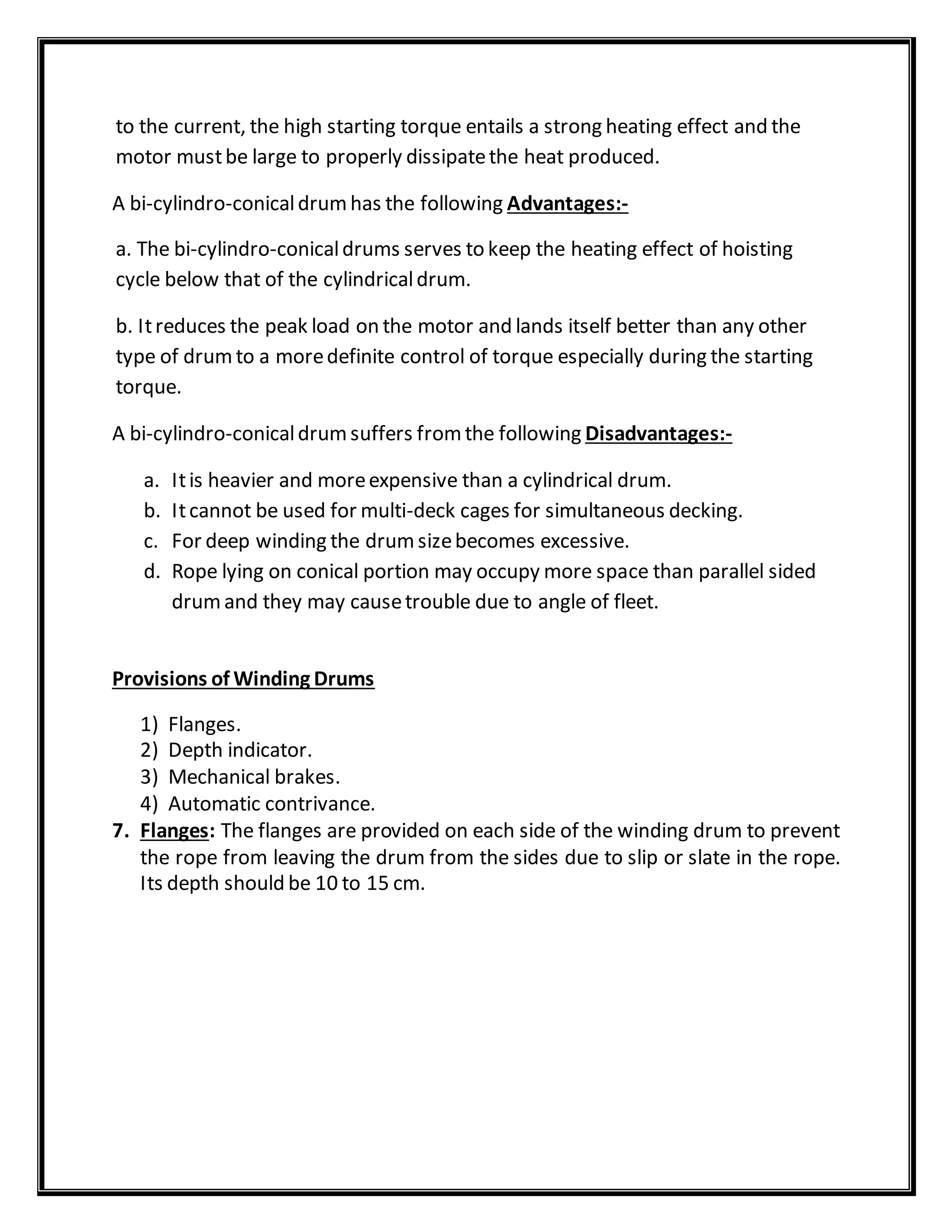
7. Flanges: The flanges are provided on each side of the winding drum to prevent
the rope from leaving the drum from the sides due to slip or slate in the rope.
Its depth should be 10 to 15 cm.
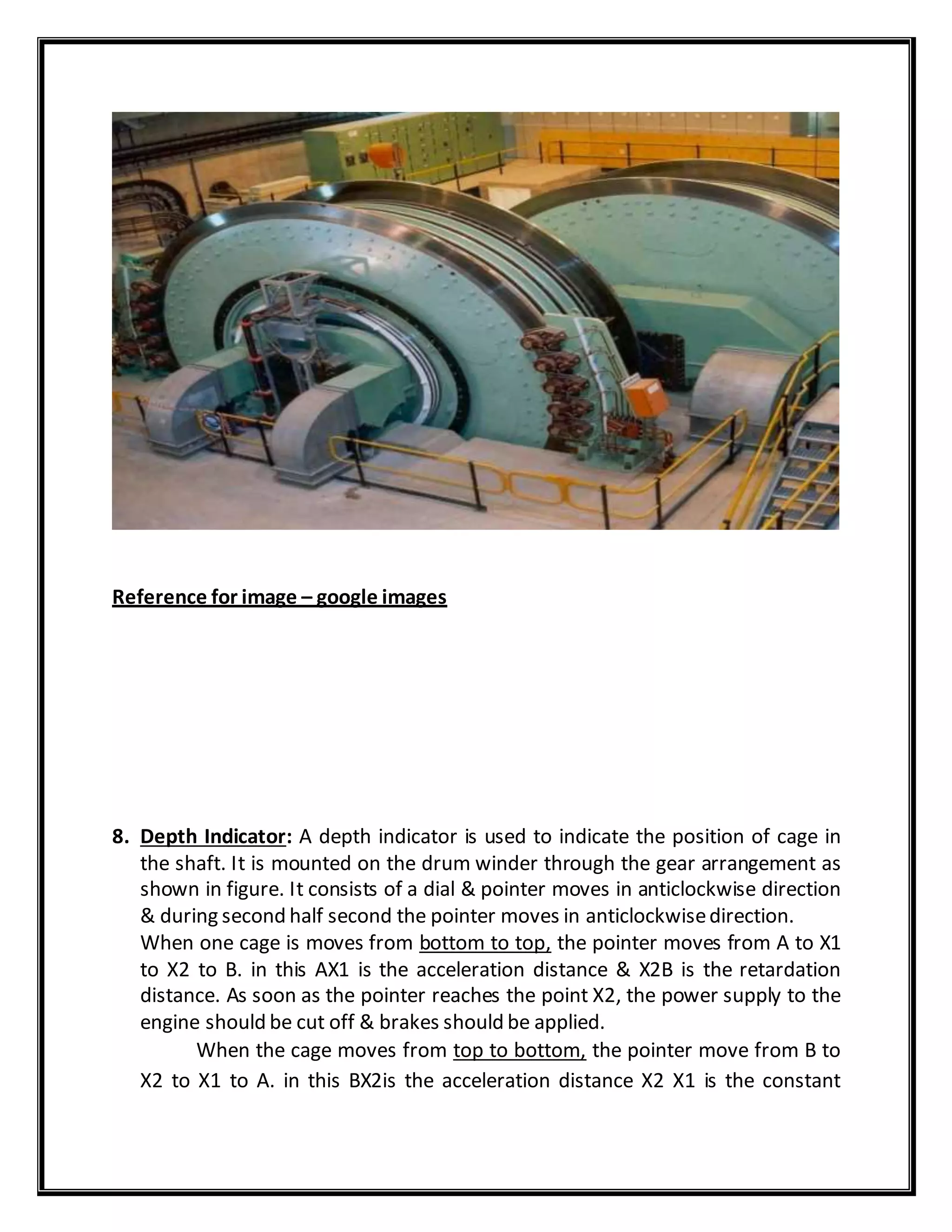
Reference for image – google images
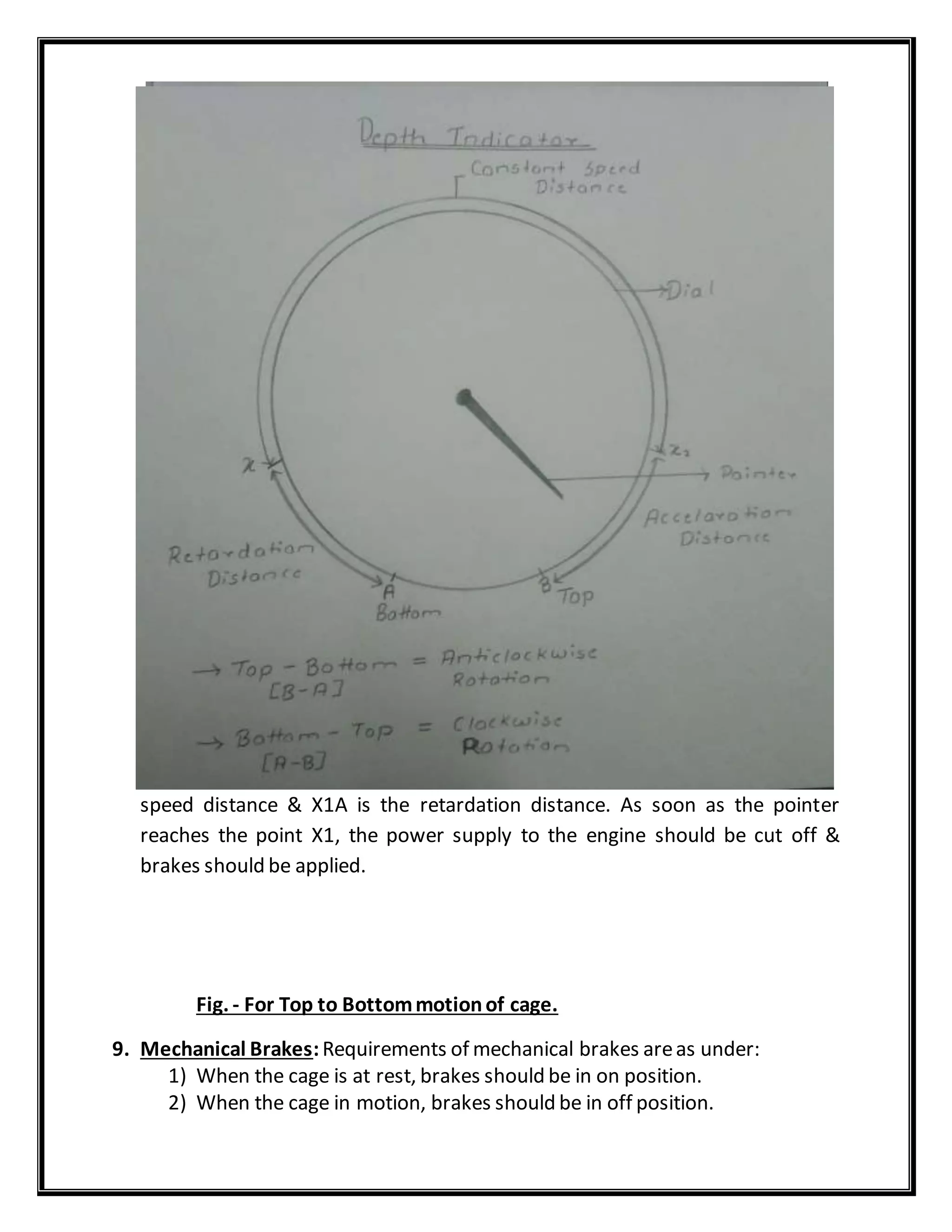
8. Depth Indicator: A depth indicator is used to indicate the position of cage in
the shaft. It is mounted on the drum winder through the gear arrangement as
shown in figure. It consists of a dial & pointer moves in anticlockwise direction
& during second half second the pointer moves in anticlockwisedirection.
When one cage is moves from bottom to top, the pointer moves from A to X1
to X2 to B. in this AX1 is the acceleration distance & X2B is the retardation
distance. As soon as the pointer reaches the point X2, the power supply to the
engine should be cut off & brakes should be applied.
When the cage moves from top to bottom, the pointer move from B to
X2 to X1 to A. in this BX2is the acceleration distance X2 X1 is the constant
speed distance & X1A is the retardation distance. As soon as the pointer
reaches the point X1, the power supply to the engine should be cut off &
brakes should be applied.
Fig. - For Top to Bottommotionof cage.
9. Mechanical Brakes:Requirements of mechanical brakes areas under:
1) When the cage is at rest, brakes should be in on position.
2) When the cage in motion, brakes should be in off position.
3) In case of power failure, the brakes should come in on position
automatically.
4) Brakes should not be used for speed control.
5) Types of mechanical brakes
6) Anchored postbrakes.
7) Centre suspended calliper post brakes
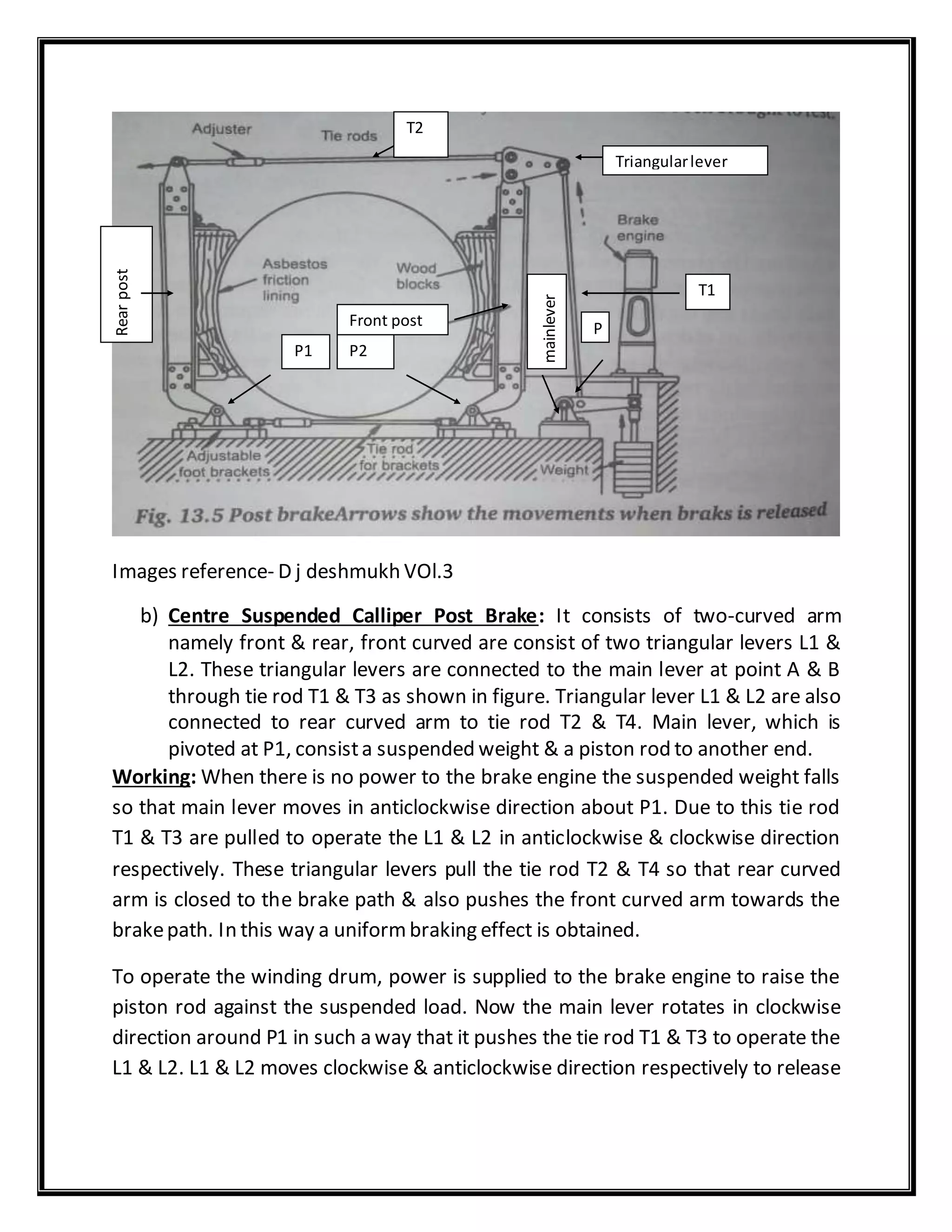
a) Anchored Post Brakes: It is made of two ‘H’ section girder pivoted at P1 &
P2. Each post carries its own curved brake block fitted with brake lining.
The front post carries a triangular lever at its top. This lever is connected
with rear post by a tie rod T2 & the main lever through tie rod T1. The main
lever is pivoted at P & its anchor end carries a suspended weight. The main
lever is also connected to a hydraulic cylinder through a piston rod.
Working: When there is no rod to the brake engine, the main lever fails down
under the suspended weight due to this tie rod T1 is pulled downward to
operate a triangular lever in anticlockwise direction due to which the tie
rod T2 is pulled. Force acting on a front post towards the brake path,
applied the brakes & anchor force which is acting on the rear post by tie
rod T2 applied the braking effect to the drum.
To operate a winding drum power is supplied to the brake engine
to raise the piston rod which lifts the main lever upwards against the
upward against the suspended weight. It will push the tie rod even
upward to operate the triangular lever, which pulls the front post & at
the same time pushes the rear post through tie rod T2. Thus the brakes
are away fromthe brakepath & the drumis free to rotate.
The main disadvantage of this brake is that the wear & tear of the
brakelining is not uniform& it is more at top & minimum at the bottom.
Images reference- D j deshmukh VOl.3
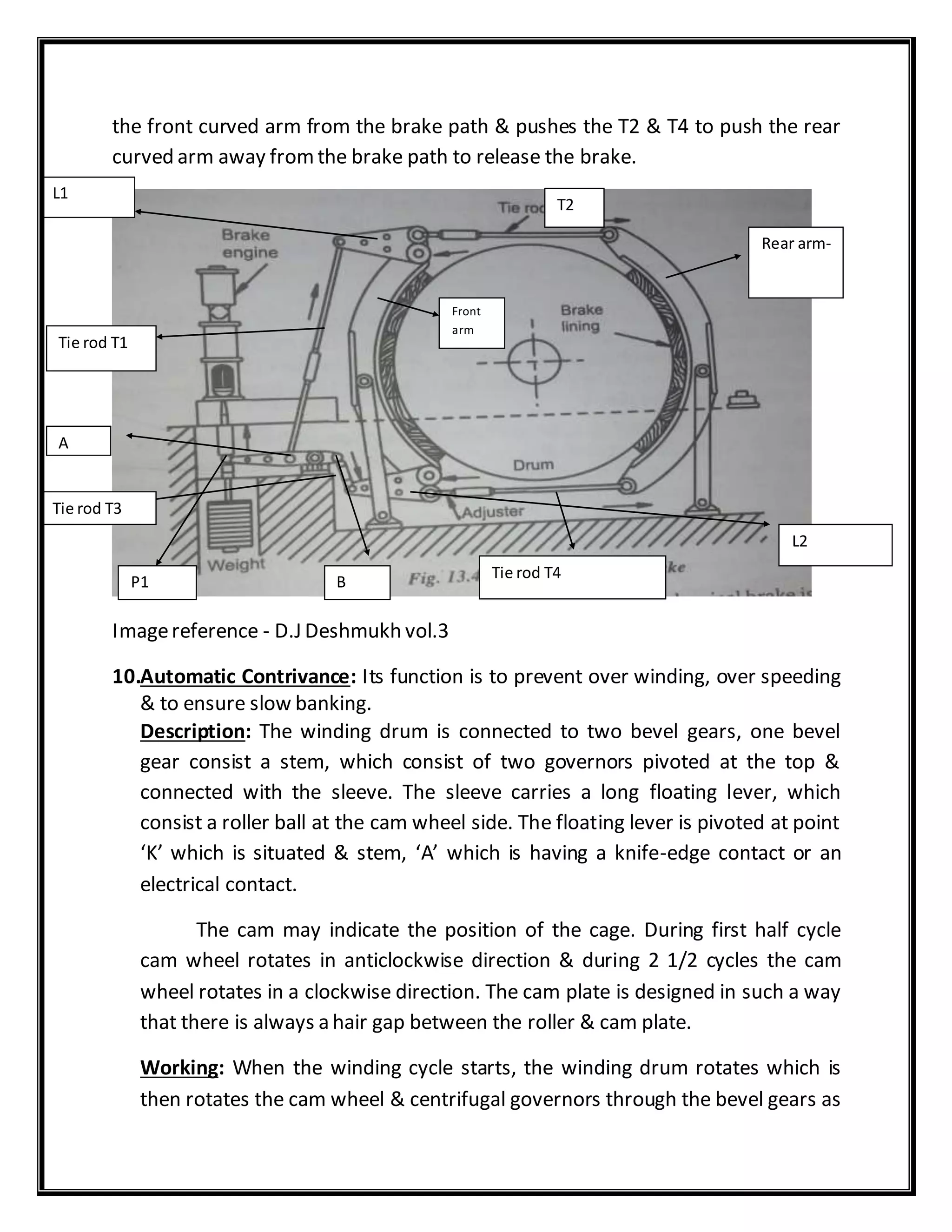
b) Centre Suspended Calliper Post Brake: It consists of two-curved arm
namely front & rear, front curved are consist of two triangular levers L1 &
L2. These triangular levers are connected to the main lever at point A & B
through tie rod T1 & T3 as shown in figure. Triangular lever L1 & L2 are also
connected to rear curved arm to tie rod T2 & T4. Main lever, which is
pivoted at P1, consista suspended weight & a piston rod to another end.
Working: When there is no power to the brake engine the suspended weight falls
so that main lever moves in anticlockwise direction about P1. Due to this tie rod
T1 & T3 are pulled to operate the L1 & L2 in anticlockwise & clockwise direction
respectively. These triangular levers pull the tie rod T2 & T4 so that rear curved
arm is closed to the brake path & also pushes the front curved arm towards the
brakepath. In this way a uniformbraking effect is obtained.
To operate the winding drum, power is supplied to the brake engine to raise the
piston rod against the suspended load. Now the main lever rotates in clockwise
direction around P1 in such a way that it pushes the tie rod T1 & T3 to operate the
L1 & L2. L1 & L2 moves clockwise & anticlockwise direction respectively to release
Triangularlever
T2Rearpost
P1 P2
Front post
mainlever
P
T1
the front curved arm from the brake path & pushes the T2 & T4 to push the rear
curved arm away fromthe brake path to release the brake.
Imagereference - D.J Deshmukh vol.3
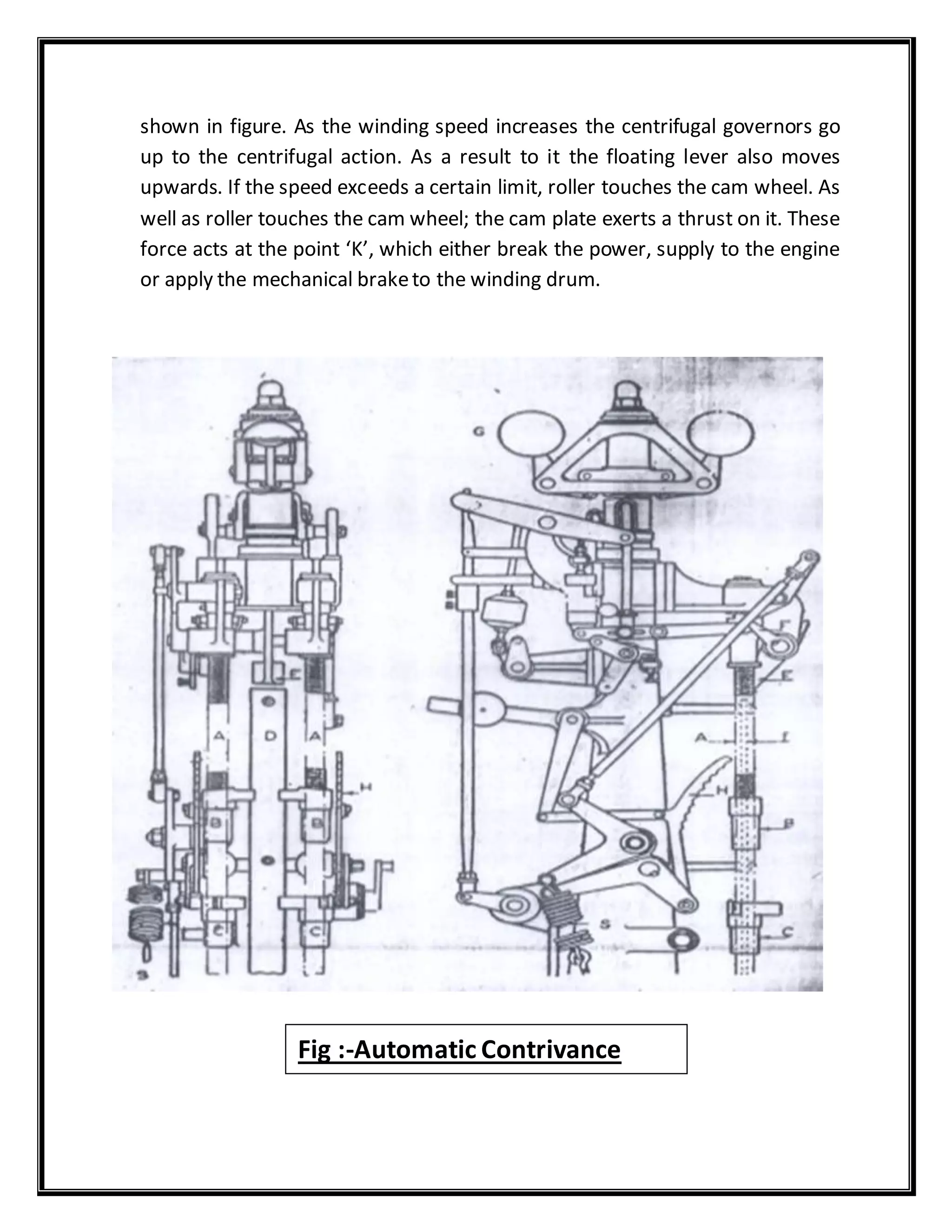
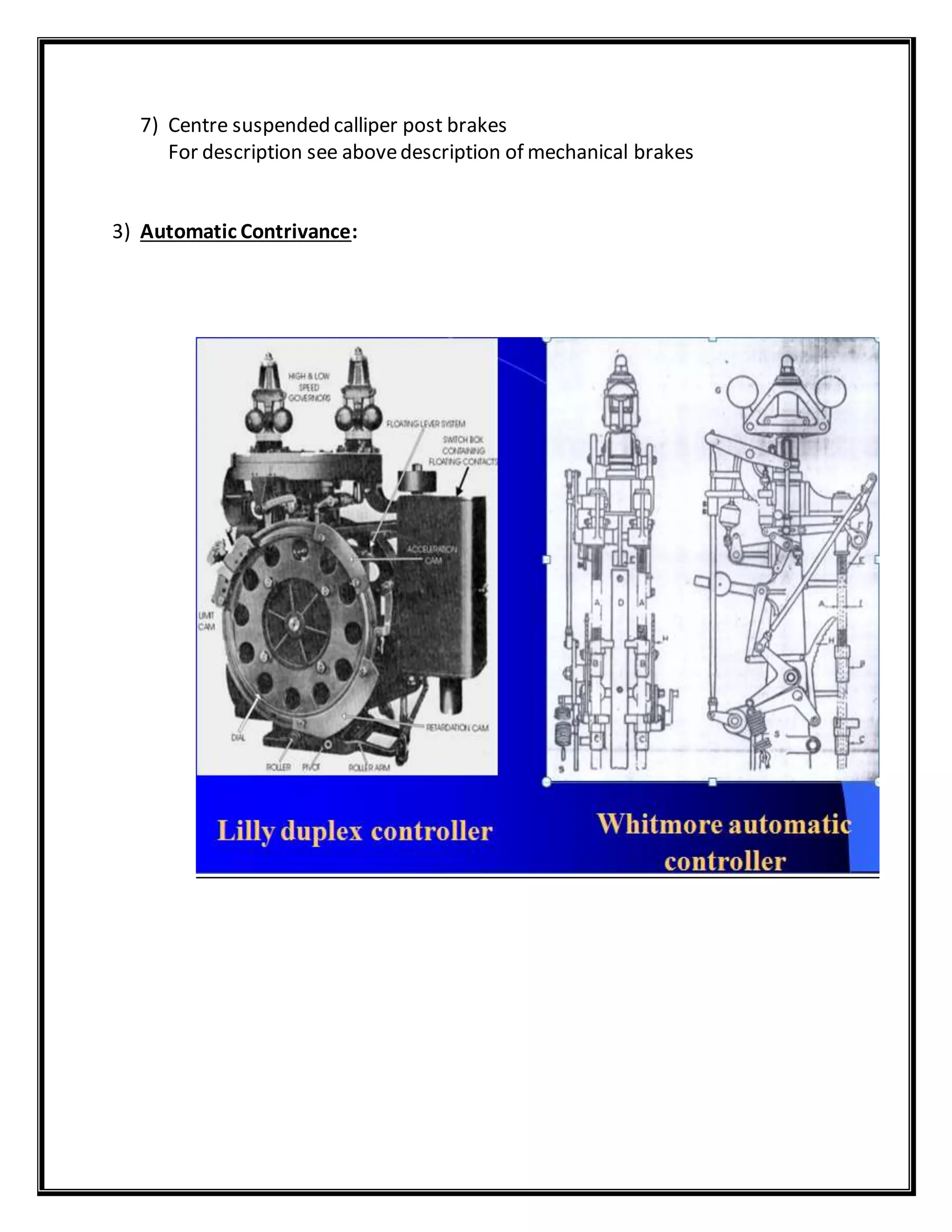
10.Automatic Contrivance: Its function is to prevent over winding, over speeding
& to ensure slow banking.
Description: The winding drum is connected to two bevel gears, one bevel
gear consist a stem, which consist of two governors pivoted at the top &
connected with the sleeve. The sleeve carries a long floating lever, which
consist a roller ball at the cam wheel side. The floating lever is pivoted at point
‘K’ which is situated & stem, ‘A’ which is having a knife-edge contact or an
electrical contact.
The cam may indicate the position of the cage. During first half cycle
cam wheel rotates in anticlockwise direction & during 2 1/2 cycles the cam
wheel rotates in a clockwise direction. The cam plate is designed in such a way
that there is always a hair gap between the roller & cam plate.
Working: When the winding cycle starts, the winding drum rotates which is
then rotates the cam wheel & centrifugal governors through the bevel gears as
L1
L2
Tie rod T1
Tie rod T3
A
BP1
Tie rod T4
T2
Front
arm
arm
Rear arm-
shown in figure. As the winding speed increases the centrifugal governors go
up to the centrifugal action. As a result to it the floating lever also moves
upwards. If the speed exceeds a certain limit, roller touches the cam wheel. As
well as roller touches the cam wheel; the cam plate exerts a thrust on it. These
force acts at the point ‘K’, which either break the power, supply to the engine
or apply the mechanical braketo the winding drum.
Fig :-Automatic Contrivance
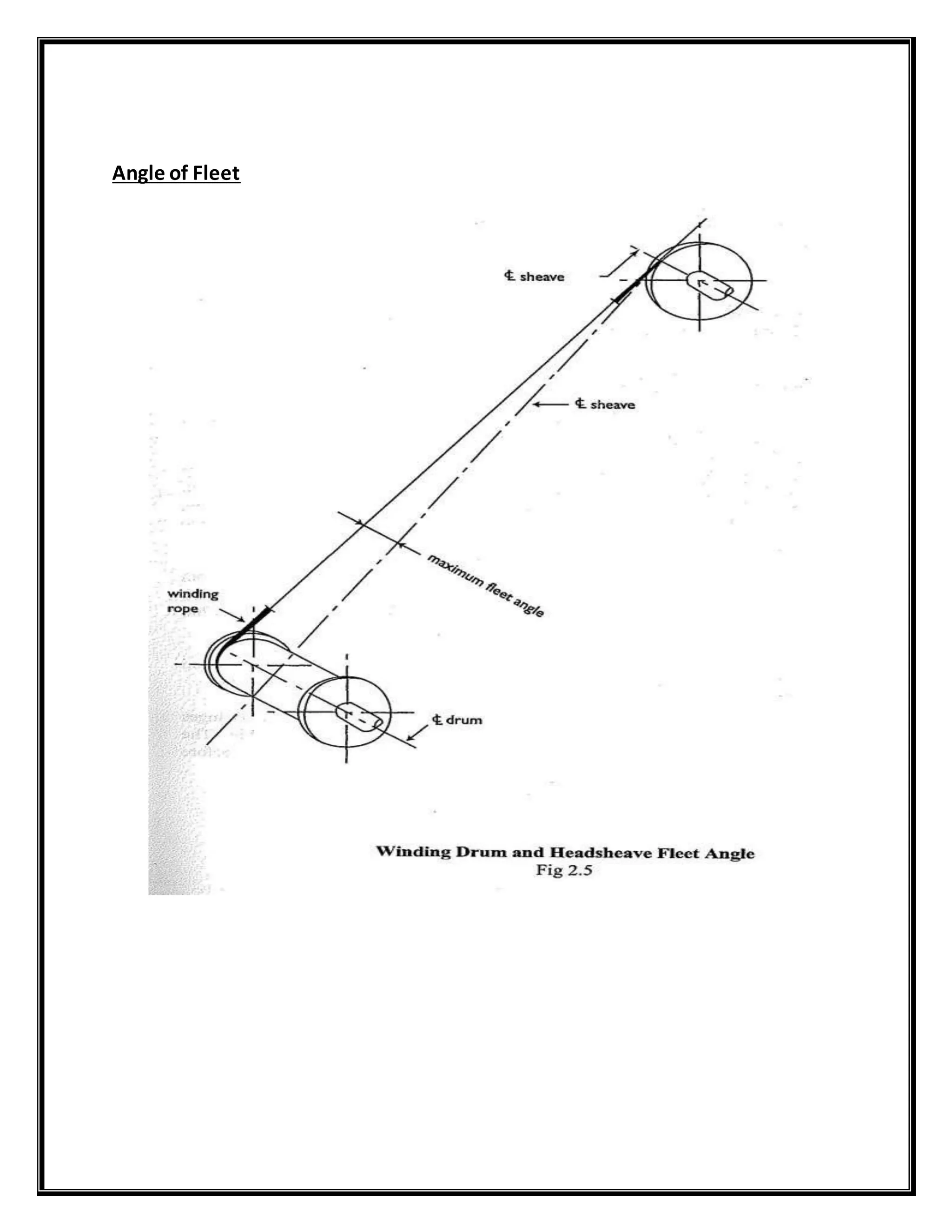
Angle of Fleet
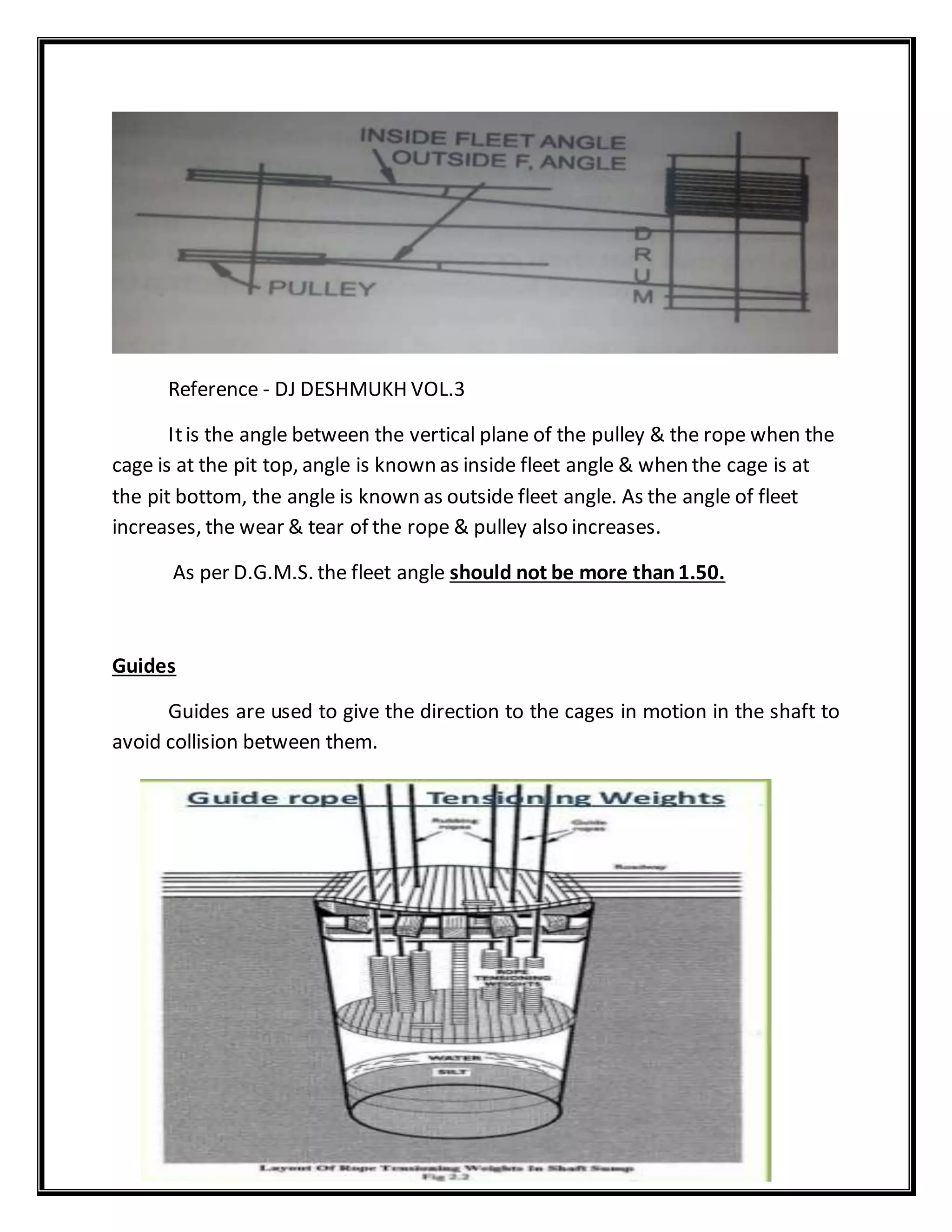
Reference - DJ DESHMUKH VOL.3
Itis the angle between the vertical plane of the pulley & the rope when the
cage is at the pit top, angle is known as inside fleet angle & when the cage is at
the pit bottom, the angle is known as outside fleet angle. As the angle of fleet
increases, the wear & tear of the rope & pulley also increases.
As per D.G.M.S. the fleet angle should not be more than1.50.
Guides
Guides are used to give the direction to the cages in motion in the shaft to
avoid collision between them.
Types of Guides
1) Rigid guides
2) Flexible guides (ropeguides)
1) Rigid Guide: These guides are made of steel or wood. They are of rectangular
cross section, usually 10 X 20 cm. & are fixed by countersunk bolts to the bun
tons of places across the shaft of the intervals of 1.8 to 3 meter. The weight of
the rail section varies from 20-to 55-kgf/m. lengths & length of the rail piece is
up to 13 meter. Only one line of bun ton is required in the middle of the shaft
for fixation of rigid guide. Generally one line of guide is enough but sometimes
two guides /cages are used. These guides are used for dip shaft. But now day’s
wooden guides are not used.
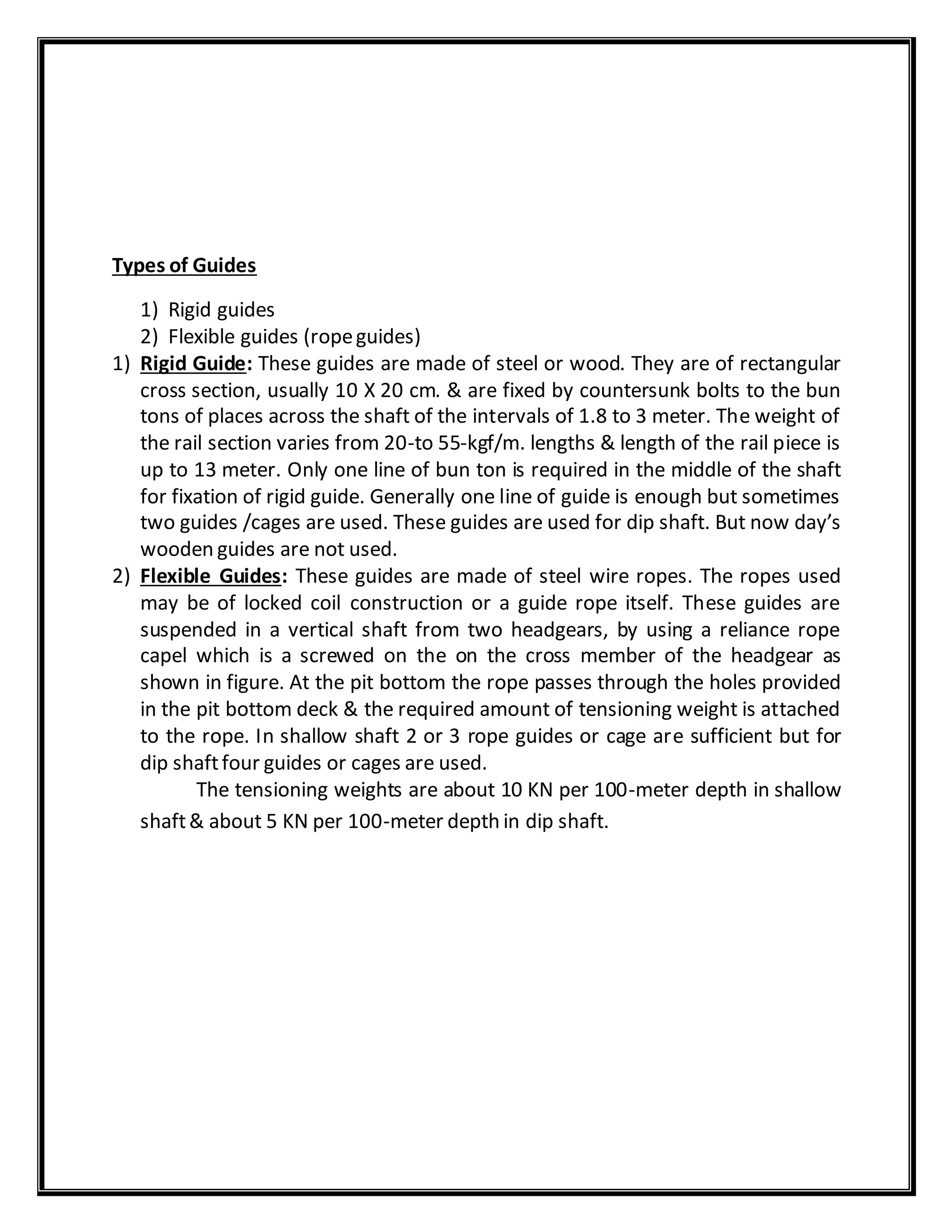
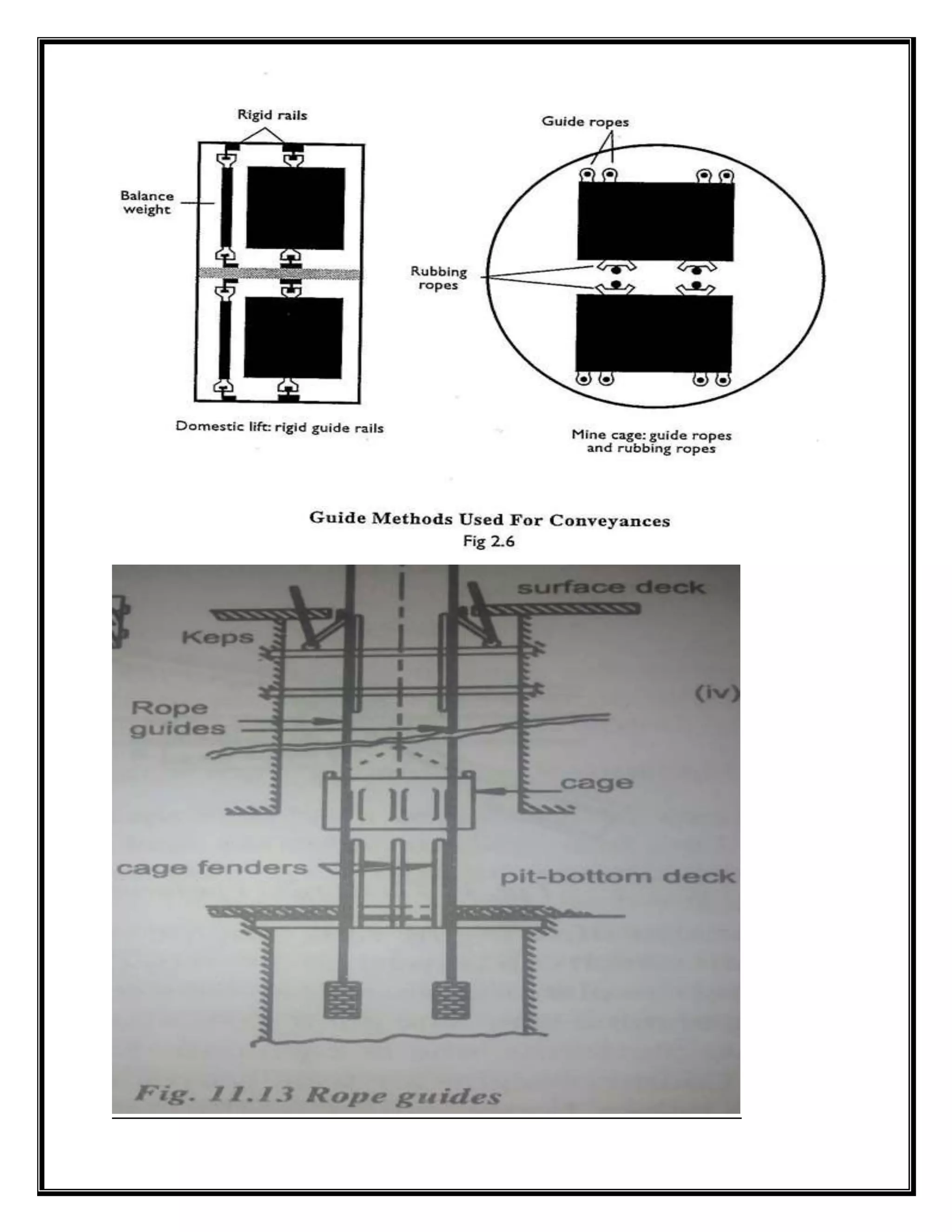
2) Flexible Guides: These guides are made of steel wire ropes. The ropes used
may be of locked coil construction or a guide rope itself. These guides are
suspended in a vertical shaft from two headgears, by using a reliance rope
capel which is a screwed on the on the cross member of the headgear as
shown in figure. At the pit bottom the rope passes through the holes provided
in the pit bottom deck & the required amount of tensioning weight is attached
to the rope. In shallow shaft 2 or 3 rope guides or cage are sufficient but for
dip shaftfour guides or cages are used.
The tensioning weights are about 10 KN per 100-meter depth in shallow
shaft& about 5 KN per 100-meter depth in dip shaft.
Above Image reference D JDESHMUKH VOL.3
Causes of Cage OscillationinRope Guide
1) Depth:If the depth of the winding increases, the length of the guide rope is
also increases. Dueto this more oscillation takes spaceas the cage travel.
2) Winding Speed: Oscillation of the cage increases as the winding speed
increases its normal speed. To reduce this winding speed should not exceed
its normal approved valueor limit.
3) Rate of Acceleration: As the rate of acceleration increases the oscillation of
the cage also increases. To reduce this rate of oscillation should not exceed
its normal approved valueor limit.
4) Rate of Retardation: As the rate of retardation increases the oscillation to
the cage also increases. To reduce this rate of oscillation should exceed its
normal approved valueor limit.
5) Tension in the Rope: If the rope having less tension it will cause more
oscillation tothe cage, hence to reduce it correct tension in the rope should
be used.
6) Rubbing of guide shoe: If there is more friction between guide shoe & rope
it will cause more oscillation to the cage. To reduce this should the proper
lubrication between rope & guide shoe.
7) Sudden Power Failure: Oscillation to the cage will increase suddenly if
there is a sudden power failure.
ComparisonbetweenRigidGuide & Rope Guide
RigidGuide Rope Guide
1) No oscillation.
2) Less spacerequired.
3) Costly
4) Difficult installation
5) More maintenance
6) More resistanceto fire
7) No load on headgear
8) Only damaged parts can be
1) Oscillation of cage is there
2) More spacerequired
3) Cheap
4) Easy installation
5) Less maintenance
6) Less resistanceto fire
7) Complete load on headgear
8) Any damage causes full
replaced
9) Buntons are required through the
shaft
10) More life
replacement
9) No buntons are required
10) Less life
Cage SuspensionGear
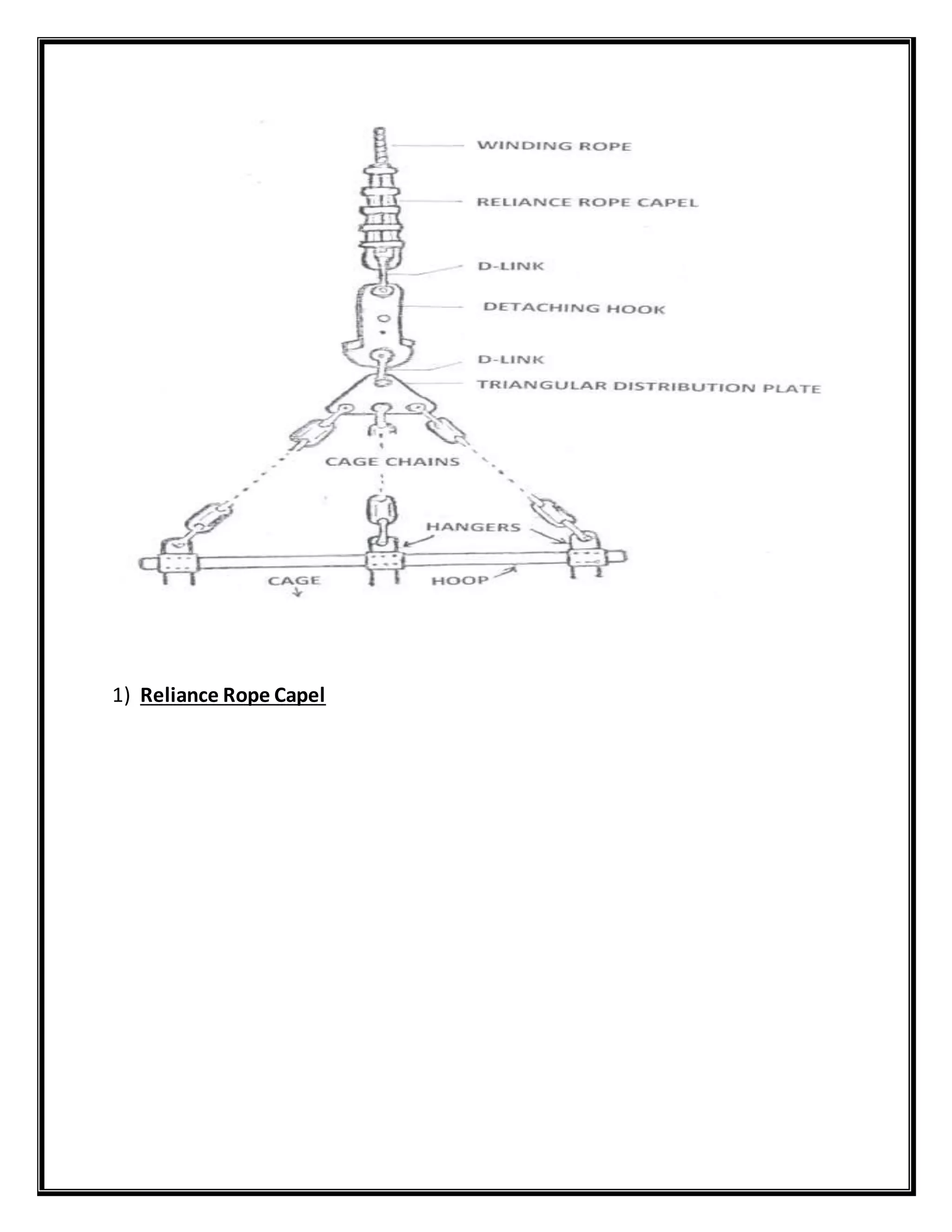
When the steel wire rope is used for winding, it can’t be directly attached
to the cage. Hence the attachment used to attach the rope with cage is known as
cage suspension gear.
It consist of a rope capel which is attached to one end of rope & it’s another
end is attached to a safety hook through ‘D’ link & bull chain. The another end of
the safety hook is attached to a triangular plate to a ‘D’ link & bull chain & the
triangular plate is further connected to the cage through four or six bridle chains.
The main parts of a Cage Suspension Gear are
7) Rope capel (Reliance ropecapel)
8) ‘D’ link & bull chain
9) Safety hook
10) Triangular plate
11) Bridle chain
1) Reliance Rope Capel
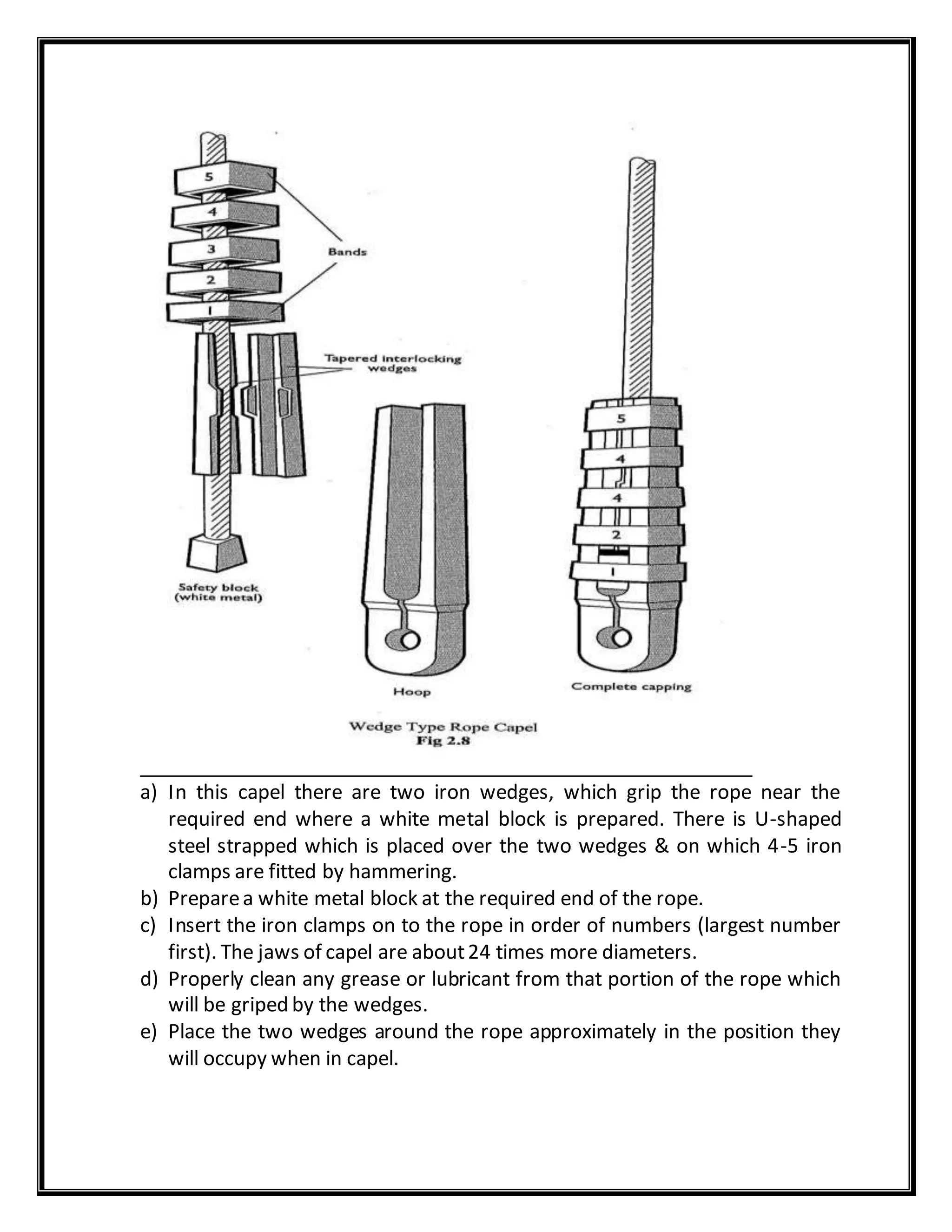
a) In this capel there are two iron wedges, which grip the rope near the
required end where a white metal block is prepared. There is U-shaped
steel strapped which is placed over the two wedges & on which 4-5 iron
clamps are fitted by hammering.
b) Preparea white metal block at the required end of the rope.
c) Insert the iron clamps on to the rope in order of numbers (largest number
first). The jaws of capel are about24 times more diameters.
d) Properly clean any grease or lubricant from that portion of the rope which
will be griped by the wedges.
e) Place the two wedges around the rope approximately in the position they
will occupy when in capel.
f) Fit the U-shaped strip over the wedges such that the U-shaped strip &
wedge top are in one line. Draw the iron clamps over the U-shaped strip.
g) Hammer the iron clamps for proper grip. The ring number 1 should not be
hammered because it is only for the safety of the white metal block. With
this capping operation is over.
2) ‘D’ Link & Bull Chain: These are used to attach any two components of cage
suspension gear & to adjust the height of cage suspension gear. The diameter
of link rod should be 1.5 times the rope’s diameter & should not be any join in
the link.
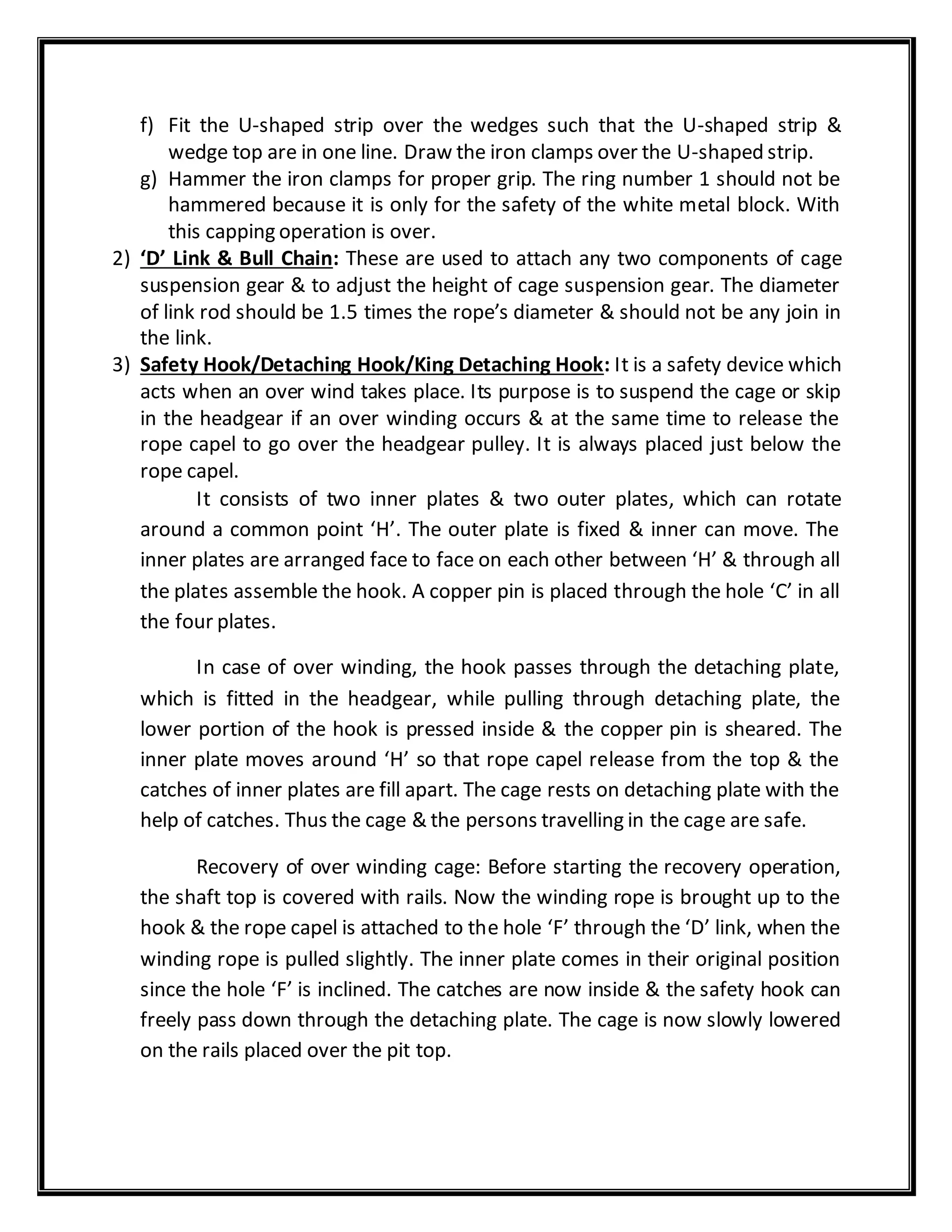
3) Safety Hook/Detaching Hook/King Detaching Hook: It is a safety device which
acts when an over wind takes place. Its purpose is to suspend the cage or skip
in the headgear if an over winding occurs & at the same time to release the
rope capel to go over the headgear pulley. It is always placed just below the
rope capel.
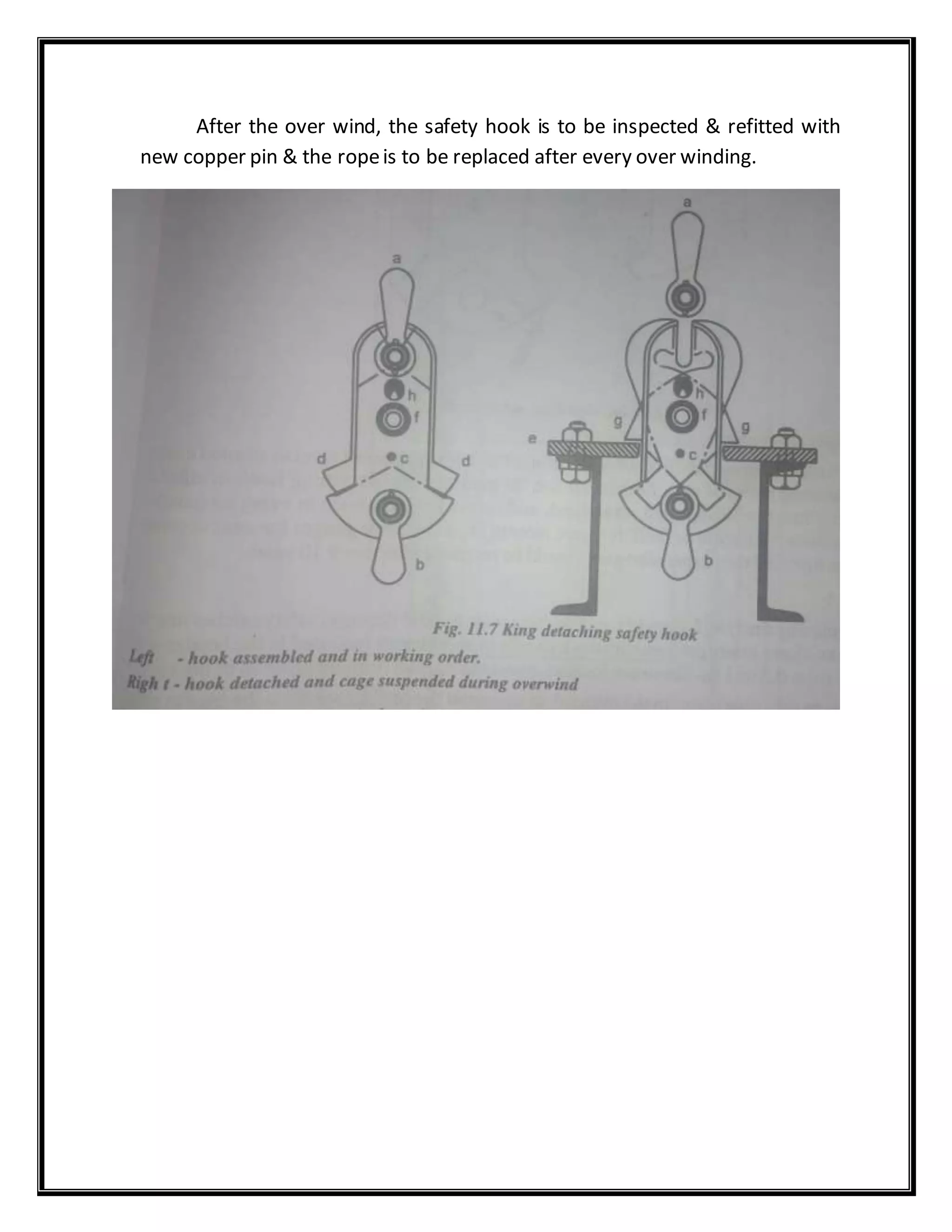
It consists of two inner plates & two outer plates, which can rotate
around a common point ‘H’. The outer plate is fixed & inner can move. The
inner plates are arranged face to face on each other between ‘H’ & through all
the plates assemble the hook. A copper pin is placed through the hole ‘C’ in all
the four plates.
In case of over winding, the hook passes through the detaching plate,
which is fitted in the headgear, while pulling through detaching plate, the
lower portion of the hook is pressed inside & the copper pin is sheared. The
inner plate moves around ‘H’ so that rope capel release from the top & the
catches of inner plates are fill apart. The cage rests on detaching plate with the
help of catches. Thus the cage & the persons travelling in the cage are safe.
Recovery of over winding cage: Before starting the recovery operation,
the shaft top is covered with rails. Now the winding rope is brought up to the
hook & the rope capel is attached to the hole ‘F’ through the ‘D’ link, when the
winding rope is pulled slightly. The inner plate comes in their original position
since the hole ‘F’ is inclined. The catches are now inside & the safety hook can
freely pass down through the detaching plate. The cage is now slowly lowered
on the rails placed over the pit top.
After the over wind, the safety hook is to be inspected & refitted with
new copper pin & the ropeis to be replaced after every over winding.
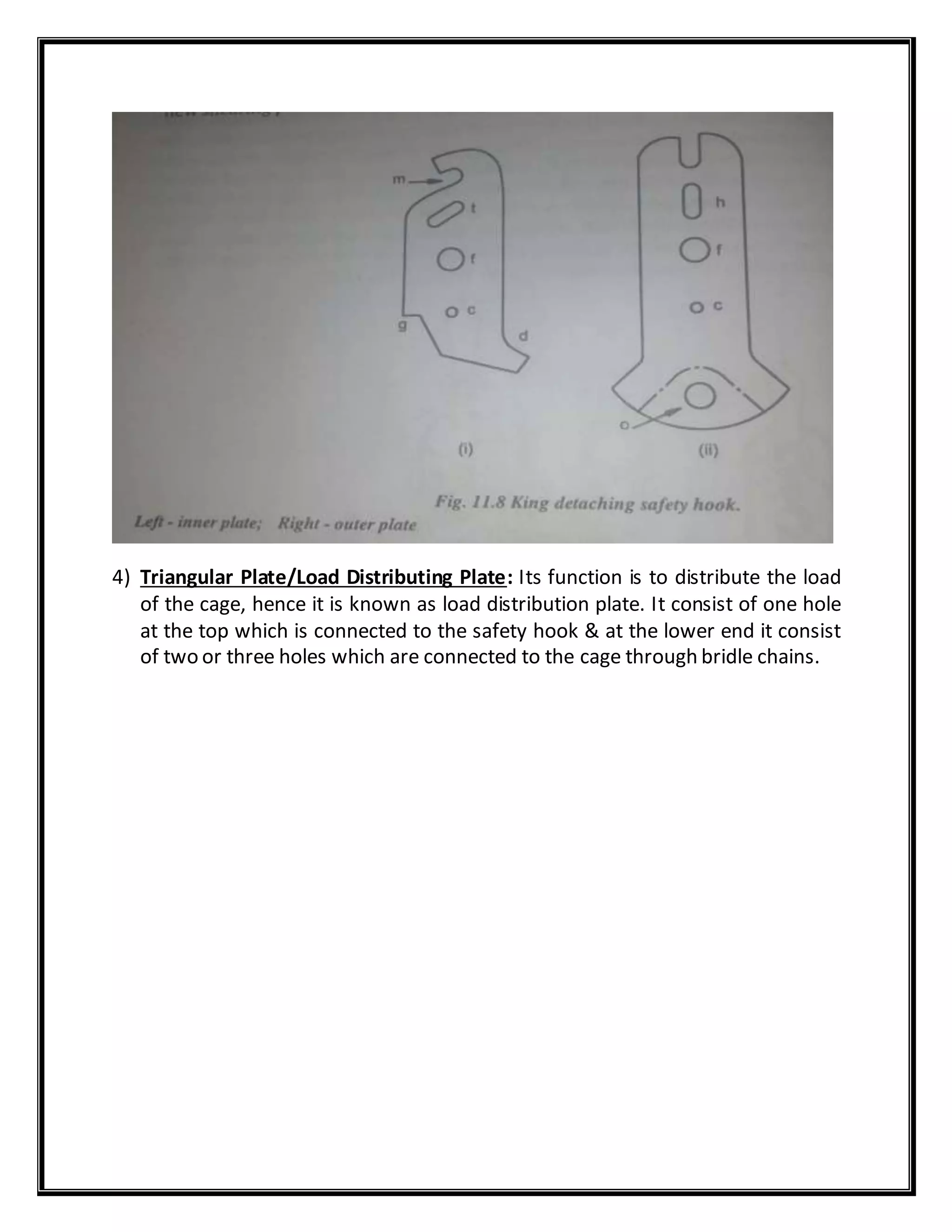
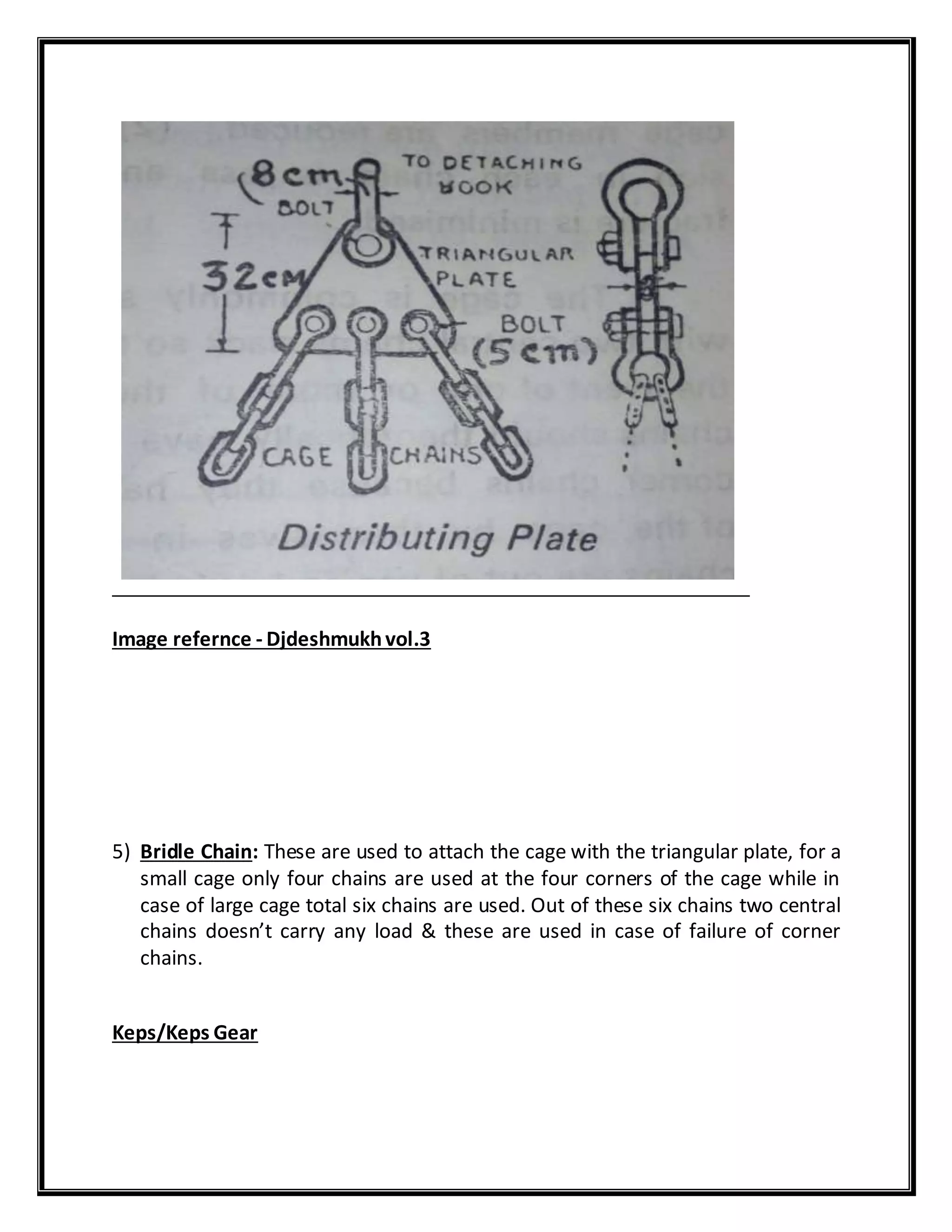
4) Triangular Plate/Load Distributing Plate: Its function is to distribute the load
of the cage, hence it is known as load distribution plate. It consist of one hole
at the top which is connected to the safety hook & at the lower end it consist
of two or three holes which are connected to the cage through bridle chains.
Image refernce - Djdeshmukhvol.3
5) Bridle Chain: These are used to attach the cage with the triangular plate, for a
small cage only four chains are used at the four corners of the cage while in
case of large cage total six chains are used. Out of these six chains two central
chains doesn’t carry any load & these are used in case of failure of corner
chains.
Keps/Keps Gear
Keps are used to support the cage at the pit top for proper alignment of the
cage floor & the decking level.
Type of Keps
1) Rigid keps
2) Davies improved keps gear
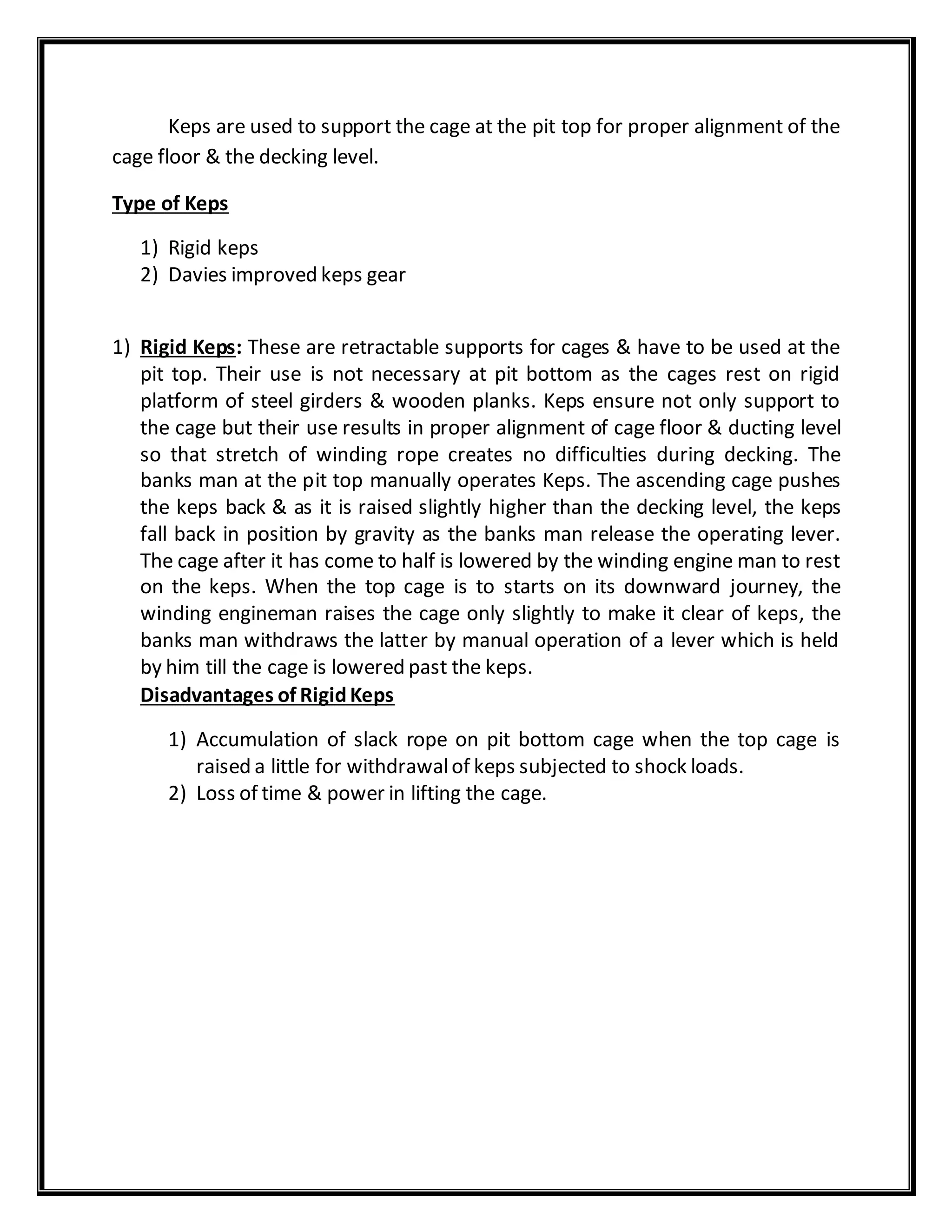
1) Rigid Keps: These are retractable supports for cages & have to be used at the
pit top. Their use is not necessary at pit bottom as the cages rest on rigid
platform of steel girders & wooden planks. Keps ensure not only support to
the cage but their use results in proper alignment of cage floor & ducting level
so that stretch of winding rope creates no difficulties during decking. The
banks man at the pit top manually operates Keps. The ascending cage pushes
the keps back & as it is raised slightly higher than the decking level, the keps
fall back in position by gravity as the banks man release the operating lever.
The cage after it has come to half is lowered by the winding engine man to rest
on the keps. When the top cage is to starts on its downward journey, the
winding engineman raises the cage only slightly to make it clear of keps, the
banks man withdraws the latter by manual operation of a lever which is held
by him till the cage is lowered past the keps.
Disadvantages of RigidKeps
1) Accumulation of slack rope on pit bottom cage when the top cage is
raised a little for withdrawalof keps subjected to shock loads.
2) Loss of time & power in lifting the cage.
Imagereferance- DJ Deshmukh vol.3
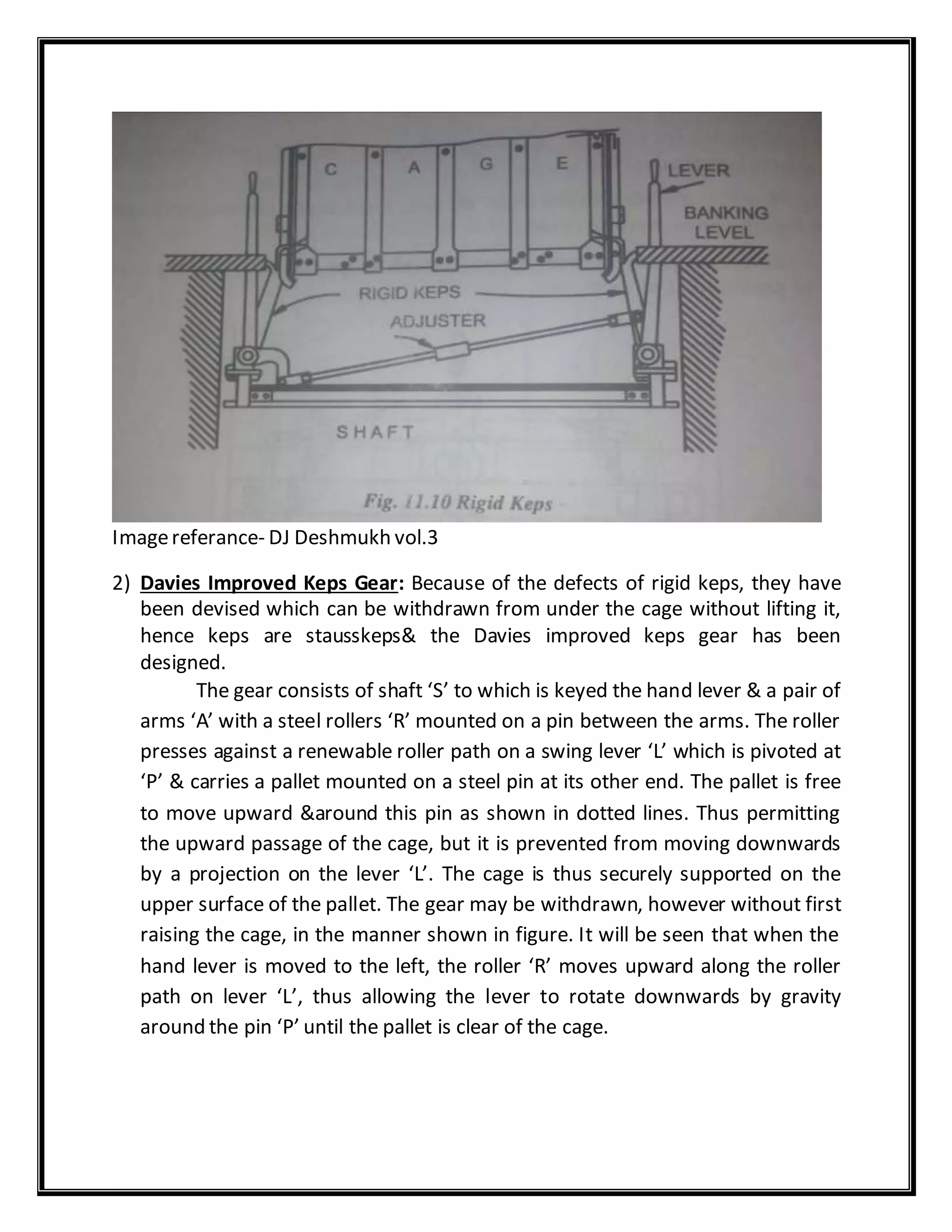
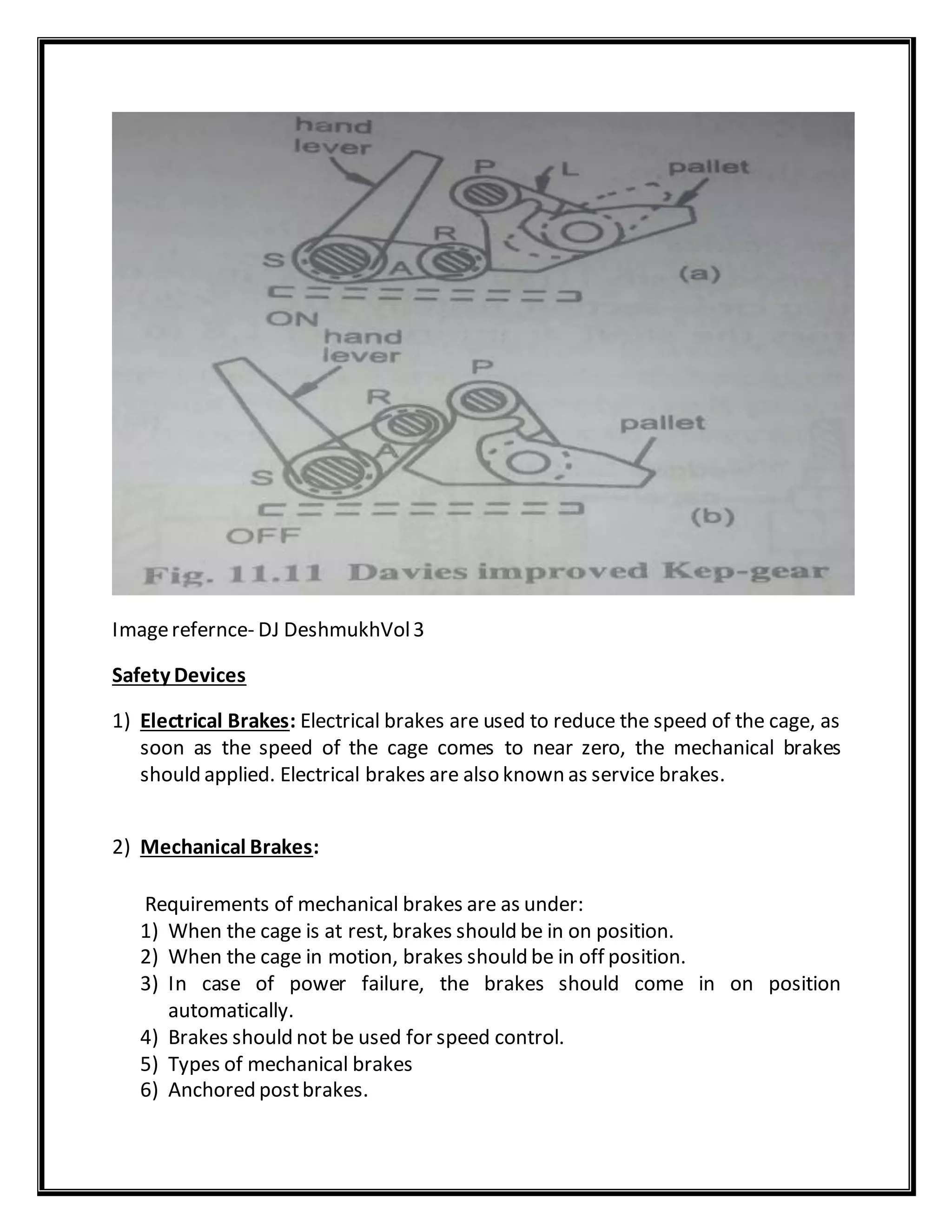
2) Davies Improved Keps Gear: Because of the defects of rigid keps, they have
been devised which can be withdrawn from under the cage without lifting it,
hence keps are stausskeps& the Davies improved keps gear has been
designed.
The gear consists of shaft ‘S’ to which is keyed the hand lever & a pair of
arms ‘A’ with a steel rollers ‘R’ mounted on a pin between the arms. The roller
presses against a renewable roller path on a swing lever ‘L’ which is pivoted at
‘P’ & carries a pallet mounted on a steel pin at its other end. The pallet is free
to move upward &around this pin as shown in dotted lines. Thus permitting
the upward passage of the cage, but it is prevented from moving downwards
by a projection on the lever ‘L’. The cage is thus securely supported on the
upper surface of the pallet. The gear may be withdrawn, however without first
raising the cage, in the manner shown in figure. It will be seen that when the
hand lever is moved to the left, the roller ‘R’ moves upward along the roller
path on lever ‘L’, thus allowing the lever to rotate downwards by gravity
around the pin ‘P’ until the pallet is clear of the cage.
Imagerefernce- DJ DeshmukhVol3
Safety Devices
1) Electrical Brakes: Electrical brakes are used to reduce the speed of the cage, as
soon as the speed of the cage comes to near zero, the mechanical brakes
should applied. Electrical brakes are also known as service brakes.
2) Mechanical Brakes:
Requirements of mechanical brakes are as under:
1) When the cage is at rest, brakes should be in on position.
2) When the cage in motion, brakes should be in off position.
3) In case of power failure, the brakes should come in on position
automatically.
4) Brakes should not be used for speed control.
5) Types of mechanical brakes
6) Anchored postbrakes.
7) Centre suspended calliper post brakes
For description see abovedescription of mechanical brakes
3) Automatic Contrivance:
Its function is to prevent over winding, over speeding & to ensure slow
banking.
Description: The winding drum is connected to two bevel gears, one bevel
gear consist a stem, which consist of two governors pivoted at the top &
connected with the sleeve. The sleeve carries a long floating lever, which
consist a roller ball at the cam wheel side. The floating lever is pivoted at point
‘K’ which is situated & stem, ‘A’ which is having a knife-edge contact or an
electrical contact.
The cam may indicate the position of the cage. During first half cycle
cam wheel rotates in anticlockwise direction & during 2 1/2 cycles the cam
wheel rotates in a clockwise direction. The cam plate is designed in such a way
that there is always a hair gap between the roller & cam plate.
Working: When the winding cycle starts, the winding drum rotates which is
then rotates the cam wheel & centrifugal governors through the bevel gears as
shown in figure. As the winding speed increases the centrifugal governors go
up to the centrifugal action. As a result to it the floating lever also moves
upwards. If the speed exceeds a certain limit, roller touches the cam wheel. As
well as roller touches the cam wheel, a thrust is exerted on it by the cam plate.
These force acts at the point ‘K’ which either break the power supply to the
engine or apply the mechanical braketo the winding drum.
4) Safety Hook/Detaching Hook/King Detaching Hook: It is a safety device which
acts when an over wind takes place. Its purpose is to suspend the cage or skip
in the headgear if an over winding occurs & at the same time to release the
rope capel to go over the headgear pulley. It is always placed just below the
rope capel.
It consists of two inner plates & two outer plates which can rotate
around a common point ‘H’. The outer plate is fixed & inner can move. The
inner plates are arranged face to face on each other between ‘H’ & through all
the plates assemble the hook. A copper pin is placed through the hole ‘C’ in all
the four plates.
In case of over winding, the hook passes through the detaching plate,
which is fitted in the headgear, while pulling through detaching plate, the
lower portion of the hook is pressed inside & the copper pin is sheared. The
inner plate moves around ‘H’ so that rope capel release from the top & the
catches of inner plates are fill apart. The cage rests on detaching plate with the
help of catches. Thus the cage & the persons travelling in the cage are safe.
Refer image of above safety hook
5) Recovery of Over Winding Cage: Before starting the recovery operation, the
shaft top is covered with rails. Now the winding rope is brought up to the hook
& the rope capel is attached to the hole ‘F’ through the ‘D’ link, when the
winding rope is pulled slightly. The inner plate comes in their original position
since the hole ‘F’ is inclined. The catches are now inside & the safety hook can
freely pass down through the detaching plate. The cage is now slowly lowered
on the rails placed over the pit top.
After the over wind, the safety hook is to be inspected & refitted with
new copper pin & the ropeis to be replaced after every over winding.
6) Reverse Direction Prevention Switch: It trips power if the winding engineman
by mistake operates the motor in wrong direction.
7) Time Limit Switch: It is mounted on the headgear. It trips power if the
ascending cage crosses decking level.
8) Tachometer Generator: It is connected to the winding drum for normal rpm it
generates a normal amount of current, but if the gearbox is faulty, the
tachometer generator will not generate the normal current & it will trip power
to the motor.
9) Safety Caches: These are mounted on in the headgear at an interval of 0.3 to
1.0 meter above the normal decking level. In case of over winding, the cage
presses the safety caches which are pivoted levers as shown in figure & it
crosses it. In case of failure of the safety hook the cage falls downward over
the safety caches. Hence the damage to the cage can be reduced. To clear the
cage these safety catches can be removed from the cage path by operating a
lever.
10) Depth Indicator: A depth indicator is used to indicate the position of cage
in the shaft. It is mounted on the drum winder through the gear arrangement
as shown in figure. It consists of a dial & pointer moves in anticlockwise
direction & during second half second the pointer moves in anticlockwise
direction. When one cage is moves from bottom to top, the pointer moves
from A to X1 to X2 to B. in this AX1 is the acceleration distance & X2B is the
retardation distance. As soon as the pointer reaches the point X2, the power
supply to the engine should be cut off & brakes should be applied.
When the cage moves from top to bottom the pointer move from B to
X2 to X1 to A. in this BX2 is the acceleration distance X2 X1 is the constant speed
distance & X1A is the retardation distance. As soon as the pointer reaches the
point X1, the power supply to the engine should be cut off & brakes should be
applied.
SEE FIGUREOF DEPTH INDICATORABOVE
11) Warning Bell: When the cage is at a distance of two revolutions before
reaching the decking level, a warning bell warns the operator to remains
alternative.
Smooth Winding cycle (Balancing Systemof Winding)
If the torque requirement during the complete winding cycle is more or less
uniform is known as smooth winding cycle. In a winding system, using a tail rope
or balancing rope may obtain a smooth winding cycle. It is of the some diameter
& some weights as the winding rope. Its length is equal to the depth of the shaft
& is attached to the bottom of the two cages.
Another method to obtain a smooth winding cycle is the use of conical or Cylindro
conical drum which are preferred for dip shaft winding. A tail rope is not used
with this type of drum.
FrictionWinding/Koepe Winding
It consist a single rope passing over a friction pulley which is electrically
operated & installed at the top of the headgear. The two ends of the rope passes
over the pulley & connected with the cages. A tail rope is always used in friction
winding. It is connected to bottom to bottom of the two cages & hangs freely in
the shaft. The winding rope along with the attached cages is raised or lowered by
power transmitted to the friction between the winding rope & the friction pulley.
The driving motor is installed at the top of the headgear to operate the system at
a time 2 to 4 or 6 ropes can be used for the winding.
CAGE/DRUM WINDING AND KOEPE WINDING:-
CAGE /DRUM WINDING KOEPE WINDING
1) Itis suitable for shallow
depths.
2) Multi-decking systemis
suitable for drum winding.
3) More spaceis required.
4) Multi-level systemof winding
is possible.
5) Maintenance of cage is
difficult or tedious and more
time consuming.
6) Itis Safer than koepe winding.
7) More maintenance cost.
8) Angle of fleet occurs in rope
of drumwinding.
9) The factor of safety of ropeis
usually 10(Men winding).
1) Itis suitable for deep depths
shaft.
2) Multidecking systemis not
suitable for drum winding.
3) Less spaceis required.
4) Single-level systemof winding
is possibleonly.
5) Maintenance is easy .
6) ItislessSafer than drum
winding.
7) Less maintenance cost.
8) Angle of fleet does not occurs
in koepe winding.
9) The factor of safety of ropeis
usually 6.5-8.
Chapter No 03
Wire Ropes.
Rope:
A Rope is a length of thick strong cord made by twisting strandsmade of wire
around a core of suitable material depending uponthe suitability of the work.
Wire ropesare made fromsteel wiresof plaincarbonsteel having high tensile
strength.
Typical analysisof steel is as follows(by weight percentage):
Carbon – 0.5
Silicon – 0.11
Manganese – 0.48
Sulphur – 0.033
Phosphorous – 0.014 and
Iron – rest
Accordingto I.S. Specificationno. 1835 of 1961, neither sulphur nor
phosphorouscontentin the steel for wirerope should exceed 0.080 %.
Ultimate tensile strength (breaking strength) of the wires used for
haulage/windingropesis generally between 140 – 170 kgf/mm2 (160
kgf/mm2 = 1570 MN/m2).
Mass and strength of wireropes:
The massof a rope dependsupon thequantity of steel in it i.e. the space factor
and the design of the rope.
Mass of rope(kg/m length) = kd2 .
Where k is a constant dependingon ropedesign and d is diameter of ropein
cm.
Strength (Breakingstrength) (KN) = sd2 .
Where S is a constant dependingon ropedesign and quality of steel and d is
diameter of rope in cm .
The valuesof K & S for purposeof the aboveformulaeare generally as follows,
if d is in cm, m (mass) is in kg/m and the breaking strength is in KN.
Type of rope k s
Round strand with fibre core 0.35 52
Round strand with wire core 0.40 56
Flattened strand with fibre core 0.41 55
Flattened strand with wire core 0.45 58
Locked coil 0.56 85
Components of Ropes:
Wire:-It is a metal drawn out into the form of a thin flexible thread or rod
made of ductile metal. It is used to make a strand in a rope.
Strand:-A strand is formed by laying up one or more layers of wires around a
strand core. A strand core is either a single wire or made up of a number of
wires.The flexibility of a strand depends upon:
1.Type of core- a strand with a flexible core is more flexible than one
with steel coreat the centre.
2.Thicknessofindividualwires –
Thinnerthewires,moreistheflexibility.and
3. Numberofwires-Largerthenumberofwires,moreistheflexibility.
Core:-Itis the centre of the wire ropearound which the strand of wire is laid or
coiled. There 3 types of cores :-
1) Fibre Core: It is made of fibres & generally used as a main core in stranded
ropes. Itprovides moreflexibility to the rope.
2) Steel Wire Core: It is a steel wire, which is used as a core. Generally it is
used in strands & locked coil ropes.
3) Independent Wire Rope Core (IWRC): If a rope itself is used as a core, it is
known as independent wire rope core. It is used when rope is subjected to
kinetic shocks.
 Standing Ropes
Some wire ropesrequired to carry the burden or load but are moreor less
stationary. e.g. guideropesin a shaft bucket, track ropesand supportingrope
in bi-cable aerials ropewaysetc. such a ropesare called as standing ropes.
 Running Ropes:
Runningropeshaveto Undergo frequentmovement, runningor coiling often
with varyingloads and are flexible e. g. ropes used for winding, haulage coal
cutting machine, winches, excavators and cranes etc. and compared to them
with wire in standingropesare usually morerobust in section and fever in
number as flexibility is notmajor consideration.
On the basis of construction, wireropesare classified as:
 Stranded ropes:
They are made of strands and each strand consists of number of
concentrically twisted wires laid in the form of helix round a
central steel wire. The strands are laid around the main core to
make a stranded rope.
The following are the types of stranded ropes:-
1. Round Strand Ropes.
2. Triangular Strand Ropes.
3. Multi-Strand Ropes.
4. Flat Strand Ropes.
 Non-stranded ropes:
They includelocked coil ropes.
1. Full Locked Coil
2. Half Locked Coil.
 Classification and construction of wire ropes:
Types of StrandedRope
1. Round StrandedRope:
It consists of six round strand laid around a main core. It is known as a simple
construction of strands is having only one layer of wire & of the compound
construction if strands are having more than one layer of wire. There two types of
Round Stranded ropes:-
A. Simple Round Strand:-
Rope usually consists of six similar strands laid around a central core of
fiber or soft material each strand consist of 7 wires around similar central
wire. The fiber core as a yielding cushion in which the strands embed thus
preventing frictional wear when bending on sheaves or drums
B. Compound strands:
These ropes contain wires commonly of different diameters and may be arranged
in different ways. In a 6x8/6/1 (or 6x8-6-1) wire rope, there are eight larger outer
wires to give flexibility .The larger outer wires provide for wear. This being
common construction for winding ropes.
Advantages of Round StrandedRope
1) Simple in construction.
2) Cheap.
3) Easy to examine visually.
4) Flexibility is more.
Disadvantages of Round StrandedRope
1) Turning tendency (rotating tendency as the load change).
2) More external wears.
2. Triangular Strand Rope or FlattenedStrandRope:
It consist of six triangular strand laid around a main core. It is known as a
simple construction of strand is having only one layer of wire & of the
compound construction if the strands are having more than one layer of
wire.
There are two types of triangular strand:-
A. Simple triangular strand:-
B. Compound triangular strand:-
Advantages of Triangular Strand Rope
1) Strength is more (10% morestrength than the round strand rope).
2) Life is more.
3) Crushing strength is more.
Disadvantages of Triangular Strand Rope
1) Costly.
2) Less flexible.
3) Rotates as the load changes.
3. Multi-StrandRope:
A multi-strand rope is built up of two or more layers of strand laid around a
main core. Each layer of strand may be composed of round strand or
triangular strand. It is known as round strand multi strand rope. The two
layers of the strand are always laid on the opposite direction to reduce the
rotating tendency of the rope.
Advantages of Multi-StrandRope
1) Non-rotating.
2) More flexible.
3) Strong & more durable.
Disadvantages of Multi-Strand
1) Interior of the ropecannot be examined visually.
2) Costly.
4. Flat Rope:
These are used for winding and are made with a flat construction. It
consists of a number of small ropes or strands laid side by side placed or
stitched together with soft iron wire. The individual wires are laid up in
opposite direction so that those of adjoining ropes test closely together.
For use with the flat rope, a special winder, known as the reel winder is
designed. This is arranged so that the flat rope winds upon it in concentric
layers which are retained all the sides by radial arms or by side plates on
the reel. By mounting two reels upon the common shaft, a partly balanced
system of winding could be arranged. The effect is similar to that of a
conical drum with which the cage at greater depth i.e. the greater
suspended load (including rope) is at smaller diameter. The development of
circular stranded ropes, which are cheaper to manufacturer, more reliable
in use and easier to operate cause them to superside the flat rope and lead
to the development of reel winders by drum
Advantages:
1. Compared to the round stranded ropes, they are more flexible.
2. They have been preferred as balancing ropes on the koepe systemof
winding.
3. Non-rotating.
4. More external surfacehence easy to examined.
Disadvantages:
1. Wear in the rope lacing or stitching which holds the individual rope section
together causes difficulty in operating flat ropes while repairs areslow and
expensive.
2. Their life is much shorter compared to the round stranded ropes
3. Costly
4. Flexible in only one direction
 Types of Non-StrandedRope:-
1. LockedCoil Rope or Full LockedCoil Rope:
They differ from standard ropes in construction and are made by spinning
concentric layers of single wire around a core and finishing with one or
more surrounding layer of shaped wires which are inter locked to restrain,
the centre layers and to make a smooth cover.
The outer layers of fully inter locked wires is laid on in the opposite
directions to the inner layers with the result that the rope is almost non-
spinning. The cross section of the locked coil rope shows that the central
portion consists of strands of thick round wires only the outer layer (or two
layers) consists of round wires placed between specially shaped wires of
I section, rail section or trapezoidal so that the wires lock with one another
and the rope surfaces is smooth and plain as compared to stranded ropes.
Advantages:
1. Ithas a major advantagein sinking shafts whereguide ropes are not
available.
2. For winding and hoisting purposes a locked coil rope is sometimes
preferred.
3. Ithas capacity factor which permits a high factor of safety.
4. Their smooth exterior causes less abrasion and wear of the surfacein
contact. Hence it gives more durability.
5. Ithas more space factor (75%). Hencegreater strength.
6. Ithas more tendencies to twist or rotate. Itreduces wear on the cage
guide.
7. They have greater strength than the round rope because the wires are
more completely arranged.
8. They are greater resistanceto crushing.
9. They have fewer tendencies to twistand stretch in working.
Disadvantages:
1. Construction is somewhatdifficult.
2. Its interior cannotbe lubricated fromoutside.
3. Itis not so flexible.
4. Itis somewhatdifficult to cap as compared to the standard ropes.
5. They do not stretch as much as the standard ropes.
6. They are not preferred for koepe winders becauseof smooth surfaceand
low coefficient of friction.
7. Itcannot be spliced.
2. Half
Locked
Coil
Rope:
It consists of one straight strand containing as many wires as necessary to
give the required rope strand. Its main core is a single wire as present in
any round strand. The layers of the wire are always laid in the opposite
direction to make the rope non-rotating. The outermost layer of the wire
consist of the half locked wires to give a smooth external surface & to
providea locking action, if the ropetries to rotate.
Advantages of Half LockedCoil Rope
1) Greater strength.
2) Smooth external surfacehence can be used as a guide rope.
3) Non-rotating.
4) Permanent stretch is less.
5) External wear is less.
6) Crushing strength is more
Disadvantages of Half LockedCoil Rope
1) Inner wirecannot be examined.
2) Less flexibility.
3) Inner position of the rope cannot be lubricated.
4) These ropes cannot be spliced.
5) Less costly than full locked coil rope.
 Guide ropes: -
These ropes are usually made up of mild steel wires or ropes of large diameter, so
sometime 12mm in circumference. The ultimate tensile strength ranges between
5.5to13.5 ton/sq.cm.
A single strand guide rope is simply 6 around 1. A locked coil rope as a guide
rope consist of 6 around 1in the Centre and the outer layer has shaped wires so
that they interlock.
ComparisonBetween stranded & non- stranded wire ropes:-
STRANDED WIRE ROPES NON – STRANDED WIRE ROPES
1. More flexible.
2. Less heavier and stronger than
Non - stranded wire ropes.
3. Itcan be spliced.
4. Itis easy to cap.
5. Its construction is simple.
6. Interior can be lubricated from
Outside.
7. Ithas rotating tendency when
Load changes.
8. More stretchable.
9. Itis less durable.
10.This ropeis of spinning type.
11.Itis not particularly suitable for
Winding.
12. Twisting of rope can be tolerated.
13.Broken wire can be easily located.
14.Itcannot work under higher radial
Pressure.
1. Less flexible.
2. More heavier and stronger.
3. Itcannot be spliced.
4. Itis somewhatdifficult to cap.
5. Its construction is difficult.
6. Interior cannotbe lubricated from
Outside.
7. Ithas no rotating tendency.
8. Less stretchable.
9. Itis more durable.
10.The rope is of non- spinning type.
11.Itis particularly suitable for winding.
12.Twisting of rope cannot be tolerated.
13.Broken wire cannot be easily located.
14.Itcan work under higher pressure.
 Lay of rope :
The lay of a wire rope describes the manner in which either the wires in a strand,
or the strands in the rope, are laid in a helix. The term lay used in relation to
strand indicates the direction of laying wires in a strand. There are two types of
lays right hand and left hand lay.
1. Right Hand Lay: If wires in a strand are laid in right hand direction
(clockwise direction) the type of lay is known as Right hand lay. In a right
hand lay rope resembles a multi start right hand screw thread. The right
hand lay is a standardconstructionunless orderedby user.
2. Left hand lay: If wires in strand are laid in the left hand direction the type
of lay is known as left hand lay. The left hand lay construction is not
common for haulage ropes or winding ropes used on drum winders but is
sometimes adopted for ropes on multi rope koepe winders, where
adjacent ropes are of opposite lays, i.e. one rope with right hand lay and
adjacent rope of left hand lay.
 Lang’s Lay: If the wire in a strands and in the rope are laid in the same
direction it is known as Lang’s lay. . Such construction cause the rope to spin
for this reason Lang’s lay rope must never be used if there is free end to
rotate. The advantage of these lay is that the rope offer a better working
surface than one of ordinary lay but also more resistance to bending fatigue.
Lang’s lay ropes are favored for winding and haulage purposes.
3. Ordinary lay or regular lay: If the wire in a strand and strand in the rope
are laid in the opposite direction it is known as Ordinary lay or regular lay.
Regular lay ropes have the advantage that they are non- rotating since the
strands and wires, being laid in opposite direction, tend to balance each
other’s rotating tendency. They are ideal for use in places where they are
freely suspended such as cranes.
COMPARISON BETWEEN LANG’S LAY & ORDINARY LAY
Ordinary Lay Lang’s Lay
1)Rough surface
2)More wear & tear
3)Less twisting
4) Less life.
5)Non-rotating
6) use in cranes.
1)Smooth surface
2)Less wear & tear
3)More twisting
4)More life
5) Rotating.
6) use for winding.
 Size ( Measurement) :-
The diameter of a wire ropeis the diameter of the circle which will justenclose all
of the strands. In the caseof strands, thediameter is that of the circle which will
justenclose all of the wires. The correct diameter is the greatestdiameter of the
rope or strand shows the correctand incorrectways of measuring wire rope.
 Lengthof rope:-
1) For stranded rope: it is the distance measure along the rope
between the highest point of one strand and the next highest point
of that strandalong the rope.
2) For non stranded rope: it is the distance measure along the
rope/strand between the highest point of one wire and the next
highest point of the wire along the ropestrand.
 Space Factor (Fill Factor)(W17,S18)
It is the percentage of steel present in the given cross section of the wire
rope. S. F. = Sum of individual wires cross section/Cross section of wire rope X
100.
Assume,
d= Diameter of wire
n= number of wires used in the rope
D= Diameter of the rope
S.F. = {n.∏ d2/4}/{∏D2/4} X100 S.F. = nd2/D2 X100
 Static Load: Itincludes,
1) The weight of the tub
2) The weight of the cage
3) The weight of coal or mineral
4) The weight of suspension gear
5) The weight of the ropeitself
 Dynamic load: Itincludes,
1) Forcedue to acceleration.
2) Forcedue to retardation.
3) Kinetic shock.
4) Bending of rope.
 Factor of Safety
It is the ratio of nominal breaking strength of the rope to the maximum
static load acting on the rope. F.O.S. = Nominal breaking strength of the
rope/Maximum static load.
Factors Affecting the Factor of Safety
1. Depth: As the depth increases, the weight of rope itself becomes very
excessive hence to control it factor of safety is reduced slightly so that the
weight of the rope can be controlled.
2. Rate of Acceleration: As the rate of acceleration increased, the factor of
safety used for rope also increases.
3. Rate of Retardation: As the rate of retardation increases, the factor of
safety used for the rope also increases.
4. Working Conditions: If a rope is used under adverse working conditions
such as on the ground, wet conditions etc its factor of safety should be
more.
5. Man or Material Transport: If a rope is used for man transportation it
should have higher factor of safety.
6. Bending of Ropes:If a rope is subjected to frequent bending it should have
higher factor of safety.
7. Shock Loads: If a rope is subjected to shock loads, it should have higher
factor of safety.
 Selection of wire ropes:
A wire ropeis to be selected on the following considerations:
1. Watery place and corrosive atmosphere - To prevent rusting and effect of
corrosivefumes, a galvanized wire rope should be used in such places.
2. High temperature – ropes with fiber core should be avoided and in such
places steel core should be used i.e. in foundries, steel melting shops, etc.
3. Stationary or running /coiling rope – stationary ropes can be of larger
diameter rods or strands e.g. guide ropes in a shaft. Running or coiling
ropes requires flexibility and smaller the drum/ pulley, more is the flexibility
required.
4. Spinning or rotating quality – in a crane rope, one end is free to rotate and
a non-spinning rope or one with ordinary lay should be used. In a sinking
shaft, the sinking bucket is not travelling on guides and therefore non-
spinning rope of locked coil construction or a rope with ordinary lay should
be used.
5. Shock loads – when the rope has to withstand shock loads, a rope with
steel coreshould be used e.g. coal cutting machine rope.
6. Resistance to wear- Ropes for haulages and winders have to be flexible and
resistance to abrasive wears. Such ropes should be of Lang’s lay
construction as they offer morewearing surface.
7. Tensile strength and factor of safety –ropes used for winding of men
should have high tensile strength and high FOS than those used for winding
of materials only. Ropes of Lang’s lay construction stretches under load
more than the rope of regular lay construction
8. Crushing Strength: If a rope is subjected to crushing load, it should have
high crushing strength. Under such conditions if flatten strand rope, steel
core ropeor locked coil rope can be used.
9. Bending of the Rope: If a rope is subjected to frequent bending, then a
rope used should have more flexibility.
10.Groove Size: The rope should not be loose or too tight in the groove of the
pulley or drum
 The different types of ropes usedfor various purposes.
Machine/Place Rope Used
1. Winding. A rope of suitable size, round strand fibre core, Lang’s
lay construction
2.Haulage
rope.
A rope of a suitable size, round strand fibre core, Lang’s
lay construction
3. Guide rope. Suitable size, guide size, full/half locked coil.
4.Shaftsinking. Suitable size, round strand, ordinary lay , steel core or
locked coil rope.
5. Cranes. Suitable size, regular lay or ordinary lay with steel core.
6. Dragline. Suitable size, Lang’s lay with IWRC(steel core).
7. Shovel. Suitable size, Lang’s lay with IWRC(steel core).
 Care & Maintenance of Wire ropes
1. Buy right construction of rope suitable for the job.
2. Under corrosiveatmosphereusethe galvanised rope.
3. Do not load the rope beyond its safe working load.
4. Ensurethat the rope is strongly tight beforeit is cut.
5. Fibre core should not be used if the rope is subjected external pressure
(crushing load).
6. Flexibility of rope should be suitable to the size of drums & pulleys.
7. Greasethe rope & cover properly beforestarting in a dry ventilated shade.
8. Handle the ropecarefully while transporting & uncoiling to avoid kinks.
9. Inspectthe rope frequently & lubricate with acid free lubricant.
10.Judge the safe life of the rope for the conditions under which it is used &
replace it in proper time.
11.Kinetic shocks to the ropeshould be avoided.
12.The rope must be recapped after every six months.
 Type of Deterioration in the Ropes
1. Wear: Wear in the rope can be classified as external wear & internal wear.
Internal wear is due to the movement of the wires which cannot be
controlled, but if the external wears become excessive in nature, the cause
should be found & it should be corrected.
2. Corrosion: The water spray, unsuitable lubricants, acids, salts etc causes it.
Any water will cause corrosion if it gets in contact with the steel surfaces.
Corrosion can be denied by using proper lubrication & galvanised ropes.
3. Wear-Corrosion: Corrosion produces a weak layer of oxides &this layer of
oxides is removed very fast by the wearing action & again a fresh steel
surface is present for further corrosion. Hence the joint effect of wears &
corrosion is much higher than their individual effect.
4. Fatigue: If a rope is subjected to rapid reversal of stresses i.e. loading &
unloading of the rope, bending of the rope etc. the rope fails as much lower
stress level. This is due the fatigue.
5. Corrosion-Fatigue: It occurs when there is a combination of the conditions
favouring both corrosion rate increases, which can be reduced by using the
sufficient & suitable lubricant.
6. Accidental Dangers: It is not a form of deterioration but it is very important
that the rope man should realise that any cause may lead to rapid
deterioration of the rope.
 Testing of Wire Rope
1. Tensile Test: In this test the tensile strength of one wire which is used in
the rope, it obtained by using this tensile strength are approximate tensile
strength of the complete rope can be calculated.
2. Tension Test: In this test one end of the wire is fixed & the other end is
rotated at 1 to 2 revolutions/second until failure occurs. The number of
rotations to the failure is noted & by using the torsion strength of the
complete rope can be calculated.
3. Reverse Bend Test:In this test one end of the wire is fixed & then it is bent
backwards & a forward continuously through till the wire fails. The number
of bends before failure gives an idea about the flexibility of the rope.
4. Wrapping Test: In this test the wire is bent & one end of wire is wrapped
tightly around the other, usually for 8 turns. It is then unwrapped & if there
is no sign of cracking, it means that the ropeis still suitable for the job.
5. Hand Test: In this test the operator takes the two ends of the wire, one in
each hand & forms a loop in it. Then pulls it out & again repeating the
procedure until the wire fails. Based on this experienced operator can
decides the approximatestrength of the rope.
 Socketing or Capping a rope end:
The end of a rope where the load is to be attached should be a good portion of
the rope, free from worn, rusted, bent or broken wires and free from the
effects of bending and corrosion.
The simplest and easiest way to make the rope end suitable for attachment of
load is to use a grooved thimble and bend back the rope end on it and part of
the rope before finally tightening 4-6 rope clips at intervals on it. It needs less
skill and such attachment is permissible for haulage and skip hauling on
inclined planes but not permitted for winding ropes. Rope length under clips is
nearly 30 times the ropediameter.
There are different ways of attaching capels or sockets
1) White metal capping (Cone sockettype capel)
2) Wedge type capping (Reliance rope capping)
3) Capping with split capel& rivets (Split capel)
 White Metal Capping (Cone socket type Capel)
1) White metal= Lead 80% + Tin 5% + Antimony 15%, melting point: 260 C to
300 C, maximum temperature: 360 C.
2) Before cutting the extra length of rope or old capping, the rope should be
tied properly to prevent any loosening of the rope.
3) Cut the rope by any suitable method & tie a thin wire up to a length 40d +
L, whered is the diameter of rope & L is basket length.
4) Insert the cone in the rope & clamped the rope below cone & at a point F is
shown in figuresuch that XL = L – 2d.
5) Open the rope between X & F & separateall the wires.
6) Cut the fibre core if it is there. Thoroughly clean each wire to ensure proper
grip of white metal.
7) By means of a single turn of thin wire repair a brush at the required end of
the rope.
8) Remove the clamp P & position the brush in the cone, & again clamp the
rope justbelow the cone.
9) Heat the cone & brush up to a temperature of 100 C & pour the molten
white metal in the cone.
10) As soon as white metal achieves the atmospheric temperature, the
clamp & thin wire are removed. With this capping operation is over.
 Capping withSplit & Rivets
1) Near the required end of the rope, mark these points A, B & C such that
AB= BC = capel length. Between A & B wrap a number of turns of thin wire
tightly to forma layer. Near b, give more turns of wireas shown in figure.
2) Open wirebetween B & C.
3) Cut 1/3rd
wires to 2/3rd
length & clean all the wires.
4) Turn back all the wires on the rope position B - A to give a cone & tie them
on that rope position with a thin wire.
5) Cut the exposed core.
6) Lay a thin layer of white metal on the cone.
7) Hammer a thin wooden wedge into the cone at end B.
8) Push a split capel with its mouth slightly widened onto the cone &
hammered the widened arms in position to grip the coned portion of rope.
9) Rivets are then hammered into the capel& through the rope at 3-4 points
nearly 20 cm apart. With this capping operation is over
Interlocking Wedge Type Capping (Reliance Rope Capping):
In this capel there are two iron wedges which grip the rope near the required end
where a white metal block is prepared. There is U-shaped steel strapped which is
placed over the two wedges & on which 4 - 5 iron clamps are fitted by
hammering.
1) Preparea white metal block at the required end of the rope.
2) Insert the iron clamps on to the rope in order of numbers (largest number
first). The jaws of capel are about24 times more diameters.
3) Properly clean any grease or lubricant from that portion of the rope, which
will be griped by the wedges.
4) Place the two wedges around the rope approximately in the position they
will occupy when in capel.
5) Fit the U-shaped strip over the wedges such that the U-shaped strip &
wedge top are in one line. Draw the iron clamps over the U-shaped strip.
6) Hammer the iron clamps for proper grip. The ring number one should not
be hammered because it is only for the safety of the white metal block.
With this capping operation is over.
 Recapping
Every rope should be re-capped at least once in every six month or if
necessary at shorten intervals & also after every over wind. Before every such re-
capping, At least two meter of rope is cut off & examined properly so that
condition of the rope can be judged. If it is found that rope can be used again, the
normal capping operation should be done.
 Rope Splicing:-
Splicing is a method of joining two wire ropes permanently without using
special fittings or attachment. Splicing of winding drum is not permitted by DGMS
after splicing the diameter of rope should not increase & also the joint should
have almost original strength of the rope. Splicing length depends on the
diameter of the rope. Let splicing length is 2X.
Procedure
1) Describethe length of splice let it be 2X.
2) Each rope is tied at the half of the splice length i.e. point A & B.
3) Open out strands of the rope up to A & B.
4) Cut the fibre core& remove fromboth ropes.
5) Bring the two ropes close to each other.
6) Strand 1’ unwound from rope B up to a length approximately equal to x &
the space left by strand 1’ is filled by strand 1 from rope A. in a similar
manner spaceleft by 2 is replaced by 2’.
7) Next set of strands number (3 - 3’ & 4 - 4’) are spliced or 2/3rd
length &
strands 5 - 5’ & 6 - 6’ are spliced for 1/3rd
length only.
8) Cut the strand up to the length required for tucking.
9) Bend the splice back & forth until all strands restfromthe in their places.
10) Insert a tucker & needle into the rope at the point where the two
strands cross, pull out the main core & cut it. The tail of strand fills the void
created by fibre core.
11) Repeat the operation at all other five points & with this splicing
operation is over.
1)
2)
3)
 Ropes usedfor different purposes:
1. Winding ropes:
6 x 7 Lang lay FC
6 x 19 Seale regular or Lang lay FC
6 x 21 Filler wireregular or Lang lay FC
6 x 25 Filler wireregular or Lang lay FC
6 x 27 Flattened strand Lang lay FC
6 x 30 Flattened strand Lang lay FC
Locked coil hoist rope
2. Guide ropes: Half locked coil guide rope
3. Winding rope for shaft sinking:
19 x 7 Non-rotating Regular lay or locked coil hoist rope.
4. Haulage ropes:
6 x 7 and 6 x 19 Seale construction in either Regular or Langslay FC, depending
upon operating conditions.
5. Coal cutting machine ropes:
6 x 37 Regular lay with IWRCor 6 x 31 Regular lay with IWRC.
6. Dipper shovel ropes:
• Dipper hoist ropes:
For 32 mm and smaller size, 6 x 25Filler Lang lay with IWRC
For 35 mm to 68 mm size, 6 x 41 Seale Filler Lang lay with IWRC
• Crowd and Retract ropes:
For 58 mm and smaller size, 6 x 41 Seale Filler Lang lay with IWRC
• Boom Hoist ropes:
For 30 mm size, 6 x 25 Filler wire Lang lay with IWRC
7. Dragline Hoist ropes:
For 32 mm to 58 mm size, 6 x 25 Filler wire Lang lay with IWRC or 6 x 41 Seale
Filler Lang lay with IWRC
8. Dozers:
6 x 25 Filler wireRegular lay with IWRC(Blade hoist ropes)
9. Guy Ropes (shipmasts- stability:
Galvanised strand 1 x 7, 1x 19, 1 x 37 etc or 7 x 7 or 7 x 19
10. Aerial ropeways:
• Bi-cable ropeway:
Track cable: Locked coil (Full or Half lock)
Traction ropes: 22 mm and larger, 6 x 19 seale Lang Lay FC or 6 x 25 Filler wire
Lang lay with IWRC
• Monocable ropeway:
6 x7 Lang lay FC
6 x 21 Filler wireLang lay FC
11. Mobile Cranes:
• Main Hoist rope:
6 x 25 Filler wire Regular lay with FC (use IWRC ropes to take care of crushing
of the rope on the drum)
• Boom hoist rope:
6 x 25 Filler wireRegular lay with IWRC
Questions in wire rope
1.compare strand and non strand wire rope?(S18)
2.Describe the complete procedure of rope splicing?
3. Classification of differtent types of wire rope?
4.Define lays of rope?(S18)
Explain different types of lay’s.(W17)
5.Explain(W18)
a.Testing wire rope .
b.Factor of safety of wire rope.
6. What is the stranded wire rope? State differet type of
stranded wire rope. Explain any one type of stranded wire
rope.( w18)
7. Expain types, suitability and use of aerial ropeway?
8. Explain preformed wire rope.(S18)
9.State the advantage of aerial ropway?(W17)
10. Expalin any one type of non stranded wire rope?(W17)
11. Explain the procedure of rope splicing method by neat
sketch?(W17)(S17)
12. state and explain different types of care in wire
rope?(W17)
13. Write causes of deterioration of wire rope?(S17)
Chapter no.4.
Mine pumps
PUMP
A pump is a device used to move fluids, such as liquids, gases,
or slurries.It increases the mechanical energy of the fluid. The
additional energy can be used to increase :
1)Velocity ( flow rate)
2)Pressure
1) Sources of water in mines
The presence of water in mines is an important problem for the
mining engineers.
Accumulationof water in a mine may be due to either
1) Percolation of surface sources, such as streams, ponds and
rain water, or due to
2) Seepages from water bearing horizons, or aquifers, or due
to
3) Influx from waterlogged old and abandoned workings, in
the adjoining areas of the mines, especially from caved or
goaf areas in coal fields.
As far as mine pumping is concerned , water that
derived from rain, water courses or other bodies of water,
which is known as meteoric water, is the only class of
importance. This water sinks into the earth as an addition
to the existing ground water.
2.classification of mine pump
1) Reciprocatingpump
a. Single acting reciprocating pump
b. Double acting reciprocating pump
Depending upon numbers of the cylinder the reciprocating
pump may classified as :
(i) single cylinder pump
(ii) doublecylinder pump
(iii) multi cylinder pump
2) Centrifugal pump
Turbine pump
3) Face pump
a) Megatorpump
b) Mono pump
c) Drill pump
Reciprocating pump
TYPES OF RECIPROCATING PUMP:-
1).Singleacting.
2)Doubleacting.
3)Rampumps.
RECIPROCATING PUMPS :-
Reciprocating pumps depends for their action on the relatively slow to and
fro motion of a piston, plunger or ramwithin a cylinder called working barren. The
reciprocating motion may be given by steam or compressed air engine, either
direct or through the medium of a crank and connecting rod or by an electric
motor through reducing gearing.
Reciprocating pump may be single acting or double acting with piston or
ram within the pump barrel. piston pump are suitable only for pumping fairly
clean water to moderate height,upto about 90mto 120m.they havethe merits of
being light, cheap and compact. But their cheap drawback is that there is some
difficult in maintaining a closed internal fit between the piston and the working
barrel, especially if the water is of gritty in natureand the delivery head is high. In
such case, leakage of water fromone side to the other may occur to a serious
extent. Ram pumps are suitable when the pumping conditions are more arduous
because of dirty water or high lift or combined. They may be designed to deal
with any head up to 100 mor
even more. The special advantageof ram is that it has only to be kept water- light
at the external stuffing boxes. These can be readily maintained in a good
condition and lekeage,if it occurs, is at once visible.
a) Single Acting Reciprocating Pump: It consist a cylinder which is fitted
with a delivery pipe & a suction pipe. Each pipe is also filled with a valve viz.
delivery valve & suction valve respectively. A piston which is connected to a
rod & cranks moves in the cylinder. When the piston moves in a right
direction, a negative pressure is generated in the cylinder which opens the
suction valves & closes the delivery valve. When the suction valve is open the
water flows into the cylinder through suction pipe.
When the piston moves in left direction a positive pressure is generated
in the cylinder which opens the delivery valve & closes the suction valve when
the delivery valve is open, the water flows through the delivery pipe. In this
manner the delivery of water is obtained only in last half cycle. The main
drawback of the pump is that it does not providecontinues supply of water.
Double- Acting Pump
This type of pump is provided with two suction vavles,V1 and V2, and two
delivery valveD1 and D2.During thestroketo the left, water entering through
the suction valves V2,and being forced through the delivery valve D1.In the
reversestroke(for the stroketo the right in the figure),water enter at V1 and
leaves through D2.Every strokeis effective to make the pump double-acting.
Water is thus delivered during every stroke.
Volumes of water discharged during two strokes (left strokeand stroketo
the rightside) are not equal due the effect of piston or ram rod. The
difference is about 3% to 4% and this is usually ignored during pump
calculations. The valves may be of the rubber disc type, or single beat valves
of the ‘poppet’ type, all metals part being of brass or gun metal. A delivery air-
vesselmay be fitted, if desired.
The pump barrelis usually fitted with a liner of cast iron or brass which can
readily be renewed when worn by gritty water. Piston pumps are suitable for
pumping clean water to moderate heights up to about 120m.They havethe
merits of being lights, cheap and compact. The chief drawback of piston pump
is that leakage of water fromone side to other may occur due to some
difficulty in maintaining a closeinternal fit between the piston and the
working barrel. Ram pumps are preferred to pistons pumps when the
pumping condition are morearduous becauseof dirty water, or high lifts, or
both combined.They may be designed to deal with any head up to 1000mor
even more.Such pumps haveonly to be kept water-tightat external stuffing
boxes.
Direct-driven double-acting ram pumps are specially suitable for raising
water fromdeep workings, or for keeping dry the advancing the faces of an
incline, wherethe water is dirty and pumps may be frequently be working on
air.
SINGLEACTING RAM PUMP
Pumps of this type may be arranged either vertically or horizontally, and they may
have either 1,2 or 3 rams. Thus a unit of two ram pumps placed side by side and
actuated by the sameengine, with a common delivery arecalled duplex pump
and three single acting pumps in similar arrangement are called triplex (or three –
through).Thetriplex pumps have a smooth flow of water fromthe delivery. If the
pump has four or fivecylinders, it is called quadruplex or quintuplex .
VETICAL SINGLEACTING PLUNGER OR RAM PUMP
Itforces the water to the delivery pipe during the down stroke. Itis therefore
called forced pump
The pump consists of hollow plunger or ram moved up and down within the
working barrelor ram case.Lekeageof water pastthe ramis prevented by a
stuffing box and gland. Two valves, one delivery and the other suction valve, are
provided. Suction pipe, delivery pipe and air vessels are the accessories.
During the upstrokeof the plunger, a low pressureis created in the cylinder as
the deliver valvecloses. Hence the suction valve opens and water fromthe
suction pipes enters into the cylinder. During the downward stroke, thesuction
valve closes and the deliver valve opens, in order to relieve the pressure, dueto
compression of the water. A part of the water enters into the air vessels, and
most of the water goes out through the delivery pipe. As the delivery may have
hydrostatic head, water fromthe delivery pipe presses on the delivery valveand
keeps it closed during the upward stroke. Thus the cycle is repeated, and water is
drawn up, fromthe suction side and pushed out on the delivery side. The
dischargeunder these conditions will be in the formof sudden spurts of water. In
order to even out the flow, air vesselis added. This is generally a hollow
cylindrical vessels in which someair is traped.As the water fromthe delivery side
enters the air vessels the air in the vesselis compressed and this acts as a cushion
or spring. When the ram retreats, during the suction stroke, the compressed air in
the air vessels causes thewater to flow out of the delivery pipe, thus producing a
steady rate of flow, during the suction strokeas well.
Since atmospheric pressurecan normally supporta column of water 10.2 m
high at mean sea level, the suction should not exceed this limiting height. But in
practice only
Since atmospheric pressurecan normally supporta column of water 10.2 m
high at mean sea level, the suction should not exceed this limiting height. But in
practice only 6 m of suction is used. A foot valveand a strainer are also fitted at
end of the suction pipe, and when starting a pump the suction pipe is filled with
water for priming.
A brief specification of pump is as follows:
1) Ram case: Usually made of cast iron, line with brass (cu-70%,zn-
30%) or gun metal (cu-88%,sn-10% and zn-2%).
2) Ram: Cast iron, may be lined similarly.
3) Ram rod: Forged mild steel.
4) Valves and seats: Brass or gun metal.
If the water is corressive,thewholepump may be made of monel metal (ni-
67%,cu-30%,fe1.25%,mn1.25%)to resistcorrosion.
The packing for the stuffing box may consists of rings of hemp soaked in tallow,
squarebraids of compressed cotton, but patend composite packings of asbestos,
graphite and interwoven with anti friction wires ,maybeused for high pressure
HORIZONTAL SINGLEACTING RAM PUMP:
In this type of pump the rammoves horizontally within the pump barrel. when
the rammoves backward, a region of low pressureis created within the barrel or
ram caseand water rises up the suction pipe and into the casebehind the
retreating ram. when the rammoves forward ,thesuction valvecloses and water
is forced through the delivery valve into the delivery pipe.
THREE-THROWRAM PUMP:
A three throw rampump consists of three rotative single-acting ram pumps
mounted together on a same bed plate and connected to common suction and
delivery pipes. All three rams are driven by one crank shaft, but the three cranks
are spaced at 120 degree to each other so as to give a uniformflow of water and
more uniformload on the driving motor. The whole of the pump, with its motor
and gearing, is mounted on the cast iron belt plate of box section, made in parts
for convenience in transitand erection.
The pump is normally driven by electrical motor. The motor is generally of
three-phaseA C.induction type, a squirrelcage motor is used the large sizes. It
drives the pump through double-reduction spur gearing; alternatively, lower
speed motor may be arrangeto drivethe pump through single-reduction double
helical gearing with a flexible coupling between the motor and pinion wheel.
Mode of action: In the backward stroke, a region of low pressureis created
within the barreland water flows fromthe sump through the suction valve and
into the barrel, being implied by the difference of the pressureof the barrel and
the outsidethe atmosphere. In the forward strokethe ramadvances into the
ram-caseand forces the water from the barrel to the delivery valve into the
delivery pipe. The process continues in each of the rams. As the cranks attached
to the rams are spaced at 120 degree, there are three delivery of the water for
each revolution of the crank shaft. The delivery of the water is thus almost
continues throughouteach revolution ,the load on he driving engine or motor
being therefore much moreuniform than with other types of reciprocating pump.
Such pump have a high mechanical effiency,80% or more, when properly
maintained and are therefore economical in power cost.
The chief disadvantageof three –throw rampump is that for large quantities of
water, they have a relatively high first cost and they take a great deal of room
,requiring large and costly foundations when installed below
ground.Moreover,carefulmaintaienceis essential for valve and stuffing boxes,
especially if the water is grity or corrosive.
Controlling valves
1. A foot valve at lower end of the suction pipe to prevent water returning to
the sump.
2. A main valve, also called a sluice or gate valve, in the delivery column.
3. A retaining valve, abovethe main valve. To holds the water in the delivery
column if the pump stops while the main valve is open.
4. By –pass valve, shortcircuiting both the main valveand the retaining valve,
to enable the pump to prime with water direct fromthe delivery column.
5. Air cock on each barrel to release the air whilstthe pump is being primed.
6. Suction and delivery air-vessels.
Electrical equipments
The following electrical apparatus would be required for supplying and
controlling the motor (assuming the pump is driven by a 3-phaseA.C. slip –ring
induction motor with wound rotor, main supply 3300V and the pump running at
550V)-
1. Main H.T.switch to control 3300 volts supply.
2. Static transformer to step down the voltage from3300v to 550 volts.
3. L.T. switch to control the 550 volts supply.
4. A variable starting resistancein the rotor circuiting of the motor for the
starting purpose.
Other Equipments required in the pump roomare –
1) A small lighting transformer to step down the voltage to 110 volts for
lighting pupose.
2) A telephone.
3) Statutory notices.
4) Pails of sand to extinguish fire.
5) Flame safety lamp.
Starting of the pump
1. Prime the pump.
2. Open the main valve.
3. Start the motor.
Stopping of the pump
1. Stops the motor.
2. Close the main valve.
Advantages and Disadvantages of Three –throw Ram Pumps
Advantages
1. Simple, reliable robustand easy to work.
2. High effiency(80-85%) remaining constantfor a long time .
3. High pressuredeveloped with small capacities.
4. The delivery of water is almost continuous and the load on the driving
motor is relatively constant.
5. Applicable to variable pressures withoutspeed adjustment.
6. Self priming.
7. Can operate under adversesuction conditions.
8. Less sensitiveto air leakage.
9. Able to handle air , gas viscous liquids.
10. Working parts arereadily accessible, and the water is more easily seen and
rectified.
11. Low power cost.
The Disadvantages Include:-
1. Larger floor spacewith heavier and comparatively expensivefoundation
is required.
2. Unreliable for high speed drivers.
3. Multiplicity of valves and stuffing boxes render carefully maintenance
essential, especially if the water is gritty or corrosive.
4. To much vibration and noise.
5. High initial cost.
6. Cost of packing and lubrication is higher.
7. Water hammer is common occurrence, and excessive pressuremay be
developed.
8. Fluctuating dischargeadversely affecting the foundation and prime
mover and increasing the friction head.
9. Inflexible operating characteristics.
Applications:-
a) Itis particularly suitable for pumping relatively small quantities of water
against high head, usually at shaftbottom in deep mines and at working
faces.
b) Itmay be used for pumping muddy, heavily mineralized or acidic water.
Duplex pump:-
A duplex pump is simply to direct driven double acting piston or ram pumps
mounted side by side on one bed plate. Such a pump has twice the pumping
capacity of a single pump and more uniformdelivery.
Differential pump:-
The differential ram pump consists of a ramwhich has two diameters, the
larger being (under root) 2 or 1.4142 times the smaller. The cross-sectional
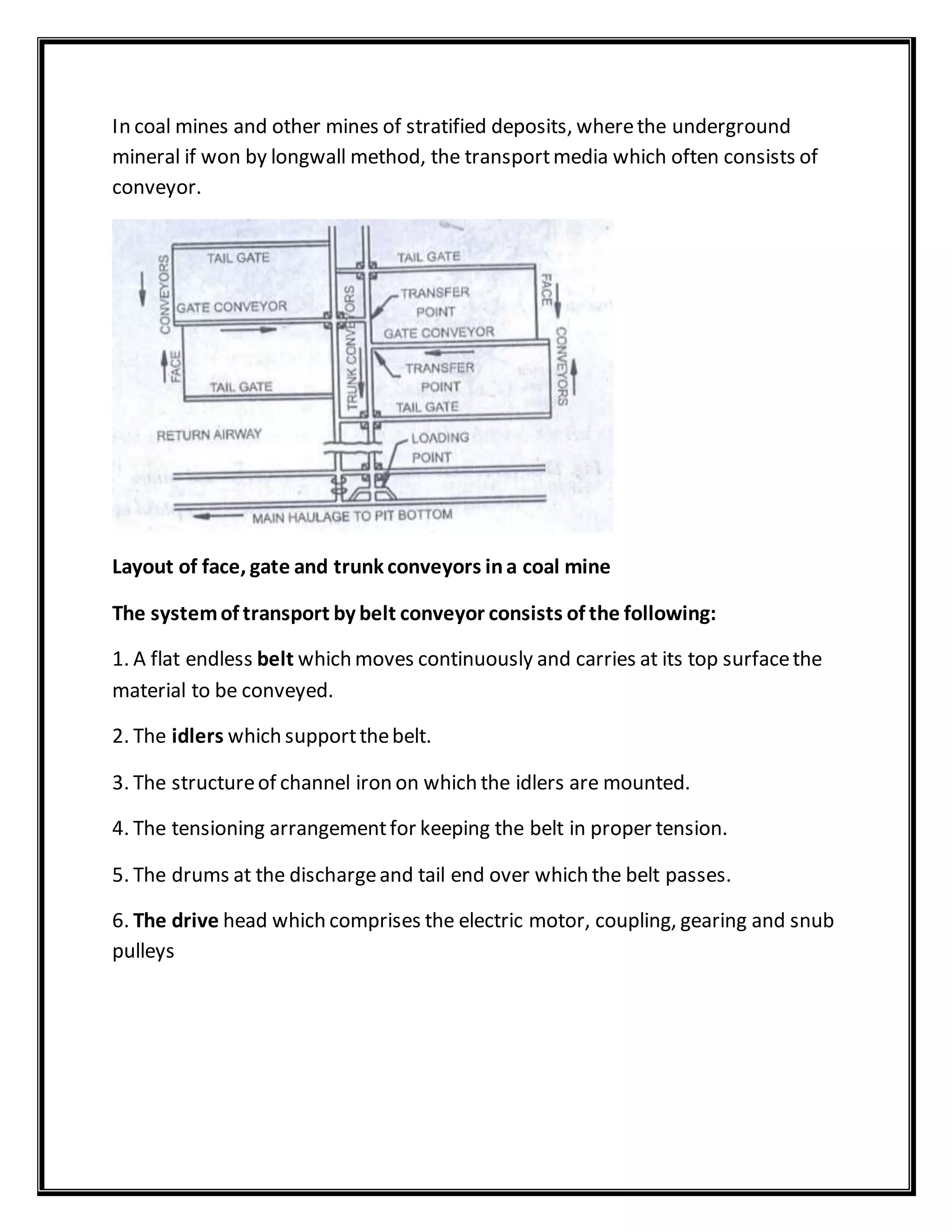
area of the plunger rod is exactly half that of ram R.
Let the ram is making its stroketo right and a volume of water,
corresponding to the displacement of the ram is forced through the delivery
valve D into the delivery pipe, the suction valve V is remaining closed. The
delivery pipe is connected via the passage‘p’ with the opposite end of the
pump barrel, and thus half the water pump by the rampasses back into the
barrel, filling the space around the plunger rod ‘r’.Theother half passes along
delivery pipe which represents the quantity of water actually pumped by the
stroketo the right.
During the stroketo the left, the pump barrelis emptied of its half volume
of water. The delivery valve D remains closed and a volume of water
corresponding to the ramflows through the now-open suction valveV.
Differential pump is so called becauseof the two different diameter of the
ram – delivers samevolume of water in every strokeits is ,in effect, a double
acting pump, having only one suction valve and one delivery valve justlike a
single-acting pump.
Effective capacity may be taken as that a double-acting pump having a
diameter equal to that of the smaller plunger ‘r’,or as that of a single-acting
pump of diameter equal to that ram R.
Priming:-
If the pump barrelis filled with air the pump will fail to draw its water. This
trouble may be overcomeby filling the barrelsolidly with water. The process
is known as priming. Actually most reciprocating pumps are self-priming, but
all pumps can be started more easily if they are firstprimed. Centrifugal or
turbine pumps cannot create their own vaccumwhen the pump is empty.
Before starting such pump must be primed solidly with water right fromthe
sump-levelto the main valve in the delivery column. If the pump fails to draw
water, it will heat up and become damaged.
Primming may be done by hand.Alternatively,water may be drawn fromthe
delivery column by the means of a special by pass valve and pipe fitted for the
purpose.
Air-Vessel:
Delivery Air-Vessel: Air vesselis a chamber filled with air and directly
communicated with delivery pipe of the pump. Its purposebeing to reduce the
jar, shock and noise with which a reciprocating pupm, and especially single-ating,
inevitably works when opposed by appreciable delivery head.
During the forcing stroke, the wholeof the water in column is accelerated and
then broughtto rest. The rate of acceleration is not constantand causes
pulsations or surgeof water which ultimately results shocks on driving
mechanism. But when an air-vesselis fitted, an certain amount is forced into it, so
compressing the air therein when the rate of delivery is maximum. At the end of
the forcing stroke, the compress air expands and drives out the excess water into
the main delivery column. Itthus helps to maintain more continuous flow of
water in the delivery pipe. Itacts like a spring buffer or cushion smoothing out
fluctuations of delivery and prevents damageto the pipes and joints. Itincrease
the effiency of the pump saving the power lostin the acceleration head.
The capacity of the air-vessel:
1. For a single-acting pump it should be 10 minutes the displacement of the
pump per stroke.
2. For a double-acting or a three-throw pump, an air-vesselof about half
this sizeor even less (2 to 4 times the displacement per revolution) will
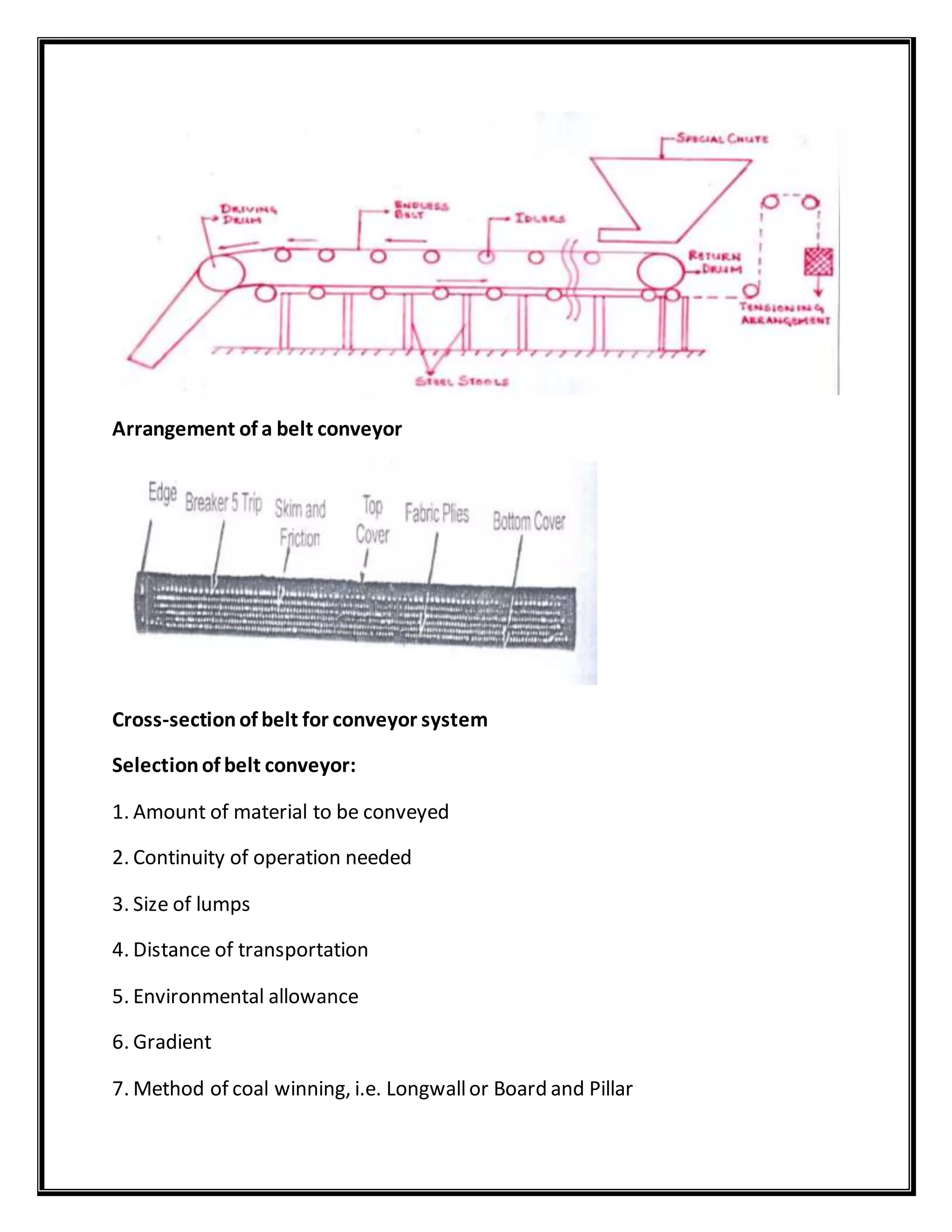
suffice.
The air-vesselshould be regularly re-charged via a tap at the top of the
vesseleither fromcompressed-air supply or by an air pump. A water
gauge should be fitted to the side of the air-vesselto check the amount
of air in vessel.
SuctionAir-Vessel:
The need for a suction air-vesselarises fromthe fact that the water
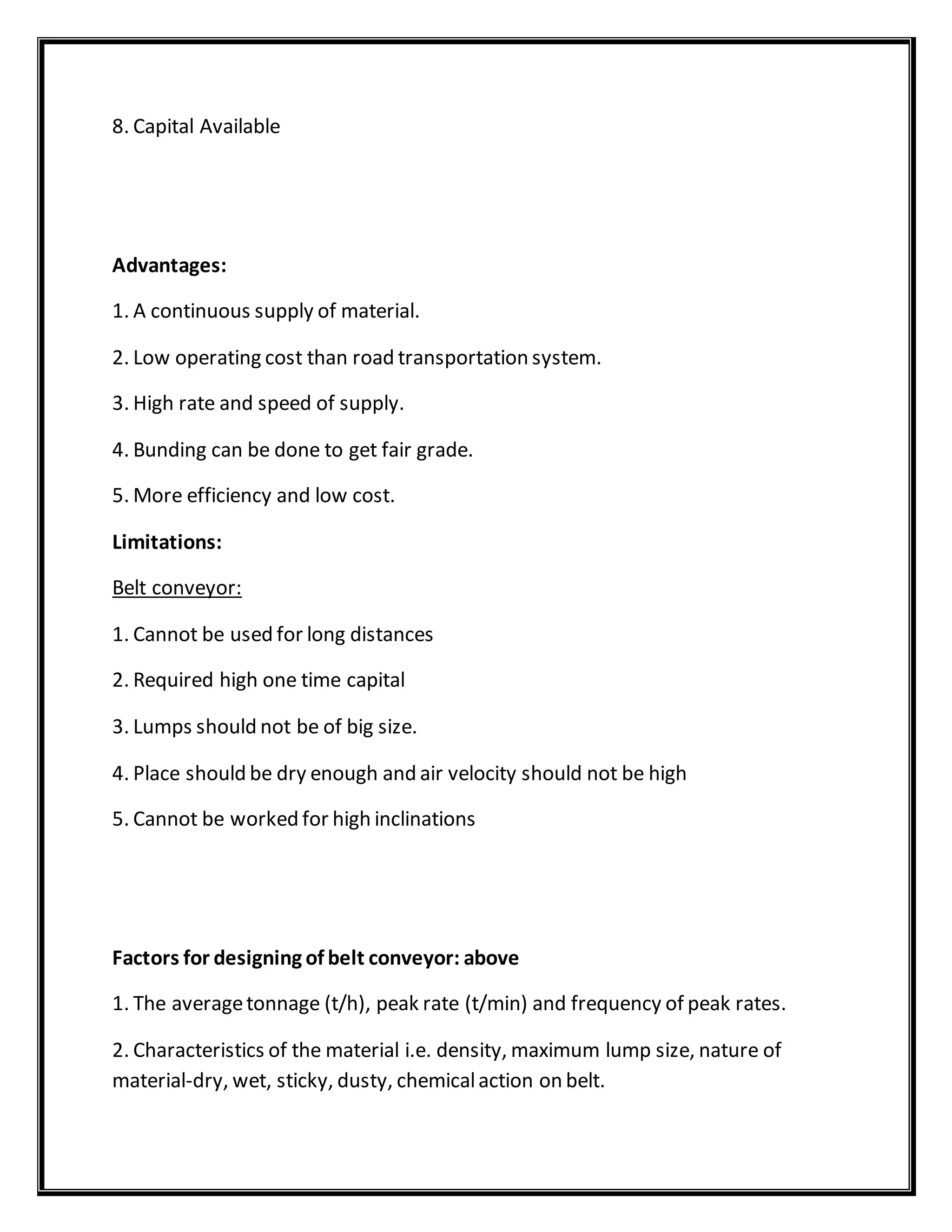
may not riseup the suction pipes as fast as the ramretreats, the result
being that an empty spaceexists between the water and the ram. This is
known as cavitation. Which is likely to arise due to high speed of the
pump and longer suction pipe of small diameter.On the reversestrokeof
the ramstrikes the still advancing water in the barrelwith a violent
shock. The useof suction air-vesselensures a constantflow of water and
enables the water to keep pace with the retreating ram. Such air-vesselis
fitted to the suction pipe, the top of the vesselbeing abovethe level of
the suction valve.
Centrifugal pump
A centrifugal pump is one of the simplest pieces of equipment. Its purpose is to
convert energy of an electric motor or engine into velocity or kinetic energy and
then into pressure of a fluid that is being pumped. The energy changes occur into
two main parts of the pump, the impeller and the volute. The impeller is the
rotating part that converts driver energy into the kinetic energy. The volute is the
stationary part that converts the kinetic energy into pressure.
Centrifugal Pump’s Principle: When a certain mass of liquid is made to rotate by
an external force, it is thrown away from the central axis of rotation and a
centrifugal head is generated which enables it to rise to a higher level.
Working Mechanismof a Centrifugal Pump
A centrifugal pump is one of the simplest pieces of equipment in any process
plant. Its purpose is to convert energy of a prime mover (a electric motor or
turbine) first into velocity or kinetic energy and then into pressure energy of a
fluid that is being pumped. The energy changes occur by virtue of two main parts
of the pump, the impeller and the volute or diffuser. The impeller is the rotating
part that converts driver energy into the kinetic energy. The volute or diffuser is
the stationary partthat converts the kinetic energy into pressureenergy.
Generationof Centrifugal Force
The process liquid enters the suction nozzleand then into eye (center) of a
revolving device known as an impeller. When the impeller rotates, it spins
the liquid sitting in the cavities between the vanes outward and provides
centrifugal acceleration. As liquid leaves the eye of the impeller a low-
pressurearea is created causing more liquid to flow toward the inlet.
Because the impeller blades are curved, the fluid is pushed in a
tangential and radial direction by the centrifugal force. This forceacting
inside the pump is the sameone that keeps water inside a bucket that is
rotating at the end of a string. Figure below depicts a side cross-section of
a centrifugal pump indicating the movement of the liquid.
Types of Centrifugal Pumps
• Volute Pump (CentrifugalPump)
• Turbine Pump
Volute Pump or Centrifugal Pump: Main components of the volute Pump
are as under:
• Impeller:Itis a wheel or rotor which is provide with a series of curved
blades or vanes. Itis mounted on a shaftwhich is coupled to an external
sourceof energy (electric motor) which supplies the required energy to
impeller, thereby making it to rotate.
• Casing:The impeller is surrounded by a spiralshaped chamber, which is
known as casing as shown in the figure. The shapeof the casing is such that
the sectional area of flow around the impeller generally increases fromthe
point A towards the delivery pipe.
1. Suction Pipe: Itis a pipe which is connected to its upper end to the inlet of
the pump, which is known as Eye. The lower end of the suction pipe dips
into the liquid which is to be pumped.
2. Foot Valve & Strainer: The lower end of the suction pipe is filled with a foot
valve & strainer. The liquid firstenters the strainer which is provided in
order to keep the debris away from the pump and then water enters the
foot valve. A foot valve is non-return valveand opens only in the upwards
direction as such the liquid will pass through the footvalve only upwards
and it will not allow the liquid to move downward back to the sump.
3. Delivery Pipe: Itis a pipe which is connected at its lower end to the outlet
of the pump and it delivers the liquid to the required height.
4. Delivery Valve: Just near the outlet of the pump on the delivery pipe a
delivery valveis provided. Itis a regulating valve which is required to
control the flow of liquid fromthe pump into delivery pipe.
5. Airlock: It is used for Priming.
Working of Volute Pump
The centrifugal pumps cannot be started until water is not filled in the casing. As
the impeller rotates, the water particles also rotate and their Kinetic energy
increases continuously. Dueto which they are thrown away fromthe impeller
tangentially towards thecasing. As soon as water particles hits casing their
kinetic energy are converted into the potential energy due to which the water is
raised to a greater height.
Priming
Itis the operation in which the suction pipe,
casing of the pump and the portion of the
delivery pipe up to the delivery valve are
completely filled with the liquid which is to be
pumped so that no air is left in the casing.
The pressuregenerated by the impeller
is directly proportionalto the density of the
liquid i.e. in contact with it. Hence if an
impeller is made to rotate in the presence of air, only a negligible pressurewould
be produced with the result that no liquid will be lifted by the pump as such it is
essential to properly bring a centrifugalpump before it can be studied.
Turbine Pump or Diffuser Pump
In a turbine pump the impeller is surrounded by a series of guide vanes
mounted on a ring case diffuser ring. The liquid after living the impeller passes
through guide vanes where the velocity of flow decreases & its pressure
increases. The guide vanes are so designed that the liquid coming out from the
impeller enters these vanes without shock. After passing through the guide vanes
the liquid flow into the casing which may be circular or spiralshaped.
These pumps will work with maximum efficiency only for first rate of
dischargeat given impeller speed. Moreover these pumps arevery costly.
Fig:-
Centrifugal
Turbine Pump
Multi-Stage Pump
0The head produced by a centrifugal pump depends on the rim speed of
the impeller to increase the rim speed, either the speed or the diameter of the
impeller or both must be increased, increasing either of these as the effect of
increasing the stress in the impeller material. This stress may be sufficient to bend
the impeller material for this reason it is not possible to produce very high head
with one impeller. But if it is required to deliver the liquid against the larger head
then it can be done by using a multistage pump.
A multistage pump consists of two or more identical impellers mounted on
the same shaft & enclosed in the same casing. All the impeller are connected in
series so that liquid discharged with increased pressure from impeller passes
through the connecting pipes to the inlet of the next impeller passes into the
delivery pipe. According to the number of impellers fitted in the casing a multi-
stage pump is named as two stage, three stages etc.
Arrangement of pipes and valves:
The requirements in the suction pipe of a turbine pump are:
1. The total suction lift, including vertical lift, pipe friction and the friction of
the foot valve and strainer, should not exceed 5 m upto the centre line of
the pump.
2. The suction pipe should be as short as possible, of large diameter and
minimum number of bends or elbows.
3. The pipe line should riseall the way to the pump so as to avoid air pockets.
4. An efficient strainer should be fitted well below the lowestwater level.
5. It should be borne in mind that when the impeller of a centrifugal or
turbine pump rotates, it causes a suction effect in the pump and water
enters the suction pipe as the atmospheric pressure forces the water in the
suction chamber.
6. The atmospheric pressure can however hold a water column, theoretically,
which is 10 m height sea level, if the water is at atmospheric temperature.
7. The atmospheric pressure has to balance not only the vertical height of
water column in the suction pipe, but also to overcome the friction in the
suction pipe, bends and elbows of the suction pipe and further, it has to
impart the velocity to the water which enters the pipe.
8. No matter how efficient the pump is, it can suck water upto a maximum of
9 m at sea level, as the atmospheric pressure can push it up only upto the
vertical height. In practice, however, a vertical lift of 4-5 m should be
considered to be a convenient maximum height for a suction pipe.
Starting of a Centrifugal Pump
1) Before priming keep the aircock of each stage open. When the every stage
is full of water, close the aircock.
2) Close the main valve(delivery valve) on the delivery side.
3) Check up for any leakage of air or water on the suction pipe up to the
aircock.
4) Put the motor switch on let the motor & pump run for ½ to 1 minute with
the valve closed & check the pressure from the pressure gauge it should
indicate full pressure.
5) Open the main valve on the delivery side slowly if delivery pipe is not fill
with water, but if it is full, open the valve rapidly otherwise motor may get
overloaded.
To Stop the Centrifugal Pump: First close the main valve & then open the motor
switch.
End Thrust
In all centrifugal & multi-stage pumps having single inlet impeller, a
considerable end thrust is developed which act towards the suction end of the
pump & these must be counter acted in the same way in order to increase that
the impeller revolve truly in their designed positions within each stage.
To end thrustcan be counter acted by two methods:
1) Double suction inlet method but this method is not commonly used.
2) Balancing disk: it is commonly used.
Balancing Disc
The common method counter acting end thrust in centrifugal pump is by
means of a balancing disc which is keyed near the delivery end of the shaft &
revolves in close contact with a seat fixed to the delivery chamber.
The periphery of the disc moves in close contact with the seat but doesn’t
touch it. The chamber between the disc & its seat is supplied with water under
pressure from the last impeller. The axial thrust towards the suction end causes
the clearance between disc & seat to close up, so that less water leaves the
chamber “A” then is trying to enter it & the pressure in this chamber therefore
increases until the axial thrust of the water on the balancing disc towards the
delivery end balances the axial thrusttowards the suction end.
ComparisonbetweenCentrifugal Pump& Reciprocating Pump
Centrifugal Pump Reciprocating Pump
1) Less spacerequired
2) Less costly
3) Run continuously in one
direction
4) They can deal with mud sand
etc.
5) No gearbox is required
6) Less maintenance
7) Less noisy in operation
8) Unsuitable when the supply of
water is not continuous
9) Less efficiency
1) More spacerequired
2) More costly
3) Run with to & fro motion
4) They can’t deal with mud or
sand etc.
5) Gearbox is required
6) More maintenance
7) More noisy in operation
8) Suitable when the supply of
water is continuous
9) More efficiency
Characteristics Curve:
Discharge (Q) in m3
/hour: A characteristic curve which shows how the discharge
of a centrifugal pump, varies with the changes in some other related quantity
such as “” head (height) & power.
1) Efficiency () Discharge Curve: As shown in figure the “” of a pump
increases up to a certain level with the increase in discharge rate &
therefore is falls as the dischargerate increases.
2) Head (Height) Discharge Curve: As shown in figure the curve is nearby flat
up to a certain level & discharge but thereafter it falls as the discharge
increases.
3) Power Discharge Curve: As shown in the graph that the power increases
uniformly with the increase in dischargerate.
4) Operating Point of a Pump (Centrifugal): A pump should be used under
those continuous which gives nearly maximum efficiency with maximum
discharge & for maximum head as shown in the graph by point “A” which
indicates the point where the pump “(” is maximum & head is also nearly
maximum. The point “A” is known as operating point.
5) Stable Characteristic Curves (Power Vs Q): A pump is seat to have a stable
characteristic when one quantity falls or increases continuously with the
increase in other quantity.
6) Unstable Characteristic Curve (( Vs Q): A pump is set to have unstable
characteristic when the curve has jumped. Bulk profile as shown in figure it
is unstable characteristic because there are two valves of a quantity for
another given parameter.
Laws governing centrifugal or turbine pumps:
1. The quantity of water delivered by a given pump varies directly to the
peripheral speed or r.p.m. of the impeller.
2. The pressuredeveloped by each impeller varies as the squareof the speed.
3. The power required varies as the product of the pressure and quantity i.e.
the cube of the speed.
Thus if the speed of the pump is increased to 1.5 times the original speed, it will
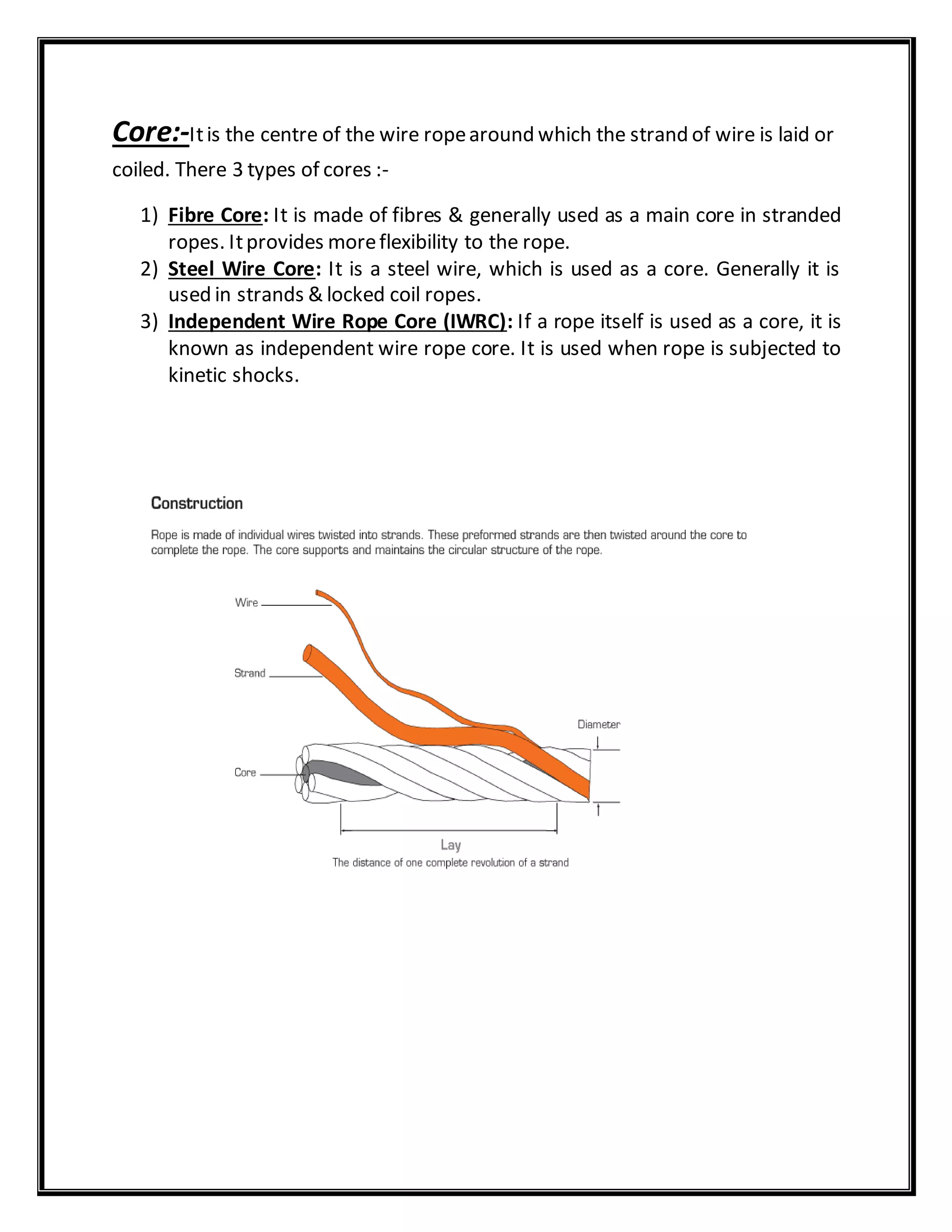
pass a.5 times as much water, it will overcome (1.5)2
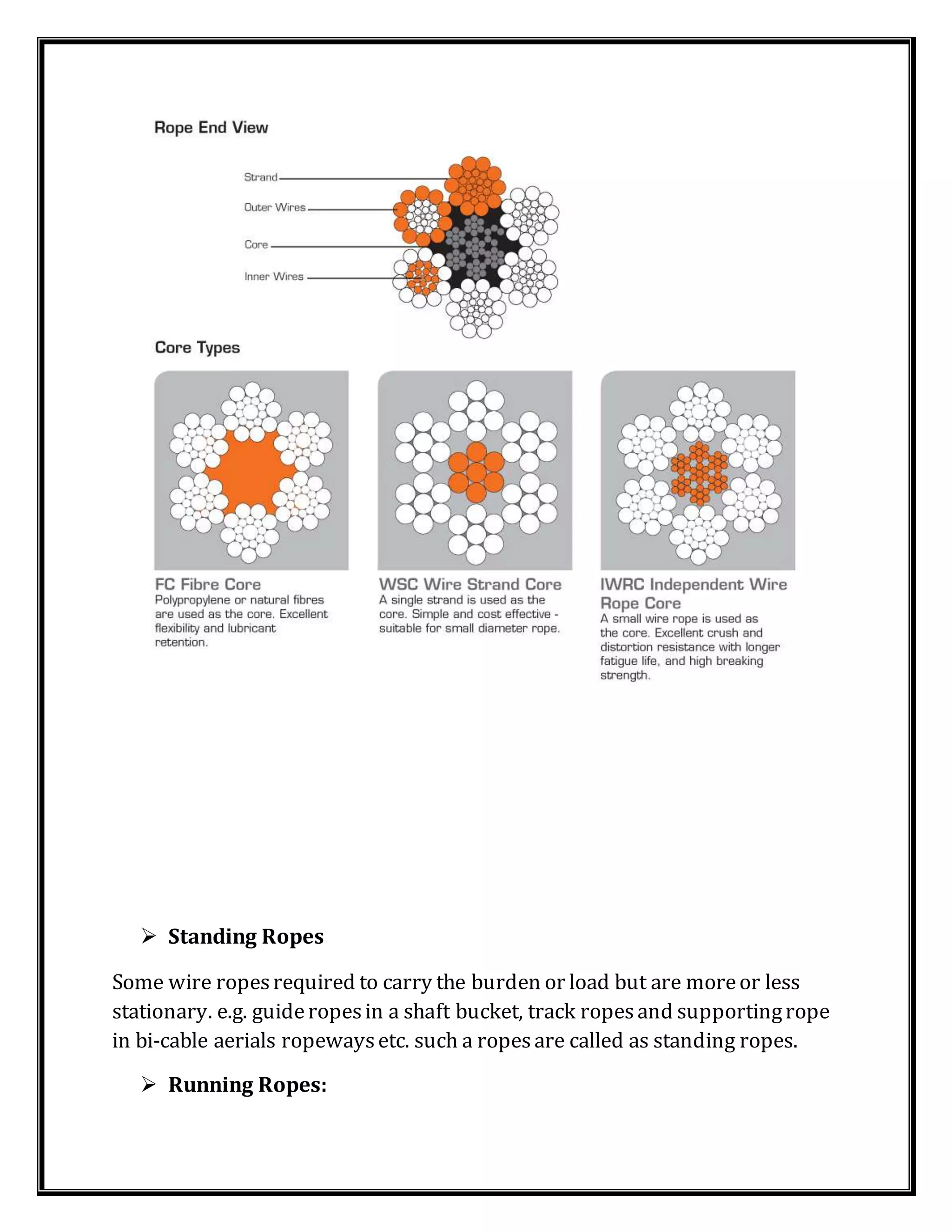
= 2.25 times the head and
with this increase it will require (1.5)3
= 3.375 times the power. These rules are
approximately true.
 A centrifugal or turbine pump only works at its best efficiency when dealing
with the exact quantity of water and the exact head for which it is
designed.
 If the head is much reduced the quantity of water will increase appreciably
and this will overload the motor.
 If a large pump designed for a particular head has to work for a small head
temporarily, a good arrangement is to take out one or two impellers and
replace them by dummy impellers.
 A dummy impeller is one which has no vanes (except for joining the two
discs constituting the impeller) and is therefore does not impart any
pressure head to the water though the impeller itself rotates along with the
shaft.
When starting the pump, if it refuses to deliver the water, the reasons and
remedies are as follows:
 See if the direction of rotation is correct. It is always marked on the casing
by an arrow.
 See that the strainer and the footvalve are below water level; in the pump
and also check that the footvalve is not kept open by some obstruction of
wooden piece or coal lump. The water in the suction pipe will flow away, if
the footvalvekept open by such obstructions.
 Check for air leakage on the suction side. The suction hose may have small
punctured holes due to rough usage. Check at all pipe joints on the suction
side, covering the joints with moist clay, wherever practicable, helps plug
the air leakage.
 Air may leak at the gland of the stuffing box. If possible cover the stuffing
box with an improvised water seal. Cotton waste, fully drenched with
water, may be placed at the entry of shaft into the gland very often this
helps.
 Foreign substance may have obstructed water passage into the suction
pipe. Tapping the steel suction range with hammer may dislodge the
obstruction fromits position.
 Delivery range might have developed a large leak at a place not easily
noticeable the motor will be overloaded in such case and ammeter will
indicate this.
Water Hammer
This is a violent shock caused by a moving column of water being suddenly
brought to rest. In reciprocating pumps, it is liable to occurs whenever the ram or
piston returns into half empty casing and meets the still advancing water with
violent shock and noise. If allowed to continue, a joint may be blown out and
valves or someother parts of the pump delivery column damaged.
Causes:
The reasons for water hammer may be as follows-
1. Suction pipe being too small.
2. Suction pipe or strainer partially choked.
3. Valve being defected.
4. Valve-seatloose
5. Suction pipe is too long.
6. The pump is suddenly started or stopped.
Remedies:
The following measures should to be take to minimize water hammer-
1. Installa larger suction pipe.
2. Avoid choking of valves and strainer.
3. Check valves and valve-seats.
4. Reduce the speed of the pump so that ramand water movein synchronism.
5. Use shorter suction range.
6. Use air-vesselsuction range.
7. Use air-vesselto ensureamore constantflow of water.
Snoring of the Pump
When the pump is working at the face, which may dry or the foot valve may
be opened in the air but the pump is running continuously, at this time the pump
makes a noise which is known as snoring of pump, at this stage impeller will be
badly damaged due to friction. To prevent this a small pipe connection is made
from delivery pipe to suction pipe so that the pump never runs dry, this pipe is
known as snoring pipe.
Siphon
Itis usefuldevice which is used for transferring theliquid fromhigher level to
lower level by utilising the atmospheric pressure.
1) It is a silent device for conveying water froma higher level to a lower level via
an elevated intervening ground.
2) Essentially, the siphon consists of a range of well jointed pipes following the
contour of the ground and fitted with a non-return valveat the end of the shorter
leg or draft pipe, and a regulating valveat longer or dischargeleg of the siphon.
3) Two other valves are provided at the highest level of the intervening ground,
one for priming and the other to allow escapeof air during priming.
4) Assuming the siphon is filled with water and the regulating valveopened, the
two forces will at once come into play causing dischargeof water.
5) The atmospheric pressureacting on the surfaceof water at upper level will
push water into the upper limb to effect the dischargecontinuously.
6) The upper limb mustbe kept continually immersed in water to prevent access
of air.
7) The effective driving head is the difference of level between the water levels at
two ends of the limbs.
Uses of siphon:
1) In hilly countries dewatering of mine workings may bedone with the help of
siphons.
2) Winzes or dip galleries can be very easily kept free of water by siphons,
eliminating pumps or water boilers thus reducing costand manpower.
3) Dewatering of faces at upper levels to a companion galleries at lower levels
belowground in coal mines may be successfully doneby siphon.
A tube ABC is filled with water & second ends of the tube are closed by
fingers one end of the tube is put below the surfaceof upper water level & the
other end is placed at a lower is placed at a lower level. When the two ends are
opened, liquid flows fromthe higher level to the lower level.
Let ABC is a tube; h1 is the elevation difference between A & B so that h2 is
greater than h1. Let B1& B2 are two points justat the left & right side of the point.
Let PA = pressureof A, g= acceleration due to gravity, d= density of liquid.
PA = PB1 + h1dg
PB1 = PA – h1dg ----------- (I)
PC = PB2 + h2dg
PB2 = PC – h2dg----------- (II)
Siphon will work if PB1 is greater than PB2
PB1 – PB2 = (PA – h1dg) – (PC + h2dg)
But PA = PC= automatic pressure
PB1 – Pb2 = h2dg-h1dg
PB1 – Pb2 = (h2-h1) dg
But h2 greater than h1, hence PB2 – PB1 is positive quantity this pressure
difference causes the liquid to flow until the upper container is empty.
Bernoulli’s Theorem
It state that when a liquid flows through a pipe of varying cross section, the
total energy of the liquid at any point remains constant assuming no friction
losses. It means that at any point the sum of pressure head, velocity head &
datum head is constant.
Let,
P = Pressureenergy,
 = Density
V = Velocity of liquid
Z = Datum head of liquid
g = Acceleration due to gravity
As for the Bernoulli’s theorem,
Pressurehead + Velocity head + Datum head = Constant
P/g + V2/Zg + Z = Constant.
If the liquid is a pipe of varying cross section as shown in figure
Then total energy at “A” = Total energy at “B”
P1/g + (V1)2
/2g + Z1 = P2/g + (V2)2
/2g + Z2 = Constant.
“Face Pumps”
A pump is a mechanical device which converts mechanical energy into hydraulic
energy.
In mines there is presenceof water it creates lot of problems.
Accumulation of water maybe due to-
1) percolation of surfacewater
2) Seepages fromwater bearing strata.
3) Influxfromwaterlogged old and abandoned.
4) Water due to stowing.
Face pumps are the pumps used in the face for drowning out the accumulated
water.
MAGATOR PUMP :
The magator pump is a hybrid product between the ram pump and turbine
pumps. It has the advantages of a centrifugal pump as if is direct-driven, no
internal valve and gearing. It has also common features of a ramp pump, viz
positive displacement and eccentrics. It works on a principle similar to that of a
three throw ram pump.
The pump consist of three rubber discs mounted eccentrically at 120® apart on a
shaft to ensure smooth flow and vibration. The discs work with in a chamber with
a closed it. The function of the ram is provided by a eccentrics, each sliding its
rubber block to and fro by their movement. The eccentrics’ works as valve
maintaining a continuous seal with blocks and thus effecting a positive
displacement as in case of reciprocating pumps.
The pumps are normally designed for heads 45 meter or more. It is
compact, light in weight, portable and directly coupled to motors. The wearing
members are minimum easy to dismantle, clean, inspect and refit-all these
qualities make it an ideal mining pumps for small requested. A Magator pump is
costly and used for face drainage.
DRILL PUMP:
The drill pump is a single stage centrifugal pump run by a normal electrical
drill. At the bottom end of the pump there are a number of inlet opening impeller
eye. The delivery outlet is a short length of pipe to which 5cm diameter pipe can
be added. The pump shaft is fitted up in the drill chuck. A carbon seal is used on
the shaft to prevent water going up. The speed of the electric drill is which is
normally 350 to 600 RPM is stopped up by means of a sum or planet gearing to
run the pump at 1450 RPM.
The drill pump is self-priming and can deal with gritty water. It is handy,
portable; weight about 18kg liters per minutes against 12 meter head. It is ideal
for face drainage. The disadvantages of this pump are it can be used for very short
period about 15 to 20 minutes &the used for longer period will heat up the motor
to cause damage again. If the pump is immersed in water due to rise of water
level, the motor winding will be damage.
MONO PUMPS:
Mono Pumps, also known as “Screw Pumps” or “Roto Pumps”,
relate to displacement until whose operating principle differs for that of
reciprocating or centrifugal pumps. It is an electrically driven rotative pump
having no valve. The pump requires no priming and can on a suction life as high as
75 meter.
CONSTRUCTION:
The Mono Pump consistof
1) A stator mode of natural or synthetic rubber or of other plastic material
torsion free stators bonded to milesleevesare also in use. The stator has a form of
a double internal index.
2) A machined cast iron or mild steel barrel inside which the stator is push
fitted.
3) A single helical rotor of special abrasion-resisting non-corrosivesteel.
4) Suction and
delivery branches, ringin for of 19mm to
75mmdid are with the main structureof the pump.
5) A showing by-puss pipe connecting the delivery branch back to the suction
to permit the recirculation of water to keep the stator lubricated during dry
running.
6) A hallow driving shaft running in bell bearing and transmitting and electric
motion to the rotor by a coupling rod of high tensile steel.
7) A three-phase AC squirrel cage induction motor running at 580 to 1450
RPM is switched direct on to the line.
Normal capacities of the pumps rang form 30 liters per minuets up to 450
liters per minutes, at total heads (including pipe frication) ranging up to 45 for
single stage pump and 90 meter for single stage pump. The pump requires no
foundation; normally it is skid mounted and works on any incline. When the
delivery head exceeds about 30m, a hand-controlled valve, with a pipe leading
back to the sump should be provided below the non-return valve in the delivery
column in order to relive the pressure developed when the pump starts up
against a full delivery column.
ACTION OF PUMPS :
The radial cross section of the rotor is circular and center are eccentric
relative to its axis of rotation. The pitch of the stator is twice that of the rotor&
the two engage in such a way that the rotor passage maintaining a constant seal
across the stator. This seal is advancing continuously through the pump giving a
uniformpositive displacement.
Water which enters the suction branch is thus caught up in the space
between the rotor and the stator and is forced through the pump as the rotor
revolves. A positive pressure developed on the delivery side and there must be a
free passagefor water before the pump is started up.
ADVANTAGES:
The advantages of mono pump are as followed;
1) The action is positiveand displacement is continuous without pulsation.
2) Self-priming is an inherent features since here are no valve to give rise to
slip and leakage.
3) The pump can work efficiently with suction life of up to 7.5 meters.
4) The pump can really deal with grit, without serious damage to the stator or
motor.
5) Itis light and portable and maintenance is cheap.
6) The works no shore, the by-pass pipe recirculates a little quantity of water
through the pump when there is no water in the sump and it keeps the stator and
rotor lubricated.
7) The speed of the rotor is kept low and the velocity of water inside the
pump is less which helps for lowering down the vibration and noise wear in stator
rotor and other moveable units.
8) Suction and discharge can be reversed by changing the direction of
rotation. The diameter of delivery pipe range should be smaller than of suction
pipe to combat suspension of the solid particles.
9) As the pump is inherently non-clogging and self-priming a regular which
saves manpower.
10) The pump is skid mounted and can be easily shifted and installed. It
requires no foundation.
11) It avoids construction of deep water collecting pit’s near the face but such
arrangement is necessary for a centrifugal pump which requires fool valve to be
always submerged in water.
DISADVANTAGES:
1) Attainable heads are limited in region of 45m and 90m for single and two
stage models.
2) It the pump run dry the stator will immediately be damage. The pumps
must be first be filled with water for lubrication purpose before the pipe are
connected.
3) Larger sizes of solid particle present in water if entered into the helical
spacemay causejamming the rotor and stator.
APPLICATION:
The mono pump has a wide field of use fullness for following purposes:
1) For handling coal slurry in was an heir.
2) For in bye works at the face or in dip beadings, where the suction
condition are difficult and variable and the pump may be have to work
on shore.
3) For cleaning sump and standings or on new drivages, where water may
be heavily 10 den with high abrasive solids or the water may contain
fine silt or slugs.
4) It may be used for water spring, wet drilling and cutting, flushing of
boreholes and infusion, blasting in coal mines.
SampleQuestionsin boardexam fromthis chapter
8 marks questions
a) What is centrifugal pump. Write causes and remedies if the centrifugal pump
refuses to deliver the water.
b) Explain in short. ( 3 times asked)
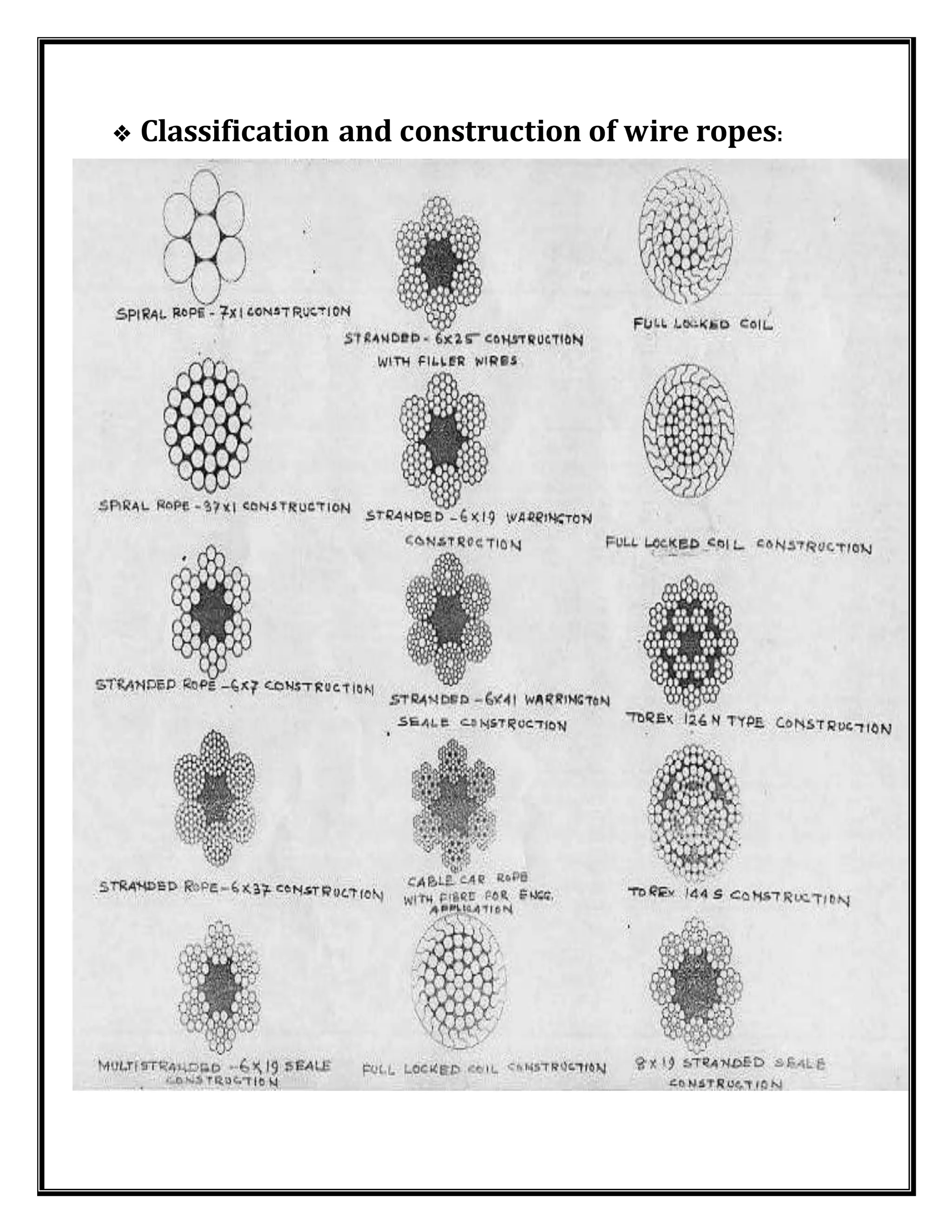
i. Water hammer
ii. Snoring of pump
c) Draw and state the functions of different parts of centrifugal pump.
d) Describein brief.
i. Mono pump
ii. Water hammer
iii. Snoring of pump
e) Explain starting and stopping of centrifugal pump.
f) Comparesingle acting reciprocating pump with double acting reciprocating
pump.
g) Comparereciprocating pumps with centrifugal pumps.
* Explain the function of following parts in pumps. (3 times for 5 or 4 marks)
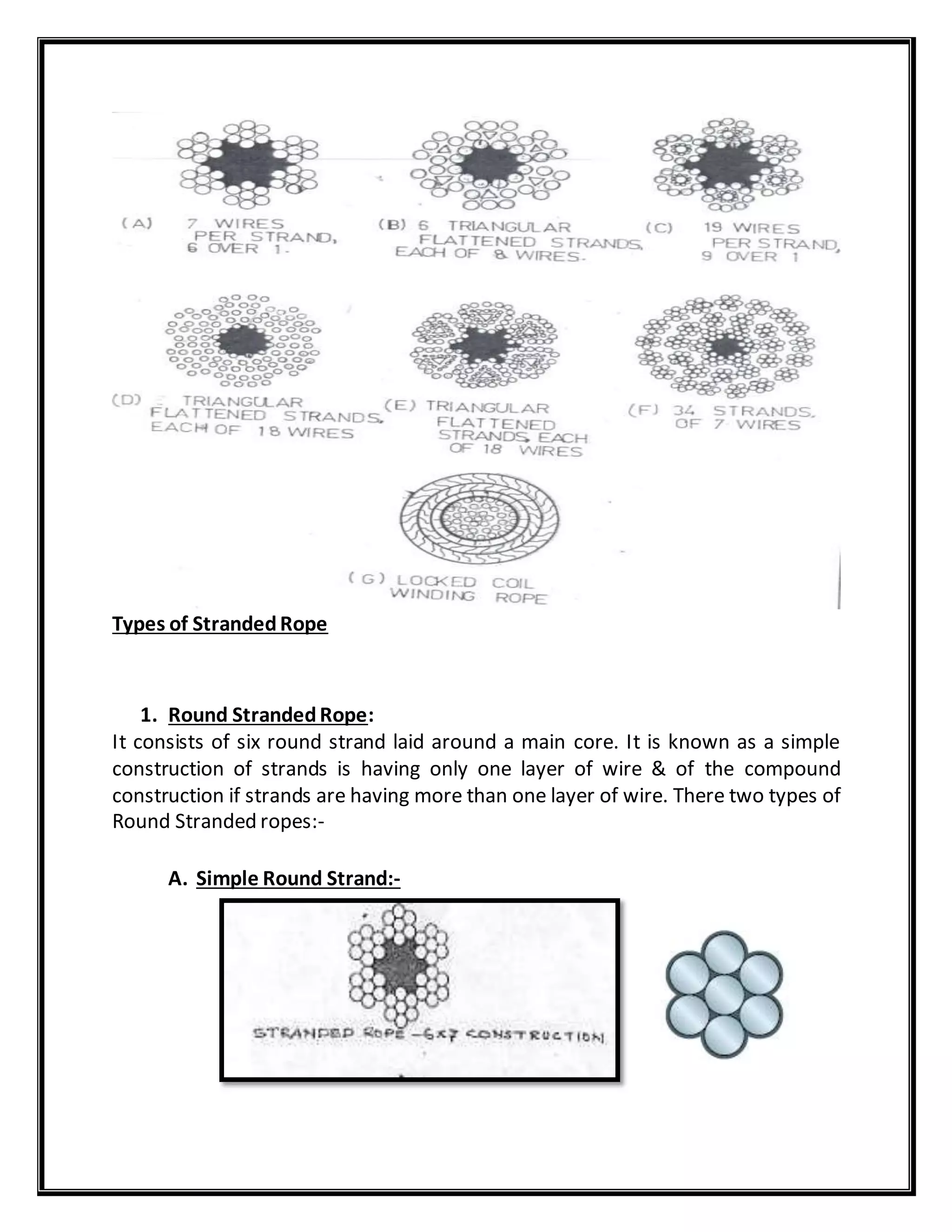
4 marks questions
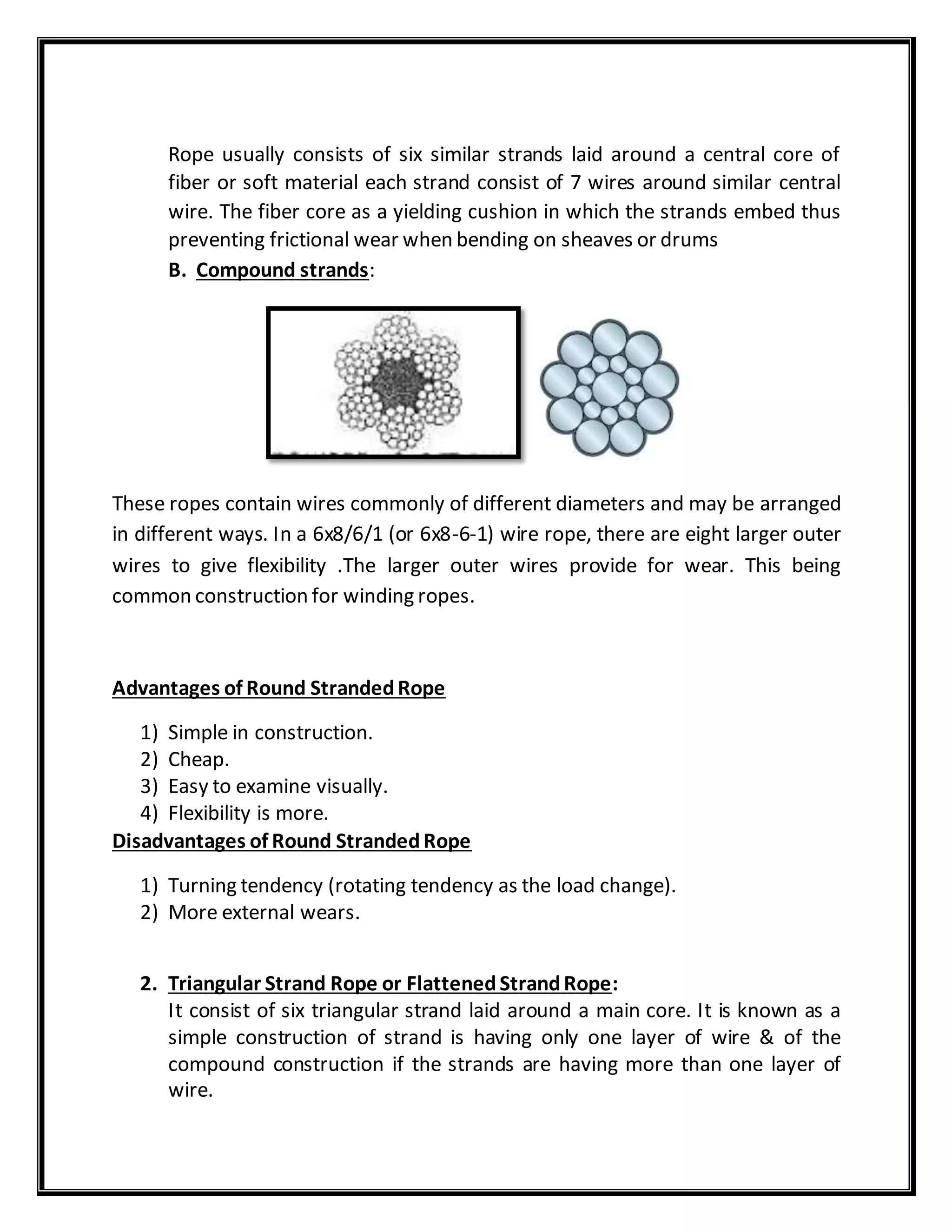
a) Give the classification of mine pumps.
b) Explain different types of face pumps.
c) State principle of working of centrifugal pump
Chapter No.:- 5
COAL CUTTING MACHINE
Definition of COAL CUTTING MACHINE (CCM):
A coal cutting machine (CCM) is to make a groove or cut 2 meter to
2.5 meter in depth & 125cm to 175cm height at a coal face. The cut is across
the whole width of the gallery in board & pillar system & across the whole
length of face in long wall mining
Que. Write various purpose of coal cutting machine
Advantages or Purpose of Coal Cutting Machine (CCM) are as follows:
1) It gives extra free face for efficient blasting.
2) To increase coal output per blasting
3) High rate of advance.
4) Straight & systematic advance.
5) Systematic roof support can be installed.
6) Roof is not damaged.
7) Less explosive is used.
8) More safety in gassy mines.
9) Dirt bands removed easily.
Que. Give the classification of coal cutting machine.(4marks)
Classification of Coal Cutting Machine (CCM):
1) Depending upon the Position of Cut
a) Under cutting coal cutting machine (CCM): It gives cut at floor
level only.
b) Over cutting coal cutting machine (CCM): It gives cut at roof
level.
c) Middle cutting coal cutting machine (CCM): It gives cut any
where between roof & floor.
d) Side cutting coal cutting machine (CCM):It gives cut at any side
right or left.
2) Depending upon Design :
a) Short wall coal cutting machine (CCM)
b) Long wall coal cutting machine (CCM)
c) Bent jib coal cutting machine (CCM)
d) Arc wall coal cutting machine (CCM)
e) Arc shearing coal cutting machine (CCM)
Theory :-
Many type of coal cutting machine have been designed and the process of
development is continuous. The coal cutting machine which are generally used to
give either an undercut, middle cut, to cut or side cut for making a free face for
efficient blasting operation are as follows:
1) Long wall coal cutters.
2) Shortwall coal cutters.
3) Arc wall coal cutting.
4) Arc shearer.
5) Percussivecoalcutters.
Que. Explain different parts of coal cutting machine.
1) Long wall coal cutters :-
The chain coal cutter this machine is built in three parts.
a) The cutting unit.
b) The hauling unit.
c) The Driving unit.
The cutting unit :-
This comprises a cost steel gear head which encloses the reduction gear-
usually a combination of spur and bevel gearing between the motor and the
cutting chain driving socket. It serves also as a support for the cutting chain jib
all shafts arecarried on boll and roller bearing.
Chain jib : This consistof three main components.
a) The jib head or bucket of cost steel swinging on the gear head.
b) The jib post or support bar of head treaded steel, bolted into a socket on
the jib head and giving rigidity to the jib of roller steel bar and which is
supplied on to it.
c) The jib of rolled steel bar and plats security riveted together, forming the
chain path and provided with renewable hardened steel wearing strips.
In some cases a sprocket is provided at the outer end of the jib so as
to reduce the wear of the cutting chain and jib, especially in hard coal,
otherwisea plan end jib are is used in CCM.
The jib can be locked in line with the machine for fitting or it can be
swing to either side and locked (at rather less than 90° to the body of the
machine) for cutting. The spring-loaded-locking pins engage automatically
at the appropriateposition.
The length of the jib may be anything form 0.95m-30m, depending
on the desired depth on many factor including the nature of the coal and
it’s associated roof and floor, the thickness of the seam and facilities for
clearance.
The cutting chain:-
It consist of a series of case-hardened or alloy steel pick boxes, joined
together by links and connecting pins in such a way as to resist all twisting
and bending excepted that necessary for going round the jib.
Each pick-box has forget upon it a block which carries the pick at the
required angle, the pick itself secured by a set-screw.
In a given chain, all the picks at a given angle form a “line” of picks
and the number of “lines” may be 7, 9 or 11. The angles of the picks and
their arrangement in the chain & depend on the nature of the material to
be cut and the position cut in the seam and are best found by experiment,
the tougher the material. The greater the number of lines of picks that are
necessary.
All the picks in each line, of course, must be set to the correct gauge
so that they project the some distance. If the coal is tender and apt to sit
down on the jib. The clearance may be increases by increasing the
projection of both top and bottom line of picks. It the jib rises in the seam
and leaves coal on the floor, the projection of the bottom like of picks may
be increased to counteract this tendency.
The normal “kerfs’” or thick of coal cut is between 16.67m – 21.67m
but winder cuts up to 8 in, can be made in easy ground by using a winder
set chain whilst special chains are also available to give thinner cut of
10.55m– 13.50m.
The picks :-
Coal cutter pick may be mode of a plain high carbon steel containing 0.60%
to 0.65% carbon, about 0.50% manganese and only small traces of sulphar and
phosphorous such a steel has the requisite. Straight and toughness and will take a
sharp cutting edge. When forget and heat-treated. It is essential that only sharp
pinks should be used forged to the correctshape.
To sharpen carbon steel picks they should be forged at a temperature of
1000°c (bright orange) down to 850°f (dark orange) and should be allow to coal
slowly in air. The cutting edge should be wider that the rest of pick so as to give
side clearance.
To harden and temper the cutting edge, various method are in use a good
method being as follows:
1) Re-heat the neat of pick to about80.0°c (brightred)
2) Partially coal the bit in the water until the remainder of the neat is dull red.
3) Clean the edge of the pick brightwith emery or a piece of sand stone.
4) Coal by complete immersion as soon as the point assumes a straw coloure.
The shank should not be hardened, for this would make it too brittle and
the pick set-screw would not bite.
Sometimes, alloy steels containing chromium, tungsten, etc. are used for
the picks because they have longer life and require less frequent shaping, but
they are much morecostly and requiremore care full heat treatment.
For abnormal conditions, plain, carbon steel picks may have their cutting
edges tipped with special nonferrous cutting material. Such as wide or
satellite. These have a natural hardness approaching that of a diamond and
can only be sharpened by graining with special wheels.
Type of Picks:
a) Throw Away Type: These picks are made of high carbon steel;
they can be prepared in mine workshop & required sharpening after
every shift. These picks are very cheap.
b) Tipped Picks: The trips of these picks are made up of tungsten
carbide, they required sharpening after every 50 to 100 cuts, and
these picks are costlier.
c) Reversible Picks: It consists of two cutting tips made of tungsten
carbide. It can be used for 100 to 200 cuts, the main advantage of
these picks is that they can be used in either direction, these picks
are very costlier. The picks are mounted on the cutting chain on the
pick boxes, these pick boxes are connected together with the help of
pin & links.
The hauling unit :-
In the machine being described, the haulage gear comprises two ropes
drum one at each side of the machine. Driven by the motor through a series of
straight cut at the end of the machine to facility turning and jibbing in each drum
carries 40 yard of (36.4m) of 1.27 cmropeor 22.75m –27.3mof 0.625 inch rope.
When cutting only the drum next to the face is in action. The rope being
secured to and anchor prop set some distance away. This arrangement of the
rope together with the face that the jib, when fixed in position for cutting forms
and angle of rather less than 90° with the machine, tends to keeps the machine
tight to the face and renders of use of guide rails or “fenders” normally
unnecessary except when the face is advancing to the rise cutting speeds can be
adjusted to 10, 20, 30, 40, 50 or 60 inches per min.
When fitting the haulage drum is driven through a different set of gears to
give a rope speed some7.5 m/m or more in some machines.
Half the stated speed can be obtained. When describe by pussing the rope
around a pulley at the anchor prop. And back to the machine to which it is then
attached the arrangementbeing term using a “double rope”.
The Driving Unit :-
This occupies the central portion of the machine and may be either an A.C.
Motor or a D.C. Motor or compressed air turbine.
In mines where it’s use is permissible electrical is nearly always preferred
because of the greater efficiency. The greater cutting speed obtained, the ease
with which the system may be extended and the lower running cost. In some
mines however compressed air must be used for reason of safety although it is
much noisier and create dustier condition at the face.
The dimensions capacity of long wall coal cutter described are : length
about 2.4 meter; width about 0.78 meter; and height 0.48 meter. A smaller model
is also available having a height of only 0.30 meter.
The cutting capacity depends on the nature of the coal. The condition
underground and the skill of the operators, but double unit regularly been cut in
one shift by one machine on a gradient of 1:3 and under and indifferent roof, a
machine of the type described regularly fitted down the face and them cut up the
136.5mallwith in shift.
Short wall and cutters :_
Short wall machines are used of cutting in the room and pillar system, both in the
developing rooms or heading and in pillar extraction; or where the face are too
large or gradient too sleep for are wall machines; or for the rapid driving of one or
two headings.
The cycle operation consist of cutting, drilling, blasting and loading & may be
completed in several time in each shift in the working place to which a machine is
allotted.
The short wall coal cutters differ from the long wall type in that it is
specially designed to sump straight in and cut across a short face only, being then
withdrawn. For such work that jib is permanently fixed in line with the machine
and special arrangementare made for maneuvering it are required.
The machine is divided into two compartment:-
a) The power unit, bearing either an A.C. or a DC Motor and
b) The gear unit which drivers the haulage drumand cutting chain
Short Wall Coal Cutting Machine
(CCM)
Long Wall Coal Cutting Machine
(CCM)
1) It is used in board & pillar
method.
1) It is used in long wall method.
2) The cutting jib is fixed in line
with the machine.
2) The cutting jib can be moved
with respect to machine in
either direction at 90.
3) The jib is longer. 3) Jib is shorter.
4) This machine is large in
overall dimension because the
haulage drums are mounted
out side machine.
4) The machines are smaller in
overall dimensions because
the haulage drums are inside
the machine.
5) It can be used as flight loader. 5) It can be used as flight loader.
6)
Que. Explain arc wall coal cutting machine.(4marks)
2) Arc wall coal cutter :-
The arc wall machine, like the short wall machine is used for driving
relatively narrow headings as in the room and pillar system, but it is
mounted on wheel, or on cater pillar track and cuts the face In a
semicircular arc.
The essential difference between the arc wall coal – cutting and long wall m/c.
A) It is mounted on a boogie or chassis, with chain driven wheels, giving a
fitting speed of some 24 meter per minute. The wheels have wide trades
and deep flanges to prevent derailment and are fitted with a power full
screw-operated brake.
B) It is fitted with slewing gear to enable the jib to be swung by power through
an arc of about 240° for this purpose. The two ropes drums project clear of
the sides of the machine (as in the short wall coal cutter) and the ropes
pass form each drum direct to the jib head. When required one of the
ropes may be used for moving a wheel-mounted machine on gradients on
which the wheels would slip, say steeper than 1:8 for fitting speed then
being 6 meter per minutes.
C) The gear head is longer by 6 or 7 in them in a long wall machine to allow
the jib head to be larger in diameter for-case in arc-cutting and to let the jib
swing through the required angle.
D) The length of the jib, i.e. its protection beyond the frame of the machine, is
usually 1.8 meter or 2.1 meter or longer is special cases a 1.8m jib sweeps a
radius of 2.25m, cut a depth of 1.8m, and forms a place 4.5m wide. A 2.1m
jib sweeps a radius of 2.55 meter, cut a depth of 2.1 meter and forms a
places 5.1 meter wide.
3) Arc – shearer :-
This differs form an ordinary arc wall machine in that it is fitted with an
adjustable gear head. Which enables the jib to be rotated in the vertical
plane through any angle so a to cut horizontally either near that bottom or
near the top of the seam or to shear the coal vertically at either side of the
place. Itis therefore, sometime described as an arc shearer.
An arc shearer may be mounted either on wheels or on crawlers, and
it may be driven by an electric motor or a compressed air turbine. The
machine is clearly more versatile that an arc wall and can therefore deal
more successfully with the variable condition met with underground.
5) Percussive coal cutters:-
This types of coal cutter is essentially a heading machine for use in narrow
working and is adoptable to either undercutting, over cutting, shearing
(nicking) or scalloping (breaking down) the coal.
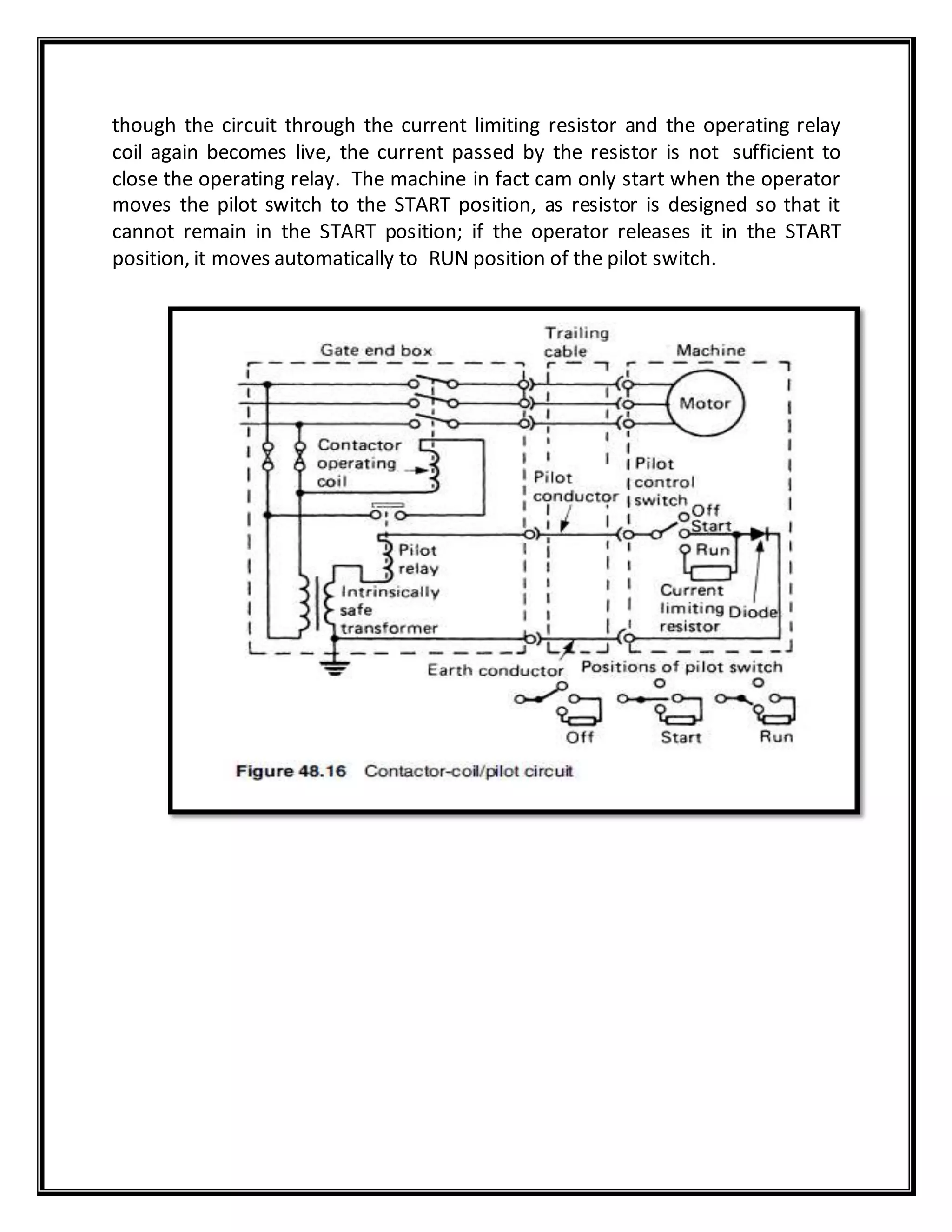
Such machine is likely to be more effective than the pneumatic pick
where the coal is very hard nature or the cleavage plane are not well
defined and when fitted with a vertical guardant for shearing or punching
(scalloping) purposes, it enables short firing to be dispensed with
altogether for coal getting.
It thus provided an alternative to short wall or arc wall coal cutters in seams
where blasting is undesirable although it cannot generally be regarded as
an adequate substitute for these machine under ordinary condition. A
typical percussive coal –cutter driven by compressed air consist of five
essential parts :-
1) Supporting column of steel tubing, with screw adjustmentto suitthe
height of the seam.
2) Toothed quadrants or segments one vertical and one horizontal, where
by the cutting tool can be revolved horizontally around the column for
undercutting plane for shearing or nicking by a combination of both
movement. The tools can be directed to any point on the coal face.
3) Air drill with a piston and valve mechanism where by a reciprocating or
punching motion is give to the cutting tool. It’s position on the steel
column may be varied to any height between roof and floor the piston
with it’s cutting tools gives 300 to 350 blows per minutes and also
rotates. The tool at about 80 to 90 rpm be feel for word as required by
the handle and screw feel.
4) Extension road 0.60 meter, 1.2 meter, 1.8 meter, 2.4 meter, 3 meter
long respectively and having conically shaped ends one end fits the drill
chuck and the other cutting bit.
5) Cutting bit of tool steel 0.09m diameter and weighting 5 lb. they usually
have five cutting prongs or edge, but may have 3 or 7 prongs in certain
cases.
Haulage GearArrangement for CoalCutting Machine (CCM)
In a haulage gear arrangement the speed of motor shaft is reduced by two
stage speed reduction gear box. The motor shaft connected to two spur gear A & B
by which the speed is reduced to 2/3rd time. Now it is connected to worm & worm
gear arrangement through which the speed is transmitted in perpendicular direction
& is reduced to 1/5th or 1/7th times. At the upper side of worm & worm wheel is
connected to another spur gear arrangement where speed is reduced to 1/4th to
1/13th times on the lower side & worm & worm gear. There is a spur gear with a
ladder placed to transfer the speed of one wheel to another in the same direction.
There is a pinion drum which may be connected to low speed by the log clutch.
The drum pinion rotates the drum gear which is connected to handing drum. In this
manner speed is reduced. Rotached& pull arrangement at the low speed side just to
prevent the rotation of handling drum in oppositedirection.
Que. Explain cutting gear arrangement of coal cutting
machine.
Cutting GearArrangement for CoalCutting Machine (CCM)
In this CCM only one motor issued for cutting hauling. One side of more
shafts is connected with the handling gear arrangement & the other side is
connected with the cutting gear arrangement. The motor shaft is connected with the
spur gear arrangement where speed is reduced to ½ to 1/3 times. There is a lever
gear which is connected to spur gear where speed is further reduced & transmitted
in perpendicular direction. The lever gear is connected with a dog clutch which
may be connected to the sprocketwheel to rotate the cutting jib.
CONTINUOUS MINER:
INTRODUCTIONOF CONTINUOUS MINER:
A continuous miner is a mining machine that produces a constant flow of
ore from the working face of the mine. The machine continuously extracts as
it is loading coal with a cutting steel drum and conveyor system. Continuous
miners are typically used in room and pillar mining operations. The
continuous miner is different from conventional or cyclical mining methods,
which halt the extraction process in order for ore-loading to proceed.[1]
Continuous miners, which began to take off in the mining industry in the
1940s, make up of 45 percent of the underground coalmine production.
Today, continuous miners are being developed as driverless machines s
DEFINATION:Continuous mining utilizes a Continuous Miner Machine with a
large rotating steel drum equipped with tungsten carbide teeth that scrape coal from the
seam.
A continuous miner is a mining machine that produces a constant flow of ore from
the working face of the mine. The machine continuously extracts as it is loading coal
with a cutting steel drum and conveyor system
Continuous miners are heading machines which combine the operation of
cutting coal or soft rock and loading it simultaneously into mine cars, shuttle
cars or conveyors without the usual unproductive breaks that are inherent
in the conventional mining which follows a definite cycle of operations.
Basically these machines include a cutting / ripping unit, a coal gathering
unit and a delivery unit. These cutter loader machines work on gradients up
to 15 degree,in seams of thickness up to 3 m (rarely up to 4.5 m) and give
a progressof 20 to 40 m in day or nearly 900 m per month, in a coal
heading. The ventilation system has to be efficientto keep pace with the
rapid advance of the face.
A continuous miner essentially consists of 5 main parts hinged to
the chassis viz.
1. A bottom carrying the cutting head,
2. A gathering head sited below the boom,
3. A frame which supports the delivery jib,
4. A jib which can be slewed,
5. Propelling unit which consists of crawler chains.
The two main types in use are (1) the borer type, and (2) the
ripper type. The borer type give very high rates of advance and depending
upon hardness of coal can penetrate at the rate of 0.3 to 0.6 m/min.
Description of one continuous miner, borer, type, is given here to
instruct its construction, manner of working and performance.
Que. Explain the different types of mechanical
loaders. Explain any one.
MechanicalLoaders
It is used for loading of coal or material in the driving road. It is having an
apron plate to collect the blasted material from the apron plate & transport it to the
discharge end. The discharge end of the loader can move in vertical & horizontal
plane.
Apron plate is lowered to touch the ground & it is inserted into the blasted
coal or rock. As apron plate is full & blasted material, it is lifted upward to
transport the blasted material on the chain conveyor is in motion & as soon as it
receives the material to the discharge end from where the material can be loaded in
the tub or conveyor etc. it has crawler mounted chain.
Joy Loader
It is used for the loading of coal or rock in the drivage road. It is having an
apron plate over which two gathering arms are mounted in the eccentric. There is a
chain conveyor to transport the coal from apron plate to discharge end. The
discharge end of ladder can move in a horizontal end vertical plane.
The apron plate is lowered to touch the ground end at the same time the two
gathering arm are rotating continuously. As soon as the apron plate is inserted in
the blasted material & loads on the chain conveyor this is in motion. The chain
conveyor transports the blasted material to the discharge end where it is loaded in
the mine tub or conveyor etc. it is crawler mounted machine.
LHD Specification
Que. Explain load haul dumper or side discharge loader.
(8marks)
Load Haul Dumper
1. Model EIMCO ELECON811 LHD contain 1.37 tons bucket capacity.
2. This model contain 37.5 KW 550 V electric motor.
3. Height of this LHD machine is 1.95-2 mand length is 6.30 m
4. Width of this loader is 1.5m.
5. Speed of this loader is on 1st
gear cover 3.8 KMPH, on 2nd
gear cover 7.2
KMPH, on 3rd
gear cover 12.2 KMPH.
Applicability conditionfor LHD
1. Seam thickness should havemore than 1.8mfor LHD machine.
2. Averageseam gradient up to 1 in 7 for LHD machine.
3. Suitable for weak floor as compared to SDL.
4. Maximum speed of LHD is 8-12 KMPH.
5. LHD machine is suitable for long distance.
6. LHD machine is driven 4.8 m width of headings.
7. In a gallery auger holes are drilled in the middle of the face up to 2mdepth
and shotholes are drilled up to 1.8mdepth.
8. P1 type permitted explosive with instantaneous type electric copper
detonator is used.
Coal is loaded by LHD on to chain conveyor which in turn transfer coal to the belt
conveyor.
1. Load Haul dumper (LHD):
 Also known as a scooptram
 specialized loading machine manufactured for the underground
mining industry.
 LHDs are used in >75 % of u/g mines throughout the world and are suitable
for small and large tunnels, mines, chambers, and stopes.
 It performs loading, hauling and dumping of bulk materials
LHD is categorized into two types:
1. Diesel LHD
2. Electric LHD
Selection:
It depends upon the following factors:
1. Size of operation
2. Length of haul
3. Height of seam
4. Operating condition
5. Local permissibility
6. Experience
Que. Explain side discharge loader(SDL)
. Side Discharge Loader (SDL):
1. mounted on a crawler track and is designed for loading the broken rocks
onto a conveyor or into the tub in coal or stone workings.
2. The high travel speed (0.7 m/s) makes it suitable for working with the
discharge point up to 10 m from the working face with no appreciable
reduction in loader output.
3. The loader can be employed on gradients rising or dipping up to 180
(1 in 3).
4. Itis totally flameproof.
5. The SDL may be adopted for discharge on the left or right side. Bucket
capacity is 2.032 te(maximum).
Optional components:
1. Cable reel
2. 0.1m3
coal bucket
3. Head light
4. Dustsuppression kit
5. Dump valve with lock and key
6. Averageoutput expected fromeach SDL/day is 200 to 500 te/day.
7. This equipment is used for applications in underground mining.
8. Itis indigenously designed and developed by in-houseR&D.
9. This equipment weighing 9 tones, is fitted with 1cu.m. bucket.
10.Fitted with powerful55 KW motor operating at 525V, 50Hz,
11.this equipment ensures very high productivity.
Itis ideally suitable for deployment in underground mines where intermediate or
Semi- mechanization is used
SDL specification
1. Model EIMCO ELECON625
Bucket capacity = 2.032 tons
Operating weight = 8.9 tons
Electric motor = 48.5 KW
Travelling speed = 3.0 kmph
2. Model M412
Bucket capacity = 1.35 tons
Operating weight =8.5-9 ton
Electric motor = 55 KW
Travelling speed =2.6 kmph
3. Model EIMCO ELECON611
Bucket capacity = 0.9 tons
Operating weight = 9 tons
Electric motor = 48 KW
Travelling speed= 3.0 kmph
Chapter No.:- 6
ELECTRIC POWER SUPPLY
DEFINITION:The current carrying conductors which are used
underground are known as cables.
6.1 Types of electrical power cable used in a mine
Explain different types of cables used in mines.
5) Permanent cable( shaft and roadways cabel)
6) Semi-flexible (conveyors,loaders, and other semi permanent
machines)
7) Flexible cable (coalcutters, drills, and other portable machines.)
6.2 PERMANENT CABLE
What are different types of permanent cables.explain
compound insulated.
Explain functions of following parts of cable.
1)jute bedding
2)lead sheath
3)armouring
4)screening
These are armoured cabelsand may be either
(A) Paper insulated
(1)PILSDWA
(2)PILSSWA
(B) Vulcanized bitumen insulated
(C) Compound insulated
(a) Paper Insulated :-
 PILSDWA (Paper insulated lead sheathed double wire
armoured cable)
Itconsistof three:-
A) COPPER CORE:-It consists of three copper cores either made of circular
section or sector shape. The copper cores are made of thin armoured
copper wire.
1) PAPER INSULATION:-All these copper conductors are insulated by paper
individually then all the three conductors are coiled together & wrapped
over by the paper to give a circular cross section. The paper used for
installation should be oily in nature to reduce its hydroscopic tendency. The
oil layer should be thin otherwiseit will havea bleeding tendency.
2) LEAD SHEATH:- To protect the cable form coming in contact with water and
the paper conductor it is covered with a joint less lead tube. The paper
insulated cable down through molten lead path for a joint less uniform lead
sheath.
1st
Jute bedding :
The lead sheathing is very shoft in nature, hence it may be rasily scratched
or cut by a steel wire used for armoring. Hence to protect it is covered by the
1st
Jute bed. So, that it is not cut by the steel wire armoring.
2nd
Jute bedding :
Around the first bed and lay of thick steel wire are wond spirally to give
mechanical strength to the cable. Between the two layers of wires there is a
layer of jute bedding to protect the wires form each other.
3rd
Jute Bedding & White Wash:
It gives a smooth surface to the cable. It is treated with a layer of coal tar.
The coal tar prevents the entry of the water inside the cable but such a
cable is sticky in nature, hence it is very difficult to take out the cable from
the drum. To overcome this difficulty the cable is painted by a thin layer of
warmish, which is known as white wash. It makes the cable non sticky in
nature.
ADVANTAGES:
1. Armouring takes the complete weight of cable.
2. Itacts as earth conductor.
3. Mechanical strength increases.
4. Crushing straightincreases.
 PILSSWA (Paper insulated lead sheath single wire
armored cable):-
It’s construction is sameas PILSDWA buttheis a single armouring in
between 1st
jute bedding and 2nd
jute bedding.
B) COPPER CORE: It consists of three copper cores either made of circular
section or sector shape. The copper cores are made of thin armoured
copper wire.
C) PAPER INSULATION: All these copper conductors are insulated by
paper individually then all the three conductors are coiled together &
wrapped over by the paper to give a circular cross section. The paper used
for installation should be oily in nature to reduce its hydroscopic tendency.
The oil layer should be thin otherwiseit will have a bleeding tendency.
D) LEAD SHEATH:- To protect the cable form coming in contact with water
and the paper conductor it is covered with a joint less lead tube. The paper
insulated cable down through molten lead path for a joint less uniform lead
sheath.
E) FIRST JUTE BEDDING: The lead sheathing is very soft in nature hence it
may be easily scratched or cut by the steel wires used for armouring, hence
to protect this; it is covered by the first jute bedding so that it is not
affected by steel wire armouring.
F) THIRD JUTE BEDDING & WHITE WASH: It gives a smooth surface
to the cable. It is treated with a layer of coal tar. The coal tar prevents the
entry of the water inside the cable but such a cable is sticky in nature,
hence it is very difficult to take out the cable out the cable from the drum.
To
overcome this difficulty the cable is painted by a thin layer of warmish,
which is known as white wash. Itmakes the cable non sticky in nature.
 Compound Insulated Cable
Compound insulator: All the three copper
core are insulated by a compound which is a combination of rubber & other
patent material. Then all the three copper conductors are laid around each other
& insulated by the compound to give a circular cross section.
Advantages of Compound Insulated Cable
1) Impervious to moisture
2) Unaffected by low & high temperature
3) Overalldiameter is less
Disadvantage of Compound Insulated Cable
1) Itis costly
 VBI (Vulcanized bitumen insulated cable)
4. COPPER CORE : It consist of 3 copper core. The copper wire used of core
consist of a small amount of tin. It is required to protect the copper form
the sulphur which is used in vulcanized process.
5. BITUMEN INSULATION : All there copper core are insulated by sheath
of vulcanized bitumen. The core are thin lead. Around each other and it is
again sheathed with bitumen to give a circular cross-section.
ADVANTAGES :
1) Impervious to moisture
1) Unaffected by low and high temperature.
2) Overalldiameter is less
DISADVANTAGES :-
1) Larger in diameter.
2) Adversely affected by high temperature.
3) Adversely affected by low temperature.
6.3 Semi-flexible cable :-
A three core semi flexible cable has 3 copper core, each vulcanized
rubber insulated and laid around center. The whole being tough rubber
sheathed to give a circular cross-section for mechanical strength, it is
armored by steel wires and overall sheathed with tough rubber or P.C.P.
Alternative the cable may have four core one being used as an earth
core or as a pilot coreor it may have five cores one being on earth.
6.4 Flexible cable :-
What is flexible cable .Expalin its different types?
Flexible cable requirements :Itshould be
1) very flexible.
2) Light in weight.
3) Water proof.
4) Mechanically strong.
5) Fire resistance.
Types of flexible cable :
1) 5 CORE A.C. CABLE :-(COLLECTIVELY SCREENED)
It consist of three power core one earth core and one pilot core each
of them is of equal size & vulcanized rubber insulated and laid
around a rubber center which may have 4 core laid around a rubber
center which consist of a pilot core. Now, it is sheathed with tough
rubber screw collectively and overall sheathed with PCP compound.
2) 3 CORE D.C. CABLE :
It consist of 3 copper cores each vulcanized rubber insulated two core
which are used for carrying current are screened and all the three cores are
laid around a rubber center& overall sheathed with PCP compound.
3) 5 CORE A.C. CABLE (INDIVIDUALLY SCREENED):
It cosist of 3 power cores one earth core and pilot core, each vulcanized rubber
insulated only 3 power cores are screened and laid around a rubber center or 3
power cores and one earth core are laid around the rubber which consist of a
pilot core. It is then overall sheathed with PCP compound to give the circular
cross-section.
4) DRILL CABLE :
It consist of 3 power core one pilot one earth core each of them is of
equal size and unscrewed and laid around a rubber center and
overall sheathed with PCP compound. It is lighter than any other
cable. It is used at 125V and the accidents at this voltage are unlikely
to be serious, henceit is made up of unscreened.
6.5 SCREENING OF CABLE
Write difference between screening and armouring
In cable, core are covered with copper screen or metallic screen by thin copper
wire. To increase the flexibility of cable and also for earthing is known as
screening of cable
There are two main type
Place Cable Used.
1. Shaft PILSDWA.
2.Underground
Levels
PILSDWA, PILSSWA, bitumen insulated or compound
insulated depending on condition.
3. C. C. M. Five core A.C. vulcanised rubber insulated (collectively
screened), flexible cable.
4. Coal drill Flexible cable, drill cable (five coreA.C. cables unscreened).
5. Watery places Permanent cable, compound insulated.
6. Belt conveyor Semi-flexible, three, four or five core vulcanised rubber
insulated & armoured cable.
7. Loader Flexible, five core vulcanised rubber insulated collectively
screened cable.
(1)Collective screening
(2)Individually screening
(1)Collective screening:-In collective screen, all the core are laid together at
the centre and overall screen with thin copper wires is known as collective
screen
(2)Individually screening:-In individually screen only power cable are screened
separately with the help of thin copper wire such type of screening is
known a individually screening
ADVANTAGES OF SCREENING
(1)Itact as earthing
(2)Itprotect the cable from external force
(3)Itprevent the cores to touch each other
(4)To prevent shortcircuit
(5)Itis easy to repair
(6)Itprovideflexibility
6.6 CABLE JOINT BOX:-
The permanent cables are jointed using the cable joint box. A joint box mustfulfil
the following conditions:
4. Itmust effectively protect the conductors frominjury.
5. Itmust preservethe efficiency & continuity of the insulation & exclude
moisture.
6. Itmust securethe cable armour & bend it in such a way as to maintain the
continuity of the earth in system.
7. a) A joint box is made of cast iron or mild steel, split longitudinally to give
the access to the conductors& assembled after the work is finished. The
actual joint between the conductors is made by a mechanical connector.
When the joint has been completed, it is covered with severallayers of
insulation tape.
b) Each coreis separated by porcelain plates each end of the joint box is
provided with an armoured clamp & saddling clamp which seals the cable
at its entry into the joint box & effectively securethe steel wirearmoured.
c) When all connection has being made the box is filled with a special
bituminous compound through the compound filling holes which are
provided in the upper half of the box. The compound is solid at normal
working temperature.
d) Finally it is most important that a copper wireis provided between the
armouring to main the continuity of the earth in system.
6.7 REPAIR OF FLEXIBLE CABLE
Permanent cables are not prepared as the flexible cables prepared. The
procedureof cable repair is as follows:
1) The five copper conductors, insulators, screen & tough rubber each are open
up to 15 cm length as shown. The five copper conductors are soldered with each
other.
2) Now put an insulation tape of black compound over each copper conductor &
then wrap the tape over all five conductors very firmly so that there should not be
any air gap between the tapes.
3) It is immersed in molten black compound & then cooled down. The screening
tape is taped & connected with the connective screen of the cable. 4) The cable is
again treated with tough rubber & P. C. P. compound to give the original design of
the cable. Now the cable is again ready for the use.
INSTALLATION OF SHAFT CABLE
what precaution you should take while fixing the cable in
vertical shaft.
CLEAT: Cleat are used to attach the cable with the bun tons in a shaft. Cleats
are prepared in two halves of circular cross section & joint together with the help
of bolts as shown. These are made of wood, their length varies from 0.7 to 1.0
meter & thickness is up to 0.2 meter.
At the top of the cleat a conical wood is provide to shade water & to deflect
material falling in the shaft. The cleats are secured to the bun tons by bolts or
suspended by chains.
TYPES OF METHODS
1) Behind the bun ton
2) On the bun ton
3) Top to bottom
4) Bottom to top
1) BEHIND THE BUN-TON: When the cable is to be fixed behind the bun tons
the cable drum & a rope drum mounted on a winch at the surface. A long
diameter pulley is installed in the headgear as shown. The cable & wire rope
are lashed & it passes over the large diameter pulley.
It is slowly lowered & also the cable & rope lashed together at certain interval.
When the cable & rope reaches the shaft bottom the cable is attached to the
bun tons by using cleats which are kept in the cage. As soon as the cleats are
fitted the lashing is taken out. In this way cable is installed behind the bun
tons.
2) TOP TO BOTTOM: In one of the cage resting at of the shaft, number of
cleats, a winch carrying the cable drum & bolts etc. are kept in the cage. The
out end of the cable is attached with the headgear with the help of cleats.
The cage is lowered slowly so that cable unwound from the winch & as soon
as the cage reaches the bun ton, it is stopped & the cable is attached to the
bun tons with the help of cleats. In this manner the cable may be installed in
the shafton the bun tons.
6.8 BLEEDING OF THE CABLE:
What do you understand by bleeding of cable
If a paper insulated cable is hanged vertically in a shaftit bleeds, in
other words the oil which is observed by the paper tries to flow down &
if access the pressuredeveloped by the oil may be sufficient to burstthe
lead sheet of the cable, this is known as bleeding of the cable.
To prevent this the oil used should be properly viscous & a proper method
should be used to make the insulated paper oily in nature. PILSDWA &
PILSSWA arebleeding type of cable while the bitumen insulated & compound
insulated cables are known as no bleeding type of cable.
6.9 CABLE CARE & MAINTENANCE OF FLEXIBLE CABLE
1) The operator should handle the cable carefully so that it is not damaged by
the moving machines.
2) Except when it is in use, cable should be coiled on the drum.
3) The cable should be examined & tested by an electrician when first
installed & thereafter once in every 24 hours.
4) The cable should be examined by the machine operator before starting the
machine.
5) If any defect is found in cable, it should be withdrawn at once.
6) The length of drilling cable in useshould be kept down to a minimum.
7) Spare cable should be ready for use in mines so that a defected cable may
replace immediately.
FACTORS TO BE CONSIDERED FOR SELECTION OF CABLE
FOR MINING USE
1) Total currentrequirement.
2) Location.
3) Working environment.
4) A.C. or D.C.
5) Remote controlled operations.
6) Type of machines to be used.
7) Length of cable required.
Short Notes
1) VULCANISING: Vulcanising compound is the rubber sheet with the liner
backing in the tape form. Each coreof the cable is bound tightly with this tape
in such a manner that no air is left between the layers. Now the cable is placed
in a vulcanising bath which is steel trough.
The trough is filled with wax which is heated to a temperature of about 300(F.
The cable is kept in the bath for about 30 to 45 minute depending on the type
& thickness of vulcanizing compound used. The cable prepared in such a way is
known as vulcanizing.
2) EARTH IN: Earth in means connection with general mass of earth in such a
manner that it ensures at all times an immediate dischargeof energy without
danger. All metallic sheets, handles, joint boxes, lamp holes, motors
switchgears etc. should be properly earthed. There should not be any fuseor
circuit breaker in the earth conductor.
3) FLAME PROOF ENCLOSURE:Ithas been defined as an apparatus that
can withstand without injury, an explosion of the inflammable gas that may
occur within it & can preventthe transmission of flame to the atmosphereto
ignite the inflammable gas which may be present in the surrounding
atmosphere. In all the gassy mines, electrical motor, switchgear, controlpanel
etc. are required to be flame proof.
4) INTRINSICALLY SAFE APPARATUS:Intrinsically safeapparatus denotes
that any sparking that may occur in normalwork is incapable of causing
explosion of inflammable gas. The spark coming out from the apparatus with
operating currentis less than one ampere. Itis achieved in caseof low power
apparatus such as telephones, signalling system, remote control& exploder
etc.
Chapter No.:- 7
GATE END BOX
 GATE END BOX:-
It is used to supply 550 volt AC to the coal cutting machine,Drill machine or
any other machine working at coal faces. The maximum distance of gate end box
from the machine is 100 m. For putting ON, OFF the switch at 550 volt on the
GATE END BOX
machine itself may produce a spark which is turn may ignite firedamp or coal
dust. Hence to avoid this there is pilot switch on the machine which works at
below 25 volts. When this switch is operated at the Machine, it operates the main
switch at gate end box to supply power to the Machine.
The gate end box is always placed in the fresh air, so that there is no danger
of gas on coal dust or firedamp explosion due to spark. The gate end box is used
to supply the power to the Machine trough a five core cable (three power core,
one pilot core & one earth in core). The main switch of the Machine which works
on 550 volts is placed at the gate end box.
 THEORY: -
In principle and in practice a gate-end panel is a contactor panel provided with
earth leakage and overload protective systems. The components of the pilot
circuits are also an important part of the gate-end box. The contactor in this box is
supposed to havea heavy duty of making and breaking a motor circuit.
Therefore contactors in gate-end box mustbe of heavy duty type subjected to
heavy electrical and mechanical (ON-OFF) duty. Thesegate-end panels are used
deep in the mines as a sourceof control and supply for various types of practical
use. For example, to operate a coal drill, it contains a transformer which provides
the necessary 125 voltsupplies or as it may be necessary.
In fact, drill panels are designed so that two drills can work fromone transformer.
These types of panels consistof two contactors each with its own control and
protective systemhoused in a single enclosure together with a transformer.
All the gate-end panels have a busbar chamber at the top, containing three
straightthrough busbars. Connections aretaken fromeach busbar to an isolator
located in the busbar chamber.
The busbar chamber is arranged so that when several panels are side by side, the
busbar sections are coupled together, forming, in effect, three busbars running
through all the panels, there being only one cable entry fromthe substation.
In fact, the busbar chamber is completely separated fromthe remainder of the
panel by flameproof enclosure. Connections are made from the busbar chamber
into the main contactor chamber by means of flameproof terminals. In the busbar
chamber also, an isolator has to be provided. Itis operated by a handle projecting
through the frontwall of the chamber.
The isolator’s main function is to isolate the contactor, the entire circuit, and the
pilot circuit fromthe busbars. Itis also provided that work can be carried out in
the contactor chamber without disturbing the busbar connection which, in-fact
would mean interrupting the supply to the other panels in the area.
However it must be ensured that the busbar chamber is not opened unless the
entire face systemhas been isolated from the substation. In this case no chance
should be taken, as it is a question of safety. The isolator is provided with four
positions, Forward, OFF,Reverse, and Test.
To move the isolator fromeither forward or reverseposition the isolator mustbe
moved to the OFF position. The isolator should not be normally being operated
when current is flowing in the power circuit.
The isolator is designed to break the circuit in an emergency i.e. if the contactor
fails to open. Now moving the isolator to the TEST position means that it
energizes the controlcircuit only to facilitate testing of various circuits within the
gate-end box.
In gate end boxes, the contactors in use are usually of air-break butt-contact type,
with wipe and rolling action under spring pressure. Themoving contacts are
spring loaded with spring capacity as per the required specification, to meet the
electrical effect of the rate of currentpassing through the contacts.
The moving contacts are mounted on a perfectly insulated spindle which is
actuated by a magnet coil called main operating coil. The contactors have to be
filled with a set of
auxiliary contacts which are held for control or sequenceoperation.
The main contacts are also sometimes fitted with auxiliary arcing contacts or
arcing points. This is designed to protect the main contact surfaces fromthe
severeeffects of serious racing’s.
However, an arrangement for guided arc extinction is done by means of specially
designed magnetic blow-outcoil, which is fitted in series with the main motor
line, so that at the time of making and breaking, full currentpasses through the
blow-outcoil.
Over and above, specially designed arc-chutes or blow-out checks are provided to
confine and interruptarcs inside these arc-chutes. Although not yet
manufactured in India, the latest development in contactor line is the vacuum
contactor, which is nowadays being used in Britain, U.S.
 How Gate End Box is Made Flame Proof?
A flame proof enclosure is one which will withstand without injury &
explosion of gas that may occur within it & will prevent the transmission of flame.
In fact it would be impossible to design the gas tight enclosure hence the
alternative is therefore to construct it so that flame coming out from the
explosion of gas will not pass outside.
 The Requirementsof Flame Proof Apparatus are as follows:-
1) At joint of enclosure, it should not have gap more than 0.5 mm.
2) If there is any hole, it mustbe blocked by a screw etc.
3) It should havesufficient strength.
4) All heads of screw/bolts should be cored.
5) All external circuit conductors must not pass through the casing but must
terminate in properly designed terminal box.
 Advantages of Gate End Box: -
1) Closing & opening of Face machine is done away from the face which is
well ventilated & safe.
2) If the pilot conductors are open circuit the main conductor automatically
trips.
3) If the trailing cable is damaged causing short circuit, the main conductor
automatically trips.
4) If the supply fails or flexible cable is removed or the plug are not fully
inserted then again main conductor trips.
5) After the insertion of power the Face machine can’t be started until the
starter handle is put back to off position & then to on position.
6) Control on the Face machine is simple & easy to operate.
7) Power core is flexible cable is allow only when the Face machine is running.
 MainSafety Provisions of Gate End Box:-
1) Overload or shortcircuit protection.
2) Lower voltage or power failure protection.
3) Earth continuity protection.
4) Earth leakage protection
5) Pilot protection.
6) Flame proof protection.
7) Mechanical protection.
1) Overload or Short Circuit Protection:In case of overloading or short circuiting
the face machine will draw more current hence more current flows flow in the
power cable & this more current may overheat the motor of face machine which
is working at the face, hence it is required that in case of overloading the machine
should be trip automatically as shown. The over current flow in the overloading
coil L1, L2 & L3 exert an extra force on plunger of dash peat which brakes the pilot
circuit at d1 & d2.
Hence the current flows in the coil Y & C1 & C2 are disconnected & again no
current flow in the coil Z. hence main conductor is operated to trip the power
supply to the machine.
2) Lower Voltage or Power Failure Protection: The pilot circuit is so designed that
if the voltage falls below 60% of the normal voltage the coil Y will not generate
forceto close C1 & C2.
3) Earth Continuity Protection: The pilot circuit is so designed that the machine
can’t be started till the earth continuity is established. It is so because pilot circuit
is completed through earth in wire only. If the earth in breaks it means no current
flow in the pilot circuit or in coil.
4) Earth Leakage Protection:If the flexible cable is partially damaged then the
insulation between earth in wire & power cores may get cracked through these
cracks the leakage of current takes place & balance of current in the leakage
transformer is distributed. Due to this a voltage is induced in the leakage
transformer & a force is exerted by the coil by on the plunger to break the pilot
circuit at E1 & E2. (If the pilot core is breaks, no current is flown in the coil & C1 &
C2 are disconnected & no currentflow in coil Z)
5) Flame Proof Protection: Whole gate end box is enclosed in flame proof
enclosure.
6) Mechanical Protection: The design of gate end box should be such that it
should not be opened till the insulator is in off position & all the apparatus are
dead & safe.
 Pilot Circuit:Somestandard pilot circuits used in the modern Gate End Box
There will be other contacts in the pilot circuit e.g. those opened by the
Earth Fault Relay when there is an earth fault.
 How does a Pilot SwitchOperate?
To start the machine, the pilot switch is moved to the start position. By
doing this the circuit is closed or completed from the secondary winding of the
transformer through the operating coil, pilot conductor, pilot switch and the earth
core of the trailing cable and back to the transformer. In this start position, as the
circuit is closed, the cost of the operating relay is energised, and its contacts close,
completing the medium voltage circuit through the contactor operating coil. This
coil then closes the three phase main contactor. As soon as the motor has
started, the pilot switch moves to the RUN position, bringing the current limiting
resistor into circuit. The resistor limits the current flowing in the pilot circuit to a
value just sufficient to hold the operating relay closed. To stop the, machine the
remote control switch is moved to the stop position. The pilot circuit is then
interrupted, and the coil of the operating relay is de-energised. The operating
relay therefore, opens, breaking the circuit to the operating coil which allows the
three phase contactor to open and then stop the motor.
Earth continuity failure protection:-
In figure seen that the earth core of the trailing provides earth continuity
between the machine and the gate end panel. In fact from the figure, we see this
earth core is also a part of the pilot circuit. Therefore, if the earth continuity is
broken, the pilot circuit is also broken and the three phase contactor
opens. Therefore it is not possible to start up the machine as long as the fault
continues.
Protection againstself-starting:-
Due to a fault in the distribution system or line, or if the power to the area
is switched off for any reason, the supply to the transformer and thus to the pilot
circuit will cease. As such the operating relay and the contactor will therefore
open. The pilot switch may be left in the RUN position, but the machine will not
start automatically when the supply is restored. This is because of the fact that
though the circuit through the current limiting resistor and the operating relay
coil again becomes live, the current passed by the resistor is not sufficient to
close the operating relay. The machine in fact cam only start when the operator
moves the pilot switch to the START position, as resistor is designed so that it
cannot remain in the START position; if the operator releases it in the START
position, it moves automatically to RUN position of the pilot switch.
 Why Pilot Circuits are used?
Pilot circuits are used primarily in the interest of safety. Following main
considerations are,
1) The use of a pilot circuit makes it possible to provide a number of specific
and particular safely measured like -
a) Pilot circuit ensures that the machine cannot self start after a power-
failure, or tripping, even if the remote control switch has been left in
the run position.
b) Makes sure that the machine will not operate if earth continuity is
interrupted.
c) The pilot circuit itself fails if it becomes faulty.
d) If anyone inadvertently attempts to disconnect a live trailing cable,
the live parts are exposed.
e) In case of emergency the pilot switch is near at hand to switch off the
circuit.
f) When the motor is not running the trailing cable is dead.
2) When a circuit carrying heavy current is broken, arcs at the main contacts
are pretty severe. It is therefore preferable that this arcing should take place
in the gate end rather than at the face where an explosive mixture of fire
damp and arc is more likely to occur. Due to the pilot circuit, the circuit can be
broken without causing any severe arc at the face, as the safety is ensured by
causing arc to take place inside the flameproof enclosure of the gate end.
3) A pilot circuit is designed as an intrinsically safe circuit.
 Failure toSafety:-
Now let us look at fig. when short circuit between the pilot and earth cores in
the trailing cable completes the circuit through the operating relay, and if the
pilot circuit were not to fail to safety, such a fault would cause the motor to
start immediately. In fact, if the motor was running, it would become
impossibleto stop switch.
However, failure to safety is ensured by the remote rectifier and the
operating relay. When the circuit is operating normally, the rectifier at the pilot
switch permits only pulses of direct current to flow in the circuit, that is, each
positive half-cycle of the alternating supply. The operating relay is designed to
operate only on this type of current. In the event of a short circuit between the
pilot switch is bypassed and a full alternating current flows in the circuit. The
operating relay, due to its higher impedance to a fault wave A.C. current, is de-
energised and the contacts of this relay immediately open and break the
operating coil circuit so that the motor cannotrun.
Protection againstdisconnecting the live cable is provided by the design of
the plugs and sockets used to connect the trailing cable to the machine and to the
gate end panel. On each plug the pin of the pilot coil is shorter than those of the
other cores. When the plug is withdrawn fromthe socket, the pilot pin breaks
contact before the others. If the cable is live when the plug is withdrawn, the
pilot circuit is broken and the main contactor opens while the power cores and
the earth coreare still connected. Open arcing at the plug when the power lines
are broken is, therefore, eliminated and the danger of electric shock is minimised
to a very great extent.
*****
IMPORTANT QUESTION ANSWERS
1. Explain Pilot circuit in (GEB) Gate End Box.
Pilot switch is safety feature in GEB which is operated in face machine by means
of switch. To start the machine, the pilot switch is moved to the start position. By
doing this the circuit is closed or completed from the secondary winding of the
transformer through the operating coil, pilot conductor, pilot switch and the earth
core of the trailing cable and back to the transformer. In this start position, as the
circuit is closed, the cost of the operating relay is energised, and its contacts close,
completing the medium voltage circuit through the contactor operating coil. This
coil then closes the three phase main contactor. As soon as the motor has
started, the pilot switch moves to the RUN position, bringing the current limiting
resistor into circuit. The resistor limits the current flowing in the pilot circuit to a
value just sufficient to hold the operating relay closed. To stop the, machine the
remote control switch is moved to the stop position. The pilot circuit is then
interrupted, and the coil of the operating relay is de-energised. The operating
relay therefore, opens, breaking the circuit to the operating coil which allows the
three phase contactor to open and then stop the motor.
Earth continuity failure protection:-
In figure seen that the earth core of the trailing provides earth continuity
between the machine and the gate end panel. In fact from the figure, we see this
earth core is also a part of the pilot circuit. Therefore, if the earth continuity is
broken, the pilot circuit is also broken and the three phase contactor
opens. Therefore it is not possible to start up the machine as long as the fault
continues.
Protection againstself-starting:-
Due to a fault in the distribution system or line, or if the power to the area
is switched off for any reason, the supply to the transformer and thus to the pilot
circuit will cease. As such the operating relay and the contactor will therefore
open. The pilot switch may be left in the RUN position, but the machine will not
start automatically when the supply is restored. This is because of the fact that
though the circuit through the current limiting resistor and the operating relay
coil again becomes live, the current passed by the resistor is not sufficient to
close the operating relay. The machine in fact cam only start when the operator
moves the pilot switch to the START position, as resistor is designed so that it
cannot remain in the START position; if the operator releases it in the START
position, it moves automatically to RUN position of the pilot switch.
2 What is Gate End Box. Write its construction.
It is used to supply 550 volt AC to the coal cutting machine,Drill machine or
any other machine working at coal faces. The maximum distance of gate end box
from the machine is 100 m. For putting ON, OFF the switch at 550 volt on the
machine itself may produce a spark which is turn may ignite firedamp or coal
dust. Hence to avoid this there is pilot switch on the machine which works at
below 30 volts. When this switch is operated at the Machine, it operates the main
switch at gate end box to supply power to the Machine.
The gate end box is always placed in the fresh air, so that there is no danger
of gas on coal dust or firedamp explosion due to spark. The gate end box is used
to supply the power to the Machine trough a five core cable (three power core,
one pilot core & one earth in core). The main switch of the Machine which works
on 550 volts is placed at the gate end box.
In principle and in practice a gate-end panel is a contactor panel provided with
earth leakage and overload protective systems. The components of the pilot
circuits are also an important part of the gate-end box. The contactor in this box is
supposed to havea heavy duty of making and breaking a motor circuit.
Therefore contactors in gate-end box mustbe of heavy duty type subjected to
heavy electrical and mechanical (ON-OFF) duty. Thesegate-end panels are used
deep in the mines as a sourceof control and supply for various types of practical
use. For example, to operate a coal drill, it contains a transformer which provides
the necessary 125 voltsupplies or as it may be necessary.
In fact, drill panels are designed so that two drills can work fromone transformer.
These types of panels consistof two contactors each with its own control and
protective systemhoused in a single enclosure together with a transformer.
3 What is flame proof apparatus? How you will make
apparatus flame proof. Also define intrinsically safe apparatus.
A flame proof enclosure is one which will withstand without injury &
explosion of gas that may occur within it & will prevent the transmission of flame
and does not ignite the firedamp outside the enclosure.
In fact it would be impossible to design the gas tight enclosure hence the
alternative is therefore to construct it so that flame coming out from the
explosion of gas will not pass outside.
 The Requirementsof Flame Proof Apparatus are as follows:-
1) At joint of enclosure, it should not have gap more than 0.5 mm.
2) If there is any hole, it mustbe blocked by a screw etc.
3) It should havesufficient strength.
4) All heads of screw/bolts should be cored.
5) All external circuit conductors must not pass through the casing but must
terminate in properly designed terminal box.
Intrinsically safe apparatus:-
Intrinsically safe apparatus safe apparatus is one which is so constructed
during its use the spark produce by it is not of such high temperature as to
ignition of gas. This construction is possible with apparatus operated by
voltage upto 25 volt.
For example signalling cable, telephones, eplodersetc
4 What are the safety provision in gate end box.Explain any two
safety provision in Gate End Box.
 MainSafety Provisions of Gate End Box:-
1) Overload or shortcircuit protection.
2) Lower voltage or power failure protection.
3) Earth continuity protection.
4) Earth leakage protection
5) Pilot protection.
6) Flame proof protection.
7) Mechanical protection.
1) Overload or Short Circuit Protection:In case of overloading or short circuiting
the face machine will draw more current hence more current flows flow in the
power cable & this more current may overheat the motor of face machine which
is working at the face, hence it is required that in case of overloading the machine
should be trip automatically as shown. The over current flow in the overloading
coil L1, L2 & L3 exert an extra force on plunger of dash peat which brakes the pilot
circuit at d1 & d2.
Hence the current flows in the coil Y & C1 & C2 are disconnected & again no
current flow in the coil Z. hence main conductor is operated to trip the power
supply to the machine.
2) Lower Voltage or Power Failure Protection: The pilot circuit is so designed that
if the voltage falls below 60% of the normal voltage the coil Y will not generate
forceto close C1 & C2.
3) Earth Continuity Protection: The pilot circuit is so designed that the machine
can’t be started till the earth continuity is established. It is so because pilot circuit
is completed through earth in wire only. If the earth in breaks it means no current
flow in the pilot circuit or in coil.
4) Earth Leakage Protection:If the flexible cable is partially damaged then the
insulation between earth in wire & power cores may get cracked through these
cracks the leakage of current takes place & balance of current in the leakage
transformer is distributed. Due to this a voltage is induced in the leakage
transformer & a force is exerted by the coil by on the plunger to break the pilot
circuit at E1 & E2. (If the pilot core is breaks, no current is flown in the coil & C1 &
C2 are disconnected & no currentflow in coil Z)
5) Flame Proof Protection: Whole gate end box is enclosed in flame proof
enclosure.
6) Mechanical Protection: The design of gate end box should be such that it
should not be opened till the insulator is in off position & all the apparatus are
dead & safe.
5 Draw a neat sketch of Gate End Box.
Fig. Circuit of Gate End Box
Fig. Gate End Box
****
EXTRA LEARNINGMATERIAL
Thank you!

Mining Machinery Learning Material for DEegree and Diploma

  • 1.
    GOVERNMENT POLYTECHNIC, NAGPUR. MININGAND MINE SURVEYING MINE MACHINERY 2018-2019 GUIDED BY :-Mr. B.J. NAIDU SIR PREPARED BY:- 1) TRANSPORT OF ORE SHOEB ANSARI 2)WINDING IN SHAFT ROHAN INDORKAR 3) WIRE ROPES RATIK MOTILINGE , KAPIL PAPDIKAR 4)MINE PUMPS DARSHAN FANDI 5) COAL CUTTING MACHINE PRAFFUL REWATKAR 6) ELECTRIC POWER SUPPLY ABHISHEK VANJAR, RUSHIKESH LANJEWAR 7) GATE END BOX
  • 2.
    RITIK THAKUR CURRICULUM OFMINE MACHINERY QUESTIONS PAPER Chapter No. 1 Transport of ore Questions :- 1)State different types of ropehaulage. Write conditions of applicability for each haulage. 2) List the various attachment used in endless rope haulage for attaching the tub with rope. Explain any one of them by drawing the neat sketch. 3) A direct ropehaulage pulls 10 loaded tubs at a time up anincline dipping at 1 in 8, An empty tub weighs 400 Kgf. and has capacity 900 Kgf. of mineral. Length of roadway covered by the haulage is 600 mt. the rope diameter is 25 mm. Ropespeed is 12 Km/hr. Coefficient of friction for the tubs and for rope is 120. Estimate the power required by the rope and by the engine. 4) Enlist and explain safety devices used on rope hallauge system. 5) State different condition for locomotive hallauge. Explain overhead wire electrical locomotive. 6) Compare direct rope hallauge with main and tail rope hallauge.
  • 3.
    7) State advantagesof Aerial ropeway. 8)What are the different types of locomative used in mine? Explain. Any one of them with neat sketch. 9) Sketch and explain. (Any two) (i) Backstay (ii) Monkey catch (iii) Runway switch  Ore-AnOre is an occurrenceof rock or sediment that contains sufficient minerals with economically important elements, (typically metals) that can be economically extracted fromthe deposit  Underground transport arrangements are dividedintofurther categories: 1) Underground to surface/main haulage 2) Underground to underground/Gathering haulage 3) surfaceto surface  Underground to surface arrangementis that which operates between winding shaft/incline and the main underground loading points. At the main loading point, the loads are collected fromone, two or more districts and then transported to the surface.  Underground to underground arrangementis that which operates between the working faces and the main loading points situated underground.  TYPES OF HAULAGE 1. Rope haulage. a. Direct rope haulage
  • 4.
    i. Single drumdirect rope haulage. ii. Double drumdirect rope haulage. b. Endless rope haulage i. Over rope. ii. Under rope. c. Main & tail rope haulage. d. Gravity rope haulage. 2. Conveyor system of haulage. a. Belt conveyor. b. Cable belt conveyor. c. Chain conveyor. i. Scraper chain conveyor. ii. Armoured chain conveyor. iii. Gate end loader. iv. Mobile stageloader. v. Pick a back conveyor. d. Plate conveyor. e. Disc conveyor. 3. Locomotive haulage. a. Diesel locomotive. b. Electric battery locomotive. c) Electric locomotive 1. Trolley wirelocomotive. 2. Cable reel locomotive.
  • 5.
    e. Compressed airlocomotive. f. Electro gyro locomotive. 4. Aerial ropeway A) Rope Haulages 1) Direct Rope Haulage a) Single DrumDirect Rope Haulage: 1. This is simplestsystemof ropehaulage.
  • 6.
    2. Itconsists ofone track, one rope& one drumwhich are connected to a motor through gears. 3. One end of the rope is connected with the train of tubs on the track & another end of the rope is connected to the drum. 4. When the drum rotates situated at the top of the incline, the loaded tubs moves upwards. Butfor the downward journey of the empty tubs it does not require any power because a tub moves downward due to their own weight. 5. The systemcan run on inclines steeper than 1 in 12& the speed of the haulage is 8 – 12 km/h. Advantages of Single Drum Direct Rope Haulage 1. Simple in operation. 2. Only one brake is required. 3. Extension is easy. 4. Branched roads can also be served, if gradient is suitable. 5. Can be used in narrow roads. Disadvantages of Single DrumDirect Rope Haulage 1. High power demands for upper journey of loaded tubs. 2. Efficient braking systemrequired for downward journey. 3. High speed haulage demands more maintenance of track. 4. Cannot be used for less incline roadways. 5. A derailment is associated with heavy damages. 6. Due to high speed more dust, morewear & tear. b) Double Drum Direct Rope Haulage:
  • 7.
    1. Itconsists oftwo drums, two ropes & two tracks but only one driving motor. 2. One end of each rope is connected with two drums & another end of rope is connected with the set of tubs, in such a way that when one set of tub is at incline top, the other set is at incline bottom. 3. The two drums are connected with each other. When drumrotates, the rope coils on one drum& uncoils fromanother drum. 4. Itcan be used if inclination is morethan 1 in 12. The speed of the systemis 8 to 12 km/h. Advantages of Double Drum Direct Rope Haulage 1. Higher output. 2. Less power demand. 3. Branched roads can also be served, if gradient is suitable. Disadvantages of Double Drum Direct Rope Haulage 1. Wider roads required. 2. Efficient breaking systemrequired for downward journey. 3. High speed haulage demands more maintenance of track. 4. Cannot be used for less incline roadways. 5. A derailment is associated with heavy damages. 6. Due to high speed more dust, morewear & tear. 2) Main& Tail Rope Haulage:-
  • 8.
    1. In thissystemthe haulage engine provided with two separate drums, one for main rope which hauls the loaded tubs up the gradient& one for tail rope which hauls the empty tubs down the gradient. 2. When one drumis in gear, the other drum revolves freely but controlled. The main ropeis approximately equal to the length of the incline & tail rope is twice this length. 3. The systemcan be used if the gradient is unsuitable for the use of direct rope haulage. Its speed is 15 – 18 kmph. Advantages of Main & Tail Rope Haulage: 1) Can be used on less inclined & undulating roadways. 2) Branch roadways can be served. 3) Only one track is required. 4) Less number of tubs is required. Disadvantages of Main& Tail Rope Haulage: 1) Due to high speed more dust, morewear & tear, moremaintenance. 2) Derailment causes high damage due to high speed. 3) More power is required than the endless rope haulage
  • 9.
    3) Endless ropehaulage:- 1. This systemconsists of double track, one driving pulley & one return pulley. 2. An endless rope passes fromthe driving pulley which is situated at the inby end & back again to the driving pulley. 3. One track is used for loaded tubs & another track is used for empty tubs. 4. Rope moves in one direction only with the speed of 3-7 km/h. 5. Only one train of tubs is attached to the ropeat a time but sometimes a set of tubs can be attached to the rope. The systemis used wherethe gradient is less, generally less than 1:12 or where the ground is undulating. A squirrelcage motor is commonly employed. Pulleys. a) Under Rope Endless Rope Haulage:- 1. If the rope passes below the tubs, it is known as under ropeendless rope haulage. 2. In this systemthere is morewear & tear to this rope but also there is an advantagethat there is more direct pull on the tubs.
  • 10.
    b. Over RopeEndless Rope Haulage:- 1. If the rope passes over the tubs, it is known as over rope endless rope haulage. 2. In this systemropeis unaffected by wet floor & liable toless wear& tear. The rope is at better working height & a systemis generally used for undulating roadways. Advantages of Endless Haulage 1) Because of slow speed, less wear & tear to the tub wheel & track. 2) Less maintenance is required. 3) Accidents do not causemuch damage. 4) Less motor power required. 5) Continuous flow of mineral or coal is attained. Disadvantages of Endless Haulage 1) Itrequires wider roads. 2) Not suitable for Steeper gradient. 3) Load on the rope is large hence a rope of large cross section require. 4) Large number of tubs & clips are required. 5) Itcannot servea branch road.
  • 11.
    6) Extension isnot simple. 7) Minor injuries to hands & feet are common. 4) Gravity Haulage: 1. This is haulage withoutmotor or any external sourceof power. 2. Itis used when load is to be transported fromuphill to down the gradient. 3. Itconsists of brake path on one side & is way pulley. It is located at the top of the incline roadway. 4. The one end of the single rope is attached to the loaded tub & the other end is attached to the empty tubs while passing over the jig pulley. 5. When the loaded tubs moves down the gradient at sometimes empty tubs moves up the gradient. 6. The brakestrap is provided with brakepath & is connected to a lever. When the lever is depressed the braking effect on the jig pulley is produced. Safety precautions:The safety measures tobe takenfor the gravity haulage include- I. Large roadways, adequatelightning, well- laid tracks with proper maintenance, strong and reliable couplings chains etc. II. Backstays behind ascending tubs, and back catches or spring catches to preventempty tubs running downwards down theincline. III. Safety prop in the frontif the jig wheel to hold the rope in the event of pulley anchoragefailure. IV. Drop Warwick near the top of incline and a bottom to rests tub in case of forward runway. Runaway switch to derail tubs and arrestthem for a samereason.
  • 12.
    V. A secondbrakeon the brakewheel should be provided which acts directly on the rope itself to preventrunaway of full tubs if they should be lowered into the incline without an empty set having been attached to the top at the bottom the brake wheel securely fenced and a guard erected to prevent men running into the handle of brake.  Driving Pulley or Surge Wheel Pulleys or wheels are used for driving purposes on haulages. They have its throat so shaped as to give the necessary grip to prevent jar and shock  Types of Driving Pulley & Surge Wheel 1) Clifton pulley. 2) V-grooved pulley. 3) Fouler’s pulley. 1. CliftonPulley: This pulley has tapered throat lining of renewable cast iron or soft steel segment having a tape of about 1 in 8. These segments are bolting to the rim to protect the main pulley from wear. The rope is coiled severaltimes (3 ½ - 4 ½) around the pulley & it enters the pulley at larger diameter & leave the pulley at smaller diameter. This pulley is commonly used in mines in endless haulages. 2. V-GroovedPulley: This pulley consists of two segments made of renewable castiron or softsteel. These segments are bolted to the main pulley in ‘V’ shape. The rope takes only a half turned around the pulley & takes the necessary grip by becoming wedged between the two inclined segments. The grip on
  • 13.
    the ropeis directlyproportionalto the tension in the rope. 3. Fowler’s pulley: Itconsistof number of bell shaped pivoted segments made of renewable cast iron or softsteel. These segments are pivoted to the main pulley as shown in figure, the pressureof the rope on bottom of the segment towards each other so that they grip the rope in proportion to its tension.  Rope clips :- The endless ropes moves at a slow speed over pulleys or rollers situated between the rails in the haulage way. Special clips are used for detaching tubs or cars to the moving rope. The design of such clips depends on whether the rope travels under the tubs, or over the tubs.  Types of Clips 1) Screw clip. 2) Small-man clip. 3) Lashing chain. 4) Goose neck clip.
  • 14.
    5) Cam clip 1.Screwclip:-Itconsists of two jaws i.e. lower jaw & upper jaw. When the distance between two jaws is enough to accommodate the rope, the moving rope is placed in between the jaws & the handle operated which reduces the distance between the two jaws. Hencethe two jaw grips the load rope, due to this grip as well as tub starts moving with the rope because the clip is connected to the tub & through a rod or lever. 2. Small man clip: - Itconsists of two side plates loosely held together by a bolt which has a spring which keeps the two plates apart. A hand lever pivoted at ‘P’ & carries a wedge at its upper end. When the hand lever is depressed, the wedge enters between the two plates to grip the rope. The clip can be detached automatically fromthe rope by fixing a trite bar to the sleeper which raises the hand lever to release the rope.
  • 15.
    3. Lashing chain- Itconsistsof a chain 2.5 to 3.0 meter long with a hook at each end. One hook is attached to the tub & other end of the chain is coiled 3 to 4 times around the rope& the hook is linked to the chain. On undulating roads chain should be used at both the ends. Generally in this case a set of tubs is attached with the rope at a time. 4. Goose neck clip-Itconsistof an ‘S’ shaped hook loosely into the holders mounted on the end of the tub as shown. When the rope is placed in position in the hook at either end or at both end of the tub, the hook turns through about 30֯& grips the rope. The grip on the rope is proportionalto the tension in the rope. But this grip bends the ropewhich reduces the rope’s life.
  • 16.
    5. Cam clip– figure _NITROURKELA Itconsistof a plate having its one edge bent over to forma grooveinto which the rope is pressed a gripped by a lever which is pivoted & other end of the lever is connected to the tub to a chain. The pull on the chain turns the lever to grip the rope. The grip on the rope is proportionalto the load.  Tensioning Arrangementsfor rope haulages :- For the proper working of endless rope haulage a uniformtension should be maintained in the endless rope. The common practice to ensureproper rope tension is to pan the rope half turned around the pulley mounted on the tension which is placed on the rope. Heavy weights are attached to the boggy through chain & wire rope. This way the weight always acts downwards. Hencea uniform tension in the ropeis always maintained.  The methods commonly adapted are:- 1. Fixed tension 2. Mobile tension 3. Gradient operated mobile tension
  • 17.
    1. Fixedtension: Thisarrangementis very usefulon shorthaulage planes up to about 750m.Ittakes up less room. The endless rope return sheaveis mounted on a special tension bogie or carriagerunning on the rail. The bogie is attached to a set of strong girders vertically placed behind through a shortlength of the chain. A wirerope attached to the sheave. Is connected with the girder which can be made shortened by special screwing arrangementthe slack rope. 2. Mobile tension: These are used for extensive endless haulage system. The purposeof this type of extension arrangementis to take up the slack rope created by variableloads on ropes. These varying loads would causethe rope to slip on the surgepulley. To take up the slack rope, the endless rope mounted on the special tension bogie or carriagerunning on rails. The bogie is controlled by heavy weights as required in a manner as shown in the figure.
  • 18.
    3. Gradient operatedtension:This is also a mobile tension wherethe gradient allows in vicinity of the haulage engine a bogie sheavecan be placed on an inclined roadway which may be connected with loaded tubs with sufficientweights to move backwards and forwardsin accordancewith necessity. Where reversegradientare met with it might be necessary to install a take up tension at each end of the haulage plane. Since slack rope would have to be taken up on both sides of engines. The correct places for the tension device is at the point where slack are mostlikely to occur. Essential Requirements of a Haulage Track 1) Rail should be of an adequate weight & cross section. 2) Sleepers used should be of single track construction. 3) Rail should be joined by fish plates, bolts & to the sleepers by log spikes.
  • 19.
    4) Track shouldbe well. 5) Change in gradient should be made by vertical curves. 6) Curveshould be of large radius. 7) At curves the other rail is super elevated. 8) Cross gradientshould be there for good systemof drainage. 9) There should be carefulalignment before & after ballasted.  Safety devices usedinhaulage roadway :- Apart fromthe falls of ground, haulageand transportoperations have been responsiblefor a greater number of accidents involving deaths and injuries than any other single cause. The major proportion of haulage and transportaccidents results fromrunaways. Thevarious safety devices used on haulage roadways are as follows: 1. Stop blocks. 13. Spring catch. 2. Buffers. 14. Manholes. 3. Back catch. 4. Pointer plate. 5. Drop Warwick. 6. Age craft device. 7. Back stays or drags. 8. Runaway switches. 9. Jazz rail. 10.Retarders and stoppers. 11.Approach warning devices. 12.Signalling arrangements. 1. Stopblocks: They are made in different forms & are used to stop or derail a moving tub on a track. Generally a wooden block which is pivoted to the sleeper at one end is kept across the track to derail the unwanted tubs. The track can be cleared by
  • 20.
    positioning the woodenblock inclined with the track. Itis used in direct rope haulage & main & tail rope haulage. 2. BUFFERS: When any roadway or face is in direct line with a haulage track and persons may be exposed fromrunaway tubs, strong buffers is provided and maintained on haulage road to preventdanger. Buffers may be horizontalor vertical. 3. Back catches: It comprises a piece of wood or rail placed in such a way that one end is always high enough to catch the axle of the backward run away tub. When the tubs move in moving in correct direction, its axle presses the elevated end of the back catch so that it can cross the back catch. In this safety device movement of tubs is possible because only in one direction. It is used in endless rope haulage.
  • 21.
    4. Pointer plates:This is fitted on the main haulage track to deflect a backward runaway into the prepared side of the roadway. Thederailed tubs may be automatically re-railed when drawn forward. fig 4. Drop warrick: This safety device consists of a strong girder which is pivoted at the roof level through an eye bolt & pin. The pin is operated through a long wire attached to the swinging lever which is to be operated by the tubs, on the up hill side when the tubs are moving in downward direction. The control movement of tub does not exert in a pull or the wirebut in casethe tub running uncontrolled. Itextracts a high pull on the wirethrough the lever which is turned. Drop the pivoted girder between tracks to arrest the forward runaway of thetubs. It is used with direct rope haulage, main & tail ropehaulage & endless ropehaulage. 6. Age craft device: This is designed to arrest forward runways automatically. These work on the principle that the firstaxle of the tubs depresses the forked end to axle
  • 22.
    height. If thetub is passing on the normal speed, the forked and the drops before the back axle reaches it. If the tub is moving fast, the back axel is held by fork and the tub is stopped. 7. Backstays: These are used behind an ascending set of tubs as a safeguard against a broken rope or coupling. Itis very strong &madeup of steel of rail section. If the tub coupling or rope breaks, the ascending tub starts moving backward. Atthe pointed end of the drag gets fixed in the ground or sleeper to derail the tubs. It is used in direct rope haulage. 8. Run Away Switch: This switch is normally kept open by a spring. When a lever handle is operated by an operator, the switch gets closed. And tubs can pass over it otherwise the tub derails when they pass over the runaway switch. Itis used with direct rope haulage & main & tail rope haulage.
  • 23.
    9. Runaway Switch&StopBlock: This safety device is situated at the incline mouth of direct or main & tail rope haulage. In this safety device the stop block & the runaway switch areso interconnected that at any time one of them is working. Thedistance between stop block & run away switch should be more than the train length (train length + 4.5 meter). The stop block & the primary switch areconnected by a lever. When the lever is operated to clear the track fromthe stop block the runaway switch is open. But as soon as the tubs crosses stop block the lever is again operated to close the runaway switch & at the sametime it is on the stop block.
  • 24.
    10.Jazz rails: In thissafety device, the straight rail track is giving a very slight curve& again made straight. In some cases the track is bent at both sides & then made straight. At normal speed the tubs can easily cross it in either direction. But the uncontrolled tubs gets a high speed hence they cannot cross the jazz rails. Hence the derailment takes place. Itis used in all types of haulage. 11. Retarders:
  • 25.
    Slowing down andstopping tubs are integral parts of haulage operation. A hand operated retarder consists of two planks, lined on the top with belting and mounted on cams. An end cover plank fastened to the inside faces of planks serves to hold the plank in position. They are operated by a single lever. When the cams are fully raised, the tub wheels are lifted clear to the rails and a braking action is provided on the axle. The tub retarders represents wasteof energy and should be avoided in planning. However, the speed movement of tubs required for quick turn over and higher rising may make its application essential at pit top, pit bottom haul brow heads etc. There are many types of elaborate designs and manually control. Smooth breaking may be affected by air or hydraulic breaking. Fully automatic retarders, which are released by pneumatic cylinder, are widely used. The device consistof two pairs of hinged bars faced with renewableskid plates and breaking action effected by movement of two opposing pistons of in a cylinder containing air. The bars areraised abovethe rail level and grip the wheels. When no braking is desired, the value releasing to the atmosphereis opened after cutting of compressed air supply. A spring draws back the breaking bars to normal position. An automatic hydraulic tub retarder is suitable for locomotive haulage or ordinary rope haulage. The hydraulic pressureis supplied from 1-2 KW eclectically driven pump. The oncoming tramp is retarded by the tread of the leading wheels running fixed skids and an inclined hinged platform which acts as a wedge.
  • 26.
    12. APPORACH WARNINGDEVICE: Itis sometime necessary to warn man working or travelling in a haulage roadway. A simple way of operating a warning device in a rope haulage roads is an arm protruding into the path of oncoming trams which, when deflected closes an electric circuit connected to a signallamp or a bell. The device is operated by a lever depressed by tram axle. 13. Spring Catch: Itconsists of a wooden block at one end & pressed sideways over therail at the other end by a spring as shown in figure. The tub moving in proper direction pushes asidethe wooden block & passes over it, but due to spring the wooden block at once returns to its original position to arresta backward run away tub. It is used in endless rope haulage. fig
  • 27.
    14. Manholes: Height shouldbe more than 1.8 meter, depth should be more than 1.2 meter & width should be more than 0.7 to 1 meter. When person are allowed to work or pass through an incline, when the haulage is in motion, the manholes are made along the roadways so that person travelling can take shelter in the manholes. The interval between two manholes should not be more 10 meters, but if the gradient is less than 1:6 the interval may be up to 20 meter. If the roadways are less than 1.8 meter in height the manhole should be made up of full height of the roadway it is used in direct, main & tail & endless ropehaulages.
  • 28.
    LOCOMOTIVES MainParts of Locomotives 1)Chasis:- Chasis is rigid frame Work of steel section. 2) Driving wheels, axles, springs & brakeblocks etc. mounted below the Chases. 3) A power Unit:it may be a diesel engine, an electric motor, a battery or compressed air. 4) Operator’s Cabin:Having control panel with brakes, operating system, horn etc. 5) Lights at both ends. 6) A screw brakefor emergency. 7) For large size locomotives an air compression for power brakes Limitations/Applicability of Locomotives 1) Generally the gradient should be less than 1:100 butit can be used up to a gradient of 1:25. 2) Where track is in settled ground. 3) Where roads/galleries are reasonably wide& high. 4) Where transportdistanceis large. 5) Where production is high. 6) In the intake airways wherethe air velocity is high enough to keep the fire damp percentage below the danger limit
  • 29.
    Locomotive Haulage: In caseofrope haulage the power to move the load is available fromexternal fixed motor to the haulage. While in caseof locomotive haulage the driving unit i.e. locomotive is coupled to a train due to which moresafety can be attained. The locomotives are very flexible in nature & they can be used for men transportalso. Types of Locomotive Haulages are:- 1) Diesel locomotive 2) Electric locomotive 1) Over head wire locomotive 2) Trolley wire locomotive 3) Electric battery locomotive 4) Compressed air locomotive 1) Diesel Locomotive: Diesellocomotive are commonly used in number of mines. Their weight varies from3 tonne to 15 tonne & power from50kw to 75kw. The power unit is a diesel engine. The locomotives used in underground coalmines have a power unit in a flame proof enclosureas a safeguard againstignition of fire damp. In coal mines the diesel locomotives are not allowed wherethe percentage of inflammable gases is more than 1.25% in the general body of air. Hence these are generally used in intake roadways. Theexhaust of the diesel engine includes oxygen, nitrogen, carbon dioxide & small quantities of oxides of sulphur & nitrogen & other aldehydes which smell badly &causes irritation of the nose, throat & eyes. To remove these oxides & aldehydes the locomotives are fitted with exhaustconditioner Advantages of Diesel Locomotives 1. Cheaper 2. Completely self-controlled Disadvantages of Diesel Locomotives 1. Danger of fire in handling the diesel. 2. production of poisonous gasses
  • 30.
    3. Adds heatsto the atmosphere. 4. More maintenance required. 5. More employees required. Exhaust Conditioner &Flame Trap: The exhaustgases fromthe engine strikes on the surfaceof the water in the chamber A. This traps hot particles & washes out the sulphur oxides &aldehydes. The gases then rise through a flame proof slag wool which is kept moist by water & thereafter pass through second chamber. Similar chamber B, where gases are further cooled & filtered beforepassing through the flame trap. A flame arrester consists of a removablestainless steel plates 1/2mmapart. Finally gases aremixed with about 30 to 40 times their volume of fresh air before entering in the atmosphere. In chamber A, a water level indicator is installed in such a way that if water level falls below certain level, the brakes areapplied automatically. The exhaust conditioner should be replaced by a clean set after every 24 hours.
  • 31.
    fig nit 2) ElectricLocomotives: The electric locomotive is equipped with an electric motor which draws the currentfrom the overhead wires through a pantograph or through a long pole which is kept pressed againstthe overhead conductor by spring tension. The DC supply to overhead wires is 250 volts. These locomotives may be used in degree I gassy mines. The overhead wires are suspended through insulators over the track at a height more than 2 meter. Advantages of Electric Locomotives
  • 32.
    1) More reliable 2)Light weight 3) Less maintenance 4) Good control 5) Small size 6) No exhaust gases Disadvantages of Electric Locomotives 1. High initial investment 2. Danger of shock & fire 3. Derailment is major problem types 3)Electric Battery Locomotives: The power unit of an electric battery locomotive is a DC electric motor which receives currentfroma storagebattery carried in the locomotive itself. Such locomotives are for light & medium duties. The batteries are of lead acid type & each battery consists of a number of 2 volt cells & their no varies from 40 to 70. The capacity of the battery to work is 8 hours & its charging time is also 8 hour. Advantages of Battery Locomotives 1) Less maintenance. 2) No poisonous gases. 3) No overheads wire’s problem. 4) Quite in operation. Disadvantages of Battery Locomotives 1. Hydrogen gas is liberated. 2. Flame proofing is not possible. 3. Overheating of cell may cause sparking or fire. 4. Large cross section. 5. Expensive batteries & less life. 6. Special charging stations involvemore cost.
  • 33.
    4) CompressedAir Locomotive: Thereare no compressed air locomotives in Indian coal mines. The sourceof power used in air locomotive is compressed air cylinder, installed over the locomotive. This cylinder supplies the required quantity of compressed air to the locomotive. These locomotives are very safe, reliable & very useful in hot & deep mines. Even though their working costis very low, they are not used in Indian coal mines due to their high costof installation. These locomotives are used for light duty work only. Advantages of CompressedAir Locomotives 1) Very safe. 2) Very reliable. 3) Less maintenance required. 4) Cooling effect of air. Disadvantages of CompressedAir Locomotives 1) High initial cost 2) Danger of pipe leakage. 3) Efficiency is less. Super Elevation/Cant:On a curve, centrifugal action creates a tendency for the train to leave the track &proceed along a line tangential to the curve. This makes the wheel flanges very hard against the inner edge of the outer rail, causing more wear on wheels & rails. To counter act this; the outer rail should be raised above the inner one. This level difference between the inner rail & outer rail is known as super elevation. S.E. = AV2/g.r meter. Where, A = gaugewidth in meter.
  • 34.
    V = velocityin meter/sec. g = acceleration due to gravity (9.8 meter/sec) r = radius of curvein meter. Ideal Gradient:If the Tractive force required to haul the loaded trail down the gradient is sameas it is required to haul the empty train of the gradient with the same velocity, this gradient is known as ideal gradient. Let, WL = Weight of loaded train. WE = Weight of empty train 1 in n = Idealgradient  = coefficient of friction Case I: Whenloaded trainis moving downward GL = WL.g.1/n FL = WL. g. ( TF = FL – GL TF = WL. g. (- WL.g 1/n-------------------------- (I) Case II: Whenempty trainis moving upward GE = WE.g.1/n FE = WE.g TF = FE+GL TF = WE.g (+ WE.g.1/n--------------------------(II)
  • 35.
    As per thedefinition equation (I) =(II) WL.g. (-WL.g.1/n =WE g + WE g 1/n WL -WE= WE.1/n + WL.1/n ((WL-WE) = 1/n (WE+WL) n= (WL+WE)/ ((WL-WE) Drawbar Pull:This is that part of the Tractive force which remains available for pulling connected load, hence drawbar pullcan be calculated after deducting fromthe total Tractive force, the Tractive force required to haul the locomotive itself. TF=TM Wloco = kg TF= TM Wloco. g = N TM= Coefficient of adhesion Force= mass X acceleration (TF+GL+FL=mass X acceleration. C) Conveyor systemof haulage 1) Belt conveyor 2) Chain conveyor 1) Belt conveyor The belt conveyor is basically an endless belt in a straightline stretched between two drums, onedriving the systemand the other acting as a return drum.
  • 36.
    In coal minesand other mines of stratified deposits, wherethe underground mineral if won by longwall method, the transportmedia which often consists of conveyor. Layout of face, gate and trunk conveyors ina coal mine The systemof transport by belt conveyor consists of the following: 1. A flat endless belt which moves continuously and carries at its top surfacethe material to be conveyed. 2. The idlers which supportthebelt. 3. The structureof channel iron on which the idlers are mounted. 4. The tensioning arrangementfor keeping the belt in proper tension. 5. The drums at the dischargeand tail end over which the belt passes. 6. The drive head which comprises the electric motor, coupling, gearing and snub pulleys
  • 37.
    Arrangement of abelt conveyor Cross-sectionof belt for conveyor system Selectionof belt conveyor: 1. Amount of material to be conveyed 2. Continuity of operation needed 3. Size of lumps 4. Distance of transportation 5. Environmental allowance 6. Gradient 7. Method of coal winning, i.e. Longwallor Board and Pillar
  • 38.
    8. Capital Available Advantages: 1.A continuous supply of material. 2. Low operating cost than road transportation system. 3. High rate and speed of supply. 4. Bunding can be done to get fair grade. 5. More efficiency and low cost. Limitations: Belt conveyor: 1. Cannot be used for long distances 2. Required high one time capital 3. Lumps should not be of big size. 4. Place should be dry enough and air velocity should not be high 5. Cannot be worked for high inclinations Factors for designing of belt conveyor: above 1. The averagetonnage (t/h), peak rate (t/min) and frequency of peak rates. 2. Characteristics of the material i.e. density, maximum lump size, nature of material-dry, wet, sticky, dusty, chemicalaction on belt.
  • 39.
    3. Graphical layoutof conveyor profile and motive power available (i.e. electric motor). 4. Operating conditions - hours of working, climatic conditions etc. 5. Suitability of a belt conveyor & width and speed of belt 6. Belt shape. 7. Power and layout required. Take- up arrangements (Tensioning device): Tensioning of the belt is necessary to prevent excessivesagging of the belt or belt in good contact with the driving drum. 1. Automatic take ups 2. Gravity take ups. 3. Take up pulley with counter weight. 4. Counter weighted loop take. 5. Counterweighted wheel mounted tail end pulley 6. Power take ups 7. Electric motorized winch and load cell loop take up. 8. Pneumatically operated take up
  • 40.
    9. Hydraulically looptakes up. 10. Rigid or manual take ups 11. Screw take up 12. Jack take up 13. Winch take up Arrangementof a drive motor, loop take-up and tensioning weights on a belt 6conveyor discharging downhill
  • 41.
    Arrangementof a drivinggear and loop take- up for a belt conveyor on level or uphill 2) Chain conveyor Itis mostly used in the longwallface. The capacity of a commonly used scraper chain conveyor is 30 to 40 tph on a level roadway, nearly 50 mlong and the drive motor is of 12- 15 KW. The main application of scraper chain conveyors in underground is transportation at the face and adjoining shortworkings, where they are ready to withstand mining condition. They are also used to haul the coal along gate roads over shortdistances before it is feed to gate belt conveyor. They are also used for transporting on inclines having an angle of inclination exceeding 180 wherebelt conveyors arenot used. They are also used on the surfacefor conveying coal fromshaftto bunker as well as in screening and washing plants. Scraper chain conveyor Different parts: 1. Trough: These arestationary things usually 2m long, and consisting of detachable section bolted together or joined by hooks, 2. Flights: An endless chain with flights moving in the troughs, which arenearly 450 mm wide at top and 300 mm at bottom. 3. Chain (endless): The chain of endless character is installed there. The chain consists of links and after 3-4 links a flight is provided so, that the flights are2- 2.5mapart.
  • 42.
    4. Tensioning head:The return or, tail end of the conveyor with its totally enclosed sprocketdrum, is provided with telescopic trough by which the tension of the chain can be adjusted through Sylvester chain 5. Drive: For enabling movement a power arrangement with driving arrangement. 6. Angle iron frame: to supportthe troughs. Types: On the basis of flexibility— 1. Rigid chain conveyor 2. Flexible / armoured chain conveyor On the basis of number of chains used— 1. Single chain conveyor 2. Double centered chain conveyor 3. Double outboard chain conveyor 4. Triple chain conveyor Rigidchain conveyor: A rigid chain conveyor essentially consists of stationary steel troughs, each usually 2m long, connected together end to end, and an endless chain with flights moving in the troughs. Troughs supported on angle iron frame work, slightly dished at one end. So, that the next one fixed in to forma flush point. Adjacent troughs aresecured together and to the frame underway by both. This gives rigidity to conveyor. Thereturn end is provided with a tensioning
  • 43.
    arrangement. The capacityis 30- 40 tph on a level roadway, nearly 50mlong and 15KW motor. Armouredchainconveyor: Used generally on long wall faces, it can be advanced without dismantling, with hydraulic rams. They can work with lateral or, vertical undulations, and coal cutting machine and shearers can be mounted on them. Motor power varies between 30 to 185 KW.Pan width at top varies from750 to 850 mm and pan length from1.3 to 1.8 m. the vertical flexibility of pans is 3-40 and horizontalflexibility is 2-30.Limiting gradient with flights 1 in 1.5 and without flights 1 in 3.Length may be upto 360 mand capacity is upto 100 tph. Advantages: 1. Can convey uphill againstrelatively steep (1 in 3 or more) gradient as well as of downhill gradient. 2. Much stronger and can be roughly handled. 3. Flexible so, as to dismantle, extended or shortened. Disadvantages: 1. High initial cost. 2. High power consumption 3. Wear and tear more 4. Highly noisy 5. Producing high percentage of fine dust
  • 44.
    D) Aerial ropeway Anaerial ropeway is an installation in which transportation of material or men is effected by moving carriers pulled by ropes suspended abovethe ground. Types: On the basis of number of ropes and the mode of transportation, the ropeways are classified as: 1) Mono-cable Ropeway–the ropeway has a single running endless rope which both supportand moves the carriers. 2) Bi-cable Ropeway- the ropeway has two fixed track ropes along which the carriers arehauled by an endless traction rope. 3) Twin-cable Ropeway- the ropeway has two pairs of track ropes to supportthe carriers and one endless traction rope. Applicability Aerial ropeway provides the only economic means of long distance transportover rough country, hilly and difficult terrain, even it can pass through the congested areas, marshy lands, nallahs, rivers, forests and importantagriculturalland. Aerial ropeways havefound wide application in: 1) Transporting and conveying bulk materials between two fixed pts. 2) Aerial dumping of load at any point along the line of route 3) Stocking of materials 4) Dumping of waste materials 5) Transporting of persons in mountainous regions
  • 45.
    Advantages: 1) A relativelyhigh transportcapacity (upto 500 t/hr) 2) Regularity of serviceand immunity to all weathers 3) Ability to overcomenatural obstructions (rivers, marshyground etc.) 4) Inherentability to keep the ground freefor other purposes 5) Ability of negotiating steep gradient (70% and over) 6) Possibility of using automation 7) Minimum time lostin transportation 8) Low initial and operating costand shorttime for return on capital Disadvantages: 1)Fixed location of loading station 2) Susceptibility to damageby string winds. 3) The length of the line and transportcapacity is limited by economic and technical consideration. Bi-cable Ropeway Ithas following components: 1. Two track ropes or cables stretched at required tension 2. An endless traction ropefor handling the loads,
  • 46.
    3. Carriers suspendedfromthe track ropes and hauled by the traction rope 4.Machinery and other arrangements for loading and unloading carriers, suspending the track ropes and driving the traction rope. Bi-cable Ariel ropeway Scope of applicability and Limitations a.Bi-cable ropeways aresuitable for capacities 100 to 400 t/hr. b. lengths up to 6 km in one section of traction rope. c. For capacities less than 100 t/hr. and distances less than 300 m, bi-cable ropeway cannotprovidethe desirable economy. Different parts Ropes:
  • 47.
    Track ropes: 1.Track ropesareusually locked coil ropes made of large sizewires in order to have longer life. 2. Locked coil ropes provide a smooth surfacefor the movement of carrier wheel and the surfacewear of it is relatively uniform. 3. The factor of safety for track ropeduring installation should be 3 and must be withdrawn fromservicewhen it reduces to 2.5. 4. Average life of the rope is 5 to 7 years. Tractionrope: Traction ropes are Six-strand lang’s lay with fibre core. The rope diameter varies from12 to 46 mm. The factor of safety should be 5 during installation and ropes should be withdrawn when it comes down to 4. Carriers: A carrier has the carriage, hanger, bucket and grip for traction rope. Carriageruns on track rope with wheels, and it runs on the track rope, with the help of wheels (20 – 30 cm/diameter) mounted on it. The number of wheel is 2 for light loads and 4 for medium or heavy loads. The hanger is suspended from carriageto make its axis vertical. The bucket is supported by the hanger and grip on carriage. Three types of carriers are commonly used namely rotating carrier,
  • 48.
    bottom dischargecarrier andfully enclosed bucket. Carrier of Bi-Cable Ropeway Trestles: Thetrestles for bi-cable ropeways providesupportto both the track and traction ropes. As well as giving necessary profileto the ropeway. Thetrack ropes rest on the saddles at the top crossbeamand the traction ropeon the sheaves at the cross beambelow. Trestles are constructed either in steel, reinforced concrete / timber. The height of the trestles is usually in the shape of a truncated pyramid. The ht. of the trestles is usually 8 to 12 m on level ground and spaced at intervals of 100-250 m. Butin a mountainous region, they mustbe as high as 100 m and spaced at 500 mor more. The trestles should be erected on firmground. Steel trestles of a Bi-cable aerial ropeway
  • 49.
    Saddles: These arerolled steel section bent along their longitudinal central line to allow rope curvatureon the support. The upper part of the saddle is grooved to accommodate and supportthe track rope. For safety againstunloading of the rope, the groovedia. should be 1.5 d and the depth of the groove0.8d, whered is the diameter of the rope. Stations: Loading station: Station wherecarriers are loaded are called loading station and in bi-cable ropeway it is morecomplicated than mono cable ropeway. Atthe loading stations, the track ropetensioning device is avoided and the end of it is anchored instead. However the tensioning of the traction rope may be incorporated. At the entry to station, the carrier leaves the track ropeand rides on the station rail and while leaving it, rides back on the rope. To facilitate those, rope deflecting saddles are put at the transition point. The carriers passes through the arrangementof releasing and gripping of the traction rope movement of the carrier is controlled manually or by running chain at automatic station. Unloading station: Itis the discharged end of the rope way. The unloading station should be sufficiently high enough above the ground level to make possible unloading by gravity. Intermediate station: When a bi-cable ropeway has morethan one section, intermediate stations are provided where it passes fromonesection to another. Arrangements arethere for tensioning. Angle station: When it is not possibleto take a straight line route, angle station are provided to change the direction of route. Here the track ropes of adjacent arms terminate by means of anchorage or tensioning arrangement.
  • 50.
    Chapter 2 Winding InShaft Questions :- 1) Compare cage winding with skip winding. 2)Explain: (i) Triangular distribution plate. (ii) Briddle chain (iii) Head gear pulley (iv) Depth indicator 3) What are the different methods of balancing torque on the winding drum. Describe bi-cytendroconical drum for winding and state how it helps in balancing torque. 4)Explain Davies improved Kep gear with neat sketch. 5)Explaininterlockingwedge type capelwithneatsketch. 6) Write the functionof safetyhook. 7) Compare drum windingwithkoepe winding. 8) Explain: (i) Factor of safety (ii) Angle of fleet 9) Explain Headgear pulley. 10) What do you mean by Automatic contrivances. 11)List the varioussafetydevicesusedinwinding.Explainanyone.
  • 51.
    130Differentiate Rigidguide withFlexibleguide. WINDING:- The Purpose of Winding is to 1) Hoist the coal or mineral fromunderground to surface. 2) Lowering & rising of men. 3) Transportthe material fromsurfaceto underground 4) Winding is a transport system from surface to underground through shaft when the mine is dip. It is more or less same as we see a lift in a multiplex building. Mainequipment’s usedfor Winding:- 1) Headgear 2) Pulley (headgear pulley) 3) Cage 4) Skip 5) Winding rope 6) Winding drum 7) Guides 8) Keps 9) Suspension gear 10) Electrical motor 1) Headgear: It is a steel or concrete framework on the mouth of the shaft. The purposeof headgear is to:- a) Supportthe headgear pulley, the weight of cage, ropes & rope guides. b) Guide the cage to banking level.  The headgear consists of four girders inclined towards the centre of the shaftat an inclination of1 in8 to 1 in10.  A network of steel girders joins these four girders to each other. Two real legs situated towards the winding engine room are connected to the headgear to prevent its building. This rear legs are also used as ladder way.  Two headgear pulleys are installed at the top of the headgear & a bell plate is installed below the headgear pulley.
  • 52.
    c) Six-leg Headgear:These types of headgears are used in drumwinding & are known as six legs tied headgear. Fig:-Shaft Winding.
  • 53.
    d) Four-leg Headgear:This type of headgear is used in friction winding. The construction is same as that of six-leg type headgear but only the difference is that it does not havetwo rear legs. e) Two-leg Headgear: It consists of only two legs inclined towards the shaft. The headgear pulley is installed on a cross member mounted between two legs. This type of headgear is not used. Designof Headgear depends on following parameters 1) Total Static Loads:Weight of cage, rope, pulley, guide rope, tub & mineral. 2) Rate of acceleration & retardation 3) Maximum velocity. 4) Depth of shaft 5) Diameter of shaft 6) Size of cage/Skip 7) Wind pressure. Heights of Headgear depends on 1) Banking level 2) Height of the cage 3) Cage suspension gear 4) Diameter of headgear pulley 5) Inspection platform Height of a Headgear Sr. No. Name of attachment Cage inmeter Skip inmeter 1. Height of cage/skip 1.8 to 6 1.8 to6 2. Suspension gear 3 to 4.5 3 to 4.5 3. Height of banking level 4.5 to 6 6 to 8 4. Over winding distance 1.8 to 7.2 1.8 to7.2 5. Diameter of winding pulley 3.6 to 7.2 3.6 to7.2 6. Inspection platform 3.6 3.6 18.3 to 30.9 19.8 to 32.9
  • 54.
    Image reference googleimages 2) Headgear Pulley: It is made up of hard steel. Its construction should be such that its weight is less. Its diameter should be such that it should minimise the bending stresses in the rope. Generally its diameter is 100 to 120 times diameter of the rope. The large size pulleys are made in two parts& bolted together. The groove is made of renewable soft steel & its diameter should be 110% of the ropes diameter for stranded ropes & 105% for locked coil ropes.
  • 55.
    3) Cage: Itis a lift like structure suspended from winding rope by means of suspension gear arrangement. It is used for the transportation of men & materials. It is made up of steel & very strong in construction. A track is provided on the floor with catches to prevent the movement of the tubs. It is open with two sides & provided with collapsible door. Man travelling in the cage provides a hand bar on the sides for holding. The types of cage are as follows: a) Single deck single cage (only one tub). b) Tandem cage – two tubs or more in one cage. c) Double deck single cage (one tub on each floor). d) Double deck tandem cage (two or more tubs on each floor). 4) Skip: Skips are generally used for coal or mineral transport only, but, in new construction type; the men can also travel in the upper portion of the skip. It does not accommodate tubs but coal or mineral is directly filled in the skip from the roof& it is discharged from the bottom. Its capacity is very high but if the mineral is of different grade then mixing of the mineral & degradation of mineral (dilution) is a problem.
  • 56.
    Que. Cage vs.Skip Cage Skip 1. Ittravels in vertical plane only. 2. Suitable for men & material transport. 3. Suitable for shallow depths. 4. High headgear is not required. 5. More Manpower is required for handling of tubs. 6. Suitable for multilevel /multideck winding. 7. Itcannot be fully automatic. 8. Landing at decking level is difficult. 9. Low production is obtained. 10.More safe. 11.Itdoes not lead to mixing of different gradeof ore as transported by tubs. 1. Ittravels in vertical plane as well as inclined plane. 2. Suitable for material transport. But recently men winding is also possible. 3. Suitable for greater depths. 4. High headgear is required. 5. Less Manpower is required. 6. Not suitable for multilevel /multideck winding. 7. Itis fully automatic. 8. Landing at decking level is easy. 9. High production is obtained. 10.Safer than Cage. 11.Itmay lead to mixing of different grade of ore. 5) Winding Ropes:-
  • 57.
    Type of WindingRopes: A rope, which is used for winding, is generally a stranded rope, fibre core & Lang’s lay construction. This type of rope is having more flexibility & smooth external surfacethis reduces the wear & tear of the rope. 6) Winding Drum Drum profile: -The power required for winding resulted in the use of various drum profiles or shapes in order to afford the efficient design there are four different shapes of drum used in India these are 1. Cylindrical drum. 2. Conical drum. 3. Cylindro-conical drum. 4. Bi-cylidroconicaldrum. 1. Cylindrical drum: - A cylindricalor parallel drumis a simple and robustin construction. The winding ropes are attached at each end of the drumbarrel, and arrangeto coil on the drum in the oppositedirection, so that when the drum rotates one cage will be raised and the other lowered. The rope coiling underneath the drumis called under lap and the rope coiling over the top of the drumis the overlap. Itmay be either grooved or plain. Its serious drawback is that it can be used for shallow shaftonly. In winding fromdeep shaft, the weight of one winding rope will exceed the weight of coal raised per wind. Thus there will an excessive load on engine when starting and negative load towards the end of the wind causing heavy brakewear. This unbalancing of load in cylindrical drums can be reduced by tail ropes.
  • 58.
    The advantage ofusing tail rope is that only load againstthe engine will be the constantload of coal raised, resulting in better control of engine and reduce power consumption. The useof tail rope has the following disadvantages: a. The total masses to be accelerated and decelerated are increased. b. Extra cost of tail rope is incurred. c. Weight on cappel is increased. 2. Conical drum: - Itis provided with flanges on two sides of the conical portion for even coiling of rope. Rope supporting the full cage is coil on the small radius and that holding the empty cage on large radius at the commencement of the wind. These portions are reserved at the end of the wind.
  • 59.
    A conical drumhasthe following advantages:- a. No tail rope is required. b. At the commencement of wind, torque againstengine, leaving the engine to accelerate the moving masses and to overcome friction. c. At end of wind, instead of negative load there will be a positive load because the descending rope has now come on small diameter, reducing its toque while the ascending rope is on large diameter and its torque correspondingly increases. The disadvantageof conical drum is that only the half width of drum can be used for coiling at each rope. Hence for deep shaft a huge size of drum will berequiredwhich may proveprohibitive proposition CYLINDRICAL DRUM AND CONICAL DRUM:- CYLINDRICAL DRUM CONICAL DRUM 3. Simple deign. 4. Suitable for shallow depth only. 5. Itconsists of tail rope for load balancing. 6. High power consumption. 7. Better control of engine is acquired due to tail-rope. 8. Torque is not uniformhence large power required. 1) Design is not simple. 2) Suitable for shallow depth as well as greater depth. 3) No tail rope is required. 4) Low power consumption. 5) Poor control of engine. 6) UniformTorque. 7) Costly
  • 60.
    9. Cheaper thanConical drum. 10.Multilevel winding is possible. 8) Multilevel winding is not possible. 3. Cylindro-conical drum: - This is an improvementupon the conical drum in which the apex of conical portion is provided with cylindricaldrum. This is a combination of cone and a cylinder. The ascending ropeis wound on the smaller diameter of the cone at first, and as the engine reaches full speed after the period of acceleration the rope is wound on the larger cylindrical part. For deep shaftthe rope is wound back on itself for the last part of the hoisting period. The double winding materially reduces the total width of the drum.
  • 61.
    A cylindro-conicalhas thefollowingadvantages a. The conical section improves the balance of the systemat the beginning of the wind when the difference between the static torques due to suspended load is greatest. b. The parallel or cylindricalsection provides for additional spacefor coiling of ascending rope, provided that the fleet angle ratio is less than 1 in 40.if the condition is not obtained, additional capacity of ropes on parallel portion can be provided by fitting a centre plate to the drumand adopting double layer coiling The main disadvantagesarethatthe design is not so simple and the operation is not so smooth. 4. Bi-cylindro-conical drum: - Itis composed of two cylindrical sections, one of small diameter, the other of large diameter, joined by a conical section or scrollof uniformor variablepitch. At beginning of hoisting period the loaded ropeis wound on the smaller cylinder until the full speed is attained, when the rope is transferred by the cone or scrollto the large diameter. Near the end of the hoist but justbefore the beginning of retardation, the descending rope is transferred fromthe large to the small cylinder. The design of electric motors is largely controlled by the heating effect due to the hoisting cycle. Heating is proportionalto the squareof the currentpassing through the motor and time it lasts. Since the torque of the motor is proportional
  • 62.
    to the current,the high starting torque entails a strong heating effect and the motor mustbe large to properly dissipatethe heat produced. A bi-cylindro-conicaldrumhas the following Advantages:- a. The bi-cylindro-conicaldrums serves to keep the heating effect of hoisting cycle below that of the cylindricaldrum. b. Itreduces the peak load on the motor and lands itself better than any other type of drumto a moredefinite control of torque especially during the starting torque. A bi-cylindro-conicaldrumsuffers fromthe following Disadvantages:- a. Itis heavier and moreexpensive than a cylindrical drum. b. Itcannot be used for multi-deck cages for simultaneous decking. c. For deep winding the drumsizebecomes excessive. d. Rope lying on conical portion may occupy more space than parallel sided drumand they may causetrouble due to angle of fleet. Provisions of Winding Drums 1) Flanges. 2) Depth indicator. 3) Mechanical brakes. 4) Automatic contrivance. 7. Flanges: The flanges are provided on each side of the winding drum to prevent the rope from leaving the drum from the sides due to slip or slate in the rope. Its depth should be 10 to 15 cm.
  • 63.
    Reference for image– google images 8. Depth Indicator: A depth indicator is used to indicate the position of cage in the shaft. It is mounted on the drum winder through the gear arrangement as shown in figure. It consists of a dial & pointer moves in anticlockwise direction & during second half second the pointer moves in anticlockwisedirection. When one cage is moves from bottom to top, the pointer moves from A to X1 to X2 to B. in this AX1 is the acceleration distance & X2B is the retardation distance. As soon as the pointer reaches the point X2, the power supply to the engine should be cut off & brakes should be applied. When the cage moves from top to bottom, the pointer move from B to X2 to X1 to A. in this BX2is the acceleration distance X2 X1 is the constant
  • 64.
    speed distance &X1A is the retardation distance. As soon as the pointer reaches the point X1, the power supply to the engine should be cut off & brakes should be applied. Fig. - For Top to Bottommotionof cage. 9. Mechanical Brakes:Requirements of mechanical brakes areas under: 1) When the cage is at rest, brakes should be in on position. 2) When the cage in motion, brakes should be in off position.
  • 65.
    3) In caseof power failure, the brakes should come in on position automatically. 4) Brakes should not be used for speed control. 5) Types of mechanical brakes 6) Anchored postbrakes. 7) Centre suspended calliper post brakes a) Anchored Post Brakes: It is made of two ‘H’ section girder pivoted at P1 & P2. Each post carries its own curved brake block fitted with brake lining. The front post carries a triangular lever at its top. This lever is connected with rear post by a tie rod T2 & the main lever through tie rod T1. The main lever is pivoted at P & its anchor end carries a suspended weight. The main lever is also connected to a hydraulic cylinder through a piston rod. Working: When there is no rod to the brake engine, the main lever fails down under the suspended weight due to this tie rod T1 is pulled downward to operate a triangular lever in anticlockwise direction due to which the tie rod T2 is pulled. Force acting on a front post towards the brake path, applied the brakes & anchor force which is acting on the rear post by tie rod T2 applied the braking effect to the drum. To operate a winding drum power is supplied to the brake engine to raise the piston rod which lifts the main lever upwards against the upward against the suspended weight. It will push the tie rod even upward to operate the triangular lever, which pulls the front post & at the same time pushes the rear post through tie rod T2. Thus the brakes are away fromthe brakepath & the drumis free to rotate. The main disadvantage of this brake is that the wear & tear of the brakelining is not uniform& it is more at top & minimum at the bottom.
  • 66.
    Images reference- Dj deshmukh VOl.3 b) Centre Suspended Calliper Post Brake: It consists of two-curved arm namely front & rear, front curved are consist of two triangular levers L1 & L2. These triangular levers are connected to the main lever at point A & B through tie rod T1 & T3 as shown in figure. Triangular lever L1 & L2 are also connected to rear curved arm to tie rod T2 & T4. Main lever, which is pivoted at P1, consista suspended weight & a piston rod to another end. Working: When there is no power to the brake engine the suspended weight falls so that main lever moves in anticlockwise direction about P1. Due to this tie rod T1 & T3 are pulled to operate the L1 & L2 in anticlockwise & clockwise direction respectively. These triangular levers pull the tie rod T2 & T4 so that rear curved arm is closed to the brake path & also pushes the front curved arm towards the brakepath. In this way a uniformbraking effect is obtained. To operate the winding drum, power is supplied to the brake engine to raise the piston rod against the suspended load. Now the main lever rotates in clockwise direction around P1 in such a way that it pushes the tie rod T1 & T3 to operate the L1 & L2. L1 & L2 moves clockwise & anticlockwise direction respectively to release Triangularlever T2Rearpost P1 P2 Front post mainlever P T1
  • 67.
    the front curvedarm from the brake path & pushes the T2 & T4 to push the rear curved arm away fromthe brake path to release the brake. Imagereference - D.J Deshmukh vol.3 10.Automatic Contrivance: Its function is to prevent over winding, over speeding & to ensure slow banking. Description: The winding drum is connected to two bevel gears, one bevel gear consist a stem, which consist of two governors pivoted at the top & connected with the sleeve. The sleeve carries a long floating lever, which consist a roller ball at the cam wheel side. The floating lever is pivoted at point ‘K’ which is situated & stem, ‘A’ which is having a knife-edge contact or an electrical contact. The cam may indicate the position of the cage. During first half cycle cam wheel rotates in anticlockwise direction & during 2 1/2 cycles the cam wheel rotates in a clockwise direction. The cam plate is designed in such a way that there is always a hair gap between the roller & cam plate. Working: When the winding cycle starts, the winding drum rotates which is then rotates the cam wheel & centrifugal governors through the bevel gears as L1 L2 Tie rod T1 Tie rod T3 A BP1 Tie rod T4 T2 Front arm arm Rear arm-
  • 68.
    shown in figure.As the winding speed increases the centrifugal governors go up to the centrifugal action. As a result to it the floating lever also moves upwards. If the speed exceeds a certain limit, roller touches the cam wheel. As well as roller touches the cam wheel; the cam plate exerts a thrust on it. These force acts at the point ‘K’, which either break the power, supply to the engine or apply the mechanical braketo the winding drum. Fig :-Automatic Contrivance
  • 69.
  • 70.
    Reference - DJDESHMUKH VOL.3 Itis the angle between the vertical plane of the pulley & the rope when the cage is at the pit top, angle is known as inside fleet angle & when the cage is at the pit bottom, the angle is known as outside fleet angle. As the angle of fleet increases, the wear & tear of the rope & pulley also increases. As per D.G.M.S. the fleet angle should not be more than1.50. Guides Guides are used to give the direction to the cages in motion in the shaft to avoid collision between them.
  • 71.
    Types of Guides 1)Rigid guides 2) Flexible guides (ropeguides) 1) Rigid Guide: These guides are made of steel or wood. They are of rectangular cross section, usually 10 X 20 cm. & are fixed by countersunk bolts to the bun tons of places across the shaft of the intervals of 1.8 to 3 meter. The weight of the rail section varies from 20-to 55-kgf/m. lengths & length of the rail piece is up to 13 meter. Only one line of bun ton is required in the middle of the shaft for fixation of rigid guide. Generally one line of guide is enough but sometimes two guides /cages are used. These guides are used for dip shaft. But now day’s wooden guides are not used. 2) Flexible Guides: These guides are made of steel wire ropes. The ropes used may be of locked coil construction or a guide rope itself. These guides are suspended in a vertical shaft from two headgears, by using a reliance rope capel which is a screwed on the on the cross member of the headgear as shown in figure. At the pit bottom the rope passes through the holes provided in the pit bottom deck & the required amount of tensioning weight is attached to the rope. In shallow shaft 2 or 3 rope guides or cage are sufficient but for dip shaftfour guides or cages are used. The tensioning weights are about 10 KN per 100-meter depth in shallow shaft& about 5 KN per 100-meter depth in dip shaft.
  • 73.
    Above Image referenceD JDESHMUKH VOL.3 Causes of Cage OscillationinRope Guide 1) Depth:If the depth of the winding increases, the length of the guide rope is also increases. Dueto this more oscillation takes spaceas the cage travel. 2) Winding Speed: Oscillation of the cage increases as the winding speed increases its normal speed. To reduce this winding speed should not exceed its normal approved valueor limit. 3) Rate of Acceleration: As the rate of acceleration increases the oscillation of the cage also increases. To reduce this rate of oscillation should not exceed its normal approved valueor limit. 4) Rate of Retardation: As the rate of retardation increases the oscillation to the cage also increases. To reduce this rate of oscillation should exceed its normal approved valueor limit. 5) Tension in the Rope: If the rope having less tension it will cause more oscillation tothe cage, hence to reduce it correct tension in the rope should be used. 6) Rubbing of guide shoe: If there is more friction between guide shoe & rope it will cause more oscillation to the cage. To reduce this should the proper lubrication between rope & guide shoe. 7) Sudden Power Failure: Oscillation to the cage will increase suddenly if there is a sudden power failure. ComparisonbetweenRigidGuide & Rope Guide RigidGuide Rope Guide 1) No oscillation. 2) Less spacerequired. 3) Costly 4) Difficult installation 5) More maintenance 6) More resistanceto fire 7) No load on headgear 8) Only damaged parts can be 1) Oscillation of cage is there 2) More spacerequired 3) Cheap 4) Easy installation 5) Less maintenance 6) Less resistanceto fire 7) Complete load on headgear 8) Any damage causes full
  • 74.
    replaced 9) Buntons arerequired through the shaft 10) More life replacement 9) No buntons are required 10) Less life Cage SuspensionGear When the steel wire rope is used for winding, it can’t be directly attached to the cage. Hence the attachment used to attach the rope with cage is known as cage suspension gear. It consist of a rope capel which is attached to one end of rope & it’s another end is attached to a safety hook through ‘D’ link & bull chain. The another end of the safety hook is attached to a triangular plate to a ‘D’ link & bull chain & the triangular plate is further connected to the cage through four or six bridle chains. The main parts of a Cage Suspension Gear are 7) Rope capel (Reliance ropecapel) 8) ‘D’ link & bull chain 9) Safety hook 10) Triangular plate 11) Bridle chain
  • 75.
  • 76.
    a) In thiscapel there are two iron wedges, which grip the rope near the required end where a white metal block is prepared. There is U-shaped steel strapped which is placed over the two wedges & on which 4-5 iron clamps are fitted by hammering. b) Preparea white metal block at the required end of the rope. c) Insert the iron clamps on to the rope in order of numbers (largest number first). The jaws of capel are about24 times more diameters. d) Properly clean any grease or lubricant from that portion of the rope which will be griped by the wedges. e) Place the two wedges around the rope approximately in the position they will occupy when in capel.
  • 77.
    f) Fit theU-shaped strip over the wedges such that the U-shaped strip & wedge top are in one line. Draw the iron clamps over the U-shaped strip. g) Hammer the iron clamps for proper grip. The ring number 1 should not be hammered because it is only for the safety of the white metal block. With this capping operation is over. 2) ‘D’ Link & Bull Chain: These are used to attach any two components of cage suspension gear & to adjust the height of cage suspension gear. The diameter of link rod should be 1.5 times the rope’s diameter & should not be any join in the link. 3) Safety Hook/Detaching Hook/King Detaching Hook: It is a safety device which acts when an over wind takes place. Its purpose is to suspend the cage or skip in the headgear if an over winding occurs & at the same time to release the rope capel to go over the headgear pulley. It is always placed just below the rope capel. It consists of two inner plates & two outer plates, which can rotate around a common point ‘H’. The outer plate is fixed & inner can move. The inner plates are arranged face to face on each other between ‘H’ & through all the plates assemble the hook. A copper pin is placed through the hole ‘C’ in all the four plates. In case of over winding, the hook passes through the detaching plate, which is fitted in the headgear, while pulling through detaching plate, the lower portion of the hook is pressed inside & the copper pin is sheared. The inner plate moves around ‘H’ so that rope capel release from the top & the catches of inner plates are fill apart. The cage rests on detaching plate with the help of catches. Thus the cage & the persons travelling in the cage are safe. Recovery of over winding cage: Before starting the recovery operation, the shaft top is covered with rails. Now the winding rope is brought up to the hook & the rope capel is attached to the hole ‘F’ through the ‘D’ link, when the winding rope is pulled slightly. The inner plate comes in their original position since the hole ‘F’ is inclined. The catches are now inside & the safety hook can freely pass down through the detaching plate. The cage is now slowly lowered on the rails placed over the pit top.
  • 78.
    After the overwind, the safety hook is to be inspected & refitted with new copper pin & the ropeis to be replaced after every over winding.
  • 79.
    4) Triangular Plate/LoadDistributing Plate: Its function is to distribute the load of the cage, hence it is known as load distribution plate. It consist of one hole at the top which is connected to the safety hook & at the lower end it consist of two or three holes which are connected to the cage through bridle chains.
  • 80.
    Image refernce -Djdeshmukhvol.3 5) Bridle Chain: These are used to attach the cage with the triangular plate, for a small cage only four chains are used at the four corners of the cage while in case of large cage total six chains are used. Out of these six chains two central chains doesn’t carry any load & these are used in case of failure of corner chains. Keps/Keps Gear
  • 81.
    Keps are usedto support the cage at the pit top for proper alignment of the cage floor & the decking level. Type of Keps 1) Rigid keps 2) Davies improved keps gear 1) Rigid Keps: These are retractable supports for cages & have to be used at the pit top. Their use is not necessary at pit bottom as the cages rest on rigid platform of steel girders & wooden planks. Keps ensure not only support to the cage but their use results in proper alignment of cage floor & ducting level so that stretch of winding rope creates no difficulties during decking. The banks man at the pit top manually operates Keps. The ascending cage pushes the keps back & as it is raised slightly higher than the decking level, the keps fall back in position by gravity as the banks man release the operating lever. The cage after it has come to half is lowered by the winding engine man to rest on the keps. When the top cage is to starts on its downward journey, the winding engineman raises the cage only slightly to make it clear of keps, the banks man withdraws the latter by manual operation of a lever which is held by him till the cage is lowered past the keps. Disadvantages of RigidKeps 1) Accumulation of slack rope on pit bottom cage when the top cage is raised a little for withdrawalof keps subjected to shock loads. 2) Loss of time & power in lifting the cage.
  • 82.
    Imagereferance- DJ Deshmukhvol.3 2) Davies Improved Keps Gear: Because of the defects of rigid keps, they have been devised which can be withdrawn from under the cage without lifting it, hence keps are stausskeps& the Davies improved keps gear has been designed. The gear consists of shaft ‘S’ to which is keyed the hand lever & a pair of arms ‘A’ with a steel rollers ‘R’ mounted on a pin between the arms. The roller presses against a renewable roller path on a swing lever ‘L’ which is pivoted at ‘P’ & carries a pallet mounted on a steel pin at its other end. The pallet is free to move upward &around this pin as shown in dotted lines. Thus permitting the upward passage of the cage, but it is prevented from moving downwards by a projection on the lever ‘L’. The cage is thus securely supported on the upper surface of the pallet. The gear may be withdrawn, however without first raising the cage, in the manner shown in figure. It will be seen that when the hand lever is moved to the left, the roller ‘R’ moves upward along the roller path on lever ‘L’, thus allowing the lever to rotate downwards by gravity around the pin ‘P’ until the pallet is clear of the cage.
  • 83.
    Imagerefernce- DJ DeshmukhVol3 SafetyDevices 1) Electrical Brakes: Electrical brakes are used to reduce the speed of the cage, as soon as the speed of the cage comes to near zero, the mechanical brakes should applied. Electrical brakes are also known as service brakes. 2) Mechanical Brakes: Requirements of mechanical brakes are as under: 1) When the cage is at rest, brakes should be in on position. 2) When the cage in motion, brakes should be in off position. 3) In case of power failure, the brakes should come in on position automatically. 4) Brakes should not be used for speed control. 5) Types of mechanical brakes 6) Anchored postbrakes.
  • 84.
    7) Centre suspendedcalliper post brakes For description see abovedescription of mechanical brakes 3) Automatic Contrivance:
  • 85.
    Its function isto prevent over winding, over speeding & to ensure slow banking. Description: The winding drum is connected to two bevel gears, one bevel gear consist a stem, which consist of two governors pivoted at the top & connected with the sleeve. The sleeve carries a long floating lever, which consist a roller ball at the cam wheel side. The floating lever is pivoted at point ‘K’ which is situated & stem, ‘A’ which is having a knife-edge contact or an electrical contact. The cam may indicate the position of the cage. During first half cycle cam wheel rotates in anticlockwise direction & during 2 1/2 cycles the cam wheel rotates in a clockwise direction. The cam plate is designed in such a way that there is always a hair gap between the roller & cam plate. Working: When the winding cycle starts, the winding drum rotates which is then rotates the cam wheel & centrifugal governors through the bevel gears as shown in figure. As the winding speed increases the centrifugal governors go up to the centrifugal action. As a result to it the floating lever also moves upwards. If the speed exceeds a certain limit, roller touches the cam wheel. As well as roller touches the cam wheel, a thrust is exerted on it by the cam plate. These force acts at the point ‘K’ which either break the power supply to the engine or apply the mechanical braketo the winding drum. 4) Safety Hook/Detaching Hook/King Detaching Hook: It is a safety device which acts when an over wind takes place. Its purpose is to suspend the cage or skip in the headgear if an over winding occurs & at the same time to release the
  • 86.
    rope capel togo over the headgear pulley. It is always placed just below the rope capel. It consists of two inner plates & two outer plates which can rotate around a common point ‘H’. The outer plate is fixed & inner can move. The inner plates are arranged face to face on each other between ‘H’ & through all the plates assemble the hook. A copper pin is placed through the hole ‘C’ in all the four plates. In case of over winding, the hook passes through the detaching plate, which is fitted in the headgear, while pulling through detaching plate, the lower portion of the hook is pressed inside & the copper pin is sheared. The inner plate moves around ‘H’ so that rope capel release from the top & the catches of inner plates are fill apart. The cage rests on detaching plate with the help of catches. Thus the cage & the persons travelling in the cage are safe. Refer image of above safety hook 5) Recovery of Over Winding Cage: Before starting the recovery operation, the shaft top is covered with rails. Now the winding rope is brought up to the hook & the rope capel is attached to the hole ‘F’ through the ‘D’ link, when the winding rope is pulled slightly. The inner plate comes in their original position since the hole ‘F’ is inclined. The catches are now inside & the safety hook can freely pass down through the detaching plate. The cage is now slowly lowered on the rails placed over the pit top. After the over wind, the safety hook is to be inspected & refitted with new copper pin & the ropeis to be replaced after every over winding. 6) Reverse Direction Prevention Switch: It trips power if the winding engineman by mistake operates the motor in wrong direction. 7) Time Limit Switch: It is mounted on the headgear. It trips power if the ascending cage crosses decking level. 8) Tachometer Generator: It is connected to the winding drum for normal rpm it generates a normal amount of current, but if the gearbox is faulty, the tachometer generator will not generate the normal current & it will trip power to the motor.
  • 87.
    9) Safety Caches:These are mounted on in the headgear at an interval of 0.3 to 1.0 meter above the normal decking level. In case of over winding, the cage presses the safety caches which are pivoted levers as shown in figure & it crosses it. In case of failure of the safety hook the cage falls downward over the safety caches. Hence the damage to the cage can be reduced. To clear the cage these safety catches can be removed from the cage path by operating a lever. 10) Depth Indicator: A depth indicator is used to indicate the position of cage in the shaft. It is mounted on the drum winder through the gear arrangement as shown in figure. It consists of a dial & pointer moves in anticlockwise direction & during second half second the pointer moves in anticlockwise direction. When one cage is moves from bottom to top, the pointer moves from A to X1 to X2 to B. in this AX1 is the acceleration distance & X2B is the retardation distance. As soon as the pointer reaches the point X2, the power supply to the engine should be cut off & brakes should be applied. When the cage moves from top to bottom the pointer move from B to X2 to X1 to A. in this BX2 is the acceleration distance X2 X1 is the constant speed distance & X1A is the retardation distance. As soon as the pointer reaches the point X1, the power supply to the engine should be cut off & brakes should be applied. SEE FIGUREOF DEPTH INDICATORABOVE 11) Warning Bell: When the cage is at a distance of two revolutions before reaching the decking level, a warning bell warns the operator to remains alternative. Smooth Winding cycle (Balancing Systemof Winding) If the torque requirement during the complete winding cycle is more or less uniform is known as smooth winding cycle. In a winding system, using a tail rope or balancing rope may obtain a smooth winding cycle. It is of the some diameter & some weights as the winding rope. Its length is equal to the depth of the shaft & is attached to the bottom of the two cages.
  • 88.
    Another method toobtain a smooth winding cycle is the use of conical or Cylindro conical drum which are preferred for dip shaft winding. A tail rope is not used with this type of drum. FrictionWinding/Koepe Winding It consist a single rope passing over a friction pulley which is electrically operated & installed at the top of the headgear. The two ends of the rope passes over the pulley & connected with the cages. A tail rope is always used in friction winding. It is connected to bottom to bottom of the two cages & hangs freely in the shaft. The winding rope along with the attached cages is raised or lowered by power transmitted to the friction between the winding rope & the friction pulley.
  • 89.
    The driving motoris installed at the top of the headgear to operate the system at a time 2 to 4 or 6 ropes can be used for the winding. CAGE/DRUM WINDING AND KOEPE WINDING:- CAGE /DRUM WINDING KOEPE WINDING 1) Itis suitable for shallow depths. 2) Multi-decking systemis suitable for drum winding. 3) More spaceis required. 4) Multi-level systemof winding is possible. 5) Maintenance of cage is difficult or tedious and more time consuming. 6) Itis Safer than koepe winding. 7) More maintenance cost. 8) Angle of fleet occurs in rope of drumwinding. 9) The factor of safety of ropeis usually 10(Men winding). 1) Itis suitable for deep depths shaft. 2) Multidecking systemis not suitable for drum winding. 3) Less spaceis required. 4) Single-level systemof winding is possibleonly. 5) Maintenance is easy . 6) ItislessSafer than drum winding. 7) Less maintenance cost. 8) Angle of fleet does not occurs in koepe winding. 9) The factor of safety of ropeis usually 6.5-8.
  • 90.
    Chapter No 03 WireRopes. Rope: A Rope is a length of thick strong cord made by twisting strandsmade of wire around a core of suitable material depending uponthe suitability of the work. Wire ropesare made fromsteel wiresof plaincarbonsteel having high tensile strength. Typical analysisof steel is as follows(by weight percentage): Carbon – 0.5 Silicon – 0.11 Manganese – 0.48 Sulphur – 0.033 Phosphorous – 0.014 and Iron – rest Accordingto I.S. Specificationno. 1835 of 1961, neither sulphur nor phosphorouscontentin the steel for wirerope should exceed 0.080 %.
  • 91.
    Ultimate tensile strength(breaking strength) of the wires used for haulage/windingropesis generally between 140 – 170 kgf/mm2 (160 kgf/mm2 = 1570 MN/m2). Mass and strength of wireropes: The massof a rope dependsupon thequantity of steel in it i.e. the space factor and the design of the rope. Mass of rope(kg/m length) = kd2 . Where k is a constant dependingon ropedesign and d is diameter of ropein cm. Strength (Breakingstrength) (KN) = sd2 . Where S is a constant dependingon ropedesign and quality of steel and d is diameter of rope in cm . The valuesof K & S for purposeof the aboveformulaeare generally as follows, if d is in cm, m (mass) is in kg/m and the breaking strength is in KN. Type of rope k s Round strand with fibre core 0.35 52 Round strand with wire core 0.40 56 Flattened strand with fibre core 0.41 55 Flattened strand with wire core 0.45 58 Locked coil 0.56 85
  • 92.
    Components of Ropes: Wire:-Itis a metal drawn out into the form of a thin flexible thread or rod made of ductile metal. It is used to make a strand in a rope. Strand:-A strand is formed by laying up one or more layers of wires around a strand core. A strand core is either a single wire or made up of a number of wires.The flexibility of a strand depends upon: 1.Type of core- a strand with a flexible core is more flexible than one with steel coreat the centre. 2.Thicknessofindividualwires – Thinnerthewires,moreistheflexibility.and 3. Numberofwires-Largerthenumberofwires,moreistheflexibility.
  • 93.
    Core:-Itis the centreof the wire ropearound which the strand of wire is laid or coiled. There 3 types of cores :- 1) Fibre Core: It is made of fibres & generally used as a main core in stranded ropes. Itprovides moreflexibility to the rope. 2) Steel Wire Core: It is a steel wire, which is used as a core. Generally it is used in strands & locked coil ropes. 3) Independent Wire Rope Core (IWRC): If a rope itself is used as a core, it is known as independent wire rope core. It is used when rope is subjected to kinetic shocks.
  • 94.
     Standing Ropes Somewire ropesrequired to carry the burden or load but are moreor less stationary. e.g. guideropesin a shaft bucket, track ropesand supportingrope in bi-cable aerials ropewaysetc. such a ropesare called as standing ropes.  Running Ropes:
  • 95.
    Runningropeshaveto Undergo frequentmovement,runningor coiling often with varyingloads and are flexible e. g. ropes used for winding, haulage coal cutting machine, winches, excavators and cranes etc. and compared to them with wire in standingropesare usually morerobust in section and fever in number as flexibility is notmajor consideration. On the basis of construction, wireropesare classified as:  Stranded ropes: They are made of strands and each strand consists of number of concentrically twisted wires laid in the form of helix round a central steel wire. The strands are laid around the main core to make a stranded rope. The following are the types of stranded ropes:- 1. Round Strand Ropes. 2. Triangular Strand Ropes. 3. Multi-Strand Ropes. 4. Flat Strand Ropes.
  • 96.
     Non-stranded ropes: Theyincludelocked coil ropes. 1. Full Locked Coil 2. Half Locked Coil.
  • 97.
     Classification andconstruction of wire ropes:
  • 98.
    Types of StrandedRope 1.Round StrandedRope: It consists of six round strand laid around a main core. It is known as a simple construction of strands is having only one layer of wire & of the compound construction if strands are having more than one layer of wire. There two types of Round Stranded ropes:- A. Simple Round Strand:-
  • 99.
    Rope usually consistsof six similar strands laid around a central core of fiber or soft material each strand consist of 7 wires around similar central wire. The fiber core as a yielding cushion in which the strands embed thus preventing frictional wear when bending on sheaves or drums B. Compound strands: These ropes contain wires commonly of different diameters and may be arranged in different ways. In a 6x8/6/1 (or 6x8-6-1) wire rope, there are eight larger outer wires to give flexibility .The larger outer wires provide for wear. This being common construction for winding ropes. Advantages of Round StrandedRope 1) Simple in construction. 2) Cheap. 3) Easy to examine visually. 4) Flexibility is more. Disadvantages of Round StrandedRope 1) Turning tendency (rotating tendency as the load change). 2) More external wears. 2. Triangular Strand Rope or FlattenedStrandRope: It consist of six triangular strand laid around a main core. It is known as a simple construction of strand is having only one layer of wire & of the compound construction if the strands are having more than one layer of wire.
  • 100.
    There are twotypes of triangular strand:- A. Simple triangular strand:- B. Compound triangular strand:- Advantages of Triangular Strand Rope 1) Strength is more (10% morestrength than the round strand rope). 2) Life is more. 3) Crushing strength is more. Disadvantages of Triangular Strand Rope 1) Costly. 2) Less flexible. 3) Rotates as the load changes.
  • 101.
    3. Multi-StrandRope: A multi-strandrope is built up of two or more layers of strand laid around a main core. Each layer of strand may be composed of round strand or triangular strand. It is known as round strand multi strand rope. The two layers of the strand are always laid on the opposite direction to reduce the rotating tendency of the rope. Advantages of Multi-StrandRope 1) Non-rotating. 2) More flexible. 3) Strong & more durable. Disadvantages of Multi-Strand 1) Interior of the ropecannot be examined visually. 2) Costly. 4. Flat Rope: These are used for winding and are made with a flat construction. It consists of a number of small ropes or strands laid side by side placed or stitched together with soft iron wire. The individual wires are laid up in opposite direction so that those of adjoining ropes test closely together. For use with the flat rope, a special winder, known as the reel winder is designed. This is arranged so that the flat rope winds upon it in concentric layers which are retained all the sides by radial arms or by side plates on the reel. By mounting two reels upon the common shaft, a partly balanced system of winding could be arranged. The effect is similar to that of a
  • 102.
    conical drum withwhich the cage at greater depth i.e. the greater suspended load (including rope) is at smaller diameter. The development of circular stranded ropes, which are cheaper to manufacturer, more reliable in use and easier to operate cause them to superside the flat rope and lead to the development of reel winders by drum Advantages: 1. Compared to the round stranded ropes, they are more flexible. 2. They have been preferred as balancing ropes on the koepe systemof winding. 3. Non-rotating. 4. More external surfacehence easy to examined. Disadvantages: 1. Wear in the rope lacing or stitching which holds the individual rope section together causes difficulty in operating flat ropes while repairs areslow and expensive. 2. Their life is much shorter compared to the round stranded ropes 3. Costly 4. Flexible in only one direction  Types of Non-StrandedRope:-
  • 103.
    1. LockedCoil Ropeor Full LockedCoil Rope: They differ from standard ropes in construction and are made by spinning concentric layers of single wire around a core and finishing with one or more surrounding layer of shaped wires which are inter locked to restrain, the centre layers and to make a smooth cover. The outer layers of fully inter locked wires is laid on in the opposite directions to the inner layers with the result that the rope is almost non- spinning. The cross section of the locked coil rope shows that the central portion consists of strands of thick round wires only the outer layer (or two layers) consists of round wires placed between specially shaped wires of I section, rail section or trapezoidal so that the wires lock with one another and the rope surfaces is smooth and plain as compared to stranded ropes. Advantages: 1. Ithas a major advantagein sinking shafts whereguide ropes are not available. 2. For winding and hoisting purposes a locked coil rope is sometimes preferred. 3. Ithas capacity factor which permits a high factor of safety. 4. Their smooth exterior causes less abrasion and wear of the surfacein contact. Hence it gives more durability. 5. Ithas more space factor (75%). Hencegreater strength. 6. Ithas more tendencies to twist or rotate. Itreduces wear on the cage guide. 7. They have greater strength than the round rope because the wires are more completely arranged. 8. They are greater resistanceto crushing.
  • 104.
    9. They havefewer tendencies to twistand stretch in working. Disadvantages: 1. Construction is somewhatdifficult. 2. Its interior cannotbe lubricated fromoutside. 3. Itis not so flexible. 4. Itis somewhatdifficult to cap as compared to the standard ropes. 5. They do not stretch as much as the standard ropes. 6. They are not preferred for koepe winders becauseof smooth surfaceand low coefficient of friction. 7. Itcannot be spliced. 2. Half Locked Coil Rope: It consists of one straight strand containing as many wires as necessary to give the required rope strand. Its main core is a single wire as present in any round strand. The layers of the wire are always laid in the opposite direction to make the rope non-rotating. The outermost layer of the wire consist of the half locked wires to give a smooth external surface & to providea locking action, if the ropetries to rotate.
  • 105.
    Advantages of HalfLockedCoil Rope 1) Greater strength. 2) Smooth external surfacehence can be used as a guide rope. 3) Non-rotating. 4) Permanent stretch is less. 5) External wear is less. 6) Crushing strength is more Disadvantages of Half LockedCoil Rope 1) Inner wirecannot be examined. 2) Less flexibility. 3) Inner position of the rope cannot be lubricated. 4) These ropes cannot be spliced. 5) Less costly than full locked coil rope.  Guide ropes: - These ropes are usually made up of mild steel wires or ropes of large diameter, so sometime 12mm in circumference. The ultimate tensile strength ranges between 5.5to13.5 ton/sq.cm. A single strand guide rope is simply 6 around 1. A locked coil rope as a guide rope consist of 6 around 1in the Centre and the outer layer has shaped wires so that they interlock.
  • 106.
    ComparisonBetween stranded &non- stranded wire ropes:- STRANDED WIRE ROPES NON – STRANDED WIRE ROPES 1. More flexible. 2. Less heavier and stronger than Non - stranded wire ropes. 3. Itcan be spliced. 4. Itis easy to cap. 5. Its construction is simple. 6. Interior can be lubricated from Outside. 7. Ithas rotating tendency when Load changes. 8. More stretchable. 9. Itis less durable. 10.This ropeis of spinning type. 11.Itis not particularly suitable for Winding. 12. Twisting of rope can be tolerated. 13.Broken wire can be easily located. 14.Itcannot work under higher radial Pressure. 1. Less flexible. 2. More heavier and stronger. 3. Itcannot be spliced. 4. Itis somewhatdifficult to cap. 5. Its construction is difficult. 6. Interior cannotbe lubricated from Outside. 7. Ithas no rotating tendency. 8. Less stretchable. 9. Itis more durable. 10.The rope is of non- spinning type. 11.Itis particularly suitable for winding. 12.Twisting of rope cannot be tolerated. 13.Broken wire cannot be easily located. 14.Itcan work under higher pressure.
  • 107.
     Lay ofrope :
  • 108.
    The lay ofa wire rope describes the manner in which either the wires in a strand, or the strands in the rope, are laid in a helix. The term lay used in relation to strand indicates the direction of laying wires in a strand. There are two types of lays right hand and left hand lay. 1. Right Hand Lay: If wires in a strand are laid in right hand direction (clockwise direction) the type of lay is known as Right hand lay. In a right hand lay rope resembles a multi start right hand screw thread. The right hand lay is a standardconstructionunless orderedby user. 2. Left hand lay: If wires in strand are laid in the left hand direction the type of lay is known as left hand lay. The left hand lay construction is not common for haulage ropes or winding ropes used on drum winders but is
  • 109.
    sometimes adopted forropes on multi rope koepe winders, where adjacent ropes are of opposite lays, i.e. one rope with right hand lay and adjacent rope of left hand lay.  Lang’s Lay: If the wire in a strands and in the rope are laid in the same direction it is known as Lang’s lay. . Such construction cause the rope to spin for this reason Lang’s lay rope must never be used if there is free end to rotate. The advantage of these lay is that the rope offer a better working surface than one of ordinary lay but also more resistance to bending fatigue. Lang’s lay ropes are favored for winding and haulage purposes. 3. Ordinary lay or regular lay: If the wire in a strand and strand in the rope are laid in the opposite direction it is known as Ordinary lay or regular lay. Regular lay ropes have the advantage that they are non- rotating since the strands and wires, being laid in opposite direction, tend to balance each other’s rotating tendency. They are ideal for use in places where they are freely suspended such as cranes.
  • 110.
    COMPARISON BETWEEN LANG’SLAY & ORDINARY LAY Ordinary Lay Lang’s Lay 1)Rough surface 2)More wear & tear 3)Less twisting 4) Less life. 5)Non-rotating 6) use in cranes. 1)Smooth surface 2)Less wear & tear 3)More twisting 4)More life 5) Rotating. 6) use for winding.
  • 111.
     Size (Measurement) :- The diameter of a wire ropeis the diameter of the circle which will justenclose all of the strands. In the caseof strands, thediameter is that of the circle which will justenclose all of the wires. The correct diameter is the greatestdiameter of the rope or strand shows the correctand incorrectways of measuring wire rope.
  • 112.
     Lengthof rope:- 1)For stranded rope: it is the distance measure along the rope between the highest point of one strand and the next highest point of that strandalong the rope. 2) For non stranded rope: it is the distance measure along the rope/strand between the highest point of one wire and the next highest point of the wire along the ropestrand.  Space Factor (Fill Factor)(W17,S18) It is the percentage of steel present in the given cross section of the wire rope. S. F. = Sum of individual wires cross section/Cross section of wire rope X 100. Assume, d= Diameter of wire n= number of wires used in the rope D= Diameter of the rope S.F. = {n.∏ d2/4}/{∏D2/4} X100 S.F. = nd2/D2 X100
  • 113.
     Static Load:Itincludes, 1) The weight of the tub 2) The weight of the cage 3) The weight of coal or mineral 4) The weight of suspension gear 5) The weight of the ropeitself  Dynamic load: Itincludes, 1) Forcedue to acceleration. 2) Forcedue to retardation. 3) Kinetic shock. 4) Bending of rope.  Factor of Safety It is the ratio of nominal breaking strength of the rope to the maximum static load acting on the rope. F.O.S. = Nominal breaking strength of the rope/Maximum static load. Factors Affecting the Factor of Safety 1. Depth: As the depth increases, the weight of rope itself becomes very excessive hence to control it factor of safety is reduced slightly so that the weight of the rope can be controlled. 2. Rate of Acceleration: As the rate of acceleration increased, the factor of safety used for rope also increases. 3. Rate of Retardation: As the rate of retardation increases, the factor of safety used for the rope also increases. 4. Working Conditions: If a rope is used under adverse working conditions such as on the ground, wet conditions etc its factor of safety should be more. 5. Man or Material Transport: If a rope is used for man transportation it should have higher factor of safety.
  • 114.
    6. Bending ofRopes:If a rope is subjected to frequent bending it should have higher factor of safety. 7. Shock Loads: If a rope is subjected to shock loads, it should have higher factor of safety.  Selection of wire ropes: A wire ropeis to be selected on the following considerations: 1. Watery place and corrosive atmosphere - To prevent rusting and effect of corrosivefumes, a galvanized wire rope should be used in such places. 2. High temperature – ropes with fiber core should be avoided and in such places steel core should be used i.e. in foundries, steel melting shops, etc. 3. Stationary or running /coiling rope – stationary ropes can be of larger diameter rods or strands e.g. guide ropes in a shaft. Running or coiling ropes requires flexibility and smaller the drum/ pulley, more is the flexibility required. 4. Spinning or rotating quality – in a crane rope, one end is free to rotate and a non-spinning rope or one with ordinary lay should be used. In a sinking shaft, the sinking bucket is not travelling on guides and therefore non- spinning rope of locked coil construction or a rope with ordinary lay should be used. 5. Shock loads – when the rope has to withstand shock loads, a rope with steel coreshould be used e.g. coal cutting machine rope. 6. Resistance to wear- Ropes for haulages and winders have to be flexible and resistance to abrasive wears. Such ropes should be of Lang’s lay construction as they offer morewearing surface. 7. Tensile strength and factor of safety –ropes used for winding of men should have high tensile strength and high FOS than those used for winding of materials only. Ropes of Lang’s lay construction stretches under load more than the rope of regular lay construction
  • 115.
    8. Crushing Strength:If a rope is subjected to crushing load, it should have high crushing strength. Under such conditions if flatten strand rope, steel core ropeor locked coil rope can be used. 9. Bending of the Rope: If a rope is subjected to frequent bending, then a rope used should have more flexibility. 10.Groove Size: The rope should not be loose or too tight in the groove of the pulley or drum
  • 116.
     The differenttypes of ropes usedfor various purposes. Machine/Place Rope Used 1. Winding. A rope of suitable size, round strand fibre core, Lang’s lay construction 2.Haulage rope. A rope of a suitable size, round strand fibre core, Lang’s lay construction 3. Guide rope. Suitable size, guide size, full/half locked coil. 4.Shaftsinking. Suitable size, round strand, ordinary lay , steel core or locked coil rope. 5. Cranes. Suitable size, regular lay or ordinary lay with steel core. 6. Dragline. Suitable size, Lang’s lay with IWRC(steel core). 7. Shovel. Suitable size, Lang’s lay with IWRC(steel core).  Care & Maintenance of Wire ropes 1. Buy right construction of rope suitable for the job. 2. Under corrosiveatmosphereusethe galvanised rope. 3. Do not load the rope beyond its safe working load. 4. Ensurethat the rope is strongly tight beforeit is cut. 5. Fibre core should not be used if the rope is subjected external pressure (crushing load). 6. Flexibility of rope should be suitable to the size of drums & pulleys. 7. Greasethe rope & cover properly beforestarting in a dry ventilated shade. 8. Handle the ropecarefully while transporting & uncoiling to avoid kinks. 9. Inspectthe rope frequently & lubricate with acid free lubricant. 10.Judge the safe life of the rope for the conditions under which it is used & replace it in proper time. 11.Kinetic shocks to the ropeshould be avoided. 12.The rope must be recapped after every six months.
  • 117.
     Type ofDeterioration in the Ropes 1. Wear: Wear in the rope can be classified as external wear & internal wear. Internal wear is due to the movement of the wires which cannot be controlled, but if the external wears become excessive in nature, the cause should be found & it should be corrected. 2. Corrosion: The water spray, unsuitable lubricants, acids, salts etc causes it. Any water will cause corrosion if it gets in contact with the steel surfaces. Corrosion can be denied by using proper lubrication & galvanised ropes. 3. Wear-Corrosion: Corrosion produces a weak layer of oxides &this layer of oxides is removed very fast by the wearing action & again a fresh steel surface is present for further corrosion. Hence the joint effect of wears & corrosion is much higher than their individual effect. 4. Fatigue: If a rope is subjected to rapid reversal of stresses i.e. loading & unloading of the rope, bending of the rope etc. the rope fails as much lower stress level. This is due the fatigue. 5. Corrosion-Fatigue: It occurs when there is a combination of the conditions favouring both corrosion rate increases, which can be reduced by using the sufficient & suitable lubricant. 6. Accidental Dangers: It is not a form of deterioration but it is very important that the rope man should realise that any cause may lead to rapid deterioration of the rope.  Testing of Wire Rope 1. Tensile Test: In this test the tensile strength of one wire which is used in the rope, it obtained by using this tensile strength are approximate tensile strength of the complete rope can be calculated. 2. Tension Test: In this test one end of the wire is fixed & the other end is rotated at 1 to 2 revolutions/second until failure occurs. The number of rotations to the failure is noted & by using the torsion strength of the complete rope can be calculated. 3. Reverse Bend Test:In this test one end of the wire is fixed & then it is bent backwards & a forward continuously through till the wire fails. The number of bends before failure gives an idea about the flexibility of the rope.
  • 118.
    4. Wrapping Test:In this test the wire is bent & one end of wire is wrapped tightly around the other, usually for 8 turns. It is then unwrapped & if there is no sign of cracking, it means that the ropeis still suitable for the job. 5. Hand Test: In this test the operator takes the two ends of the wire, one in each hand & forms a loop in it. Then pulls it out & again repeating the procedure until the wire fails. Based on this experienced operator can decides the approximatestrength of the rope.  Socketing or Capping a rope end: The end of a rope where the load is to be attached should be a good portion of the rope, free from worn, rusted, bent or broken wires and free from the effects of bending and corrosion. The simplest and easiest way to make the rope end suitable for attachment of load is to use a grooved thimble and bend back the rope end on it and part of the rope before finally tightening 4-6 rope clips at intervals on it. It needs less skill and such attachment is permissible for haulage and skip hauling on inclined planes but not permitted for winding ropes. Rope length under clips is nearly 30 times the ropediameter. There are different ways of attaching capels or sockets 1) White metal capping (Cone sockettype capel) 2) Wedge type capping (Reliance rope capping) 3) Capping with split capel& rivets (Split capel)  White Metal Capping (Cone socket type Capel) 1) White metal= Lead 80% + Tin 5% + Antimony 15%, melting point: 260 C to 300 C, maximum temperature: 360 C. 2) Before cutting the extra length of rope or old capping, the rope should be tied properly to prevent any loosening of the rope. 3) Cut the rope by any suitable method & tie a thin wire up to a length 40d + L, whered is the diameter of rope & L is basket length.
  • 119.
    4) Insert thecone in the rope & clamped the rope below cone & at a point F is shown in figuresuch that XL = L – 2d. 5) Open the rope between X & F & separateall the wires. 6) Cut the fibre core if it is there. Thoroughly clean each wire to ensure proper grip of white metal. 7) By means of a single turn of thin wire repair a brush at the required end of the rope. 8) Remove the clamp P & position the brush in the cone, & again clamp the rope justbelow the cone. 9) Heat the cone & brush up to a temperature of 100 C & pour the molten white metal in the cone. 10) As soon as white metal achieves the atmospheric temperature, the clamp & thin wire are removed. With this capping operation is over.
  • 120.
     Capping withSplit& Rivets 1) Near the required end of the rope, mark these points A, B & C such that AB= BC = capel length. Between A & B wrap a number of turns of thin wire tightly to forma layer. Near b, give more turns of wireas shown in figure. 2) Open wirebetween B & C. 3) Cut 1/3rd wires to 2/3rd length & clean all the wires. 4) Turn back all the wires on the rope position B - A to give a cone & tie them on that rope position with a thin wire. 5) Cut the exposed core. 6) Lay a thin layer of white metal on the cone. 7) Hammer a thin wooden wedge into the cone at end B. 8) Push a split capel with its mouth slightly widened onto the cone & hammered the widened arms in position to grip the coned portion of rope. 9) Rivets are then hammered into the capel& through the rope at 3-4 points nearly 20 cm apart. With this capping operation is over Interlocking Wedge Type Capping (Reliance Rope Capping):
  • 121.
    In this capelthere are two iron wedges which grip the rope near the required end where a white metal block is prepared. There is U-shaped steel strapped which is placed over the two wedges & on which 4 - 5 iron clamps are fitted by hammering. 1) Preparea white metal block at the required end of the rope. 2) Insert the iron clamps on to the rope in order of numbers (largest number first). The jaws of capel are about24 times more diameters. 3) Properly clean any grease or lubricant from that portion of the rope, which will be griped by the wedges. 4) Place the two wedges around the rope approximately in the position they will occupy when in capel. 5) Fit the U-shaped strip over the wedges such that the U-shaped strip & wedge top are in one line. Draw the iron clamps over the U-shaped strip. 6) Hammer the iron clamps for proper grip. The ring number one should not be hammered because it is only for the safety of the white metal block. With this capping operation is over.  Recapping Every rope should be re-capped at least once in every six month or if necessary at shorten intervals & also after every over wind. Before every such re- capping, At least two meter of rope is cut off & examined properly so that condition of the rope can be judged. If it is found that rope can be used again, the normal capping operation should be done.  Rope Splicing:-
  • 122.
    Splicing is amethod of joining two wire ropes permanently without using special fittings or attachment. Splicing of winding drum is not permitted by DGMS after splicing the diameter of rope should not increase & also the joint should have almost original strength of the rope. Splicing length depends on the diameter of the rope. Let splicing length is 2X. Procedure 1) Describethe length of splice let it be 2X. 2) Each rope is tied at the half of the splice length i.e. point A & B. 3) Open out strands of the rope up to A & B. 4) Cut the fibre core& remove fromboth ropes. 5) Bring the two ropes close to each other.
  • 123.
    6) Strand 1’unwound from rope B up to a length approximately equal to x & the space left by strand 1’ is filled by strand 1 from rope A. in a similar manner spaceleft by 2 is replaced by 2’. 7) Next set of strands number (3 - 3’ & 4 - 4’) are spliced or 2/3rd length & strands 5 - 5’ & 6 - 6’ are spliced for 1/3rd length only. 8) Cut the strand up to the length required for tucking. 9) Bend the splice back & forth until all strands restfromthe in their places. 10) Insert a tucker & needle into the rope at the point where the two strands cross, pull out the main core & cut it. The tail of strand fills the void created by fibre core. 11) Repeat the operation at all other five points & with this splicing operation is over. 1)
  • 124.
    2) 3)  Ropes usedfordifferent purposes: 1. Winding ropes: 6 x 7 Lang lay FC 6 x 19 Seale regular or Lang lay FC 6 x 21 Filler wireregular or Lang lay FC
  • 125.
    6 x 25Filler wireregular or Lang lay FC 6 x 27 Flattened strand Lang lay FC 6 x 30 Flattened strand Lang lay FC Locked coil hoist rope 2. Guide ropes: Half locked coil guide rope 3. Winding rope for shaft sinking: 19 x 7 Non-rotating Regular lay or locked coil hoist rope. 4. Haulage ropes: 6 x 7 and 6 x 19 Seale construction in either Regular or Langslay FC, depending upon operating conditions. 5. Coal cutting machine ropes: 6 x 37 Regular lay with IWRCor 6 x 31 Regular lay with IWRC. 6. Dipper shovel ropes: • Dipper hoist ropes: For 32 mm and smaller size, 6 x 25Filler Lang lay with IWRC For 35 mm to 68 mm size, 6 x 41 Seale Filler Lang lay with IWRC • Crowd and Retract ropes: For 58 mm and smaller size, 6 x 41 Seale Filler Lang lay with IWRC • Boom Hoist ropes: For 30 mm size, 6 x 25 Filler wire Lang lay with IWRC 7. Dragline Hoist ropes:
  • 126.
    For 32 mmto 58 mm size, 6 x 25 Filler wire Lang lay with IWRC or 6 x 41 Seale Filler Lang lay with IWRC 8. Dozers: 6 x 25 Filler wireRegular lay with IWRC(Blade hoist ropes) 9. Guy Ropes (shipmasts- stability: Galvanised strand 1 x 7, 1x 19, 1 x 37 etc or 7 x 7 or 7 x 19 10. Aerial ropeways: • Bi-cable ropeway: Track cable: Locked coil (Full or Half lock) Traction ropes: 22 mm and larger, 6 x 19 seale Lang Lay FC or 6 x 25 Filler wire Lang lay with IWRC • Monocable ropeway: 6 x7 Lang lay FC 6 x 21 Filler wireLang lay FC 11. Mobile Cranes: • Main Hoist rope: 6 x 25 Filler wire Regular lay with FC (use IWRC ropes to take care of crushing of the rope on the drum) • Boom hoist rope: 6 x 25 Filler wireRegular lay with IWRC
  • 129.
    Questions in wirerope 1.compare strand and non strand wire rope?(S18) 2.Describe the complete procedure of rope splicing? 3. Classification of differtent types of wire rope? 4.Define lays of rope?(S18) Explain different types of lay’s.(W17) 5.Explain(W18) a.Testing wire rope . b.Factor of safety of wire rope. 6. What is the stranded wire rope? State differet type of stranded wire rope. Explain any one type of stranded wire rope.( w18) 7. Expain types, suitability and use of aerial ropeway? 8. Explain preformed wire rope.(S18) 9.State the advantage of aerial ropway?(W17) 10. Expalin any one type of non stranded wire rope?(W17)
  • 130.
    11. Explain theprocedure of rope splicing method by neat sketch?(W17)(S17) 12. state and explain different types of care in wire rope?(W17) 13. Write causes of deterioration of wire rope?(S17)
  • 131.
    Chapter no.4. Mine pumps PUMP Apump is a device used to move fluids, such as liquids, gases, or slurries.It increases the mechanical energy of the fluid. The additional energy can be used to increase : 1)Velocity ( flow rate) 2)Pressure 1) Sources of water in mines The presence of water in mines is an important problem for the mining engineers. Accumulationof water in a mine may be due to either 1) Percolation of surface sources, such as streams, ponds and rain water, or due to 2) Seepages from water bearing horizons, or aquifers, or due to 3) Influx from waterlogged old and abandoned workings, in the adjoining areas of the mines, especially from caved or goaf areas in coal fields.
  • 132.
    As far asmine pumping is concerned , water that derived from rain, water courses or other bodies of water, which is known as meteoric water, is the only class of importance. This water sinks into the earth as an addition to the existing ground water. 2.classification of mine pump 1) Reciprocatingpump a. Single acting reciprocating pump b. Double acting reciprocating pump Depending upon numbers of the cylinder the reciprocating pump may classified as : (i) single cylinder pump (ii) doublecylinder pump (iii) multi cylinder pump 2) Centrifugal pump Turbine pump
  • 133.
    3) Face pump a)Megatorpump b) Mono pump c) Drill pump Reciprocating pump TYPES OF RECIPROCATING PUMP:- 1).Singleacting. 2)Doubleacting. 3)Rampumps. RECIPROCATING PUMPS :-
  • 134.
    Reciprocating pumps dependsfor their action on the relatively slow to and fro motion of a piston, plunger or ramwithin a cylinder called working barren. The reciprocating motion may be given by steam or compressed air engine, either direct or through the medium of a crank and connecting rod or by an electric motor through reducing gearing. Reciprocating pump may be single acting or double acting with piston or ram within the pump barrel. piston pump are suitable only for pumping fairly clean water to moderate height,upto about 90mto 120m.they havethe merits of being light, cheap and compact. But their cheap drawback is that there is some difficult in maintaining a closed internal fit between the piston and the working barrel, especially if the water is of gritty in natureand the delivery head is high. In such case, leakage of water fromone side to the other may occur to a serious extent. Ram pumps are suitable when the pumping conditions are more arduous because of dirty water or high lift or combined. They may be designed to deal with any head up to 100 mor even more. The special advantageof ram is that it has only to be kept water- light at the external stuffing boxes. These can be readily maintained in a good condition and lekeage,if it occurs, is at once visible. a) Single Acting Reciprocating Pump: It consist a cylinder which is fitted with a delivery pipe & a suction pipe. Each pipe is also filled with a valve viz.
  • 135.
    delivery valve &suction valve respectively. A piston which is connected to a rod & cranks moves in the cylinder. When the piston moves in a right direction, a negative pressure is generated in the cylinder which opens the suction valves & closes the delivery valve. When the suction valve is open the water flows into the cylinder through suction pipe. When the piston moves in left direction a positive pressure is generated in the cylinder which opens the delivery valve & closes the suction valve when the delivery valve is open, the water flows through the delivery pipe. In this manner the delivery of water is obtained only in last half cycle. The main drawback of the pump is that it does not providecontinues supply of water. Double- Acting Pump This type of pump is provided with two suction vavles,V1 and V2, and two delivery valveD1 and D2.During thestroketo the left, water entering through the suction valves V2,and being forced through the delivery valve D1.In the reversestroke(for the stroketo the right in the figure),water enter at V1 and leaves through D2.Every strokeis effective to make the pump double-acting. Water is thus delivered during every stroke. Volumes of water discharged during two strokes (left strokeand stroketo the rightside) are not equal due the effect of piston or ram rod. The difference is about 3% to 4% and this is usually ignored during pump calculations. The valves may be of the rubber disc type, or single beat valves of the ‘poppet’ type, all metals part being of brass or gun metal. A delivery air- vesselmay be fitted, if desired. The pump barrelis usually fitted with a liner of cast iron or brass which can readily be renewed when worn by gritty water. Piston pumps are suitable for pumping clean water to moderate heights up to about 120m.They havethe merits of being lights, cheap and compact. The chief drawback of piston pump is that leakage of water fromone side to other may occur due to some difficulty in maintaining a closeinternal fit between the piston and the working barrel. Ram pumps are preferred to pistons pumps when the
  • 136.
    pumping condition aremorearduous becauseof dirty water, or high lifts, or both combined.They may be designed to deal with any head up to 1000mor even more.Such pumps haveonly to be kept water-tightat external stuffing boxes. Direct-driven double-acting ram pumps are specially suitable for raising water fromdeep workings, or for keeping dry the advancing the faces of an incline, wherethe water is dirty and pumps may be frequently be working on air.
  • 137.
    SINGLEACTING RAM PUMP Pumpsof this type may be arranged either vertically or horizontally, and they may have either 1,2 or 3 rams. Thus a unit of two ram pumps placed side by side and actuated by the sameengine, with a common delivery arecalled duplex pump and three single acting pumps in similar arrangement are called triplex (or three – through).Thetriplex pumps have a smooth flow of water fromthe delivery. If the pump has four or fivecylinders, it is called quadruplex or quintuplex .
  • 138.
    VETICAL SINGLEACTING PLUNGEROR RAM PUMP Itforces the water to the delivery pipe during the down stroke. Itis therefore called forced pump The pump consists of hollow plunger or ram moved up and down within the working barrelor ram case.Lekeageof water pastthe ramis prevented by a stuffing box and gland. Two valves, one delivery and the other suction valve, are provided. Suction pipe, delivery pipe and air vessels are the accessories. During the upstrokeof the plunger, a low pressureis created in the cylinder as the deliver valvecloses. Hence the suction valve opens and water fromthe suction pipes enters into the cylinder. During the downward stroke, thesuction valve closes and the deliver valve opens, in order to relieve the pressure, dueto compression of the water. A part of the water enters into the air vessels, and most of the water goes out through the delivery pipe. As the delivery may have hydrostatic head, water fromthe delivery pipe presses on the delivery valveand keeps it closed during the upward stroke. Thus the cycle is repeated, and water is drawn up, fromthe suction side and pushed out on the delivery side. The dischargeunder these conditions will be in the formof sudden spurts of water. In order to even out the flow, air vesselis added. This is generally a hollow cylindrical vessels in which someair is traped.As the water fromthe delivery side enters the air vessels the air in the vesselis compressed and this acts as a cushion or spring. When the ram retreats, during the suction stroke, the compressed air in the air vessels causes thewater to flow out of the delivery pipe, thus producing a steady rate of flow, during the suction strokeas well. Since atmospheric pressurecan normally supporta column of water 10.2 m high at mean sea level, the suction should not exceed this limiting height. But in practice only
  • 139.
    Since atmospheric pressurecannormally supporta column of water 10.2 m high at mean sea level, the suction should not exceed this limiting height. But in practice only 6 m of suction is used. A foot valveand a strainer are also fitted at end of the suction pipe, and when starting a pump the suction pipe is filled with water for priming. A brief specification of pump is as follows: 1) Ram case: Usually made of cast iron, line with brass (cu-70%,zn- 30%) or gun metal (cu-88%,sn-10% and zn-2%). 2) Ram: Cast iron, may be lined similarly. 3) Ram rod: Forged mild steel. 4) Valves and seats: Brass or gun metal. If the water is corressive,thewholepump may be made of monel metal (ni- 67%,cu-30%,fe1.25%,mn1.25%)to resistcorrosion. The packing for the stuffing box may consists of rings of hemp soaked in tallow, squarebraids of compressed cotton, but patend composite packings of asbestos, graphite and interwoven with anti friction wires ,maybeused for high pressure
  • 140.
    HORIZONTAL SINGLEACTING RAMPUMP: In this type of pump the rammoves horizontally within the pump barrel. when the rammoves backward, a region of low pressureis created within the barrel or ram caseand water rises up the suction pipe and into the casebehind the retreating ram. when the rammoves forward ,thesuction valvecloses and water is forced through the delivery valve into the delivery pipe. THREE-THROWRAM PUMP: A three throw rampump consists of three rotative single-acting ram pumps mounted together on a same bed plate and connected to common suction and delivery pipes. All three rams are driven by one crank shaft, but the three cranks are spaced at 120 degree to each other so as to give a uniformflow of water and more uniformload on the driving motor. The whole of the pump, with its motor and gearing, is mounted on the cast iron belt plate of box section, made in parts for convenience in transitand erection. The pump is normally driven by electrical motor. The motor is generally of three-phaseA C.induction type, a squirrelcage motor is used the large sizes. It drives the pump through double-reduction spur gearing; alternatively, lower speed motor may be arrangeto drivethe pump through single-reduction double helical gearing with a flexible coupling between the motor and pinion wheel.
  • 141.
    Mode of action:In the backward stroke, a region of low pressureis created within the barreland water flows fromthe sump through the suction valve and into the barrel, being implied by the difference of the pressureof the barrel and the outsidethe atmosphere. In the forward strokethe ramadvances into the ram-caseand forces the water from the barrel to the delivery valve into the
  • 142.
    delivery pipe. Theprocess continues in each of the rams. As the cranks attached to the rams are spaced at 120 degree, there are three delivery of the water for each revolution of the crank shaft. The delivery of the water is thus almost continues throughouteach revolution ,the load on he driving engine or motor being therefore much moreuniform than with other types of reciprocating pump. Such pump have a high mechanical effiency,80% or more, when properly maintained and are therefore economical in power cost. The chief disadvantageof three –throw rampump is that for large quantities of water, they have a relatively high first cost and they take a great deal of room ,requiring large and costly foundations when installed below ground.Moreover,carefulmaintaienceis essential for valve and stuffing boxes, especially if the water is grity or corrosive. Controlling valves 1. A foot valve at lower end of the suction pipe to prevent water returning to the sump. 2. A main valve, also called a sluice or gate valve, in the delivery column. 3. A retaining valve, abovethe main valve. To holds the water in the delivery column if the pump stops while the main valve is open. 4. By –pass valve, shortcircuiting both the main valveand the retaining valve, to enable the pump to prime with water direct fromthe delivery column. 5. Air cock on each barrel to release the air whilstthe pump is being primed. 6. Suction and delivery air-vessels. Electrical equipments The following electrical apparatus would be required for supplying and controlling the motor (assuming the pump is driven by a 3-phaseA.C. slip –ring induction motor with wound rotor, main supply 3300V and the pump running at 550V)- 1. Main H.T.switch to control 3300 volts supply.
  • 143.
    2. Static transformerto step down the voltage from3300v to 550 volts. 3. L.T. switch to control the 550 volts supply. 4. A variable starting resistancein the rotor circuiting of the motor for the starting purpose. Other Equipments required in the pump roomare – 1) A small lighting transformer to step down the voltage to 110 volts for lighting pupose. 2) A telephone. 3) Statutory notices. 4) Pails of sand to extinguish fire. 5) Flame safety lamp. Starting of the pump 1. Prime the pump. 2. Open the main valve. 3. Start the motor. Stopping of the pump 1. Stops the motor. 2. Close the main valve. Advantages and Disadvantages of Three –throw Ram Pumps Advantages 1. Simple, reliable robustand easy to work. 2. High effiency(80-85%) remaining constantfor a long time . 3. High pressuredeveloped with small capacities. 4. The delivery of water is almost continuous and the load on the driving motor is relatively constant. 5. Applicable to variable pressures withoutspeed adjustment. 6. Self priming. 7. Can operate under adversesuction conditions.
  • 144.
    8. Less sensitivetoair leakage. 9. Able to handle air , gas viscous liquids. 10. Working parts arereadily accessible, and the water is more easily seen and rectified. 11. Low power cost. The Disadvantages Include:- 1. Larger floor spacewith heavier and comparatively expensivefoundation is required. 2. Unreliable for high speed drivers. 3. Multiplicity of valves and stuffing boxes render carefully maintenance essential, especially if the water is gritty or corrosive. 4. To much vibration and noise. 5. High initial cost. 6. Cost of packing and lubrication is higher. 7. Water hammer is common occurrence, and excessive pressuremay be developed. 8. Fluctuating dischargeadversely affecting the foundation and prime mover and increasing the friction head. 9. Inflexible operating characteristics. Applications:- a) Itis particularly suitable for pumping relatively small quantities of water against high head, usually at shaftbottom in deep mines and at working faces. b) Itmay be used for pumping muddy, heavily mineralized or acidic water. Duplex pump:-
  • 145.
    A duplex pumpis simply to direct driven double acting piston or ram pumps mounted side by side on one bed plate. Such a pump has twice the pumping capacity of a single pump and more uniformdelivery. Differential pump:- The differential ram pump consists of a ramwhich has two diameters, the larger being (under root) 2 or 1.4142 times the smaller. The cross-sectional area of the plunger rod is exactly half that of ram R. Let the ram is making its stroketo right and a volume of water, corresponding to the displacement of the ram is forced through the delivery valve D into the delivery pipe, the suction valve V is remaining closed. The delivery pipe is connected via the passage‘p’ with the opposite end of the pump barrel, and thus half the water pump by the rampasses back into the barrel, filling the space around the plunger rod ‘r’.Theother half passes along delivery pipe which represents the quantity of water actually pumped by the stroketo the right. During the stroketo the left, the pump barrelis emptied of its half volume of water. The delivery valve D remains closed and a volume of water corresponding to the ramflows through the now-open suction valveV. Differential pump is so called becauseof the two different diameter of the ram – delivers samevolume of water in every strokeits is ,in effect, a double acting pump, having only one suction valve and one delivery valve justlike a single-acting pump.
  • 146.
    Effective capacity maybe taken as that a double-acting pump having a diameter equal to that of the smaller plunger ‘r’,or as that of a single-acting pump of diameter equal to that ram R. Priming:- If the pump barrelis filled with air the pump will fail to draw its water. This trouble may be overcomeby filling the barrelsolidly with water. The process is known as priming. Actually most reciprocating pumps are self-priming, but all pumps can be started more easily if they are firstprimed. Centrifugal or turbine pumps cannot create their own vaccumwhen the pump is empty. Before starting such pump must be primed solidly with water right fromthe sump-levelto the main valve in the delivery column. If the pump fails to draw water, it will heat up and become damaged. Primming may be done by hand.Alternatively,water may be drawn fromthe delivery column by the means of a special by pass valve and pipe fitted for the purpose. Air-Vessel:
  • 147.
    Delivery Air-Vessel: Airvesselis a chamber filled with air and directly communicated with delivery pipe of the pump. Its purposebeing to reduce the jar, shock and noise with which a reciprocating pupm, and especially single-ating, inevitably works when opposed by appreciable delivery head. During the forcing stroke, the wholeof the water in column is accelerated and then broughtto rest. The rate of acceleration is not constantand causes pulsations or surgeof water which ultimately results shocks on driving mechanism. But when an air-vesselis fitted, an certain amount is forced into it, so compressing the air therein when the rate of delivery is maximum. At the end of the forcing stroke, the compress air expands and drives out the excess water into the main delivery column. Itthus helps to maintain more continuous flow of water in the delivery pipe. Itacts like a spring buffer or cushion smoothing out fluctuations of delivery and prevents damageto the pipes and joints. Itincrease the effiency of the pump saving the power lostin the acceleration head. The capacity of the air-vessel: 1. For a single-acting pump it should be 10 minutes the displacement of the pump per stroke. 2. For a double-acting or a three-throw pump, an air-vesselof about half this sizeor even less (2 to 4 times the displacement per revolution) will suffice. The air-vesselshould be regularly re-charged via a tap at the top of the vesseleither fromcompressed-air supply or by an air pump. A water gauge should be fitted to the side of the air-vesselto check the amount of air in vessel. SuctionAir-Vessel: The need for a suction air-vesselarises fromthe fact that the water may not riseup the suction pipes as fast as the ramretreats, the result being that an empty spaceexists between the water and the ram. This is known as cavitation. Which is likely to arise due to high speed of the pump and longer suction pipe of small diameter.On the reversestrokeof
  • 148.
    the ramstrikes thestill advancing water in the barrelwith a violent shock. The useof suction air-vesselensures a constantflow of water and enables the water to keep pace with the retreating ram. Such air-vesselis fitted to the suction pipe, the top of the vesselbeing abovethe level of the suction valve. Centrifugal pump A centrifugal pump is one of the simplest pieces of equipment. Its purpose is to
  • 149.
    convert energy ofan electric motor or engine into velocity or kinetic energy and then into pressure of a fluid that is being pumped. The energy changes occur into two main parts of the pump, the impeller and the volute. The impeller is the rotating part that converts driver energy into the kinetic energy. The volute is the stationary part that converts the kinetic energy into pressure. Centrifugal Pump’s Principle: When a certain mass of liquid is made to rotate by an external force, it is thrown away from the central axis of rotation and a centrifugal head is generated which enables it to rise to a higher level. Working Mechanismof a Centrifugal Pump A centrifugal pump is one of the simplest pieces of equipment in any process plant. Its purpose is to convert energy of a prime mover (a electric motor or turbine) first into velocity or kinetic energy and then into pressure energy of a fluid that is being pumped. The energy changes occur by virtue of two main parts of the pump, the impeller and the volute or diffuser. The impeller is the rotating part that converts driver energy into the kinetic energy. The volute or diffuser is the stationary partthat converts the kinetic energy into pressureenergy.
  • 150.
    Generationof Centrifugal Force Theprocess liquid enters the suction nozzleand then into eye (center) of a revolving device known as an impeller. When the impeller rotates, it spins the liquid sitting in the cavities between the vanes outward and provides centrifugal acceleration. As liquid leaves the eye of the impeller a low- pressurearea is created causing more liquid to flow toward the inlet. Because the impeller blades are curved, the fluid is pushed in a tangential and radial direction by the centrifugal force. This forceacting inside the pump is the sameone that keeps water inside a bucket that is rotating at the end of a string. Figure below depicts a side cross-section of a centrifugal pump indicating the movement of the liquid. Types of Centrifugal Pumps • Volute Pump (CentrifugalPump) • Turbine Pump Volute Pump or Centrifugal Pump: Main components of the volute Pump are as under:
  • 151.
    • Impeller:Itis awheel or rotor which is provide with a series of curved blades or vanes. Itis mounted on a shaftwhich is coupled to an external sourceof energy (electric motor) which supplies the required energy to impeller, thereby making it to rotate. • Casing:The impeller is surrounded by a spiralshaped chamber, which is known as casing as shown in the figure. The shapeof the casing is such that the sectional area of flow around the impeller generally increases fromthe point A towards the delivery pipe. 1. Suction Pipe: Itis a pipe which is connected to its upper end to the inlet of the pump, which is known as Eye. The lower end of the suction pipe dips into the liquid which is to be pumped. 2. Foot Valve & Strainer: The lower end of the suction pipe is filled with a foot valve & strainer. The liquid firstenters the strainer which is provided in order to keep the debris away from the pump and then water enters the foot valve. A foot valve is non-return valveand opens only in the upwards direction as such the liquid will pass through the footvalve only upwards and it will not allow the liquid to move downward back to the sump.
  • 152.
    3. Delivery Pipe:Itis a pipe which is connected at its lower end to the outlet of the pump and it delivers the liquid to the required height. 4. Delivery Valve: Just near the outlet of the pump on the delivery pipe a delivery valveis provided. Itis a regulating valve which is required to control the flow of liquid fromthe pump into delivery pipe. 5. Airlock: It is used for Priming. Working of Volute Pump The centrifugal pumps cannot be started until water is not filled in the casing. As the impeller rotates, the water particles also rotate and their Kinetic energy increases continuously. Dueto which they are thrown away fromthe impeller tangentially towards thecasing. As soon as water particles hits casing their kinetic energy are converted into the potential energy due to which the water is raised to a greater height. Priming Itis the operation in which the suction pipe, casing of the pump and the portion of the delivery pipe up to the delivery valve are completely filled with the liquid which is to be pumped so that no air is left in the casing. The pressuregenerated by the impeller is directly proportionalto the density of the liquid i.e. in contact with it. Hence if an impeller is made to rotate in the presence of air, only a negligible pressurewould be produced with the result that no liquid will be lifted by the pump as such it is essential to properly bring a centrifugalpump before it can be studied. Turbine Pump or Diffuser Pump
  • 153.
    In a turbinepump the impeller is surrounded by a series of guide vanes mounted on a ring case diffuser ring. The liquid after living the impeller passes through guide vanes where the velocity of flow decreases & its pressure increases. The guide vanes are so designed that the liquid coming out from the impeller enters these vanes without shock. After passing through the guide vanes the liquid flow into the casing which may be circular or spiralshaped. These pumps will work with maximum efficiency only for first rate of dischargeat given impeller speed. Moreover these pumps arevery costly. Fig:- Centrifugal Turbine Pump Multi-Stage Pump 0The head produced by a centrifugal pump depends on the rim speed of the impeller to increase the rim speed, either the speed or the diameter of the
  • 154.
    impeller or bothmust be increased, increasing either of these as the effect of increasing the stress in the impeller material. This stress may be sufficient to bend the impeller material for this reason it is not possible to produce very high head with one impeller. But if it is required to deliver the liquid against the larger head then it can be done by using a multistage pump. A multistage pump consists of two or more identical impellers mounted on the same shaft & enclosed in the same casing. All the impeller are connected in series so that liquid discharged with increased pressure from impeller passes through the connecting pipes to the inlet of the next impeller passes into the delivery pipe. According to the number of impellers fitted in the casing a multi- stage pump is named as two stage, three stages etc.
  • 155.
    Arrangement of pipesand valves: The requirements in the suction pipe of a turbine pump are: 1. The total suction lift, including vertical lift, pipe friction and the friction of the foot valve and strainer, should not exceed 5 m upto the centre line of the pump. 2. The suction pipe should be as short as possible, of large diameter and minimum number of bends or elbows. 3. The pipe line should riseall the way to the pump so as to avoid air pockets.
  • 156.
    4. An efficientstrainer should be fitted well below the lowestwater level. 5. It should be borne in mind that when the impeller of a centrifugal or turbine pump rotates, it causes a suction effect in the pump and water enters the suction pipe as the atmospheric pressure forces the water in the suction chamber. 6. The atmospheric pressure can however hold a water column, theoretically, which is 10 m height sea level, if the water is at atmospheric temperature. 7. The atmospheric pressure has to balance not only the vertical height of water column in the suction pipe, but also to overcome the friction in the suction pipe, bends and elbows of the suction pipe and further, it has to impart the velocity to the water which enters the pipe. 8. No matter how efficient the pump is, it can suck water upto a maximum of 9 m at sea level, as the atmospheric pressure can push it up only upto the vertical height. In practice, however, a vertical lift of 4-5 m should be considered to be a convenient maximum height for a suction pipe.
  • 157.
    Starting of aCentrifugal Pump 1) Before priming keep the aircock of each stage open. When the every stage is full of water, close the aircock. 2) Close the main valve(delivery valve) on the delivery side. 3) Check up for any leakage of air or water on the suction pipe up to the aircock. 4) Put the motor switch on let the motor & pump run for ½ to 1 minute with the valve closed & check the pressure from the pressure gauge it should indicate full pressure. 5) Open the main valve on the delivery side slowly if delivery pipe is not fill with water, but if it is full, open the valve rapidly otherwise motor may get overloaded. To Stop the Centrifugal Pump: First close the main valve & then open the motor switch. End Thrust In all centrifugal & multi-stage pumps having single inlet impeller, a considerable end thrust is developed which act towards the suction end of the pump & these must be counter acted in the same way in order to increase that the impeller revolve truly in their designed positions within each stage. To end thrustcan be counter acted by two methods: 1) Double suction inlet method but this method is not commonly used. 2) Balancing disk: it is commonly used. Balancing Disc The common method counter acting end thrust in centrifugal pump is by means of a balancing disc which is keyed near the delivery end of the shaft & revolves in close contact with a seat fixed to the delivery chamber. The periphery of the disc moves in close contact with the seat but doesn’t touch it. The chamber between the disc & its seat is supplied with water under
  • 158.
    pressure from thelast impeller. The axial thrust towards the suction end causes the clearance between disc & seat to close up, so that less water leaves the chamber “A” then is trying to enter it & the pressure in this chamber therefore increases until the axial thrust of the water on the balancing disc towards the delivery end balances the axial thrusttowards the suction end. ComparisonbetweenCentrifugal Pump& Reciprocating Pump Centrifugal Pump Reciprocating Pump 1) Less spacerequired 2) Less costly 3) Run continuously in one direction 4) They can deal with mud sand etc. 5) No gearbox is required 6) Less maintenance 7) Less noisy in operation 8) Unsuitable when the supply of water is not continuous 9) Less efficiency 1) More spacerequired 2) More costly 3) Run with to & fro motion 4) They can’t deal with mud or sand etc. 5) Gearbox is required 6) More maintenance 7) More noisy in operation 8) Suitable when the supply of water is continuous 9) More efficiency Characteristics Curve: Discharge (Q) in m3 /hour: A characteristic curve which shows how the discharge of a centrifugal pump, varies with the changes in some other related quantity such as “” head (height) & power.
  • 159.
    1) Efficiency ()Discharge Curve: As shown in figure the “” of a pump increases up to a certain level with the increase in discharge rate & therefore is falls as the dischargerate increases. 2) Head (Height) Discharge Curve: As shown in figure the curve is nearby flat up to a certain level & discharge but thereafter it falls as the discharge increases. 3) Power Discharge Curve: As shown in the graph that the power increases uniformly with the increase in dischargerate. 4) Operating Point of a Pump (Centrifugal): A pump should be used under those continuous which gives nearly maximum efficiency with maximum discharge & for maximum head as shown in the graph by point “A” which indicates the point where the pump “(” is maximum & head is also nearly maximum. The point “A” is known as operating point. 5) Stable Characteristic Curves (Power Vs Q): A pump is seat to have a stable characteristic when one quantity falls or increases continuously with the increase in other quantity. 6) Unstable Characteristic Curve (( Vs Q): A pump is set to have unstable characteristic when the curve has jumped. Bulk profile as shown in figure it is unstable characteristic because there are two valves of a quantity for another given parameter.
  • 160.
    Laws governing centrifugalor turbine pumps: 1. The quantity of water delivered by a given pump varies directly to the peripheral speed or r.p.m. of the impeller. 2. The pressuredeveloped by each impeller varies as the squareof the speed. 3. The power required varies as the product of the pressure and quantity i.e. the cube of the speed. Thus if the speed of the pump is increased to 1.5 times the original speed, it will pass a.5 times as much water, it will overcome (1.5)2 = 2.25 times the head and with this increase it will require (1.5)3 = 3.375 times the power. These rules are approximately true.  A centrifugal or turbine pump only works at its best efficiency when dealing with the exact quantity of water and the exact head for which it is designed.  If the head is much reduced the quantity of water will increase appreciably and this will overload the motor.  If a large pump designed for a particular head has to work for a small head temporarily, a good arrangement is to take out one or two impellers and replace them by dummy impellers.  A dummy impeller is one which has no vanes (except for joining the two discs constituting the impeller) and is therefore does not impart any pressure head to the water though the impeller itself rotates along with the shaft. When starting the pump, if it refuses to deliver the water, the reasons and remedies are as follows:
  • 161.
     See ifthe direction of rotation is correct. It is always marked on the casing by an arrow.  See that the strainer and the footvalve are below water level; in the pump and also check that the footvalve is not kept open by some obstruction of wooden piece or coal lump. The water in the suction pipe will flow away, if the footvalvekept open by such obstructions.  Check for air leakage on the suction side. The suction hose may have small punctured holes due to rough usage. Check at all pipe joints on the suction side, covering the joints with moist clay, wherever practicable, helps plug the air leakage.  Air may leak at the gland of the stuffing box. If possible cover the stuffing box with an improvised water seal. Cotton waste, fully drenched with water, may be placed at the entry of shaft into the gland very often this helps.  Foreign substance may have obstructed water passage into the suction pipe. Tapping the steel suction range with hammer may dislodge the obstruction fromits position.  Delivery range might have developed a large leak at a place not easily noticeable the motor will be overloaded in such case and ammeter will indicate this. Water Hammer This is a violent shock caused by a moving column of water being suddenly brought to rest. In reciprocating pumps, it is liable to occurs whenever the ram or piston returns into half empty casing and meets the still advancing water with violent shock and noise. If allowed to continue, a joint may be blown out and valves or someother parts of the pump delivery column damaged.
  • 162.
    Causes: The reasons forwater hammer may be as follows- 1. Suction pipe being too small. 2. Suction pipe or strainer partially choked. 3. Valve being defected. 4. Valve-seatloose 5. Suction pipe is too long. 6. The pump is suddenly started or stopped. Remedies: The following measures should to be take to minimize water hammer- 1. Installa larger suction pipe. 2. Avoid choking of valves and strainer. 3. Check valves and valve-seats. 4. Reduce the speed of the pump so that ramand water movein synchronism. 5. Use shorter suction range. 6. Use air-vesselsuction range. 7. Use air-vesselto ensureamore constantflow of water. Snoring of the Pump When the pump is working at the face, which may dry or the foot valve may be opened in the air but the pump is running continuously, at this time the pump makes a noise which is known as snoring of pump, at this stage impeller will be badly damaged due to friction. To prevent this a small pipe connection is made from delivery pipe to suction pipe so that the pump never runs dry, this pipe is known as snoring pipe.
  • 163.
    Siphon Itis usefuldevice whichis used for transferring theliquid fromhigher level to lower level by utilising the atmospheric pressure. 1) It is a silent device for conveying water froma higher level to a lower level via an elevated intervening ground. 2) Essentially, the siphon consists of a range of well jointed pipes following the contour of the ground and fitted with a non-return valveat the end of the shorter leg or draft pipe, and a regulating valveat longer or dischargeleg of the siphon. 3) Two other valves are provided at the highest level of the intervening ground, one for priming and the other to allow escapeof air during priming. 4) Assuming the siphon is filled with water and the regulating valveopened, the two forces will at once come into play causing dischargeof water. 5) The atmospheric pressureacting on the surfaceof water at upper level will push water into the upper limb to effect the dischargecontinuously. 6) The upper limb mustbe kept continually immersed in water to prevent access of air. 7) The effective driving head is the difference of level between the water levels at two ends of the limbs. Uses of siphon: 1) In hilly countries dewatering of mine workings may bedone with the help of siphons. 2) Winzes or dip galleries can be very easily kept free of water by siphons, eliminating pumps or water boilers thus reducing costand manpower. 3) Dewatering of faces at upper levels to a companion galleries at lower levels belowground in coal mines may be successfully doneby siphon.
  • 164.
    A tube ABCis filled with water & second ends of the tube are closed by fingers one end of the tube is put below the surfaceof upper water level & the other end is placed at a lower is placed at a lower level. When the two ends are opened, liquid flows fromthe higher level to the lower level. Let ABC is a tube; h1 is the elevation difference between A & B so that h2 is greater than h1. Let B1& B2 are two points justat the left & right side of the point. Let PA = pressureof A, g= acceleration due to gravity, d= density of liquid. PA = PB1 + h1dg PB1 = PA – h1dg ----------- (I) PC = PB2 + h2dg PB2 = PC – h2dg----------- (II) Siphon will work if PB1 is greater than PB2 PB1 – PB2 = (PA – h1dg) – (PC + h2dg) But PA = PC= automatic pressure PB1 – Pb2 = h2dg-h1dg PB1 – Pb2 = (h2-h1) dg
  • 165.
    But h2 greaterthan h1, hence PB2 – PB1 is positive quantity this pressure difference causes the liquid to flow until the upper container is empty. Bernoulli’s Theorem It state that when a liquid flows through a pipe of varying cross section, the total energy of the liquid at any point remains constant assuming no friction losses. It means that at any point the sum of pressure head, velocity head & datum head is constant. Let, P = Pressureenergy,  = Density V = Velocity of liquid
  • 166.
    Z = Datumhead of liquid g = Acceleration due to gravity As for the Bernoulli’s theorem, Pressurehead + Velocity head + Datum head = Constant P/g + V2/Zg + Z = Constant. If the liquid is a pipe of varying cross section as shown in figure Then total energy at “A” = Total energy at “B” P1/g + (V1)2 /2g + Z1 = P2/g + (V2)2 /2g + Z2 = Constant. “Face Pumps” A pump is a mechanical device which converts mechanical energy into hydraulic energy. In mines there is presenceof water it creates lot of problems. Accumulation of water maybe due to- 1) percolation of surfacewater 2) Seepages fromwater bearing strata. 3) Influxfromwaterlogged old and abandoned. 4) Water due to stowing. Face pumps are the pumps used in the face for drowning out the accumulated water.
  • 167.
    MAGATOR PUMP : Themagator pump is a hybrid product between the ram pump and turbine pumps. It has the advantages of a centrifugal pump as if is direct-driven, no internal valve and gearing. It has also common features of a ramp pump, viz positive displacement and eccentrics. It works on a principle similar to that of a three throw ram pump. The pump consist of three rubber discs mounted eccentrically at 120® apart on a shaft to ensure smooth flow and vibration. The discs work with in a chamber with a closed it. The function of the ram is provided by a eccentrics, each sliding its rubber block to and fro by their movement. The eccentrics’ works as valve maintaining a continuous seal with blocks and thus effecting a positive displacement as in case of reciprocating pumps. The pumps are normally designed for heads 45 meter or more. It is compact, light in weight, portable and directly coupled to motors. The wearing members are minimum easy to dismantle, clean, inspect and refit-all these qualities make it an ideal mining pumps for small requested. A Magator pump is costly and used for face drainage. DRILL PUMP:
  • 168.
    The drill pumpis a single stage centrifugal pump run by a normal electrical drill. At the bottom end of the pump there are a number of inlet opening impeller eye. The delivery outlet is a short length of pipe to which 5cm diameter pipe can be added. The pump shaft is fitted up in the drill chuck. A carbon seal is used on the shaft to prevent water going up. The speed of the electric drill is which is normally 350 to 600 RPM is stopped up by means of a sum or planet gearing to run the pump at 1450 RPM. The drill pump is self-priming and can deal with gritty water. It is handy, portable; weight about 18kg liters per minutes against 12 meter head. It is ideal for face drainage. The disadvantages of this pump are it can be used for very short period about 15 to 20 minutes &the used for longer period will heat up the motor to cause damage again. If the pump is immersed in water due to rise of water level, the motor winding will be damage. MONO PUMPS:
  • 169.
    Mono Pumps, alsoknown as “Screw Pumps” or “Roto Pumps”, relate to displacement until whose operating principle differs for that of reciprocating or centrifugal pumps. It is an electrically driven rotative pump having no valve. The pump requires no priming and can on a suction life as high as 75 meter. CONSTRUCTION: The Mono Pump consistof 1) A stator mode of natural or synthetic rubber or of other plastic material torsion free stators bonded to milesleevesare also in use. The stator has a form of a double internal index. 2) A machined cast iron or mild steel barrel inside which the stator is push fitted. 3) A single helical rotor of special abrasion-resisting non-corrosivesteel. 4) Suction and delivery branches, ringin for of 19mm to 75mmdid are with the main structureof the pump.
  • 170.
    5) A showingby-puss pipe connecting the delivery branch back to the suction to permit the recirculation of water to keep the stator lubricated during dry running. 6) A hallow driving shaft running in bell bearing and transmitting and electric motion to the rotor by a coupling rod of high tensile steel. 7) A three-phase AC squirrel cage induction motor running at 580 to 1450 RPM is switched direct on to the line. Normal capacities of the pumps rang form 30 liters per minuets up to 450 liters per minutes, at total heads (including pipe frication) ranging up to 45 for single stage pump and 90 meter for single stage pump. The pump requires no foundation; normally it is skid mounted and works on any incline. When the delivery head exceeds about 30m, a hand-controlled valve, with a pipe leading back to the sump should be provided below the non-return valve in the delivery column in order to relive the pressure developed when the pump starts up against a full delivery column. ACTION OF PUMPS : The radial cross section of the rotor is circular and center are eccentric relative to its axis of rotation. The pitch of the stator is twice that of the rotor& the two engage in such a way that the rotor passage maintaining a constant seal across the stator. This seal is advancing continuously through the pump giving a uniformpositive displacement.
  • 171.
    Water which entersthe suction branch is thus caught up in the space between the rotor and the stator and is forced through the pump as the rotor revolves. A positive pressure developed on the delivery side and there must be a free passagefor water before the pump is started up. ADVANTAGES: The advantages of mono pump are as followed; 1) The action is positiveand displacement is continuous without pulsation. 2) Self-priming is an inherent features since here are no valve to give rise to slip and leakage. 3) The pump can work efficiently with suction life of up to 7.5 meters. 4) The pump can really deal with grit, without serious damage to the stator or motor. 5) Itis light and portable and maintenance is cheap. 6) The works no shore, the by-pass pipe recirculates a little quantity of water through the pump when there is no water in the sump and it keeps the stator and rotor lubricated. 7) The speed of the rotor is kept low and the velocity of water inside the pump is less which helps for lowering down the vibration and noise wear in stator rotor and other moveable units. 8) Suction and discharge can be reversed by changing the direction of rotation. The diameter of delivery pipe range should be smaller than of suction pipe to combat suspension of the solid particles. 9) As the pump is inherently non-clogging and self-priming a regular which saves manpower. 10) The pump is skid mounted and can be easily shifted and installed. It requires no foundation.
  • 172.
    11) It avoidsconstruction of deep water collecting pit’s near the face but such arrangement is necessary for a centrifugal pump which requires fool valve to be always submerged in water. DISADVANTAGES: 1) Attainable heads are limited in region of 45m and 90m for single and two stage models. 2) It the pump run dry the stator will immediately be damage. The pumps must be first be filled with water for lubrication purpose before the pipe are connected. 3) Larger sizes of solid particle present in water if entered into the helical spacemay causejamming the rotor and stator. APPLICATION: The mono pump has a wide field of use fullness for following purposes: 1) For handling coal slurry in was an heir. 2) For in bye works at the face or in dip beadings, where the suction condition are difficult and variable and the pump may be have to work on shore. 3) For cleaning sump and standings or on new drivages, where water may be heavily 10 den with high abrasive solids or the water may contain fine silt or slugs. 4) It may be used for water spring, wet drilling and cutting, flushing of boreholes and infusion, blasting in coal mines.
  • 173.
    SampleQuestionsin boardexam fromthischapter 8 marks questions a) What is centrifugal pump. Write causes and remedies if the centrifugal pump refuses to deliver the water. b) Explain in short. ( 3 times asked) i. Water hammer ii. Snoring of pump c) Draw and state the functions of different parts of centrifugal pump. d) Describein brief. i. Mono pump ii. Water hammer iii. Snoring of pump e) Explain starting and stopping of centrifugal pump. f) Comparesingle acting reciprocating pump with double acting reciprocating pump. g) Comparereciprocating pumps with centrifugal pumps. * Explain the function of following parts in pumps. (3 times for 5 or 4 marks) 4 marks questions a) Give the classification of mine pumps. b) Explain different types of face pumps. c) State principle of working of centrifugal pump
  • 174.
    Chapter No.:- 5 COALCUTTING MACHINE Definition of COAL CUTTING MACHINE (CCM): A coal cutting machine (CCM) is to make a groove or cut 2 meter to 2.5 meter in depth & 125cm to 175cm height at a coal face. The cut is across the whole width of the gallery in board & pillar system & across the whole length of face in long wall mining Que. Write various purpose of coal cutting machine Advantages or Purpose of Coal Cutting Machine (CCM) are as follows: 1) It gives extra free face for efficient blasting. 2) To increase coal output per blasting 3) High rate of advance. 4) Straight & systematic advance. 5) Systematic roof support can be installed. 6) Roof is not damaged. 7) Less explosive is used. 8) More safety in gassy mines. 9) Dirt bands removed easily. Que. Give the classification of coal cutting machine.(4marks) Classification of Coal Cutting Machine (CCM): 1) Depending upon the Position of Cut a) Under cutting coal cutting machine (CCM): It gives cut at floor level only.
  • 175.
    b) Over cuttingcoal cutting machine (CCM): It gives cut at roof level. c) Middle cutting coal cutting machine (CCM): It gives cut any where between roof & floor. d) Side cutting coal cutting machine (CCM):It gives cut at any side right or left. 2) Depending upon Design : a) Short wall coal cutting machine (CCM) b) Long wall coal cutting machine (CCM) c) Bent jib coal cutting machine (CCM) d) Arc wall coal cutting machine (CCM) e) Arc shearing coal cutting machine (CCM) Theory :- Many type of coal cutting machine have been designed and the process of development is continuous. The coal cutting machine which are generally used to give either an undercut, middle cut, to cut or side cut for making a free face for efficient blasting operation are as follows: 1) Long wall coal cutters. 2) Shortwall coal cutters. 3) Arc wall coal cutting. 4) Arc shearer. 5) Percussivecoalcutters. Que. Explain different parts of coal cutting machine. 1) Long wall coal cutters :- The chain coal cutter this machine is built in three parts. a) The cutting unit. b) The hauling unit.
  • 176.
    c) The Drivingunit. The cutting unit :- This comprises a cost steel gear head which encloses the reduction gear- usually a combination of spur and bevel gearing between the motor and the cutting chain driving socket. It serves also as a support for the cutting chain jib all shafts arecarried on boll and roller bearing. Chain jib : This consistof three main components. a) The jib head or bucket of cost steel swinging on the gear head. b) The jib post or support bar of head treaded steel, bolted into a socket on the jib head and giving rigidity to the jib of roller steel bar and which is supplied on to it. c) The jib of rolled steel bar and plats security riveted together, forming the chain path and provided with renewable hardened steel wearing strips. In some cases a sprocket is provided at the outer end of the jib so as to reduce the wear of the cutting chain and jib, especially in hard coal, otherwisea plan end jib are is used in CCM. The jib can be locked in line with the machine for fitting or it can be swing to either side and locked (at rather less than 90° to the body of the machine) for cutting. The spring-loaded-locking pins engage automatically at the appropriateposition.
  • 177.
    The length ofthe jib may be anything form 0.95m-30m, depending on the desired depth on many factor including the nature of the coal and it’s associated roof and floor, the thickness of the seam and facilities for clearance. The cutting chain:- It consist of a series of case-hardened or alloy steel pick boxes, joined together by links and connecting pins in such a way as to resist all twisting and bending excepted that necessary for going round the jib. Each pick-box has forget upon it a block which carries the pick at the required angle, the pick itself secured by a set-screw. In a given chain, all the picks at a given angle form a “line” of picks and the number of “lines” may be 7, 9 or 11. The angles of the picks and their arrangement in the chain & depend on the nature of the material to be cut and the position cut in the seam and are best found by experiment, the tougher the material. The greater the number of lines of picks that are necessary. All the picks in each line, of course, must be set to the correct gauge so that they project the some distance. If the coal is tender and apt to sit down on the jib. The clearance may be increases by increasing the projection of both top and bottom line of picks. It the jib rises in the seam
  • 178.
    and leaves coalon the floor, the projection of the bottom like of picks may be increased to counteract this tendency. The normal “kerfs’” or thick of coal cut is between 16.67m – 21.67m but winder cuts up to 8 in, can be made in easy ground by using a winder set chain whilst special chains are also available to give thinner cut of 10.55m– 13.50m. The picks :- Coal cutter pick may be mode of a plain high carbon steel containing 0.60% to 0.65% carbon, about 0.50% manganese and only small traces of sulphar and phosphorous such a steel has the requisite. Straight and toughness and will take a sharp cutting edge. When forget and heat-treated. It is essential that only sharp pinks should be used forged to the correctshape. To sharpen carbon steel picks they should be forged at a temperature of 1000°c (bright orange) down to 850°f (dark orange) and should be allow to coal slowly in air. The cutting edge should be wider that the rest of pick so as to give side clearance. To harden and temper the cutting edge, various method are in use a good method being as follows: 1) Re-heat the neat of pick to about80.0°c (brightred) 2) Partially coal the bit in the water until the remainder of the neat is dull red. 3) Clean the edge of the pick brightwith emery or a piece of sand stone. 4) Coal by complete immersion as soon as the point assumes a straw coloure. The shank should not be hardened, for this would make it too brittle and the pick set-screw would not bite. Sometimes, alloy steels containing chromium, tungsten, etc. are used for the picks because they have longer life and require less frequent shaping, but they are much morecostly and requiremore care full heat treatment. For abnormal conditions, plain, carbon steel picks may have their cutting edges tipped with special nonferrous cutting material. Such as wide or
  • 179.
    satellite. These havea natural hardness approaching that of a diamond and can only be sharpened by graining with special wheels. Type of Picks: a) Throw Away Type: These picks are made of high carbon steel; they can be prepared in mine workshop & required sharpening after every shift. These picks are very cheap. b) Tipped Picks: The trips of these picks are made up of tungsten carbide, they required sharpening after every 50 to 100 cuts, and these picks are costlier. c) Reversible Picks: It consists of two cutting tips made of tungsten carbide. It can be used for 100 to 200 cuts, the main advantage of these picks is that they can be used in either direction, these picks are very costlier. The picks are mounted on the cutting chain on the pick boxes, these pick boxes are connected together with the help of pin & links. The hauling unit :- In the machine being described, the haulage gear comprises two ropes drum one at each side of the machine. Driven by the motor through a series of straight cut at the end of the machine to facility turning and jibbing in each drum carries 40 yard of (36.4m) of 1.27 cmropeor 22.75m –27.3mof 0.625 inch rope. When cutting only the drum next to the face is in action. The rope being secured to and anchor prop set some distance away. This arrangement of the rope together with the face that the jib, when fixed in position for cutting forms and angle of rather less than 90° with the machine, tends to keeps the machine tight to the face and renders of use of guide rails or “fenders” normally unnecessary except when the face is advancing to the rise cutting speeds can be adjusted to 10, 20, 30, 40, 50 or 60 inches per min. When fitting the haulage drum is driven through a different set of gears to give a rope speed some7.5 m/m or more in some machines.
  • 180.
    Half the statedspeed can be obtained. When describe by pussing the rope around a pulley at the anchor prop. And back to the machine to which it is then attached the arrangementbeing term using a “double rope”. The Driving Unit :- This occupies the central portion of the machine and may be either an A.C. Motor or a D.C. Motor or compressed air turbine. In mines where it’s use is permissible electrical is nearly always preferred because of the greater efficiency. The greater cutting speed obtained, the ease with which the system may be extended and the lower running cost. In some mines however compressed air must be used for reason of safety although it is much noisier and create dustier condition at the face. The dimensions capacity of long wall coal cutter described are : length about 2.4 meter; width about 0.78 meter; and height 0.48 meter. A smaller model is also available having a height of only 0.30 meter. The cutting capacity depends on the nature of the coal. The condition underground and the skill of the operators, but double unit regularly been cut in one shift by one machine on a gradient of 1:3 and under and indifferent roof, a machine of the type described regularly fitted down the face and them cut up the 136.5mallwith in shift.
  • 181.
    Short wall andcutters :_ Short wall machines are used of cutting in the room and pillar system, both in the developing rooms or heading and in pillar extraction; or where the face are too large or gradient too sleep for are wall machines; or for the rapid driving of one or two headings. The cycle operation consist of cutting, drilling, blasting and loading & may be completed in several time in each shift in the working place to which a machine is allotted. The short wall coal cutters differ from the long wall type in that it is specially designed to sump straight in and cut across a short face only, being then withdrawn. For such work that jib is permanently fixed in line with the machine and special arrangementare made for maneuvering it are required. The machine is divided into two compartment:- a) The power unit, bearing either an A.C. or a DC Motor and b) The gear unit which drivers the haulage drumand cutting chain
  • 182.
    Short Wall CoalCutting Machine (CCM) Long Wall Coal Cutting Machine (CCM) 1) It is used in board & pillar method. 1) It is used in long wall method. 2) The cutting jib is fixed in line with the machine. 2) The cutting jib can be moved with respect to machine in either direction at 90. 3) The jib is longer. 3) Jib is shorter. 4) This machine is large in overall dimension because the haulage drums are mounted out side machine. 4) The machines are smaller in overall dimensions because the haulage drums are inside the machine. 5) It can be used as flight loader. 5) It can be used as flight loader. 6) Que. Explain arc wall coal cutting machine.(4marks) 2) Arc wall coal cutter :- The arc wall machine, like the short wall machine is used for driving relatively narrow headings as in the room and pillar system, but it is mounted on wheel, or on cater pillar track and cuts the face In a semicircular arc.
  • 183.
    The essential differencebetween the arc wall coal – cutting and long wall m/c. A) It is mounted on a boogie or chassis, with chain driven wheels, giving a fitting speed of some 24 meter per minute. The wheels have wide trades and deep flanges to prevent derailment and are fitted with a power full screw-operated brake. B) It is fitted with slewing gear to enable the jib to be swung by power through an arc of about 240° for this purpose. The two ropes drums project clear of the sides of the machine (as in the short wall coal cutter) and the ropes pass form each drum direct to the jib head. When required one of the ropes may be used for moving a wheel-mounted machine on gradients on which the wheels would slip, say steeper than 1:8 for fitting speed then being 6 meter per minutes. C) The gear head is longer by 6 or 7 in them in a long wall machine to allow the jib head to be larger in diameter for-case in arc-cutting and to let the jib swing through the required angle. D) The length of the jib, i.e. its protection beyond the frame of the machine, is usually 1.8 meter or 2.1 meter or longer is special cases a 1.8m jib sweeps a radius of 2.25m, cut a depth of 1.8m, and forms a place 4.5m wide. A 2.1m jib sweeps a radius of 2.55 meter, cut a depth of 2.1 meter and forms a places 5.1 meter wide.
  • 184.
    3) Arc –shearer :- This differs form an ordinary arc wall machine in that it is fitted with an adjustable gear head. Which enables the jib to be rotated in the vertical plane through any angle so a to cut horizontally either near that bottom or near the top of the seam or to shear the coal vertically at either side of the place. Itis therefore, sometime described as an arc shearer. An arc shearer may be mounted either on wheels or on crawlers, and it may be driven by an electric motor or a compressed air turbine. The machine is clearly more versatile that an arc wall and can therefore deal more successfully with the variable condition met with underground. 5) Percussive coal cutters:-
  • 185.
    This types ofcoal cutter is essentially a heading machine for use in narrow working and is adoptable to either undercutting, over cutting, shearing (nicking) or scalloping (breaking down) the coal. Such machine is likely to be more effective than the pneumatic pick where the coal is very hard nature or the cleavage plane are not well defined and when fitted with a vertical guardant for shearing or punching (scalloping) purposes, it enables short firing to be dispensed with altogether for coal getting. It thus provided an alternative to short wall or arc wall coal cutters in seams where blasting is undesirable although it cannot generally be regarded as an adequate substitute for these machine under ordinary condition. A typical percussive coal –cutter driven by compressed air consist of five essential parts :- 1) Supporting column of steel tubing, with screw adjustmentto suitthe height of the seam. 2) Toothed quadrants or segments one vertical and one horizontal, where by the cutting tool can be revolved horizontally around the column for
  • 186.
    undercutting plane forshearing or nicking by a combination of both movement. The tools can be directed to any point on the coal face. 3) Air drill with a piston and valve mechanism where by a reciprocating or punching motion is give to the cutting tool. It’s position on the steel column may be varied to any height between roof and floor the piston with it’s cutting tools gives 300 to 350 blows per minutes and also rotates. The tool at about 80 to 90 rpm be feel for word as required by the handle and screw feel. 4) Extension road 0.60 meter, 1.2 meter, 1.8 meter, 2.4 meter, 3 meter long respectively and having conically shaped ends one end fits the drill chuck and the other cutting bit. 5) Cutting bit of tool steel 0.09m diameter and weighting 5 lb. they usually have five cutting prongs or edge, but may have 3 or 7 prongs in certain cases. Haulage GearArrangement for CoalCutting Machine (CCM) In a haulage gear arrangement the speed of motor shaft is reduced by two stage speed reduction gear box. The motor shaft connected to two spur gear A & B by which the speed is reduced to 2/3rd time. Now it is connected to worm & worm gear arrangement through which the speed is transmitted in perpendicular direction & is reduced to 1/5th or 1/7th times. At the upper side of worm & worm wheel is connected to another spur gear arrangement where speed is reduced to 1/4th to 1/13th times on the lower side & worm & worm gear. There is a spur gear with a ladder placed to transfer the speed of one wheel to another in the same direction. There is a pinion drum which may be connected to low speed by the log clutch. The drum pinion rotates the drum gear which is connected to handing drum. In this manner speed is reduced. Rotached& pull arrangement at the low speed side just to prevent the rotation of handling drum in oppositedirection.
  • 187.
    Que. Explain cuttinggear arrangement of coal cutting machine. Cutting GearArrangement for CoalCutting Machine (CCM) In this CCM only one motor issued for cutting hauling. One side of more shafts is connected with the handling gear arrangement & the other side is connected with the cutting gear arrangement. The motor shaft is connected with the spur gear arrangement where speed is reduced to ½ to 1/3 times. There is a lever gear which is connected to spur gear where speed is further reduced & transmitted in perpendicular direction. The lever gear is connected with a dog clutch which may be connected to the sprocketwheel to rotate the cutting jib.
  • 188.
    CONTINUOUS MINER: INTRODUCTIONOF CONTINUOUSMINER: A continuous miner is a mining machine that produces a constant flow of ore from the working face of the mine. The machine continuously extracts as it is loading coal with a cutting steel drum and conveyor system. Continuous miners are typically used in room and pillar mining operations. The continuous miner is different from conventional or cyclical mining methods, which halt the extraction process in order for ore-loading to proceed.[1] Continuous miners, which began to take off in the mining industry in the 1940s, make up of 45 percent of the underground coalmine production. Today, continuous miners are being developed as driverless machines s
  • 189.
    DEFINATION:Continuous mining utilizesa Continuous Miner Machine with a large rotating steel drum equipped with tungsten carbide teeth that scrape coal from the seam. A continuous miner is a mining machine that produces a constant flow of ore from the working face of the mine. The machine continuously extracts as it is loading coal with a cutting steel drum and conveyor system Continuous miners are heading machines which combine the operation of cutting coal or soft rock and loading it simultaneously into mine cars, shuttle cars or conveyors without the usual unproductive breaks that are inherent in the conventional mining which follows a definite cycle of operations. Basically these machines include a cutting / ripping unit, a coal gathering unit and a delivery unit. These cutter loader machines work on gradients up to 15 degree,in seams of thickness up to 3 m (rarely up to 4.5 m) and give a progressof 20 to 40 m in day or nearly 900 m per month, in a coal heading. The ventilation system has to be efficientto keep pace with the rapid advance of the face. A continuous miner essentially consists of 5 main parts hinged to the chassis viz. 1. A bottom carrying the cutting head, 2. A gathering head sited below the boom, 3. A frame which supports the delivery jib, 4. A jib which can be slewed, 5. Propelling unit which consists of crawler chains. The two main types in use are (1) the borer type, and (2) the ripper type. The borer type give very high rates of advance and depending upon hardness of coal can penetrate at the rate of 0.3 to 0.6 m/min. Description of one continuous miner, borer, type, is given here to instruct its construction, manner of working and performance.
  • 190.
    Que. Explain thedifferent types of mechanical loaders. Explain any one. MechanicalLoaders It is used for loading of coal or material in the driving road. It is having an apron plate to collect the blasted material from the apron plate & transport it to the discharge end. The discharge end of the loader can move in vertical & horizontal plane. Apron plate is lowered to touch the ground & it is inserted into the blasted coal or rock. As apron plate is full & blasted material, it is lifted upward to transport the blasted material on the chain conveyor is in motion & as soon as it receives the material to the discharge end from where the material can be loaded in the tub or conveyor etc. it has crawler mounted chain. Joy Loader It is used for the loading of coal or rock in the drivage road. It is having an apron plate over which two gathering arms are mounted in the eccentric. There is a chain conveyor to transport the coal from apron plate to discharge end. The discharge end of ladder can move in a horizontal end vertical plane. The apron plate is lowered to touch the ground end at the same time the two gathering arm are rotating continuously. As soon as the apron plate is inserted in the blasted material & loads on the chain conveyor this is in motion. The chain conveyor transports the blasted material to the discharge end where it is loaded in the mine tub or conveyor etc. it is crawler mounted machine.
  • 191.
  • 192.
    Que. Explain loadhaul dumper or side discharge loader. (8marks) Load Haul Dumper 1. Model EIMCO ELECON811 LHD contain 1.37 tons bucket capacity. 2. This model contain 37.5 KW 550 V electric motor. 3. Height of this LHD machine is 1.95-2 mand length is 6.30 m 4. Width of this loader is 1.5m. 5. Speed of this loader is on 1st gear cover 3.8 KMPH, on 2nd gear cover 7.2 KMPH, on 3rd gear cover 12.2 KMPH. Applicability conditionfor LHD 1. Seam thickness should havemore than 1.8mfor LHD machine. 2. Averageseam gradient up to 1 in 7 for LHD machine. 3. Suitable for weak floor as compared to SDL. 4. Maximum speed of LHD is 8-12 KMPH. 5. LHD machine is suitable for long distance. 6. LHD machine is driven 4.8 m width of headings. 7. In a gallery auger holes are drilled in the middle of the face up to 2mdepth and shotholes are drilled up to 1.8mdepth. 8. P1 type permitted explosive with instantaneous type electric copper detonator is used. Coal is loaded by LHD on to chain conveyor which in turn transfer coal to the belt conveyor. 1. Load Haul dumper (LHD):  Also known as a scooptram  specialized loading machine manufactured for the underground mining industry.  LHDs are used in >75 % of u/g mines throughout the world and are suitable for small and large tunnels, mines, chambers, and stopes.  It performs loading, hauling and dumping of bulk materials
  • 193.
    LHD is categorizedinto two types: 1. Diesel LHD 2. Electric LHD Selection: It depends upon the following factors: 1. Size of operation 2. Length of haul 3. Height of seam 4. Operating condition 5. Local permissibility 6. Experience
  • 194.
    Que. Explain sidedischarge loader(SDL) . Side Discharge Loader (SDL):
  • 195.
    1. mounted ona crawler track and is designed for loading the broken rocks onto a conveyor or into the tub in coal or stone workings. 2. The high travel speed (0.7 m/s) makes it suitable for working with the discharge point up to 10 m from the working face with no appreciable reduction in loader output. 3. The loader can be employed on gradients rising or dipping up to 180 (1 in 3). 4. Itis totally flameproof. 5. The SDL may be adopted for discharge on the left or right side. Bucket capacity is 2.032 te(maximum). Optional components: 1. Cable reel 2. 0.1m3 coal bucket 3. Head light 4. Dustsuppression kit 5. Dump valve with lock and key 6. Averageoutput expected fromeach SDL/day is 200 to 500 te/day. 7. This equipment is used for applications in underground mining. 8. Itis indigenously designed and developed by in-houseR&D. 9. This equipment weighing 9 tones, is fitted with 1cu.m. bucket. 10.Fitted with powerful55 KW motor operating at 525V, 50Hz, 11.this equipment ensures very high productivity. Itis ideally suitable for deployment in underground mines where intermediate or Semi- mechanization is used
  • 196.
    SDL specification 1. ModelEIMCO ELECON625 Bucket capacity = 2.032 tons Operating weight = 8.9 tons Electric motor = 48.5 KW Travelling speed = 3.0 kmph 2. Model M412 Bucket capacity = 1.35 tons Operating weight =8.5-9 ton Electric motor = 55 KW Travelling speed =2.6 kmph 3. Model EIMCO ELECON611 Bucket capacity = 0.9 tons Operating weight = 9 tons Electric motor = 48 KW Travelling speed= 3.0 kmph
  • 198.
    Chapter No.:- 6 ELECTRICPOWER SUPPLY DEFINITION:The current carrying conductors which are used underground are known as cables. 6.1 Types of electrical power cable used in a mine Explain different types of cables used in mines. 5) Permanent cable( shaft and roadways cabel) 6) Semi-flexible (conveyors,loaders, and other semi permanent machines) 7) Flexible cable (coalcutters, drills, and other portable machines.) 6.2 PERMANENT CABLE What are different types of permanent cables.explain compound insulated. Explain functions of following parts of cable. 1)jute bedding 2)lead sheath 3)armouring 4)screening
  • 199.
    These are armouredcabelsand may be either (A) Paper insulated (1)PILSDWA (2)PILSSWA (B) Vulcanized bitumen insulated (C) Compound insulated (a) Paper Insulated :-  PILSDWA (Paper insulated lead sheathed double wire armoured cable) Itconsistof three:- A) COPPER CORE:-It consists of three copper cores either made of circular section or sector shape. The copper cores are made of thin armoured copper wire.
  • 200.
    1) PAPER INSULATION:-Allthese copper conductors are insulated by paper individually then all the three conductors are coiled together & wrapped over by the paper to give a circular cross section. The paper used for installation should be oily in nature to reduce its hydroscopic tendency. The oil layer should be thin otherwiseit will havea bleeding tendency. 2) LEAD SHEATH:- To protect the cable form coming in contact with water and the paper conductor it is covered with a joint less lead tube. The paper insulated cable down through molten lead path for a joint less uniform lead sheath. 1st Jute bedding : The lead sheathing is very shoft in nature, hence it may be rasily scratched or cut by a steel wire used for armoring. Hence to protect it is covered by the 1st Jute bed. So, that it is not cut by the steel wire armoring. 2nd Jute bedding : Around the first bed and lay of thick steel wire are wond spirally to give mechanical strength to the cable. Between the two layers of wires there is a layer of jute bedding to protect the wires form each other. 3rd Jute Bedding & White Wash: It gives a smooth surface to the cable. It is treated with a layer of coal tar. The coal tar prevents the entry of the water inside the cable but such a cable is sticky in nature, hence it is very difficult to take out the cable from the drum. To overcome this difficulty the cable is painted by a thin layer of warmish, which is known as white wash. It makes the cable non sticky in nature.
  • 201.
    ADVANTAGES: 1. Armouring takesthe complete weight of cable. 2. Itacts as earth conductor. 3. Mechanical strength increases. 4. Crushing straightincreases.  PILSSWA (Paper insulated lead sheath single wire armored cable):-
  • 202.
    It’s construction issameas PILSDWA buttheis a single armouring in between 1st jute bedding and 2nd jute bedding. B) COPPER CORE: It consists of three copper cores either made of circular section or sector shape. The copper cores are made of thin armoured copper wire. C) PAPER INSULATION: All these copper conductors are insulated by paper individually then all the three conductors are coiled together & wrapped over by the paper to give a circular cross section. The paper used for installation should be oily in nature to reduce its hydroscopic tendency. The oil layer should be thin otherwiseit will have a bleeding tendency. D) LEAD SHEATH:- To protect the cable form coming in contact with water and the paper conductor it is covered with a joint less lead tube. The paper insulated cable down through molten lead path for a joint less uniform lead sheath. E) FIRST JUTE BEDDING: The lead sheathing is very soft in nature hence it may be easily scratched or cut by the steel wires used for armouring, hence to protect this; it is covered by the first jute bedding so that it is not affected by steel wire armouring.
  • 203.
    F) THIRD JUTEBEDDING & WHITE WASH: It gives a smooth surface to the cable. It is treated with a layer of coal tar. The coal tar prevents the entry of the water inside the cable but such a cable is sticky in nature, hence it is very difficult to take out the cable out the cable from the drum. To overcome this difficulty the cable is painted by a thin layer of warmish, which is known as white wash. Itmakes the cable non sticky in nature.  Compound Insulated Cable Compound insulator: All the three copper core are insulated by a compound which is a combination of rubber & other patent material. Then all the three copper conductors are laid around each other & insulated by the compound to give a circular cross section. Advantages of Compound Insulated Cable 1) Impervious to moisture 2) Unaffected by low & high temperature 3) Overalldiameter is less Disadvantage of Compound Insulated Cable 1) Itis costly
  • 204.
     VBI (Vulcanizedbitumen insulated cable) 4. COPPER CORE : It consist of 3 copper core. The copper wire used of core consist of a small amount of tin. It is required to protect the copper form the sulphur which is used in vulcanized process. 5. BITUMEN INSULATION : All there copper core are insulated by sheath of vulcanized bitumen. The core are thin lead. Around each other and it is again sheathed with bitumen to give a circular cross-section. ADVANTAGES : 1) Impervious to moisture 1) Unaffected by low and high temperature. 2) Overalldiameter is less DISADVANTAGES :- 1) Larger in diameter. 2) Adversely affected by high temperature. 3) Adversely affected by low temperature. 6.3 Semi-flexible cable :- A three core semi flexible cable has 3 copper core, each vulcanized rubber insulated and laid around center. The whole being tough rubber
  • 205.
    sheathed to givea circular cross-section for mechanical strength, it is armored by steel wires and overall sheathed with tough rubber or P.C.P. Alternative the cable may have four core one being used as an earth core or as a pilot coreor it may have five cores one being on earth. 6.4 Flexible cable :- What is flexible cable .Expalin its different types? Flexible cable requirements :Itshould be 1) very flexible. 2) Light in weight. 3) Water proof. 4) Mechanically strong. 5) Fire resistance.
  • 206.
    Types of flexiblecable : 1) 5 CORE A.C. CABLE :-(COLLECTIVELY SCREENED) It consist of three power core one earth core and one pilot core each of them is of equal size & vulcanized rubber insulated and laid around a rubber center which may have 4 core laid around a rubber center which consist of a pilot core. Now, it is sheathed with tough rubber screw collectively and overall sheathed with PCP compound. 2) 3 CORE D.C. CABLE :
  • 207.
    It consist of3 copper cores each vulcanized rubber insulated two core which are used for carrying current are screened and all the three cores are laid around a rubber center& overall sheathed with PCP compound. 3) 5 CORE A.C. CABLE (INDIVIDUALLY SCREENED): It cosist of 3 power cores one earth core and pilot core, each vulcanized rubber insulated only 3 power cores are screened and laid around a rubber center or 3 power cores and one earth core are laid around the rubber which consist of a pilot core. It is then overall sheathed with PCP compound to give the circular cross-section. 4) DRILL CABLE : It consist of 3 power core one pilot one earth core each of them is of equal size and unscrewed and laid around a rubber center and overall sheathed with PCP compound. It is lighter than any other cable. It is used at 125V and the accidents at this voltage are unlikely to be serious, henceit is made up of unscreened.
  • 208.
    6.5 SCREENING OFCABLE Write difference between screening and armouring In cable, core are covered with copper screen or metallic screen by thin copper wire. To increase the flexibility of cable and also for earthing is known as screening of cable There are two main type Place Cable Used. 1. Shaft PILSDWA. 2.Underground Levels PILSDWA, PILSSWA, bitumen insulated or compound insulated depending on condition. 3. C. C. M. Five core A.C. vulcanised rubber insulated (collectively screened), flexible cable. 4. Coal drill Flexible cable, drill cable (five coreA.C. cables unscreened). 5. Watery places Permanent cable, compound insulated. 6. Belt conveyor Semi-flexible, three, four or five core vulcanised rubber insulated & armoured cable. 7. Loader Flexible, five core vulcanised rubber insulated collectively screened cable.
  • 209.
    (1)Collective screening (2)Individually screening (1)Collectivescreening:-In collective screen, all the core are laid together at the centre and overall screen with thin copper wires is known as collective screen (2)Individually screening:-In individually screen only power cable are screened separately with the help of thin copper wire such type of screening is known a individually screening ADVANTAGES OF SCREENING (1)Itact as earthing
  • 210.
    (2)Itprotect the cablefrom external force (3)Itprevent the cores to touch each other (4)To prevent shortcircuit (5)Itis easy to repair (6)Itprovideflexibility 6.6 CABLE JOINT BOX:- The permanent cables are jointed using the cable joint box. A joint box mustfulfil the following conditions: 4. Itmust effectively protect the conductors frominjury. 5. Itmust preservethe efficiency & continuity of the insulation & exclude moisture. 6. Itmust securethe cable armour & bend it in such a way as to maintain the continuity of the earth in system. 7. a) A joint box is made of cast iron or mild steel, split longitudinally to give the access to the conductors& assembled after the work is finished. The actual joint between the conductors is made by a mechanical connector. When the joint has been completed, it is covered with severallayers of insulation tape. b) Each coreis separated by porcelain plates each end of the joint box is provided with an armoured clamp & saddling clamp which seals the cable at its entry into the joint box & effectively securethe steel wirearmoured.
  • 211.
    c) When allconnection has being made the box is filled with a special bituminous compound through the compound filling holes which are provided in the upper half of the box. The compound is solid at normal working temperature. d) Finally it is most important that a copper wireis provided between the armouring to main the continuity of the earth in system. 6.7 REPAIR OF FLEXIBLE CABLE Permanent cables are not prepared as the flexible cables prepared. The procedureof cable repair is as follows: 1) The five copper conductors, insulators, screen & tough rubber each are open up to 15 cm length as shown. The five copper conductors are soldered with each other.
  • 212.
    2) Now putan insulation tape of black compound over each copper conductor & then wrap the tape over all five conductors very firmly so that there should not be any air gap between the tapes. 3) It is immersed in molten black compound & then cooled down. The screening tape is taped & connected with the connective screen of the cable. 4) The cable is again treated with tough rubber & P. C. P. compound to give the original design of the cable. Now the cable is again ready for the use. INSTALLATION OF SHAFT CABLE what precaution you should take while fixing the cable in vertical shaft. CLEAT: Cleat are used to attach the cable with the bun tons in a shaft. Cleats are prepared in two halves of circular cross section & joint together with the help of bolts as shown. These are made of wood, their length varies from 0.7 to 1.0 meter & thickness is up to 0.2 meter. At the top of the cleat a conical wood is provide to shade water & to deflect material falling in the shaft. The cleats are secured to the bun tons by bolts or suspended by chains. TYPES OF METHODS 1) Behind the bun ton 2) On the bun ton 3) Top to bottom 4) Bottom to top 1) BEHIND THE BUN-TON: When the cable is to be fixed behind the bun tons the cable drum & a rope drum mounted on a winch at the surface. A long diameter pulley is installed in the headgear as shown. The cable & wire rope are lashed & it passes over the large diameter pulley.
  • 213.
    It is slowlylowered & also the cable & rope lashed together at certain interval. When the cable & rope reaches the shaft bottom the cable is attached to the bun tons by using cleats which are kept in the cage. As soon as the cleats are fitted the lashing is taken out. In this way cable is installed behind the bun tons. 2) TOP TO BOTTOM: In one of the cage resting at of the shaft, number of cleats, a winch carrying the cable drum & bolts etc. are kept in the cage. The out end of the cable is attached with the headgear with the help of cleats. The cage is lowered slowly so that cable unwound from the winch & as soon as the cage reaches the bun ton, it is stopped & the cable is attached to the bun tons with the help of cleats. In this manner the cable may be installed in the shafton the bun tons. 6.8 BLEEDING OF THE CABLE: What do you understand by bleeding of cable If a paper insulated cable is hanged vertically in a shaftit bleeds, in other words the oil which is observed by the paper tries to flow down & if access the pressuredeveloped by the oil may be sufficient to burstthe lead sheet of the cable, this is known as bleeding of the cable. To prevent this the oil used should be properly viscous & a proper method should be used to make the insulated paper oily in nature. PILSDWA & PILSSWA arebleeding type of cable while the bitumen insulated & compound insulated cables are known as no bleeding type of cable. 6.9 CABLE CARE & MAINTENANCE OF FLEXIBLE CABLE 1) The operator should handle the cable carefully so that it is not damaged by the moving machines. 2) Except when it is in use, cable should be coiled on the drum. 3) The cable should be examined & tested by an electrician when first installed & thereafter once in every 24 hours. 4) The cable should be examined by the machine operator before starting the machine.
  • 214.
    5) If anydefect is found in cable, it should be withdrawn at once. 6) The length of drilling cable in useshould be kept down to a minimum. 7) Spare cable should be ready for use in mines so that a defected cable may replace immediately. FACTORS TO BE CONSIDERED FOR SELECTION OF CABLE FOR MINING USE 1) Total currentrequirement. 2) Location. 3) Working environment. 4) A.C. or D.C. 5) Remote controlled operations. 6) Type of machines to be used. 7) Length of cable required. Short Notes 1) VULCANISING: Vulcanising compound is the rubber sheet with the liner backing in the tape form. Each coreof the cable is bound tightly with this tape in such a manner that no air is left between the layers. Now the cable is placed in a vulcanising bath which is steel trough. The trough is filled with wax which is heated to a temperature of about 300(F. The cable is kept in the bath for about 30 to 45 minute depending on the type & thickness of vulcanizing compound used. The cable prepared in such a way is known as vulcanizing. 2) EARTH IN: Earth in means connection with general mass of earth in such a manner that it ensures at all times an immediate dischargeof energy without danger. All metallic sheets, handles, joint boxes, lamp holes, motors switchgears etc. should be properly earthed. There should not be any fuseor circuit breaker in the earth conductor. 3) FLAME PROOF ENCLOSURE:Ithas been defined as an apparatus that can withstand without injury, an explosion of the inflammable gas that may occur within it & can preventthe transmission of flame to the atmosphereto
  • 215.
    ignite the inflammablegas which may be present in the surrounding atmosphere. In all the gassy mines, electrical motor, switchgear, controlpanel etc. are required to be flame proof. 4) INTRINSICALLY SAFE APPARATUS:Intrinsically safeapparatus denotes that any sparking that may occur in normalwork is incapable of causing explosion of inflammable gas. The spark coming out from the apparatus with operating currentis less than one ampere. Itis achieved in caseof low power apparatus such as telephones, signalling system, remote control& exploder etc.
  • 216.
    Chapter No.:- 7 GATEEND BOX  GATE END BOX:- It is used to supply 550 volt AC to the coal cutting machine,Drill machine or any other machine working at coal faces. The maximum distance of gate end box from the machine is 100 m. For putting ON, OFF the switch at 550 volt on the GATE END BOX
  • 217.
    machine itself mayproduce a spark which is turn may ignite firedamp or coal dust. Hence to avoid this there is pilot switch on the machine which works at below 25 volts. When this switch is operated at the Machine, it operates the main switch at gate end box to supply power to the Machine. The gate end box is always placed in the fresh air, so that there is no danger of gas on coal dust or firedamp explosion due to spark. The gate end box is used to supply the power to the Machine trough a five core cable (three power core, one pilot core & one earth in core). The main switch of the Machine which works on 550 volts is placed at the gate end box.  THEORY: - In principle and in practice a gate-end panel is a contactor panel provided with earth leakage and overload protective systems. The components of the pilot circuits are also an important part of the gate-end box. The contactor in this box is supposed to havea heavy duty of making and breaking a motor circuit.
  • 218.
    Therefore contactors ingate-end box mustbe of heavy duty type subjected to heavy electrical and mechanical (ON-OFF) duty. Thesegate-end panels are used deep in the mines as a sourceof control and supply for various types of practical use. For example, to operate a coal drill, it contains a transformer which provides the necessary 125 voltsupplies or as it may be necessary. In fact, drill panels are designed so that two drills can work fromone transformer. These types of panels consistof two contactors each with its own control and protective systemhoused in a single enclosure together with a transformer. All the gate-end panels have a busbar chamber at the top, containing three straightthrough busbars. Connections aretaken fromeach busbar to an isolator located in the busbar chamber. The busbar chamber is arranged so that when several panels are side by side, the busbar sections are coupled together, forming, in effect, three busbars running through all the panels, there being only one cable entry fromthe substation. In fact, the busbar chamber is completely separated fromthe remainder of the panel by flameproof enclosure. Connections are made from the busbar chamber into the main contactor chamber by means of flameproof terminals. In the busbar chamber also, an isolator has to be provided. Itis operated by a handle projecting through the frontwall of the chamber. The isolator’s main function is to isolate the contactor, the entire circuit, and the pilot circuit fromthe busbars. Itis also provided that work can be carried out in the contactor chamber without disturbing the busbar connection which, in-fact would mean interrupting the supply to the other panels in the area. However it must be ensured that the busbar chamber is not opened unless the entire face systemhas been isolated from the substation. In this case no chance should be taken, as it is a question of safety. The isolator is provided with four positions, Forward, OFF,Reverse, and Test. To move the isolator fromeither forward or reverseposition the isolator mustbe moved to the OFF position. The isolator should not be normally being operated when current is flowing in the power circuit.
  • 219.
    The isolator isdesigned to break the circuit in an emergency i.e. if the contactor fails to open. Now moving the isolator to the TEST position means that it energizes the controlcircuit only to facilitate testing of various circuits within the gate-end box. In gate end boxes, the contactors in use are usually of air-break butt-contact type, with wipe and rolling action under spring pressure. Themoving contacts are spring loaded with spring capacity as per the required specification, to meet the electrical effect of the rate of currentpassing through the contacts. The moving contacts are mounted on a perfectly insulated spindle which is actuated by a magnet coil called main operating coil. The contactors have to be filled with a set of auxiliary contacts which are held for control or sequenceoperation. The main contacts are also sometimes fitted with auxiliary arcing contacts or arcing points. This is designed to protect the main contact surfaces fromthe severeeffects of serious racing’s. However, an arrangement for guided arc extinction is done by means of specially designed magnetic blow-outcoil, which is fitted in series with the main motor line, so that at the time of making and breaking, full currentpasses through the blow-outcoil. Over and above, specially designed arc-chutes or blow-out checks are provided to confine and interruptarcs inside these arc-chutes. Although not yet manufactured in India, the latest development in contactor line is the vacuum contactor, which is nowadays being used in Britain, U.S.  How Gate End Box is Made Flame Proof? A flame proof enclosure is one which will withstand without injury & explosion of gas that may occur within it & will prevent the transmission of flame. In fact it would be impossible to design the gas tight enclosure hence the alternative is therefore to construct it so that flame coming out from the explosion of gas will not pass outside.  The Requirementsof Flame Proof Apparatus are as follows:-
  • 220.
    1) At jointof enclosure, it should not have gap more than 0.5 mm. 2) If there is any hole, it mustbe blocked by a screw etc. 3) It should havesufficient strength. 4) All heads of screw/bolts should be cored. 5) All external circuit conductors must not pass through the casing but must terminate in properly designed terminal box.  Advantages of Gate End Box: - 1) Closing & opening of Face machine is done away from the face which is well ventilated & safe. 2) If the pilot conductors are open circuit the main conductor automatically trips. 3) If the trailing cable is damaged causing short circuit, the main conductor automatically trips. 4) If the supply fails or flexible cable is removed or the plug are not fully inserted then again main conductor trips. 5) After the insertion of power the Face machine can’t be started until the starter handle is put back to off position & then to on position. 6) Control on the Face machine is simple & easy to operate. 7) Power core is flexible cable is allow only when the Face machine is running.  MainSafety Provisions of Gate End Box:- 1) Overload or shortcircuit protection. 2) Lower voltage or power failure protection. 3) Earth continuity protection. 4) Earth leakage protection 5) Pilot protection. 6) Flame proof protection. 7) Mechanical protection. 1) Overload or Short Circuit Protection:In case of overloading or short circuiting the face machine will draw more current hence more current flows flow in the
  • 221.
    power cable &this more current may overheat the motor of face machine which is working at the face, hence it is required that in case of overloading the machine should be trip automatically as shown. The over current flow in the overloading coil L1, L2 & L3 exert an extra force on plunger of dash peat which brakes the pilot circuit at d1 & d2. Hence the current flows in the coil Y & C1 & C2 are disconnected & again no current flow in the coil Z. hence main conductor is operated to trip the power supply to the machine. 2) Lower Voltage or Power Failure Protection: The pilot circuit is so designed that if the voltage falls below 60% of the normal voltage the coil Y will not generate forceto close C1 & C2. 3) Earth Continuity Protection: The pilot circuit is so designed that the machine can’t be started till the earth continuity is established. It is so because pilot circuit is completed through earth in wire only. If the earth in breaks it means no current flow in the pilot circuit or in coil. 4) Earth Leakage Protection:If the flexible cable is partially damaged then the insulation between earth in wire & power cores may get cracked through these cracks the leakage of current takes place & balance of current in the leakage transformer is distributed. Due to this a voltage is induced in the leakage transformer & a force is exerted by the coil by on the plunger to break the pilot circuit at E1 & E2. (If the pilot core is breaks, no current is flown in the coil & C1 & C2 are disconnected & no currentflow in coil Z) 5) Flame Proof Protection: Whole gate end box is enclosed in flame proof enclosure. 6) Mechanical Protection: The design of gate end box should be such that it should not be opened till the insulator is in off position & all the apparatus are dead & safe.  Pilot Circuit:Somestandard pilot circuits used in the modern Gate End Box There will be other contacts in the pilot circuit e.g. those opened by the Earth Fault Relay when there is an earth fault.
  • 222.
     How doesa Pilot SwitchOperate? To start the machine, the pilot switch is moved to the start position. By doing this the circuit is closed or completed from the secondary winding of the transformer through the operating coil, pilot conductor, pilot switch and the earth core of the trailing cable and back to the transformer. In this start position, as the circuit is closed, the cost of the operating relay is energised, and its contacts close, completing the medium voltage circuit through the contactor operating coil. This coil then closes the three phase main contactor. As soon as the motor has started, the pilot switch moves to the RUN position, bringing the current limiting resistor into circuit. The resistor limits the current flowing in the pilot circuit to a value just sufficient to hold the operating relay closed. To stop the, machine the remote control switch is moved to the stop position. The pilot circuit is then interrupted, and the coil of the operating relay is de-energised. The operating relay therefore, opens, breaking the circuit to the operating coil which allows the three phase contactor to open and then stop the motor. Earth continuity failure protection:-
  • 223.
    In figure seenthat the earth core of the trailing provides earth continuity between the machine and the gate end panel. In fact from the figure, we see this earth core is also a part of the pilot circuit. Therefore, if the earth continuity is broken, the pilot circuit is also broken and the three phase contactor opens. Therefore it is not possible to start up the machine as long as the fault continues. Protection againstself-starting:- Due to a fault in the distribution system or line, or if the power to the area is switched off for any reason, the supply to the transformer and thus to the pilot circuit will cease. As such the operating relay and the contactor will therefore open. The pilot switch may be left in the RUN position, but the machine will not start automatically when the supply is restored. This is because of the fact that though the circuit through the current limiting resistor and the operating relay coil again becomes live, the current passed by the resistor is not sufficient to close the operating relay. The machine in fact cam only start when the operator moves the pilot switch to the START position, as resistor is designed so that it cannot remain in the START position; if the operator releases it in the START position, it moves automatically to RUN position of the pilot switch.  Why Pilot Circuits are used? Pilot circuits are used primarily in the interest of safety. Following main considerations are, 1) The use of a pilot circuit makes it possible to provide a number of specific and particular safely measured like - a) Pilot circuit ensures that the machine cannot self start after a power- failure, or tripping, even if the remote control switch has been left in the run position. b) Makes sure that the machine will not operate if earth continuity is interrupted. c) The pilot circuit itself fails if it becomes faulty. d) If anyone inadvertently attempts to disconnect a live trailing cable, the live parts are exposed.
  • 224.
    e) In caseof emergency the pilot switch is near at hand to switch off the circuit. f) When the motor is not running the trailing cable is dead. 2) When a circuit carrying heavy current is broken, arcs at the main contacts are pretty severe. It is therefore preferable that this arcing should take place in the gate end rather than at the face where an explosive mixture of fire damp and arc is more likely to occur. Due to the pilot circuit, the circuit can be broken without causing any severe arc at the face, as the safety is ensured by causing arc to take place inside the flameproof enclosure of the gate end. 3) A pilot circuit is designed as an intrinsically safe circuit.  Failure toSafety:- Now let us look at fig. when short circuit between the pilot and earth cores in the trailing cable completes the circuit through the operating relay, and if the pilot circuit were not to fail to safety, such a fault would cause the motor to start immediately. In fact, if the motor was running, it would become impossibleto stop switch. However, failure to safety is ensured by the remote rectifier and the operating relay. When the circuit is operating normally, the rectifier at the pilot switch permits only pulses of direct current to flow in the circuit, that is, each positive half-cycle of the alternating supply. The operating relay is designed to operate only on this type of current. In the event of a short circuit between the pilot switch is bypassed and a full alternating current flows in the circuit. The operating relay, due to its higher impedance to a fault wave A.C. current, is de- energised and the contacts of this relay immediately open and break the operating coil circuit so that the motor cannotrun. Protection againstdisconnecting the live cable is provided by the design of the plugs and sockets used to connect the trailing cable to the machine and to the gate end panel. On each plug the pin of the pilot coil is shorter than those of the other cores. When the plug is withdrawn fromthe socket, the pilot pin breaks contact before the others. If the cable is live when the plug is withdrawn, the pilot circuit is broken and the main contactor opens while the power cores and the earth coreare still connected. Open arcing at the plug when the power lines
  • 225.
    are broken is,therefore, eliminated and the danger of electric shock is minimised to a very great extent. ***** IMPORTANT QUESTION ANSWERS 1. Explain Pilot circuit in (GEB) Gate End Box. Pilot switch is safety feature in GEB which is operated in face machine by means of switch. To start the machine, the pilot switch is moved to the start position. By doing this the circuit is closed or completed from the secondary winding of the transformer through the operating coil, pilot conductor, pilot switch and the earth core of the trailing cable and back to the transformer. In this start position, as the circuit is closed, the cost of the operating relay is energised, and its contacts close, completing the medium voltage circuit through the contactor operating coil. This coil then closes the three phase main contactor. As soon as the motor has started, the pilot switch moves to the RUN position, bringing the current limiting resistor into circuit. The resistor limits the current flowing in the pilot circuit to a value just sufficient to hold the operating relay closed. To stop the, machine the remote control switch is moved to the stop position. The pilot circuit is then interrupted, and the coil of the operating relay is de-energised. The operating relay therefore, opens, breaking the circuit to the operating coil which allows the three phase contactor to open and then stop the motor. Earth continuity failure protection:- In figure seen that the earth core of the trailing provides earth continuity between the machine and the gate end panel. In fact from the figure, we see this earth core is also a part of the pilot circuit. Therefore, if the earth continuity is broken, the pilot circuit is also broken and the three phase contactor opens. Therefore it is not possible to start up the machine as long as the fault continues. Protection againstself-starting:- Due to a fault in the distribution system or line, or if the power to the area is switched off for any reason, the supply to the transformer and thus to the pilot circuit will cease. As such the operating relay and the contactor will therefore open. The pilot switch may be left in the RUN position, but the machine will not start automatically when the supply is restored. This is because of the fact that
  • 226.
    though the circuitthrough the current limiting resistor and the operating relay coil again becomes live, the current passed by the resistor is not sufficient to close the operating relay. The machine in fact cam only start when the operator moves the pilot switch to the START position, as resistor is designed so that it cannot remain in the START position; if the operator releases it in the START position, it moves automatically to RUN position of the pilot switch.
  • 227.
    2 What isGate End Box. Write its construction. It is used to supply 550 volt AC to the coal cutting machine,Drill machine or any other machine working at coal faces. The maximum distance of gate end box from the machine is 100 m. For putting ON, OFF the switch at 550 volt on the machine itself may produce a spark which is turn may ignite firedamp or coal dust. Hence to avoid this there is pilot switch on the machine which works at below 30 volts. When this switch is operated at the Machine, it operates the main switch at gate end box to supply power to the Machine. The gate end box is always placed in the fresh air, so that there is no danger of gas on coal dust or firedamp explosion due to spark. The gate end box is used to supply the power to the Machine trough a five core cable (three power core, one pilot core & one earth in core). The main switch of the Machine which works on 550 volts is placed at the gate end box. In principle and in practice a gate-end panel is a contactor panel provided with earth leakage and overload protective systems. The components of the pilot circuits are also an important part of the gate-end box. The contactor in this box is supposed to havea heavy duty of making and breaking a motor circuit. Therefore contactors in gate-end box mustbe of heavy duty type subjected to heavy electrical and mechanical (ON-OFF) duty. Thesegate-end panels are used deep in the mines as a sourceof control and supply for various types of practical use. For example, to operate a coal drill, it contains a transformer which provides the necessary 125 voltsupplies or as it may be necessary. In fact, drill panels are designed so that two drills can work fromone transformer. These types of panels consistof two contactors each with its own control and protective systemhoused in a single enclosure together with a transformer.
  • 228.
    3 What isflame proof apparatus? How you will make apparatus flame proof. Also define intrinsically safe apparatus. A flame proof enclosure is one which will withstand without injury & explosion of gas that may occur within it & will prevent the transmission of flame and does not ignite the firedamp outside the enclosure. In fact it would be impossible to design the gas tight enclosure hence the alternative is therefore to construct it so that flame coming out from the explosion of gas will not pass outside.  The Requirementsof Flame Proof Apparatus are as follows:- 1) At joint of enclosure, it should not have gap more than 0.5 mm. 2) If there is any hole, it mustbe blocked by a screw etc. 3) It should havesufficient strength. 4) All heads of screw/bolts should be cored. 5) All external circuit conductors must not pass through the casing but must terminate in properly designed terminal box. Intrinsically safe apparatus:- Intrinsically safe apparatus safe apparatus is one which is so constructed during its use the spark produce by it is not of such high temperature as to ignition of gas. This construction is possible with apparatus operated by voltage upto 25 volt. For example signalling cable, telephones, eplodersetc
  • 229.
    4 What arethe safety provision in gate end box.Explain any two safety provision in Gate End Box.  MainSafety Provisions of Gate End Box:- 1) Overload or shortcircuit protection. 2) Lower voltage or power failure protection. 3) Earth continuity protection. 4) Earth leakage protection 5) Pilot protection. 6) Flame proof protection. 7) Mechanical protection. 1) Overload or Short Circuit Protection:In case of overloading or short circuiting the face machine will draw more current hence more current flows flow in the power cable & this more current may overheat the motor of face machine which is working at the face, hence it is required that in case of overloading the machine should be trip automatically as shown. The over current flow in the overloading coil L1, L2 & L3 exert an extra force on plunger of dash peat which brakes the pilot circuit at d1 & d2. Hence the current flows in the coil Y & C1 & C2 are disconnected & again no current flow in the coil Z. hence main conductor is operated to trip the power supply to the machine. 2) Lower Voltage or Power Failure Protection: The pilot circuit is so designed that if the voltage falls below 60% of the normal voltage the coil Y will not generate forceto close C1 & C2. 3) Earth Continuity Protection: The pilot circuit is so designed that the machine can’t be started till the earth continuity is established. It is so because pilot circuit is completed through earth in wire only. If the earth in breaks it means no current flow in the pilot circuit or in coil. 4) Earth Leakage Protection:If the flexible cable is partially damaged then the insulation between earth in wire & power cores may get cracked through these cracks the leakage of current takes place & balance of current in the leakage transformer is distributed. Due to this a voltage is induced in the leakage transformer & a force is exerted by the coil by on the plunger to break the pilot circuit at E1 & E2. (If the pilot core is breaks, no current is flown in the coil & C1 & C2 are disconnected & no currentflow in coil Z)
  • 230.
    5) Flame ProofProtection: Whole gate end box is enclosed in flame proof enclosure. 6) Mechanical Protection: The design of gate end box should be such that it should not be opened till the insulator is in off position & all the apparatus are dead & safe. 5 Draw a neat sketch of Gate End Box. Fig. Circuit of Gate End Box
  • 231.
    Fig. Gate EndBox **** EXTRA LEARNINGMATERIAL Thank you!