MATERIALS HANDLING EQUIPMENT
Lecture Four
Conveyors
Outlines
 Introduction
 Belt conveyors
 Oscillating conveyors
 Chain conveyors
By: Amanuel D.
9/7/2019 1By: Amanuel Diriba
Definition
– A conveyor is a mechanized device to move materials in
relatively large quantities between specific locations over a
fixed path.
– Conveyor is equipment used to move materials over fixed
path between specific points.
Conveyors are used:
– When material is to be moved frequently between specific
points.
– To move materials over a fixed path
– When there is a sufficient flow volume to justify the fixed
conveyor investment
9/7/2019 2By: Amanuel Diriba
Cont..
Benefits of Conveyors
– Automation of the flow of products
– Continuous flow of materials
– May be set up almost any place
– Can be utilized to move almost anything
– Improve safety, order accuracy, labor cost
– Shorten time from order to shipment
Conveyors can be classified in different ways:
– Type of product being handled: unit load or bulk load
– Location of the conveyor: in-floor, on-floor, or overhead
– Whether loads can accumulate on the conveyor or no
accumulation is possible
9/7/2019 3By: Amanuel Diriba
Some types of conveyors are:-
1. Chute conveyor
2. Wheel conveyor
3. Roller conveyor
4. Chain conveyor
5. Slat conveyor
6. Belt conveyor
7. Magnetic belt conveyor
8. Troughed belt conveyor
9. Bucket conveyor
10. Vibrating conveyor
11. Screw conveyor
12. Pneumatic conveyor
13. Vertical conveyor
14. Cart-on-track conveyor
15. Tow conveyor
16. Trolley conveyor
17. Power-and-free conveyor
18. Monorail
19. Sortation conveyor
20. Oscillating conveyors9/7/2019 4By: Amanuel Diriba
1. Belt conveyors
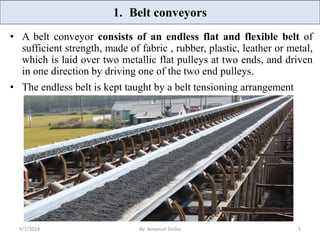
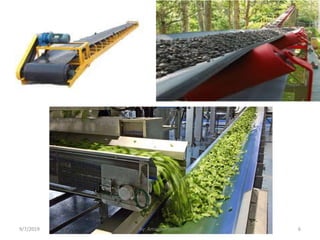
• A belt conveyor consists of an endless flat and flexible belt of
sufficient strength, made of fabric , rubber, plastic, leather or metal,
which is laid over two metallic flat pulleys at two ends, and driven
in one direction by driving one of the two end pulleys.
• The endless belt is kept taught by a belt tensioning arrangement
9/7/2019 5By: Amanuel Diriba
9/7/2019 6By: Amanuel Diriba
Cont..
• Belt conveyors occupy an outstanding position in the field of
bulk material handling.
• They are the most multipurpose and widely used of all conveyors
• The range of sizes, which may be handled, is limited only by the
width of the belt.
• They can handle a wide range of capacities over longer
distance than possible with other types of conveyors system.
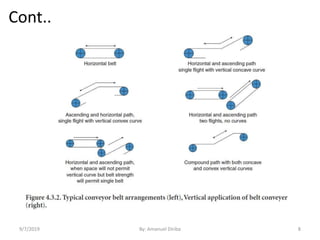
• Many varied arrangements or paths of belt conveyors are
possible.
• They can be any combination of horizontal ascending or
descending path.
9/7/2019 7By: Amanuel Diriba
Cont..
9/7/2019 8By: Amanuel Diriba
Cont..
• Belt conveyors are the mostly used for transport of solid
objects and bulk materials at great speed, covering great
distances (up to 30 km)
General Characteristics
i. Belt conveyors operate in one horizontally or with an inclination
(up or down) depending on the frictional property of the load
conveyed.
ii. For changing direction of the materials being conveyed, in the
horizontal plane, more than one belt conveyors are needed.
iii. Conveying capacity of a conveyor can be controlled by changing
belt speed.
iv. Belt conveyors are generally employed for continuous flow of
materials.
v. Metal/special belts can carry hot, abrasive or reactive materials
9/7/2019 9By: Amanuel Diriba
Cont..
Advantages of Belt Conveyor
Silent continuous transport.
Require less manpower.
Economical, low power consumption.
Require simple arrangements both at loading and unloading
ends.
Low maintenance cost.
Multipoint loading is convenient.
9/7/2019 10By: Amanuel Diriba
Cont..
Disadvantages
 Vertical transportation can not be done.
 A separate arrangement for material handling is required.
 Hot materials can not be transported.
 High initial cost for short distances.
 Not suitable for shorter distance and inclination > 20º
 Not suitable for dust particles and slurry.
9/7/2019 11By: Amanuel Diriba
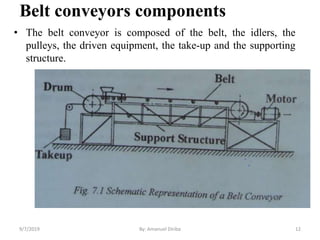
Belt conveyors components
• The belt conveyor is composed of the belt, the idlers, the
pulleys, the driven equipment, the take-up and the supporting
structure.
9/7/2019 12By: Amanuel Diriba
Cont..
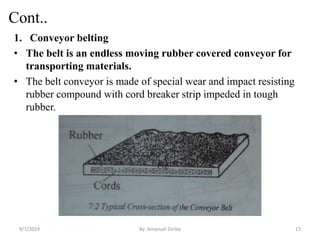
1. Conveyor belting
• The belt is an endless moving rubber covered conveyor for
transporting materials.
• The belt conveyor is made of special wear and impact resisting
rubber compound with cord breaker strip impeded in tough
rubber.
9/7/2019 13By: Amanuel Diriba
Cont..
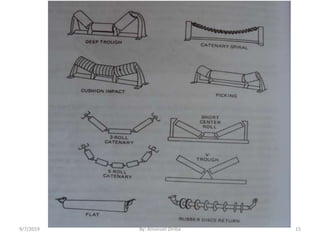
2. Belt idlers
• The idlers are used to carry and train the belt.
• Idlers must be selected to properly protect and support the belt
and load to be carried.
• The types of belt idlers with in the series include 20 degree
and 45 degree toughing cushion, belt training, flat belt and
return idlers.
9/7/2019 14By: Amanuel Diriba
9/7/2019 15By: Amanuel Diriba
Cont..
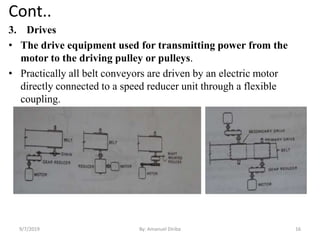
3. Drives
• The drive equipment used for transmitting power from the
motor to the driving pulley or pulleys.
• Practically all belt conveyors are driven by an electric motor
directly connected to a speed reducer unit through a flexible
coupling.
9/7/2019 16By: Amanuel Diriba
Cont..
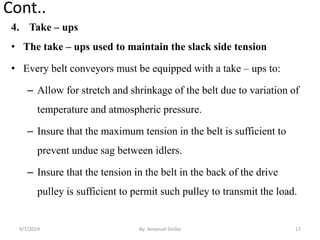
4. Take – ups
• The take – ups used to maintain the slack side tension
• Every belt conveyors must be equipped with a take – ups to:
– Allow for stretch and shrinkage of the belt due to variation of
temperature and atmospheric pressure.
– Insure that the maximum tension in the belt is sufficient to
prevent undue sag between idlers.
– Insure that the tension in the belt in the back of the drive
pulley is sufficient to permit such pulley to transmit the load.
9/7/2019 17By: Amanuel Diriba
Cont..
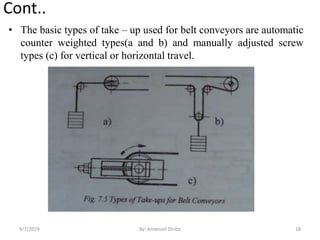
• The basic types of take – up used for belt conveyors are automatic
counter weighted types(a and b) and manually adjusted screw
types (c) for vertical or horizontal travel.
9/7/2019 18By: Amanuel Diriba
Cont..
5. Pulleys, shafts and bearings
• The pulleys with their shafts and bearing used to drive the belt
and change its direction of travel.
6. Supporting structure
• The structure is which supports and maintain alignment of idlers,
pulleys and the drive.
• The adhesion ( wheel grip) between the belt and the driving
pulley can be increased by
i. Changing the pulley
ii. Increasing the arc of contact
iii. Using stretchers(take – ups)
9/7/2019 19By: Amanuel Diriba
Types of Belt conveyors
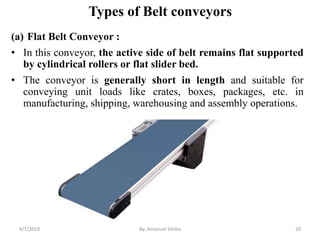
(a) Flat Belt Conveyor :
• In this conveyor, the active side of belt remains flat supported
by cylindrical rollers or flat slider bed.
• The conveyor is generally short in length and suitable for
conveying unit loads like crates, boxes, packages, etc. in
manufacturing, shipping, warehousing and assembly operations.
9/7/2019 20By: Amanuel Diriba
Cont..
(b) Troughed Belt Conveyor :
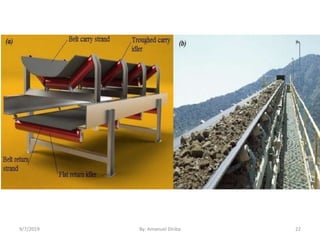
• In this conveyor, comparatively wide flat belt is supported on
troughed carrying rollers or shaped supporting surface so
that the two edges of the active side of the belt are elevated from
the middle part to form a trough.
• This provides a greater carrying capacity than a flat belt of equal
width for conveying bulk materials or those materials which
would slide off flat belts.
• These conveyors are used in handling bulk materials of different
classes.
9/7/2019 21By: Amanuel Diriba
9/7/2019 22By: Amanuel Diriba
Cont..
(c) Closed Belt Conveyor:
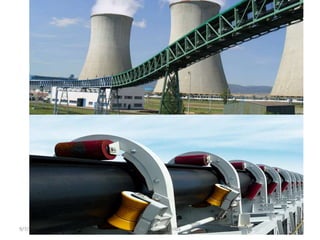
• In a closed belt conveyor, the specially fabricated belt, after
being loaded with the material, can be wrapped completely
around the load.
• It essentially forms a closed tube moving along with the
material.
The advantages of a closed belt conveyor are:
i. it can handle fragile materials safely and without breaking by
reducing inter particle collision,
ii. it can handle fine bulk materials without being swept by air
(however, it is not really air tight at loading and unloading
points),
iii. ability to handle corrosive and reactive materials without
contamination and
iv. the tubed belt can travel around bends in more than one plane
9/7/2019 23By: Amanuel Diriba
9/7/2019 24By: Amanuel Diriba
Cont..
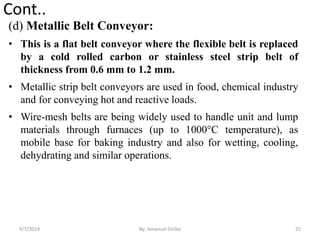
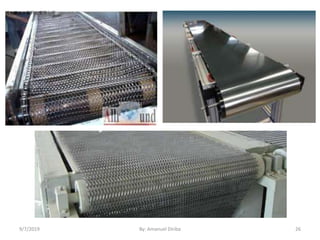
(d) Metallic Belt Conveyor:
• This is a flat belt conveyor where the flexible belt is replaced
by a cold rolled carbon or stainless steel strip belt of
thickness from 0.6 mm to 1.2 mm.
• Metallic strip belt conveyors are used in food, chemical industry
and for conveying hot and reactive loads.
• Wire-mesh belts are being widely used to handle unit and lump
materials through furnaces (up to 1000°C temperature), as
mobile base for baking industry and also for wetting, cooling,
dehydrating and similar operations.
9/7/2019 25By: Amanuel Diriba
9/7/2019 26By: Amanuel Diriba
Cont..
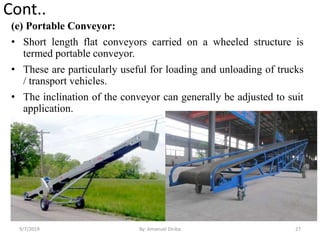
(e) Portable Conveyor:
• Short length flat conveyors carried on a wheeled structure is
termed portable conveyor.
• These are particularly useful for loading and unloading of trucks
/ transport vehicles.
• The inclination of the conveyor can generally be adjusted to suit
application.
9/7/2019 27By: Amanuel Diriba
Cont..
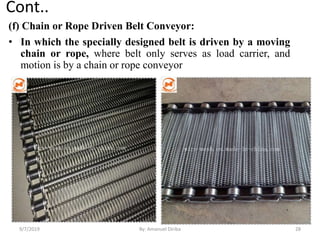
(f) Chain or Rope Driven Belt Conveyor:
• In which the specially designed belt is driven by a moving
chain or rope, where belt only serves as load carrier, and
motion is by a chain or rope conveyor
9/7/2019 28By: Amanuel Diriba
Cont..
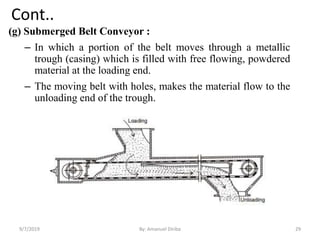
(g) Submerged Belt Conveyor :
– In which a portion of the belt moves through a metallic
trough (casing) which is filled with free flowing, powdered
material at the loading end.
– The moving belt with holes, makes the material flow to the
unloading end of the trough.
9/7/2019 29By: Amanuel Diriba
9/7/2019 30By: Amanuel Diriba
2. Oscillating conveyors
• A type of vibrating conveyor having a relatively low frequency and large
amplitude of motion
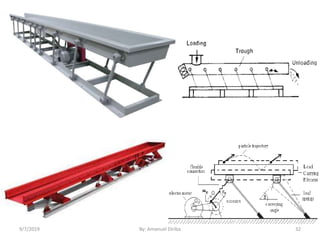
• Oscillating conveyors move materials in a uniform, continuous flow
by the upward and forward oscillating motion of a continuous metal
trough, mounted on robust inclined reactor legs.
• The angle of α Inclination of the conveyor arm may vary from 25 to
30degree.
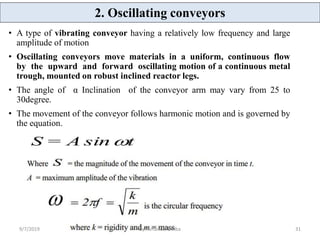
• The movement of the conveyor follows harmonic motion and is governed by
the equation.
9/7/2019 31By: Amanuel Diriba
9/7/2019 32By: Amanuel Diriba
Cont..
Advantages of Oscillating Conveyors:
– simple construction and easy maintenance,
– high strength and hard mining conditions resistance,
– relatively low investments costs,
– easy to disassemble, move and assemble,
– easy and quick extension and shortening of trough,
– safety ,
Disadvantages of Oscillating Conveyors:
– unable to lift material (above 4° ineffective),
– moving of material causes its attrition and increases dust,
– poor efficiency .
9/7/2019 33By: Amanuel Diriba
Types of oscillating conveyors
• There are basically three types of oscillating conveyors for light,
medium and heavy duty service.
a. Flexmount oscillating conveyors
 They are used for light duty applications.
 They have simple construction, remarkably rugged, compact
and require minimum maintenance and attention.
b. Coilmount oscillating conveyors
 They are used for medium duty service.
 They are rugged, well strengthened and require minimum
maintenance.
 The coil springs operate in the natural frequency rang.
9/7/2019 34By: Amanuel Diriba
Cont..
c) Torqmount oscillating conveyors
 They are used for heavy and extra duty applications.
 They are rugged, dependable and easy to adjust and
maintain.
 Torsion bars fixed at one end and steel backed rubber
bushed at the other end, absorb the energy of the
trough movement at the end of the stroke at all
points of support along the trough length.
9/7/2019 35By: Amanuel Diriba
9/7/2019 36By: Amanuel Diriba
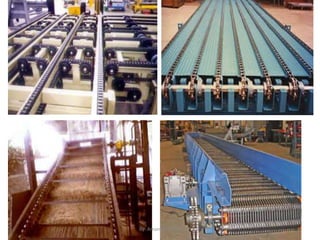
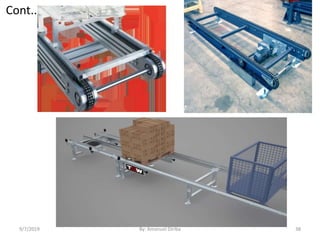
3. CHAIN CONVEYORS
• A chain conveyor is a machine that transfers material or
objects from one point to another by means of a moving
chain.
• The conveyor chain is driven by a head sprocket or roller, also
called a drive wheel.
• A conveyor chain may have plates, blocks or bars attached to it
which are designed to fastener, push or drag the object or
material which is to be moved.
• Chain conveyors are used for moving products down an
assembly line and/or around a manufacturing or warehousing
facility.
• Chain conveyors are generally easy to install and have very
minimum maintenance for users
9/7/2019 37By: Amanuel Diriba
Cont..
9/7/2019 38By: Amanuel Diriba
9/7/2019 39By: Amanuel Diriba
Cont..
 Chain, compared to belts of a belt conveyor, have certain
advantages as well as disadvantages.
 The major advantages are:-
– The chain easily wrap around sprockets of small diameter,
and the drive is positive.
– No slippage takes place between chain and sprocket.
– The chain stretch is also little.
 The disadvantages of chain are:-
– Its high weight,
– High initial cost,
– Higher maintenance cost and
– Limited running speed
9/7/2019 40By: Amanuel Diriba
CHAIN CONVEYOR APPLICATIONS
• Transporting heavy products from one location to another.
• Moving product through high temperature zones, for instance
through ovens where other conveyor types may not be suitable
• Conveying of products in either continuous or indexing modes
(i.e. the chain stops and starts each time to move a product to the
end of the chain using a sensor)
• Changing the speed is necessary. Importantly when fitted with a
VFD (variable frequency drive), a chain conveyor is a simple
conveyor to adjust the speed on.
9/7/2019 41By: Amanuel Diriba
Types of Chain Conveyors
9/7/2019 42
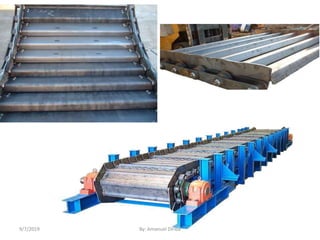
(a) Apron or Pan Conveyor:
• This is the most common type of chain conveyor.
• It consists of one or more strands of endless chain, usually
link plate roller type, running in steel guides.
• The carrying surface of the conveyor is composed of a series
of plates or shapes called apron, which are attached to the links
of the chains through cleats.
By: Amanuel Diriba
9/7/2019 43By: Amanuel Diriba
Cont..
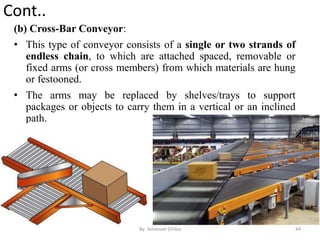
(b) Cross-Bar Conveyor:
• This type of conveyor consists of a single or two strands of
endless chain, to which are attached spaced, removable or
fixed arms (or cross members) from which materials are hung
or festooned.
• The arms may be replaced by shelves/trays to support
packages or objects to carry them in a vertical or an inclined
path.
9/7/2019 44By: Amanuel Diriba
Cont..
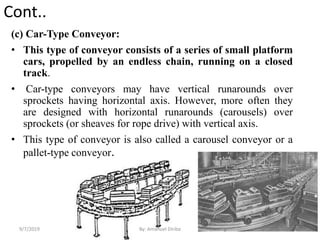
(c) Car-Type Conveyor:
• This type of conveyor consists of a series of small platform
cars, propelled by an endless chain, running on a closed
track.
• Car-type conveyors may have vertical runarounds over
sprockets having horizontal axis. However, more often they
are designed with horizontal runarounds (carousels) over
sprockets (or sheaves for rope drive) with vertical axis.
• This type of conveyor is also called a carousel conveyor or a
pallet-type conveyor.
9/7/2019 45By: Amanuel Diriba
Cont..
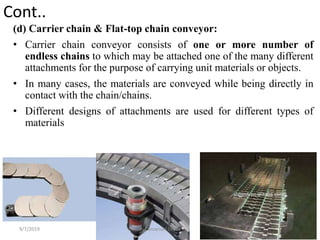
(d) Carrier chain & Flat-top chain conveyor:
• Carrier chain conveyor consists of one or more number of
endless chains to which may be attached one of the many different
attachments for the purpose of carrying unit materials or objects.
• In many cases, the materials are conveyed while being directly in
contact with the chain/chains.
• Different designs of attachments are used for different types of
materials
9/7/2019 46By: Amanuel Diriba
Cont..
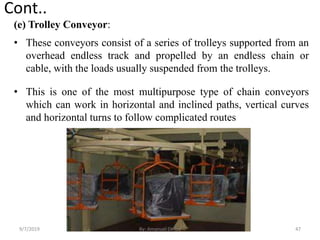
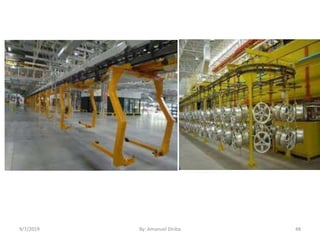
(e) Trolley Conveyor:
• These conveyors consist of a series of trolleys supported from an
overhead endless track and propelled by an endless chain or
cable, with the loads usually suspended from the trolleys.
• This is one of the most multipurpose type of chain conveyors
which can work in horizontal and inclined paths, vertical curves
and horizontal turns to follow complicated routes
9/7/2019 47By: Amanuel Diriba
9/7/2019 48By: Amanuel Diriba
Cont..
9/7/2019 49By: Amanuel Diriba

Lecture 4 Material Handling Equipment (Conveyors)

  • 1.
    MATERIALS HANDLING EQUIPMENT LectureFour Conveyors Outlines  Introduction  Belt conveyors  Oscillating conveyors  Chain conveyors By: Amanuel D. 9/7/2019 1By: Amanuel Diriba
  • 2.
    Definition – A conveyoris a mechanized device to move materials in relatively large quantities between specific locations over a fixed path. – Conveyor is equipment used to move materials over fixed path between specific points. Conveyors are used: – When material is to be moved frequently between specific points. – To move materials over a fixed path – When there is a sufficient flow volume to justify the fixed conveyor investment 9/7/2019 2By: Amanuel Diriba
  • 3.
    Cont.. Benefits of Conveyors –Automation of the flow of products – Continuous flow of materials – May be set up almost any place – Can be utilized to move almost anything – Improve safety, order accuracy, labor cost – Shorten time from order to shipment Conveyors can be classified in different ways: – Type of product being handled: unit load or bulk load – Location of the conveyor: in-floor, on-floor, or overhead – Whether loads can accumulate on the conveyor or no accumulation is possible 9/7/2019 3By: Amanuel Diriba
  • 4.
    Some types ofconveyors are:- 1. Chute conveyor 2. Wheel conveyor 3. Roller conveyor 4. Chain conveyor 5. Slat conveyor 6. Belt conveyor 7. Magnetic belt conveyor 8. Troughed belt conveyor 9. Bucket conveyor 10. Vibrating conveyor 11. Screw conveyor 12. Pneumatic conveyor 13. Vertical conveyor 14. Cart-on-track conveyor 15. Tow conveyor 16. Trolley conveyor 17. Power-and-free conveyor 18. Monorail 19. Sortation conveyor 20. Oscillating conveyors9/7/2019 4By: Amanuel Diriba
  • 5.
    1. Belt conveyors •A belt conveyor consists of an endless flat and flexible belt of sufficient strength, made of fabric , rubber, plastic, leather or metal, which is laid over two metallic flat pulleys at two ends, and driven in one direction by driving one of the two end pulleys. • The endless belt is kept taught by a belt tensioning arrangement 9/7/2019 5By: Amanuel Diriba
  • 6.
  • 7.
    Cont.. • Belt conveyorsoccupy an outstanding position in the field of bulk material handling. • They are the most multipurpose and widely used of all conveyors • The range of sizes, which may be handled, is limited only by the width of the belt. • They can handle a wide range of capacities over longer distance than possible with other types of conveyors system. • Many varied arrangements or paths of belt conveyors are possible. • They can be any combination of horizontal ascending or descending path. 9/7/2019 7By: Amanuel Diriba
  • 8.
  • 9.
    Cont.. • Belt conveyorsare the mostly used for transport of solid objects and bulk materials at great speed, covering great distances (up to 30 km) General Characteristics i. Belt conveyors operate in one horizontally or with an inclination (up or down) depending on the frictional property of the load conveyed. ii. For changing direction of the materials being conveyed, in the horizontal plane, more than one belt conveyors are needed. iii. Conveying capacity of a conveyor can be controlled by changing belt speed. iv. Belt conveyors are generally employed for continuous flow of materials. v. Metal/special belts can carry hot, abrasive or reactive materials 9/7/2019 9By: Amanuel Diriba
  • 10.
    Cont.. Advantages of BeltConveyor Silent continuous transport. Require less manpower. Economical, low power consumption. Require simple arrangements both at loading and unloading ends. Low maintenance cost. Multipoint loading is convenient. 9/7/2019 10By: Amanuel Diriba
  • 11.
    Cont.. Disadvantages  Vertical transportationcan not be done.  A separate arrangement for material handling is required.  Hot materials can not be transported.  High initial cost for short distances.  Not suitable for shorter distance and inclination > 20º  Not suitable for dust particles and slurry. 9/7/2019 11By: Amanuel Diriba
  • 12.
    Belt conveyors components •The belt conveyor is composed of the belt, the idlers, the pulleys, the driven equipment, the take-up and the supporting structure. 9/7/2019 12By: Amanuel Diriba
  • 13.
    Cont.. 1. Conveyor belting •The belt is an endless moving rubber covered conveyor for transporting materials. • The belt conveyor is made of special wear and impact resisting rubber compound with cord breaker strip impeded in tough rubber. 9/7/2019 13By: Amanuel Diriba
  • 14.
    Cont.. 2. Belt idlers •The idlers are used to carry and train the belt. • Idlers must be selected to properly protect and support the belt and load to be carried. • The types of belt idlers with in the series include 20 degree and 45 degree toughing cushion, belt training, flat belt and return idlers. 9/7/2019 14By: Amanuel Diriba
  • 15.
  • 16.
    Cont.. 3. Drives • Thedrive equipment used for transmitting power from the motor to the driving pulley or pulleys. • Practically all belt conveyors are driven by an electric motor directly connected to a speed reducer unit through a flexible coupling. 9/7/2019 16By: Amanuel Diriba
  • 17.
    Cont.. 4. Take –ups • The take – ups used to maintain the slack side tension • Every belt conveyors must be equipped with a take – ups to: – Allow for stretch and shrinkage of the belt due to variation of temperature and atmospheric pressure. – Insure that the maximum tension in the belt is sufficient to prevent undue sag between idlers. – Insure that the tension in the belt in the back of the drive pulley is sufficient to permit such pulley to transmit the load. 9/7/2019 17By: Amanuel Diriba
  • 18.
    Cont.. • The basictypes of take – up used for belt conveyors are automatic counter weighted types(a and b) and manually adjusted screw types (c) for vertical or horizontal travel. 9/7/2019 18By: Amanuel Diriba
  • 19.
    Cont.. 5. Pulleys, shaftsand bearings • The pulleys with their shafts and bearing used to drive the belt and change its direction of travel. 6. Supporting structure • The structure is which supports and maintain alignment of idlers, pulleys and the drive. • The adhesion ( wheel grip) between the belt and the driving pulley can be increased by i. Changing the pulley ii. Increasing the arc of contact iii. Using stretchers(take – ups) 9/7/2019 19By: Amanuel Diriba
  • 20.
    Types of Beltconveyors (a) Flat Belt Conveyor : • In this conveyor, the active side of belt remains flat supported by cylindrical rollers or flat slider bed. • The conveyor is generally short in length and suitable for conveying unit loads like crates, boxes, packages, etc. in manufacturing, shipping, warehousing and assembly operations. 9/7/2019 20By: Amanuel Diriba
  • 21.
    Cont.. (b) Troughed BeltConveyor : • In this conveyor, comparatively wide flat belt is supported on troughed carrying rollers or shaped supporting surface so that the two edges of the active side of the belt are elevated from the middle part to form a trough. • This provides a greater carrying capacity than a flat belt of equal width for conveying bulk materials or those materials which would slide off flat belts. • These conveyors are used in handling bulk materials of different classes. 9/7/2019 21By: Amanuel Diriba
  • 22.
  • 23.
    Cont.. (c) Closed BeltConveyor: • In a closed belt conveyor, the specially fabricated belt, after being loaded with the material, can be wrapped completely around the load. • It essentially forms a closed tube moving along with the material. The advantages of a closed belt conveyor are: i. it can handle fragile materials safely and without breaking by reducing inter particle collision, ii. it can handle fine bulk materials without being swept by air (however, it is not really air tight at loading and unloading points), iii. ability to handle corrosive and reactive materials without contamination and iv. the tubed belt can travel around bends in more than one plane 9/7/2019 23By: Amanuel Diriba
  • 24.
  • 25.
    Cont.. (d) Metallic BeltConveyor: • This is a flat belt conveyor where the flexible belt is replaced by a cold rolled carbon or stainless steel strip belt of thickness from 0.6 mm to 1.2 mm. • Metallic strip belt conveyors are used in food, chemical industry and for conveying hot and reactive loads. • Wire-mesh belts are being widely used to handle unit and lump materials through furnaces (up to 1000°C temperature), as mobile base for baking industry and also for wetting, cooling, dehydrating and similar operations. 9/7/2019 25By: Amanuel Diriba
  • 26.
  • 27.
    Cont.. (e) Portable Conveyor: •Short length flat conveyors carried on a wheeled structure is termed portable conveyor. • These are particularly useful for loading and unloading of trucks / transport vehicles. • The inclination of the conveyor can generally be adjusted to suit application. 9/7/2019 27By: Amanuel Diriba
  • 28.
    Cont.. (f) Chain orRope Driven Belt Conveyor: • In which the specially designed belt is driven by a moving chain or rope, where belt only serves as load carrier, and motion is by a chain or rope conveyor 9/7/2019 28By: Amanuel Diriba
  • 29.
    Cont.. (g) Submerged BeltConveyor : – In which a portion of the belt moves through a metallic trough (casing) which is filled with free flowing, powdered material at the loading end. – The moving belt with holes, makes the material flow to the unloading end of the trough. 9/7/2019 29By: Amanuel Diriba
  • 30.
  • 31.
    2. Oscillating conveyors •A type of vibrating conveyor having a relatively low frequency and large amplitude of motion • Oscillating conveyors move materials in a uniform, continuous flow by the upward and forward oscillating motion of a continuous metal trough, mounted on robust inclined reactor legs. • The angle of α Inclination of the conveyor arm may vary from 25 to 30degree. • The movement of the conveyor follows harmonic motion and is governed by the equation. 9/7/2019 31By: Amanuel Diriba
  • 32.
  • 33.
    Cont.. Advantages of OscillatingConveyors: – simple construction and easy maintenance, – high strength and hard mining conditions resistance, – relatively low investments costs, – easy to disassemble, move and assemble, – easy and quick extension and shortening of trough, – safety , Disadvantages of Oscillating Conveyors: – unable to lift material (above 4° ineffective), – moving of material causes its attrition and increases dust, – poor efficiency . 9/7/2019 33By: Amanuel Diriba
  • 34.
    Types of oscillatingconveyors • There are basically three types of oscillating conveyors for light, medium and heavy duty service. a. Flexmount oscillating conveyors  They are used for light duty applications.  They have simple construction, remarkably rugged, compact and require minimum maintenance and attention. b. Coilmount oscillating conveyors  They are used for medium duty service.  They are rugged, well strengthened and require minimum maintenance.  The coil springs operate in the natural frequency rang. 9/7/2019 34By: Amanuel Diriba
  • 35.
    Cont.. c) Torqmount oscillatingconveyors  They are used for heavy and extra duty applications.  They are rugged, dependable and easy to adjust and maintain.  Torsion bars fixed at one end and steel backed rubber bushed at the other end, absorb the energy of the trough movement at the end of the stroke at all points of support along the trough length. 9/7/2019 35By: Amanuel Diriba
  • 36.
  • 37.
    3. CHAIN CONVEYORS •A chain conveyor is a machine that transfers material or objects from one point to another by means of a moving chain. • The conveyor chain is driven by a head sprocket or roller, also called a drive wheel. • A conveyor chain may have plates, blocks or bars attached to it which are designed to fastener, push or drag the object or material which is to be moved. • Chain conveyors are used for moving products down an assembly line and/or around a manufacturing or warehousing facility. • Chain conveyors are generally easy to install and have very minimum maintenance for users 9/7/2019 37By: Amanuel Diriba
  • 38.
  • 39.
  • 40.
    Cont..  Chain, comparedto belts of a belt conveyor, have certain advantages as well as disadvantages.  The major advantages are:- – The chain easily wrap around sprockets of small diameter, and the drive is positive. – No slippage takes place between chain and sprocket. – The chain stretch is also little.  The disadvantages of chain are:- – Its high weight, – High initial cost, – Higher maintenance cost and – Limited running speed 9/7/2019 40By: Amanuel Diriba
  • 41.
    CHAIN CONVEYOR APPLICATIONS •Transporting heavy products from one location to another. • Moving product through high temperature zones, for instance through ovens where other conveyor types may not be suitable • Conveying of products in either continuous or indexing modes (i.e. the chain stops and starts each time to move a product to the end of the chain using a sensor) • Changing the speed is necessary. Importantly when fitted with a VFD (variable frequency drive), a chain conveyor is a simple conveyor to adjust the speed on. 9/7/2019 41By: Amanuel Diriba
  • 42.
    Types of ChainConveyors 9/7/2019 42 (a) Apron or Pan Conveyor: • This is the most common type of chain conveyor. • It consists of one or more strands of endless chain, usually link plate roller type, running in steel guides. • The carrying surface of the conveyor is composed of a series of plates or shapes called apron, which are attached to the links of the chains through cleats. By: Amanuel Diriba
  • 43.
  • 44.
    Cont.. (b) Cross-Bar Conveyor: •This type of conveyor consists of a single or two strands of endless chain, to which are attached spaced, removable or fixed arms (or cross members) from which materials are hung or festooned. • The arms may be replaced by shelves/trays to support packages or objects to carry them in a vertical or an inclined path. 9/7/2019 44By: Amanuel Diriba
  • 45.
    Cont.. (c) Car-Type Conveyor: •This type of conveyor consists of a series of small platform cars, propelled by an endless chain, running on a closed track. • Car-type conveyors may have vertical runarounds over sprockets having horizontal axis. However, more often they are designed with horizontal runarounds (carousels) over sprockets (or sheaves for rope drive) with vertical axis. • This type of conveyor is also called a carousel conveyor or a pallet-type conveyor. 9/7/2019 45By: Amanuel Diriba
  • 46.
    Cont.. (d) Carrier chain& Flat-top chain conveyor: • Carrier chain conveyor consists of one or more number of endless chains to which may be attached one of the many different attachments for the purpose of carrying unit materials or objects. • In many cases, the materials are conveyed while being directly in contact with the chain/chains. • Different designs of attachments are used for different types of materials 9/7/2019 46By: Amanuel Diriba
  • 47.
    Cont.. (e) Trolley Conveyor: •These conveyors consist of a series of trolleys supported from an overhead endless track and propelled by an endless chain or cable, with the loads usually suspended from the trolleys. • This is one of the most multipurpose type of chain conveyors which can work in horizontal and inclined paths, vertical curves and horizontal turns to follow complicated routes 9/7/2019 47By: Amanuel Diriba
  • 48.
  • 49.