N I D H I J A D H A V
Structural elucidation
Introduction nicotine
 Introduction Nicotine was isolated from tobacco leaves (Nicotiana tabacum)
in 1828, but the powerful effects of nicotine were already well recognized
 The tobacco plant is native to the Americas and its use as a medicine and
stimulant goes back at least 2000 years and most likely many millennia
before that.
 Tobacco appears to part of the healing arts and sacred rituals of many of the
native peoples of the Americas. Codex, 16th century.)
 Nicotine is a potent parasympathomimetic alkaloid found in the nightshade
family of plants (Solanaceae) and a stimulant drug
 It is a nicotinic acetylcholine agonist receptor.
 It constitutes approximately 0.6–3.0% of the dry weight of tobacco and is
present in the range of 2–7 µg/kg of various edible plants.
 It functions as an antiherbivore chemical; consequently, nicotine was widely
used as an insecticide in the past and nicotine analogs such as imidacloprid
are currently widely used.
Nomenclature
 Chemical names:-
 Nicotinamide :- Pyridine-3-crboxamide; nicotinic acid amide; 3-pyridine
carboxylic acid amide; 3- pyridine carboxamide
 Nicotinic acid:- pyridine -3- crboxamide;3-pyridine crboxamide; pyridine-
β- carboxylic acid.
 Generic name :- nicotinamide; niacinamide; nicotylamide; nicotinamidum;
vitamin PP; vitamine B3 ; aminocotin; dipegyl; pilonin amide; amide PP.
 Trade name:- nicotinamide: nicamina; nicobion; nicosedine; nicovel;
nicovit; nicamindon; nicotamide; nicofort; niozymin;pelmine; benicot;
vinietyl; amisyl; farmabion
 colour:- Nicotinamide exists as colourless crystal or white crystalline
powder.
 odor :- faint characteristic
 Taste: salty and better.
 while nicotinic acid appears as needle or white to creamy- white crystals or
crystalline powder
 Optical activity:-
 both the drug substance are optically inactive because of the absences of
chemical asymmetry.
 Solubility:-
 Nicotinamideis highly soluble in water and alcohol 1g dissolves in about 1ml
of water in about 1.5ml alcohol and in 10 ml glycerol.
 it is slightly soluble in ether and chloroform , while it is soluble in solution of
alkali.
 nicotinic acid 1g is soluble in 55 to 60 ml of water and 100 ml of ethanol,
very slightly in chloroform.
 practically insoluble in ether.
 soluble in alkaline solution of hydroxides and carbonates.
 Moisture content and hygroscopity:-
 Nicotinamide absorbs insignificant amount of moisture at 250 c at relative
humidities up to about 90%
 Stability:-
 nicotinamide is stable in air, light, and at certain PH-changes
 Storage:-
 both drug substances should be stored in air-tight container
 Identification :-
 Color test:-
 to 2ml 0.1% solution of nicotinamide or nicotinic acid add 6ml of cyanogen
bromide solution and 1 ml of a 2.5% v/v solution of aniline golden yellow i.e
konigs reaction. Nicotinamide gives brown- orange color with nessler
reagent.
 Microcrystal test:
 Nicotinamide yield with gold chloride solution dense rosettes and with
platinic iodide solution a mass of hair – like needles
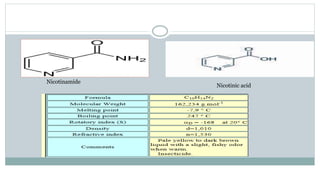
Nicotinamide
Nicotinic acid
Spectral properties
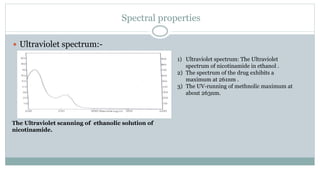
 Ultraviolet spectrum:-
The Ultraviolet scanning of ethanolic solution of
nicotinamide.
1) Ultraviolet spectrum: The Ultraviolet
spectrum of nicotinamide in ethanol .
2) The spectrum of the drug exhibits a
maximum at 261nm .
3) The UV-running of methnolic maximum at
about 263nm.
Infrared spectrum
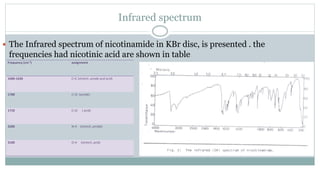
 The Infrared spectrum of nicotinamide in KBr disc, is presented . the
frequencies had nicotinic acid are shown in table
Frequency (cm-1) assignment
1600-1630 C=C (stretch ,amide and acid)
1700 C=O (amide)
1710 C=O ( acid)
3200 N-H (stretch ,amide)
3100 O-H (stretch ,acid)
Proton nuclear spectrum (1H-NMR)
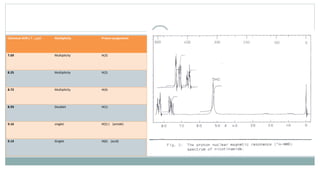
 The 1H-NMR running were undertaken for each drug substances . the 1H-
NMR spectrum of nicotinamide.
 Each drug substances was dissolved in deuterium oxides and its spectrum
determined on a varian T6A NMR spectrometer using DSS ( sodium-2,2-
dimethyl-2-silapentane-5-sulfonate) as the internal standard . the structural
assignments are
Chemical shift (δ,ppm) Multiplicity Proton assignment
7.69 Multiplicity H(3)
8.25 Multiplicity H(2)
8.72 Multiplicity H(4)
8.93 Doublet H(1)
9.16 singlet H(5) ) (amide)
9.14 Singlet H(6) (acid)
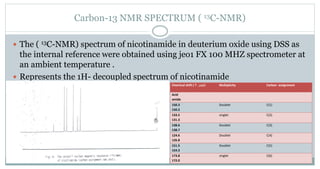
Carbon-13 NMR SPECTRUM ( 13C-NMR)
 The ( 13C-NMR) spectrum of nicotinamide in deuterium oxide using DSS as
the internal reference were obtained using jeo1 FX 100 MHZ spectrometer at
an ambient temperature .
 Represents the 1H- decoupled spectrum of nicotinamide
Chemical shift (δ,ppm) Multiplicity Carbon assignment
Acid
amide
150.3
150.2
Doublet C(1)
133.5
131.3
singlet C(2)
138.6
138.7
Doublet C(3)
124.6
126.8
Doublet C(4)
151.5
154.3
Doublet C(5)
173.8
172.0
singlet C(6)
Pilocarpine
 Dried leaves of pilocarpus jaborandi ; Fam: rutaceae.
 Origin of the Drug
 -South American Shrub
 - Pilocarpus jaborandi
 -Isolated in 1875
 Pilocarpine binds to muscarinic receptor
 Activates receptor binds G-protein
 Removal of GDP and addition of GTP to G-protein
 Dissociation of G-protein from muscarinic receptor
 Separation of G-protein into alpha and beta-gamma subunits
 Alpha subunit interacts with and activates Phospholipase C - Phosphatidyl
inositol biphosphate (PIP) complex
 Phospholipase breaks down PIP into inositol 1,4,5-triphosphate (IP3)and
diacylglycerol (both 2o)
 IP3 interacts with ER membrane which releases Ca2
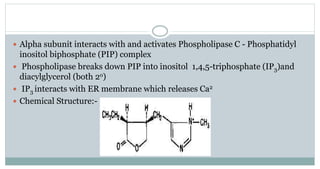
 Chemical Structure:-
 Chemical name:-
 2-ethyl1-3-(1-methyl1-5-imidazolyl)methyl) -4 butanolide.
 (3s-cis-3-ethyldihydro-4-(methyl-1H-imidazole-5-yl)-2-(3H)-furanone.
 Generic name:-
 Pipocarpine
 Pilocarpine hydrochloride; pilocarpine muriate;almocarpine.
 Pilocarpine nitrate; licarpin .
 Trade name
 For base: OCUSERT pilo.
 For nitrate : PV cerpine
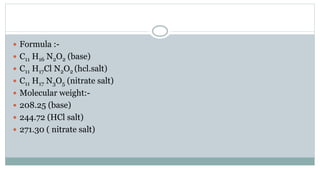
 Formula :-
 C11 H16 N2O2 (base)
 C11 H17Cl N2O2 (hcl.salt)
 C11 H17 N3O5 (nitrate salt)
 Molecular weight:-
 208.25 (base)
 244.72 (HCl salt)
 271.30 ( nitrate salt)
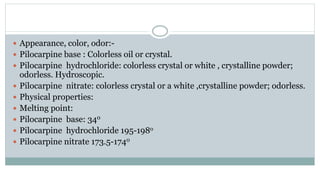
 Appearance, color, odor:-
 Pilocarpine base : Colorless oil or crystal.
 Pilocarpine hydrochloride: colorless crystal or white , crystalline powder;
odorless. Hydroscopic.
 Pilocarpine nitrate: colorless crystal or a white ,crystalline powder; odorless.
 Physical properties:
 Melting point:
 Pilocarpine base: 340
 Pilocarpine hydrochloride 195-198o
 Pilocarpine nitrate 173.5-1740
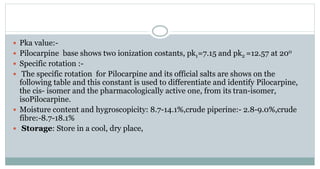
 Pka value:-
 Pilocarpine base shows two ionization costants, pk1=7.15 and pk2 =12.57 at 200
 Specific rotation :-
 The specific rotation for Pilocarpine and its official salts are shows on the
following table and this constant is used to differentiate and identify Pilocarpine,
the cis- isomer and the pharmacologically active one, from its tran-isomer,
isoPilocarpine.
 Moisture content and hygroscopicity: 8.7-14.1%,crude piperine:- 2.8-9.0%,crude
fibre:-8.7-18.1%
 Storage: Store in a cool, dry place,
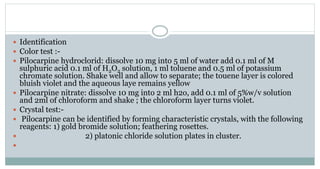
 Identification
 Color test :-
 Pilocarpine hydroclorid: dissolve 10 mg into 5 ml of water add 0.1 ml of M
sulphuric acid 0.1 ml of H2O2 solution, 1 ml toluene and 0.5 ml of potassium
chromate solution. Shake well and allow to separate; the touene layer is colored
bluish violet and the aqueous laye remains yellow
 Pilocarpine nitrate: dissolve 10 mg into 2 ml h2o, add 0.1 ml of 5%w/v solution
and 2ml of chloroform and shake ; the chloroform layer turns violet.
 Crystal test:-
 Pilocarpine can be identified by forming characteristic crystals, with the following
reagents: 1) gold bromide solution; feathering rosettes.
 2) platonic chloride solution plates in cluster.

 Degradation test : the following tests were cited by the WHO in the international
pharmacopeia . if the substances does not pass this test, this indicates that gross
,Degradation of both Pilocarpine hydrochloride and Pilocarpine nitrate had
occurred.
 Stability:-
 Pilocarpine possessesseveral pharmacological properties, e.g., it possesses amotic
action and lowers the intraocular pressure. Its chief clinical application in
opthomology has been for the treatment of glaucoma in buffered iisotonic silution
renging from 0.5 to 6% as Pilocarpine nitrate or hydrocholoride . however,
pilocarpine in aq. Solution decomposes through two major pathways which are
both base catalysed .

Spectral properties:
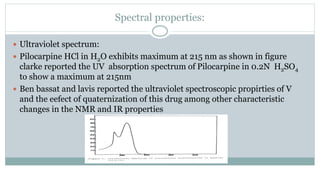
 Ultraviolet spectrum:
 Pilocarpine HCl in H2O exhibits maximum at 215 nm as shown in figure
clarke reported the UV absorption spectrum of Pilocarpine in 0.2N H2SO4
to show a maximum at 215nm
 Ben bassat and lavis reported the ultraviolet spectroscopic propirties of V
and the eefect of quaternization of this drug among other characteristic
changes in the NMR and IR properties
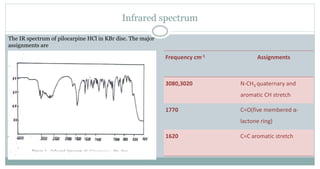
Infrared spectrum
The IR spectrum of pilocarpine HCl in KBr disc. The major
assignments are
Frequency cm-1 Assignments
3080,3020 N-CH3 quaternary and
aromatic CH stretch
1770 C=O(five membered α-
lactone ring)
1620 C=C aromatic stretch
Proton magnetic resonance spectrum
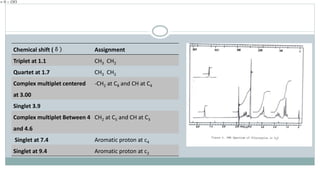
 A typical PMR spectrum of pilocarine HCl is shown in figure .
 The spectrum was determined on varian T60A spectrometer.
 The smple was dissolve in D2O with 3-(trimethylsilyl)-propionic acid)
sodium salt as an internal standard.
 The following structural assignments have been made for figure .
Chemical shift (δ) Assignment
Triplet at 1.1 CH3 CH2
Quartet at 1.7 CH3 CH2
Complex multiplet centered
at 3.00
-CH2 at C8 and CH at C4
Singlet 3.9
Complex multiplet Between 4
and 4.6
CH2 at C5 and CH at C3
Singlet at 7.4 Aromatic proton at c4
Singlet at 9.4 Aromatic proton at c2
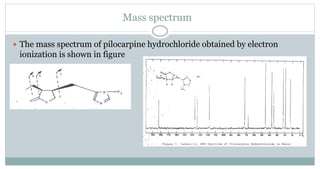
Mass spectrum
 The mass spectrum of pilocarpine hydrochloride obtained by electron
ionization is shown in figure
Chromatographic analysis
 Paper chromatography
 Clarke described a solvent system used for the paper chromatography of
pilocarpine consisting of citric acid; water; n- butanol. The deug can
detected by several agents such as bromocresol green speay or iodoplatinate
spray
Solvent system Absorbant Localizing agent
Strong ammonia solution: methanol(
1.5: 100) should be changed after
two hours
Silica gel G. Acidified iodoplatinate spray
Chloroform : acetone : diethylamine
( 5:4:1.)
Kiesel gel GF 254 Dragendorff reagent
Chloroform : acetone : diethylamine
( 9:1.)
Silica gel G Iodoplatinate spray or Dragendorff
reagent
Butanol: anhydrous ACOH:
water,(4:1:5.)
Hydrolysed cotton wool prepared
specially for this purpose + CaSO4
UV light
Butanol: acetic acid: water(4:1:5.) Silufol Iodine or Dragendorff reagent
Piperine
 Piperine is commercially available.
 If desired, it may be extracted from black pepper using dichloromethane.
 Aqueous hydrotopes can also be used in the extraction to result in high yield
and selectivity.
 The amount of piperine varies from 1-2% in long pepper, to 5-10% in
commercial white and black peppers.
 Further, it may be prepared by treating the solvent-free residue from an
alcoholic extract of black pepper, with a solution of potassium hydroxide to
remove resin (said to contain chavicine, an isomer of piperine) and solution
of the washed, insoluble residue in warm alcohol, from which the alkaloid
crystallises on cooling.
 Piperine, along with its isomer chavicine, is the alkaloid responsible for the
pungency of black pepper and long pepper.
 It has also been used in some forms of traditional medicine and as an
insecticide.
 Piperine forms monoclinic needles, is slightly soluble in water (1 g/25 L
(18 °C)), and is highly soluble in alcohol (1 g/15 mL), ether (1 g/36 mL) and
chloroform (1 g/1.7 mL).
 The solution in alcohol has a pepper-like taste
Nomenclature
 Chemical names:-
 1) 1-[5-(1,3-Benzodioxol-5-yl)-1-oxo-2,4- pentadienyl]piperidine
 2) 5-(3,4-Methylenedioxyphenyl)-2,4-pentadienoyl-2- piperidine
 3) Piperoylpiperidine
 4)Bioperine
 structure:-
 Molecular formula
 C17H19NO3
 Molar mass
 285.34 g·mol−1
 Boiling point
 decomposes
 Melting point
 130 °C (266 °F; 403 K)
 Color: Black
 Odour :Aromatic
 Taste: Aromatic and Pungent
 Generic Name: Diavita Total Power, Ferrous Ascorbate With Vitamins,
Minerals & Amino Acids Syrup, Calcium, Piperine & Lycopene Capsules,
Foot Repair Cream, Sunscreen Lotion. Lovon Capsule,
 Trade name:- Diavita Total Power, Femyfit Tablets, METH 5, Nutrican
Capsules, Ferolax Syrup, L-Vita, Bioma Oil, Verasoft Lotion, Diavita Powder,
Ulite Cream, Parasoft Cream, Kozicare, Baclean, Bactocid, Eyederm Lotion,
Sunnycare Lotion:, Olivera Lotion, FRC Cream, TAM 20, THALEP 100,
Cleanz Syrup, Lovon Capsule
 Solubility:-
 Petroleum ether :Soluble
 Chloroform :Soluble
 Ethanol: Soluble
 Methanol: Soluble
 Water : Insoluble
 Identification test
 The piperine (in mcL) was subjected on to the precoated and activated (kept the plates in
oven for 1hr at 700C) silica gel TLCplates.
 The mobile phase is Toluene: Ethyl acetate in 70:3 ratios and the detecting agent is
Vanillin- Sulphuric acid reagent. After the
 TLC run and spraying the detecting agent the yellow spots of piperine were identified
 visually. Rf value was calculated8.
High Performance Liquid Chromatography (HPLC) Analysis
 HPLC Analysis of extract
 File name: H piperine 50 ppm
 MP: water: MeOH [30:70]
 Column: HiQ Sil C18W
 Flow rate: 1 ml/min
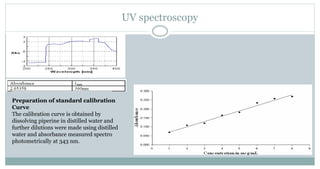
UV spectroscopy
Preparation of standard calibration
Curve
The calibration curve is obtained by
dissolving piperine in distilled water and
further dilutions were made using distilled
water and absorbance measured spectro
photometrically at 343 nm.
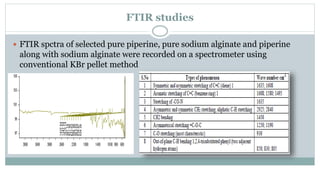
FTIR studies
 FTIR spctra of selected pure piperine, pure sodium alginate and piperine
along with sodium alginate were recorded on a spectrometer using
conventional KBr pellet method

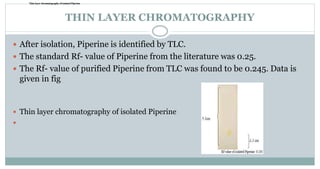
THIN LAYER CHROMATOGRAPHY
 After isolation, Piperine is identified by TLC.
 The standard Rf- value of Piperine from the literature was 0.25.
 The Rf- value of purified Piperine from TLC was found to be 0.245. Data is
given in fig
 Thin layer chromatography of isolated Piperine

Thin layer chromatography of isolated PiperineThin layer chromatography of isolated PiperineThin layer chromatography of isolated Piperine
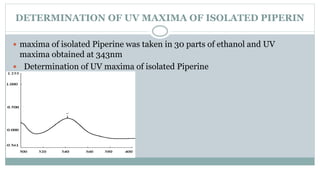
DETERMINATION OF UV MAXIMA OF ISOLATED PIPERIN
 maxima of isolated Piperine was taken in 30 parts of ethanol and UV
maxima obtained at 343nm
 Determination of UV maxima of isolated Piperine
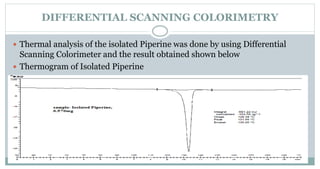
DIFFERENTIAL SCANNING COLORIMETRY
 Thermal analysis of the isolated Piperine was done by using Differential
Scanning Colorimeter and the result obtained shown below
 Thermogram of Isolated Piperine

Structural elucidation

  • 1.
    N I DH I J A D H A V Structural elucidation
  • 2.
    Introduction nicotine  IntroductionNicotine was isolated from tobacco leaves (Nicotiana tabacum) in 1828, but the powerful effects of nicotine were already well recognized  The tobacco plant is native to the Americas and its use as a medicine and stimulant goes back at least 2000 years and most likely many millennia before that.  Tobacco appears to part of the healing arts and sacred rituals of many of the native peoples of the Americas. Codex, 16th century.)  Nicotine is a potent parasympathomimetic alkaloid found in the nightshade family of plants (Solanaceae) and a stimulant drug
  • 3.
     It isa nicotinic acetylcholine agonist receptor.  It constitutes approximately 0.6–3.0% of the dry weight of tobacco and is present in the range of 2–7 µg/kg of various edible plants.  It functions as an antiherbivore chemical; consequently, nicotine was widely used as an insecticide in the past and nicotine analogs such as imidacloprid are currently widely used.
  • 4.
    Nomenclature  Chemical names:- Nicotinamide :- Pyridine-3-crboxamide; nicotinic acid amide; 3-pyridine carboxylic acid amide; 3- pyridine carboxamide  Nicotinic acid:- pyridine -3- crboxamide;3-pyridine crboxamide; pyridine- β- carboxylic acid.  Generic name :- nicotinamide; niacinamide; nicotylamide; nicotinamidum; vitamin PP; vitamine B3 ; aminocotin; dipegyl; pilonin amide; amide PP.  Trade name:- nicotinamide: nicamina; nicobion; nicosedine; nicovel; nicovit; nicamindon; nicotamide; nicofort; niozymin;pelmine; benicot; vinietyl; amisyl; farmabion
  • 5.
     colour:- Nicotinamideexists as colourless crystal or white crystalline powder.  odor :- faint characteristic  Taste: salty and better.  while nicotinic acid appears as needle or white to creamy- white crystals or crystalline powder  Optical activity:-  both the drug substance are optically inactive because of the absences of chemical asymmetry.
  • 6.
     Solubility:-  Nicotinamideishighly soluble in water and alcohol 1g dissolves in about 1ml of water in about 1.5ml alcohol and in 10 ml glycerol.  it is slightly soluble in ether and chloroform , while it is soluble in solution of alkali.  nicotinic acid 1g is soluble in 55 to 60 ml of water and 100 ml of ethanol, very slightly in chloroform.  practically insoluble in ether.  soluble in alkaline solution of hydroxides and carbonates.
  • 7.
     Moisture contentand hygroscopity:-  Nicotinamide absorbs insignificant amount of moisture at 250 c at relative humidities up to about 90%  Stability:-  nicotinamide is stable in air, light, and at certain PH-changes  Storage:-  both drug substances should be stored in air-tight container
  • 8.
     Identification :- Color test:-  to 2ml 0.1% solution of nicotinamide or nicotinic acid add 6ml of cyanogen bromide solution and 1 ml of a 2.5% v/v solution of aniline golden yellow i.e konigs reaction. Nicotinamide gives brown- orange color with nessler reagent.  Microcrystal test:  Nicotinamide yield with gold chloride solution dense rosettes and with platinic iodide solution a mass of hair – like needles
  • 9.
  • 10.
    Spectral properties  Ultravioletspectrum:- The Ultraviolet scanning of ethanolic solution of nicotinamide. 1) Ultraviolet spectrum: The Ultraviolet spectrum of nicotinamide in ethanol . 2) The spectrum of the drug exhibits a maximum at 261nm . 3) The UV-running of methnolic maximum at about 263nm.
  • 11.
    Infrared spectrum  TheInfrared spectrum of nicotinamide in KBr disc, is presented . the frequencies had nicotinic acid are shown in table Frequency (cm-1) assignment 1600-1630 C=C (stretch ,amide and acid) 1700 C=O (amide) 1710 C=O ( acid) 3200 N-H (stretch ,amide) 3100 O-H (stretch ,acid)
  • 12.
    Proton nuclear spectrum(1H-NMR)  The 1H-NMR running were undertaken for each drug substances . the 1H- NMR spectrum of nicotinamide.  Each drug substances was dissolved in deuterium oxides and its spectrum determined on a varian T6A NMR spectrometer using DSS ( sodium-2,2- dimethyl-2-silapentane-5-sulfonate) as the internal standard . the structural assignments are
  • 13.
    Chemical shift (δ,ppm)Multiplicity Proton assignment 7.69 Multiplicity H(3) 8.25 Multiplicity H(2) 8.72 Multiplicity H(4) 8.93 Doublet H(1) 9.16 singlet H(5) ) (amide) 9.14 Singlet H(6) (acid)
  • 14.
    Carbon-13 NMR SPECTRUM( 13C-NMR)  The ( 13C-NMR) spectrum of nicotinamide in deuterium oxide using DSS as the internal reference were obtained using jeo1 FX 100 MHZ spectrometer at an ambient temperature .  Represents the 1H- decoupled spectrum of nicotinamide Chemical shift (δ,ppm) Multiplicity Carbon assignment Acid amide 150.3 150.2 Doublet C(1) 133.5 131.3 singlet C(2) 138.6 138.7 Doublet C(3) 124.6 126.8 Doublet C(4) 151.5 154.3 Doublet C(5) 173.8 172.0 singlet C(6)
  • 15.
    Pilocarpine  Dried leavesof pilocarpus jaborandi ; Fam: rutaceae.  Origin of the Drug  -South American Shrub  - Pilocarpus jaborandi  -Isolated in 1875  Pilocarpine binds to muscarinic receptor  Activates receptor binds G-protein  Removal of GDP and addition of GTP to G-protein  Dissociation of G-protein from muscarinic receptor  Separation of G-protein into alpha and beta-gamma subunits
  • 16.
     Alpha subunitinteracts with and activates Phospholipase C - Phosphatidyl inositol biphosphate (PIP) complex  Phospholipase breaks down PIP into inositol 1,4,5-triphosphate (IP3)and diacylglycerol (both 2o)  IP3 interacts with ER membrane which releases Ca2  Chemical Structure:-
  • 17.
     Chemical name:- 2-ethyl1-3-(1-methyl1-5-imidazolyl)methyl) -4 butanolide.  (3s-cis-3-ethyldihydro-4-(methyl-1H-imidazole-5-yl)-2-(3H)-furanone.  Generic name:-  Pipocarpine  Pilocarpine hydrochloride; pilocarpine muriate;almocarpine.  Pilocarpine nitrate; licarpin .  Trade name  For base: OCUSERT pilo.  For nitrate : PV cerpine
  • 18.
     Formula :- C11 H16 N2O2 (base)  C11 H17Cl N2O2 (hcl.salt)  C11 H17 N3O5 (nitrate salt)  Molecular weight:-  208.25 (base)  244.72 (HCl salt)  271.30 ( nitrate salt)
  • 19.
     Appearance, color,odor:-  Pilocarpine base : Colorless oil or crystal.  Pilocarpine hydrochloride: colorless crystal or white , crystalline powder; odorless. Hydroscopic.  Pilocarpine nitrate: colorless crystal or a white ,crystalline powder; odorless.  Physical properties:  Melting point:  Pilocarpine base: 340  Pilocarpine hydrochloride 195-198o  Pilocarpine nitrate 173.5-1740
  • 20.
     Pka value:- Pilocarpine base shows two ionization costants, pk1=7.15 and pk2 =12.57 at 200  Specific rotation :-  The specific rotation for Pilocarpine and its official salts are shows on the following table and this constant is used to differentiate and identify Pilocarpine, the cis- isomer and the pharmacologically active one, from its tran-isomer, isoPilocarpine.  Moisture content and hygroscopicity: 8.7-14.1%,crude piperine:- 2.8-9.0%,crude fibre:-8.7-18.1%  Storage: Store in a cool, dry place,
  • 21.
     Identification  Colortest :-  Pilocarpine hydroclorid: dissolve 10 mg into 5 ml of water add 0.1 ml of M sulphuric acid 0.1 ml of H2O2 solution, 1 ml toluene and 0.5 ml of potassium chromate solution. Shake well and allow to separate; the touene layer is colored bluish violet and the aqueous laye remains yellow  Pilocarpine nitrate: dissolve 10 mg into 2 ml h2o, add 0.1 ml of 5%w/v solution and 2ml of chloroform and shake ; the chloroform layer turns violet.  Crystal test:-  Pilocarpine can be identified by forming characteristic crystals, with the following reagents: 1) gold bromide solution; feathering rosettes.  2) platonic chloride solution plates in cluster. 
  • 22.
     Degradation test: the following tests were cited by the WHO in the international pharmacopeia . if the substances does not pass this test, this indicates that gross ,Degradation of both Pilocarpine hydrochloride and Pilocarpine nitrate had occurred.  Stability:-  Pilocarpine possessesseveral pharmacological properties, e.g., it possesses amotic action and lowers the intraocular pressure. Its chief clinical application in opthomology has been for the treatment of glaucoma in buffered iisotonic silution renging from 0.5 to 6% as Pilocarpine nitrate or hydrocholoride . however, pilocarpine in aq. Solution decomposes through two major pathways which are both base catalysed . 
  • 23.
    Spectral properties:  Ultravioletspectrum:  Pilocarpine HCl in H2O exhibits maximum at 215 nm as shown in figure clarke reported the UV absorption spectrum of Pilocarpine in 0.2N H2SO4 to show a maximum at 215nm  Ben bassat and lavis reported the ultraviolet spectroscopic propirties of V and the eefect of quaternization of this drug among other characteristic changes in the NMR and IR properties
  • 24.
    Infrared spectrum The IRspectrum of pilocarpine HCl in KBr disc. The major assignments are Frequency cm-1 Assignments 3080,3020 N-CH3 quaternary and aromatic CH stretch 1770 C=O(five membered α- lactone ring) 1620 C=C aromatic stretch
  • 25.
    Proton magnetic resonancespectrum  A typical PMR spectrum of pilocarine HCl is shown in figure .  The spectrum was determined on varian T60A spectrometer.  The smple was dissolve in D2O with 3-(trimethylsilyl)-propionic acid) sodium salt as an internal standard.  The following structural assignments have been made for figure .
  • 26.
    Chemical shift (δ)Assignment Triplet at 1.1 CH3 CH2 Quartet at 1.7 CH3 CH2 Complex multiplet centered at 3.00 -CH2 at C8 and CH at C4 Singlet 3.9 Complex multiplet Between 4 and 4.6 CH2 at C5 and CH at C3 Singlet at 7.4 Aromatic proton at c4 Singlet at 9.4 Aromatic proton at c2
  • 27.
    Mass spectrum  Themass spectrum of pilocarpine hydrochloride obtained by electron ionization is shown in figure
  • 28.
    Chromatographic analysis  Paperchromatography  Clarke described a solvent system used for the paper chromatography of pilocarpine consisting of citric acid; water; n- butanol. The deug can detected by several agents such as bromocresol green speay or iodoplatinate spray
  • 29.
    Solvent system AbsorbantLocalizing agent Strong ammonia solution: methanol( 1.5: 100) should be changed after two hours Silica gel G. Acidified iodoplatinate spray Chloroform : acetone : diethylamine ( 5:4:1.) Kiesel gel GF 254 Dragendorff reagent Chloroform : acetone : diethylamine ( 9:1.) Silica gel G Iodoplatinate spray or Dragendorff reagent Butanol: anhydrous ACOH: water,(4:1:5.) Hydrolysed cotton wool prepared specially for this purpose + CaSO4 UV light Butanol: acetic acid: water(4:1:5.) Silufol Iodine or Dragendorff reagent
  • 30.
    Piperine  Piperine iscommercially available.  If desired, it may be extracted from black pepper using dichloromethane.  Aqueous hydrotopes can also be used in the extraction to result in high yield and selectivity.  The amount of piperine varies from 1-2% in long pepper, to 5-10% in commercial white and black peppers.  Further, it may be prepared by treating the solvent-free residue from an alcoholic extract of black pepper, with a solution of potassium hydroxide to remove resin (said to contain chavicine, an isomer of piperine) and solution of the washed, insoluble residue in warm alcohol, from which the alkaloid crystallises on cooling.
  • 31.
     Piperine, alongwith its isomer chavicine, is the alkaloid responsible for the pungency of black pepper and long pepper.  It has also been used in some forms of traditional medicine and as an insecticide.  Piperine forms monoclinic needles, is slightly soluble in water (1 g/25 L (18 °C)), and is highly soluble in alcohol (1 g/15 mL), ether (1 g/36 mL) and chloroform (1 g/1.7 mL).  The solution in alcohol has a pepper-like taste
  • 32.
    Nomenclature  Chemical names:- 1) 1-[5-(1,3-Benzodioxol-5-yl)-1-oxo-2,4- pentadienyl]piperidine  2) 5-(3,4-Methylenedioxyphenyl)-2,4-pentadienoyl-2- piperidine  3) Piperoylpiperidine  4)Bioperine  structure:-
  • 33.
     Molecular formula C17H19NO3  Molar mass  285.34 g·mol−1  Boiling point  decomposes  Melting point  130 °C (266 °F; 403 K)  Color: Black  Odour :Aromatic  Taste: Aromatic and Pungent
  • 34.
     Generic Name:Diavita Total Power, Ferrous Ascorbate With Vitamins, Minerals & Amino Acids Syrup, Calcium, Piperine & Lycopene Capsules, Foot Repair Cream, Sunscreen Lotion. Lovon Capsule,  Trade name:- Diavita Total Power, Femyfit Tablets, METH 5, Nutrican Capsules, Ferolax Syrup, L-Vita, Bioma Oil, Verasoft Lotion, Diavita Powder, Ulite Cream, Parasoft Cream, Kozicare, Baclean, Bactocid, Eyederm Lotion, Sunnycare Lotion:, Olivera Lotion, FRC Cream, TAM 20, THALEP 100, Cleanz Syrup, Lovon Capsule
  • 35.
     Solubility:-  Petroleumether :Soluble  Chloroform :Soluble  Ethanol: Soluble  Methanol: Soluble  Water : Insoluble  Identification test  The piperine (in mcL) was subjected on to the precoated and activated (kept the plates in oven for 1hr at 700C) silica gel TLCplates.  The mobile phase is Toluene: Ethyl acetate in 70:3 ratios and the detecting agent is Vanillin- Sulphuric acid reagent. After the  TLC run and spraying the detecting agent the yellow spots of piperine were identified  visually. Rf value was calculated8.
  • 36.
    High Performance LiquidChromatography (HPLC) Analysis  HPLC Analysis of extract  File name: H piperine 50 ppm  MP: water: MeOH [30:70]  Column: HiQ Sil C18W  Flow rate: 1 ml/min
  • 37.
    UV spectroscopy Preparation ofstandard calibration Curve The calibration curve is obtained by dissolving piperine in distilled water and further dilutions were made using distilled water and absorbance measured spectro photometrically at 343 nm.
  • 38.
    FTIR studies  FTIRspctra of selected pure piperine, pure sodium alginate and piperine along with sodium alginate were recorded on a spectrometer using conventional KBr pellet method 
  • 39.
    THIN LAYER CHROMATOGRAPHY After isolation, Piperine is identified by TLC.  The standard Rf- value of Piperine from the literature was 0.25.  The Rf- value of purified Piperine from TLC was found to be 0.245. Data is given in fig  Thin layer chromatography of isolated Piperine  Thin layer chromatography of isolated PiperineThin layer chromatography of isolated PiperineThin layer chromatography of isolated Piperine
  • 40.
    DETERMINATION OF UVMAXIMA OF ISOLATED PIPERIN  maxima of isolated Piperine was taken in 30 parts of ethanol and UV maxima obtained at 343nm  Determination of UV maxima of isolated Piperine
  • 41.
    DIFFERENTIAL SCANNING COLORIMETRY Thermal analysis of the isolated Piperine was done by using Differential Scanning Colorimeter and the result obtained shown below  Thermogram of Isolated Piperine