Perfumes and Flavouring
Agents
Prepared by
Ms. Shivanee Vyas
Assistant Professor
SVKM’s NMIMS, School of Pharmacy and Technology
Management
1
Perfumes and Flavouring Agents
• Any substance which is made from natural or synthetic material or a combination of both used
for creating pleasant odour or removed the undesered smell, is known as perfumes.
• The flavoring agents are the agents which are used to mask the unpleasant taste.
• Drugs which used for these purpose are:
 Peppermint Oil,
 Lemon Oil,
 Orange Oil,
 Lemon grass Oil,
 Sandalwood.
2
Peppermint Oil
• Synonyms: Mentha oil, oleum menthe, colpermin.
• Biological source: Peppermint oil is obtained by steam distillation of the fresh flowering tops of
Mentha poperita linn.
• Family: Labiatae.
• Geographical source: Peppermint widely grows in Europe. Its various species are cultivated in
various parts of the word like Japan, England, France, Italy, USA, Balgaria. In India it grows near
Jammu and in Tarai region of Uttarpradesh.
3
• Morphological characters:
 Colour: Colorless to yellow
 Odour: Characteristic and pleasant
 Taste: Pungent followed by cooling sensation
 Solubility: Soluble in 70% alcohol, ether and chloroform and insoluble in water
• Chemical constituent: Peppermint oil contains L-menthol (up to 80%) in free form and
also in the form of esters. other important constituents of peppermint oil are menthone,
menthofuran, Jasmone, menthyl isovalerate, menthyl acetate, and some other terpene
derivatives L-limonene, isopulegone, cineole, Pinene, camphene.
Menthol Menthone
4
• Chemical test: A few drops of peppermint oil and 5ml of nitric acid solution are mixed and
heated on a water bath within 5 minutes the liquid develops a blue colour, which deepens
on further heating, develops copper colour fluorescence and after some time becomes
golden yellow.
• Uses:
1. It is used as a carminative, stimulant, and flavouring agent.
2. It has mild antiseptic properties.
3. It is an ingredient of toothpastes, tooth powders, shaving creams, chewing gums, candles
and different pharmaceutical dosage forms.
4. It produces smooth muscle relaxant effects, thus is used for reducing spasm during colon
endoscopy.
5. Due to its antitussive property, it is used for inhalation in steam and also added in topical
products and lozenge.
5
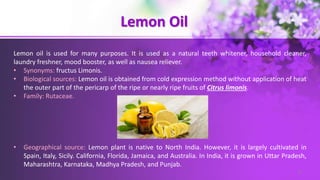
Lemon Oil
Lemon oil is used for many purposes. It is used as a natural teeth whitener, household cleaner,
laundry freshner, mood booster, as well as nausea reliever.
• Synonyms: fructus Limonis.
• Biological sources: Lemon oil is obtained from cold expression method without application of heat
the outer part of the pericarp of the ripe or nearly ripe fruits of Citrus limonis.
• Family: Rutaceae.
• Geographical source: Lemon plant is native to North India. However, it is largely cultivated in
Spain, Italy, Sicily. California, Florida, Jamaica, and Australia. In India, it is grown in Uttar Pradesh,
Maharashtra, Karnataka, Madhya Pradesh, and Punjab.
6
• Morphological characters:
 Colour: fresh lemon peel is externally bright green yellow coloured and internally white
Coloured; dried peel is externally yellow internally pithy white, oil is pale yellow in colour
and greenish.
 Odour: The fruit has a strong, fragrant, aromatic, and characteristic odour, oil has a sharp
and fresh odour.
 Taste: Aromatic and bitter
 Size and shape: fruits are oblong about 5-12 cm in length; peels are irregular and spiral
shaped, found in the form of strips
 Surface: outer surface is rough due to the presence of numerous minute pits which are oil
glands, inner surface has white spongy pericarp.
• Chemical constituents: The major chemical components of lemon oil are terpenes mainly
limonene, camphene, β-pinene, sabinene, L-terpinene, linalool), B-bisabolene,
sesquiterpines mainly citral, geraniol, aldehyde maily citronellal.
7
• Chemical test:
 A solution of freshly isolated oil in three volume of alcohol is neutral or slightly acidic to
litmus paper.
• Uses:
1. It is an antimicrobial, antirheumatic, antiseptic, bactericidal, carminative, diuretic
hypotensive agent.
2. It is very beneficial to the circulatory system, reduces blood pressure and relieves
nose bleeding.
3. It help to relieve throat infection, asthma, and flu.
4. It boost the immune system and cleanse the body.
5. It improves the function of digestive system.
6. It relieves the headache, and migraine pain.
7. It also used for clearing acne, cleaning greasy skin and hair, as well as removing dead
skin cell, mouth ulcer.
8. Lemon peel is used as a flavouring agent, perfumery, and stomachic.
• Marketed Products: It is one of the ingredients of the preparations known as Protein
shampoo (Himalaya Drug Company), Panch Nimba churna (Zaipa Pharmaceuticals), and
Ultra Doux conditioner (Garnier).
8
9
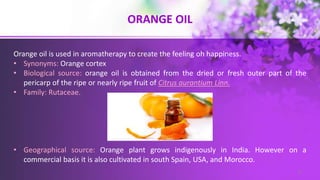
ORANGE OIL
Orange oil is used in aromatherapy to create the feeling oh happiness.
• Synonyms: Orange cortex
• Biological source: orange oil is obtained from the dried or fresh outer part of the
pericarp of the ripe or nearly ripe fruit of Citrus aurantium Linn.
• Family: Rutaceae.
• Geographical source: Orange plant grows indigenously in India. However on a
commercial basis it is also cultivated in south Spain, USA, and Morocco.
• Morphological characters:
 Colour: Dark orange red
 Odour: Fresh and tangy
 Size: Strips of various size and shape, and are about 3-4mm thick.
 Fracture: short
 Surface: Brittle, outer surface is rough due to the presence of number of small pits of oil
glands.
• Chemical constituent: the major chemical constituent of orange oil are α-pinene,
citronellal, sabinene, myrcene, limonene, linaloolcitronellal, neral and geranial.
10
• Uses:
1. It reduces anxiety and anger.
2. It provide quick and effective relief from internal as well as external inflammation.
3. It promotes the secretion from exocrine and endocrine glands, thus it used for
regulating menstruation, lactation, the secretion of bile, digestive juice and
enzymes.
4. It eliminates toxin like uric acid, bile, excess salts, pollutants and excess water by
increases the process of urination.
5. It is detoxifier, boost immunity and treat constipation.
6. It produce a happy and relaxed feeling.
7. It also makes the skin smooth as it helps in curing acne and dermatitis.
11
12
LEMON GRASS OIL
• Synonyms: East India lemongrass, Malabar, or Cochin Lemongrass.
• Biological source: Lemongrass oil is obtained form Cymbopogon flexuosus.
• Family: Poaceae.
• Geographical source: Lemongrass is wildly grows and cultivated throughout the India and is found
in Tamilnadu, kerala, Maharashtra, Karnataka, Tinnevelli, and Cochin.
• Morphological characters:
 Colour: Yellowish brown liquid
 Odour: Lemony
 Taste: Lemony
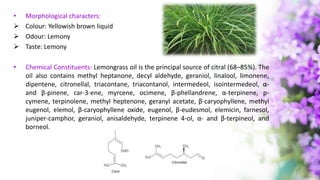
• Chemical Constituents: Lemongrass oil is the principal source of citral (68–85%). The
oil also contains methyl heptanone, decyl aldehyde, geraniol, linalool, limonene,
dipentene, citronellal, triacontane, triacontanol, intermedeol, isointermedeol, α-
and β-pinene, car-3-ene, myrcene, ocimene, β-phellandrene, α-terpinene, p-
cymene, terpinolene, methyl heptenone, geranyl acetate, β-caryophyllene, methyl
eugenol, elemol, β-caryophyllene oxide, eugenol, β-eudesmol, elemicin, farnesol,
juniper-camphor, geraniol, anisaldehyde, terpinene 4-ol, α- and β-terpineol, and
borneol.
13
• Uses:
1. The oil is used as a perfume and as a disinfectant.
2. It possesses central nervous system depressant property.
3. The grass has diuretic and a tonic.
4. Due to the carminative property, it enhance digestion.
5. The oil also possesses antifungal and antimicrobial properties.
14
15
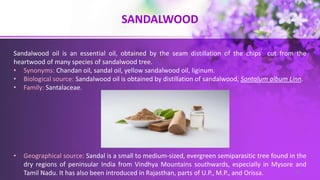
SANDALWOOD
Sandalwood oil is an essential oil, obtained by the seam distillation of the chips cut from the
heartwood of many species of sandalwood tree.
• Synonyms: Chandan oil, sandal oil, yellow sandalwood oil, liginum.
• Biological source: Sandalwood oil is obtained by distillation of sandalwood, Santalum album Linn.
• Family: Santalaceae.
• Geographical source: Sandal is a small to medium-sized, evergreen semiparasitic tree found in the
dry regions of peninsular India from Vindhya Mountains southwards, especially in Mysore and
Tamil Nadu. It has also been introduced in Rajasthan, parts of U.P., M.P., and Orissa.
• Morphological characters:
 Colour: golden yellow to yellowish
 Odour: Pleasant
 Taste: Slightly bitter
 Solubility: Soluble in water, and slightly soluble in alcohol and chloroform
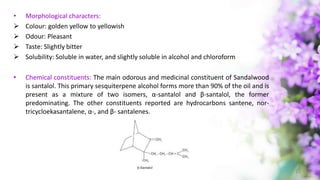
• Chemical constituents: The main odorous and medicinal constituent of Sandalwood
is santalol. This primary sesquiterpene alcohol forms more than 90% of the oil and is
present as a mixture of two isomers, α-santalol and β-santalol, the former
predominating. The other constituents reported are hydrocarbons santene, nor-
tricycloekasantalene, α-, and β- santalenes.
16
• Chemical test:
1. A thin section of sandalwood + alcoholic solution of sudan III
Globules become red coloured Globules remain unchanged
Volatile oil is present No volatile oil
2. A few drops of sandalwood oil+ 2-3ml of 90% alcohol
Soluble Insoluble
The oil to be volatile The oil to be non-volatile
17
• Uses:
1. Sandalwood oil is highly used in perfumery creations and finds an
important place in soaps, face creams, and powders.
2. The sandalwood is also used in common cold, urinary tract infections, liver
and gallbladder problems, digestive problems, muscle problems and
mental disorders.
3. Sandalwood oil will help settle and balance emotions.
4. Sandalwood oil has the ability to act as a natural astringent, anti-
inflammatory, anti-viral and expectorant.
5. This incredible oil demonstrates anti-cancer effects, specifically when it
comes to skin cancer.
6. Sandalwood oil uses include colds, coughs, acne, eczema, psoriasis and
more.
18
19

Perfumes and flavouring agents

  • 1.
    Perfumes and Flavouring Agents Preparedby Ms. Shivanee Vyas Assistant Professor SVKM’s NMIMS, School of Pharmacy and Technology Management 1
  • 2.
    Perfumes and FlavouringAgents • Any substance which is made from natural or synthetic material or a combination of both used for creating pleasant odour or removed the undesered smell, is known as perfumes. • The flavoring agents are the agents which are used to mask the unpleasant taste. • Drugs which used for these purpose are:  Peppermint Oil,  Lemon Oil,  Orange Oil,  Lemon grass Oil,  Sandalwood. 2
  • 3.
    Peppermint Oil • Synonyms:Mentha oil, oleum menthe, colpermin. • Biological source: Peppermint oil is obtained by steam distillation of the fresh flowering tops of Mentha poperita linn. • Family: Labiatae. • Geographical source: Peppermint widely grows in Europe. Its various species are cultivated in various parts of the word like Japan, England, France, Italy, USA, Balgaria. In India it grows near Jammu and in Tarai region of Uttarpradesh. 3
  • 4.
    • Morphological characters: Colour: Colorless to yellow  Odour: Characteristic and pleasant  Taste: Pungent followed by cooling sensation  Solubility: Soluble in 70% alcohol, ether and chloroform and insoluble in water • Chemical constituent: Peppermint oil contains L-menthol (up to 80%) in free form and also in the form of esters. other important constituents of peppermint oil are menthone, menthofuran, Jasmone, menthyl isovalerate, menthyl acetate, and some other terpene derivatives L-limonene, isopulegone, cineole, Pinene, camphene. Menthol Menthone 4
  • 5.
    • Chemical test:A few drops of peppermint oil and 5ml of nitric acid solution are mixed and heated on a water bath within 5 minutes the liquid develops a blue colour, which deepens on further heating, develops copper colour fluorescence and after some time becomes golden yellow. • Uses: 1. It is used as a carminative, stimulant, and flavouring agent. 2. It has mild antiseptic properties. 3. It is an ingredient of toothpastes, tooth powders, shaving creams, chewing gums, candles and different pharmaceutical dosage forms. 4. It produces smooth muscle relaxant effects, thus is used for reducing spasm during colon endoscopy. 5. Due to its antitussive property, it is used for inhalation in steam and also added in topical products and lozenge. 5
  • 6.
    Lemon Oil Lemon oilis used for many purposes. It is used as a natural teeth whitener, household cleaner, laundry freshner, mood booster, as well as nausea reliever. • Synonyms: fructus Limonis. • Biological sources: Lemon oil is obtained from cold expression method without application of heat the outer part of the pericarp of the ripe or nearly ripe fruits of Citrus limonis. • Family: Rutaceae. • Geographical source: Lemon plant is native to North India. However, it is largely cultivated in Spain, Italy, Sicily. California, Florida, Jamaica, and Australia. In India, it is grown in Uttar Pradesh, Maharashtra, Karnataka, Madhya Pradesh, and Punjab. 6
  • 7.
    • Morphological characters: Colour: fresh lemon peel is externally bright green yellow coloured and internally white Coloured; dried peel is externally yellow internally pithy white, oil is pale yellow in colour and greenish.  Odour: The fruit has a strong, fragrant, aromatic, and characteristic odour, oil has a sharp and fresh odour.  Taste: Aromatic and bitter  Size and shape: fruits are oblong about 5-12 cm in length; peels are irregular and spiral shaped, found in the form of strips  Surface: outer surface is rough due to the presence of numerous minute pits which are oil glands, inner surface has white spongy pericarp. • Chemical constituents: The major chemical components of lemon oil are terpenes mainly limonene, camphene, β-pinene, sabinene, L-terpinene, linalool), B-bisabolene, sesquiterpines mainly citral, geraniol, aldehyde maily citronellal. 7
  • 8.
    • Chemical test: A solution of freshly isolated oil in three volume of alcohol is neutral or slightly acidic to litmus paper. • Uses: 1. It is an antimicrobial, antirheumatic, antiseptic, bactericidal, carminative, diuretic hypotensive agent. 2. It is very beneficial to the circulatory system, reduces blood pressure and relieves nose bleeding. 3. It help to relieve throat infection, asthma, and flu. 4. It boost the immune system and cleanse the body. 5. It improves the function of digestive system. 6. It relieves the headache, and migraine pain. 7. It also used for clearing acne, cleaning greasy skin and hair, as well as removing dead skin cell, mouth ulcer. 8. Lemon peel is used as a flavouring agent, perfumery, and stomachic. • Marketed Products: It is one of the ingredients of the preparations known as Protein shampoo (Himalaya Drug Company), Panch Nimba churna (Zaipa Pharmaceuticals), and Ultra Doux conditioner (Garnier). 8
  • 9.
    9 ORANGE OIL Orange oilis used in aromatherapy to create the feeling oh happiness. • Synonyms: Orange cortex • Biological source: orange oil is obtained from the dried or fresh outer part of the pericarp of the ripe or nearly ripe fruit of Citrus aurantium Linn. • Family: Rutaceae. • Geographical source: Orange plant grows indigenously in India. However on a commercial basis it is also cultivated in south Spain, USA, and Morocco.
  • 10.
    • Morphological characters: Colour: Dark orange red  Odour: Fresh and tangy  Size: Strips of various size and shape, and are about 3-4mm thick.  Fracture: short  Surface: Brittle, outer surface is rough due to the presence of number of small pits of oil glands. • Chemical constituent: the major chemical constituent of orange oil are α-pinene, citronellal, sabinene, myrcene, limonene, linaloolcitronellal, neral and geranial. 10
  • 11.
    • Uses: 1. Itreduces anxiety and anger. 2. It provide quick and effective relief from internal as well as external inflammation. 3. It promotes the secretion from exocrine and endocrine glands, thus it used for regulating menstruation, lactation, the secretion of bile, digestive juice and enzymes. 4. It eliminates toxin like uric acid, bile, excess salts, pollutants and excess water by increases the process of urination. 5. It is detoxifier, boost immunity and treat constipation. 6. It produce a happy and relaxed feeling. 7. It also makes the skin smooth as it helps in curing acne and dermatitis. 11
  • 12.
    12 LEMON GRASS OIL •Synonyms: East India lemongrass, Malabar, or Cochin Lemongrass. • Biological source: Lemongrass oil is obtained form Cymbopogon flexuosus. • Family: Poaceae. • Geographical source: Lemongrass is wildly grows and cultivated throughout the India and is found in Tamilnadu, kerala, Maharashtra, Karnataka, Tinnevelli, and Cochin.
  • 13.
    • Morphological characters: Colour: Yellowish brown liquid  Odour: Lemony  Taste: Lemony • Chemical Constituents: Lemongrass oil is the principal source of citral (68–85%). The oil also contains methyl heptanone, decyl aldehyde, geraniol, linalool, limonene, dipentene, citronellal, triacontane, triacontanol, intermedeol, isointermedeol, α- and β-pinene, car-3-ene, myrcene, ocimene, β-phellandrene, α-terpinene, p- cymene, terpinolene, methyl heptenone, geranyl acetate, β-caryophyllene, methyl eugenol, elemol, β-caryophyllene oxide, eugenol, β-eudesmol, elemicin, farnesol, juniper-camphor, geraniol, anisaldehyde, terpinene 4-ol, α- and β-terpineol, and borneol. 13
  • 14.
    • Uses: 1. Theoil is used as a perfume and as a disinfectant. 2. It possesses central nervous system depressant property. 3. The grass has diuretic and a tonic. 4. Due to the carminative property, it enhance digestion. 5. The oil also possesses antifungal and antimicrobial properties. 14
  • 15.
    15 SANDALWOOD Sandalwood oil isan essential oil, obtained by the seam distillation of the chips cut from the heartwood of many species of sandalwood tree. • Synonyms: Chandan oil, sandal oil, yellow sandalwood oil, liginum. • Biological source: Sandalwood oil is obtained by distillation of sandalwood, Santalum album Linn. • Family: Santalaceae. • Geographical source: Sandal is a small to medium-sized, evergreen semiparasitic tree found in the dry regions of peninsular India from Vindhya Mountains southwards, especially in Mysore and Tamil Nadu. It has also been introduced in Rajasthan, parts of U.P., M.P., and Orissa.
  • 16.
    • Morphological characters: Colour: golden yellow to yellowish  Odour: Pleasant  Taste: Slightly bitter  Solubility: Soluble in water, and slightly soluble in alcohol and chloroform • Chemical constituents: The main odorous and medicinal constituent of Sandalwood is santalol. This primary sesquiterpene alcohol forms more than 90% of the oil and is present as a mixture of two isomers, α-santalol and β-santalol, the former predominating. The other constituents reported are hydrocarbons santene, nor- tricycloekasantalene, α-, and β- santalenes. 16
  • 17.
    • Chemical test: 1.A thin section of sandalwood + alcoholic solution of sudan III Globules become red coloured Globules remain unchanged Volatile oil is present No volatile oil 2. A few drops of sandalwood oil+ 2-3ml of 90% alcohol Soluble Insoluble The oil to be volatile The oil to be non-volatile 17
  • 18.
    • Uses: 1. Sandalwoodoil is highly used in perfumery creations and finds an important place in soaps, face creams, and powders. 2. The sandalwood is also used in common cold, urinary tract infections, liver and gallbladder problems, digestive problems, muscle problems and mental disorders. 3. Sandalwood oil will help settle and balance emotions. 4. Sandalwood oil has the ability to act as a natural astringent, anti- inflammatory, anti-viral and expectorant. 5. This incredible oil demonstrates anti-cancer effects, specifically when it comes to skin cancer. 6. Sandalwood oil uses include colds, coughs, acne, eczema, psoriasis and more. 18
  • 19.