HERBAL DRUG TECHNOLOGY
Presented by
Prof.(Dr.)Kirtimaya Mishra
Unit-1
Topics to be covered
Herbs as raw materials
Biodynamic Agriculture
Indian system of Medicine
Herbs as raw materials
Definition of herb
It consists of entire plant or any part of the plant.
Or
It can be defined as, any plant which has leaves, stem, flowers, roots
and seeds; used for different purposes like flavoring, food,
medicine or perfume.
Or
Botanically, herb is any seed-bearing plant which does not have a
woody stem and dies down to the ground after flowering or
completion of life cycle.
Eg., Botanically, Tulsi (Ocimum Sanctum) can be considered as herb
while Neem (Azadirachta Indica) is tree not herb.
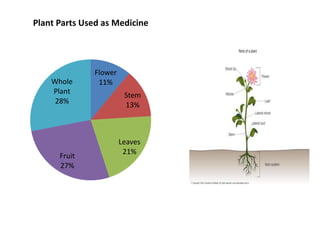
Flower
11%
Stem
13%
Leaves
21%
Fruit
27%
Whole
Plant
28%
Plant Parts Used as Medicine
Herbal Drug/Medicine
 These consist of plants or any part of the plants, usually in
unprocessed or crude forms (crude drugs) which have medicinal
value.
 They include different parts of plants like entire aerial part,
flowers, fruits, seeds, bark, leaves, roots, rhizomes etc.
 The constituents and their therapeutic activity may be known or
unknown.
Note:- Isolated compounds from herbs are not considered as herbal
drugs and regulated as modern licensed medicines.
Eg., Digitalis is herbal medicine but when digoxin and other
glycosides isolated form plant and prescribed in pure form, they
are termed as isolated drugs, they are no more called as herbal
medicines.
Herbal drug preparation
 They are processed form of herbs. They are derived from
herbal drug by various techniques like extraction,
fractionalization, purification, conc. fermentation and may
be in the form of powders, extracts, tinctures, fixed oils,
volatile oils, resins, gums, etc.
 They contain a mixture of various constituents. However
pure isolated compounds do not come under this category.
Herbal Medicinal Products (Finished Herbal Products)
 These are the medicinal products which contain exclusive
herbal drugs or herbal drug preparation which are made
from one or more herbs.
 They may contain excipients in addition to active
ingredients.
Sources of Herbs
 Herbs can be obtained through different sources. These are can be
collected from wild or plant sources.
 Cultivation of herb is becoming common practice all over world
because it gives consistent good quality raw material.
 Cultivated herbs are generally free from contamination.
Source of herbs
Herbs or medicinal plants can be obtained from two sources:
➢ Wild source
➢ Cultivated source
Wild Source
 The plants are obtained from the wild sources such as forest,
plains, river banks etc.
 Obtaining herbs from wild source is my economical, less time
consuming, decreased cost of labour.
 However it also offer various disadvantages such as quality of the
plants cannot be predicted due to various environmental changes.
The plants will not be uniform in their growth and yielding
characteristics.
 Modern scientific techniques cannot be applied to increase the
yield as well as quality.
 If the plants are obtained continuously from wild source for
prolonged periods a may lead to depletion of raw materials from
the wild.
Cultivated source
In recent times, medicinal plants have been systematically
cultivated by applying modern scientific techniques.
Advantages
 Quality and purity is ensured
 Better yield and more profit
 Ensures regular supply of raw materials
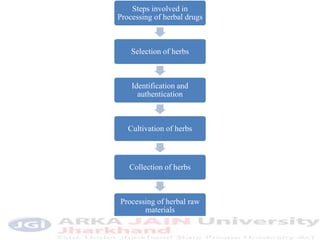
Steps involved in
Processing of herbal drugs
Selection of herbs
Identification and
authentication
Cultivation of herbs
Collection of herbs
Processing of herbal raw
materials
Selection of Herbs
 As per World Health Organization, more than 60% of world
population using plant based medicine directly or indirectly.
 For this, it is very important to select right plant materials for
development of herbal drug.
Selection of plants can be done by,
 Randomized selection
 Ecological selection
 Chemo systemic selection
 Ethanobotanical selection
Randomized selection
 In this, plant material is selected randomly from forest for
discovery of new medicine.
 Success rate is low but this approach offers wide variety of
diversity and plant material is available readily.
Ecological selection
 Ecological selection is an observation of animal behavior for
discovery and development of new drugs.
Eg., Observation of Chimpanzee in African forest lead to discovery of
antimalarial properties of Trichillia rubescens leaves. Hence it is
termed as ecological selection.
Chemosystemic selection
 Distribution of chemical constituents is common in certain
group of plants. This approach is also called as
chemotexonomic approach.
 If plants belongs to certain classification is therapeutically
active, then there is high chance that other plants from same
class can be active.
Eg., Emblica officinalis (Euphorbiaceae) commonly called as
Amala contains ascorbic acid, gallic acid and tannins. So one
can expect other species of Euphorbiaceae can also contain
similar chemical compound and activity.
Ethanobotanical selection
 This is a branch of science which observes knowledge of people,
their tradition and beliefs for discovery and development of
drugs.
 It is also related to reverse pharmacology approach. In this
approach, drug which is already in use from several years is
taken and studied or explored for possible drug development.
Identification & authentication of herbal
materials
 Botanical identity: The species, subspecies, genus, variety etc. of
the plant for cultivation should be verified from a qualified
botanist/institute and recorded
 Specimens: In case of a new plant with medicinal properties
whose identity is not known, a specimen of the plant should be
submitted to a national herbarium for identification &
documentation.
 Seeds and other propagation materials: The suppliers of seeds
and other propagation materials should specify all the necessary
information relating to the identity, quality as well as their
breeding history. The seeds and propagation materials should be
free from contamination and diseases in order to promote healthy
plant growth
Cultivation of medicinal plants
 Cultivation of medicinal plants requires intensive care and
management as various factors such as environment, soil,
irrigation, pests, etc. play a vital role. These factors vary from one
plant to another
 Scientific documented methods should be followed, if nom data
available, traditional methods should be adopted and a systemic
method should be developed through research
 Good Agricultural Practices in Cultivation (GACP) and
Conservation Agriculture (CA) which aims to improve, conserve
& make more efficient use of natural resources.
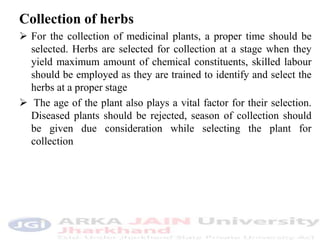
Collection of herbs
 For the collection of medicinal plants, a proper time should be
selected. Herbs are selected for collection at a stage when they
yield maximum amount of chemical constituents, skilled labour
should be employed as they are trained to identify and select the
herbs at a proper stage
 The age of the plant also plays a vital factor for their selection.
Diseased plants should be rejected, season of collection should
be given due consideration while selecting the plant for
collection
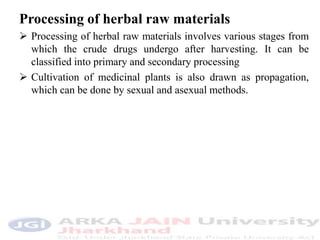
Processing of herbal raw materials
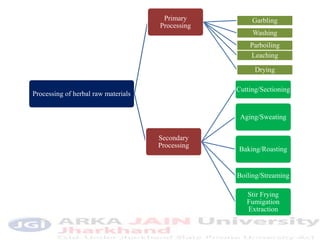
 Processing of herbal raw materials involves various stages from
which the crude drugs undergo after harvesting. It can be
classified into primary and secondary processing
 Cultivation of medicinal plants is also drawn as propagation,
which can be done by sexual and asexual methods.
Processing of herbal raw materials
Primary
Processing
Garbling
Washing
Parboiling
Leaching
Drying
Secondary
Processing
Cutting/Sectioning
Aging/Sweating
Baking/Roasting
Boiling/Streaming
Stir Frying
Fumigation
Extraction
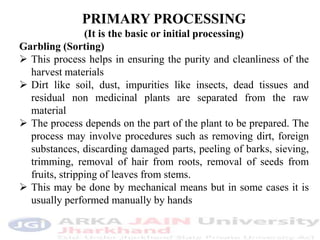
PRIMARY PROCESSING
(It is the basic or initial processing)
Garbling (Sorting)
 This process helps in ensuring the purity and cleanliness of the
harvest materials
 Dirt like soil, dust, impurities like insects, dead tissues and
residual non medicinal plants are separated from the raw
material
 The process depends on the part of the plant to be prepared. The
process may involve procedures such as removing dirt, foreign
substances, discarding damaged parts, peeling of barks, sieving,
trimming, removal of hair from roots, removal of seeds from
fruits, stripping of leaves from stems.
 This may be done by mechanical means but in some cases it is
usually performed manually by hands
Washing
 After garbing the herbal raw materials should be cleaned well to
remove the traces of remaining soil, dirt and other impurities
from the surface
 The roots, rhizomes and tubers are washes with clean water.
During the washing process, scrapping and brushing may be
necessary
Parboiling (Blanching)
 After washing, certain herbal raw materials need to undergo
parboiling process in which they are put in boiling water for
short period.
 This may help in improving the storage life of the raw materials
and preventing insert/mould contamination.
 It may also facilitate in further processing such as removal of
stubborn impurities as well as outer coats/covering of raw
materials
Leaching
 Some impurities can be removed by subjecting the plant material
under running water known as leaching. However the duration
of leaching should be controlled to prevent the loss of chemical
constituents present in the drug
Drying
 In some cases, the plant material should be thoroughly dried
after washing in order to prevent the deterioration and
degradation of active constituents. They must be dried as soon as
possible to remove moisture and reduce damage due to
microbial or mould infestation
 Drying also prevents the activation of certain enzymes which
may otherwise degrade the active ingredients and also facilitate
grinding and milling of the raw material.
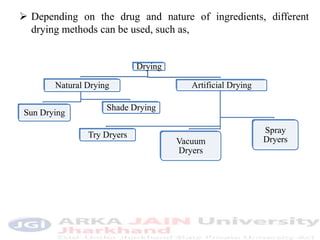
 Depending on the drug and nature of ingredients, different
drying methods can be used, such as,
Drying
Natural Drying
Sun Drying
Shade Drying
Artificial Drying
Try Dryers
Vacuum
Dryers
Spray
Dryers
1. Natural drying
a) Sun drying
 Most herbal raw material can be dried in open air under direct
sunshine provided the climate is suitable. The duration of drying
process depends on the physical structure of the plant material and
weather conditions.
 The plant materials should be spread out in thin layers, care should
be taken to prevent contamination by dirt impurities
 While drying the plant material should also be protected from
inserts, birds, rodents, pests and other domestics
b) Shade drying
 Some medicinal plants cannot be directly exposed to sunlight,
hence need to be dried under shade
 This drying process is slow but helps in minimizing loss of color,
volatile oils and aromatic compartments from being evaporated
2. Artificial drying
 Drying by artificial heat is more rapid than open air drying and
is necessary in rainy seasons and regions where there is high
humidity.
 The temperature and equipment used for drying depends on the
physical and chemical nature of the drug and its constituents.
various equipment such as tray dryers, spray dryers, vacuum
dryers are used
 Overheating may lead to excessive loss of volatile components
as well as decomposition of chemical constituents. The
temperature should be kept maintained below 60°c wherever
possible.
a) Tray dryers (Oven)
 The drugs which do not contain volatile oils and are quite stable to heat
or which need deactivation of enzymes are dried in tray dryers
 In the process, hot air of the desired temperature is circulated through
the dryers and this facilitates the removal of water content of the drug
(belladonna roots, cinchona bark, tea and raspberry leaves and gums
are dried by this method)
b) Vacuum dryers
 The drugs which are sensitive to higher temperature are dried by this
process.
E.g. Tannic acid and digitalis leaves
c) Spray dryers
 Few drugs which are highly sensitive to atmospheric conditions and
also to temperature of vacuum-drying are dried by spray-drying
method. The technique is followed for quick drying of economically
important plant or animal constituents, rather than the crude drugs.
E.g. Papaya latex, pectin, tannins etc.
SECONDARY PROCESSING
(It includes advanced techniques or done post primary processing)
 The secondary processing differs from one herbs to another
depending upon the nature of active ingredients as well as
therapeutic properties
 Secondary processing includes techniques such as,
 Removal of foreign substances
 Prevention of microbial/infestation
 Enhancing the efficacy of drugs
 Reducing the toxicity
 Extraction using suitable solvents
 Conc. & drying of extracts
These are further standardized by different methods.
Cutting, Sectioning and communition
 After thoroughly drying, the herbal materials are processed by
cutting and sectioning into smaller sizes which are convenient for
storage as well as extraction
 Various sizes can be obtained depending on the part of herb and
extraction methods used. It may be small particles, coarse powder
or fine powder
Aging/Sweating
 Aging refers to storing the raw material for a specified time after
harvesting
 It is generally done under sun or in shade for up to a year
 During the process of aging excessive water is evaporated &
enzymatic reactions may occur to alter the chemical composition
of herbal materials
E.g. Cascara bark should be aged for at least one year prior to use
in medicinal preparations to reduce its irritant effects
 Sweating is done by subjecting the herbal materials at a
temperature between 45 to 65°C with high humidity for a period
ranging from one week to few months. The herbal materials are
stacked between woolen blankets or other kind of cloth
 The sweating process is considered a hydrolytic and oxidative
process in which some of the chemical ingredients of the herbs
are hydrolyzed or oxidized
Baking/Roasting
 It is a process of drug heating where the herbal materials is
heated in ovens. The temperature of heating and duration of
baking /roasting vary from one herbal material to another until
the drug develops a specific color
E.g. Nutmeg is roasted till they turn to yellowish brown color
Boiling/Streaming
 In the boiling process the drug is cooked in water or any other liquid
solvent such as vinegar, wine, milk or animal urine.
E.g. Acorus calamus rhizome is boiled in cow’s urine with stream using
a streamer resulting in development of moist texture
Stir frying
 In the process in which the herbal material are put in spot of frying pan
and continuously stirring or tossed for a specific period under heat until
the external color changes, charred or even carbonized. To facilitate
uniform heating, the drug material can be admixed with sand, talc or
clay
E.g. Liquorice roots and rhizomes are stir fried with honey
Fumigation
 Sometimes the harvesting raw materials are subjected to fumes.
Fumigation with Sulphur-dioxide is commonly employed for some
medicinal herbs for the purpose of preserving, color, improved
appearance, bleaching and preventing the growth of inserts and moulds.
Extraction
 Extraction is a process of separation in which the chemical constituents
present in plant and tissues are removed by using selective solvents which is
called menstrum.
 Herbal extracts includes infusion, decoctions, fluid extracts, tinctures and
powder extract.
i. Infusion
It is a liquid preparation obtained by extracting herbal materials with either
cold or hot water without boiling. Other solvent may also be used
ii. Decoction
It is a liquid preparation obtained by boiling the herbal material with water
iii. Fluid extract
It is a liquid preparation obtained by maceration or percolation of herbal
materials in alcohol. The ratio will be one part of liquid contain one part of
herbs (1:1)
iv. Tinctures
It is dilute alcoholic extract of herbal materials typically made up of 1 part of
herbal material with 5 to 10 parts of the solvent
v. Powdered extract
It is a form of herbal preparation which is processed into dried, granulated or
powdered materials.
Herbs as raw materials

Herbs as raw materials

  • 1.
    HERBAL DRUG TECHNOLOGY Presentedby Prof.(Dr.)Kirtimaya Mishra
  • 2.
    Unit-1 Topics to becovered Herbs as raw materials Biodynamic Agriculture Indian system of Medicine
  • 3.
    Herbs as rawmaterials Definition of herb It consists of entire plant or any part of the plant. Or It can be defined as, any plant which has leaves, stem, flowers, roots and seeds; used for different purposes like flavoring, food, medicine or perfume. Or Botanically, herb is any seed-bearing plant which does not have a woody stem and dies down to the ground after flowering or completion of life cycle. Eg., Botanically, Tulsi (Ocimum Sanctum) can be considered as herb while Neem (Azadirachta Indica) is tree not herb.
  • 4.
  • 5.
    Herbal Drug/Medicine  Theseconsist of plants or any part of the plants, usually in unprocessed or crude forms (crude drugs) which have medicinal value.  They include different parts of plants like entire aerial part, flowers, fruits, seeds, bark, leaves, roots, rhizomes etc.  The constituents and their therapeutic activity may be known or unknown. Note:- Isolated compounds from herbs are not considered as herbal drugs and regulated as modern licensed medicines. Eg., Digitalis is herbal medicine but when digoxin and other glycosides isolated form plant and prescribed in pure form, they are termed as isolated drugs, they are no more called as herbal medicines.
  • 6.
    Herbal drug preparation They are processed form of herbs. They are derived from herbal drug by various techniques like extraction, fractionalization, purification, conc. fermentation and may be in the form of powders, extracts, tinctures, fixed oils, volatile oils, resins, gums, etc.  They contain a mixture of various constituents. However pure isolated compounds do not come under this category. Herbal Medicinal Products (Finished Herbal Products)  These are the medicinal products which contain exclusive herbal drugs or herbal drug preparation which are made from one or more herbs.  They may contain excipients in addition to active ingredients.
  • 7.
    Sources of Herbs Herbs can be obtained through different sources. These are can be collected from wild or plant sources.  Cultivation of herb is becoming common practice all over world because it gives consistent good quality raw material.  Cultivated herbs are generally free from contamination.
  • 8.
    Source of herbs Herbsor medicinal plants can be obtained from two sources: ➢ Wild source ➢ Cultivated source Wild Source  The plants are obtained from the wild sources such as forest, plains, river banks etc.  Obtaining herbs from wild source is my economical, less time consuming, decreased cost of labour.  However it also offer various disadvantages such as quality of the plants cannot be predicted due to various environmental changes. The plants will not be uniform in their growth and yielding characteristics.  Modern scientific techniques cannot be applied to increase the yield as well as quality.  If the plants are obtained continuously from wild source for prolonged periods a may lead to depletion of raw materials from the wild.
  • 9.
    Cultivated source In recenttimes, medicinal plants have been systematically cultivated by applying modern scientific techniques. Advantages  Quality and purity is ensured  Better yield and more profit  Ensures regular supply of raw materials
  • 10.
    Steps involved in Processingof herbal drugs Selection of herbs Identification and authentication Cultivation of herbs Collection of herbs Processing of herbal raw materials
  • 11.
    Selection of Herbs As per World Health Organization, more than 60% of world population using plant based medicine directly or indirectly.  For this, it is very important to select right plant materials for development of herbal drug. Selection of plants can be done by,  Randomized selection  Ecological selection  Chemo systemic selection  Ethanobotanical selection
  • 12.
    Randomized selection  Inthis, plant material is selected randomly from forest for discovery of new medicine.  Success rate is low but this approach offers wide variety of diversity and plant material is available readily. Ecological selection  Ecological selection is an observation of animal behavior for discovery and development of new drugs. Eg., Observation of Chimpanzee in African forest lead to discovery of antimalarial properties of Trichillia rubescens leaves. Hence it is termed as ecological selection.
  • 13.
    Chemosystemic selection  Distributionof chemical constituents is common in certain group of plants. This approach is also called as chemotexonomic approach.  If plants belongs to certain classification is therapeutically active, then there is high chance that other plants from same class can be active. Eg., Emblica officinalis (Euphorbiaceae) commonly called as Amala contains ascorbic acid, gallic acid and tannins. So one can expect other species of Euphorbiaceae can also contain similar chemical compound and activity.
  • 14.
    Ethanobotanical selection  Thisis a branch of science which observes knowledge of people, their tradition and beliefs for discovery and development of drugs.  It is also related to reverse pharmacology approach. In this approach, drug which is already in use from several years is taken and studied or explored for possible drug development.
  • 15.
    Identification & authenticationof herbal materials  Botanical identity: The species, subspecies, genus, variety etc. of the plant for cultivation should be verified from a qualified botanist/institute and recorded  Specimens: In case of a new plant with medicinal properties whose identity is not known, a specimen of the plant should be submitted to a national herbarium for identification & documentation.  Seeds and other propagation materials: The suppliers of seeds and other propagation materials should specify all the necessary information relating to the identity, quality as well as their breeding history. The seeds and propagation materials should be free from contamination and diseases in order to promote healthy plant growth
  • 16.
    Cultivation of medicinalplants  Cultivation of medicinal plants requires intensive care and management as various factors such as environment, soil, irrigation, pests, etc. play a vital role. These factors vary from one plant to another  Scientific documented methods should be followed, if nom data available, traditional methods should be adopted and a systemic method should be developed through research  Good Agricultural Practices in Cultivation (GACP) and Conservation Agriculture (CA) which aims to improve, conserve & make more efficient use of natural resources.
  • 17.
    Collection of herbs For the collection of medicinal plants, a proper time should be selected. Herbs are selected for collection at a stage when they yield maximum amount of chemical constituents, skilled labour should be employed as they are trained to identify and select the herbs at a proper stage  The age of the plant also plays a vital factor for their selection. Diseased plants should be rejected, season of collection should be given due consideration while selecting the plant for collection
  • 18.
    Processing of herbalraw materials  Processing of herbal raw materials involves various stages from which the crude drugs undergo after harvesting. It can be classified into primary and secondary processing  Cultivation of medicinal plants is also drawn as propagation, which can be done by sexual and asexual methods.
  • 19.
    Processing of herbalraw materials Primary Processing Garbling Washing Parboiling Leaching Drying Secondary Processing Cutting/Sectioning Aging/Sweating Baking/Roasting Boiling/Streaming Stir Frying Fumigation Extraction
  • 20.
    PRIMARY PROCESSING (It isthe basic or initial processing) Garbling (Sorting)  This process helps in ensuring the purity and cleanliness of the harvest materials  Dirt like soil, dust, impurities like insects, dead tissues and residual non medicinal plants are separated from the raw material  The process depends on the part of the plant to be prepared. The process may involve procedures such as removing dirt, foreign substances, discarding damaged parts, peeling of barks, sieving, trimming, removal of hair from roots, removal of seeds from fruits, stripping of leaves from stems.  This may be done by mechanical means but in some cases it is usually performed manually by hands
  • 21.
    Washing  After garbingthe herbal raw materials should be cleaned well to remove the traces of remaining soil, dirt and other impurities from the surface  The roots, rhizomes and tubers are washes with clean water. During the washing process, scrapping and brushing may be necessary Parboiling (Blanching)  After washing, certain herbal raw materials need to undergo parboiling process in which they are put in boiling water for short period.  This may help in improving the storage life of the raw materials and preventing insert/mould contamination.  It may also facilitate in further processing such as removal of stubborn impurities as well as outer coats/covering of raw materials
  • 22.
    Leaching  Some impuritiescan be removed by subjecting the plant material under running water known as leaching. However the duration of leaching should be controlled to prevent the loss of chemical constituents present in the drug Drying  In some cases, the plant material should be thoroughly dried after washing in order to prevent the deterioration and degradation of active constituents. They must be dried as soon as possible to remove moisture and reduce damage due to microbial or mould infestation  Drying also prevents the activation of certain enzymes which may otherwise degrade the active ingredients and also facilitate grinding and milling of the raw material.
  • 23.
     Depending onthe drug and nature of ingredients, different drying methods can be used, such as, Drying Natural Drying Sun Drying Shade Drying Artificial Drying Try Dryers Vacuum Dryers Spray Dryers
  • 24.
    1. Natural drying a)Sun drying  Most herbal raw material can be dried in open air under direct sunshine provided the climate is suitable. The duration of drying process depends on the physical structure of the plant material and weather conditions.  The plant materials should be spread out in thin layers, care should be taken to prevent contamination by dirt impurities  While drying the plant material should also be protected from inserts, birds, rodents, pests and other domestics b) Shade drying  Some medicinal plants cannot be directly exposed to sunlight, hence need to be dried under shade  This drying process is slow but helps in minimizing loss of color, volatile oils and aromatic compartments from being evaporated
  • 25.
    2. Artificial drying Drying by artificial heat is more rapid than open air drying and is necessary in rainy seasons and regions where there is high humidity.  The temperature and equipment used for drying depends on the physical and chemical nature of the drug and its constituents. various equipment such as tray dryers, spray dryers, vacuum dryers are used  Overheating may lead to excessive loss of volatile components as well as decomposition of chemical constituents. The temperature should be kept maintained below 60°c wherever possible.
  • 26.
    a) Tray dryers(Oven)  The drugs which do not contain volatile oils and are quite stable to heat or which need deactivation of enzymes are dried in tray dryers  In the process, hot air of the desired temperature is circulated through the dryers and this facilitates the removal of water content of the drug (belladonna roots, cinchona bark, tea and raspberry leaves and gums are dried by this method) b) Vacuum dryers  The drugs which are sensitive to higher temperature are dried by this process. E.g. Tannic acid and digitalis leaves c) Spray dryers  Few drugs which are highly sensitive to atmospheric conditions and also to temperature of vacuum-drying are dried by spray-drying method. The technique is followed for quick drying of economically important plant or animal constituents, rather than the crude drugs. E.g. Papaya latex, pectin, tannins etc.
  • 27.
    SECONDARY PROCESSING (It includesadvanced techniques or done post primary processing)  The secondary processing differs from one herbs to another depending upon the nature of active ingredients as well as therapeutic properties  Secondary processing includes techniques such as,  Removal of foreign substances  Prevention of microbial/infestation  Enhancing the efficacy of drugs  Reducing the toxicity  Extraction using suitable solvents  Conc. & drying of extracts These are further standardized by different methods.
  • 28.
    Cutting, Sectioning andcommunition  After thoroughly drying, the herbal materials are processed by cutting and sectioning into smaller sizes which are convenient for storage as well as extraction  Various sizes can be obtained depending on the part of herb and extraction methods used. It may be small particles, coarse powder or fine powder Aging/Sweating  Aging refers to storing the raw material for a specified time after harvesting  It is generally done under sun or in shade for up to a year  During the process of aging excessive water is evaporated & enzymatic reactions may occur to alter the chemical composition of herbal materials E.g. Cascara bark should be aged for at least one year prior to use in medicinal preparations to reduce its irritant effects
  • 29.
     Sweating isdone by subjecting the herbal materials at a temperature between 45 to 65°C with high humidity for a period ranging from one week to few months. The herbal materials are stacked between woolen blankets or other kind of cloth  The sweating process is considered a hydrolytic and oxidative process in which some of the chemical ingredients of the herbs are hydrolyzed or oxidized Baking/Roasting  It is a process of drug heating where the herbal materials is heated in ovens. The temperature of heating and duration of baking /roasting vary from one herbal material to another until the drug develops a specific color E.g. Nutmeg is roasted till they turn to yellowish brown color
  • 30.
    Boiling/Streaming  In theboiling process the drug is cooked in water or any other liquid solvent such as vinegar, wine, milk or animal urine. E.g. Acorus calamus rhizome is boiled in cow’s urine with stream using a streamer resulting in development of moist texture Stir frying  In the process in which the herbal material are put in spot of frying pan and continuously stirring or tossed for a specific period under heat until the external color changes, charred or even carbonized. To facilitate uniform heating, the drug material can be admixed with sand, talc or clay E.g. Liquorice roots and rhizomes are stir fried with honey Fumigation  Sometimes the harvesting raw materials are subjected to fumes. Fumigation with Sulphur-dioxide is commonly employed for some medicinal herbs for the purpose of preserving, color, improved appearance, bleaching and preventing the growth of inserts and moulds.
  • 31.
    Extraction  Extraction isa process of separation in which the chemical constituents present in plant and tissues are removed by using selective solvents which is called menstrum.  Herbal extracts includes infusion, decoctions, fluid extracts, tinctures and powder extract. i. Infusion It is a liquid preparation obtained by extracting herbal materials with either cold or hot water without boiling. Other solvent may also be used ii. Decoction It is a liquid preparation obtained by boiling the herbal material with water iii. Fluid extract It is a liquid preparation obtained by maceration or percolation of herbal materials in alcohol. The ratio will be one part of liquid contain one part of herbs (1:1) iv. Tinctures It is dilute alcoholic extract of herbal materials typically made up of 1 part of herbal material with 5 to 10 parts of the solvent v. Powdered extract It is a form of herbal preparation which is processed into dried, granulated or powdered materials.