Herbal Formulations
Prepared by: Shagufta Farooqui
Assistant professor
Nanded Pharmacy College, Nanded
Introduction
Herbal formulations is a dosage form consisting of one or more herbs or
processed herbs in particular quantities to provide specific nutritional,
cosmetic benefits and are meant to diagnose,treat,alleviate disease of human
beings or animals ,alter the structure of human beings or animals.
Herbal formulation contain a herbal substance or in combination with one or
more herbal substances to process like extraction,distillation,fractionation,
fermentation include powder.
Polyherbal formulations means the use of more than one herb in a therapeutic
preparation.
In Ayurveda multiple herbs in a particular ratio may be used in the treatment of
illness.
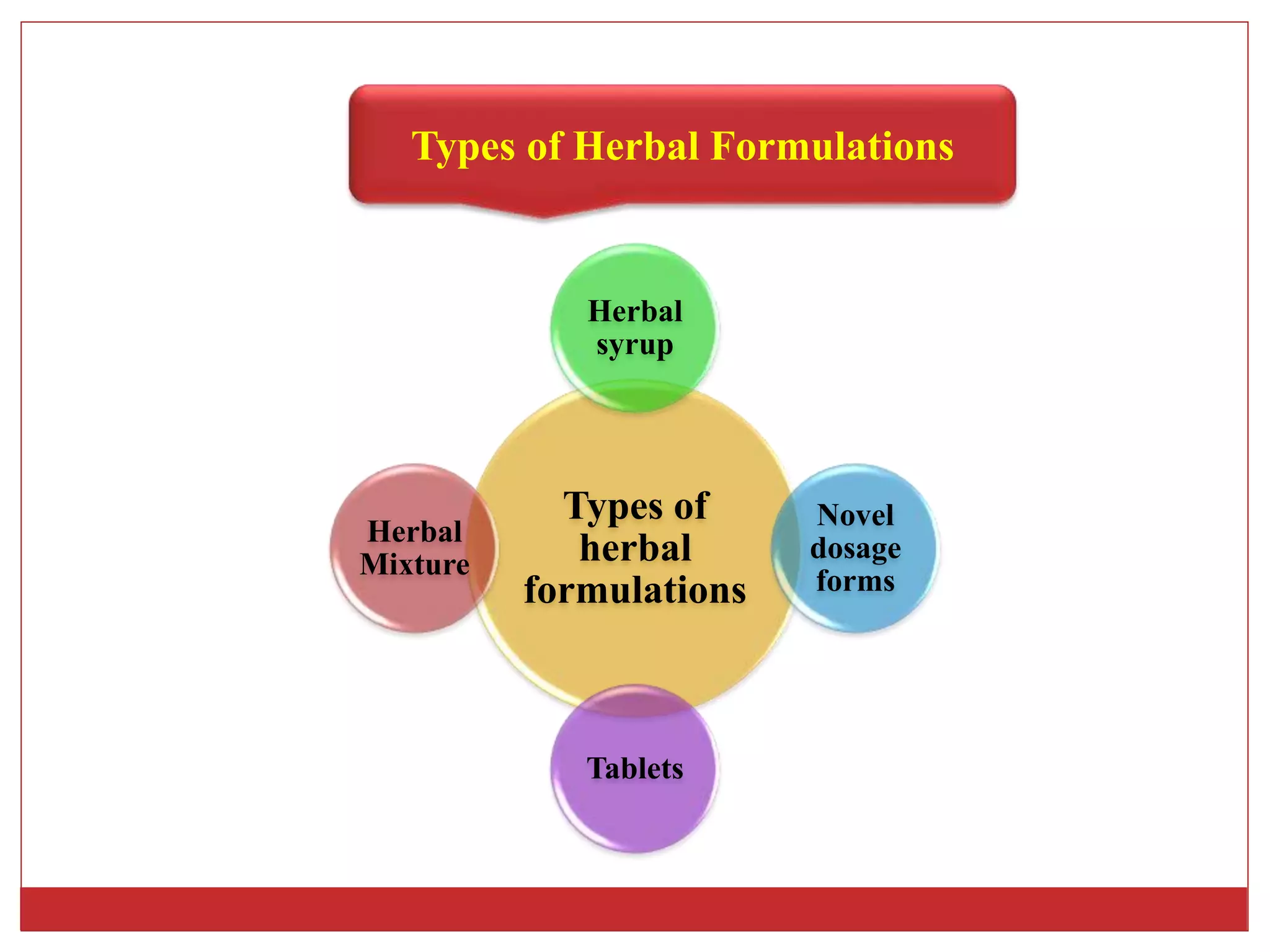
Types of Herbal Formulations
Types of
herbal
formulations
Herbal
syrup
Novel
dosage
forms
Tablets
Herbal
Mixture
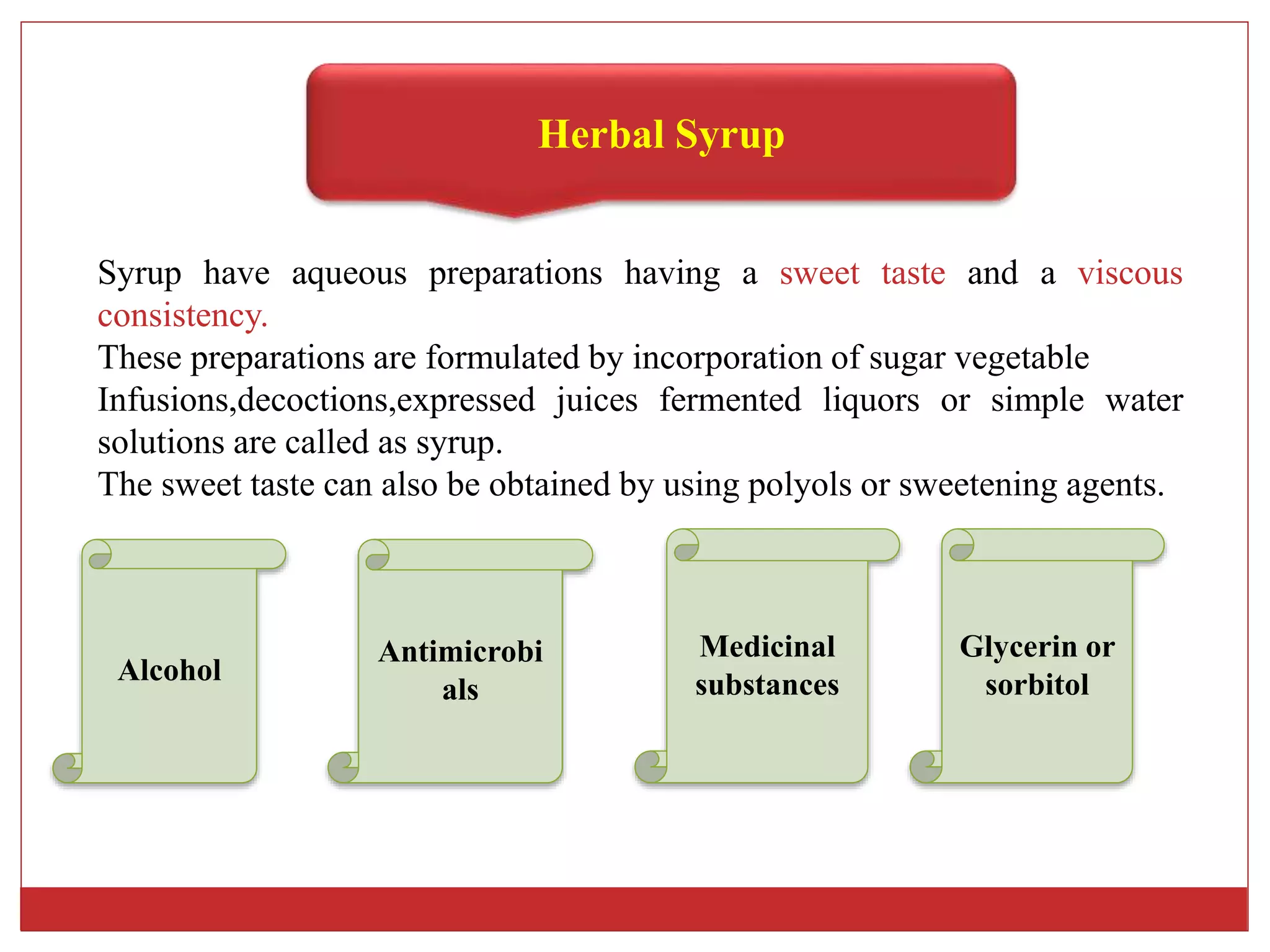
Herbal Syrup
Syrup have aqueous preparations having a sweet taste and a viscous
consistency.
These preparations are formulated by incorporation of sugar vegetable
Infusions,decoctions,expressed juices fermented liquors or simple water
solutions are called as syrup.
The sweet taste can also be obtained by using polyols or sweetening agents.
Alcohol
Glycerin or
sorbitol
Medicinal
substances
Antimicrobi
als
The syrup is made with equal proportion of the herbal infusion or decoction and
honey or unrefined sugar .
when making infusion or decoction for syrup ,it needs to be infused or simmered
for long time in order to optimize its medical action .
Infusion should be for 15 min and decoction for 30 min.
Then soaked herb was pressed through the strainer or sieve to remove as
much as liquid as possible .
A small amount of tincture can be added to increase effectiveness .
The syrup may also be made with tinctures instead of infusion or
decoctions.
500 gm of honey or unrefined sugar is combined with 250 ml 0f water .It
is Gently heated until all the sugar or honey has dissolved and the
mixture has thickened
Once cooled ,one part of the tincture, mixture of tincture is stirred into
three parts of the syrup and stored.
Advantages of Herbal syrup
Mask bad taste of
drugs
Soothing effect
on irritated
tissues due to
viscous nature
Used for
pediatric
formulations
Methods for the Preparation of syrup
Solution with heating
Agitation without
heating
Used when constituent is heat
stable and nonvolatile
The sucrose is added to the
purified water and heated until
solution is formed
Ten it is strained and sufficient
purified water is added to make
up the volume
Used in case of heat labile and
volatile constituents.
 Glass–lined tanks with mechanical
agitators , for dissolving sucrose are
used for making syrups in large
quantities.
Preservations and storage
1
• Syrups should be made in quantities that can be consumed within few
months in those cases where preservation is done at low temperature
2
• Syrups may contain preservatives like,glycerin,methyl paraben ,benzoic acid
and sodium benzoate
3
• Any simple syrup can be preserved be preserved by substituting glycerin for
a certain portion of syrup
4
• They can be stored in dark glass bottles with cork tops in a cool place for
upto 6 months
5
• They should be stored at temperature not exceeding 30 ° C
6
• Dosage -1-2 teaspoonful, Three times a day
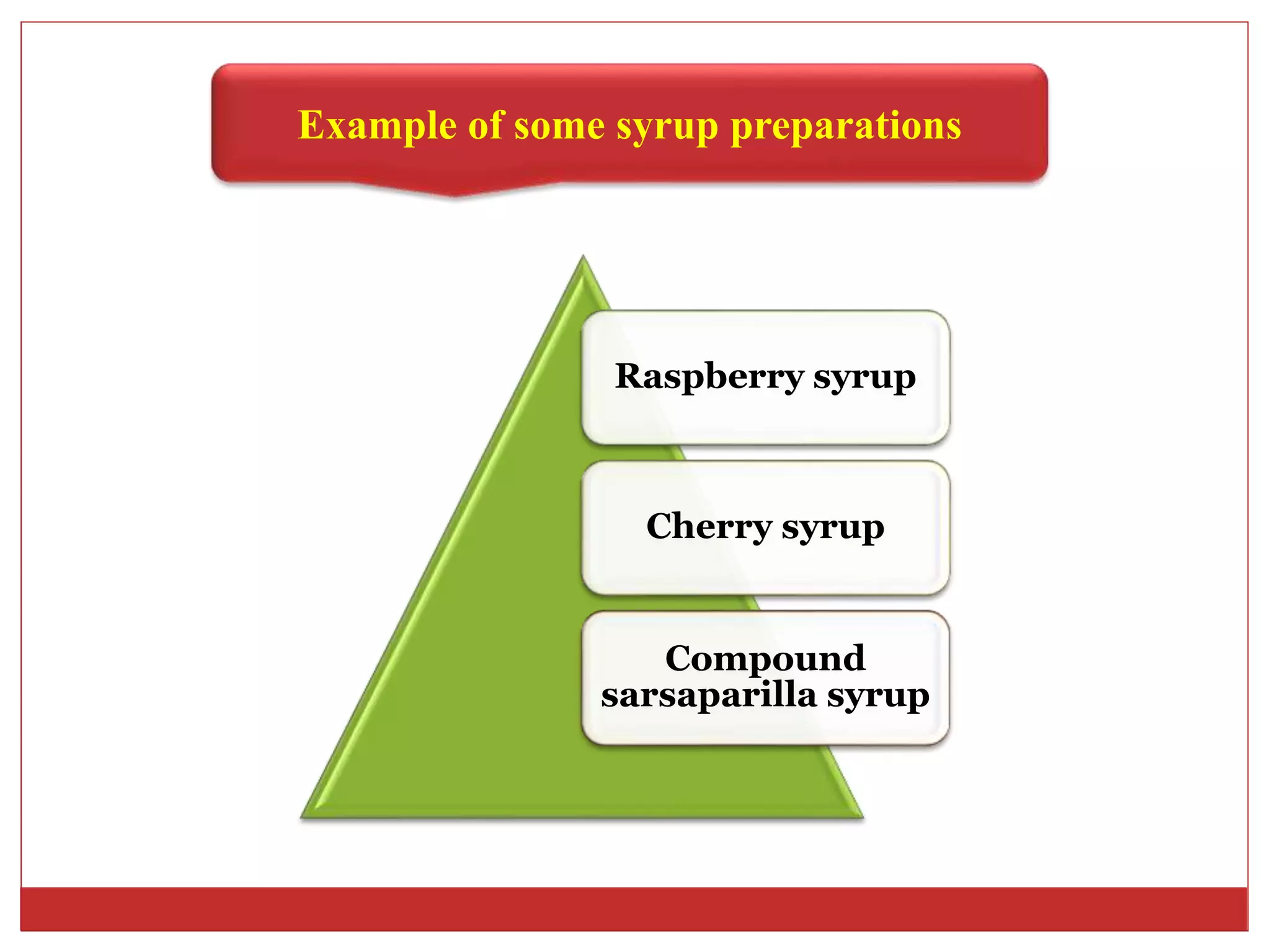
Example of some syrup preparations
Raspberry syrup
Cherry syrup
Compound
sarsaparilla syrup
1 • Evaluation of physical constant-1)Determination of PH 2) Total solid content
2
• Phytochemical screening
3 • Quantitative Estimation of phytoconstitunts like phenols,flavonoids,alkaloids
4
• Quantitative Estimation of Heavy metals
5
• Microbial Load Analysis
6
• HPTLC finger –printing of polyhebal syrup
7
• Accelerated stability testing of Polyherbal syrup
Evaluation of polyherbal syrup
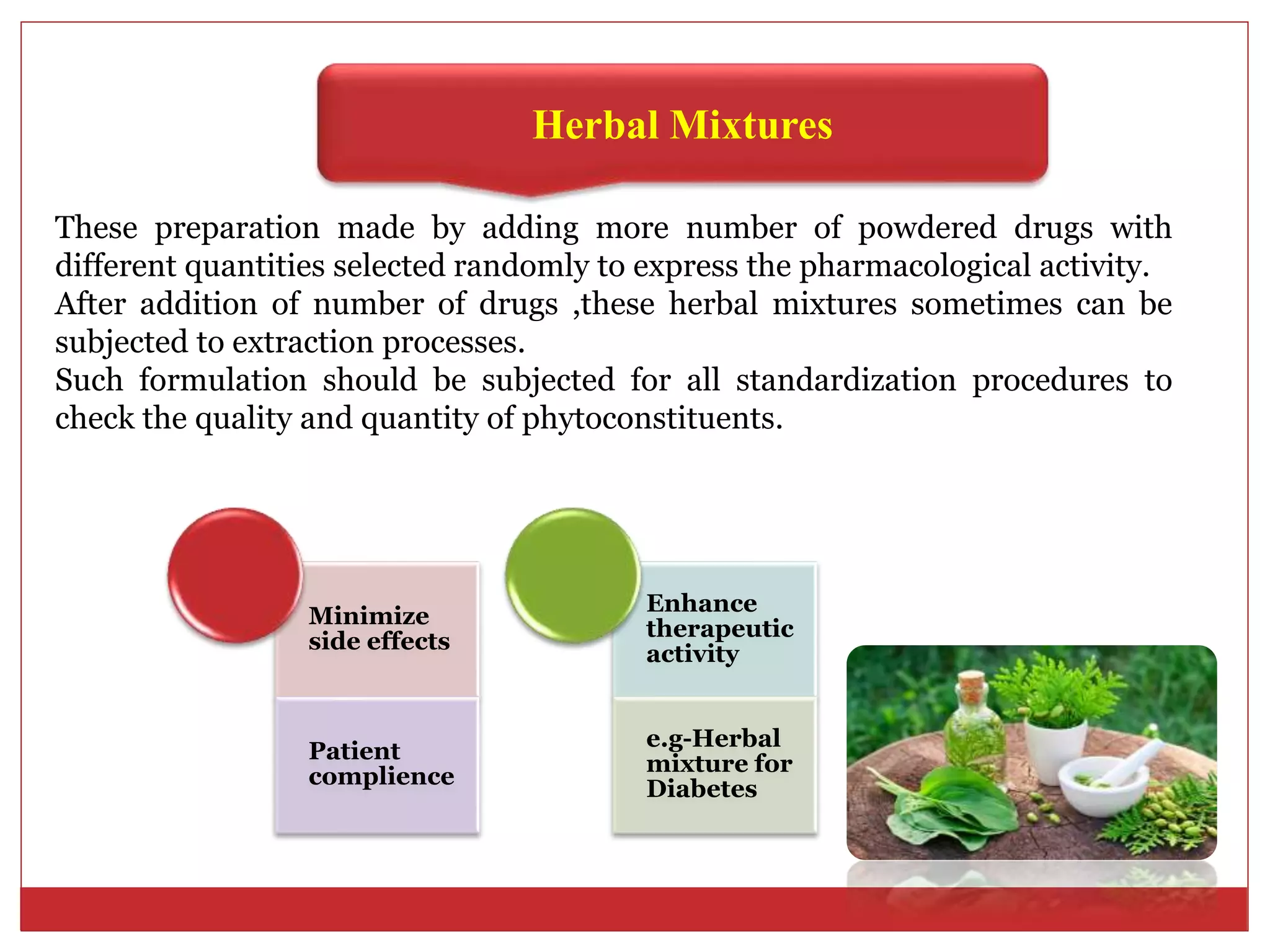
Herbal Mixtures
These preparation made by adding more number of powdered drugs with
different quantities selected randomly to express the pharmacological activity.
After addition of number of drugs ,these herbal mixtures sometimes can be
subjected to extraction processes.
Such formulation should be subjected for all standardization procedures to
check the quality and quantity of phytoconstituents.
Minimize
side effects
Patient
complience
Enhance
therapeutic
activity
e.g-Herbal
mixture for
Diabetes
Tablet
Tablets are the solid dosage form of powdered herbs , herbal extracts or their
constituents prepared by moulding or compression .
Certain additives are also to the medicaments in the formulation of tablets.
Tablets are usually circular in shape and may be flat or biconvex.
Method of preparation
Weighing the
ingredients
Mixing the
powdered
ingredients
and excipients
Convert into
granules
compressionCoatingEvaluation
Weighing of ingredients
If crude drugs are used they must first be ground into fine powder and
passed through a no.100 mesh sieve.
Mixing
All the medicaments and excipients are mixed uniformly so that uniform
tablets can be manufactured. The mixing of ingredients should be done
in an ascending order of their weight.
Converting the mixed
into granules
1) Wet granulation
2) Dry granulation
3) Granulation by preliminary compression
The dried granules obtained above are compressed into tablets by using a tablet
punching machine.
The compression is achieved by filling the required quantity of granules into die
and then compressing them between the lower punch and upper punch .
Coating of a tablet is required-
1) To mask the unpleasant taste and odour
2) To improve the appearance of the tablet
3) To protect the medicaments from atmospheric effects,
4) To control the site of action of drugs and to produce sustained release of the
product
Coating of tablet required to mask the unpleasant taste and odour,
 improve the appearance of the tablets
to protects the medicaments from the atmospheric effects,
to control the site of action of drugs and
produce sustained release of the products.
The coating is generally carried out either by using pan or press coating.
Pan coating is used for -
Sugar
coating
Enteric
coating
Film
coating
Novel Dosage forms
Now a days significant attention has bees concentrated on the development of
novel drug delivery system (NDDS) for herbal drugs.
Conventional dosage forms are not capable to satisfy the requirements of
holding the drug component at a distinct rate all through the period of holding the
drug component at a distinct rate all through the period of treatment and are not
target specific.
In phyto formulation research ,development of a nano-sized dosage forms has
number of advantages for herbal drugs, like –
1) Improvement of solubility and bioavailability
2) Increase stability
3) Improving distribution of drug in tissues
4) Sustained delivery
5) Protection from physical degradations
Phytosome
The word Phyto means plant and some means cell like .
Phytosomes are small cell like structure.
A phytosome is a complex made up of natural active ingredients or drug and a
phospholipid mostly lecithin.
Phytosome include herbal drug which is loaded in vesicles and is available in the
nano form.
The phytosome provide a coating around the active constituent of drug and due to
this main constituent of herbal extract remains safe from degradation by digestive
secretion and bacteria.
Phytosome is effectively absorbed from water loving environment of the cell
membrane and finally reaching to the blood circulation.
It can be used in the treatment of various fatal disease without denaturating the
active phyto compounds and also enhances bioavailability.
1
• Phytosome prepared by adding accurate amount of phospholipids i.e
soya lecithin with herbal extract in an aprotic solvent
2
• Soya lecithin contain phosphatidylcholine which is having a double
function
3
• Phosphatidyl part is lipophilic in nature and choline part is
hydrophilic in nature
4
• The choline part is attached with hydrophilic constituent ,where as
phosphatidyl part is attached with lipid soluble compound
5
• It is result in the formation of lipid complex with better stability and
bioavailability
Preparation of phytosome
Antisolvent
precipitation
technique
Rotatory
evaporation
technique
Solvent evaporation
technique
Methods of preparation of
phytosome
Properties of phytosmome
Physical
properties
Phytosome are complex
between
phytoconstituents and
natural phospholoipids
Interaction is due to
formation of hydrogen
bond
Phytosome shows a cell
like structure as a
liposome
Biological
properties
Enhances absorption
of active ingredients
Better efficacy
Better
pharmacokinetics
Advantages
In
predeter
mine rate
delivery
of drug
Deliver
the drug
at the site
of action
Minimize
the toxic
effects
Increases
bioavaila
bility
Small
dose
produces
desired
result
Better
stability
Determination of % Yield
Determination of particle size
Determination of entrapment
efficiency
Determination of drug content
Scanning electron microscopy
Evaluation of Phytosomes
Herbal formulations

Herbal formulations

  • 1.
    Herbal Formulations Prepared by:Shagufta Farooqui Assistant professor Nanded Pharmacy College, Nanded
  • 2.
    Introduction Herbal formulations isa dosage form consisting of one or more herbs or processed herbs in particular quantities to provide specific nutritional, cosmetic benefits and are meant to diagnose,treat,alleviate disease of human beings or animals ,alter the structure of human beings or animals. Herbal formulation contain a herbal substance or in combination with one or more herbal substances to process like extraction,distillation,fractionation, fermentation include powder. Polyherbal formulations means the use of more than one herb in a therapeutic preparation. In Ayurveda multiple herbs in a particular ratio may be used in the treatment of illness.
  • 3.
    Types of HerbalFormulations Types of herbal formulations Herbal syrup Novel dosage forms Tablets Herbal Mixture
  • 4.
    Herbal Syrup Syrup haveaqueous preparations having a sweet taste and a viscous consistency. These preparations are formulated by incorporation of sugar vegetable Infusions,decoctions,expressed juices fermented liquors or simple water solutions are called as syrup. The sweet taste can also be obtained by using polyols or sweetening agents. Alcohol Glycerin or sorbitol Medicinal substances Antimicrobi als
  • 5.
    The syrup ismade with equal proportion of the herbal infusion or decoction and honey or unrefined sugar . when making infusion or decoction for syrup ,it needs to be infused or simmered for long time in order to optimize its medical action . Infusion should be for 15 min and decoction for 30 min. Then soaked herb was pressed through the strainer or sieve to remove as much as liquid as possible . A small amount of tincture can be added to increase effectiveness . The syrup may also be made with tinctures instead of infusion or decoctions. 500 gm of honey or unrefined sugar is combined with 250 ml 0f water .It is Gently heated until all the sugar or honey has dissolved and the mixture has thickened Once cooled ,one part of the tincture, mixture of tincture is stirred into three parts of the syrup and stored.
  • 6.
    Advantages of Herbalsyrup Mask bad taste of drugs Soothing effect on irritated tissues due to viscous nature Used for pediatric formulations
  • 7.
    Methods for thePreparation of syrup Solution with heating Agitation without heating Used when constituent is heat stable and nonvolatile The sucrose is added to the purified water and heated until solution is formed Ten it is strained and sufficient purified water is added to make up the volume Used in case of heat labile and volatile constituents.  Glass–lined tanks with mechanical agitators , for dissolving sucrose are used for making syrups in large quantities.
  • 8.
    Preservations and storage 1 •Syrups should be made in quantities that can be consumed within few months in those cases where preservation is done at low temperature 2 • Syrups may contain preservatives like,glycerin,methyl paraben ,benzoic acid and sodium benzoate 3 • Any simple syrup can be preserved be preserved by substituting glycerin for a certain portion of syrup 4 • They can be stored in dark glass bottles with cork tops in a cool place for upto 6 months 5 • They should be stored at temperature not exceeding 30 ° C 6 • Dosage -1-2 teaspoonful, Three times a day
  • 9.
    Example of somesyrup preparations Raspberry syrup Cherry syrup Compound sarsaparilla syrup
  • 10.
    1 • Evaluationof physical constant-1)Determination of PH 2) Total solid content 2 • Phytochemical screening 3 • Quantitative Estimation of phytoconstitunts like phenols,flavonoids,alkaloids 4 • Quantitative Estimation of Heavy metals 5 • Microbial Load Analysis 6 • HPTLC finger –printing of polyhebal syrup 7 • Accelerated stability testing of Polyherbal syrup Evaluation of polyherbal syrup
  • 11.
    Herbal Mixtures These preparationmade by adding more number of powdered drugs with different quantities selected randomly to express the pharmacological activity. After addition of number of drugs ,these herbal mixtures sometimes can be subjected to extraction processes. Such formulation should be subjected for all standardization procedures to check the quality and quantity of phytoconstituents. Minimize side effects Patient complience Enhance therapeutic activity e.g-Herbal mixture for Diabetes
  • 12.
    Tablet Tablets are thesolid dosage form of powdered herbs , herbal extracts or their constituents prepared by moulding or compression . Certain additives are also to the medicaments in the formulation of tablets. Tablets are usually circular in shape and may be flat or biconvex.
  • 13.
    Method of preparation Weighingthe ingredients Mixing the powdered ingredients and excipients Convert into granules compressionCoatingEvaluation
  • 14.
    Weighing of ingredients Ifcrude drugs are used they must first be ground into fine powder and passed through a no.100 mesh sieve. Mixing All the medicaments and excipients are mixed uniformly so that uniform tablets can be manufactured. The mixing of ingredients should be done in an ascending order of their weight. Converting the mixed into granules 1) Wet granulation 2) Dry granulation 3) Granulation by preliminary compression
  • 15.
    The dried granulesobtained above are compressed into tablets by using a tablet punching machine. The compression is achieved by filling the required quantity of granules into die and then compressing them between the lower punch and upper punch . Coating of a tablet is required- 1) To mask the unpleasant taste and odour 2) To improve the appearance of the tablet 3) To protect the medicaments from atmospheric effects, 4) To control the site of action of drugs and to produce sustained release of the product
  • 16.
    Coating of tabletrequired to mask the unpleasant taste and odour,  improve the appearance of the tablets to protects the medicaments from the atmospheric effects, to control the site of action of drugs and produce sustained release of the products. The coating is generally carried out either by using pan or press coating. Pan coating is used for - Sugar coating Enteric coating Film coating
  • 17.
    Novel Dosage forms Nowa days significant attention has bees concentrated on the development of novel drug delivery system (NDDS) for herbal drugs. Conventional dosage forms are not capable to satisfy the requirements of holding the drug component at a distinct rate all through the period of holding the drug component at a distinct rate all through the period of treatment and are not target specific. In phyto formulation research ,development of a nano-sized dosage forms has number of advantages for herbal drugs, like – 1) Improvement of solubility and bioavailability 2) Increase stability 3) Improving distribution of drug in tissues 4) Sustained delivery 5) Protection from physical degradations
  • 18.
    Phytosome The word Phytomeans plant and some means cell like . Phytosomes are small cell like structure. A phytosome is a complex made up of natural active ingredients or drug and a phospholipid mostly lecithin. Phytosome include herbal drug which is loaded in vesicles and is available in the nano form. The phytosome provide a coating around the active constituent of drug and due to this main constituent of herbal extract remains safe from degradation by digestive secretion and bacteria. Phytosome is effectively absorbed from water loving environment of the cell membrane and finally reaching to the blood circulation. It can be used in the treatment of various fatal disease without denaturating the active phyto compounds and also enhances bioavailability.
  • 19.
    1 • Phytosome preparedby adding accurate amount of phospholipids i.e soya lecithin with herbal extract in an aprotic solvent 2 • Soya lecithin contain phosphatidylcholine which is having a double function 3 • Phosphatidyl part is lipophilic in nature and choline part is hydrophilic in nature 4 • The choline part is attached with hydrophilic constituent ,where as phosphatidyl part is attached with lipid soluble compound 5 • It is result in the formation of lipid complex with better stability and bioavailability Preparation of phytosome
  • 20.
  • 21.
    Properties of phytosmome Physical properties Phytosomeare complex between phytoconstituents and natural phospholoipids Interaction is due to formation of hydrogen bond Phytosome shows a cell like structure as a liposome Biological properties Enhances absorption of active ingredients Better efficacy Better pharmacokinetics
  • 22.
    Advantages In predeter mine rate delivery of drug Deliver thedrug at the site of action Minimize the toxic effects Increases bioavaila bility Small dose produces desired result Better stability
  • 23.
    Determination of %Yield Determination of particle size Determination of entrapment efficiency Determination of drug content Scanning electron microscopy Evaluation of Phytosomes