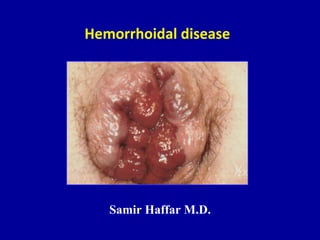
Hemorrhoidal disease
Samir Haffar M.D.
Definitions
• Hemorrhoids
Dillated vascular channel in 3 constant locations
Normal part of human anatomy
• Hemorroidal Disease
Manifeted by prolapse, bleeding, & itching
• Internal hemorrhoids
Originate above dentate line
Covered with transitional mucosa
• External hemorrhoids
Located close to the verge
Covered with transitional mucosa
Usual sites of internal hemorrhoids
Knee-chest position
Left lateral
Right posterior
Right anterior
Incidence of hemorrhoidal disease
• Exact incidence is not known
• 10 - 25 % of adult population thought to be
affected
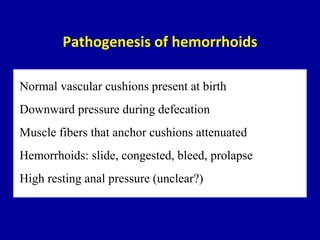
Pathogenesis of hemorrhoids
Normal vascular cushions present at birth
Downward pressure during defecation
Muscle fibers that anchor cushions attenuated
Hemorrhoids: slide, congested, bleed, prolapse
High resting anal pressure (unclear?)
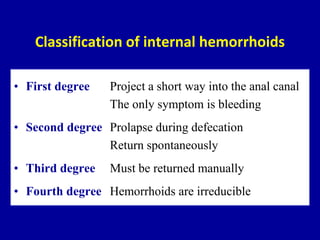
Classification of internal hemorrhoids
• First degree Project a short way into the anal canal
The only symptom is bleeding
• Second degree Prolapse during defecation
Return spontaneously
• Third degree Must be returned manually
• Fourth degree Hemorrhoids are irreducible
Symptoms of hemorrhoids
Intermittent symptoms
• Painless bleeding
Seen on toilet tissue
Dripping into toilet at end of defecation
Accumulate in rectum with dark blood or clots
• Prolapsed hemorrhoids
Blood & mucus stain patient’s underwear
Mucus against anal skin lead to itching
Third degree internal hemorrhoids
Forth degree internal hemorrhoids
Knee-chest position
Anal & rectal palpation
Normal anal canal
Internal hemorroids
Seen with the proctoscope
Localized hemorrhoidal prolapse
Prolapse of 3 mains hemorrhoidal piles
External hemorroids (skin tags)
Hypertrophic papillae
Protruding hypertrophied papilla
Treatment of internal hemorrhoids
Reduce downward pressure
Diet
Bulk agents
Veinotonic agents
Avoid prolonged sitting at stool
Fix cushions to sphincter
Sclerosing injections
Rubber band ligation
Cryotherapy
Photocoagulation: infrared - laser
Electrocoagulation: bipolar - heater probe
Excise hemorrhoids
Hemorrhoidectomy
Preferences for treatment of hemorrhoids
Degree or Grade Treatment
1 Sclerosing injections
Infrared coagulation
2 Infrared coagulation
Rubber band ligation
3 Rubber band ligation
4 Hemorrhoidectomy
Sclerosing injection
Instruments
Sclerosing injection
Sites of sclerosing injections
1 Superficial
2 Good (submucosa)
3 Deep (intramuscular)
Sclerosing injections
• Substances
1 ml is sufficient to create raise area
Phenol 5 % – Quinine Chlorhydrate & urea 5%
• Number of injections
2 injections per week
4 – 6 injections in total
• Results
Success in 75 % of first & second degree
Infrared photocoagulation
• Coagulation proximal to internal hemorrhoids
• Applied for 1.5 sec in 2 – 3 sites
• Success in 75 % of 1st & sd degree
• Rare complications
Rubber band ligation
Number of bands in one session
Disagreement
• 1 band by session
Many authorities believe that severity of pain & risk
of complictions are less
• 2 – 3 bands by session
Safe & effective at one setting
• 8 – 10 bands in one session
Retroflexed endoscopic multiple band ligation
Extensive ligations of internal hemorrhoids & normal rectal mucosa
immediately proximal to internal hemorrhoids
weeks after8 – 10 elastic bands
in one session
Before band ligation
Gastrointest Endosc 2004 ; 59 : 380 – 4 .
Rubber band ligation is probably the
most common fixation method in use
worldwide today
Rubber band ligation
Complications
Pain Moderate 5 - 85% – analgesic
Severe near dentate line – ablation
Bleeding Minimal 1 – 15 %
Severe: 0.5 - 2% – Transfusion – suture
Cellutitis Severe complication (50% mortality)
15 cases reported between 1980 – 1988
Anaerobic – Gram negative bacteria
Early symptoms: anorectal pain & urinary troubles
Early treatment ameliorate prognosis (antibiotics)
Dysuria & urine retention
External hemorroidal thrombosis
Thrombectomy
Instruments
Thrombectomy
Local anesthesia Incision
Enucleation
Edematous external hemorroidal thrombosis
Sebaceous cyst
Not painful After puncture
Thrombosed hemorrhoidal prolapse
Acute hemorrhoidal disease
Treatment of acute hemorrhoidal disease
Medical
Direct injection of 9 ml bupivacaine 0.25% + 1 ml hyaluronidase
Gentle massage followed by reduction of the mass
NSAIDs parenterally
Surgical
Emergency hemorrhoidectomy occasionally
Only about 10% of patients should
undergo operation
Thank You

Hemorrhoides