ACUTE
CHOLECYSTITIS
RUQ PAIN
AN OVRVIEWDr.B.Selvaraj MS;Mch;FICS;
“Surgical Educator”
Malaysia
ACUTE CHOLECYSTITIS
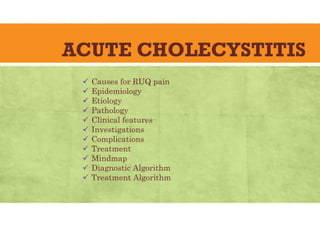
 Causes for RUQ pain
 Epidemiology
 Etiology
 Pathology
 Clinical features
 Investigations
 Complications
 Treatment
 Mindmap
 Diagnostic Algorithm
 Treatment Algorithm
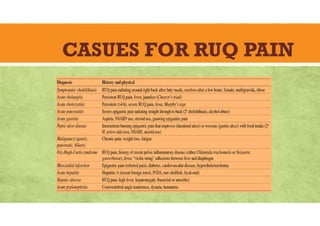
CASUES FOR RUQ PAIN
ACUTE CHOLECYSTITIS
-Epidemiology
 Cholecystitis is inflammation of the
gallbladder most commonly due to an
obstruction of the cystic duct by gallstones
arising from the gallbladder (cholelithiasis).
 Uncomplicated cholecystitis has an excellent
prognosis; the development of complications
such as perforation or gangrene renders a bad
prognosis.
 10%-20% of Americans have gallstones, and as
many as one third of these people develop
acute cholecystitis
 AGE: The incidence of cholecystitis increases
with age. Explanation for this is unclear.
 Sex distribution: Gallstones are 2-3 times
more frequent in females than in males,
resulting in a higher incidence of calculous
cholecystitis in females. Elevated progesterone
levels during pregnancy is the cause.
Acalculous cholecystitis is observed more often
in elderly men.
 Prevalence by race and ethinicity: More
common in people of Scandinavian descent,
Pima Indians, and Hispanic populations. In
the United States, white people have a higher
prevalence than black people.
ACUTE CHOLECYSTITIS
-ETIOLOGY
 Risk factors for Calculus Cholecystitis: 90%
- Female
- Fat- obese
- Fertile- Multigravida
- Forty- elderly
- Certain ethnic groups
- Certain drugs like HRT in females
 Risk factors for Acalculus Cholecystitis:
10%
- Critically ill patients
- Those who underwent major
surgery/trauma/Burns
- Severe Sepsis
- Prolonged fasting
- Long term TPN
- Sickle cell disease
- Immunocompromised patients- Diabetes & HIV
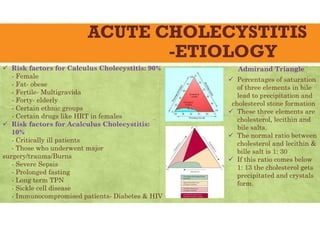
Admirand Triangle
 Percentages of saturation
of three elements in bile
lead to precipitation and
cholesterol stone formation
 These three elements are
cholesterol, lecithin and
bile salts.
 The normal ratio between
cholesterol and lecithin &
bille salt is 1: 30
 If this ratio comes below
1: 13 the cholesterol gets
precipitated and crystals
form.
ACUTE CHOLECYSTITIS
-PATHOLOGY
 90% of cases of cholecystitis involve
calculous cholecystitis, with the other
10% of cases representing acalculous
cholecystitis.
 Acute calculous cholecystitis is caused
by an obstruction of the cystic duct,
leading to distention of the gallbladder.
As the gallbladder becomes distended,
blood flow and lymphatic drainage are
compromised, leading to mucosal
ischemia and necrosis.
 Acalculous cholecystitis- exact
mechanism is unclear. Injury may be
the result of retained concentrated bile.
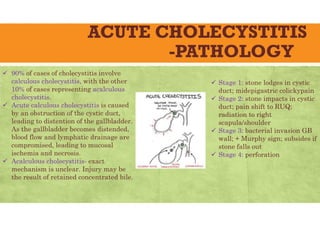
 Stage 1: stone lodges in cystic
duct; midepigastric colickypain
 Stage 2: stone impacts in cystic
duct; pain shift to RUQ;
radiation to right
scapula/shoulder
 Stage 3: bacterial invasion GB
wall; + Murphy sign; subsides if
stone falls out
 Stage 4: perforation
ACUTE CHOLECYSTITIS
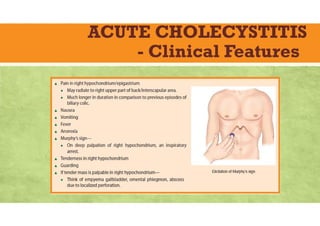
- Clinical Features
ACUTE CHOLECYSTITIS
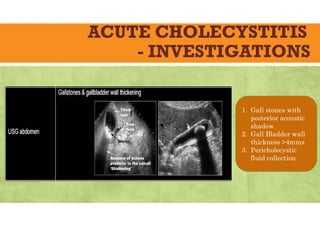
- INVESTIGATIONS
1. Gall stones with
posterior acoustic
shadow
2. Gall Bladder wall
thickness >4mms
3. Pericholecystic
fluid collection
ACUTE CHOLECYSTITIS
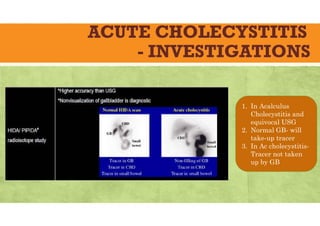
- INVESTIGATIONS
1. In Acalculus
Cholecystitis and
equivocal USG
2. Normal GB- will
take-up tracer
3. In Ac cholecystitis-
Tracer not taken
up by GB
ACUTE CHOLECYSTITIS
- INVESTIGATIONS
ACUTE CHOLECYSTITIS
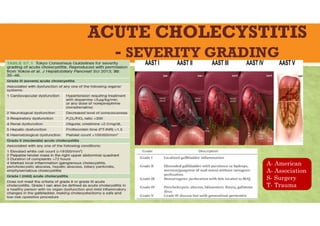
- SEVERITY GRADING
A- American
A- Association
S- Surgery
T- Trauma
ACUTE CHOLECYSTITIS
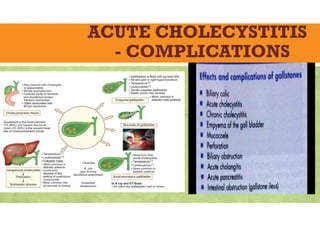
- COMPLICATIONS
ACUTE CHOLECYSTITIS
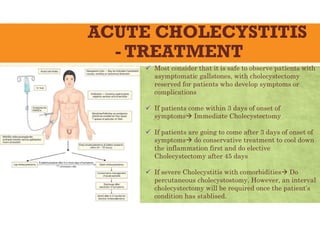
- TREATMENT
 Most consider that it is safe to observe patients with
asymptomatic gallstones, with cholecystectomy
reserved for patients who develop symptoms or
complications
 If patients come within 3 days of onset of
symptoms Immediate Cholecystectomy
 If patients are going to come after 3 days of onset of
symptoms do conservative treatment to cool down
the inflammation first and do elective
Cholecystectomy after 45 days
 If severe Cholecystitis with comorbidities Do
percutaneous cholecystostomy. However, an interval
cholecystectomy will be required once the patient’s
condition has stablised.
ACUTE CHOLECYSTITIS
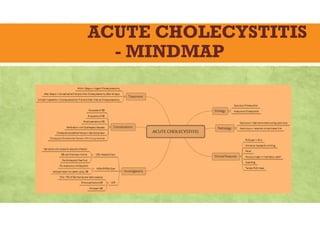
- MINDMAP
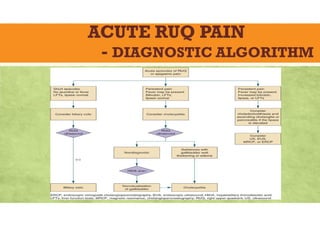
ACUTE RUQ PAIN
- DIAGNOSTIC ALGORITHM
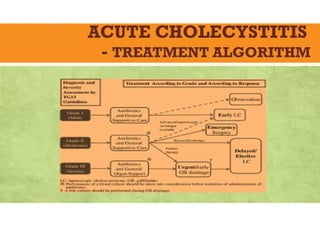
ACUTE CHOLECYSTITIS
- TREATMENT ALGORITHM
Peripheral Arterial Diseases(PAD)

Acute cholecystitis/ RUQ Pain

  • 1.
    ACUTE CHOLECYSTITIS RUQ PAIN AN OVRVIEWDr.B.SelvarajMS;Mch;FICS; “Surgical Educator” Malaysia
  • 2.
    ACUTE CHOLECYSTITIS  Causesfor RUQ pain  Epidemiology  Etiology  Pathology  Clinical features  Investigations  Complications  Treatment  Mindmap  Diagnostic Algorithm  Treatment Algorithm
  • 3.
  • 4.
    ACUTE CHOLECYSTITIS -Epidemiology  Cholecystitisis inflammation of the gallbladder most commonly due to an obstruction of the cystic duct by gallstones arising from the gallbladder (cholelithiasis).  Uncomplicated cholecystitis has an excellent prognosis; the development of complications such as perforation or gangrene renders a bad prognosis.  10%-20% of Americans have gallstones, and as many as one third of these people develop acute cholecystitis  AGE: The incidence of cholecystitis increases with age. Explanation for this is unclear.  Sex distribution: Gallstones are 2-3 times more frequent in females than in males, resulting in a higher incidence of calculous cholecystitis in females. Elevated progesterone levels during pregnancy is the cause. Acalculous cholecystitis is observed more often in elderly men.  Prevalence by race and ethinicity: More common in people of Scandinavian descent, Pima Indians, and Hispanic populations. In the United States, white people have a higher prevalence than black people.
  • 5.
    ACUTE CHOLECYSTITIS -ETIOLOGY  Riskfactors for Calculus Cholecystitis: 90% - Female - Fat- obese - Fertile- Multigravida - Forty- elderly - Certain ethnic groups - Certain drugs like HRT in females  Risk factors for Acalculus Cholecystitis: 10% - Critically ill patients - Those who underwent major surgery/trauma/Burns - Severe Sepsis - Prolonged fasting - Long term TPN - Sickle cell disease - Immunocompromised patients- Diabetes & HIV Admirand Triangle  Percentages of saturation of three elements in bile lead to precipitation and cholesterol stone formation  These three elements are cholesterol, lecithin and bile salts.  The normal ratio between cholesterol and lecithin & bille salt is 1: 30  If this ratio comes below 1: 13 the cholesterol gets precipitated and crystals form.
  • 6.
    ACUTE CHOLECYSTITIS -PATHOLOGY  90%of cases of cholecystitis involve calculous cholecystitis, with the other 10% of cases representing acalculous cholecystitis.  Acute calculous cholecystitis is caused by an obstruction of the cystic duct, leading to distention of the gallbladder. As the gallbladder becomes distended, blood flow and lymphatic drainage are compromised, leading to mucosal ischemia and necrosis.  Acalculous cholecystitis- exact mechanism is unclear. Injury may be the result of retained concentrated bile.  Stage 1: stone lodges in cystic duct; midepigastric colickypain  Stage 2: stone impacts in cystic duct; pain shift to RUQ; radiation to right scapula/shoulder  Stage 3: bacterial invasion GB wall; + Murphy sign; subsides if stone falls out  Stage 4: perforation
  • 7.
  • 8.
    ACUTE CHOLECYSTITIS - INVESTIGATIONS 1.Gall stones with posterior acoustic shadow 2. Gall Bladder wall thickness >4mms 3. Pericholecystic fluid collection
  • 9.
    ACUTE CHOLECYSTITIS - INVESTIGATIONS 1.In Acalculus Cholecystitis and equivocal USG 2. Normal GB- will take-up tracer 3. In Ac cholecystitis- Tracer not taken up by GB
  • 10.
  • 11.
    ACUTE CHOLECYSTITIS - SEVERITYGRADING A- American A- Association S- Surgery T- Trauma
  • 12.
  • 13.
    ACUTE CHOLECYSTITIS - TREATMENT Most consider that it is safe to observe patients with asymptomatic gallstones, with cholecystectomy reserved for patients who develop symptoms or complications  If patients come within 3 days of onset of symptoms Immediate Cholecystectomy  If patients are going to come after 3 days of onset of symptoms do conservative treatment to cool down the inflammation first and do elective Cholecystectomy after 45 days  If severe Cholecystitis with comorbidities Do percutaneous cholecystostomy. However, an interval cholecystectomy will be required once the patient’s condition has stablised.
  • 14.
  • 15.
    ACUTE RUQ PAIN -DIAGNOSTIC ALGORITHM
  • 16.
  • 17.