GI HEMORRHAGE
CLINICAL VIGNETTES-CASETRIGGERS
Dr. B. Selvaraj MS; Mch; FICS;
Professor of Surgery
Melaka Manipal Medical College
Melaka 75150 Malaysia
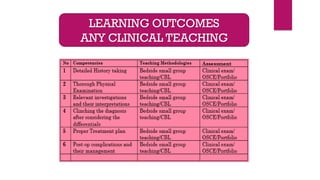
LEARNING OUTCOMES
ANY CLINICAL TEACHING
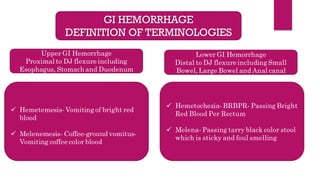
GI HEMORRHAGE
DEFINITION OF TERMINOLOGIES
✓ Hemetemesis- Vomiting of bright red
blood
✓ Melenemesis- Coffee-ground vomitus-
Vomiting coffee color blood
✓ Hemetochezia-BRBPR- Passing Bright
Red Blood Per Rectum
✓ Melena- Passing tarry black color stool
which is sticky and foul smelling
Upper GI Hemorrhage
Proximal to DJ flexure including
Esophagus, Stomach and Duodenum
Lower GI Hemorrhage
Distal to DJ flexure including Small
Bowel, Large Bowel and Anal canal
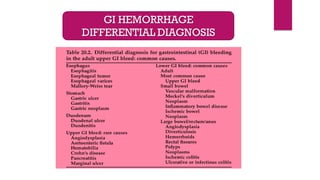
GI HEMORRHAGE
DIFFERENTIAL DIAGNOSIS
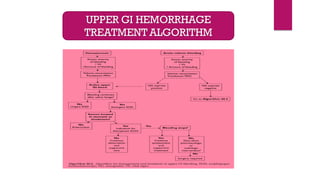
UPPER GI HEMORRHAGE
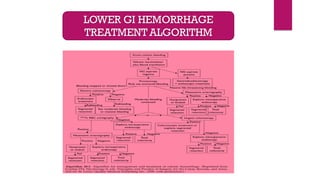
TREATMENT ALGORITHM
LOWER GI HEMORRHAGE
TREATMENT ALGORITHM
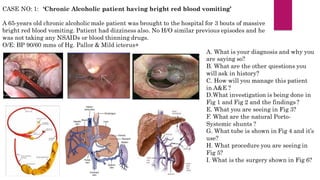
CASE NO: 1:
A 65-years old chronic alcoholic male patient was brought to the hospital for 3 bouts of massive
bright red blood vomiting. Patient had dizziness also. No H/O similar previous episodes and he
was not taking any NSAIDs or blood thinning drugs.
O/E: BP 90/60 mms of Hg. Pallor & Mild icterus+
A. What is your diagnosis and why you
are saying so?
B. What are the other questions you
will ask in history?
C. How will you manage this patient
in A&E ?
D.What investigation is being done in
Fig 1 and Fig 2 and the findings ?
E. What you are seeing in Fig 3?
F. What are the natural Porto-
Systemic shunts ?
G. What tube is shown in Fig 4 and it’s
use?
H. What procedure you are seeing in
Fig 5?
I. What is the surgery shown in Fig 6?
‘Chronic Alcoholic patient having bright red blood vomiting’
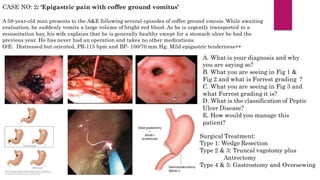
CASE NO: 2: ‘Epigastric pain with coffee ground vomitus’
A 58-year-old man presents to the A&E following several episodes of coffee ground emesis. While awaiting
evaluation, he suddenly vomits a large volume of bright red blood. As he is urgently transported to a
resuscitation bay, his wife explains that he is generally healthy except for a stomach ulcer he had the
previous year. He has never had an operation and takes no other medications.
O/E: Distressed but oriented, PR-115 bpm and BP- 100/70 mm Hg. Mild epigastric tenderness++
A. What is your diagnosis and why
you are saying so?
B. What you are seeing in Fig 1 &
Fig 2 and what is Forrest grading ?
C. What you are seeing in Fig 3 and
what Forrest grading it is?
D. What is the classification of Peptic
Ulcer Disease?
E. How would you manage this
patient?
Surgical Treatment:
Type 1: Wedge Resection
Type 2 & 3: Truncal vagotomy plus
Antrectomy
Type 4 & 5: Gastrostomy and Oversewing
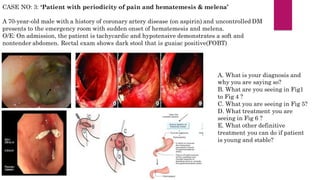
CASE NO: 3: ‘Patient with periodicity of pain and hematemesis & melena’
A 70-year-old male with a history of coronary artery disease (on aspirin) and uncontrolled DM
presents to the emergency room with sudden onset of hematemesis and melena.
O/E: On admission, the patient is tachycardic and hypotensive demonstrates a soft and
nontender abdomen. Rectal exam shows dark stool that is guaiac positive(FOBT)
A. What is your diagnosis and
why you are saying so?
B. What are you seeing in Fig1
to Fig 4 ?
C. What you are seeing in Fig 5?
D. What treatment you are
seeing in Fig 6 ?
E. What other definitive
treatment you can do if patient
is young and stable?
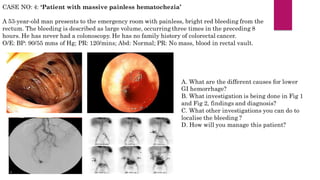
CASE NO: 4: ‘Patient with massive painless hematochezia’
A 53-year-old man presents to the emergency room with painless, bright red bleeding from the
rectum. The bleeding is described as large volume, occurring three times in the preceding 8
hours. He has never had a colonoscopy. He has no family history of colorectal cancer.
O/E: BP: 90/55 mms of Hg; PR: 120/mins; Abd: Normal; PR: No mass, blood in rectal vault.
A. What are the different causes for lower
GI hemorrhage?
B. What investigation is being done in Fig 1
and Fig 2, findings and diagnosis?
C. What other investigations you can do to
localise the bleeding ?
D. How will you manage this patient?
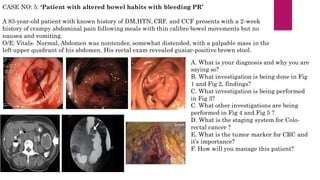
CASE NO: 5: ‘Patient with altered bowel habits with bleeding PR’
A 83-year-old patient with known history of DM,HTN, CRF, and CCF presents with a 2-week
history of crampy abdominal pain following meals with thin calibre bowel movements but no
nausea and vomiting.
O/E: Vitals- Normal, Abdomen was nontender, somewhat distended, with a palpable mass in the
left upper quadrant of his abdomen. His rectal exam revealed guaiac-positive brown stool.
A. What is your diagnosis and why you are
saying so?
B. What investigation is being done in Fig
1 and Fig 2, findings?
C. What investigation is being performed
in Fig 3?
C. What other investigations are being
performed in Fig 4 and Fig 5 ?
D. What is the staging system for Colo-
rectal cancer ?
E. What is the tumor marker for CRC and
it’s importance?
F. How will you manage this patient?
THANK YOU
To know the answers watch the video in
youtube.com/c/surgicaleducator

Gi hemorrhage/ problem oriented case based teaching- my online class

  • 1.
    GI HEMORRHAGE CLINICAL VIGNETTES-CASETRIGGERS Dr.B. Selvaraj MS; Mch; FICS; Professor of Surgery Melaka Manipal Medical College Melaka 75150 Malaysia
  • 2.
  • 3.
    GI HEMORRHAGE DEFINITION OFTERMINOLOGIES ✓ Hemetemesis- Vomiting of bright red blood ✓ Melenemesis- Coffee-ground vomitus- Vomiting coffee color blood ✓ Hemetochezia-BRBPR- Passing Bright Red Blood Per Rectum ✓ Melena- Passing tarry black color stool which is sticky and foul smelling Upper GI Hemorrhage Proximal to DJ flexure including Esophagus, Stomach and Duodenum Lower GI Hemorrhage Distal to DJ flexure including Small Bowel, Large Bowel and Anal canal
  • 4.
  • 5.
  • 6.
  • 7.
    CASE NO: 1: A65-years old chronic alcoholic male patient was brought to the hospital for 3 bouts of massive bright red blood vomiting. Patient had dizziness also. No H/O similar previous episodes and he was not taking any NSAIDs or blood thinning drugs. O/E: BP 90/60 mms of Hg. Pallor & Mild icterus+ A. What is your diagnosis and why you are saying so? B. What are the other questions you will ask in history? C. How will you manage this patient in A&E ? D.What investigation is being done in Fig 1 and Fig 2 and the findings ? E. What you are seeing in Fig 3? F. What are the natural Porto- Systemic shunts ? G. What tube is shown in Fig 4 and it’s use? H. What procedure you are seeing in Fig 5? I. What is the surgery shown in Fig 6? ‘Chronic Alcoholic patient having bright red blood vomiting’
  • 8.
    CASE NO: 2:‘Epigastric pain with coffee ground vomitus’ A 58-year-old man presents to the A&E following several episodes of coffee ground emesis. While awaiting evaluation, he suddenly vomits a large volume of bright red blood. As he is urgently transported to a resuscitation bay, his wife explains that he is generally healthy except for a stomach ulcer he had the previous year. He has never had an operation and takes no other medications. O/E: Distressed but oriented, PR-115 bpm and BP- 100/70 mm Hg. Mild epigastric tenderness++ A. What is your diagnosis and why you are saying so? B. What you are seeing in Fig 1 & Fig 2 and what is Forrest grading ? C. What you are seeing in Fig 3 and what Forrest grading it is? D. What is the classification of Peptic Ulcer Disease? E. How would you manage this patient? Surgical Treatment: Type 1: Wedge Resection Type 2 & 3: Truncal vagotomy plus Antrectomy Type 4 & 5: Gastrostomy and Oversewing
  • 9.
    CASE NO: 3:‘Patient with periodicity of pain and hematemesis & melena’ A 70-year-old male with a history of coronary artery disease (on aspirin) and uncontrolled DM presents to the emergency room with sudden onset of hematemesis and melena. O/E: On admission, the patient is tachycardic and hypotensive demonstrates a soft and nontender abdomen. Rectal exam shows dark stool that is guaiac positive(FOBT) A. What is your diagnosis and why you are saying so? B. What are you seeing in Fig1 to Fig 4 ? C. What you are seeing in Fig 5? D. What treatment you are seeing in Fig 6 ? E. What other definitive treatment you can do if patient is young and stable?
  • 10.
    CASE NO: 4:‘Patient with massive painless hematochezia’ A 53-year-old man presents to the emergency room with painless, bright red bleeding from the rectum. The bleeding is described as large volume, occurring three times in the preceding 8 hours. He has never had a colonoscopy. He has no family history of colorectal cancer. O/E: BP: 90/55 mms of Hg; PR: 120/mins; Abd: Normal; PR: No mass, blood in rectal vault. A. What are the different causes for lower GI hemorrhage? B. What investigation is being done in Fig 1 and Fig 2, findings and diagnosis? C. What other investigations you can do to localise the bleeding ? D. How will you manage this patient?
  • 11.
    CASE NO: 5:‘Patient with altered bowel habits with bleeding PR’ A 83-year-old patient with known history of DM,HTN, CRF, and CCF presents with a 2-week history of crampy abdominal pain following meals with thin calibre bowel movements but no nausea and vomiting. O/E: Vitals- Normal, Abdomen was nontender, somewhat distended, with a palpable mass in the left upper quadrant of his abdomen. His rectal exam revealed guaiac-positive brown stool. A. What is your diagnosis and why you are saying so? B. What investigation is being done in Fig 1 and Fig 2, findings? C. What investigation is being performed in Fig 3? C. What other investigations are being performed in Fig 4 and Fig 5 ? D. What is the staging system for Colo- rectal cancer ? E. What is the tumor marker for CRC and it’s importance? F. How will you manage this patient?
  • 12.
    THANK YOU To knowthe answers watch the video in youtube.com/c/surgicaleducator