SURGERY
HEMORRHOIDS
DR. CHONGO SHAPI (BSc. HB, MBChB)
HEMORRHOIDS
Definition
-Are vascular and connective tissue cushions in anal
mucosa.
-Hemorrhoids function as protective pillows that engorge
with blood during the act of defecation, protecting the anal
canal from direct trauma due to passage of stool.
-Hemorrhoidal tissues engorge when intra-abdominal
pressure is increased.
This occurs with obesity, pregnancy, lifting, and
defecation.
Classification
Internal hemorrhoids
-Are found superior to the dentate line and lined with
columnar epithelium.
-They have autonomic innervation and thus not painful.
-They are further classified as:
1st degree, Do not prolapse only bleeding announces their
presence
2nd degree -Spontaneously reducing prolapse at defecation
3rd
degree, prolapse requiring manual replacement;
4th
degree, permanent prolapse.
External hemorrhoids
-Are found below the dentate line and lined by squamous
epithelium .
-Are innervated by cutaneous nerves that supply the
perianal area. These nerves include the pudendal nerve and
sacral plexus. Thus are very painful.
Etiology-not clearly known but risk factors
1. Pregnancy
2. Colon malignancy
3. Liver disease-Portal hypertension
4. Constipation
5. low-fiber diets cause small-caliber stools, which
result in straining with defecation
6. Occupations that require prolonged sitting
7. Loss of muscle tone in old age
8. rectal surgery, episiotomy, anal intercourse
9. Obesity
Pathopysiology
-Hemorrhoids generally cause symptoms when they
become enlarged, inflamed, thrombosed, or prolapsed
-Abnormal hemorrhoidal tissue development is related to
chronic straining that leads to engorgement, vascular
dilatation due to decreased venous return.
-This leads to stretching of the supporting connective
tissue. The most common cause of prolonged straining is
the act of defecation.
-Aging causes weakening of the support structures, which
facilitates prolapse. Weakening of support structures can
occur as early as the third decade of life.
SIGNS AND SYMPTOMS:
1. Constipation
2. Straining with defecation
3. Episodic bleeding on stool
4. Feeling of incomplete evacuation
5. Pruritus
6. Severe acute pain may be due to thrombosis of
the veins but hemmorhoids are classically
painless.
7. Ulceration
DIAGNOSTIC PROCEDURES:
· Ano-rectal examination including anoscopy
· Sigmoidoscopy
· Inspection following straining at stool
Differential diagnosis
1.carcinoma of the colon and rectum, diverticular disease,
2.adenomatous polyps
3.ulcerative colitis
4.Rectal prolapse (procidentia
MANAGEMENT
-This is only done when the hemorrhoids become
symptomatic.
-The goal of treatment is not to obliterate hemorrhoidal
plexuses but rather to render the patient asymptomatic.
A.Medical Treatment:
Most patients with early hemorrhoids (first- and second-
degree) can be managed by simple local measures and
dietary advice.
Decreasing straining and constipation shrinks internal
hemorrhoids and decreases their symptoms; therefore,
first-line treatment for all first- and second-degree (and
many third- and fourth-degree) internal hemorrhoids
should include measures to decrease straining and
constipation.
1. Avoid constipation-The diet should be high in fiber
(vegetables, fruits), and increased water intake must be
stressed. Unrefined bran can be used to augment dietary
bulk.
2.Avoid straining-no prolonged stay in the toilet seat
2.Stool softeners may be used-lactulose
3. Rectal suppositories and astringents-local
anaesthetics+steroids sometimes antibiotics
Topical hydrocortisone can sometimes ease internal
hemorrhoidal bleeding.
4. Warm sitz baths may also offer symptomatic relief.
Done 3times a day for 30 minutes each time on just warm
water-tasted first
5.Sclerotherapy-Injection treatment, a form of
sclerotherapy, consists of injecting an irritating chemical
solution (eg, 5% phenol in vegetable oil) submucosally
into the loose areolar tissue above the internal hemorrhoid
6.Cryosurgery: Hemorrhoids can be necrosed by freezing
with a cryoprobe, using CO2 or N2O.
7. Strangulation -Rubber Band Ligation: For enlarged
or prolapsing hemorrhoids, band ligation is excellent
treatment. With the aid of an anoscope, the redundant
mucosa above the hemorrhoid is grasped with forceps and
advanced through the barrel of a special ligator. Ischemic
necrosis occurs over several days, with eventual slough,
fibrosis, and fixation of the tissues. major complication of
this technique is pain severe enough to require removal of
the band
Others
- Infrared photocoagulation
-Laser ablation
-Lord dilatation
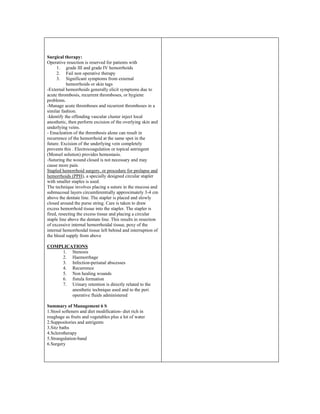
Surgical therapy:
Operative resection is reserved for patients with
1. grade III and grade IV hemorrhoids
2. Fail non operative therapy
3. Significant symptoms from external
hemorrhoids or skin tags
-External hemorrhoids generally elicit symptoms due to
acute thrombosis, recurrent thromboses, or hygiene
problems.
-Manage acute thromboses and recurrent thromboses in a
similar fashion.
-Identify the offending vascular cluster inject local
anesthetic, then perform excision of the overlying skin and
underlying veins.
- Enucleation of the thrombosis alone can result in
recurrence of the hemorrhoid at the same spot in the
future. Excision of the underlying vein completely
prevents this . Electrocoagulation or topical astringent
(Monsel solution) provides hemostasis.
-Suturing the wound closed is not necessary and may
cause more pain.
Stapled hemorrhoid surgery, or procedure for prolapse and
hemorrhoids (PPH), a specially designed circular stapler
with smaller staples is used.
The technique involves placing a suture in the mucosa and
submucosal layers circumferentially approximately 3-4 cm
above the dentate line. The stapler is placed and slowly
closed around the purse string. Care is taken to draw
excess hemorrhoid tissue into the stapler. The stapler is
fired, resecting the excess tissue and placing a circular
staple line above the dentate line. This results in resection
of excessive internal hemorrhoidal tissue, pexy of the
internal hemorrhoidal tissue left behind and interruption of
the blood supply from above
COMPLICATIONS
1. Stenosis
2. Haemorrhage
3. Infection-perianal abscesses
4. Recurrence
5. Non healing wounds
6. fistula formation
7. Urinary retention is directly related to the
anesthetic technique used and to the peri
operative fluids administered
Summary of Management 6 S
1.Stool softeners and diet modification- diet rich in
roughage as fruits and vegetables plus a lot of water
2.Suppositories and astrigents
3.Sitz baths
4.Sclerotherapy
5.Strangulation-band
6.Surgery

HEMORRHOIDS.pdf

  • 1.
  • 2.
    HEMORRHOIDS Definition -Are vascular andconnective tissue cushions in anal mucosa. -Hemorrhoids function as protective pillows that engorge with blood during the act of defecation, protecting the anal canal from direct trauma due to passage of stool. -Hemorrhoidal tissues engorge when intra-abdominal pressure is increased. This occurs with obesity, pregnancy, lifting, and defecation. Classification Internal hemorrhoids -Are found superior to the dentate line and lined with columnar epithelium. -They have autonomic innervation and thus not painful. -They are further classified as: 1st degree, Do not prolapse only bleeding announces their presence 2nd degree -Spontaneously reducing prolapse at defecation 3rd degree, prolapse requiring manual replacement; 4th degree, permanent prolapse. External hemorrhoids -Are found below the dentate line and lined by squamous epithelium . -Are innervated by cutaneous nerves that supply the perianal area. These nerves include the pudendal nerve and sacral plexus. Thus are very painful. Etiology-not clearly known but risk factors 1. Pregnancy 2. Colon malignancy 3. Liver disease-Portal hypertension 4. Constipation 5. low-fiber diets cause small-caliber stools, which result in straining with defecation 6. Occupations that require prolonged sitting 7. Loss of muscle tone in old age 8. rectal surgery, episiotomy, anal intercourse 9. Obesity Pathopysiology -Hemorrhoids generally cause symptoms when they become enlarged, inflamed, thrombosed, or prolapsed -Abnormal hemorrhoidal tissue development is related to chronic straining that leads to engorgement, vascular dilatation due to decreased venous return. -This leads to stretching of the supporting connective tissue. The most common cause of prolonged straining is the act of defecation. -Aging causes weakening of the support structures, which facilitates prolapse. Weakening of support structures can occur as early as the third decade of life. SIGNS AND SYMPTOMS: 1. Constipation 2. Straining with defecation 3. Episodic bleeding on stool 4. Feeling of incomplete evacuation 5. Pruritus 6. Severe acute pain may be due to thrombosis of the veins but hemmorhoids are classically painless. 7. Ulceration DIAGNOSTIC PROCEDURES: · Ano-rectal examination including anoscopy · Sigmoidoscopy · Inspection following straining at stool Differential diagnosis 1.carcinoma of the colon and rectum, diverticular disease, 2.adenomatous polyps 3.ulcerative colitis 4.Rectal prolapse (procidentia MANAGEMENT -This is only done when the hemorrhoids become symptomatic. -The goal of treatment is not to obliterate hemorrhoidal plexuses but rather to render the patient asymptomatic. A.Medical Treatment: Most patients with early hemorrhoids (first- and second- degree) can be managed by simple local measures and dietary advice. Decreasing straining and constipation shrinks internal hemorrhoids and decreases their symptoms; therefore, first-line treatment for all first- and second-degree (and many third- and fourth-degree) internal hemorrhoids should include measures to decrease straining and constipation. 1. Avoid constipation-The diet should be high in fiber (vegetables, fruits), and increased water intake must be stressed. Unrefined bran can be used to augment dietary bulk. 2.Avoid straining-no prolonged stay in the toilet seat 2.Stool softeners may be used-lactulose 3. Rectal suppositories and astringents-local anaesthetics+steroids sometimes antibiotics Topical hydrocortisone can sometimes ease internal hemorrhoidal bleeding. 4. Warm sitz baths may also offer symptomatic relief. Done 3times a day for 30 minutes each time on just warm water-tasted first 5.Sclerotherapy-Injection treatment, a form of sclerotherapy, consists of injecting an irritating chemical solution (eg, 5% phenol in vegetable oil) submucosally into the loose areolar tissue above the internal hemorrhoid 6.Cryosurgery: Hemorrhoids can be necrosed by freezing with a cryoprobe, using CO2 or N2O. 7. Strangulation -Rubber Band Ligation: For enlarged or prolapsing hemorrhoids, band ligation is excellent treatment. With the aid of an anoscope, the redundant mucosa above the hemorrhoid is grasped with forceps and advanced through the barrel of a special ligator. Ischemic necrosis occurs over several days, with eventual slough, fibrosis, and fixation of the tissues. major complication of this technique is pain severe enough to require removal of the band Others - Infrared photocoagulation -Laser ablation -Lord dilatation
  • 3.
    Surgical therapy: Operative resectionis reserved for patients with 1. grade III and grade IV hemorrhoids 2. Fail non operative therapy 3. Significant symptoms from external hemorrhoids or skin tags -External hemorrhoids generally elicit symptoms due to acute thrombosis, recurrent thromboses, or hygiene problems. -Manage acute thromboses and recurrent thromboses in a similar fashion. -Identify the offending vascular cluster inject local anesthetic, then perform excision of the overlying skin and underlying veins. - Enucleation of the thrombosis alone can result in recurrence of the hemorrhoid at the same spot in the future. Excision of the underlying vein completely prevents this . Electrocoagulation or topical astringent (Monsel solution) provides hemostasis. -Suturing the wound closed is not necessary and may cause more pain. Stapled hemorrhoid surgery, or procedure for prolapse and hemorrhoids (PPH), a specially designed circular stapler with smaller staples is used. The technique involves placing a suture in the mucosa and submucosal layers circumferentially approximately 3-4 cm above the dentate line. The stapler is placed and slowly closed around the purse string. Care is taken to draw excess hemorrhoid tissue into the stapler. The stapler is fired, resecting the excess tissue and placing a circular staple line above the dentate line. This results in resection of excessive internal hemorrhoidal tissue, pexy of the internal hemorrhoidal tissue left behind and interruption of the blood supply from above COMPLICATIONS 1. Stenosis 2. Haemorrhage 3. Infection-perianal abscesses 4. Recurrence 5. Non healing wounds 6. fistula formation 7. Urinary retention is directly related to the anesthetic technique used and to the peri operative fluids administered Summary of Management 6 S 1.Stool softeners and diet modification- diet rich in roughage as fruits and vegetables plus a lot of water 2.Suppositories and astrigents 3.Sitz baths 4.Sclerotherapy 5.Strangulation-band 6.Surgery