Microcirculation
Prof. Dr. Rashid Mahmood
Microcirculation | © Prof. Dr. Rashid Mahmood 2
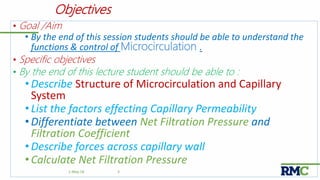
Objectives
• Goal /Aim
• By the end of this session students should be able to understand the
functions & control of Microcirculation .
• Specific objectives
• By the end of this lecture student should be able to :
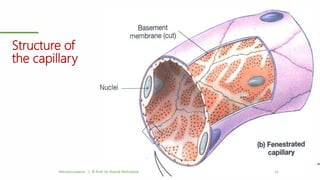
•Describe Structure of Microcirculation and Capillary
System
•List the factors effecting Capillary Permeability
•Differentiate between Net Filtration Pressure and
Filtration Coefficient
•Describe forces across capillary wall
•Calculate Net Filtration Pressure
31-May-18
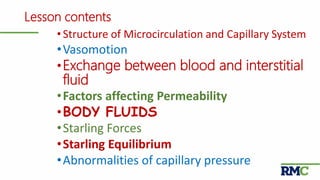
Lesson contents
• Structure of Microcirculation and Capillary System
•Vasomotion
•Exchange between blood and interstitial
fluid
•Factors affecting Permeability
•BODY FLUIDS
•Starling Forces
•Starling Equilibrium
•Abnormalities of capillary pressure
Lesson contents
•Structure of Microcirculation and Capillary
System
•Vasomotion
•Exchange between blood and interstitial
fluid
•Factors affecting Permeability
•BODY FLUIDS
•Starling Forces
•Starling Equilibrium
Vascular
distensibility &
Functions of
Arterial and
Venous System |
51-May-18
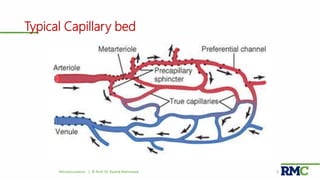
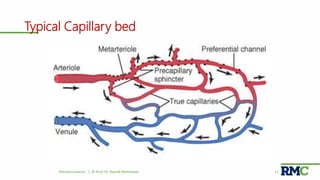
Typical Capillary bed
Microcirculation | © Prof. Dr. Rashid Mahmood 6
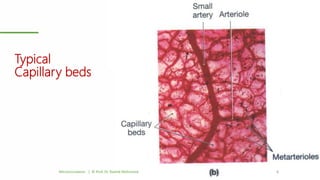
Typical
Capillary beds
Microcirculation | © Prof. Dr. Rashid Mahmood 7
Typical
Capillary beds
Microcirculation | © Prof. Dr. Rashid Mahmood 8
9
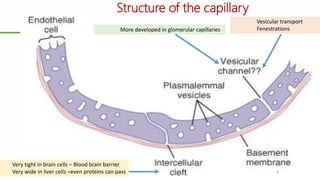
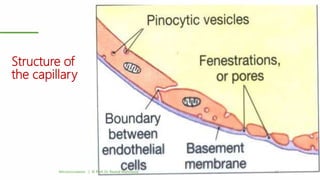
Structure of the capillary
Very tight in brain cells – Blood brain barrier
Very wide in liver cells –even proteins can pass
More developed in glomerular capillaries
Vesicular transport
Fenestrations
Structure of
the capillary
Microcirculation | © Prof. Dr. Rashid Mahmood 10
Structure of
the capillary
Microcirculation | © Prof. Dr. Rashid Mahmood 11
Typical Capillary bed
Microcirculation | © Prof. Dr. Rashid Mahmood 12
Lesson contents
• Structure of Microcirculation and Capillary System
•Vasomotion
•Exchange between blood and interstitial
fluid
•Factors affecting Permeability
•BODY FLUIDS
•Starling Forces
•Starling Equilibrium
•Abnormalities of capillary pressure
Vascular
distensibility &
Functions of
Arterial and
Venous System |
131-May-18
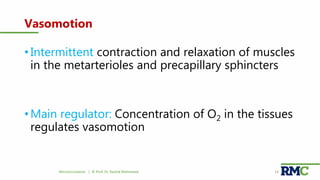
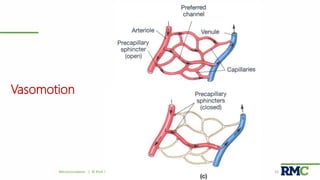
• Intermittent contraction and relaxation of muscles
in the metarterioles and precapillary sphincters
• Main regulator: Concentration of O2 in the tissues
regulates vasomotion
Vasomotion
Microcirculation | © Prof. Dr. Rashid Mahmood 14
Vasomotion
Microcirculation | © Prof. Dr. Rashid Mahmood 15
Lesson contents
• Structure of Microcirculation and Capillary System
•Vasomotion
•Exchange between blood and
interstitial fluid
•Factors affecting Permeability
•BODY FLUIDS
•Starling Forces
•Starling Equilibrium
•Abnormalities of capillary pressure
Vascular
distensibility &
Functions of
Arterial and
Venous System |
161-May-18
Lesson contents
• Structure of Microcirculation and Capillary System
•Vasomotion
•Exchange between blood and interstitial
fluid
•Factors affecting Permeability
•BODY FLUIDS
•Starling Forces
•Starling Equilibrium
•Abnormalities of capillary pressure
Vascular
distensibility &
Functions of
Arterial and
Venous System |
171-May-18
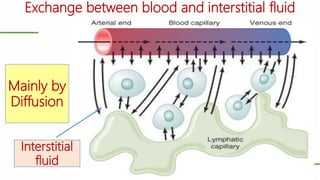
Exchange between blood and interstitial fluid
Microcirculation | © Prof. Dr. Rashid Mahmood 18
Mainly by
Diffusion
Interstitial
fluid
Microcirculation | © Prof. Dr. Rashid Mahmood 19
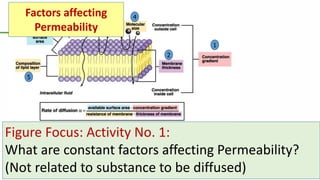
1
2
3
4
5
6
Figure Focus: Activity No. 1:
What are constant factors affecting Permeability?
(Not related to substance to be diffused)
Factors affecting
Permeability
Microcirculation | © Prof. Dr. Rashid Mahmood 20
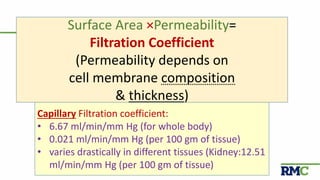
Surface Area ×Permeability=
Filtration Coefficient
(Permeability depends on
cell membrane composition
& thickness)
Capillary Filtration coefficient:
• 6.67 ml/min/mm Hg (for whole body)
• 0.021 ml/min/mm Hg (per 100 gm of tissue)
• varies drastically in different tissues (Kidney:12.51
ml/min/mm Hg (per 100 gm of tissue)
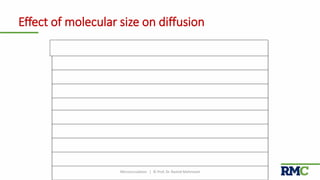
Effect of molecular size on diffusion
Substance Molecular weight Permeability
Water 18 1.00
NaCl 58.5 0.96
Urea 60 0.8
Glucose 180 0.6
Sucrose 342 0.4
Inulin 5000 0.2
Myoglobin 17600 0.03
Hemoglobin 68000 0.01
Albumin 69000 0.001Microcirculation | © Prof. Dr. Rashid Mahmood 21
Lesson contents
• Structure of Microcirculation and Capillary System
•Vasomotion
•Exchange between blood and interstitial
fluid
•Factors affecting Permeability
BODY FLUIDS
•Starling Forces
•Starling Equilibrium
•Abnormalities of capillary pressure
Vascular
distensibility &
Functions of
Arterial and
Venous System |
221-May-18
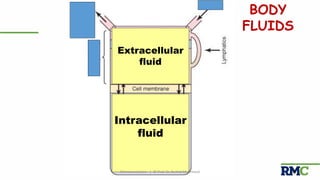
23
20%
40 %
BODY
FLUIDS
Intracellular
fluid
Interstitial
Fluid
Plasma
Microcirculation | © Prof. Dr. Rashid Mahmood
Extracellular
fluid
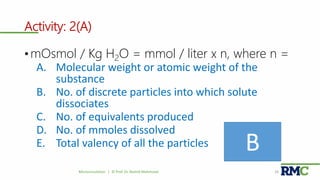
Activity: 2(A)
• mOsmol / Kg H2O = mmol / liter x n, where n =
A. Molecular weight or atomic weight of the
substance
B. No. of discrete particles into which solute
dissociates
C. No. of equivalents produced
D. No. of mmoles dissolved
E. Total valency of all the particles
Microcirculation | © Prof. Dr. Rashid Mahmood 24
B
Lesson contents
• Structure of Microcirculation and Capillary System
•Vasomotion
•Exchange between blood and interstitial
fluid
•Factors affecting Permeability
•BODY FLUIDS
Starling Forces
•Starling Equilibrium
•Abnormalities of capillary pressure
Vascular
distensibility &
Functions of
Arterial and
Venous System |
251-May-18
Forces acting across capillary wall
Microcirculation | © Prof. Dr. Rashid Mahmood 26
Starling Forces
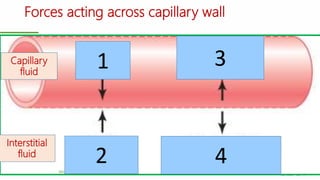
Forces acting across capillary wall
Microcirculation | © Prof. Dr. Rashid Mahmood 27
1
2
3
4
Interstitial
fluid
Capillary
fluid
Forces acting across capillary wall
Microcirculation | © Prof. Dr. Rashid Mahmood 28
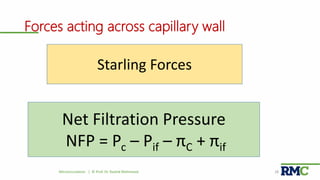
Net Filtration Pressure
NFP = Pc – Pif – πC + πif
Starling Forces
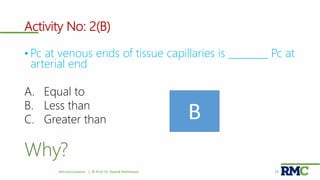
Activity No: 2(B)
• Pc at venous ends of tissue capillaries is ________ Pc at
arterial end
A. Equal to
B. Less than
C. Greater than
Why?
Microcirculation | © Prof. Dr. Rashid Mahmood 29
B
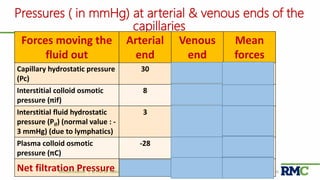
Pressures ( in mmHg) at arterial & venous ends of the
capillaries
Forces moving the
fluid out
Arterial
end
Venous
end
Mean
forces
Capillary hydrostatic pressure
(Pc)
30 10 17.3
Interstitial colloid osmotic
pressure (πif)
8 8 8
Interstitial fluid hydrostatic
pressure (Pif) (normal value : -
3 mmHg) (due to lymphatics)
3 3 3
Plasma colloid osmotic
pressure (πC)
-28 -28 -28
Net filtration Pressure 13 -7 0.3 30Microcirculation | © Prof. Dr. Rashid Mahmood
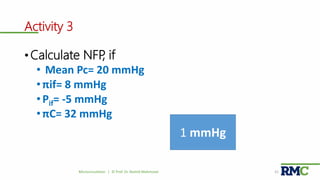
Activity 3
• Calculate NFP, if
• Mean Pc= 20 mmHg
•πif= 8 mmHg
•Pif= -5 mmHg
•πC= 32 mmHg
Microcirculation | © Prof. Dr. Rashid Mahmood 31
1 mmHg
Lesson contents
• Structure of Microcirculation and Capillary System
•Vasomotion
•Exchange between blood and interstitial
fluid
•Factors affecting Permeability
•BODY FLUIDS
•Starling Forces
•Starling Equilibrium
•Abnormalities of capillary pressure
Vascular
distensibility &
Functions of
Arterial and
Venous System |
321-May-18
Microcirculation | © Prof. Dr. Rashid Mahmood 33
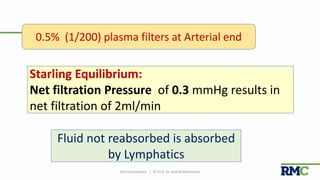
0.5% (1/200) plasma filters at Arterial end
Starling Equilibrium:
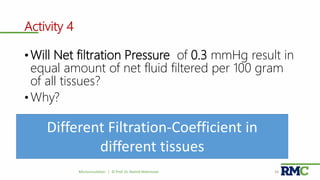
Net filtration Pressure of 0.3 mmHg results in
net filtration of 2ml/min
Fluid not reabsorbed is absorbed
by Lymphatics
Activity 4
• Will Net filtration Pressure of 0.3 mmHg result in
equal amount of net fluid filtered per 100 gram
of all tissues?
• Why?
Microcirculation | © Prof. Dr. Rashid Mahmood 34
Different Filtration-Coefficient in
different tissues
Lesson contents
• Structure of Microcirculation and Capillary System
•Vasomotion
•Exchange between blood and interstitial
fluid
•Factors affecting Permeability
•BODY FLUIDS
•Starling Forces
•Starling Equilibrium
•Abnormalities of capillary pressure
Vascular
distensibility &
Functions of
Arterial and
Venous System |
351-May-18
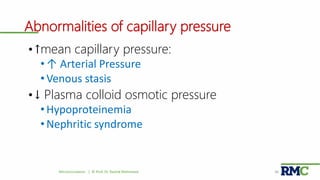
Abnormalities of capillary pressure
Microcirculation | © Prof. Dr. Rashid Mahmood 36
• ↑mean capillary pressure:
•↑ Arterial Pressure
•Venous stasis
• ↓ Plasma colloid osmotic pressure
•Hypoproteinemia
•Nephritic syndrome
More topics
1. Interstitial fluid
2. Lymphatic System
1-May-18
Vascular distensibility & Functions of Arterial and Venous System | ©
Prof. Dr. Rashid Mahmood
37
Learning Resources
• Guyton and Hall (Text book of physiology), 13th
Edition
• Berne & Levy Principles of Physiology (Koeppen
BM), 6th Edition
• Human Physiology, Silverthorn
• Human Physiology : from cells to system,
Lauralee Sherwood, 9th edition
381-May-18
Take Home Points (Slide 1/2)
•A typical tissue capillary is made up of single layer
of endothelial cells lying on a basement
membrane, separated by intercellular clefts
•Blood supply to capillaries is controlled by
intermittent contraction and relaxation of muscles
in metarterioles and precapillary sphincters. This
process is called vasomotion
•Amount of fluid filtered by capillaries depends
upon net filtration pressure (NFP) and filtration
coefficient 391-May-18
Take Home Points (Slide 2/2)
• Filtration coefficient is product of permeability
and surface area
• NFP depends on Starling forces
•Starling forces include capillary hydrostatic
pressure interstitial hydrostatic pressure, plasma
colloid osmotic pressure, and interstitial fluid
colloid osmotic pressure
•At Starling Equilibrium there is net filtration of fluid
at the rate of 2ml/min in entire body. The fluid not
reabsorbed by venous end of capillaries is drained40
Thank You
Vascular distensibility & Functions of Arterial and Venous System | ©
Prof. Dr. Rashid Mahmood
1-May-18 41
Questions ?
Comments ?
drrashid62@gmail.com
rashid.mahmood@rmi.edu.pk
ppt also available at
https://www.slideshare.net

Microcirculation

  • 1.
  • 2.
    Microcirculation | ©Prof. Dr. Rashid Mahmood 2
  • 3.
    Objectives • Goal /Aim •By the end of this session students should be able to understand the functions & control of Microcirculation . • Specific objectives • By the end of this lecture student should be able to : •Describe Structure of Microcirculation and Capillary System •List the factors effecting Capillary Permeability •Differentiate between Net Filtration Pressure and Filtration Coefficient •Describe forces across capillary wall •Calculate Net Filtration Pressure 31-May-18
  • 4.
    Lesson contents • Structureof Microcirculation and Capillary System •Vasomotion •Exchange between blood and interstitial fluid •Factors affecting Permeability •BODY FLUIDS •Starling Forces •Starling Equilibrium •Abnormalities of capillary pressure
  • 5.
    Lesson contents •Structure ofMicrocirculation and Capillary System •Vasomotion •Exchange between blood and interstitial fluid •Factors affecting Permeability •BODY FLUIDS •Starling Forces •Starling Equilibrium Vascular distensibility & Functions of Arterial and Venous System | 51-May-18
  • 6.
    Typical Capillary bed Microcirculation| © Prof. Dr. Rashid Mahmood 6
  • 7.
    Typical Capillary beds Microcirculation |© Prof. Dr. Rashid Mahmood 7
  • 8.
    Typical Capillary beds Microcirculation |© Prof. Dr. Rashid Mahmood 8
  • 9.
    9 Structure of thecapillary Very tight in brain cells – Blood brain barrier Very wide in liver cells –even proteins can pass More developed in glomerular capillaries Vesicular transport Fenestrations
  • 10.
    Structure of the capillary Microcirculation| © Prof. Dr. Rashid Mahmood 10
  • 11.
    Structure of the capillary Microcirculation| © Prof. Dr. Rashid Mahmood 11
  • 12.
    Typical Capillary bed Microcirculation| © Prof. Dr. Rashid Mahmood 12
  • 13.
    Lesson contents • Structureof Microcirculation and Capillary System •Vasomotion •Exchange between blood and interstitial fluid •Factors affecting Permeability •BODY FLUIDS •Starling Forces •Starling Equilibrium •Abnormalities of capillary pressure Vascular distensibility & Functions of Arterial and Venous System | 131-May-18
  • 14.
    • Intermittent contractionand relaxation of muscles in the metarterioles and precapillary sphincters • Main regulator: Concentration of O2 in the tissues regulates vasomotion Vasomotion Microcirculation | © Prof. Dr. Rashid Mahmood 14
  • 15.
    Vasomotion Microcirculation | ©Prof. Dr. Rashid Mahmood 15
  • 16.
    Lesson contents • Structureof Microcirculation and Capillary System •Vasomotion •Exchange between blood and interstitial fluid •Factors affecting Permeability •BODY FLUIDS •Starling Forces •Starling Equilibrium •Abnormalities of capillary pressure Vascular distensibility & Functions of Arterial and Venous System | 161-May-18
  • 17.
    Lesson contents • Structureof Microcirculation and Capillary System •Vasomotion •Exchange between blood and interstitial fluid •Factors affecting Permeability •BODY FLUIDS •Starling Forces •Starling Equilibrium •Abnormalities of capillary pressure Vascular distensibility & Functions of Arterial and Venous System | 171-May-18
  • 18.
    Exchange between bloodand interstitial fluid Microcirculation | © Prof. Dr. Rashid Mahmood 18 Mainly by Diffusion Interstitial fluid
  • 19.
    Microcirculation | ©Prof. Dr. Rashid Mahmood 19 1 2 3 4 5 6 Figure Focus: Activity No. 1: What are constant factors affecting Permeability? (Not related to substance to be diffused) Factors affecting Permeability
  • 20.
    Microcirculation | ©Prof. Dr. Rashid Mahmood 20 Surface Area ×Permeability= Filtration Coefficient (Permeability depends on cell membrane composition & thickness) Capillary Filtration coefficient: • 6.67 ml/min/mm Hg (for whole body) • 0.021 ml/min/mm Hg (per 100 gm of tissue) • varies drastically in different tissues (Kidney:12.51 ml/min/mm Hg (per 100 gm of tissue)
  • 21.
    Effect of molecularsize on diffusion Substance Molecular weight Permeability Water 18 1.00 NaCl 58.5 0.96 Urea 60 0.8 Glucose 180 0.6 Sucrose 342 0.4 Inulin 5000 0.2 Myoglobin 17600 0.03 Hemoglobin 68000 0.01 Albumin 69000 0.001Microcirculation | © Prof. Dr. Rashid Mahmood 21
  • 22.
    Lesson contents • Structureof Microcirculation and Capillary System •Vasomotion •Exchange between blood and interstitial fluid •Factors affecting Permeability BODY FLUIDS •Starling Forces •Starling Equilibrium •Abnormalities of capillary pressure Vascular distensibility & Functions of Arterial and Venous System | 221-May-18
  • 23.
  • 24.
    Activity: 2(A) • mOsmol/ Kg H2O = mmol / liter x n, where n = A. Molecular weight or atomic weight of the substance B. No. of discrete particles into which solute dissociates C. No. of equivalents produced D. No. of mmoles dissolved E. Total valency of all the particles Microcirculation | © Prof. Dr. Rashid Mahmood 24 B
  • 25.
    Lesson contents • Structureof Microcirculation and Capillary System •Vasomotion •Exchange between blood and interstitial fluid •Factors affecting Permeability •BODY FLUIDS Starling Forces •Starling Equilibrium •Abnormalities of capillary pressure Vascular distensibility & Functions of Arterial and Venous System | 251-May-18
  • 26.
    Forces acting acrosscapillary wall Microcirculation | © Prof. Dr. Rashid Mahmood 26 Starling Forces
  • 27.
    Forces acting acrosscapillary wall Microcirculation | © Prof. Dr. Rashid Mahmood 27 1 2 3 4 Interstitial fluid Capillary fluid
  • 28.
    Forces acting acrosscapillary wall Microcirculation | © Prof. Dr. Rashid Mahmood 28 Net Filtration Pressure NFP = Pc – Pif – πC + πif Starling Forces
  • 29.
    Activity No: 2(B) •Pc at venous ends of tissue capillaries is ________ Pc at arterial end A. Equal to B. Less than C. Greater than Why? Microcirculation | © Prof. Dr. Rashid Mahmood 29 B
  • 30.
    Pressures ( inmmHg) at arterial & venous ends of the capillaries Forces moving the fluid out Arterial end Venous end Mean forces Capillary hydrostatic pressure (Pc) 30 10 17.3 Interstitial colloid osmotic pressure (πif) 8 8 8 Interstitial fluid hydrostatic pressure (Pif) (normal value : - 3 mmHg) (due to lymphatics) 3 3 3 Plasma colloid osmotic pressure (πC) -28 -28 -28 Net filtration Pressure 13 -7 0.3 30Microcirculation | © Prof. Dr. Rashid Mahmood
  • 31.
    Activity 3 • CalculateNFP, if • Mean Pc= 20 mmHg •πif= 8 mmHg •Pif= -5 mmHg •πC= 32 mmHg Microcirculation | © Prof. Dr. Rashid Mahmood 31 1 mmHg
  • 32.
    Lesson contents • Structureof Microcirculation and Capillary System •Vasomotion •Exchange between blood and interstitial fluid •Factors affecting Permeability •BODY FLUIDS •Starling Forces •Starling Equilibrium •Abnormalities of capillary pressure Vascular distensibility & Functions of Arterial and Venous System | 321-May-18
  • 33.
    Microcirculation | ©Prof. Dr. Rashid Mahmood 33 0.5% (1/200) plasma filters at Arterial end Starling Equilibrium: Net filtration Pressure of 0.3 mmHg results in net filtration of 2ml/min Fluid not reabsorbed is absorbed by Lymphatics
  • 34.
    Activity 4 • WillNet filtration Pressure of 0.3 mmHg result in equal amount of net fluid filtered per 100 gram of all tissues? • Why? Microcirculation | © Prof. Dr. Rashid Mahmood 34 Different Filtration-Coefficient in different tissues
  • 35.
    Lesson contents • Structureof Microcirculation and Capillary System •Vasomotion •Exchange between blood and interstitial fluid •Factors affecting Permeability •BODY FLUIDS •Starling Forces •Starling Equilibrium •Abnormalities of capillary pressure Vascular distensibility & Functions of Arterial and Venous System | 351-May-18
  • 36.
    Abnormalities of capillarypressure Microcirculation | © Prof. Dr. Rashid Mahmood 36 • ↑mean capillary pressure: •↑ Arterial Pressure •Venous stasis • ↓ Plasma colloid osmotic pressure •Hypoproteinemia •Nephritic syndrome
  • 37.
    More topics 1. Interstitialfluid 2. Lymphatic System 1-May-18 Vascular distensibility & Functions of Arterial and Venous System | © Prof. Dr. Rashid Mahmood 37
  • 38.
    Learning Resources • Guytonand Hall (Text book of physiology), 13th Edition • Berne & Levy Principles of Physiology (Koeppen BM), 6th Edition • Human Physiology, Silverthorn • Human Physiology : from cells to system, Lauralee Sherwood, 9th edition 381-May-18
  • 39.
    Take Home Points(Slide 1/2) •A typical tissue capillary is made up of single layer of endothelial cells lying on a basement membrane, separated by intercellular clefts •Blood supply to capillaries is controlled by intermittent contraction and relaxation of muscles in metarterioles and precapillary sphincters. This process is called vasomotion •Amount of fluid filtered by capillaries depends upon net filtration pressure (NFP) and filtration coefficient 391-May-18
  • 40.
    Take Home Points(Slide 2/2) • Filtration coefficient is product of permeability and surface area • NFP depends on Starling forces •Starling forces include capillary hydrostatic pressure interstitial hydrostatic pressure, plasma colloid osmotic pressure, and interstitial fluid colloid osmotic pressure •At Starling Equilibrium there is net filtration of fluid at the rate of 2ml/min in entire body. The fluid not reabsorbed by venous end of capillaries is drained40
  • 41.
    Thank You Vascular distensibility& Functions of Arterial and Venous System | © Prof. Dr. Rashid Mahmood 1-May-18 41 Questions ? Comments ? drrashid62@gmail.com rashid.mahmood@rmi.edu.pk ppt also available at https://www.slideshare.net

Editor's Notes