PRESENTED BY:
Dr. Hrudi Sundar Sahoo
 INTRODUCTION
 PHYSIOLOGIC ANATOMY OF HEART
 CORONARY BLOOD FLOW
 CONTROL OF CORONARY BLOOD FLOW
 NERVOUS CONTROL
 CONCLUSION
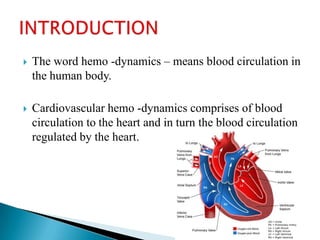
   The word hemo -dynamics – means blood circulation in
    the human body.

   Cardiovascular hemo -dynamics comprises of blood
    circulation to the heart and in turn the blood circulation
    regulated by the heart.
   Main coronary arteries lie on the surface of the heart
    and small arteries penetrate into the cardiac muscle
    mass.

   Heart receives nutrition supply through these arteries.

   Left coronary artery supplies mainly anterior and
    lateral portion of left ventricle.

   Right coronary artery supplies most of right ventricle as
    well as posterior part of left ventricle.
   Venous blood flow from left ventricle leaves by way of
    coronary sinus.

   Most of venous blood from right ventricle flows
    through small anterior cardiac vein directly into the
    right atrium and not connected with coronary sinus.

   Small amount of coronary blood flows back into the
    heart through Thebesian vein.
   Resting coronary blood flow in human, average is
    approximately 225ml/minute, Which is 0.7 to 0.8 ml
    per gram of heart muscle.

   During diastole cardiac muscle relaxes completely and
    no longer obstruct the blood flow through the left
    ventricular capillaries.

    This is phasic changes in coronary blood flow during
    cardiac muscle compression.
   During cardiac contraction – Intra myocardial pressure
    in the inner layer of the heart muscle is so much greater
    than the outer layer


   It compresses the sub endocardial blood vessels far
    more than it compresses the outer vessel.
I.   Oxygen demand major factor in local blood flow
     regulation.

II. Determinants of oxygen consumption.

III. Importance of increase in coronary blood flow in response
     to myocardial oxygen usage.

IV. Reactive hyperemia in coronary system.
   Local metabolism as the primary control of coronary
    flow .

   Blood flow through coronary system is regulated
    almost entirely by vascular response to the local
    needs.
   Blood flow in coronary arteries is proportion to the
    need of cardiac musculature for oxygen.

   Decrease in oxygen concentration in the heart causes
    vasodilator substance to be released from the muscle
    cells .
   There are different factors that can alter myocardial
    oxygen consumption.

   Cardiac oxygen consumption related to work
    performed by the heart.


   Greater the work greater the oxygen consumption.
   Important principle of heart function is that myocardial
    energy consumption and oxygen usage are very nearly
    proportional to tension time.


   The time that the tension is maintained during cardiac
    cycle .
   Consumption or stimulation of heart by epinephrine ,
    norepinephrine ,thyroxine , digitalis and calcium ions.
    Resting heart, extract most of the oxygen from the
    coronary blood as it flows through the heart muscles.

   when coronary blood flow fails to increase during
    demands the strength of muscle diminishes rapidly
    causes acute heart failure.
   When coronary flow to heart is occluded for a few
    seconds to few minutes and then disoccluded the blood
    flow increases to as high as 3 to 4 times normal.

   It remains high for a few second to few minutes.
   Stimulation of autonomic nerves to the heart can affect
    coronary blood flow in 2 ways:


            1. Directly


            2.Indirectly
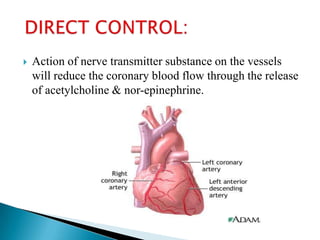
   Action of nerve transmitter substance on the vessels
    will reduce the coronary blood flow through the release
    of acetylcholine & nor-epinephrine.
   Sympathetic stimulation of nerve to the heart can affect
    the coronary blood flow, by the release of nor-
    epinephrine.
Cardiovascular hemodynamics

Cardiovascular hemodynamics

  • 1.
  • 2.
     INTRODUCTION  PHYSIOLOGICANATOMY OF HEART  CORONARY BLOOD FLOW  CONTROL OF CORONARY BLOOD FLOW  NERVOUS CONTROL  CONCLUSION
  • 3.
    The word hemo -dynamics – means blood circulation in the human body.  Cardiovascular hemo -dynamics comprises of blood circulation to the heart and in turn the blood circulation regulated by the heart.
  • 4.
    Main coronary arteries lie on the surface of the heart and small arteries penetrate into the cardiac muscle mass.  Heart receives nutrition supply through these arteries.  Left coronary artery supplies mainly anterior and lateral portion of left ventricle.  Right coronary artery supplies most of right ventricle as well as posterior part of left ventricle.
  • 5.
    Venous blood flow from left ventricle leaves by way of coronary sinus.  Most of venous blood from right ventricle flows through small anterior cardiac vein directly into the right atrium and not connected with coronary sinus.  Small amount of coronary blood flows back into the heart through Thebesian vein.
  • 6.
    Resting coronary blood flow in human, average is approximately 225ml/minute, Which is 0.7 to 0.8 ml per gram of heart muscle.  During diastole cardiac muscle relaxes completely and no longer obstruct the blood flow through the left ventricular capillaries.  This is phasic changes in coronary blood flow during cardiac muscle compression.
  • 7.
    During cardiac contraction – Intra myocardial pressure in the inner layer of the heart muscle is so much greater than the outer layer  It compresses the sub endocardial blood vessels far more than it compresses the outer vessel.
  • 8.
    I. Oxygen demand major factor in local blood flow regulation. II. Determinants of oxygen consumption. III. Importance of increase in coronary blood flow in response to myocardial oxygen usage. IV. Reactive hyperemia in coronary system.
  • 9.
    Local metabolism as the primary control of coronary flow .  Blood flow through coronary system is regulated almost entirely by vascular response to the local needs.
  • 11.
    Blood flow in coronary arteries is proportion to the need of cardiac musculature for oxygen.  Decrease in oxygen concentration in the heart causes vasodilator substance to be released from the muscle cells .
  • 12.
    There are different factors that can alter myocardial oxygen consumption.  Cardiac oxygen consumption related to work performed by the heart.  Greater the work greater the oxygen consumption.
  • 13.
    Important principle of heart function is that myocardial energy consumption and oxygen usage are very nearly proportional to tension time.  The time that the tension is maintained during cardiac cycle .
  • 14.
    Consumption or stimulation of heart by epinephrine , norepinephrine ,thyroxine , digitalis and calcium ions.
  • 15.
    Resting heart, extract most of the oxygen from the coronary blood as it flows through the heart muscles.  when coronary blood flow fails to increase during demands the strength of muscle diminishes rapidly causes acute heart failure.
  • 16.
    When coronary flow to heart is occluded for a few seconds to few minutes and then disoccluded the blood flow increases to as high as 3 to 4 times normal.  It remains high for a few second to few minutes.
  • 17.
    Stimulation of autonomic nerves to the heart can affect coronary blood flow in 2 ways:  1. Directly 2.Indirectly
  • 18.
    Action of nerve transmitter substance on the vessels will reduce the coronary blood flow through the release of acetylcholine & nor-epinephrine.
  • 19.
    Sympathetic stimulation of nerve to the heart can affect the coronary blood flow, by the release of nor- epinephrine.