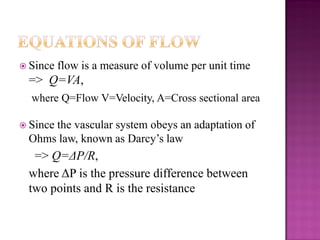
1) Blood flow is defined as the volume of blood flowing through an organ or vessel per unit time and is normally expressed in ml/min. The total blood flow in an adult is about 5.25 l/min, known as cardiac output.
2) Blood flow (Q) is calculated as the product of velocity (V) and cross-sectional area (A), or can be calculated using Darcy's law as the ratio of the pressure difference (ΔP) between two points and the resistance (R) of the vessel.
3) Blood pressure is usually measured in millimeters of mercury (mmHg) and refers to either systolic or diastolic pressure, which is the peak or minimum



![ Difference between the systolic and diastolic
pressure is called as Pulse Pressure
Pulse pressure = 45 mmHg
MAP
Sum of diastolic pressure and one-third of
the pulse pressure
MAP=[ diastolic pressure+(Pulse pressure/3) ]
Varies with the influence of gravity
Standing adult-
62 mmHg in the major arteries of the head
180 mmHg – arteries in legs](https://image.slidesharecdn.com/bloodflowregulatingfactors-180129124349/85/Blood-flowregulatingfactors-5-320.jpg)