Bad Points
1. Should be more animated
videos
2. Some students disturbing the
class by asking irrelevant
questions
3. Speed was a little fast
4. ECG strip should be provided
5. Some things not clearly
explained e.g interpretation,
voltage, X-axis, leads
6. Use of white board was less
7. Did not understand completely
8. Lecture was a little bit lengthy
9. Repeat of LGF demanded
10. Some students ask questions
just to disturb class
Good Points
1. Enjoyed the lecture
2. Understood the lecture
3. Diagrams were good
4. Animations, slides and
images were good
5. Answered the questions
6. Some things were explained
very well e.g leads
7. Way of teaching was liked.
LGF was informative and
well explained; Concepts
were cleared
8. Brief introduction to each
point. Different books were
consulted
9. It was a step-wise lecture
10. I should take more classes
Prof. Dr. Rashid
Mahmood
 By the end of this lecture, students should be able to know the
physical principles of blood flow peripheral resistance, blood
pressure and change in velocity.
 Specific objectives:
◦ Explain the factors that regulate the volume of blood flow.
◦ Explain how blood pressure changes throughout the cardio
vascular system.
◦ Indicate the factors that determine mean arterial pressure and
systemic vascular resistance.
◦ Outline the relationship between cross sectional area and
velocity of blood flow.
◦ Explain how blood pressure and resistance determine volume of
blood flow.
◦ How is the return of venous blood to the heart accomplished?
◦ Why is velocity of blood faster in arteries than in veins?
Prof. Dr. Rashid Mahmood 3
 Interrelationship among pressure flow and
resistance.
 Ohm’s Law and Poieulle’s Law.
 Role of blood Hematocrit and peripheral
resistance.
 Arterial pressure.
 Blood pressure.
Prof. Dr. Rashid Mahmood 4
Prof. Dr. Rashid Mahmood 5
Cut here
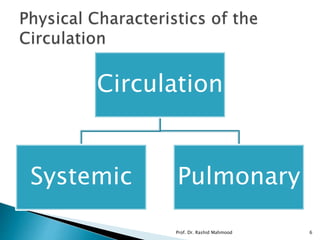
Circulation
Systemic Pulmonary
Prof. Dr. Rashid Mahmood 6
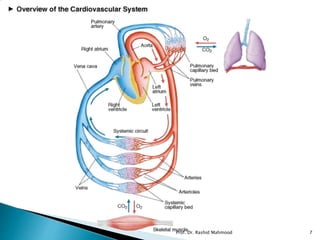
Prof. Dr. Rashid Mahmood 7
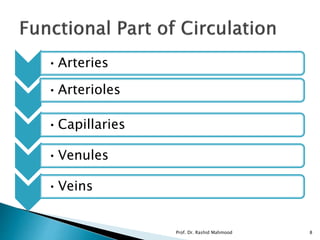
•Arteries
•Arterioles
•Capillaries
•Venules
•Veins
Prof. Dr. Rashid Mahmood 8
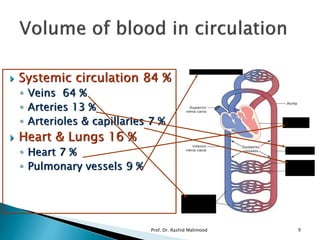
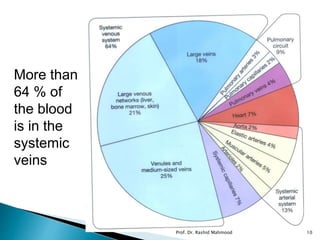
 Systemic circulation 84 %
◦ Veins 64 %
◦ Arteries 13 %
◦ Arterioles & capillaries 7 %
 Heart & Lungs 16 %
◦ Heart 7 %
◦ Pulmonary vessels 9 %
Prof. Dr. Rashid Mahmood 9
More than
64 % of
the blood
is in the
systemic
veins
Prof. Dr. Rashid Mahmood 10
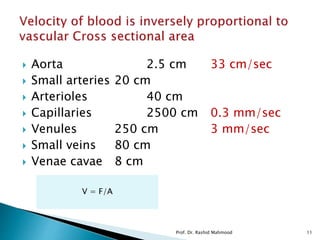
 Aorta 2.5 cm 33 cm/sec
 Small arteries 20 cm
 Arterioles 40 cm
 Capillaries 2500 cm 0.3 mm/sec
 Venules 250 cm 3 mm/sec
 Small veins 80 cm
 Venae cavae 8 cm
V = F/A
Prof. Dr. Rashid Mahmood 11
Prof. Dr. Rashid Mahmood 12
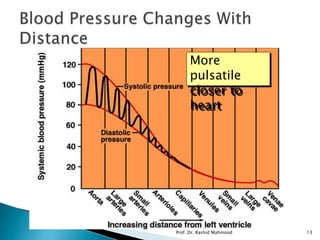
More
pulsatile
closer to
heart
Prof. Dr. Rashid Mahmood 13
1. The rate of blood flow to each tissue is
controlled in relation to the tissue need
2. The cardiac output is controlled mainly by
the sum of all the local tissue flows.
3. Arterial pressure is controlled independently
of either local blood flow control or cardiac
output control
Prof. Dr. Rashid Mahmood 14
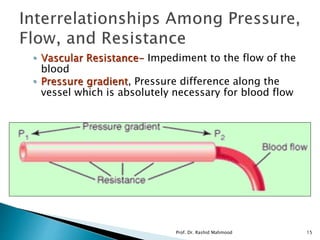
◦ Vascular Resistance- Impediment to the flow of the
blood
◦ Pressure gradient, Pressure difference along the
vessel which is absolutely necessary for blood flow
Prof. Dr. Rashid Mahmood 15
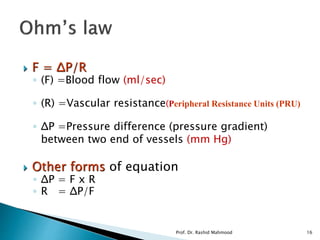
 F = ΔP/R
◦ (F) =Blood flow (ml/sec)
◦ (R) =Vascular resistance(Peripheral Resistance Units (PRU)
◦ ΔP =Pressure difference (pressure gradient)
between two end of vessels (mm Hg)
 Other forms of equation
◦ ΔP = F x R
◦ R = ΔP/F
Prof. Dr. Rashid Mahmood 16
 Enumerate the factors that regulate the blood
flow.
Prof. Dr. Rashid Mahmood 17
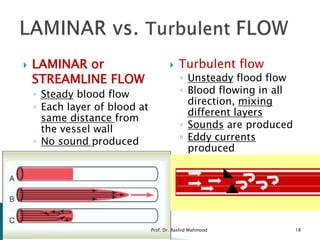
 LAMINAR or
STREAMLINE FLOW
◦ Steady blood flow
◦ Each layer of blood at
same distance from
the vessel wall
◦ No sound produced
 Turbulent flow
◦ Unsteady flood flow
◦ Blood flowing in all
direction, mixing
different layers
◦ Sounds are produced
◦ Eddy currents
produced
Prof. Dr. Rashid Mahmood 18
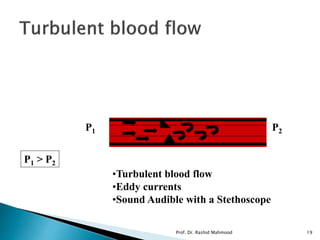
P2P1
P1 > P2
•Turbulent blood flow
•Eddy currents
•Sound Audible with a Stethoscope
Prof. Dr. Rashid Mahmood 19
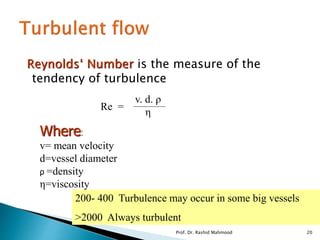
Reynolds‘ Number is the measure of the
tendency of turbulence
Re =
v. d. ρ
η
Where:
v= mean velocity
d=vessel diameter
ρ =density
η=viscosity
200- 400 Turbulence may occur in some big vessels
>2000 Always turbulent
Prof. Dr. Rashid Mahmood 20
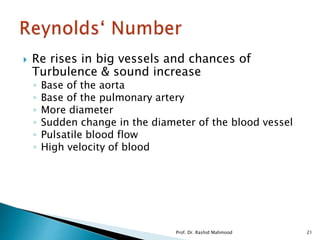
 Re rises in big vessels and chances of
Turbulence & sound increase
◦ Base of the aorta
◦ Base of the pulmonary artery
◦ More diameter
◦ Sudden change in the diameter of the blood vessel
◦ Pulsatile blood flow
◦ High velocity of blood
Prof. Dr. Rashid Mahmood 21
 How is Peripheral Resistance related to blood
flow.
Prof. Dr. Rashid Mahmood 22
 Force exerted by the flowing blood
against per unit area of the vessel
wall
 Usually expressed as mm Hg
 Occasionally expressed as cm H2O
 1 mm Hg = 1.36 cm of H2O
Prof. Dr. Rashid Mahmood 23
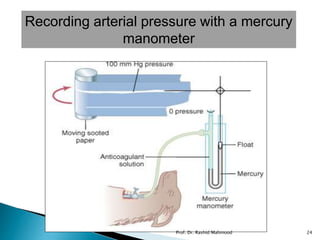
Recording arterial pressure with a mercury
manometer
Prof. Dr. Rashid Mahmood 24
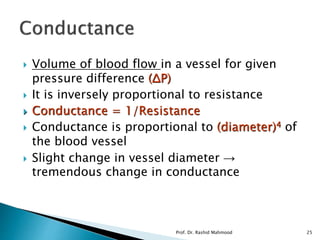
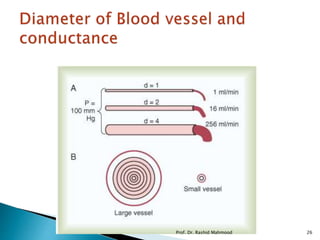
 Volume of blood flow in a vessel for given
pressure difference (ΔP)
 It is inversely proportional to resistance
 Conductance = 1/Resistance
 Conductance is proportional to (diameter)4 of
the blood vessel
 Slight change in vessel diameter →
tremendous change in conductance
Prof. Dr. Rashid Mahmood 25
Prof. Dr. Rashid Mahmood 26
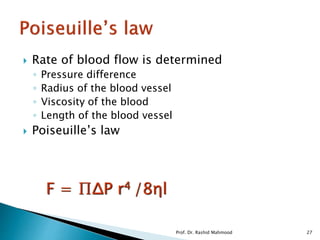
 Rate of blood flow is determined
◦ Pressure difference
◦ Radius of the blood vessel
◦ Viscosity of the blood
◦ Length of the blood vessel
 Poiseuille’s law
F = ∏ΔP r4 /8ηl
Prof. Dr. Rashid Mahmood 27
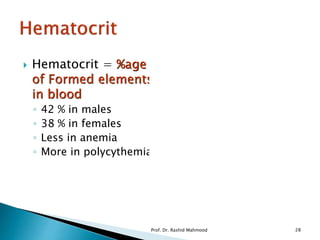
 Hematocrit = %age
of Formed elements
in blood
◦ 42 % in males
◦ 38 % in females
◦ Less in anemia
◦ More in polycythemia
Prof. Dr. Rashid Mahmood 28
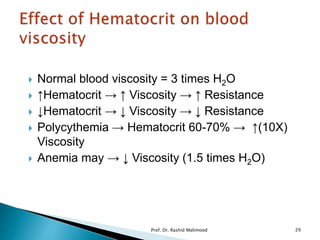
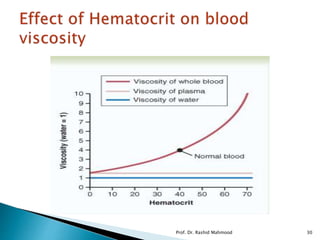
 Normal blood viscosity = 3 times H2O
 ↑Hematocrit → ↑ Viscosity → ↑ Resistance
 ↓Hematocrit → ↓ Viscosity → ↓ Resistance
 Polycythemia → Hematocrit 60-70% → ↑(10X)
Viscosity
 Anemia may → ↓ Viscosity (1.5 times H2O)
Prof. Dr. Rashid Mahmood 29
Prof. Dr. Rashid Mahmood 30
 How does an increase in hematocrit affect the
peripheral resistance.
Prof. Dr. Rashid Mahmood 31
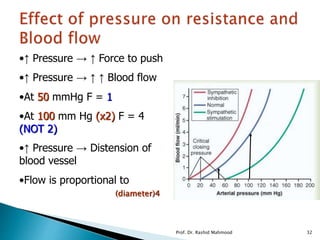
•↑ Pressure → ↑ Force to push
•↑ Pressure → ↑ ↑ Blood flow
•At 50 mmHg F = 1
•At 100 mm Hg (x2) F = 4
(NOT 2)
•↑ Pressure → Distension of
blood vessel
•Flow is proportional to
(diameter)4
Prof. Dr. Rashid Mahmood 32
 Circulation is described as systemic and
pulmonary circulation
 About 64% of blood is in systemic Veins
 Velocity of blood is inversely proportional
to vascular Cross sectional area (V = F/A)
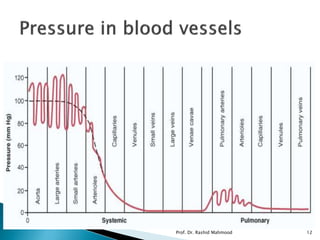
 Blood Pressure in blood vessels decreases
as the Distance increases from the heart
 Blood flow, as determined by Ohm’s Law, is
directly proportional to pressure gradient,
and inversely proportional to peripheral
vascular resistance (F = ΔP/R)
Prof. Dr. Rashid Mahmood 33
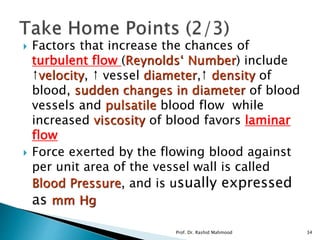
 Factors that increase the chances of
turbulent flow (Reynolds‘ Number) include
↑velocity, ↑ vessel diameter,↑ density of
blood, sudden changes in diameter of blood
vessels and pulsatile blood flow while
increased viscosity of blood favors laminar
flow
 Force exerted by the flowing blood against
per unit area of the vessel wall is called
Blood Pressure, and is usually expressed
as mm Hg
Prof. Dr. Rashid Mahmood 34
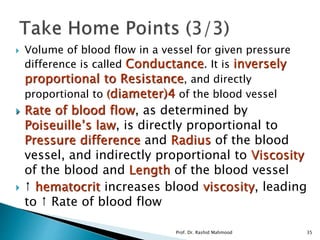
 Volume of blood flow in a vessel for given pressure
difference is called Conductance. It is inversely
proportional to Resistance, and directly
proportional to (diameter)4 of the blood vessel
 Rate of blood flow, as determined by
Poiseuille’s law, is directly proportional to
Pressure difference and Radius of the blood
vessel, and indirectly proportional to Viscosity
of the blood and Length of the blood vessel
 ↑ hematocrit increases blood viscosity, leading
to ↑ Rate of blood flow
Prof. Dr. Rashid Mahmood 35
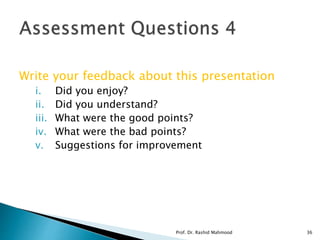
Write your feedback about this presentation
i. Did you enjoy?
ii. Did you understand?
iii. What were the good points?
iv. What were the bad points?
v. Suggestions for improvement
Prof. Dr. Rashid Mahmood 36
 Guyton and Hall (Text book of physiology), 13th
Edition
 Ganong (Text book of physiology), 24th Edition
 Berne & Levy Principles of Physiology (Koeppen
BM), 6th Edition
 Human Physiology Stuart Fox, 13th Edition
 Human Physiology : from cells to system with
Power Lecture DVD Lauralee Sherwood, 9th edition
 Internet
Prof .Dr. Rashid Mahmood37
 Questions
 Comments
 Criticism
rashid.mahmood@rmi.edu.pk
drrashid62@gmail.com
Prof .Dr. Rashid Mahmood38
 Regulation of blood pressure –I
 27.04.2017
Prof. Dr. Rashid Mahmood 39

Physical principles of circulation rmc

  • 1.
    Bad Points 1. Shouldbe more animated videos 2. Some students disturbing the class by asking irrelevant questions 3. Speed was a little fast 4. ECG strip should be provided 5. Some things not clearly explained e.g interpretation, voltage, X-axis, leads 6. Use of white board was less 7. Did not understand completely 8. Lecture was a little bit lengthy 9. Repeat of LGF demanded 10. Some students ask questions just to disturb class Good Points 1. Enjoyed the lecture 2. Understood the lecture 3. Diagrams were good 4. Animations, slides and images were good 5. Answered the questions 6. Some things were explained very well e.g leads 7. Way of teaching was liked. LGF was informative and well explained; Concepts were cleared 8. Brief introduction to each point. Different books were consulted 9. It was a step-wise lecture 10. I should take more classes
  • 2.
  • 3.
     By theend of this lecture, students should be able to know the physical principles of blood flow peripheral resistance, blood pressure and change in velocity.  Specific objectives: ◦ Explain the factors that regulate the volume of blood flow. ◦ Explain how blood pressure changes throughout the cardio vascular system. ◦ Indicate the factors that determine mean arterial pressure and systemic vascular resistance. ◦ Outline the relationship between cross sectional area and velocity of blood flow. ◦ Explain how blood pressure and resistance determine volume of blood flow. ◦ How is the return of venous blood to the heart accomplished? ◦ Why is velocity of blood faster in arteries than in veins? Prof. Dr. Rashid Mahmood 3
  • 4.
     Interrelationship amongpressure flow and resistance.  Ohm’s Law and Poieulle’s Law.  Role of blood Hematocrit and peripheral resistance.  Arterial pressure.  Blood pressure. Prof. Dr. Rashid Mahmood 4
  • 5.
    Prof. Dr. RashidMahmood 5 Cut here
  • 6.
  • 7.
  • 8.
  • 9.
     Systemic circulation84 % ◦ Veins 64 % ◦ Arteries 13 % ◦ Arterioles & capillaries 7 %  Heart & Lungs 16 % ◦ Heart 7 % ◦ Pulmonary vessels 9 % Prof. Dr. Rashid Mahmood 9
  • 10.
    More than 64 %of the blood is in the systemic veins Prof. Dr. Rashid Mahmood 10
  • 11.
     Aorta 2.5cm 33 cm/sec  Small arteries 20 cm  Arterioles 40 cm  Capillaries 2500 cm 0.3 mm/sec  Venules 250 cm 3 mm/sec  Small veins 80 cm  Venae cavae 8 cm V = F/A Prof. Dr. Rashid Mahmood 11
  • 12.
    Prof. Dr. RashidMahmood 12
  • 13.
  • 14.
    1. The rateof blood flow to each tissue is controlled in relation to the tissue need 2. The cardiac output is controlled mainly by the sum of all the local tissue flows. 3. Arterial pressure is controlled independently of either local blood flow control or cardiac output control Prof. Dr. Rashid Mahmood 14
  • 15.
    ◦ Vascular Resistance-Impediment to the flow of the blood ◦ Pressure gradient, Pressure difference along the vessel which is absolutely necessary for blood flow Prof. Dr. Rashid Mahmood 15
  • 16.
     F =ΔP/R ◦ (F) =Blood flow (ml/sec) ◦ (R) =Vascular resistance(Peripheral Resistance Units (PRU) ◦ ΔP =Pressure difference (pressure gradient) between two end of vessels (mm Hg)  Other forms of equation ◦ ΔP = F x R ◦ R = ΔP/F Prof. Dr. Rashid Mahmood 16
  • 17.
     Enumerate thefactors that regulate the blood flow. Prof. Dr. Rashid Mahmood 17
  • 18.
     LAMINAR or STREAMLINEFLOW ◦ Steady blood flow ◦ Each layer of blood at same distance from the vessel wall ◦ No sound produced  Turbulent flow ◦ Unsteady flood flow ◦ Blood flowing in all direction, mixing different layers ◦ Sounds are produced ◦ Eddy currents produced Prof. Dr. Rashid Mahmood 18
  • 19.
    P2P1 P1 > P2 •Turbulentblood flow •Eddy currents •Sound Audible with a Stethoscope Prof. Dr. Rashid Mahmood 19
  • 20.
    Reynolds‘ Number isthe measure of the tendency of turbulence Re = v. d. ρ η Where: v= mean velocity d=vessel diameter ρ =density η=viscosity 200- 400 Turbulence may occur in some big vessels >2000 Always turbulent Prof. Dr. Rashid Mahmood 20
  • 21.
     Re risesin big vessels and chances of Turbulence & sound increase ◦ Base of the aorta ◦ Base of the pulmonary artery ◦ More diameter ◦ Sudden change in the diameter of the blood vessel ◦ Pulsatile blood flow ◦ High velocity of blood Prof. Dr. Rashid Mahmood 21
  • 22.
     How isPeripheral Resistance related to blood flow. Prof. Dr. Rashid Mahmood 22
  • 23.
     Force exertedby the flowing blood against per unit area of the vessel wall  Usually expressed as mm Hg  Occasionally expressed as cm H2O  1 mm Hg = 1.36 cm of H2O Prof. Dr. Rashid Mahmood 23
  • 24.
    Recording arterial pressurewith a mercury manometer Prof. Dr. Rashid Mahmood 24
  • 25.
     Volume ofblood flow in a vessel for given pressure difference (ΔP)  It is inversely proportional to resistance  Conductance = 1/Resistance  Conductance is proportional to (diameter)4 of the blood vessel  Slight change in vessel diameter → tremendous change in conductance Prof. Dr. Rashid Mahmood 25
  • 26.
    Prof. Dr. RashidMahmood 26
  • 27.
     Rate ofblood flow is determined ◦ Pressure difference ◦ Radius of the blood vessel ◦ Viscosity of the blood ◦ Length of the blood vessel  Poiseuille’s law F = ∏ΔP r4 /8ηl Prof. Dr. Rashid Mahmood 27
  • 28.
     Hematocrit =%age of Formed elements in blood ◦ 42 % in males ◦ 38 % in females ◦ Less in anemia ◦ More in polycythemia Prof. Dr. Rashid Mahmood 28
  • 29.
     Normal bloodviscosity = 3 times H2O  ↑Hematocrit → ↑ Viscosity → ↑ Resistance  ↓Hematocrit → ↓ Viscosity → ↓ Resistance  Polycythemia → Hematocrit 60-70% → ↑(10X) Viscosity  Anemia may → ↓ Viscosity (1.5 times H2O) Prof. Dr. Rashid Mahmood 29
  • 30.
    Prof. Dr. RashidMahmood 30
  • 31.
     How doesan increase in hematocrit affect the peripheral resistance. Prof. Dr. Rashid Mahmood 31
  • 32.
    •↑ Pressure →↑ Force to push •↑ Pressure → ↑ ↑ Blood flow •At 50 mmHg F = 1 •At 100 mm Hg (x2) F = 4 (NOT 2) •↑ Pressure → Distension of blood vessel •Flow is proportional to (diameter)4 Prof. Dr. Rashid Mahmood 32
  • 33.
     Circulation isdescribed as systemic and pulmonary circulation  About 64% of blood is in systemic Veins  Velocity of blood is inversely proportional to vascular Cross sectional area (V = F/A)  Blood Pressure in blood vessels decreases as the Distance increases from the heart  Blood flow, as determined by Ohm’s Law, is directly proportional to pressure gradient, and inversely proportional to peripheral vascular resistance (F = ΔP/R) Prof. Dr. Rashid Mahmood 33
  • 34.
     Factors thatincrease the chances of turbulent flow (Reynolds‘ Number) include ↑velocity, ↑ vessel diameter,↑ density of blood, sudden changes in diameter of blood vessels and pulsatile blood flow while increased viscosity of blood favors laminar flow  Force exerted by the flowing blood against per unit area of the vessel wall is called Blood Pressure, and is usually expressed as mm Hg Prof. Dr. Rashid Mahmood 34
  • 35.
     Volume ofblood flow in a vessel for given pressure difference is called Conductance. It is inversely proportional to Resistance, and directly proportional to (diameter)4 of the blood vessel  Rate of blood flow, as determined by Poiseuille’s law, is directly proportional to Pressure difference and Radius of the blood vessel, and indirectly proportional to Viscosity of the blood and Length of the blood vessel  ↑ hematocrit increases blood viscosity, leading to ↑ Rate of blood flow Prof. Dr. Rashid Mahmood 35
  • 36.
    Write your feedbackabout this presentation i. Did you enjoy? ii. Did you understand? iii. What were the good points? iv. What were the bad points? v. Suggestions for improvement Prof. Dr. Rashid Mahmood 36
  • 37.
     Guyton andHall (Text book of physiology), 13th Edition  Ganong (Text book of physiology), 24th Edition  Berne & Levy Principles of Physiology (Koeppen BM), 6th Edition  Human Physiology Stuart Fox, 13th Edition  Human Physiology : from cells to system with Power Lecture DVD Lauralee Sherwood, 9th edition  Internet Prof .Dr. Rashid Mahmood37
  • 38.
     Questions  Comments Criticism rashid.mahmood@rmi.edu.pk drrashid62@gmail.com Prof .Dr. Rashid Mahmood38
  • 39.
     Regulation ofblood pressure –I  27.04.2017 Prof. Dr. Rashid Mahmood 39