General principals ofGeneral principals of
circulationcirculation
Dr. Kamla Choudhary
Assistant Professor
Dynamics of Circulation will be discussed
under following heading:-
1.Functional organization and structure of
Vascular System
2. Pressure and Blood Flow in different segments
of circulatory system
3.Hemodynamic
4. Blood pressure
12/21/16 4
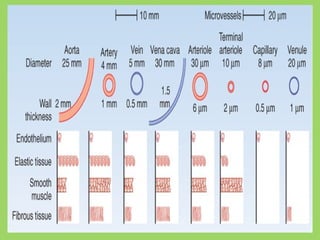
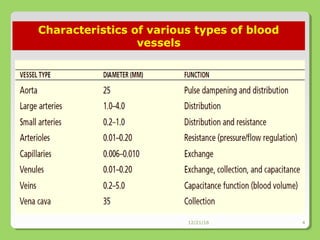
Characteristics of various types of blood
vessels
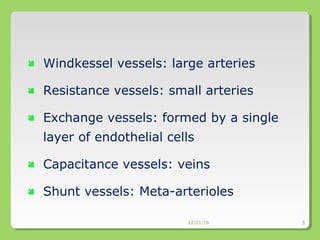
 Windkessel vessels: large arteries
 Resistance vessels: small arteries
 Exchange vessels: formed by a single
layer of endothelial cells
 Capacitance vessels: veins
 Shunt vessels: Meta-arterioles
12/21/16 5
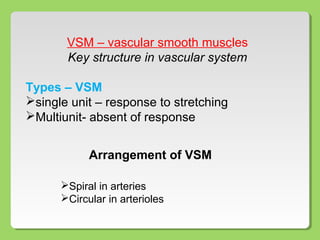
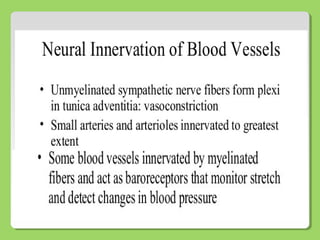
VSM – vascular smooth muscles
Key structure in vascular system
Types – VSM
single unit – response to stretching
Multiunit- absent of response
Arrangement of VSM
Spiral in arteries
Circular in arterioles
2- Pressure and Blood volume in different
segments of circulatory system
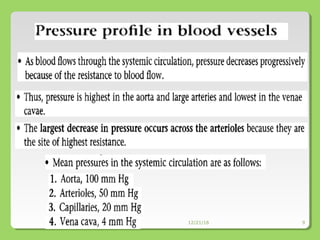
12/21/16 9
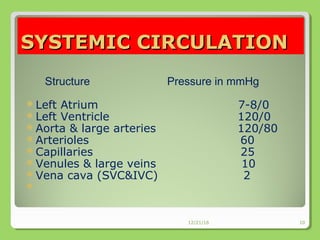
SYSTEMIC CIRCULATIONSYSTEMIC CIRCULATION
Structure Pressure in mmHg
Left Atrium 7-8/0
Left Ventricle 120/0
Aorta & large arteries 120/80
Arterioles 60
Capillaries 25
Venules & large veins 10
Vena cava (SVC&IVC) 2

12/21/16 10
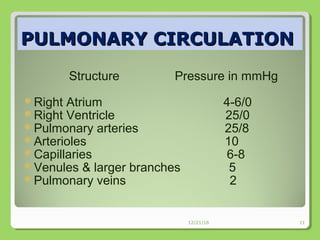
PULMONARY CIRCULATIONPULMONARY CIRCULATION
Structure Pressure in mmHg
Right Atrium 4-6/0
Right Ventricle 25/0
Pulmonary arteries 25/8
Arterioles 10
Capillaries 6-8
Venules & larger branches 5
Pulmonary veins 2
12/21/16 11
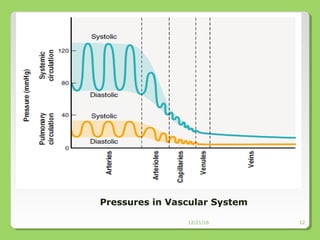
12/21/16 12
Pressures in Vascular System
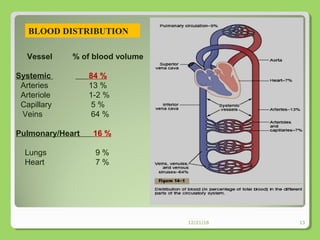
Vessel % of blood volume
Systemic 84 %
Arteries 13 %
Arteriole 1-2 %
Capillary 5 %
Veins 64 %
Pulmonary/Heart 16 %
Lungs 9 %
Heart 7 %
12/21/16 13
BLOOD DISTRIBUTION
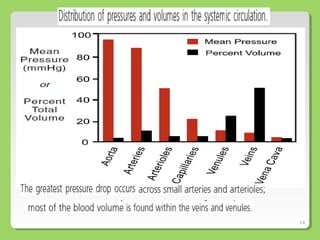
14
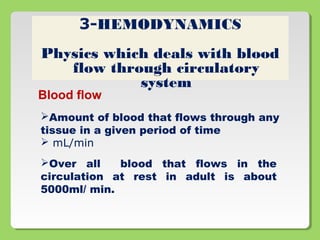
3-HEMODYNAMICS
Physics which deals with blood
flow through circulatory
system
Blood flow
Amount of blood that flows through any
tissue in a given period of time
 mL/min
Over all blood that flows in the
circulation at rest in adult is about
5000ml/ min.
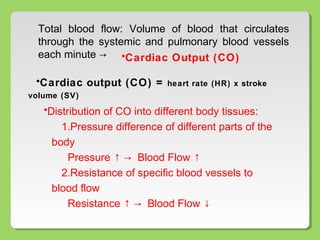
•Distribution of CO into different body tissues:
1.Pressure difference of different parts of the
body
Pressure ↑ → Blood Flow ↑
2.Resistance of specific blood vessels to
blood flow
Resistance ↑ → Blood Flow ↓
Total blood flow: Volume of blood that circulates
through the systemic and pulmonary blood vessels
each minute → •Cardiac Output (CO)
•Cardiac output (CO) = heart rate (HR) x stroke
volume (SV)
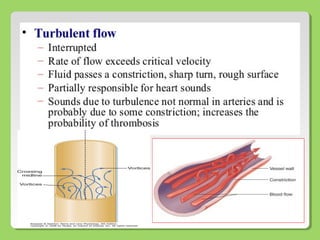
Blood flow patterns - two
types
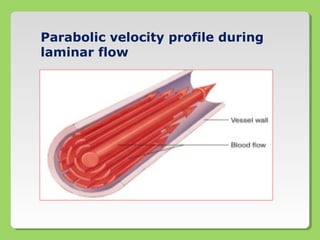
Laminar blood flow
 Turbulent blood flow
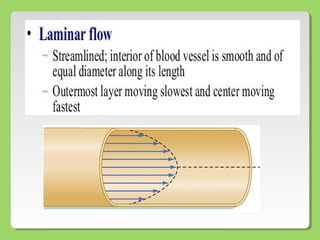
Parabolic velocity profile during
laminar flow
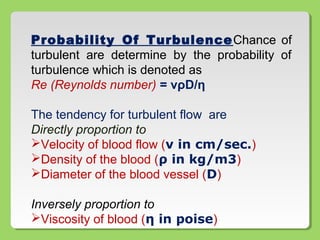
Probability Of TurbulenceChance of
turbulent are determine by the probability of
turbulence which is denoted as
Re (Reynolds number) = vρD/η
The tendency for turbulent flow are
Directly proportion to
Velocity of blood flow (v in cm/sec.)
Density of the blood (ρ in kg/m3)
Diameter of the blood vessel (D)
Inversely proportion to
Viscosity of blood (η in poise)
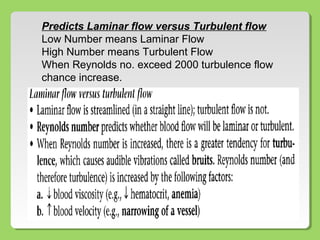
Predicts Laminar flow versus Turbulent flow
Low Number means Laminar Flow
High Number means Turbulent Flow
When Reynolds no. exceed 2000 turbulence flow
chance increase.
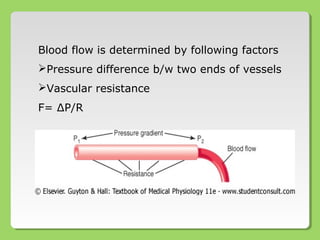
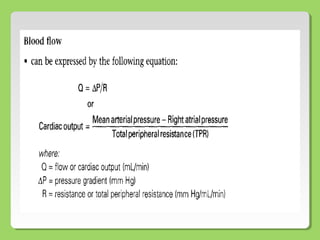
Blood flow is determined by following factors
Pressure difference b/w two ends of vessels
Vascular resistance
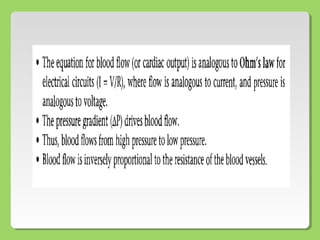
F= ∆P/R
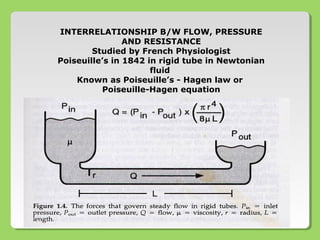
INTERRELATIONSHIP B/W FLOW, PRESSURE
AND RESISTANCE
Studied by French Physiologist
Poiseuille’s in 1842 in rigid tube in Newtonian
fluid
Known as Poiseuille’s - Hagen law or
Poiseuille-Hagen equation
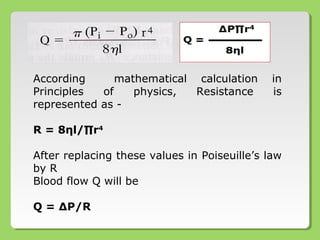
According mathematical calculation in
Principles of physics, Resistance is
represented as -
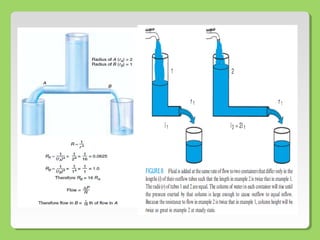
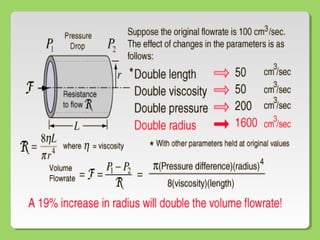
R = 8ηl/∏r4
After replacing these values in Poiseuille’s law
by R
Blood flow Q will be
Q = ∆P/R
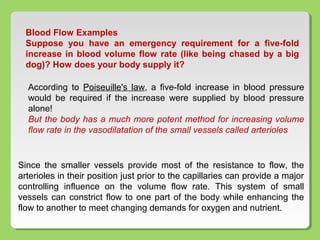
Blood Flow Examples
Suppose you have an emergency requirement for a five-fold
increase in blood volume flow rate (like being chased by a big
dog)? How does your body supply it?
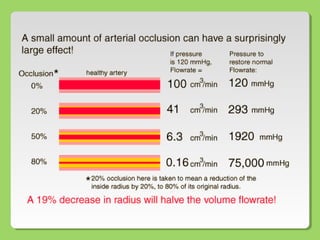
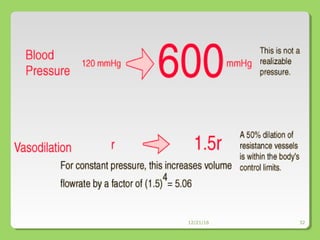
According to Poiseuille's law, a five-fold increase in blood pressure
would be required if the increase were supplied by blood pressure
alone!
But the body has a much more potent method for increasing volume
flow rate in the vasodilatation of the small vessels called arterioles
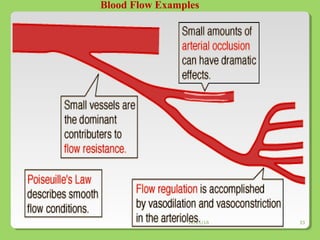
Since the smaller vessels provide most of the resistance to flow, the
arterioles in their position just prior to the capillaries can provide a major
controlling influence on the volume flow rate. This system of small
vessels can constrict flow to one part of the body while enhancing the
flow to another to meet changing demands for oxygen and nutrient.
12/21/16 32
Blood Flow Examples
12/21/16 33
Haemodynamics 2

Haemodynamics 2

  • 1.
    General principals ofGeneralprincipals of circulationcirculation Dr. Kamla Choudhary Assistant Professor
  • 2.
    Dynamics of Circulationwill be discussed under following heading:- 1.Functional organization and structure of Vascular System 2. Pressure and Blood Flow in different segments of circulatory system 3.Hemodynamic 4. Blood pressure
  • 4.
    12/21/16 4 Characteristics ofvarious types of blood vessels
  • 5.
     Windkessel vessels:large arteries  Resistance vessels: small arteries  Exchange vessels: formed by a single layer of endothelial cells  Capacitance vessels: veins  Shunt vessels: Meta-arterioles 12/21/16 5
  • 6.
    VSM – vascularsmooth muscles Key structure in vascular system Types – VSM single unit – response to stretching Multiunit- absent of response Arrangement of VSM Spiral in arteries Circular in arterioles
  • 8.
    2- Pressure andBlood volume in different segments of circulatory system
  • 9.
  • 10.
    SYSTEMIC CIRCULATIONSYSTEMIC CIRCULATION StructurePressure in mmHg Left Atrium 7-8/0 Left Ventricle 120/0 Aorta & large arteries 120/80 Arterioles 60 Capillaries 25 Venules & large veins 10 Vena cava (SVC&IVC) 2  12/21/16 10
  • 11.
    PULMONARY CIRCULATIONPULMONARY CIRCULATION StructurePressure in mmHg Right Atrium 4-6/0 Right Ventricle 25/0 Pulmonary arteries 25/8 Arterioles 10 Capillaries 6-8 Venules & larger branches 5 Pulmonary veins 2 12/21/16 11
  • 12.
    12/21/16 12 Pressures inVascular System
  • 13.
    Vessel % ofblood volume Systemic 84 % Arteries 13 % Arteriole 1-2 % Capillary 5 % Veins 64 % Pulmonary/Heart 16 % Lungs 9 % Heart 7 % 12/21/16 13 BLOOD DISTRIBUTION
  • 14.
  • 15.
    3-HEMODYNAMICS Physics which dealswith blood flow through circulatory system Blood flow Amount of blood that flows through any tissue in a given period of time  mL/min Over all blood that flows in the circulation at rest in adult is about 5000ml/ min.
  • 16.
    •Distribution of COinto different body tissues: 1.Pressure difference of different parts of the body Pressure ↑ → Blood Flow ↑ 2.Resistance of specific blood vessels to blood flow Resistance ↑ → Blood Flow ↓ Total blood flow: Volume of blood that circulates through the systemic and pulmonary blood vessels each minute → •Cardiac Output (CO) •Cardiac output (CO) = heart rate (HR) x stroke volume (SV)
  • 17.
    Blood flow patterns- two types Laminar blood flow  Turbulent blood flow
  • 19.
    Parabolic velocity profileduring laminar flow
  • 21.
    Probability Of TurbulenceChanceof turbulent are determine by the probability of turbulence which is denoted as Re (Reynolds number) = vρD/η The tendency for turbulent flow are Directly proportion to Velocity of blood flow (v in cm/sec.) Density of the blood (ρ in kg/m3) Diameter of the blood vessel (D) Inversely proportion to Viscosity of blood (η in poise)
  • 22.
    Predicts Laminar flowversus Turbulent flow Low Number means Laminar Flow High Number means Turbulent Flow When Reynolds no. exceed 2000 turbulence flow chance increase.
  • 23.
    Blood flow isdetermined by following factors Pressure difference b/w two ends of vessels Vascular resistance F= ∆P/R
  • 25.
    INTERRELATIONSHIP B/W FLOW,PRESSURE AND RESISTANCE Studied by French Physiologist Poiseuille’s in 1842 in rigid tube in Newtonian fluid Known as Poiseuille’s - Hagen law or Poiseuille-Hagen equation
  • 26.
    According mathematical calculationin Principles of physics, Resistance is represented as - R = 8ηl/∏r4 After replacing these values in Poiseuille’s law by R Blood flow Q will be Q = ∆P/R
  • 31.
    Blood Flow Examples Supposeyou have an emergency requirement for a five-fold increase in blood volume flow rate (like being chased by a big dog)? How does your body supply it? According to Poiseuille's law, a five-fold increase in blood pressure would be required if the increase were supplied by blood pressure alone! But the body has a much more potent method for increasing volume flow rate in the vasodilatation of the small vessels called arterioles Since the smaller vessels provide most of the resistance to flow, the arterioles in their position just prior to the capillaries can provide a major controlling influence on the volume flow rate. This system of small vessels can constrict flow to one part of the body while enhancing the flow to another to meet changing demands for oxygen and nutrient.
  • 32.
  • 33.