HelpingHelping
 Why do we help?Why do we help?
 When will we help?When will we help?
 Who will help?Who will help?
 How can we increase helping?How can we increase helping?
HelpingHelping
AltruismAltruism
A motive to increase another’s welfareA motive to increase another’s welfare
without conscious regard for one’s self-without conscious regard for one’s self-
interests.interests.
Altruism:Altruism:
EgoismEgoism
A motive to increase one’s own welfare.A motive to increase one’s own welfare.
Egoism:Egoism:
1.) Why do we help?1.) Why do we help?
Social-exchangeSocial-exchange
Social NormsSocial Norms
Evolutionary PsychologyEvolutionary Psychology
Why do we help? (Why do we help? (TheoriesTheories))
Social ExchangeSocial Exchange
the theory that human interactions arethe theory that human interactions are
transactions that aim to maximize one’stransactions that aim to maximize one’s
rewards and minimize one’s costs.rewards and minimize one’s costs.
Social-exchange theory:Social-exchange theory:
RewardsRewards
 External rewardsExternal rewards
 Internal rewardsInternal rewards
Rewards:Rewards:
 ExternalExternal – “we give to get”.– “we give to get”.
 InternalInternal – “our sense of self-worth”.– “our sense of self-worth”.
Rewards:Rewards:
 GuiltGuilt
 Feel bad-do goodFeel bad-do good
 Feel good-do goodFeel good-do good
Internal Rewards:Internal Rewards:
((emotional state/personal traitsemotional state/personal traits))
Social NormsSocial Norms
 are social expectations.are social expectations.
 prescribes proper behavior.prescribes proper behavior.
Social Norms:Social Norms:
 The Reciprocity NormThe Reciprocity Norm
 The Social-Responsibility NormThe Social-Responsibility Norm
Two Social Norms:Two Social Norms:
 The Reciprocity NormThe Reciprocity Norm – an expectation– an expectation
that people will help, not hurt, those whothat people will help, not hurt, those who
have helped them.have helped them.
 The Social-Responsibility NormThe Social-Responsibility Norm – an– an
expectation that people will help thoseexpectation that people will help those
needing help.needing help.
Two Social Norms:Two Social Norms:
Gender and Receiving HelpGender and Receiving Help
 WomenWomen offered help equally to males andoffered help equally to males and
females, whereasfemales, whereas MenMen offered more helpoffered more help
when the persons in need were females.when the persons in need were females.
Gender & Receiving Help:Gender & Receiving Help:
Evolutionary PsychologyEvolutionary Psychology
 the study of the evolution of cognitionthe study of the evolution of cognition
and behavior using the principles ofand behavior using the principles of
natural selection.natural selection.
 the theory contends that the essence ofthe theory contends that the essence of
life is survival.life is survival.
Evolutionary Psychology:Evolutionary Psychology:
 Kin ProtectionKin Protection
 kin selection-kin selection- the idea that evolution has selectedthe idea that evolution has selected
altruism towards one’s close relatives to enhancealtruism towards one’s close relatives to enhance
the survival of mutually shared genes.the survival of mutually shared genes.
 ReciprocityReciprocity
Two types of self-sacrificialTwo types of self-sacrificial
helping (helping (Evolutionary Psychology TheoryEvolutionary Psychology Theory))
Comparison of TheoriesComparison of Theories
Theory Level of
Explanation
Externally
Helping
Intrinsic
Helping
Social-Social-
exchangeexchange
PsychologicalPsychological External rewards for
helping
Inner rewards for
helping
Social NormsSocial Norms SociologicalSociological Reciprocity norm Social-responsibility
norm
EvolutionaryEvolutionary BiologicalBiological Reciprocity Kin selection
Genuine Altruism/EmpathyGenuine Altruism/Empathy
the vicarious experience of another’sthe vicarious experience of another’s
feelings; putting oneself in another’s shoes.feelings; putting oneself in another’s shoes.
Empathy:Empathy:
(2) When will we help?(2) When will we help?
 As the number of bystanders increases,As the number of bystanders increases,
any given bystander is less likely toany given bystander is less likely to
notice the incident, less likely to assumenotice the incident, less likely to assume
responsibility for taking action.responsibility for taking action.
 Lone bystanders were more likely to help.Lone bystanders were more likely to help.
Number of Bystanders:Number of Bystanders:
 The finding that a person is less likely toThe finding that a person is less likely to
provide help when there are otherprovide help when there are other
bystanders.bystanders.
Bystander effect:Bystander effect:
Noticing/InterpretingNoticing/Interpreting
Assuming ResponsibilityAssuming Responsibility
 Prosocial models do promote altruism.Prosocial models do promote altruism.
ExampleExample: New Jersey shoppers were most: New Jersey shoppers were most
likely to drop money in a Salvation Armylikely to drop money in a Salvation Army
kettle if they had seen someone else dokettle if they had seen someone else do
the same.the same.
Helping when someone else does:Helping when someone else does:
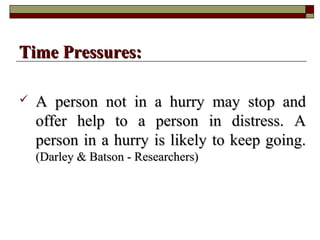
 A person not in a hurry may stop andA person not in a hurry may stop and
offer help to a person in distress. Aoffer help to a person in distress. A
person in a hurry is likely to keep going.person in a hurry is likely to keep going.
(Darley & Batson - Researchers)(Darley & Batson - Researchers)
Time Pressures:Time Pressures:
 We tend to help those whom we perceiveWe tend to help those whom we perceive
as being similar to us.as being similar to us.
Similarity:Similarity:
(3) Who will help?(3) Who will help?
 Attitude and trait predict averageAttitude and trait predict average
behavior across many situations morebehavior across many situations more
accurately.accurately.
 IndividualIndividual differencesdifferences – “some people are– “some people are
reliably more helpful”.reliably more helpful”.
Personality Traits:Personality Traits:
 NetworkNetwork traitstraits – “those high in positive– “those high in positive
emotionality, empathy & self-efficacy areemotionality, empathy & self-efficacy are
most likely concerned and helpful.”most likely concerned and helpful.”
 Personality influences how particularPersonality influences how particular
people react to particular situations.people react to particular situations.
Personality Traits:Personality Traits:
 Predicts long-term altruism, as reflected IPredicts long-term altruism, as reflected I
volunteerism & charitable contributions.volunteerism & charitable contributions.
Religious Faith:Religious Faith:
(4) How can we increase helping?(4) How can we increase helping?
 ReduceReduce the ambiguity andthe ambiguity and increaseincrease
responsibility.responsibility.
 UseUse door-in-the-facedoor-in-the-face effecteffect technique totechnique to
evoke guilt feelings or concern for self-evoke guilt feelings or concern for self-
image.image.
 TeachTeach altruismaltruism..
3 ways to increase helping:3 ways to increase helping:
 Door-in-the-faceDoor-in-the-face effecteffect – A strategy for– A strategy for
gaining a concession.gaining a concession.
 Overjustification effectOverjustification effect – the result of– the result of
bribing people to do what they alreadybribing people to do what they already
like doing; they may then see theirlike doing; they may then see their
actions as externally controlled ratheractions as externally controlled rather
than intrinsically appealing.than intrinsically appealing.

Helping

  • 1.
  • 2.
     Why dowe help?Why do we help?  When will we help?When will we help?  Who will help?Who will help?  How can we increase helping?How can we increase helping? HelpingHelping
  • 3.
  • 4.
    A motive toincrease another’s welfareA motive to increase another’s welfare without conscious regard for one’s self-without conscious regard for one’s self- interests.interests. Altruism:Altruism:
  • 5.
  • 6.
    A motive toincrease one’s own welfare.A motive to increase one’s own welfare. Egoism:Egoism:
  • 7.
    1.) Why dowe help?1.) Why do we help?
  • 8.
    Social-exchangeSocial-exchange Social NormsSocial Norms EvolutionaryPsychologyEvolutionary Psychology Why do we help? (Why do we help? (TheoriesTheories))
  • 9.
  • 10.
    the theory thathuman interactions arethe theory that human interactions are transactions that aim to maximize one’stransactions that aim to maximize one’s rewards and minimize one’s costs.rewards and minimize one’s costs. Social-exchange theory:Social-exchange theory:
  • 11.
  • 12.
     External rewardsExternalrewards  Internal rewardsInternal rewards Rewards:Rewards:
  • 13.
     ExternalExternal –“we give to get”.– “we give to get”.  InternalInternal – “our sense of self-worth”.– “our sense of self-worth”. Rewards:Rewards:
  • 14.
     GuiltGuilt  Feelbad-do goodFeel bad-do good  Feel good-do goodFeel good-do good Internal Rewards:Internal Rewards: ((emotional state/personal traitsemotional state/personal traits))
  • 15.
  • 16.
     are socialexpectations.are social expectations.  prescribes proper behavior.prescribes proper behavior. Social Norms:Social Norms:
  • 17.
     The ReciprocityNormThe Reciprocity Norm  The Social-Responsibility NormThe Social-Responsibility Norm Two Social Norms:Two Social Norms:
  • 18.
     The ReciprocityNormThe Reciprocity Norm – an expectation– an expectation that people will help, not hurt, those whothat people will help, not hurt, those who have helped them.have helped them.  The Social-Responsibility NormThe Social-Responsibility Norm – an– an expectation that people will help thoseexpectation that people will help those needing help.needing help. Two Social Norms:Two Social Norms:
  • 19.
    Gender and ReceivingHelpGender and Receiving Help
  • 20.
     WomenWomen offeredhelp equally to males andoffered help equally to males and females, whereasfemales, whereas MenMen offered more helpoffered more help when the persons in need were females.when the persons in need were females. Gender & Receiving Help:Gender & Receiving Help:
  • 21.
  • 22.
     the studyof the evolution of cognitionthe study of the evolution of cognition and behavior using the principles ofand behavior using the principles of natural selection.natural selection.  the theory contends that the essence ofthe theory contends that the essence of life is survival.life is survival. Evolutionary Psychology:Evolutionary Psychology:
  • 23.
     Kin ProtectionKinProtection  kin selection-kin selection- the idea that evolution has selectedthe idea that evolution has selected altruism towards one’s close relatives to enhancealtruism towards one’s close relatives to enhance the survival of mutually shared genes.the survival of mutually shared genes.  ReciprocityReciprocity Two types of self-sacrificialTwo types of self-sacrificial helping (helping (Evolutionary Psychology TheoryEvolutionary Psychology Theory))
  • 24.
    Comparison of TheoriesComparisonof Theories Theory Level of Explanation Externally Helping Intrinsic Helping Social-Social- exchangeexchange PsychologicalPsychological External rewards for helping Inner rewards for helping Social NormsSocial Norms SociologicalSociological Reciprocity norm Social-responsibility norm EvolutionaryEvolutionary BiologicalBiological Reciprocity Kin selection
  • 25.
  • 26.
    the vicarious experienceof another’sthe vicarious experience of another’s feelings; putting oneself in another’s shoes.feelings; putting oneself in another’s shoes. Empathy:Empathy:
  • 27.
    (2) When willwe help?(2) When will we help?
  • 28.
     As thenumber of bystanders increases,As the number of bystanders increases, any given bystander is less likely toany given bystander is less likely to notice the incident, less likely to assumenotice the incident, less likely to assume responsibility for taking action.responsibility for taking action.  Lone bystanders were more likely to help.Lone bystanders were more likely to help. Number of Bystanders:Number of Bystanders:
  • 29.
     The findingthat a person is less likely toThe finding that a person is less likely to provide help when there are otherprovide help when there are other bystanders.bystanders. Bystander effect:Bystander effect:
  • 30.
  • 31.
     Prosocial modelsdo promote altruism.Prosocial models do promote altruism. ExampleExample: New Jersey shoppers were most: New Jersey shoppers were most likely to drop money in a Salvation Armylikely to drop money in a Salvation Army kettle if they had seen someone else dokettle if they had seen someone else do the same.the same. Helping when someone else does:Helping when someone else does:
  • 32.
     A personnot in a hurry may stop andA person not in a hurry may stop and offer help to a person in distress. Aoffer help to a person in distress. A person in a hurry is likely to keep going.person in a hurry is likely to keep going. (Darley & Batson - Researchers)(Darley & Batson - Researchers) Time Pressures:Time Pressures:
  • 33.
     We tendto help those whom we perceiveWe tend to help those whom we perceive as being similar to us.as being similar to us. Similarity:Similarity:
  • 34.
    (3) Who willhelp?(3) Who will help?
  • 35.
     Attitude andtrait predict averageAttitude and trait predict average behavior across many situations morebehavior across many situations more accurately.accurately.  IndividualIndividual differencesdifferences – “some people are– “some people are reliably more helpful”.reliably more helpful”. Personality Traits:Personality Traits:
  • 36.
     NetworkNetwork traitstraits– “those high in positive– “those high in positive emotionality, empathy & self-efficacy areemotionality, empathy & self-efficacy are most likely concerned and helpful.”most likely concerned and helpful.”  Personality influences how particularPersonality influences how particular people react to particular situations.people react to particular situations. Personality Traits:Personality Traits:
  • 37.
     Predicts long-termaltruism, as reflected IPredicts long-term altruism, as reflected I volunteerism & charitable contributions.volunteerism & charitable contributions. Religious Faith:Religious Faith:
  • 38.
    (4) How canwe increase helping?(4) How can we increase helping?
  • 39.
     ReduceReduce theambiguity andthe ambiguity and increaseincrease responsibility.responsibility.  UseUse door-in-the-facedoor-in-the-face effecteffect technique totechnique to evoke guilt feelings or concern for self-evoke guilt feelings or concern for self- image.image.  TeachTeach altruismaltruism.. 3 ways to increase helping:3 ways to increase helping:
  • 40.
     Door-in-the-faceDoor-in-the-face effecteffect– A strategy for– A strategy for gaining a concession.gaining a concession.  Overjustification effectOverjustification effect – the result of– the result of bribing people to do what they alreadybribing people to do what they already like doing; they may then see theirlike doing; they may then see their actions as externally controlled ratheractions as externally controlled rather than intrinsically appealing.than intrinsically appealing.