Do Many Hands Make More Help?:
Prosocial Behavior
Consider the four people in your life I’ve listed below. Please
think about your entire life so far and rank these four people in
terms of how much they have helped you.
___ A. maternal grandmother (mom’s mom)
___ B. maternal grandfather (mom’s dad)
___ C. paternal grandmother (dad’s mom)
___ D. paternal grandfather (dad’s dad)
But before we review and discuss research on helping, I’d
like to remind you that much of what you’ve already learned
in this course is highly relevant to helping behavior.
attribution
evolution
prejudice &
stereotypes
social influence
close
relationships
power of the
situation
constructivism
Kitty Genovese
1964, Queens, NY. Kitty Genovese returns home at 3 a.m.
She’s brutally attacked by a guy with a knife. She screams,
waking many of her neighbors (at least 38).
She calls out for help repeatedly for more than 30 minutes.
Nobody helps. (Some say no one even called the police.)
Her attacker finally leaves, and Kitty Genovese is dead.
The media concluded that our society had crumbled.
Social psychologists concluded that we needed to better
understand helping behavior.
Many years after Kitty Genovese was murdered, a plane
crashed near Taos, NM -- at about 8 p.m. By 9 p.m., nearby
citizens had organized a volunteer-only search operation, and
by 6:32 a.m., they found & rescued Greg Morris & his family.
Social psychologists concluded that we needed to better
understand helping behavior.
Many years after Kitty Genovese was murdered, a plane
crashed near Taos, NM -- at about 8 p.m. By 9 p.m., nearby
citizens had organized a volunteer-only search operation, and
by 6:32 a.m., they found & rescued Greg Morris & his family.
Morris’s response was to sue several NM state agencies for
not rescuing his family “quickly enough.”
These two stories illustrate some of the complexities of helping.
prosocial behavior - behavior that benefits other people
bystander intervention - helping a stranger during an emergency
altruism - prosocial behavior that:
a) is voluntary
b) is costly to the performer
c) is NOT motivated by the anticipation of reward
Notice that the definition of altruism involves internal states
(intention or motivation). This is extremely difficult to show.
Let’s examine two very different theories of bystander
intervention.
Darley & Latané. 1960’s, response to Kitty Genovese story.
In order to intervene (help in an emergency) a bystander must:
1 Notice the emergency
2 Interpret it as such
3 Assume responsibility for helping
4 Choose a strategy for helping
5 Implement the Strategy
Contrast this with Piliavin, Piliavin, & Rodin’s (1975) model,
which has four assumptions:
1 The sight of a distressed person unpleasant arousal
2 This arousal is labeled (fear, sympathy, confusion, etc.)
3 If (& only if) arousal is labeled as sympathy, people will
consider the rewards & costs of helping vs. not helping
4 If rewards outweigh the costs, people will help.
So if the perceived costs to me (of helping) are low & the
cost to the victim (of not helping) are high, what will I do?
What if the costs to me (of helping) are high & the costs to
the victim (of not helping) are low?
What if both are high?
So if the perceived costs to me (of helping) are low & the
cost to the victim (of not helping) are high, what will I do?
What if the costs to me (of helping) are high & the costs to
the victim (of not helping) are low?
What if both are high?
It depends. I will try to find a way to:
redefine the situation, make excuses, or spread the blame,
(& if I can do so, I will be very unlikely to help).
Notice that this is a hedonistic model. It assumes that
we’re selfish and wish to feel good.
It’s based on the “minimax rule.”
Human beings wish to:
minimize costs/pain & maximize rewards/pleasure.
Which model is right?
Are we inherently selfish? Inherently helpful? Or both?
This is hard to say, but let’s begin to tackle the question by
examining support for both models.
When do we help?
1. when no one else is around.
2. when the cost of helping is low
3. when we feel empathy for a victim
4. when those who need help trigger helping (for
evolutionary reasons)
I. We help when no one else (who could help) is around.
the bystander effect -- people are less likely to help,
and slower to help, when other people are present
Darley & Latané (1968) “communication study”
the bystander effect -- people are less likely to help,
and slower to help, when other people are present
Darley & Latané (1968) “communication study”
0
10
20
30
40
50
60
70
80
90 85
62
31
Alone
1 other
4 others
Percentage of people responding within 1 minute.
Interestingly, Darley & Latané have shown the
bystander effect even when the victim is us.
Why does it occur?
1. social influence - we use others as cues to interpret
novel situations. (constructivism)
Interestingly, Darley & Latané have shown the
bystander effect even when the victim is us.
Why does it occur?
1. social influence - we use others as cues to interpret
novel situations. (constructivism)
2. audience inhibition - “evaluation apprehension” we
don’t want to look stupid (by overreacting)
Interestingly, Darley & Latané have shown the
bystander effect even when the victim is us.
Why does it occur?
1. social influence - we use others as cues to interpret
novel situations. (constructivism)
2. audience inhibition - “evaluation apprehension” we
don’t want to look stupid (by overreacting)
3. diffusion of responsibility -- more observers means
more people to share the blame for NOT helping
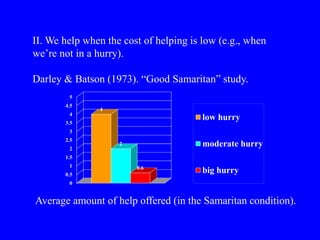
II. We help when the cost of helping is low (e.g., when
we’re not in a hurry).
Darley & Batson (1973). “Good Samaritan” study.
II. We help when the cost of helping is low (e.g., when
we’re not in a hurry).
Darley & Batson (1973). “Good Samaritan” study.
0
0.5
1
1.5
2
2.5
3
3.5
4
4.5
5
4
2
0.6
low hurry
moderate hurry
big hurry
Average amount of help offered (in the Samaritan condition).
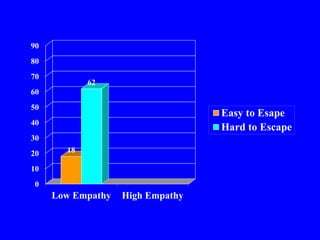
III. We help when we feel EMPATHY for a victim.
Batson et al.’s empathy-altruism model (1981).
Participants take part in a study with Elaine…
Elaine is highly similar or highly dissimilar to participants*
And it’s easy or hard to “escape” from the experiment.
*Similarity is known to promote empathy. Studies that have measured naturally
occurring empathy have yielded results similar to those you’re about to see.
0
10
20
30
40
50
60
70
80
90
Low Empathy High Empathy
18
62
Easy to Esape
Hard to Escape
0
10
20
30
40
50
60
70
80
90
Low Empathy High Empathy
18
88
62
83
Easy to Esape
Hard to Escape
How can we be so unhelpful at times and so helpful
at others?
An evolutionary perspective.
It is adaptive to help ingroup members because of
things such as reciprocal altruism (and it’s ingroup
members for whom we often feel empathy).
reciprocal altruism - trading of altruistic acts by
individuals (at different times).
OK. So (1) the power of the situation plays a big
role in helping behavior and (2) it looks like people
who truly feel empathy for a person in need may
sometimes engage in true altruism.
But there must be some predictors of routine
helping behavior other than having time on one’s
hands and feeling empathy for a victim.
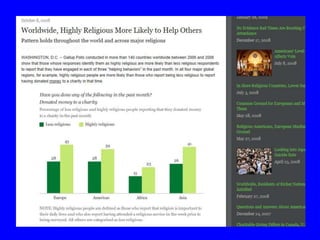
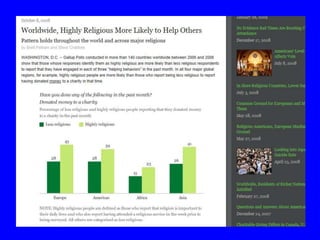
Who helps? There is still some debate about this.
But most people now agree, for example, that
highly religious people are especially helpful.
In the end, it’s almost impossible to know for sure what
ultimately motivated a costly helping behavior.
Nonetheless, many anecdotes that suggest true altruism
involve the behavior of highly religious people. It seems
unlikely that Mother Teresa or Martin Luther King, Jr. would
have done what they did if they hadn’t felt their work was a
fulfillment of firmly held their religious beliefs and ideals.
One way to resolve the debate about altruism is to consider
that certain kinds of helping may become automatic to people
who are highly empathic. Thus, they may (a) “mindlessly” do
some of the most noble (heroic) things imaginable or (b) set
out consciously to make superhuman sacrifices on a daily basis.
One of the most puzzling things about helping behavior,
especially apparent examples of altruism, is that real altruism
seems incompatible with some of the basic principles of
evolution. Thus, Richard Dawkins argued in The Selfish Gene
that true altruism is logically and biologically impossible.
But more recent evolutionary thinking suggests that social
creatures such as monkeys, people, lions, ants and vampire
bats may be predisposed to care about other members of their
species and engage, for example, in reciprocal altruism.
Vampire bats and ants do this almost every day.
http://www.livescience.com/25860-altruism-brain-cells-found.html
You can read about
a recent study that
suggests that helping
others is truly
rewarding (at least
in rhesus monkeys).
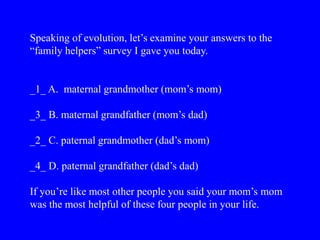
Speaking of evolution, let’s examine your answers to the
“family helpers” survey I gave you today.
___ A. maternal grandmother (mom’s mom)
___ B. maternal grandfather (mom’s dad)
___ C. paternal grandmother (dad’s mom)
___ D. paternal grandfather (dad’s dad)
Speaking of evolution, let’s examine your answers to the
“family helpers” survey I gave you today.
___ A. maternal grandmother (mom’s mom)
___ B. maternal grandfather (mom’s dad)
___ C. paternal grandmother (dad’s mom)
___ D. paternal grandfather (dad’s dad)
If you’re like most other people you said your mom’s mom
was the most helpful of these four people in your life.
Speaking of evolution, let’s examine your answers to the
“family helpers” survey I gave you today.
_1_ A. maternal grandmother (mom’s mom)
_3_ B. maternal grandfather (mom’s dad)
_2_ C. paternal grandmother (dad’s mom)
_4_ D. paternal grandfather (dad’s dad)
If you’re like most other people you said your mom’s mom
was the most helpful of these four people in your life.
Finally, as it turns out, helping other people may not just feel
good. It may also help us live longer.
Brown and colleagues (2003)* followed about 800 seniors
(aged 65+) for five years. Those most likely to survive
over the five-year window were those who initially reported
offering the most emotional and physical help (aka “social
support”) to other people.
It may be better to give than to receive. Or is it?
*Brown, Ness, Vinokur, & Smith (2003). Psych Science.
Couldn’t this “help leads to health” (or “giving leads to living,”
if you prefer) finding be based on demographic or personality
confounds? Perhaps women help others more and also happen
to live longer than men.
Couldn’t this “help leads to health” (or “giving leads to living,”
if you prefer) finding be based on demographic or personality
confounds? Perhaps women help others more and also happen
to live longer than men.
Brown et al. were worried about this, too. They statistically
controlled for: age, gender, education, income, exercise level,
smoking status, alcohol consumption, subjective well-being,
health satisfaction, self-rated functional health, interviewer
rated health, the 5 basic human personality factors (OCEAN),
marital satisfaction, perceived marital equity, receipt of social
support, & psychological dependence on one’s spouse.
The help  health mortality effect still held up!
So get out there and help people, especially if you are a senior
citizen!
And when you can’t help by yourself, consider trying to help
locate someone else who can. Here is a great opportunity,
especially if you or someone you know is from India.
http://www.psychologytoday.com/blog/science-small-
talk/201303/point-click-save-womans-life

Lecture_16_or_so_Prosocial_Behavior_.pptx

  • 1.
    Do Many HandsMake More Help?: Prosocial Behavior
  • 2.
    Consider the fourpeople in your life I’ve listed below. Please think about your entire life so far and rank these four people in terms of how much they have helped you. ___ A. maternal grandmother (mom’s mom) ___ B. maternal grandfather (mom’s dad) ___ C. paternal grandmother (dad’s mom) ___ D. paternal grandfather (dad’s dad)
  • 3.
    But before wereview and discuss research on helping, I’d like to remind you that much of what you’ve already learned in this course is highly relevant to helping behavior. attribution evolution prejudice & stereotypes social influence close relationships power of the situation constructivism
  • 4.
    Kitty Genovese 1964, Queens,NY. Kitty Genovese returns home at 3 a.m. She’s brutally attacked by a guy with a knife. She screams, waking many of her neighbors (at least 38). She calls out for help repeatedly for more than 30 minutes. Nobody helps. (Some say no one even called the police.) Her attacker finally leaves, and Kitty Genovese is dead. The media concluded that our society had crumbled.
  • 5.
    Social psychologists concludedthat we needed to better understand helping behavior. Many years after Kitty Genovese was murdered, a plane crashed near Taos, NM -- at about 8 p.m. By 9 p.m., nearby citizens had organized a volunteer-only search operation, and by 6:32 a.m., they found & rescued Greg Morris & his family.
  • 6.
    Social psychologists concludedthat we needed to better understand helping behavior. Many years after Kitty Genovese was murdered, a plane crashed near Taos, NM -- at about 8 p.m. By 9 p.m., nearby citizens had organized a volunteer-only search operation, and by 6:32 a.m., they found & rescued Greg Morris & his family. Morris’s response was to sue several NM state agencies for not rescuing his family “quickly enough.”
  • 7.
    These two storiesillustrate some of the complexities of helping. prosocial behavior - behavior that benefits other people bystander intervention - helping a stranger during an emergency altruism - prosocial behavior that: a) is voluntary b) is costly to the performer c) is NOT motivated by the anticipation of reward Notice that the definition of altruism involves internal states (intention or motivation). This is extremely difficult to show.
  • 8.
    Let’s examine twovery different theories of bystander intervention. Darley & Latané. 1960’s, response to Kitty Genovese story. In order to intervene (help in an emergency) a bystander must: 1 Notice the emergency 2 Interpret it as such 3 Assume responsibility for helping 4 Choose a strategy for helping 5 Implement the Strategy
  • 9.
    Contrast this withPiliavin, Piliavin, & Rodin’s (1975) model, which has four assumptions: 1 The sight of a distressed person unpleasant arousal 2 This arousal is labeled (fear, sympathy, confusion, etc.) 3 If (& only if) arousal is labeled as sympathy, people will consider the rewards & costs of helping vs. not helping 4 If rewards outweigh the costs, people will help.
  • 10.
    So if theperceived costs to me (of helping) are low & the cost to the victim (of not helping) are high, what will I do? What if the costs to me (of helping) are high & the costs to the victim (of not helping) are low? What if both are high?
  • 11.
    So if theperceived costs to me (of helping) are low & the cost to the victim (of not helping) are high, what will I do? What if the costs to me (of helping) are high & the costs to the victim (of not helping) are low? What if both are high? It depends. I will try to find a way to: redefine the situation, make excuses, or spread the blame, (& if I can do so, I will be very unlikely to help).
  • 12.
    Notice that thisis a hedonistic model. It assumes that we’re selfish and wish to feel good. It’s based on the “minimax rule.” Human beings wish to: minimize costs/pain & maximize rewards/pleasure. Which model is right? Are we inherently selfish? Inherently helpful? Or both?
  • 13.
    This is hardto say, but let’s begin to tackle the question by examining support for both models. When do we help? 1. when no one else is around. 2. when the cost of helping is low 3. when we feel empathy for a victim 4. when those who need help trigger helping (for evolutionary reasons)
  • 14.
    I. We helpwhen no one else (who could help) is around. the bystander effect -- people are less likely to help, and slower to help, when other people are present Darley & Latané (1968) “communication study”
  • 15.
    the bystander effect-- people are less likely to help, and slower to help, when other people are present Darley & Latané (1968) “communication study” 0 10 20 30 40 50 60 70 80 90 85 62 31 Alone 1 other 4 others Percentage of people responding within 1 minute.
  • 16.
    Interestingly, Darley &Latané have shown the bystander effect even when the victim is us. Why does it occur? 1. social influence - we use others as cues to interpret novel situations. (constructivism)
  • 17.
    Interestingly, Darley &Latané have shown the bystander effect even when the victim is us. Why does it occur? 1. social influence - we use others as cues to interpret novel situations. (constructivism) 2. audience inhibition - “evaluation apprehension” we don’t want to look stupid (by overreacting)
  • 18.
    Interestingly, Darley &Latané have shown the bystander effect even when the victim is us. Why does it occur? 1. social influence - we use others as cues to interpret novel situations. (constructivism) 2. audience inhibition - “evaluation apprehension” we don’t want to look stupid (by overreacting) 3. diffusion of responsibility -- more observers means more people to share the blame for NOT helping
  • 19.
    II. We helpwhen the cost of helping is low (e.g., when we’re not in a hurry). Darley & Batson (1973). “Good Samaritan” study.
  • 20.
    II. We helpwhen the cost of helping is low (e.g., when we’re not in a hurry). Darley & Batson (1973). “Good Samaritan” study. 0 0.5 1 1.5 2 2.5 3 3.5 4 4.5 5 4 2 0.6 low hurry moderate hurry big hurry Average amount of help offered (in the Samaritan condition).
  • 21.
    III. We helpwhen we feel EMPATHY for a victim. Batson et al.’s empathy-altruism model (1981). Participants take part in a study with Elaine… Elaine is highly similar or highly dissimilar to participants* And it’s easy or hard to “escape” from the experiment. *Similarity is known to promote empathy. Studies that have measured naturally occurring empathy have yielded results similar to those you’re about to see.
  • 22.
    0 10 20 30 40 50 60 70 80 90 Low Empathy HighEmpathy 18 62 Easy to Esape Hard to Escape
  • 23.
    0 10 20 30 40 50 60 70 80 90 Low Empathy HighEmpathy 18 88 62 83 Easy to Esape Hard to Escape
  • 24.
    How can webe so unhelpful at times and so helpful at others? An evolutionary perspective. It is adaptive to help ingroup members because of things such as reciprocal altruism (and it’s ingroup members for whom we often feel empathy). reciprocal altruism - trading of altruistic acts by individuals (at different times).
  • 25.
    OK. So (1)the power of the situation plays a big role in helping behavior and (2) it looks like people who truly feel empathy for a person in need may sometimes engage in true altruism. But there must be some predictors of routine helping behavior other than having time on one’s hands and feeling empathy for a victim. Who helps? There is still some debate about this. But most people now agree, for example, that highly religious people are especially helpful.
  • 30.
    In the end,it’s almost impossible to know for sure what ultimately motivated a costly helping behavior. Nonetheless, many anecdotes that suggest true altruism involve the behavior of highly religious people. It seems unlikely that Mother Teresa or Martin Luther King, Jr. would have done what they did if they hadn’t felt their work was a fulfillment of firmly held their religious beliefs and ideals. One way to resolve the debate about altruism is to consider that certain kinds of helping may become automatic to people who are highly empathic. Thus, they may (a) “mindlessly” do some of the most noble (heroic) things imaginable or (b) set out consciously to make superhuman sacrifices on a daily basis.
  • 31.
    One of themost puzzling things about helping behavior, especially apparent examples of altruism, is that real altruism seems incompatible with some of the basic principles of evolution. Thus, Richard Dawkins argued in The Selfish Gene that true altruism is logically and biologically impossible. But more recent evolutionary thinking suggests that social creatures such as monkeys, people, lions, ants and vampire bats may be predisposed to care about other members of their species and engage, for example, in reciprocal altruism. Vampire bats and ants do this almost every day.
  • 32.
    http://www.livescience.com/25860-altruism-brain-cells-found.html You can readabout a recent study that suggests that helping others is truly rewarding (at least in rhesus monkeys).
  • 33.
    Speaking of evolution,let’s examine your answers to the “family helpers” survey I gave you today. ___ A. maternal grandmother (mom’s mom) ___ B. maternal grandfather (mom’s dad) ___ C. paternal grandmother (dad’s mom) ___ D. paternal grandfather (dad’s dad)
  • 34.
    Speaking of evolution,let’s examine your answers to the “family helpers” survey I gave you today. ___ A. maternal grandmother (mom’s mom) ___ B. maternal grandfather (mom’s dad) ___ C. paternal grandmother (dad’s mom) ___ D. paternal grandfather (dad’s dad) If you’re like most other people you said your mom’s mom was the most helpful of these four people in your life.
  • 35.
    Speaking of evolution,let’s examine your answers to the “family helpers” survey I gave you today. _1_ A. maternal grandmother (mom’s mom) _3_ B. maternal grandfather (mom’s dad) _2_ C. paternal grandmother (dad’s mom) _4_ D. paternal grandfather (dad’s dad) If you’re like most other people you said your mom’s mom was the most helpful of these four people in your life.
  • 36.
    Finally, as itturns out, helping other people may not just feel good. It may also help us live longer.
  • 37.
    Brown and colleagues(2003)* followed about 800 seniors (aged 65+) for five years. Those most likely to survive over the five-year window were those who initially reported offering the most emotional and physical help (aka “social support”) to other people. It may be better to give than to receive. Or is it? *Brown, Ness, Vinokur, & Smith (2003). Psych Science.
  • 38.
    Couldn’t this “helpleads to health” (or “giving leads to living,” if you prefer) finding be based on demographic or personality confounds? Perhaps women help others more and also happen to live longer than men.
  • 39.
    Couldn’t this “helpleads to health” (or “giving leads to living,” if you prefer) finding be based on demographic or personality confounds? Perhaps women help others more and also happen to live longer than men. Brown et al. were worried about this, too. They statistically controlled for: age, gender, education, income, exercise level, smoking status, alcohol consumption, subjective well-being, health satisfaction, self-rated functional health, interviewer rated health, the 5 basic human personality factors (OCEAN), marital satisfaction, perceived marital equity, receipt of social support, & psychological dependence on one’s spouse. The help  health mortality effect still held up!
  • 40.
    So get outthere and help people, especially if you are a senior citizen! And when you can’t help by yourself, consider trying to help locate someone else who can. Here is a great opportunity, especially if you or someone you know is from India. http://www.psychologytoday.com/blog/science-small- talk/201303/point-click-save-womans-life