IS ALTRUISM A MYTH?

GERD R. NAYDOCK, MSS, LSW
PHILADELPHIA COLLEGE OF
OSTEOPATHIC MEDICINE
“Altruism is not … an agreeable ornament to social
life, but it will forever be its fundamental basis. How
can we really dispense with it?”        E. Durkheim, 1933
WHAT DEFINES ALTRUISM?


 Altruism  is a motivational state with
 the ultimate goal of increasing
 another‟s welfare without regard to
 self-interest concerns.
OTHER USES OF THE TERM “ALTRUISM”
1.   As helping behavior, not motivational state. This
     simply equates altruism with helping behavior.
     (i.e. evolutionary altruism)

2.   As acting morally. Self-interest is often equated
     with selfishness, which is in turn often
     considered the epitome of immorality.

3.   As helping in order to gain internal rather than
     external rewards.
WHY IS MOTIVATION IMPORTANT?

   Knowing more generally when and where help can
    be expected, and how effective it is likely to be.

   The creation of more caring society.

   Think about some examples in your own life why
    this is important.
ALTRUISM IS COUNTERINTUITIVE TO
EXPLAINING MOTIVATIONS TO HELP
I.      Social Exchange Theory

    Relationships are designed to minimize
     costs and maximize rewards.

    Internal rewards

    External rewards
SOCIOBIOLOGICAL THEORY

   Genes wish to maximize their likelihood of being
    passed on.

   We are more likely to help our kin and those who
    are more “like us” .

   Reciprocal altruism. Reciprocal systems increase
    likelihood of survival. (Especially small systems)
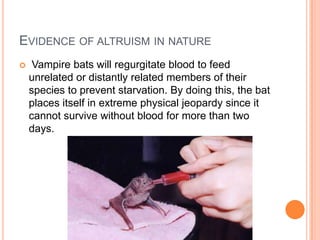
EVIDENCE OF ALTRUISM IN NATURE
    Vampire bats will regurgitate blood to feed
    unrelated or distantly related members of their
    species to prevent starvation. By doing this, the bat
    places itself in extreme physical jeopardy since it
    cannot survive without blood for more than two
    days.
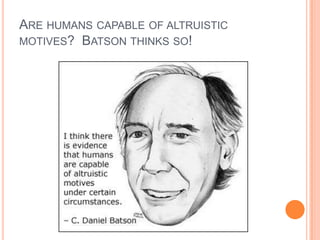
ARE HUMANS CAPABLE OF ALTRUISTIC
MOTIVES? BATSON THINKS SO!
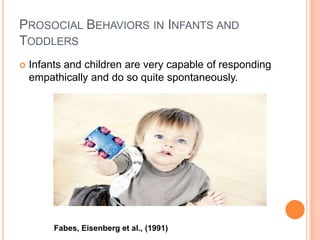
PROSOCIAL BEHAVIORS IN INFANTS AND
TODDLERS
   Infants and children are very capable of responding
    empathically and do so quite spontaneously.


         Fabes, Eisenberg et al., (1991)
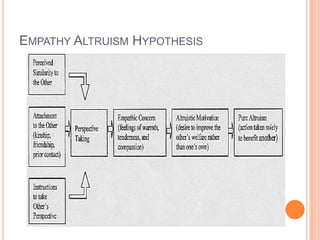
EMPATHY AND ALTRUISM


   The empathy-altruism hypothesis posits that
    when empathy is triggered, people are motivated to
    help out of genuine concern for the welfare of
    others regardless of cost or benefits.

   Conversely, egoism is a motivational state which is
    centered on the goal of increasing one‟s own
    welfare.
EMPATHY ALTRUISM HYPOTHESIS
EMPATHY VS. EGOISM

 Advocates of egoism do not believe that pure
  altruism is a motivator for the ultimate goal of
  helping others. Rather they cite that humans help
  others to:
 1) Minimize their own distress (Aversive-arousal
  reduction)

   2) Avoid punishment (social and self)

   3) Seek Rewards
DOES THE BYSTANDER EFFECT ALWAYS HOLD
               TRUE?

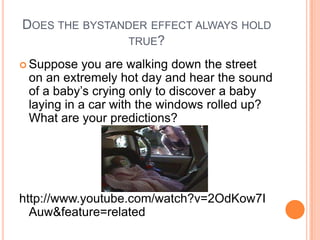
 Suppose   you are walking down the street
 on an extremely hot day and hear the sound
 of a baby‟s crying only to discover a baby
 laying in a car with the windows rolled up?
 What are your predictions?


http://www.youtube.com/watch?v=2OdKow7I
  Auw&feature=related
EMPIRICAL SUPPORT FOR ALTRUISM

 Batson and Shaw (1991)
 Witness a person (confederate) receiving electric
  shock
 Told they could fill in for the person taking shocks if
  they like
 Half were allowed to stop watching situation

 Authors manipulated whether experimenter and
  target knew of participant choice (WHY?)
RESULTS…..


   High empathy participants: helped regardless of
    ease of escape (interested in others‟ welfare)

   Low empathy participants: tended to help only if
    they had to continue watching (to relieve personal
    distress)
ENDOCENTRIC VS. EXOCENTRIC ALTRUISM
KARYLOWSKI (1982)


   Altruistic helping can be based on one of the
    following motivations:

      A need to live up to one‟s perceived moral
       standards or imperatives (endocentric)
 OR
      A desire to improve another‟s condition
       (exocentric)
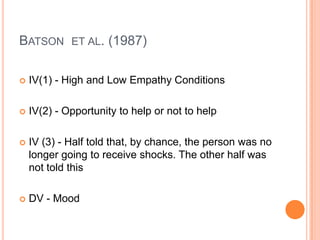
BATSON ET AL. (1987)

   IV(1) - High and Low Empathy Conditions

   IV(2) - Opportunity to help or not to help

   IV (3) - Half told that, by chance, the person was no
    longer going to receive shocks. The other half was
    not told this

   DV - Mood
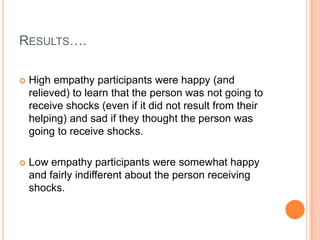
RESULTS….

   High empathy participants were happy (and
    relieved) to learn that the person was not going to
    receive shocks (even if it did not result from their
    helping) and sad if they thought the person was
    going to receive shocks.

   Low empathy participants were somewhat happy
    and fairly indifferent about the person receiving
    shocks.
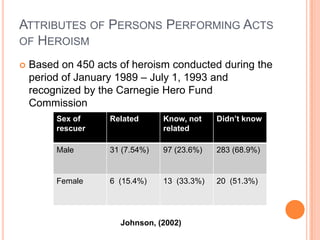
ATTRIBUTES OF PERSONS PERFORMING ACTS
OF HEROISM

   Based on 450 acts of heroism conducted during the
    period of January 1989 – July 1, 1993 and
    recognized by the Carnegie Hero Fund
    Commission
         Sex of     Related      Know, not    Didn’t know
         rescuer                 related

         Male       31 (7.54%)   97 (23.6%)   283 (68.9%)


         Female     6 (15.4%)    13 (33.3%)   20 (51.3%)


                      Johnson, (2002)
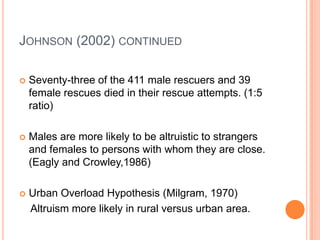
JOHNSON (2002) CONTINUED

   Seventy-three of the 411 male rescuers and 39
    female rescues died in their rescue attempts. (1:5
    ratio)

   Males are more likely to be altruistic to strangers
    and females to persons with whom they are close.
    (Eagly and Crowley,1986)

   Urban Overload Hypothesis (Milgram, 1970)
    Altruism more likely in rural versus urban area.
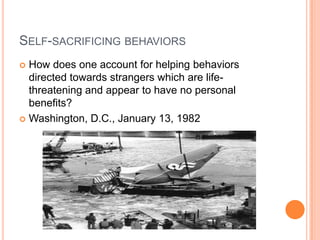
SELF-SACRIFICING BEHAVIORS
 How does one account for helping behaviors
  directed towards strangers which are life-
  threatening and appear to have no personal
  benefits?
 Washington, D.C., January 13, 1982
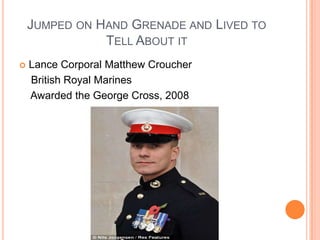
JUMPED ON HAND GRENADE AND LIVED TO
               TELL ABOUT IT
   Lance Corporal Matthew Croucher
    British Royal Marines
    Awarded the George Cross, 2008
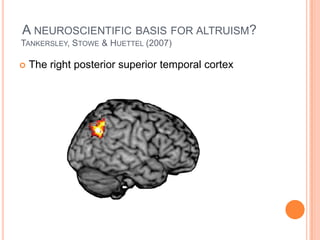
A NEUROSCIENTIFIC BASIS FOR ALTRUISM?
TANKERSLEY, STOWE & HUETTEL (2007)

   The right posterior superior temporal cortex
NEUROSCIENTIFIC BASIS FOR ALTRUISM?
 Hypothesis: If the perception of agency (i.e.
  empathy and perspective taking) is a precursor to
  altruism, then activity in the pSTC should predict
  subject‟s propensity for altruistic behavior.
 N = 45

 IV – Subjects simply watched computer play
  reaction time game. (Watching condition)
 IV – Subjects played game to win money for
  themselves or selected charity
 IV – “high” altruism vs. “low altruism subjects
RESULTS: NO ACTIVATION IN BRAIN REWARD
                         CENTERS
   Significant relationship between altruism and right pSTC
    activation.

   Increased pSTC activation on “watching” trials with
    “high” altruistic subjects.

   Decreased pSTC activation on “playing” trials with
    “high” altruistic subjects.

   (R= 0.57, P=<0.01)

   Atruistic behavior may originate from how people view
    the world rather than how they act in it.
WHAT WOULD THE WORLD BE LIKE WITHOUT
EMPATHY?


   Consider what it would feel like to live in a
    world where all people were motivated only by
    self-interest.

   What would that look like?
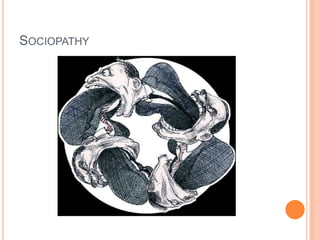
SOCIOPATHY
   “lacking in conscience and empathy, they take what
    they want and do as they please, violating social
    norms and expectations without guilt or remorse.”
                             Hare, (1995)

   Sociopathic individuals do not possess the skills
    necessary to construct a concept of reciprocity in
    human relationships which is fundamental for the
    maintenance of social harmony.
SOCIOPATHY
REFERENCES:
Batson, C.D. (1987). Prosocial motivation: Is it ever truly
          altruistic? Advanced Experimental Social Psychology,
          20, 65-122.
Batson, C.D., Dyck, J.L., Brandt, J.R., Batson, J.G., Powell, A.L.,
          McMaster, R. R., & Griffitt, C. (1988). Five studies
          testing two new egoistic alternatives to the empathy-
          altruism hypothesis. Journal of Personality and Social
          Psychology, 55, 52-77.
Batson, C. D. (1990). How social an animal? The human
          capacity for caring. American Psychologist, 45, 336-
          346.
Durkheim, E. (1933). The Division of Labor in Society. New
          York: Macmillan
REFERENCES:
Eagly, A.H., & Crowley, M. (1986) Gender and helping behavior:
          A meta-analysis review of the social psychological
          literature. Psychological Bulletin, 100, 283-308
Fabes, R., Eisenberg, N., Nyman, M., & Michelieu, Q. (1991).
          Children's appraisals of others„ spontaneous emotional
          reactions. Developmental Psychology, 27, 858-866.
Harding, T. (2008, July 23) George Cross Marine would jump on
          hand grenade again. The Telegraph.
Hare, R. D. (1995) Psychopaths: New trends in research.
          Harvard Mental Health Letter, 12(3), 4-5
Johnson, R. C. (2002). Attributes of persons performing acts of
          heroism and of the recipients of these acts. IPT
          Journal,12, 2002
REFERENCES:
Karylowski, J. (1982) Two types of altruistic
        behavior: Doing good to feel good or to
        make the other feel good. In V. J.
        Deriega, & J. Grzelak (Eds.). Cooperation
        and helping behavior: Theories and
        research (pp 397-413). New York:
        Academic Press.
Milgram, S. (1970) The experience of living in
        cities. Science,167, 1461-1468.
Wilkinson, G. S. (1990) Food Sharing in Vampire
         Bats. Scientific American, February 1990,
         76- 82

Is altruism a myth

  • 1.
    IS ALTRUISM AMYTH? GERD R. NAYDOCK, MSS, LSW PHILADELPHIA COLLEGE OF OSTEOPATHIC MEDICINE “Altruism is not … an agreeable ornament to social life, but it will forever be its fundamental basis. How can we really dispense with it?” E. Durkheim, 1933
  • 2.
    WHAT DEFINES ALTRUISM? Altruism is a motivational state with the ultimate goal of increasing another‟s welfare without regard to self-interest concerns.
  • 3.
    OTHER USES OFTHE TERM “ALTRUISM” 1. As helping behavior, not motivational state. This simply equates altruism with helping behavior. (i.e. evolutionary altruism) 2. As acting morally. Self-interest is often equated with selfishness, which is in turn often considered the epitome of immorality. 3. As helping in order to gain internal rather than external rewards.
  • 4.
    WHY IS MOTIVATIONIMPORTANT?  Knowing more generally when and where help can be expected, and how effective it is likely to be.  The creation of more caring society.  Think about some examples in your own life why this is important.
  • 5.
    ALTRUISM IS COUNTERINTUITIVETO EXPLAINING MOTIVATIONS TO HELP I. Social Exchange Theory  Relationships are designed to minimize costs and maximize rewards.  Internal rewards  External rewards
  • 6.
    SOCIOBIOLOGICAL THEORY  Genes wish to maximize their likelihood of being passed on.  We are more likely to help our kin and those who are more “like us” .  Reciprocal altruism. Reciprocal systems increase likelihood of survival. (Especially small systems)
  • 7.
    EVIDENCE OF ALTRUISMIN NATURE  Vampire bats will regurgitate blood to feed unrelated or distantly related members of their species to prevent starvation. By doing this, the bat places itself in extreme physical jeopardy since it cannot survive without blood for more than two days.
  • 8.
    ARE HUMANS CAPABLEOF ALTRUISTIC MOTIVES? BATSON THINKS SO!
  • 9.
    PROSOCIAL BEHAVIORS ININFANTS AND TODDLERS  Infants and children are very capable of responding empathically and do so quite spontaneously. Fabes, Eisenberg et al., (1991)
  • 10.
    EMPATHY AND ALTRUISM  The empathy-altruism hypothesis posits that when empathy is triggered, people are motivated to help out of genuine concern for the welfare of others regardless of cost or benefits.  Conversely, egoism is a motivational state which is centered on the goal of increasing one‟s own welfare.
  • 11.
  • 12.
    EMPATHY VS. EGOISM Advocates of egoism do not believe that pure altruism is a motivator for the ultimate goal of helping others. Rather they cite that humans help others to:  1) Minimize their own distress (Aversive-arousal reduction)  2) Avoid punishment (social and self)  3) Seek Rewards
  • 13.
    DOES THE BYSTANDEREFFECT ALWAYS HOLD TRUE?  Suppose you are walking down the street on an extremely hot day and hear the sound of a baby‟s crying only to discover a baby laying in a car with the windows rolled up? What are your predictions? http://www.youtube.com/watch?v=2OdKow7I Auw&feature=related
  • 14.
    EMPIRICAL SUPPORT FORALTRUISM  Batson and Shaw (1991)  Witness a person (confederate) receiving electric shock  Told they could fill in for the person taking shocks if they like  Half were allowed to stop watching situation  Authors manipulated whether experimenter and target knew of participant choice (WHY?)
  • 15.
    RESULTS…..  High empathy participants: helped regardless of ease of escape (interested in others‟ welfare)  Low empathy participants: tended to help only if they had to continue watching (to relieve personal distress)
  • 16.
    ENDOCENTRIC VS. EXOCENTRICALTRUISM KARYLOWSKI (1982)  Altruistic helping can be based on one of the following motivations:  A need to live up to one‟s perceived moral standards or imperatives (endocentric) OR  A desire to improve another‟s condition (exocentric)
  • 17.
    BATSON ET AL.(1987)  IV(1) - High and Low Empathy Conditions  IV(2) - Opportunity to help or not to help  IV (3) - Half told that, by chance, the person was no longer going to receive shocks. The other half was not told this  DV - Mood
  • 18.
    RESULTS….  High empathy participants were happy (and relieved) to learn that the person was not going to receive shocks (even if it did not result from their helping) and sad if they thought the person was going to receive shocks.  Low empathy participants were somewhat happy and fairly indifferent about the person receiving shocks.
  • 19.
    ATTRIBUTES OF PERSONSPERFORMING ACTS OF HEROISM  Based on 450 acts of heroism conducted during the period of January 1989 – July 1, 1993 and recognized by the Carnegie Hero Fund Commission Sex of Related Know, not Didn’t know rescuer related Male 31 (7.54%) 97 (23.6%) 283 (68.9%) Female 6 (15.4%) 13 (33.3%) 20 (51.3%) Johnson, (2002)
  • 20.
    JOHNSON (2002) CONTINUED  Seventy-three of the 411 male rescuers and 39 female rescues died in their rescue attempts. (1:5 ratio)  Males are more likely to be altruistic to strangers and females to persons with whom they are close. (Eagly and Crowley,1986)  Urban Overload Hypothesis (Milgram, 1970) Altruism more likely in rural versus urban area.
  • 21.
    SELF-SACRIFICING BEHAVIORS  Howdoes one account for helping behaviors directed towards strangers which are life- threatening and appear to have no personal benefits?  Washington, D.C., January 13, 1982
  • 22.
    JUMPED ON HANDGRENADE AND LIVED TO TELL ABOUT IT  Lance Corporal Matthew Croucher British Royal Marines Awarded the George Cross, 2008
  • 23.
    A NEUROSCIENTIFIC BASISFOR ALTRUISM? TANKERSLEY, STOWE & HUETTEL (2007)  The right posterior superior temporal cortex
  • 24.
    NEUROSCIENTIFIC BASIS FORALTRUISM?  Hypothesis: If the perception of agency (i.e. empathy and perspective taking) is a precursor to altruism, then activity in the pSTC should predict subject‟s propensity for altruistic behavior.  N = 45  IV – Subjects simply watched computer play reaction time game. (Watching condition)  IV – Subjects played game to win money for themselves or selected charity  IV – “high” altruism vs. “low altruism subjects
  • 25.
    RESULTS: NO ACTIVATIONIN BRAIN REWARD CENTERS  Significant relationship between altruism and right pSTC activation.  Increased pSTC activation on “watching” trials with “high” altruistic subjects.  Decreased pSTC activation on “playing” trials with “high” altruistic subjects.  (R= 0.57, P=<0.01)  Atruistic behavior may originate from how people view the world rather than how they act in it.
  • 26.
    WHAT WOULD THEWORLD BE LIKE WITHOUT EMPATHY?  Consider what it would feel like to live in a world where all people were motivated only by self-interest.  What would that look like?
  • 27.
    SOCIOPATHY  “lacking in conscience and empathy, they take what they want and do as they please, violating social norms and expectations without guilt or remorse.” Hare, (1995)  Sociopathic individuals do not possess the skills necessary to construct a concept of reciprocity in human relationships which is fundamental for the maintenance of social harmony.
  • 28.
  • 29.
    REFERENCES: Batson, C.D. (1987).Prosocial motivation: Is it ever truly altruistic? Advanced Experimental Social Psychology, 20, 65-122. Batson, C.D., Dyck, J.L., Brandt, J.R., Batson, J.G., Powell, A.L., McMaster, R. R., & Griffitt, C. (1988). Five studies testing two new egoistic alternatives to the empathy- altruism hypothesis. Journal of Personality and Social Psychology, 55, 52-77. Batson, C. D. (1990). How social an animal? The human capacity for caring. American Psychologist, 45, 336- 346. Durkheim, E. (1933). The Division of Labor in Society. New York: Macmillan
  • 30.
    REFERENCES: Eagly, A.H., &Crowley, M. (1986) Gender and helping behavior: A meta-analysis review of the social psychological literature. Psychological Bulletin, 100, 283-308 Fabes, R., Eisenberg, N., Nyman, M., & Michelieu, Q. (1991). Children's appraisals of others„ spontaneous emotional reactions. Developmental Psychology, 27, 858-866. Harding, T. (2008, July 23) George Cross Marine would jump on hand grenade again. The Telegraph. Hare, R. D. (1995) Psychopaths: New trends in research. Harvard Mental Health Letter, 12(3), 4-5 Johnson, R. C. (2002). Attributes of persons performing acts of heroism and of the recipients of these acts. IPT Journal,12, 2002
  • 31.
    REFERENCES: Karylowski, J. (1982)Two types of altruistic behavior: Doing good to feel good or to make the other feel good. In V. J. Deriega, & J. Grzelak (Eds.). Cooperation and helping behavior: Theories and research (pp 397-413). New York: Academic Press. Milgram, S. (1970) The experience of living in cities. Science,167, 1461-1468. Wilkinson, G. S. (1990) Food Sharing in Vampire Bats. Scientific American, February 1990, 76- 82