CONTENTS
1.) INTRODUCTION
2.) HISTORY
3.) PROPERTIES
4.) SPECTRA
5.) ENERGY LEVELS OF HELIUM
6.) ORTHO HELIUM & PARA HELIUM
7.) GROUND STATE ENERGY OF HELIUM
ATOM BY VARIATIONAL METHOD
8.) USES & APPLICATION
INTRODUCTION
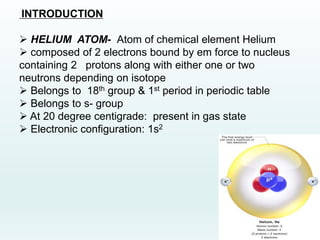
 HELIUM ATOM- Atom of chemical element Helium
 composed of 2 electrons bound by em force to nucleus
containing 2 protons along with either one or two
neutrons depending on isotope
 Belongs to 18th group & 1st period in periodic table
 Belongs to s- group
 At 20 degree centigrade: present in gas state
 Electronic configuration: 1s2
HISTORY
1868 – first evidence was observed as a bright
yellow line with a wavelength of 587.49 nm in the
spectrum of sun. The line was detected by French
astronomer Jules Janseen during a total solar
eclipse in India
1882- Italian physicist Luigi Palmieri detected
helium on earth for the very first time
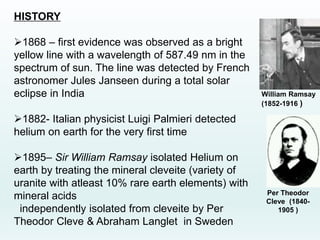
1895– Sir William Ramsay isolated Helium on
earth by treating the mineral cleveite (variety of
uranite with atleast 10% rare earth elements) with
mineral acids
independently isolated from cleveite by Per
Theodor Cleve & Abraham Langlet in Sweden
William Ramsay
(1852-1916 )
Per Theodor
Cleve (1840-
1905 )
PROPERTIES OF HELIUM
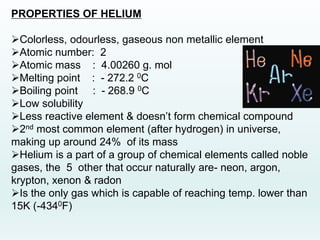
Colorless, odourless, gaseous non metallic element
Atomic number: 2
Atomic mass : 4.00260 g. mol
Melting point : - 272.2 0C
Boiling point : - 268.9 0C
Low solubility
Less reactive element & doesn’t form chemical compound
2nd most common element (after hydrogen) in universe,
making up around 24% of its mass
Helium is a part of a group of chemical elements called noble
gases, the 5 other that occur naturally are- neon, argon,
krypton, xenon & radon
Is the only gas which is capable of reaching temp. lower than
15K (-4340F)
SPECTRA
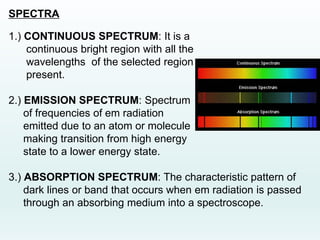
1.) CONTINUOUS SPECTRUM: It is a
continuous bright region with all the
wavelengths of the selected region
present.
2.) EMISSION SPECTRUM: Spectrum
of frequencies of em radiation
emitted due to an atom or molecule
making transition from high energy
state to a lower energy state.
3.) ABSORPTION SPECTRUM: The characteristic pattern of
dark lines or band that occurs when em radiation is passed
through an absorbing medium into a spectroscope.
SPECTRA OF HELIUM ATOM
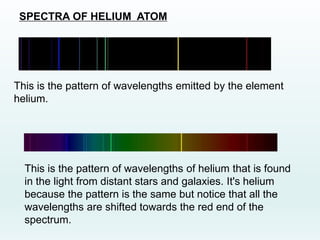
This is the pattern of wavelengths emitted by the element
helium.
This is the pattern of wavelengths of helium that is found
in the light from distant stars and galaxies. It's helium
because the pattern is the same but notice that all the
wavelengths are shifted towards the red end of the
spectrum.
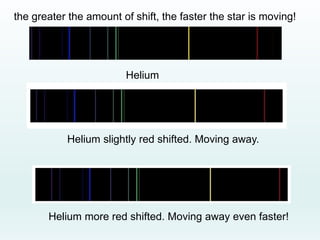
the greater the amount of shift, the faster the star is moving!
Helium
Helium slightly red shifted. Moving away.
Helium more red shifted. Moving away even faster!
HELIUM ENERGY LEVELS
 Ground state consists of 2 identical 1s electrons . The
energy required to remove one of them is the highest
ionization energy of any atom in periodic table (24.6 ev).
 energy required to remove 2nd electron is 54.4ev
 the description of any electron in a multi- electron atom
must find a way to characterize the effect of other electrons
on the energy
An electron in upper state can have spin -
antiparallel to the ground state electron ( s=0, singlet
state, parahelium)
 Parallel to the ground state electron (s=1, triplet state,
orthohelium)
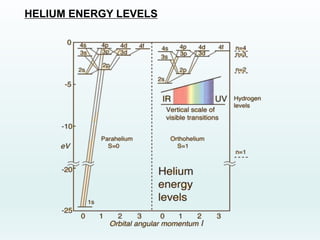
HELIUM ENERGY LEVELS
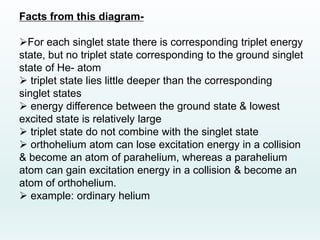
Facts from this diagram-
For each singlet state there is corresponding triplet energy
state, but no triplet state corresponding to the ground singlet
state of He- atom
 triplet state lies little deeper than the corresponding
singlet states
 energy difference between the ground state & lowest
excited state is relatively large
 triplet state do not combine with the singlet state
 orthohelium atom can lose excitation energy in a collision
& become an atom of parahelium, whereas a parahelium
atom can gain excitation energy in a collision & become an
atom of orthohelium.
 example: ordinary helium
ORTHOHELIUM & PARAHELIUM ENERGY LEVELS
It is observed that orthohelium state are lower in energy
than parahelium states.
Because—
 parallel spin makes the spin part of the wavefunction
symmetric
Total wavefunction for the electrons must be anti-
symmetric , since they are fermions & must obey Pauli’s
Exclusion Principle
 wavefunction can be written as the product of space &
spin parts of the wavefunction
Antisymmetric space wave function for 2 electrons
implies a larger average distance between them then a
symmetric function of same type
GROUND- STATE ENERGY OF HELIUM ATOM BY
VARIATIONAL METHOD
VARIATIONAL METHOD
It is the main appropriate method used in quantum
mechanics
As compared to perturbation theory, the variation method
can be more robust in situations where it’s hard to
determine a good unperturbed Hamiltonian
In cases where there is a good unperturbed Hamiltonian ,
perturbation theory can be more efficient than the
variational method
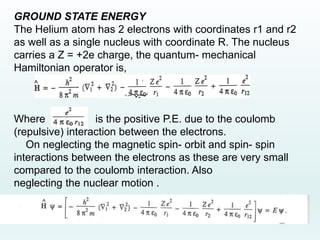
GROUND STATE ENERGY
The Helium atom has 2 electrons with coordinates r1 and r2
as well as a single nucleus with coordinate R. The nucleus
carries a Z = +2e charge, the quantum- mechanical
Hamiltonian operator is,
Where is the positive P.E. due to the coulomb
(repulsive) interaction between the electrons.
On neglecting the magnetic spin- orbit and spin- spin
interactions between the electrons as these are very small
compared to the coulomb interaction. Also
neglecting the nuclear motion .
The wave equation for the He-like atom can be written as,
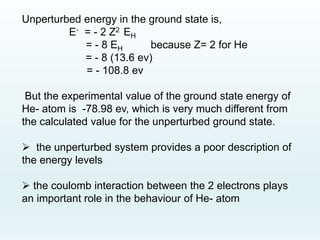
Unperturbed energy in the ground state is,
E◦ = - 2 Z2 EH
= - 8 EH because Z= 2 for He
= - 8 (13.6 ev)
= - 108.8 ev
But the experimental value of the ground state energy of
He- atom is -78.98 ev, which is very much different from
the calculated value for the unperturbed ground state.
 the unperturbed system provides a poor description of
the energy levels
 the coulomb interaction between the 2 electrons plays
an important role in the behaviour of He- atom
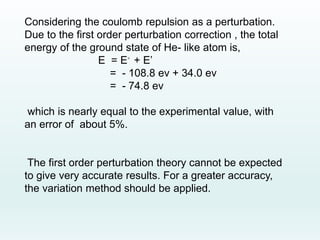
Considering the coulomb repulsion as a perturbation.
Due to the first order perturbation correction , the total
energy of the ground state of He- like atom is,
E = E◦ + E’
= - 108.8 ev + 34.0 ev
= - 74.8 ev
which is nearly equal to the experimental value, with
an error of about 5%.
The first order perturbation theory cannot be expected
to give very accurate results. For a greater accuracy,
the variation method should be applied.
USES & APPLICATIONS
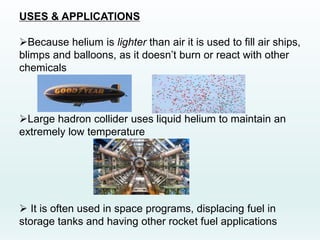
Because helium is lighter than air it is used to fill air ships,
blimps and balloons, as it doesn’t burn or react with other
chemicals
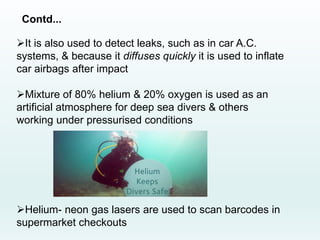
Large hadron collider uses liquid helium to maintain an
extremely low temperature
 It is often used in space programs, displacing fuel in
storage tanks and having other rocket fuel applications
Contd...
It is also used to detect leaks, such as in car A.C.
systems, & because it diffuses quickly it is used to inflate
car airbags after impact
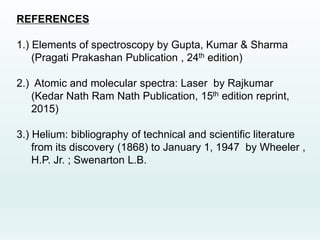
Mixture of 80% helium & 20% oxygen is used as an
artificial atmosphere for deep sea divers & others
working under pressurised conditions
Helium- neon gas lasers are used to scan barcodes in
supermarket checkouts
REFERENCES
1.) Elements of spectroscopy by Gupta, Kumar & Sharma
(Pragati Prakashan Publication , 24th edition)
2.) Atomic and molecular spectra: Laser by Rajkumar
(Kedar Nath Ram Nath Publication, 15th edition reprint,
2015)
3.) Helium: bibliography of technical and scientific literature
from its discovery (1868) to January 1, 1947 by Wheeler ,
H.P. Jr. ; Swenarton L.B.
Helium Front

Helium Front

  • 1.
    CONTENTS 1.) INTRODUCTION 2.) HISTORY 3.)PROPERTIES 4.) SPECTRA 5.) ENERGY LEVELS OF HELIUM 6.) ORTHO HELIUM & PARA HELIUM 7.) GROUND STATE ENERGY OF HELIUM ATOM BY VARIATIONAL METHOD 8.) USES & APPLICATION
  • 2.
    INTRODUCTION  HELIUM ATOM-Atom of chemical element Helium  composed of 2 electrons bound by em force to nucleus containing 2 protons along with either one or two neutrons depending on isotope  Belongs to 18th group & 1st period in periodic table  Belongs to s- group  At 20 degree centigrade: present in gas state  Electronic configuration: 1s2
  • 3.
    HISTORY 1868 – firstevidence was observed as a bright yellow line with a wavelength of 587.49 nm in the spectrum of sun. The line was detected by French astronomer Jules Janseen during a total solar eclipse in India 1882- Italian physicist Luigi Palmieri detected helium on earth for the very first time 1895– Sir William Ramsay isolated Helium on earth by treating the mineral cleveite (variety of uranite with atleast 10% rare earth elements) with mineral acids independently isolated from cleveite by Per Theodor Cleve & Abraham Langlet in Sweden William Ramsay (1852-1916 ) Per Theodor Cleve (1840- 1905 )
  • 4.
    PROPERTIES OF HELIUM Colorless,odourless, gaseous non metallic element Atomic number: 2 Atomic mass : 4.00260 g. mol Melting point : - 272.2 0C Boiling point : - 268.9 0C Low solubility Less reactive element & doesn’t form chemical compound 2nd most common element (after hydrogen) in universe, making up around 24% of its mass Helium is a part of a group of chemical elements called noble gases, the 5 other that occur naturally are- neon, argon, krypton, xenon & radon Is the only gas which is capable of reaching temp. lower than 15K (-4340F)
  • 5.
    SPECTRA 1.) CONTINUOUS SPECTRUM:It is a continuous bright region with all the wavelengths of the selected region present. 2.) EMISSION SPECTRUM: Spectrum of frequencies of em radiation emitted due to an atom or molecule making transition from high energy state to a lower energy state. 3.) ABSORPTION SPECTRUM: The characteristic pattern of dark lines or band that occurs when em radiation is passed through an absorbing medium into a spectroscope.
  • 6.
    SPECTRA OF HELIUMATOM This is the pattern of wavelengths emitted by the element helium. This is the pattern of wavelengths of helium that is found in the light from distant stars and galaxies. It's helium because the pattern is the same but notice that all the wavelengths are shifted towards the red end of the spectrum.
  • 7.
    the greater theamount of shift, the faster the star is moving! Helium Helium slightly red shifted. Moving away. Helium more red shifted. Moving away even faster!
  • 8.
    HELIUM ENERGY LEVELS Ground state consists of 2 identical 1s electrons . The energy required to remove one of them is the highest ionization energy of any atom in periodic table (24.6 ev).  energy required to remove 2nd electron is 54.4ev  the description of any electron in a multi- electron atom must find a way to characterize the effect of other electrons on the energy An electron in upper state can have spin - antiparallel to the ground state electron ( s=0, singlet state, parahelium)  Parallel to the ground state electron (s=1, triplet state, orthohelium)
  • 9.
  • 10.
    Facts from thisdiagram- For each singlet state there is corresponding triplet energy state, but no triplet state corresponding to the ground singlet state of He- atom  triplet state lies little deeper than the corresponding singlet states  energy difference between the ground state & lowest excited state is relatively large  triplet state do not combine with the singlet state  orthohelium atom can lose excitation energy in a collision & become an atom of parahelium, whereas a parahelium atom can gain excitation energy in a collision & become an atom of orthohelium.  example: ordinary helium
  • 11.
    ORTHOHELIUM & PARAHELIUMENERGY LEVELS It is observed that orthohelium state are lower in energy than parahelium states. Because—  parallel spin makes the spin part of the wavefunction symmetric Total wavefunction for the electrons must be anti- symmetric , since they are fermions & must obey Pauli’s Exclusion Principle  wavefunction can be written as the product of space & spin parts of the wavefunction Antisymmetric space wave function for 2 electrons implies a larger average distance between them then a symmetric function of same type
  • 12.
    GROUND- STATE ENERGYOF HELIUM ATOM BY VARIATIONAL METHOD VARIATIONAL METHOD It is the main appropriate method used in quantum mechanics As compared to perturbation theory, the variation method can be more robust in situations where it’s hard to determine a good unperturbed Hamiltonian In cases where there is a good unperturbed Hamiltonian , perturbation theory can be more efficient than the variational method
  • 13.
    GROUND STATE ENERGY TheHelium atom has 2 electrons with coordinates r1 and r2 as well as a single nucleus with coordinate R. The nucleus carries a Z = +2e charge, the quantum- mechanical Hamiltonian operator is, Where is the positive P.E. due to the coulomb (repulsive) interaction between the electrons. On neglecting the magnetic spin- orbit and spin- spin interactions between the electrons as these are very small compared to the coulomb interaction. Also neglecting the nuclear motion . The wave equation for the He-like atom can be written as,
  • 14.
    Unperturbed energy inthe ground state is, E◦ = - 2 Z2 EH = - 8 EH because Z= 2 for He = - 8 (13.6 ev) = - 108.8 ev But the experimental value of the ground state energy of He- atom is -78.98 ev, which is very much different from the calculated value for the unperturbed ground state.  the unperturbed system provides a poor description of the energy levels  the coulomb interaction between the 2 electrons plays an important role in the behaviour of He- atom
  • 15.
    Considering the coulombrepulsion as a perturbation. Due to the first order perturbation correction , the total energy of the ground state of He- like atom is, E = E◦ + E’ = - 108.8 ev + 34.0 ev = - 74.8 ev which is nearly equal to the experimental value, with an error of about 5%. The first order perturbation theory cannot be expected to give very accurate results. For a greater accuracy, the variation method should be applied.
  • 16.
    USES & APPLICATIONS Becausehelium is lighter than air it is used to fill air ships, blimps and balloons, as it doesn’t burn or react with other chemicals Large hadron collider uses liquid helium to maintain an extremely low temperature  It is often used in space programs, displacing fuel in storage tanks and having other rocket fuel applications
  • 17.
    Contd... It is alsoused to detect leaks, such as in car A.C. systems, & because it diffuses quickly it is used to inflate car airbags after impact Mixture of 80% helium & 20% oxygen is used as an artificial atmosphere for deep sea divers & others working under pressurised conditions Helium- neon gas lasers are used to scan barcodes in supermarket checkouts
  • 18.
    REFERENCES 1.) Elements ofspectroscopy by Gupta, Kumar & Sharma (Pragati Prakashan Publication , 24th edition) 2.) Atomic and molecular spectra: Laser by Rajkumar (Kedar Nath Ram Nath Publication, 15th edition reprint, 2015) 3.) Helium: bibliography of technical and scientific literature from its discovery (1868) to January 1, 1947 by Wheeler , H.P. Jr. ; Swenarton L.B.