4G - WIRELESS NETWORK
Content
• Wireless network
• 3G network
• Features of 3G
• Advantages and disadvantages
• History of 4G
• Introduction
• Features
• Technology used in 4G
• Future scope
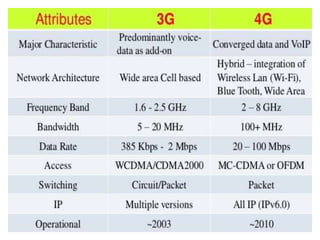
• Comparison 3G and 4G
• Conclusion
• Reference
WHAT IS WIRELESS NETWORK?
• A wireless local-area network (LAN) uses radio
waves to connect devices such as laptops to
the Internet and to our business network and
its applications.
• When we connect a laptop to a WiFi hotspot
at a cafe, hotel, airport lounge, or other public
place, we're connecting to that business's
wireless network.
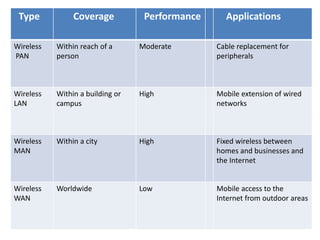
Type Coverage Performance Applications
Wireless
PAN
Within reach of a
person
Moderate Cable replacement for
peripherals
Wireless
LAN
Within a building or
campus
High Mobile extension of wired
networks
Wireless
MAN
Within a city High Fixed wireless between
homes and businesses and
the Internet
Wireless
WAN
Worldwide Low Mobile access to the
Internet from outdoor areas
3G Network
• Third-generation mobile networks, or 3G, came to
the U.S. in 2003. With minimum consistent Internet
speeds of 144Kbps, 3G was supposed to bring
"mobile broadband.
• " There are now so many varieties of 3G, though,
that a "3G" connection can get you Internet speeds
anywhere from 400Kbps to more than ten times
that.
Features OF 3G
• The main feature of 3G technology is that it
supports greater voice and data capacity and
high data transmission at low-cost. 3G mobiles
can operate on 2G and 3G technologies.
• The second major feature is the security: 3G
offers greater security features than 2G like
Network Access Security, Network Domain
Security, User Domain Security, Application
Security.
• Video calls and video conference is another
major feature in 3G mobile technology.
Advantages
• Overcrowding is relieved in
existing systems with radio
spectrum.
• Bandwidth and security are
more.
• Availability of fixed and
variable rates.
• Support to devices with
backward compatibility with
existing networks.
• Always online devices – 3G
uses IP connectivity which is
packet based.
• Rich multi media services are
available.
Disadvantages
• The cost of cellular
infrastructure , upgrading
base stations is very high.
• Needs different handsets.
• Roaming and data/voice
work together has not yet
been implemented.
• Power consumption is high.
• Requires closer base
stations and are expensive.
Why Moves Towards 4G ?
• High spectrum fees for the 3G services.
• Health impact because of the electromagnetic waves.
• Prices are very high for 3G mobile services.
• Expense of 3G phones.
• Limitation to meet expectations of applications like
multimedia , full motion video , wireless
teleconferencing .
o Wider Bandwidth.
Introduction Of 4G Network
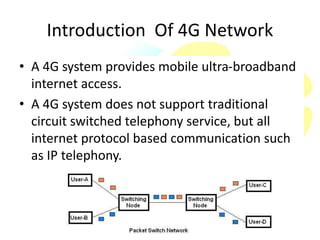
• A 4G system provides mobile ultra-broadband
internet access.
• A 4G system does not support traditional
circuit switched telephony service, but all
internet protocol based communication such
as IP telephony.
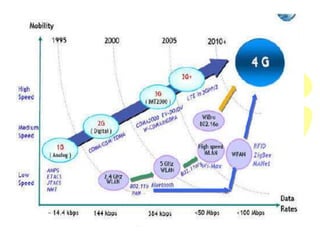
History Of 4G Network
• The first generation of mobile communications started
with the Advanced Mobile Phone Systems (AMPS), which
was an analogue system.
• AMPS can be thought of as 1G. From there, we
progressed to GSM and CDMA-one and then to UMTS
and EV-DO, which are 3G technologies.
• The latest technologies that are regarded as candidates
for 4G are LTE . In the case of 802.16m, the candidate for
4G is also known as WirelessMAN Advanced, or WiMAX2.
• LTE progresses through versions known as releases. The
latest release that qualifies as being 4G is release 10,
often called LTE-Advanced.
Move To 4G …………
• 4G=4th Generation mobile communication.
• Data rates (with wide area coverage
and significant mobility)=50 to 100 Mbps.
• Wider bandwidth.
• High security.
• Offering any kind of services
anytime,anywhere.
• End-to-end quality of service.
Features OF 4G Network
• Wireless Internet with a bandwidth much wider than
the 2G or 3G networks - 100 MHz.
• Significantly increased the speed of data transmission -
up to Gbps 1st.
• Calls video conference - with more than 2 speakers,
and because the flow of data faster will be less
problems, not so often as to break with the 3G.
• The enhanced security features to prevent fraud and
theft.
• The larger bandwidth for data sharing are relatively
inexpensive
4G Phones
TECHNOLOGIES USED IN 4G
• Smart Antenas for multiple-input and multiple-
output(MIMO)
• IPv6
• VoIP
• OFDM
• Software defined Radio(SDR) system
Future scope
• Lifecycle of 4G is expected to be of 15 years.
• Fast internet access to both stationery and
mobile users.
• 4G can be efficiently combined with cellular
technologies to make consistent use of smart
phones and also create video blogs.
Conclusion
• 4g can be describe in one word MAGIC.
• True 4G services could come only after 2015.
• 4G will open doors to various mobile applications.
• Though 4G is facing challenges and problems we
believe that future research will overcome these
challenges and integrate newly developed services to
4G networks making them available to everyone ,
anytime and everywhere.
Reference
• www.4g.co.uk
• www.authorstream.com
• Wireless communications(T.S.RAPPAPORT)
• www.3gpp.org
4G wireless Network

4G wireless Network

  • 1.
  • 2.
    Content • Wireless network •3G network • Features of 3G • Advantages and disadvantages • History of 4G • Introduction • Features • Technology used in 4G • Future scope • Comparison 3G and 4G • Conclusion • Reference
  • 3.
    WHAT IS WIRELESSNETWORK? • A wireless local-area network (LAN) uses radio waves to connect devices such as laptops to the Internet and to our business network and its applications. • When we connect a laptop to a WiFi hotspot at a cafe, hotel, airport lounge, or other public place, we're connecting to that business's wireless network.
  • 4.
    Type Coverage PerformanceApplications Wireless PAN Within reach of a person Moderate Cable replacement for peripherals Wireless LAN Within a building or campus High Mobile extension of wired networks Wireless MAN Within a city High Fixed wireless between homes and businesses and the Internet Wireless WAN Worldwide Low Mobile access to the Internet from outdoor areas
  • 5.
    3G Network • Third-generationmobile networks, or 3G, came to the U.S. in 2003. With minimum consistent Internet speeds of 144Kbps, 3G was supposed to bring "mobile broadband. • " There are now so many varieties of 3G, though, that a "3G" connection can get you Internet speeds anywhere from 400Kbps to more than ten times that.
  • 6.
    Features OF 3G •The main feature of 3G technology is that it supports greater voice and data capacity and high data transmission at low-cost. 3G mobiles can operate on 2G and 3G technologies. • The second major feature is the security: 3G offers greater security features than 2G like Network Access Security, Network Domain Security, User Domain Security, Application Security. • Video calls and video conference is another major feature in 3G mobile technology.
  • 7.
    Advantages • Overcrowding isrelieved in existing systems with radio spectrum. • Bandwidth and security are more. • Availability of fixed and variable rates. • Support to devices with backward compatibility with existing networks. • Always online devices – 3G uses IP connectivity which is packet based. • Rich multi media services are available. Disadvantages • The cost of cellular infrastructure , upgrading base stations is very high. • Needs different handsets. • Roaming and data/voice work together has not yet been implemented. • Power consumption is high. • Requires closer base stations and are expensive.
  • 8.
    Why Moves Towards4G ? • High spectrum fees for the 3G services. • Health impact because of the electromagnetic waves. • Prices are very high for 3G mobile services. • Expense of 3G phones. • Limitation to meet expectations of applications like multimedia , full motion video , wireless teleconferencing . o Wider Bandwidth.
  • 9.
    Introduction Of 4GNetwork • A 4G system provides mobile ultra-broadband internet access. • A 4G system does not support traditional circuit switched telephony service, but all internet protocol based communication such as IP telephony.
  • 10.
    History Of 4GNetwork • The first generation of mobile communications started with the Advanced Mobile Phone Systems (AMPS), which was an analogue system. • AMPS can be thought of as 1G. From there, we progressed to GSM and CDMA-one and then to UMTS and EV-DO, which are 3G technologies. • The latest technologies that are regarded as candidates for 4G are LTE . In the case of 802.16m, the candidate for 4G is also known as WirelessMAN Advanced, or WiMAX2. • LTE progresses through versions known as releases. The latest release that qualifies as being 4G is release 10, often called LTE-Advanced.
  • 11.
    Move To 4G………… • 4G=4th Generation mobile communication. • Data rates (with wide area coverage and significant mobility)=50 to 100 Mbps. • Wider bandwidth. • High security. • Offering any kind of services anytime,anywhere. • End-to-end quality of service.
  • 13.
    Features OF 4GNetwork • Wireless Internet with a bandwidth much wider than the 2G or 3G networks - 100 MHz. • Significantly increased the speed of data transmission - up to Gbps 1st. • Calls video conference - with more than 2 speakers, and because the flow of data faster will be less problems, not so often as to break with the 3G. • The enhanced security features to prevent fraud and theft. • The larger bandwidth for data sharing are relatively inexpensive
  • 14.
  • 15.
    TECHNOLOGIES USED IN4G • Smart Antenas for multiple-input and multiple- output(MIMO) • IPv6 • VoIP • OFDM • Software defined Radio(SDR) system
  • 16.
    Future scope • Lifecycleof 4G is expected to be of 15 years. • Fast internet access to both stationery and mobile users. • 4G can be efficiently combined with cellular technologies to make consistent use of smart phones and also create video blogs.
  • 18.
    Conclusion • 4g canbe describe in one word MAGIC. • True 4G services could come only after 2015. • 4G will open doors to various mobile applications. • Though 4G is facing challenges and problems we believe that future research will overcome these challenges and integrate newly developed services to 4G networks making them available to everyone , anytime and everywhere.
  • 19.
    Reference • www.4g.co.uk • www.authorstream.com •Wireless communications(T.S.RAPPAPORT) • www.3gpp.org