ME 6403- Environmental Science and
Engineering
ENVIRONMENTAL POLLUTION
Prepared by
V.NaveenPrabhu
Assistant Professor
Sri Eshwar college of Engineering
Coimbatore
2
Pollution
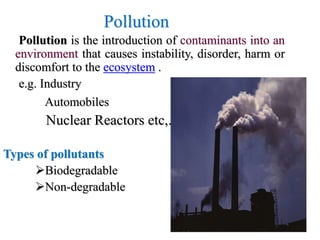
Pollution is the introduction of contaminants into an
environment that causes instability, disorder, harm or
discomfort to the ecosystem .
e.g. Industry
Automobiles
Nuclear Reactors etc,.
Types of pollutants
Biodegradable
Non-degradable
Types of pollution
Air pollution
Marine (Water) pollution
Land or soil pollution
Noise pollution
Thermal pollution
Nuclear pollution
AIR POLLUTION
Air pollution is the ā€œpresence of contaminants
in atmosphere in quantities such that it is
injurious to human, plant animal life and
propertyā€.
Sources of air pollution
Natural sources : Volcanic eruption, forest fires,
biological decay.
Manmade sources :thermal power plant ,fuel
burning, agriculture activities.
Classification of Air pollutants
1.Primary air pollutants.
Emitted directly in the atmosphere. E.g. CO,NO
& SO2
INDOOR AIR POLLUTANTS
Radon gas emitted from building materials like
bricks,concrete,tiles etc.,
It is present in natural gas and ground water.
burning of fuel in the kitchen, cigaratte,
smoke.
2.Secondary air pollutants
Sulphur dioxide:
 The combustion of sulphur containing fuels such as
coal and oil.
 It can be converted into sulphuric acid.
Human Sources :
 Coal burning in power plant (88%)
 Industrial processes (10%)
Environmental effects :
 In humans : it causes eye irritation, cough, lung
diseases including lung cancer and asthma
 In plants: it causes damage of leaves, bleaching of
chlorophyll which turns leaves brown, damage to
crops and to growth of plants.
Carbon monoxide
Sources:
 Cigarette smoking,incomplete burning of fuels.
 Automobile exhaust- carbon monoxide is formed
during the combustion of fuel such as petrol.(77%)
 Industries: carbon monoxide is released by industries
such as iron and steel and petroleum .
CO2 + C ------- 2CO
2CO2 --------- 2CO + O2
Effects:
In humans:
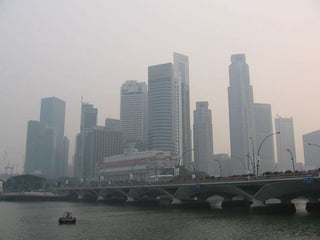
When the atmosphere is polluted with carbon
monoxide, on inhalation, CO combines with
the hemoglobin to form car boxy hemoglobin
and hence oxygen carrying capacity of the
blood decreases.
This causes, headache, dizziness,
unconsciousness.
When inhaled for a long duration it may cause
even death.
In environment :
it increase globe temp.
Lead
Sources
Paint, metal refineries, storage battteries…..
Effects
In humans
Mental retardation, health problems even leads
to cancer.
In environment
Harms wild life
Control of air pollution
Source Control:
 Use only unleaded petrol.
 Use petroleum products and other fuels that have low
sulphur and ash content.
 Reduce the no. of private vehicles
 Ensure the houses, schools are not located on busy
streets.
 Plant trees along busy streets to reduce particulates,
CO and noise.
 Industries should be situated outside the city
 Use catalytic converters to control CO
&hydrocarbons
Control measures in industries
The emission rates should be restricted to
permissible levels by industries.
Air pollution control equipments must be
made mandatory.
Continuous monitoring of the atmosphere
for the pollutants, to know the pollution
levels.
EQUIPMENTS USED TO CONTROL AIR
POLLUTION
Use sufficient supply of oxygen in
combustion chamber, so that the combustion is
complete.
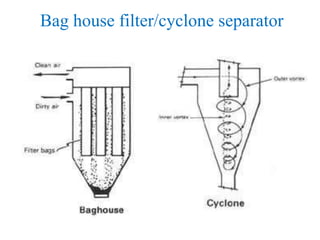
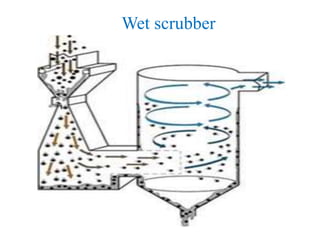
Use mechanical devices such as
 scrubbers, cyclones, bag houses and
electro-static precipitators to reduce particulate
pollutants
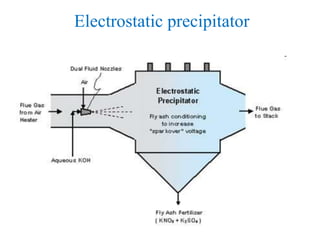
Electrostatic precipitator
Bag house filter/cyclone separator
Wet scrubber
WATER POLLUTION
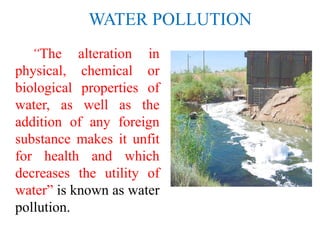
ā€œThe alteration in
physical, chemical or
biological properties of
water, as well as the
addition of any foreign
substance makes it unfit
for health and which
decreases the utility of
waterā€ is known as water
pollution.
Main sources of water pollution are:
 Domestic and municipal sewage
 Industrial waste
 Agricultural waste
 Radioactive materials, etc.,
POINT AND NONPOINT SOURCES
Two types of water pollutants exist;
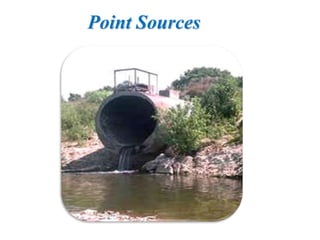
Point source
Point sources of pollution occur when harmful
substances are emitted directly into water.
e.g.,Oil spill
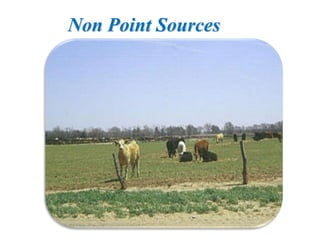
Nonpoint source.
A non-point source delivers pollutants indirectly
through environmental changes.
e.g., Fertilizer from a field is carried into a stream by
rain
Point Sources
Non Point Sources
Types of water pollutant:
1.Infectious agents: Bacteria, viruses, protozoa
source : animal waste.
Effect : variety of diseases
2.Oxygen demanding waste:
Dissolved oxygen (DO) is the amount of oxygen
dissolved in given quantity of water at a particular
P and T. The saturation point 8-15mg/lit.
Sources: Sewage, paper waste, food processing
waste.
Effects: affect the water quality, affect fish
survival and migration.
3.Inorganic chemicals : Acids, pb, arsenic, selenium,
sodium chloride and fluorides.
Sources : surface runoff, effluents
Effects: Cause skin cancer, damage nervous
system,harm to fish and aquatic life, lower crop
yields.
4.Organic chemicals:Oil, gasoline,plastics,
solvents ,detergents.
Sources: Industrial efflents, surface runoff forms.
Effects: Causing effect nervous system ,cancer,
harm fish and wild life.
5.Plant nutrients:
Nitrate, phosphate and ammonium ions
Sources: sewage, runoff water from agriculture,
fertillizer.
Effects: Excessive growth of algae, lower the
oxygen carrying capacity.
6.Sediment: Soil
Source: Land erosion.
Effects: Can reduce photosynthesis, Affect aquatic
food webs.
Testing of water
Dissolved oxygen (DO)
Amount of oxygen dissolved in water at a
particular pressure and temp.
Bio chemical oxygen demand (BOD)
Oxygen required for biological decomposition
of organic matters.
Chemical oxygen demand (COD)
Oxygen required for chemical oxidation of
organic matters
Control measures of water pollution:
 Avoid Pesticides and fertilizers on sloped land areas.
The nutrient rich water can be used as fertilizer in the
fields.
Separate drainage of sewage and rain water should be
provided to prevent overflow of sewage with rain water.
Planting more trees.
Use nitrogen fixing plants to supplement the use of
fertilizers.
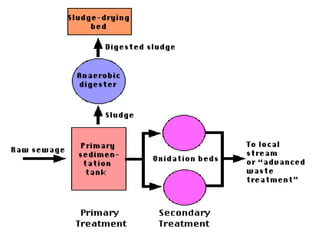
Sewage treatment
Main objective is to convert harmful
compounds into harmless compounds.
In primary treatment, the suspended solids
and floating objects are removed using coarse
screens and sieves.
In secondary treatment, the maximum
proportions of the suspended inorganic/ organic
solids are removed from the liquid sewage. The
liquid material passes into the sedimentation
tank and finely suspended particles are allowed
to settle by adding coagulants like Alum.
Tertiary treatment
Remove detergents, metal ions, nitrates and
pesticides, as these are not removed in the
earlier treatments.
The phosphates are removed as calcium
phosphates by adding calcium hydroxide at pH
10-11. At this pH, ammonium salts are also
converted into ammonia.
The effluent is chlorinated to remove
pathogenic bacteria's and finally passed
through activated charcoal to absorb gases.
SOIL POLLUTION
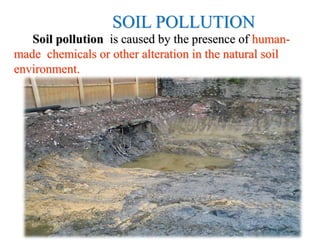
Soil pollution is caused by the presence of human-
made chemicals or other alteration in the natural soil
environment.
This type of contamination typically arises
from,
Application of pesticides and fertilizers
Percolation of contaminated surface water to
subsurface strata, oil and fuel dumping.
Discharge of industrial wastes to the soil. The
most common chemicals involved are
petroleum hydrocarbons, solvents, pesticides,
lead and other heavy metals.
Effects of soil pollution:
Chronic exposure to chromium, lead and other
metals, petroleum, solvents, and many pesticide
and herbicide formulations can be carcinogenic.
Chronic exposure to benzene leads to
leukemia.(blood cancer)
Mercury and cyclodienes are known to induce
higher incidences of kidney damage.
Sewage sludge has many types of bacteria, viruses
and worms which cause types of diseases and also
emits toxic vapours.
Radioactive fallout cause abnormalities .eg.,
Strontium-90 instead of calcium gets deposited
in the bones.
Effects occur to agricultural lands which have
certain types of soil contamination.
Alteration of metabolism of endemic
microorganisms.
N & P from fertilizer in soil reach water bodies
with agricultural runoff cause Eutrophication.
Chemicals contaminates ground water
resources.
Acids, alkalis, heavy metals affect soil fertility.
Inhibit non target organism like flora, fauna
and soil productivity.
Control of soil pollution :
Effluents should be properly treated before
discharging on the soil.
Solid waste should be properly collected and
disposed off by appropriate method.
From the waste, recovery of useful products
should be done.
Cattle dung should be used for methane
generation.
Microbial degradation of biodegradable
substance for reducing soil pollution.
NOISE POLLUTION
Definition: Noise Pollution can be defied as unwanted or
unpleasant sounds that causes discomfort for all living
things.
 The various sources of noises are associated with urban
development; road-air and rail transport; Industrial noise.
 In our country, indiscriminate use of loud speakers,
generator sets and firecrackers has given new dimensions
to the noise pollution problem.
 The commonly used parameter for noise is the sound
level in decibel(dB). Human ears are sensitive in the
frequency range of 20Hz to 20000Hz
Major Noise Sources:
1. Road Traffic:
Road traffic noise is one of the most
widespread and growing environmental problems in
urban area. The impact of road traffic noise on the
community depends an various factors such as road
location and design, land use planning measures,
building design, Vehicle standards and deriver
behavior. Motor vehicle ownership in India has
increased substantially over the last 30 years and
general levels of road traffic noise throughout India
have increased through out the period.
2. Air Traffic:
The extend of aircraft noise impact depends
on the type of aircraft flown, the number of flights
and flight paths. The increase in number of flights, an
important factor is overall noise levels, the led to an
increase in general noise levels associated with air
traffic.
3. Rail Traffic:
The two main sources of noise and vibration
relating to the operation of the rail network is
1. The operation of trains and the maintenance
2. Construction of rail infrastructure.
4.Neighborhood & Domestic Noise:
Other significant source of noise
annoyance is car alarms, building construction
and household noise,Celebrations- religious
function,social and elections.
5.Noise generated by noise levels of 125dB as
per Environmental rules 1999.
Effects:
1. Noise can disturb out work, rest, sleep and
communication.
2. It can damage our hearing and evoke other
psychological, physiological and possibly
pathological reactions.
3.It effects health efficiency and behaviour. It
may cause damage to heart, brain,kidneys and
liver.
4.It causes muscles to contract leading to
nervous breakdown, tension.
5.Change in hormone content of blood, which
turn increase the rate of heart beat.
6.Recently it has been reported that blood is also
thickened by excessive noise.
7. Hearing damage : it can cause permanent
hearing loss.
8.Interferences with man’s communication :In
noise area communication is affected.
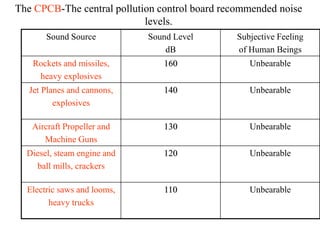
Sound Source Sound Level
dB
Subjective Feeling
of Human Beings
Rockets and missiles,
heavy explosives
160 Unbearable
Jet Planes and cannons,
explosives
140 Unbearable
Aircraft Propeller and
Machine Guns
130 Unbearable
Diesel, steam engine and
ball mills, crackers
120 Unbearable
Electric saws and looms,
heavy trucks
110 Unbearable
The CPCB-The central pollution control board recommended noise
levels.
CONTROL MEASURES OF NOISE POLLUTION:
1.REDUCTION IN SOURCE OF NOISE : Heavy vehicles and old
vehicles may not be allowed in populated areas.
2. Noise making machines should be kept in containers with
sound absorbing media.
3. Proper oiling will reduce the noise from the machinery.
4. Use sound absorbing silencers: Silencers can reduce
noise by absorbing sound.
5. Planting more trees having broad leaves.
6. Through law:
sound production is minimized at various
social function.
7. The use of fireworks or fire crackers shall not be
permitted except between 6.00a.m and
10.00p.m.No fireworks or fire crackers shall be
used between 10.00p.m and 6.00a.m.
8. Silence zone in area comprising not less than
100meters around hospitals, educational
institutions ,courts and religious places.
THERMAL POLLUTION
 Thermal pollution is the degradation of water quality by
any process that changes ambient water temperature.
 A common cause of thermal pollution is the use of water
as a coolant by power plants and industrial manufacturers.
 Energy is the basic necessity for the economic
development of a country.
 The electrical energy is produced in power plants or
generating stations. The conventional power plants are:
- Steam or Thermal Power station,
- Hydro-electric Power station,
- Nuclear Power station
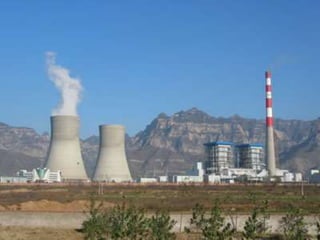
Steam or Thermal Power station
In the thermal power station, the steam is
produced in the boiler, using the heat released
by the combustion of coal, oil or natural gas.
The steam is used to rotate the steam turbine
(impulse/ reaction).
The steam turbine drives the alternator, which
converts mechanical energy into electrical
energy.10-16oC higher than initial temp.
Hydro-electric Power station
Hydroelectricity is the term referring to
electricity generated by hydropower.
The production of electrical power through the
use of the gravitational force of falling or
flowing water.
It is the most widely used form of renewable
energy.
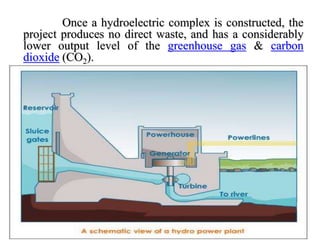
Once a hydroelectric complex is constructed, the
project produces no direct waste, and has a considerably
lower output level of the greenhouse gas & carbon
dioxide (CO2).
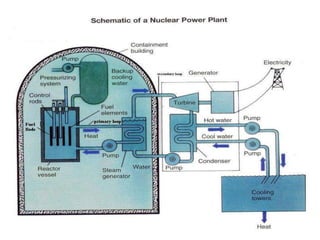
Nuclear Power station
Nuclear power is produced by controlled
(i.e., non-explosive) nuclear reactions.
Commercial and utility plants currently
use nuclear fission reactions to heat water to
produce steam, which is then used to generate
electricity.
Effects of thermal pollution
Elevated temperature typically decreases the level
of dissolved oxygen (DO) in water.
Thermal pollution may also increase the
metabolic rate of aquatic animals.
Fish migration is affected due to formation of
various thermal zones.
Discharge of hot water near the shores could
disturb and even kill young fishes.
Toxicity of pesticides ,detergents and chemicals
into the effluent increases with increase in temp.
The composition of flora and fauna changes.
Control of thermal pollution
 Thermal pollution from industrial sources is generated
mostly by power plants, petroleum refineries, pulp and
paper mills, chemical plants, steel mills and smelters.
Cooling ponds, man-made bodies of water designed for
cooling by evaporation, convection, and radiation.
Cooling towers, which transfer waste heat to the
atmosphere through evaporation and/or heat transfer.
Cogeneration, a process where waste heat is recycled
for domestic and/or industrial heating purposes.
RADIO ACTIVE OR NUCLEAR POLLUTION
The uncontrolled distribution of radioactive
material in a given environment.
Radioactive contamination is typically the
result of a spill or accident during the
production or use of radionuclide
(radioisotopes), an unstable nucleus which has
excessive energy.
Contamination may occur from radioactive
gases, liquids or particles
Effects
Radioactive contamination can enter the body
through ingestion, inhalation, absorption, or
injection that causes discomfort, diarrhea,
nausea or vomiting, and burns skin and hair
loss.
 The cumulative damage can cause serious
health problems long term, such as cancer,
especially leukemia and Thyroid Cancer.
 For this reason, it is important to use personal
protective equipment when working with
radioactive materials.
Control methods:
It includes the stoppage of leakage from the
radioactive materials including the nuclear
reactors, industries and laboratories.
The disposal of radioactive material must be
safe and secure.
The protective garments must be worn by the
workers who work in the nuclear plants.
The natural radiation must be at the permissible
limits and they must not cross it.
SOLID WASTE MANAGEMENT:
Each household generates garbage or waste
day in and day out. There are different types of
solid waste depending on their source
Types of solid waste: Solid waste can be
classified into different types depending on
their source: Household waste is generally
classified as,
 Municipal waste
 Industrial waste as hazardous waste
 Biomedical waste or hospital waste
E waste-Electronic waste
SOURCES OF URBAN AND INDUSTRIAL
WASTE:
Waste from homes: polyethylene bags, cans,
glass bottles, waste paper, cloth, food waste,
empty metal.
Waste from shops: Cans, bottles, waste paper,
tea leaves, packaging material.
Biomedical waste : discarded medicines,
chemical wastes, disposable syringes, swabs,
bandages and body fluids.
Construction waste :wood, concrete, cement .,
Industrial waste :Packaging meterial,organic
waste, acid,alkali and metals.
Solid waste: Rubber,plastic,paper,glass,
wood,oils,paints, dyes,heavy metals, asbestos.
Effects of solid waste :
Physicochemical and chemical characteristics
affecting productivity of soils.
Toxic substance contaminate the ground water.
Burning of materials produce dioxins, furans
causes cancer.
TYPES INVOLVED SOLID WASTE
MANAGEMENT:
1.REDUCE,REUSE,RECYCLE:
a.Reduce the usage of raw materials:
If usage is reduced,generation of waste also
reduced.
b.Reuse of waste materials:
1.Refillable containers can be reused
2.Discarded cycle tubes can be made into rubber
rings.
c.Recycling of materials:
1.Old Al cans and bottles are melted and recast
into new cans and bottles.
2.Preparation of cellulose insulation from paper
3.Preparation fuel pellets from kitchen waste.
Methods of disposal of solid waste:
a. Landfill :
The bottom is covered with several layers of
clay,plastic & sand –protects ground water
contamination.
• Landfill is covered with clay, sand & gravel.
• Methane gas is collected and used to produce
electricity.
b. Composting:
The biodegradable waste is allowed to
decomposed into oxygen rich medium and
quality rich environment is formed which
improves soil fertility rate.
c. Incineration :Burning of waste at high
temp(2800-3200 F) in combustion chamber
and used to produce electricity and
incinerate100-150tonnes per hour.
Role of individual in prevention of
pollution
 Individuals can, however, play an important role in
abatement of air, water, soil or noise pollution in the
following simple manners:
Use low-phosphate, phosphate-free or
biodegradable dishwashing liquid, laundry
detergent, and shampoo.
Use manure or compost instead of commercial
inorganic fertilizers to fertilize gardens and yard
plant.
Use biological methods or integrated pest
management to control garden, yard, and household
pests.
Don't pour pesticides, paints, solvents, oils, or other
products containing harmful chemicals down drain
or on the ground.
Recycle old motor oil and antifreeze at an auto
service center that has an oil recycling program.
Test water for lead, nitrates, trihalomethanes, radon,
volatile, organic compounds and pesticides.
Support ecological land-use planning in your
community.
Get to know your local water bodies and form
watchdog groups to help monitor and protect.
ā€œTHINK GLOBALLY ACT LOCALLYā€
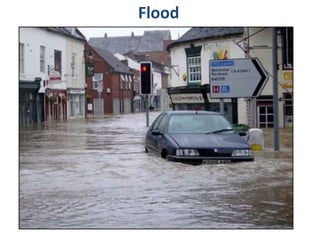
Flood
Flood
Definition: Whenever the magnitude of water
flow exceeds the carrying capacity of the
channel within its bank, the excess of water over
flows on the surroundings causes floods.
Causes of flood
1.Slow kinds: Runoff from sustained rainfall
2.Rapid kinds: snow melt exceeding the capacity
of a river's channel.
3.Fast kinds: sudden release of water from dam,
landslide, or glacier.
Effects of flood
1.Primary effects
2.Secondary effects
1.Primary effects
Physical damage – Can damage any type of
structure, including bridges, cars, buildings,
sewerage systems, roadways, and canals.
2.Secondary effects
 Water supplies – Contamination of water. Clean
drinking water becomes scarce.
 Diseases – Unhygienic conditions. Spread of water-
borne diseases.
 Crops and food supplies – Shortage of food crops can
be caused due to loss of entire harvest.
 Trees – Non-tolerant species can die from suffocation.
 Transport - Transport links destroyed.
Flood management:
1.Diverting excess water through channel or canals
like river ,lake.
2.Satelite pictures of pre-flood, flood and post
flood with other information.
3.River networking .
4.Flood warning given by central water
commission.
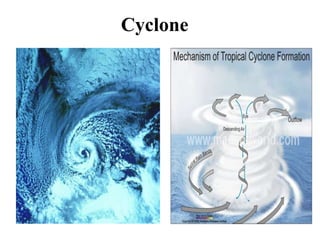
Cyclone
Definition:
ā€œA cyclone is an area of closed, circular
fluid motion rotating in the same direction as the
Earthā€
 Most large-scale cyclonic circulations are centered on
areas of low atmospheric pressure.
 Cyclones are powerful destructive and active from days
to weak and speed varies 180-500km/hr.
 A broad area of low pressure rotating "counter-
clockwise" (cyclonically) is also a cyclone.
Different names of cyclone
Hurricanes - Atlantic, USA
Typhoons – western pacific, Japan
Cyclones – Bangladesh, India
Willy willies - Australia
Occurrence:
1.Tropical cyclone in the warm oceans are formed,
because of heat and moisture.
2. Sea surface temperature must below 25Oc .
3.It move like spinning top at the speed of 10-
30km/hr.
4.Indian cyclone occurs during oct-dec or April –
may.
Effects:
Tropical cyclones are responsible for large
amounts of damage to human life, crop, roads,
transport, tanks wherever they strike.
Slow down the developmental activities.
Control:
Boarding up homes and businesses, strategically
placing sand bags, and building more wind
resistant structures.
Cyclone management:
Satellite images are used by meteorological
department.
Radar system is used to detect the cyclone and
for cyclone warning.
For observing exact location of cyclone ,every
half an hour satellite picture are analyzed.
Its difficult to stop the formation of cyclone,
but the effect could be minimized by planting
more trees.
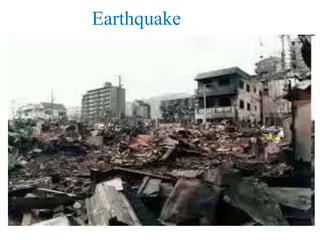
Earthquake
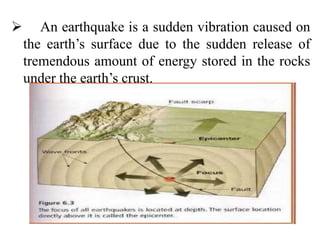
 An earthquake is a sudden vibration caused on
the earth’s surface due to the sudden release of
tremendous amount of energy stored in the rocks
under the earth’s crust.
Causes
Volcanic eruptions, rock falls, landslides, and
explosions ,hydrostatic pressure of manmade water
bodies.
Under ground nuclear testing.
Decrease under ground water level.
Its measures by Richter scale.
 less than 4 – insignificant,4-4.9 – minor,5-5.9-
damaging,6-6.9 – destructive,7-7.9 – major, more
than 8 – severe damage.
Effects
Earthquakes produce deformation of ground
space.
 This includes damage to buildings and in worst
cases the loss of human life.
 The effects of the rumbling produced by
earthquakes usually leads to the destruction of
structures such as buildings, bridges, and dams.
They can also trigger landslides.
Control:
To prevent an earthquake hazard the building
should be properly designed.
Do not construct houses on high risk prone areas.
In case of an earthquake move out of the
building and came in the open but not panic.
Do not use lifts in case of an earthquake.
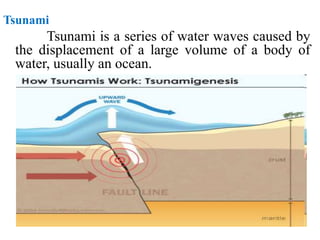
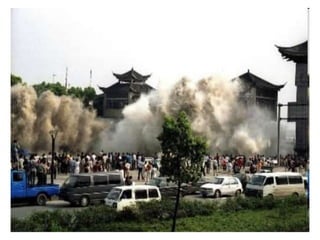
Tsunami
Tsunami is a series of water waves caused by
the displacement of a large volume of a body of
water, usually an ocean.
Causes :
Earth quake ,landslide
Deformatiaon of the sea floor due to the
movement of plates.
Ordinary wave – 100,tsunami – 500km.
It travels across the deep sea at very high
velocity of at around 800-900km/hr.
Velocity decreases ,the height and energy of
wave increases.
Its height near the sea shore ranges from 15-
65m
Effects:
The effects of the tsunami on the country during
this period range from destruction damage, death,
injury, millions of dollars in financial loss, and long
lasting psychological problems for the inhabitants of the
region.
Tsunami management :
 Under the water, the bottom of sea is monitored by sensors.
 If any changes, sensor send information.
The information will be passed through earth stations.
Warning system are warned of the danger approaching.
Land slides
Land slides are the process of large
differential movement of two land portion.
OR
A landslide or landslip is a geological
phenomenon which includes a wide range of
ground movement.
Causes:
Down hill movement of earth caused by rain,
forces either increasing top materials.
Movement of heavy vehicles.
Earthquake ,shocks, vibrations, cyclone creates
landslides.
Erosion in the hilly tract due to runoff water.
Underground caves, underground mining
operation.
Effects
Property damage,
Injury,
Death,
adversely affect a variety of water supplies,
fisheries,
sewage disposal systems,
forests, dams, and roadways
Control measures
Soil Conservation: Ways to reduce soil erosion:
Terracing: Terracing reduces soil erosion on steep slopes
by concerting the land into a series of broad, level
terraces. This retains water for crops at each level and
reduces soil erosion by water run off.
Contour Farming: This method is adopted for gently
sloped land. This involves planting crops in rows across
the contour of gently sloped land.
Agro forestry: In this method crops are planted together
in strips or alleys between trees and shrubs that can
provide fruits and fuel wood. The trees and shrubs
provide shade which reduce water loss by evaporation
and preserve soil moisture.
Wind Breaks : Wind breaks and shelter belts or trees are
established to reduce wind erosion and also for retaining
soil moisture
Unloading the upper parts of the slope.
Concrete support.
Draining the surface and subsurface water from
sloppy region.
Soil stabilization by using quick lime in weak
areas.
environmental pollution, water pollution , air pollution

environmental pollution, water pollution , air pollution

  • 1.
    ME 6403- EnvironmentalScience and Engineering ENVIRONMENTAL POLLUTION Prepared by V.NaveenPrabhu Assistant Professor Sri Eshwar college of Engineering Coimbatore
  • 2.
  • 3.
    Pollution Pollution is theintroduction of contaminants into an environment that causes instability, disorder, harm or discomfort to the ecosystem . e.g. Industry Automobiles Nuclear Reactors etc,. Types of pollutants Biodegradable Non-degradable
  • 4.
    Types of pollution Airpollution Marine (Water) pollution Land or soil pollution Noise pollution Thermal pollution Nuclear pollution
  • 5.
    AIR POLLUTION Air pollutionis the ā€œpresence of contaminants in atmosphere in quantities such that it is injurious to human, plant animal life and propertyā€. Sources of air pollution Natural sources : Volcanic eruption, forest fires, biological decay. Manmade sources :thermal power plant ,fuel burning, agriculture activities.
  • 6.
    Classification of Airpollutants 1.Primary air pollutants. Emitted directly in the atmosphere. E.g. CO,NO & SO2 INDOOR AIR POLLUTANTS Radon gas emitted from building materials like bricks,concrete,tiles etc., It is present in natural gas and ground water. burning of fuel in the kitchen, cigaratte, smoke. 2.Secondary air pollutants
  • 7.
    Sulphur dioxide:  Thecombustion of sulphur containing fuels such as coal and oil.  It can be converted into sulphuric acid. Human Sources :  Coal burning in power plant (88%)  Industrial processes (10%) Environmental effects :  In humans : it causes eye irritation, cough, lung diseases including lung cancer and asthma  In plants: it causes damage of leaves, bleaching of chlorophyll which turns leaves brown, damage to crops and to growth of plants.
  • 8.
    Carbon monoxide Sources:  Cigarettesmoking,incomplete burning of fuels.  Automobile exhaust- carbon monoxide is formed during the combustion of fuel such as petrol.(77%)  Industries: carbon monoxide is released by industries such as iron and steel and petroleum . CO2 + C ------- 2CO 2CO2 --------- 2CO + O2
  • 9.
    Effects: In humans: When theatmosphere is polluted with carbon monoxide, on inhalation, CO combines with the hemoglobin to form car boxy hemoglobin and hence oxygen carrying capacity of the blood decreases. This causes, headache, dizziness, unconsciousness. When inhaled for a long duration it may cause even death. In environment : it increase globe temp.
  • 11.
    Lead Sources Paint, metal refineries,storage battteries….. Effects In humans Mental retardation, health problems even leads to cancer. In environment Harms wild life
  • 12.
    Control of airpollution Source Control:  Use only unleaded petrol.  Use petroleum products and other fuels that have low sulphur and ash content.  Reduce the no. of private vehicles  Ensure the houses, schools are not located on busy streets.  Plant trees along busy streets to reduce particulates, CO and noise.  Industries should be situated outside the city  Use catalytic converters to control CO &hydrocarbons
  • 13.
    Control measures inindustries The emission rates should be restricted to permissible levels by industries. Air pollution control equipments must be made mandatory. Continuous monitoring of the atmosphere for the pollutants, to know the pollution levels.
  • 14.
    EQUIPMENTS USED TOCONTROL AIR POLLUTION Use sufficient supply of oxygen in combustion chamber, so that the combustion is complete. Use mechanical devices such as  scrubbers, cyclones, bag houses and electro-static precipitators to reduce particulate pollutants
  • 15.
  • 16.
  • 17.
  • 18.
    WATER POLLUTION ā€œThe alterationin physical, chemical or biological properties of water, as well as the addition of any foreign substance makes it unfit for health and which decreases the utility of waterā€ is known as water pollution.
  • 19.
    Main sources ofwater pollution are:  Domestic and municipal sewage  Industrial waste  Agricultural waste  Radioactive materials, etc., POINT AND NONPOINT SOURCES Two types of water pollutants exist; Point source Point sources of pollution occur when harmful substances are emitted directly into water. e.g.,Oil spill Nonpoint source. A non-point source delivers pollutants indirectly through environmental changes. e.g., Fertilizer from a field is carried into a stream by rain
  • 20.
  • 21.
  • 22.
    Types of waterpollutant: 1.Infectious agents: Bacteria, viruses, protozoa source : animal waste. Effect : variety of diseases 2.Oxygen demanding waste: Dissolved oxygen (DO) is the amount of oxygen dissolved in given quantity of water at a particular P and T. The saturation point 8-15mg/lit. Sources: Sewage, paper waste, food processing waste. Effects: affect the water quality, affect fish survival and migration.
  • 23.
    3.Inorganic chemicals :Acids, pb, arsenic, selenium, sodium chloride and fluorides. Sources : surface runoff, effluents Effects: Cause skin cancer, damage nervous system,harm to fish and aquatic life, lower crop yields. 4.Organic chemicals:Oil, gasoline,plastics, solvents ,detergents. Sources: Industrial efflents, surface runoff forms. Effects: Causing effect nervous system ,cancer, harm fish and wild life.
  • 24.
    5.Plant nutrients: Nitrate, phosphateand ammonium ions Sources: sewage, runoff water from agriculture, fertillizer. Effects: Excessive growth of algae, lower the oxygen carrying capacity. 6.Sediment: Soil Source: Land erosion. Effects: Can reduce photosynthesis, Affect aquatic food webs.
  • 25.
    Testing of water Dissolvedoxygen (DO) Amount of oxygen dissolved in water at a particular pressure and temp. Bio chemical oxygen demand (BOD) Oxygen required for biological decomposition of organic matters. Chemical oxygen demand (COD) Oxygen required for chemical oxidation of organic matters
  • 26.
    Control measures ofwater pollution:  Avoid Pesticides and fertilizers on sloped land areas. The nutrient rich water can be used as fertilizer in the fields. Separate drainage of sewage and rain water should be provided to prevent overflow of sewage with rain water. Planting more trees. Use nitrogen fixing plants to supplement the use of fertilizers.
  • 27.
    Sewage treatment Main objectiveis to convert harmful compounds into harmless compounds. In primary treatment, the suspended solids and floating objects are removed using coarse screens and sieves. In secondary treatment, the maximum proportions of the suspended inorganic/ organic solids are removed from the liquid sewage. The liquid material passes into the sedimentation tank and finely suspended particles are allowed to settle by adding coagulants like Alum.
  • 29.
    Tertiary treatment Remove detergents,metal ions, nitrates and pesticides, as these are not removed in the earlier treatments. The phosphates are removed as calcium phosphates by adding calcium hydroxide at pH 10-11. At this pH, ammonium salts are also converted into ammonia. The effluent is chlorinated to remove pathogenic bacteria's and finally passed through activated charcoal to absorb gases.
  • 30.
    SOIL POLLUTION Soil pollutionis caused by the presence of human- made chemicals or other alteration in the natural soil environment.
  • 31.
    This type ofcontamination typically arises from, Application of pesticides and fertilizers Percolation of contaminated surface water to subsurface strata, oil and fuel dumping. Discharge of industrial wastes to the soil. The most common chemicals involved are petroleum hydrocarbons, solvents, pesticides, lead and other heavy metals.
  • 32.
    Effects of soilpollution: Chronic exposure to chromium, lead and other metals, petroleum, solvents, and many pesticide and herbicide formulations can be carcinogenic. Chronic exposure to benzene leads to leukemia.(blood cancer) Mercury and cyclodienes are known to induce higher incidences of kidney damage. Sewage sludge has many types of bacteria, viruses and worms which cause types of diseases and also emits toxic vapours.
  • 33.
    Radioactive fallout causeabnormalities .eg., Strontium-90 instead of calcium gets deposited in the bones. Effects occur to agricultural lands which have certain types of soil contamination. Alteration of metabolism of endemic microorganisms.
  • 34.
    N & Pfrom fertilizer in soil reach water bodies with agricultural runoff cause Eutrophication. Chemicals contaminates ground water resources. Acids, alkalis, heavy metals affect soil fertility. Inhibit non target organism like flora, fauna and soil productivity.
  • 35.
    Control of soilpollution : Effluents should be properly treated before discharging on the soil. Solid waste should be properly collected and disposed off by appropriate method. From the waste, recovery of useful products should be done. Cattle dung should be used for methane generation. Microbial degradation of biodegradable substance for reducing soil pollution.
  • 36.
    NOISE POLLUTION Definition: NoisePollution can be defied as unwanted or unpleasant sounds that causes discomfort for all living things.  The various sources of noises are associated with urban development; road-air and rail transport; Industrial noise.  In our country, indiscriminate use of loud speakers, generator sets and firecrackers has given new dimensions to the noise pollution problem.  The commonly used parameter for noise is the sound level in decibel(dB). Human ears are sensitive in the frequency range of 20Hz to 20000Hz
  • 37.
    Major Noise Sources: 1.Road Traffic: Road traffic noise is one of the most widespread and growing environmental problems in urban area. The impact of road traffic noise on the community depends an various factors such as road location and design, land use planning measures, building design, Vehicle standards and deriver behavior. Motor vehicle ownership in India has increased substantially over the last 30 years and general levels of road traffic noise throughout India have increased through out the period.
  • 38.
    2. Air Traffic: Theextend of aircraft noise impact depends on the type of aircraft flown, the number of flights and flight paths. The increase in number of flights, an important factor is overall noise levels, the led to an increase in general noise levels associated with air traffic. 3. Rail Traffic: The two main sources of noise and vibration relating to the operation of the rail network is 1. The operation of trains and the maintenance 2. Construction of rail infrastructure.
  • 39.
    4.Neighborhood & DomesticNoise: Other significant source of noise annoyance is car alarms, building construction and household noise,Celebrations- religious function,social and elections. 5.Noise generated by noise levels of 125dB as per Environmental rules 1999.
  • 40.
    Effects: 1. Noise candisturb out work, rest, sleep and communication. 2. It can damage our hearing and evoke other psychological, physiological and possibly pathological reactions. 3.It effects health efficiency and behaviour. It may cause damage to heart, brain,kidneys and liver. 4.It causes muscles to contract leading to nervous breakdown, tension.
  • 41.
    5.Change in hormonecontent of blood, which turn increase the rate of heart beat. 6.Recently it has been reported that blood is also thickened by excessive noise. 7. Hearing damage : it can cause permanent hearing loss. 8.Interferences with man’s communication :In noise area communication is affected.
  • 42.
    Sound Source SoundLevel dB Subjective Feeling of Human Beings Rockets and missiles, heavy explosives 160 Unbearable Jet Planes and cannons, explosives 140 Unbearable Aircraft Propeller and Machine Guns 130 Unbearable Diesel, steam engine and ball mills, crackers 120 Unbearable Electric saws and looms, heavy trucks 110 Unbearable The CPCB-The central pollution control board recommended noise levels.
  • 43.
    CONTROL MEASURES OFNOISE POLLUTION: 1.REDUCTION IN SOURCE OF NOISE : Heavy vehicles and old vehicles may not be allowed in populated areas. 2. Noise making machines should be kept in containers with sound absorbing media. 3. Proper oiling will reduce the noise from the machinery. 4. Use sound absorbing silencers: Silencers can reduce noise by absorbing sound. 5. Planting more trees having broad leaves.
  • 44.
    6. Through law: soundproduction is minimized at various social function. 7. The use of fireworks or fire crackers shall not be permitted except between 6.00a.m and 10.00p.m.No fireworks or fire crackers shall be used between 10.00p.m and 6.00a.m. 8. Silence zone in area comprising not less than 100meters around hospitals, educational institutions ,courts and religious places.
  • 45.
    THERMAL POLLUTION  Thermalpollution is the degradation of water quality by any process that changes ambient water temperature.  A common cause of thermal pollution is the use of water as a coolant by power plants and industrial manufacturers.  Energy is the basic necessity for the economic development of a country.  The electrical energy is produced in power plants or generating stations. The conventional power plants are: - Steam or Thermal Power station, - Hydro-electric Power station, - Nuclear Power station
  • 46.
    Steam or ThermalPower station In the thermal power station, the steam is produced in the boiler, using the heat released by the combustion of coal, oil or natural gas. The steam is used to rotate the steam turbine (impulse/ reaction). The steam turbine drives the alternator, which converts mechanical energy into electrical energy.10-16oC higher than initial temp.
  • 48.
    Hydro-electric Power station Hydroelectricityis the term referring to electricity generated by hydropower. The production of electrical power through the use of the gravitational force of falling or flowing water. It is the most widely used form of renewable energy.
  • 49.
    Once a hydroelectriccomplex is constructed, the project produces no direct waste, and has a considerably lower output level of the greenhouse gas & carbon dioxide (CO2).
  • 50.
    Nuclear Power station Nuclearpower is produced by controlled (i.e., non-explosive) nuclear reactions. Commercial and utility plants currently use nuclear fission reactions to heat water to produce steam, which is then used to generate electricity.
  • 51.
    Effects of thermalpollution Elevated temperature typically decreases the level of dissolved oxygen (DO) in water. Thermal pollution may also increase the metabolic rate of aquatic animals. Fish migration is affected due to formation of various thermal zones. Discharge of hot water near the shores could disturb and even kill young fishes. Toxicity of pesticides ,detergents and chemicals into the effluent increases with increase in temp. The composition of flora and fauna changes.
  • 52.
    Control of thermalpollution  Thermal pollution from industrial sources is generated mostly by power plants, petroleum refineries, pulp and paper mills, chemical plants, steel mills and smelters. Cooling ponds, man-made bodies of water designed for cooling by evaporation, convection, and radiation. Cooling towers, which transfer waste heat to the atmosphere through evaporation and/or heat transfer. Cogeneration, a process where waste heat is recycled for domestic and/or industrial heating purposes.
  • 53.
    RADIO ACTIVE ORNUCLEAR POLLUTION The uncontrolled distribution of radioactive material in a given environment. Radioactive contamination is typically the result of a spill or accident during the production or use of radionuclide (radioisotopes), an unstable nucleus which has excessive energy. Contamination may occur from radioactive gases, liquids or particles
  • 54.
    Effects Radioactive contamination canenter the body through ingestion, inhalation, absorption, or injection that causes discomfort, diarrhea, nausea or vomiting, and burns skin and hair loss.  The cumulative damage can cause serious health problems long term, such as cancer, especially leukemia and Thyroid Cancer.  For this reason, it is important to use personal protective equipment when working with radioactive materials.
  • 55.
    Control methods: It includesthe stoppage of leakage from the radioactive materials including the nuclear reactors, industries and laboratories. The disposal of radioactive material must be safe and secure. The protective garments must be worn by the workers who work in the nuclear plants. The natural radiation must be at the permissible limits and they must not cross it.
  • 56.
    SOLID WASTE MANAGEMENT: Eachhousehold generates garbage or waste day in and day out. There are different types of solid waste depending on their source Types of solid waste: Solid waste can be classified into different types depending on their source: Household waste is generally classified as,  Municipal waste  Industrial waste as hazardous waste  Biomedical waste or hospital waste E waste-Electronic waste
  • 57.
    SOURCES OF URBANAND INDUSTRIAL WASTE: Waste from homes: polyethylene bags, cans, glass bottles, waste paper, cloth, food waste, empty metal. Waste from shops: Cans, bottles, waste paper, tea leaves, packaging material. Biomedical waste : discarded medicines, chemical wastes, disposable syringes, swabs, bandages and body fluids. Construction waste :wood, concrete, cement .,
  • 58.
    Industrial waste :Packagingmeterial,organic waste, acid,alkali and metals. Solid waste: Rubber,plastic,paper,glass, wood,oils,paints, dyes,heavy metals, asbestos. Effects of solid waste : Physicochemical and chemical characteristics affecting productivity of soils. Toxic substance contaminate the ground water. Burning of materials produce dioxins, furans causes cancer.
  • 59.
    TYPES INVOLVED SOLIDWASTE MANAGEMENT: 1.REDUCE,REUSE,RECYCLE: a.Reduce the usage of raw materials: If usage is reduced,generation of waste also reduced. b.Reuse of waste materials: 1.Refillable containers can be reused 2.Discarded cycle tubes can be made into rubber rings.
  • 60.
    c.Recycling of materials: 1.OldAl cans and bottles are melted and recast into new cans and bottles. 2.Preparation of cellulose insulation from paper 3.Preparation fuel pellets from kitchen waste. Methods of disposal of solid waste: a. Landfill : The bottom is covered with several layers of clay,plastic & sand –protects ground water contamination.
  • 61.
    • Landfill iscovered with clay, sand & gravel. • Methane gas is collected and used to produce electricity. b. Composting: The biodegradable waste is allowed to decomposed into oxygen rich medium and quality rich environment is formed which improves soil fertility rate. c. Incineration :Burning of waste at high temp(2800-3200 F) in combustion chamber and used to produce electricity and incinerate100-150tonnes per hour.
  • 62.
    Role of individualin prevention of pollution  Individuals can, however, play an important role in abatement of air, water, soil or noise pollution in the following simple manners: Use low-phosphate, phosphate-free or biodegradable dishwashing liquid, laundry detergent, and shampoo. Use manure or compost instead of commercial inorganic fertilizers to fertilize gardens and yard plant. Use biological methods or integrated pest management to control garden, yard, and household pests.
  • 63.
    Don't pour pesticides,paints, solvents, oils, or other products containing harmful chemicals down drain or on the ground. Recycle old motor oil and antifreeze at an auto service center that has an oil recycling program. Test water for lead, nitrates, trihalomethanes, radon, volatile, organic compounds and pesticides. Support ecological land-use planning in your community. Get to know your local water bodies and form watchdog groups to help monitor and protect. ā€œTHINK GLOBALLY ACT LOCALLYā€
  • 64.
  • 65.
    Flood Definition: Whenever themagnitude of water flow exceeds the carrying capacity of the channel within its bank, the excess of water over flows on the surroundings causes floods. Causes of flood 1.Slow kinds: Runoff from sustained rainfall 2.Rapid kinds: snow melt exceeding the capacity of a river's channel. 3.Fast kinds: sudden release of water from dam, landslide, or glacier.
  • 66.
    Effects of flood 1.Primaryeffects 2.Secondary effects 1.Primary effects Physical damage – Can damage any type of structure, including bridges, cars, buildings, sewerage systems, roadways, and canals.
  • 67.
    2.Secondary effects  Watersupplies – Contamination of water. Clean drinking water becomes scarce.  Diseases – Unhygienic conditions. Spread of water- borne diseases.  Crops and food supplies – Shortage of food crops can be caused due to loss of entire harvest.  Trees – Non-tolerant species can die from suffocation.  Transport - Transport links destroyed.
  • 68.
    Flood management: 1.Diverting excesswater through channel or canals like river ,lake. 2.Satelite pictures of pre-flood, flood and post flood with other information. 3.River networking . 4.Flood warning given by central water commission.
  • 69.
  • 70.
    Definition: ā€œA cyclone isan area of closed, circular fluid motion rotating in the same direction as the Earthā€  Most large-scale cyclonic circulations are centered on areas of low atmospheric pressure.  Cyclones are powerful destructive and active from days to weak and speed varies 180-500km/hr.  A broad area of low pressure rotating "counter- clockwise" (cyclonically) is also a cyclone.
  • 71.
    Different names ofcyclone Hurricanes - Atlantic, USA Typhoons – western pacific, Japan Cyclones – Bangladesh, India Willy willies - Australia
  • 72.
    Occurrence: 1.Tropical cyclone inthe warm oceans are formed, because of heat and moisture. 2. Sea surface temperature must below 25Oc . 3.It move like spinning top at the speed of 10- 30km/hr. 4.Indian cyclone occurs during oct-dec or April – may.
  • 73.
    Effects: Tropical cyclones areresponsible for large amounts of damage to human life, crop, roads, transport, tanks wherever they strike. Slow down the developmental activities. Control: Boarding up homes and businesses, strategically placing sand bags, and building more wind resistant structures.
  • 74.
    Cyclone management: Satellite imagesare used by meteorological department. Radar system is used to detect the cyclone and for cyclone warning. For observing exact location of cyclone ,every half an hour satellite picture are analyzed. Its difficult to stop the formation of cyclone, but the effect could be minimized by planting more trees.
  • 75.
  • 76.
     An earthquakeis a sudden vibration caused on the earth’s surface due to the sudden release of tremendous amount of energy stored in the rocks under the earth’s crust.
  • 77.
    Causes Volcanic eruptions, rockfalls, landslides, and explosions ,hydrostatic pressure of manmade water bodies. Under ground nuclear testing. Decrease under ground water level. Its measures by Richter scale.  less than 4 – insignificant,4-4.9 – minor,5-5.9- damaging,6-6.9 – destructive,7-7.9 – major, more than 8 – severe damage.
  • 78.
    Effects Earthquakes produce deformationof ground space.  This includes damage to buildings and in worst cases the loss of human life.  The effects of the rumbling produced by earthquakes usually leads to the destruction of structures such as buildings, bridges, and dams. They can also trigger landslides.
  • 79.
    Control: To prevent anearthquake hazard the building should be properly designed. Do not construct houses on high risk prone areas. In case of an earthquake move out of the building and came in the open but not panic. Do not use lifts in case of an earthquake.
  • 80.
    Tsunami Tsunami is aseries of water waves caused by the displacement of a large volume of a body of water, usually an ocean.
  • 82.
    Causes : Earth quake,landslide Deformatiaon of the sea floor due to the movement of plates. Ordinary wave – 100,tsunami – 500km. It travels across the deep sea at very high velocity of at around 800-900km/hr. Velocity decreases ,the height and energy of wave increases. Its height near the sea shore ranges from 15- 65m
  • 83.
    Effects: The effects ofthe tsunami on the country during this period range from destruction damage, death, injury, millions of dollars in financial loss, and long lasting psychological problems for the inhabitants of the region. Tsunami management :  Under the water, the bottom of sea is monitored by sensors.  If any changes, sensor send information. The information will be passed through earth stations. Warning system are warned of the danger approaching.
  • 84.
    Land slides Land slidesare the process of large differential movement of two land portion. OR A landslide or landslip is a geological phenomenon which includes a wide range of ground movement.
  • 85.
    Causes: Down hill movementof earth caused by rain, forces either increasing top materials. Movement of heavy vehicles. Earthquake ,shocks, vibrations, cyclone creates landslides. Erosion in the hilly tract due to runoff water. Underground caves, underground mining operation.
  • 86.
    Effects Property damage, Injury, Death, adversely affecta variety of water supplies, fisheries, sewage disposal systems, forests, dams, and roadways
  • 87.
    Control measures Soil Conservation:Ways to reduce soil erosion: Terracing: Terracing reduces soil erosion on steep slopes by concerting the land into a series of broad, level terraces. This retains water for crops at each level and reduces soil erosion by water run off. Contour Farming: This method is adopted for gently sloped land. This involves planting crops in rows across the contour of gently sloped land.
  • 88.
    Agro forestry: Inthis method crops are planted together in strips or alleys between trees and shrubs that can provide fruits and fuel wood. The trees and shrubs provide shade which reduce water loss by evaporation and preserve soil moisture. Wind Breaks : Wind breaks and shelter belts or trees are established to reduce wind erosion and also for retaining soil moisture Unloading the upper parts of the slope. Concrete support. Draining the surface and subsurface water from sloppy region. Soil stabilization by using quick lime in weak areas.