
Presented By
Shashi Shekhar Singh
 SES,JNU New Delhi
INTRODUCTION
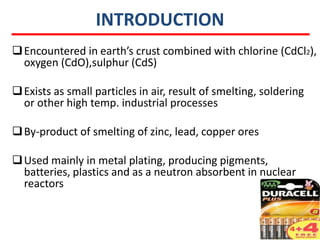
 Encountered in earth’s crust combined with chlorine (CdCl2),
  oxygen (CdO),sulphur (CdS)

 Exists as small particles in air, result of smelting, soldering
  or other high temp. industrial processes

 By-product of smelting of zinc, lead, copper ores

 Used mainly in metal plating, producing pigments,
  batteries, plastics and as a neutron absorbent in nuclear
  reactors
CADMIUM POISONING

 Caused by excessive exposure to cadmium
 No constructive purpose in the human body.
 Extremely toxic even in low concentrations, and
 will bioaccumulation in organisms and ecosystems
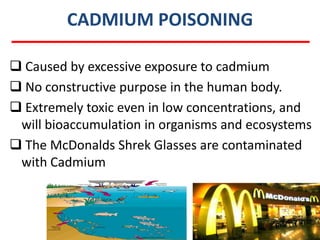
 The McDonalds Shrek Glasses are contaminated
 with Cadmium
EXPOSURE SOURCES
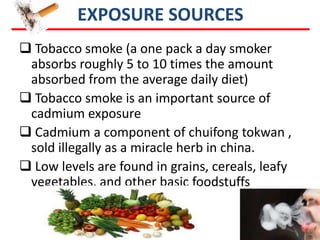
 Tobacco smoke (a one pack a day smoker
 absorbs roughly 5 to 10 times the amount
 absorbed from the average daily diet)
 Tobacco smoke is an important source of
 cadmium exposure
 Cadmium a component of chuifong tokwan ,
 sold illegally as a miracle herb in china.
 Low levels are found in grains, cereals, leafy
 vegetables, and other basic foodstuffs
Toxicity
 Primary effects on lungs & kidneys
 Lung, Emphysema, Kidney, Calcium metabolism, Possible lung
  carcinogen.
 Secondary effects on skeletal system
 Mechanisms
 Binds to sulfhydryl groups, displacing other metals from
  metalloenzymes, disrupting those enzymes
 competing with calcium for binding sites (calmodulin)
 Kidney toxicity
    Free Cd binds to kidney glomerulus

    Proximal tubule dysfunction
Contd…
 Lung toxicity:
    Edema and Emphysema by killing lung macrophages
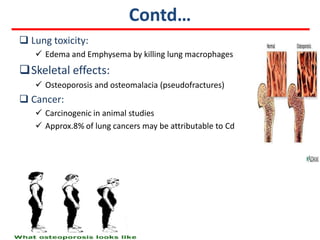
Skeletal effects:
    Osteoporosis and osteomalacia (pseudofractures)
 Cancer:
    Carcinogenic in animal studies
    Approx.8% of lung cancers may be attributable to Cd
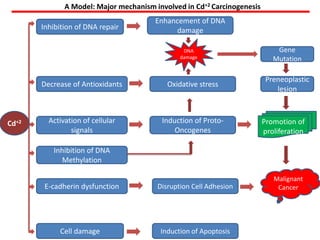
A Model: Major mechanism involved in Cd+2 Carcinogenesis
                                       Enhancement of DNA
       Inhibition of DNA repair             damage

                                                DNA                          Gene
                                               damage                       Mutation

                                                                          Preneoplastic
       Decrease of Antioxidants            Oxidative stress
                                                                             lesion


Cd+2     Activation of cellular          Induction of Proto-             Promotion of
                signals                      Oncogenes                   proliferation

          Inhibition of DNA
            Methylation

                                                                            Malignant
        E-cadherin dysfunction          Disruption Cell Adhesion             Cancer


            Cell damage                  Induction of Apoptosis
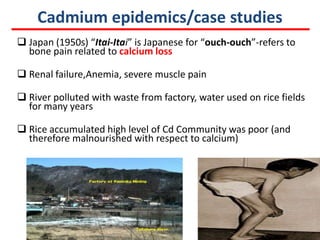
Cadmium epidemics/case studies
 Japan (1950s) “Itai-Itai” is Japanese for “ouch-ouch”-refers to
  bone pain related to calcium loss

 Renal failure,Anemia, severe muscle pain

 River polluted with waste from factory, water used on rice fields
  for many years

 Rice accumulated high level of Cd Community was poor (and
  therefore malnourished with respect to calcium)
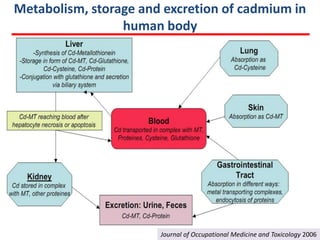
Metabolism, storage and excretion of cadmium in
                 human body


                       Journal of Occupational Medicine and Toxicology 2006
Mechanism
 Two mechanisms are involved in cadmium mutagenicity,
 Induction of reactive oxygen species and
 Inhibition of DNA repair
 Cystein is a precursor to the anti-oxidant protein glutathione and
  is also required for metallothionein which is a protein that binds
  to cadmium specifically
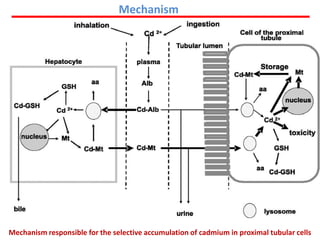
 Intracellular, cadmium binds to metallothionein
 Cadmium is released into the plasma after haemolysis or when
  the erythrocytes lifetime has expired
 Cadmium is transported in blood plasma initially bound to
  albumin
 Cadmium bound to albumin is preferentially taken up by the liver
Contd..
 In the liver, cadmium induces the synthesis of
  metallothionein
 After a few days exposure metallothionein-bound
  cadmium appears in the blood plasma
 Plasma metallothionein play an important role in
  transport of cadmium
 Bound to sulfhydryl groups of cystein residues
 After chronic exposure, cadmium accumulates in the
  liver then redistributed slowly to the kidney
Mechanism


Mechanism responsible for the selective accumulation of cadmium in proximal tubular cells
Cadmium-induced apoptosis involves two main
                        pathways
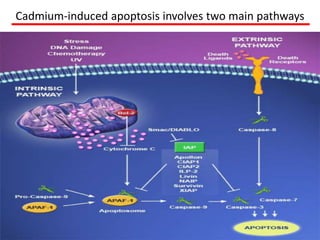
•   Extrinsic pathway Fas- FADD caspase-8 pathway initiated by ligand-induced activation
    of the death receptors (such as Fas) at the plasma membrane resulting in the
    activation of caspase-8 or caspase-10

•    Intrinsic pathway triggered by cellular stress signals (such as DNA damage) activating
    caspase-9. Caspase-8 and caspase-9 cleave and activate the effector caspases
    caspase-3 and caspase-7, which kill the cells by cleaving a wide range of protein
    substrates

•   cadmium induced cell death seems to be associated with caspase-8 activation (via
    FAS receptor) followed by BID cleavage and induction of mitochondria caspase
    cascade after release of cytochrome C .

•   Apoptosis may also be induced by caspase-independent events after intoxication,
    maybe by Ca2+-calpain coupled processes or by translocation to the nucleus of
    apoptosis-inducing factor (AIF)
Cadmium-induced apoptosis involves two main pathways
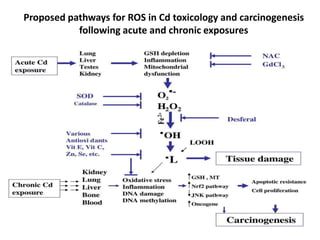
Cadmium induces ROS production
 Cadmium exposure causes oxidative stress, which is not due to
  direct involvement of cadmium in the production of ROS but
  through indirect processes like decrease of cellular anti-oxidants
  and exhalation of ROS from mitochondria

 Surprisingly, the activities of superoxide dismutase (SOD) and
  glutathione peroxidase (GPx) are reduced after 4 h but increased
  again after 8 h of intoxication

 The reduction of glutathione levels after cadmium administration is
  also shown to occur in mice.

 The reduction of the activities of antioxidants may lead to the
  production of ROS species like H202,            OH and O2–. This
  overproduction of ROS is partly responsible for the DNA damage.
Proposed pathways for ROS in Cd toxicology and carcinogenesis
           following acute and chronic exposures
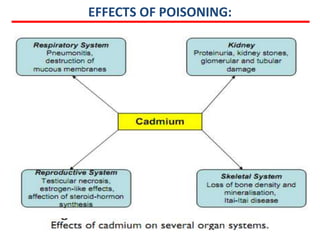
EFFECTS OF POISONING:
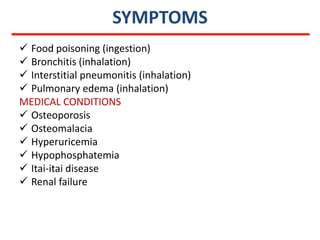
SYMPTOMS
 Food poisoning (ingestion)
 Bronchitis (inhalation)
 Interstitial pneumonitis (inhalation)
 Pulmonary edema (inhalation)
MEDICAL CONDITIONS
 Osteoporosis
 Osteomalacia
 Hyperuricemia
 Hypophosphatemia
 Itai-itai disease
 Renal failure
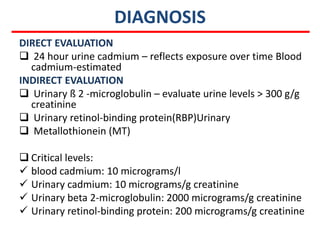
DIAGNOSIS
DIRECT EVALUATION
 24 hour urine cadmium – reflects exposure over time Blood
  cadmium-estimated
INDIRECT EVALUATION
 Urinary ß 2 -microglobulin – evaluate urine levels > 300 g/g
  creatinine
 Urinary retinol-binding protein(RBP)Urinary
 Metallothionein (MT)

 Critical levels:
 blood cadmium: 10 micrograms/l
 Urinary cadmium: 10 micrograms/g creatinine
 Urinary beta 2-microglobulin: 2000 micrograms/g creatinine
 Urinary retinol-binding protein: 200 micrograms/g creatinine
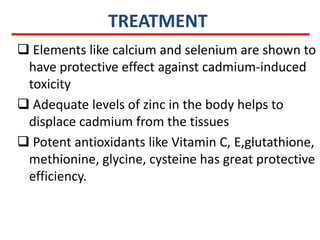
TREATMENT
 Elements like calcium and selenium are shown to
 have protective effect against cadmium-induced
 toxicity
 Adequate levels of zinc in the body helps to
 displace cadmium from the tissues
 Potent antioxidants like Vitamin C, E,glutathione,
 methionine, glycine, cysteine has great protective
 efficiency.
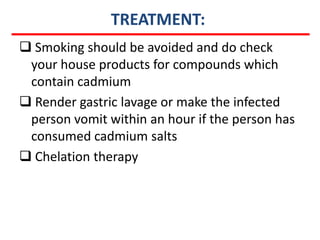
TREATMENT:
 Smoking should be avoided and do check
 your house products for compounds which
 contain cadmium
 Render gastric lavage or make the infected
 person vomit within an hour if the person has
 consumed cadmium salts
 Chelation therapy
SMOKING IS INJURIOUS TO
HEALTH…..STOP SMOKING!!!:

Cadmium toxicity in human

  • 1.
    Presented By Shashi ShekharSingh SES,JNU New Delhi
  • 2.
    INTRODUCTION  Encountered inearth’s crust combined with chlorine (CdCl2), oxygen (CdO),sulphur (CdS)  Exists as small particles in air, result of smelting, soldering or other high temp. industrial processes  By-product of smelting of zinc, lead, copper ores  Used mainly in metal plating, producing pigments, batteries, plastics and as a neutron absorbent in nuclear reactors
  • 3.
    CADMIUM POISONING  Causedby excessive exposure to cadmium  No constructive purpose in the human body.  Extremely toxic even in low concentrations, and will bioaccumulation in organisms and ecosystems  The McDonalds Shrek Glasses are contaminated with Cadmium
  • 4.
    EXPOSURE SOURCES  Tobaccosmoke (a one pack a day smoker absorbs roughly 5 to 10 times the amount absorbed from the average daily diet)  Tobacco smoke is an important source of cadmium exposure  Cadmium a component of chuifong tokwan , sold illegally as a miracle herb in china.  Low levels are found in grains, cereals, leafy vegetables, and other basic foodstuffs
  • 5.
    Toxicity  Primary effectson lungs & kidneys  Lung, Emphysema, Kidney, Calcium metabolism, Possible lung carcinogen.  Secondary effects on skeletal system  Mechanisms  Binds to sulfhydryl groups, displacing other metals from metalloenzymes, disrupting those enzymes  competing with calcium for binding sites (calmodulin)  Kidney toxicity  Free Cd binds to kidney glomerulus  Proximal tubule dysfunction
  • 6.
    Contd…  Lung toxicity:  Edema and Emphysema by killing lung macrophages Skeletal effects:  Osteoporosis and osteomalacia (pseudofractures)  Cancer:  Carcinogenic in animal studies  Approx.8% of lung cancers may be attributable to Cd
  • 7.
    A Model: Majormechanism involved in Cd+2 Carcinogenesis Enhancement of DNA Inhibition of DNA repair damage DNA Gene damage Mutation Preneoplastic Decrease of Antioxidants Oxidative stress lesion Cd+2 Activation of cellular Induction of Proto- Promotion of signals Oncogenes proliferation Inhibition of DNA Methylation Malignant E-cadherin dysfunction Disruption Cell Adhesion Cancer Cell damage Induction of Apoptosis
  • 8.
    Cadmium epidemics/case studies Japan (1950s) “Itai-Itai” is Japanese for “ouch-ouch”-refers to bone pain related to calcium loss  Renal failure,Anemia, severe muscle pain  River polluted with waste from factory, water used on rice fields for many years  Rice accumulated high level of Cd Community was poor (and therefore malnourished with respect to calcium)
  • 9.
    Metabolism, storage andexcretion of cadmium in human body Journal of Occupational Medicine and Toxicology 2006
  • 10.
    Mechanism  Two mechanismsare involved in cadmium mutagenicity,  Induction of reactive oxygen species and  Inhibition of DNA repair  Cystein is a precursor to the anti-oxidant protein glutathione and is also required for metallothionein which is a protein that binds to cadmium specifically  Intracellular, cadmium binds to metallothionein  Cadmium is released into the plasma after haemolysis or when the erythrocytes lifetime has expired  Cadmium is transported in blood plasma initially bound to albumin  Cadmium bound to albumin is preferentially taken up by the liver
  • 11.
    Contd..  In theliver, cadmium induces the synthesis of metallothionein  After a few days exposure metallothionein-bound cadmium appears in the blood plasma  Plasma metallothionein play an important role in transport of cadmium  Bound to sulfhydryl groups of cystein residues  After chronic exposure, cadmium accumulates in the liver then redistributed slowly to the kidney
  • 12.
    Mechanism Mechanism responsible forthe selective accumulation of cadmium in proximal tubular cells
  • 13.
    Cadmium-induced apoptosis involvestwo main pathways • Extrinsic pathway Fas- FADD caspase-8 pathway initiated by ligand-induced activation of the death receptors (such as Fas) at the plasma membrane resulting in the activation of caspase-8 or caspase-10 • Intrinsic pathway triggered by cellular stress signals (such as DNA damage) activating caspase-9. Caspase-8 and caspase-9 cleave and activate the effector caspases caspase-3 and caspase-7, which kill the cells by cleaving a wide range of protein substrates • cadmium induced cell death seems to be associated with caspase-8 activation (via FAS receptor) followed by BID cleavage and induction of mitochondria caspase cascade after release of cytochrome C . • Apoptosis may also be induced by caspase-independent events after intoxication, maybe by Ca2+-calpain coupled processes or by translocation to the nucleus of apoptosis-inducing factor (AIF)
  • 14.
  • 15.
    Cadmium induces ROSproduction  Cadmium exposure causes oxidative stress, which is not due to direct involvement of cadmium in the production of ROS but through indirect processes like decrease of cellular anti-oxidants and exhalation of ROS from mitochondria  Surprisingly, the activities of superoxide dismutase (SOD) and glutathione peroxidase (GPx) are reduced after 4 h but increased again after 8 h of intoxication  The reduction of glutathione levels after cadmium administration is also shown to occur in mice.  The reduction of the activities of antioxidants may lead to the production of ROS species like H202, OH and O2–. This overproduction of ROS is partly responsible for the DNA damage.
  • 16.
    Proposed pathways forROS in Cd toxicology and carcinogenesis following acute and chronic exposures
  • 17.
  • 18.
    SYMPTOMS  Food poisoning(ingestion)  Bronchitis (inhalation)  Interstitial pneumonitis (inhalation)  Pulmonary edema (inhalation) MEDICAL CONDITIONS  Osteoporosis  Osteomalacia  Hyperuricemia  Hypophosphatemia  Itai-itai disease  Renal failure
  • 19.
    DIAGNOSIS DIRECT EVALUATION  24hour urine cadmium – reflects exposure over time Blood cadmium-estimated INDIRECT EVALUATION  Urinary ß 2 -microglobulin – evaluate urine levels > 300 g/g creatinine  Urinary retinol-binding protein(RBP)Urinary  Metallothionein (MT)  Critical levels:  blood cadmium: 10 micrograms/l  Urinary cadmium: 10 micrograms/g creatinine  Urinary beta 2-microglobulin: 2000 micrograms/g creatinine  Urinary retinol-binding protein: 200 micrograms/g creatinine
  • 20.
    TREATMENT  Elements likecalcium and selenium are shown to have protective effect against cadmium-induced toxicity  Adequate levels of zinc in the body helps to displace cadmium from the tissues  Potent antioxidants like Vitamin C, E,glutathione, methionine, glycine, cysteine has great protective efficiency.
  • 21.
    TREATMENT:  Smoking shouldbe avoided and do check your house products for compounds which contain cadmium  Render gastric lavage or make the infected person vomit within an hour if the person has consumed cadmium salts  Chelation therapy
  • 22.
    SMOKING IS INJURIOUSTO HEALTH…..STOP SMOKING!!!:

Editor's Notes

  • #17 Gadolinium chloride. NAC. N-acetyl-l-cysteine