HEAVY METAL POLLUTION AND
ITS EFFECT ON ENVIRONMENT
Course Name: Current Trends in Agronomy(APA-701)
NAME: KANIKA BHAKUNI
Id. No.: 49873
Ph.D Agronomy (I Year)
TABLE OF CONTENT
• Heavy metals
– Definition
– Properties
• Sources
• Fate of Heavy metals
• Permissible limit of Heavy metals
• Water quality
• Air quality
• Soil quality
• Effect on Plants and Human
• Remediation techniques
– Phytoremediation
Background
• Heavy metal contamination and toxicity : a prominent environmental
issue in water, soil/sediments and air.
• Heavy metals can be both beneficial and detrimental (at high
concentration) to the environment and life.
• These are natural components of the Earth’s crust.
• Consumed by lifeforms via eating food, drinking water and inhaling air.
What are Heavy Metals?
• Definition: Any metallic chemical elements that has a relatively high density and is
toxic or poisonous at low concentration.
• High density: range from 3.5g/cm3 to 7 g/cm3
• Specific gravity at least 5 times more than water.
• Some are transition metals on the periodic table.
– often ‘trace elements’, often occurs as oxyanions.
• Heavy metals can be found in the forms of sulfates, hydroxides, oxides, sulfides,
phosphates, and silicates.
Properties of Heavy Metals
Physical
properties
of Heavy
Metals
Lustre
shininess
High melting
point
High density
Good
conductor of
heat and
electricity Non-
degradable
Malleable
Ductile
Toxicological properties of
Heavy Metals
Persistence -long
residual and half
life
Soil residence
time->1000 years
Acute toxicity-
plants,animals and
microorganisms
Bioaccumlation
and
biomagnification
through food chain
Chronic and sub-
lethal effects at
low concentration
Synergistic effects
Teratogenic and
carcinogenic
properties
Heavy Metal Contamination: Important Factors
• Process of mobilization from sources areas- to water and sediments.
• Important concept is about
 Speciation- oxidation state or compound it occurs in
Example- Arsenic in arsenite has an oxidation state of 3, As in
arsenate has an oxidation state of 5.
As3+ is 5 times more toxic than As5+.
Cr6+ is much more toxic than Cr3+.
 Affinity for -SH (Sulfhydryl group)- can deactivate enzyme.
Natural sources
weathering
of rocks
Volcanic
eruption
Forest
fires
NATURAL SOURCES OF
HEAVY METALS
Wind blown
dust
Anthropogenic sources
Fate of Heavy metals
Most common Heavy Metals
Mercury(Hg)
• Acidic(pH-5-7) water contains significant amount of Hg.
• Microorganisms in soil converts mercury into
methylmercury which readily absorbed by most of the
organisms and cause nerve damage.
• Fishes accumulates methylmercury.
Lead(Pb)
• Inorganic lead is general metabolic poison.
• Breaks the blood barrier and interfers with normal
development of brain.
• It accumulates in the bodies of water and soil organisms
• Phytoplanktons population gets disturbed.
Cadmium(Cd)
• It is transported over a great distance when absorbed by
sludge.
• Pollute surface water and soil.
• Readily absorbed on microorganisms of soil.
• Acidic nature of soil increase its toxicity
Arsenic(Ar)
• Groundwater is the major source of which has cancer risk
at low concentration.
• It is attached to particulate matter ,containg mixture of
arsenite and arsenate.
• Human exposure to Ar is throughout the air at low
concentration
Permissible limit of Heavy metals in soil,water and plant
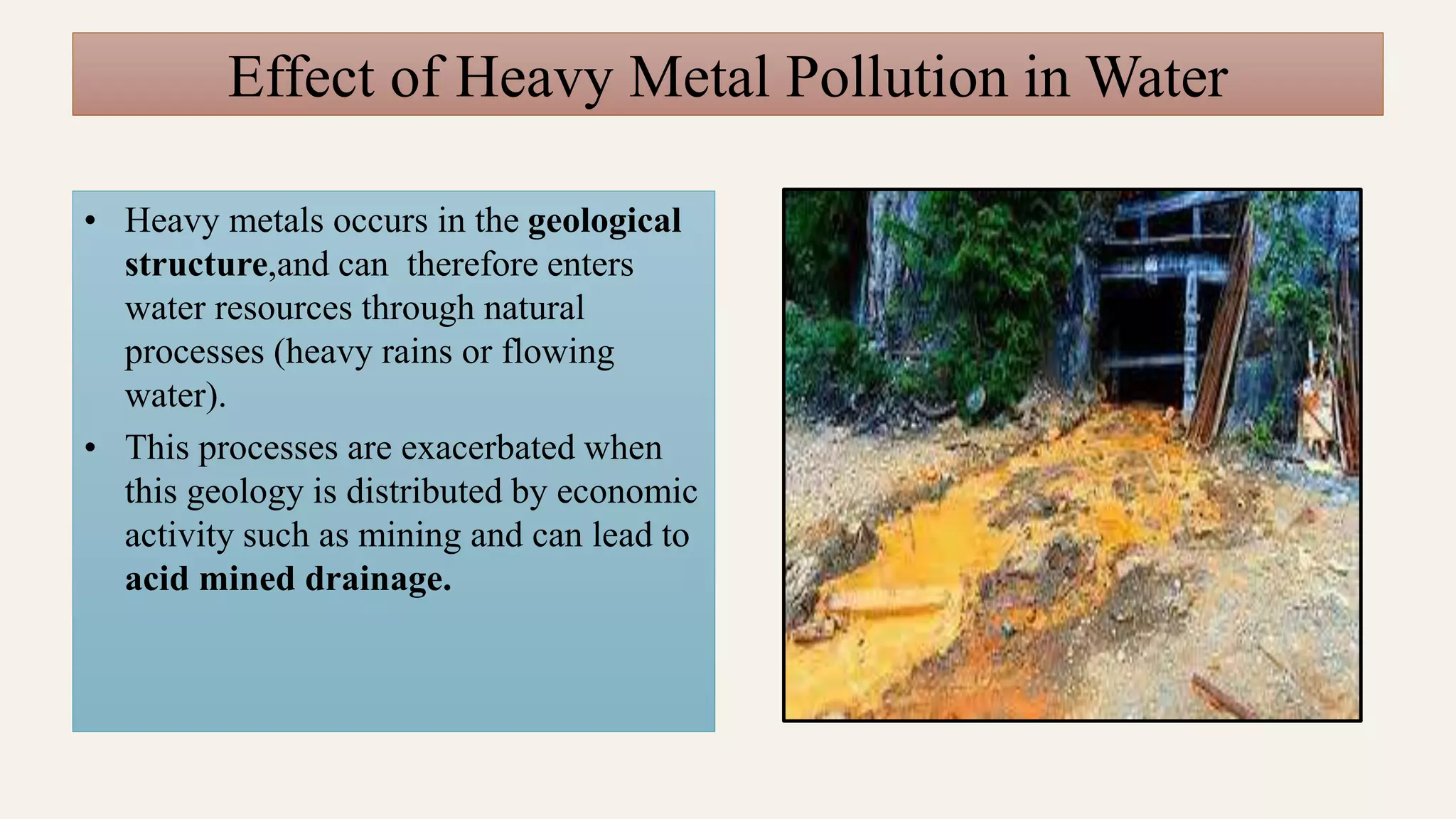
Effect of Heavy Metal Pollution in Water
• Heavy metals occurs in the geological
structure,and can therefore enters
water resources through natural
processes (heavy rains or flowing
water).
• This processes are exacerbated when
this geology is distributed by economic
activity such as mining and can lead to
acid mined drainage.
Fate of metals in Aquatic environment
Precipitate in hard
water
Soluble in acidic
water
Insoluble metals
deposit in the river
sediments
Aquatic organisms
take up from water
or sediments
Benthic organisms
accumulate through
food chain
More soluble at
high temperture
• Trophic transfer: passage of contaminant in food
chains, from one trophic level to the next.
• Bioconcentration: accumulation of contaminant in
an organisms ambient environment.
• Dietary accumulation : accumulation of
contaminant in an organisms as a result of its
uptake from the organism’s food.
• Bioaccumulation: accumulation of contaminant in
an organisms as a result of its uptake from both
ambient abiotic environment and organism’s food.
• Biomagnification: increase in concentration of the
contaminant along a food chain.
• Biodilution: decrease in concentration of the
contaminant along the food chain.
Effect on Air quality
• Atmospheric particulate matter is of great concern and has strong potential for adsorbing toxic metals which may
then enter the human body through inhalaton.
• Fine PM i.e., PM2.5 has greater surface area per unit mass, allowing more heavy metals to accumulate and
therefore more dangerous.
• PM can be directly emitted into the air or formed secondarily in the atmosphere.
Heavy metal toxicity effects soil
• 2 major factors:
1) pH : governs bioavailability
– Low pH :high Cd, Pb, Cu
– High pH :high Zn
2) Soil organic matter: adsorption.
Effect of Heavy
Metals on Soil
Soil Health and
Fertility
Soil Microbial
Dynamics
Decrease in CFU of
bacteria and fungi
Carbon
Mineralization
Low respiration-slow
decomposition
Nitrogen
Transformation
Significant decrease
in N2 fixation and
nitrification
Soil Enzymes
Inhibition of beta-
glucosidase,urease
etc.
Classification of Heavy Metals
Essential Heavy metals Beneficial Heavy metals
Non-essential Heavy metals
-Required for all kind of plants.
Example: Cu for photosynthesis,Zn,
Co,Mo,and Se.
-Required for specific plant groups.
Examples :Ni: activities of enzymes,
Si,Mn,B,Va.
- Not required and accumulated in
the plant body due to their weak
upake control mechanisms.
Example: Cd,Hg,Cr,Pd and As.
Effect of Heavy metals on plants
• Fodor model (5 stepwise model)
– STAGE 1- metal ion enter into the plant,
formation of ROS and effect the membrane.
– STAGE2- metal ion reacts with the cytoplasm
including proteins,other macromolecules.
– STAGE 3- interfere with the processes like
water uptake, transport and transpiration.
Symptoms starts to develop.
– STAGE 4- symptoms become visible.
– STAGE 5- death of the plant.
Generation of ROS (reactive
oxidative species)
Heavy metals cause membrane
damage through various
mechanisms, including oxidation
of cross linking with protein and
cause change in the composition
of membrane.
Membrane damage
The most important ROS like
peroxide and hydroxyl radical highly
unstable and reactive.
Activity of enzymes
• Heavy metals have ability to bind
strongly to oxygen, nitrogen and
sulphur atoms and inactivate
enzymes.
• For example: Cd binding to sulfhydryl
groups of structural proteins and
enzymes leads to misfolding and
inhibition of their activity.
• Divalent cations such as Co2+ , Ni2+
and Zn2+ displaces Mg in ribulose 1,5-
bisphosphate carboxylase(RubisCo)
and results in loss of activity.
• Direct effects of heavy metals on light
and dark reactions and indirect
effects caused by them decreasing the
photosynthesis pigment content
involved.
• Several enzymes involved in calvin
cycle are inhibited like RubisCO and
PEP carboxylase.
Photosynthesis
• Industrial and municipal sewage is also an important source of heavy
metals.
• Wastewater irrigation changes physical and chemical properties of the
soil and led to the heavy metal uptake.
• Concentration of heavy metals also depends upon the amount of
pesticides and fertilizers used.
• A basic treatment restricting metal mobility is soil de-acidification by
liming.
• The addition of phosphate increases soil permeability, thus
contributing to arsenic migration deeper into soil profile and entering
groundwater.
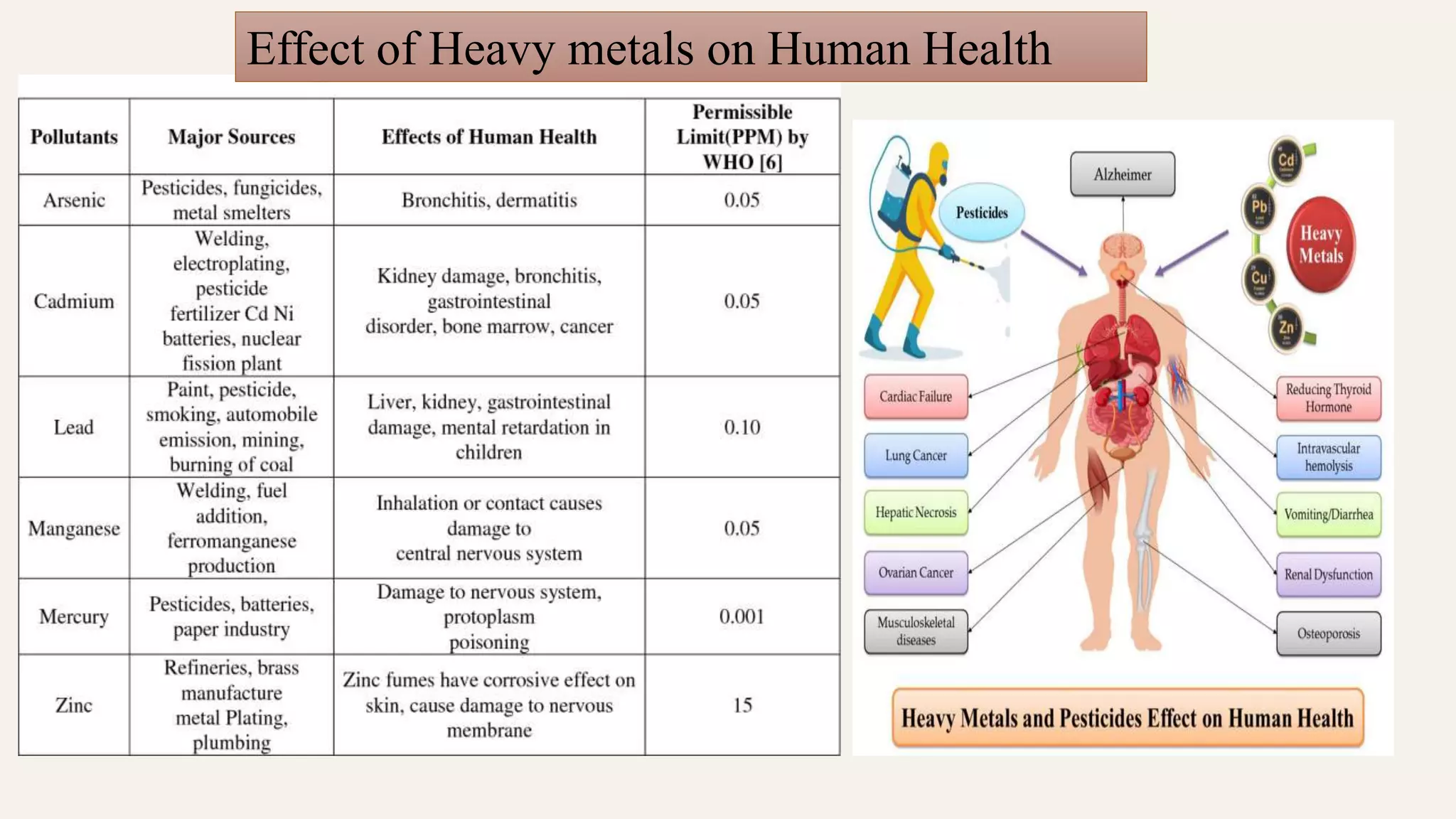
Effect of Heavy metals on Human Health
The Biggest Disasters with a special appearance of Heavy
Metals
• 1932-1952 Minimata- The mercury accumulated in
sea creatures, leading eventually to mercury
poisoning in the population. In 1952, the first
incident of mercury poisoning appear in the
population of Minimata Bay in Japan, caused by
consumption of fish polluted with mercury, bringing
nearly 1000 fatalities.
• Itai-itai disease was documented case of mass
cadmium poisonning in Toyama Prefecture, Japan
around 1912.
• 1986 Sandoz : Water used to extinguish a major fire
carried 30 t fungicide containing mercury into the
Rhine river turning into red color and killing fshes
over a stretch over 100km.
• Arsenic groundwater disaster: high arsenic
groundwater in Bangladesh have natural geological
sources. It is 4 times poisonous as mercury and have
LD as 125 milligram.
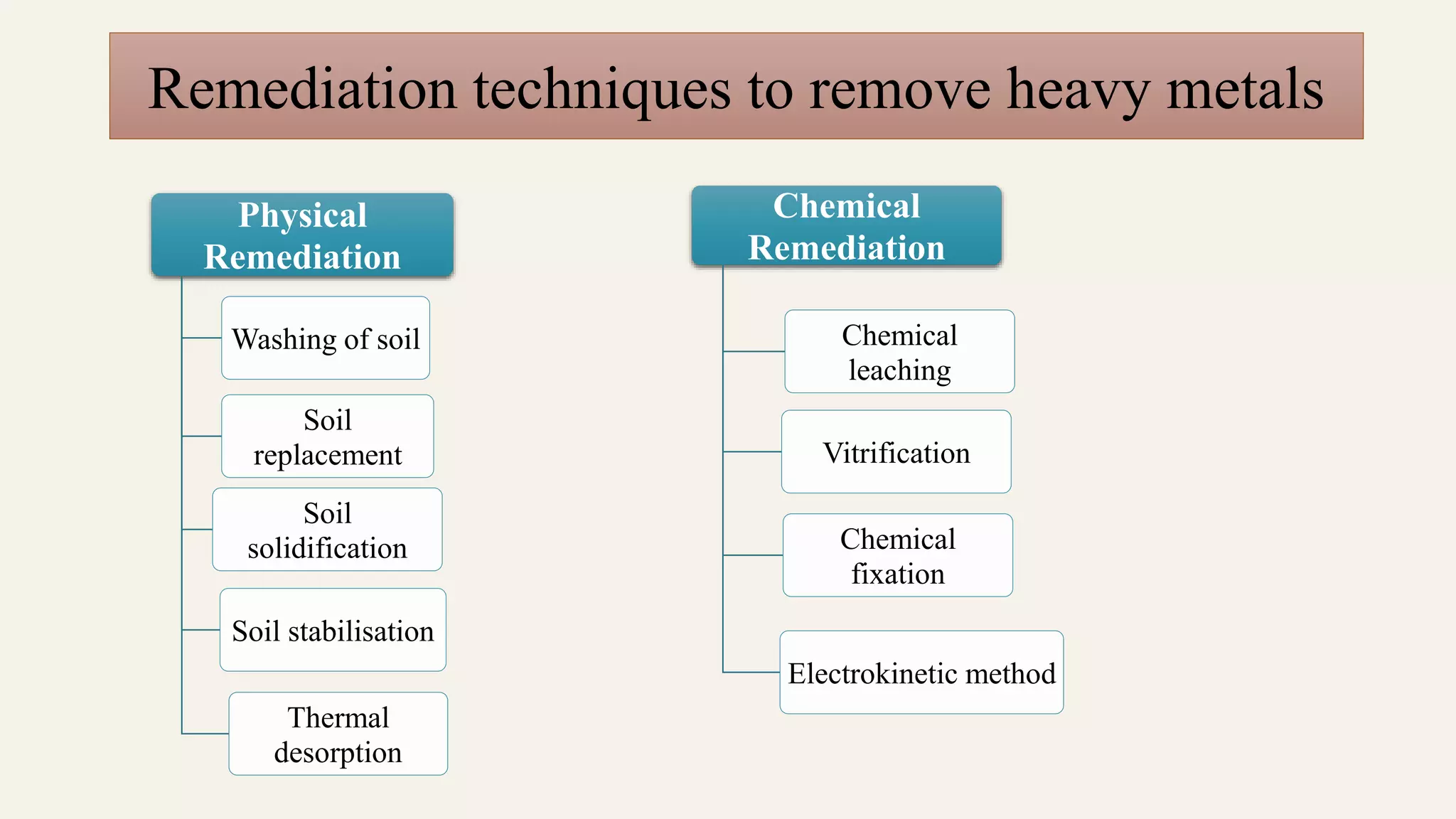
Physical
Remediation
Washing of soil
Soil
replacement
Soil
solidification
Soil stabilisation
Thermal
desorption
Chemical
Remediation
Chemical
leaching
Vitrification
Chemical
fixation
Electrokinetic method
Remediation techniques to remove heavy metals
Biological Remediation
1. Using Microorganisms
– Microorganisms do not degrade the
heavy metals but transform these
metals via changing their physical
and chemical properties.
– Remediation mechanisms include
complexation, intracellular
accumulation, and precipitation or
oxidation-reduction.
Metals Bacteria Fungi
Pb Micrococcus
lutens,Bacillus
subtilis.
Candida
sphaerica
Cd Pseudomonas
aerudinosa,
Bacillus subtilis
Coprinisis
atramentaria
Cu Staphylococcus
sp., Streptomyces
sp.
Aspergillus
versicolor,
Aspergillus niger
Ni Micrococcus sp.
Pseudomonas sp.
Aspergillus
versicolor
Cr Bacillus cereus,
Acinetobacter sp.
Aspergillus niger,
Rhizopus oryzae
Hg Klebsiella
pneumoniae,
Pseudomonas
aeruginosa
Candida
parapsilosis
2. Phytoremediation- a green solution to the problem of heavy
metals
HEAVY METAL POLLUTION.pptx

HEAVY METAL POLLUTION.pptx

  • 1.
    HEAVY METAL POLLUTIONAND ITS EFFECT ON ENVIRONMENT Course Name: Current Trends in Agronomy(APA-701) NAME: KANIKA BHAKUNI Id. No.: 49873 Ph.D Agronomy (I Year)
  • 2.
    TABLE OF CONTENT •Heavy metals – Definition – Properties • Sources • Fate of Heavy metals • Permissible limit of Heavy metals • Water quality • Air quality • Soil quality • Effect on Plants and Human • Remediation techniques – Phytoremediation
  • 3.
    Background • Heavy metalcontamination and toxicity : a prominent environmental issue in water, soil/sediments and air. • Heavy metals can be both beneficial and detrimental (at high concentration) to the environment and life. • These are natural components of the Earth’s crust. • Consumed by lifeforms via eating food, drinking water and inhaling air.
  • 4.
    What are HeavyMetals? • Definition: Any metallic chemical elements that has a relatively high density and is toxic or poisonous at low concentration. • High density: range from 3.5g/cm3 to 7 g/cm3 • Specific gravity at least 5 times more than water. • Some are transition metals on the periodic table. – often ‘trace elements’, often occurs as oxyanions. • Heavy metals can be found in the forms of sulfates, hydroxides, oxides, sulfides, phosphates, and silicates.
  • 6.
    Properties of HeavyMetals Physical properties of Heavy Metals Lustre shininess High melting point High density Good conductor of heat and electricity Non- degradable Malleable Ductile Toxicological properties of Heavy Metals Persistence -long residual and half life Soil residence time->1000 years Acute toxicity- plants,animals and microorganisms Bioaccumlation and biomagnification through food chain Chronic and sub- lethal effects at low concentration Synergistic effects Teratogenic and carcinogenic properties
  • 7.
    Heavy Metal Contamination:Important Factors • Process of mobilization from sources areas- to water and sediments. • Important concept is about  Speciation- oxidation state or compound it occurs in Example- Arsenic in arsenite has an oxidation state of 3, As in arsenate has an oxidation state of 5. As3+ is 5 times more toxic than As5+. Cr6+ is much more toxic than Cr3+.  Affinity for -SH (Sulfhydryl group)- can deactivate enzyme.
  • 8.
  • 9.
  • 10.
  • 11.
    Most common HeavyMetals Mercury(Hg) • Acidic(pH-5-7) water contains significant amount of Hg. • Microorganisms in soil converts mercury into methylmercury which readily absorbed by most of the organisms and cause nerve damage. • Fishes accumulates methylmercury. Lead(Pb) • Inorganic lead is general metabolic poison. • Breaks the blood barrier and interfers with normal development of brain. • It accumulates in the bodies of water and soil organisms • Phytoplanktons population gets disturbed. Cadmium(Cd) • It is transported over a great distance when absorbed by sludge. • Pollute surface water and soil. • Readily absorbed on microorganisms of soil. • Acidic nature of soil increase its toxicity Arsenic(Ar) • Groundwater is the major source of which has cancer risk at low concentration. • It is attached to particulate matter ,containg mixture of arsenite and arsenate. • Human exposure to Ar is throughout the air at low concentration
  • 12.
    Permissible limit ofHeavy metals in soil,water and plant
  • 13.
    Effect of HeavyMetal Pollution in Water • Heavy metals occurs in the geological structure,and can therefore enters water resources through natural processes (heavy rains or flowing water). • This processes are exacerbated when this geology is distributed by economic activity such as mining and can lead to acid mined drainage.
  • 14.
    Fate of metalsin Aquatic environment Precipitate in hard water Soluble in acidic water Insoluble metals deposit in the river sediments Aquatic organisms take up from water or sediments Benthic organisms accumulate through food chain More soluble at high temperture
  • 15.
    • Trophic transfer:passage of contaminant in food chains, from one trophic level to the next. • Bioconcentration: accumulation of contaminant in an organisms ambient environment. • Dietary accumulation : accumulation of contaminant in an organisms as a result of its uptake from the organism’s food. • Bioaccumulation: accumulation of contaminant in an organisms as a result of its uptake from both ambient abiotic environment and organism’s food. • Biomagnification: increase in concentration of the contaminant along a food chain. • Biodilution: decrease in concentration of the contaminant along the food chain.
  • 17.
    Effect on Airquality • Atmospheric particulate matter is of great concern and has strong potential for adsorbing toxic metals which may then enter the human body through inhalaton. • Fine PM i.e., PM2.5 has greater surface area per unit mass, allowing more heavy metals to accumulate and therefore more dangerous. • PM can be directly emitted into the air or formed secondarily in the atmosphere.
  • 19.
    Heavy metal toxicityeffects soil • 2 major factors: 1) pH : governs bioavailability – Low pH :high Cd, Pb, Cu – High pH :high Zn 2) Soil organic matter: adsorption. Effect of Heavy Metals on Soil Soil Health and Fertility Soil Microbial Dynamics Decrease in CFU of bacteria and fungi Carbon Mineralization Low respiration-slow decomposition Nitrogen Transformation Significant decrease in N2 fixation and nitrification Soil Enzymes Inhibition of beta- glucosidase,urease etc.
  • 20.
    Classification of HeavyMetals Essential Heavy metals Beneficial Heavy metals Non-essential Heavy metals -Required for all kind of plants. Example: Cu for photosynthesis,Zn, Co,Mo,and Se. -Required for specific plant groups. Examples :Ni: activities of enzymes, Si,Mn,B,Va. - Not required and accumulated in the plant body due to their weak upake control mechanisms. Example: Cd,Hg,Cr,Pd and As.
  • 21.
    Effect of Heavymetals on plants • Fodor model (5 stepwise model) – STAGE 1- metal ion enter into the plant, formation of ROS and effect the membrane. – STAGE2- metal ion reacts with the cytoplasm including proteins,other macromolecules. – STAGE 3- interfere with the processes like water uptake, transport and transpiration. Symptoms starts to develop. – STAGE 4- symptoms become visible. – STAGE 5- death of the plant.
  • 22.
    Generation of ROS(reactive oxidative species) Heavy metals cause membrane damage through various mechanisms, including oxidation of cross linking with protein and cause change in the composition of membrane. Membrane damage The most important ROS like peroxide and hydroxyl radical highly unstable and reactive.
  • 23.
    Activity of enzymes •Heavy metals have ability to bind strongly to oxygen, nitrogen and sulphur atoms and inactivate enzymes. • For example: Cd binding to sulfhydryl groups of structural proteins and enzymes leads to misfolding and inhibition of their activity. • Divalent cations such as Co2+ , Ni2+ and Zn2+ displaces Mg in ribulose 1,5- bisphosphate carboxylase(RubisCo) and results in loss of activity. • Direct effects of heavy metals on light and dark reactions and indirect effects caused by them decreasing the photosynthesis pigment content involved. • Several enzymes involved in calvin cycle are inhibited like RubisCO and PEP carboxylase. Photosynthesis
  • 24.
    • Industrial andmunicipal sewage is also an important source of heavy metals. • Wastewater irrigation changes physical and chemical properties of the soil and led to the heavy metal uptake. • Concentration of heavy metals also depends upon the amount of pesticides and fertilizers used. • A basic treatment restricting metal mobility is soil de-acidification by liming. • The addition of phosphate increases soil permeability, thus contributing to arsenic migration deeper into soil profile and entering groundwater.
  • 26.
    Effect of Heavymetals on Human Health
  • 27.
    The Biggest Disasterswith a special appearance of Heavy Metals • 1932-1952 Minimata- The mercury accumulated in sea creatures, leading eventually to mercury poisoning in the population. In 1952, the first incident of mercury poisoning appear in the population of Minimata Bay in Japan, caused by consumption of fish polluted with mercury, bringing nearly 1000 fatalities.
  • 28.
    • Itai-itai diseasewas documented case of mass cadmium poisonning in Toyama Prefecture, Japan around 1912. • 1986 Sandoz : Water used to extinguish a major fire carried 30 t fungicide containing mercury into the Rhine river turning into red color and killing fshes over a stretch over 100km. • Arsenic groundwater disaster: high arsenic groundwater in Bangladesh have natural geological sources. It is 4 times poisonous as mercury and have LD as 125 milligram.
  • 29.
    Physical Remediation Washing of soil Soil replacement Soil solidification Soilstabilisation Thermal desorption Chemical Remediation Chemical leaching Vitrification Chemical fixation Electrokinetic method Remediation techniques to remove heavy metals
  • 30.
    Biological Remediation 1. UsingMicroorganisms – Microorganisms do not degrade the heavy metals but transform these metals via changing their physical and chemical properties. – Remediation mechanisms include complexation, intracellular accumulation, and precipitation or oxidation-reduction. Metals Bacteria Fungi Pb Micrococcus lutens,Bacillus subtilis. Candida sphaerica Cd Pseudomonas aerudinosa, Bacillus subtilis Coprinisis atramentaria Cu Staphylococcus sp., Streptomyces sp. Aspergillus versicolor, Aspergillus niger Ni Micrococcus sp. Pseudomonas sp. Aspergillus versicolor Cr Bacillus cereus, Acinetobacter sp. Aspergillus niger, Rhizopus oryzae Hg Klebsiella pneumoniae, Pseudomonas aeruginosa Candida parapsilosis
  • 31.
    2. Phytoremediation- agreen solution to the problem of heavy metals