S VITHYA
M.PHARM I YEAR
INTRODUCTION
People continue to be exposed to heavy metals in the
environment.
Metals contaminate water and food in some areas. Metals
also leach from eating utensils and cookware.
The emergence of the industrial age and large-scale mining
brought occupational diseases caused by various toxic metals.
Metallic constituents of pesticides and even therapeutic
agents (e.g.antimicrobials) have been additional sources of
hazardous exposure.
The burning of fossil fuels containing heavy metals, the
addition of tetraethyl lead to gasoline, and the increase in
industrial applications of metals have made environmental
pollution the major source of heavy-metal poisoning
LEAD POISONING/ PLUMBISM
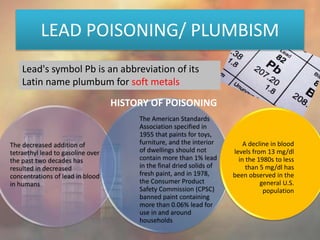
Lead's symbol Pb is an abbreviation of its
Latin name plumbum for soft metals
The decreased addition of
tetraethyl lead to gasoline over
the past two decades has
resulted in decreased
concentrations of lead in blood
in humans
The American Standards
Association specified in
1955 that paints for toys,
furniture, and the interior
of dwellings should not
contain more than 1% lead
in the final dried solids of
fresh paint, and in 1978,
the Consumer Product
Safety Commission (CPSC)
banned paint containing
more than 0.06% lead for
use in and around
households
A decline in blood
levels from 13 mg/dl
in the 1980s to less
than 5 mg/dl has
been observed in the
general U.S.
population
HISTORY OF POISONING
SOURCE
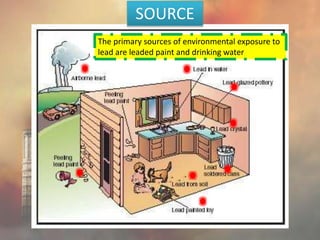
The primary sources of environmental exposure to
lead are leaded paint and drinking water
PHARMACOKINETICS
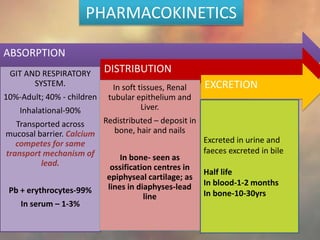
ABSORPTION
GIT AND RESPIRATORY
SYSTEM.
10%-Adult; 40% - children
Inhalational-90%
Transported across
mucosal barrier. Calcium
competes for same
transport mechanism of
lead.
Pb + erythrocytes-99%
In serum – 1-3%
DISTRIBUTION
In soft tissues, Renal
tubular epithelium and
Liver.
Redistributed – deposit in
bone, hair and nails
In bone- seen as
ossification centres in
epiphyseal cartilage; as
lines in diaphyses-lead
line
EXCRETION
Excreted in urine and
faeces excreted in bile
Half life
In blood-1-2 months
In bone-10-30yrs
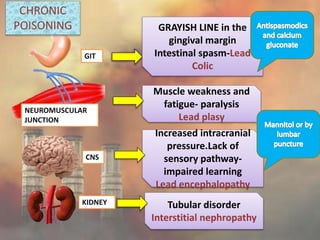
SYMPTOMS
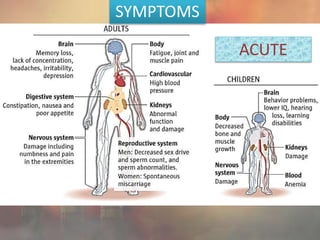
ACUTE
GIT
GRAYISH LINE in the
gingival margin
Intestinal spasm-Lead
Colic
Muscle weakness and
fatigue- paralysis
Lead plasy
Increased intracranial
pressure.Lack of
sensory pathway-
impaired learning
Lead encephalopathy
NEUROMUSCULAR
JUNCTION
CNS
Tubular disorder
Interstitial nephropathy
KIDNEY
CHRONIC
POISONING
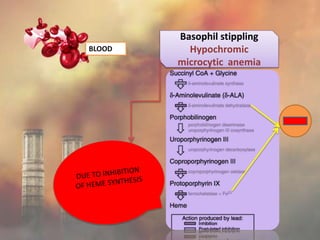
Basophil stippling
Hypochromic
microcytic anemia
BLOOD
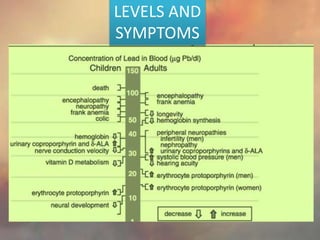
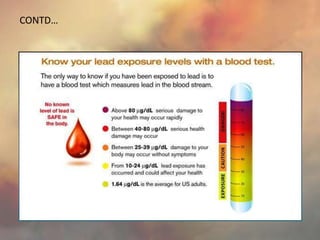
LEVELS AND
SYMPTOMS
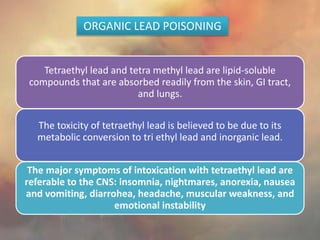
Tetraethyl lead and tetra methyl lead are lipid-soluble
compounds that are absorbed readily from the skin, GI tract,
and lungs.
The toxicity of tetraethyl lead is believed to be due to its
metabolic conversion to tri ethyl lead and inorganic lead.
The major symptoms of intoxication with tetraethyl lead are
referable to the CNS: insomnia, nightmares, anorexia, nausea
and vomiting, diarrohea, headache, muscular weakness, and
emotional instability
ORGANIC LEAD POISONING
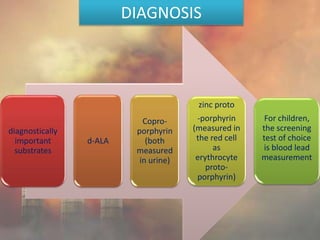
DIAGNOSIS
diagnostically
important
substrates
d-ALA
Copro-
porphyrin
(both
measured
in urine)
zinc proto
-porphyrin
(measured in
the red cell
as
erythrocyte
proto-
porphyrin)
For children,
the screening
test of choice
is blood lead
measurement
CONTD…
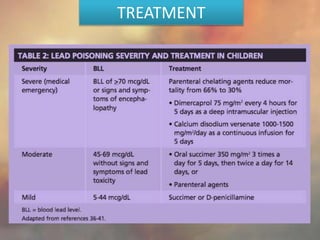
TREATMENT
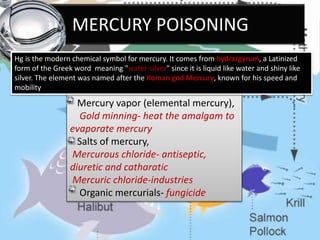
MERCURY POISONING
Mercury vapor (elemental mercury),
Gold minning- heat the amalgam to
evaporate mercury
Salts of mercury,
Mercurous chloride- antiseptic,
diuretic and catharatic
Mercuric chloride-industries
Organic mercurials- fungicide
Hg is the modern chemical symbol for mercury. It comes from hydrargyrum, a Latinized
form of the Greek word meaning "water-silver" since it is liquid like water and shiny like
silver. The element was named after the Roman god Mercury, known for his speed and
mobility
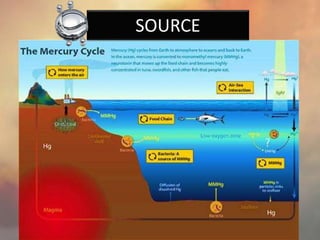
SOURCE
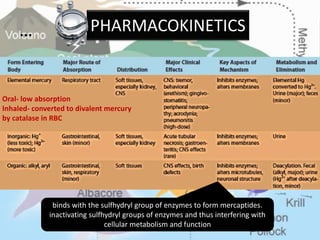
… PHARMACOKINETICS
binds with the sulfhydryl group of enzymes to form mercaptides.
inactivating sulfhydryl groups of enzymes and thus interfering with
cellular metabolism and function
Oral- low absorption
Inhaled- converted to divalent mercury
by catalase in RBC
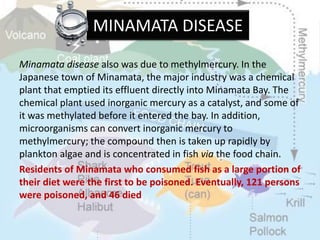
Minamata disease also was due to methylmercury. In the
Japanese town of Minamata, the major industry was a chemical
plant that emptied its effluent directly into Minamata Bay. The
chemical plant used inorganic mercury as a catalyst, and some of
it was methylated before it entered the bay. In addition,
microorganisms can convert inorganic mercury to
methylmercury; the compound then is taken up rapidly by
plankton algae and is concentrated in fish via the food chain.
Residents of Minamata who consumed fish as a large portion of
their diet were the first to be poisoned. Eventually, 121 persons
were poisoned, and 46 died
MINAMATA DISEASE
SYMPTOMS
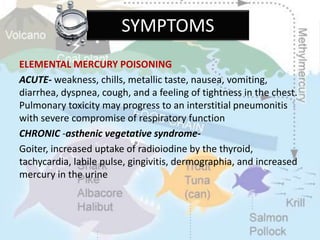
ELEMENTAL MERCURY POISONING
ACUTE- weakness, chills, metallic taste, nausea, vomiting,
diarrhea, dyspnea, cough, and a feeling of tightness in the chest.
Pulmonary toxicity may progress to an interstitial pneumonitis
with severe compromise of respiratory function
CHRONIC -asthenic vegetative syndrome-
Goiter, increased uptake of radioiodine by the thyroid,
tachycardia, labile pulse, gingivitis, dermographia, and increased
mercury in the urine
SYMPTOMS
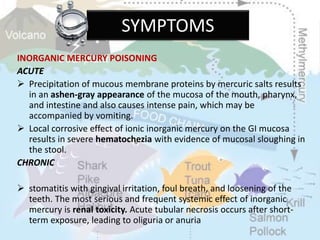
INORGANIC MERCURY POISONING
ACUTE
 Precipitation of mucous membrane proteins by mercuric salts results
in an ashen-gray appearance of the mucosa of the mouth, pharynx,
and intestine and also causes intense pain, which may be
accompanied by vomiting.
 Local corrosive effect of ionic inorganic mercury on the GI mucosa
results in severe hematochezia with evidence of mucosal sloughing in
the stool.
CHRONIC
 stomatitis with gingival irritation, foul breath, and loosening of the
teeth. The most serious and frequent systemic effect of inorganic
mercury is renal toxicity. Acute tubular necrosis occurs after short-
term exposure, leading to oliguria or anuria
SYMPTOMS
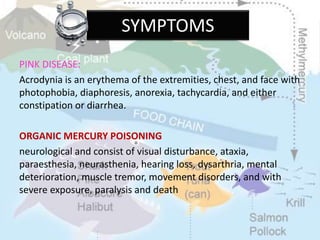
PINK DISEASE:
Acrodynia is an erythema of the extremities, chest, and face with
photophobia, diaphoresis, anorexia, tachycardia, and either
constipation or diarrhea.
ORGANIC MERCURY POISONING
neurological and consist of visual disturbance, ataxia,
paraesthesia, neurasthenia, hearing loss, dysarthria, mental
deterioration, muscle tremor, movement disorders, and with
severe exposure, paralysis and death
SYMPTOMS
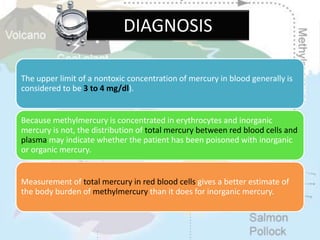
The upper limit of a nontoxic concentration of mercury in blood generally is
considered to be 3 to 4 mg/dl).
Because methylmercury is concentrated in erythrocytes and inorganic
mercury is not, the distribution of total mercury between red blood cells and
plasma may indicate whether the patient has been poisoned with inorganic
or organic mercury.
Measurement of total mercury in red blood cells gives a better estimate of
the body burden of methylmercury than it does for inorganic mercury.
DIAGNOSIS
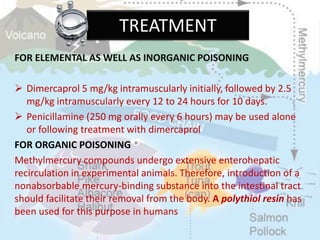
FOR ELEMENTAL AS WELL AS INORGANIC POISONING
 Dimercaprol 5 mg/kg intramuscularly initially, followed by 2.5
mg/kg intramuscularly every 12 to 24 hours for 10 days.
 Penicillamine (250 mg orally every 6 hours) may be used alone
or following treatment with dimercaprol
FOR ORGANIC POISONING
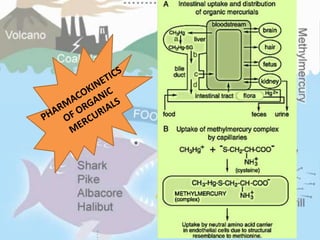
Methylmercury compounds undergo extensive enterohepatic
recirculation in experimental animals. Therefore, introduction of a
nonabsorbable mercury-binding substance into the intestinal tract
should facilitate their removal from the body. A polythiol resin has
been used for this purpose in humans
TREATMENT
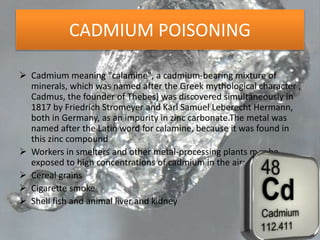
CADMIUM POISONING
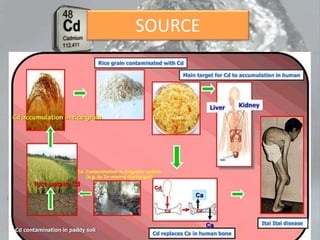
 Cadmium meaning "calamine", a cadmium-bearing mixture of
minerals, which was named after the Greek mythological character ,
Cadmus, the founder of Thebes) was discovered simultaneously in
1817 by Friedrich Stromeyer and Karl Samuel Leberecht Hermann,
both in Germany, as an impurity in zinc carbonate.The metal was
named after the Latin word for calamine, because it was found in
this zinc compound
 Workers in smelters and other metal-processing plants may be
exposed to high concentrations of cadmium in the air;
 Cereal grains
 Cigarette smoke
 Shell fish and animal liver and kidney
SOURCE
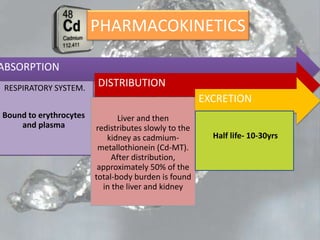
ABSORPTION
RESPIRATORY SYSTEM.
Bound to erythrocytes
and plasma
DISTRIBUTION
Liver and then
redistributes slowly to the
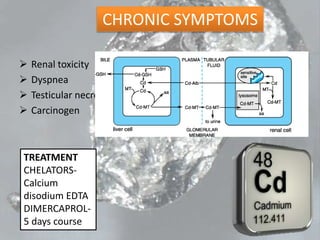
kidney as cadmium-
metallothionein (Cd-MT).
After distribution,
approximately 50% of the
total-body burden is found
in the liver and kidney
EXCRETION
Half life- 10-30yrs
PHARMACOKINETICS
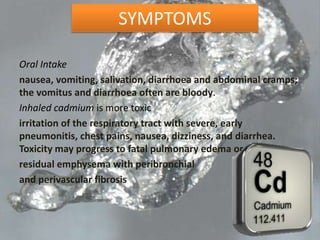
SYMPTOMS
Oral Intake
nausea, vomiting, salivation, diarrhoea and abdominal cramps;
the vomitus and diarrhoea often are bloody.
Inhaled cadmium is more toxic
irritation of the respiratory tract with severe, early
pneumonitis, chest pains, nausea, dizziness, and diarrhea.
Toxicity may progress to fatal pulmonary edema or
residual emphysema with peribronchial
and perivascular fibrosis
CHRONIC SYMPTOMS
 Renal toxicity
 Dyspnea
 Testicular necrosis
 Carcinogen
TREATMENT
CHELATORS-
Calcium
disodium EDTA
DIMERCAPROL-
5 days course
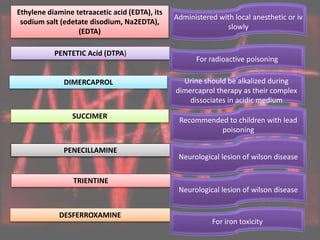
HEAVY METAL ANTAGONIST
Ethylene diamine tetraacetic acid (EDTA), its
sodium salt (edetate disodium, Na2EDTA),
(EDTA)
PENTETIC Acid (DTPA)
SUCCIMER
DIMERCAPROL
PENECILLAMINE
TRIENTINE
DESFERROXAMINE
Administered with local anesthetic or iv
slowly
For radioactive poisoning
Urine should be alkalized during
dimercaprol therapy as their complex
dissociates in acidic medium
Recommended to children with lead
poisoning
Neurological lesion of wilson disease
For iron toxicity
REFERENCE
 BASICS AND CLINICAL PHARMACOLOGY BY KATZUNG 12TH EDITION
 PHARMACOLOGY AND PHARMACOTHERAPEUTICS BY SATOSKAR
22ND EDITION
 GOODMAN & GILMAN'S THE PHARMACOLOGICAL BASIS OF
THERAPEUTICS - 11th Ed. (2006)
Heavy Metal Toxicity

Heavy Metal Toxicity

  • 1.
  • 2.
    INTRODUCTION People continue tobe exposed to heavy metals in the environment. Metals contaminate water and food in some areas. Metals also leach from eating utensils and cookware. The emergence of the industrial age and large-scale mining brought occupational diseases caused by various toxic metals. Metallic constituents of pesticides and even therapeutic agents (e.g.antimicrobials) have been additional sources of hazardous exposure. The burning of fossil fuels containing heavy metals, the addition of tetraethyl lead to gasoline, and the increase in industrial applications of metals have made environmental pollution the major source of heavy-metal poisoning
  • 3.
    LEAD POISONING/ PLUMBISM Lead'ssymbol Pb is an abbreviation of its Latin name plumbum for soft metals The decreased addition of tetraethyl lead to gasoline over the past two decades has resulted in decreased concentrations of lead in blood in humans The American Standards Association specified in 1955 that paints for toys, furniture, and the interior of dwellings should not contain more than 1% lead in the final dried solids of fresh paint, and in 1978, the Consumer Product Safety Commission (CPSC) banned paint containing more than 0.06% lead for use in and around households A decline in blood levels from 13 mg/dl in the 1980s to less than 5 mg/dl has been observed in the general U.S. population HISTORY OF POISONING
  • 4.
    SOURCE The primary sourcesof environmental exposure to lead are leaded paint and drinking water
  • 5.
    PHARMACOKINETICS ABSORPTION GIT AND RESPIRATORY SYSTEM. 10%-Adult;40% - children Inhalational-90% Transported across mucosal barrier. Calcium competes for same transport mechanism of lead. Pb + erythrocytes-99% In serum – 1-3% DISTRIBUTION In soft tissues, Renal tubular epithelium and Liver. Redistributed – deposit in bone, hair and nails In bone- seen as ossification centres in epiphyseal cartilage; as lines in diaphyses-lead line EXCRETION Excreted in urine and faeces excreted in bile Half life In blood-1-2 months In bone-10-30yrs
  • 6.
  • 7.
    GIT GRAYISH LINE inthe gingival margin Intestinal spasm-Lead Colic Muscle weakness and fatigue- paralysis Lead plasy Increased intracranial pressure.Lack of sensory pathway- impaired learning Lead encephalopathy NEUROMUSCULAR JUNCTION CNS Tubular disorder Interstitial nephropathy KIDNEY CHRONIC POISONING
  • 8.
  • 9.
  • 10.
    Tetraethyl lead andtetra methyl lead are lipid-soluble compounds that are absorbed readily from the skin, GI tract, and lungs. The toxicity of tetraethyl lead is believed to be due to its metabolic conversion to tri ethyl lead and inorganic lead. The major symptoms of intoxication with tetraethyl lead are referable to the CNS: insomnia, nightmares, anorexia, nausea and vomiting, diarrohea, headache, muscular weakness, and emotional instability ORGANIC LEAD POISONING
  • 11.
    DIAGNOSIS diagnostically important substrates d-ALA Copro- porphyrin (both measured in urine) zinc proto -porphyrin (measuredin the red cell as erythrocyte proto- porphyrin) For children, the screening test of choice is blood lead measurement
  • 12.
  • 13.
  • 14.
    MERCURY POISONING Mercury vapor(elemental mercury), Gold minning- heat the amalgam to evaporate mercury Salts of mercury, Mercurous chloride- antiseptic, diuretic and catharatic Mercuric chloride-industries Organic mercurials- fungicide Hg is the modern chemical symbol for mercury. It comes from hydrargyrum, a Latinized form of the Greek word meaning "water-silver" since it is liquid like water and shiny like silver. The element was named after the Roman god Mercury, known for his speed and mobility
  • 15.
  • 16.
    … PHARMACOKINETICS binds withthe sulfhydryl group of enzymes to form mercaptides. inactivating sulfhydryl groups of enzymes and thus interfering with cellular metabolism and function Oral- low absorption Inhaled- converted to divalent mercury by catalase in RBC
  • 18.
    Minamata disease alsowas due to methylmercury. In the Japanese town of Minamata, the major industry was a chemical plant that emptied its effluent directly into Minamata Bay. The chemical plant used inorganic mercury as a catalyst, and some of it was methylated before it entered the bay. In addition, microorganisms can convert inorganic mercury to methylmercury; the compound then is taken up rapidly by plankton algae and is concentrated in fish via the food chain. Residents of Minamata who consumed fish as a large portion of their diet were the first to be poisoned. Eventually, 121 persons were poisoned, and 46 died MINAMATA DISEASE
  • 19.
  • 20.
    ELEMENTAL MERCURY POISONING ACUTE-weakness, chills, metallic taste, nausea, vomiting, diarrhea, dyspnea, cough, and a feeling of tightness in the chest. Pulmonary toxicity may progress to an interstitial pneumonitis with severe compromise of respiratory function CHRONIC -asthenic vegetative syndrome- Goiter, increased uptake of radioiodine by the thyroid, tachycardia, labile pulse, gingivitis, dermographia, and increased mercury in the urine SYMPTOMS
  • 21.
    INORGANIC MERCURY POISONING ACUTE Precipitation of mucous membrane proteins by mercuric salts results in an ashen-gray appearance of the mucosa of the mouth, pharynx, and intestine and also causes intense pain, which may be accompanied by vomiting.  Local corrosive effect of ionic inorganic mercury on the GI mucosa results in severe hematochezia with evidence of mucosal sloughing in the stool. CHRONIC  stomatitis with gingival irritation, foul breath, and loosening of the teeth. The most serious and frequent systemic effect of inorganic mercury is renal toxicity. Acute tubular necrosis occurs after short- term exposure, leading to oliguria or anuria SYMPTOMS
  • 22.
    PINK DISEASE: Acrodynia isan erythema of the extremities, chest, and face with photophobia, diaphoresis, anorexia, tachycardia, and either constipation or diarrhea. ORGANIC MERCURY POISONING neurological and consist of visual disturbance, ataxia, paraesthesia, neurasthenia, hearing loss, dysarthria, mental deterioration, muscle tremor, movement disorders, and with severe exposure, paralysis and death SYMPTOMS
  • 23.
    The upper limitof a nontoxic concentration of mercury in blood generally is considered to be 3 to 4 mg/dl). Because methylmercury is concentrated in erythrocytes and inorganic mercury is not, the distribution of total mercury between red blood cells and plasma may indicate whether the patient has been poisoned with inorganic or organic mercury. Measurement of total mercury in red blood cells gives a better estimate of the body burden of methylmercury than it does for inorganic mercury. DIAGNOSIS
  • 24.
    FOR ELEMENTAL ASWELL AS INORGANIC POISONING  Dimercaprol 5 mg/kg intramuscularly initially, followed by 2.5 mg/kg intramuscularly every 12 to 24 hours for 10 days.  Penicillamine (250 mg orally every 6 hours) may be used alone or following treatment with dimercaprol FOR ORGANIC POISONING Methylmercury compounds undergo extensive enterohepatic recirculation in experimental animals. Therefore, introduction of a nonabsorbable mercury-binding substance into the intestinal tract should facilitate their removal from the body. A polythiol resin has been used for this purpose in humans TREATMENT
  • 25.
    CADMIUM POISONING  Cadmiummeaning "calamine", a cadmium-bearing mixture of minerals, which was named after the Greek mythological character , Cadmus, the founder of Thebes) was discovered simultaneously in 1817 by Friedrich Stromeyer and Karl Samuel Leberecht Hermann, both in Germany, as an impurity in zinc carbonate.The metal was named after the Latin word for calamine, because it was found in this zinc compound  Workers in smelters and other metal-processing plants may be exposed to high concentrations of cadmium in the air;  Cereal grains  Cigarette smoke  Shell fish and animal liver and kidney
  • 26.
  • 27.
    ABSORPTION RESPIRATORY SYSTEM. Bound toerythrocytes and plasma DISTRIBUTION Liver and then redistributes slowly to the kidney as cadmium- metallothionein (Cd-MT). After distribution, approximately 50% of the total-body burden is found in the liver and kidney EXCRETION Half life- 10-30yrs PHARMACOKINETICS
  • 28.
    SYMPTOMS Oral Intake nausea, vomiting,salivation, diarrhoea and abdominal cramps; the vomitus and diarrhoea often are bloody. Inhaled cadmium is more toxic irritation of the respiratory tract with severe, early pneumonitis, chest pains, nausea, dizziness, and diarrhea. Toxicity may progress to fatal pulmonary edema or residual emphysema with peribronchial and perivascular fibrosis
  • 29.
    CHRONIC SYMPTOMS  Renaltoxicity  Dyspnea  Testicular necrosis  Carcinogen TREATMENT CHELATORS- Calcium disodium EDTA DIMERCAPROL- 5 days course
  • 30.
  • 31.
    Ethylene diamine tetraaceticacid (EDTA), its sodium salt (edetate disodium, Na2EDTA), (EDTA) PENTETIC Acid (DTPA) SUCCIMER DIMERCAPROL PENECILLAMINE TRIENTINE DESFERROXAMINE Administered with local anesthetic or iv slowly For radioactive poisoning Urine should be alkalized during dimercaprol therapy as their complex dissociates in acidic medium Recommended to children with lead poisoning Neurological lesion of wilson disease Neurological lesion of wilson disease For iron toxicity
  • 32.
    REFERENCE  BASICS ANDCLINICAL PHARMACOLOGY BY KATZUNG 12TH EDITION  PHARMACOLOGY AND PHARMACOTHERAPEUTICS BY SATOSKAR 22ND EDITION  GOODMAN & GILMAN'S THE PHARMACOLOGICAL BASIS OF THERAPEUTICS - 11th Ed. (2006)