
Department of Electrical & Electronics Engineering
Raghu Engineering College
(Autonomous)
Accredited by NBA & NAAC with ‘A Grade, Permanently Affiliated JNTU Kakinada
Dakamarri (v), Bheemunipatnam Mandal, Visakhapatnam, Andhra Pradesh 531162
DECEMBER—2019
A CASE STUDY
ON
NUCLEAR REACTORS AND THEIR TYPES
Submitted as a part of Second Year First Semester curriculum of
BACHELOR OF TECHNOLOGY
IN
ELECTRICAL AND ELECTRONICS ENGINEERING
By
Mr P.Eswar sai 18981A0237
Mr P.Mohan 18981A0238
Ms P.Supriya 18981A0239
Mr.P.Nitish 18981A0240
Mr.P.Sanjay Kumar 18981A0241
Under the Supervision of
Ms.D.ANUSHA
Assistant Professor
Head of the department
Dr.P.SASI KIRAN
Professor
Faculty Member
Ms.D.ANUSHA
Assistant Professor
NUCLEAR REACTOR INTRODUCTION
Nuclear Reactor:
• A nuclear reactor is a device to initiate, and control, a sustained nuclear
chain reaction.
• The most common use of nuclear reactor is for the generation of
electrical power also termed as nuclear power.
NUCLEAR ENERGY :-
 Each of the five reactors produces about 1,100 million watts (megawatts) of
electricity
 This is enough to power one million homes per reactor
 Each reactor’s production is equivalent to 15 million barrels of oil or 3.5 million tons
of coal a year.
 The total 5,500 reactor produced megawatts is out of a peak state electrical power
of 30,000 – 40,000 megawatts.
HOW A NUCLEAR REACTOR WORKS :-
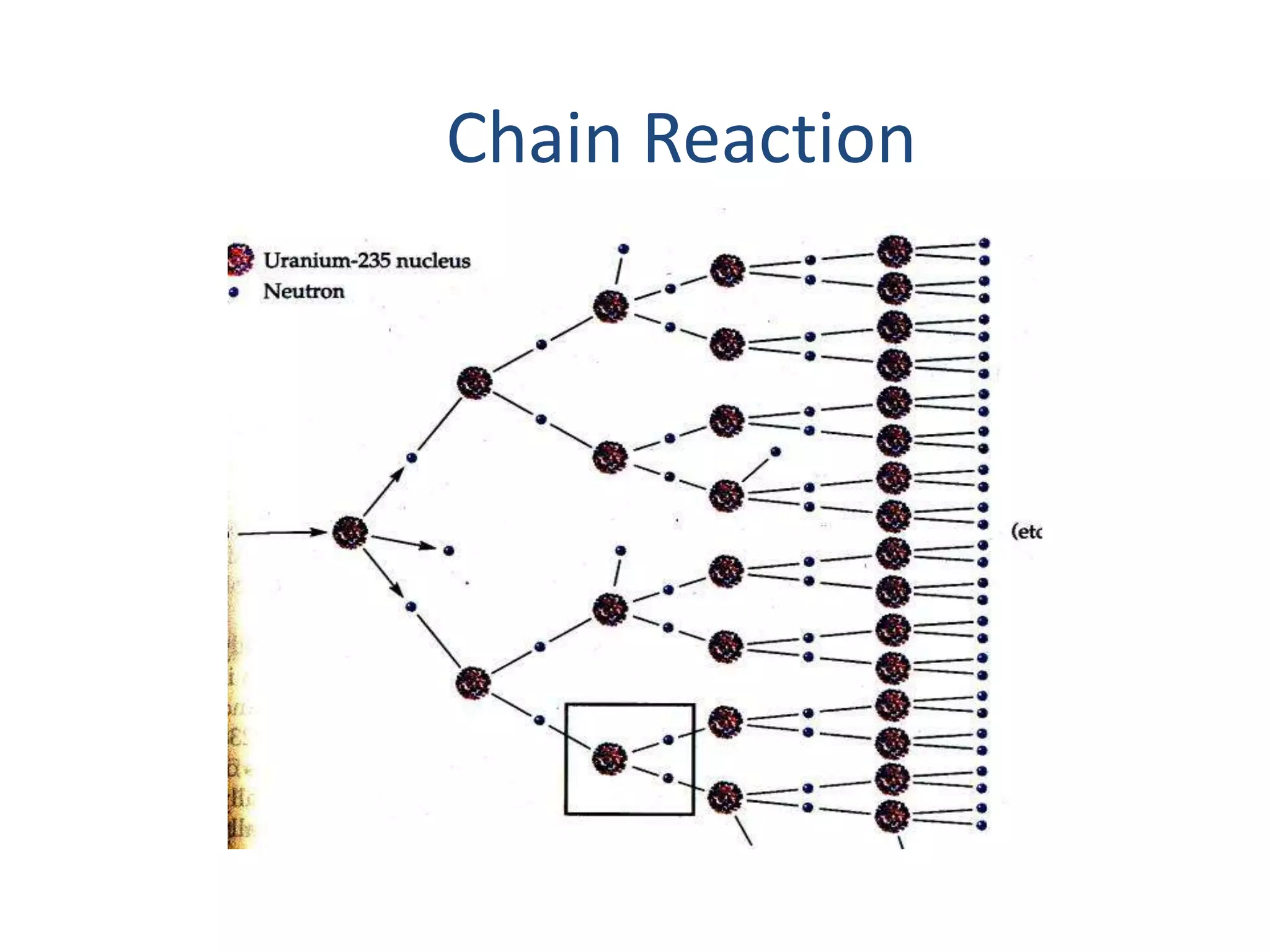
 235U fissions by absorbing a neutron and producing 2 to 3 neutrons, which initiate on
average one more fission to make a controlled chain reaction
 Normal water is used as a moderator to slow the neutrons since slow neutrons take
longer to pass by a U nucleus and have more time to be absorbed
 The protons in the hydrogen in the water have the same mass as the neutron and stop
them by a billiard ball effect
 The extra neutrons are taken up by protons to form deuterons
 235U is enriched from its 0.7% in nature to about 3% to produce the reaction, and is
contained in rods in the water
 Boron control rods are inserted to absorb neutrons when it is time to shut down the
reactor
 The hot water is boiled or sent through a heat exchanger to produce steam. The steam
then powers turbines.
TYPES OF NUCLEAR REACTORS
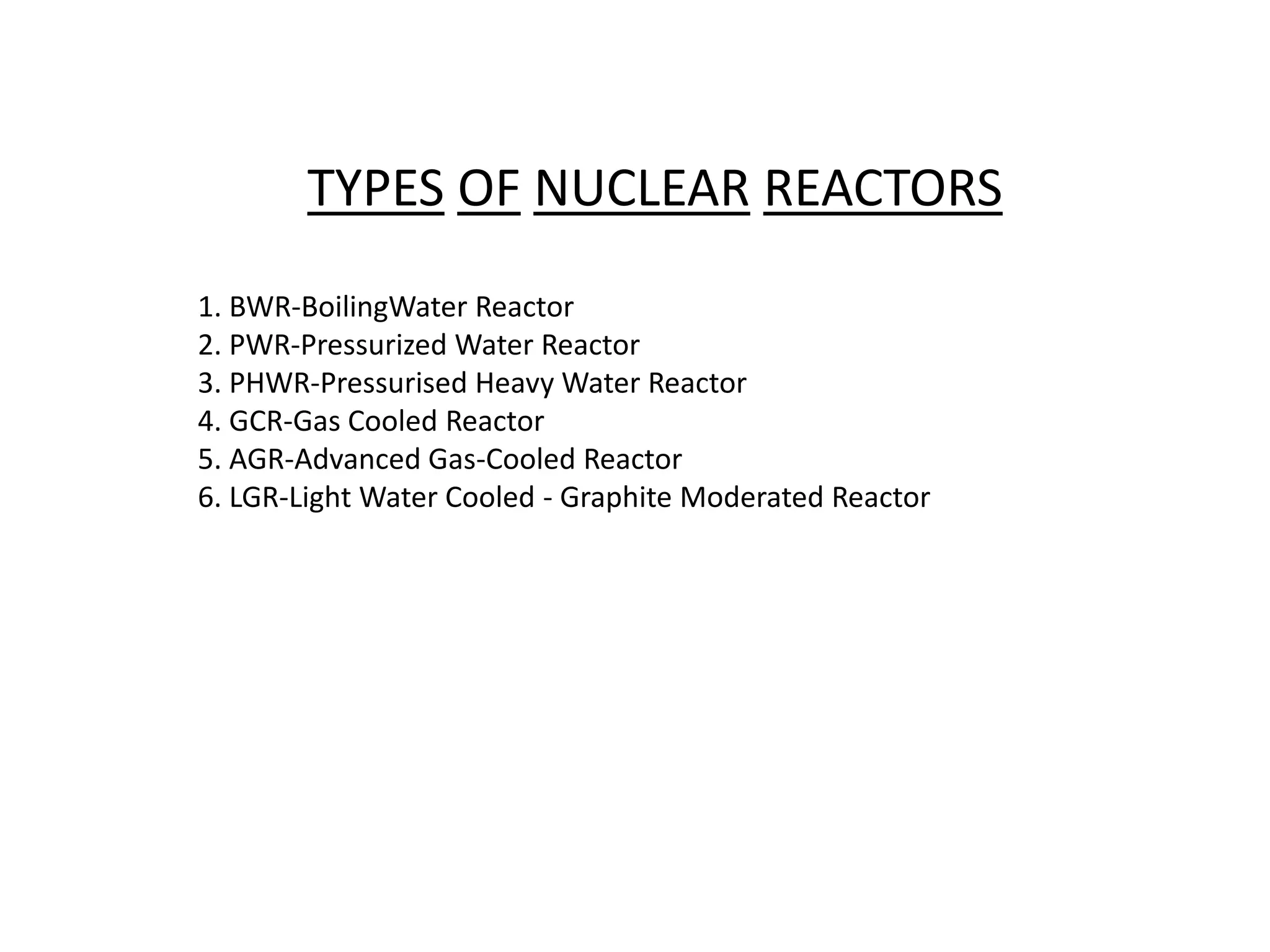
1. BWR-BoilingWater Reactor
2. PWR-Pressurized Water Reactor
3. PHWR-Pressurised Heavy Water Reactor
4. GCR-Gas Cooled Reactor
5. AGR-Advanced Gas-Cooled Reactor
6. LGR-Light Water Cooled - Graphite Moderated Reactor
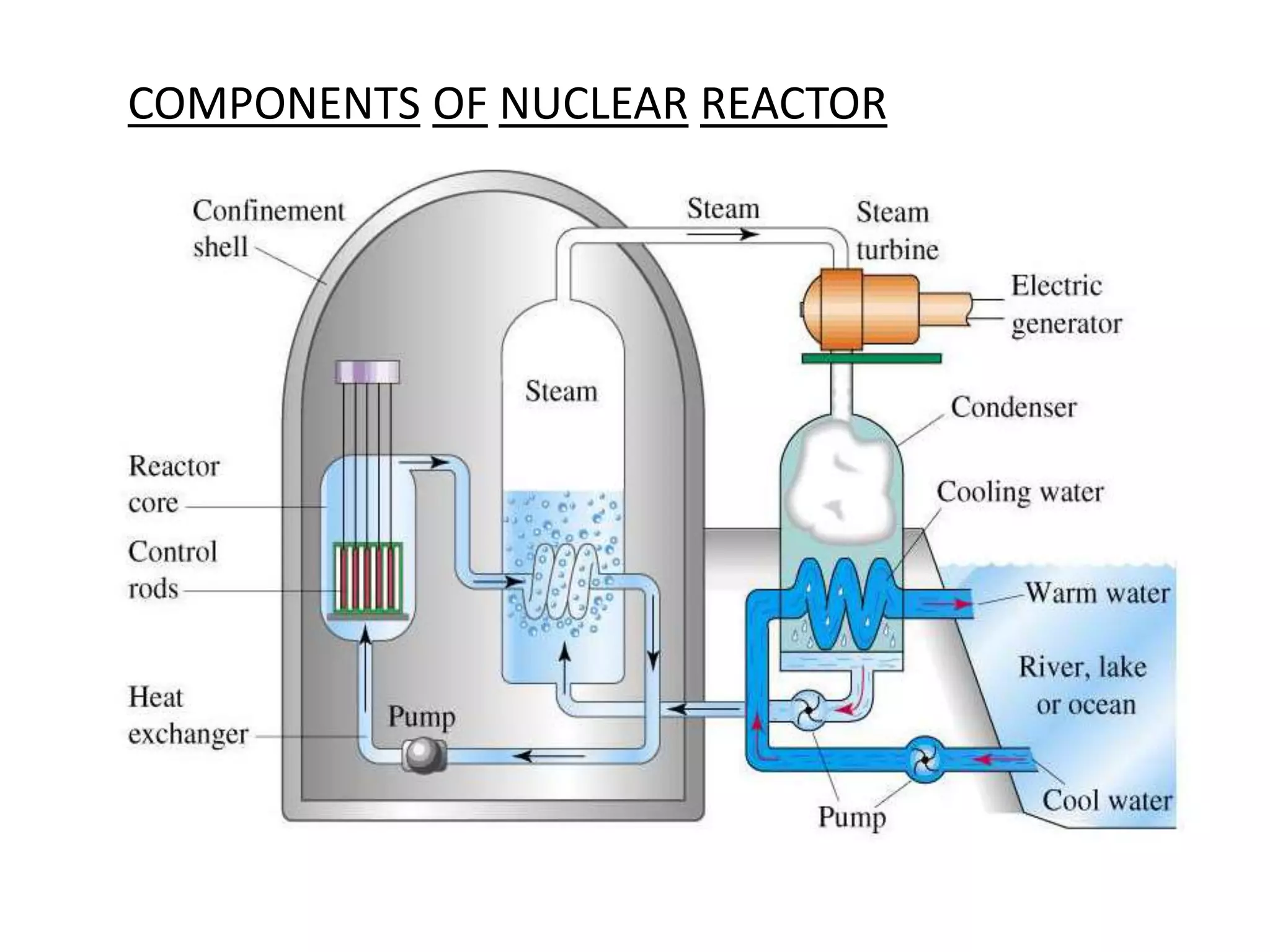
COMPONENTS OF NUCLEAR REACTOR
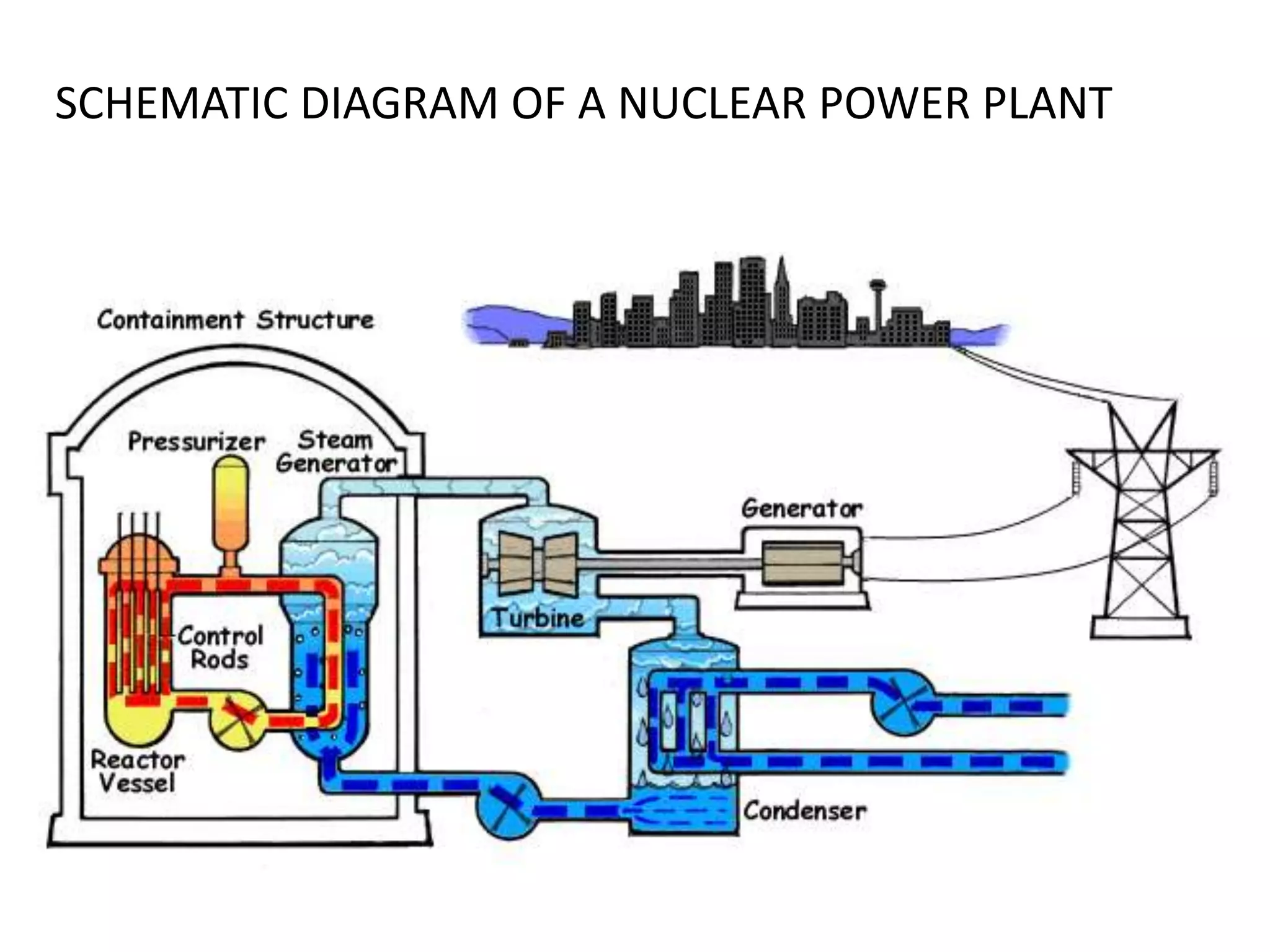
SCHEMATIC DIAGRAM OF A NUCLEAR POWER PLANT
Chain Reaction
CLASSIFICATION OF NUCLEAR REACTOR: -
1. On the basis of Neutron Energy
a) Fast Reactors
b) Thermal Reactors
2. On the basis of Fuel used
a) Natural fuel
b) Enriched Uranium
3. On the basis of Moderator used
a) Water Moderator
b) Heavy water Moderator
c) Graphite Moderator
d) Beryllium Moderator
4. On the basis of Coolant used
a) Water cooled reactor (Ordinary or Heavy)
b) Gas cooled reactor
c) Liquid metal cooled reactor
d) Organic liquid cooled reactor
BWR-BOILING WATER REACTOR
 In the boiling water reactor (BWR), the water which passes over the reactor core act as
moderator and coolant. It is also the steam source for the turbine.
 The disadvantage of BWR is that any fuel leak might make the water radioactive and that
radioactivity would reach the turbine and the rest of the loop.
 A typical operating pressure for BWR is about 70 atm at which the water boils at about
285°C temperature. This operating temperature gives a efficiency of only 42% with a
practical operating efficiency of around 32%, somewhat less than the Pressurized Water
Reactor(PWR).
PWR-PRESSURIZED WATER REACTOR
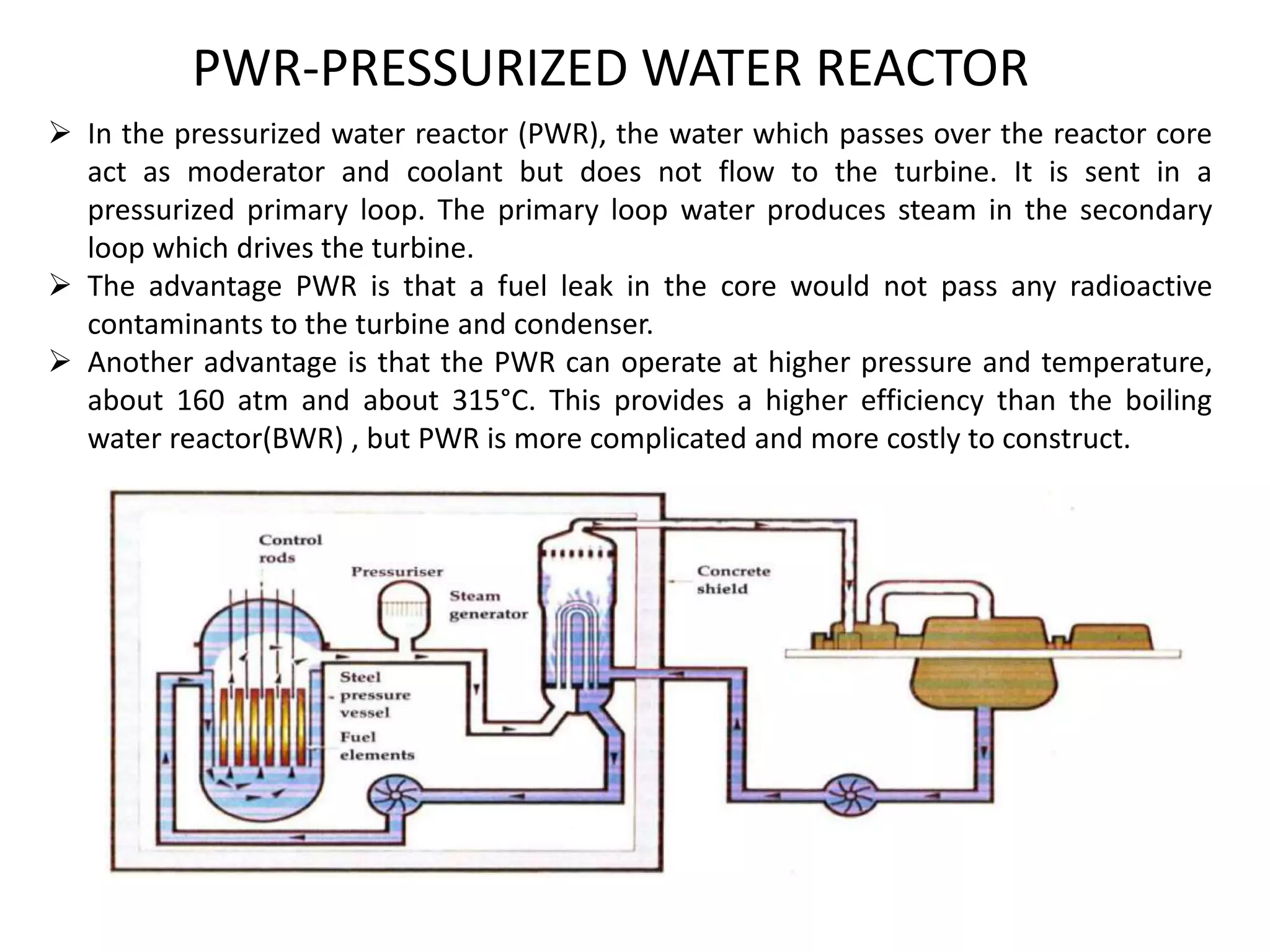
 In the pressurized water reactor (PWR), the water which passes over the reactor core
act as moderator and coolant but does not flow to the turbine. It is sent in a
pressurized primary loop. The primary loop water produces steam in the secondary
loop which drives the turbine.
 The advantage PWR is that a fuel leak in the core would not pass any radioactive
contaminants to the turbine and condenser.
 Another advantage is that the PWR can operate at higher pressure and temperature,
about 160 atm and about 315°C. This provides a higher efficiency than the boiling
water reactor(BWR) , but PWR is more complicated and more costly to construct.
PHWR-PRESSURISED HEAVY WATER REACTOR
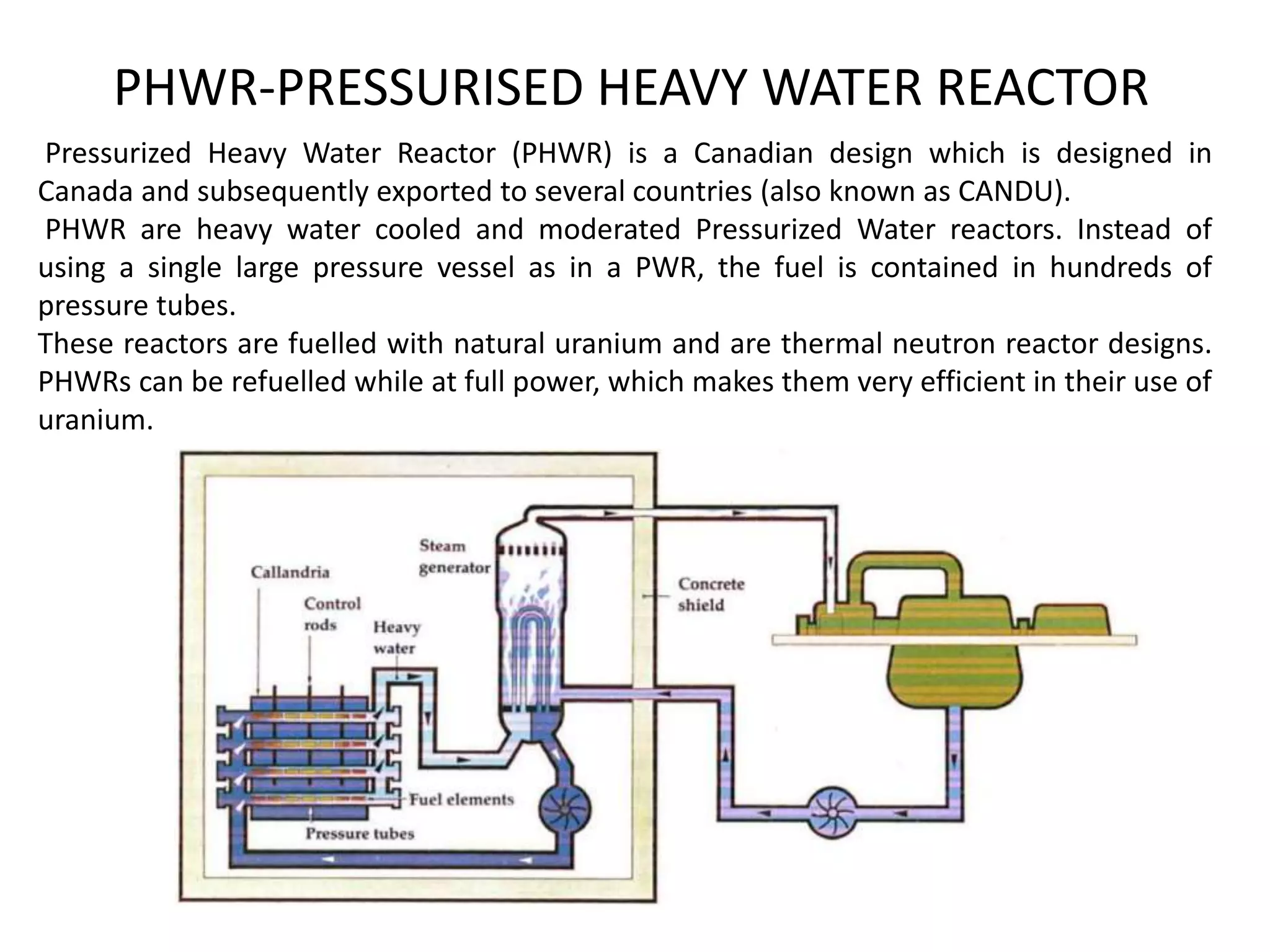
Pressurized Heavy Water Reactor (PHWR) is a Canadian design which is designed in
Canada and subsequently exported to several countries (also known as CANDU).
PHWR are heavy water cooled and moderated Pressurized Water reactors. Instead of
using a single large pressure vessel as in a PWR, the fuel is contained in hundreds of
pressure tubes.
These reactors are fuelled with natural uranium and are thermal neutron reactor designs.
PHWRs can be refuelled while at full power, which makes them very efficient in their use of
uranium.
GCR-GAS COOLED REACTOR
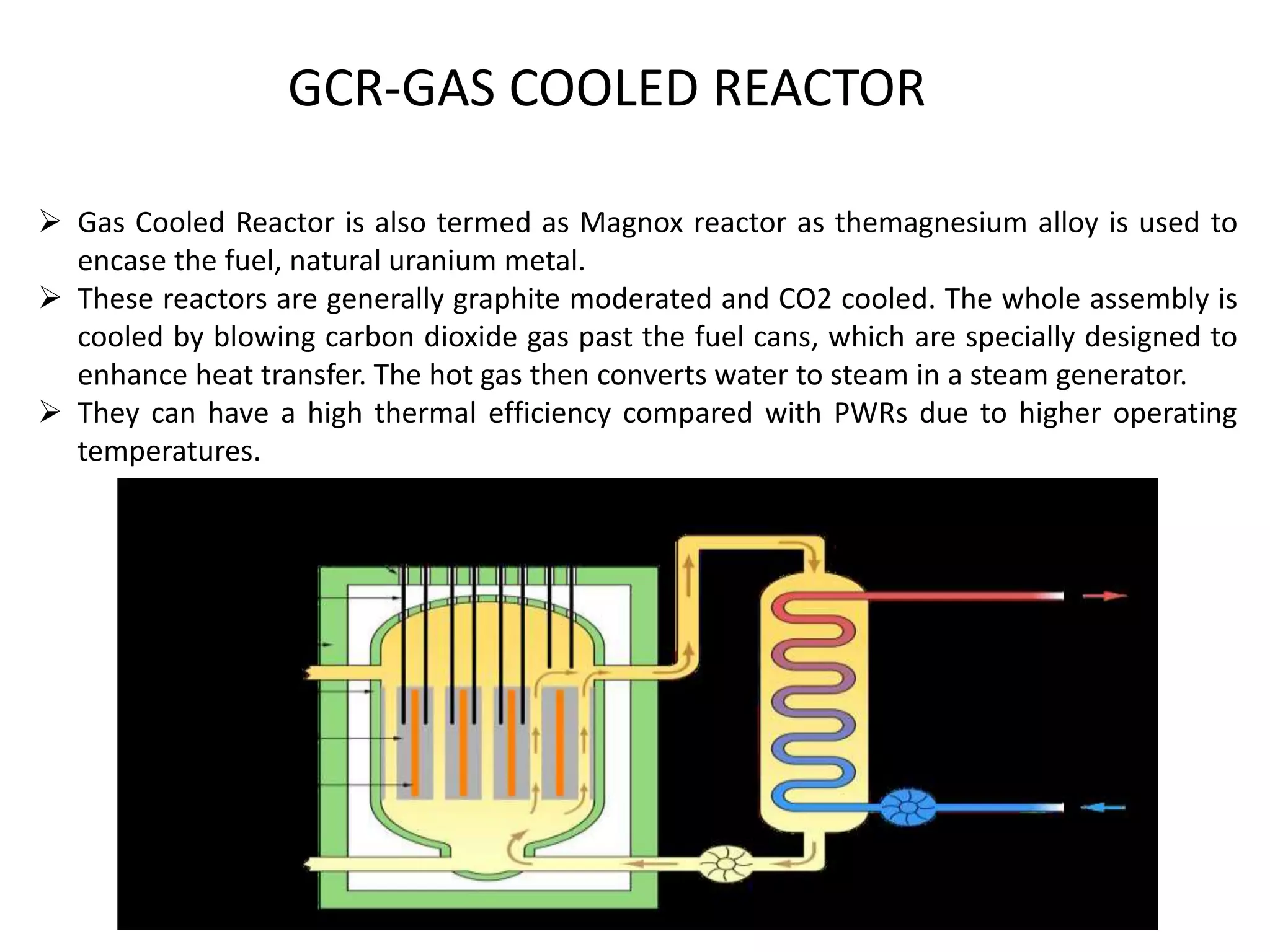
 Gas Cooled Reactor is also termed as Magnox reactor as themagnesium alloy is used to
encase the fuel, natural uranium metal.
 These reactors are generally graphite moderated and CO2 cooled. The whole assembly is
cooled by blowing carbon dioxide gas past the fuel cans, which are specially designed to
enhance heat transfer. The hot gas then converts water to steam in a steam generator.
 They can have a high thermal efficiency compared with PWRs due to higher operating
temperatures.
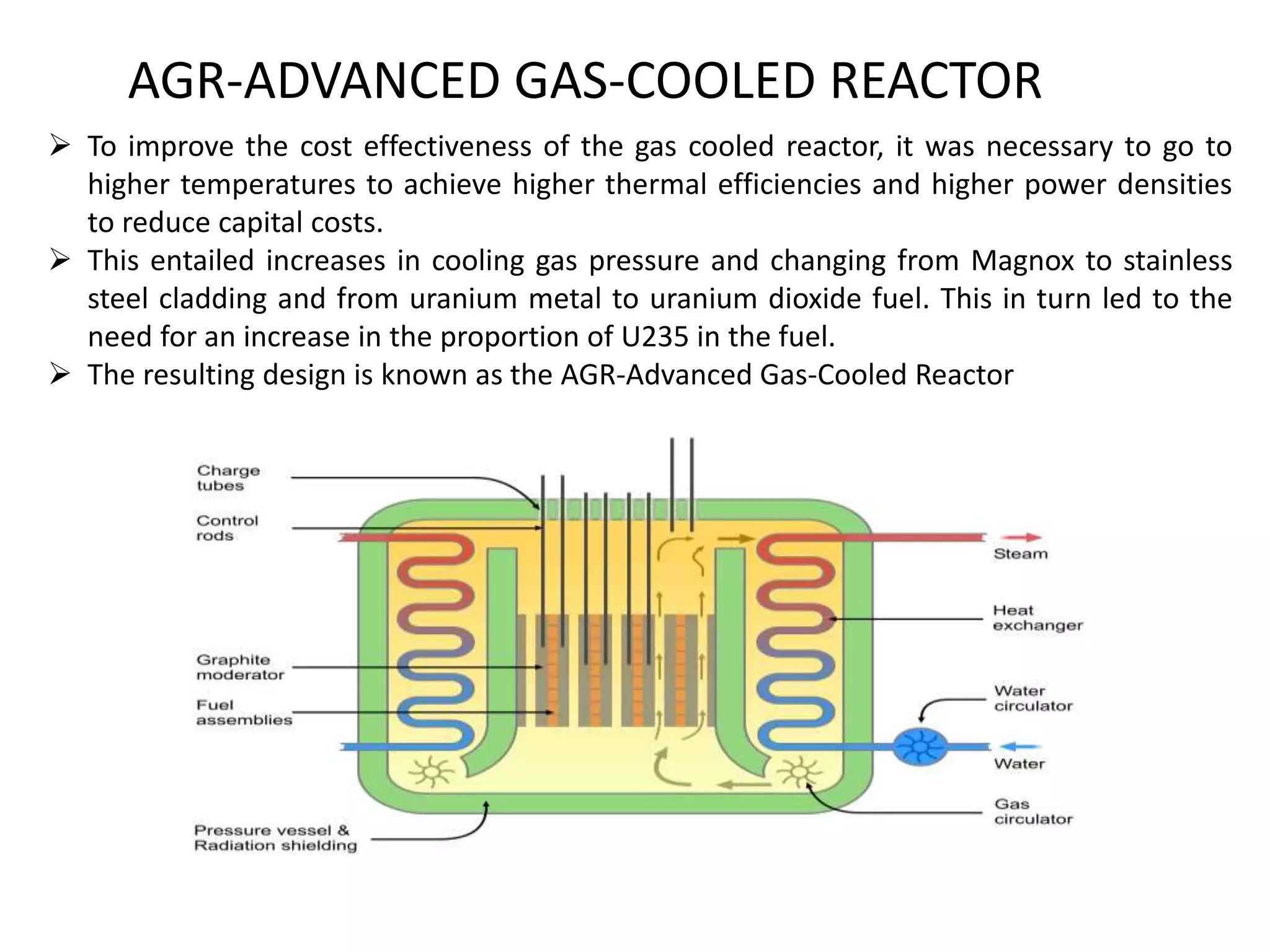
AGR-ADVANCED GAS-COOLED REACTOR
 To improve the cost effectiveness of the gas cooled reactor, it was necessary to go to
higher temperatures to achieve higher thermal efficiencies and higher power densities
to reduce capital costs.
 This entailed increases in cooling gas pressure and changing from Magnox to stainless
steel cladding and from uranium metal to uranium dioxide fuel. This in turn led to the
need for an increase in the proportion of U235 in the fuel.
 The resulting design is known as the AGR-Advanced Gas-Cooled Reactor
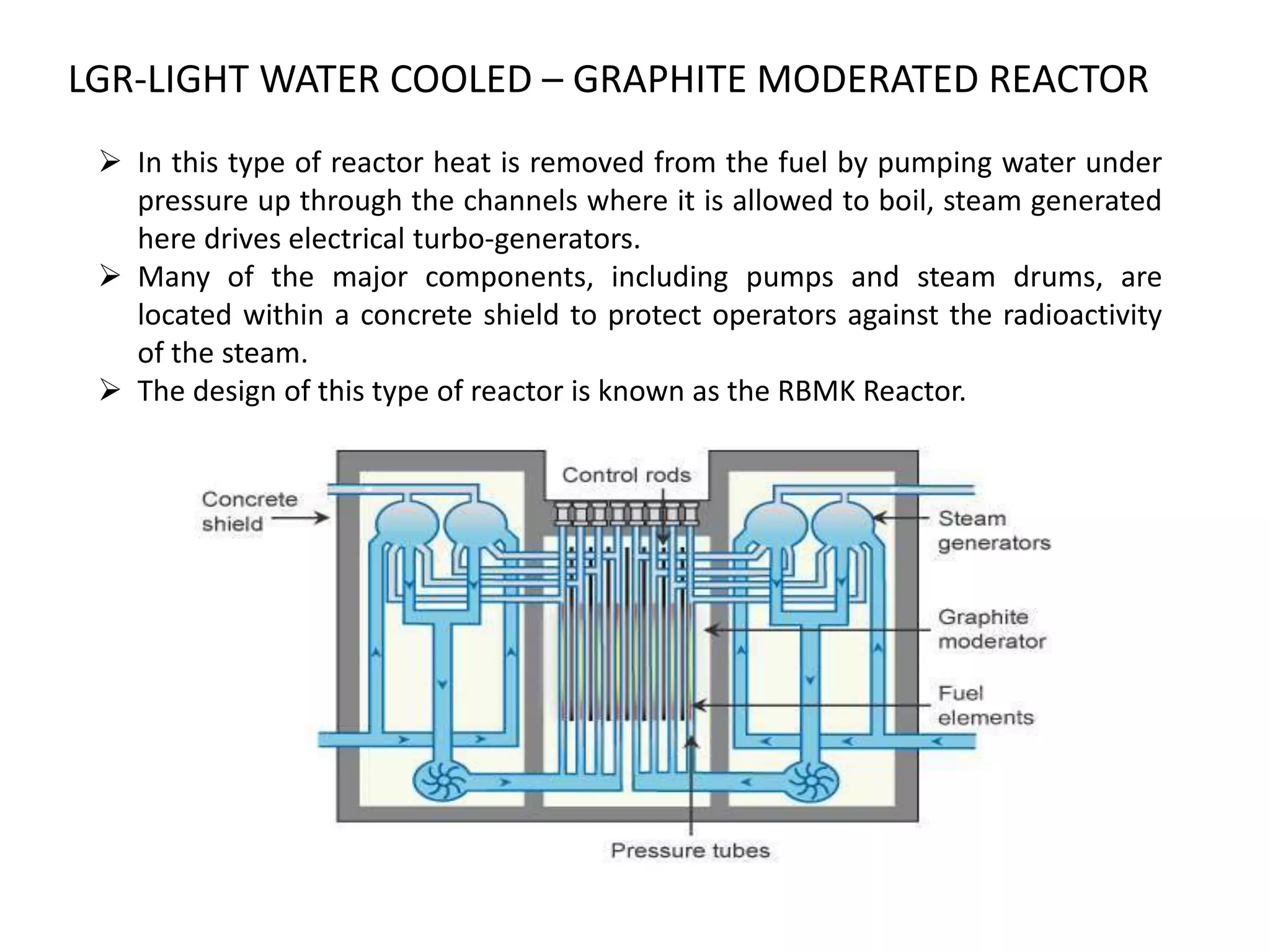
LGR-LIGHT WATER COOLED – GRAPHITE MODERATED REACTOR
 In this type of reactor heat is removed from the fuel by pumping water under
pressure up through the channels where it is allowed to boil, steam generated
here drives electrical turbo-generators.
 Many of the major components, including pumps and steam drums, are
located within a concrete shield to protect operators against the radioactivity
of the steam.
 The design of this type of reactor is known as the RBMK Reactor.
ADVANTAGES :-
 Water used as coolant, moderator and reflector is cheap and available in plenty.
 The reactor is compact and high power density (65 KW/liter).
 Hardly 60 control rods are required in 1000 MW plant.
 Inspecting and maintaining of turbine, feed heaters and condenser during
operation.
 Reducing fuel cost and extracting more energy.
DISADVANTAGES :-
 Requires high pressure vessel and high capital cost.
 Thermodynamic efficiency of plant is as low as 20% due to low pressure.
 Corrosion problems are more severe. Use of stainless steel for vessel is necessary.
 Fuel recharging requires a couple of months time.
 Ashvani Shah C&I Reliance. NUCLEAR REACTOR. web.
5 Sep. 2016.
 Abdul Karim et al. NUCLEAR REACTOR AND ITS
WORKING. web. 5 Sep. 2016.
 Nptel Lectures
REFERENCES:-
POWER SYSTEMS PPT OF NUCLEAR REACTORS AND THEIR TYPES

POWER SYSTEMS PPT OF NUCLEAR REACTORS AND THEIR TYPES

  • 1.
    Department of Electrical& Electronics Engineering Raghu Engineering College (Autonomous) Accredited by NBA & NAAC with ‘A Grade, Permanently Affiliated JNTU Kakinada Dakamarri (v), Bheemunipatnam Mandal, Visakhapatnam, Andhra Pradesh 531162 DECEMBER—2019 A CASE STUDY ON NUCLEAR REACTORS AND THEIR TYPES Submitted as a part of Second Year First Semester curriculum of
  • 2.
    BACHELOR OF TECHNOLOGY IN ELECTRICALAND ELECTRONICS ENGINEERING By Mr P.Eswar sai 18981A0237 Mr P.Mohan 18981A0238 Ms P.Supriya 18981A0239 Mr.P.Nitish 18981A0240 Mr.P.Sanjay Kumar 18981A0241 Under the Supervision of Ms.D.ANUSHA Assistant Professor Head of the department Dr.P.SASI KIRAN Professor Faculty Member Ms.D.ANUSHA Assistant Professor
  • 3.
    NUCLEAR REACTOR INTRODUCTION NuclearReactor: • A nuclear reactor is a device to initiate, and control, a sustained nuclear chain reaction. • The most common use of nuclear reactor is for the generation of electrical power also termed as nuclear power.
  • 4.
    NUCLEAR ENERGY :- Each of the five reactors produces about 1,100 million watts (megawatts) of electricity  This is enough to power one million homes per reactor  Each reactor’s production is equivalent to 15 million barrels of oil or 3.5 million tons of coal a year.  The total 5,500 reactor produced megawatts is out of a peak state electrical power of 30,000 – 40,000 megawatts.
  • 5.
    HOW A NUCLEARREACTOR WORKS :-  235U fissions by absorbing a neutron and producing 2 to 3 neutrons, which initiate on average one more fission to make a controlled chain reaction  Normal water is used as a moderator to slow the neutrons since slow neutrons take longer to pass by a U nucleus and have more time to be absorbed  The protons in the hydrogen in the water have the same mass as the neutron and stop them by a billiard ball effect  The extra neutrons are taken up by protons to form deuterons  235U is enriched from its 0.7% in nature to about 3% to produce the reaction, and is contained in rods in the water  Boron control rods are inserted to absorb neutrons when it is time to shut down the reactor  The hot water is boiled or sent through a heat exchanger to produce steam. The steam then powers turbines.
  • 6.
    TYPES OF NUCLEARREACTORS 1. BWR-BoilingWater Reactor 2. PWR-Pressurized Water Reactor 3. PHWR-Pressurised Heavy Water Reactor 4. GCR-Gas Cooled Reactor 5. AGR-Advanced Gas-Cooled Reactor 6. LGR-Light Water Cooled - Graphite Moderated Reactor
  • 7.
  • 8.
    SCHEMATIC DIAGRAM OFA NUCLEAR POWER PLANT
  • 9.
  • 10.
    CLASSIFICATION OF NUCLEARREACTOR: - 1. On the basis of Neutron Energy a) Fast Reactors b) Thermal Reactors 2. On the basis of Fuel used a) Natural fuel b) Enriched Uranium 3. On the basis of Moderator used a) Water Moderator b) Heavy water Moderator c) Graphite Moderator d) Beryllium Moderator 4. On the basis of Coolant used a) Water cooled reactor (Ordinary or Heavy) b) Gas cooled reactor c) Liquid metal cooled reactor d) Organic liquid cooled reactor
  • 11.
    BWR-BOILING WATER REACTOR In the boiling water reactor (BWR), the water which passes over the reactor core act as moderator and coolant. It is also the steam source for the turbine.  The disadvantage of BWR is that any fuel leak might make the water radioactive and that radioactivity would reach the turbine and the rest of the loop.  A typical operating pressure for BWR is about 70 atm at which the water boils at about 285°C temperature. This operating temperature gives a efficiency of only 42% with a practical operating efficiency of around 32%, somewhat less than the Pressurized Water Reactor(PWR).
  • 12.
    PWR-PRESSURIZED WATER REACTOR In the pressurized water reactor (PWR), the water which passes over the reactor core act as moderator and coolant but does not flow to the turbine. It is sent in a pressurized primary loop. The primary loop water produces steam in the secondary loop which drives the turbine.  The advantage PWR is that a fuel leak in the core would not pass any radioactive contaminants to the turbine and condenser.  Another advantage is that the PWR can operate at higher pressure and temperature, about 160 atm and about 315°C. This provides a higher efficiency than the boiling water reactor(BWR) , but PWR is more complicated and more costly to construct.
  • 13.
    PHWR-PRESSURISED HEAVY WATERREACTOR Pressurized Heavy Water Reactor (PHWR) is a Canadian design which is designed in Canada and subsequently exported to several countries (also known as CANDU). PHWR are heavy water cooled and moderated Pressurized Water reactors. Instead of using a single large pressure vessel as in a PWR, the fuel is contained in hundreds of pressure tubes. These reactors are fuelled with natural uranium and are thermal neutron reactor designs. PHWRs can be refuelled while at full power, which makes them very efficient in their use of uranium.
  • 14.
    GCR-GAS COOLED REACTOR Gas Cooled Reactor is also termed as Magnox reactor as themagnesium alloy is used to encase the fuel, natural uranium metal.  These reactors are generally graphite moderated and CO2 cooled. The whole assembly is cooled by blowing carbon dioxide gas past the fuel cans, which are specially designed to enhance heat transfer. The hot gas then converts water to steam in a steam generator.  They can have a high thermal efficiency compared with PWRs due to higher operating temperatures.
  • 15.
    AGR-ADVANCED GAS-COOLED REACTOR To improve the cost effectiveness of the gas cooled reactor, it was necessary to go to higher temperatures to achieve higher thermal efficiencies and higher power densities to reduce capital costs.  This entailed increases in cooling gas pressure and changing from Magnox to stainless steel cladding and from uranium metal to uranium dioxide fuel. This in turn led to the need for an increase in the proportion of U235 in the fuel.  The resulting design is known as the AGR-Advanced Gas-Cooled Reactor
  • 16.
    LGR-LIGHT WATER COOLED– GRAPHITE MODERATED REACTOR  In this type of reactor heat is removed from the fuel by pumping water under pressure up through the channels where it is allowed to boil, steam generated here drives electrical turbo-generators.  Many of the major components, including pumps and steam drums, are located within a concrete shield to protect operators against the radioactivity of the steam.  The design of this type of reactor is known as the RBMK Reactor.
  • 17.
    ADVANTAGES :-  Waterused as coolant, moderator and reflector is cheap and available in plenty.  The reactor is compact and high power density (65 KW/liter).  Hardly 60 control rods are required in 1000 MW plant.  Inspecting and maintaining of turbine, feed heaters and condenser during operation.  Reducing fuel cost and extracting more energy.
  • 18.
    DISADVANTAGES :-  Requireshigh pressure vessel and high capital cost.  Thermodynamic efficiency of plant is as low as 20% due to low pressure.  Corrosion problems are more severe. Use of stainless steel for vessel is necessary.  Fuel recharging requires a couple of months time.
  • 19.
     Ashvani ShahC&I Reliance. NUCLEAR REACTOR. web. 5 Sep. 2016.  Abdul Karim et al. NUCLEAR REACTOR AND ITS WORKING. web. 5 Sep. 2016.  Nptel Lectures REFERENCES:-