Breeder Reactor
Presentation by;
Muhammad Mudasser Afzal
Ghulam Mustafa
Breeder Reactor
 The reactors which are designed so that breeding will take place is
known as breeder reactor.
 Breeder reactors are capable of producing more fissile material than
they consume during the fission chain reaction (by converting fertile
U-238 to Pu-239, or Th-232 to U-233). Thus, a uranium breeder
reactor, once running, can be re-fueled with natural or even depleted
uranium, and a thorium breeder reactor can be re-fueled with
thorium; however, an initial stock of fissile material is required.
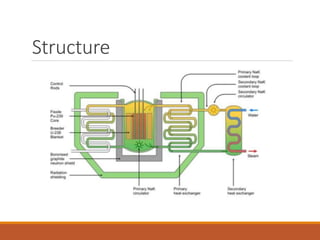
Structure
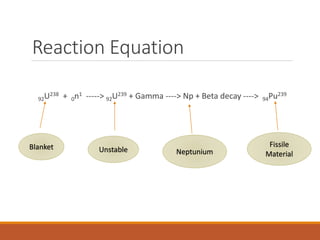
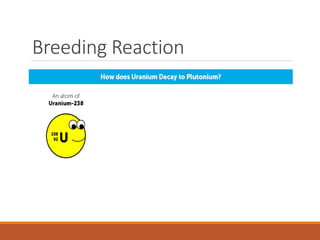
Reaction Equation
92U238 + 0n1 -----> 92U239 + Gamma ----> Np + Beta decay ----> 94Pu239
Blanket Unstable Neptunium
Fissile
Material
Breeding Reaction
Types of Breeder Reactor
 Liquid-metal cooled fast breeder reactor (LMFBR)
 Gas-cooled fast breeder-reactor (GCFR)
 Molten Salt Breeder reactor
 Light Water Breeder Reactor
Liquid-metal cooled fast breeder
reactor (LMFBR)
The first experimental breeder reactor was a small plutonium fueled,
mercury-cooled device, operating at a power level of 25 kW, cooled with
a mixture of sodium and potassium, was placed in operation in 1951 at
the Argonne National Laboratory in Idaho.
This reactor, the Experimental Breeder Reactor-I (EBR-I), produced
steam in a secondary loop that drove a turbine generator. The system
produced 200 kW of electricity, the world's first nuclear generated
electricity-and it came from LMFBR . Since these early experiments,
dozens of LMFBRs have been constructed around the world. Sodium has
been universally chosen a the coolant for the modern LMFBR.
Its melting point, 980oC is much higher than room temperature, so the
entire coolant system must be kept heated at all times to prevent the
sodium from solidifying. This is accomplished by winding a spiral of
insulated heating wire called tracing along coolant piping, valves, and so
forth.
Unfortunately, sodium absorbs neutrons, even fast neutrons, leading to
the formation of the beta-gamma emitter 24Na, with a half-life of 15
hours. Therefore, sodium that passes through the reactor core becomes
radioactive. LMFBR plants operate on the steam cycle-that is, the heat
from the reactor is ultimately utilized to produce steam in steam
generators
Gas-cooled fast breeder-reactor
(GCFR)
It is a helium-cooled reactor fueled with a mixture of plutonium
and uranium.
The core of the GCFR is similar to that of an LMFBR, with mixed
PuO2 and UO2 pellets in stainless steel pins, except that the pins
are not as close together as they are in the LMFBR. Also, the pins
in the GCFR have a roughened outer surface to enhance heat
transfer to the passing coolant.
Molten Salt Breeder reactor
This is a thermal breeder that operates on the 233 U-thorium
cycle. It is recalled that 233U is the only fissile isotope capable of
breeding in a thermal reactor.
The MSBR concept is a unique design among reactors in that the
fuel, fertile material, and coolant are mixed together in one
homogeneous fluid. This is composed of various fluoride salts
that, at an elevated temperature, melt to become a clear, non-
viscous fluid.
Advantages of MSBR
Because of the low vapor pressure of the molten salts, the MSBR
operates at just a little above atmospheric pressure and thus no
expensive pressure vessel is required.
High temperatures are possible with the molten salts, the MSBR
can produce superheated steam at 24 MPa and 540 C, which
leads to a very high overall plant efficiency of about 44% .
Light Water Breeder Reactor
Even when a special effort is made in the design of the LWBR to
reduce neutron losses, its overall breeding gain will be very small-
too small to make the reactor a net producer of 233U for other
reactors of this type.
To see whether breeding can actually be achieved in a light-water
reactor, the U.S. Department of Energy developed an LWB R core
that was installed in the government-owned pressurized water
reactor at Shipping port, Pennsylvania.
Japan First Breeder Reactor
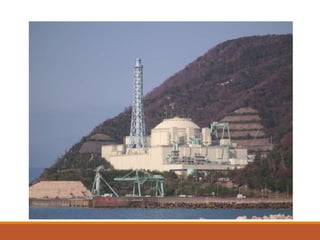
Monju is a demonstration reactor, designed to be a small-scale example
of the potential of the fast breeder technology
Monju first reached criticality in 1994, before being shut in 1995 due to
a sodium leak causing a fire.
Japanese fast breeder reactor Monju restarted after 14-year shutdown
Including the discovery in 2012 that JAEA hadn’t adhered to safety
regulations, failing to check up to 10,000 parts.
According to the Japan Times the Monju project cost about ¥900 billion
($7.5 billion) so far, including ¥600 billion ($5 billion) for construction.
 It was caused by a broken thermocouple in the secondary sodium loop
that gave way to a massive sodium leak estimated at 640 kg, some of
which ignited. Sodium is highly reactive in contact with air and water.
Thank You

Breeder reactor

  • 1.
    Breeder Reactor Presentation by; MuhammadMudasser Afzal Ghulam Mustafa
  • 2.
    Breeder Reactor  Thereactors which are designed so that breeding will take place is known as breeder reactor.  Breeder reactors are capable of producing more fissile material than they consume during the fission chain reaction (by converting fertile U-238 to Pu-239, or Th-232 to U-233). Thus, a uranium breeder reactor, once running, can be re-fueled with natural or even depleted uranium, and a thorium breeder reactor can be re-fueled with thorium; however, an initial stock of fissile material is required.
  • 3.
  • 4.
    Reaction Equation 92U238 +0n1 -----> 92U239 + Gamma ----> Np + Beta decay ----> 94Pu239 Blanket Unstable Neptunium Fissile Material
  • 5.
  • 6.
    Types of BreederReactor  Liquid-metal cooled fast breeder reactor (LMFBR)  Gas-cooled fast breeder-reactor (GCFR)  Molten Salt Breeder reactor  Light Water Breeder Reactor
  • 7.
    Liquid-metal cooled fastbreeder reactor (LMFBR) The first experimental breeder reactor was a small plutonium fueled, mercury-cooled device, operating at a power level of 25 kW, cooled with a mixture of sodium and potassium, was placed in operation in 1951 at the Argonne National Laboratory in Idaho. This reactor, the Experimental Breeder Reactor-I (EBR-I), produced steam in a secondary loop that drove a turbine generator. The system produced 200 kW of electricity, the world's first nuclear generated electricity-and it came from LMFBR . Since these early experiments, dozens of LMFBRs have been constructed around the world. Sodium has been universally chosen a the coolant for the modern LMFBR.
  • 8.
    Its melting point,980oC is much higher than room temperature, so the entire coolant system must be kept heated at all times to prevent the sodium from solidifying. This is accomplished by winding a spiral of insulated heating wire called tracing along coolant piping, valves, and so forth. Unfortunately, sodium absorbs neutrons, even fast neutrons, leading to the formation of the beta-gamma emitter 24Na, with a half-life of 15 hours. Therefore, sodium that passes through the reactor core becomes radioactive. LMFBR plants operate on the steam cycle-that is, the heat from the reactor is ultimately utilized to produce steam in steam generators
  • 9.
    Gas-cooled fast breeder-reactor (GCFR) Itis a helium-cooled reactor fueled with a mixture of plutonium and uranium. The core of the GCFR is similar to that of an LMFBR, with mixed PuO2 and UO2 pellets in stainless steel pins, except that the pins are not as close together as they are in the LMFBR. Also, the pins in the GCFR have a roughened outer surface to enhance heat transfer to the passing coolant.
  • 10.
    Molten Salt Breederreactor This is a thermal breeder that operates on the 233 U-thorium cycle. It is recalled that 233U is the only fissile isotope capable of breeding in a thermal reactor. The MSBR concept is a unique design among reactors in that the fuel, fertile material, and coolant are mixed together in one homogeneous fluid. This is composed of various fluoride salts that, at an elevated temperature, melt to become a clear, non- viscous fluid.
  • 11.
    Advantages of MSBR Becauseof the low vapor pressure of the molten salts, the MSBR operates at just a little above atmospheric pressure and thus no expensive pressure vessel is required. High temperatures are possible with the molten salts, the MSBR can produce superheated steam at 24 MPa and 540 C, which leads to a very high overall plant efficiency of about 44% .
  • 12.
    Light Water BreederReactor Even when a special effort is made in the design of the LWBR to reduce neutron losses, its overall breeding gain will be very small- too small to make the reactor a net producer of 233U for other reactors of this type. To see whether breeding can actually be achieved in a light-water reactor, the U.S. Department of Energy developed an LWB R core that was installed in the government-owned pressurized water reactor at Shipping port, Pennsylvania.
  • 13.
    Japan First BreederReactor Monju is a demonstration reactor, designed to be a small-scale example of the potential of the fast breeder technology Monju first reached criticality in 1994, before being shut in 1995 due to a sodium leak causing a fire. Japanese fast breeder reactor Monju restarted after 14-year shutdown Including the discovery in 2012 that JAEA hadn’t adhered to safety regulations, failing to check up to 10,000 parts. According to the Japan Times the Monju project cost about ¥900 billion ($7.5 billion) so far, including ¥600 billion ($5 billion) for construction.  It was caused by a broken thermocouple in the secondary sodium loop that gave way to a massive sodium leak estimated at 640 kg, some of which ignited. Sodium is highly reactive in contact with air and water.
  • 15.