Deuterium oxide
( D2O )
 WHAT IS A HEAVY WATER ?
 INTRODUCTION OF DEUTERIUM OXIDE .
• PHYSICAL PROPERTIES OF DEAUTERIUM OXIDE
 PRODUCTION OF HEAVY WATER.
 Hydrogen Sulfide-Water chemical Exchange
 EFFECT ON BIOLOGICAL SYSTEM .
EFFECT ON ANIMAL
EFFECT ON HUMAN
EFFECT ON PLANT
 USE OF HEAVY WATER .
 CANDU REACTOR .
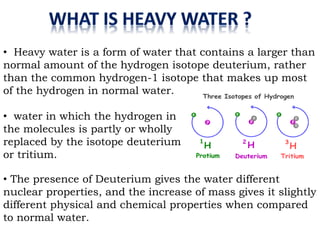
• Heavy water is a form of water that contains a larger than
normal amount of the hydrogen isotope deuterium, rather
than the common hydrogen-1 isotope that makes up most
of the hydrogen in normal water.
• water in which the hydrogen in
the molecules is partly or wholly
replaced by the isotope deuterium
or tritium.
• The presence of Deuterium gives the water different
nuclear properties, and the increase of mass gives it slightly
different physical and chemical properties when compared
to normal water.
DEUTERIUM OXIDE
• Deuterium is a hydrogen isotope with a nucleus
containing a neutron and a proton the nucleus of a protium
(normal hydrogen) atom consists of just a proton. The
additional neutron makes a deuterium atom roughly twice
as heavy as a protium atom.
• Heavy water was first produced in 1932, a few months
after the discovery of deuterium. With the discovery
of nuclear fission in late 1938, and the need for a neutron
moderator that captured few neutrons, heavy water became
a component of early nuclear energy research. Since then,
heavy water has been an essential component in some
types of reactors, both those that generate power and those
designed to produce isotopes for nuclear weapons.
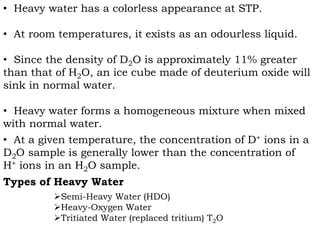
• Heavy water has a colorless appearance at STP.
• At room temperatures, it exists as an odourless liquid.
• Since the density of D2O is approximately 11% greater
than that of H2O, an ice cube made of deuterium oxide will
sink in normal water.
• Heavy water forms a homogeneous mixture when mixed
with normal water.
• At a given temperature, the concentration of D+ ions in a
D2O sample is generally lower than the concentration of
H+ ions in an H2O sample.
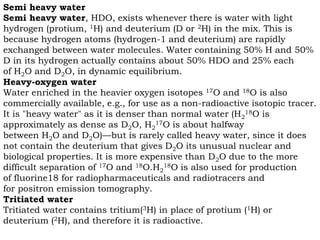
Types of Heavy Water
Semi-Heavy Water (HDO)
Heavy-Oxygen Water
Tritiated Water (replaced tritium) T2O
Semi heavy water
Semi heavy water, HDO, exists whenever there is water with light
hydrogen (protium, 1H) and deuterium (D or 2H) in the mix. This is
because hydrogen atoms (hydrogen-1 and deuterium) are rapidly
exchanged between water molecules. Water containing 50% H and 50%
D in its hydrogen actually contains about 50% HDO and 25% each
of H2O and D2O, in dynamic equilibrium.
Heavy-oxygen water
Water enriched in the heavier oxygen isotopes 17O and 18O is also
commercially available, e.g., for use as a non-radioactive isotopic tracer.
It is "heavy water" as it is denser than normal water (H2
18O is
approximately as dense as D2O, H2
17O is about halfway
between H2O and D2O)—but is rarely called heavy water, since it does
not contain the deuterium that gives D2O its unusual nuclear and
biological properties. It is more expensive than D2O due to the more
difficult separation of 17O and 18O.H2
18O is also used for production
of fluorine18 for radiopharmaceuticals and radiotracers and
for positron emission tomography.
Tritiated water
Tritiated water contains tritium(3H) in place of protium (1H) or
deuterium (2H), and therefore it is radioactive.
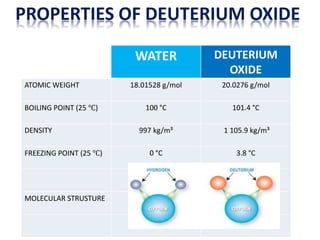
PROPERTIES OF DEUTERIUM OXIDE
WATER DEUTERIUM
OXIDE
ATOMIC WEIGHT 18.01528 g/mol 20.0276 g/mol
BOILING POINT (25 ℃) 100 °C 101.4 °C
DENSITY 997 kg/m³ 1 105.9 kg/m³
FREEZING POINT (25 ℃) 0 °C 3.8 °C
MOLECULAR STRUSTURE
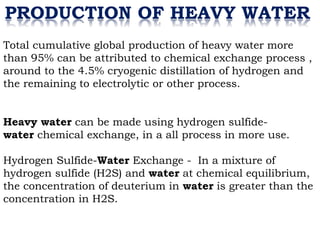
PRODUCTION OF HEAVY WATER
Total cumulative global production of heavy water more
than 95% can be attributed to chemical exchange process ,
around to the 4.5% cryogenic distillation of hydrogen and
the remaining to electrolytic or other process.
Heavy water can be made using hydrogen sulfide-
water chemical exchange, in a all process in more use.
Hydrogen Sulfide-Water Exchange - In a mixture of
hydrogen sulfide (H2S) and water at chemical equilibrium,
the concentration of deuterium in water is greater than the
concentration in H2S.
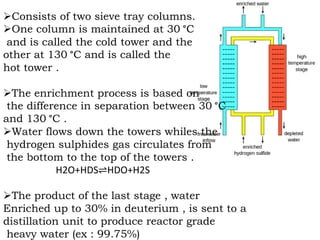
Consists of two sieve tray columns.
One column is maintained at 30 °C
and is called the cold tower and the
other at 130 °C and is called the
hot tower .
The enrichment process is based on
the difference in separation between 30 °C
and 130 °C .
Water flows down the towers whiles the
hydrogen sulphides gas circulates from
the bottom to the top of the towers .
H2O+HDS⇌HDO+H2S
The product of the last stage , water
Enriched up to 30% in deuterium , is sent to a
distillation unit to produce reactor grade
heavy water (ex : 99.75%)
EFFECT ON BIOLOGICAL SYSTEM
Heavy water is the only known chemical substance that
affects the period of circadian oscillations, consistently
increasing the length of each cycle. The effect is seen in
unicellular organisms, green plants, isopods, insects, birds,
and mice.
Effect in Animal
High concentrations of heavy water (90%) rapidly kill fish,
tadpoles, flatworms, and Drosophila. Mammals (for
example, rats) given heavy water to drink die after a week,
at a time when their body water approaches about 50%
deuteration.
Toxicity in human
The degree to which a substance (a toxin or poison)
can harm humans . ... Chronic toxicity is the ability of a
substance or mixture of substances to cause harmful
effects over an extended period, usually upon repeated or
continuous exposure, sometimes lasting for the entire life of
the exposed organism.
Because it would take a very large amount of heavy water
to replace 25% to 50% of a human being's body water
(water being in turn 50–75% of body weight) with heavy
water, accidental or intentional poisoning with heavy water
is unlikely to the point of practical disregard. Poisoning
would require that the victim ingest large amounts of heavy
water without significant normal water intake for many
days to produce any noticeable toxic effects.
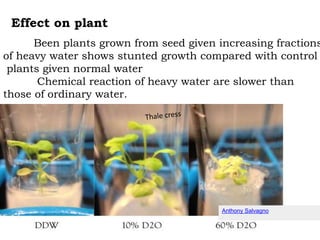
Effect on plant
Been plants grown from seed given increasing fractions
of heavy water shows stunted growth compared with control
plants given normal water
Chemical reaction of heavy water are slower than
those of ordinary water.
Anthony Salvagno
,
USE OF HEAVY WATER
• Heavy Water is used for the preparation of Deuterium.
• As a tracer to study the mechanism of respiration,
photosynthesis.
• D2O is used in NMR (nuclear magnetic resonance)
spectroscopy, which is used to observe the magnetic fields
around the nuclei of atoms.
•As a moderator in the nuclear reactor to slow down the
neutrons. Since it can slow down the fast-moving neutrons
so that they can react with the 235U isotope instead of
the 238U isotope.
• The metabolic rate in humans and animals is tested with
the help of a mixture of D2O and heavy-oxygen water.
CANDU REACTOR
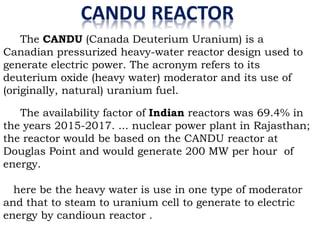
The CANDU (Canada Deuterium Uranium) is a
Canadian pressurized heavy-water reactor design used to
generate electric power. The acronym refers to its
deuterium oxide (heavy water) moderator and its use of
(originally, natural) uranium fuel.
The availability factor of Indian reactors was 69.4% in
the years 2015-2017. ... nuclear power plant in Rajasthan;
the reactor would be based on the CANDU reactor at
Douglas Point and would generate 200 MW per hour of
energy.
here be the heavy water is use in one type of moderator
and that to steam to uranium cell to generate to electric
energy by candioun reactor .
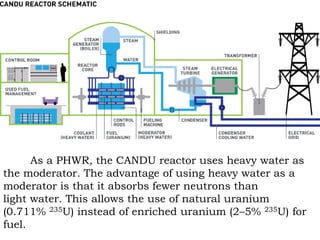
As a PHWR, the CANDU reactor uses heavy water as
the moderator. The advantage of using heavy water as a
moderator is that it absorbs fewer neutrons than
light water. This allows the use of natural uranium
(0.711% 235U) instead of enriched uranium (2–5% 235U) for
fuel.
REFFERENCE …..
HEAVY WATER
BY
SHARAD M.DAVE
THANK YOU

Heavy water

  • 1.
  • 2.
     WHAT ISA HEAVY WATER ?  INTRODUCTION OF DEUTERIUM OXIDE . • PHYSICAL PROPERTIES OF DEAUTERIUM OXIDE  PRODUCTION OF HEAVY WATER.  Hydrogen Sulfide-Water chemical Exchange  EFFECT ON BIOLOGICAL SYSTEM . EFFECT ON ANIMAL EFFECT ON HUMAN EFFECT ON PLANT  USE OF HEAVY WATER .  CANDU REACTOR .
  • 3.
    • Heavy wateris a form of water that contains a larger than normal amount of the hydrogen isotope deuterium, rather than the common hydrogen-1 isotope that makes up most of the hydrogen in normal water. • water in which the hydrogen in the molecules is partly or wholly replaced by the isotope deuterium or tritium. • The presence of Deuterium gives the water different nuclear properties, and the increase of mass gives it slightly different physical and chemical properties when compared to normal water.
  • 4.
    DEUTERIUM OXIDE • Deuteriumis a hydrogen isotope with a nucleus containing a neutron and a proton the nucleus of a protium (normal hydrogen) atom consists of just a proton. The additional neutron makes a deuterium atom roughly twice as heavy as a protium atom. • Heavy water was first produced in 1932, a few months after the discovery of deuterium. With the discovery of nuclear fission in late 1938, and the need for a neutron moderator that captured few neutrons, heavy water became a component of early nuclear energy research. Since then, heavy water has been an essential component in some types of reactors, both those that generate power and those designed to produce isotopes for nuclear weapons.
  • 5.
    • Heavy waterhas a colorless appearance at STP. • At room temperatures, it exists as an odourless liquid. • Since the density of D2O is approximately 11% greater than that of H2O, an ice cube made of deuterium oxide will sink in normal water. • Heavy water forms a homogeneous mixture when mixed with normal water. • At a given temperature, the concentration of D+ ions in a D2O sample is generally lower than the concentration of H+ ions in an H2O sample. Types of Heavy Water Semi-Heavy Water (HDO) Heavy-Oxygen Water Tritiated Water (replaced tritium) T2O
  • 6.
    Semi heavy water Semiheavy water, HDO, exists whenever there is water with light hydrogen (protium, 1H) and deuterium (D or 2H) in the mix. This is because hydrogen atoms (hydrogen-1 and deuterium) are rapidly exchanged between water molecules. Water containing 50% H and 50% D in its hydrogen actually contains about 50% HDO and 25% each of H2O and D2O, in dynamic equilibrium. Heavy-oxygen water Water enriched in the heavier oxygen isotopes 17O and 18O is also commercially available, e.g., for use as a non-radioactive isotopic tracer. It is "heavy water" as it is denser than normal water (H2 18O is approximately as dense as D2O, H2 17O is about halfway between H2O and D2O)—but is rarely called heavy water, since it does not contain the deuterium that gives D2O its unusual nuclear and biological properties. It is more expensive than D2O due to the more difficult separation of 17O and 18O.H2 18O is also used for production of fluorine18 for radiopharmaceuticals and radiotracers and for positron emission tomography. Tritiated water Tritiated water contains tritium(3H) in place of protium (1H) or deuterium (2H), and therefore it is radioactive.
  • 7.
    PROPERTIES OF DEUTERIUMOXIDE WATER DEUTERIUM OXIDE ATOMIC WEIGHT 18.01528 g/mol 20.0276 g/mol BOILING POINT (25 ℃) 100 °C 101.4 °C DENSITY 997 kg/m³ 1 105.9 kg/m³ FREEZING POINT (25 ℃) 0 °C 3.8 °C MOLECULAR STRUSTURE
  • 8.
    PRODUCTION OF HEAVYWATER Total cumulative global production of heavy water more than 95% can be attributed to chemical exchange process , around to the 4.5% cryogenic distillation of hydrogen and the remaining to electrolytic or other process. Heavy water can be made using hydrogen sulfide- water chemical exchange, in a all process in more use. Hydrogen Sulfide-Water Exchange - In a mixture of hydrogen sulfide (H2S) and water at chemical equilibrium, the concentration of deuterium in water is greater than the concentration in H2S.
  • 9.
    Consists of twosieve tray columns. One column is maintained at 30 °C and is called the cold tower and the other at 130 °C and is called the hot tower . The enrichment process is based on the difference in separation between 30 °C and 130 °C . Water flows down the towers whiles the hydrogen sulphides gas circulates from the bottom to the top of the towers . H2O+HDS⇌HDO+H2S The product of the last stage , water Enriched up to 30% in deuterium , is sent to a distillation unit to produce reactor grade heavy water (ex : 99.75%)
  • 10.
    EFFECT ON BIOLOGICALSYSTEM Heavy water is the only known chemical substance that affects the period of circadian oscillations, consistently increasing the length of each cycle. The effect is seen in unicellular organisms, green plants, isopods, insects, birds, and mice. Effect in Animal High concentrations of heavy water (90%) rapidly kill fish, tadpoles, flatworms, and Drosophila. Mammals (for example, rats) given heavy water to drink die after a week, at a time when their body water approaches about 50% deuteration.
  • 11.
    Toxicity in human Thedegree to which a substance (a toxin or poison) can harm humans . ... Chronic toxicity is the ability of a substance or mixture of substances to cause harmful effects over an extended period, usually upon repeated or continuous exposure, sometimes lasting for the entire life of the exposed organism. Because it would take a very large amount of heavy water to replace 25% to 50% of a human being's body water (water being in turn 50–75% of body weight) with heavy water, accidental or intentional poisoning with heavy water is unlikely to the point of practical disregard. Poisoning would require that the victim ingest large amounts of heavy water without significant normal water intake for many days to produce any noticeable toxic effects.
  • 12.
    Effect on plant Beenplants grown from seed given increasing fractions of heavy water shows stunted growth compared with control plants given normal water Chemical reaction of heavy water are slower than those of ordinary water. Anthony Salvagno ,
  • 13.
    USE OF HEAVYWATER • Heavy Water is used for the preparation of Deuterium. • As a tracer to study the mechanism of respiration, photosynthesis. • D2O is used in NMR (nuclear magnetic resonance) spectroscopy, which is used to observe the magnetic fields around the nuclei of atoms. •As a moderator in the nuclear reactor to slow down the neutrons. Since it can slow down the fast-moving neutrons so that they can react with the 235U isotope instead of the 238U isotope. • The metabolic rate in humans and animals is tested with the help of a mixture of D2O and heavy-oxygen water.
  • 14.
    CANDU REACTOR The CANDU(Canada Deuterium Uranium) is a Canadian pressurized heavy-water reactor design used to generate electric power. The acronym refers to its deuterium oxide (heavy water) moderator and its use of (originally, natural) uranium fuel. The availability factor of Indian reactors was 69.4% in the years 2015-2017. ... nuclear power plant in Rajasthan; the reactor would be based on the CANDU reactor at Douglas Point and would generate 200 MW per hour of energy. here be the heavy water is use in one type of moderator and that to steam to uranium cell to generate to electric energy by candioun reactor .
  • 15.
    As a PHWR,the CANDU reactor uses heavy water as the moderator. The advantage of using heavy water as a moderator is that it absorbs fewer neutrons than light water. This allows the use of natural uranium (0.711% 235U) instead of enriched uranium (2–5% 235U) for fuel.
  • 16.