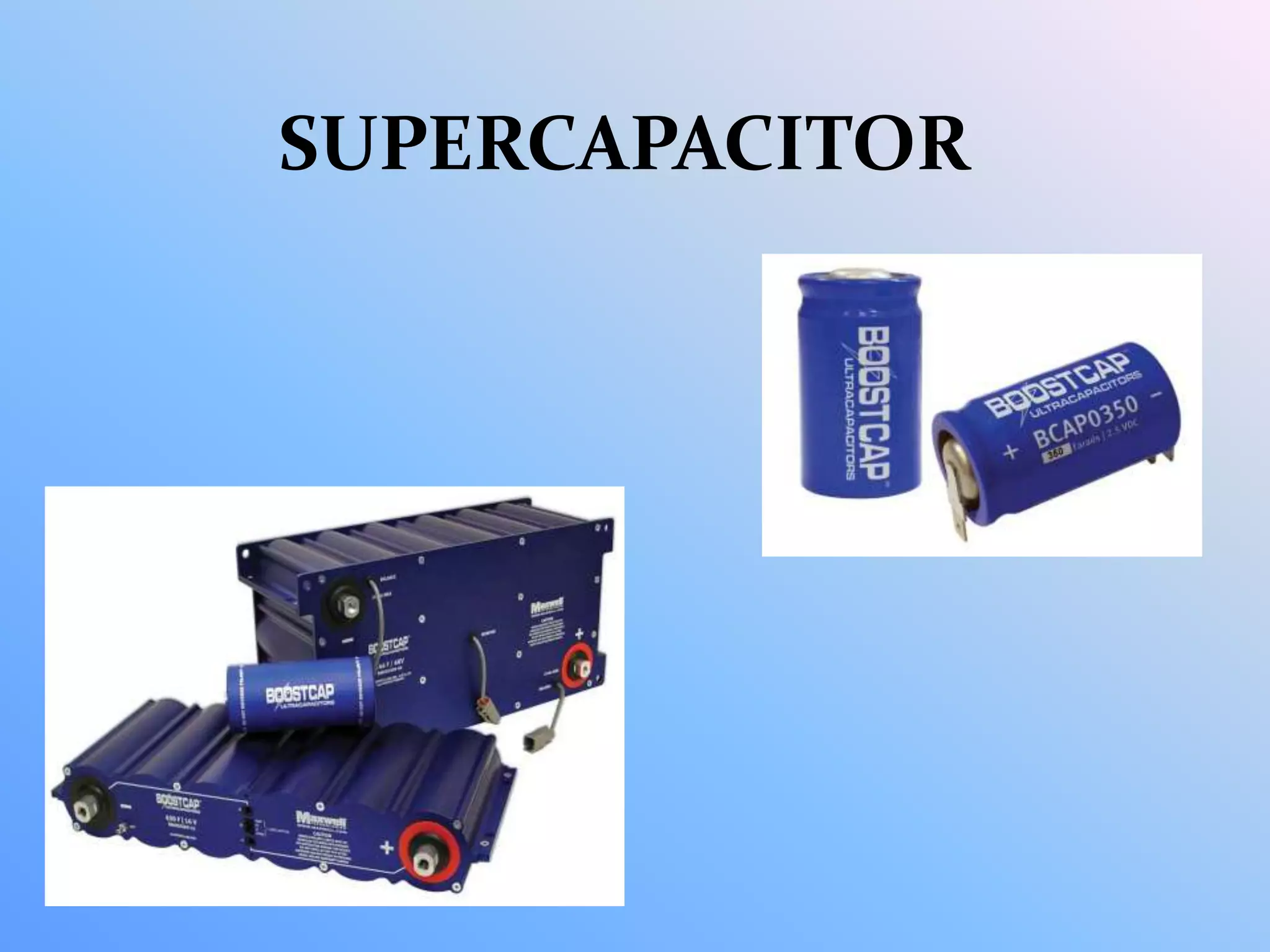
SUPERCAPACITOR
CONTENTS
 What is capacitor
 Capacitance
 How charge stored in capacitor
 Factors affecting capacitance of capacitor
 Why super capacitor
 What is super capacitor
 Comparison between super capacitor and capacitor
 Types of super capacitor
 Working of super capacitor
 Advantages and Disadvantages
 Applications
 Conclusion
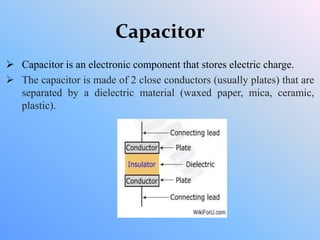
Capacitor
 Capacitor is an electronic component that stores electric charge.
 The capacitor is made of 2 close conductors (usually plates) that are
separated by a dielectric material (waxed paper, mica, ceramic,
plastic).
• The plates accumulate electric charge when connected to
power source.
• One plate accumulates positive charge and the other plate
accumulates negative charge.
Capacitance
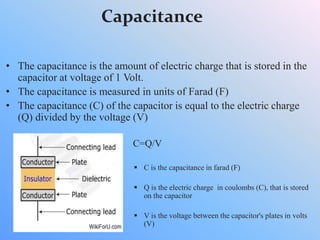
• The capacitance is the amount of electric charge that is stored in the
capacitor at voltage of 1 Volt.
• The capacitance is measured in units of Farad (F)
• The capacitance (C) of the capacitor is equal to the electric charge
(Q) divided by the voltage (V)
C=Q/V
 C is the capacitance in farad (F)
 Q is the electric charge in coulombs (C), that is stored
on the capacitor
 V is the voltage between the capacitor's plates in volts
(V)
Capacitance of parallel plate capacitor
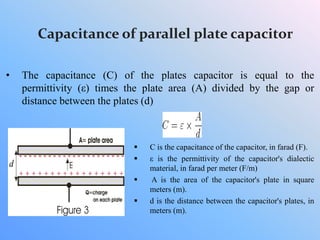
• The capacitance (C) of the plates capacitor is equal to the
permittivity (ε) times the plate area (A) divided by the gap or
distance between the plates (d)
 C is the capacitance of the capacitor, in farad (F).
 ε is the permittivity of the capacitor's dialectic
material, in farad per meter (F/m)
 A is the area of the capacitor's plate in square
meters (m).
 d is the distance between the capacitor's plates, in
meters (m).
How charge stored in capacitor
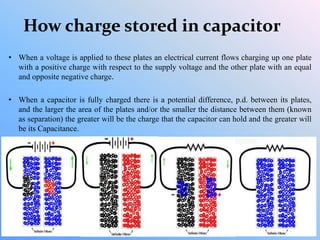
• When a voltage is applied to these plates an electrical current flows charging up one plate
with a positive charge with respect to the supply voltage and the other plate with an equal
and opposite negative charge.
• When a capacitor is fully charged there is a potential difference, p.d. between its plates,
and the larger the area of the plates and/or the smaller the distance between them (known
as separation) the greater will be the charge that the capacitor can hold and the greater will
be its Capacitance.
Factors Affecting Capacitance
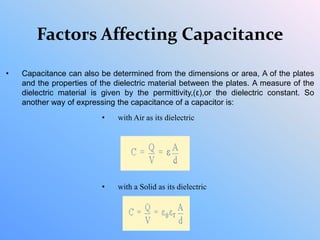
• Capacitance can also be determined from the dimensions or area, A of the plates
and the properties of the dielectric material between the plates. A measure of the
dielectric material is given by the permittivity,(ε),or the dielectric constant. So
another way of expressing the capacitance of a capacitor is:
• with Air as its dielectric
• with a Solid as its dielectric
Factors Affecting Capacitance
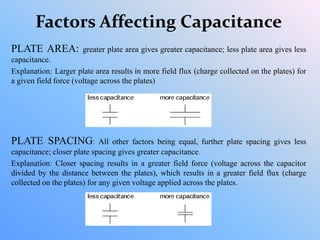
PLATE AREA: greater plate area gives greater capacitance; less plate area gives less
capacitance.
Explanation: Larger plate area results in more field flux (charge collected on the plates) for
a given field force (voltage across the plates)
PLATE SPACING: All other factors being equal, further plate spacing gives less
capacitance; closer plate spacing gives greater capacitance.
Explanation: Closer spacing results in a greater field force (voltage across the capacitor
divided by the distance between the plates), which results in a greater field flux (charge
collected on the plates) for any given voltage applied across the plates.
Factors Affecting Capacitance
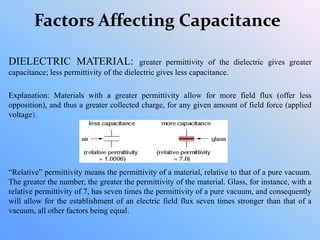
DIELECTRIC MATERIAL: greater permittivity of the dielectric gives greater
capacitance; less permittivity of the dielectric gives less capacitance.
Explanation: Materials with a greater permittivity allow for more field flux (offer less
opposition), and thus a greater collected charge, for any given amount of field force (applied
voltage).
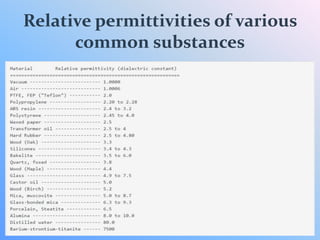
“Relative” permittivity means the permittivity of a material, relative to that of a pure vacuum.
The greater the number, the greater the permittivity of the material. Glass, for instance, with a
relative permittivity of 7, has seven times the permittivity of a pure vacuum, and consequently
will allow for the establishment of an electric field flux seven times stronger than that of a
vacuum, all other factors being equal.
Relative permittivities of various
common substances
Why super capacitor
 Electricity is relatively difficult to store in a hurry.
 Batteries can hold large amounts of power.
 They take hours to charge up.
 Capacitors, on the other hand…
 charge almost instantly but store only tiny
amounts of energy
 Then we need to store and release large amounts of electricity very
quickly, it's quite likely we'll turn to supercapacitors (also known as
ultra capacitors) that combine the best of both worlds.
Super capacitor
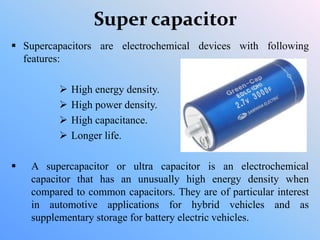
 Supercapacitors are electrochemical devices with following
features:
 High energy density.
 High power density.
 High capacitance.
 Longer life.
 A supercapacitor or ultra capacitor is an electrochemical
capacitor that has an unusually high energy density when
compared to common capacitors. They are of particular interest
in automotive applications for hybrid vehicles and as
supplementary storage for battery electric vehicles.
• They typically store 10 to 100 times more energy per unit volume or
mass than electrolytic capacitors, can accept and deliver charge
much faster than batteries, and tolerate many more charge and
discharge cycles than rechargeable batteries.
• Supercapacitors are used in applications requiring many rapid
charge/discharge cycles rather than long term compact energy
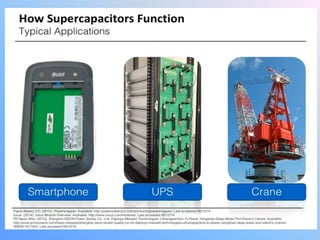
storage: within cars, buses, trains, cranes and elevators, where they
are used for regenerative braking.
• Supercapacitors do not use the conventional solid dielectric of
ordinary capacitors. They use electrostatic double-layer capacitance
or electrochemical pseudo capacitance or a combination of both
instead
history
• In 1950s General Electric Engineers started experimenting
components using porous carbon electrodes for fuel
cells and rechargeable batteries.
• In 1957 H. Becker developed a "Low voltage electrolytic capacitor
with porous carbon electrodes.(He believed that the energy was
stored as a charge in the carbon pores )
• In 1966 researchers at Standard Oil of Ohio (SOHIO) developed
another version of the component as "electrical energy storage
apparatus", while working on experimental fuel cell designs. The
nature of electrochemical energy storage was not described in this
patent.
• SOHIO did not commercialize their invention, licensing the
technology to NEC, who finally marketed the results as
"supercapacitors" in 1971, to provide backup power for computer
memory
Principle, construction and working
Principle:
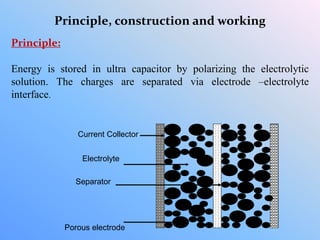
Energy is stored in ultra capacitor by polarizing the electrolytic
solution. The charges are separated via electrode –electrolyte
interface.
Current Collector
Electrolyte
Separator
Porous electrode
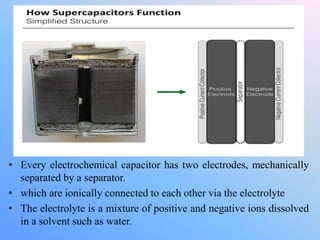
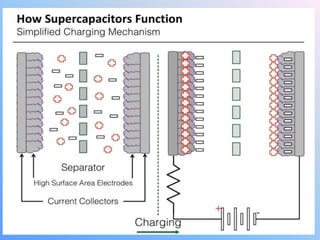
• Every electrochemical capacitor has two electrodes, mechanically
separated by a separator.
• which are ionically connected to each other via the electrolyte
• The electrolyte is a mixture of positive and negative ions dissolved
in a solvent such as water.
• At each of the two electrodes surfaces originates an area in
which the liquid electrolyte contacts the conductive metallic
surface of the electrode.
• This interface forms a common boundary among two different
phases of matter.
• In this interface occurs a very special phenomenon of the
double layer effect.
Working
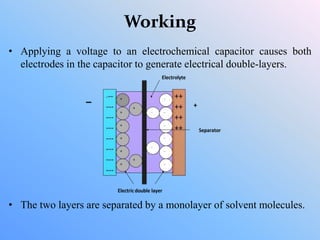
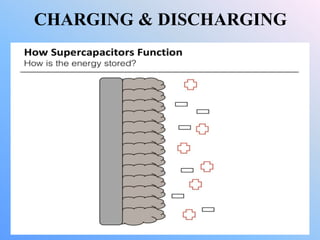
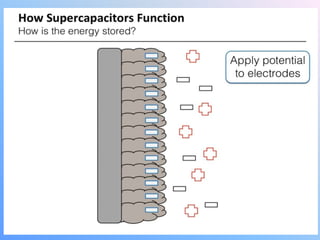
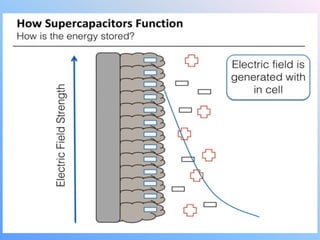
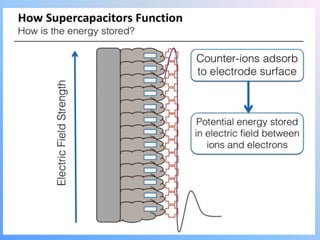
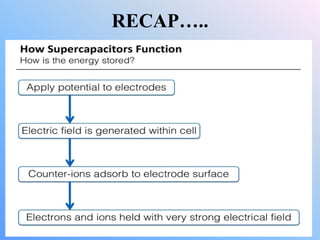
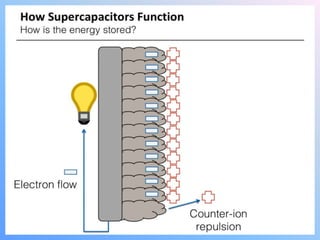
• Applying a voltage to an electrochemical capacitor causes both
electrodes in the capacitor to generate electrical double-layers.
• The two layers are separated by a monolayer of solvent molecules.
• There for there is a formation of a layer of ions the both side of
the plate. This is called ‘double layer’ formation
• For this reason ultracapacitor also known as double layer
capacitor
• The distance between the plates is in the order of angstroms
• According to the formula of capacitance,
Dielectric constant of medium X area of the plate
capacitance: --------------------------------------------------------------
Distance between the plates
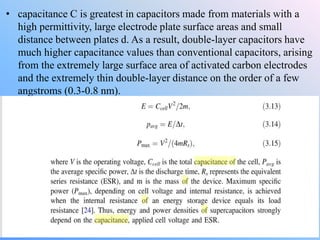
• capacitance C is greatest in capacitors made from materials with a
high permittivity, large electrode plate surface areas and small
distance between plates d. As a result, double-layer capacitors have
much higher capacitance values than conventional capacitors, arising
from the extremely large surface area of activated carbon electrodes
and the extremely thin double-layer distance on the order of a few
angstroms (0.3-0.8 nm).
CHARGING & DISCHARGING
RECAP…..
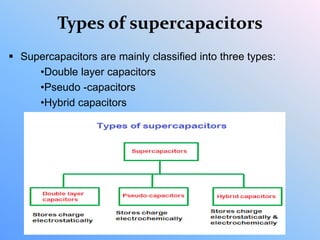
Types of supercapacitors
 Supercapacitors are mainly classified into three types:
•Double layer capacitors
•Pseudo -capacitors
•Hybrid capacitors
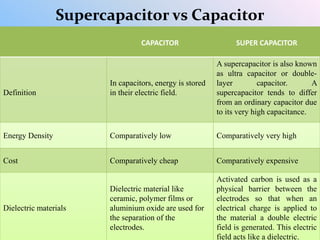
Supercapacitor vs Capacitor
CAPACITOR SUPER CAPACITOR
Definition
In capacitors, energy is stored
in their electric field.
A supercapacitor is also known
as ultra capacitor or double-
layer capacitor. A
supercapacitor tends to differ
from an ordinary capacitor due
to its very high capacitance.
Energy Density Comparatively low Comparatively very high
Cost Comparatively cheap Comparatively expensive
Dielectric materials
Dielectric material like
ceramic, polymer films or
aluminium oxide are used for
the separation of the
electrodes.
Activated carbon is used as a
physical barrier between the
electrodes so that when an
electrical charge is applied to
the material a double electric
field is generated. This electric
field acts like a dielectric.
Advantages
• Less Battery Drain – A
car’s battery does not
deplete due to a capacitor.
• Powerful stereos-
Amplifiers and subwoofers
working mechanism is
based on the capacitors
• Less Damaged equipment –
It helps to avoid the
excessive drawing of
power.
• High energy storage -
Compared to conventional
capacitor technologies, it
possesses orders of
magnitude higher energy
density.
• Low Equivalent Series
Resistance (ESR) -
Compared to batteries, they
have a low internal
resistance. Thus, providing
high power density
capability.
• Fast charge/discharge –
they can be charged and
discharged without
damaging to the parts.
Applications • High Voltage Electrolytic
used in power supplies.
• High Voltage disk ceramic;
small size and capacitance
value, excellent tolerance
characteristics.
• CMOS RAM, IC for clocks
• High current supply for a
short
• Micro computer, RAM
• Power source of toys, LED,
buzzer
• Driving motor
Advantages
• Long life: It works for large number of cycle without wear and aging.
• Rapid charging: it takes a second to charge completely(due to their
low internal resistance)
• Low cost: it is less expensive as compared to electrochemical battery.
• High power storage: It stores huge amount of energy in a small
volume(The supercapacitor consists of large surface area electrodes and
very thin dielectric)
• Faster release:Release the energy much faster than battery
Disadvantages
 Has the highest dielectric absorption of any type of capacitor.
 High self-discharge - the rate is considerably higher than that of an
electrochemical battery.
 Cells hold low voltages - serial connections are needed to obtain
higher voltages. Voltage balancing is required if more than three
capacitors are connected in series.
 Due to rapid and large release of energy (albeit over short times),
EDLC's have the potential to be deadly to humans.
Applications
 Some of the earliest uses were motor start-up capacitors for large
engines in tanks and submarines
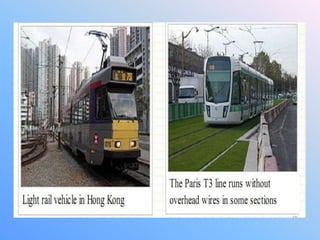
 China is experimenting with a new form of electric bus (capabus)
that runs without powerlines using large on-board EDLCs
 Germany has operated a light-rail vehicle (LRV) that uses EDLCs to
store braking energy.
 EDLCs can be used in PC Cards, flash photography devices in
digital cameras, flashlights, portable media players, and in automated
meter reading, particularly where extremely fast charging is
desirable.
 Used as backup energy source for GPS guided missiles
CONCLUSION
 Supercapacitors may be used where high power or energy storage
is required.
 Supercapacitors can be used widely because of their long life &
short charging time.
 On the other hand it has limitations due to its high cost, self
discharge, packaging problems etc.

SUPER CAPACITOR

  • 1.
  • 2.
    CONTENTS  What iscapacitor  Capacitance  How charge stored in capacitor  Factors affecting capacitance of capacitor  Why super capacitor  What is super capacitor  Comparison between super capacitor and capacitor  Types of super capacitor  Working of super capacitor  Advantages and Disadvantages  Applications  Conclusion
  • 3.
    Capacitor  Capacitor isan electronic component that stores electric charge.  The capacitor is made of 2 close conductors (usually plates) that are separated by a dielectric material (waxed paper, mica, ceramic, plastic).
  • 4.
    • The platesaccumulate electric charge when connected to power source. • One plate accumulates positive charge and the other plate accumulates negative charge.
  • 5.
    Capacitance • The capacitanceis the amount of electric charge that is stored in the capacitor at voltage of 1 Volt. • The capacitance is measured in units of Farad (F) • The capacitance (C) of the capacitor is equal to the electric charge (Q) divided by the voltage (V) C=Q/V  C is the capacitance in farad (F)  Q is the electric charge in coulombs (C), that is stored on the capacitor  V is the voltage between the capacitor's plates in volts (V)
  • 6.
    Capacitance of parallelplate capacitor • The capacitance (C) of the plates capacitor is equal to the permittivity (ε) times the plate area (A) divided by the gap or distance between the plates (d)  C is the capacitance of the capacitor, in farad (F).  ε is the permittivity of the capacitor's dialectic material, in farad per meter (F/m)  A is the area of the capacitor's plate in square meters (m).  d is the distance between the capacitor's plates, in meters (m).
  • 7.
    How charge storedin capacitor • When a voltage is applied to these plates an electrical current flows charging up one plate with a positive charge with respect to the supply voltage and the other plate with an equal and opposite negative charge. • When a capacitor is fully charged there is a potential difference, p.d. between its plates, and the larger the area of the plates and/or the smaller the distance between them (known as separation) the greater will be the charge that the capacitor can hold and the greater will be its Capacitance.
  • 8.
    Factors Affecting Capacitance •Capacitance can also be determined from the dimensions or area, A of the plates and the properties of the dielectric material between the plates. A measure of the dielectric material is given by the permittivity,(ε),or the dielectric constant. So another way of expressing the capacitance of a capacitor is: • with Air as its dielectric • with a Solid as its dielectric
  • 9.
    Factors Affecting Capacitance PLATEAREA: greater plate area gives greater capacitance; less plate area gives less capacitance. Explanation: Larger plate area results in more field flux (charge collected on the plates) for a given field force (voltage across the plates) PLATE SPACING: All other factors being equal, further plate spacing gives less capacitance; closer plate spacing gives greater capacitance. Explanation: Closer spacing results in a greater field force (voltage across the capacitor divided by the distance between the plates), which results in a greater field flux (charge collected on the plates) for any given voltage applied across the plates.
  • 10.
    Factors Affecting Capacitance DIELECTRICMATERIAL: greater permittivity of the dielectric gives greater capacitance; less permittivity of the dielectric gives less capacitance. Explanation: Materials with a greater permittivity allow for more field flux (offer less opposition), and thus a greater collected charge, for any given amount of field force (applied voltage). “Relative” permittivity means the permittivity of a material, relative to that of a pure vacuum. The greater the number, the greater the permittivity of the material. Glass, for instance, with a relative permittivity of 7, has seven times the permittivity of a pure vacuum, and consequently will allow for the establishment of an electric field flux seven times stronger than that of a vacuum, all other factors being equal.
  • 11.
    Relative permittivities ofvarious common substances
  • 12.
    Why super capacitor Electricity is relatively difficult to store in a hurry.  Batteries can hold large amounts of power.  They take hours to charge up.  Capacitors, on the other hand…  charge almost instantly but store only tiny amounts of energy  Then we need to store and release large amounts of electricity very quickly, it's quite likely we'll turn to supercapacitors (also known as ultra capacitors) that combine the best of both worlds.
  • 13.
    Super capacitor  Supercapacitorsare electrochemical devices with following features:  High energy density.  High power density.  High capacitance.  Longer life.  A supercapacitor or ultra capacitor is an electrochemical capacitor that has an unusually high energy density when compared to common capacitors. They are of particular interest in automotive applications for hybrid vehicles and as supplementary storage for battery electric vehicles.
  • 14.
    • They typicallystore 10 to 100 times more energy per unit volume or mass than electrolytic capacitors, can accept and deliver charge much faster than batteries, and tolerate many more charge and discharge cycles than rechargeable batteries. • Supercapacitors are used in applications requiring many rapid charge/discharge cycles rather than long term compact energy storage: within cars, buses, trains, cranes and elevators, where they are used for regenerative braking. • Supercapacitors do not use the conventional solid dielectric of ordinary capacitors. They use electrostatic double-layer capacitance or electrochemical pseudo capacitance or a combination of both instead
  • 15.
    history • In 1950sGeneral Electric Engineers started experimenting components using porous carbon electrodes for fuel cells and rechargeable batteries. • In 1957 H. Becker developed a "Low voltage electrolytic capacitor with porous carbon electrodes.(He believed that the energy was stored as a charge in the carbon pores ) • In 1966 researchers at Standard Oil of Ohio (SOHIO) developed another version of the component as "electrical energy storage apparatus", while working on experimental fuel cell designs. The nature of electrochemical energy storage was not described in this patent.
  • 16.
    • SOHIO didnot commercialize their invention, licensing the technology to NEC, who finally marketed the results as "supercapacitors" in 1971, to provide backup power for computer memory
  • 17.
    Principle, construction andworking Principle: Energy is stored in ultra capacitor by polarizing the electrolytic solution. The charges are separated via electrode –electrolyte interface. Current Collector Electrolyte Separator Porous electrode
  • 18.
    • Every electrochemicalcapacitor has two electrodes, mechanically separated by a separator. • which are ionically connected to each other via the electrolyte • The electrolyte is a mixture of positive and negative ions dissolved in a solvent such as water.
  • 19.
    • At eachof the two electrodes surfaces originates an area in which the liquid electrolyte contacts the conductive metallic surface of the electrode. • This interface forms a common boundary among two different phases of matter. • In this interface occurs a very special phenomenon of the double layer effect.
  • 20.
    Working • Applying avoltage to an electrochemical capacitor causes both electrodes in the capacitor to generate electrical double-layers. • The two layers are separated by a monolayer of solvent molecules.
  • 22.
    • There forthere is a formation of a layer of ions the both side of the plate. This is called ‘double layer’ formation • For this reason ultracapacitor also known as double layer capacitor • The distance between the plates is in the order of angstroms • According to the formula of capacitance, Dielectric constant of medium X area of the plate capacitance: -------------------------------------------------------------- Distance between the plates
  • 23.
    • capacitance Cis greatest in capacitors made from materials with a high permittivity, large electrode plate surface areas and small distance between plates d. As a result, double-layer capacitors have much higher capacitance values than conventional capacitors, arising from the extremely large surface area of activated carbon electrodes and the extremely thin double-layer distance on the order of a few angstroms (0.3-0.8 nm).
  • 24.
  • 28.
  • 30.
    Types of supercapacitors Supercapacitors are mainly classified into three types: •Double layer capacitors •Pseudo -capacitors •Hybrid capacitors
  • 31.
    Supercapacitor vs Capacitor CAPACITORSUPER CAPACITOR Definition In capacitors, energy is stored in their electric field. A supercapacitor is also known as ultra capacitor or double- layer capacitor. A supercapacitor tends to differ from an ordinary capacitor due to its very high capacitance. Energy Density Comparatively low Comparatively very high Cost Comparatively cheap Comparatively expensive Dielectric materials Dielectric material like ceramic, polymer films or aluminium oxide are used for the separation of the electrodes. Activated carbon is used as a physical barrier between the electrodes so that when an electrical charge is applied to the material a double electric field is generated. This electric field acts like a dielectric.
  • 32.
    Advantages • Less BatteryDrain – A car’s battery does not deplete due to a capacitor. • Powerful stereos- Amplifiers and subwoofers working mechanism is based on the capacitors • Less Damaged equipment – It helps to avoid the excessive drawing of power. • High energy storage - Compared to conventional capacitor technologies, it possesses orders of magnitude higher energy density. • Low Equivalent Series Resistance (ESR) - Compared to batteries, they have a low internal resistance. Thus, providing high power density capability. • Fast charge/discharge – they can be charged and discharged without damaging to the parts. Applications • High Voltage Electrolytic used in power supplies. • High Voltage disk ceramic; small size and capacitance value, excellent tolerance characteristics. • CMOS RAM, IC for clocks • High current supply for a short • Micro computer, RAM • Power source of toys, LED, buzzer • Driving motor
  • 33.
    Advantages • Long life:It works for large number of cycle without wear and aging. • Rapid charging: it takes a second to charge completely(due to their low internal resistance) • Low cost: it is less expensive as compared to electrochemical battery. • High power storage: It stores huge amount of energy in a small volume(The supercapacitor consists of large surface area electrodes and very thin dielectric) • Faster release:Release the energy much faster than battery
  • 34.
    Disadvantages  Has thehighest dielectric absorption of any type of capacitor.  High self-discharge - the rate is considerably higher than that of an electrochemical battery.  Cells hold low voltages - serial connections are needed to obtain higher voltages. Voltage balancing is required if more than three capacitors are connected in series.  Due to rapid and large release of energy (albeit over short times), EDLC's have the potential to be deadly to humans.
  • 35.
    Applications  Some ofthe earliest uses were motor start-up capacitors for large engines in tanks and submarines  China is experimenting with a new form of electric bus (capabus) that runs without powerlines using large on-board EDLCs  Germany has operated a light-rail vehicle (LRV) that uses EDLCs to store braking energy.  EDLCs can be used in PC Cards, flash photography devices in digital cameras, flashlights, portable media players, and in automated meter reading, particularly where extremely fast charging is desirable.  Used as backup energy source for GPS guided missiles
  • 38.
    CONCLUSION  Supercapacitors maybe used where high power or energy storage is required.  Supercapacitors can be used widely because of their long life & short charging time.  On the other hand it has limitations due to its high cost, self discharge, packaging problems etc.