5X800 MW DAMERACHERLANALGONDATPS
BHARAT HEAVY ELECTRICALS LIMITED.
HYDROGEN GENERATION PLANT
One (1) no. Unipolar Bipolar type Hydrogen generation plant of 30 NM3/hr capacity with two
streams each of 15 NM3/hr capacity has been envisaged to provide make–up hydrogen for turbo
generator cooling. Three (3) no’s hydrogen compressors each of capacity 18.75 NM3/hr (min)
shall be provided for compressing the hydrogen gas up to 150 kg/cm2 (g). The hydrogen
generated shall be filled in cylinders. The major scope of supply consists of:
Principle of working:
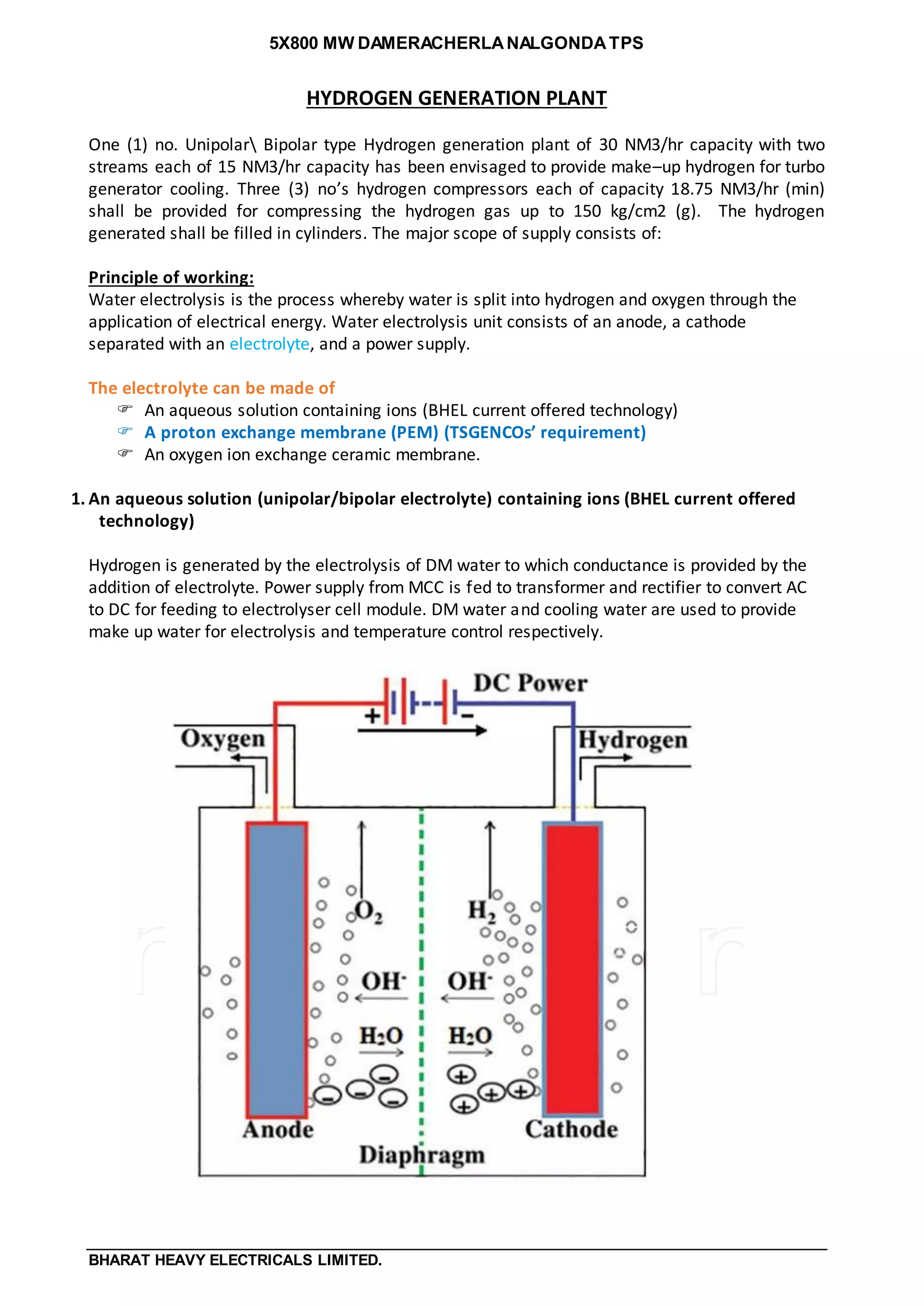
Water electrolysis is the process whereby water is split into hydrogen and oxygen through the
application of electrical energy. Water electrolysis unit consists of an anode, a cathode
separated with an electrolyte, and a power supply.
The electrolyte can be made of
 An aqueous solution containing ions (BHEL current offered technology)
 A proton exchange membrane (PEM) (TSGENCOs’ requirement)
 An oxygen ion exchange ceramic membrane.
1. An aqueous solution (unipolar/bipolar electrolyte) containing ions (BHEL current offered
technology)
Hydrogen is generated by the electrolysis of DM water to which conductance is provided by the
addition of electrolyte. Power supply from MCC is fed to transformer and rectifier to convert AC
to DC for feeding to electrolyser cell module. DM water and cooling water are used to provide
make up water for electrolysis and temperature control respectively.
5X800 MW DAMERACHERLANALGONDATPS
BHARAT HEAVY ELECTRICALS LIMITED.
Oxygen gas produced is separated and vented to atmosphere. Hydrogen gas is compressed,
purified in filters (catalytic purifier) and passed through drier to meet the hydrogen purity
requirement of 99.9 %. The hydrogen gas after filtration and purification is then passed on to a
cylinder-filling manifold, arranged in dual sections to permit connection and removal of cylinder
without interruption of filling.
2. A proton exchange membrane (PEM) (TSGENCOs’ requirement)
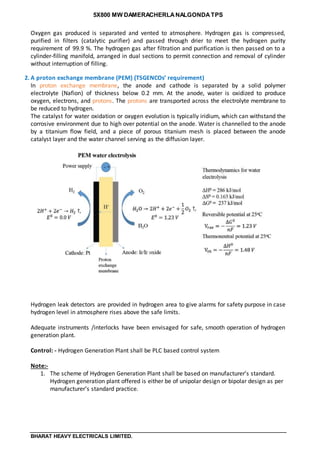
In proton exchange membrane, the anode and cathode is separated by a solid polymer
electrolyte (Nafion) of thickness below 0.2 mm. At the anode, water is oxidized to produce
oxygen, electrons, and protons. The protons are transported across the electrolyte membrane to
be reduced to hydrogen.
The catalyst for water oxidation or oxygen evolution is typically iridium, which can withstand the
corrosive environment due to high over potential on the anode. Water is channelled to the anode
by a titanium flow field, and a piece of porous titanium mesh is placed between the anode
catalyst layer and the water channel serving as the diffusion layer.
Hydrogen leak detectors are provided in hydrogen area to give alarms for safety purpose in case
hydrogen level in atmosphere rises above the safe limits.
Adequate instruments /interlocks have been envisaged for safe, smooth operation of hydrogen
generation plant.
Control: - Hydrogen Generation Plant shall be PLC based control system
Note:-
1. The scheme of Hydrogen Generation Plant shall be based on manufacturer’s standard.
Hydrogen generation plant offered is either be of unipolar design or bipolar design as per
manufacturer’s standard practice.

Hydrogen generation plant

  • 1.
    5X800 MW DAMERACHERLANALGONDATPS BHARATHEAVY ELECTRICALS LIMITED. HYDROGEN GENERATION PLANT One (1) no. Unipolar Bipolar type Hydrogen generation plant of 30 NM3/hr capacity with two streams each of 15 NM3/hr capacity has been envisaged to provide make–up hydrogen for turbo generator cooling. Three (3) no’s hydrogen compressors each of capacity 18.75 NM3/hr (min) shall be provided for compressing the hydrogen gas up to 150 kg/cm2 (g). The hydrogen generated shall be filled in cylinders. The major scope of supply consists of: Principle of working: Water electrolysis is the process whereby water is split into hydrogen and oxygen through the application of electrical energy. Water electrolysis unit consists of an anode, a cathode separated with an electrolyte, and a power supply. The electrolyte can be made of  An aqueous solution containing ions (BHEL current offered technology)  A proton exchange membrane (PEM) (TSGENCOs’ requirement)  An oxygen ion exchange ceramic membrane. 1. An aqueous solution (unipolar/bipolar electrolyte) containing ions (BHEL current offered technology) Hydrogen is generated by the electrolysis of DM water to which conductance is provided by the addition of electrolyte. Power supply from MCC is fed to transformer and rectifier to convert AC to DC for feeding to electrolyser cell module. DM water and cooling water are used to provide make up water for electrolysis and temperature control respectively.
  • 2.
    5X800 MW DAMERACHERLANALGONDATPS BHARATHEAVY ELECTRICALS LIMITED. Oxygen gas produced is separated and vented to atmosphere. Hydrogen gas is compressed, purified in filters (catalytic purifier) and passed through drier to meet the hydrogen purity requirement of 99.9 %. The hydrogen gas after filtration and purification is then passed on to a cylinder-filling manifold, arranged in dual sections to permit connection and removal of cylinder without interruption of filling. 2. A proton exchange membrane (PEM) (TSGENCOs’ requirement) In proton exchange membrane, the anode and cathode is separated by a solid polymer electrolyte (Nafion) of thickness below 0.2 mm. At the anode, water is oxidized to produce oxygen, electrons, and protons. The protons are transported across the electrolyte membrane to be reduced to hydrogen. The catalyst for water oxidation or oxygen evolution is typically iridium, which can withstand the corrosive environment due to high over potential on the anode. Water is channelled to the anode by a titanium flow field, and a piece of porous titanium mesh is placed between the anode catalyst layer and the water channel serving as the diffusion layer. Hydrogen leak detectors are provided in hydrogen area to give alarms for safety purpose in case hydrogen level in atmosphere rises above the safe limits. Adequate instruments /interlocks have been envisaged for safe, smooth operation of hydrogen generation plant. Control: - Hydrogen Generation Plant shall be PLC based control system Note:- 1. The scheme of Hydrogen Generation Plant shall be based on manufacturer’s standard. Hydrogen generation plant offered is either be of unipolar design or bipolar design as per manufacturer’s standard practice.