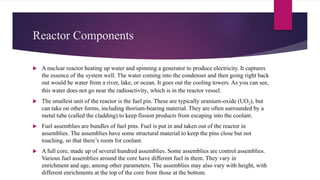
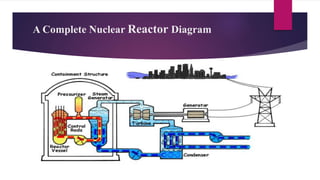
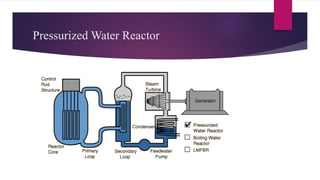
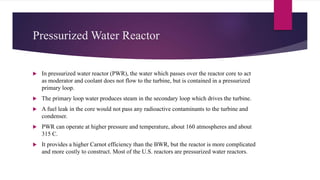
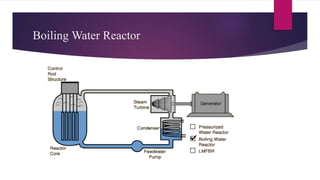
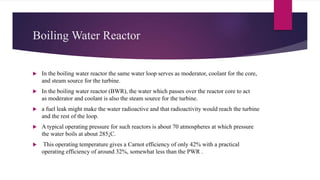
A nuclear reactor contains and controls sustained nuclear chain reactions to generate electricity, power naval vessels, produce medical isotopes, and conduct research. The reactor core contains fuel rods that split atoms when hit by neutrons, releasing energy as heat. This heat is transferred by coolant like water to power turbines and generators. Key reactor components include fuel pins bundled in fuel assemblies, control assemblies, and the reactor vessel. Common reactor types are pressurized water reactors, where coolant is contained in a pressurized primary loop, and boiling water reactors, where the same water acts as coolant and steam source. Nuclear reactors have important applications in power generation, nuclear weapons reduction, scientific research, and medicine.



![industry 4.0-Revolution-PowerPoint-Templates [Autosaved].pptx](https://cdn.slidesharecdn.com/ss_thumbnails/industry4-240910061852-d49188b5-thumbnail.jpg?width=640&height=640&fit=bounds)


