SUBMITTED BY
MEGHA AGARWAL
K11566
EE
5TH SEM
 NUCLEAR PLANTS
 INTRODUCTION
 RAW MATERIALS
 PLASMA
 WHY FUSION RESEARCH
 POWER PRODUCTION
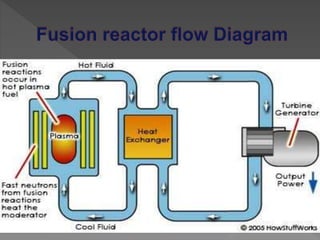
 FUSION REACTOR FLOW DIAGRAM
 WORKING OF FUSION REACTOR
 FUSION IN OUR WORLD
 CONSIDERATIONS
 SAFETY AND THE ENVIRONMENT
 ADVANTAGES
 DISADVANTAGES
 CONCLUSION
 Electricity was generated for the first time ever
by a nuclear reactor on December 20, 1951 at
the EBR-I experimental station near Arco,
Idaho in the United States.
 On June 27, 1954, the world's first nuclear
power plant to generate electricity for a power
grid started operations at Obninsk, USSR.
 The world's first commercial scale power
station, Calder Hall in England opened
in October 17, 1956.
 Nuclear fusion is the process of making a single
heavy nucleus from two lighter nuclei. This process
is called a nuclear reaction. It releases a large
amount of energy. The nucleus made by fusion is
heavier than either of the starting nuclei. However,
it is not as heavy as the combination of the
original mass of the starting nuclei. This lost mass
is changed into lots of energy. This is shown
in Einstein's famous E=mc2 equation.
 Fusion happens in the middle of stars, like the Sun.
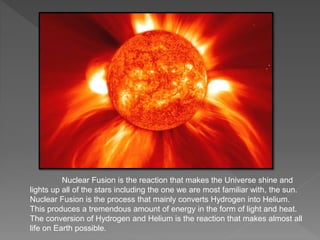
Nuclear Fusion is the reaction that makes the Universe shine and
lights up all of the stars including the one we are most familiar with, the sun.
Nuclear Fusion is the process that mainly converts Hydrogen into Helium.
This produces a tremendous amount of energy in the form of light and heat.
The conversion of Hydrogen and Helium is the reaction that makes almost all
life on Earth possible.
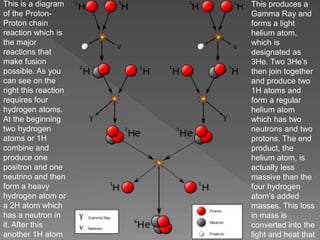
This is a diagram
of the Proton-
Proton chain
reaction which is
the major
reactions that
make fusion
possible. As you
can see on the
right this reaction
requires four
hydrogen atoms.
At the beginning
two hydrogen
atoms or 1H
combine and
produce one
positron and one
neutrino and then
form a heavy
hydrogen atom or
a 2H atom which
has a neutron in
it. After this
another 1H atom
This produces a
Gamma Ray and
forms a light
helium atom,
which is
designated as
3He. Two 3He’s
then join together
and produce two
1H atoms and
form a regular
helium atom
which has two
neutrons and two
protons. The end
product, the
helium atom, is
actually less
massive than the
four hydrogen
atom’s added
masses. This loss
in mass is
converted into the
light and heat that
 TRITIUM:
Tritium is an isotope of hydrogen, which has two neutrons. It
does not occur naturally. It can however be easily produced
form the neutron bombardment of lithium, which is naturally
abundant. Currently accessible reserves of lithium could
supply all the world’s energy demands for more than 1000
years.
 DEUTERIUM:
Deuterium is an isotope of hydrogen, which has one neutron.
Its abundance is approximately 33 g of deuterium in every
cubic meter of water. As water is available in plenty, we have
a whole lot of deuterium.
 What is Plasma?
 Plasma Confinement:
 Confinement refers to all the conditions
necessary to keep a plasma dense and hot
long enough to undergo fusion.
 Some general principles; Equilibrium,
Stability and Conduction.
Why fusion research?
 Ever increasing energy demand.
 Limited fossil fuels.
 Global climate change.
 Limited scope of renewable energy.
 High energy output by fusion.
Three methods have been proposed so far
on how to produce power using nuclear
fusion:
 Steam Turbines
 Direct Conversion
 The fusion reactor will heat a stream of deuterium and
tritium fuel to form high-temperature plasma. It will
squeeze the plasma so that fusion can take place.
 The lithium blankets outside the plasma reaction chamber
will absorb high-energy neutrons from the fusion reaction
to make more tritium fuel. The blankets will also get heated
by the neutrons.
 The heat will be transferred by a water-cooling loop to a
heat exchanger to make steam.
 The steam will drive electrical turbines to produce
electricity.
 The steam will be condensed back into water to absorb
more heat from the reactor in the heat exchanger
Fusion in Our World
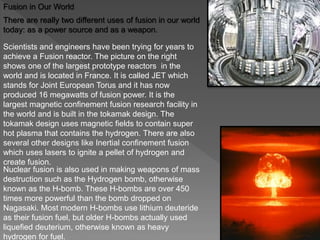
There are really two different uses of fusion in our world
today: as a power source and as a weapon.
Scientists and engineers have been trying for years to
achieve a Fusion reactor. The picture on the right
shows one of the largest prototype reactors in the
world and is located in France. It is called JET which
stands for Joint European Torus and it has now
produced 16 megawatts of fusion power. It is the
largest magnetic confinement fusion research facility in
the world and is built in the tokamak design. The
tokamak design uses magnetic fields to contain super
hot plasma that contains the hydrogen. There are also
several other designs like Inertial confinement fusion
which uses lasers to ignite a pellet of hydrogen and
create fusion.
Nuclear fusion is also used in making weapons of mass
destruction such as the Hydrogen bomb, otherwise
known as the H-bomb. These H-bombs are over 450
times more powerful than the bomb dropped on
Nagasaki. Most modern H-bombs use lithium deuteride
as their fusion fuel, but older H-bombs actually used
liquefied deuterium, otherwise known as heavy
hydrogen for fuel.
Any power plant using hot plasma, is going to have
plasma facing walls. In even the simplest plasma
approaches, the material will get blasted with matter and
energy. This leads to a minimum list of considerations,
including dealing with:
 A heating and cooling cycle, up to a 10 MW/m² thermal
load.
 Neutron radiation, which over time leads to neutron
activation.
 High energy ions leaving at tens to hundreds of electron
volts.
 Alpha particles leaving at millions of electron volts.
 Electrons leaving at high energy.
 Light radiation (IR, visible, UV, X-ray).
 Accident Potential: There is no possibility of a
catastrophic accident in a fusion reactor resulting in
major release of radioactivity to the environment or
injury to non-staff, unlike modern fission reactors.
 Effluents during normal: The natural product of the
fusion reaction is a small amount of helium, which
is completely harmless to life.
 Waste management: There is very lesser amount of
radioactivity produced when compared to a fission
reaction and that too burns off within a very small
time.
 As a sustainable energy source: It is a very
sustainable source of energy as the reserves of
deuterium are supposed to last for a very long
time along with lithium, which is also supposed
to last for about 3000 years.
 Reliable Power: Fusion power plants should
provide a base load supply of large amounts of
electricity, at costs that are estimated to be
broadly similar to other energy sources.
 Environment friendly as no greenhouse
gases are produced.
 Virtually limitless fuel is available as the
stocks are supposed to last for a really long
time.
 No chain reaction. So no chances of major
accidents as the reactions can be stopped
anytime by just cutting off the supply of the
fuel which is also quite low.
 The cost of the fuel is very low.
 Can be used for interstellar space where
solar energy is not available.
 Some problems like fresh water shortages
can also be solved because they exist
mainly because of the power shortages.
 Unproven till now at a commercial scale.
 Initial experiments have been very costly.
 The energy required to initiate is greater than
what’s generated.
 The material for setups has to be worked
upon so that it can take the excessive
temperatures produced during the process.
 This initial investment will be worthwhile if
fusion will turn out to be an economical way
to generate power.
 Having negligible negative impact to the
nature, fusion promises to be the answer to
our energy crisis.
Thank you

NUCLEAR FUSION

  • 1.
  • 2.
     NUCLEAR PLANTS INTRODUCTION  RAW MATERIALS  PLASMA  WHY FUSION RESEARCH  POWER PRODUCTION  FUSION REACTOR FLOW DIAGRAM  WORKING OF FUSION REACTOR  FUSION IN OUR WORLD  CONSIDERATIONS  SAFETY AND THE ENVIRONMENT  ADVANTAGES  DISADVANTAGES  CONCLUSION
  • 3.
     Electricity wasgenerated for the first time ever by a nuclear reactor on December 20, 1951 at the EBR-I experimental station near Arco, Idaho in the United States.  On June 27, 1954, the world's first nuclear power plant to generate electricity for a power grid started operations at Obninsk, USSR.  The world's first commercial scale power station, Calder Hall in England opened in October 17, 1956.
  • 4.
     Nuclear fusionis the process of making a single heavy nucleus from two lighter nuclei. This process is called a nuclear reaction. It releases a large amount of energy. The nucleus made by fusion is heavier than either of the starting nuclei. However, it is not as heavy as the combination of the original mass of the starting nuclei. This lost mass is changed into lots of energy. This is shown in Einstein's famous E=mc2 equation.  Fusion happens in the middle of stars, like the Sun.
  • 5.
    Nuclear Fusion isthe reaction that makes the Universe shine and lights up all of the stars including the one we are most familiar with, the sun. Nuclear Fusion is the process that mainly converts Hydrogen into Helium. This produces a tremendous amount of energy in the form of light and heat. The conversion of Hydrogen and Helium is the reaction that makes almost all life on Earth possible.
  • 6.
    This is adiagram of the Proton- Proton chain reaction which is the major reactions that make fusion possible. As you can see on the right this reaction requires four hydrogen atoms. At the beginning two hydrogen atoms or 1H combine and produce one positron and one neutrino and then form a heavy hydrogen atom or a 2H atom which has a neutron in it. After this another 1H atom This produces a Gamma Ray and forms a light helium atom, which is designated as 3He. Two 3He’s then join together and produce two 1H atoms and form a regular helium atom which has two neutrons and two protons. The end product, the helium atom, is actually less massive than the four hydrogen atom’s added masses. This loss in mass is converted into the light and heat that
  • 7.
     TRITIUM: Tritium isan isotope of hydrogen, which has two neutrons. It does not occur naturally. It can however be easily produced form the neutron bombardment of lithium, which is naturally abundant. Currently accessible reserves of lithium could supply all the world’s energy demands for more than 1000 years.  DEUTERIUM: Deuterium is an isotope of hydrogen, which has one neutron. Its abundance is approximately 33 g of deuterium in every cubic meter of water. As water is available in plenty, we have a whole lot of deuterium.
  • 8.
     What isPlasma?  Plasma Confinement:  Confinement refers to all the conditions necessary to keep a plasma dense and hot long enough to undergo fusion.  Some general principles; Equilibrium, Stability and Conduction.
  • 9.
    Why fusion research? Ever increasing energy demand.  Limited fossil fuels.  Global climate change.  Limited scope of renewable energy.  High energy output by fusion.
  • 10.
    Three methods havebeen proposed so far on how to produce power using nuclear fusion:  Steam Turbines  Direct Conversion
  • 12.
     The fusionreactor will heat a stream of deuterium and tritium fuel to form high-temperature plasma. It will squeeze the plasma so that fusion can take place.  The lithium blankets outside the plasma reaction chamber will absorb high-energy neutrons from the fusion reaction to make more tritium fuel. The blankets will also get heated by the neutrons.  The heat will be transferred by a water-cooling loop to a heat exchanger to make steam.  The steam will drive electrical turbines to produce electricity.  The steam will be condensed back into water to absorb more heat from the reactor in the heat exchanger
  • 13.
    Fusion in OurWorld There are really two different uses of fusion in our world today: as a power source and as a weapon. Scientists and engineers have been trying for years to achieve a Fusion reactor. The picture on the right shows one of the largest prototype reactors in the world and is located in France. It is called JET which stands for Joint European Torus and it has now produced 16 megawatts of fusion power. It is the largest magnetic confinement fusion research facility in the world and is built in the tokamak design. The tokamak design uses magnetic fields to contain super hot plasma that contains the hydrogen. There are also several other designs like Inertial confinement fusion which uses lasers to ignite a pellet of hydrogen and create fusion. Nuclear fusion is also used in making weapons of mass destruction such as the Hydrogen bomb, otherwise known as the H-bomb. These H-bombs are over 450 times more powerful than the bomb dropped on Nagasaki. Most modern H-bombs use lithium deuteride as their fusion fuel, but older H-bombs actually used liquefied deuterium, otherwise known as heavy hydrogen for fuel.
  • 14.
    Any power plantusing hot plasma, is going to have plasma facing walls. In even the simplest plasma approaches, the material will get blasted with matter and energy. This leads to a minimum list of considerations, including dealing with:  A heating and cooling cycle, up to a 10 MW/m² thermal load.  Neutron radiation, which over time leads to neutron activation.  High energy ions leaving at tens to hundreds of electron volts.  Alpha particles leaving at millions of electron volts.  Electrons leaving at high energy.  Light radiation (IR, visible, UV, X-ray).
  • 15.
     Accident Potential:There is no possibility of a catastrophic accident in a fusion reactor resulting in major release of radioactivity to the environment or injury to non-staff, unlike modern fission reactors.  Effluents during normal: The natural product of the fusion reaction is a small amount of helium, which is completely harmless to life.  Waste management: There is very lesser amount of radioactivity produced when compared to a fission reaction and that too burns off within a very small time.
  • 16.
     As asustainable energy source: It is a very sustainable source of energy as the reserves of deuterium are supposed to last for a very long time along with lithium, which is also supposed to last for about 3000 years.  Reliable Power: Fusion power plants should provide a base load supply of large amounts of electricity, at costs that are estimated to be broadly similar to other energy sources.
  • 17.
     Environment friendlyas no greenhouse gases are produced.  Virtually limitless fuel is available as the stocks are supposed to last for a really long time.  No chain reaction. So no chances of major accidents as the reactions can be stopped anytime by just cutting off the supply of the fuel which is also quite low.
  • 18.
     The costof the fuel is very low.  Can be used for interstellar space where solar energy is not available.  Some problems like fresh water shortages can also be solved because they exist mainly because of the power shortages.
  • 19.
     Unproven tillnow at a commercial scale.  Initial experiments have been very costly.  The energy required to initiate is greater than what’s generated.  The material for setups has to be worked upon so that it can take the excessive temperatures produced during the process.
  • 20.
     This initialinvestment will be worthwhile if fusion will turn out to be an economical way to generate power.  Having negligible negative impact to the nature, fusion promises to be the answer to our energy crisis.
  • 21.