HEAT EXCHANGERS
CONTENTS:
 INTRODUCTION
 TYPES
 ADVANTAGES
 DISADVANTAGES
 APPLICATIONS
 REFERENCE
INTRODUCTION
Heat exchanger is a device which is used for transferring the
heat from one fluid to another through the separating wall.
The heat exchanger is mainly used in process industries.
In a chemical process is a heat balance must be calculated
through the addition or removal of heat by exchangers with
hot and cold process streams.
TYPES
 There are different types of heat exchangers:
 Shell and tube heat exchanger
 Double pipe heat exchanger
 Plate type heat exchanger
 Finned tube heat exchanger
SHELL AND TUBE HEAT EXCHANGE
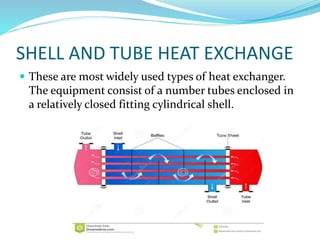
 These are most widely used types of heat exchanger.
The equipment consist of a number tubes enclosed in
a relatively closed fitting cylindrical shell.
ADVANTAGES DISADVANTAGES
 Pressure drop across a
tube cooler is less.
 Less expensive as
compared to plate type
cooler .
 Capacity of tube cannot
be increased .
 Requires more space in
comparison to plate
cooler .
DOUBLE PIPE HEAT EXCHANGER
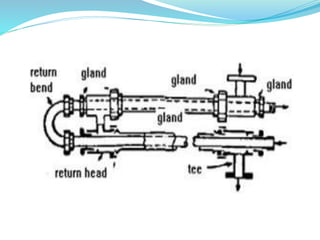
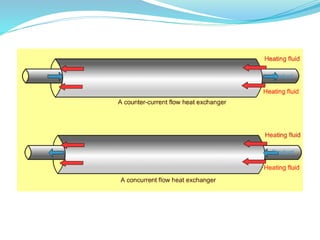
 This is used particularly when the flow rates are low
and when the temperature range is relatively high. In
this type one fluid flows inside a pipe while a second
fluid either co current or countercurrent in the
annulus a large pipe and out side of the inner pipe
carrying the fluid. The components of the heat unit
consist of concentric pipes connecting tees and return
bands.
ADVANTAGES DISADVANTAGES
 Very simple to construct
& very easy of operation.
 U-type or hair pin
construction handle
differential thermal
expansions.
 The use of two single
flow areas leads to
relatively low flow rates
and moderate
temperature diff.
 can’t be used in handling
dirty fluids.
PLATE TYPE HEAT EXCHANGER
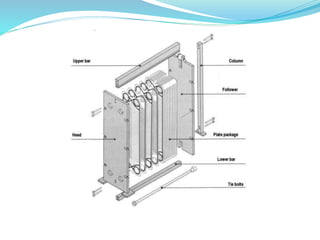
 This is constructed by a series of corrugated parallel
plates held firmly together between frames. The heat
transfer surfaces consists of adjust place. Gaskets
connected to the plates help to form separate channels
for the two fluids.
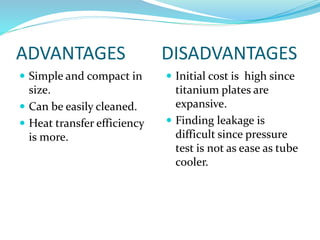
ADVANTAGES DISADVANTAGES
 Simple and compact in
size.
 Can be easily cleaned.
 Heat transfer efficiency
is more.
 Initial cost is high since
titanium plates are
expansive.
 Finding leakage is
difficult since pressure
test is not as ease as tube
cooler.
FINNED TUBE HEAT EXCHANGER
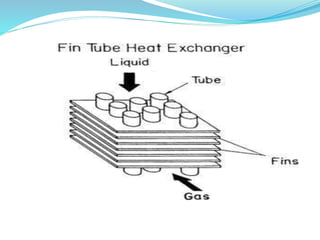
 In case of heating air or gas where the heat transfer
coefficient are low the surface area can be increased by
the used of fines either in transverse or longitudinal
form. Transverse finned tubes are used for cooling
process streams by air , longitudinal finned tube units
are used at high temperature and high pressure service
where heat transfer rates are low.
ADVANTAGES DISADVANTAGES
 Use to handle low heat
transfer coefficient fluids
 Used for cooling and
heating of gasses.
 Slurry fluid can not be
handled.
 High pressure drop.
 Deposition of particle at
fin corner.
APPLICATIONS
 Chemical and petrochemical
 Food industry
 Pharmaceutical industry
 Fertilizer industry
 Textile industry
 Power production
 Waste heat recovery
REFERENCE
 Dr. D.S. Kumar publisher S.K. KATARIA & SONS
 M.V. Joshi process equipment Design ( Fourth Edition)
 D.Q .Kern
Heat exchangers

Heat exchangers

  • 1.
  • 2.
    CONTENTS:  INTRODUCTION  TYPES ADVANTAGES  DISADVANTAGES  APPLICATIONS  REFERENCE
  • 3.
    INTRODUCTION Heat exchanger isa device which is used for transferring the heat from one fluid to another through the separating wall. The heat exchanger is mainly used in process industries. In a chemical process is a heat balance must be calculated through the addition or removal of heat by exchangers with hot and cold process streams.
  • 4.
    TYPES  There aredifferent types of heat exchangers:  Shell and tube heat exchanger  Double pipe heat exchanger  Plate type heat exchanger  Finned tube heat exchanger
  • 5.
    SHELL AND TUBEHEAT EXCHANGE  These are most widely used types of heat exchanger. The equipment consist of a number tubes enclosed in a relatively closed fitting cylindrical shell.
  • 6.
    ADVANTAGES DISADVANTAGES  Pressuredrop across a tube cooler is less.  Less expensive as compared to plate type cooler .  Capacity of tube cannot be increased .  Requires more space in comparison to plate cooler .
  • 7.
    DOUBLE PIPE HEATEXCHANGER  This is used particularly when the flow rates are low and when the temperature range is relatively high. In this type one fluid flows inside a pipe while a second fluid either co current or countercurrent in the annulus a large pipe and out side of the inner pipe carrying the fluid. The components of the heat unit consist of concentric pipes connecting tees and return bands.
  • 10.
    ADVANTAGES DISADVANTAGES  Verysimple to construct & very easy of operation.  U-type or hair pin construction handle differential thermal expansions.  The use of two single flow areas leads to relatively low flow rates and moderate temperature diff.  can’t be used in handling dirty fluids.
  • 11.
    PLATE TYPE HEATEXCHANGER  This is constructed by a series of corrugated parallel plates held firmly together between frames. The heat transfer surfaces consists of adjust place. Gaskets connected to the plates help to form separate channels for the two fluids.
  • 13.
    ADVANTAGES DISADVANTAGES  Simpleand compact in size.  Can be easily cleaned.  Heat transfer efficiency is more.  Initial cost is high since titanium plates are expansive.  Finding leakage is difficult since pressure test is not as ease as tube cooler.
  • 14.
    FINNED TUBE HEATEXCHANGER  In case of heating air or gas where the heat transfer coefficient are low the surface area can be increased by the used of fines either in transverse or longitudinal form. Transverse finned tubes are used for cooling process streams by air , longitudinal finned tube units are used at high temperature and high pressure service where heat transfer rates are low.
  • 16.
    ADVANTAGES DISADVANTAGES  Useto handle low heat transfer coefficient fluids  Used for cooling and heating of gasses.  Slurry fluid can not be handled.  High pressure drop.  Deposition of particle at fin corner.
  • 17.
    APPLICATIONS  Chemical andpetrochemical  Food industry  Pharmaceutical industry  Fertilizer industry  Textile industry  Power production  Waste heat recovery
  • 18.
    REFERENCE  Dr. D.S.Kumar publisher S.K. KATARIA & SONS  M.V. Joshi process equipment Design ( Fourth Edition)  D.Q .Kern