PROCESS HEAT TRANSFER
 TYPES OF HEAT EXCHANGERS
BY:
ABHIJITPANCHMATIYA
(130280105030)
Heat Exchangers
•Heat exchangers are one of the most common pieces of
equipment found in all plants.
•Heat Exchangers are components that allow the
transfer of heat from one fluid (liquid or gas) to another
fluid.
•In a heat exchanger there is no direct contact between
the two fluids. The heat is transferred from the hot fluid
to the metal isolating the two fluids and then to the
cooler fluid.
Types of Heat Exchangers
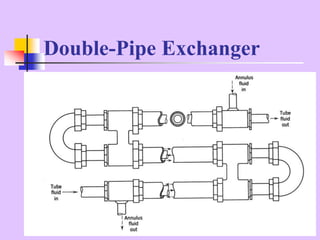
Double-Pipe Exchanger
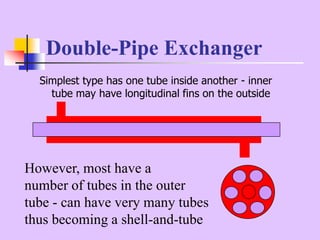
Simplest type has one tube inside another - inner
tube may have longitudinal fins on the outside
However, most have a
number of tubes in the outer
tube - can have very many tubes
thus becoming a shell-and-tube
Double-Pipe Exchanger
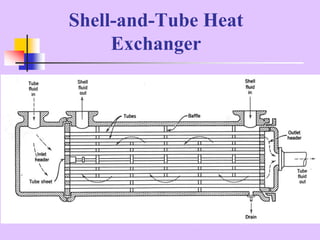
Shell-and-Tube Heat
Exchanger
 Shell-and-Tube Heat Exchangers are the most
important type of HE.
 It is used in almost every type of industry.
 This type of heat exchanger consists of a set of
tubes in a container called a shell.
 The fluid flowing inside the tubes is called the
tube side fluid and the fluid flowing on the outside
of the tubes is the shell side fluid.
Shell-and-Tube Heat
Exchanger
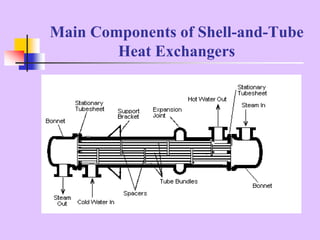
Main Components of Shell-and-Tube
Heat Exchangers
Some common heat-exchanger
terms
 Tube side: Inside the tubes.
 Shell side: Outside the tubes, between the
tubes and the shell.
 Tube sheet A thick plate provided with holes
(one per tube) in which the tubes are fixed.
 Tube bundle Consists of tubes, tube sheet and
baffle plates
 Shell A cylinder of plate in which the tube bundle
is placed
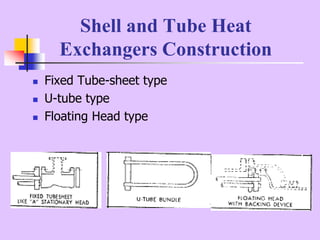
Shell and Tube Heat
Exchangers Construction
 Fixed Tube-sheet type
 U-tube type
 Floating Head type
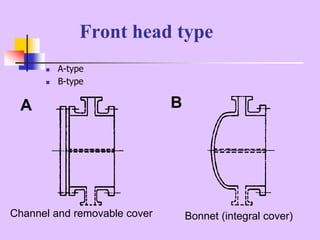
Front head type
 A-type
 B-type
B
Channel and removable cover Bonnet (integral cover)
A
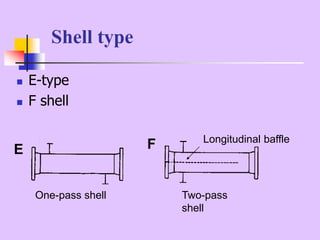
Shell type
 E-type
 F shell
E F
One-pass shell Two-pass
shell
Longitudinal baffle
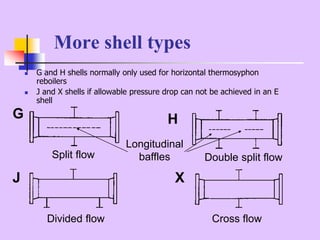
More shell types
 G and H shells normally only used for horizontal thermosyphon
reboilers
 J and X shells if allowable pressure drop can not be achieved in an E
shell
J
HG
X
Split flow Double split flow
Divided flow Cross flow
Longitudinal
baffles
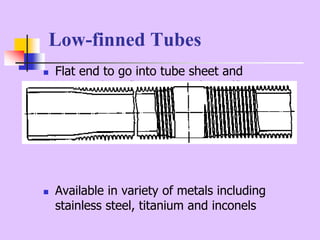
Low-finned Tubes
 Flat end to go into tube sheet and
intermediate flat portions for baffle
locations
 Available in variety of metals including
stainless steel, titanium and inconels
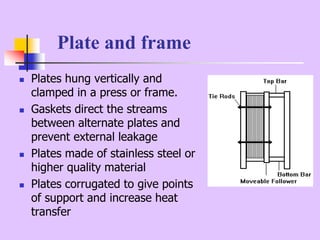
Plate and frame
 Plates hung vertically and
clamped in a press or frame.
 Gaskets direct the streams
between alternate plates and
prevent external leakage
 Plates made of stainless steel or
higher quality material
 Plates corrugated to give points
of support and increase heat
transfer
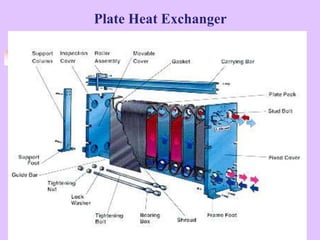
Plate Heat Exchanger
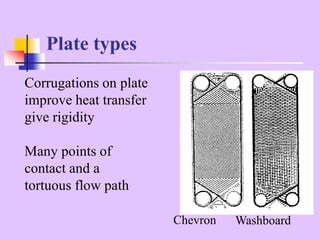
Chevron Washboard
Plate types
Corrugations on plate
improve heat transfer
give rigidity
Many points of
contact and a
tortuous flow path
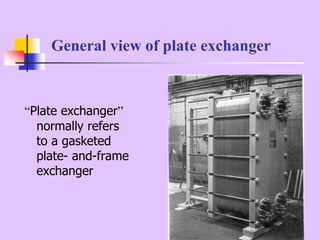
General view of plate exchanger
“Plate exchanger”
normally refers
to a gasketed
plate- and-frame
exchanger
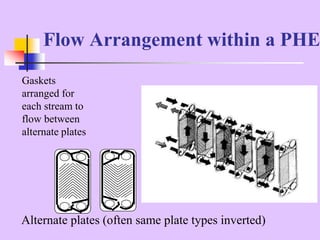
Flow Arrangement within a PHE
Alternate plates (often same plate types inverted)
Gaskets
arranged for
each stream to
flow between
alternate plates
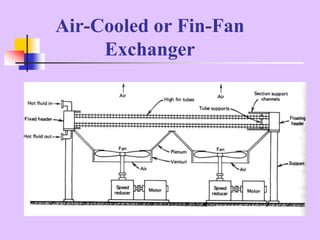
Air-Cooled or Fin-Fan
Exchanger
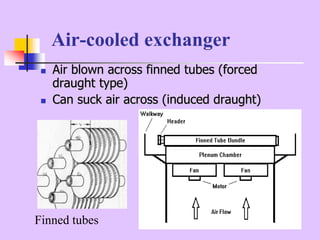
Air-cooled exchanger
 Air blown across finned tubes (forced
draught type)
 Can suck air across (induced draught)
Finned tubes
Spiral Heat Exchanger
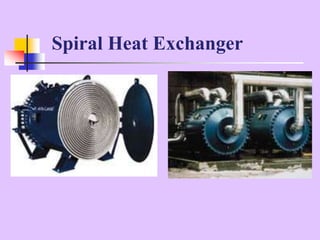
 Spiral heat exchangers can be used in most applications in the
chemical process industry
 In many difficult applications where fouling and plugging are
problems, a standard shell and tube design may not be
effective
 While a spiral heat exchanger often has a higher initial cost, it
may provide a lower life cycle cost due to lower fouling rates
and ease of maintenance
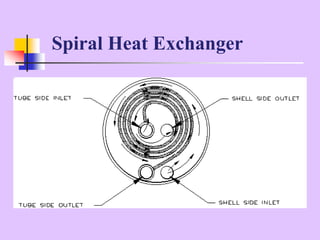
Spiral Heat Exchanger
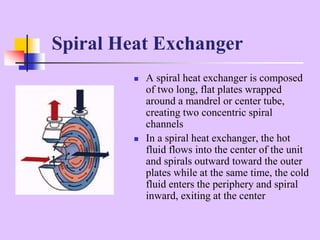
 A spiral heat exchanger is composed
of two long, flat plates wrapped
around a mandrel or center tube,
creating two concentric spiral
channels
 In a spiral heat exchanger, the hot
fluid flows into the center of the unit
and spirals outward toward the outer
plates while at the same time, the cold
fluid enters the periphery and spiral
inward, exiting at the center
Spiral Heat Exchanger
types of heat exchanger

types of heat exchanger

  • 1.
    PROCESS HEAT TRANSFER TYPES OF HEAT EXCHANGERS BY: ABHIJITPANCHMATIYA (130280105030)
  • 2.
    Heat Exchangers •Heat exchangersare one of the most common pieces of equipment found in all plants. •Heat Exchangers are components that allow the transfer of heat from one fluid (liquid or gas) to another fluid. •In a heat exchanger there is no direct contact between the two fluids. The heat is transferred from the hot fluid to the metal isolating the two fluids and then to the cooler fluid.
  • 3.
    Types of HeatExchangers
  • 4.
  • 5.
    Simplest type hasone tube inside another - inner tube may have longitudinal fins on the outside However, most have a number of tubes in the outer tube - can have very many tubes thus becoming a shell-and-tube Double-Pipe Exchanger
  • 6.
  • 7.
     Shell-and-Tube HeatExchangers are the most important type of HE.  It is used in almost every type of industry.  This type of heat exchanger consists of a set of tubes in a container called a shell.  The fluid flowing inside the tubes is called the tube side fluid and the fluid flowing on the outside of the tubes is the shell side fluid. Shell-and-Tube Heat Exchanger
  • 8.
    Main Components ofShell-and-Tube Heat Exchangers
  • 9.
    Some common heat-exchanger terms Tube side: Inside the tubes.  Shell side: Outside the tubes, between the tubes and the shell.  Tube sheet A thick plate provided with holes (one per tube) in which the tubes are fixed.  Tube bundle Consists of tubes, tube sheet and baffle plates  Shell A cylinder of plate in which the tube bundle is placed
  • 10.
    Shell and TubeHeat Exchangers Construction  Fixed Tube-sheet type  U-tube type  Floating Head type
  • 11.
    Front head type A-type  B-type B Channel and removable cover Bonnet (integral cover) A
  • 12.
    Shell type  E-type F shell E F One-pass shell Two-pass shell Longitudinal baffle
  • 13.
    More shell types G and H shells normally only used for horizontal thermosyphon reboilers  J and X shells if allowable pressure drop can not be achieved in an E shell J HG X Split flow Double split flow Divided flow Cross flow Longitudinal baffles
  • 14.
    Low-finned Tubes  Flatend to go into tube sheet and intermediate flat portions for baffle locations  Available in variety of metals including stainless steel, titanium and inconels
  • 15.
    Plate and frame Plates hung vertically and clamped in a press or frame.  Gaskets direct the streams between alternate plates and prevent external leakage  Plates made of stainless steel or higher quality material  Plates corrugated to give points of support and increase heat transfer
  • 16.
  • 17.
    Chevron Washboard Plate types Corrugationson plate improve heat transfer give rigidity Many points of contact and a tortuous flow path
  • 18.
    General view ofplate exchanger “Plate exchanger” normally refers to a gasketed plate- and-frame exchanger
  • 19.
    Flow Arrangement withina PHE Alternate plates (often same plate types inverted) Gaskets arranged for each stream to flow between alternate plates
  • 20.
  • 21.
    Air-cooled exchanger  Airblown across finned tubes (forced draught type)  Can suck air across (induced draught) Finned tubes
  • 22.
  • 23.
     Spiral heatexchangers can be used in most applications in the chemical process industry  In many difficult applications where fouling and plugging are problems, a standard shell and tube design may not be effective  While a spiral heat exchanger often has a higher initial cost, it may provide a lower life cycle cost due to lower fouling rates and ease of maintenance Spiral Heat Exchanger
  • 24.
     A spiralheat exchanger is composed of two long, flat plates wrapped around a mandrel or center tube, creating two concentric spiral channels  In a spiral heat exchanger, the hot fluid flows into the center of the unit and spirals outward toward the outer plates while at the same time, the cold fluid enters the periphery and spiral inward, exiting at the center Spiral Heat Exchanger
  • 25.