HVAC
EVAPORATOR AND TYPES
ABHINAND SANTHOSH
ANANTHAKRISHNAN
ANDREA SUSAN BINOY
HALA GAFOOR
MEENAKSHY M S
EVAPORATOR
◉ The purpose of the evaporator is to receive low-pressure,
low temperature fluid from the expansion valve and to bring
it in close thermal contact with the load.
◉ The refrigerant takes up its latent heat from the load and
leaves the evaporator as a dry gas.
◉ In most cases air or a liquid is first cooled, and this is then
used to cool the load. e.g., in a cold-room air is cooled and
this air cools the stored produce and carries away heat
leaking through the structure; in a water chiller, water is
circulated to cool the load, etc.
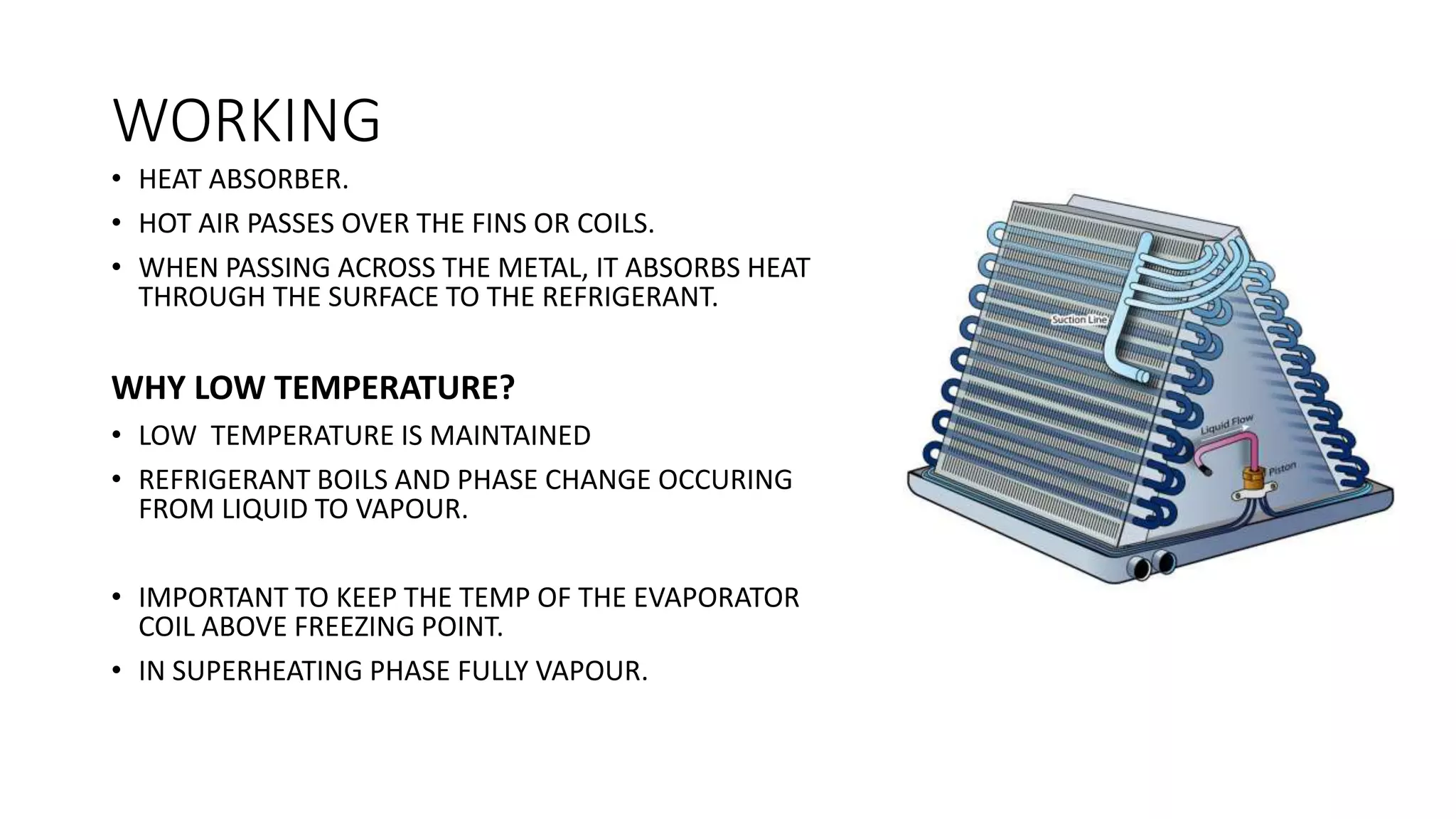
WORKING
• HEAT ABSORBER.
• HOT AIR PASSES OVER THE FINS OR COILS.
• WHEN PASSING ACROSS THE METAL, IT ABSORBS HEAT
THROUGH THE SURFACE TO THE REFRIGERANT.
WHY LOW TEMPERATURE?
• LOW TEMPERATURE IS MAINTAINED
• REFRIGERANT BOILS AND PHASE CHANGE OCCURING
FROM LIQUID TO VAPOUR.
• IMPORTANT TO KEEP THE TEMP OF THE EVAPORATOR
COIL ABOVE FREEZING POINT.
• IN SUPERHEATING PHASE FULLY VAPOUR.
CLASSIFICATION OF EVAPORATOR
• BASED ON MODE OF HEAT TRANSFER:
o NATURAL CONVECTION EVAPORATOR
o FORCED CONVECTION EVAPORATOR
FORCED CONVECTION EVAPORATOR:
• Bare Tube Evaporators
• Finned tube evaporators
• Plate evaporator
• Tube in tube evaporator
• Shell and coil evaporator
• Shell and tube evaporator
• Flooded type
• Direct expansion type ( DX)
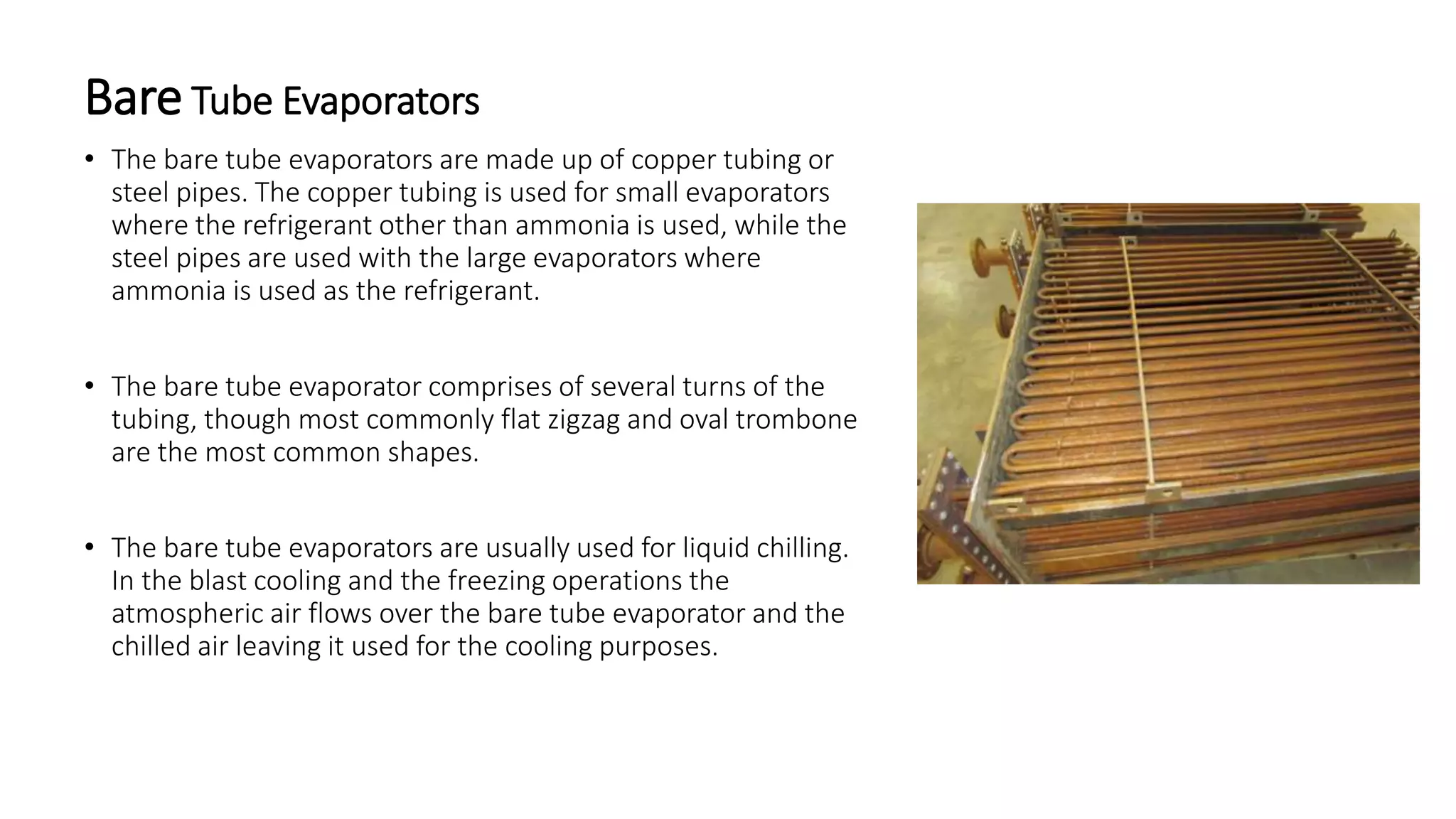
Bare Tube Evaporators
• The bare tube evaporators are made up of copper tubing or
steel pipes. The copper tubing is used for small evaporators
where the refrigerant other than ammonia is used, while the
steel pipes are used with the large evaporators where
ammonia is used as the refrigerant.
• The bare tube evaporator comprises of several turns of the
tubing, though most commonly flat zigzag and oval trombone
are the most common shapes.
• The bare tube evaporators are usually used for liquid chilling.
In the blast cooling and the freezing operations the
atmospheric air flows over the bare tube evaporator and the
chilled air leaving it used for the cooling purposes.
Plate Type of Evaporators
• the coil usually made up of copper or aluminum is
embedded in the plate so as so to form a flat looking
surface.
• Externally the plate type of evaporator looks like a
single plate, but inside it there are several turns of the
metal tubing through which the refrigerant flows.
• The plate type heat exchangers can be easily formed
into various shapes as per the requirement. Thus in the
household refrigerators and the deep freezers, where
they are used most commonly, they can be converted
into the box shape to form the closed enclosure, where
various food can be kept in the frozen state. The plates
can also be welded together that can be used the larger
evaporators of higher capacities.
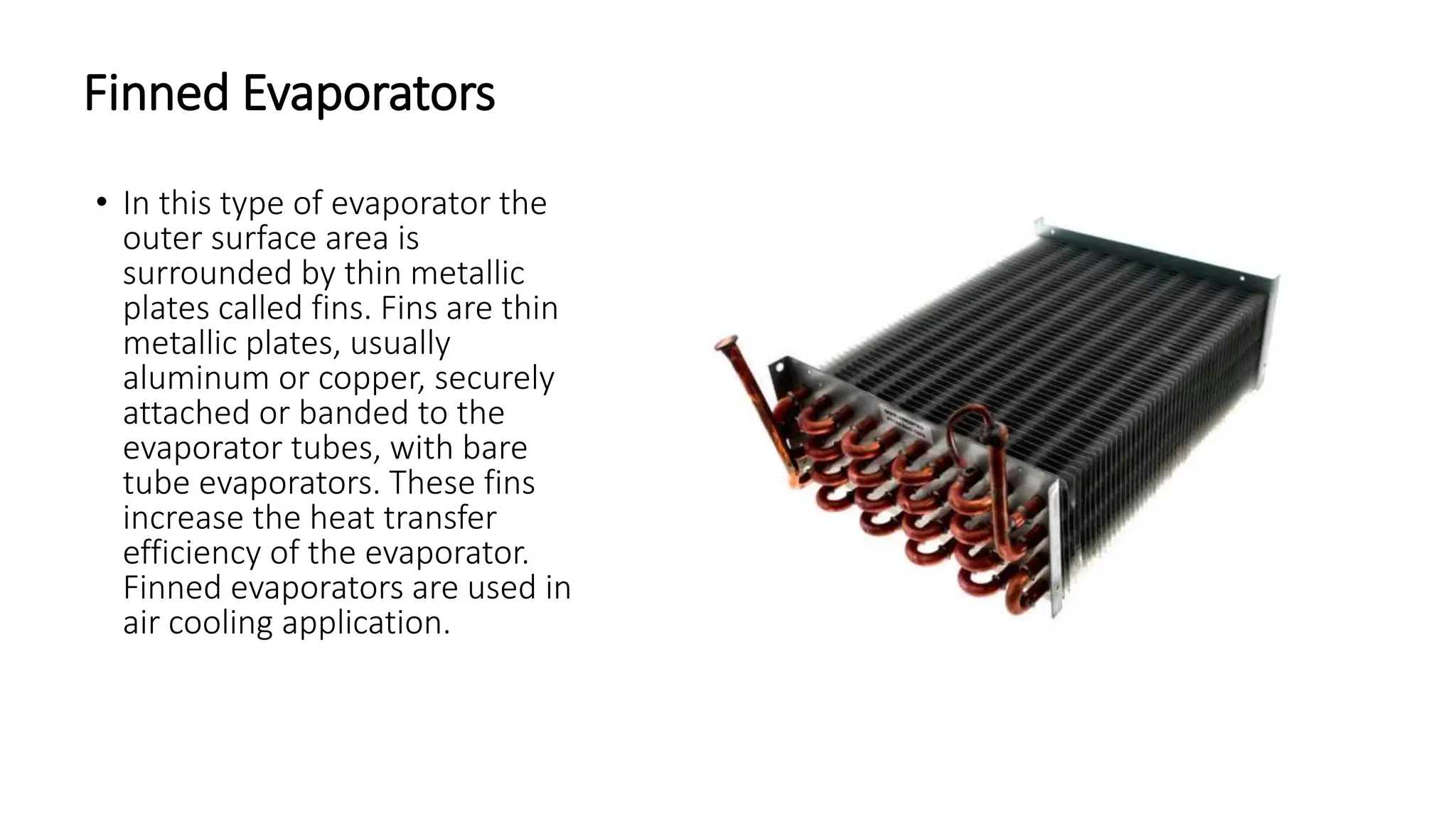
Finned Evaporators
• In this type of evaporator the
outer surface area is
surrounded by thin metallic
plates called fins. Fins are thin
metallic plates, usually
aluminum or copper, securely
attached or banded to the
evaporator tubes, with bare
tube evaporators. These fins
increase the heat transfer
efficiency of the evaporator.
Finned evaporators are used in
air cooling application.
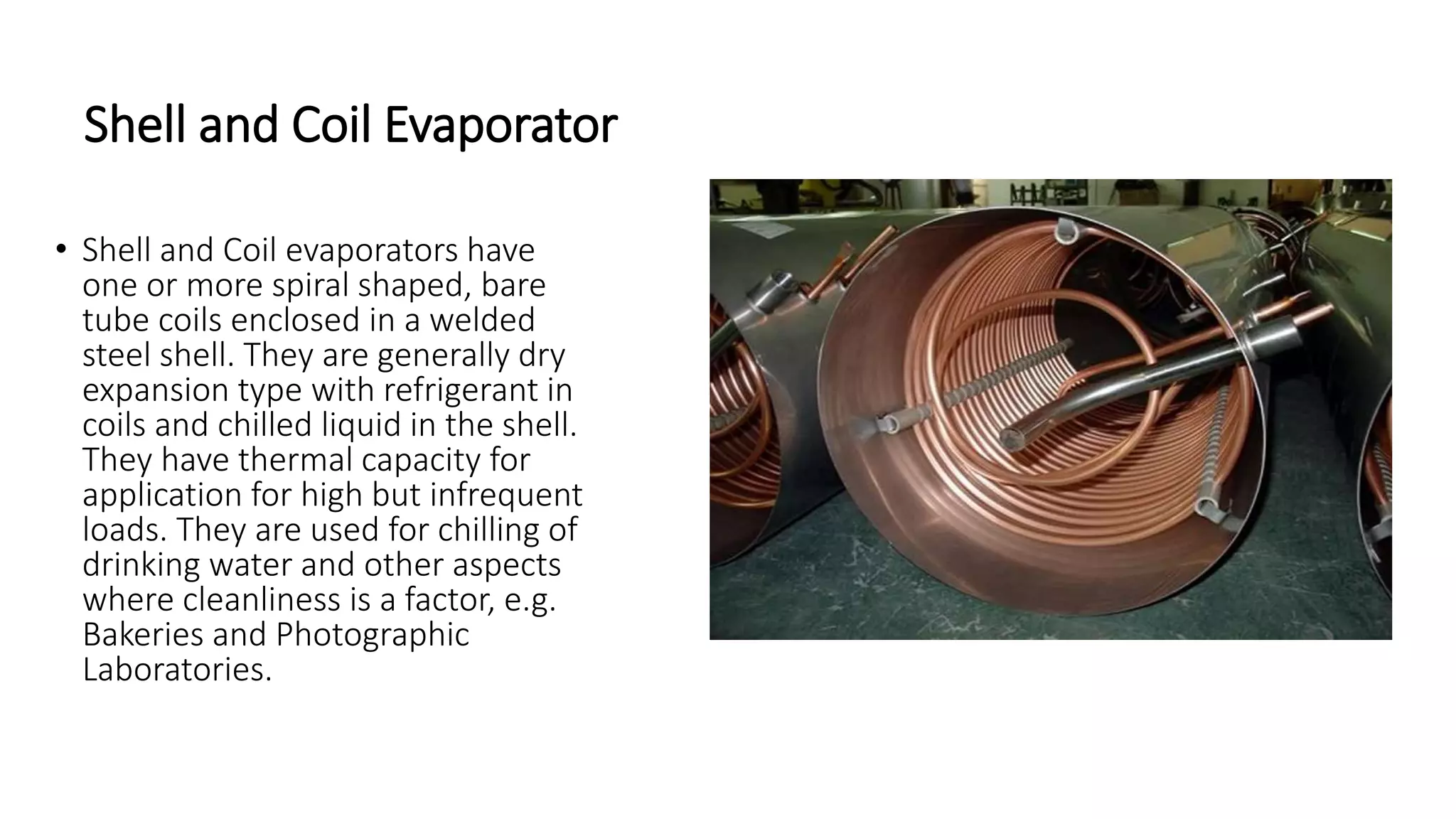
Shell and Coil Evaporator
• Shell and Coil evaporators have
one or more spiral shaped, bare
tube coils enclosed in a welded
steel shell. They are generally dry
expansion type with refrigerant in
coils and chilled liquid in the shell.
They have thermal capacity for
application for high but infrequent
loads. They are used for chilling of
drinking water and other aspects
where cleanliness is a factor, e.g.
Bakeries and Photographic
Laboratories.
Shell and Tube evaporators
• Shell and Tube evaporators consist of a
cylindrical shell in which there are a number of
straight tubes arranged in parallel, held in place
by end plates. When in operation, refrigerant is
expanded in the tubes with chilled liquid in the
shell.
• Shell diameters range from 150 mm to 1.5 m,
numbers of tubes from less than fifty to several
thousand.
• Tube diameters range from 16 mm to 50 mm
with tube lengths 1.5 m to 6 m.
• Steel tubes are used for ammonia and copper
tubes used for other refrigerants. Copper tubes
give high heat transfer coefficients.. They are
used for both Dry and Flooded applications.
SHELL AND TUBE TYPE EVAPORATOR
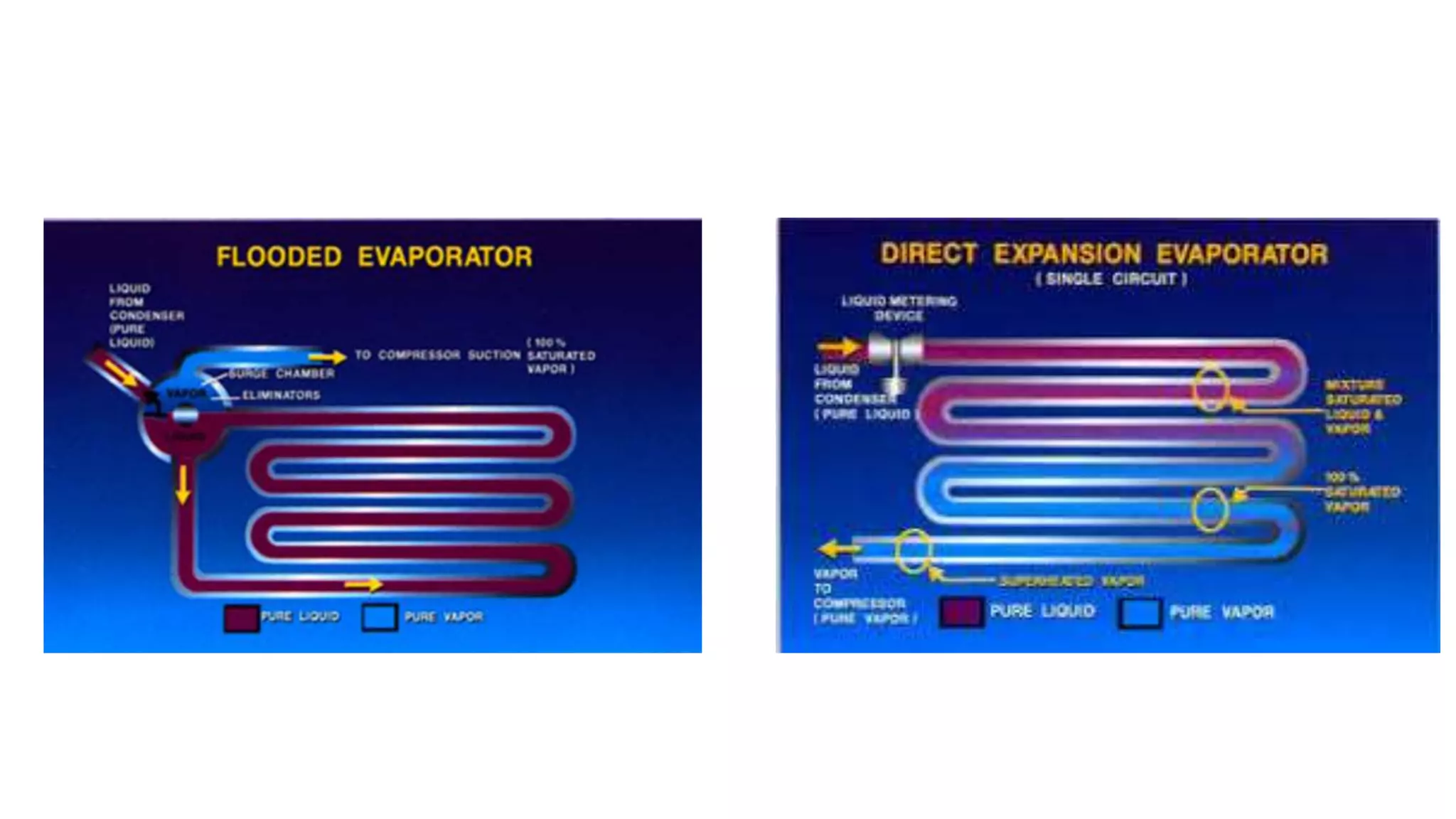
FLOODED TYPE
• FLOODED EVAPORATOR IS ALWAYS FILLED
WITH LIQUID REFRIGERANT.
• THE REFRIGERANT FLOWS THOUGH THE SHELL
AND WATER PASSES THROUGH THE TUBES.
• THE REFRIGERANT REMAINS IN THE LIQUID
STATE AS IT PASSES FROM THE INLET TO THE
OUTLET.
• REQUIRES LARGE AMOUNTS OF REFRIGERANT
TO AVOID SUPERHEATING.
• GRAVITY CAUSES THE REFRIGERANT TO FLOW
DOWN INTO THE SYSTEM.
• HIGHER COP (COEFFICIENT OF PERFORMANCE).
DX TYPE (DIRECT EXPANSION)
• DOES NOT ALLOW THE EVAPORATOR COIL TO
BE FULL OF LIQUID REFRIGERANT.
• THE REFRIGERANT FLOWS THROUGH TUBES
AND WATER PASSES THROUGH THE SHELL.
• THE REFRIGERANT IS LIQUID AT FIRST BUT LATER
BECOMES GAS BY THE TIME IT REACHES THE
OUTLET.
• REQUIRES LESS AMOUNT OF REFRIGERANT FOR
THE SAME COIL VOLUME AS FLOODED USUALLY
1/3 OR 1/4.
• PRESSURE DIFFERENCE BETWEEN THE OUTLET
AND INLET CAUSES THE REFRIGERANT TO FLOW.
• LOWER COP.
• HIGHER INSTALLATION COST.
• MAINTENANCE IS NOT AS EASY AS DX TYPE.
• HIGHER HEAT TRANSFER RATE
• MORE EFFICIENT DUE TO WETTED SURFACE.
• USUALLY USED FOR LARGER PLANTS.
• IN CASE REFRIGERANT LEVEL DECREASES THE
FLOAT VALVE ALLOWS MORE LIQUID
REFRIGERANT INTO THE SYSTEM.
• LIQUID REFRIGERANT TRAPPED IN
ACCUMULATOR IS RE-CIRCULATED THROUGH
EVAPORATOR.
• SURGE CHAMBER IS PROVIDED TO PREVENT
LIQUID FROM GOING TO THE COMPRESSOR
AND ONLY ALLOWING VAPOUR.
• LESS INSTALLATION COST.
• EASIER MAINTANENCE.
• LOWER HEAT TRANSFER RATE.
• LESS EFFICIENT
• USED IN DOMESTIC APPLICATIONS.
• EXPANSION VALVE CONTROLSTHE RATE OF
FLOW OF LIQUID REFRIGERANT SUCH THAT
ALL THE IQUID REFRIGERANT IS VAPOURISED
BY THE TIME IT REACHES THE OUTLET.
• REFRIGERANT DOES NOT RECIRCULATE
WITHIN EVAPORATOR DUE TO
SUPERGEATING.
• SURGE CHAMBER NOT REQUIRED AS THE
LIQUID REFRIGERANT GETS CONVERTED TO
VAPOUR COMPLETELY.
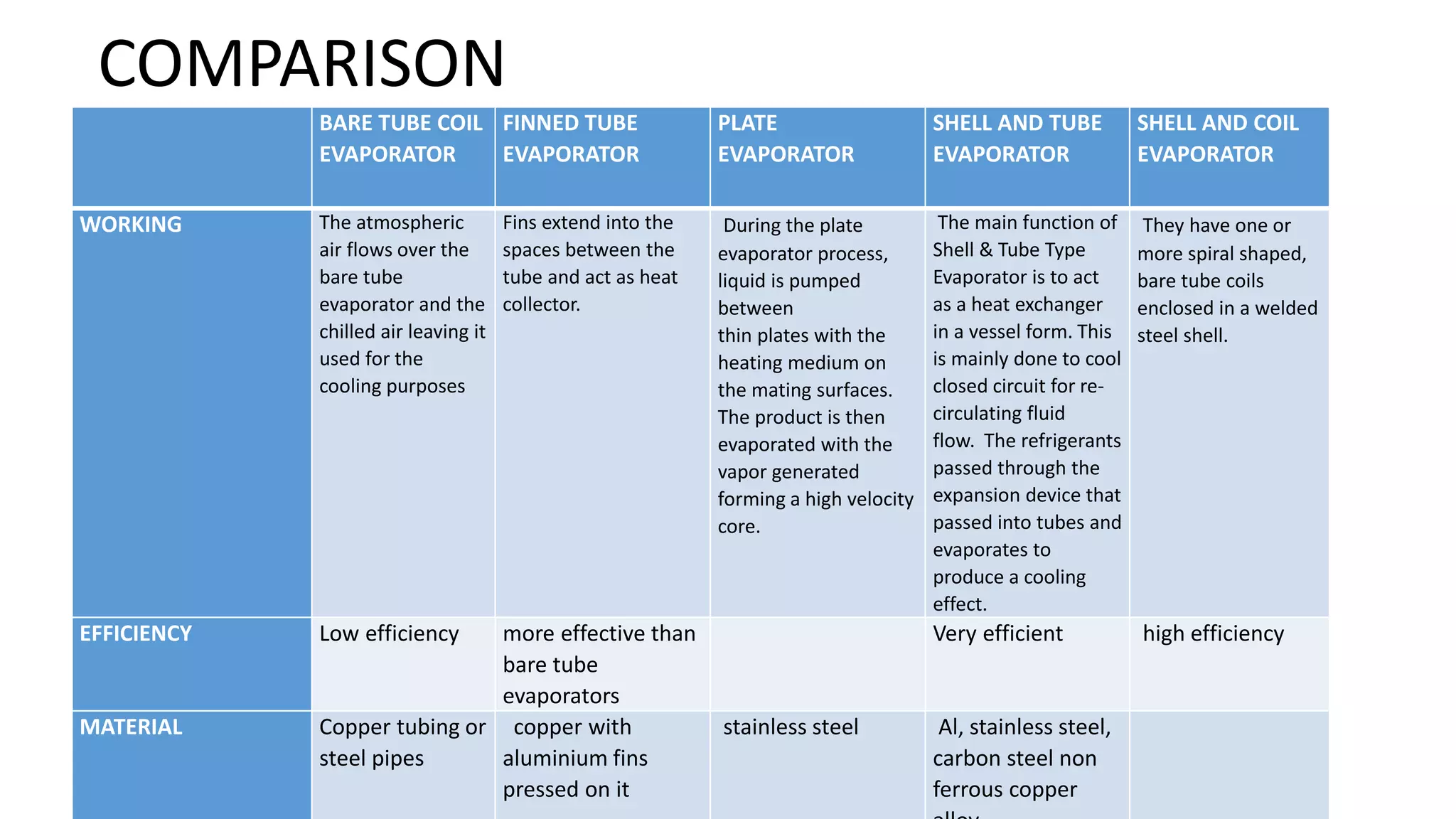
BARE TUBE COIL
EVAPORATOR
FINNED TUBE
EVAPORATOR
PLATE
EVAPORATOR
SHELL AND TUBE
EVAPORATOR
SHELL AND COIL
EVAPORATOR
WORKING The atmospheric
air flows over the
bare tube
evaporator and the
chilled air leaving it
used for the
cooling purposes
Fins extend into the
spaces between the
tube and act as heat
collector.
During the plate
evaporator process,
liquid is pumped
between
thin plates with the
heating medium on
the mating surfaces.
The product is then
evaporated with the
vapor generated
forming a high velocity
core.
The main function of
Shell & Tube Type
Evaporator is to act
as a heat exchanger
in a vessel form. This
is mainly done to cool
closed circuit for re-
circulating fluid
flow. The refrigerants
passed through the
expansion device that
passed into tubes and
evaporates to
produce a cooling
effect.
They have one or
more spiral shaped,
bare tube coils
enclosed in a welded
steel shell.
EFFICIENCY Low efficiency more effective than
bare tube
evaporators
Very efficient high efficiency
MATERIAL Copper tubing or
steel pipes
copper with
aluminium fins
pressed on it
stainless steel Al, stainless steel,
carbon steel non
ferrous copper
COMPARISON
ADVANTAGES Easier to keep clean The fins on the external
surface of the bare tube
evaporators increases the
contact surface of the of
the metallic tubing with
the fluid and increase the
heat transfer rate
1.Simple and Compact in
size
2.Heat transfer efficiency is
more
3.Can be easily cleaned
4.No extra space is
required for dismantling
5.Capacity can be
increased by introducing
plates in pairs
6.Leaking plates can be
removed in pairs, if
necessary without
replacement
7.Maintenance is simple
8.Turbulent flow help to
reduce deposits which
would interfere with heat
transfer
1.Less expensive as compared to Plate type
coolers
2.Can be used in systems with higher
operating temperatures and pressures
3.Pressure drop across a tube cooler is less
4.Tube leaks are easily located and plugged
since pressure test is comparatively easy
5.Tubular coolers in refrigeration system can
act as receiver also.
6.Using sacrificial anodes protects the whole
cooling system against corrosion
7.Tube coolers may be preferred for
lubricating oil cooling because of the
pressure differential
.compact and
light weight
.High efficiency
.Low installation
costs
.Flexible design
.Low maintenance
Low pressure drop
BARE TUBE COIL
EVAPORATOR
FINNED TUBE
EVAPORATOR
PLATE EVAPORATOR SHELL AND TUBE EVAPORATOR SHELL AND
COIL
EVAPORATOR
DISADVANTAGES When the fluid (air or
water) to be chilled
flows over the bare tube
evaporator lots of
cooling effect from the
refrigerant goes wasted
since there is less
surface for the transfer
of heat from the fluid to
the refrigerant. The fluid
tends to move between
the open spaces of the
tubing and does not
come in contact with the
surface of the coil
Tough the fins help
increase the heat
transfer, rate, adding
them beyond certain
numbers won’t produce
any additional benefits,
hence only certain
number of fins should
be applied on the
external surface of the
tube.
1.Initial cost is high since Titanium
plates are expensive
2.Finding leakage is difficult since
pressure test is not as ease as tube
coolers
3.Bonding material between
plates limits operating
temperature of the cooler
4.Pressure drop caused by plate
cooler is higher than tube cooler
5.Careful dismantling and
assembling to be done
6.Over tightening of the clamping
bolts result in increased pressure
drop across the cooler
7.Joints may be deteriorated
according to the operating
conditions
8.Since Titanium is a noble metal,
other parts of the cooling system
are susceptible to corrosion
1.Heat transfer efficiency
is less compared to plate
type cooler
2.Cleaning and
maintenance is difficult
since a tube cooler
requires enough
clearance at one end to
remove the tube nest
3.Capacity of tube cooler
cannot be increased.
4.Requires more space in
comparison to plate
coolers
BARE TUBE COIL
EVAPORATOR
FINNED TUBE
EVAPORATOR
PLATE EVAPORATOR SHELL AND TUBE
EVAPORATOR
SHELL AND
COIL
EVAPORATO
R
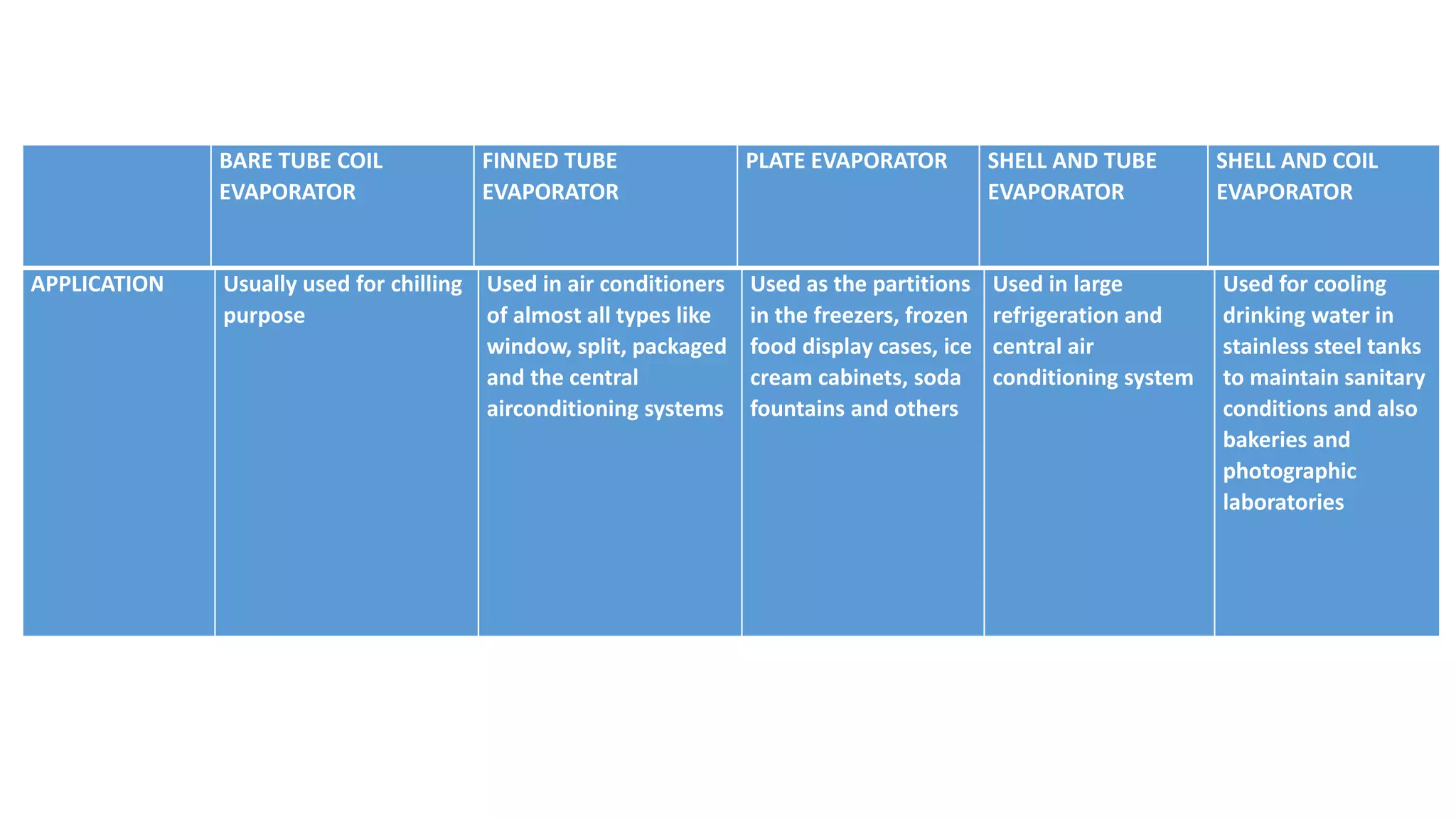
APPLICATION Usually used for chilling
purpose
Used in air conditioners
of almost all types like
window, split, packaged
and the central
airconditioning systems
Used as the partitions
in the freezers, frozen
food display cases, ice
cream cabinets, soda
fountains and others
Used in large
refrigeration and
central air
conditioning system
Used for cooling
drinking water in
stainless steel tanks
to maintain sanitary
conditions and also
bakeries and
photographic
laboratories
BARE TUBE COIL
EVAPORATOR
FINNED TUBE
EVAPORATOR
PLATE EVAPORATOR SHELL AND TUBE
EVAPORATOR
SHELL AND COIL
EVAPORATOR

EVAPORATORS AND TYPES

  • 1.
    HVAC EVAPORATOR AND TYPES ABHINANDSANTHOSH ANANTHAKRISHNAN ANDREA SUSAN BINOY HALA GAFOOR MEENAKSHY M S
  • 2.
    EVAPORATOR ◉ The purposeof the evaporator is to receive low-pressure, low temperature fluid from the expansion valve and to bring it in close thermal contact with the load. ◉ The refrigerant takes up its latent heat from the load and leaves the evaporator as a dry gas. ◉ In most cases air or a liquid is first cooled, and this is then used to cool the load. e.g., in a cold-room air is cooled and this air cools the stored produce and carries away heat leaking through the structure; in a water chiller, water is circulated to cool the load, etc.
  • 3.
    WORKING • HEAT ABSORBER. •HOT AIR PASSES OVER THE FINS OR COILS. • WHEN PASSING ACROSS THE METAL, IT ABSORBS HEAT THROUGH THE SURFACE TO THE REFRIGERANT. WHY LOW TEMPERATURE? • LOW TEMPERATURE IS MAINTAINED • REFRIGERANT BOILS AND PHASE CHANGE OCCURING FROM LIQUID TO VAPOUR. • IMPORTANT TO KEEP THE TEMP OF THE EVAPORATOR COIL ABOVE FREEZING POINT. • IN SUPERHEATING PHASE FULLY VAPOUR.
  • 4.
    CLASSIFICATION OF EVAPORATOR •BASED ON MODE OF HEAT TRANSFER: o NATURAL CONVECTION EVAPORATOR o FORCED CONVECTION EVAPORATOR FORCED CONVECTION EVAPORATOR: • Bare Tube Evaporators • Finned tube evaporators • Plate evaporator • Tube in tube evaporator • Shell and coil evaporator • Shell and tube evaporator • Flooded type • Direct expansion type ( DX)
  • 5.
    Bare Tube Evaporators •The bare tube evaporators are made up of copper tubing or steel pipes. The copper tubing is used for small evaporators where the refrigerant other than ammonia is used, while the steel pipes are used with the large evaporators where ammonia is used as the refrigerant. • The bare tube evaporator comprises of several turns of the tubing, though most commonly flat zigzag and oval trombone are the most common shapes. • The bare tube evaporators are usually used for liquid chilling. In the blast cooling and the freezing operations the atmospheric air flows over the bare tube evaporator and the chilled air leaving it used for the cooling purposes.
  • 6.
    Plate Type ofEvaporators • the coil usually made up of copper or aluminum is embedded in the plate so as so to form a flat looking surface. • Externally the plate type of evaporator looks like a single plate, but inside it there are several turns of the metal tubing through which the refrigerant flows. • The plate type heat exchangers can be easily formed into various shapes as per the requirement. Thus in the household refrigerators and the deep freezers, where they are used most commonly, they can be converted into the box shape to form the closed enclosure, where various food can be kept in the frozen state. The plates can also be welded together that can be used the larger evaporators of higher capacities.
  • 7.
    Finned Evaporators • Inthis type of evaporator the outer surface area is surrounded by thin metallic plates called fins. Fins are thin metallic plates, usually aluminum or copper, securely attached or banded to the evaporator tubes, with bare tube evaporators. These fins increase the heat transfer efficiency of the evaporator. Finned evaporators are used in air cooling application.
  • 8.
    Shell and CoilEvaporator • Shell and Coil evaporators have one or more spiral shaped, bare tube coils enclosed in a welded steel shell. They are generally dry expansion type with refrigerant in coils and chilled liquid in the shell. They have thermal capacity for application for high but infrequent loads. They are used for chilling of drinking water and other aspects where cleanliness is a factor, e.g. Bakeries and Photographic Laboratories.
  • 9.
    Shell and Tubeevaporators • Shell and Tube evaporators consist of a cylindrical shell in which there are a number of straight tubes arranged in parallel, held in place by end plates. When in operation, refrigerant is expanded in the tubes with chilled liquid in the shell. • Shell diameters range from 150 mm to 1.5 m, numbers of tubes from less than fifty to several thousand. • Tube diameters range from 16 mm to 50 mm with tube lengths 1.5 m to 6 m. • Steel tubes are used for ammonia and copper tubes used for other refrigerants. Copper tubes give high heat transfer coefficients.. They are used for both Dry and Flooded applications.
  • 10.
    SHELL AND TUBETYPE EVAPORATOR FLOODED TYPE • FLOODED EVAPORATOR IS ALWAYS FILLED WITH LIQUID REFRIGERANT. • THE REFRIGERANT FLOWS THOUGH THE SHELL AND WATER PASSES THROUGH THE TUBES. • THE REFRIGERANT REMAINS IN THE LIQUID STATE AS IT PASSES FROM THE INLET TO THE OUTLET. • REQUIRES LARGE AMOUNTS OF REFRIGERANT TO AVOID SUPERHEATING. • GRAVITY CAUSES THE REFRIGERANT TO FLOW DOWN INTO THE SYSTEM. • HIGHER COP (COEFFICIENT OF PERFORMANCE). DX TYPE (DIRECT EXPANSION) • DOES NOT ALLOW THE EVAPORATOR COIL TO BE FULL OF LIQUID REFRIGERANT. • THE REFRIGERANT FLOWS THROUGH TUBES AND WATER PASSES THROUGH THE SHELL. • THE REFRIGERANT IS LIQUID AT FIRST BUT LATER BECOMES GAS BY THE TIME IT REACHES THE OUTLET. • REQUIRES LESS AMOUNT OF REFRIGERANT FOR THE SAME COIL VOLUME AS FLOODED USUALLY 1/3 OR 1/4. • PRESSURE DIFFERENCE BETWEEN THE OUTLET AND INLET CAUSES THE REFRIGERANT TO FLOW. • LOWER COP.
  • 12.
    • HIGHER INSTALLATIONCOST. • MAINTENANCE IS NOT AS EASY AS DX TYPE. • HIGHER HEAT TRANSFER RATE • MORE EFFICIENT DUE TO WETTED SURFACE. • USUALLY USED FOR LARGER PLANTS. • IN CASE REFRIGERANT LEVEL DECREASES THE FLOAT VALVE ALLOWS MORE LIQUID REFRIGERANT INTO THE SYSTEM. • LIQUID REFRIGERANT TRAPPED IN ACCUMULATOR IS RE-CIRCULATED THROUGH EVAPORATOR. • SURGE CHAMBER IS PROVIDED TO PREVENT LIQUID FROM GOING TO THE COMPRESSOR AND ONLY ALLOWING VAPOUR. • LESS INSTALLATION COST. • EASIER MAINTANENCE. • LOWER HEAT TRANSFER RATE. • LESS EFFICIENT • USED IN DOMESTIC APPLICATIONS. • EXPANSION VALVE CONTROLSTHE RATE OF FLOW OF LIQUID REFRIGERANT SUCH THAT ALL THE IQUID REFRIGERANT IS VAPOURISED BY THE TIME IT REACHES THE OUTLET. • REFRIGERANT DOES NOT RECIRCULATE WITHIN EVAPORATOR DUE TO SUPERGEATING. • SURGE CHAMBER NOT REQUIRED AS THE LIQUID REFRIGERANT GETS CONVERTED TO VAPOUR COMPLETELY.
  • 13.
    BARE TUBE COIL EVAPORATOR FINNEDTUBE EVAPORATOR PLATE EVAPORATOR SHELL AND TUBE EVAPORATOR SHELL AND COIL EVAPORATOR WORKING The atmospheric air flows over the bare tube evaporator and the chilled air leaving it used for the cooling purposes Fins extend into the spaces between the tube and act as heat collector. During the plate evaporator process, liquid is pumped between thin plates with the heating medium on the mating surfaces. The product is then evaporated with the vapor generated forming a high velocity core. The main function of Shell & Tube Type Evaporator is to act as a heat exchanger in a vessel form. This is mainly done to cool closed circuit for re- circulating fluid flow. The refrigerants passed through the expansion device that passed into tubes and evaporates to produce a cooling effect. They have one or more spiral shaped, bare tube coils enclosed in a welded steel shell. EFFICIENCY Low efficiency more effective than bare tube evaporators Very efficient high efficiency MATERIAL Copper tubing or steel pipes copper with aluminium fins pressed on it stainless steel Al, stainless steel, carbon steel non ferrous copper COMPARISON
  • 14.
    ADVANTAGES Easier tokeep clean The fins on the external surface of the bare tube evaporators increases the contact surface of the of the metallic tubing with the fluid and increase the heat transfer rate 1.Simple and Compact in size 2.Heat transfer efficiency is more 3.Can be easily cleaned 4.No extra space is required for dismantling 5.Capacity can be increased by introducing plates in pairs 6.Leaking plates can be removed in pairs, if necessary without replacement 7.Maintenance is simple 8.Turbulent flow help to reduce deposits which would interfere with heat transfer 1.Less expensive as compared to Plate type coolers 2.Can be used in systems with higher operating temperatures and pressures 3.Pressure drop across a tube cooler is less 4.Tube leaks are easily located and plugged since pressure test is comparatively easy 5.Tubular coolers in refrigeration system can act as receiver also. 6.Using sacrificial anodes protects the whole cooling system against corrosion 7.Tube coolers may be preferred for lubricating oil cooling because of the pressure differential .compact and light weight .High efficiency .Low installation costs .Flexible design .Low maintenance Low pressure drop BARE TUBE COIL EVAPORATOR FINNED TUBE EVAPORATOR PLATE EVAPORATOR SHELL AND TUBE EVAPORATOR SHELL AND COIL EVAPORATOR
  • 15.
    DISADVANTAGES When thefluid (air or water) to be chilled flows over the bare tube evaporator lots of cooling effect from the refrigerant goes wasted since there is less surface for the transfer of heat from the fluid to the refrigerant. The fluid tends to move between the open spaces of the tubing and does not come in contact with the surface of the coil Tough the fins help increase the heat transfer, rate, adding them beyond certain numbers won’t produce any additional benefits, hence only certain number of fins should be applied on the external surface of the tube. 1.Initial cost is high since Titanium plates are expensive 2.Finding leakage is difficult since pressure test is not as ease as tube coolers 3.Bonding material between plates limits operating temperature of the cooler 4.Pressure drop caused by plate cooler is higher than tube cooler 5.Careful dismantling and assembling to be done 6.Over tightening of the clamping bolts result in increased pressure drop across the cooler 7.Joints may be deteriorated according to the operating conditions 8.Since Titanium is a noble metal, other parts of the cooling system are susceptible to corrosion 1.Heat transfer efficiency is less compared to plate type cooler 2.Cleaning and maintenance is difficult since a tube cooler requires enough clearance at one end to remove the tube nest 3.Capacity of tube cooler cannot be increased. 4.Requires more space in comparison to plate coolers BARE TUBE COIL EVAPORATOR FINNED TUBE EVAPORATOR PLATE EVAPORATOR SHELL AND TUBE EVAPORATOR SHELL AND COIL EVAPORATO R
  • 16.
    APPLICATION Usually usedfor chilling purpose Used in air conditioners of almost all types like window, split, packaged and the central airconditioning systems Used as the partitions in the freezers, frozen food display cases, ice cream cabinets, soda fountains and others Used in large refrigeration and central air conditioning system Used for cooling drinking water in stainless steel tanks to maintain sanitary conditions and also bakeries and photographic laboratories BARE TUBE COIL EVAPORATOR FINNED TUBE EVAPORATOR PLATE EVAPORATOR SHELL AND TUBE EVAPORATOR SHELL AND COIL EVAPORATOR