Heat Transfer (2151909)
Presented By:
Upadhyay Ayush. (150123119053)
Presentation On:- Heat Exchanger
GANDHINAGAR INSTITUTE
OF
TECHNOLOGY
Introduction
• A heat exchanger is a piece of equipment built for
efficient heat transfer from one medium to another. The
media may be separated by a solid wall, so that they
never mix, or they may be in direct contact.
• They are widely used in petroleum refineries, chemical
plants, petrochemical plants, natural gas processing,
refrigeration, power plants, air conditioning and space
heating.
7/8/2017 Heat Transfer 2
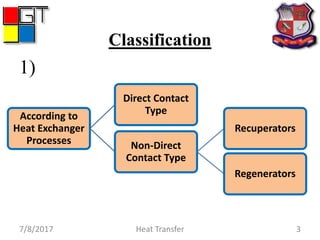
Classification
7/8/2017 Heat Transfer 3
According to
Heat Exchanger
Processes
Direct Contact
Type
Non-Direct
Contact Type
Recuperators
Regenerators
1)
7/8/2017 Heat Transfer 4
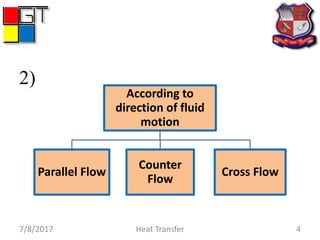
According to
direction of fluid
motion
Parallel Flow
Counter
Flow
Cross Flow
2)
7/8/2017 Heat Transfer 5
3)
According to mechanical design
Concentric
Tubes
Finned Tube
Multiple shell
& Tube passes
Compact Shell & Tube
7/8/2017 Heat Transfer 6
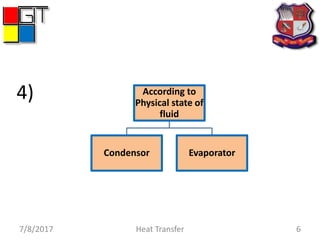
According to
Physical state of
fluid
Condensor Evaporator
4)
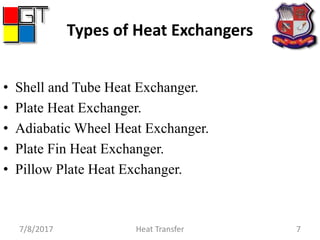
Types of Heat Exchangers
• Shell and Tube Heat Exchanger.
• Plate Heat Exchanger.
• Adiabatic Wheel Heat Exchanger.
• Plate Fin Heat Exchanger.
• Pillow Plate Heat Exchanger.
7/8/2017 Heat Transfer 7
7/8/2017 Heat Transfer 8
Shell & Tube
Heat Exchanger
• Shell and tube heat exchangers consist of a series of tubes.
• One set of these tubes contains the fluid that must be either
heated or cooled. The second fluid runs over the tubes that
are being heated or cooled so that it can either provide the
heat or absorb the heat required.
Plate Heat Exchanger
• Plate Heat Exchanger is composed of multiple, thin, slightly
- separated plates that have very large surface areas and
fluid flow passages for heat transfer.
• This stacked-plate arrangement can be more effective, in a
given space, than the shell and tube heat exchanger.
7/8/2017 Heat Transfer 9
Adiabatic Wheel
Heat Exchanger.
• Adiabatic Wheel heat exchanger uses an intermediate fluid
or solid store to hold heat, which is then moved to the other
side of the heat exchanger to be released.
7/8/2017 Heat Transfer 10
Plate Fin Heat Exchanger
• Plate Fin heat exchanger uses "sandwiched" passages
containing fins to increase the affectivity of the unit.
• The designs include cross flow and counter flow coupled
with various fin configurations such as straight fins, offset
fins and wavy fins.
7/8/2017 Heat Transfer 11
Pillow Plate
Heat Exchanger
• A pillow plate exchanger is commonly used in the dairy
industry for cooling milk in large direct-expansion stainless
steel bulk tanks.
7/8/2017 Heat Transfer 12
Applications
7/8/2017 Heat Transfer 13
• Heat Exchangers prevent car engine overheating
and increase efficiency
• Heat exchangers are used in many Industries Like,
Oil & Gas , Chemical Processing , Power
Generation , etc. for heat transfer.
• Heat exchangers are used in AC and furnaces.
presentation on  heat exchanger

presentation on heat exchanger

  • 1.
    Heat Transfer (2151909) PresentedBy: Upadhyay Ayush. (150123119053) Presentation On:- Heat Exchanger GANDHINAGAR INSTITUTE OF TECHNOLOGY
  • 2.
    Introduction • A heatexchanger is a piece of equipment built for efficient heat transfer from one medium to another. The media may be separated by a solid wall, so that they never mix, or they may be in direct contact. • They are widely used in petroleum refineries, chemical plants, petrochemical plants, natural gas processing, refrigeration, power plants, air conditioning and space heating. 7/8/2017 Heat Transfer 2
  • 3.
    Classification 7/8/2017 Heat Transfer3 According to Heat Exchanger Processes Direct Contact Type Non-Direct Contact Type Recuperators Regenerators 1)
  • 4.
    7/8/2017 Heat Transfer4 According to direction of fluid motion Parallel Flow Counter Flow Cross Flow 2)
  • 5.
    7/8/2017 Heat Transfer5 3) According to mechanical design Concentric Tubes Finned Tube Multiple shell & Tube passes Compact Shell & Tube
  • 6.
    7/8/2017 Heat Transfer6 According to Physical state of fluid Condensor Evaporator 4)
  • 7.
    Types of HeatExchangers • Shell and Tube Heat Exchanger. • Plate Heat Exchanger. • Adiabatic Wheel Heat Exchanger. • Plate Fin Heat Exchanger. • Pillow Plate Heat Exchanger. 7/8/2017 Heat Transfer 7
  • 8.
    7/8/2017 Heat Transfer8 Shell & Tube Heat Exchanger • Shell and tube heat exchangers consist of a series of tubes. • One set of these tubes contains the fluid that must be either heated or cooled. The second fluid runs over the tubes that are being heated or cooled so that it can either provide the heat or absorb the heat required.
  • 9.
    Plate Heat Exchanger •Plate Heat Exchanger is composed of multiple, thin, slightly - separated plates that have very large surface areas and fluid flow passages for heat transfer. • This stacked-plate arrangement can be more effective, in a given space, than the shell and tube heat exchanger. 7/8/2017 Heat Transfer 9
  • 10.
    Adiabatic Wheel Heat Exchanger. •Adiabatic Wheel heat exchanger uses an intermediate fluid or solid store to hold heat, which is then moved to the other side of the heat exchanger to be released. 7/8/2017 Heat Transfer 10
  • 11.
    Plate Fin HeatExchanger • Plate Fin heat exchanger uses "sandwiched" passages containing fins to increase the affectivity of the unit. • The designs include cross flow and counter flow coupled with various fin configurations such as straight fins, offset fins and wavy fins. 7/8/2017 Heat Transfer 11
  • 12.
    Pillow Plate Heat Exchanger •A pillow plate exchanger is commonly used in the dairy industry for cooling milk in large direct-expansion stainless steel bulk tanks. 7/8/2017 Heat Transfer 12
  • 13.
    Applications 7/8/2017 Heat Transfer13 • Heat Exchangers prevent car engine overheating and increase efficiency • Heat exchangers are used in many Industries Like, Oil & Gas , Chemical Processing , Power Generation , etc. for heat transfer. • Heat exchangers are used in AC and furnaces.