Prepared by:
140050119032
Lakhani Dhruvit
1
 The mechanism used for lowering or producing
low temp. in a body or a space, whose temp. is
already below the temp. of its surrounding, is
called the refrigeration system.
 Here the heat is being generally pumped from low
level to the higher one & is rejected at high temp.
2
 The term refrigeration may be defined as the
process of removing heat from a substance
under controlled conditions.
 It also includes the process of reducing heat &
maintaining the temp. of a body below the
general temp. of its surroundings.
3
 A refrigerator is a reversed heat engine or a heat
pump which takes out heat from a cold body &
delivers it to a hot body.
 The refrigerant is a heat carrying medium which
during their cycle in a refrigeration system
absorbs heat from a low temp. system & delivers it
to a higher temp. system.
4
 NH3(AMMONIA)
 Properties- Highly toxic,flammable,good thermal
properties,highest refrigerant effect per kg of
refrigerant.
 uses- It is widely used in large industrial and
commercial refrigeration system.it is mostly used
with VAR system like ice plants,cold storage etc.
 CO2(CARBON DIOXIDE)
 Properties- colourless,non-toxic,and non-
corrosive gas.
5
 Uses- It is used in marine refrigeration system.
 AIR
 Properties- Easily available without cost,non-
toxic,completely safe refrigerant.
 Uses- It is used in aircraft air conditioning
system.
 R11(TRICHLORO MONOFLUORO METHANE)
 Properties- Non-toxic,non-flammable,non-
corrosive.
 Uses- It is used in small office buildings and air
conditioning.
6
 R12(DICHLARO-DIFURO METHANE)
 Properties- Non-toxic,non-flammable, non-
explosive,most suitable refrigerant
 Uses-It is used in domestic vapour
compression refrigeration.
 R22(MONOCHLORO-DIFLURO METHANE)
 Properties- Non-toxic, non flammable,
required less compressor displacement.
 Uses- It is used in commercial and industrial
low temperature applications.
7
 Vapour compression refrigeration system
 Vapour absorption refrigeration system
 Air refrigeration system
8
 This is the most important system from the point
of commercial & domestic utility & most practical
form of refrigeration.
 The working fluid refrigerant used in this
refrigeration system readily evaporates &
condenses or changes alternatively between the
vapour & liquid phases without leaving the
refrigerating plant
9
10
 During evaporation it absorbs heat from the cold
body or in condensing or cooling it rejects heat to
the external hot body .
 The heat absorbed from cold body during
evaporation is used as its latent heat for
converting it from liquid to vapour.
 Thus a cooling effect is created in working fluid.
11
 This system of refrigeration thus act as latent
heat pump since its pump its latent heat from
the cold body or brine & rejects it or deliver it to
the external hot body or the cooling medium.
 According to the law of thermodynamics , this
can be done only on the expenditure of energy
which is supplied to the system in the form of
electrical energy driving the compressor.
12
 Each cycle of operation consists of the four
fundamental changes of state or processes:-
 Expansion
 Vaporization
 Compression
 Condensation
13
 The low pressure & temp. refrigerant from
evaporator is drawn into the compressor through
the inlet or suction valve , where it is
compressed to a high pressure & temp.
 The high pressure & temp vapour refrigerant is
discharged into the condenser through the
delivery or discharge valve.
14
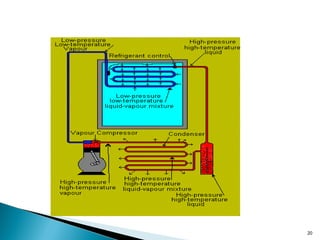
 The condenser or the cooler consists of coils of
pipe in which the high pressure & temp. vapour
refrigerant is cooled & condensed.
 The refrigerant while passing through the
condenser, rejects its latent heat to surrounding
condensing medium which is normally air or
water.
 Thus hot refrigerant vapour received from
compressor is converted into liquid form in
condenser.
15
 The condensed liquid refrigerant from the
condenser is stored in a vessel, known as
receiver, from where it is supplied to the
expansion valve or refrigerant control valve.
16
 The function of this valve is to allow the liquid
refrigerant under high pressure & temp. to pass at
a controlled rate after reducing its pressure &
temp.
 some of liquid refrigerant evaporates as it passes
through the expansion valve, but the greater
portion is vaporised in the evaporator at the low
pressure & temp.
17
 An evaporator consists of coils of pipes in which
the liquid vapour refrigerant at low pressure &
temp. is evaporated & changed into vapour
refrigerant at low pressure & temp.
 During evaporation process, the liquid vapour
refrigerant absorbs its latent heat of vaporization
from the medium which is to be cooled.
18
 The application of refrigeration for domestic
purposes are mainly in the form of domestic
refrigerators & home freezers.
 The main purpose of this type of refrigeration is to
provide low temp. for storage & distribution of
foods & drinks.
19
20
 In this system the refrigerant coming from
evaporate is absorbed by absorber.
 The ammonia is a very suitable refrigerant
for VAR system.
 Ammonia has characteristic as it easily
by water at low pressure and temperature,
but at high pressure and temperature, the
21
Solubility of ammonia in water is reduce.
 Therefore when mixture of water and ammonia is
heated by generator, the ammonia vapour is separated
from water.
 This principle is used in the vapour absorption
refrigeration system.
22
23
 The air refrigerator is one of the oldest type
of refrigerator.
 In this refrigerator air is refrigerant and
operator on bell coleman cycle.
 It consist of compressor, expander, cooler,
and cold storage.
24
25
26

Refrigeration system

  • 1.
  • 2.
     The mechanismused for lowering or producing low temp. in a body or a space, whose temp. is already below the temp. of its surrounding, is called the refrigeration system.  Here the heat is being generally pumped from low level to the higher one & is rejected at high temp. 2
  • 3.
     The termrefrigeration may be defined as the process of removing heat from a substance under controlled conditions.  It also includes the process of reducing heat & maintaining the temp. of a body below the general temp. of its surroundings. 3
  • 4.
     A refrigeratoris a reversed heat engine or a heat pump which takes out heat from a cold body & delivers it to a hot body.  The refrigerant is a heat carrying medium which during their cycle in a refrigeration system absorbs heat from a low temp. system & delivers it to a higher temp. system. 4
  • 5.
     NH3(AMMONIA)  Properties-Highly toxic,flammable,good thermal properties,highest refrigerant effect per kg of refrigerant.  uses- It is widely used in large industrial and commercial refrigeration system.it is mostly used with VAR system like ice plants,cold storage etc.  CO2(CARBON DIOXIDE)  Properties- colourless,non-toxic,and non- corrosive gas. 5
  • 6.
     Uses- Itis used in marine refrigeration system.  AIR  Properties- Easily available without cost,non- toxic,completely safe refrigerant.  Uses- It is used in aircraft air conditioning system.  R11(TRICHLORO MONOFLUORO METHANE)  Properties- Non-toxic,non-flammable,non- corrosive.  Uses- It is used in small office buildings and air conditioning. 6
  • 7.
     R12(DICHLARO-DIFURO METHANE) Properties- Non-toxic,non-flammable, non- explosive,most suitable refrigerant  Uses-It is used in domestic vapour compression refrigeration.  R22(MONOCHLORO-DIFLURO METHANE)  Properties- Non-toxic, non flammable, required less compressor displacement.  Uses- It is used in commercial and industrial low temperature applications. 7
  • 8.
     Vapour compressionrefrigeration system  Vapour absorption refrigeration system  Air refrigeration system 8
  • 9.
     This isthe most important system from the point of commercial & domestic utility & most practical form of refrigeration.  The working fluid refrigerant used in this refrigeration system readily evaporates & condenses or changes alternatively between the vapour & liquid phases without leaving the refrigerating plant 9
  • 10.
  • 11.
     During evaporationit absorbs heat from the cold body or in condensing or cooling it rejects heat to the external hot body .  The heat absorbed from cold body during evaporation is used as its latent heat for converting it from liquid to vapour.  Thus a cooling effect is created in working fluid. 11
  • 12.
     This systemof refrigeration thus act as latent heat pump since its pump its latent heat from the cold body or brine & rejects it or deliver it to the external hot body or the cooling medium.  According to the law of thermodynamics , this can be done only on the expenditure of energy which is supplied to the system in the form of electrical energy driving the compressor. 12
  • 13.
     Each cycleof operation consists of the four fundamental changes of state or processes:-  Expansion  Vaporization  Compression  Condensation 13
  • 14.
     The lowpressure & temp. refrigerant from evaporator is drawn into the compressor through the inlet or suction valve , where it is compressed to a high pressure & temp.  The high pressure & temp vapour refrigerant is discharged into the condenser through the delivery or discharge valve. 14
  • 15.
     The condenseror the cooler consists of coils of pipe in which the high pressure & temp. vapour refrigerant is cooled & condensed.  The refrigerant while passing through the condenser, rejects its latent heat to surrounding condensing medium which is normally air or water.  Thus hot refrigerant vapour received from compressor is converted into liquid form in condenser. 15
  • 16.
     The condensedliquid refrigerant from the condenser is stored in a vessel, known as receiver, from where it is supplied to the expansion valve or refrigerant control valve. 16
  • 17.
     The functionof this valve is to allow the liquid refrigerant under high pressure & temp. to pass at a controlled rate after reducing its pressure & temp.  some of liquid refrigerant evaporates as it passes through the expansion valve, but the greater portion is vaporised in the evaporator at the low pressure & temp. 17
  • 18.
     An evaporatorconsists of coils of pipes in which the liquid vapour refrigerant at low pressure & temp. is evaporated & changed into vapour refrigerant at low pressure & temp.  During evaporation process, the liquid vapour refrigerant absorbs its latent heat of vaporization from the medium which is to be cooled. 18
  • 19.
     The applicationof refrigeration for domestic purposes are mainly in the form of domestic refrigerators & home freezers.  The main purpose of this type of refrigeration is to provide low temp. for storage & distribution of foods & drinks. 19
  • 20.
  • 21.
     In thissystem the refrigerant coming from evaporate is absorbed by absorber.  The ammonia is a very suitable refrigerant for VAR system.  Ammonia has characteristic as it easily by water at low pressure and temperature, but at high pressure and temperature, the 21
  • 22.
    Solubility of ammoniain water is reduce.  Therefore when mixture of water and ammonia is heated by generator, the ammonia vapour is separated from water.  This principle is used in the vapour absorption refrigeration system. 22
  • 23.
  • 24.
     The airrefrigerator is one of the oldest type of refrigerator.  In this refrigerator air is refrigerant and operator on bell coleman cycle.  It consist of compressor, expander, cooler, and cold storage. 24
  • 25.
  • 26.