Heaven’s Light is our Guide
Rajshahi University of Engineering & Technology
Department of Mechanical Engineering
PAGE 1
One DimensionalHeat conductionEquation – Plane wall
Consider a thin element of thickness ∆xin a large plane wall as shown in
figure 1.1
Let,
The density of the wall = ρ
The specific heat = C, and
The area of the wall normalto the direction of heat transfer = A
Fig.1.1: One dimensional heat conduction through a volume element in a
large plane wall
An energy balance on this thin element during a small time interval ∆t can
be expressed as
(
𝑅𝑎𝑡𝑒 𝑜𝑓
ℎ𝑒𝑎𝑡
𝑐𝑜𝑛𝑑𝑢𝑐𝑡𝑖𝑜𝑛
𝑎𝑡 𝑥
) - (
𝑅𝑎𝑡𝑒 𝑜𝑓
ℎ𝑒𝑎𝑡
𝑐𝑜𝑛𝑑𝑢𝑐𝑡𝑖𝑜𝑛
𝑎𝑡 𝑥 + ∆𝑥
)+ (
𝑅𝑎𝑡𝑒 𝑜𝑓 ℎ𝑒𝑎𝑡
𝑔𝑒𝑛𝑒𝑟𝑎𝑡𝑖𝑜𝑛
𝑖𝑛𝑠𝑖𝑑𝑒 𝑡ℎ𝑒
𝑒𝑙𝑒𝑚𝑒𝑛𝑡
) = (
𝑅𝑎𝑡𝑒 𝑜𝑓 𝑐ℎ𝑎𝑛𝑒
𝑜𝑓 𝑡ℎ𝑒 𝑒𝑛𝑒𝑟𝑔𝑦
𝑐𝑜𝑛𝑡𝑒𝑛𝑡 𝑜𝑓 𝑡ℎ𝑒
𝑒𝑙𝑒𝑚𝑒𝑛𝑡
)
̇Q̇ x - Q̇ x+∆x + Ġ element =
∆𝐸 𝑒𝑙𝑒𝑚𝑒𝑛𝑡
∆𝑡
………………………………… (1.1)
PAGE 2
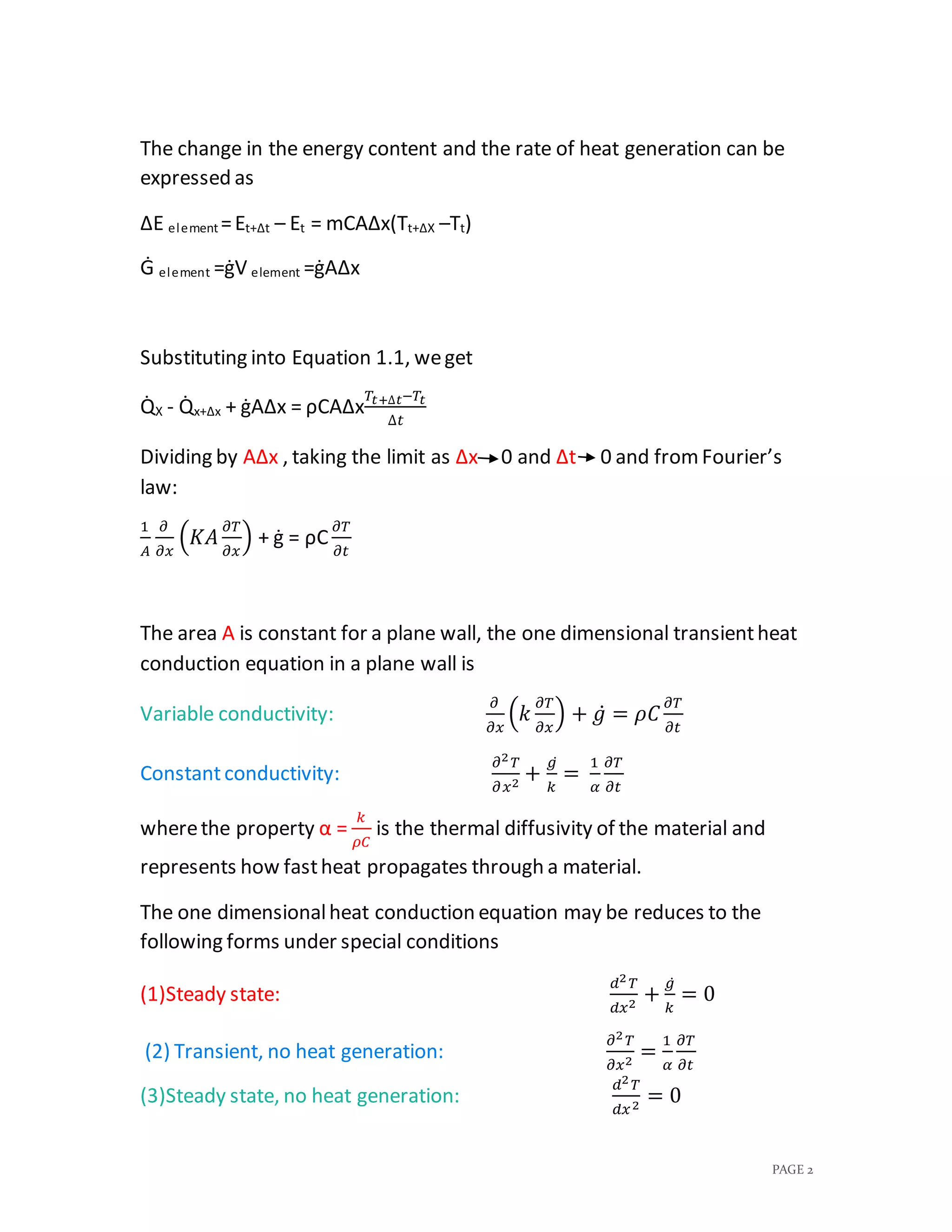
The change in the energy content and the rate of heat generation can be
expressed as
∆E element =Et+∆t – Et = mCA∆x(Tt+∆X –Tt)
Ġ element =ġV element =ġA∆x
Substituting into Equation 1.1, weget
Q̇ X - Q̇ x+∆x + ġA∆x = ρCA∆x
𝑇𝑡+∆𝑡−𝑇𝑡
∆𝑡
Dividing by A∆x , taking the limit as ∆x 0 and ∆t 0 and fromFourier’s
law:
1
𝐴
𝜕
𝜕𝑥
(𝐾𝐴
𝜕𝑇
𝜕𝑥
) + ġ = ρC
𝜕𝑇
𝜕𝑡
The area A is constant for a plane wall, the one dimensional transientheat
conduction equation in a plane wall is
Variable conductivity:
𝜕
𝜕𝑥
(𝑘
𝜕𝑇
𝜕𝑥
) + 𝑔̇ = 𝜌𝐶
𝜕𝑇
𝜕𝑡
Constantconductivity:
𝜕2 𝑇
𝜕𝑥2
+
𝑔̇̇
𝑘
=
1
𝛼
𝜕𝑇
𝜕𝑡
wherethe property α =
𝑘
𝜌𝐶
is the thermal diffusivity of the material and
represents how fastheat propagates through a material.
The one dimensionalheat conduction equation may be reduces to the
following forms under special conditions
(1)Steady state:
𝑑2 𝑇
𝑑𝑥2
+
𝑔̇̇
𝑘
= 0
(2) Transient, no heat generation:
𝜕2 𝑇
𝜕𝑥2
=
1
𝛼
𝜕𝑇
𝜕𝑡
(3)Steady state, no heat generation:
𝑑2 𝑇
𝑑𝑥2
= 0
PAGE 3
One Dimensional Heat Conduction Equation – Long Cylinder
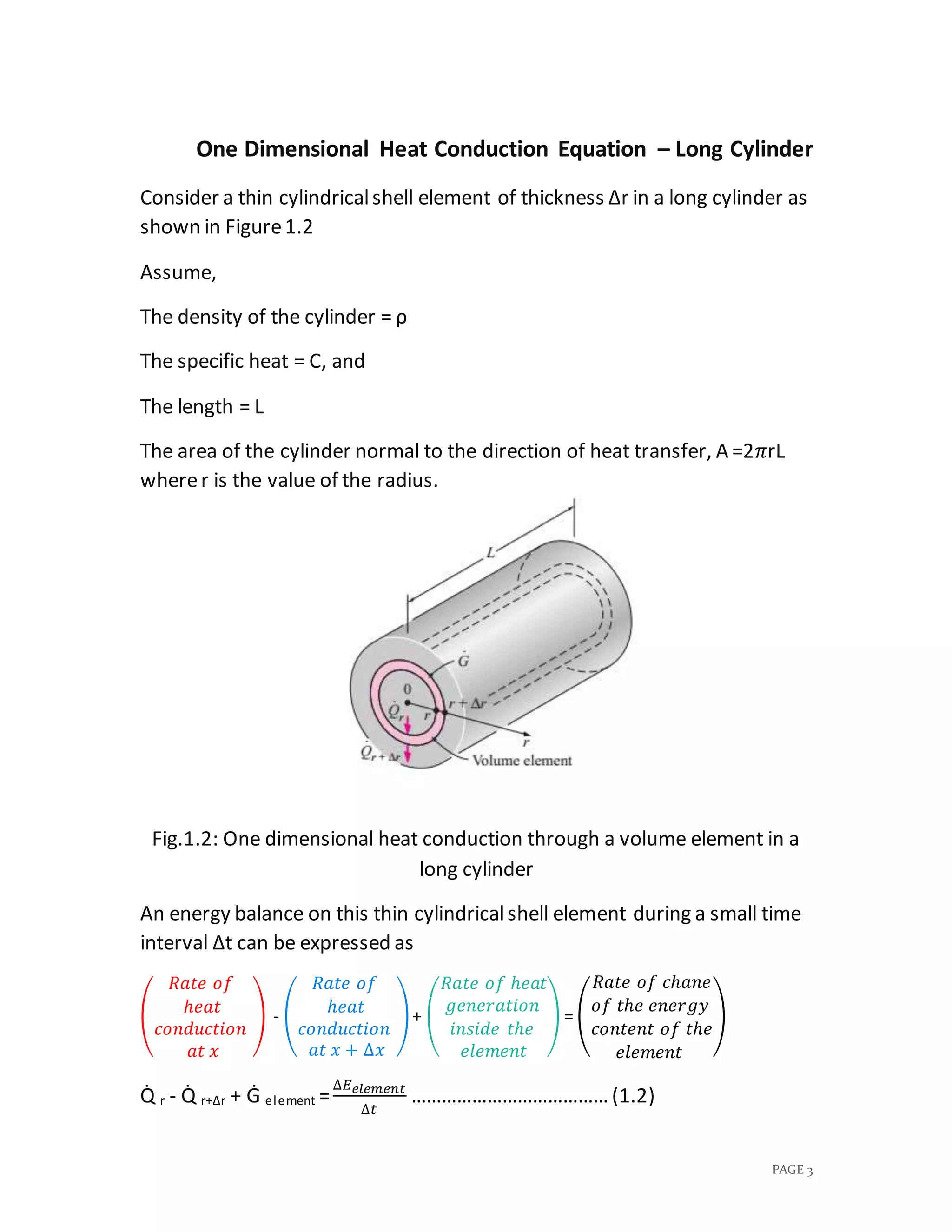
Consider a thin cylindricalshell element of thickness ∆r in a long cylinder as
shown in Figure1.2
Assume,
The density of the cylinder = ρ
The specific heat = C, and
The length = L
The area of the cylinder normal to the direction of heat transfer, A =2𝜋rL
wherer is the value of the radius.
Fig.1.2: One dimensional heat conduction through a volume element in a
long cylinder
An energy balance on this thin cylindricalshell element during a small time
interval ∆t can be expressed as
(
𝑅𝑎𝑡𝑒 𝑜𝑓
ℎ𝑒𝑎𝑡
𝑐𝑜𝑛𝑑𝑢𝑐𝑡𝑖𝑜𝑛
𝑎𝑡 𝑥
) - (
𝑅𝑎𝑡𝑒 𝑜𝑓
ℎ𝑒𝑎𝑡
𝑐𝑜𝑛𝑑𝑢𝑐𝑡𝑖𝑜𝑛
𝑎𝑡 𝑥 + ∆𝑥
)+ (
𝑅𝑎𝑡𝑒 𝑜𝑓 ℎ𝑒𝑎𝑡
𝑔𝑒𝑛𝑒𝑟𝑎𝑡𝑖𝑜𝑛
𝑖𝑛𝑠𝑖𝑑𝑒 𝑡ℎ𝑒
𝑒𝑙𝑒𝑚𝑒𝑛𝑡
) = (
𝑅𝑎𝑡𝑒 𝑜𝑓 𝑐ℎ𝑎𝑛𝑒
𝑜𝑓 𝑡ℎ𝑒 𝑒𝑛𝑒𝑟𝑔𝑦
𝑐𝑜𝑛𝑡𝑒𝑛𝑡 𝑜𝑓 𝑡ℎ𝑒
𝑒𝑙𝑒𝑚𝑒𝑛𝑡
)
Q̇ r - Q̇ r+∆r + Ġ element =
∆𝐸 𝑒𝑙𝑒𝑚𝑒𝑛𝑡
∆𝑡
………………………………… (1.2)
PAGE 4
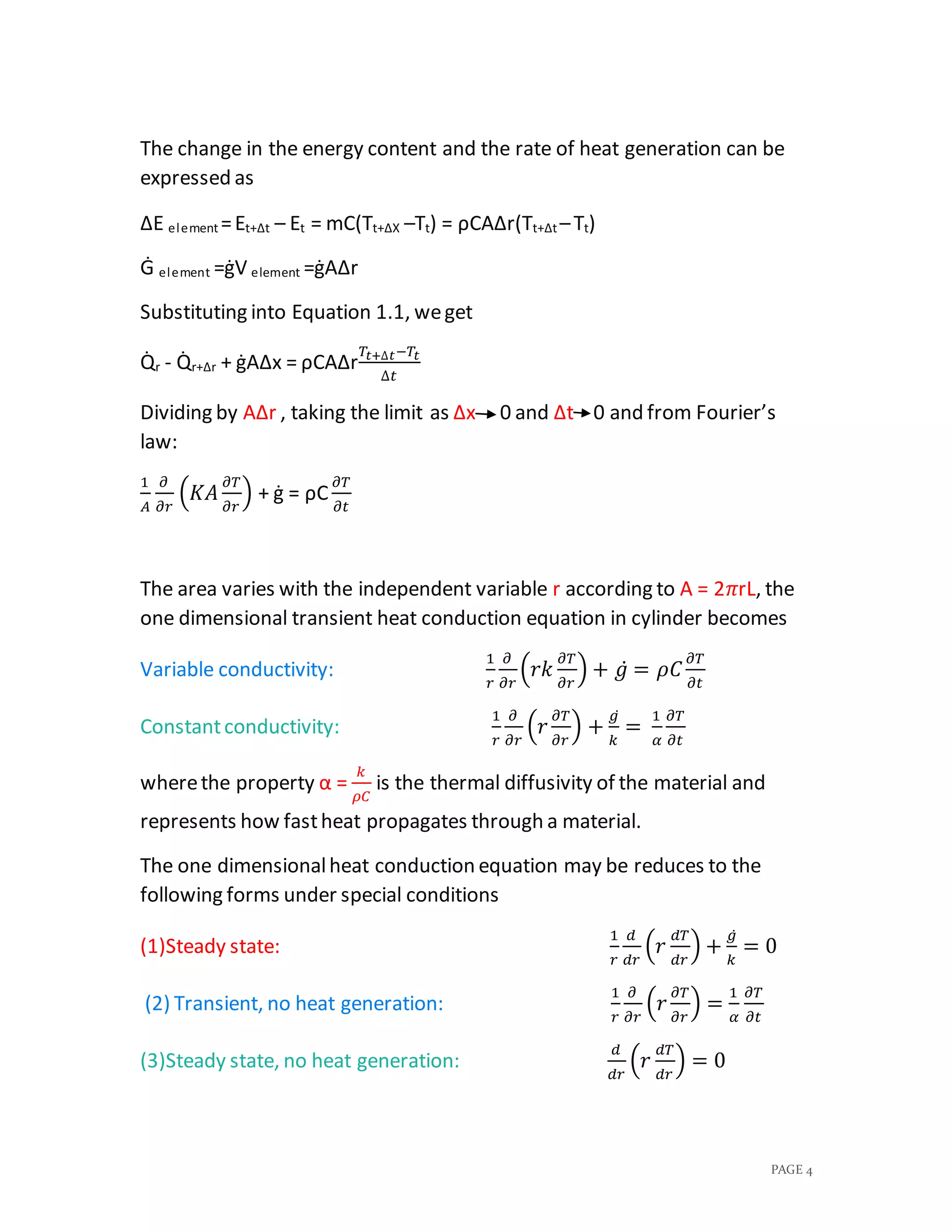
The change in the energy content and the rate of heat generation can be
expressed as
∆E element =Et+∆t – Et = mC(Tt+∆X –Tt) = ρCA∆r(Tt+∆t –Tt)
Ġ element =ġV element =ġA∆r
Substituting into Equation 1.1, weget
Q̇ r - Q̇ r+∆r + ġA∆x = ρCA∆r
𝑇𝑡+∆𝑡−𝑇𝑡
∆𝑡
Dividing by A∆r , taking the limit as ∆x 0 and ∆t 0 and from Fourier’s
law:
1
𝐴
𝜕
𝜕𝑟
(𝐾𝐴
𝜕𝑇
𝜕𝑟
) + ġ = ρC
𝜕𝑇
𝜕𝑡
The area varies with the independent variable r according to A = 2𝜋rL, the
one dimensional transient heat conduction equation in cylinder becomes
Variable conductivity:
1
𝑟
𝜕
𝜕𝑟
(𝑟𝑘
𝜕𝑇
𝜕𝑟
) + 𝑔̇ = 𝜌𝐶
𝜕𝑇
𝜕𝑡
Constantconductivity:
1
𝑟
𝜕
𝜕𝑟
(𝑟
𝜕𝑇
𝜕𝑟
) +
𝑔̇̇
𝑘
=
1
𝛼
𝜕𝑇
𝜕𝑡
wherethe property α =
𝑘
𝜌𝐶
is the thermal diffusivity of the material and
represents how fastheat propagates through a material.
The one dimensionalheat conduction equation may be reduces to the
following forms under special conditions
(1)Steady state:
1
𝑟
𝑑
𝑑𝑟
(𝑟
𝑑𝑇
𝑑𝑟
) +
𝑔̇̇
𝑘
= 0
(2) Transient, no heat generation:
1
𝑟
𝜕
𝜕𝑟
(𝑟
𝜕𝑇
𝜕𝑟
) =
1
𝛼
𝜕𝑇
𝜕𝑡
(3)Steady state, no heat generation:
𝑑
𝑑𝑟
(𝑟
𝑑𝑇
𝑑𝑟
) = 0
PAGE 5
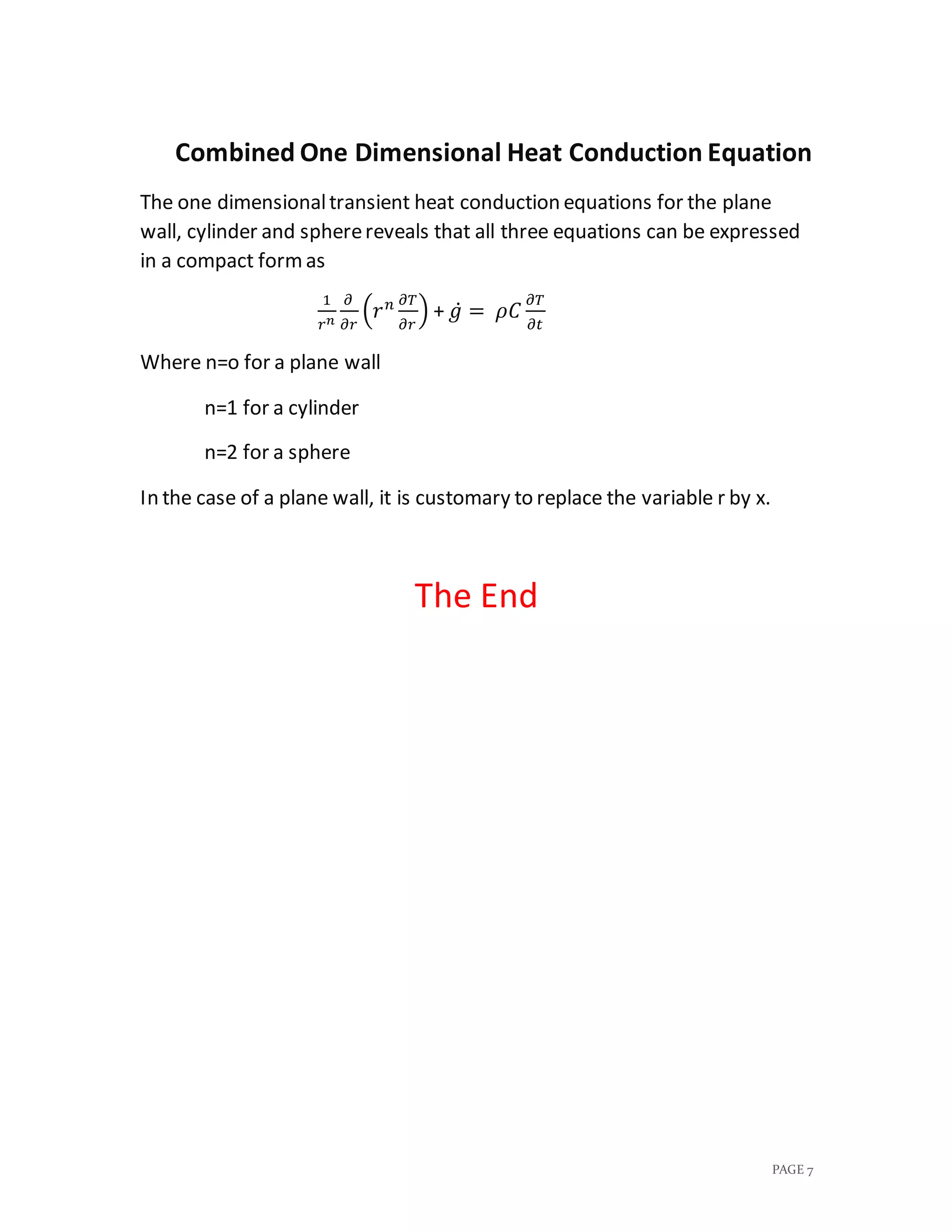
One Dimensional Heat Conduction Equation – Sphere
Consider a spherewith density ρ, specific heat C, and outer radius R. The
area of the sphere normalto the direction of heat transfer, A =4𝜋r2
where
r is the value of the radius.
Fig.1.3: One dimensional heat conduction through a volume element in a
sphere
An energy balance on this thin sphericalelement during a small time
interval ∆t can be expressed as
(
𝑅𝑎𝑡𝑒 𝑜𝑓
ℎ𝑒𝑎𝑡
𝑐𝑜𝑛𝑑𝑢𝑐𝑡𝑖𝑜𝑛
𝑎𝑡 𝑥
) - (
𝑅𝑎𝑡𝑒 𝑜𝑓
ℎ𝑒𝑎𝑡
𝑐𝑜𝑛𝑑𝑢𝑐𝑡𝑖𝑜𝑛
𝑎𝑡 𝑥 + ∆𝑥
)+ (
𝑅𝑎𝑡𝑒 𝑜𝑓 ℎ𝑒𝑎𝑡
𝑔𝑒𝑛𝑒𝑟𝑎𝑡𝑖𝑜𝑛
𝑖𝑛𝑠𝑖𝑑𝑒 𝑡ℎ𝑒
𝑒𝑙𝑒𝑚𝑒𝑛𝑡
) = (
𝑅𝑎𝑡𝑒 𝑜𝑓 𝑐ℎ𝑎𝑛𝑒
𝑜𝑓 𝑡ℎ𝑒 𝑒𝑛𝑒𝑟𝑔𝑦
𝑐𝑜𝑛𝑡𝑒𝑛𝑡 𝑜𝑓 𝑡ℎ𝑒
𝑒𝑙𝑒𝑚𝑒𝑛𝑡
)
Q̇ r - Q̇ r+∆r + Ġ element =
∆𝐸 𝑒𝑙𝑒𝑚𝑒𝑛𝑡
∆𝑡
………………………………… (1.3)
The change in the energy content and the rate of heat generation can be
expressed as
∆E element =Et+∆t – Et = mC(Tt+∆X –Tt) = ρCA∆r(Tt+∆t –Tt)
Ġ element =ġV element =ġA∆r
Substituting into Equation 1.1, weget
Q̇ r - Q̇ r+∆r + ġA∆x = ρCA∆r
𝑇𝑡+∆𝑡−𝑇𝑡
∆𝑡
PAGE 6
Dividing by A∆r , taking the limit as ∆x 0 and ∆t 0 and fromFourier’s law:
1
𝐴
𝜕
𝜕𝑟
(𝐾𝐴
𝜕𝑇
𝜕𝑟
) + ġ = ρC
𝜕𝑇
𝜕𝑡
The area varies with the independent variable r according to A = 4𝜋r2
, the
one dimensional transient heat conduction equation in sphere becomes
Variable conductivity:
1
𝑟2
𝜕
𝜕𝑟
(𝑟2
𝑘
𝜕𝑇
𝜕𝑟
) + 𝑔̇ = 𝜌𝐶
𝜕𝑇
𝜕𝑡
Constantconductivity:
1
𝑟2
𝜕
𝜕𝑟
(𝑟2 𝜕𝑇
𝜕𝑟
) +
𝑔̇̇
𝑘
=
1
𝛼
𝜕𝑇
𝜕𝑡
wherethe property α =
𝑘
𝜌𝐶
is the thermal diffusivity of the material and
represents how fastheat propagates through a material.
The one dimensionalheat conduction equation may be reduces to the
following forms under special conditions
(1)Steady state:
1
𝑟2
𝑑
𝑑𝑟
(𝑟2 𝑑𝑇
𝑑𝑟
) +
𝑔̇̇
𝑘
= 0
(2) Transient, no heat generation:
1
𝑟2
𝜕
𝜕𝑟
(𝑟2 𝜕𝑇
𝜕𝑟
) =
1
𝛼
𝜕𝑇
𝜕𝑡
(3)Steady state, no heat generation:
𝑑
𝑑𝑟
(𝑟2 𝑑𝑇
𝑑𝑟
) = 0
PAGE 7
Combined One Dimensional Heat Conduction Equation
The one dimensionaltransient heat conduction equations for the plane
wall, cylinder and spherereveals that all three equations can be expressed
in a compact formas
1
𝑟 𝑛
𝜕
𝜕𝑟
(𝑟 𝑛 𝜕𝑇
𝜕𝑟
) + 𝑔̇ = 𝜌𝐶
𝜕𝑇
𝜕𝑡
Where n=o for a plane wall
n=1 for a cylinder
n=2 for a sphere
In the case of a plane wall, it is customary to replace the variable r by x.
The End

One dimensional heat conduction equation

  • 1.
    Heaven’s Light isour Guide Rajshahi University of Engineering & Technology Department of Mechanical Engineering
  • 2.
    PAGE 1 One DimensionalHeatconductionEquation – Plane wall Consider a thin element of thickness ∆xin a large plane wall as shown in figure 1.1 Let, The density of the wall = ρ The specific heat = C, and The area of the wall normalto the direction of heat transfer = A Fig.1.1: One dimensional heat conduction through a volume element in a large plane wall An energy balance on this thin element during a small time interval ∆t can be expressed as ( 𝑅𝑎𝑡𝑒 𝑜𝑓 ℎ𝑒𝑎𝑡 𝑐𝑜𝑛𝑑𝑢𝑐𝑡𝑖𝑜𝑛 𝑎𝑡 𝑥 ) - ( 𝑅𝑎𝑡𝑒 𝑜𝑓 ℎ𝑒𝑎𝑡 𝑐𝑜𝑛𝑑𝑢𝑐𝑡𝑖𝑜𝑛 𝑎𝑡 𝑥 + ∆𝑥 )+ ( 𝑅𝑎𝑡𝑒 𝑜𝑓 ℎ𝑒𝑎𝑡 𝑔𝑒𝑛𝑒𝑟𝑎𝑡𝑖𝑜𝑛 𝑖𝑛𝑠𝑖𝑑𝑒 𝑡ℎ𝑒 𝑒𝑙𝑒𝑚𝑒𝑛𝑡 ) = ( 𝑅𝑎𝑡𝑒 𝑜𝑓 𝑐ℎ𝑎𝑛𝑒 𝑜𝑓 𝑡ℎ𝑒 𝑒𝑛𝑒𝑟𝑔𝑦 𝑐𝑜𝑛𝑡𝑒𝑛𝑡 𝑜𝑓 𝑡ℎ𝑒 𝑒𝑙𝑒𝑚𝑒𝑛𝑡 ) ̇Q̇ x - Q̇ x+∆x + Ġ element = ∆𝐸 𝑒𝑙𝑒𝑚𝑒𝑛𝑡 ∆𝑡 ………………………………… (1.1)
  • 3.
    PAGE 2 The changein the energy content and the rate of heat generation can be expressed as ∆E element =Et+∆t – Et = mCA∆x(Tt+∆X –Tt) Ġ element =ġV element =ġA∆x Substituting into Equation 1.1, weget Q̇ X - Q̇ x+∆x + ġA∆x = ρCA∆x 𝑇𝑡+∆𝑡−𝑇𝑡 ∆𝑡 Dividing by A∆x , taking the limit as ∆x 0 and ∆t 0 and fromFourier’s law: 1 𝐴 𝜕 𝜕𝑥 (𝐾𝐴 𝜕𝑇 𝜕𝑥 ) + ġ = ρC 𝜕𝑇 𝜕𝑡 The area A is constant for a plane wall, the one dimensional transientheat conduction equation in a plane wall is Variable conductivity: 𝜕 𝜕𝑥 (𝑘 𝜕𝑇 𝜕𝑥 ) + 𝑔̇ = 𝜌𝐶 𝜕𝑇 𝜕𝑡 Constantconductivity: 𝜕2 𝑇 𝜕𝑥2 + 𝑔̇̇ 𝑘 = 1 𝛼 𝜕𝑇 𝜕𝑡 wherethe property α = 𝑘 𝜌𝐶 is the thermal diffusivity of the material and represents how fastheat propagates through a material. The one dimensionalheat conduction equation may be reduces to the following forms under special conditions (1)Steady state: 𝑑2 𝑇 𝑑𝑥2 + 𝑔̇̇ 𝑘 = 0 (2) Transient, no heat generation: 𝜕2 𝑇 𝜕𝑥2 = 1 𝛼 𝜕𝑇 𝜕𝑡 (3)Steady state, no heat generation: 𝑑2 𝑇 𝑑𝑥2 = 0
  • 4.
    PAGE 3 One DimensionalHeat Conduction Equation – Long Cylinder Consider a thin cylindricalshell element of thickness ∆r in a long cylinder as shown in Figure1.2 Assume, The density of the cylinder = ρ The specific heat = C, and The length = L The area of the cylinder normal to the direction of heat transfer, A =2𝜋rL wherer is the value of the radius. Fig.1.2: One dimensional heat conduction through a volume element in a long cylinder An energy balance on this thin cylindricalshell element during a small time interval ∆t can be expressed as ( 𝑅𝑎𝑡𝑒 𝑜𝑓 ℎ𝑒𝑎𝑡 𝑐𝑜𝑛𝑑𝑢𝑐𝑡𝑖𝑜𝑛 𝑎𝑡 𝑥 ) - ( 𝑅𝑎𝑡𝑒 𝑜𝑓 ℎ𝑒𝑎𝑡 𝑐𝑜𝑛𝑑𝑢𝑐𝑡𝑖𝑜𝑛 𝑎𝑡 𝑥 + ∆𝑥 )+ ( 𝑅𝑎𝑡𝑒 𝑜𝑓 ℎ𝑒𝑎𝑡 𝑔𝑒𝑛𝑒𝑟𝑎𝑡𝑖𝑜𝑛 𝑖𝑛𝑠𝑖𝑑𝑒 𝑡ℎ𝑒 𝑒𝑙𝑒𝑚𝑒𝑛𝑡 ) = ( 𝑅𝑎𝑡𝑒 𝑜𝑓 𝑐ℎ𝑎𝑛𝑒 𝑜𝑓 𝑡ℎ𝑒 𝑒𝑛𝑒𝑟𝑔𝑦 𝑐𝑜𝑛𝑡𝑒𝑛𝑡 𝑜𝑓 𝑡ℎ𝑒 𝑒𝑙𝑒𝑚𝑒𝑛𝑡 ) Q̇ r - Q̇ r+∆r + Ġ element = ∆𝐸 𝑒𝑙𝑒𝑚𝑒𝑛𝑡 ∆𝑡 ………………………………… (1.2)
  • 5.
    PAGE 4 The changein the energy content and the rate of heat generation can be expressed as ∆E element =Et+∆t – Et = mC(Tt+∆X –Tt) = ρCA∆r(Tt+∆t –Tt) Ġ element =ġV element =ġA∆r Substituting into Equation 1.1, weget Q̇ r - Q̇ r+∆r + ġA∆x = ρCA∆r 𝑇𝑡+∆𝑡−𝑇𝑡 ∆𝑡 Dividing by A∆r , taking the limit as ∆x 0 and ∆t 0 and from Fourier’s law: 1 𝐴 𝜕 𝜕𝑟 (𝐾𝐴 𝜕𝑇 𝜕𝑟 ) + ġ = ρC 𝜕𝑇 𝜕𝑡 The area varies with the independent variable r according to A = 2𝜋rL, the one dimensional transient heat conduction equation in cylinder becomes Variable conductivity: 1 𝑟 𝜕 𝜕𝑟 (𝑟𝑘 𝜕𝑇 𝜕𝑟 ) + 𝑔̇ = 𝜌𝐶 𝜕𝑇 𝜕𝑡 Constantconductivity: 1 𝑟 𝜕 𝜕𝑟 (𝑟 𝜕𝑇 𝜕𝑟 ) + 𝑔̇̇ 𝑘 = 1 𝛼 𝜕𝑇 𝜕𝑡 wherethe property α = 𝑘 𝜌𝐶 is the thermal diffusivity of the material and represents how fastheat propagates through a material. The one dimensionalheat conduction equation may be reduces to the following forms under special conditions (1)Steady state: 1 𝑟 𝑑 𝑑𝑟 (𝑟 𝑑𝑇 𝑑𝑟 ) + 𝑔̇̇ 𝑘 = 0 (2) Transient, no heat generation: 1 𝑟 𝜕 𝜕𝑟 (𝑟 𝜕𝑇 𝜕𝑟 ) = 1 𝛼 𝜕𝑇 𝜕𝑡 (3)Steady state, no heat generation: 𝑑 𝑑𝑟 (𝑟 𝑑𝑇 𝑑𝑟 ) = 0
  • 6.
    PAGE 5 One DimensionalHeat Conduction Equation – Sphere Consider a spherewith density ρ, specific heat C, and outer radius R. The area of the sphere normalto the direction of heat transfer, A =4𝜋r2 where r is the value of the radius. Fig.1.3: One dimensional heat conduction through a volume element in a sphere An energy balance on this thin sphericalelement during a small time interval ∆t can be expressed as ( 𝑅𝑎𝑡𝑒 𝑜𝑓 ℎ𝑒𝑎𝑡 𝑐𝑜𝑛𝑑𝑢𝑐𝑡𝑖𝑜𝑛 𝑎𝑡 𝑥 ) - ( 𝑅𝑎𝑡𝑒 𝑜𝑓 ℎ𝑒𝑎𝑡 𝑐𝑜𝑛𝑑𝑢𝑐𝑡𝑖𝑜𝑛 𝑎𝑡 𝑥 + ∆𝑥 )+ ( 𝑅𝑎𝑡𝑒 𝑜𝑓 ℎ𝑒𝑎𝑡 𝑔𝑒𝑛𝑒𝑟𝑎𝑡𝑖𝑜𝑛 𝑖𝑛𝑠𝑖𝑑𝑒 𝑡ℎ𝑒 𝑒𝑙𝑒𝑚𝑒𝑛𝑡 ) = ( 𝑅𝑎𝑡𝑒 𝑜𝑓 𝑐ℎ𝑎𝑛𝑒 𝑜𝑓 𝑡ℎ𝑒 𝑒𝑛𝑒𝑟𝑔𝑦 𝑐𝑜𝑛𝑡𝑒𝑛𝑡 𝑜𝑓 𝑡ℎ𝑒 𝑒𝑙𝑒𝑚𝑒𝑛𝑡 ) Q̇ r - Q̇ r+∆r + Ġ element = ∆𝐸 𝑒𝑙𝑒𝑚𝑒𝑛𝑡 ∆𝑡 ………………………………… (1.3) The change in the energy content and the rate of heat generation can be expressed as ∆E element =Et+∆t – Et = mC(Tt+∆X –Tt) = ρCA∆r(Tt+∆t –Tt) Ġ element =ġV element =ġA∆r Substituting into Equation 1.1, weget Q̇ r - Q̇ r+∆r + ġA∆x = ρCA∆r 𝑇𝑡+∆𝑡−𝑇𝑡 ∆𝑡
  • 7.
    PAGE 6 Dividing byA∆r , taking the limit as ∆x 0 and ∆t 0 and fromFourier’s law: 1 𝐴 𝜕 𝜕𝑟 (𝐾𝐴 𝜕𝑇 𝜕𝑟 ) + ġ = ρC 𝜕𝑇 𝜕𝑡 The area varies with the independent variable r according to A = 4𝜋r2 , the one dimensional transient heat conduction equation in sphere becomes Variable conductivity: 1 𝑟2 𝜕 𝜕𝑟 (𝑟2 𝑘 𝜕𝑇 𝜕𝑟 ) + 𝑔̇ = 𝜌𝐶 𝜕𝑇 𝜕𝑡 Constantconductivity: 1 𝑟2 𝜕 𝜕𝑟 (𝑟2 𝜕𝑇 𝜕𝑟 ) + 𝑔̇̇ 𝑘 = 1 𝛼 𝜕𝑇 𝜕𝑡 wherethe property α = 𝑘 𝜌𝐶 is the thermal diffusivity of the material and represents how fastheat propagates through a material. The one dimensionalheat conduction equation may be reduces to the following forms under special conditions (1)Steady state: 1 𝑟2 𝑑 𝑑𝑟 (𝑟2 𝑑𝑇 𝑑𝑟 ) + 𝑔̇̇ 𝑘 = 0 (2) Transient, no heat generation: 1 𝑟2 𝜕 𝜕𝑟 (𝑟2 𝜕𝑇 𝜕𝑟 ) = 1 𝛼 𝜕𝑇 𝜕𝑡 (3)Steady state, no heat generation: 𝑑 𝑑𝑟 (𝑟2 𝑑𝑇 𝑑𝑟 ) = 0
  • 8.
    PAGE 7 Combined OneDimensional Heat Conduction Equation The one dimensionaltransient heat conduction equations for the plane wall, cylinder and spherereveals that all three equations can be expressed in a compact formas 1 𝑟 𝑛 𝜕 𝜕𝑟 (𝑟 𝑛 𝜕𝑇 𝜕𝑟 ) + 𝑔̇ = 𝜌𝐶 𝜕𝑇 𝜕𝑡 Where n=o for a plane wall n=1 for a cylinder n=2 for a sphere In the case of a plane wall, it is customary to replace the variable r by x. The End