Heat and mass transfer One Dimensional Transient Heat Conduction
Yashawantha K M, Dept. of Marine Engineering, SIT, Mangaluru Page 1
ONE DIMENSIONAL TRANSIENT HEAT CONDUCTION
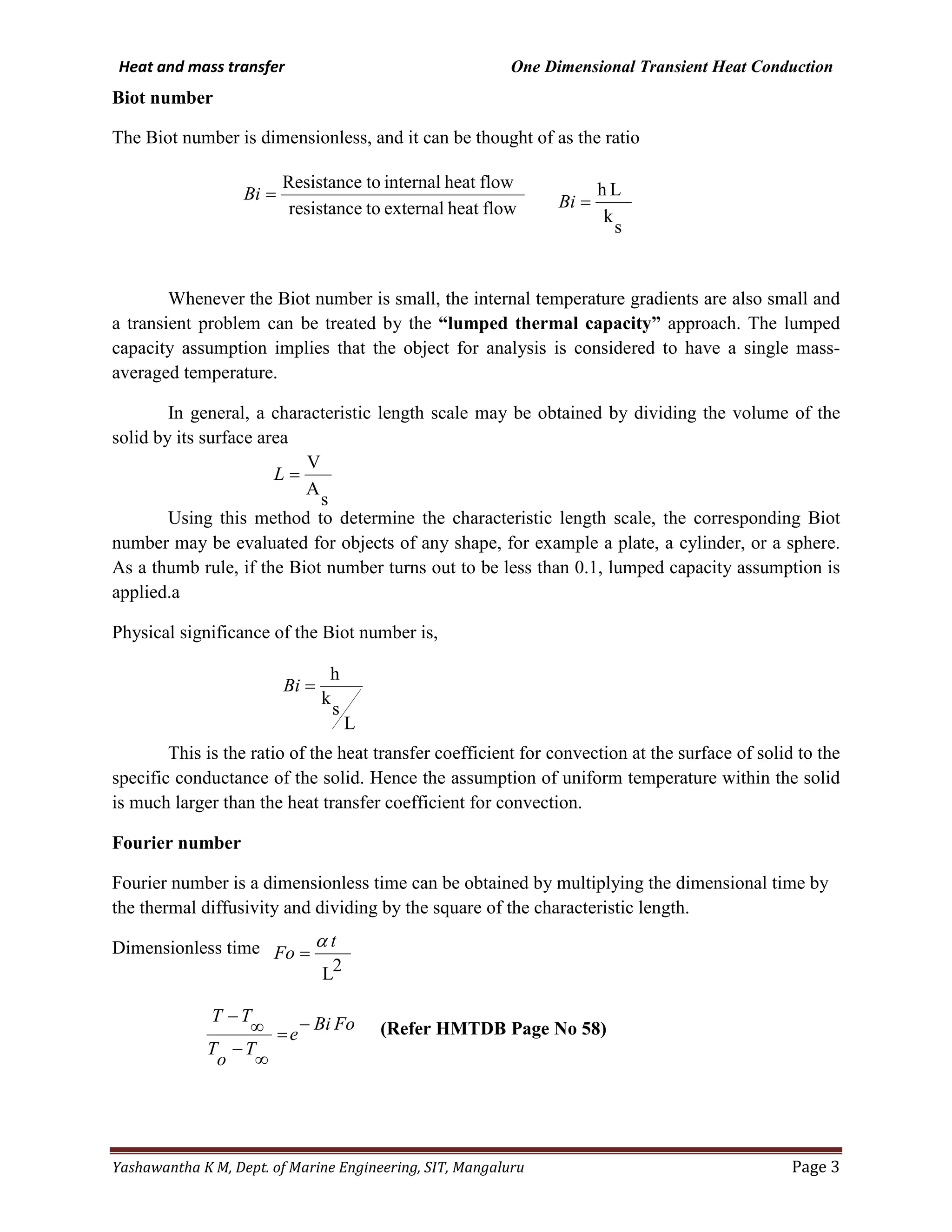
Introduction
To this point, we have considered conductive heat transfer problems in which the
temperatures are independent of time. In many applications, however, the temperatures are
varying with time, and we require the understanding of the complete time history of the
temperature variation.
For example, in metallurgy, the heat treating process can be controlled to directly affect
the characteristics of the processed materials. Annealing (slow cool) can soften metals and
improve ductility. On the other hand, quenching (rapid cool) can harden the strain boundary and
increase strength. In order to characterize this transient behavior, the full unsteady equation is
needed:
where is the thermal diffusivity. Without any heat generation and considering
spatial variation of temperature only in x-direction, the above equation reduces to:
For the solution of equation, we need two boundary conditions in x-direction and one initial
condition. Boundary conditions, as the name implies, are frequently specified along the physical
boundary of an object; they can, however, also be internal – e.g. a known temperature gradient at
an internal line of symmetry.
The simplest situation in an unsteady heat transfer process is to use the lumped capacity
assumption, wherein we neglect the temperature distribution inside the solid and only deal with
the heat transfer between the solid and the ambient fluids. In other words, we are assuming that
the temperature inside the solid is constant and is equal to the surface temperature.
The solid object shown in figure is a metal piece which is being cooled in air after hot
forming. Thermal energy is leaving the object from all elements of the surface, and this is shown
for simplicity by a single arrow.
The first law of thermodynamics applied to this problem is
t
T
k
g
q
z
T
y
T
x
T
∂
∂
=+
∂
∂
+
∂
∂
+
∂
∂
α
1
2
2
2
2
2
2
p
c
k
ρ
α =
t
T
x
T
∂
∂
=
∂
∂
α
1
2
2
)(
∞
−= TT
s
hAQ
o
T
Heat and mass transfer One Dimensional Transient Heat Conduction
Yashawantha K M, Dept. of Marine Engineering, SIT, Mangaluru Page 2
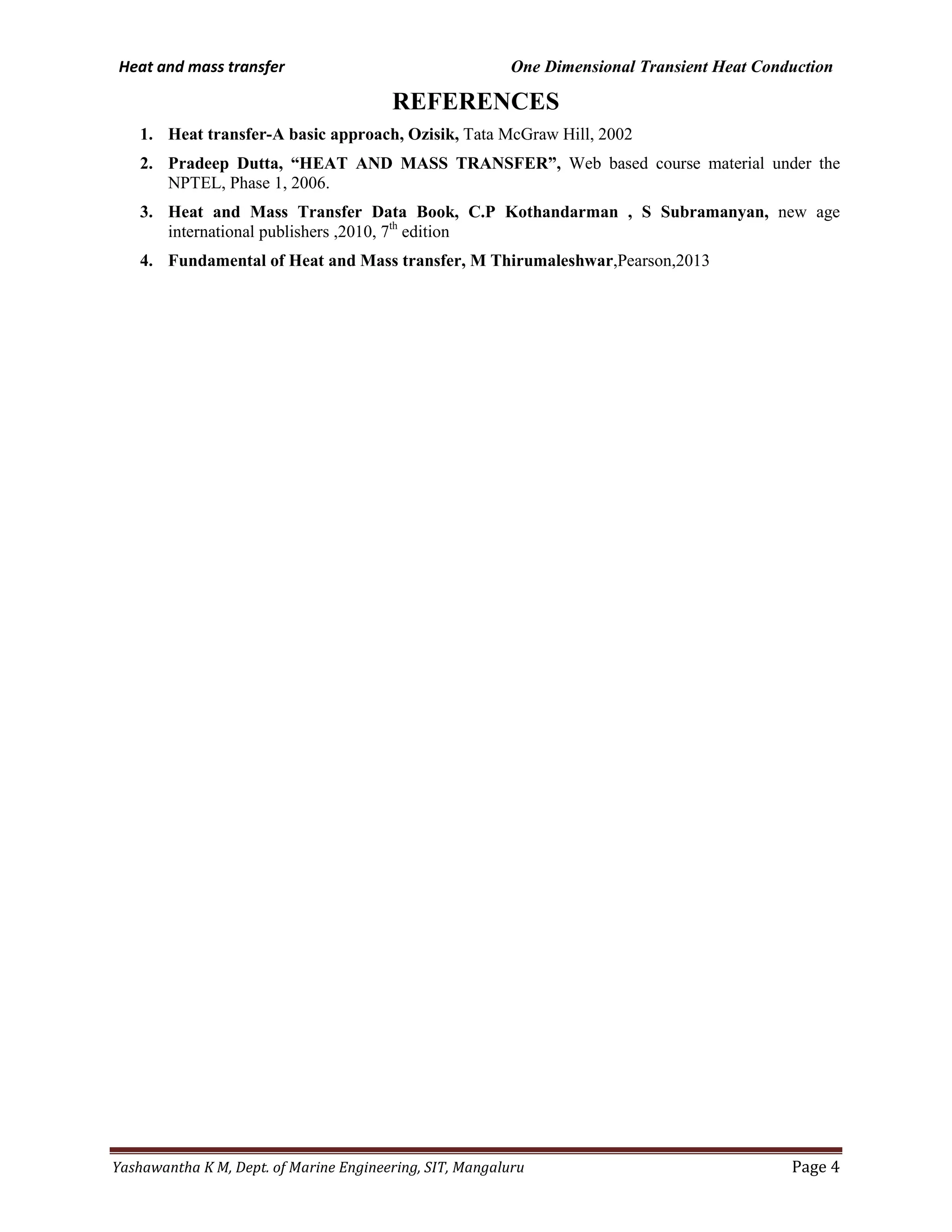
[Heat out of the object during time dt] = [decrease of internal thermal energy of
object during time dt]
Let consider that a solid f arbitrary shape volume v, total surface area As, thermal conductivity ks,
density ρ , specific heat c. uniform temperature To is suddenly immersed at the time t=0 in a well stirred
fluid which is kept at a uniform temperature
∞
T as shown in figure
The above equation is an ordinal differential equation for the temperature θ (t) and its
general solution given as,
By boundary condition,
(Refer HMTDB Page No 58)
dt
dT
VcTTh
s
A ρ=−
∞
)(
dt
dT
TT
Vc
h
s
A
=−
∞
)(
ρ
)( TT
Vc
h
s
A
dt
dT
−
∞
−=
ρ
)(
∞
−= TT
Vc
h
s
A
dt
dT
ρ
0)( =
∞
−− TT
Vc
h
s
A
dt
dT
ρ
Vc
h
s
A
m
ρ
=
0)( =
∞
−− TTm
dt
dT θ=
∞
−TT
dt
d
dt
dT θ
=0=− θ
θ
m
dt
d
mtCet −=)(θ
0==
∞
− tat
o
T
o
T θ
Co=θ
mtet o
−=θθ )(
mte
o
t −=
θ
θ )(
mte
T
o
T
TT
−=
∞
−
∞
−
Heat and mass transfer One Dimensional Transient Heat Conduction
Yashawantha K M, Dept. of Marine Engineering, SIT, Mangaluru Page 3
Biot number
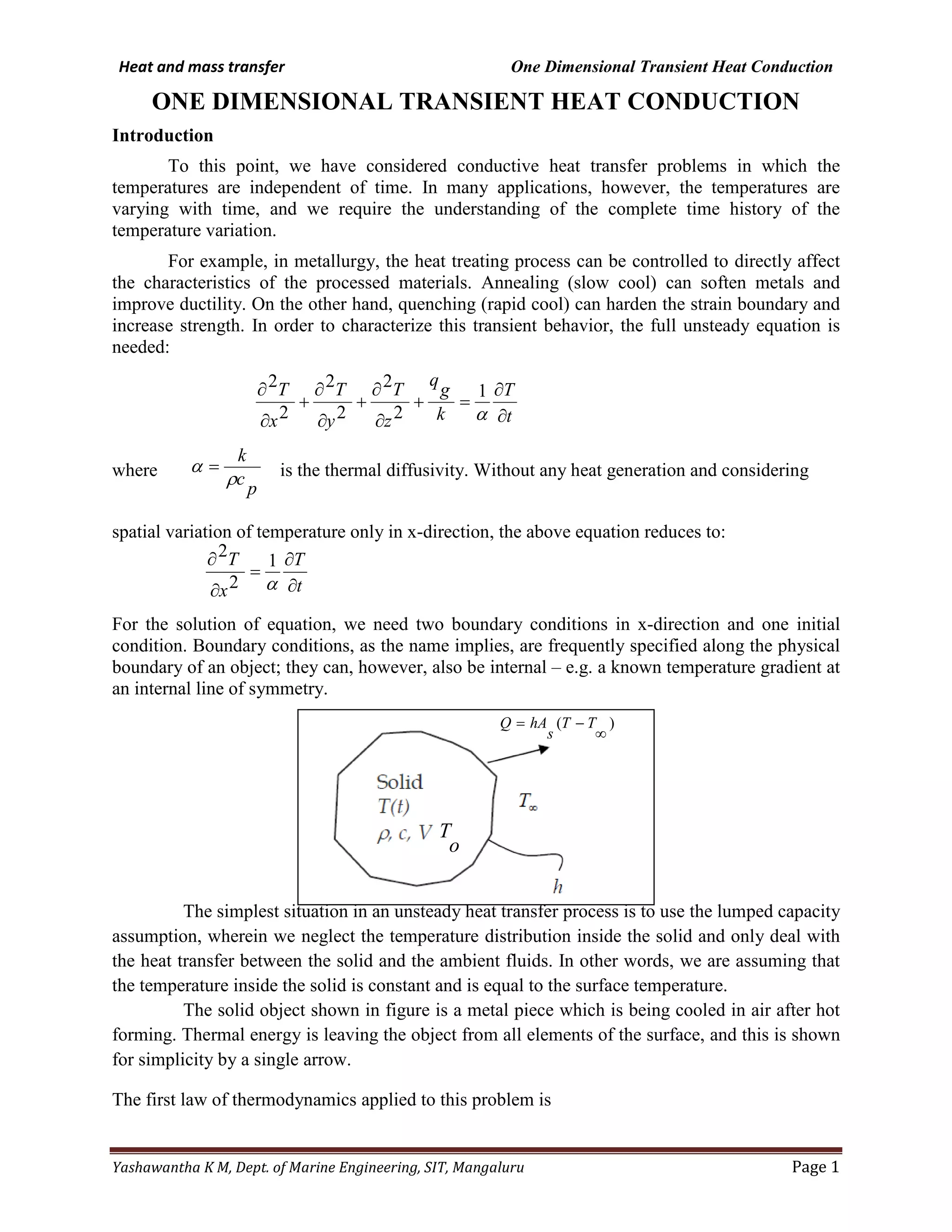
The Biot number is dimensionless, and it can be thought of as the ratio
Whenever the Biot number is small, the internal temperature gradients are also small and
a transient problem can be treated by the “lumped thermal capacity” approach. The lumped
capacity assumption implies that the object for analysis is considered to have a single mass-
averaged temperature.
In general, a characteristic length scale may be obtained by dividing the volume of the
solid by its surface area
Using this method to determine the characteristic length scale, the corresponding Biot
number may be evaluated for objects of any shape, for example a plate, a cylinder, or a sphere.
As a thumb rule, if the Biot number turns out to be less than 0.1, lumped capacity assumption is
applied.a
Physical significance of the Biot number is,
This is the ratio of the heat transfer coefficient for convection at the surface of solid to the
specific conductance of the solid. Hence the assumption of uniform temperature within the solid
is much larger than the heat transfer coefficient for convection.
Fourier number
Fourier number is a dimensionless time can be obtained by multiplying the dimensional time by
the thermal diffusivity and dividing by the square of the characteristic length.
Dimensionless time
(Refer HMTDB Page No 58)
flowheatexternaltoresistance
flowheatinternaltoResistance
=Bi
s
k
Lh
=Bi
s
A
V
=L
L
s
k
h
=Bi
2L
t
Fo
α
=
FoBi
e
T
o
T
TT −
=
∞
−
∞
−
Heat and mass transfer One Dimensional Transient Heat Conduction
Yashawantha K M, Dept. of Marine Engineering, SIT, Mangaluru Page 4
REFERENCES
1. Heat transfer-A basic approach, Ozisik, Tata McGraw Hill, 2002
2. Pradeep Dutta, “HEAT AND MASS TRANSFER”, Web based course material under the
NPTEL, Phase 1, 2006.
3. Heat and Mass Transfer Data Book, C.P Kothandarman , S Subramanyan, new age
international publishers ,2010, 7th
edition
4. Fundamental of Heat and Mass transfer, M Thirumaleshwar,Pearson,2013

Unit 3 transient heat condution

  • 1.
    Heat and masstransfer One Dimensional Transient Heat Conduction Yashawantha K M, Dept. of Marine Engineering, SIT, Mangaluru Page 1 ONE DIMENSIONAL TRANSIENT HEAT CONDUCTION Introduction To this point, we have considered conductive heat transfer problems in which the temperatures are independent of time. In many applications, however, the temperatures are varying with time, and we require the understanding of the complete time history of the temperature variation. For example, in metallurgy, the heat treating process can be controlled to directly affect the characteristics of the processed materials. Annealing (slow cool) can soften metals and improve ductility. On the other hand, quenching (rapid cool) can harden the strain boundary and increase strength. In order to characterize this transient behavior, the full unsteady equation is needed: where is the thermal diffusivity. Without any heat generation and considering spatial variation of temperature only in x-direction, the above equation reduces to: For the solution of equation, we need two boundary conditions in x-direction and one initial condition. Boundary conditions, as the name implies, are frequently specified along the physical boundary of an object; they can, however, also be internal – e.g. a known temperature gradient at an internal line of symmetry. The simplest situation in an unsteady heat transfer process is to use the lumped capacity assumption, wherein we neglect the temperature distribution inside the solid and only deal with the heat transfer between the solid and the ambient fluids. In other words, we are assuming that the temperature inside the solid is constant and is equal to the surface temperature. The solid object shown in figure is a metal piece which is being cooled in air after hot forming. Thermal energy is leaving the object from all elements of the surface, and this is shown for simplicity by a single arrow. The first law of thermodynamics applied to this problem is t T k g q z T y T x T ∂ ∂ =+ ∂ ∂ + ∂ ∂ + ∂ ∂ α 1 2 2 2 2 2 2 p c k ρ α = t T x T ∂ ∂ = ∂ ∂ α 1 2 2 )( ∞ −= TT s hAQ o T
  • 2.
    Heat and masstransfer One Dimensional Transient Heat Conduction Yashawantha K M, Dept. of Marine Engineering, SIT, Mangaluru Page 2 [Heat out of the object during time dt] = [decrease of internal thermal energy of object during time dt] Let consider that a solid f arbitrary shape volume v, total surface area As, thermal conductivity ks, density ρ , specific heat c. uniform temperature To is suddenly immersed at the time t=0 in a well stirred fluid which is kept at a uniform temperature ∞ T as shown in figure The above equation is an ordinal differential equation for the temperature θ (t) and its general solution given as, By boundary condition, (Refer HMTDB Page No 58) dt dT VcTTh s A ρ=− ∞ )( dt dT TT Vc h s A =− ∞ )( ρ )( TT Vc h s A dt dT − ∞ −= ρ )( ∞ −= TT Vc h s A dt dT ρ 0)( = ∞ −− TT Vc h s A dt dT ρ Vc h s A m ρ = 0)( = ∞ −− TTm dt dT θ= ∞ −TT dt d dt dT θ =0=− θ θ m dt d mtCet −=)(θ 0== ∞ − tat o T o T θ Co=θ mtet o −=θθ )( mte o t −= θ θ )( mte T o T TT −= ∞ − ∞ −
  • 3.
    Heat and masstransfer One Dimensional Transient Heat Conduction Yashawantha K M, Dept. of Marine Engineering, SIT, Mangaluru Page 3 Biot number The Biot number is dimensionless, and it can be thought of as the ratio Whenever the Biot number is small, the internal temperature gradients are also small and a transient problem can be treated by the “lumped thermal capacity” approach. The lumped capacity assumption implies that the object for analysis is considered to have a single mass- averaged temperature. In general, a characteristic length scale may be obtained by dividing the volume of the solid by its surface area Using this method to determine the characteristic length scale, the corresponding Biot number may be evaluated for objects of any shape, for example a plate, a cylinder, or a sphere. As a thumb rule, if the Biot number turns out to be less than 0.1, lumped capacity assumption is applied.a Physical significance of the Biot number is, This is the ratio of the heat transfer coefficient for convection at the surface of solid to the specific conductance of the solid. Hence the assumption of uniform temperature within the solid is much larger than the heat transfer coefficient for convection. Fourier number Fourier number is a dimensionless time can be obtained by multiplying the dimensional time by the thermal diffusivity and dividing by the square of the characteristic length. Dimensionless time (Refer HMTDB Page No 58) flowheatexternaltoresistance flowheatinternaltoResistance =Bi s k Lh =Bi s A V =L L s k h =Bi 2L t Fo α = FoBi e T o T TT − = ∞ − ∞ −
  • 4.
    Heat and masstransfer One Dimensional Transient Heat Conduction Yashawantha K M, Dept. of Marine Engineering, SIT, Mangaluru Page 4 REFERENCES 1. Heat transfer-A basic approach, Ozisik, Tata McGraw Hill, 2002 2. Pradeep Dutta, “HEAT AND MASS TRANSFER”, Web based course material under the NPTEL, Phase 1, 2006. 3. Heat and Mass Transfer Data Book, C.P Kothandarman , S Subramanyan, new age international publishers ,2010, 7th edition 4. Fundamental of Heat and Mass transfer, M Thirumaleshwar,Pearson,2013