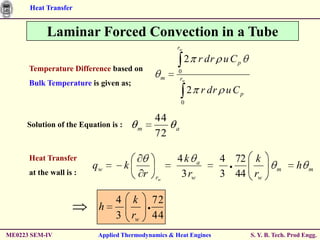
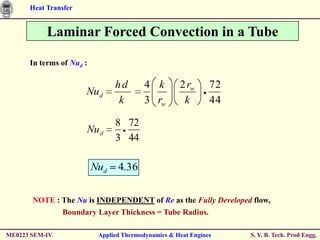
Heat Transfer


                      Heat Transfer


  Applied Thermodynamics & Heat Engines

                                  S.Y. B. Tech.
                              ME0223 SEM - IV
                          Production Engineering

ME0223 SEM-IV         Applied Thermodynamics & Heat Engines   S. Y. B. Tech. Prod Engg.
Heat Transfer


                                        Outline

  •   One – Dimensional Steady State Heat Transfer by conduction through plane wall,
      Radial Heat Transfer by Conduction through hollow Cylinder / Sphere. Conduction
      through Composite Plane and Cylindrical Wall.


  •   Heat flow by Convection. Free and Forced Convection. Nusselt, Reynolds and Prandtl
      Numbers. Heat Transfer between two fluids separated by Composite Plane and
      Cylindrical wall. Overall Heat Transfer Coefficient.


  •   Heat Exchangers, types of Heat Exchangers, Log Mean Temperature Difference.


  •   Radiation Heat Transfer, Absorptivity, Reflectivity and Transmissivity, Monochromatic
      Emissive Power, Wein’s Law, Stefan-Boltzman’s Law and Kirchoff’s Law.


ME0223 SEM-IV             Applied Thermodynamics & Heat Engines         S. Y. B. Tech. Prod Engg.
Heat Transfer


                                    Heat Transfer

  HEAT TRANSFER is a science that seeks to predict the energy transfer that may
  take place between material bodies, as a result of temperature difference.


  Heat Transfer RATE is the desired objective of an analysis that points out the
  difference between Heat Transfer and Thermodynamics.


  Thermodynamics is dealt with equilibrium, and does not predict how fast the
  change will take place.


  Heat Transfer supplements the First and Second Laws of Thermodynamics, with
  additional rules to analyse the Energy Transfer RATES.


ME0223 SEM-IV               Applied Thermodynamics & Heat Engines      S. Y. B. Tech. Prod Engg.
Heat Transfer


                        Conduction Heat Transfer
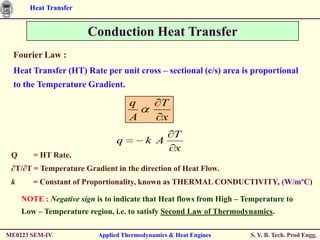
  Fourier Law :
  Heat Transfer (HT) Rate per unit cross – sectional (c/s) area is proportional
  to the Temperature Gradient.

                                     q         T
                                     A         x
                                                   T
                                 q        k A
                                                   x
 Q      = HT Rate,
 ∂T/∂T = Temperature Gradient in the direction of Heat Flow.
 k      = Constant of Proportionality, known as THERMAL CONDUCTIVITY, (W/mºC)

     NOTE : Negative sign is to indicate that Heat flows from High – Temperature to
     Low – Temperature region, i.e. to satisfy Second Law of Thermodynamics.

ME0223 SEM-IV              Applied Thermodynamics & Heat Engines      S. Y. B. Tech. Prod Engg.
Heat Transfer


                        Conduction Heat Transfer
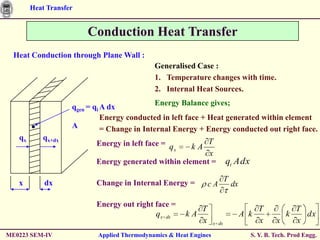
  Heat Conduction through Plane Wall :
                                             Generalised Case :
                                             1. Temperature changes with time.
                                             2. Internal Heat Sources.
                                              Energy Balance gives;
                    qgen = qi A dx
                              Energy conducted in left face + Heat generated within element
                    A         = Change in Internal Energy + Energy conducted out right face.
   qx       qx+dx                                         T
                           Energy in left face = q       kA
                                                   x
                                                          x
                           Energy generated within element =              qi A dx
                                                                          T
   x        dx             Change in Internal Energy =           cA           dx

                           Energy out right face =
                                                             T                           T            T
                                            qx dx      kA                          A k            k     dx
                                                             x     x dx                  x    x       x
ME0223 SEM-IV              Applied Thermodynamics & Heat Engines                     S. Y. B. Tech. Prod Engg.
Heat Transfer


                         Conduction Heat Transfer
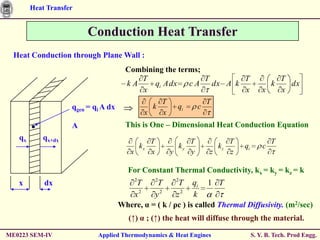
  Heat Conduction through Plane Wall :
                                       Combining the terms;
                                          T                  T        T                             T
                                       kA     qi A dx    cA    dx A k                           k     dx
                                          x                           x                     x       x
                                                 T           T
                    qgen = qi A dx           k        qi   c
                                           x     x
                    A                  This is One – Dimensional Heat Conduction Equation
   qx       qx+dx                                    T            T            T                T
                                                kx           ky           kz       qi       c
                                        x            x   y        y   z        z

                                        For Constant Thermal Conductivity, kx = ky = kz = k
                                            2  2       2
   x        dx                           T      T       T qi 1 T
                                        x2     y2      z2 k
                                     Where, α = ( k / ρc ) is called Thermal Diffusivity. (m2/sec)
                                        (↑) α ; (↑) the heat will diffuse through the material.

ME0223 SEM-IV               Applied Thermodynamics & Heat Engines                       S. Y. B. Tech. Prod Engg.
Heat Transfer


                      Conduction Heat Transfer
                                         2                    2             2
                                          T       1 T    1    T              T       qi    1 T
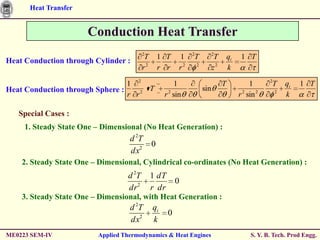
Heat Conduction through Cylinder :
                                         r2       r r    r2       2
                                                                            z2       k

                                 1 2                    1                        T             1      2
                                                                                                       T      qi   1 T
Heat Conduction through Sphere :      rT                              sin
                                 r r2              r 2 sin                                r 2 sin 2       2
                                                                                                              k

   Special Cases :
     1. Steady State One – Dimensional (No Heat Generation) :
                                   d 2T
                                              0
                                   dx2
    2. Steady State One – Dimensional, Cylindrical co-ordinates (No Heat Generation) :
                                  d 2T        1 dT
                                                         0
                                  dr 2        r dr
    3. Steady State One – Dimensional, with Heat Generation :
                                   d 2T       qi
                                                     0
                                   dx2        k
ME0223 SEM-IV            Applied Thermodynamics & Heat Engines                                 S. Y. B. Tech. Prod Engg.
Heat Transfer


                          Thermal Conductivity

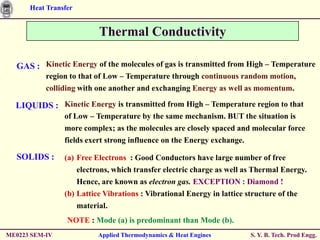
  GAS : Kinetic Energy of the molecules of gas is transmitted from High – Temperature
           region to that of Low – Temperature through continuous random motion,
           colliding with one another and exchanging Energy as well as momentum.

  LIQUIDS : Kinetic Energy is transmitted from High – Temperature region to that
                of Low – Temperature by the same mechanism. BUT the situation is
                more complex; as the molecules are closely spaced and molecular force
                fields exert strong influence on the Energy exchange.

  SOLIDS :      (a) Free Electrons : Good Conductors have large number of free
                    electrons, which transfer electric charge as well as Thermal Energy.
                    Hence, are known as electron gas. EXCEPTION : Diamond !
                (b) Lattice Vibrations : Vibrational Energy in lattice structure of the
                    material.
                 NOTE : Mode (a) is predominant than Mode (b).
ME0223 SEM-IV            Applied Thermodynamics & Heat Engines          S. Y. B. Tech. Prod Engg.
Heat Transfer


                      Thermal Conductivity
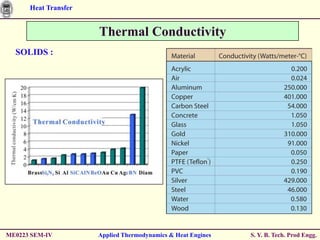
  SOLIDS :


ME0223 SEM-IV         Applied Thermodynamics & Heat Engines   S. Y. B. Tech. Prod Engg.
Heat Transfer


                           Multilayer Insulation


Alternate Layers of Metal and Non-Metal

   Metal having higher Reflectivity.

ME0223 SEM-IV             Applied Thermodynamics & Heat Engines   S. Y. B. Tech. Prod Engg.
Heat Transfer


                      Thermal Conductivity
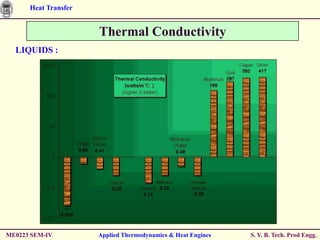
  LIQUIDS :


ME0223 SEM-IV         Applied Thermodynamics & Heat Engines   S. Y. B. Tech. Prod Engg.
Heat Transfer


                      Thermal Conductivity
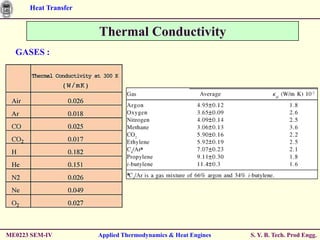
  GASES :


ME0223 SEM-IV         Applied Thermodynamics & Heat Engines   S. Y. B. Tech. Prod Engg.
Heat Transfer


                      Thermal Conductivity
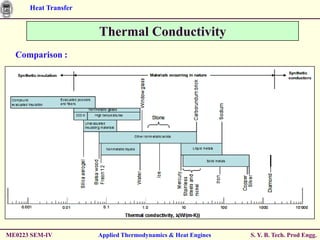
  Comparison :


ME0223 SEM-IV         Applied Thermodynamics & Heat Engines   S. Y. B. Tech. Prod Engg.
Heat Transfer


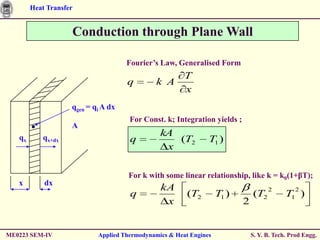
                    Conduction through Plane Wall

                                     Fourier’s Law, Generalised Form
                                                        T
                                     q         k A
                                                        x
                    qgen = qi A dx
                                      For Const. k; Integration yields ;
                    A
   qx       qx+dx
                                                kA
                                      q            (T2          T1 )
                                                 x

                                     For k with some linear relationship, like k = k0(1+βT);
   x        dx
                                                kA                                   2         2
                                      q                  (T2        T1 )       (T2          T1 )
                                                 x                         2


ME0223 SEM-IV               Applied Thermodynamics & Heat Engines              S. Y. B. Tech. Prod Engg.
Heat Transfer


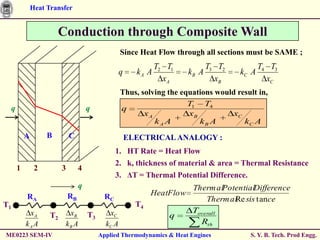
                       Conduction through Composite Wall
                                                    Since Heat Flow through all sections must be SAME ;
                                                                 T2 T1           T3 T2          T4 T3
                                                    q     kA A            kB A           kC A
                                                                   xA              xB             xC
                                                    Thus, solving the equations would result in,
                                                                        T1 T4
  q                                   q             q
                                                           xA           xB           xC
                                                              kA A         kB A         kC A
          A        B         C                          ELECTRICAL ANALOGY :
                                                  1. HT Rate = Heat Flow
                                                  2. k, thickness of material & area = Thermal Resistance
      1        2         3        4
                                                  3. ΔT = Thermal Potential Difference.
                                  q                                        Therm alPotentialDifference
          RA                 RB              RC                HeatFlow
                                                                               Therm al sis tance
                                                                                      Re
T1                                                        T4
           xA             xB                  xC                           Toverall
                    T2                T3                             q
          kA A           kB A                kC A                            Rth
ME0223 SEM-IV                              Applied Thermodynamics & Heat Engines           S. Y. B. Tech. Prod Engg.
Heat Transfer


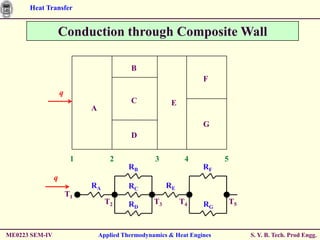
                    Conduction through Composite Wall

                                           B
                                                                   F
                    q
                                           C             E
                             A
                                                                   G
                                           D

                         1          2              3          4          5
                                          RB                       RF
                q
                             RA           RC            RE
                        T1
                                   T2     RD       T3        T4    RG        T5


ME0223 SEM-IV                    Applied Thermodynamics & Heat Engines            S. Y. B. Tech. Prod Engg.
Heat Transfer


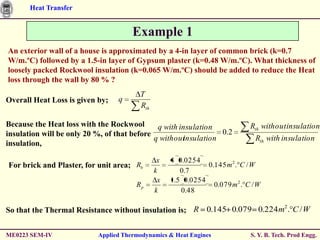
                                      Example 1
An exterior wall of a house is approximated by a 4-in layer of common brick (k=0.7
W/m.ºC) followed by a 1.5-in layer of Gypsum plaster (k=0.48 W/m.ºC). What thickness of
loosely packed Rockwool insulation (k=0.065 W/m.ºC) should be added to reduce the Heat
loss through the wall by 80 % ?
                                        T
Overall Heat Loss is given by;   q
                                        Rth

Because the Heat loss with the Rockwool       q with insulation              Rth without insulation
insulation will be only 20 %, of that before                     0.2
                                             q withoutinsulation               Rth with insulation
insulation,

                                               x   4 0.0254
For brick and Plaster, for unit area; Rb                      0.145 m 2 . C / W
                                              k       0.7
                                               x   1.5 0.0254
                                       Rp                       0.079 m 2 . C / W
                                              k       0.48

                                                                           2
So that the Thermal Resistance without insulation is; R 0.145 0.079 0.224 m . C / W


ME0223 SEM-IV              Applied Thermodynamics & Heat Engines             S. Y. B. Tech. Prod Engg.
Heat Transfer


                                Example 1…contd

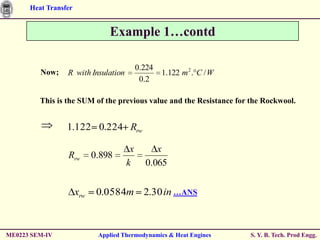
                                           0.224
         Now;    R with Insulation                 1.122 m 2 . C / W
                                            0.2

         This is the SUM of the previous value and the Resistance for the Rockwool.


                 1.122 0.224 Rrw

                                       x        x
                 Rrw        0.898
                                      k      0.065


                      xrw    0.0584m 2.30 in …ANS


ME0223 SEM-IV                Applied Thermodynamics & Heat Engines     S. Y. B. Tech. Prod Engg.
Heat Transfer


                    Conduction through Radial Systems
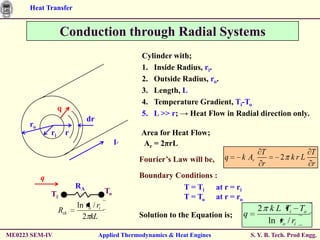
                                                    Cylinder with;
                                                    1. Inside Radius, ri.
                                                    2. Outside Radius, ro.
                                                    3. Length, L
                                                    4. Temperature Gradient, Ti-To
                    q
                                                    5. L >> r; → Heat Flow in Radial direction only.
                                 dr
      ro
               ri       r                           Area for Heat Flow;
                                                    Ar = 2πrL
                                                                                          T                 T
                                                   Fourier’s Law will be,     q   k Ar           2 krL
                                                                                          r                 r
           q                                       Boundary Conditions :
                            RA                                T = Ti at r = ri
               Ti                        To
                                                              T = To at r = ro
                            ln ro / ri                                                   2 k L Ti To
                    Rth                                                           q
                              2 kL                 Solution to the Equation is;
                                                                                           ln ro / ri
ME0223 SEM-IV                         Applied Thermodynamics & Heat Engines           S. Y. B. Tech. Prod Engg.
Heat Transfer


                     Conduction through Radial Systems

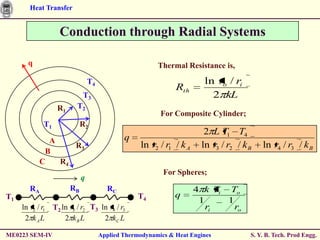
       q                                                  Thermal Resistance is,

                                  T4                                     ln ro / ri
                                                                Rth
                              T3                                           2 kL
                    R1      T2
                                                           For Composite Cylinder;
              T1              R2
                                                                         2 L T1 T4
              A                                q
                   R3                               ln r2 / r1 / k A    ln r3 / r2 / k B   ln r4 / r3 / k B
             B
            C   R4
                                                            For Spheres;
                              q
        RA               RB              RC                            4 k Ti To
T1                                                  T4          q
                                                                        1     1
     ln r2 / r1    T2 ln r3 / r2 T3 ln r4 / r3                            ri    ro
      2 kAL            2 kB L        2 kC L

ME0223 SEM-IV                          Applied Thermodynamics & Heat Engines           S. Y. B. Tech. Prod Engg.
Heat Transfer


                                      Example 2
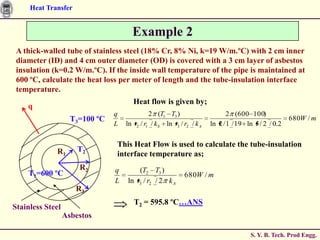
 A thick-walled tube of stainless steel (18% Cr, 8% Ni, k=19 W/m.ºC) with 2 cm inner
 diameter (ID) and 4 cm outer diameter (OD) is covered with a 3 cm layer of asbestos
 insulation (k=0.2 W/m.ºC). If the inside wall temperature of the pipe is maintained at
 600 ºC, calculate the heat loss per meter of length and the tube-insulation interface
 temperature.
                                       Heat flow is given by;
    q
                                q             2 (T1 T3 )                      2 (600 100)
                    T3=100 ºC                                                                         680W / m
                                L   ln r2 / r1 / kS ln r3 / r2 / k A   ln 2 / 1 / 19 ln 5 / 2 / 0.2

                                This Heat Flow is used to calculate the tube-insulation
             R1       T2
                                interface temperature as;
                      R2        q       (T2 T3 )
    T1=600 ºC                                               680W / m
                                L   ln r3 / r2 / 2 k A
                     R3
                                       T2 = 595.8 ºC…ANS
Stainless Steel
                  Asbestos

                                                                                      S. Y. B. Tech. Prod Engg.
Heat Transfer


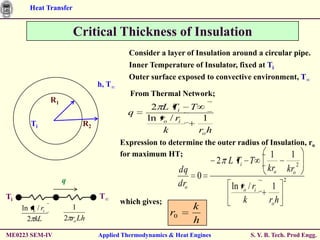
                           Critical Thickness of Insulation
                                            Consider a layer of Insulation around a circular pipe.
                                            Inner Temperature of Insulator, fixed at Ti
                                            Outer surface exposed to convective environment, T∞
                                  h, T∞
                                             From Thermal Network;
                  R1
                                                   2 L Ti       T
                                            q
                                                  ln ro / ri         1
        Ti                   R2
                                                      k             ro h
                                          Expression to determine the outer radius of Insulation, ro
                                          for maximum HT;                             1     1
                                                                           2 L Ti T                          2
                                                              dq                           kro         kro
                       q
                                                                  0                                2
                                                              dro             ln ro / ri     1
Ti                                T∞                                              k         ro h
                                          which gives;
     ln ro / ri          1                                       k
                                                         r0
       2 kL            2 ro Lh                                   h
ME0223 SEM-IV                     Applied Thermodynamics & Heat Engines              S. Y. B. Tech. Prod Engg.
Heat Transfer


                                        Example 3
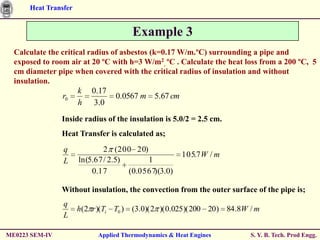
  Calculate the critical radius of asbestos (k=0.17 W/m.ºC) surrounding a pipe and
  exposed to room air at 20 ºC with h=3 W/m2. ºC . Calculate the heat loss from a 200 ºC, 5
  cm diameter pipe when covered with the critical radius of insulation and without
  insulation.
                      k 0.17
                r0               0.0567 m 5.67 cm
                      h 3.0
                Inside radius of the insulation is 5.0/2 = 2.5 cm.
                Heat Transfer is calculated as;
                q             2 (200 20)
                                                       105.7 W / m
                L     ln(5.67 / 2.5)      1
                          0.17       (0.0567)(3.0)

                Without insulation, the convection from the outer surface of the pipe is;
                q
                      h(2 r )(Ti T0 )   (3.0)( 2 )( 0.025 )( 200 20) 84.8W / m
                L

ME0223 SEM-IV               Applied Thermodynamics & Heat Engines          S. Y. B. Tech. Prod Engg.
Heat Transfer


                                Example 3…contd

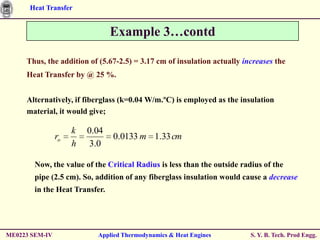
     Thus, the addition of (5.67-2.5) = 3.17 cm of insulation actually increases the
     Heat Transfer by @ 25 %.


     Alternatively, if fiberglass (k=0.04 W/m.ºC) is employed as the insulation
     material, it would give;

                     k   0.04
                ro              0.0133 m 1.33 cm
                     h   3.0

        Now, the value of the Critical Radius is less than the outside radius of the
        pipe (2.5 cm). So, addition of any fiberglass insulation would cause a decrease
        in the Heat Transfer.


ME0223 SEM-IV              Applied Thermodynamics & Heat Engines          S. Y. B. Tech. Prod Engg.
Heat Transfer


                               Thermal Contact Resistance

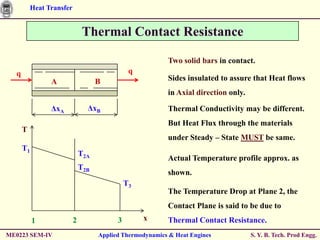
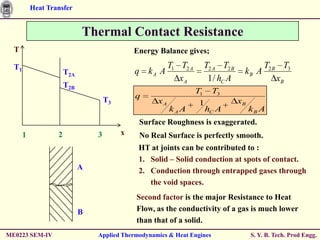
                                                          Two solid bars in contact.
  q                                            q
                A                   B                     Sides insulated to assure that Heat flows
                                                          in Axial direction only.

                ΔxA             ΔxB                       Thermal Conductivity may be different.
                                                          But Heat Flux through the materials
      T
                                                          under Steady – State MUST be same.
      T1
                              T2A
                                                          Actual Temperature profile approx. as
                              T2B
                                                          shown.
                                              T3
                                                          The Temperature Drop at Plane 2, the
                                                          Contact Plane is said to be due to
           1              2               3        x      Thermal Contact Resistance.
ME0223 SEM-IV                       Applied Thermodynamics & Heat Engines            S. Y. B. Tech. Prod Engg.
Heat Transfer


                             Thermal Contact Resistance
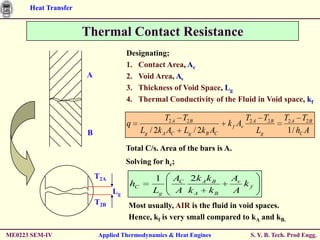
  T                                           Energy Balance gives;

  T1                                                     T1 T2 A        T2 A T2 B             T2 B T3
                       T2A                    q kA A                                 kB A
                                                            xA           1 / hC A                 xB
                       T2B
                                                                   T1     T3
                                              q
                                     T3             xA              1               xB
                                                         kA A           hC A             kB A
                                               Surface Roughness is exaggerated.
       1           2             3        x    No Real Surface is perfectly smooth.
                                               HT at joints can be contributed to :
                                               1. Solid – Solid conduction at spots of contact.
                             A                 2. Conduction through entrapped gases through
                                                  the void spaces.
                                              Second factor is the major Resistance to Heat
                             B                Flow, as the conductivity of a gas is much lower
                                              than that of a solid.
ME0223 SEM-IV                    Applied Thermodynamics & Heat Engines                   S. Y. B. Tech. Prod Engg.
Heat Transfer


                      Thermal Contact Resistance
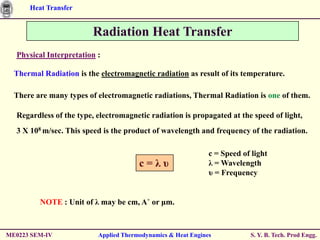
                                     Designating;
                                     1. Contact Area, Ac
                      A              2. Void Area, Av
                                     3. Thickness of Void Space, Lg
                                     4. Thermal Conductivity of the Fluid in Void space, kf

                                                    T2 A T2 B                   T2 A T2 B    T2 A T2 B
                                     q                                 k f Av
                      B                    Lg / 2k A AC Lg / 2k B AC                Lg        1 / hC A

                                     Total C/s. Area of the bars is A.
                                     Solving for hc;
                          T2A                  1     AC 2k A k B        Av
                                      hC                                   kf
                                Lg             Lg    A k A kB           A
                          T2B        Most usually, AIR is the fluid in void spaces.
                                     Hence, kf is very small compared to kA and kB.

ME0223 SEM-IV             Applied Thermodynamics & Heat Engines                  S. Y. B. Tech. Prod Engg.
Heat Transfer


                                       Example 4
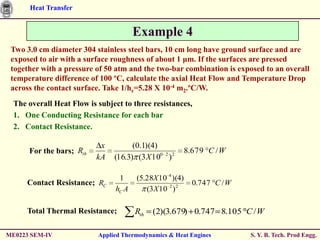
 Two 3.0 cm diameter 304 stainless steel bars, 10 cm long have ground surface and are
 exposed to air with a surface roughness of about 1 μm. If the surfaces are pressed
 together with a pressure of 50 atm and the two-bar combination is exposed to an overall
 temperature difference of 100 ºC, calculate the axial Heat Flow and Temperature Drop
 across the contact surface. Take 1/hc=5.28 X 10-4 m2.ºC/W.
  The overall Heat Flow is subject to three resistances,
  1. One Conducting Resistance for each bar
  2. Contact Resistance.

                            x         (0.1)(4)
      For the bars; Rth                                   8.679 C / W
                           kA   (16.3) (3 X 100 2 ) 2

                                 1     (5.28X 10 4 )(4)
      Contact Resistance; RC                                0.747 C / W
                                hC A      (3 X 10 2 ) 2

      Total Thermal Resistance;        Rth   (2)(3.679) 0.747 8.105 C / W

ME0223 SEM-IV              Applied Thermodynamics & Heat Engines          S. Y. B. Tech. Prod Engg.
Heat Transfer


                               Example 4…contd

                                     T       100
     Overall Heat Flow is; q                      12.338 W …ANS
                                     Rth    8.105

     Temperature Drop across the contact is found by taking the ratio of the Contact
     Resistance to the Total Resistance.

                       RC          (0.747)
                TC          T              (100) 6.0544 C …ANS
                        Rth        12.338

        i.e. 6 % of the total resistance.


ME0223 SEM-IV              Applied Thermodynamics & Heat Engines      S. Y. B. Tech. Prod Engg.
Heat Transfer


                         Radiation Heat Transfer
  Physical Interpretation :

  Thermal Radiation is the electromagnetic radiation as result of its temperature.

  There are many types of electromagnetic radiations, Thermal Radiation is one of them.

  Regardless of the type, electromagnetic radiation is propagated at the speed of light,
  3 X 10⁸ m/sec. This speed is the product of wavelength and frequency of the radiation.

                                                              c = Speed of light
                                       c=λυ                   λ = Wavelength
                                                              υ = Frequency


         NOTE : Unit of λ may be cm, A˚ or μm.


ME0223 SEM-IV             Applied Thermodynamics & Heat Engines           S. Y. B. Tech. Prod Engg.
Heat Transfer


                        Radiation Heat Transfer
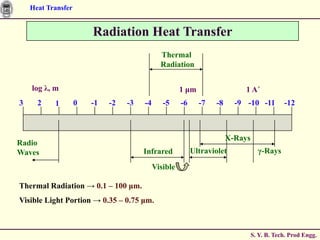
                                              Thermal
                                              Radiation

    log λ, m                                          1 μm                  1 A˚
3     2    1        0   -1   -2   -3   -4      -5     -6     -7   -8     -9 -10 -11         -12


                                                                       X-Rays
Radio
Waves                                  Infrared            Ultraviolet            γ-Rays

                                            Visible

Thermal Radiation → 0.1 – 100 μm.
Visible Light Portion → 0.35 – 0.75 μm.


                                                                                S. Y. B. Tech. Prod Engg.
Heat Transfer


                         Radiation Heat Transfer
  Physical Interpretation :

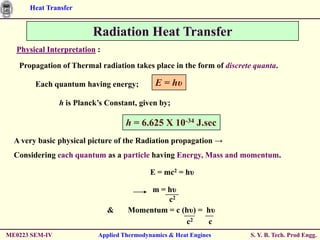
   Propagation of Thermal radiation takes place in the form of discrete quanta.

        Each quantum having energy;          E = hυ

                h is Planck’s Constant, given by;

                                    h = 6.625 X 10⁻³⁴ J.sec
  A very basic physical picture of the Radiation propagation →
  Considering each quantum as a particle having Energy, Mass and momentum.

                                            E = mc2 = hυ

                                         m = hυ
                                             c2
                              &     Momentum = c (hυ) = hυ
                                                  c2    c
ME0223 SEM-IV              Applied Thermodynamics & Heat Engines      S. Y. B. Tech. Prod Engg.
Heat Transfer


                        Stefan – Boltzmann Law
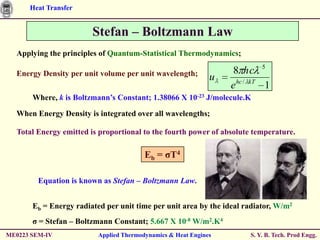
  Applying the principles of Quantum-Statistical Thermodynamics;

  Energy Density per unit volume per unit wavelength;              8 hc 5
                                                              u
                                                                  e hc / kT 1
       Where, k is Boltzmann’s Constant; 1.38066 X 10⁻²³ J/molecule.K

  When Energy Density is integrated over all wavelengths;

  Total Energy emitted is proportional to the fourth power of absolute temperature.

                                         Eb = ζT4

         Equation is known as Stefan – Boltzmann Law.


       Eb = Energy radiated per unit time per unit area by the ideal radiator, W/m2
       ζ = Stefan – Boltzmann Constant; 5.667 X 10⁻⁸ W/m2.K4
ME0223 SEM-IV             Applied Thermodynamics & Heat Engines        S. Y. B. Tech. Prod Engg.
Heat Transfer


                           Stefan – Boltzmann Law

  Subscript b in this equation → Radiation from a Blackbody.

  Materials which obey this Law appear black to the eye, as they do not reflect any

  radiation.

  Thus, a Blackbody is a body which absorbs all the radiations incident upon it.

  Eb is known as the Emissive Power of the Blackbody.

  i.e. Energy radiated per unit time per unit area.


                        Eb = ζT4                      qemitted = ζ.A.T4

  NOTE : “Blackness” of a surface to Thermal Radiation can be quite deceiving.
               e.g. Lamp-black…..and Ice….!!!

ME0223 SEM-IV               Applied Thermodynamics & Heat Engines         S. Y. B. Tech. Prod Engg.
Heat Transfer


                            Radiation Properties
  Radiant Energy incident on a surface;
                                                         (a) Part is Reflected,
                                                         (b) Part is Absorbed,
                                                         (c) Part is Transmitted.
     Incident
     Radiation               Reflection                             Reflected Energy
                                                 Reflectivity = ρ =
                                                                    Incident Energy
                                                                        Absorbed Energy
                      Absorption                 Absorptivity = α =
                                                                        Incident Energy
                                                                        Transmitted Energy
                                                 Transmissivity = η =
            Transmission                                                  Incident Energy


                                                          ρ+α+η=1

  NOTE : Most solids do not transmit Thermal Radiations. →            ρ+α=1
ME0223 SEM-IV              Applied Thermodynamics & Heat Engines           S. Y. B. Tech. Prod Engg.
Heat Transfer


                             Radiation Properties
  Types of Reflection :
       1. Angle of Incidence = Angle of Reflection → Specular Reflection

       2. Incident beam distributed uniformly in all directions → Diffuse Reflection

                                                   Source
          Source
                    θ1      θ2


                Specular Reflection                         Diffuse Reflection

   Offers the Mirror Image to the Observer
ME0223 SEM-IV               Applied Thermodynamics & Heat Engines           S. Y. B. Tech. Prod Engg.
Heat Transfer


                           Radiation Properties


  No REAL surface cab be perfectly Specular or Diffuse.


  Ordinary mirror → Specular for visible region; but may not be in complete spectrum

  of Thermal Radiation.


  Rough surface exhibits the Diffused behaviour.

  Polished surface exhibits the Specular behaviour.


ME0223 SEM-IV             Applied Thermodynamics & Heat Engines     S. Y. B. Tech. Prod Engg.
Heat Transfer


                                Kirchhoff’s Law
                                                 Assume perfect Black enclosure.

                                                 Radiant flux incident is qi W/m2.

                                                 A Sample body placed inside Enclosure, in
                          Black Enclosure
                                                 Thermal Equilibrium with it.

         EA              qiAα
                Sample
                                         Energy Absorbed by the Sample = Energy emitted.

                                                     i.e. E A = qi A α              …(I)

                                         Replacing the Sample Body with a Blackbody;
                                                        Eb A = qi A (1)             …(II)

                                            Dividing (I) by (II);

                                                               E / Eb = α

ME0223 SEM-IV              Applied Thermodynamics & Heat Engines            S. Y. B. Tech. Prod Engg.
Heat Transfer


                                     Kirchhoff’s Law

                                                        Ratio of Emissive Power of a body
                          Black Enclosure
                                                        to that of a Perfectly Black body, at
                                                        the same temperature is known as
        EA               qiAα
                Sample                                  Emissivity, ε of the body.

                                                          ε = E / Eb


                                                          Thus;

                                                                   ε=α

                                                         This is known as Kirchhoff’s Identity.


ME0223 SEM-IV                   Applied Thermodynamics & Heat Engines          S. Y. B. Tech. Prod Engg.
Heat Transfer


                                     Gray Body
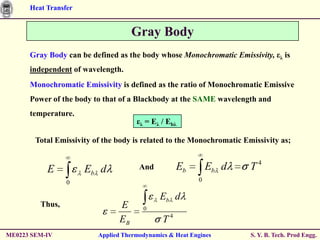
      Gray Body can be defined as the body whose Monochromatic Emissivity, ελ is
      independent of wavelength.
      Monochromatic Emissivity is defined as the ratio of Monochromatic Emissive
      Power of the body to that of a Blackbody at the SAME wavelength and
      temperature.
                                      ελ = Eλ / Ebλ

        Total Emissivity of the body is related to the Monochromatic Emissivity as;


           E          Eb d             And          Eb        Eb d     T4
                 0                                        0

                                              Eb d
         Thus,                  E       0

                                EB             T4
ME0223 SEM-IV             Applied Thermodynamics & Heat Engines        S. Y. B. Tech. Prod Engg.
Heat Transfer


                                     Gray Body
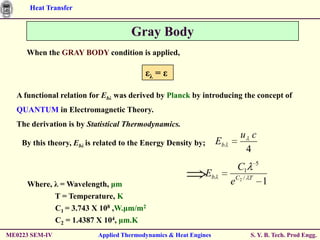
     When the GRAY BODY condition is applied,

                                          ελ = ε

  A functional relation for Ebλ was derived by Planck by introducing the concept of
  QUANTUM in Electromagnetic Theory.
  The derivation is by Statistical Thermodynamics.
                                                                            u c
    By this theory, Ebλ is related to the Energy Density by;       Eb
                                                                             4
                                                                                     5
                                                                          C1
                                                              Eb
     Where, λ = Wavelength, μm                                          e C2 /   T
                                                                                         1
                T = Temperature, K
                C1 = 3.743 X 10⁸ ,W.μm/m2
                C2 = 1.4387 X 10⁴, μm.K
ME0223 SEM-IV              Applied Thermodynamics & Heat Engines                 S. Y. B. Tech. Prod Engg.
Heat Transfer


                      Wien’s Displacement Law
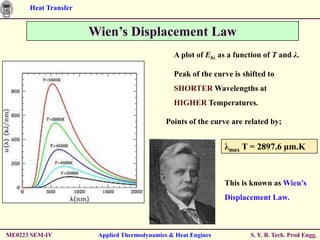
                                               A plot of Ebλ as a function of T and λ.

                                               Peak of the curve is shifted to
                                               SHORTER Wavelengths at
                                               HIGHER Temperatures.

                                             Points of the curve are related by;


                                                               λmax T = 2897.6 μm.K


                                                               This is known as Wien’s
                                                               Displacement Law.


ME0223 SEM-IV          Applied Thermodynamics & Heat Engines          S. Y. B. Tech. Prod Engg.
Heat Transfer


                         Wien’s Displacement Law
Shift in the maximum point of the Radiation Curve helps to explain the change in colour
of a body as it is heated.
Band of wavelengths visible to the eye lies between 0.3 – 0.7 μm.
Very small portion of the radiant energy spectrum at low temperatures is visible to eye.
As the body is heated, maximum intensity shifts to shorter wavelengths.
Accordingly, first visible sight of increase in temperature of a body is DARK RED
colour.
Further heating yields BRIGHT RED colour.
Then BRIGHT YELLOW.
And, finally WHITE…!!
Material also looks brighter at higher temperatures, as large portion of the total
radiation falls within the visible range.

ME0223 SEM-IV                Applied Thermodynamics & Heat Engines       S. Y. B. Tech. Prod Engg.
Heat Transfer


                         Radiation Heat Transfer
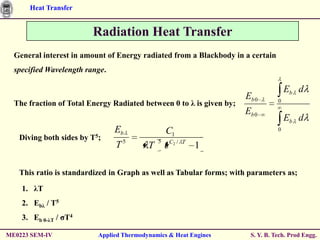
  General interest in amount of Energy radiated from a Blackbody in a certain
  specified Wavelength range.

                                                                                     Eb d
                                                                      Eb 0
  The fraction of Total Energy Radiated between 0 to λ is given by;              0

                                                                      Eb 0
                                                                                     Eb d
                                Eb                C1                             0
   Diving both sides by T5;                   5
                                T5        T       e C2 /   T
                                                               1

   This ratio is standardized in Graph as well as Tabular forms; with parameters as;

    1. λT
    2. Ebλ / T5
    3. Eb 0-λT / ζT4

ME0223 SEM-IV             Applied Thermodynamics & Heat Engines        S. Y. B. Tech. Prod Engg.
Heat Transfer


                           Radiation Heat Transfer


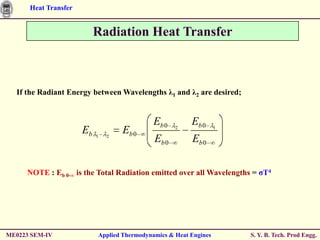
  If the Radiant Energy between Wavelengths λ1 and λ2 are desired;


                                             Eb 0        Eb 0
                      Eb           Eb 0             2              1
                           1   2
                                             Eb 0        Eb 0

     NOTE : Eb 0-∞ is the Total Radiation emitted over all Wavelengths = ζT4


ME0223 SEM-IV              Applied Thermodynamics & Heat Engines       S. Y. B. Tech. Prod Engg.
Heat Transfer


                         Radiation Heat Transfer
 EXAMPLE :


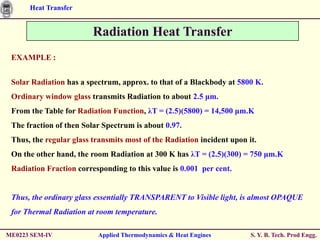
 Solar Radiation has a spectrum, approx. to that of a Blackbody at 5800 K.
 Ordinary window glass transmits Radiation to about 2.5 μm.
 From the Table for Radiation Function, λT = (2.5)(5800) = 14,500 μm.K
 The fraction of then Solar Spectrum is about 0.97.
 Thus, the regular glass transmits most of the Radiation incident upon it.
 On the other hand, the room Radiation at 300 K has λT = (2.5)(300) = 750 μm.K
 Radiation Fraction corresponding to this value is 0.001 per cent.


 Thus, the ordinary glass essentially TRANSPARENT to Visible light, is almost OPAQUE
 for Thermal Radiation at room temperature.

ME0223 SEM-IV             Applied Thermodynamics & Heat Engines         S. Y. B. Tech. Prod Engg.
Heat Transfer


                                           Heat Exchangers
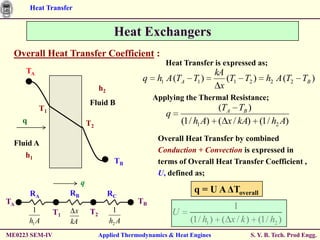
  Overall Heat Transfer Coefficient :
                                                           Heat Transfer is expressed as;
     TA                                                                      kA
                                                   q    h1 A (TA T1 )           (T1 T2 )     h2 A (T2 TB )
                                     h2                                       x
                                                       Applying the Thermal Resistance;
                               Fluid B
            T1                                                                (TA TB )
                                                           q
     q                         T2                                  (1 / h1 A) ( x / kA) (1 / h2 A)
                                                        Overall Heat Transfer by combined
  Fluid A
                                                        Conduction + Convection is expressed in
     h1
                                           TB           terms of Overall Heat Transfer Coefficient ,
                                                        U, defined as;
                           q
         RA           RB                  RC                          q = U A ΔToverall
TA                                                TB
          1            x                   1                                      1
                 T1             T2                             U
         h1 A         kA                  h2 A                       (1 / h1 ) ( x / k ) (1 / h2 )
ME0223 SEM-IV                        Applied Thermodynamics & Heat Engines              S. Y. B. Tech. Prod Engg.
Heat Transfer


                                       Heat Exchangers
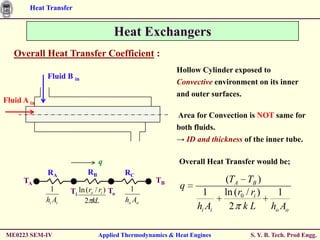
   Overall Heat Transfer Coefficient :
                                                          Hollow Cylinder exposed to
             Fluid B in
                                                          Convective environment on its inner
                                                          and outer surfaces.
Fluid A in
                                                          Area for Convection is NOT same for
                                                          both fluids.
                                                          → ID and thickness of the inner tube.

                                 q                         Overall Heat Transfer would be;
             RA             RB             RC
      TA                                           TB                    (TA TB )
              1                              1             q
                     Ti ln (ro / ri ) To                          1      ln (r0 / ri )   1
             hi Ai        2 kL             ho Ao
                                                                 hi Ai    2 kL         ho Ao

ME0223 SEM-IV                    Applied Thermodynamics & Heat Engines          S. Y. B. Tech. Prod Engg.
Heat Transfer


                               Heat Exchangers
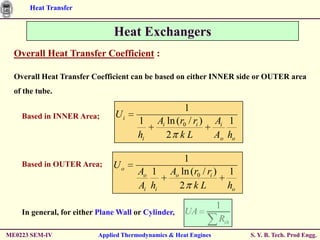
  Overall Heat Transfer Coefficient :

  Overall Heat Transfer Coefficient can be based on either INNER side or OUTER area
  of the tube.

                                                       1
    Based in INNER Area;        Ui
                                       1       Ai ln (r0 / ri )   Ai 1
                                       hi         2 kL            Ao ho

                                                       1
    Based in OUTER Area;       Uo
                                       Ao 1        Ao ln (r0 / ri )   1
                                       Ai hi         2 kL             ho
                                                                  1
    In general, for either Plane Wall or Cylinder,      UA
                                                                   Rth
ME0223 SEM-IV             Applied Thermodynamics & Heat Engines            S. Y. B. Tech. Prod Engg.
Heat Transfer


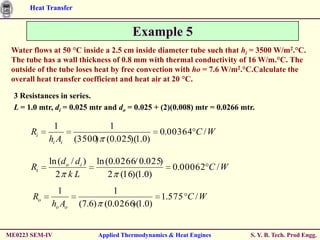
                                        Example 5
 Water flows at 50 °C inside a 2.5 cm inside diameter tube such that hi = 3500 W/m2.°C.
 The tube has a wall thickness of 0.8 mm with thermal conductivity of 16 W/m.°C. The
 outside of the tube loses heat by free convection with ho = 7.6 W/m2.°C.Calculate the
 overall heat transfer coefficient and heat air at 20 °C.

  3 Resistances in series.
  L = 1.0 mtr, di = 0.025 mtr and do = 0.025 + (2)(0.008) mtr = 0.0266 mtr.

             1               1
       Ri                                        0.00364 C / W
            hi Ai     (3500 (0.025)(1.0)
                           )

            ln (d o / di )   ln (0.0266/ 0.025)
       Rt                                            0.00062 C / W
              2 kL               2 (16)(1.0)
               1                1
       Ro                                 1.575 C / W
             ho Ao     (7.6) (0.0266 1.0)
                                    )(


ME0223 SEM-IV                Applied Thermodynamics & Heat Engines       S. Y. B. Tech. Prod Engg.
Heat Transfer


                                    Example 5….contd

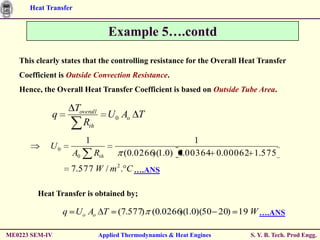
   This clearly states that the controlling resistance for the Overall Heat Transfer
   Coefficient is Outside Convection Resistance.
   Hence, the Overall Heat Transfer Coefficient is based on Outside Tube Area.

                      Toverall
             q                      U 0 Ao T
                        Rth
                          1                               1
            U0
                   A0         Rth        (0.0266 1.0) 0.00364 0.00062 1.575
                                                )(
                  7.577 W / m 2 . C ….ANS

        Heat Transfer is obtained by;

                 q Uo Ao T             (7.577) (0.0266 1.0)(50 20) 19 W ….ANS
                                                      )(

ME0223 SEM-IV                    Applied Thermodynamics & Heat Engines   S. Y. B. Tech. Prod Engg.
Heat Transfer


                                Heat Exchangers
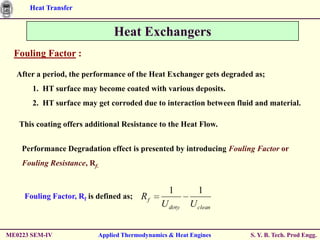
  Fouling Factor :

  After a period, the performance of the Heat Exchanger gets degraded as;
       1. HT surface may become coated with various deposits.
       2. HT surface may get corroded due to interaction between fluid and material.

   This coating offers additional Resistance to the Heat Flow.


    Performance Degradation effect is presented by introducing Fouling Factor or
    Fouling Resistance, Rf.


                                                  1        1
     Fouling Factor, Rf is defined as;   Rf
                                               U dirty   U clean


ME0223 SEM-IV              Applied Thermodynamics & Heat Engines     S. Y. B. Tech. Prod Engg.
Heat Transfer


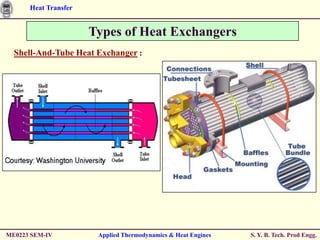
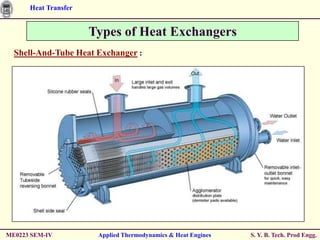
                      Types of Heat Exchangers
  Shell-And-Tube Heat Exchanger :


ME0223 SEM-IV          Applied Thermodynamics & Heat Engines   S. Y. B. Tech. Prod Engg.
Heat Transfer


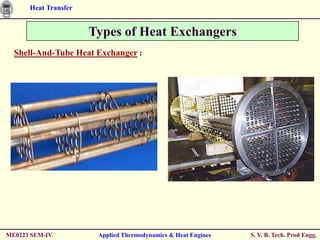
                      Types of Heat Exchangers
  Shell-And-Tube Heat Exchanger :


ME0223 SEM-IV          Applied Thermodynamics & Heat Engines   S. Y. B. Tech. Prod Engg.
Heat Transfer


                      Types of Heat Exchangers
  Shell-And-Tube Heat Exchanger :


ME0223 SEM-IV          Applied Thermodynamics & Heat Engines   S. Y. B. Tech. Prod Engg.
Heat Transfer


                      Types of Heat Exchangers
  Shell-And-Tube Heat Exchanger :


ME0223 SEM-IV          Applied Thermodynamics & Heat Engines   S. Y. B. Tech. Prod Engg.
Heat Transfer


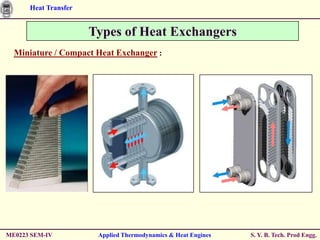
                      Types of Heat Exchangers
  Miniature / Compact Heat Exchanger :


ME0223 SEM-IV          Applied Thermodynamics & Heat Engines   S. Y. B. Tech. Prod Engg.
Heat Transfer


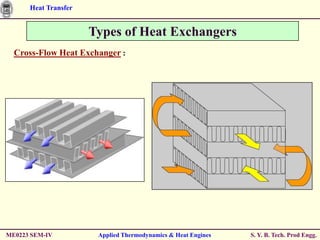
                      Types of Heat Exchangers
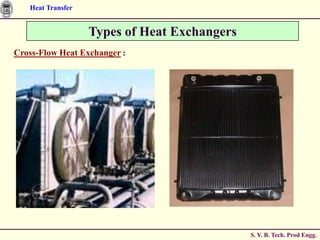
  Cross-Flow Heat Exchanger :


ME0223 SEM-IV          Applied Thermodynamics & Heat Engines   S. Y. B. Tech. Prod Engg.
Heat Transfer


                   Types of Heat Exchangers
Cross-Flow Heat Exchanger :


                                              S. Y. B. Tech. Prod Engg.
Heat Transfer


                   Log Mean Temperature Difference
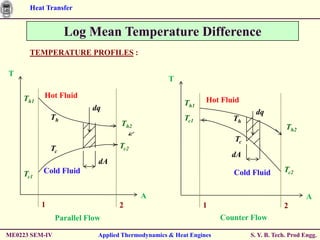
      TEMPERATURE PROFILES :

T
                                                   T

    Th1   Hot Fluid
                                                        Th1    Hot Fluid
                          dq
                                                                              dq
              Th                                        Tc1            Th
                                   Th2                                                   Th2
                                                                       Tc
              Tc                  Tc2
                                                                      dA
                            dA
          Cold Fluid                                                   Cold Fluid       Tc2
    Tc1

                                         A                                                      A
          1                       2                           1                         2
                Parallel Flow                                       Counter Flow

ME0223 SEM-IV               Applied Thermodynamics & Heat Engines           S. Y. B. Tech. Prod Engg.
Heat Transfer


                   Log Mean Temperature Difference

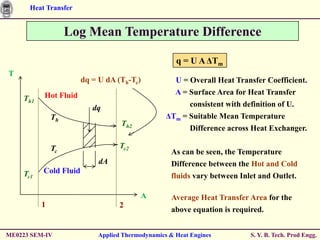
                                                    q = U A ΔTm
T
                       dq = U dA (Th-Tc)           U = Overall Heat Transfer Coefficient.
          Hot Fluid                                A = Surface Area for Heat Transfer
    Th1
                          dq                           consistent with definition of U.
              Th                                 ΔTm = Suitable Mean Temperature
                                  Th2
                                                       Difference across Heat Exchanger.

              Tc                 Tc2
                                                  As can be seen, the Temperature
                            dA                    Difference between the Hot and Cold
    Tc1   Cold Fluid
                                                  fluids vary between Inlet and Outlet.

                                        A         Average Heat Transfer Area for the
          1                      2
                                                  above equation is required.


ME0223 SEM-IV              Applied Thermodynamics & Heat Engines         S. Y. B. Tech. Prod Engg.
Heat Transfer


                   Log Mean Temperature Difference

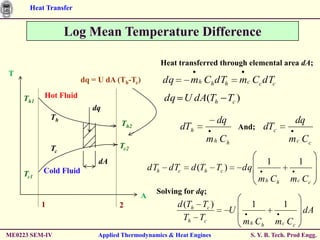
                                                  Heat transferred through elemental area dA;
T
                       dq = U dA (Th-Tc)          dq      mh Ch dTh          mc Cc dTc
    Th1   Hot Fluid                                dq U dA(Th Tc )
                          dq
              Th                                                    dq                            dq
                                  Th2                  dTh                   And;    dTc
                                                              m h Ch                             m c Cc
              Tc                 Tc2
                            dA                                                         1            1
          Cold Fluid                        dTh     dTc   d (Th Tc )         dq
    Tc1
                                                                                    m h Ch       m c Cc
                                              Solving for dq;
                                        A
          1                      2                     d (Th Tc )               1            1
                                                                         U                          dA
                                                         Th Tc                m h Ch       m c Cc
ME0223 SEM-IV              Applied Thermodynamics & Heat Engines                S. Y. B. Tech. Prod Engg.
Heat Transfer


                   Log Mean Temperature Difference
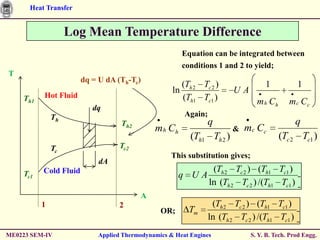
                                                      Equation can be integrated between
                                                      conditions 1 and 2 to yield;
T
                       dq = U dA (Th-Tc)
                                                      (Th 2 Tc 2 )                1           1
                                                   ln                   UA
    Th1   Hot Fluid                                   (Th1 Tc1 )               m h Ch      m c Cc
                          dq
              Th                                       Again;
                                  Th2                         q                               q
                                             m h Ch                    &   mc Cc
                                                         (Th1 Th 2 )                    (Tc 2 Tc1 )
              Tc                 Tc2
                                                  This substitution gives;
                            dA
    Tc1   Cold Fluid                                             (Th 2 Tc 2 ) (Th1 Tc1 )
                                                     q UA
                                                                ln (Th 2 Tc 2 ) /(Th1 Tc1 )
                                        A
          1                      2                               (Th 2 Tc 2 ) (Th1 Tc1 )
                                               OR;      Tm
                                                                ln (Th 2 Tc 2 ) /(Th1 Tc1 )
ME0223 SEM-IV              Applied Thermodynamics & Heat Engines             S. Y. B. Tech. Prod Engg.
Heat Transfer


                Log Mean Temperature Difference
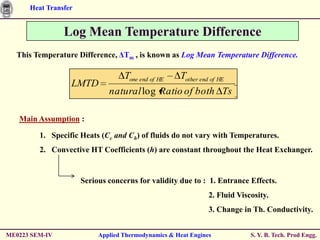
  This Temperature Difference, ΔTm , is known as Log Mean Temperature Difference.

                                   Tone end of HE    Tother end of HE
                  LMTD
                              natural log Ratio of both Ts

   Main Assumption :

         1. Specific Heats (Cc and Ch) of fluids do not vary with Temperatures.
         2. Convective HT Coefficients (h) are constant throughout the Heat Exchanger.


                      Serious concerns for validity due to : 1. Entrance Effects.
                                                               2. Fluid Viscosity.
                                                               3. Change in Th. Conductivity.


ME0223 SEM-IV              Applied Thermodynamics & Heat Engines            S. Y. B. Tech. Prod Engg.
Heat Transfer


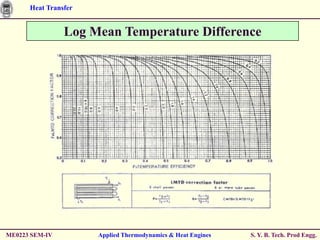
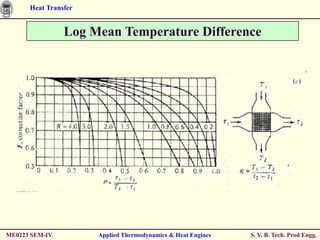
                Log Mean Temperature Difference


ME0223 SEM-IV         Applied Thermodynamics & Heat Engines   S. Y. B. Tech. Prod Engg.
Heat Transfer


                Log Mean Temperature Difference


ME0223 SEM-IV         Applied Thermodynamics & Heat Engines   S. Y. B. Tech. Prod Engg.
Heat Transfer


                Log Mean Temperature Difference


ME0223 SEM-IV         Applied Thermodynamics & Heat Engines   S. Y. B. Tech. Prod Engg.
Heat Transfer


                Log Mean Temperature Difference


ME0223 SEM-IV         Applied Thermodynamics & Heat Engines   S. Y. B. Tech. Prod Engg.
Heat Transfer


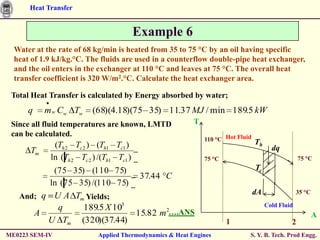
                                          Example 6
  Water at the rate of 68 kg/min is heated from 35 to 75 °C by an oil having specific
  heat of 1.9 kJ/kg.°C. The fluids are used in a counterflow double-pipe heat exchanger,
  and the oil enters in the exchanger at 110 °C and leaves at 75 °C. The overall heat
  transfer coefficient is 320 W/m2.°C. Calculate the heat exchanger area.

 Total Heat Transfer is calculated by Energy absorbed by water;
      q    m w Cw Tw      (68)(4.18)(75 35) 11.37 MJ / min 189.5 kW
 Since all fluid temperatures are known, LMTD             T
 can be calculated.
                                                              110 °C Hot Fluid   Th
             (Th 2 Tc 2 ) (Th1 Tc1 )                                                    dq
      Tm
            ln (Th 2 Tc 2 ) /(Th1 Tc1 )                       75 °C                                75 °C

          (75 35) (110 75)                                                       Tc
                               37.44 C
         ln (75 35) /(110 75)
                                                                                 dA                35 °C
   And; q U A Tm Yields;
           q     189.5 X 10³                                                          Cold Fluid
      A                       15.82 m2….ANS                                                                A
         U Tm (320)(37.44)                                            1                        2
ME0223 SEM-IV              Applied Thermodynamics & Heat Engines             S. Y. B. Tech. Prod Engg.
Heat Transfer


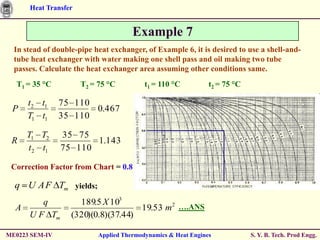
                                      Example 7
  In stead of double-pipe heat exchanger, of Example 6, it is desired to use a shell-and-
  tube heat exchanger with water making one shell pass and oil making two tube
  passes. Calculate the heat exchanger area assuming other conditions same.
  T1 = 35 °C          T2 = 75 °C          t1 = 110 °C          t2 = 75 °C

      t2 t1     75 110
 P                     0.467
      T1 t1     35 110

     T1 T2      35 75
 R                     1.143
     t2 t1      75 110

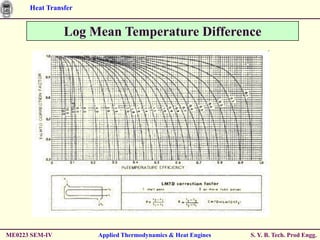
 Correction Factor from Chart = 0.8

  q U A F Tm yields;
       q             189.5 X 10³
  A                                  19.53 m2 ….ANS
    U F Tm         (320)(0.8)(37.44)

ME0223 SEM-IV              Applied Thermodynamics & Heat Engines            S. Y. B. Tech. Prod Engg.
Heat Transfer


                        Effectiveness-NTU Method
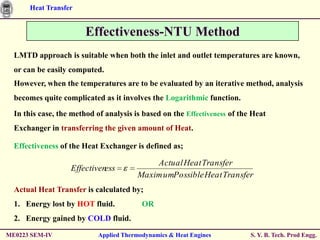
  LMTD approach is suitable when both the inlet and outlet temperatures are known,
  or can be easily computed.
  However, when the temperatures are to be evaluated by an iterative method, analysis
  becomes quite complicated as it involves the Logarithmic function.
  In this case, the method of analysis is based on the Effectiveness of the Heat
  Exchanger in transferring the given amount of Heat.

  Effectiveness of the Heat Exchanger is defined as;

                                            Actual Heat Transfer
                   Effectiveness
                                        Maxim umPossible Heat Transfer
  Actual Heat Transfer is calculated by;
  1. Energy lost by HOT fluid.            OR
  2. Energy gained by COLD fluid.

ME0223 SEM-IV               Applied Thermodynamics & Heat Engines          S. Y. B. Tech. Prod Engg.
Heat Transfer


                         Effectiveness-NTU Method
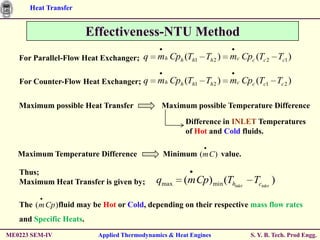
   For Parallel-Flow Heat Exchanger; q       mh Cph (Th1 Th 2 )     mc Cpc (Tc 2 Tc1 )

   For Counter-Flow Heat Exchanger; q        mh Cph (Th1 Th 2 )     mc Cpc (Tc1 Tc 2 )

   Maximum possible Heat Transfer             Maximum possible Temperature Difference

                                                      Difference in INLET Temperatures
                                                      of Hot and Cold fluids.

   Maximum Temperature Difference              Minimum (m C ) value.

   Thus;
   Maximum Heat Transfer is given by;        qmax     (m Cp) min (Thinlet    Tcinlet )

   The ( m Cp )fluid may be Hot or Cold, depending on their respective mass flow rates
   and Specific Heats.
ME0223 SEM-IV             Applied Thermodynamics & Heat Engines             S. Y. B. Tech. Prod Engg.
Heat Transfer


                      Effectiveness-NTU Method
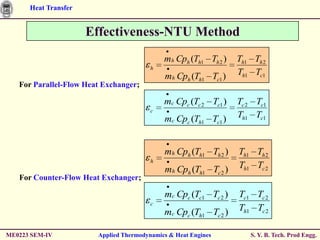
                                             mh Cph (Th1 Th 2 )   Th1 Th 2
                                         h
                                             mh Cph (Th1 Tc1 )    Th1 Tc1
   For Parallel-Flow Heat Exchanger;

                                             mc Cpc (Tc 2 Tc1 )   Tc 2 Tc1
                                         c
                                             mc Cpc (Th1 Tc1 )    Th1 Tc1


                                             mh Cph (Th1 Th 2 )   Th1 Th 2
                                         h
                                             mh Cph (Th1 Tc 2 )   Th1 Tc 2
   For Counter-Flow Heat Exchanger;

                                             mc Cpc (Tc1 Tc 2 )   Tc1 Tc 2
                                         c
                                             mc Cpc (Th1 Tc 2 )   Th1 Tc 2

ME0223 SEM-IV           Applied Thermodynamics & Heat Engines        S. Y. B. Tech. Prod Engg.
Heat Transfer


                        Effectiveness-NTU Method
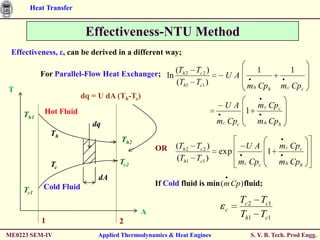
 Effectiveness, ε, can be derived in a different way;

          For Parallel-Flow Heat Exchanger; ln (Th 2 Tc 2 )          UA
                                                                                    1            1
                                                    (Th1 Tc1 )                m h Cph         m c Cpc
T
                       dq = U dA (Th-Tc)
                                                                     UA             m c Cpc
    Th1    Hot Fluid                                                          1
                          dq                                       m c Cpc          m h Cph
              Th
                                  Th2
                                             OR     (Th 2 Tc 2 )              UA            m c Cpc
                                                                   exp                  1
                                  Tc2               (Th1 Tc1 )           m c Cpc            m h Cph
              Tc
                            dA
          Cold Fluid                         If Cold fluid is min ( m Cp ) fluid;
    Tc1
                                                                             Tc 2 Tc1
                                        A                            c
                                                                             Th1 Tc1
          1                       2
ME0223 SEM-IV              Applied Thermodynamics & Heat Engines                  S. Y. B. Tech. Prod Engg.
Heat Transfer


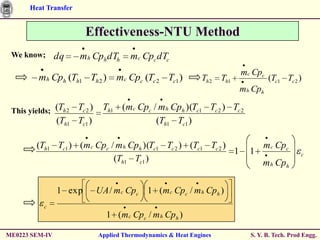
                         Effectiveness-NTU Method
 We know;       dq     m h Cph dTh        mc Cpc dTc
                                                                              mc Cpc
         mh Cph (Th1 Th 2 )          mc Cpc (Tc 2 Tc1 )          Th 2   Th1            (Tc1 Tc 2 )
                                                                              mh Cph

 This yields; (Th 2    Tc 2 )    Th1 (mc Cpc / m h Cph )(Tc1 Tc 2 ) Tc 2
                (Th1   Tc1 )                  (Th1 Tc1 )

        (Th1 Tc1 ) (m c Cpc / m h Cph )(Tc1 Tc 2 ) (Tc1 Tc 2 )                      m c Cpc
                                                               1                1                  c
                             (Th1 Tc1 )                                             m h Cph

                1 exp           UA / m c Cpc 1 (m c Cpc / m h Cph )
           c
                                  1 (m c Cpc / m h Cph )

ME0223 SEM-IV                   Applied Thermodynamics & Heat Engines           S. Y. B. Tech. Prod Engg.
Heat Transfer


                            Effectiveness-NTU Method
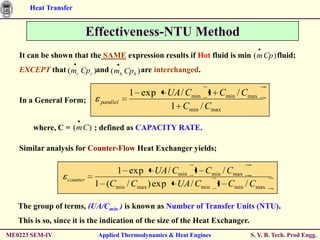
   It can be shown that the SAME expression results if Hot fluid is min ( m Cp ) fluid;
   EXCEPT that (mc Cpc )and (mh Cp h ) are interchanged.

                                         1 exp     UA / Cmin 1 Cmin / Cmax
   In a General Form;         parallel
                                                   1 Cmin / Cmax

       where, C = (m C ) ; defined as CAPACITY RATE.

   Similar analysis for Counter-Flow Heat Exchanger yields;

                                 1 exp UA / Cmin 1 Cmin / Cmax
                  counter
                             1 (Cmin / Cmax ) exp UA / Cmin 1 Cmin / Cmax

   The group of terms, (UA/Cmin ) is known as Number of Transfer Units (NTU).
   This is so, since it is the indication of the size of the Heat Exchanger.
ME0223 SEM-IV                Applied Thermodynamics & Heat Engines             S. Y. B. Tech. Prod Engg.
Heat Transfer


                            Effectiveness-NTU Method
  Heat Exchanger Effectiveness Relations :

         N = NTU = UA/Cmin         C = Cmin/Cmax
                         Flow Geometry                                Relation
         Double Pipe :
                                                           1 exp[ N (1 C )]
            Parallel Flow                                       1 C
                                                            1 exp[ N (1 C )]
            Counter Flow
                                                           1 C exp[ N (1 C )]
                                                             N
            Counter Flow, C = 1                            N 1
         Cross Flow :
                                                                  exp( NCn) 1                             0.22
            Both Fluids Mixed                              1 exp               where n                N
                                                                       Cn                         1
                                                                1           C      1
            Both Fluids Unmixed
                                                            1 exp( N ) 1 exp( NC ) N
            Cmax mixed, Cmin Unmixed                       (1/ C){ exp[ C(1 e N )]}
                                                                  1

            Cmax Unmixed, Cmin Mixed                       1 exp{ (1 / C )[1 exp( NC )]}

         Shell-and-Tube :
                                                                                                                 1
                                                                         2 1/ 2     1 exp[ N (1 C 2 )1/ 2 ]
            1 Shell-pass; 2/4/6 Tube-pass                  2 1 C (1 C )           X
                                                                                    1 exp[ N (1 C 2 )1/ 2 ]
         All Exchangers, C = 0 :                           1 e   N


ME0223 SEM-IV                Applied Thermodynamics & Heat Engines                        S. Y. B. Tech. Prod Engg.
Heat Transfer


                            Effectiveness-NTU Method
  Heat Exchanger NTU Relations :
         N = NTU = UA/Cmin         C = Cmin/Cmax      ε = Effectiveness
                         Flow Geometry                                         Relation
         Double Pipe :
                                                               ln[1 (1 C ) ]
            Parallel Flow                                N
                                                                   1 C
            Counter Flow                                       1         1
                                                         N         ln
                                                              C 1     C 1
            Counter Flow, C = 1                          N
                                                              1
         Cross Flow :
                                                                          1
            Cmax mixed, Cmin Unmixed                      N       ln 1      ln (1 C )
                                                                          C
                                                               1
            Cmax Unmixed, Cmin Mixed                     N       ln [1 C ln (1          )]
                                                              C
         Shell-and-Tube :
                                                                          2 1/ 2        (2 / ) 1 C (1 C 2 )1/ 2
            1 Shell-pass; 2/4/6 Tube-pass                 N       (1 C )           X ln
                                                                                        (2 / ) 1 C (1 C 2 )1/ 2
         All Exchangers, C = 0 :                         N        ln (1    )


ME0223 SEM-IV                Applied Thermodynamics & Heat Engines                              S. Y. B. Tech. Prod Engg.
Heat Transfer


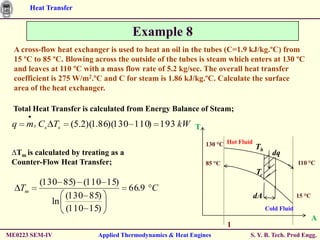
                                       Example 8
  A cross-flow heat exchanger is used to heat an oil in the tubes (C=1.9 kJ/kg.ºC) from
  15 ºC to 85 ºC. Blowing across the outside of the tubes is steam which enters at 130 ºC
  and leaves at 110 ºC with a mass flow rate of 5.2 kg/sec. The overall heat transfer
  coefficient is 275 W/m2.ºC and C for steam is 1.86 kJ/kg.ºC. Calculate the surface
  area of the heat exchanger.

  Total Heat Transfer is calculated from Energy Balance of Steam;
 q    m s Cs Ts       (5.2)(1.86)(130 110) 193 kW T

                                                               130 °C Hot Fluid   Th
 ∆Tm is calculated by treating as a                                                      dq
 Counter-Flow Heat Transfer;                                   85 °C                                110 °C
                                                                                  Tc
            (130 85) (110 15)
     Tm                               66.9 C
                  (130 85)                                                        dA                15 °C
               ln
                  (110 15)                                                             Cold Fluid
                                                                                                            A
                                                                       1
ME0223 SEM-IV               Applied Thermodynamics & Heat Engines             S. Y. B. Tech. Prod Engg.
Heat Transfer


                               Example 8….contd
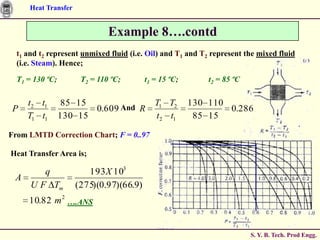
  t1 and t2 represent unmixed fluid (i.e. Oil) and T1 and T2 represent the mixed fluid
  (i.e. Steam). Hence;

  T1 = 130 ºC;         T2 = 110 ºC;       t1 = 15 ºC;       t2 = 85 ºC

     t2 t1        85 15                      T1 T2      130 110
P                       0.609 And R                             0.286
     T1 t1       130 15                      t2 t1       85 15

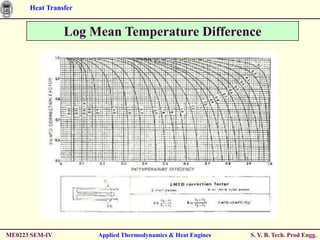
From LMTD Correction Chart; F = 0..97

Heat Transfer Area is;

      q                  193 X 103
 A
   U F Tm             (275)(0.97)(66.9)
     10.82 m 2 ….ANS


                                                                         S. Y. B. Tech. Prod Engg.
Heat Transfer


                                       Example 9
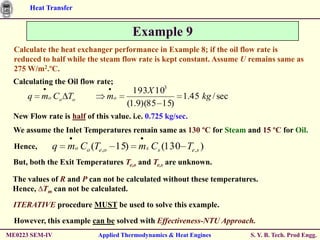
  Calculate the heat exchanger performance in Example 8; if the oil flow rate is
  reduced to half while the steam flow rate is kept constant. Assume U remains same as
  275 W/m2.ºC.
  Calculating the Oil flow rate;
                                       193X 103
      q    mo Co To            mo                 1.45 kg / sec
                                     (1.9)(85 15)
  New Flow rate is half of this value. i.e. 0.725 kg/sec.
  We assume the Inlet Temperatures remain same as 130 ºC for Steam and 15 ºC for Oil.

  Hence,      q    mo Co (Te,o 15) ms Cs (130 Te,s )
  But, both the Exit Temperatures Te,o and Te,s are unknown.

 The values of R and P can not be calculated without these temperatures.
 Hence, ∆Tm can not be calculated.

  ITERATIVE procedure MUST be used to solve this example.

  However, this example can be solved with Effectiveness-NTU Approach.
ME0223 SEM-IV               Applied Thermodynamics & Heat Engines     S. Y. B. Tech. Prod Engg.
Heat Transfer


                                     Example 10
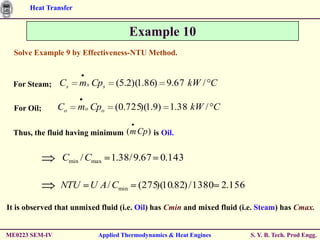
  Solve Example 9 by Effectiveness-NTU Method.


  For Steam;    Cs    m s Cps   (5.2)(1.86) 9.67 kW / C

  For Oil;      Co    mo Cpo    (0.725)(1.9) 1.38 kW / C

  Thus, the fluid having minimum ( m Cp ) is Oil.


                Cmin / Cmax 1.38/ 9.67 0.143

                NTU     U A / Cmin      (275)(10.82) / 1380 2.156

It is observed that unmixed fluid (i.e. Oil) has Cmin and mixed fluid (i.e. Steam) has Cmax.


ME0223 SEM-IV              Applied Thermodynamics & Heat Engines        S. Y. B. Tech. Prod Engg.
Heat Transfer


                          Example 10….contd

Hence; from the Table; we get;

         (1 / C ){1 exp[ C (1 e N )]}
                                               2.156
         (1 / 0 / 143) 1 exp[ (0.143)(1 e              )]   0.831

Using the Effectiveness, we can calculate the Temperature Difference for Oil as;

             To      ( Tmax ) (0.831 130 15) 95.5 C
                                    )(

 Thus, the Heat Transfer is;

           q      mo Cpo To      (1.38)(95.5) 132 kW
Thus,
Reduction in Oil flow rate by 50 % results in reduction in Heat Transfer by 32 % only.

                                                                      S. Y. B. Tech. Prod Engg.
Heat Transfer


                                         Example 11
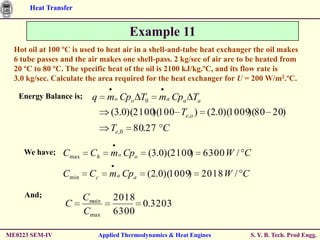
  Hot oil at 100 ºC is used to heat air in a shell-and-tube heat exchanger the oil makes
  6 tube passes and the air makes one shell-pass. 2 kg/sec of air are to be heated from
  20 ºC to 80 ºC. The specific heat of the oil is 2100 kJ/kg.ºC, and its flow rate is
  3.0 kg/sec. Calculate the area required for the heat exchanger for U = 200 W/m2.ºC.

   Energy Balance is;     q     mo Cpo T0        ma Cpa Ta
                                  (3.0)(2100 100 Te,o ) (2.0)(1009 80 20)
                                            )(                    )(
                                  Te,0   80.27 C

     We have;   Cmax      Ch      mo Cpo      (3.0)(2100 6300 W / C
                                                        )

                Cmin     Cc      m a Cpa      (2.0)(1009)      2018 W / C

     And;               Cmain     2018
                 C                     0.3203
                        Cmax      6300

ME0223 SEM-IV                 Applied Thermodynamics & Heat Engines         S. Y. B. Tech. Prod Engg.
Heat Transfer


                                 Example 11….contd
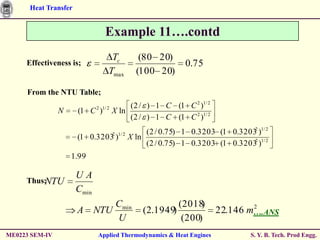
                                   Tc             (80 20)
     Effectiveness is;                                         0.75
                                  Tmax           (100 20)

     From the NTU Table;
                             2 1/ 2        (2 / ) 1 C (1 C 2 )1/ 2
                N     (1 C )          X ln
                                           (2 / ) 1 C (1 C 2 )1/ 2
                                      2 1/ 2        (2 / 0.75) 1 0.3203 (1 0.32032 )1/ 2
                      (1 0.3203 )              X ln
                                                    (2 / 0.75) 1 0.3203 (1 0.32032 )1/ 2
                    1.99

                      UA
         NTU
     Thus;
                      Cmin
                                       Cmin                   (2018 )           2
                      A      NTU                   (2.1949)             22.146 m….ANS
                                       U                       (200)
ME0223 SEM-IV                Applied Thermodynamics & Heat Engines                S. Y. B. Tech. Prod Engg.
Heat Transfer


                     Convection Heat Transfer
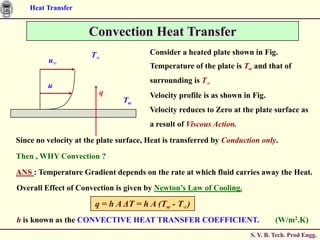
                      T∞                Consider a heated plate shown in Fig.
         u∞
                                        Temperature of the plate is Tw and that of
                                        surrounding is T∞
         u
                         q              Velocity profile is as shown in Fig.
                                Tw
                                        Velocity reduces to Zero at the plate surface as
                                        a result of Viscous Action.

Since no velocity at the plate surface, Heat is transferred by Conduction only.

Then , WHY Convection ?

ANS : Temperature Gradient depends on the rate at which fluid carries away the Heat.
Overall Effect of Convection is given by Newton’s Law of Cooling.

                       q = h A ΔT = h A (Tw - T∞)
h is known as the CONVECTIVE HEAT TRANSFER COEFFICIENT.                         (W/m2.K)
                                                                       S. Y. B. Tech. Prod Engg.
Heat Transfer


                        Convection Heat Transfer
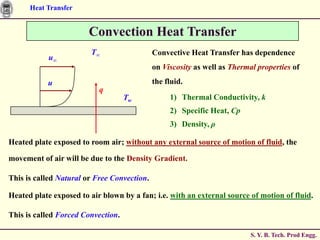
                        T∞                   Convective Heat Transfer has dependence
            u∞
                                             on Viscosity as well as Thermal properties of
           u                                 the fluid.
                           q
                                    Tw            1) Thermal Conductivity, k
                                                  2) Specific Heat, Cp
                                                  3) Density, ρ

Heated plate exposed to room air; without any external source of motion of fluid, the

movement of air will be due to the Density Gradient.

This is called Natural or Free Convection.

Heated plate exposed to air blown by a fan; i.e. with an external source of motion of fluid.

This is called Forced Convection.

                                                                           S. Y. B. Tech. Prod Engg.
Heat Transfer


      Convection Energy Balance on Flow Channel

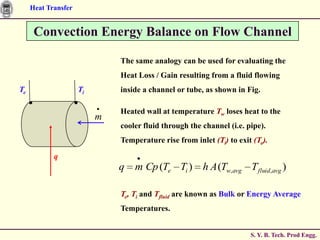
                              The same analogy can be used for evaluating the
                              Heat Loss / Gain resulting from a fluid flowing
Te                   Ti       inside a channel or tube, as shown in Fig.

                              Heated wall at temperature Tw loses heat to the
                          m
                              cooler fluid through the channel (i.e. pipe).
                              Temperature rise from inlet (Ti) to exit (Te).

            q
                              q   m Cp (Te Ti ) h A (Tw,avg T fluid,avg )

                              Te, Ti and Tfluid are known as Bulk or Energy Average
                              Temperatures.


                                                                      S. Y. B. Tech. Prod Engg.
Heat Transfer


                  Convection Boundary Condition


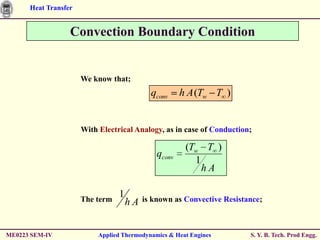
                      We know that;
                                            qconv     h A (Tw T )


                      With Electrical Analogy, as in case of Conduction;

                                                       (Tw T )
                                              qconv
                                                         1
                                                           hA

                      The term
                                 1        is known as Convective Resistance;
                                     hA


ME0223 SEM-IV              Applied Thermodynamics & Heat Engines        S. Y. B. Tech. Prod Engg.
Heat Transfer


                  Conduction – Convection System
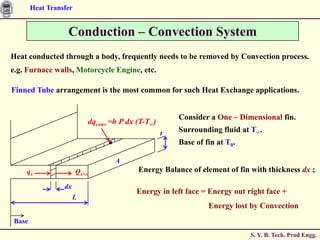
Heat conducted through a body, frequently needs to be removed by Convection process.
e.g. Furnace walls, Motorcycle Engine, etc.

Finned Tube arrangement is the most common for such Heat Exchange applications.


                                                          Consider a One – Dimensional fin.
                              dqconv =h P dx (T-T∞)
                                                      t   Surrounding fluid at T∞.
                                                          Base of fin at T0.

                                      A
    qx                 Qx+x                  Energy Balance of element of fin with thickness dx ;

                 dx
                                            Energy in left face = Energy out right face +
                      L
                                                                   Energy lost by Convection
Base
                                                                               S. Y. B. Tech. Prod Engg.
Heat Transfer


                  Conduction – Convection System
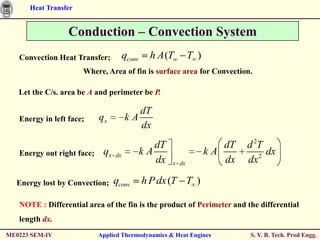
   Convection Heat Transfer;           qconv     h A (Tw T )
                      Where, Area of fin is surface area for Convection.

   Let the C/s. area be A and perimeter be P.

                                          dT
   Energy in left face;     qx         kA
                                          dx
                                                  dT              dT   d 2T
   Energy out right face;    qx   dx           kA              kA         2
                                                                            dx
                                                  dx   x dx       dx   dx

  Energy lost by Convection;      qconv        h P dx (T T )

   NOTE : Differential area of the fin is the product of Perimeter and the differential
   length dx.
ME0223 SEM-IV               Applied Thermodynamics & Heat Engines       S. Y. B. Tech. Prod Engg.
Heat Transfer


                Conduction – Convection System

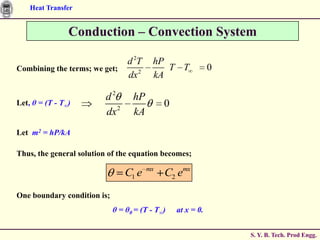
                                 d 2T    hP
Combining the terms; we get;                T T              0
                                 dx 2    kA

                          d2       hP
Let, θ = (T - T∞)                            0
                          dx 2     kA
Let m2 = hP/kA

Thus, the general solution of the equation becomes;
                                        mx
                                 C1 e        C2 emx
One boundary condition is;
                             θ = θ0 = (T - T∞)   at x = 0.


                                                                 S. Y. B. Tech. Prod Engg.
Heat Transfer


                 Conduction – Convection System
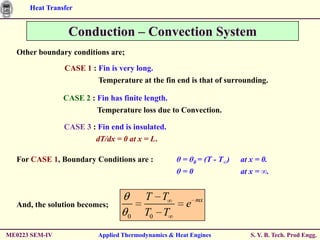
  Other boundary conditions are;

                CASE 1 : Fin is very long.
                          Temperature at the fin end is that of surrounding.

                CASE 2 : Fin has finite length.
                         Temperature loss due to Convection.

                CASE 3 : Fin end is insulated.
                        dT/dx = 0 at x = L.

  For CASE 1, Boundary Conditions are :            θ = θ0 = (T - T∞)   at x = 0.
                                                   θ=0                 at x = ∞.


                                         T T              mx
  And, the solution becomes;                          e
                                   0     T0 T
ME0223 SEM-IV             Applied Thermodynamics & Heat Engines           S. Y. B. Tech. Prod Engg.
Heat Transfer


                  Conduction – Convection System

  For CASE 3, Boundary Conditions are :              θ = θ0 = (T - T∞)   at x = 0.
                                                     dθ/dx = 0           at x = L.

  This yields;
                       0   C1 C2
                                       mL
                       0   m ( C1 e          C2 e mL )

                                             e mx           emx          cosh[m ( L x)]
  Solving for C1 and C2, we get;
                                      0     1 e 2mL        1 e2mL          cosh (mL)

   where, the hyperbolic functions are defined as;
                ex e   x
                                            ex e     x
                                                                          ex e       x
   sinh x                      cosh x                          tanh x
                  2                            2                          ex e       x


ME0223 SEM-IV              Applied Thermodynamics & Heat Engines            S. Y. B. Tech. Prod Engg.
Heat Transfer


                  Conduction – Convection System


 Solution for CASE 2 is;
                           T T            cosh[m ( L x)] (h / mk )sinh[m ( L x)]
                           T0 T                cosh (mL) (h / mk )sinh (mL)


 All the Heat loss by the fin MUST be conducted to the base of fin at x = 0.
                                           dT
 Thus, the Heat loss is;   qx   dx      kA
                                           dx    x 0


 Alternate method of integrating Convection Heat Loss;
                                L                      L
                           q         h P (T T ) dx         h P dx
                                0                      0


ME0223 SEM-IV              Applied Thermodynamics & Heat Engines        S. Y. B. Tech. Prod Engg.
Heat Transfer


                 Conduction – Convection System
   Application of Conduction equation is easier than that for Convection.


                                                  m(0)
     For CASE 1 :     q       k A[ m        0e           ]    h Pk A    0


                                       1                       1
                       q       kA 0m
                                     1 e 2 mL                1 e 2 mL
     For CASE 3 :
                               hPk A        0   tanh (mL)


                                      sinh (mL) (h / mk ) cosh (mL)
     For CASE 2 :     q       hPk A 0
                                      cosh (mL) (h / mk )sinh (mL)

ME0223 SEM-IV              Applied Thermodynamics & Heat Engines            S. Y. B. Tech. Prod Engg.
Heat Transfer


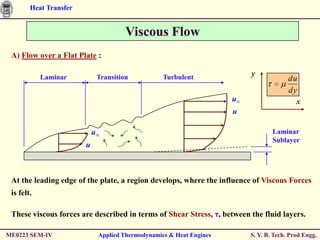
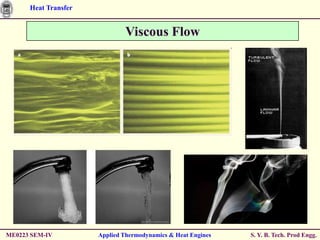
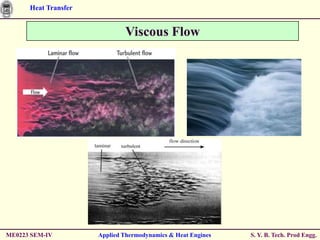
                                      Viscous Flow
 A) Flow over a Flat Plate :

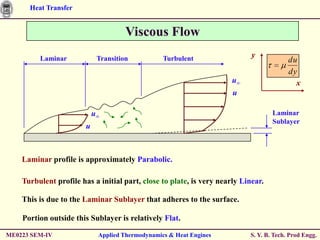
            Laminar          Transition           Turbulent               y
                                                                                        du
                                                                                        dy
                                                                     u∞                   x
                                                                     u

                            u∞                                                    Laminar
                                                                                  Sublayer
                        u


 At the leading edge of the plate, a region develops, where the influence of Viscous Forces
 is felt.

 These viscous forces are described in terms of Shear Stress, η, between the fluid layers.

ME0223 SEM-IV                Applied Thermodynamics & Heat Engines        S. Y. B. Tech. Prod Engg.
Heat Transfer


                                  Viscous Flow
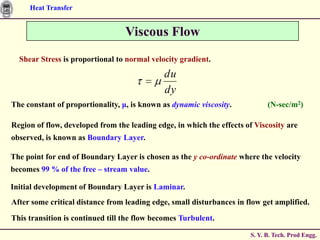
  Shear Stress is proportional to normal velocity gradient.
                                             du
                                             dy
The constant of proportionality, μ, is known as dynamic viscosity.           (N-sec/m2)

Region of flow, developed from the leading edge, in which the effects of Viscosity are
observed, is known as Boundary Layer.

The point for end of Boundary Layer is chosen as the y co-ordinate where the velocity
becomes 99 % of the free – stream value.

Initial development of Boundary Layer is Laminar.
After some critical distance from leading edge, small disturbances in flow get amplified.

This transition is continued till the flow becomes Turbulent.

                                                                       S. Y. B. Tech. Prod Engg.
Heat Transfer


                                     Viscous Flow
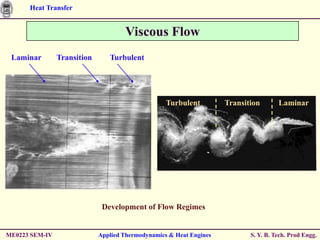
 Laminar        Transition      Turbulent


                                                   Turbulent         Transition       Laminar


                              Development of Flow Regimes


ME0223 SEM-IV                Applied Thermodynamics & Heat Engines          S. Y. B. Tech. Prod Engg.
Heat Transfer


                              Viscous Flow


ME0223 SEM-IV         Applied Thermodynamics & Heat Engines   S. Y. B. Tech. Prod Engg.
Heat Transfer


                              Viscous Flow


ME0223 SEM-IV         Applied Thermodynamics & Heat Engines   S. Y. B. Tech. Prod Engg.
Heat Transfer


                              Viscous Flow


ME0223 SEM-IV         Applied Thermodynamics & Heat Engines   S. Y. B. Tech. Prod Engg.
Heat Transfer


                                      Viscous Flow
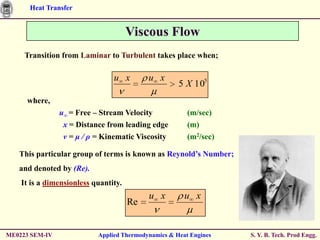
     Transition from Laminar to Turbulent takes place when;

                                u x        u x
                                                     5 X 10⁵
     where,
                u∞ = Free – Stream Velocity             (m/sec)
                 x = Distance from leading edge         (m)
                 ν = μ / ρ = Kinematic Viscosity        (m2/sec)

   This particular group of terms is known as Reynold’s Number;
   and denoted by (Re).
    It is a dimensionless quantity.
                                           u x         u x
                                      Re


ME0223 SEM-IV              Applied Thermodynamics & Heat Engines   S. Y. B. Tech. Prod Engg.
Heat Transfer


                                   Viscous Flow

    Reynolds Number (Re) =
    Ratio of Momentum Forces ( α ρu∞2 ) to Shear Stress ( α μu∞ / x ) .


   Range for Reynlold’s No. (Re) transition from Laminar to Turbulent lies between
   2 X 10⁵ to 106; depending on;
                  1. Surface Roughness.                   2. Turbulence Level.


    NOTE : Generally, Transition ends at twice the Re where it starts.


ME0223 SEM-IV             Applied Thermodynamics & Heat Engines           S. Y. B. Tech. Prod Engg.
Heat Transfer


                                      Viscous Flow
         Laminar             Transition           Turbulent                 y
                                                                                         du
                                                                                         dy
                                                                      u∞                   x
                                                                      u

                            u∞                                                     Laminar
                                                                                   Sublayer
                        u


    Laminar profile is approximately Parabolic.

    Turbulent profile has a initial part, close to plate, is very nearly Linear.

    This is due to the Laminar Sublayer that adheres to the surface.

    Portion outside this Sublayer is relatively Flat.

ME0223 SEM-IV                Applied Thermodynamics & Heat Engines         S. Y. B. Tech. Prod Engg.
Heat Transfer


                                    Viscous Flow
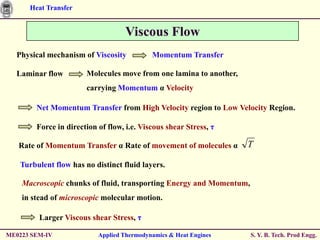
  Physical mechanism of Viscosity           Momentum Transfer

  Laminar flow         Molecules move from one lamina to another,
                       carrying Momentum α Velocity

        Net Momentum Transfer from High Velocity region to Low Velocity Region.

        Force in direction of flow, i.e. Viscous shear Stress, η

   Rate of Momentum Transfer α Rate of movement of molecules α      T

   Turbulent flow has no distinct fluid layers.

    Macroscopic chunks of fluid, transporting Energy and Momentum,
    in stead of microscopic molecular motion.

         Larger Viscous shear Stress, η

ME0223 SEM-IV              Applied Thermodynamics & Heat Engines     S. Y. B. Tech. Prod Engg.
Heat Transfer


                                     Viscous Flow
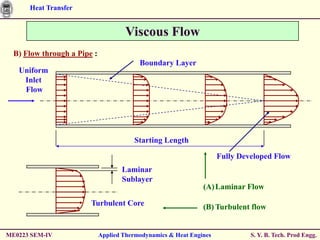
  B) Flow through a Pipe :
                                          Boundary Layer
   Uniform
    Inlet
    Flow


                                        Starting Length

                                                                     Fully Developed Flow
                                    Laminar
                                    Sublayer
                                                               (A) Laminar Flow

                        Turbulent Core                         (B) Turbulent flow


ME0223 SEM-IV                Applied Thermodynamics & Heat Engines            S. Y. B. Tech. Prod Engg.
Heat Transfer


                                   Viscous Flow
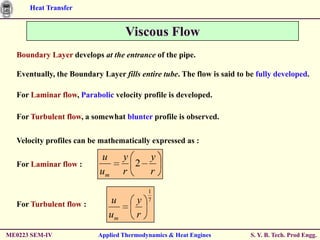
  Boundary Layer develops at the entrance of the pipe.

  Eventually, the Boundary Layer fills entire tube. The flow is said to be fully developed.

  For Laminar flow, Parabolic velocity profile is developed.

  For Turbulent flow, a somewhat blunter profile is observed.

  Velocity profiles can be mathematically expressed as :

                           u       y       y
  For Laminar flow :                 2
                           um      r       r
                                          1

  For Turbulent flow :        u       y   7

                              um      r
ME0223 SEM-IV             Applied Thermodynamics & Heat Engines          S. Y. B. Tech. Prod Engg.
Heat Transfer


                                 Viscous Flow

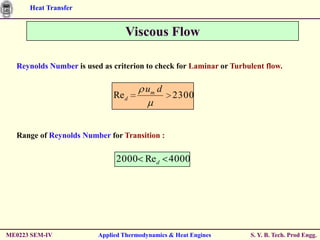
  Reynolds Number is used as criterion to check for Laminar or Turbulent flow.

                                        um d
                              Re d               2300


  Range of Reynolds Number for Transition :

                              2000 Red 4000


ME0223 SEM-IV            Applied Thermodynamics & Heat Engines      S. Y. B. Tech. Prod Engg.
Heat Transfer


                                  Viscous Flow
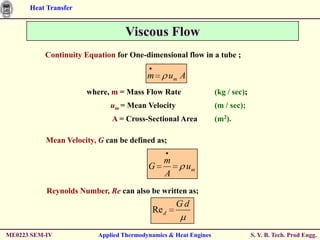
          Continuity Equation for One-dimensional flow in a tube ;

                                          m       um A
                      where, m = Mass Flow Rate                   (kg / sec);
                              um = Mean Velocity                  (m / sec);
                              A = Cross-Sectional Area            (m2).

           Mean Velocity, G can be defined as;

                                            m
                                          G              um
                                            A
           Reynolds Number, Re can also be written as;
                                                   Gd
                                           Re d

ME0223 SEM-IV             Applied Thermodynamics & Heat Engines                 S. Y. B. Tech. Prod Engg.
Heat Transfer


                                    Inviscid Flow
    No Real fluid is inviscid.

    Practically, we can assume the flow to be inviscid for certain conditions.

    Flow at a sufficiently large distance from the flat plate, can be assumed to be inviscid.

           Velocity Gradients, normal to the direction of flow are very small.

                      Viscous – Shear Forces are also very small.
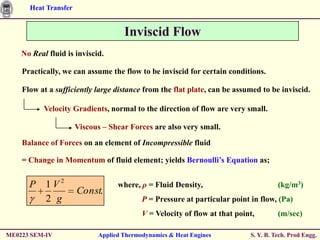
    Balance of Forces on an element of Incompressible fluid

    = Change in Momentum of fluid element; yields Bernoulli’s Equation as;


      P 1V2                       where, ρ = Fluid Density,                          (kg/m3)
                      Const.
        2 g                               P = Pressure at particular point in flow, (Pa)
                                          V = Velocity of flow at that point,        (m/sec)

ME0223 SEM-IV               Applied Thermodynamics & Heat Engines          S. Y. B. Tech. Prod Engg.
Heat Transfer


                                    Inviscid Flow


      Bernoulli’s Equation is considered as Energy Equation due to ;

                      1. The term ( V2 / 2g ) ≡ Kinetic Energy.
                      2. The term ( P / γ )   ≡ Potential Energy.


      For a Compressible fluid, Energy Equation should take into account :
                1. Changes in Internal Energy, h
                2. Corresponding changes in Temperatures, T.


ME0223 SEM-IV               Applied Thermodynamics & Heat Engines      S. Y. B. Tech. Prod Engg.
Heat Transfer


                                       Inviscid Flow
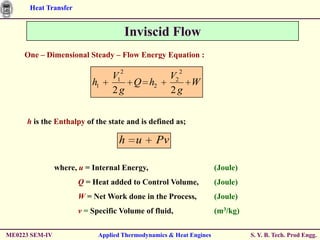
     One – Dimensional Steady – Flow Energy Equation :

                                   2                  2
                                V1                 V2
                          h1       Q h2               W
                                2g                 2g


     h is the Enthalpy of the state and is defined as;

                                  h u         Pv

                where, u = Internal Energy,                         (Joule)
                      Q = Heat added to Control Volume,             (Joule)
                      W = Net Work done in the Process,             (Joule)
                      v = Specific Volume of fluid,                 (m3/kg)

ME0223 SEM-IV               Applied Thermodynamics & Heat Engines             S. Y. B. Tech. Prod Engg.
Heat Transfer


                         Compressible Fluid Flow
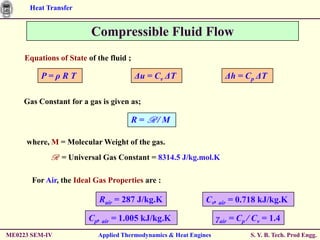
     Equations of State of the fluid ;

          P=ρRT                          Δu = Cv ΔT                  Δh = Cp ΔT

     Gas Constant for a gas is given as;

                                     R=R /M

     where, M = Molecular Weight of the gas.
             R = Universal Gas Constant = 8314.5 J/kg.mol.K

       For Air, the Ideal Gas Properties are :

                            Rair = 287 J/kg.K                 Cv, air = 0.718 kJ/kg.K

                        Cp, air = 1.005 kJ/kg.K                    γair = Cp / Cv = 1.4
ME0223 SEM-IV              Applied Thermodynamics & Heat Engines             S. Y. B. Tech. Prod Engg.
Heat Transfer


                          Thermal Boundary Layer
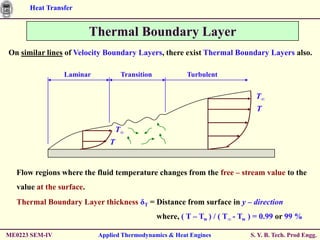
On similar lines of Velocity Boundary Layers, there exist Thermal Boundary Layers also.

                Laminar            Transition            Turbulent


                                                                               T∞
                                                                               T

                                  T∞
                              T


  Flow regions where the fluid temperature changes from the free – stream value to the
  value at the surface.
  Thermal Boundary Layer thickness δT = Distance from surface in y – direction
                                                where, ( T – Tw ) / ( T∞ - Tw ) = 0.99 or 99 %

ME0223 SEM-IV              Applied Thermodynamics & Heat Engines             S. Y. B. Tech. Prod Engg.
Heat Transfer


             Laminar Boundary Layer on Flat Plate
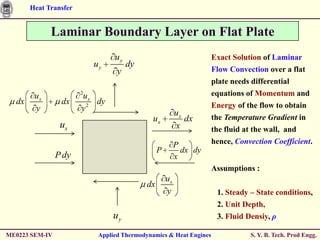
                                 uy                                 Exact Solution of Laminar
                           uy         dy
                                  y                                 Flow Convection over a flat
                                                                    plate needs differential
        ux             2
                       ux                                           equations of Momentum and
  dx             dx      2
                           dy                                       Energy of the flow to obtain
        y              y
                                                         ux         the Temperature Gradient in
                                              ux            dx
                 ux                                      x          the fluid at the wall, and
                                                         P          hence, Convection Coefficient.
                                                P          dx dy
                P dy                                     x
                                                                    Assumptions :
                                                    ux
                                           dx
                                                    y                1. Steady – State conditions,
                                                                     2. Unit Depth,
                                uy                                   3. Fluid Densiy, ρ

ME0223 SEM-IV               Applied Thermodynamics & Heat Engines              S. Y. B. Tech. Prod Engg.
Heat Transfer


             Laminar Boundary Layer on Flat Plate
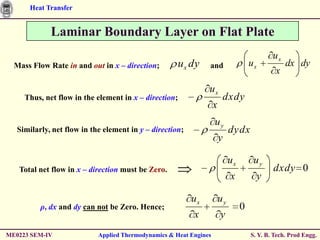
                                                                                              ux
  Mass Flow Rate in and out in x – direction;         u x dy    and                   ux           dx dy
                                                                                               x
                                                                ux
     Thus, net flow in the element in x – direction;                     dx dy
                                                                    x
                                                                    uy
   Similarly, net flow in the element in y – direction;                      dy dx
                                                                        y

                                                                             ux        uy
   Total net flow in x – direction must be Zero.                                              dx dy 0
                                                                             x          y

                                                          ux            uy
          ρ, dx and dy can not be Zero. Hence;                                    0
                                                           x            y
ME0223 SEM-IV               Applied Thermodynamics & Heat Engines                     S. Y. B. Tech. Prod Engg.
Heat Transfer


             Laminar Boundary Layer on Flat Plate
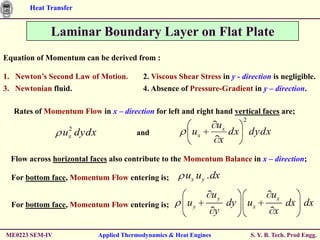
Equation of Momentum can be derived from :

1. Newton’s Second Law of Motion.         2. Viscous Shear Stress in y - direction is negligible.
3. Newtonian fluid.                       4. Absence of Pressure-Gradient in y – direction.

  Rates of Momentum Flow in x – direction for left and right hand vertical faces are;
                                                                              2
                  2                                                  ux
                 ux dy dx               and               ux            dx dy dx
                                                                     x
  Flow across horizontal faces also contribute to the Momentum Balance in x – direction;

  For bottom face, Momentum Flow entering is;           ux u y . dx
                                                                    uy                   ux
  For bottom face, Momentum Flow entering is;            uy              dy       ux           dx dx
                                                                    y                     x

ME0223 SEM-IV               Applied Thermodynamics & Heat Engines                 S. Y. B. Tech. Prod Engg.
Heat Transfer


            Laminar Boundary Layer on Flat Plate

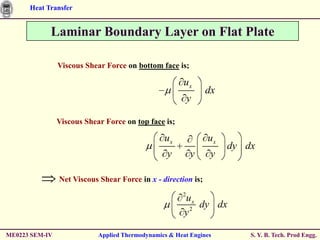
                Viscous Shear Force on bottom face is;

                                                        ux
                                                               dx
                                                           y

                Viscous Shear Force on top face is;

                                                 ux            ux
                                                                    dy dx
                                                  y        y    y

                Net Viscous Shear Force in x - direction is;
                                                       2
                                                        ux
                                                          2
                                                            dy dx
                                                        y

ME0223 SEM-IV               Applied Thermodynamics & Heat Engines       S. Y. B. Tech. Prod Engg.
Heat Transfer


             Laminar Boundary Layer on Flat Plate

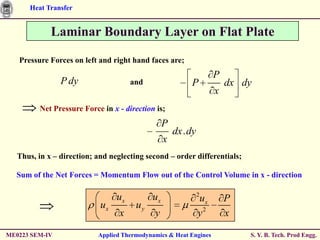
   Pressure Forces on left and right hand faces are;
                                                                    P
                P dy                  and                 P             dx dy
                                                                    x
         Net Pressure Force in x - direction is;
                                                 P
                                                     dx . dy
                                                 x
   Thus, in x – direction; and neglecting second – order differentials;

  Sum of the Net Forces = Momentum Flow out of the Control Volume in x - direction

                                                               2
                                 ux         ux                 ux       P
                            ux         uy
                                 x           y                 y2       x

ME0223 SEM-IV              Applied Thermodynamics & Heat Engines            S. Y. B. Tech. Prod Engg.
Heat Transfer


               Laminar Boundary Layer on Flat Plate
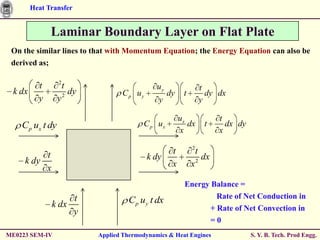
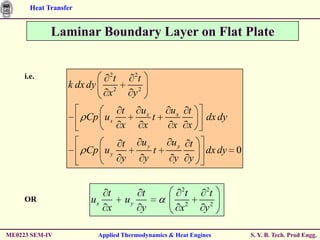
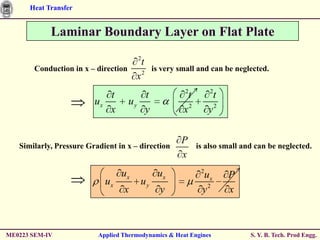
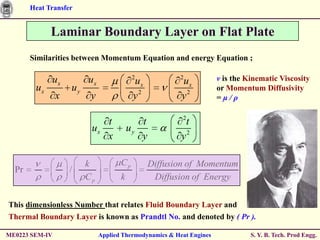
 On the similar lines to that with Momentum Equation; the Energy Equation can also be
 derived as;

                 2
           t         t                           uy                     t
  k dx                   dy          Cp uy            dy    t             dy dx
           y     y2                              y                      y

                                                           ux                  t
    Cp ux t dy                              C p ux            dx         t       dx dy
                                                           x                   x

                                                                2
          t                                            t            t
     k dy                                    k dy                   2
                                                                        dx
          x                                            x        x

                                                            Energy Balance =
                    t                                                          Rate of Net Conduction in
               k dx                    Cp uy t dx
                    y                                                        + Rate of Net Convection in
                                                                             =0
ME0223 SEM-IV                 Applied Thermodynamics & Heat Engines                      S. Y. B. Tech. Prod Engg.
Heat Transfer


             Laminar Boundary Layer on Flat Plate


     i.e.                      2            2
                                   t            t
                  k dx dy
                               x2          y2
                                       t            ux       ux t
                       Cp u x                          t               dx dy
                                       x            x        x x
                                       t            uy       uy t
                       Cp u y                            t             dx dy 0
                                       y            y        y y

                                                               2       2
                              t                     t              t       t
     OR                 ux             uy
                              x                     y         x2       y2

ME0223 SEM-IV               Applied Thermodynamics & Heat Engines                S. Y. B. Tech. Prod Engg.
Heat Transfer


            Laminar Boundary Layer on Flat Plate
                                          2
                                              t
       Conduction in x – direction            2
                                                      is very small and can be neglected.
                                        x
                                                                2            2
                               t                  t                 t            t
                         ux          uy
                               x                  y            x2            y2

                                                              P
   Similarly, Pressure Gradient in x – direction                        is also small and can be neglected.
                                                              x
                                                                         2
                                   ux                  ux                ux          P
                              ux          uy
                                   x                    y                y2          x


ME0223 SEM-IV             Applied Thermodynamics & Heat Engines                          S. Y. B. Tech. Prod Engg.
Heat Transfer


             Laminar Boundary Layer on Flat Plate
       Similarities between Momentum Equation and energy Equation ;

             ux          ux               2
                                          ux             2
                                                         ux           ν is the Kinematic Viscosity
        ux          uy                                                or Momentum Diffusivity
                x         y               y2             y2           =μ/ρ

                                                          2
                                 t            t               t
                          ux             uy
                                 x            y          y2

                         k           Cp           Diffusion of Momentum
  Pr                /
                         Cp          k             Diffusion of Energy

This dimensionless Number that relates Fluid Boundary Layer and
Thermal Boundary Layer is known as Prandtl No. and denoted by ( Pr ).

ME0223 SEM-IV                 Applied Thermodynamics & Heat Engines             S. Y. B. Tech. Prod Engg.
Heat Transfer


            Laminar Boundary Layer on Flat Plate

                Pr < 1                           Pr = 1                       Pr > 1


u
                                                           δ = δT
T∞               δ       δT                                                     δT       δ


     Prandtl No. can vary from 4 X 10⁻³ – 0.2 and 1.0 - 4 X 10⁴
                                     Liquid Metals        Viscous Oils


     Gases have generally Pr = 0.7


ME0223 SEM-IV                 Applied Thermodynamics & Heat Engines      S. Y. B. Tech. Prod Engg.
Heat Transfer


         Integral Momentum and Energy Equations

                                                   Consider a Control Volume that extends
                                                   from wall to just beyond the limit of
                                     D
                                                   Boundary Layer in y – direction.


                      B                            Thickness dx in x – direction.
                                    C
                           y=δ
                                                   Unit depth in z – direction.
                   A
                  y
                                                Equation to relate Net Momentum Outflow
                                                to Net Force acting in x – direction.


ME0223 SEM-IV             Applied Thermodynamics & Heat Engines           S. Y. B. Tech. Prod Engg.
Heat Transfer


         Integral Momentum and Energy Equations
                                               2
  Momentum Flow across face AB :             u x dy
                                       0

                                              2       d     2
  Momentum Flow across face CD :             ux dy         ux dy . dx
                                       0
                                                      dx 0
                                             d
  Fluid also enters the control Volume            ux dy . dx
                                             dx 0
  across face BD with rate of :
                                           = Fluid leaving across face CD –
                                             Fluid entering across face AB

      Fluid entering across face BD has Velocity us in x – direction.

                                                                      d
         Momentum Flow into Control Volume in x – direction :      us      ux dy . dx
                                                                      dx 0
ME0223 SEM-IV             Applied Thermodynamics & Heat Engines          S. Y. B. Tech. Prod Engg.
Heat Transfer


         Integral Momentum and Energy Equations

  Net Momentum Outflow in x – direction :
                      d                  d
                           ux dy . dx us      ux dy . dx
                      dx 0               dx 0
  Pressure Force will act on face AB and CD.

  Shear Force will act on face AC.

  No Shear Force will act on face BD since it is at limit of Boundary Layer.
                                           ux
                                                  0
                                           y
           Net Force acting on Control Volume in x – direction :

                               Px                            Px
                Px      Px        dx          w dx              dx   w   dx
                               x                             x
ME0223 SEM-IV             Applied Thermodynamics & Heat Engines          S. Y. B. Tech. Prod Engg.
Heat Transfer


         Integral Momentum and Energy Equations

    Pressure Gradient can be neglected as it is very small, compared to other terms.


         Equality of the Net Momentum Outflow to the Net Force in x – direction :


                            d
                                 ux us ux dy               w
                            dx 0

     This is know as the Integral Momentum Equation in Laminar Boundary Layer.


ME0223 SEM-IV             Applied Thermodynamics & Heat Engines        S. Y. B. Tech. Prod Engg.
Heat Transfer


         Integral Momentum and Energy Equations
   Integral Energy Equation can be derived in a similar way.
                                                      Control Volume similar to that of
                                    Velocity Boundary
                                                      Integral Momentum Equation is
                                    Layer, δ
                                                      considered, but extending beyond
                                     D                the limits of both Velocity
                                                      Boundary Layer and Thermal
                                                      Boundary Layer.
                      B                                Principle of Conservation of Energy
                                    C
                                             Thermal applied involves :
                                             Boundary 1. Enthalpy and Kinetic Energy of
                                             Layer, δT
                   A                                      Fluid entering and leaving.
                  y                                      2. Heat Transfer by Conduction.

                                                          Kinetic Energy can be neglected
                                                          as it is very small.
ME0223 SEM-IV             Applied Thermodynamics & Heat Engines         S. Y. B. Tech. Prod Engg.
Heat Transfer


         Integral Momentum and Energy Equations
                                                  ys

  Enthalpy Flow Rate across face AB :                    C p u x t dy
                                                  0
                                           ys                                ys
                                                                        d
  Enthalpy Flow Rate across face CD :                  C p ux t dy                C p u x t dy . dx
                                              0
                                                                        dx   0
                                                        ys
                                                  d
  Fluid also enters the control Volume                       u x dy . dx
                                                  dx    0
  across face BD at the rate :
                                          = Flow rate out face CD –
                                            Flow rate in face AB

                                          ys
                                     d
  Enthalpy Flow will be :     C p ts                  u x dy . dx
                                     dx   0


ME0223 SEM-IV               Applied Thermodynamics & Heat Engines                    S. Y. B. Tech. Prod Engg.
Heat Transfer


       Integral Momentum and Energy Equations
                                                    t
  Heat Transfer by Conduction is :         k dx
                                                    y   y 0
  Conservation of Energy gives :
                    ys                     ys
               d                      d                                     t
        C p ts            u x dy . dx           C p u x t dy . dx    k dx               0
               dx     0
                                      dx   0
                                                                            y   y 0

    Beyond the Thermal Boundary Layer, the temperature is constant at ts.

    Integration needs to be carried out only up to y = δT.

    Above equation changes to :
                                 T
                            d                              t
                                     ts t u x dy                      0
                            dx   0
                                                           y   y 0


     This is know as the Integral Energy Equation in Laminar Boundary Layer.

ME0223 SEM-IV               Applied Thermodynamics & Heat Engines           S. Y. B. Tech. Prod Engg.
Heat Transfer


        Laminar Forced Convection on Flat Plate
 Integral Momentum Equation and Integral Energy Equation are applied to solve the
 equation for Laminar Forced Convection.
 Analysis assumes uniform Viscosity with Temperature.

STEP 1 :
Apply Integral Momentum Equation to derive for Velocity Boundary Layer Thickness.

Velocity profile assumed to be : ux = a + by + cy2 + dy3

Constants a, b, c and d are found by applying known Boundary Conditions :

           ux = 0 at y = 0.       a = 0.            ux
                                                            0 at y = δ
                                                    y                    2
           ux = us at y = δ.                                             ux
                                                   ux and uy = 0              0 at y = 0
                                                                         y2
                               3 us                           - 1 us
        This yields;     b=                  c=0         d=
                               2 δ                             2 δ3

ME0223 SEM-IV                  Applied Thermodynamics & Heat Engines          S. Y. B. Tech. Prod Engg.
Heat Transfer


        Laminar Forced Convection on Flat Plate
                                                   3
                      ux     3 y           1 y
     This yields;
                      us     2             2

STEP 2 :
Apply Integral Momentum Equation,

                d
                     ux us ux dy                    w
                dx 0

                                                        3                        3
                d                  3 y        1 y                 3 y    1 y
                           us2                              . 1                      dy
                dx    0
                                   2          2                   2      2

                      du x
                      dy         y 0

ME0223 SEM-IV                    Applied Thermodynamics & Heat Engines         S. Y. B. Tech. Prod Engg.
Heat Transfer


         Laminar Forced Convection on Flat Plate
                                                                                           3 us
  Wall Shear Stress is found by considering Velocity Gradient at y = 0 and is =
                                                                                           2 δ
           d        2 39      3    us                       2           3 280    us
                    u
                    s                                     u d
                                                            s                         dx
           dx         280     2                                         2 39
                                                                    2
                        140                                               140 x
                    d          dx           Integration yields;                  C
                         13 us                                      2      13 us

  δ = 0 at x = 0.       C=0

                                        2      280 x
                                               13 us

                              OR
                                               4.64
                                        x     (Re)1/ 2
ME0223 SEM-IV               Applied Thermodynamics & Heat Engines               S. Y. B. Tech. Prod Engg.
Heat Transfer


        Laminar Forced Convection on Flat Plate
 Temperature Distribution in the Thermal Boundary Layer can be found out in similar
 manner.

STEP 1 :
 Temperature profile assumed to be : θx = ( t – tw ) = dy + ey2 + fy3

 Applying the known Boundary Conditions and solving for the constants d, e and f ;
                                                                3
                                           3   y        1   y
                                   s       2    T       2   T
STEP 2 :
Apply Integral Energy Equation,
                               T
                        d
                                       s       u x dy                     0
                        dx    0
                                                                y   y 0


ME0223 SEM-IV                Applied Thermodynamics & Heat Engines            S. Y. B. Tech. Prod Engg.
Heat Transfer


           Laminar Forced Convection on Flat Plate
   From the Temperature Distribution Equation;

                                                              3     s

                                               y       y 0
                                                              2     T
  This yields;

                                           3                                     3
      T
 d               3    y        1      y                   3   y          1   y                        3      s
             S                                     S    .           uS               uS dy
 dx   0
                 2    T        2      T                   2    T         2   T                        2      T


   Substituting as λ = δT / δ; gives;


                          d                             3      3    3        3       s
                                    S uS       T
                          dx                           20     280            2       T


ME0223 SEM-IV                      Applied Thermodynamics & Heat Engines                 S. Y. B. Tech. Prod Engg.
Heat Transfer


           Laminar Forced Convection on Flat Plate
                                                                                       4.64
  Neglecting as 3λ3 / 280 as very small term; and substituting for δ from;
                                                                                x     (Re)1/2
                                           3                     3/4
                                       T       0.93        xh
                                                    1
                                                Pr         x
         where, xh is the length of the start of the heated section.

 If the plate is heating along its entire length, xh = 0

                                 1/3                y
                  T      0.93
                          Pr                                                                   δ
                                                                                         δT
                  T      1
         OR                                                 xh
                       (Pr)1/3                                         x

ME0223 SEM-IV               Applied Thermodynamics & Heat Engines          S. Y. B. Tech. Prod Engg.
Heat Transfer


           Laminar Forced Convection on Flat Plate

                                                              3      S   …..from Temperature
    Heat Transfer at the wall is :   qw   k                 k
                                                 y   y 0
                                                              2      T     Distribution Profile

                                                qw      3 k
   This Heat Transfer rate is expressed as                          and is the Heat Transfer
                                                 S      2 T         Coefficient, h


   The group
                 hx    is a dimensionless number.
                 k

   This is known as Nusselt Number, and is denoted by ( Nu )

                  hx
           Nu
                  k
ME0223 SEM-IV               Applied Thermodynamics & Heat Engines              S. Y. B. Tech. Prod Engg.
Heat Transfer


          Laminar Forced Convection on Flat Plate

                      characterstic Linear Dimension of the System
                Nu
                       Equivalent conducting film of thickness T


                                           TS
                                                  θS


                       δT                                           δT’ Equivalent
                                                                        Conducting Film


                                         Tw


ME0223 SEM-IV               Applied Thermodynamics & Heat Engines       S. Y. B. Tech. Prod Engg.
Heat Transfer


           Laminar Forced Convection on Flat Plate
                                      k                        k                       hx        x
      Thus,     qw       h   S             .    S      h                         Nu
                                      T                        T                       k          T

                                                qw x           3 x    3 x (Re)1/2 (Pr)1/3
         This gives Nu as ;          Nux
                                                 S k           2 T   2(0.93)1/3 (4.64) x

          This gives ;                    Nux        0.332(Rex ) 1/ 2 (Pr)1/ 3
 This gives Local Nusselt Number at some point x from the leading edge of the plate.

 The average value of the Convection Coefficient, h over the distance of 0 to x is given by;
                                                           x
                                                      1
                                                    h    h dx
                                                      x0
  Thus, Average Nusselt No. is;           Nux        0.664(Rex ) 1/ 2 (Pr)1/ 3
ME0223 SEM-IV                    Applied Thermodynamics & Heat Engines             S. Y. B. Tech. Prod Engg.
Heat Transfer


                                           Example 12
Air flows at 5 m/sec. along a flat plate maintained at 77 °C. Bulk air temperature is 27 °C.
Determine at 0.1 mtr from the leading edge the velocity an temperature boundary layer
thickness and local as well as average heat transfer coefficient.
                                       77 27                          =1.084 kg / m3
 Bulk Mean Temperature =                        52 C 325 K
                                         2                          k = 28.1 X 10⁻⁶ kW / m.K
                                                                    μ = 1.965 X 10⁻⁵ Pa.sec
                                                                    Pr = 0.703

                     ux                  (1.087)(5)(0.1)
    Re x    0.1
                                                                27, 659.03
                           0.1             1.965 X 10 5

                    4.64                                   4.64
                         1/2                                         (0.1) 2.789 mm        …..Ans (i)
     x    0.1     Re x                             0.1
                                                         (Re0.1 )1/2
                                 0.1


ME0223 SEM-IV                    Applied Thermodynamics & Heat Engines          S. Y. B. Tech. Prod Engg.
Heat Transfer


                                           Example 12….cntd
                       1                                               1
     T
                                                       T                      (2.789) 3.134 mm            …..Ans (ii)
                                                           0.1            1/3
          0.1        (Pr) 1/3                                      (0.703)
                                  0.1


                      hx                                    1/2                      1/3
   Nux     0.1
                                    0.332 Re x                              Pr
                      k    0.1
                                                                   0.1


                                                1/ 2                     1/ 3    28.1 X 10 6
   (h) 0.1         0.332 (27,659.03)                       (0.703)
                                                                                     0.1
                   13.8 X 10 3 kW / m 2 .K                 …..Ans (iii)

                      hx                                     1/2                      1/3
    Nu x                                0.664 Re x                              Pr
             0.1      k     0.1
                                                                    0.1


         27.6 X 10 3 kW / m2 .K …..Ans (iv)
ME0223 SEM-IV                           Applied Thermodynamics & Heat Engines                  S. Y. B. Tech. Prod Engg.
Heat Transfer


           Laminar Forced Convection in a Tube
                                                   Case for :
                                                   1. Fully Developed Flow, and
                                                   2. Constant Heat Flux.

                                                   Velocity Profile of Parabolic shape.

                                                To derive Energy Equation for flow in tube :

                                                    Consider a cylindrical element of flow.

                                                     Length, dx

                                                     Inner Radius, r

                                                     Outer Radius, r + dr

   Energy Flow into and out of the element in :
   1. Radial direction by Conduction, and           2. Axial direction by Convection.

ME0223 SEM-IV             Applied Thermodynamics & Heat Engines          S. Y. B. Tech. Prod Engg.
Heat Transfer


           Laminar Forced Convection in a Tube
                                                         T
     Conduction into the element :    Qr        k 2 r dx
                                                         r
                                                        Qr                           T
     With change of radius dr, Conduction rate :           dr      k 2 dx       r      dr
                                                        r                   r        r
     This change in Conduction rate = Difference between Convection rates into and
                                      out of the element in Axial Direction.
    Temperature changes in Axial Direction.

     Rate of Convection into the element :       2 r dr u C p T
                                                                        T
     Rate of Convection out of the element :       2 r dr u C p T         dx
                                                                        x
                                                            T
     Hence, the difference is :        2 r dr      u Cp       dx
                                                            x
ME0223 SEM-IV              Applied Thermodynamics & Heat Engines      S. Y. B. Tech. Prod Engg.
Heat Transfer


           Laminar Forced Convection in a Tube
      Summation of total Forces is zero.


                              1      T                 Cp T
                                   r
                              ur r   r                 k  x

        This is the ENERGY EQUATION FOR LAMINAR FLOW IN TUBES.


      Assumptions :

      1. Constant Heat Flow, qw,
      2. Constant Fluid properties,


      Temperature of the fluid (at any radius) must               T
                                                                      Cons tan t
      increase linearly in the direction of flow.                 x

ME0223 SEM-IV             Applied Thermodynamics & Heat Engines         S. Y. B. Tech. Prod Engg.
Heat Transfer


              Laminar Forced Convection in a Tube
   Boundary Conditions :

     1.
          T                                                       2.   T   Tw   at r      rw
                   0       at r         0
          r
                            T                             Heat Flux is related to Temperature Gradient.
     3.   qw           k                     at r    rw
                            r      rw


          T
                   Cons tan t                equation reduces to Total Differential Equation.
          x

     Velocity, u α Velocity at the Axis of tube, ua and Radius, r.
                                        2
              u                r
                       1                    ….assuming Parabolic Distribution.
              ua              rw            ….rw = wall radius.

ME0223 SEM-IV                      Applied Thermodynamics & Heat Engines               S. Y. B. Tech. Prod Engg.
Heat Transfer


           Laminar Forced Convection in a Tube
                                                                                 2
     Substituting this value in the                T        1 T             r
                                               r                ua 1                 r
     above Equation would give;            r       r          x            rw

      Integrating for two times,               1 T    r2 r4
                                       T           ua       2
                                                                           C1 ln r       C2
       would give :                              x    4 16 rw
     Applying the Boundary Conditions :

           1.
                    T
                         0    at r    0                C1 =0
                    r                                                          2
                                                                     1 T    3 rw
           2.   T       Tw   at r     rw               C2   Tw           ua
                                                                       x    16
    Thus, Equation becomes :
                                                   2             4
                        1 T     2 1 r                    1 r           3
                T           ua rw                                           Tw
                          x       4 rw                  16 rw         16
ME0223 SEM-IV                Applied Thermodynamics & Heat Engines              S. Y. B. Tech. Prod Engg.
Heat Transfer


           Laminar Forced Convection in a Tube
  Equation can be expressed in terms of Temperature Difference :            θ = T - Tw

  θa = Temperature Difference between axis ( r = 0 ) and wall.

                                        1 T     2  3
                                    a       ua rw
                                          x       16
  Temperature Profile can be expressed non – dimensionally as :
                                                    2             4
                                            4 r            1 r
                                    1
                           a                3 rw           3 rw
  Heat Transfer at wall α Temperature Gradient at r = rw

                      d                         8    4             4    a
                                        a
                      dr       rw            3 rw   3 rw          3    rw
ME0223 SEM-IV              Applied Thermodynamics & Heat Engines              S. Y. B. Tech. Prod Engg.
Heat Transfer


            Laminar Forced Convection in a Tube
  On the similar lines;

                                       4k a                                     4 k
      qw        k                                     h   a                 h
                       r   rw           3 rw                                    3 rw

                                     hd        4 k         2 rw         8
   In terms of Nud :       Nu d
                                      k        3 rw         k           3

  This analysis is based on the Temperature Difference between the Axis and the Wall.

  From practical point of view, analysis for Temperature Difference between the Bulk
  and the Wall is important.

  Bulk Temperature = Mean Temperature of the fluid.


ME0223 SEM-IV                   Applied Thermodynamics & Heat Engines            S. Y. B. Tech. Prod Engg.
Heat Transfer


           Laminar Forced Convection in a Tube
                                                      rw

                                                           2 r dr u C p
      Temperature Difference based on                 0
                                                  m   rw
      Bulk Temperature is given as;
                                                              2 r dr u C p
                                                          0

                                                 44
     Solution of the Equation is :       m            a
                                                 72

      Heat Transfer                                   4k a           4 72 k
                         qw          k                                                m       h   m
      at the wall is :                       r         3 rw          3 44 rw
                                                 rw


                                4 k              72
                          h
                                3 rw             44
ME0223 SEM-IV             Applied Thermodynamics & Heat Engines              S. Y. B. Tech. Prod Engg.
Heat Transfer


           Laminar Forced Convection in a Tube

      In terms of Nud :

                                hd        4 k        2 rw      72
                      Nu d
                                 k        3 rw        k        44

                                8 72
                      Nu d
                                3 44

                          Nud    4.36

       NOTE : The Nu is INDEPENDENT of Re as the Fully Developed flow,
              Boundary Layer Thickness = Tube Radius.

ME0223 SEM-IV              Applied Thermodynamics & Heat Engines    S. Y. B. Tech. Prod Engg.
Heat Transfer


                               Reynolds Analogy
Till now, the analysis of Forced Convection for Laminar Flow is carried out.

Turbulent flow demands for introduction of additional terms into Momentum
Equation and Energy Equation to take into consideration the presence of Turbulence.
                Demands for Numerical Solution for Finite Difference Equations.

Approach for Turbulent Flow Convection α Similarities between Equations for :
                                                 1. Heat Transfer and
                                                 2. Shear Stress (OR Momentum Transfer)


   Original Idea of such Analogy is put forth by Reynolds;
   and hence named after him.


ME0223 SEM-IV              Applied Thermodynamics & Heat Engines        S. Y. B. Tech. Prod Engg.
Heat Transfer


                                Reynolds Analogy
                                                              du            du
  Equation for Shear Stress in Laminar Flow is :
                                                              dy            dy
                                                       where, ν is the Kinematic Viscosity.

                                                                          du
   Similar equation for Shear Stress in Turbulent Flow is :        T
                                                                          dy
  The term, ε is known as Eddy Diffusivity.

  ε α Shear Stress due to Random Turbulent Motion.

  Turbulent Flow             Presence of Viscous Shear Stress also.
                                                                         du
                             Total Shear Stress is :
                                                                         dy
  ε is not a Property of fluid, like μ
  ε α Re and Turbulence Level.
   ε generally >> ν
ME0223 SEM-IV              Applied Thermodynamics & Heat Engines           S. Y. B. Tech. Prod Engg.
Heat Transfer


                      Shear Stress at Solid Surface
  Reynolds Analogy implies that;

  Heat Transfer at surface of Flat Plate / Tube = Shear Stress acting on the surface


  Shear Stress        Substituting
                                        u     in Equation of η
                                        y   y 0


  Thus, for Laminar Flow on Flat Plate,
            x from leading edge,                             0.647
                                                     Cf                 1/2
            Reynolds Number (Rex),                           Re x
            Free – Stream Velocity us

                                                                    w
  Cf is known as Skin Friction Coefficient,         Cf
                                                            1            2
                                                                        uS
                                                                2
  For Laminar Flow, the average value of Cd for length x = 2 . Cf

ME0223 SEM-IV              Applied Thermodynamics & Heat Engines              S. Y. B. Tech. Prod Engg.
Heat Transfer


                    Shear Stress at Solid Surface
                                                1/5
For Turbulent Flow;      Cf     0.0583 Re x

                                      0.455
               And,      Cd                   2.58
                                 log Re x

These are Empirical Correlations α Laminar + Turbulent portion of Boundary Layer.

             Velocity at limit of Boundary Layer
The Ratio                                             α (Rex)
                    Free – Stream Velocity


                    ub         2.12
                                     0.1
                    uS        Re x

                                                                S. Y. B. Tech. Prod Engg.
Heat Transfer


                    Shear Stress at Solid Surface
Corresponding relationships for Flow in Tubes :

                                                               4.   w
Expressed in terms of Friction Factor, f:   f     4. C f
                                                           1         2
                                                                    um
                                                               2
                                            um = Mean Velocity of Flow.

                             64
  Laminar Flow :         f
                             Re d

 Turbulent Flow :
                             0.308
                     f              1/4
                             Red                for Smooth Surfaces.


                    ub        2.44
                                     1/8
                    uS       Red                NOTE : Values for Rough Surfaces
                                                are much higher.

                                                                         S. Y. B. Tech. Prod Engg.
Heat Transfer


            Heat Transfer across Boundary Layer
 Laminar Flow : Heat Transfer across flow α Only by Conduction.


                                           dT
     Fourier’s Law :    q        CP
                                           dy

Turbulent Flow : Energy will also be transmitted through Random Turbulent Motion.


                                                    dT
                        q         CP            q
                                                    dy

εq is known as Thermal Eddy Diffusivity.


                                                                  S. Y. B. Tech. Prod Engg.
Heat Transfer


                        Basis for Reynolds Analogy
  Heat Transfer at surface of Flat Plate / Tube = Shear Stress acting on the surface

                                             du
  Laminar Flow, compare                                and
                                             dy
                                                    dT
                                  q          CP
                                                    dy
                                                     du
  Turbulent Flow, compare                                     and
                                                     dy
                                                              dT
                                  q          CP           q
                                                              dy
  We know, ν     / α = Prandtl Number, (Pr)
  Similarly, ε   / εq = Turbulent Prandtl Number.
  NOTE : This is NOT a Property of the fluid.
ME0223 SEM-IV               Applied Thermodynamics & Heat Engines       S. Y. B. Tech. Prod Engg.
Heat Transfer


                   Assumptions for Reynolds Analogy
  1.    ε = εq .   An eddy of fluid with certain Temperature and Velocity is transferred
                   to a different state, then it assumes its new Temperature and Velocity
                   in equal time.

        This assumption is found practically valid as;
         ε / εq varies between 1.0 and 1.6
   2.   q and τ have same ratio at all values of y .

        True when Temperature Profile and Velocity Profile are identical.

                   i.e. Pr = 1...….Laminar Flow

                         ε ≈ εq …..Turbulent Flow      Since, ν and α << ε and εq

                                                                           1
                                                                   q   q
ME0223 SEM-IV                  Applied Thermodynamics & Heat Engines           S. Y. B. Tech. Prod Engg.
Heat Transfer


                            Simple Reynolds Analogy
   Flow is assumed to be Full laminar OR Full Turbulent with Pr = 1.

                                                               du                             dT
  Laminar Flow : Comparing the Equations,                             and   q         CP
                                                               dy                             dy

           q           k dT
                         du

   This gives q     / τ at any arbitrary plane
            = qw      / τw at wall…..according to Assumptions.

           qw         k (TS Tw )
                w          uS

ME0223 SEM-IV                 Applied Thermodynamics & Heat Engines         S. Y. B. Tech. Prod Engg.
Heat Transfer


                       Simple Reynolds Analogy
  Turbulent Flow : Comparing the Equations,

                                                 du
                                                          and
                                                 dy
                                                          dT
                               q         CP           q
                                                          dy

           q      CP       q   dT
                               du


          qw       (TS Tw )
                CP
           w          uS

ME0223 SEM-IV           Applied Thermodynamics & Heat Engines   S. Y. B. Tech. Prod Engg.
Heat Transfer


                              Simple Reynolds Analogy
    qw           k (TS Tw )     and
                                       qw              (TS Tw )   are clearly identical if Pr = 1
                                                  CP
        w             uS                 w                uS                     i.e. μ.Cp / k = 1
                                                                                 i.e. Cp = k / μ
  Rearranging the terms;
            qw      w CP                                     Cf                       h            Cf
   h                                                     h         CP u s
             S       uS                                       2                      CP us         2
                        where, θs = ( Ts – Tw )

  This gives Convection Coefficient h in terms of
  Skin Friction Factor, Cf
        h
                  is known as Stanton Number and denoted by ( St ).
       CP u s     is dimensionless.
                                                    Nu
                                             St
                                                   Re. Pr
ME0223 SEM-IV                   Applied Thermodynamics & Heat Engines            S. Y. B. Tech. Prod Engg.
Heat Transfer


                       Simple Reynolds Analogy
  Further re-arranging the terms;

       x        Cf               x                      x        Cf    us x    as μ.Cp / k = 1
     h                CP u s                          h
       k        2                k                      k        2             i.e. Cp = k / μ
                                                                 Cf
                                                          Nu x        Re x
                                                                  2
                       0.647                              Nu x   0.323 Re x
                                                                                1/2
    We know,    Cf             1/2
                       Re x

    With Integral Boundary Layer Equations for Laminar Flow on Flat Plate,
                        1/2          1/3
    Nu    0.332 Re x           Pr
                                                                              1/ 2
                                           With Pr = 1,   Nu     0.332 Re x

ME0223 SEM-IV             Applied Thermodynamics & Heat Engines               S. Y. B. Tech. Prod Engg.
Heat Transfer


                         Simple Reynolds Analogy
  For the Flow in Tubes;

  θs and us are replaced by corresponding Mean Values, θm and um.

                                   d         Cf          um d
                                 h
                                   k          2

                                              Cf
                                     Nud             Red
                                               2
                                                   1/4
    We know,    f     4.C f     0.308 Red

                                                                0.75
                                     Nud      0.038 Red


ME0223 SEM-IV                 Applied Thermodynamics & Heat Engines    S. Y. B. Tech. Prod Engg.
Heat Transfer


                      Prandtl – Taylor Modification
   Prandtl and Taylor had modified the Reynolds Analogy to take into account the
   variation of Prandtl Number.

   Prandtl – Taylor Modification is valid for 0.5 < Pr < 250.

   Reynolds Analogy modified by Prandtl and Taylor :

                            qw           S         1
                                   CP
                               w        uS 1 ub Pr 1
                                             uS
   Introducing the term Cf :

                          qw                 Cf         1
                                    uS CP
                          S w                2 1 ub Pr 1
                                                 uS
ME0223 SEM-IV             Applied Thermodynamics & Heat Engines     S. Y. B. Tech. Prod Engg.
Heat Transfer


                  Prandtl – Taylor Modification

   Turbulent Flow on Flat Plate :

                                                    4/5
                                    0.0292 Re x           Pr
                       Nu x                        1/10
                               1 2.12 Re x                Pr 1


   Turbulent Flow in Round Tubes :

                                                    3/4
                                    0.0386 Re x           Pr
                        Nux                        1/8
                               1 2.44 Re x                Pr 1


ME0223 SEM-IV            Applied Thermodynamics & Heat Engines   S. Y. B. Tech. Prod Engg.
Heat Transfer


                                     Example 13
Compare the heat transfer coefficients for water flowing at an average fluid temperature
of 100 °C, and at a velocity of 0.232 m/sec. in a 2.54 cm bore pipe; using simple Reynolds
Analogy and Prandtl – Taylor Modification.
At 100 °C, Pr = 1.74, k = 0.68 kW / m.K, ν = 0.0294 X 10⁻⁵ m2 / sec.

                                          ud        (0.232)(0.0254 )
  Reynolds Number is :      Re                                              20,000
                                                     0.0294 X 10 5
  Simple Reynolds Analogy gives :
                                                    0.75
                           Nud     0.038 Red                       Nud   62.5


                           h
                                 Nu . k        (62.5) (0.68 X 10 3 )
                                  d                  0.0254
                                               1.675 kW / m.K …..Ans (i)

ME0223 SEM-IV              Applied Thermodynamics & Heat Engines          S. Y. B. Tech. Prod Engg.
Heat Transfer


                             Example 13…cntd.
 With Prandtl – Taylor Modification :

                                                    3/4
                                  0.0386 Red               Pr
                       Nud                          1/8
                               1 2.44 Red                 Pr 1

                                                           3/4
                                  0.0386 20, 000                 1.74
                       Nud                                1/8
                                                                          72.4
                               1 2.44 20, 000                    1.74 1


                        h
                             Nu . k       (72.4) (0.68 X 10 3 )
                              d                 0.0254
                                          1.973 kW / m.K …..Ans (ii)


ME0223 SEM-IV            Applied Thermodynamics & Heat Engines            S. Y. B. Tech. Prod Engg.
Heat Transfer


                             Dimensional Analysis

  Convection Heat Transfer Analysis              Difficult to approach analytically.

                                                  Easy to deal with Dimensional Analysis +
                                                  Experiments.


  Dimensional Analysis           Equations in terms of important physical quantities in
                                 dimensionless groups.


  Given Process α n different physical variables.
                      Q1, Q2, Q3, ….Qn.
                      Composed of k independent dimensional quantities.
                      (e.g. Length, Mass, Time, etc.)

ME0223 SEM-IV               Applied Thermodynamics & Heat Engines          S. Y. B. Tech. Prod Engg.
Heat Transfer


                            Dimensional Analysis
  Buckingham’s Pi Theorem :

  Dimensionally Homogeneous Equation α ( n – k ) dimensional groups.

        f1 ( Q1, Q2, Q3, …..Qn ) = 0
  Then, f2   ( π1, π 2, π 3, ….. π n-k ) = 0
  Each term, π composed of Q variables in form;

        π = Q1a, Q2 b, Q3c, …..Qnx ) = 0         and is dimensionless.
  Thus, a set of π terms includes all independent dimensionless groups.

  No π term can be formed by combining other π terms.

  Set of Equations for a, b, c, …..x by equating the sum of components of each
  independent dimensions to Zero.

         k Equations for n unknowns.

ME0223 SEM-IV              Applied Thermodynamics & Heat Engines         S. Y. B. Tech. Prod Engg.
Heat Transfer


                   Dimensional Analysis….Example
   Consider the Differential Equation for Momentum and Energy Transfer for Forced
   Convection in Laminar Flow.

                                        2                                               2        2
            ux           ux             ux       P          t           t                   t        t
       ux          uy                                  ux         uy
            x            y              y2       x          x           y              x2        y2
 Dependent Variable : Convection Coefficient, h

Independent : 1. Velocity, u                         Independent : 1. Mass, M
Variables        2. Linear Dimension, l              Dimensional 2. Length, L
                 3. Thermal Conductivity, k          Quantities       3. Time, T
                 4. Viscosity, μ                                      4. Temperature, θ
                 5. Specific Heat, Cp                                 5. Heat, H…..Assumed.
                 6. Density, ρ                                        6. H / θ in case of ( h, k & Cp)

ME0223 SEM-IV                 Applied Thermodynamics & Heat Engines                S. Y. B. Tech. Prod Engg.
Heat Transfer


                    Dimensional Analysis….Example
  Thus; 7 Physical Variables.
                                                             ( n – k ) = 3 π terms obtained.
         4 Independent Quantities.

  4 Variables, which involve all 4 dimensions and DO NOT form any dimensionless group
  within, are : u, l, k and μ.

                1   u a1 l b1 k c1       d1
                                              h
                2   u a2 l b2 k c2        d2
                                               CP
                3   u a3 l b3 k c3        d3


     The term π1 can be written as :
                              a1                       c1        d1
                         L               b1        H        M           H
                                     L
                         T                        LT        LT        L2 T

ME0223 SEM-IV                 Applied Thermodynamics & Heat Engines             S. Y. B. Tech. Prod Engg.
Heat Transfer


                     Dimensional Analysis….Example
  Following Equations for a1, b1, c1 and d1 can be obtained :

                                 L      : a1 + b1 – c1 – d1 – 2 = 0

                                 T      : – a1 – c1 – d1 – 1 = 0

                                 H / θ : c1 + 1 = 0

                                 M      : d1 = 0
    This implies :    a1 = 0
                      b1 = 1
                      c1 = (-1)
                      d1 = 0
                           hl
            π1 term is =             Nu
                           k
ME0223 SEM-IV                  Applied Thermodynamics & Heat Engines   S. Y. B. Tech. Prod Engg.
Heat Transfer


                  Dimensional Analysis….Example
                                CP
   Similarly, π2 term is =              Pr
                                k
                                ul
        And, π3 term is =              Re

    Thus, the result is :

                                   φ2 ( Nu, Pr, Re ) = 0

                                     Nu = φ ( Pr, Re )

    This agrees with Reynolds Analogy, i.e.

                                      Nu = f ( Pr, Re )


ME0223 SEM-IV                Applied Thermodynamics & Heat Engines   S. Y. B. Tech. Prod Engg.
Heat Transfer


                             Dimensional Analysis
  Scale Model Testing is the valuable practical application of use of such Dimensionless

  Analysis.

  With such models, the performance of the projected design can be estimated.


  Pre – requisites : 1. Model must be geometrically similar to the full – scale design.

                      2. Re, Pr must be reproduced correctly.


  This helps to predict : 1. Flow Patterns.

                          2. Thermal Boundary Layer.

                          3. Fluid Boundary Layer.

                          4. Nusselt Number ( Nu ).

ME0223 SEM-IV               Applied Thermodynamics & Heat Engines         S. Y. B. Tech. Prod Engg.
Heat Transfer


         Empirical Relations for Forced Convection
  A. Laminar Flow in Tubes :

           Average Nusselt Number at distance x from the entry is given by :

                                                                     1/3       0.14
                                             1/3         1/3    d
                      Nud    1.86 Re d             Pr
                                                                x          w


   All physical properties are to be evaluated at Arithmetic Mean Bulk Temperature, θm

   except μw at Wall Temperature.

   Equation is valid for Heating as well as Cooling, in the range,
                                                               1/3
                                       1/3         1/3   d
                      100       Red          Pr                      10,000
                                                         x

ME0223 SEM-IV               Applied Thermodynamics & Heat Engines                 S. Y. B. Tech. Prod Engg.
Heat Transfer


         Empirical Relations for Forced Convection
  B. Turbulent Flow in Tubes :

            For       1. Fluids with Pr = 1
                      2. Moderate Temperature Difference between fluid and wall
                                  ( 5 °C for Liquids and 55 °C for Gases )
                                                           0.8        n
                                 Nud      0.023 Re d             Pr
    All physical properties are to be evaluated at Arithmetic Mean Bulk Temperature, θm

    n = 0.4…..Heating
      = 0.3…...Cooling

    Equation is valid for :        Red     10,000

    Equation is for Fully Developed Flow, i.e. ( x / d ) >> 60.

ME0223 SEM-IV                 Applied Thermodynamics & Heat Engines          S. Y. B. Tech. Prod Engg.
Heat Transfer


         Empirical Relations for Forced Convection
  B. Turbulent Flow in Tubes :

    For larger Temperature Difference and wide range of Prandtl Numbers,

                                                                         0.14
                                                   0.8        1/3
                        Nud       0.027 Re d             Pr
                                                                     w


   Equation is valid for :

                                   0.7 < Pr < 16,700

   All physical properties are to be evaluated at Arithmetic Mean Bulk Temperature, θm

   except μw at Wall Temperature.


ME0223 SEM-IV                Applied Thermodynamics & Heat Engines              S. Y. B. Tech. Prod Engg.
Heat Transfer


         Empirical Relations for Forced Convection
  C. Turbulent Flow along Flat Plate :


                                                1/3
                       Nud       0.036 Pr             Red 0.8 18, 700

   All physical properties are to be evaluated at Arithmetic Mean Bulk Temperature, θm


   Equation is based on :

                                                                    1/2        1/3
                1. Laminar Flow, i.e. Nu x        0.664 Re x              Pr
                2. Turbulent Flow after Transition at Re = 40,000.
                3. 10 > Pr > 0.6


ME0223 SEM-IV               Applied Thermodynamics & Heat Engines                    S. Y. B. Tech. Prod Engg.
Heat Transfer


         Empirical Relations for Forced Convection
  D. Heat Transfer to Liquid Metals :

           Liquid Metals            very low Prandtl Number

           For         1. Turbulent Flow
                       2. Smooth Pipes / Tubes

                                                                       0.4
      a ) Uniform Wall Heat Flux :           Nud      0.625 Re d Pr
                                                                                0.8
      b ) Constant Wall Temperature : Nud             5.0      0.025 Re d Pr
   All physical properties are to be evaluated at Arithmetic Mean Bulk Temperature, θm

   Equation is for :   1. ( x / d ) >> 60.
                       2. 102 < (Red Pr) < 104

ME0223 SEM-IV               Applied Thermodynamics & Heat Engines       S. Y. B. Tech. Prod Engg.
Heat Transfer


                             Natural Convection
 Energy Exchange between a body and an essentially stagnant fluid surrounding it.

 Fluid Motion is due entirely to Buoyancy Forces caused by Density Variation of the fluid.


 Natural Convection          Object dissipating its Energy to the surrounding.


                         1. Intentional : Cooling of any Machine.
                                          Heating of house or room


                         2. Unintentional : Loss through Steam Pipe.
                                              Dissipation of warmth to the cold air
                                              outside the window or room


ME0223 SEM-IV             Applied Thermodynamics & Heat Engines         S. Y. B. Tech. Prod Engg.
Heat Transfer


                           Natural Convection

    Fluid Flow due to Natural Convection has both Laminar and Turbulent regimes.


    Boundary Layer produced has ZERO Velocity at both, 1. Solid Surface and
                                                                 2. At the Outer Limit.
                            Velocity Distribution


                                                                  Tw
                 u=0                                   u=0
                              Bulk Fluid Temperature


                               Direction of
                               induced Motion

ME0223 SEM-IV            Applied Thermodynamics & Heat Engines             S. Y. B. Tech. Prod Engg.
Heat Transfer


                          Laminar Flow over Flat Plate
  Solution for Boundary Layer Momentum Equation and Energy Equation is possible
  with introduction of a term known as Body Force.
  This is then followed by Dimensional Analysis.
  Body Force :         ρs = Density of Cold Undisturbed Fluid.
                       ρ = Density of warmer fluid.
                       θ = Temperature Difference between the two fluid regimes.
                       Buoyancy Force =       (   S        ).g

   s   is related to   by :    S         (1       )       β = Coefficient of Cubical Expansion of fluid.

                       Buoyancy Force =               1               .g       .g . .
Independent Variables for calculation of h

                       Addition of Buoyancy Force ( β, g, θ )
                       along with fluid properties ( , Cp, μ, k, and linear dimension l )
ME0223 SEM-IV                      Applied Thermodynamics & Heat Engines            S. Y. B. Tech. Prod Engg.
Heat Transfer


                            Dimensional Analysis
        8 Physical Variables
                                                        3 π terms are expected.
        5 Dimensionless Quantities

    H and θ are not combined; as the Temperature Difference is now an important
    Physical Variable.

    5 Physical Variables selected common to all π terms are : ( , μ, k, θ and l )

    h, Cp and ( βg ) each appear in separate π terms.

                                     a1   b1
                             1                  k c1   d1 e1
                                                            l h
                                     a2    b2
                             2                  k c2    d2
                                                             l e2 CP
                                     a3   b3
                             3                  k c3   d3
                                                             l e3 g
ME0223 SEM-IV              Applied Thermodynamics & Heat Engines           S. Y. B. Tech. Prod Engg.
Heat Transfer


                            Dimensional Analysis
    Solving for a, b, c, d, and e as Constants, and substituting;

                                                                           2 3
           hl                         CP                           g        l         g l3
      1           Nu         2                Pr          3            2                  2
           k                          k
  This π3 is known as Grashof Number and denoted by ( Gr ).

  The Dimensionless Relationship obtained is :

          ( Nu, Pr, Gr ) 0            OR       Nu        (Gr , Pr)

                                               Buoyancy Force
                Grashof Number (Gr )
                                                Shear Force

  Buoyancy Force in Natural Convection ≡ Momentum Force in Forced Convection.

ME0223 SEM-IV              Applied Thermodynamics & Heat Engines            S. Y. B. Tech. Prod Engg.
Heat Transfer


                            Dimensional Analysis
  By experimental studies, it is found that,


                              Nu        (Gr , Pr)
  is corrected to :

                              Nu a (Gr , Pr)b
                              where a and b are Constants.

  This product, ( Gr . Pr ) is known as Rayleigh Number,
  and denoted by ( Ra ).

  Transition from Laminar to Turbulent Flow takes place in the
  range of :
                            107 < ( Gr . Pr ) < 109
ME0223 SEM-IV              Applied Thermodynamics & Heat Engines   S. Y. B. Tech. Prod Engg.
Heat Transfer


                 Formulae for Natural Convection
  A. Horizontal Cylinder :

  Nud      0.525(Grd .Pr) 0.25
            when 104 < ( Grd . Pr ) < 109 (Laminar Flow)

  Nud     0.129(Grd .Pr) 0.33
            when 109 < ( Grd . Pr ) < 1012 (Turbulent Flow)
  All physical properties are to be evaluated at Average of Surface and Bulk Fluid
  Temperature; which is the Mean Film Temperature.
  Below ( Grd . Pr ) = 104 ; No such relationship exists and Nu reduces to 0.4

  With such low values of ( Grd . Pr ) the Boundary Layer Thickness becomes
  appreciable as compared to the diameter.

  In case of thin wires, Heat Transfer occurs in the limit by Conduction through the
  stagnant film.
ME0223 SEM-IV              Applied Thermodynamics & Heat Engines        S. Y. B. Tech. Prod Engg.
Heat Transfer


                  Formulae for Natural Convection
B. Vertical Surfaces :

Characteristic Linear Dimension is the Length or Height of the surface, l
                                                                                                l
Boundary Layer results from the vertical motion of the fluid.

Length of Boundary Layer is important than its Width.

  Nud      0.59(Grl .Pr) 0.25
           when 104 < ( Grd . Pr ) < 109 (Laminar Flow)
                                                                      l

 Nud      0.129(Grd .Pr) 0.33
           when 109 < ( Grd . Pr ) < 1012 (Turbulent Flow)
 All physical properties are to be evaluated at Average of Surface and Bulk Fluid
 Temperature; which is the Mean Film Temperature.

ME0223 SEM-IV             Applied Thermodynamics & Heat Engines           S. Y. B. Tech. Prod Engg.
Heat Transfer


                  Formulae for Natural Convection
C. Horizontal Flat Surfaces :

 Fluid Flow is most restricted in case of horizontal surfaces.

 Also, Heat Transfer Coefficient varies depending whether
 the horizontal surface is above or below the fluid.

 Square / Rectangular Surface up to l = 2 ft ( Mean Length of side )


  Nud     0.54(Grl .Pr) 0.25
          when 105 < ( Grd . Pr ) < 108 (Laminar Flow)
                                                             For Cold fluid above Hot surface
                              0.33
   Nud      0.14(Grd .Pr)                                    OR Hot fluid below Cold surface
            When ( Grd . Pr ) > 108 (Turbulent Flow)

ME0223 SEM-IV              Applied Thermodynamics & Heat Engines          S. Y. B. Tech. Prod Engg.
Heat Transfer


                 Formulae for Natural Convection
C. Horizontal Flat Surfaces :

 Convective motion is surely restricted surface itself prevents vertical
 motion.

 Therefore, only Laminar Flow is possible with,

  For Cold fluid below Hot surface
  OR Hot fluid above Cold surface


                      Nud    0.25(Grd .Pr) 0.25
                            When ( Grd . Pr ) > 105

 All physical properties are to be evaluated at Average of Surface and Bulk Fluid
 Temperature; which is the Mean Film Temperature.

ME0223 SEM-IV               Applied Thermodynamics & Heat Engines          S. Y. B. Tech. Prod Engg.
Heat Transfer


                Formulae for Natural Convection
D. Approximate Formulae for Air :
      Convective Convection mainly deals with Air as a fluid medium;

      Air properties do not vary greatly over limited temperature range.

      It is possible to derive simplified formulae for Air as :
                                                                 2        b
                                                         g           CP
                      h Cons t ant k 1           b                              b
                                                                                    l 3b   1


                                                  b
                           Cons t ant X               l 3b   1


      It could be found out that
                b = 0.25…..Laminar Flow                              Index for l = ( -0.25 )….Laminar Flow
                b = 0.33….Turbulent Flow                                            =0         …..Turbulent Flow
                          0.25

           h C            ….Laminar Flow                 AND              h C       0.33
                                                                                       ….Turbulent Flow
                      l
ME0223 SEM-IV                    Applied Thermodynamics & Heat Engines                         S. Y. B. Tech. Prod Engg.
Heat Transfer


                  Formulae for Natural Convection
D. Approximate Formulae for Air :

                    Geometry / Orientation                               Relation
          Horizontal Cylinders :                                                 0.25

             d = diameter
                                                           h    0.00131
                                                                         d                Laminar
                                                           h    0.00124 ) 0.33
                                                                       (                  Turbulent
                                                                                 0.25
          Vertical Surfaces :                                                             Laminar
                                                           h    0.00141
             l = height                                                     l             Turbulent
                                                                                0.33
                                                            h   0.00131 )
                                                                      (
          Vertical Surfaces : ( l – length of side )                             0.25

             Hot, facing upwards
                                                           h    0.00131
                                                                            l             Laminar
             Cold, facing downwards                        h    0.00152 ) 0.33
                                                                       (                  Turbulent
             Hot, facing downwards                                               0.25

                                                           h    0.00058
             Cold, facing upwards                                           l             Laminar

h is given in terms of ( kW / m2.K )                                θ is given in terms of ( °C )
                         l, the linear dimension is given in terms of (m )
ME0223 SEM-IV                    Applied Thermodynamics & Heat Engines                 S. Y. B. Tech. Prod Engg.
Heat Transfer


                         Thank You !


ME0223 SEM-IV         Applied Thermodynamics & Heat Engines   S. Y. B. Tech. Prod Engg.

Thermodynamics Chapter 3- Heat Transfer

  • 1.
    Heat Transfer Heat Transfer Applied Thermodynamics & Heat Engines S.Y. B. Tech. ME0223 SEM - IV Production Engineering ME0223 SEM-IV Applied Thermodynamics & Heat Engines S. Y. B. Tech. Prod Engg.
  • 2.
    Heat Transfer Outline • One – Dimensional Steady State Heat Transfer by conduction through plane wall, Radial Heat Transfer by Conduction through hollow Cylinder / Sphere. Conduction through Composite Plane and Cylindrical Wall. • Heat flow by Convection. Free and Forced Convection. Nusselt, Reynolds and Prandtl Numbers. Heat Transfer between two fluids separated by Composite Plane and Cylindrical wall. Overall Heat Transfer Coefficient. • Heat Exchangers, types of Heat Exchangers, Log Mean Temperature Difference. • Radiation Heat Transfer, Absorptivity, Reflectivity and Transmissivity, Monochromatic Emissive Power, Wein’s Law, Stefan-Boltzman’s Law and Kirchoff’s Law. ME0223 SEM-IV Applied Thermodynamics & Heat Engines S. Y. B. Tech. Prod Engg.
  • 3.
    Heat Transfer Heat Transfer HEAT TRANSFER is a science that seeks to predict the energy transfer that may take place between material bodies, as a result of temperature difference. Heat Transfer RATE is the desired objective of an analysis that points out the difference between Heat Transfer and Thermodynamics. Thermodynamics is dealt with equilibrium, and does not predict how fast the change will take place. Heat Transfer supplements the First and Second Laws of Thermodynamics, with additional rules to analyse the Energy Transfer RATES. ME0223 SEM-IV Applied Thermodynamics & Heat Engines S. Y. B. Tech. Prod Engg.
  • 4.
    Heat Transfer Conduction Heat Transfer Fourier Law : Heat Transfer (HT) Rate per unit cross – sectional (c/s) area is proportional to the Temperature Gradient. q T A x T q k A x Q = HT Rate, ∂T/∂T = Temperature Gradient in the direction of Heat Flow. k = Constant of Proportionality, known as THERMAL CONDUCTIVITY, (W/mºC) NOTE : Negative sign is to indicate that Heat flows from High – Temperature to Low – Temperature region, i.e. to satisfy Second Law of Thermodynamics. ME0223 SEM-IV Applied Thermodynamics & Heat Engines S. Y. B. Tech. Prod Engg.
  • 5.
    Heat Transfer Conduction Heat Transfer Heat Conduction through Plane Wall : Generalised Case : 1. Temperature changes with time. 2. Internal Heat Sources. Energy Balance gives; qgen = qi A dx Energy conducted in left face + Heat generated within element A = Change in Internal Energy + Energy conducted out right face. qx qx+dx T Energy in left face = q kA x x Energy generated within element = qi A dx T x dx Change in Internal Energy = cA dx Energy out right face = T T T qx dx kA A k k dx x x dx x x x ME0223 SEM-IV Applied Thermodynamics & Heat Engines S. Y. B. Tech. Prod Engg.
  • 6.
    Heat Transfer Conduction Heat Transfer Heat Conduction through Plane Wall : Combining the terms; T T T T kA qi A dx cA dx A k k dx x x x x T T qgen = qi A dx k qi c x x A This is One – Dimensional Heat Conduction Equation qx qx+dx T T T T kx ky kz qi c x x y y z z For Constant Thermal Conductivity, kx = ky = kz = k 2 2 2 x dx T T T qi 1 T x2 y2 z2 k Where, α = ( k / ρc ) is called Thermal Diffusivity. (m2/sec) (↑) α ; (↑) the heat will diffuse through the material. ME0223 SEM-IV Applied Thermodynamics & Heat Engines S. Y. B. Tech. Prod Engg.
  • 7.
    Heat Transfer Conduction Heat Transfer 2 2 2 T 1 T 1 T T qi 1 T Heat Conduction through Cylinder : r2 r r r2 2 z2 k 1 2 1 T 1 2 T qi 1 T Heat Conduction through Sphere : rT sin r r2 r 2 sin r 2 sin 2 2 k Special Cases : 1. Steady State One – Dimensional (No Heat Generation) : d 2T 0 dx2 2. Steady State One – Dimensional, Cylindrical co-ordinates (No Heat Generation) : d 2T 1 dT 0 dr 2 r dr 3. Steady State One – Dimensional, with Heat Generation : d 2T qi 0 dx2 k ME0223 SEM-IV Applied Thermodynamics & Heat Engines S. Y. B. Tech. Prod Engg.
  • 8.
    Heat Transfer Thermal Conductivity GAS : Kinetic Energy of the molecules of gas is transmitted from High – Temperature region to that of Low – Temperature through continuous random motion, colliding with one another and exchanging Energy as well as momentum. LIQUIDS : Kinetic Energy is transmitted from High – Temperature region to that of Low – Temperature by the same mechanism. BUT the situation is more complex; as the molecules are closely spaced and molecular force fields exert strong influence on the Energy exchange. SOLIDS : (a) Free Electrons : Good Conductors have large number of free electrons, which transfer electric charge as well as Thermal Energy. Hence, are known as electron gas. EXCEPTION : Diamond ! (b) Lattice Vibrations : Vibrational Energy in lattice structure of the material. NOTE : Mode (a) is predominant than Mode (b). ME0223 SEM-IV Applied Thermodynamics & Heat Engines S. Y. B. Tech. Prod Engg.
  • 9.
    Heat Transfer Thermal Conductivity SOLIDS : ME0223 SEM-IV Applied Thermodynamics & Heat Engines S. Y. B. Tech. Prod Engg.
  • 10.
    Heat Transfer Multilayer Insulation Alternate Layers of Metal and Non-Metal Metal having higher Reflectivity. ME0223 SEM-IV Applied Thermodynamics & Heat Engines S. Y. B. Tech. Prod Engg.
  • 11.
    Heat Transfer Thermal Conductivity LIQUIDS : ME0223 SEM-IV Applied Thermodynamics & Heat Engines S. Y. B. Tech. Prod Engg.
  • 12.
    Heat Transfer Thermal Conductivity GASES : ME0223 SEM-IV Applied Thermodynamics & Heat Engines S. Y. B. Tech. Prod Engg.
  • 13.
    Heat Transfer Thermal Conductivity Comparison : ME0223 SEM-IV Applied Thermodynamics & Heat Engines S. Y. B. Tech. Prod Engg.
  • 14.
    Heat Transfer Conduction through Plane Wall Fourier’s Law, Generalised Form T q k A x qgen = qi A dx For Const. k; Integration yields ; A qx qx+dx kA q (T2 T1 ) x For k with some linear relationship, like k = k0(1+βT); x dx kA 2 2 q (T2 T1 ) (T2 T1 ) x 2 ME0223 SEM-IV Applied Thermodynamics & Heat Engines S. Y. B. Tech. Prod Engg.
  • 15.
    Heat Transfer Conduction through Composite Wall Since Heat Flow through all sections must be SAME ; T2 T1 T3 T2 T4 T3 q kA A kB A kC A xA xB xC Thus, solving the equations would result in, T1 T4 q q q xA xB xC kA A kB A kC A A B C ELECTRICAL ANALOGY : 1. HT Rate = Heat Flow 2. k, thickness of material & area = Thermal Resistance 1 2 3 4 3. ΔT = Thermal Potential Difference. q Therm alPotentialDifference RA RB RC HeatFlow Therm al sis tance Re T1 T4 xA xB xC Toverall T2 T3 q kA A kB A kC A Rth ME0223 SEM-IV Applied Thermodynamics & Heat Engines S. Y. B. Tech. Prod Engg.
  • 16.
    Heat Transfer Conduction through Composite Wall B F q C E A G D 1 2 3 4 5 RB RF q RA RC RE T1 T2 RD T3 T4 RG T5 ME0223 SEM-IV Applied Thermodynamics & Heat Engines S. Y. B. Tech. Prod Engg.
  • 17.
    Heat Transfer Example 1 An exterior wall of a house is approximated by a 4-in layer of common brick (k=0.7 W/m.ºC) followed by a 1.5-in layer of Gypsum plaster (k=0.48 W/m.ºC). What thickness of loosely packed Rockwool insulation (k=0.065 W/m.ºC) should be added to reduce the Heat loss through the wall by 80 % ? T Overall Heat Loss is given by; q Rth Because the Heat loss with the Rockwool q with insulation Rth without insulation insulation will be only 20 %, of that before 0.2 q withoutinsulation Rth with insulation insulation, x 4 0.0254 For brick and Plaster, for unit area; Rb 0.145 m 2 . C / W k 0.7 x 1.5 0.0254 Rp 0.079 m 2 . C / W k 0.48 2 So that the Thermal Resistance without insulation is; R 0.145 0.079 0.224 m . C / W ME0223 SEM-IV Applied Thermodynamics & Heat Engines S. Y. B. Tech. Prod Engg.
  • 18.
    Heat Transfer Example 1…contd 0.224 Now; R with Insulation 1.122 m 2 . C / W 0.2 This is the SUM of the previous value and the Resistance for the Rockwool. 1.122 0.224 Rrw x x Rrw 0.898 k 0.065 xrw 0.0584m 2.30 in …ANS ME0223 SEM-IV Applied Thermodynamics & Heat Engines S. Y. B. Tech. Prod Engg.
  • 19.
    Heat Transfer Conduction through Radial Systems Cylinder with; 1. Inside Radius, ri. 2. Outside Radius, ro. 3. Length, L 4. Temperature Gradient, Ti-To q 5. L >> r; → Heat Flow in Radial direction only. dr ro ri r Area for Heat Flow; Ar = 2πrL T T Fourier’s Law will be, q k Ar 2 krL r r q Boundary Conditions : RA T = Ti at r = ri Ti To T = To at r = ro ln ro / ri 2 k L Ti To Rth q 2 kL Solution to the Equation is; ln ro / ri ME0223 SEM-IV Applied Thermodynamics & Heat Engines S. Y. B. Tech. Prod Engg.
  • 20.
    Heat Transfer Conduction through Radial Systems q Thermal Resistance is, T4 ln ro / ri Rth T3 2 kL R1 T2 For Composite Cylinder; T1 R2 2 L T1 T4 A q R3 ln r2 / r1 / k A ln r3 / r2 / k B ln r4 / r3 / k B B C R4 For Spheres; q RA RB RC 4 k Ti To T1 T4 q 1 1 ln r2 / r1 T2 ln r3 / r2 T3 ln r4 / r3 ri ro 2 kAL 2 kB L 2 kC L ME0223 SEM-IV Applied Thermodynamics & Heat Engines S. Y. B. Tech. Prod Engg.
  • 21.
    Heat Transfer Example 2 A thick-walled tube of stainless steel (18% Cr, 8% Ni, k=19 W/m.ºC) with 2 cm inner diameter (ID) and 4 cm outer diameter (OD) is covered with a 3 cm layer of asbestos insulation (k=0.2 W/m.ºC). If the inside wall temperature of the pipe is maintained at 600 ºC, calculate the heat loss per meter of length and the tube-insulation interface temperature. Heat flow is given by; q q 2 (T1 T3 ) 2 (600 100) T3=100 ºC 680W / m L ln r2 / r1 / kS ln r3 / r2 / k A ln 2 / 1 / 19 ln 5 / 2 / 0.2 This Heat Flow is used to calculate the tube-insulation R1 T2 interface temperature as; R2 q (T2 T3 ) T1=600 ºC 680W / m L ln r3 / r2 / 2 k A R3 T2 = 595.8 ºC…ANS Stainless Steel Asbestos S. Y. B. Tech. Prod Engg.
  • 22.
    Heat Transfer Critical Thickness of Insulation Consider a layer of Insulation around a circular pipe. Inner Temperature of Insulator, fixed at Ti Outer surface exposed to convective environment, T∞ h, T∞ From Thermal Network; R1 2 L Ti T q ln ro / ri 1 Ti R2 k ro h Expression to determine the outer radius of Insulation, ro for maximum HT; 1 1 2 L Ti T 2 dq kro kro q 0 2 dro ln ro / ri 1 Ti T∞ k ro h which gives; ln ro / ri 1 k r0 2 kL 2 ro Lh h ME0223 SEM-IV Applied Thermodynamics & Heat Engines S. Y. B. Tech. Prod Engg.
  • 23.
    Heat Transfer Example 3 Calculate the critical radius of asbestos (k=0.17 W/m.ºC) surrounding a pipe and exposed to room air at 20 ºC with h=3 W/m2. ºC . Calculate the heat loss from a 200 ºC, 5 cm diameter pipe when covered with the critical radius of insulation and without insulation. k 0.17 r0 0.0567 m 5.67 cm h 3.0 Inside radius of the insulation is 5.0/2 = 2.5 cm. Heat Transfer is calculated as; q 2 (200 20) 105.7 W / m L ln(5.67 / 2.5) 1 0.17 (0.0567)(3.0) Without insulation, the convection from the outer surface of the pipe is; q h(2 r )(Ti T0 ) (3.0)( 2 )( 0.025 )( 200 20) 84.8W / m L ME0223 SEM-IV Applied Thermodynamics & Heat Engines S. Y. B. Tech. Prod Engg.
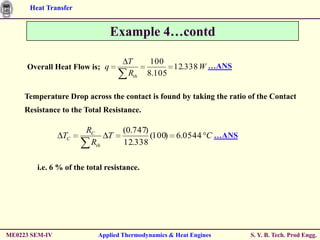
  • 24.
    Heat Transfer Example 3…contd Thus, the addition of (5.67-2.5) = 3.17 cm of insulation actually increases the Heat Transfer by @ 25 %. Alternatively, if fiberglass (k=0.04 W/m.ºC) is employed as the insulation material, it would give; k 0.04 ro 0.0133 m 1.33 cm h 3.0 Now, the value of the Critical Radius is less than the outside radius of the pipe (2.5 cm). So, addition of any fiberglass insulation would cause a decrease in the Heat Transfer. ME0223 SEM-IV Applied Thermodynamics & Heat Engines S. Y. B. Tech. Prod Engg.
  • 25.
    Heat Transfer Thermal Contact Resistance Two solid bars in contact. q q A B Sides insulated to assure that Heat flows in Axial direction only. ΔxA ΔxB Thermal Conductivity may be different. But Heat Flux through the materials T under Steady – State MUST be same. T1 T2A Actual Temperature profile approx. as T2B shown. T3 The Temperature Drop at Plane 2, the Contact Plane is said to be due to 1 2 3 x Thermal Contact Resistance. ME0223 SEM-IV Applied Thermodynamics & Heat Engines S. Y. B. Tech. Prod Engg.
  • 26.
    Heat Transfer Thermal Contact Resistance T Energy Balance gives; T1 T1 T2 A T2 A T2 B T2 B T3 T2A q kA A kB A xA 1 / hC A xB T2B T1 T3 q T3 xA 1 xB kA A hC A kB A Surface Roughness is exaggerated. 1 2 3 x No Real Surface is perfectly smooth. HT at joints can be contributed to : 1. Solid – Solid conduction at spots of contact. A 2. Conduction through entrapped gases through the void spaces. Second factor is the major Resistance to Heat B Flow, as the conductivity of a gas is much lower than that of a solid. ME0223 SEM-IV Applied Thermodynamics & Heat Engines S. Y. B. Tech. Prod Engg.
  • 27.
    Heat Transfer Thermal Contact Resistance Designating; 1. Contact Area, Ac A 2. Void Area, Av 3. Thickness of Void Space, Lg 4. Thermal Conductivity of the Fluid in Void space, kf T2 A T2 B T2 A T2 B T2 A T2 B q k f Av B Lg / 2k A AC Lg / 2k B AC Lg 1 / hC A Total C/s. Area of the bars is A. Solving for hc; T2A 1 AC 2k A k B Av hC kf Lg Lg A k A kB A T2B Most usually, AIR is the fluid in void spaces. Hence, kf is very small compared to kA and kB. ME0223 SEM-IV Applied Thermodynamics & Heat Engines S. Y. B. Tech. Prod Engg.
  • 28.
    Heat Transfer Example 4 Two 3.0 cm diameter 304 stainless steel bars, 10 cm long have ground surface and are exposed to air with a surface roughness of about 1 μm. If the surfaces are pressed together with a pressure of 50 atm and the two-bar combination is exposed to an overall temperature difference of 100 ºC, calculate the axial Heat Flow and Temperature Drop across the contact surface. Take 1/hc=5.28 X 10-4 m2.ºC/W. The overall Heat Flow is subject to three resistances, 1. One Conducting Resistance for each bar 2. Contact Resistance. x (0.1)(4) For the bars; Rth 8.679 C / W kA (16.3) (3 X 100 2 ) 2 1 (5.28X 10 4 )(4) Contact Resistance; RC 0.747 C / W hC A (3 X 10 2 ) 2 Total Thermal Resistance; Rth (2)(3.679) 0.747 8.105 C / W ME0223 SEM-IV Applied Thermodynamics & Heat Engines S. Y. B. Tech. Prod Engg.
  • 29.
    Heat Transfer Example 4…contd T 100 Overall Heat Flow is; q 12.338 W …ANS Rth 8.105 Temperature Drop across the contact is found by taking the ratio of the Contact Resistance to the Total Resistance. RC (0.747) TC T (100) 6.0544 C …ANS Rth 12.338 i.e. 6 % of the total resistance. ME0223 SEM-IV Applied Thermodynamics & Heat Engines S. Y. B. Tech. Prod Engg.
  • 30.
    Heat Transfer Radiation Heat Transfer Physical Interpretation : Thermal Radiation is the electromagnetic radiation as result of its temperature. There are many types of electromagnetic radiations, Thermal Radiation is one of them. Regardless of the type, electromagnetic radiation is propagated at the speed of light, 3 X 10⁸ m/sec. This speed is the product of wavelength and frequency of the radiation. c = Speed of light c=λυ λ = Wavelength υ = Frequency NOTE : Unit of λ may be cm, A˚ or μm. ME0223 SEM-IV Applied Thermodynamics & Heat Engines S. Y. B. Tech. Prod Engg.
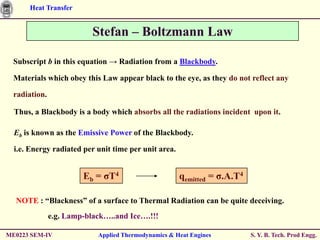
  • 31.
    Heat Transfer Radiation Heat Transfer Thermal Radiation log λ, m 1 μm 1 A˚ 3 2 1 0 -1 -2 -3 -4 -5 -6 -7 -8 -9 -10 -11 -12 X-Rays Radio Waves Infrared Ultraviolet γ-Rays Visible Thermal Radiation → 0.1 – 100 μm. Visible Light Portion → 0.35 – 0.75 μm. S. Y. B. Tech. Prod Engg.
  • 32.
    Heat Transfer Radiation Heat Transfer Physical Interpretation : Propagation of Thermal radiation takes place in the form of discrete quanta. Each quantum having energy; E = hυ h is Planck’s Constant, given by; h = 6.625 X 10⁻³⁴ J.sec A very basic physical picture of the Radiation propagation → Considering each quantum as a particle having Energy, Mass and momentum. E = mc2 = hυ m = hυ c2 & Momentum = c (hυ) = hυ c2 c ME0223 SEM-IV Applied Thermodynamics & Heat Engines S. Y. B. Tech. Prod Engg.
  • 33.
    Heat Transfer Stefan – Boltzmann Law Applying the principles of Quantum-Statistical Thermodynamics; Energy Density per unit volume per unit wavelength; 8 hc 5 u e hc / kT 1 Where, k is Boltzmann’s Constant; 1.38066 X 10⁻²³ J/molecule.K When Energy Density is integrated over all wavelengths; Total Energy emitted is proportional to the fourth power of absolute temperature. Eb = ζT4 Equation is known as Stefan – Boltzmann Law. Eb = Energy radiated per unit time per unit area by the ideal radiator, W/m2 ζ = Stefan – Boltzmann Constant; 5.667 X 10⁻⁸ W/m2.K4 ME0223 SEM-IV Applied Thermodynamics & Heat Engines S. Y. B. Tech. Prod Engg.
  • 34.
    Heat Transfer Stefan – Boltzmann Law Subscript b in this equation → Radiation from a Blackbody. Materials which obey this Law appear black to the eye, as they do not reflect any radiation. Thus, a Blackbody is a body which absorbs all the radiations incident upon it. Eb is known as the Emissive Power of the Blackbody. i.e. Energy radiated per unit time per unit area. Eb = ζT4 qemitted = ζ.A.T4 NOTE : “Blackness” of a surface to Thermal Radiation can be quite deceiving. e.g. Lamp-black…..and Ice….!!! ME0223 SEM-IV Applied Thermodynamics & Heat Engines S. Y. B. Tech. Prod Engg.
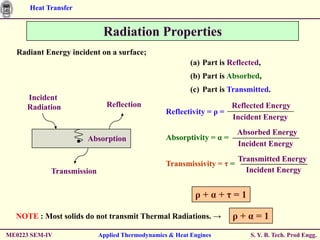
  • 35.
    Heat Transfer Radiation Properties Radiant Energy incident on a surface; (a) Part is Reflected, (b) Part is Absorbed, (c) Part is Transmitted. Incident Radiation Reflection Reflected Energy Reflectivity = ρ = Incident Energy Absorbed Energy Absorption Absorptivity = α = Incident Energy Transmitted Energy Transmissivity = η = Transmission Incident Energy ρ+α+η=1 NOTE : Most solids do not transmit Thermal Radiations. → ρ+α=1 ME0223 SEM-IV Applied Thermodynamics & Heat Engines S. Y. B. Tech. Prod Engg.
  • 36.
    Heat Transfer Radiation Properties Types of Reflection : 1. Angle of Incidence = Angle of Reflection → Specular Reflection 2. Incident beam distributed uniformly in all directions → Diffuse Reflection Source Source θ1 θ2 Specular Reflection Diffuse Reflection Offers the Mirror Image to the Observer ME0223 SEM-IV Applied Thermodynamics & Heat Engines S. Y. B. Tech. Prod Engg.
  • 37.
    Heat Transfer Radiation Properties No REAL surface cab be perfectly Specular or Diffuse. Ordinary mirror → Specular for visible region; but may not be in complete spectrum of Thermal Radiation. Rough surface exhibits the Diffused behaviour. Polished surface exhibits the Specular behaviour. ME0223 SEM-IV Applied Thermodynamics & Heat Engines S. Y. B. Tech. Prod Engg.
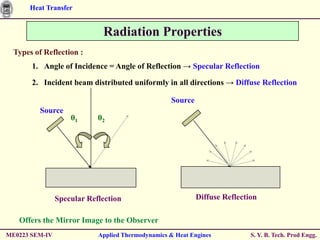
  • 38.
    Heat Transfer Kirchhoff’s Law Assume perfect Black enclosure. Radiant flux incident is qi W/m2. A Sample body placed inside Enclosure, in Black Enclosure Thermal Equilibrium with it. EA qiAα Sample Energy Absorbed by the Sample = Energy emitted. i.e. E A = qi A α …(I) Replacing the Sample Body with a Blackbody; Eb A = qi A (1) …(II) Dividing (I) by (II); E / Eb = α ME0223 SEM-IV Applied Thermodynamics & Heat Engines S. Y. B. Tech. Prod Engg.
  • 39.
    Heat Transfer Kirchhoff’s Law Ratio of Emissive Power of a body Black Enclosure to that of a Perfectly Black body, at the same temperature is known as EA qiAα Sample Emissivity, ε of the body. ε = E / Eb Thus; ε=α This is known as Kirchhoff’s Identity. ME0223 SEM-IV Applied Thermodynamics & Heat Engines S. Y. B. Tech. Prod Engg.
  • 40.
    Heat Transfer Gray Body Gray Body can be defined as the body whose Monochromatic Emissivity, ελ is independent of wavelength. Monochromatic Emissivity is defined as the ratio of Monochromatic Emissive Power of the body to that of a Blackbody at the SAME wavelength and temperature. ελ = Eλ / Ebλ Total Emissivity of the body is related to the Monochromatic Emissivity as; E Eb d And Eb Eb d T4 0 0 Eb d Thus, E 0 EB T4 ME0223 SEM-IV Applied Thermodynamics & Heat Engines S. Y. B. Tech. Prod Engg.
  • 41.
    Heat Transfer Gray Body When the GRAY BODY condition is applied, ελ = ε A functional relation for Ebλ was derived by Planck by introducing the concept of QUANTUM in Electromagnetic Theory. The derivation is by Statistical Thermodynamics. u c By this theory, Ebλ is related to the Energy Density by; Eb 4 5 C1 Eb Where, λ = Wavelength, μm e C2 / T 1 T = Temperature, K C1 = 3.743 X 10⁸ ,W.μm/m2 C2 = 1.4387 X 10⁴, μm.K ME0223 SEM-IV Applied Thermodynamics & Heat Engines S. Y. B. Tech. Prod Engg.
  • 42.
    Heat Transfer Wien’s Displacement Law A plot of Ebλ as a function of T and λ. Peak of the curve is shifted to SHORTER Wavelengths at HIGHER Temperatures. Points of the curve are related by; λmax T = 2897.6 μm.K This is known as Wien’s Displacement Law. ME0223 SEM-IV Applied Thermodynamics & Heat Engines S. Y. B. Tech. Prod Engg.
  • 43.
    Heat Transfer Wien’s Displacement Law Shift in the maximum point of the Radiation Curve helps to explain the change in colour of a body as it is heated. Band of wavelengths visible to the eye lies between 0.3 – 0.7 μm. Very small portion of the radiant energy spectrum at low temperatures is visible to eye. As the body is heated, maximum intensity shifts to shorter wavelengths. Accordingly, first visible sight of increase in temperature of a body is DARK RED colour. Further heating yields BRIGHT RED colour. Then BRIGHT YELLOW. And, finally WHITE…!! Material also looks brighter at higher temperatures, as large portion of the total radiation falls within the visible range. ME0223 SEM-IV Applied Thermodynamics & Heat Engines S. Y. B. Tech. Prod Engg.
  • 44.
    Heat Transfer Radiation Heat Transfer General interest in amount of Energy radiated from a Blackbody in a certain specified Wavelength range. Eb d Eb 0 The fraction of Total Energy Radiated between 0 to λ is given by; 0 Eb 0 Eb d Eb C1 0 Diving both sides by T5; 5 T5 T e C2 / T 1 This ratio is standardized in Graph as well as Tabular forms; with parameters as; 1. λT 2. Ebλ / T5 3. Eb 0-λT / ζT4 ME0223 SEM-IV Applied Thermodynamics & Heat Engines S. Y. B. Tech. Prod Engg.
  • 45.
    Heat Transfer Radiation Heat Transfer If the Radiant Energy between Wavelengths λ1 and λ2 are desired; Eb 0 Eb 0 Eb Eb 0 2 1 1 2 Eb 0 Eb 0 NOTE : Eb 0-∞ is the Total Radiation emitted over all Wavelengths = ζT4 ME0223 SEM-IV Applied Thermodynamics & Heat Engines S. Y. B. Tech. Prod Engg.
  • 46.
    Heat Transfer Radiation Heat Transfer EXAMPLE : Solar Radiation has a spectrum, approx. to that of a Blackbody at 5800 K. Ordinary window glass transmits Radiation to about 2.5 μm. From the Table for Radiation Function, λT = (2.5)(5800) = 14,500 μm.K The fraction of then Solar Spectrum is about 0.97. Thus, the regular glass transmits most of the Radiation incident upon it. On the other hand, the room Radiation at 300 K has λT = (2.5)(300) = 750 μm.K Radiation Fraction corresponding to this value is 0.001 per cent. Thus, the ordinary glass essentially TRANSPARENT to Visible light, is almost OPAQUE for Thermal Radiation at room temperature. ME0223 SEM-IV Applied Thermodynamics & Heat Engines S. Y. B. Tech. Prod Engg.
  • 47.
    Heat Transfer Heat Exchangers Overall Heat Transfer Coefficient : Heat Transfer is expressed as; TA kA q h1 A (TA T1 ) (T1 T2 ) h2 A (T2 TB ) h2 x Applying the Thermal Resistance; Fluid B T1 (TA TB ) q q T2 (1 / h1 A) ( x / kA) (1 / h2 A) Overall Heat Transfer by combined Fluid A Conduction + Convection is expressed in h1 TB terms of Overall Heat Transfer Coefficient , U, defined as; q RA RB RC q = U A ΔToverall TA TB 1 x 1 1 T1 T2 U h1 A kA h2 A (1 / h1 ) ( x / k ) (1 / h2 ) ME0223 SEM-IV Applied Thermodynamics & Heat Engines S. Y. B. Tech. Prod Engg.
  • 48.
    Heat Transfer Heat Exchangers Overall Heat Transfer Coefficient : Hollow Cylinder exposed to Fluid B in Convective environment on its inner and outer surfaces. Fluid A in Area for Convection is NOT same for both fluids. → ID and thickness of the inner tube. q Overall Heat Transfer would be; RA RB RC TA TB (TA TB ) 1 1 q Ti ln (ro / ri ) To 1 ln (r0 / ri ) 1 hi Ai 2 kL ho Ao hi Ai 2 kL ho Ao ME0223 SEM-IV Applied Thermodynamics & Heat Engines S. Y. B. Tech. Prod Engg.
  • 49.
    Heat Transfer Heat Exchangers Overall Heat Transfer Coefficient : Overall Heat Transfer Coefficient can be based on either INNER side or OUTER area of the tube. 1 Based in INNER Area; Ui 1 Ai ln (r0 / ri ) Ai 1 hi 2 kL Ao ho 1 Based in OUTER Area; Uo Ao 1 Ao ln (r0 / ri ) 1 Ai hi 2 kL ho 1 In general, for either Plane Wall or Cylinder, UA Rth ME0223 SEM-IV Applied Thermodynamics & Heat Engines S. Y. B. Tech. Prod Engg.
  • 50.
    Heat Transfer Example 5 Water flows at 50 °C inside a 2.5 cm inside diameter tube such that hi = 3500 W/m2.°C. The tube has a wall thickness of 0.8 mm with thermal conductivity of 16 W/m.°C. The outside of the tube loses heat by free convection with ho = 7.6 W/m2.°C.Calculate the overall heat transfer coefficient and heat air at 20 °C. 3 Resistances in series. L = 1.0 mtr, di = 0.025 mtr and do = 0.025 + (2)(0.008) mtr = 0.0266 mtr. 1 1 Ri 0.00364 C / W hi Ai (3500 (0.025)(1.0) ) ln (d o / di ) ln (0.0266/ 0.025) Rt 0.00062 C / W 2 kL 2 (16)(1.0) 1 1 Ro 1.575 C / W ho Ao (7.6) (0.0266 1.0) )( ME0223 SEM-IV Applied Thermodynamics & Heat Engines S. Y. B. Tech. Prod Engg.
  • 51.
    Heat Transfer Example 5….contd This clearly states that the controlling resistance for the Overall Heat Transfer Coefficient is Outside Convection Resistance. Hence, the Overall Heat Transfer Coefficient is based on Outside Tube Area. Toverall q U 0 Ao T Rth 1 1 U0 A0 Rth (0.0266 1.0) 0.00364 0.00062 1.575 )( 7.577 W / m 2 . C ….ANS Heat Transfer is obtained by; q Uo Ao T (7.577) (0.0266 1.0)(50 20) 19 W ….ANS )( ME0223 SEM-IV Applied Thermodynamics & Heat Engines S. Y. B. Tech. Prod Engg.
  • 52.
    Heat Transfer Heat Exchangers Fouling Factor : After a period, the performance of the Heat Exchanger gets degraded as; 1. HT surface may become coated with various deposits. 2. HT surface may get corroded due to interaction between fluid and material. This coating offers additional Resistance to the Heat Flow. Performance Degradation effect is presented by introducing Fouling Factor or Fouling Resistance, Rf. 1 1 Fouling Factor, Rf is defined as; Rf U dirty U clean ME0223 SEM-IV Applied Thermodynamics & Heat Engines S. Y. B. Tech. Prod Engg.
  • 53.
    Heat Transfer Types of Heat Exchangers Shell-And-Tube Heat Exchanger : ME0223 SEM-IV Applied Thermodynamics & Heat Engines S. Y. B. Tech. Prod Engg.
  • 54.
    Heat Transfer Types of Heat Exchangers Shell-And-Tube Heat Exchanger : ME0223 SEM-IV Applied Thermodynamics & Heat Engines S. Y. B. Tech. Prod Engg.
  • 55.
    Heat Transfer Types of Heat Exchangers Shell-And-Tube Heat Exchanger : ME0223 SEM-IV Applied Thermodynamics & Heat Engines S. Y. B. Tech. Prod Engg.
  • 56.
    Heat Transfer Types of Heat Exchangers Shell-And-Tube Heat Exchanger : ME0223 SEM-IV Applied Thermodynamics & Heat Engines S. Y. B. Tech. Prod Engg.
  • 57.
    Heat Transfer Types of Heat Exchangers Miniature / Compact Heat Exchanger : ME0223 SEM-IV Applied Thermodynamics & Heat Engines S. Y. B. Tech. Prod Engg.
  • 58.
    Heat Transfer Types of Heat Exchangers Cross-Flow Heat Exchanger : ME0223 SEM-IV Applied Thermodynamics & Heat Engines S. Y. B. Tech. Prod Engg.
  • 59.
    Heat Transfer Types of Heat Exchangers Cross-Flow Heat Exchanger : S. Y. B. Tech. Prod Engg.
  • 60.
    Heat Transfer Log Mean Temperature Difference TEMPERATURE PROFILES : T T Th1 Hot Fluid Th1 Hot Fluid dq dq Th Tc1 Th Th2 Th2 Tc Tc Tc2 dA dA Cold Fluid Cold Fluid Tc2 Tc1 A A 1 2 1 2 Parallel Flow Counter Flow ME0223 SEM-IV Applied Thermodynamics & Heat Engines S. Y. B. Tech. Prod Engg.
  • 61.
    Heat Transfer Log Mean Temperature Difference q = U A ΔTm T dq = U dA (Th-Tc) U = Overall Heat Transfer Coefficient. Hot Fluid A = Surface Area for Heat Transfer Th1 dq consistent with definition of U. Th ΔTm = Suitable Mean Temperature Th2 Difference across Heat Exchanger. Tc Tc2 As can be seen, the Temperature dA Difference between the Hot and Cold Tc1 Cold Fluid fluids vary between Inlet and Outlet. A Average Heat Transfer Area for the 1 2 above equation is required. ME0223 SEM-IV Applied Thermodynamics & Heat Engines S. Y. B. Tech. Prod Engg.
  • 62.
    Heat Transfer Log Mean Temperature Difference Heat transferred through elemental area dA; T dq = U dA (Th-Tc) dq mh Ch dTh mc Cc dTc Th1 Hot Fluid dq U dA(Th Tc ) dq Th dq dq Th2 dTh And; dTc m h Ch m c Cc Tc Tc2 dA 1 1 Cold Fluid dTh dTc d (Th Tc ) dq Tc1 m h Ch m c Cc Solving for dq; A 1 2 d (Th Tc ) 1 1 U dA Th Tc m h Ch m c Cc ME0223 SEM-IV Applied Thermodynamics & Heat Engines S. Y. B. Tech. Prod Engg.
  • 63.
    Heat Transfer Log Mean Temperature Difference Equation can be integrated between conditions 1 and 2 to yield; T dq = U dA (Th-Tc) (Th 2 Tc 2 ) 1 1 ln UA Th1 Hot Fluid (Th1 Tc1 ) m h Ch m c Cc dq Th Again; Th2 q q m h Ch & mc Cc (Th1 Th 2 ) (Tc 2 Tc1 ) Tc Tc2 This substitution gives; dA Tc1 Cold Fluid (Th 2 Tc 2 ) (Th1 Tc1 ) q UA ln (Th 2 Tc 2 ) /(Th1 Tc1 ) A 1 2 (Th 2 Tc 2 ) (Th1 Tc1 ) OR; Tm ln (Th 2 Tc 2 ) /(Th1 Tc1 ) ME0223 SEM-IV Applied Thermodynamics & Heat Engines S. Y. B. Tech. Prod Engg.
  • 64.
    Heat Transfer Log Mean Temperature Difference This Temperature Difference, ΔTm , is known as Log Mean Temperature Difference. Tone end of HE Tother end of HE LMTD natural log Ratio of both Ts Main Assumption : 1. Specific Heats (Cc and Ch) of fluids do not vary with Temperatures. 2. Convective HT Coefficients (h) are constant throughout the Heat Exchanger. Serious concerns for validity due to : 1. Entrance Effects. 2. Fluid Viscosity. 3. Change in Th. Conductivity. ME0223 SEM-IV Applied Thermodynamics & Heat Engines S. Y. B. Tech. Prod Engg.
  • 65.
    Heat Transfer Log Mean Temperature Difference ME0223 SEM-IV Applied Thermodynamics & Heat Engines S. Y. B. Tech. Prod Engg.
  • 66.
    Heat Transfer Log Mean Temperature Difference ME0223 SEM-IV Applied Thermodynamics & Heat Engines S. Y. B. Tech. Prod Engg.
  • 67.
    Heat Transfer Log Mean Temperature Difference ME0223 SEM-IV Applied Thermodynamics & Heat Engines S. Y. B. Tech. Prod Engg.
  • 68.
    Heat Transfer Log Mean Temperature Difference ME0223 SEM-IV Applied Thermodynamics & Heat Engines S. Y. B. Tech. Prod Engg.
  • 69.
    Heat Transfer Example 6 Water at the rate of 68 kg/min is heated from 35 to 75 °C by an oil having specific heat of 1.9 kJ/kg.°C. The fluids are used in a counterflow double-pipe heat exchanger, and the oil enters in the exchanger at 110 °C and leaves at 75 °C. The overall heat transfer coefficient is 320 W/m2.°C. Calculate the heat exchanger area. Total Heat Transfer is calculated by Energy absorbed by water; q m w Cw Tw (68)(4.18)(75 35) 11.37 MJ / min 189.5 kW Since all fluid temperatures are known, LMTD T can be calculated. 110 °C Hot Fluid Th (Th 2 Tc 2 ) (Th1 Tc1 ) dq Tm ln (Th 2 Tc 2 ) /(Th1 Tc1 ) 75 °C 75 °C (75 35) (110 75) Tc 37.44 C ln (75 35) /(110 75) dA 35 °C And; q U A Tm Yields; q 189.5 X 10³ Cold Fluid A 15.82 m2….ANS A U Tm (320)(37.44) 1 2 ME0223 SEM-IV Applied Thermodynamics & Heat Engines S. Y. B. Tech. Prod Engg.
  • 70.
    Heat Transfer Example 7 In stead of double-pipe heat exchanger, of Example 6, it is desired to use a shell-and- tube heat exchanger with water making one shell pass and oil making two tube passes. Calculate the heat exchanger area assuming other conditions same. T1 = 35 °C T2 = 75 °C t1 = 110 °C t2 = 75 °C t2 t1 75 110 P 0.467 T1 t1 35 110 T1 T2 35 75 R 1.143 t2 t1 75 110 Correction Factor from Chart = 0.8 q U A F Tm yields; q 189.5 X 10³ A 19.53 m2 ….ANS U F Tm (320)(0.8)(37.44) ME0223 SEM-IV Applied Thermodynamics & Heat Engines S. Y. B. Tech. Prod Engg.
  • 71.
    Heat Transfer Effectiveness-NTU Method LMTD approach is suitable when both the inlet and outlet temperatures are known, or can be easily computed. However, when the temperatures are to be evaluated by an iterative method, analysis becomes quite complicated as it involves the Logarithmic function. In this case, the method of analysis is based on the Effectiveness of the Heat Exchanger in transferring the given amount of Heat. Effectiveness of the Heat Exchanger is defined as; Actual Heat Transfer Effectiveness Maxim umPossible Heat Transfer Actual Heat Transfer is calculated by; 1. Energy lost by HOT fluid. OR 2. Energy gained by COLD fluid. ME0223 SEM-IV Applied Thermodynamics & Heat Engines S. Y. B. Tech. Prod Engg.

  • 72.
    Heat Transfer Effectiveness-NTU Method For Parallel-Flow Heat Exchanger; q mh Cph (Th1 Th 2 ) mc Cpc (Tc 2 Tc1 ) For Counter-Flow Heat Exchanger; q mh Cph (Th1 Th 2 ) mc Cpc (Tc1 Tc 2 ) Maximum possible Heat Transfer Maximum possible Temperature Difference Difference in INLET Temperatures of Hot and Cold fluids. Maximum Temperature Difference Minimum (m C ) value. Thus; Maximum Heat Transfer is given by; qmax (m Cp) min (Thinlet Tcinlet ) The ( m Cp )fluid may be Hot or Cold, depending on their respective mass flow rates and Specific Heats. ME0223 SEM-IV Applied Thermodynamics & Heat Engines S. Y. B. Tech. Prod Engg.
  • 73.
    Heat Transfer Effectiveness-NTU Method mh Cph (Th1 Th 2 ) Th1 Th 2 h mh Cph (Th1 Tc1 ) Th1 Tc1 For Parallel-Flow Heat Exchanger; mc Cpc (Tc 2 Tc1 ) Tc 2 Tc1 c mc Cpc (Th1 Tc1 ) Th1 Tc1 mh Cph (Th1 Th 2 ) Th1 Th 2 h mh Cph (Th1 Tc 2 ) Th1 Tc 2 For Counter-Flow Heat Exchanger; mc Cpc (Tc1 Tc 2 ) Tc1 Tc 2 c mc Cpc (Th1 Tc 2 ) Th1 Tc 2 ME0223 SEM-IV Applied Thermodynamics & Heat Engines S. Y. B. Tech. Prod Engg.
  • 74.
    Heat Transfer Effectiveness-NTU Method Effectiveness, ε, can be derived in a different way; For Parallel-Flow Heat Exchanger; ln (Th 2 Tc 2 ) UA 1 1 (Th1 Tc1 ) m h Cph m c Cpc T dq = U dA (Th-Tc) UA m c Cpc Th1 Hot Fluid 1 dq m c Cpc m h Cph Th Th2 OR (Th 2 Tc 2 ) UA m c Cpc exp 1 Tc2 (Th1 Tc1 ) m c Cpc m h Cph Tc dA Cold Fluid If Cold fluid is min ( m Cp ) fluid; Tc1 Tc 2 Tc1 A c Th1 Tc1 1 2 ME0223 SEM-IV Applied Thermodynamics & Heat Engines S. Y. B. Tech. Prod Engg.
  • 75.
    Heat Transfer Effectiveness-NTU Method We know; dq m h Cph dTh mc Cpc dTc mc Cpc mh Cph (Th1 Th 2 ) mc Cpc (Tc 2 Tc1 ) Th 2 Th1 (Tc1 Tc 2 ) mh Cph This yields; (Th 2 Tc 2 ) Th1 (mc Cpc / m h Cph )(Tc1 Tc 2 ) Tc 2 (Th1 Tc1 ) (Th1 Tc1 ) (Th1 Tc1 ) (m c Cpc / m h Cph )(Tc1 Tc 2 ) (Tc1 Tc 2 ) m c Cpc 1 1 c (Th1 Tc1 ) m h Cph 1 exp UA / m c Cpc 1 (m c Cpc / m h Cph ) c 1 (m c Cpc / m h Cph ) ME0223 SEM-IV Applied Thermodynamics & Heat Engines S. Y. B. Tech. Prod Engg.
  • 76.
    Heat Transfer Effectiveness-NTU Method It can be shown that the SAME expression results if Hot fluid is min ( m Cp ) fluid; EXCEPT that (mc Cpc )and (mh Cp h ) are interchanged. 1 exp UA / Cmin 1 Cmin / Cmax In a General Form; parallel 1 Cmin / Cmax where, C = (m C ) ; defined as CAPACITY RATE. Similar analysis for Counter-Flow Heat Exchanger yields; 1 exp UA / Cmin 1 Cmin / Cmax counter 1 (Cmin / Cmax ) exp UA / Cmin 1 Cmin / Cmax The group of terms, (UA/Cmin ) is known as Number of Transfer Units (NTU). This is so, since it is the indication of the size of the Heat Exchanger. ME0223 SEM-IV Applied Thermodynamics & Heat Engines S. Y. B. Tech. Prod Engg.
  • 77.
    Heat Transfer Effectiveness-NTU Method Heat Exchanger Effectiveness Relations : N = NTU = UA/Cmin C = Cmin/Cmax Flow Geometry Relation Double Pipe : 1 exp[ N (1 C )] Parallel Flow 1 C 1 exp[ N (1 C )] Counter Flow 1 C exp[ N (1 C )] N Counter Flow, C = 1 N 1 Cross Flow : exp( NCn) 1 0.22 Both Fluids Mixed 1 exp where n N Cn 1 1 C 1 Both Fluids Unmixed 1 exp( N ) 1 exp( NC ) N Cmax mixed, Cmin Unmixed (1/ C){ exp[ C(1 e N )]} 1 Cmax Unmixed, Cmin Mixed 1 exp{ (1 / C )[1 exp( NC )]} Shell-and-Tube : 1 2 1/ 2 1 exp[ N (1 C 2 )1/ 2 ] 1 Shell-pass; 2/4/6 Tube-pass 2 1 C (1 C ) X 1 exp[ N (1 C 2 )1/ 2 ] All Exchangers, C = 0 : 1 e N ME0223 SEM-IV Applied Thermodynamics & Heat Engines S. Y. B. Tech. Prod Engg.
  • 78.
    Heat Transfer Effectiveness-NTU Method Heat Exchanger NTU Relations : N = NTU = UA/Cmin C = Cmin/Cmax ε = Effectiveness Flow Geometry Relation Double Pipe : ln[1 (1 C ) ] Parallel Flow N 1 C Counter Flow 1 1 N ln C 1 C 1 Counter Flow, C = 1 N 1 Cross Flow : 1 Cmax mixed, Cmin Unmixed N ln 1 ln (1 C ) C 1 Cmax Unmixed, Cmin Mixed N ln [1 C ln (1 )] C Shell-and-Tube : 2 1/ 2 (2 / ) 1 C (1 C 2 )1/ 2 1 Shell-pass; 2/4/6 Tube-pass N (1 C ) X ln (2 / ) 1 C (1 C 2 )1/ 2 All Exchangers, C = 0 : N ln (1 ) ME0223 SEM-IV Applied Thermodynamics & Heat Engines S. Y. B. Tech. Prod Engg.
  • 79.
    Heat Transfer Example 8 A cross-flow heat exchanger is used to heat an oil in the tubes (C=1.9 kJ/kg.ºC) from 15 ºC to 85 ºC. Blowing across the outside of the tubes is steam which enters at 130 ºC and leaves at 110 ºC with a mass flow rate of 5.2 kg/sec. The overall heat transfer coefficient is 275 W/m2.ºC and C for steam is 1.86 kJ/kg.ºC. Calculate the surface area of the heat exchanger. Total Heat Transfer is calculated from Energy Balance of Steam; q m s Cs Ts (5.2)(1.86)(130 110) 193 kW T 130 °C Hot Fluid Th ∆Tm is calculated by treating as a dq Counter-Flow Heat Transfer; 85 °C 110 °C Tc (130 85) (110 15) Tm 66.9 C (130 85) dA 15 °C ln (110 15) Cold Fluid A 1 ME0223 SEM-IV Applied Thermodynamics & Heat Engines S. Y. B. Tech. Prod Engg.
  • 80.
    Heat Transfer Example 8….contd t1 and t2 represent unmixed fluid (i.e. Oil) and T1 and T2 represent the mixed fluid (i.e. Steam). Hence; T1 = 130 ºC; T2 = 110 ºC; t1 = 15 ºC; t2 = 85 ºC t2 t1 85 15 T1 T2 130 110 P 0.609 And R 0.286 T1 t1 130 15 t2 t1 85 15 From LMTD Correction Chart; F = 0..97 Heat Transfer Area is; q 193 X 103 A U F Tm (275)(0.97)(66.9) 10.82 m 2 ….ANS S. Y. B. Tech. Prod Engg.
  • 81.
    Heat Transfer Example 9 Calculate the heat exchanger performance in Example 8; if the oil flow rate is reduced to half while the steam flow rate is kept constant. Assume U remains same as 275 W/m2.ºC. Calculating the Oil flow rate; 193X 103 q mo Co To mo 1.45 kg / sec (1.9)(85 15) New Flow rate is half of this value. i.e. 0.725 kg/sec. We assume the Inlet Temperatures remain same as 130 ºC for Steam and 15 ºC for Oil. Hence, q mo Co (Te,o 15) ms Cs (130 Te,s ) But, both the Exit Temperatures Te,o and Te,s are unknown. The values of R and P can not be calculated without these temperatures. Hence, ∆Tm can not be calculated. ITERATIVE procedure MUST be used to solve this example. However, this example can be solved with Effectiveness-NTU Approach. ME0223 SEM-IV Applied Thermodynamics & Heat Engines S. Y. B. Tech. Prod Engg.
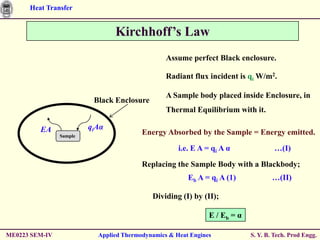
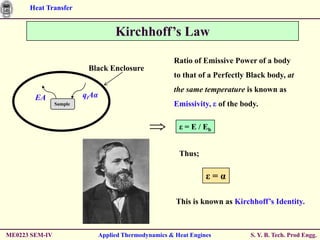
  • 82.
    Heat Transfer Example 10 Solve Example 9 by Effectiveness-NTU Method. For Steam; Cs m s Cps (5.2)(1.86) 9.67 kW / C For Oil; Co mo Cpo (0.725)(1.9) 1.38 kW / C Thus, the fluid having minimum ( m Cp ) is Oil. Cmin / Cmax 1.38/ 9.67 0.143 NTU U A / Cmin (275)(10.82) / 1380 2.156 It is observed that unmixed fluid (i.e. Oil) has Cmin and mixed fluid (i.e. Steam) has Cmax. ME0223 SEM-IV Applied Thermodynamics & Heat Engines S. Y. B. Tech. Prod Engg.
  • 83.
    Heat Transfer Example 10….contd Hence; from the Table; we get; (1 / C ){1 exp[ C (1 e N )]} 2.156 (1 / 0 / 143) 1 exp[ (0.143)(1 e )] 0.831 Using the Effectiveness, we can calculate the Temperature Difference for Oil as; To ( Tmax ) (0.831 130 15) 95.5 C )( Thus, the Heat Transfer is; q mo Cpo To (1.38)(95.5) 132 kW Thus, Reduction in Oil flow rate by 50 % results in reduction in Heat Transfer by 32 % only. S. Y. B. Tech. Prod Engg.
  • 84.
    Heat Transfer Example 11 Hot oil at 100 ºC is used to heat air in a shell-and-tube heat exchanger the oil makes 6 tube passes and the air makes one shell-pass. 2 kg/sec of air are to be heated from 20 ºC to 80 ºC. The specific heat of the oil is 2100 kJ/kg.ºC, and its flow rate is 3.0 kg/sec. Calculate the area required for the heat exchanger for U = 200 W/m2.ºC. Energy Balance is; q mo Cpo T0 ma Cpa Ta (3.0)(2100 100 Te,o ) (2.0)(1009 80 20) )( )( Te,0 80.27 C We have; Cmax Ch mo Cpo (3.0)(2100 6300 W / C ) Cmin Cc m a Cpa (2.0)(1009) 2018 W / C And; Cmain 2018 C 0.3203 Cmax 6300 ME0223 SEM-IV Applied Thermodynamics & Heat Engines S. Y. B. Tech. Prod Engg.
  • 85.
    Heat Transfer Example 11….contd Tc (80 20) Effectiveness is; 0.75 Tmax (100 20) From the NTU Table; 2 1/ 2 (2 / ) 1 C (1 C 2 )1/ 2 N (1 C ) X ln (2 / ) 1 C (1 C 2 )1/ 2 2 1/ 2 (2 / 0.75) 1 0.3203 (1 0.32032 )1/ 2 (1 0.3203 ) X ln (2 / 0.75) 1 0.3203 (1 0.32032 )1/ 2 1.99 UA NTU Thus; Cmin Cmin (2018 ) 2 A NTU (2.1949) 22.146 m….ANS U (200) ME0223 SEM-IV Applied Thermodynamics & Heat Engines S. Y. B. Tech. Prod Engg.
  • 86.
    Heat Transfer Convection Heat Transfer T∞ Consider a heated plate shown in Fig. u∞ Temperature of the plate is Tw and that of surrounding is T∞ u q Velocity profile is as shown in Fig. Tw Velocity reduces to Zero at the plate surface as a result of Viscous Action. Since no velocity at the plate surface, Heat is transferred by Conduction only. Then , WHY Convection ? ANS : Temperature Gradient depends on the rate at which fluid carries away the Heat. Overall Effect of Convection is given by Newton’s Law of Cooling. q = h A ΔT = h A (Tw - T∞) h is known as the CONVECTIVE HEAT TRANSFER COEFFICIENT. (W/m2.K) S. Y. B. Tech. Prod Engg.
  • 87.
    Heat Transfer Convection Heat Transfer T∞ Convective Heat Transfer has dependence u∞ on Viscosity as well as Thermal properties of u the fluid. q Tw 1) Thermal Conductivity, k 2) Specific Heat, Cp 3) Density, ρ Heated plate exposed to room air; without any external source of motion of fluid, the movement of air will be due to the Density Gradient. This is called Natural or Free Convection. Heated plate exposed to air blown by a fan; i.e. with an external source of motion of fluid. This is called Forced Convection. S. Y. B. Tech. Prod Engg.
  • 88.
    Heat Transfer Convection Energy Balance on Flow Channel The same analogy can be used for evaluating the Heat Loss / Gain resulting from a fluid flowing Te Ti inside a channel or tube, as shown in Fig. Heated wall at temperature Tw loses heat to the m cooler fluid through the channel (i.e. pipe). Temperature rise from inlet (Ti) to exit (Te). q q m Cp (Te Ti ) h A (Tw,avg T fluid,avg ) Te, Ti and Tfluid are known as Bulk or Energy Average Temperatures. S. Y. B. Tech. Prod Engg.
  • 89.
    Heat Transfer Convection Boundary Condition We know that; qconv h A (Tw T ) With Electrical Analogy, as in case of Conduction; (Tw T ) qconv 1 hA The term 1 is known as Convective Resistance; hA ME0223 SEM-IV Applied Thermodynamics & Heat Engines S. Y. B. Tech. Prod Engg.
  • 90.
    Heat Transfer Conduction – Convection System Heat conducted through a body, frequently needs to be removed by Convection process. e.g. Furnace walls, Motorcycle Engine, etc. Finned Tube arrangement is the most common for such Heat Exchange applications. Consider a One – Dimensional fin. dqconv =h P dx (T-T∞) t Surrounding fluid at T∞. Base of fin at T0. A qx Qx+x Energy Balance of element of fin with thickness dx ; dx Energy in left face = Energy out right face + L Energy lost by Convection Base S. Y. B. Tech. Prod Engg.
  • 91.
    Heat Transfer Conduction – Convection System Convection Heat Transfer; qconv h A (Tw T ) Where, Area of fin is surface area for Convection. Let the C/s. area be A and perimeter be P. dT Energy in left face; qx kA dx dT dT d 2T Energy out right face; qx dx kA kA 2 dx dx x dx dx dx Energy lost by Convection; qconv h P dx (T T ) NOTE : Differential area of the fin is the product of Perimeter and the differential length dx. ME0223 SEM-IV Applied Thermodynamics & Heat Engines S. Y. B. Tech. Prod Engg.
  • 92.
    Heat Transfer Conduction – Convection System d 2T hP Combining the terms; we get; T T 0 dx 2 kA d2 hP Let, θ = (T - T∞) 0 dx 2 kA Let m2 = hP/kA Thus, the general solution of the equation becomes; mx C1 e C2 emx One boundary condition is; θ = θ0 = (T - T∞) at x = 0. S. Y. B. Tech. Prod Engg.
  • 93.
    Heat Transfer Conduction – Convection System Other boundary conditions are; CASE 1 : Fin is very long. Temperature at the fin end is that of surrounding. CASE 2 : Fin has finite length. Temperature loss due to Convection. CASE 3 : Fin end is insulated. dT/dx = 0 at x = L. For CASE 1, Boundary Conditions are : θ = θ0 = (T - T∞) at x = 0. θ=0 at x = ∞. T T mx And, the solution becomes; e 0 T0 T ME0223 SEM-IV Applied Thermodynamics & Heat Engines S. Y. B. Tech. Prod Engg.
  • 94.
    Heat Transfer Conduction – Convection System For CASE 3, Boundary Conditions are : θ = θ0 = (T - T∞) at x = 0. dθ/dx = 0 at x = L. This yields; 0 C1 C2 mL 0 m ( C1 e C2 e mL ) e mx emx cosh[m ( L x)] Solving for C1 and C2, we get; 0 1 e 2mL 1 e2mL cosh (mL) where, the hyperbolic functions are defined as; ex e x ex e x ex e x sinh x cosh x tanh x 2 2 ex e x ME0223 SEM-IV Applied Thermodynamics & Heat Engines S. Y. B. Tech. Prod Engg.
  • 95.
    Heat Transfer Conduction – Convection System Solution for CASE 2 is; T T cosh[m ( L x)] (h / mk )sinh[m ( L x)] T0 T cosh (mL) (h / mk )sinh (mL) All the Heat loss by the fin MUST be conducted to the base of fin at x = 0. dT Thus, the Heat loss is; qx dx kA dx x 0 Alternate method of integrating Convection Heat Loss; L L q h P (T T ) dx h P dx 0 0 ME0223 SEM-IV Applied Thermodynamics & Heat Engines S. Y. B. Tech. Prod Engg.
  • 96.
    Heat Transfer Conduction – Convection System Application of Conduction equation is easier than that for Convection. m(0) For CASE 1 : q k A[ m 0e ] h Pk A 0 1 1 q kA 0m 1 e 2 mL 1 e 2 mL For CASE 3 : hPk A 0 tanh (mL) sinh (mL) (h / mk ) cosh (mL) For CASE 2 : q hPk A 0 cosh (mL) (h / mk )sinh (mL) ME0223 SEM-IV Applied Thermodynamics & Heat Engines S. Y. B. Tech. Prod Engg.
  • 97.
    Heat Transfer Viscous Flow A) Flow over a Flat Plate : Laminar Transition Turbulent y du dy u∞ x u u∞ Laminar Sublayer u At the leading edge of the plate, a region develops, where the influence of Viscous Forces is felt. These viscous forces are described in terms of Shear Stress, η, between the fluid layers. ME0223 SEM-IV Applied Thermodynamics & Heat Engines S. Y. B. Tech. Prod Engg.
  • 98.
    Heat Transfer Viscous Flow Shear Stress is proportional to normal velocity gradient. du dy The constant of proportionality, μ, is known as dynamic viscosity. (N-sec/m2) Region of flow, developed from the leading edge, in which the effects of Viscosity are observed, is known as Boundary Layer. The point for end of Boundary Layer is chosen as the y co-ordinate where the velocity becomes 99 % of the free – stream value. Initial development of Boundary Layer is Laminar. After some critical distance from leading edge, small disturbances in flow get amplified. This transition is continued till the flow becomes Turbulent. S. Y. B. Tech. Prod Engg.
  • 99.
    Heat Transfer Viscous Flow Laminar Transition Turbulent Turbulent Transition Laminar Development of Flow Regimes ME0223 SEM-IV Applied Thermodynamics & Heat Engines S. Y. B. Tech. Prod Engg.
  • 100.
    Heat Transfer Viscous Flow ME0223 SEM-IV Applied Thermodynamics & Heat Engines S. Y. B. Tech. Prod Engg.
  • 101.
    Heat Transfer Viscous Flow ME0223 SEM-IV Applied Thermodynamics & Heat Engines S. Y. B. Tech. Prod Engg.
  • 102.
    Heat Transfer Viscous Flow ME0223 SEM-IV Applied Thermodynamics & Heat Engines S. Y. B. Tech. Prod Engg.
  • 103.
    Heat Transfer Viscous Flow Transition from Laminar to Turbulent takes place when; u x u x 5 X 10⁵ where, u∞ = Free – Stream Velocity (m/sec) x = Distance from leading edge (m) ν = μ / ρ = Kinematic Viscosity (m2/sec) This particular group of terms is known as Reynold’s Number; and denoted by (Re). It is a dimensionless quantity. u x u x Re ME0223 SEM-IV Applied Thermodynamics & Heat Engines S. Y. B. Tech. Prod Engg.
  • 104.
    Heat Transfer Viscous Flow Reynolds Number (Re) = Ratio of Momentum Forces ( α ρu∞2 ) to Shear Stress ( α μu∞ / x ) . Range for Reynlold’s No. (Re) transition from Laminar to Turbulent lies between 2 X 10⁵ to 106; depending on; 1. Surface Roughness. 2. Turbulence Level. NOTE : Generally, Transition ends at twice the Re where it starts. ME0223 SEM-IV Applied Thermodynamics & Heat Engines S. Y. B. Tech. Prod Engg.
  • 105.
    Heat Transfer Viscous Flow Laminar Transition Turbulent y du dy u∞ x u u∞ Laminar Sublayer u Laminar profile is approximately Parabolic. Turbulent profile has a initial part, close to plate, is very nearly Linear. This is due to the Laminar Sublayer that adheres to the surface. Portion outside this Sublayer is relatively Flat. ME0223 SEM-IV Applied Thermodynamics & Heat Engines S. Y. B. Tech. Prod Engg.
  • 106.
    Heat Transfer Viscous Flow Physical mechanism of Viscosity Momentum Transfer Laminar flow Molecules move from one lamina to another, carrying Momentum α Velocity Net Momentum Transfer from High Velocity region to Low Velocity Region. Force in direction of flow, i.e. Viscous shear Stress, η Rate of Momentum Transfer α Rate of movement of molecules α T Turbulent flow has no distinct fluid layers. Macroscopic chunks of fluid, transporting Energy and Momentum, in stead of microscopic molecular motion. Larger Viscous shear Stress, η ME0223 SEM-IV Applied Thermodynamics & Heat Engines S. Y. B. Tech. Prod Engg.
  • 107.
    Heat Transfer Viscous Flow B) Flow through a Pipe : Boundary Layer Uniform Inlet Flow Starting Length Fully Developed Flow Laminar Sublayer (A) Laminar Flow Turbulent Core (B) Turbulent flow ME0223 SEM-IV Applied Thermodynamics & Heat Engines S. Y. B. Tech. Prod Engg.
  • 108.
    Heat Transfer Viscous Flow Boundary Layer develops at the entrance of the pipe. Eventually, the Boundary Layer fills entire tube. The flow is said to be fully developed. For Laminar flow, Parabolic velocity profile is developed. For Turbulent flow, a somewhat blunter profile is observed. Velocity profiles can be mathematically expressed as : u y y For Laminar flow : 2 um r r 1 For Turbulent flow : u y 7 um r ME0223 SEM-IV Applied Thermodynamics & Heat Engines S. Y. B. Tech. Prod Engg.
  • 109.
    Heat Transfer Viscous Flow Reynolds Number is used as criterion to check for Laminar or Turbulent flow. um d Re d 2300 Range of Reynolds Number for Transition : 2000 Red 4000 ME0223 SEM-IV Applied Thermodynamics & Heat Engines S. Y. B. Tech. Prod Engg.
  • 110.
    Heat Transfer Viscous Flow Continuity Equation for One-dimensional flow in a tube ; m um A where, m = Mass Flow Rate (kg / sec); um = Mean Velocity (m / sec); A = Cross-Sectional Area (m2). Mean Velocity, G can be defined as; m G um A Reynolds Number, Re can also be written as; Gd Re d ME0223 SEM-IV Applied Thermodynamics & Heat Engines S. Y. B. Tech. Prod Engg.
  • 111.
    Heat Transfer Inviscid Flow No Real fluid is inviscid. Practically, we can assume the flow to be inviscid for certain conditions. Flow at a sufficiently large distance from the flat plate, can be assumed to be inviscid. Velocity Gradients, normal to the direction of flow are very small. Viscous – Shear Forces are also very small. Balance of Forces on an element of Incompressible fluid = Change in Momentum of fluid element; yields Bernoulli’s Equation as; P 1V2 where, ρ = Fluid Density, (kg/m3) Const. 2 g P = Pressure at particular point in flow, (Pa) V = Velocity of flow at that point, (m/sec) ME0223 SEM-IV Applied Thermodynamics & Heat Engines S. Y. B. Tech. Prod Engg.
  • 112.
    Heat Transfer Inviscid Flow Bernoulli’s Equation is considered as Energy Equation due to ; 1. The term ( V2 / 2g ) ≡ Kinetic Energy. 2. The term ( P / γ ) ≡ Potential Energy. For a Compressible fluid, Energy Equation should take into account : 1. Changes in Internal Energy, h 2. Corresponding changes in Temperatures, T. ME0223 SEM-IV Applied Thermodynamics & Heat Engines S. Y. B. Tech. Prod Engg.
  • 113.
    Heat Transfer Inviscid Flow One – Dimensional Steady – Flow Energy Equation : 2 2 V1 V2 h1 Q h2 W 2g 2g h is the Enthalpy of the state and is defined as; h u Pv where, u = Internal Energy, (Joule) Q = Heat added to Control Volume, (Joule) W = Net Work done in the Process, (Joule) v = Specific Volume of fluid, (m3/kg) ME0223 SEM-IV Applied Thermodynamics & Heat Engines S. Y. B. Tech. Prod Engg.
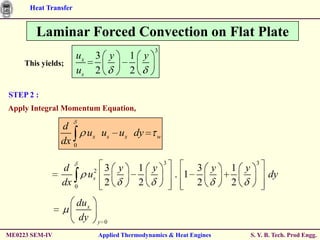
  • 114.
    Heat Transfer Compressible Fluid Flow Equations of State of the fluid ; P=ρRT Δu = Cv ΔT Δh = Cp ΔT Gas Constant for a gas is given as; R=R /M where, M = Molecular Weight of the gas. R = Universal Gas Constant = 8314.5 J/kg.mol.K For Air, the Ideal Gas Properties are : Rair = 287 J/kg.K Cv, air = 0.718 kJ/kg.K Cp, air = 1.005 kJ/kg.K γair = Cp / Cv = 1.4 ME0223 SEM-IV Applied Thermodynamics & Heat Engines S. Y. B. Tech. Prod Engg.
  • 115.
    Heat Transfer Thermal Boundary Layer On similar lines of Velocity Boundary Layers, there exist Thermal Boundary Layers also. Laminar Transition Turbulent T∞ T T∞ T Flow regions where the fluid temperature changes from the free – stream value to the value at the surface. Thermal Boundary Layer thickness δT = Distance from surface in y – direction where, ( T – Tw ) / ( T∞ - Tw ) = 0.99 or 99 % ME0223 SEM-IV Applied Thermodynamics & Heat Engines S. Y. B. Tech. Prod Engg.
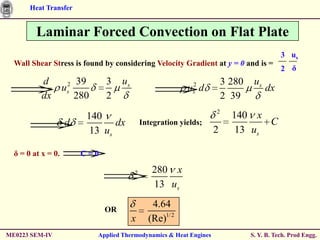
  • 116.
    Heat Transfer Laminar Boundary Layer on Flat Plate uy Exact Solution of Laminar uy dy y Flow Convection over a flat plate needs differential ux 2 ux equations of Momentum and dx dx 2 dy Energy of the flow to obtain y y ux the Temperature Gradient in ux dx ux x the fluid at the wall, and P hence, Convection Coefficient. P dx dy P dy x Assumptions : ux dx y 1. Steady – State conditions, 2. Unit Depth, uy 3. Fluid Densiy, ρ ME0223 SEM-IV Applied Thermodynamics & Heat Engines S. Y. B. Tech. Prod Engg.
  • 117.
    Heat Transfer Laminar Boundary Layer on Flat Plate ux Mass Flow Rate in and out in x – direction; u x dy and ux dx dy x ux Thus, net flow in the element in x – direction; dx dy x uy Similarly, net flow in the element in y – direction; dy dx y ux uy Total net flow in x – direction must be Zero. dx dy 0 x y ux uy ρ, dx and dy can not be Zero. Hence; 0 x y ME0223 SEM-IV Applied Thermodynamics & Heat Engines S. Y. B. Tech. Prod Engg.
  • 118.
    Heat Transfer Laminar Boundary Layer on Flat Plate Equation of Momentum can be derived from : 1. Newton’s Second Law of Motion. 2. Viscous Shear Stress in y - direction is negligible. 3. Newtonian fluid. 4. Absence of Pressure-Gradient in y – direction. Rates of Momentum Flow in x – direction for left and right hand vertical faces are; 2 2 ux ux dy dx and ux dx dy dx x Flow across horizontal faces also contribute to the Momentum Balance in x – direction; For bottom face, Momentum Flow entering is; ux u y . dx uy ux For bottom face, Momentum Flow entering is; uy dy ux dx dx y x ME0223 SEM-IV Applied Thermodynamics & Heat Engines S. Y. B. Tech. Prod Engg.
  • 119.
    Heat Transfer Laminar Boundary Layer on Flat Plate Viscous Shear Force on bottom face is; ux dx y Viscous Shear Force on top face is; ux ux dy dx y y y Net Viscous Shear Force in x - direction is; 2 ux 2 dy dx y ME0223 SEM-IV Applied Thermodynamics & Heat Engines S. Y. B. Tech. Prod Engg.
  • 120.
    Heat Transfer Laminar Boundary Layer on Flat Plate Pressure Forces on left and right hand faces are; P P dy and P dx dy x Net Pressure Force in x - direction is; P dx . dy x Thus, in x – direction; and neglecting second – order differentials; Sum of the Net Forces = Momentum Flow out of the Control Volume in x - direction 2 ux ux ux P ux uy x y y2 x ME0223 SEM-IV Applied Thermodynamics & Heat Engines S. Y. B. Tech. Prod Engg.
  • 121.
    Heat Transfer Laminar Boundary Layer on Flat Plate On the similar lines to that with Momentum Equation; the Energy Equation can also be derived as; 2 t t uy t k dx dy Cp uy dy t dy dx y y2 y y ux t Cp ux t dy C p ux dx t dx dy x x 2 t t t k dy k dy 2 dx x x x Energy Balance = t Rate of Net Conduction in k dx Cp uy t dx y + Rate of Net Convection in =0 ME0223 SEM-IV Applied Thermodynamics & Heat Engines S. Y. B. Tech. Prod Engg.
  • 122.
    Heat Transfer Laminar Boundary Layer on Flat Plate i.e. 2 2 t t k dx dy x2 y2 t ux ux t Cp u x t dx dy x x x x t uy uy t Cp u y t dx dy 0 y y y y 2 2 t t t t OR ux uy x y x2 y2 ME0223 SEM-IV Applied Thermodynamics & Heat Engines S. Y. B. Tech. Prod Engg.
  • 123.
    Heat Transfer Laminar Boundary Layer on Flat Plate 2 t Conduction in x – direction 2 is very small and can be neglected. x 2 2 t t t t ux uy x y x2 y2 P Similarly, Pressure Gradient in x – direction is also small and can be neglected. x 2 ux ux ux P ux uy x y y2 x ME0223 SEM-IV Applied Thermodynamics & Heat Engines S. Y. B. Tech. Prod Engg.
  • 124.
    Heat Transfer Laminar Boundary Layer on Flat Plate Similarities between Momentum Equation and energy Equation ; ux ux 2 ux 2 ux ν is the Kinematic Viscosity ux uy or Momentum Diffusivity x y y2 y2 =μ/ρ 2 t t t ux uy x y y2 k Cp Diffusion of Momentum Pr / Cp k Diffusion of Energy This dimensionless Number that relates Fluid Boundary Layer and Thermal Boundary Layer is known as Prandtl No. and denoted by ( Pr ). ME0223 SEM-IV Applied Thermodynamics & Heat Engines S. Y. B. Tech. Prod Engg.
  • 125.
    Heat Transfer Laminar Boundary Layer on Flat Plate Pr < 1 Pr = 1 Pr > 1 u δ = δT T∞ δ δT δT δ Prandtl No. can vary from 4 X 10⁻³ – 0.2 and 1.0 - 4 X 10⁴ Liquid Metals Viscous Oils Gases have generally Pr = 0.7 ME0223 SEM-IV Applied Thermodynamics & Heat Engines S. Y. B. Tech. Prod Engg.
  • 126.
    Heat Transfer Integral Momentum and Energy Equations Consider a Control Volume that extends from wall to just beyond the limit of D Boundary Layer in y – direction. B Thickness dx in x – direction. C y=δ Unit depth in z – direction. A y Equation to relate Net Momentum Outflow to Net Force acting in x – direction. ME0223 SEM-IV Applied Thermodynamics & Heat Engines S. Y. B. Tech. Prod Engg.
  • 127.
    Heat Transfer Integral Momentum and Energy Equations 2 Momentum Flow across face AB : u x dy 0 2 d 2 Momentum Flow across face CD : ux dy ux dy . dx 0 dx 0 d Fluid also enters the control Volume ux dy . dx dx 0 across face BD with rate of : = Fluid leaving across face CD – Fluid entering across face AB Fluid entering across face BD has Velocity us in x – direction. d Momentum Flow into Control Volume in x – direction : us ux dy . dx dx 0 ME0223 SEM-IV Applied Thermodynamics & Heat Engines S. Y. B. Tech. Prod Engg.
  • 128.
    Heat Transfer Integral Momentum and Energy Equations Net Momentum Outflow in x – direction : d d ux dy . dx us ux dy . dx dx 0 dx 0 Pressure Force will act on face AB and CD. Shear Force will act on face AC. No Shear Force will act on face BD since it is at limit of Boundary Layer. ux 0 y Net Force acting on Control Volume in x – direction : Px Px Px Px dx w dx dx w dx x x ME0223 SEM-IV Applied Thermodynamics & Heat Engines S. Y. B. Tech. Prod Engg.
  • 129.
    Heat Transfer Integral Momentum and Energy Equations Pressure Gradient can be neglected as it is very small, compared to other terms. Equality of the Net Momentum Outflow to the Net Force in x – direction : d ux us ux dy w dx 0 This is know as the Integral Momentum Equation in Laminar Boundary Layer. ME0223 SEM-IV Applied Thermodynamics & Heat Engines S. Y. B. Tech. Prod Engg.
  • 130.
    Heat Transfer Integral Momentum and Energy Equations Integral Energy Equation can be derived in a similar way. Control Volume similar to that of Velocity Boundary Integral Momentum Equation is Layer, δ considered, but extending beyond D the limits of both Velocity Boundary Layer and Thermal Boundary Layer. B Principle of Conservation of Energy C Thermal applied involves : Boundary 1. Enthalpy and Kinetic Energy of Layer, δT A Fluid entering and leaving. y 2. Heat Transfer by Conduction. Kinetic Energy can be neglected as it is very small. ME0223 SEM-IV Applied Thermodynamics & Heat Engines S. Y. B. Tech. Prod Engg.
  • 131.
    Heat Transfer Integral Momentum and Energy Equations ys Enthalpy Flow Rate across face AB : C p u x t dy 0 ys ys d Enthalpy Flow Rate across face CD : C p ux t dy C p u x t dy . dx 0 dx 0 ys d Fluid also enters the control Volume u x dy . dx dx 0 across face BD at the rate : = Flow rate out face CD – Flow rate in face AB ys d Enthalpy Flow will be : C p ts u x dy . dx dx 0 ME0223 SEM-IV Applied Thermodynamics & Heat Engines S. Y. B. Tech. Prod Engg.
  • 132.
    Heat Transfer Integral Momentum and Energy Equations t Heat Transfer by Conduction is : k dx y y 0 Conservation of Energy gives : ys ys d d t C p ts u x dy . dx C p u x t dy . dx k dx 0 dx 0 dx 0 y y 0 Beyond the Thermal Boundary Layer, the temperature is constant at ts. Integration needs to be carried out only up to y = δT. Above equation changes to : T d t ts t u x dy 0 dx 0 y y 0 This is know as the Integral Energy Equation in Laminar Boundary Layer. ME0223 SEM-IV Applied Thermodynamics & Heat Engines S. Y. B. Tech. Prod Engg.
  • 133.
    Heat Transfer Laminar Forced Convection on Flat Plate Integral Momentum Equation and Integral Energy Equation are applied to solve the equation for Laminar Forced Convection. Analysis assumes uniform Viscosity with Temperature. STEP 1 : Apply Integral Momentum Equation to derive for Velocity Boundary Layer Thickness. Velocity profile assumed to be : ux = a + by + cy2 + dy3 Constants a, b, c and d are found by applying known Boundary Conditions : ux = 0 at y = 0. a = 0. ux 0 at y = δ y 2 ux = us at y = δ. ux ux and uy = 0 0 at y = 0 y2 3 us - 1 us This yields; b= c=0 d= 2 δ 2 δ3 ME0223 SEM-IV Applied Thermodynamics & Heat Engines S. Y. B. Tech. Prod Engg.
  • 134.
    Heat Transfer Laminar Forced Convection on Flat Plate 3 ux 3 y 1 y This yields; us 2 2 STEP 2 : Apply Integral Momentum Equation, d ux us ux dy w dx 0 3 3 d 3 y 1 y 3 y 1 y us2 . 1 dy dx 0 2 2 2 2 du x dy y 0 ME0223 SEM-IV Applied Thermodynamics & Heat Engines S. Y. B. Tech. Prod Engg.
  • 135.
    Heat Transfer Laminar Forced Convection on Flat Plate 3 us Wall Shear Stress is found by considering Velocity Gradient at y = 0 and is = 2 δ d 2 39 3 us 2 3 280 us u s u d s dx dx 280 2 2 39 2 140 140 x d dx Integration yields; C 13 us 2 13 us δ = 0 at x = 0. C=0 2 280 x 13 us OR 4.64 x (Re)1/ 2 ME0223 SEM-IV Applied Thermodynamics & Heat Engines S. Y. B. Tech. Prod Engg.
  • 136.
    Heat Transfer Laminar Forced Convection on Flat Plate Temperature Distribution in the Thermal Boundary Layer can be found out in similar manner. STEP 1 : Temperature profile assumed to be : θx = ( t – tw ) = dy + ey2 + fy3 Applying the known Boundary Conditions and solving for the constants d, e and f ; 3 3 y 1 y s 2 T 2 T STEP 2 : Apply Integral Energy Equation, T d s u x dy 0 dx 0 y y 0 ME0223 SEM-IV Applied Thermodynamics & Heat Engines S. Y. B. Tech. Prod Engg.
  • 137.
    Heat Transfer Laminar Forced Convection on Flat Plate From the Temperature Distribution Equation; 3 s y y 0 2 T This yields; 3 3 T d 3 y 1 y 3 y 1 y 3 s S S . uS uS dy dx 0 2 T 2 T 2 T 2 T 2 T Substituting as λ = δT / δ; gives; d 3 3 3 3 s S uS T dx 20 280 2 T ME0223 SEM-IV Applied Thermodynamics & Heat Engines S. Y. B. Tech. Prod Engg.
  • 138.
    Heat Transfer Laminar Forced Convection on Flat Plate 4.64 Neglecting as 3λ3 / 280 as very small term; and substituting for δ from; x (Re)1/2 3 3/4 T 0.93 xh 1 Pr x where, xh is the length of the start of the heated section. If the plate is heating along its entire length, xh = 0 1/3 y T 0.93 Pr δ δT T 1 OR xh (Pr)1/3 x ME0223 SEM-IV Applied Thermodynamics & Heat Engines S. Y. B. Tech. Prod Engg.
  • 139.
    Heat Transfer Laminar Forced Convection on Flat Plate 3 S …..from Temperature Heat Transfer at the wall is : qw k k y y 0 2 T Distribution Profile qw 3 k This Heat Transfer rate is expressed as and is the Heat Transfer S 2 T Coefficient, h The group hx is a dimensionless number. k This is known as Nusselt Number, and is denoted by ( Nu ) hx Nu k ME0223 SEM-IV Applied Thermodynamics & Heat Engines S. Y. B. Tech. Prod Engg.
  • 140.
    Heat Transfer Laminar Forced Convection on Flat Plate characterstic Linear Dimension of the System Nu Equivalent conducting film of thickness T TS θS δT δT’ Equivalent Conducting Film Tw ME0223 SEM-IV Applied Thermodynamics & Heat Engines S. Y. B. Tech. Prod Engg.
  • 141.
    Heat Transfer Laminar Forced Convection on Flat Plate k k hx x Thus, qw h S . S h Nu T T k T qw x 3 x 3 x (Re)1/2 (Pr)1/3 This gives Nu as ; Nux S k 2 T 2(0.93)1/3 (4.64) x This gives ; Nux 0.332(Rex ) 1/ 2 (Pr)1/ 3 This gives Local Nusselt Number at some point x from the leading edge of the plate. The average value of the Convection Coefficient, h over the distance of 0 to x is given by; x 1 h h dx x0 Thus, Average Nusselt No. is; Nux 0.664(Rex ) 1/ 2 (Pr)1/ 3 ME0223 SEM-IV Applied Thermodynamics & Heat Engines S. Y. B. Tech. Prod Engg.
  • 142.
    Heat Transfer Example 12 Air flows at 5 m/sec. along a flat plate maintained at 77 °C. Bulk air temperature is 27 °C. Determine at 0.1 mtr from the leading edge the velocity an temperature boundary layer thickness and local as well as average heat transfer coefficient. 77 27 =1.084 kg / m3 Bulk Mean Temperature = 52 C 325 K 2 k = 28.1 X 10⁻⁶ kW / m.K μ = 1.965 X 10⁻⁵ Pa.sec Pr = 0.703 ux (1.087)(5)(0.1) Re x 0.1 27, 659.03 0.1 1.965 X 10 5 4.64 4.64 1/2 (0.1) 2.789 mm …..Ans (i) x 0.1 Re x 0.1 (Re0.1 )1/2 0.1 ME0223 SEM-IV Applied Thermodynamics & Heat Engines S. Y. B. Tech. Prod Engg.
  • 143.
    Heat Transfer Example 12….cntd 1 1 T T (2.789) 3.134 mm …..Ans (ii) 0.1 1/3 0.1 (Pr) 1/3 (0.703) 0.1 hx 1/2 1/3 Nux 0.1 0.332 Re x Pr k 0.1 0.1 1/ 2 1/ 3 28.1 X 10 6 (h) 0.1 0.332 (27,659.03) (0.703) 0.1 13.8 X 10 3 kW / m 2 .K …..Ans (iii) hx 1/2 1/3 Nu x 0.664 Re x Pr 0.1 k 0.1 0.1 27.6 X 10 3 kW / m2 .K …..Ans (iv) ME0223 SEM-IV Applied Thermodynamics & Heat Engines S. Y. B. Tech. Prod Engg.
  • 144.
    Heat Transfer Laminar Forced Convection in a Tube Case for : 1. Fully Developed Flow, and 2. Constant Heat Flux. Velocity Profile of Parabolic shape. To derive Energy Equation for flow in tube : Consider a cylindrical element of flow. Length, dx Inner Radius, r Outer Radius, r + dr Energy Flow into and out of the element in : 1. Radial direction by Conduction, and 2. Axial direction by Convection. ME0223 SEM-IV Applied Thermodynamics & Heat Engines S. Y. B. Tech. Prod Engg.
  • 145.
    Heat Transfer Laminar Forced Convection in a Tube T Conduction into the element : Qr k 2 r dx r Qr T With change of radius dr, Conduction rate : dr k 2 dx r dr r r r This change in Conduction rate = Difference between Convection rates into and out of the element in Axial Direction. Temperature changes in Axial Direction. Rate of Convection into the element : 2 r dr u C p T T Rate of Convection out of the element : 2 r dr u C p T dx x T Hence, the difference is : 2 r dr u Cp dx x ME0223 SEM-IV Applied Thermodynamics & Heat Engines S. Y. B. Tech. Prod Engg.
  • 146.
    Heat Transfer Laminar Forced Convection in a Tube Summation of total Forces is zero. 1 T Cp T r ur r r k x This is the ENERGY EQUATION FOR LAMINAR FLOW IN TUBES. Assumptions : 1. Constant Heat Flow, qw, 2. Constant Fluid properties, Temperature of the fluid (at any radius) must T Cons tan t increase linearly in the direction of flow. x ME0223 SEM-IV Applied Thermodynamics & Heat Engines S. Y. B. Tech. Prod Engg.
  • 147.
    Heat Transfer Laminar Forced Convection in a Tube Boundary Conditions : 1. T 2. T Tw at r rw 0 at r 0 r T Heat Flux is related to Temperature Gradient. 3. qw k at r rw r rw T Cons tan t equation reduces to Total Differential Equation. x Velocity, u α Velocity at the Axis of tube, ua and Radius, r. 2 u r 1 ….assuming Parabolic Distribution. ua rw ….rw = wall radius. ME0223 SEM-IV Applied Thermodynamics & Heat Engines S. Y. B. Tech. Prod Engg.
  • 148.
    Heat Transfer Laminar Forced Convection in a Tube 2 Substituting this value in the T 1 T r r ua 1 r above Equation would give; r r x rw Integrating for two times, 1 T r2 r4 T ua 2 C1 ln r C2 would give : x 4 16 rw Applying the Boundary Conditions : 1. T 0 at r 0 C1 =0 r 2 1 T 3 rw 2. T Tw at r rw C2 Tw ua x 16 Thus, Equation becomes : 2 4 1 T 2 1 r 1 r 3 T ua rw Tw x 4 rw 16 rw 16 ME0223 SEM-IV Applied Thermodynamics & Heat Engines S. Y. B. Tech. Prod Engg.
  • 149.
    Heat Transfer Laminar Forced Convection in a Tube Equation can be expressed in terms of Temperature Difference : θ = T - Tw θa = Temperature Difference between axis ( r = 0 ) and wall. 1 T 2 3 a ua rw x 16 Temperature Profile can be expressed non – dimensionally as : 2 4 4 r 1 r 1 a 3 rw 3 rw Heat Transfer at wall α Temperature Gradient at r = rw d 8 4 4 a a dr rw 3 rw 3 rw 3 rw ME0223 SEM-IV Applied Thermodynamics & Heat Engines S. Y. B. Tech. Prod Engg.
  • 150.
    Heat Transfer Laminar Forced Convection in a Tube On the similar lines; 4k a 4 k qw k h a h r rw 3 rw 3 rw hd 4 k 2 rw 8 In terms of Nud : Nu d k 3 rw k 3 This analysis is based on the Temperature Difference between the Axis and the Wall. From practical point of view, analysis for Temperature Difference between the Bulk and the Wall is important. Bulk Temperature = Mean Temperature of the fluid. ME0223 SEM-IV Applied Thermodynamics & Heat Engines S. Y. B. Tech. Prod Engg.
  • 151.
    Heat Transfer Laminar Forced Convection in a Tube rw 2 r dr u C p Temperature Difference based on 0 m rw Bulk Temperature is given as; 2 r dr u C p 0 44 Solution of the Equation is : m a 72 Heat Transfer 4k a 4 72 k qw k m h m at the wall is : r 3 rw 3 44 rw rw 4 k 72 h 3 rw 44 ME0223 SEM-IV Applied Thermodynamics & Heat Engines S. Y. B. Tech. Prod Engg.
  • 152.
    Heat Transfer Laminar Forced Convection in a Tube In terms of Nud : hd 4 k 2 rw 72 Nu d k 3 rw k 44 8 72 Nu d 3 44 Nud 4.36 NOTE : The Nu is INDEPENDENT of Re as the Fully Developed flow, Boundary Layer Thickness = Tube Radius. ME0223 SEM-IV Applied Thermodynamics & Heat Engines S. Y. B. Tech. Prod Engg.
  • 153.
    Heat Transfer Reynolds Analogy Till now, the analysis of Forced Convection for Laminar Flow is carried out. Turbulent flow demands for introduction of additional terms into Momentum Equation and Energy Equation to take into consideration the presence of Turbulence. Demands for Numerical Solution for Finite Difference Equations. Approach for Turbulent Flow Convection α Similarities between Equations for : 1. Heat Transfer and 2. Shear Stress (OR Momentum Transfer) Original Idea of such Analogy is put forth by Reynolds; and hence named after him. ME0223 SEM-IV Applied Thermodynamics & Heat Engines S. Y. B. Tech. Prod Engg.
  • 154.
    Heat Transfer Reynolds Analogy du du Equation for Shear Stress in Laminar Flow is : dy dy where, ν is the Kinematic Viscosity. du Similar equation for Shear Stress in Turbulent Flow is : T dy The term, ε is known as Eddy Diffusivity. ε α Shear Stress due to Random Turbulent Motion. Turbulent Flow Presence of Viscous Shear Stress also. du Total Shear Stress is : dy ε is not a Property of fluid, like μ ε α Re and Turbulence Level. ε generally >> ν ME0223 SEM-IV Applied Thermodynamics & Heat Engines S. Y. B. Tech. Prod Engg.
  • 155.
    Heat Transfer Shear Stress at Solid Surface Reynolds Analogy implies that; Heat Transfer at surface of Flat Plate / Tube = Shear Stress acting on the surface Shear Stress Substituting u in Equation of η y y 0 Thus, for Laminar Flow on Flat Plate, x from leading edge, 0.647 Cf 1/2 Reynolds Number (Rex), Re x Free – Stream Velocity us w Cf is known as Skin Friction Coefficient, Cf 1 2 uS 2 For Laminar Flow, the average value of Cd for length x = 2 . Cf ME0223 SEM-IV Applied Thermodynamics & Heat Engines S. Y. B. Tech. Prod Engg.
  • 156.
    Heat Transfer Shear Stress at Solid Surface 1/5 For Turbulent Flow; Cf 0.0583 Re x 0.455 And, Cd 2.58 log Re x These are Empirical Correlations α Laminar + Turbulent portion of Boundary Layer. Velocity at limit of Boundary Layer The Ratio α (Rex) Free – Stream Velocity ub 2.12 0.1 uS Re x S. Y. B. Tech. Prod Engg.
  • 157.
    Heat Transfer Shear Stress at Solid Surface Corresponding relationships for Flow in Tubes : 4. w Expressed in terms of Friction Factor, f: f 4. C f 1 2 um 2 um = Mean Velocity of Flow. 64 Laminar Flow : f Re d Turbulent Flow : 0.308 f 1/4 Red for Smooth Surfaces. ub 2.44 1/8 uS Red NOTE : Values for Rough Surfaces are much higher. S. Y. B. Tech. Prod Engg.
  • 158.
    Heat Transfer Heat Transfer across Boundary Layer Laminar Flow : Heat Transfer across flow α Only by Conduction. dT Fourier’s Law : q CP dy Turbulent Flow : Energy will also be transmitted through Random Turbulent Motion. dT q CP q dy εq is known as Thermal Eddy Diffusivity. S. Y. B. Tech. Prod Engg.
  • 159.
    Heat Transfer Basis for Reynolds Analogy Heat Transfer at surface of Flat Plate / Tube = Shear Stress acting on the surface du Laminar Flow, compare and dy dT q CP dy du Turbulent Flow, compare and dy dT q CP q dy We know, ν / α = Prandtl Number, (Pr) Similarly, ε / εq = Turbulent Prandtl Number. NOTE : This is NOT a Property of the fluid. ME0223 SEM-IV Applied Thermodynamics & Heat Engines S. Y. B. Tech. Prod Engg.
  • 160.
    Heat Transfer Assumptions for Reynolds Analogy 1. ε = εq . An eddy of fluid with certain Temperature and Velocity is transferred to a different state, then it assumes its new Temperature and Velocity in equal time. This assumption is found practically valid as; ε / εq varies between 1.0 and 1.6 2. q and τ have same ratio at all values of y . True when Temperature Profile and Velocity Profile are identical. i.e. Pr = 1...….Laminar Flow ε ≈ εq …..Turbulent Flow Since, ν and α << ε and εq 1 q q ME0223 SEM-IV Applied Thermodynamics & Heat Engines S. Y. B. Tech. Prod Engg.
  • 161.
    Heat Transfer Simple Reynolds Analogy Flow is assumed to be Full laminar OR Full Turbulent with Pr = 1. du dT Laminar Flow : Comparing the Equations, and q CP dy dy q k dT du This gives q / τ at any arbitrary plane = qw / τw at wall…..according to Assumptions. qw k (TS Tw ) w uS ME0223 SEM-IV Applied Thermodynamics & Heat Engines S. Y. B. Tech. Prod Engg.
  • 162.
    Heat Transfer Simple Reynolds Analogy Turbulent Flow : Comparing the Equations, du and dy dT q CP q dy q CP q dT du qw (TS Tw ) CP w uS ME0223 SEM-IV Applied Thermodynamics & Heat Engines S. Y. B. Tech. Prod Engg.
  • 163.
    Heat Transfer Simple Reynolds Analogy qw k (TS Tw ) and qw (TS Tw ) are clearly identical if Pr = 1 CP w uS w uS i.e. μ.Cp / k = 1 i.e. Cp = k / μ Rearranging the terms; qw w CP Cf h Cf h h CP u s S uS 2 CP us 2 where, θs = ( Ts – Tw ) This gives Convection Coefficient h in terms of Skin Friction Factor, Cf h is known as Stanton Number and denoted by ( St ). CP u s is dimensionless. Nu St Re. Pr ME0223 SEM-IV Applied Thermodynamics & Heat Engines S. Y. B. Tech. Prod Engg.
  • 164.
    Heat Transfer Simple Reynolds Analogy Further re-arranging the terms; x Cf x x Cf us x as μ.Cp / k = 1 h CP u s h k 2 k k 2 i.e. Cp = k / μ Cf Nu x Re x 2 0.647 Nu x 0.323 Re x 1/2 We know, Cf 1/2 Re x With Integral Boundary Layer Equations for Laminar Flow on Flat Plate, 1/2 1/3 Nu 0.332 Re x Pr 1/ 2 With Pr = 1, Nu 0.332 Re x ME0223 SEM-IV Applied Thermodynamics & Heat Engines S. Y. B. Tech. Prod Engg.
  • 165.
    Heat Transfer Simple Reynolds Analogy For the Flow in Tubes; θs and us are replaced by corresponding Mean Values, θm and um. d Cf um d h k 2 Cf Nud Red 2 1/4 We know, f 4.C f 0.308 Red 0.75 Nud 0.038 Red ME0223 SEM-IV Applied Thermodynamics & Heat Engines S. Y. B. Tech. Prod Engg.
  • 166.
    Heat Transfer Prandtl – Taylor Modification Prandtl and Taylor had modified the Reynolds Analogy to take into account the variation of Prandtl Number. Prandtl – Taylor Modification is valid for 0.5 < Pr < 250. Reynolds Analogy modified by Prandtl and Taylor : qw S 1 CP w uS 1 ub Pr 1 uS Introducing the term Cf : qw Cf 1 uS CP S w 2 1 ub Pr 1 uS ME0223 SEM-IV Applied Thermodynamics & Heat Engines S. Y. B. Tech. Prod Engg.
  • 167.
    Heat Transfer Prandtl – Taylor Modification Turbulent Flow on Flat Plate : 4/5 0.0292 Re x Pr Nu x 1/10 1 2.12 Re x Pr 1 Turbulent Flow in Round Tubes : 3/4 0.0386 Re x Pr Nux 1/8 1 2.44 Re x Pr 1 ME0223 SEM-IV Applied Thermodynamics & Heat Engines S. Y. B. Tech. Prod Engg.
  • 168.
    Heat Transfer Example 13 Compare the heat transfer coefficients for water flowing at an average fluid temperature of 100 °C, and at a velocity of 0.232 m/sec. in a 2.54 cm bore pipe; using simple Reynolds Analogy and Prandtl – Taylor Modification. At 100 °C, Pr = 1.74, k = 0.68 kW / m.K, ν = 0.0294 X 10⁻⁵ m2 / sec. ud (0.232)(0.0254 ) Reynolds Number is : Re 20,000 0.0294 X 10 5 Simple Reynolds Analogy gives : 0.75 Nud 0.038 Red Nud 62.5 h Nu . k (62.5) (0.68 X 10 3 ) d 0.0254 1.675 kW / m.K …..Ans (i) ME0223 SEM-IV Applied Thermodynamics & Heat Engines S. Y. B. Tech. Prod Engg.
  • 169.
    Heat Transfer Example 13…cntd. With Prandtl – Taylor Modification : 3/4 0.0386 Red Pr Nud 1/8 1 2.44 Red Pr 1 3/4 0.0386 20, 000 1.74 Nud 1/8 72.4 1 2.44 20, 000 1.74 1 h Nu . k (72.4) (0.68 X 10 3 ) d 0.0254 1.973 kW / m.K …..Ans (ii) ME0223 SEM-IV Applied Thermodynamics & Heat Engines S. Y. B. Tech. Prod Engg.
  • 170.
    Heat Transfer Dimensional Analysis Convection Heat Transfer Analysis Difficult to approach analytically. Easy to deal with Dimensional Analysis + Experiments. Dimensional Analysis Equations in terms of important physical quantities in dimensionless groups. Given Process α n different physical variables. Q1, Q2, Q3, ….Qn. Composed of k independent dimensional quantities. (e.g. Length, Mass, Time, etc.) ME0223 SEM-IV Applied Thermodynamics & Heat Engines S. Y. B. Tech. Prod Engg.
  • 171.
    Heat Transfer Dimensional Analysis Buckingham’s Pi Theorem : Dimensionally Homogeneous Equation α ( n – k ) dimensional groups. f1 ( Q1, Q2, Q3, …..Qn ) = 0 Then, f2 ( π1, π 2, π 3, ….. π n-k ) = 0 Each term, π composed of Q variables in form; π = Q1a, Q2 b, Q3c, …..Qnx ) = 0 and is dimensionless. Thus, a set of π terms includes all independent dimensionless groups. No π term can be formed by combining other π terms. Set of Equations for a, b, c, …..x by equating the sum of components of each independent dimensions to Zero. k Equations for n unknowns. ME0223 SEM-IV Applied Thermodynamics & Heat Engines S. Y. B. Tech. Prod Engg.
  • 172.
    Heat Transfer Dimensional Analysis….Example Consider the Differential Equation for Momentum and Energy Transfer for Forced Convection in Laminar Flow. 2 2 2 ux ux ux P t t t t ux uy ux uy x y y2 x x y x2 y2 Dependent Variable : Convection Coefficient, h Independent : 1. Velocity, u Independent : 1. Mass, M Variables 2. Linear Dimension, l Dimensional 2. Length, L 3. Thermal Conductivity, k Quantities 3. Time, T 4. Viscosity, μ 4. Temperature, θ 5. Specific Heat, Cp 5. Heat, H…..Assumed. 6. Density, ρ 6. H / θ in case of ( h, k & Cp) ME0223 SEM-IV Applied Thermodynamics & Heat Engines S. Y. B. Tech. Prod Engg.
  • 173.
    Heat Transfer Dimensional Analysis….Example Thus; 7 Physical Variables. ( n – k ) = 3 π terms obtained. 4 Independent Quantities. 4 Variables, which involve all 4 dimensions and DO NOT form any dimensionless group within, are : u, l, k and μ. 1 u a1 l b1 k c1 d1 h 2 u a2 l b2 k c2 d2 CP 3 u a3 l b3 k c3 d3 The term π1 can be written as : a1 c1 d1 L b1 H M H L T LT LT L2 T ME0223 SEM-IV Applied Thermodynamics & Heat Engines S. Y. B. Tech. Prod Engg.
  • 174.
    Heat Transfer Dimensional Analysis….Example Following Equations for a1, b1, c1 and d1 can be obtained : L : a1 + b1 – c1 – d1 – 2 = 0 T : – a1 – c1 – d1 – 1 = 0 H / θ : c1 + 1 = 0 M : d1 = 0 This implies : a1 = 0 b1 = 1 c1 = (-1) d1 = 0 hl π1 term is = Nu k ME0223 SEM-IV Applied Thermodynamics & Heat Engines S. Y. B. Tech. Prod Engg.
  • 175.
    Heat Transfer Dimensional Analysis….Example CP Similarly, π2 term is = Pr k ul And, π3 term is = Re Thus, the result is : φ2 ( Nu, Pr, Re ) = 0 Nu = φ ( Pr, Re ) This agrees with Reynolds Analogy, i.e. Nu = f ( Pr, Re ) ME0223 SEM-IV Applied Thermodynamics & Heat Engines S. Y. B. Tech. Prod Engg.
  • 176.
    Heat Transfer Dimensional Analysis Scale Model Testing is the valuable practical application of use of such Dimensionless Analysis. With such models, the performance of the projected design can be estimated. Pre – requisites : 1. Model must be geometrically similar to the full – scale design. 2. Re, Pr must be reproduced correctly. This helps to predict : 1. Flow Patterns. 2. Thermal Boundary Layer. 3. Fluid Boundary Layer. 4. Nusselt Number ( Nu ). ME0223 SEM-IV Applied Thermodynamics & Heat Engines S. Y. B. Tech. Prod Engg.
  • 177.
    Heat Transfer Empirical Relations for Forced Convection A. Laminar Flow in Tubes : Average Nusselt Number at distance x from the entry is given by : 1/3 0.14 1/3 1/3 d Nud 1.86 Re d Pr x w All physical properties are to be evaluated at Arithmetic Mean Bulk Temperature, θm except μw at Wall Temperature. Equation is valid for Heating as well as Cooling, in the range, 1/3 1/3 1/3 d 100 Red Pr 10,000 x ME0223 SEM-IV Applied Thermodynamics & Heat Engines S. Y. B. Tech. Prod Engg.
  • 178.
    Heat Transfer Empirical Relations for Forced Convection B. Turbulent Flow in Tubes : For 1. Fluids with Pr = 1 2. Moderate Temperature Difference between fluid and wall ( 5 °C for Liquids and 55 °C for Gases ) 0.8 n Nud 0.023 Re d Pr All physical properties are to be evaluated at Arithmetic Mean Bulk Temperature, θm n = 0.4…..Heating = 0.3…...Cooling Equation is valid for : Red 10,000 Equation is for Fully Developed Flow, i.e. ( x / d ) >> 60. ME0223 SEM-IV Applied Thermodynamics & Heat Engines S. Y. B. Tech. Prod Engg.
  • 179.
    Heat Transfer Empirical Relations for Forced Convection B. Turbulent Flow in Tubes : For larger Temperature Difference and wide range of Prandtl Numbers, 0.14 0.8 1/3 Nud 0.027 Re d Pr w Equation is valid for : 0.7 < Pr < 16,700 All physical properties are to be evaluated at Arithmetic Mean Bulk Temperature, θm except μw at Wall Temperature. ME0223 SEM-IV Applied Thermodynamics & Heat Engines S. Y. B. Tech. Prod Engg.
  • 180.
    Heat Transfer Empirical Relations for Forced Convection C. Turbulent Flow along Flat Plate : 1/3 Nud 0.036 Pr Red 0.8 18, 700 All physical properties are to be evaluated at Arithmetic Mean Bulk Temperature, θm Equation is based on : 1/2 1/3 1. Laminar Flow, i.e. Nu x 0.664 Re x Pr 2. Turbulent Flow after Transition at Re = 40,000. 3. 10 > Pr > 0.6 ME0223 SEM-IV Applied Thermodynamics & Heat Engines S. Y. B. Tech. Prod Engg.
  • 181.
    Heat Transfer Empirical Relations for Forced Convection D. Heat Transfer to Liquid Metals : Liquid Metals very low Prandtl Number For 1. Turbulent Flow 2. Smooth Pipes / Tubes 0.4 a ) Uniform Wall Heat Flux : Nud 0.625 Re d Pr 0.8 b ) Constant Wall Temperature : Nud 5.0 0.025 Re d Pr All physical properties are to be evaluated at Arithmetic Mean Bulk Temperature, θm Equation is for : 1. ( x / d ) >> 60. 2. 102 < (Red Pr) < 104 ME0223 SEM-IV Applied Thermodynamics & Heat Engines S. Y. B. Tech. Prod Engg.
  • 182.
    Heat Transfer Natural Convection Energy Exchange between a body and an essentially stagnant fluid surrounding it. Fluid Motion is due entirely to Buoyancy Forces caused by Density Variation of the fluid. Natural Convection Object dissipating its Energy to the surrounding. 1. Intentional : Cooling of any Machine. Heating of house or room 2. Unintentional : Loss through Steam Pipe. Dissipation of warmth to the cold air outside the window or room ME0223 SEM-IV Applied Thermodynamics & Heat Engines S. Y. B. Tech. Prod Engg.
  • 183.
    Heat Transfer Natural Convection Fluid Flow due to Natural Convection has both Laminar and Turbulent regimes. Boundary Layer produced has ZERO Velocity at both, 1. Solid Surface and 2. At the Outer Limit. Velocity Distribution Tw u=0 u=0 Bulk Fluid Temperature Direction of induced Motion ME0223 SEM-IV Applied Thermodynamics & Heat Engines S. Y. B. Tech. Prod Engg.
  • 184.
    Heat Transfer Laminar Flow over Flat Plate Solution for Boundary Layer Momentum Equation and Energy Equation is possible with introduction of a term known as Body Force. This is then followed by Dimensional Analysis. Body Force : ρs = Density of Cold Undisturbed Fluid. ρ = Density of warmer fluid. θ = Temperature Difference between the two fluid regimes. Buoyancy Force = ( S ).g s is related to by : S (1 ) β = Coefficient of Cubical Expansion of fluid. Buoyancy Force = 1 .g .g . . Independent Variables for calculation of h Addition of Buoyancy Force ( β, g, θ ) along with fluid properties ( , Cp, μ, k, and linear dimension l ) ME0223 SEM-IV Applied Thermodynamics & Heat Engines S. Y. B. Tech. Prod Engg.
  • 185.
    Heat Transfer Dimensional Analysis 8 Physical Variables 3 π terms are expected. 5 Dimensionless Quantities H and θ are not combined; as the Temperature Difference is now an important Physical Variable. 5 Physical Variables selected common to all π terms are : ( , μ, k, θ and l ) h, Cp and ( βg ) each appear in separate π terms. a1 b1 1 k c1 d1 e1 l h a2 b2 2 k c2 d2 l e2 CP a3 b3 3 k c3 d3 l e3 g ME0223 SEM-IV Applied Thermodynamics & Heat Engines S. Y. B. Tech. Prod Engg.
  • 186.
    Heat Transfer Dimensional Analysis Solving for a, b, c, d, and e as Constants, and substituting; 2 3 hl CP g l g l3 1 Nu 2 Pr 3 2 2 k k This π3 is known as Grashof Number and denoted by ( Gr ). The Dimensionless Relationship obtained is : ( Nu, Pr, Gr ) 0 OR Nu (Gr , Pr) Buoyancy Force Grashof Number (Gr ) Shear Force Buoyancy Force in Natural Convection ≡ Momentum Force in Forced Convection. ME0223 SEM-IV Applied Thermodynamics & Heat Engines S. Y. B. Tech. Prod Engg.
  • 187.
    Heat Transfer Dimensional Analysis By experimental studies, it is found that, Nu (Gr , Pr) is corrected to : Nu a (Gr , Pr)b where a and b are Constants. This product, ( Gr . Pr ) is known as Rayleigh Number, and denoted by ( Ra ). Transition from Laminar to Turbulent Flow takes place in the range of : 107 < ( Gr . Pr ) < 109 ME0223 SEM-IV Applied Thermodynamics & Heat Engines S. Y. B. Tech. Prod Engg.
  • 188.
    Heat Transfer Formulae for Natural Convection A. Horizontal Cylinder : Nud 0.525(Grd .Pr) 0.25 when 104 < ( Grd . Pr ) < 109 (Laminar Flow) Nud 0.129(Grd .Pr) 0.33 when 109 < ( Grd . Pr ) < 1012 (Turbulent Flow) All physical properties are to be evaluated at Average of Surface and Bulk Fluid Temperature; which is the Mean Film Temperature. Below ( Grd . Pr ) = 104 ; No such relationship exists and Nu reduces to 0.4 With such low values of ( Grd . Pr ) the Boundary Layer Thickness becomes appreciable as compared to the diameter. In case of thin wires, Heat Transfer occurs in the limit by Conduction through the stagnant film. ME0223 SEM-IV Applied Thermodynamics & Heat Engines S. Y. B. Tech. Prod Engg.
  • 189.
    Heat Transfer Formulae for Natural Convection B. Vertical Surfaces : Characteristic Linear Dimension is the Length or Height of the surface, l l Boundary Layer results from the vertical motion of the fluid. Length of Boundary Layer is important than its Width. Nud 0.59(Grl .Pr) 0.25 when 104 < ( Grd . Pr ) < 109 (Laminar Flow) l Nud 0.129(Grd .Pr) 0.33 when 109 < ( Grd . Pr ) < 1012 (Turbulent Flow) All physical properties are to be evaluated at Average of Surface and Bulk Fluid Temperature; which is the Mean Film Temperature. ME0223 SEM-IV Applied Thermodynamics & Heat Engines S. Y. B. Tech. Prod Engg.
  • 190.
    Heat Transfer Formulae for Natural Convection C. Horizontal Flat Surfaces : Fluid Flow is most restricted in case of horizontal surfaces. Also, Heat Transfer Coefficient varies depending whether the horizontal surface is above or below the fluid. Square / Rectangular Surface up to l = 2 ft ( Mean Length of side ) Nud 0.54(Grl .Pr) 0.25 when 105 < ( Grd . Pr ) < 108 (Laminar Flow) For Cold fluid above Hot surface 0.33 Nud 0.14(Grd .Pr) OR Hot fluid below Cold surface When ( Grd . Pr ) > 108 (Turbulent Flow) ME0223 SEM-IV Applied Thermodynamics & Heat Engines S. Y. B. Tech. Prod Engg.
  • 191.
    Heat Transfer Formulae for Natural Convection C. Horizontal Flat Surfaces : Convective motion is surely restricted surface itself prevents vertical motion. Therefore, only Laminar Flow is possible with, For Cold fluid below Hot surface OR Hot fluid above Cold surface Nud 0.25(Grd .Pr) 0.25 When ( Grd . Pr ) > 105 All physical properties are to be evaluated at Average of Surface and Bulk Fluid Temperature; which is the Mean Film Temperature. ME0223 SEM-IV Applied Thermodynamics & Heat Engines S. Y. B. Tech. Prod Engg.
  • 192.
    Heat Transfer Formulae for Natural Convection D. Approximate Formulae for Air : Convective Convection mainly deals with Air as a fluid medium; Air properties do not vary greatly over limited temperature range. It is possible to derive simplified formulae for Air as : 2 b g CP h Cons t ant k 1 b b l 3b 1 b Cons t ant X l 3b 1 It could be found out that b = 0.25…..Laminar Flow Index for l = ( -0.25 )….Laminar Flow b = 0.33….Turbulent Flow =0 …..Turbulent Flow 0.25 h C ….Laminar Flow AND h C 0.33 ….Turbulent Flow l ME0223 SEM-IV Applied Thermodynamics & Heat Engines S. Y. B. Tech. Prod Engg.
  • 193.
    Heat Transfer Formulae for Natural Convection D. Approximate Formulae for Air : Geometry / Orientation Relation Horizontal Cylinders : 0.25 d = diameter h 0.00131 d Laminar h 0.00124 ) 0.33 ( Turbulent 0.25 Vertical Surfaces : Laminar h 0.00141 l = height l Turbulent 0.33 h 0.00131 ) ( Vertical Surfaces : ( l – length of side ) 0.25 Hot, facing upwards h 0.00131 l Laminar Cold, facing downwards h 0.00152 ) 0.33 ( Turbulent Hot, facing downwards 0.25 h 0.00058 Cold, facing upwards l Laminar h is given in terms of ( kW / m2.K ) θ is given in terms of ( °C ) l, the linear dimension is given in terms of (m ) ME0223 SEM-IV Applied Thermodynamics & Heat Engines S. Y. B. Tech. Prod Engg.
  • 194.
    Heat Transfer Thank You ! ME0223 SEM-IV Applied Thermodynamics & Heat Engines S. Y. B. Tech. Prod Engg.