UNIT-II
Draught And Chimney
Content
 Introduction to draught system
 Functions & Classification of Draughts
 Introduction to natural draught
 Estimate the height & diameter of chimney with Numericals.
 Condition for maximum discharge through a chimney
 Efficiency of chimney
 Advantages and Limitations of chimney or natural draught
 Boiler Performance: Equivalent Evaporation and Boiler
Efficiency with Numericals.
PramodKathamore
Draught
 Draught is defined as “the pressure difference (between absolute gas
pressure at any point in a gas flow passage and the atmospheric air outside
the boiler) required to maintain flow of air and exhaust gases through the
boiler setting.”
 Function of draught:
 To supply required quantity of air to the boiler furnace for the combustion of
fuel.
 To remove exhaust gases from the boiler passage to maintain flow of air
and gases.
 Tocreate pressure difference against pressure losses in the flow passage.
 To discharge the exhaust gases such that they will not be objectionable or
injurious to the surroundings.
PramodKathamore
Classification of Draught
Draught
Natural
Draught
Produced by chimney
Artificial
Draught
Steam Jet
Draught
Produced by jet of stream
Forced
Draught
Induced
Draught
Mechanical
Draught
Produced by fans
Forced
Draught Fan
Induced
Draught Fan
PramodKathamore
Artificial Draught
PramodKathamore
PramodKathamore
Natural draught
 It does not need any running cost although it has a big initial
cost.
 Natural draught allows natural circulation of air through the
boiler system.
 The natural draught mainly depends upon the height of the
chimney.
PramodKathamore
Natural Draught is obtained by the use of a chimney.
The chimney in a boiler installation performs one or more of the
following functions:
1) It produces the draught whereby the air and gas are forced
through the fuel bed, furnace, boiler passes and settings.
2) It carries the products of combustion to such a height before
discharging them that they will not be Objectionable or injurious
to surroundings.
 A Chimney is vertical, Tubular structure built either of masonry,
concrete or steel.
 The draught produced by the chimney is due to the density
difference between the column of hot gases inside the chimney
and the cold air outside.
PramodKathamore
Estimate the height & diameter of chimney
Natural Draught = Difference of pressure due to cold air column
and hot gas column
PramodKathamore
P1= Pa + ρg.gH
Where, P1= Pressure at the grate level (Chimney Side)
Pa= Atmospheric Pressure at Chimney top
ρg. gH= Pressure due to the column of hot gas of height H meters,
ρg= Average mass density of hot gas.
Similarly
P2= Pa +ρa.gH
Where
P2= Pressure acting on the grate (Open Side)
Pa= Atmospheric Pressure at Chimney top
ρa. gH= Pressure exerted by the column of cold air outside the chimney of height H m
Ρa=Average mass density of air outside the chimney.
Net Pressure diffrence causing the flow through the combustion chamber,
△P= P2-P1 = (ρa – ρg) gH
The diffrence of Pressure causing the flow of gases is known as Static Draught. Its value is very small &
generally measured by a water manometer.
It may be noted that this pressure diffrence in chimney is generally less than 12 mm of water
PramodKathamore
Let us assume that the volume of products of combustion is equal to
the volume of air supplied, both reduced to the same temperature
and pressure conditions.
Let,
ma= Mass of air supplied per kg of fuel
ma+1= Mass of Chimney gases
Ta= Absolute temp. of Atmosphere
Tg= Average absolute temp. of chimney gases
Also
𝑴𝒂𝒔𝒔 𝒐𝒇 𝒉𝒐𝒕 𝒈𝒂𝒔𝒆𝒔
𝑴𝒂𝒔𝒔 𝒐𝒇 𝑨𝒊𝒓
=
𝒎𝒂+𝟏
𝒎𝒂
PramodKathamore
For Calculating Height of Chimney, we have to go through two basic
equations of gaseous pressure.
The equations are
Where, "P" is the pressure of air or gas, "ρ" is the density of the air or gas,
"g" is the gravitational constant, and "h" is the height of the head.
Here "V" is the volume of the air or gas, "m" is the mass of the gas or air, "T"
is the temperature measured in kelvin scale and "R" is the gas constant.
PramodKathamore
Equation (2) can be rewritten as
Combustion:
C + O2 = CO2
1Volm 1Volm 1Volm
Volm of Air = Volm Flue gas
When Temp before & after combustion=Constant,
Temp Change=Volm Vary
 The air entries in the combustion chamber will gain extra volume after
combustion due to combustion temperature. The gained volume of the air
will be equivalent to the volume of the flue gases created after combustion.
PramodKathamore
Let us assume,
 ρo is the density of the air at 0oC or 273 K, and say it is To Here,
 P is the pressure of air at 0oC or 273 K, that is at To K.
If we keep, the pressure P as constant, the relation between density and
temperature of the air or gases can be written as,
PramodKathamore
Where, ρa and ρg is the density of the air at temperature Ta and Tg K
respectively.
From, equation (1) and (5) we can write the expression of pressure at point "a"
outside the chimney, as
PramodKathamore
The volume of the air at the temperature Tg would be
Let us assume, m kg of air is required to burn 1 kg of carbon then the density of the
flue gas would be
The pressure of the flue gas inside the chimney from equation (1) and (8), would be
PramodKathamore
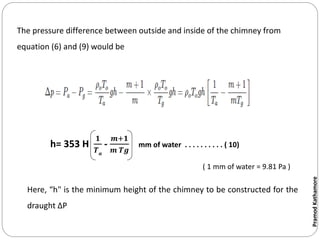
The pressure difference between outside and inside of the chimney from
equation (6) and (9) would be
h= 353 H
𝟏
𝑻 𝒂
-
𝒎+𝟏
𝒎 𝑻𝒈
mm of water . . . . . . . . . . ( 10)
Here, “h" is the minimum height of the chimney to be constructed for the
draught ΔP
( 1 mm of water = 9.81 Pa )
PramodKathamore
Assuming no loss, the velocity of the gases passing through the
chimney is given by
𝑉= 2݃H1
If the Pressure Loss in Chimney is equivalent to a hot gas column H’ meters.
Now, Hot Gas Velocity in Chimney 𝑉= 2g (H – h’)
V= 4.43 𝐻 − 𝐻′
V= 4.43 𝐻1 1 −
𝐻′
𝐻
= K 𝐻1
Where K = 4.43 1 −
𝐻′
𝐻
Value of K=1 for Brick Chimneys and
K=1.1 for Steel Chimney
PramodKathamore
The mass of the gases flowing through any cross section of the
Chimney is given by
mg= ρg. A.C kg/s
mg= ρg.
π
4
D2 . C
D2 =
𝑚𝑔
ρ 𝑔𝐶
x
4
π
Diameter of Chimney is D = 1.128
𝒎𝒈
ρ 𝒈𝑪
.
.
.
PramodKathamore
Maximum Discharge:
The Draught in mm of water column for maximum discharge can be evaluated
by inserting the value of Tg /Ta in
Tg = 2
𝒎+𝟏
𝒎
Ta
Thus we see that for maximum discharge, temperature of the flue gases (Tg)
should be slightly more than the atmospheric temperature (Ta).
Note 1: The Height of gas column (H’) producing the draught for maximum
mass of hot gases to be discharged is obtained by substituting the value of Tg in
equation (10)
H’=H
𝑚
𝑚+1
X
2 𝑚+1 𝑇 𝑎
𝑚 𝑋 𝑇𝑎
-1 = H meters
It shows that for maximum discharge, the height of hot gas column producing
the draught is equal to the height of the chimney.
PramodKathamore
Note 2: We know that draught pressure
h= 353 H
1
𝑇 𝑎
-
𝑚+1
𝑚 𝑇𝑔
mm of water
The draught pressure for maximum discharge
h = 353 H
1
𝑇 𝑎
-
𝑚+1
𝑚
X
1
2
𝑚+1
𝑚
𝑇 𝑎
=
353 𝐻
2 𝑇𝑎
h =
𝟏𝟕𝟔.𝟓 𝑯
𝑻 𝒂
mm of water
Tg = 2
𝑚+1
𝑚
Ta
PramodKathamore
Efficiency of Chimney
It may be Defined as the ratio of the energy required to produce the artificial
draught (expressed in meters head or J/Kg of flue gas) to the mechanical equivalent
of extra heat carried away per kg of flue gases due to the natural draught.
Let, H’= Height of the flue gas column or the artificial draught produced in meters.
Tg= Temperature of flue gases in chimney with natural draught in K,
T= Temperature of flue gases in chimney with artificial draught in k
Cp= Specific heat of flue gases in KJ/Kg K. Its value may be taken as 1.005 KJ/Kg K.
We Know that energy required to produce the artificial draught per kg of flue gas.
=H’g J/Kg of flue gas
And extra heat carried away per kg of flue gas due to natural draught
= 1 X Cp (Tg-T) KJ/Kg
Mechanical equivalent of extra heat carried away
=1000 Cp (Tg-T) J/Kg of flue gas
PramodKathamore
η=
𝑯′ 𝒈
𝟏𝟎𝟎𝟎 𝑪𝒑 (𝑻𝒈−𝑻)
And efficiency
Note 1: In the above expression the value of H’ may be substituted as
H’= H
𝒎
𝒎+𝟏
x
𝑻𝒈
𝑻
- 1
Note 2: The efficiency of Chimney is less than 1 Percent
PramodKathamore
Problem No 1
Calculate the height of Chimney required to
produce a draught equivalent to 1.7 cm of
water if the flue gas temperature is 270 0 C and
ambient temperature is 220 C and minimum
amount of air per kg of fuel is 17 kg.
PramodKathamore
Given Data:
Draught in mm of H2O hw or △P =1.7 cm =17 mm
Flue Gas temperature Tg = 270+273=543 K
Ambient Temperature Ta =22+273=295 K
Minimum amount of Air per kg of Fuel ma=17 kg
To Find: Height of Chimney, H
PramodKathamore
Using the Relation,
hw = 353 H
𝟏
𝑻 𝒂
-
𝒎+𝟏
𝒎 𝑻𝒈
17 = 0.508 H
H = 33.46 m
Hence Height of Chimney = 33.46 m
PramodKathamore
Problem No 2:
Calculate the mass of Flue gases flowing the Chimney
when the draught produced is equal to 1.9 cm of
water. Temperature of Flue gases is 2900 C and
ambient temperature is 200 C. The flue gases formed
per kg of fuel burnt are 23 kg. Neglect the losses and
take the diameter of the chimney as 1.8 m.
PramodKathamore
Given Data:
Draught in mm of H2O hw or △P =1.9 cm =19 mm
Flue Gas temperature Tg= 290+273=563 K
Ambient Temperature Ta=20+273=293 K
Flue gases formed per kg of Fuel burnt, (ma + 1) =23 kg
Diameter of the Chimney D=1.8 m
To Find: Mass of flue gases mg:
PramodKathamore
Using the relation,
H1 = △P or hw………………………………………(1)
Where H1 is the head in terms of gas column
Also
( Here Given ma+1=23 kg , So ma = 22 kg )
19= 0.548 H
H= 34.67 m
hw= 353 H
𝟏
𝑻 𝒂
-
𝒎+𝟏
𝒎 𝑻𝒈
PramodKathamore
Now Put value of H in equation no 1 , So we get
H1=29.05 m of Air.
Velocity of gases, C = 𝟐𝒈𝑯𝟏
C=23.87 m/s
Now
mass of flue gases mg =A X C X ρg
ρ 𝑔 = 353
𝑚𝑎+1
𝑚𝑎
X
1
𝑇𝑔
ρ 𝑔= 0.655 kg/m3
PramodKathamore
mg =
𝜋
4
X 1.82 X 23.87 X 0.655
mg = 39.8 kg/s
Hence mass of flue gases passing through the chimney
PramodKathamore
Problem No 3: A Chimney is 60 meters high and
the temperature of atmospheric air is 270 C. If 15
kg of air/ kg of fuel is used. Find for maximum
discharge of hot gases’
1) The temperature of hot gases and
2) The draught Pressure in mm of water.
Given Data:
H= 60 m
Ta= 270 C = 27+273 = 300 K
m = 15 kg/kg of fuel
PramodKathamore
1) The temperature of hot gases for maximum discharge
We know that temperature of hot gases for maximum
discharge
Tg = 2
𝒎+𝟏
𝒎
Ta Tg = 2
15+1
15
300
Tg = 640 K
2) Draught Pressure in mm of water
We know that draught Pressure for maximum discharge
h =
176.5 𝐻
𝑇𝑎
=
176.5 𝑋 60
300
h = 35.3 mm of water
PramodKathamore
Advantages
1. Chimney draught does not require any external power
to produce draught.
2. Simple in construction, less cost& has long life.
3. No mechanical parts & hence maintenance cost is
negligible.
4. Chimney keeps flue gases at a high place in the
atmosphere which prevents contamination of
atmosphere & maintains the cleanliness.
PramodKathamore
Performance of Steam Generators
Introduction:
The Performance of a steam boiler is measured in terms of its Evaporative
capacity. However, the evaporative capacities of two boiler cant be compared
unless both the boiler have the same feed water temp. , working Pressure, Fuel &
the final condition of steam. In actual practice, the feed water temp and working
pressure varies considerably. It is thus oblivious, that the comparison of two
boilers becomes difficult unless some standard feed temperature and working
pressure is adopted.
The feed temp usually adopted is 100 degree C and the working pressure
as normal atmospheric pressure i. e 1.013 bar. It is assumed that the boiler is
supplied with water at the boiling temperature (100 degree C) Corresponding to
the atmospheric Pressure.
PramodKathamore
Equivalent Evaporation
It is the amount of water evaporated from feed
water at 100 degree C & formed into dry and saturated steam
at 100 degree C at normal atmospheric pressure. It is usually
written as “From and at 100 degree C.
As the water is already at the boiling temp. it requires only
latent heat at 1.013 bar to convert it into steam at the temp.
(100 degree c). The value of this latent heat is taken as 2257
KJ/Kg
PramodKathamore
Mathematically
Equivalent evaporation from & at 1000 C
E =
𝐓𝐨𝐭𝐚𝐥 𝐡𝐞𝐚𝐭 𝐫𝐞𝐪𝐮𝐢𝐫𝐞𝐝 𝐭𝐨 𝐞𝐯𝐚𝐩𝐨𝐫𝐚𝐭𝐞 𝐟𝐞𝐞𝐝 𝐰𝐚𝐭𝐞𝐫
𝟐𝟐𝟓𝟕
t1= Temperature of feed water in o C
hf1= Enthalpy or Sensible heat of feed water in KJ/Kg
of steam corresponding to t1
0C (From steam table)
h=hf + x hfg (for wet steam)
=hf +hfg = hg (for dry wet steam)
= hg + Cp (tsup – t) (for superheated steam)
PramodKathamore
Note: Here, h = hg
me= mass of water actually evaporated or stem produced in kg/h or kg/kg
of fuel burnt
We know that heat required evaporate 1 kg of water = h-hf1
Total heat required to evaporate me kg of water = me (h-hf1)
and equivalent evaporation from and at 1000 C
E=
𝐦 𝐞
(𝐡−𝐡𝐟𝟏)
𝟐𝟐𝟓𝟕
Note: The factor
(𝐡−𝐡𝐟𝟏)
𝟐𝟐𝟓𝟕
is known as factor of evaporation and is usually
denoted by Fe. Its value is always greater than unity for all boilers.
PramodKathamore
h = hg
It may be defined as the ratio of heat actually used in producing the steam
to the heat liberated in the furnace. It is also known as thermal efficiency of
the boiler.
Mathematically,
Boiler efficiency or thermal efficiency,
η=
𝐇𝐞𝐚𝐭 𝐚𝐜𝐭𝐮𝐚𝐥𝐥𝐲 𝐮𝐬𝐞𝐝 𝐢𝐧 𝐩𝐫𝐨𝐝𝐮𝐜𝐢𝐧𝐠 𝐬𝐭𝐞𝐚𝐦
𝐇𝐞𝐚𝐭 𝐥𝐢𝐛𝐞𝐫𝐚𝐭𝐞𝐝 𝐢𝐧 𝐭𝐡𝐞 𝐟𝐮𝐫𝐧𝐚𝐜𝐞
=
𝒎 𝒆
(𝒉−𝒉𝒇 𝟏
)
𝑪.𝑽
me= Mass of water actually evaporated or actual evaporation in kg / kg of
fuel and
C.V= Calorific value of fuel in KJ/Kg of fuel
Boiler efficiency
PramodKathamore
h = hg
Note:1 If mg= Total mass of water evaporated into steam in kg
And mf = mass of fuel used in kg
Then me=
𝑚 𝑔
𝑚𝑓
kg/kg of fuel
And
η=
𝒎 𝒈 (𝒉−𝒉𝒇 𝟏)
𝒎 𝒇
𝑿 𝑪𝑽
Note: 2
If a boiler consisting of an economiser and superheater is
considered to be a single unit then the efficiency is termed as
overall efficiency of the boiler.
PramodKathamore
Problem 1:
A boiler evaporates 3.6 kg of water per kg of coal
into dry saturated steam at 10 bar. The
temperature of feed water is 320C. Find the
equivalent evaporation “’from and at 1000C” as
well as the factor of evaporation.
PramodKathamore
Given Data:
me= 3.6 kg / kg of coal
P=10 bar
t1= 320c
To Find: 1) Equivalent evaporation “’from and at 1000C”
2) The factor of evaporation
PramodKathamore
1) Equivalent evaporation “from and at 1000C”
From steam tables corresponding to a feed water temperature of 320C, we
find that
𝒉 𝒇𝟏 = 134 KJ/ Kg
And Corresponding to a steam pressure of 10 bar we
find that
h = hg = 2776.2 KJ/Kg ……(for dry saturated steam)
We know that equivalent evaporation from and at 1000C
E=
𝐦 𝐞
(𝐡−𝐡𝐟𝟏)
𝟐𝟐𝟓𝟕
=
𝟑.𝟔(𝟐𝟕𝟕𝟔.𝟐−𝟏𝟑𝟒)
𝟐𝟐𝟓𝟕
E= 4.2 Kg / kg of coal
PramodKathamore
2) Factor of evaporation:
We know that factor of evaporation
Fe=
(𝐡−𝐡𝐟𝟏)
𝟐𝟐𝟓𝟕
=
(𝟐𝟕𝟕𝟔.𝟐−𝟏𝟑𝟒)
𝟐𝟐𝟓𝟕
Fe= 1.17
PramodKathamore
Problem 2:
The following observations were made in a boiler
trial:
Coal used 250 kg of Calorific value 29800 KJ/Kg
water evaporated 2000 kg steam pressure 11.5 bar.
Dryness fraction of steam 0.95 and feed water
temperature 340C.
Calculate the equivalent evaporation “From and at
1000C” per kg of coal and the efficiency of the boiler.
PramodKathamore
Given Data:
mf= 250 kg
C.V= 29800 KJ/ Kg
mg= 2000 kg
P= 11.5 bar
x = 0.95
t1= 340C
To Find : 1) Equivalent evaporation from and at 1000C
2) Boiler Efficiency
From steam tables, corresponding to a feed water temperature of 340C,
We find that hf1= 142.4 KJ/Kg
and Corresponding to a steam pressure of 11.5 bar
we find that hf = 790 KJ/Kg, hfg= 1991.4 KJ/Kg
PramodKathamore
We know that enthalpy or total heat of steam,
h = hf + x h fg
= 790 +0.95 X 1991.4
h = 2681.8 KJ/Kg
and mass of water evaporated per kg of coal
me=
𝒎𝒈
𝒎𝒇
=
𝟐𝟎𝟎𝟎
𝟐𝟓𝟎
me = 8 kg/ kg of coal.
So Equivalent evaporation from and at 1000C
E=
𝐦 𝐞
(𝐡−𝐡𝐟𝟏)
𝟐𝟐𝟓𝟕
=
𝟖(𝟐𝟔𝟖𝟏.𝟖−𝟏𝟒𝟐.𝟒)
𝟐𝟐𝟓𝟕
= 9 Kg / kg of coal
PramodKathamore
h = hg
Efficiency of the Boiler
We know that efficiency of the boiler,
η=
𝐇𝐞𝐚𝐭 𝐚𝐜𝐭𝐮𝐚𝐥𝐥𝐲 𝐮𝐬𝐞𝐝 𝐢𝐧 𝐩𝐫𝐨𝐝𝐮𝐜𝐢𝐧𝐠 𝐬𝐭𝐞𝐚𝐦
𝐇𝐞𝐚𝐭 𝐥𝐢𝐛𝐞𝐫𝐚𝐭𝐞𝐝 𝐢𝐧 𝐭𝐡𝐞 𝐟𝐮𝐫𝐧𝐚𝐜𝐞
=
𝒎 𝒆
(𝒉−𝒉𝒇 𝟏
)
𝑪.𝑽
=
𝟖 (𝟐𝟔𝟖𝟏.𝟖−𝟏𝟒𝟐.𝟒)
𝟐𝟗𝟖𝟎𝟎
η = 0.682 or 68.2 %
PramodKathamore

Draught and chimney

  • 1.
  • 2.
    Content  Introduction todraught system  Functions & Classification of Draughts  Introduction to natural draught  Estimate the height & diameter of chimney with Numericals.  Condition for maximum discharge through a chimney  Efficiency of chimney  Advantages and Limitations of chimney or natural draught  Boiler Performance: Equivalent Evaporation and Boiler Efficiency with Numericals. PramodKathamore
  • 3.
    Draught  Draught isdefined as “the pressure difference (between absolute gas pressure at any point in a gas flow passage and the atmospheric air outside the boiler) required to maintain flow of air and exhaust gases through the boiler setting.”  Function of draught:  To supply required quantity of air to the boiler furnace for the combustion of fuel.  To remove exhaust gases from the boiler passage to maintain flow of air and gases.  Tocreate pressure difference against pressure losses in the flow passage.  To discharge the exhaust gases such that they will not be objectionable or injurious to the surroundings. PramodKathamore
  • 4.
    Classification of Draught Draught Natural Draught Producedby chimney Artificial Draught Steam Jet Draught Produced by jet of stream Forced Draught Induced Draught Mechanical Draught Produced by fans Forced Draught Fan Induced Draught Fan PramodKathamore
  • 5.
  • 6.
  • 7.
    Natural draught  Itdoes not need any running cost although it has a big initial cost.  Natural draught allows natural circulation of air through the boiler system.  The natural draught mainly depends upon the height of the chimney. PramodKathamore
  • 8.
    Natural Draught isobtained by the use of a chimney. The chimney in a boiler installation performs one or more of the following functions: 1) It produces the draught whereby the air and gas are forced through the fuel bed, furnace, boiler passes and settings. 2) It carries the products of combustion to such a height before discharging them that they will not be Objectionable or injurious to surroundings.  A Chimney is vertical, Tubular structure built either of masonry, concrete or steel.  The draught produced by the chimney is due to the density difference between the column of hot gases inside the chimney and the cold air outside. PramodKathamore
  • 9.
    Estimate the height& diameter of chimney Natural Draught = Difference of pressure due to cold air column and hot gas column PramodKathamore
  • 10.
    P1= Pa +ρg.gH Where, P1= Pressure at the grate level (Chimney Side) Pa= Atmospheric Pressure at Chimney top ρg. gH= Pressure due to the column of hot gas of height H meters, ρg= Average mass density of hot gas. Similarly P2= Pa +ρa.gH Where P2= Pressure acting on the grate (Open Side) Pa= Atmospheric Pressure at Chimney top ρa. gH= Pressure exerted by the column of cold air outside the chimney of height H m Ρa=Average mass density of air outside the chimney. Net Pressure diffrence causing the flow through the combustion chamber, △P= P2-P1 = (ρa – ρg) gH The diffrence of Pressure causing the flow of gases is known as Static Draught. Its value is very small & generally measured by a water manometer. It may be noted that this pressure diffrence in chimney is generally less than 12 mm of water PramodKathamore
  • 11.
    Let us assumethat the volume of products of combustion is equal to the volume of air supplied, both reduced to the same temperature and pressure conditions. Let, ma= Mass of air supplied per kg of fuel ma+1= Mass of Chimney gases Ta= Absolute temp. of Atmosphere Tg= Average absolute temp. of chimney gases Also 𝑴𝒂𝒔𝒔 𝒐𝒇 𝒉𝒐𝒕 𝒈𝒂𝒔𝒆𝒔 𝑴𝒂𝒔𝒔 𝒐𝒇 𝑨𝒊𝒓 = 𝒎𝒂+𝟏 𝒎𝒂 PramodKathamore
  • 12.
    For Calculating Heightof Chimney, we have to go through two basic equations of gaseous pressure. The equations are Where, "P" is the pressure of air or gas, "ρ" is the density of the air or gas, "g" is the gravitational constant, and "h" is the height of the head. Here "V" is the volume of the air or gas, "m" is the mass of the gas or air, "T" is the temperature measured in kelvin scale and "R" is the gas constant. PramodKathamore
  • 13.
    Equation (2) canbe rewritten as Combustion: C + O2 = CO2 1Volm 1Volm 1Volm Volm of Air = Volm Flue gas When Temp before & after combustion=Constant, Temp Change=Volm Vary  The air entries in the combustion chamber will gain extra volume after combustion due to combustion temperature. The gained volume of the air will be equivalent to the volume of the flue gases created after combustion. PramodKathamore
  • 14.
    Let us assume, ρo is the density of the air at 0oC or 273 K, and say it is To Here,  P is the pressure of air at 0oC or 273 K, that is at To K. If we keep, the pressure P as constant, the relation between density and temperature of the air or gases can be written as, PramodKathamore
  • 15.
    Where, ρa andρg is the density of the air at temperature Ta and Tg K respectively. From, equation (1) and (5) we can write the expression of pressure at point "a" outside the chimney, as PramodKathamore
  • 16.
    The volume ofthe air at the temperature Tg would be Let us assume, m kg of air is required to burn 1 kg of carbon then the density of the flue gas would be The pressure of the flue gas inside the chimney from equation (1) and (8), would be PramodKathamore
  • 17.
    The pressure differencebetween outside and inside of the chimney from equation (6) and (9) would be h= 353 H 𝟏 𝑻 𝒂 - 𝒎+𝟏 𝒎 𝑻𝒈 mm of water . . . . . . . . . . ( 10) Here, “h" is the minimum height of the chimney to be constructed for the draught ΔP ( 1 mm of water = 9.81 Pa ) PramodKathamore
  • 18.
    Assuming no loss,the velocity of the gases passing through the chimney is given by 𝑉= 2݃H1 If the Pressure Loss in Chimney is equivalent to a hot gas column H’ meters. Now, Hot Gas Velocity in Chimney 𝑉= 2g (H – h’) V= 4.43 𝐻 − 𝐻′ V= 4.43 𝐻1 1 − 𝐻′ 𝐻 = K 𝐻1 Where K = 4.43 1 − 𝐻′ 𝐻 Value of K=1 for Brick Chimneys and K=1.1 for Steel Chimney PramodKathamore
  • 19.
    The mass ofthe gases flowing through any cross section of the Chimney is given by mg= ρg. A.C kg/s mg= ρg. π 4 D2 . C D2 = 𝑚𝑔 ρ 𝑔𝐶 x 4 π Diameter of Chimney is D = 1.128 𝒎𝒈 ρ 𝒈𝑪 . . . PramodKathamore
  • 20.
    Maximum Discharge: The Draughtin mm of water column for maximum discharge can be evaluated by inserting the value of Tg /Ta in Tg = 2 𝒎+𝟏 𝒎 Ta Thus we see that for maximum discharge, temperature of the flue gases (Tg) should be slightly more than the atmospheric temperature (Ta). Note 1: The Height of gas column (H’) producing the draught for maximum mass of hot gases to be discharged is obtained by substituting the value of Tg in equation (10) H’=H 𝑚 𝑚+1 X 2 𝑚+1 𝑇 𝑎 𝑚 𝑋 𝑇𝑎 -1 = H meters It shows that for maximum discharge, the height of hot gas column producing the draught is equal to the height of the chimney. PramodKathamore
  • 21.
    Note 2: Weknow that draught pressure h= 353 H 1 𝑇 𝑎 - 𝑚+1 𝑚 𝑇𝑔 mm of water The draught pressure for maximum discharge h = 353 H 1 𝑇 𝑎 - 𝑚+1 𝑚 X 1 2 𝑚+1 𝑚 𝑇 𝑎 = 353 𝐻 2 𝑇𝑎 h = 𝟏𝟕𝟔.𝟓 𝑯 𝑻 𝒂 mm of water Tg = 2 𝑚+1 𝑚 Ta PramodKathamore
  • 22.
    Efficiency of Chimney Itmay be Defined as the ratio of the energy required to produce the artificial draught (expressed in meters head or J/Kg of flue gas) to the mechanical equivalent of extra heat carried away per kg of flue gases due to the natural draught. Let, H’= Height of the flue gas column or the artificial draught produced in meters. Tg= Temperature of flue gases in chimney with natural draught in K, T= Temperature of flue gases in chimney with artificial draught in k Cp= Specific heat of flue gases in KJ/Kg K. Its value may be taken as 1.005 KJ/Kg K. We Know that energy required to produce the artificial draught per kg of flue gas. =H’g J/Kg of flue gas And extra heat carried away per kg of flue gas due to natural draught = 1 X Cp (Tg-T) KJ/Kg Mechanical equivalent of extra heat carried away =1000 Cp (Tg-T) J/Kg of flue gas PramodKathamore
  • 23.
    η= 𝑯′ 𝒈 𝟏𝟎𝟎𝟎 𝑪𝒑(𝑻𝒈−𝑻) And efficiency Note 1: In the above expression the value of H’ may be substituted as H’= H 𝒎 𝒎+𝟏 x 𝑻𝒈 𝑻 - 1 Note 2: The efficiency of Chimney is less than 1 Percent PramodKathamore
  • 24.
    Problem No 1 Calculatethe height of Chimney required to produce a draught equivalent to 1.7 cm of water if the flue gas temperature is 270 0 C and ambient temperature is 220 C and minimum amount of air per kg of fuel is 17 kg. PramodKathamore
  • 25.
    Given Data: Draught inmm of H2O hw or △P =1.7 cm =17 mm Flue Gas temperature Tg = 270+273=543 K Ambient Temperature Ta =22+273=295 K Minimum amount of Air per kg of Fuel ma=17 kg To Find: Height of Chimney, H PramodKathamore
  • 26.
    Using the Relation, hw= 353 H 𝟏 𝑻 𝒂 - 𝒎+𝟏 𝒎 𝑻𝒈 17 = 0.508 H H = 33.46 m Hence Height of Chimney = 33.46 m PramodKathamore
  • 27.
    Problem No 2: Calculatethe mass of Flue gases flowing the Chimney when the draught produced is equal to 1.9 cm of water. Temperature of Flue gases is 2900 C and ambient temperature is 200 C. The flue gases formed per kg of fuel burnt are 23 kg. Neglect the losses and take the diameter of the chimney as 1.8 m. PramodKathamore
  • 28.
    Given Data: Draught inmm of H2O hw or △P =1.9 cm =19 mm Flue Gas temperature Tg= 290+273=563 K Ambient Temperature Ta=20+273=293 K Flue gases formed per kg of Fuel burnt, (ma + 1) =23 kg Diameter of the Chimney D=1.8 m To Find: Mass of flue gases mg: PramodKathamore
  • 29.
    Using the relation, H1= △P or hw………………………………………(1) Where H1 is the head in terms of gas column Also ( Here Given ma+1=23 kg , So ma = 22 kg ) 19= 0.548 H H= 34.67 m hw= 353 H 𝟏 𝑻 𝒂 - 𝒎+𝟏 𝒎 𝑻𝒈 PramodKathamore
  • 30.
    Now Put valueof H in equation no 1 , So we get H1=29.05 m of Air. Velocity of gases, C = 𝟐𝒈𝑯𝟏 C=23.87 m/s Now mass of flue gases mg =A X C X ρg ρ 𝑔 = 353 𝑚𝑎+1 𝑚𝑎 X 1 𝑇𝑔 ρ 𝑔= 0.655 kg/m3 PramodKathamore
  • 31.
    mg = 𝜋 4 X 1.82X 23.87 X 0.655 mg = 39.8 kg/s Hence mass of flue gases passing through the chimney PramodKathamore
  • 32.
    Problem No 3:A Chimney is 60 meters high and the temperature of atmospheric air is 270 C. If 15 kg of air/ kg of fuel is used. Find for maximum discharge of hot gases’ 1) The temperature of hot gases and 2) The draught Pressure in mm of water. Given Data: H= 60 m Ta= 270 C = 27+273 = 300 K m = 15 kg/kg of fuel PramodKathamore
  • 33.
    1) The temperatureof hot gases for maximum discharge We know that temperature of hot gases for maximum discharge Tg = 2 𝒎+𝟏 𝒎 Ta Tg = 2 15+1 15 300 Tg = 640 K 2) Draught Pressure in mm of water We know that draught Pressure for maximum discharge h = 176.5 𝐻 𝑇𝑎 = 176.5 𝑋 60 300 h = 35.3 mm of water PramodKathamore
  • 34.
    Advantages 1. Chimney draughtdoes not require any external power to produce draught. 2. Simple in construction, less cost& has long life. 3. No mechanical parts & hence maintenance cost is negligible. 4. Chimney keeps flue gases at a high place in the atmosphere which prevents contamination of atmosphere & maintains the cleanliness. PramodKathamore
  • 35.
    Performance of SteamGenerators Introduction: The Performance of a steam boiler is measured in terms of its Evaporative capacity. However, the evaporative capacities of two boiler cant be compared unless both the boiler have the same feed water temp. , working Pressure, Fuel & the final condition of steam. In actual practice, the feed water temp and working pressure varies considerably. It is thus oblivious, that the comparison of two boilers becomes difficult unless some standard feed temperature and working pressure is adopted. The feed temp usually adopted is 100 degree C and the working pressure as normal atmospheric pressure i. e 1.013 bar. It is assumed that the boiler is supplied with water at the boiling temperature (100 degree C) Corresponding to the atmospheric Pressure. PramodKathamore
  • 36.
    Equivalent Evaporation It isthe amount of water evaporated from feed water at 100 degree C & formed into dry and saturated steam at 100 degree C at normal atmospheric pressure. It is usually written as “From and at 100 degree C. As the water is already at the boiling temp. it requires only latent heat at 1.013 bar to convert it into steam at the temp. (100 degree c). The value of this latent heat is taken as 2257 KJ/Kg PramodKathamore
  • 37.
    Mathematically Equivalent evaporation from& at 1000 C E = 𝐓𝐨𝐭𝐚𝐥 𝐡𝐞𝐚𝐭 𝐫𝐞𝐪𝐮𝐢𝐫𝐞𝐝 𝐭𝐨 𝐞𝐯𝐚𝐩𝐨𝐫𝐚𝐭𝐞 𝐟𝐞𝐞𝐝 𝐰𝐚𝐭𝐞𝐫 𝟐𝟐𝟓𝟕 t1= Temperature of feed water in o C hf1= Enthalpy or Sensible heat of feed water in KJ/Kg of steam corresponding to t1 0C (From steam table) h=hf + x hfg (for wet steam) =hf +hfg = hg (for dry wet steam) = hg + Cp (tsup – t) (for superheated steam) PramodKathamore Note: Here, h = hg
  • 38.
    me= mass ofwater actually evaporated or stem produced in kg/h or kg/kg of fuel burnt We know that heat required evaporate 1 kg of water = h-hf1 Total heat required to evaporate me kg of water = me (h-hf1) and equivalent evaporation from and at 1000 C E= 𝐦 𝐞 (𝐡−𝐡𝐟𝟏) 𝟐𝟐𝟓𝟕 Note: The factor (𝐡−𝐡𝐟𝟏) 𝟐𝟐𝟓𝟕 is known as factor of evaporation and is usually denoted by Fe. Its value is always greater than unity for all boilers. PramodKathamore h = hg
  • 39.
    It may bedefined as the ratio of heat actually used in producing the steam to the heat liberated in the furnace. It is also known as thermal efficiency of the boiler. Mathematically, Boiler efficiency or thermal efficiency, η= 𝐇𝐞𝐚𝐭 𝐚𝐜𝐭𝐮𝐚𝐥𝐥𝐲 𝐮𝐬𝐞𝐝 𝐢𝐧 𝐩𝐫𝐨𝐝𝐮𝐜𝐢𝐧𝐠 𝐬𝐭𝐞𝐚𝐦 𝐇𝐞𝐚𝐭 𝐥𝐢𝐛𝐞𝐫𝐚𝐭𝐞𝐝 𝐢𝐧 𝐭𝐡𝐞 𝐟𝐮𝐫𝐧𝐚𝐜𝐞 = 𝒎 𝒆 (𝒉−𝒉𝒇 𝟏 ) 𝑪.𝑽 me= Mass of water actually evaporated or actual evaporation in kg / kg of fuel and C.V= Calorific value of fuel in KJ/Kg of fuel Boiler efficiency PramodKathamore h = hg
  • 40.
    Note:1 If mg=Total mass of water evaporated into steam in kg And mf = mass of fuel used in kg Then me= 𝑚 𝑔 𝑚𝑓 kg/kg of fuel And η= 𝒎 𝒈 (𝒉−𝒉𝒇 𝟏) 𝒎 𝒇 𝑿 𝑪𝑽 Note: 2 If a boiler consisting of an economiser and superheater is considered to be a single unit then the efficiency is termed as overall efficiency of the boiler. PramodKathamore
  • 41.
    Problem 1: A boilerevaporates 3.6 kg of water per kg of coal into dry saturated steam at 10 bar. The temperature of feed water is 320C. Find the equivalent evaporation “’from and at 1000C” as well as the factor of evaporation. PramodKathamore
  • 42.
    Given Data: me= 3.6kg / kg of coal P=10 bar t1= 320c To Find: 1) Equivalent evaporation “’from and at 1000C” 2) The factor of evaporation PramodKathamore
  • 43.
    1) Equivalent evaporation“from and at 1000C” From steam tables corresponding to a feed water temperature of 320C, we find that 𝒉 𝒇𝟏 = 134 KJ/ Kg And Corresponding to a steam pressure of 10 bar we find that h = hg = 2776.2 KJ/Kg ……(for dry saturated steam) We know that equivalent evaporation from and at 1000C E= 𝐦 𝐞 (𝐡−𝐡𝐟𝟏) 𝟐𝟐𝟓𝟕 = 𝟑.𝟔(𝟐𝟕𝟕𝟔.𝟐−𝟏𝟑𝟒) 𝟐𝟐𝟓𝟕 E= 4.2 Kg / kg of coal PramodKathamore
  • 44.
    2) Factor ofevaporation: We know that factor of evaporation Fe= (𝐡−𝐡𝐟𝟏) 𝟐𝟐𝟓𝟕 = (𝟐𝟕𝟕𝟔.𝟐−𝟏𝟑𝟒) 𝟐𝟐𝟓𝟕 Fe= 1.17 PramodKathamore
  • 45.
    Problem 2: The followingobservations were made in a boiler trial: Coal used 250 kg of Calorific value 29800 KJ/Kg water evaporated 2000 kg steam pressure 11.5 bar. Dryness fraction of steam 0.95 and feed water temperature 340C. Calculate the equivalent evaporation “From and at 1000C” per kg of coal and the efficiency of the boiler. PramodKathamore
  • 46.
    Given Data: mf= 250kg C.V= 29800 KJ/ Kg mg= 2000 kg P= 11.5 bar x = 0.95 t1= 340C To Find : 1) Equivalent evaporation from and at 1000C 2) Boiler Efficiency From steam tables, corresponding to a feed water temperature of 340C, We find that hf1= 142.4 KJ/Kg and Corresponding to a steam pressure of 11.5 bar we find that hf = 790 KJ/Kg, hfg= 1991.4 KJ/Kg PramodKathamore
  • 47.
    We know thatenthalpy or total heat of steam, h = hf + x h fg = 790 +0.95 X 1991.4 h = 2681.8 KJ/Kg and mass of water evaporated per kg of coal me= 𝒎𝒈 𝒎𝒇 = 𝟐𝟎𝟎𝟎 𝟐𝟓𝟎 me = 8 kg/ kg of coal. So Equivalent evaporation from and at 1000C E= 𝐦 𝐞 (𝐡−𝐡𝐟𝟏) 𝟐𝟐𝟓𝟕 = 𝟖(𝟐𝟔𝟖𝟏.𝟖−𝟏𝟒𝟐.𝟒) 𝟐𝟐𝟓𝟕 = 9 Kg / kg of coal PramodKathamore h = hg
  • 48.
    Efficiency of theBoiler We know that efficiency of the boiler, η= 𝐇𝐞𝐚𝐭 𝐚𝐜𝐭𝐮𝐚𝐥𝐥𝐲 𝐮𝐬𝐞𝐝 𝐢𝐧 𝐩𝐫𝐨𝐝𝐮𝐜𝐢𝐧𝐠 𝐬𝐭𝐞𝐚𝐦 𝐇𝐞𝐚𝐭 𝐥𝐢𝐛𝐞𝐫𝐚𝐭𝐞𝐝 𝐢𝐧 𝐭𝐡𝐞 𝐟𝐮𝐫𝐧𝐚𝐜𝐞 = 𝒎 𝒆 (𝒉−𝒉𝒇 𝟏 ) 𝑪.𝑽 = 𝟖 (𝟐𝟔𝟖𝟏.𝟖−𝟏𝟒𝟐.𝟒) 𝟐𝟗𝟖𝟎𝟎 η = 0.682 or 68.2 % PramodKathamore