School Name : Ramakrishna Mission Vidyalaya, 
Viveknagar, Tripura, West 
Affiliated to CBSE, New Delhi 
TTooppiicc:: NNuuttrriittiioonn iinn AAnniimmaall 
NCERT Based Curriculumn. 
Target Group : Class VII students 
Digital eContent Submitted by: 
Name of the Teacher : Mr. Uday Pal(PGT) 
Year: 2014-15
IINNTTRROODDUUCCTTIIOONN :: 
Plants make their food by the process of photosynthesis, 
but animals cannot make their food themselves. Animals 
get their food from plants. Some animals eat plants 
directly while some animals eat plant eating animals. 
Thus, animals get their food from plants either directly or 
indirectly. 
All organisms require food for survival and growth. 
Requirement of nutrients, mode of intake of food and its 
utilization in body are collectively known as nutrition.
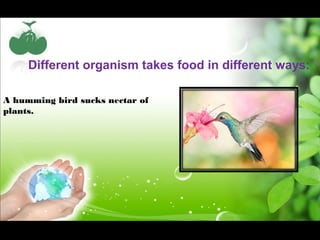
Different organism takes food in different ways: 
A humming bird sucks nectar of 
plants.
Different organism takes food in different ways: 
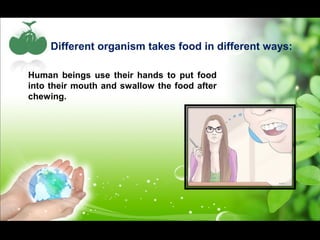
Human beings use their hands to put food 
into their mouth and swallow the food after 
chewing.
Different organism takes food in different ways: 
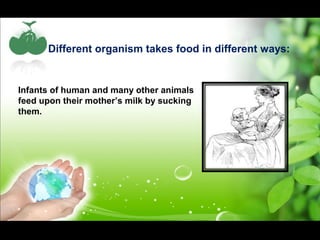
Infants of human and many other animals 
feed upon their mother’s milk by sucking 
them.
Different organism takes food in different ways: 
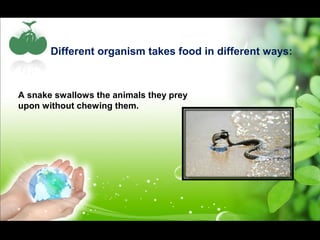
A snake swallows the animals they prey 
upon without chewing them.
Different organism takes food in different ways: 
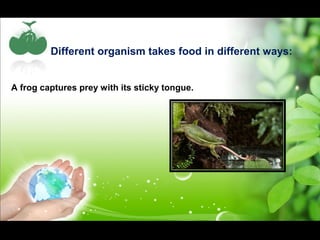
A frog captures prey with its sticky tongue.
Different organism takes food in different ways: 
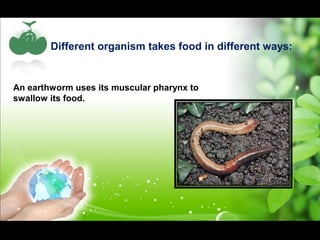
An earthworm uses its muscular pharynx to 
swallow its food.
Different organism takes food in different ways: 
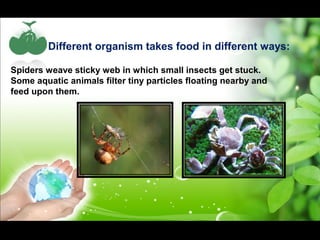
Spiders weave sticky web in which small insects get stuck. 
Some aquatic animals filter tiny particles floating nearby and 
feed upon them.
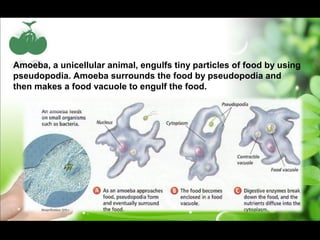
Amoeba, a unicellular animal, engulfs tiny particles of food by using 
pseudopodia. Amoeba surrounds the food by pseudopodia and 
then makes a food vacuole to engulf the food.
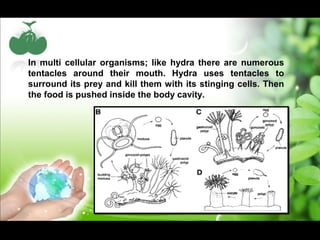
In multi cellular organisms; like hydra there are numerous 
tentacles around their mouth. Hydra uses tentacles to 
surround its prey and kill them with its stinging cells. Then 
the food is pushed inside the body cavity.
Digestion: 
After taking of food, food is digested and then it is passed to 
the different parts of body for the growth, repair and other 
vital functioning of body. 
The food we take is primarily in the form of complex 
substances. Food in such complex form is not used as such 
by animals. Hence, they need to be first broken down into 
simpler soluble forms so that they can be absorbed by the 
cells of the body.
Digestion: 
The process of breaking down of complex component of food 
into simpler substances is called digestion. The process of 
digestion is different in human, grass eating animals, amoeba, 
hydra, etc. 
Enzymes help in the breakdown of complex molecules like 
carbohydrates, protein, fats, etc. into simple molecules. 
Digestion in unicellular animals; like Amoeba; is intracellular. 

The digestive enzymes are secreted in the food vacuoles.
IQ Test: 
Question – 1 – What is ingestion? 
Answer- The intake of food is called ingestion. 
Questions - 2 - What is digestion? 
Answer- The breaking down of solid and complex food into simple and 
soluble forms is called digestion. 
Question – 3 – What is absorption? 
Answer- The process of passing of digested food into blood vessels in the 
intestine is called the absorption. 
Question – 4 – What do you understand by assimilation? 
Answer - The conversion of absorbed food in complex substances such as 
proteins and vitamins required by body is called assimilation.
IQ Test: 
Question – 5 – What do you understand by egestion? 
Answer- Removal of waste materials from the body, time to time from 
anus is called egestion. 
Questions – 6 - What are the steps of nutrition involved in animals? 
Answer- There is five steps of nutrition involved in animals. These are 
Ingestion, Digestion, Absorption, Assimilation and Egestion.
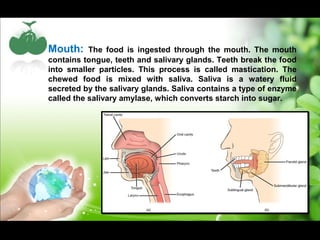
Mouth: The food is ingested through the mouth. The mouth 
contains tongue, teeth and salivary glands. Teeth break the food 
into smaller particles. This process is called mastication. The 
chewed food is mixed with saliva. Saliva is a watery fluid 
secreted by the salivary glands. Saliva contains a type of enzyme 
called the salivary amylase, which converts starch into sugar.
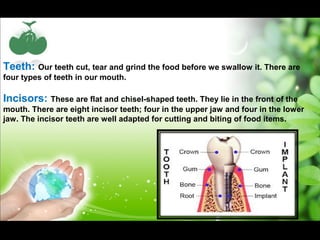
Teeth: Our teeth cut, tear and grind the food before we swallow it. There are 
four types of teeth in our mouth. 
Incisors: These are flat and chisel-shaped teeth. They lie in the front of the 
mouth. There are eight incisor teeth; four in the upper jaw and four in the lower 
jaw. The incisor teeth are well adapted for cutting and biting of food items.
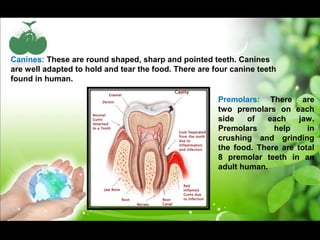
Canines: These are round shaped, sharp and pointed teeth. Canines 
are well adapted to hold and tear the food. There are four canine teeth 
found in human. 
Premolars: There are 
two premolars on each 
side of each jaw. 
Premolars help in 
crushing and grinding 
the food. There are total 
8 premolar teeth in an 
adult human.
Molars: There are two molars on both sides in both the jaws. They have 
almost a flat surface with small projections. These teeth are meant for 
fine grinding of food. 
There are total 12 molar teeth including the wisdom teeth in an adult 
human. The 4 molar teeth are also called wisdom teeth. Wisdom teeth 
usually grow between the ages of 18 to 21. 
The tooth is covered with a white substance 
called enamel. It is the hardest substance in the 
human body.
IQ Test: 
Question-1- How many types of teeth are found in human beings? 
Answer- There are four types of teeth in human beings. These are called 
incisors, canines, premolars and molars. 
Question – 2 – How many incisors are found in an adult human? 
Answer – There are 8 incisors, 4 in lower and 4 in upper jaw, found in an adult 
human. 
Question – 3 – What is the function of incisors? 
Answer – Incisors are used to cut and bite the food. 
Question – 4 – How many canines are found in an adult human? 
Answer – There are four canine found in an adult human.
MMiillkk tteeeetthh aanndd PPeerrmmaanneenntt tteeeetthh 
HHuummaannss ggeett ttwwoo sseettss ooff tteeeetthh iinn tthheeiirr lliiffeettiimmee.. TThhee ffiirrsstt sseett eerruuppttss wwhheenn wwee aarree 
bbaabbiieess,, aarree ccaalllleedd mmiillkk tteeeetthh.. MMiillkk tteeeetthh llaasstt uunnttiill wwee aarree aabboouutt 88 yyeeaarrss oolldd.. MMiillkk 
tteeeetthh aarree rreeppllaacceedd bbyy tthhee sseeccoonndd sseett ooff tteeeetthh aanndd aarree ccaalllleedd ppeerrmmaanneenntt tteeeetthh.. 
AAnn aadduulltt hhuummaann hhaass 3322 tteeeetthh iinn aallll;; 1166 iinn eeaacchh jjaaww..
IQ Test: 
Questions - 5 - What is the functions of Canines? 
Answer - Canines are the type of teeth, which help to hold and tear the 
food. 
Question – 6 – How many premolars are found in an adult human? 
Answer – There are 8 premolars found in an adult human. 
Question – 7 – What is the function of premolars? 
Answer - Premolars help in crushing and grinding the food. 
Question – 8 – How many molars are found in an adult human? 
Answer – There are total 12 molars are found in an adult human. 
Question – 9 – What is wisdom tooth? 
Answer – Wisdom teeth are molar teeth that grow usually between the age 
of 18 to 21 in an human.
IQ Test: 
Question- 10 - How many teeth does a human adult have? 
Answer- A human adult has 32 teeth in all; 16 teeth in each jaw. 
Question – 11 – What do you understand by milk and permanent teeth? 
Answer – Human has two sets of teeth. These are called milk teeth and 
permanent teeth. Milk teeth start growing at the baby stage and are replaced 
gradually by permanent teeth from the age of 8 year. 
Question- 12 - What is Enamel? 
Answer - The white substance that covers our teeth is called enamel. It is the 
hardest substances in the human body.
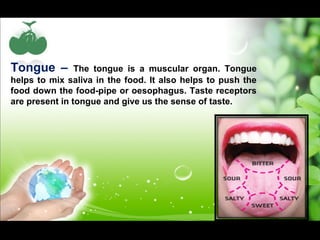
Tongue – The tongue is a muscular organ. Tongue 
helps to mix saliva in the food. It also helps to push the 
food down the food-pipe or oesophagus. Taste receptors 
are present in tongue and give us the sense of taste.
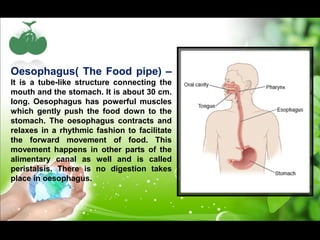
Oesophagus( The Food pipe) – 
It is a tube-like structure connecting the 
mouth and the stomach. It is about 30 cm. 
long. Oesophagus has powerful muscles 
which gently push the food down to the 
stomach. The oesophagus contracts and 
relaxes in a rhythmic fashion to facilitate 
the forward movement of food. This 
movement happens in other parts of the 
alimentary canal as well and is called 
peristalsis. There is no digestion takes 
place in oesophagus.
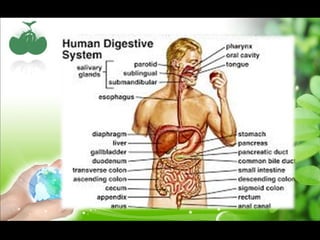
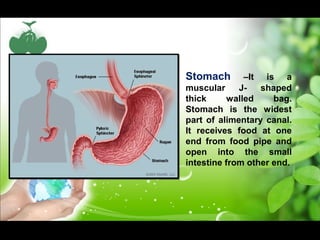
Stomach –It is a 
muscular J- shaped 
thick walled bag. 
Stomach is the widest 
part of alimentary canal. 
It receives food at one 
end from food pipe and 
open into the small 
intestine from other end.
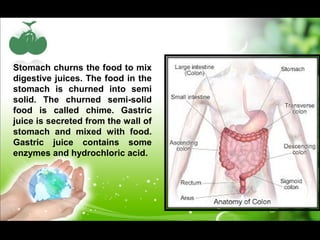
Stomach churns the food to mix 
digestive juices. The food in the 
stomach is churned into semi 
solid. The churned semi-solid 
food is called chime. Gastric 
juice is secreted from the wall of 
stomach and mixed with food. 
Gastric juice contains some 
enzymes and hydrochloric acid.
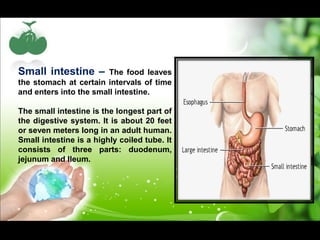
Small intestine – The food leaves 
the stomach at certain intervals of time 
and enters into the small intestine. 
The small intestine is the longest part of 
the digestive system. It is about 20 feet 
or seven meters long in an adult human. 
Small intestine is a highly coiled tube. It 
consists of three parts: duodenum, 
jejunum and Ileum.
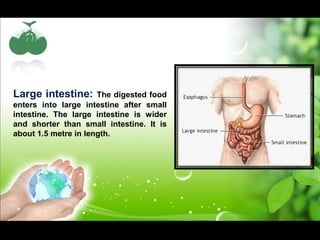
Large intestine: The digested food 
enters into large intestine after small 
intestine. The large intestine is wider 
and shorter than small intestine. It is 
about 1.5 metre in length.
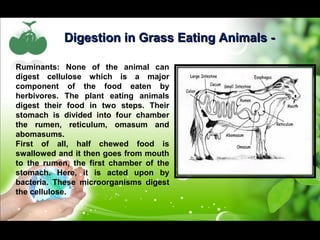
Digestion iinn GGrraassss EEaattiinngg AAnniimmaallss -- 
Ruminants: None of the animal can 
digest cellulose which is a major 
component of the food eaten by 
herbivores. The plant eating animals 
digest their food in two steps. Their 
stomach is divided into four chamber 
the rumen, reticulum, omasum and 
abomasums. 
First of all, half chewed food is 
swallowed and it then goes from mouth 
to the rumen, the first chamber of the 
stomach. Here, it is acted upon by 
bacteria. These microorganisms digest 
the cellulose.
This half digested food goes to the second muscular chamber; the 
reticulum. From the reticulum the food is sent back to the mouth; as 
cud; to be chewed again. Chewing of the cud is called rumination 
and such animals are called ruminating animals or ruminants. Cow, 
goat, buffaloes, sheep, bison, etc. are good example of ruminating 
animals. 
After digestion and absorption, nutrients from food are taken to the 
cells in all parts of the body. The cells oxidize the food to release 
energy.
Short answer type question: 
Question- 1.What is a carnivorous animal? Give two examples. 
Answer- Animals, which eat the flesh of other animals, are called carnivorous, e.g. 
lion, tiger. 
Question – 2 - What is the function of the digestive juice secreted by the liver? 
Answer- The digestive juice from the liver breaks up fat into tiny particle. 
Question – 3 - Name the organs that make up the alimentary canal. 
Answer-Mouth, oesophagus, stomach, small intestine, large intestine and rectum 
are the parts of the alimentary canal. 
Question- 4 - Name the four types of teeth. 
Answer: The four types of teeth are: Incisors, Canines, Premolars and Molars. 
Question – 5 - Name the four compartments in a ruminant’s stomach. 
Answer: Four compartments in a ruminant’s stomach: Rumen, reticulum, osmium 
and abomasums.
Choose the correct answer: 
Questions -1 - Movement of food through alimentary canal is called by 
which of these terms? 
(a) Locomotion 
(b) Peristalsis 
(c) Pumping 
(d) Sliding. 
Answer-(b) Peristalsis 
Question – 2 - The liver produces which of these enzymes? 
(a) Amylase 
(b) Trypsin 
(c) Lipase 
(d) None of these 
Answer-(d) None of these.
Choose the correct answer: 
Question – 3 - Which of these is not a part of nutrition? 
(a) Digestion 
(b) Excretion 
(c) Assimilation 
(d) Egestion 
Answer-(b) Excretion. 
Question – 4 - Digestive juice is not secreted by which of these organs? 
(a) Small intestine 
(b) Liver 
(c) Stomach 
(d) Oesophagus 
Answer- (b) liver
Question – 5 - The walls of the large intestine absorb which of these? 
(a) Cellulose 
(b) Digested food 
(c) Oxygen 
(d) Water 
Answer-(d) Water. 
Question – 6 - Which of the following is not a part of ruminant stomach? 
(a) Reticulum 
(b) Anus 
(c) Omasum 
(d) Abomasum. 
Answer-(b) Anus. 
Question – 7 - Bile is produced by which organ? 
(a) Pancreas 
(b) Gall bladder 
(c) Liver 
(d) Stomach. 
Answer- (c ) Liver
Source:
Thank You.

Nutrition in animals class vii

  • 1.
    School Name :Ramakrishna Mission Vidyalaya, Viveknagar, Tripura, West Affiliated to CBSE, New Delhi TTooppiicc:: NNuuttrriittiioonn iinn AAnniimmaall NCERT Based Curriculumn. Target Group : Class VII students Digital eContent Submitted by: Name of the Teacher : Mr. Uday Pal(PGT) Year: 2014-15
  • 2.
    IINNTTRROODDUUCCTTIIOONN :: Plantsmake their food by the process of photosynthesis, but animals cannot make their food themselves. Animals get their food from plants. Some animals eat plants directly while some animals eat plant eating animals. Thus, animals get their food from plants either directly or indirectly. All organisms require food for survival and growth. Requirement of nutrients, mode of intake of food and its utilization in body are collectively known as nutrition.
  • 3.
    Different organism takesfood in different ways: A humming bird sucks nectar of plants.
  • 4.
    Different organism takesfood in different ways: Human beings use their hands to put food into their mouth and swallow the food after chewing.
  • 5.
    Different organism takesfood in different ways: Infants of human and many other animals feed upon their mother’s milk by sucking them.
  • 6.
    Different organism takesfood in different ways: A snake swallows the animals they prey upon without chewing them.
  • 7.
    Different organism takesfood in different ways: A frog captures prey with its sticky tongue.
  • 8.
    Different organism takesfood in different ways: An earthworm uses its muscular pharynx to swallow its food.
  • 9.
    Different organism takesfood in different ways: Spiders weave sticky web in which small insects get stuck. Some aquatic animals filter tiny particles floating nearby and feed upon them.
  • 10.
    Amoeba, a unicellularanimal, engulfs tiny particles of food by using pseudopodia. Amoeba surrounds the food by pseudopodia and then makes a food vacuole to engulf the food.
  • 11.
    In multi cellularorganisms; like hydra there are numerous tentacles around their mouth. Hydra uses tentacles to surround its prey and kill them with its stinging cells. Then the food is pushed inside the body cavity.
  • 12.
    Digestion: After takingof food, food is digested and then it is passed to the different parts of body for the growth, repair and other vital functioning of body. The food we take is primarily in the form of complex substances. Food in such complex form is not used as such by animals. Hence, they need to be first broken down into simpler soluble forms so that they can be absorbed by the cells of the body.
  • 14.
    Digestion: The processof breaking down of complex component of food into simpler substances is called digestion. The process of digestion is different in human, grass eating animals, amoeba, hydra, etc. Enzymes help in the breakdown of complex molecules like carbohydrates, protein, fats, etc. into simple molecules. Digestion in unicellular animals; like Amoeba; is intracellular. The digestive enzymes are secreted in the food vacuoles.
  • 16.
    IQ Test: Question– 1 – What is ingestion? Answer- The intake of food is called ingestion. Questions - 2 - What is digestion? Answer- The breaking down of solid and complex food into simple and soluble forms is called digestion. Question – 3 – What is absorption? Answer- The process of passing of digested food into blood vessels in the intestine is called the absorption. Question – 4 – What do you understand by assimilation? Answer - The conversion of absorbed food in complex substances such as proteins and vitamins required by body is called assimilation.
  • 17.
    IQ Test: Question– 5 – What do you understand by egestion? Answer- Removal of waste materials from the body, time to time from anus is called egestion. Questions – 6 - What are the steps of nutrition involved in animals? Answer- There is five steps of nutrition involved in animals. These are Ingestion, Digestion, Absorption, Assimilation and Egestion.
  • 18.
    Mouth: The foodis ingested through the mouth. The mouth contains tongue, teeth and salivary glands. Teeth break the food into smaller particles. This process is called mastication. The chewed food is mixed with saliva. Saliva is a watery fluid secreted by the salivary glands. Saliva contains a type of enzyme called the salivary amylase, which converts starch into sugar.
  • 19.
    Teeth: Our teethcut, tear and grind the food before we swallow it. There are four types of teeth in our mouth. Incisors: These are flat and chisel-shaped teeth. They lie in the front of the mouth. There are eight incisor teeth; four in the upper jaw and four in the lower jaw. The incisor teeth are well adapted for cutting and biting of food items.
  • 20.
    Canines: These areround shaped, sharp and pointed teeth. Canines are well adapted to hold and tear the food. There are four canine teeth found in human. Premolars: There are two premolars on each side of each jaw. Premolars help in crushing and grinding the food. There are total 8 premolar teeth in an adult human.
  • 21.
    Molars: There aretwo molars on both sides in both the jaws. They have almost a flat surface with small projections. These teeth are meant for fine grinding of food. There are total 12 molar teeth including the wisdom teeth in an adult human. The 4 molar teeth are also called wisdom teeth. Wisdom teeth usually grow between the ages of 18 to 21. The tooth is covered with a white substance called enamel. It is the hardest substance in the human body.
  • 22.
    IQ Test: Question-1-How many types of teeth are found in human beings? Answer- There are four types of teeth in human beings. These are called incisors, canines, premolars and molars. Question – 2 – How many incisors are found in an adult human? Answer – There are 8 incisors, 4 in lower and 4 in upper jaw, found in an adult human. Question – 3 – What is the function of incisors? Answer – Incisors are used to cut and bite the food. Question – 4 – How many canines are found in an adult human? Answer – There are four canine found in an adult human.
  • 23.
    MMiillkk tteeeetthh aannddPPeerrmmaanneenntt tteeeetthh HHuummaannss ggeett ttwwoo sseettss ooff tteeeetthh iinn tthheeiirr lliiffeettiimmee.. TThhee ffiirrsstt sseett eerruuppttss wwhheenn wwee aarree bbaabbiieess,, aarree ccaalllleedd mmiillkk tteeeetthh.. MMiillkk tteeeetthh llaasstt uunnttiill wwee aarree aabboouutt 88 yyeeaarrss oolldd.. MMiillkk tteeeetthh aarree rreeppllaacceedd bbyy tthhee sseeccoonndd sseett ooff tteeeetthh aanndd aarree ccaalllleedd ppeerrmmaanneenntt tteeeetthh.. AAnn aadduulltt hhuummaann hhaass 3322 tteeeetthh iinn aallll;; 1166 iinn eeaacchh jjaaww..
  • 24.
    IQ Test: Questions- 5 - What is the functions of Canines? Answer - Canines are the type of teeth, which help to hold and tear the food. Question – 6 – How many premolars are found in an adult human? Answer – There are 8 premolars found in an adult human. Question – 7 – What is the function of premolars? Answer - Premolars help in crushing and grinding the food. Question – 8 – How many molars are found in an adult human? Answer – There are total 12 molars are found in an adult human. Question – 9 – What is wisdom tooth? Answer – Wisdom teeth are molar teeth that grow usually between the age of 18 to 21 in an human.
  • 25.
    IQ Test: Question-10 - How many teeth does a human adult have? Answer- A human adult has 32 teeth in all; 16 teeth in each jaw. Question – 11 – What do you understand by milk and permanent teeth? Answer – Human has two sets of teeth. These are called milk teeth and permanent teeth. Milk teeth start growing at the baby stage and are replaced gradually by permanent teeth from the age of 8 year. Question- 12 - What is Enamel? Answer - The white substance that covers our teeth is called enamel. It is the hardest substances in the human body.
  • 26.
    Tongue – Thetongue is a muscular organ. Tongue helps to mix saliva in the food. It also helps to push the food down the food-pipe or oesophagus. Taste receptors are present in tongue and give us the sense of taste.
  • 27.
    Oesophagus( The Foodpipe) – It is a tube-like structure connecting the mouth and the stomach. It is about 30 cm. long. Oesophagus has powerful muscles which gently push the food down to the stomach. The oesophagus contracts and relaxes in a rhythmic fashion to facilitate the forward movement of food. This movement happens in other parts of the alimentary canal as well and is called peristalsis. There is no digestion takes place in oesophagus.
  • 28.
    Stomach –It isa muscular J- shaped thick walled bag. Stomach is the widest part of alimentary canal. It receives food at one end from food pipe and open into the small intestine from other end.
  • 29.
    Stomach churns thefood to mix digestive juices. The food in the stomach is churned into semi solid. The churned semi-solid food is called chime. Gastric juice is secreted from the wall of stomach and mixed with food. Gastric juice contains some enzymes and hydrochloric acid.
  • 30.
    Small intestine –The food leaves the stomach at certain intervals of time and enters into the small intestine. The small intestine is the longest part of the digestive system. It is about 20 feet or seven meters long in an adult human. Small intestine is a highly coiled tube. It consists of three parts: duodenum, jejunum and Ileum.
  • 31.
    Large intestine: Thedigested food enters into large intestine after small intestine. The large intestine is wider and shorter than small intestine. It is about 1.5 metre in length.
  • 32.
    Digestion iinn GGrraassssEEaattiinngg AAnniimmaallss -- Ruminants: None of the animal can digest cellulose which is a major component of the food eaten by herbivores. The plant eating animals digest their food in two steps. Their stomach is divided into four chamber the rumen, reticulum, omasum and abomasums. First of all, half chewed food is swallowed and it then goes from mouth to the rumen, the first chamber of the stomach. Here, it is acted upon by bacteria. These microorganisms digest the cellulose.
  • 33.
    This half digestedfood goes to the second muscular chamber; the reticulum. From the reticulum the food is sent back to the mouth; as cud; to be chewed again. Chewing of the cud is called rumination and such animals are called ruminating animals or ruminants. Cow, goat, buffaloes, sheep, bison, etc. are good example of ruminating animals. After digestion and absorption, nutrients from food are taken to the cells in all parts of the body. The cells oxidize the food to release energy.
  • 34.
    Short answer typequestion: Question- 1.What is a carnivorous animal? Give two examples. Answer- Animals, which eat the flesh of other animals, are called carnivorous, e.g. lion, tiger. Question – 2 - What is the function of the digestive juice secreted by the liver? Answer- The digestive juice from the liver breaks up fat into tiny particle. Question – 3 - Name the organs that make up the alimentary canal. Answer-Mouth, oesophagus, stomach, small intestine, large intestine and rectum are the parts of the alimentary canal. Question- 4 - Name the four types of teeth. Answer: The four types of teeth are: Incisors, Canines, Premolars and Molars. Question – 5 - Name the four compartments in a ruminant’s stomach. Answer: Four compartments in a ruminant’s stomach: Rumen, reticulum, osmium and abomasums.
  • 35.
    Choose the correctanswer: Questions -1 - Movement of food through alimentary canal is called by which of these terms? (a) Locomotion (b) Peristalsis (c) Pumping (d) Sliding. Answer-(b) Peristalsis Question – 2 - The liver produces which of these enzymes? (a) Amylase (b) Trypsin (c) Lipase (d) None of these Answer-(d) None of these.
  • 36.
    Choose the correctanswer: Question – 3 - Which of these is not a part of nutrition? (a) Digestion (b) Excretion (c) Assimilation (d) Egestion Answer-(b) Excretion. Question – 4 - Digestive juice is not secreted by which of these organs? (a) Small intestine (b) Liver (c) Stomach (d) Oesophagus Answer- (b) liver
  • 37.
    Question – 5- The walls of the large intestine absorb which of these? (a) Cellulose (b) Digested food (c) Oxygen (d) Water Answer-(d) Water. Question – 6 - Which of the following is not a part of ruminant stomach? (a) Reticulum (b) Anus (c) Omasum (d) Abomasum. Answer-(b) Anus. Question – 7 - Bile is produced by which organ? (a) Pancreas (b) Gall bladder (c) Liver (d) Stomach. Answer- (c ) Liver
  • 38.
  • 39.