UNDERSTANDING HEAT TRANSFER,
CONDUCTION, CONVECTION AND RADIATION
HEAT TRANSFER
Heat always moves from a warmer place to a cooler place.
Hot objects in a cooler room will cool to room temperature.
Cold objects in a warmer room will heat up to room temperature.
QUESTION
If a cup of coffee and a red popsickle were left on the table in this room
what would happen to them? Why?
The cup of coffee will cool until it reaches room temperature. The popsickle
will melt and then the liquid will warm to room temperature.
Wan A eat!
HEAT TRANSFER METHODS
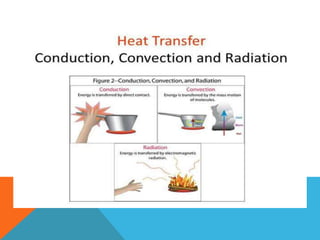
Heat transfers in three ways:
Conduction
Convection
Radiation
CONDUCTION
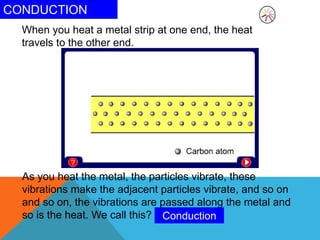
When you heat a metal strip at one end, the heat
travels to the other end.
As you heat the metal, the particles vibrate, these
vibrations make the adjacent particles vibrate, and so on
and so on, the vibrations are passed along the metal and
so is the heat. We call this? Conduction
METALS ARE DIFFERENT
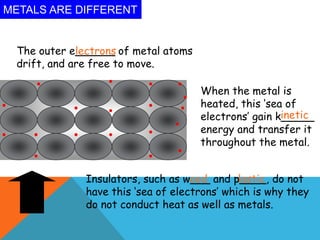
The outer e______ of metal atoms
drift, and are free to move.
When the metal is
heated, this ‘sea of
electrons’ gain k_____
energy and transfer it
throughout the metal.
Insulators, such as w___ and p____, do not
have this ‘sea of electrons’ which is why they
do not conduct heat as well as metals.
lectrons
inetic
ood lastic
WHY DOES METAL FEEL COLDER THAN
WOOD, IF THEY ARE BOTH AT THE SAME
TEMPERATURE?
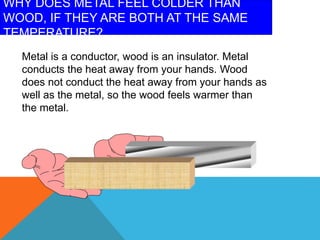
Metal is a conductor, wood is an insulator. Metal
conducts the heat away from your hands. Wood
does not conduct the heat away from your hands as
well as the metal, so the wood feels warmer than
the metal.
CONVECTION
What happens to the particles in a liquid or a
gas when you heat them?
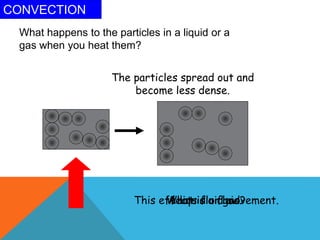
The particles spread out and
become less dense.
This effects fluid movement.
What is a fluid?
A liquid or gas.
FLUID MOVEMENT
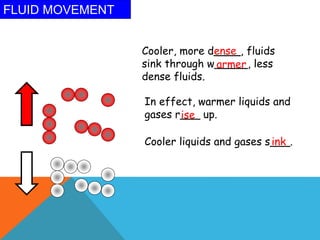
Cooler, more d____, fluids
sink through w_____, less
dense fluids.
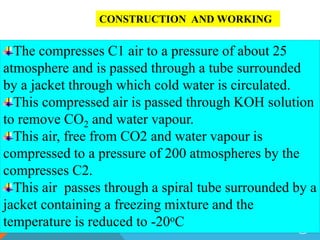
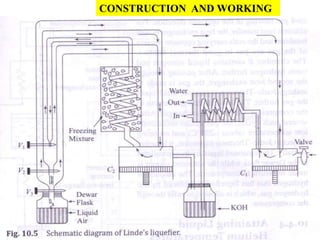
In effect, warmer liquids and
gases r___ up.
Cooler liquids and gases s___.
ense
armer
ise
ink
WATER MOVEMENT
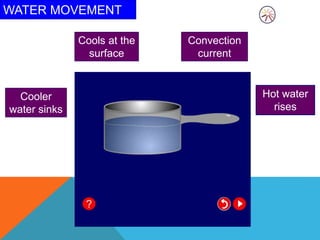
Hot water
rises
Cooler
water sinks
Convection
current
Cools at the
surface
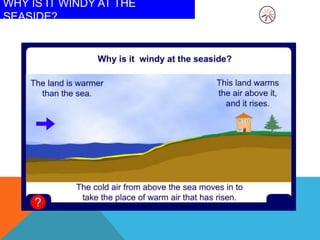
WHY IS IT WINDY AT THE
SEASIDE?
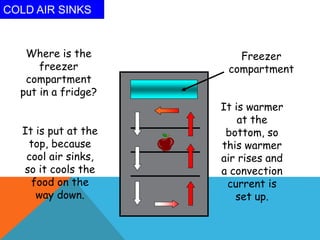
COLD AIR SINKS
Where is the
freezer
compartment
put in a fridge?
Freezer
compartment
It is put at the
top, because
cool air sinks,
so it cools the
food on the
way down.
It is warmer
at the
bottom, so
this warmer
air rises and
a convection
current is
set up.
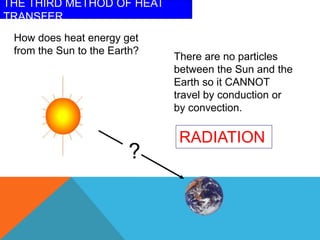
THE THIRD METHOD OF HEAT
TRANSFER
How does heat energy get
from the Sun to the Earth?
There are no particles
between the Sun and the
Earth so it CANNOT
travel by conduction or
by convection.
?
RADIATION
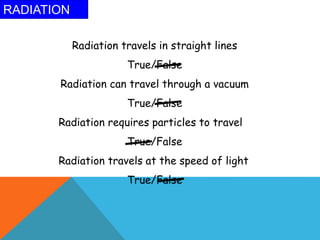
RADIATION
Radiation travels in straight lines
True/False
Radiation can travel through a vacuum
True/False
Radiation requires particles to travel
True/False
Radiation travels at the speed of light
True/False
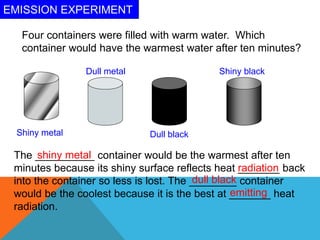
EMISSION EXPERIMENT
Four containers were filled with warm water. Which
container would have the warmest water after ten minutes?
Shiny metal
Dull metal
Dull black
Shiny black
The __________ container would be the warmest after ten
minutes because its shiny surface reflects heat _______ back
into the container so less is lost. The ________ container
would be the coolest because it is the best at _______ heat
radiation.
shiny metal
radiation
dull black
emitting
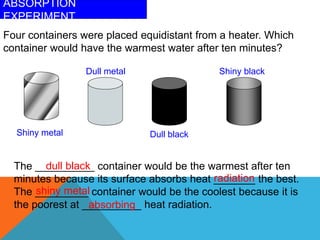
ABSORPTION
EXPERIMENT
Four containers were placed equidistant from a heater. Which
container would have the warmest water after ten minutes?
The __________ container would be the warmest after ten
minutes because its surface absorbs heat _______ the best.
The _________ container would be the coolest because it is
the poorest at __________ heat radiation.
dull black
radiation
shiny metal
absorbing
Shiny metal
Dull metal
Dull black
Shiny black
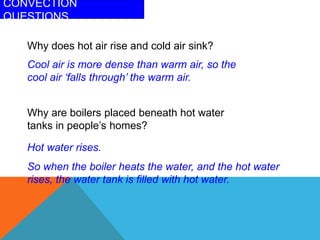
CONVECTION
QUESTIONS
Why are boilers placed beneath hot water
tanks in people’s homes?
Hot water rises.
So when the boiler heats the water, and the hot water
rises, the water tank is filled with hot water.
Why does hot air rise and cold air sink?
Cool air is more dense than warm air, so the
cool air ‘falls through’ the warm air.
RADIATION
QUESTIONS
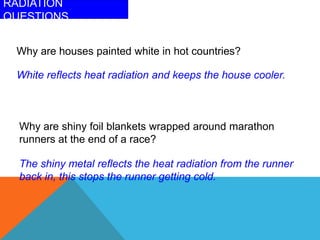
Why are houses painted white in hot countries?
White reflects heat radiation and keeps the house cooler.
Why are shiny foil blankets wrapped around marathon
runners at the end of a race?
The shiny metal reflects the heat radiation from the runner
back in, this stops the runner getting cold.
1. Which of the following is not a
method of heat transfer?
A. Radiation
B. Insulation
C. Conduction
D. Convection
2. In which of the following are
the particles closest together?
A. Solid
B. Liquid
C. Gas
D. Fluid
3. How does heat energy reach
the Earth from the Sun?
A. Radiation
B. Conduction
C. Convection
D. Insulation
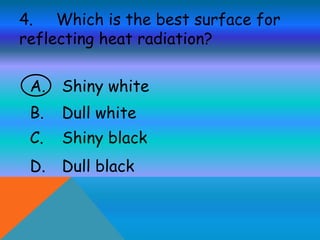
4. Which is the best surface for
reflecting heat radiation?
A. Shiny white
B. Dull white
C. Shiny black
D. Dull black
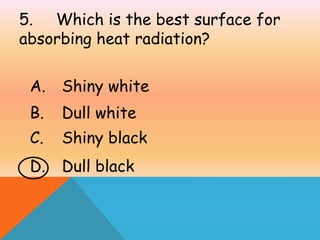
5. Which is the best surface for
absorbing heat radiation?
A. Shiny white
B. Dull white
C. Shiny black
D. Dull black
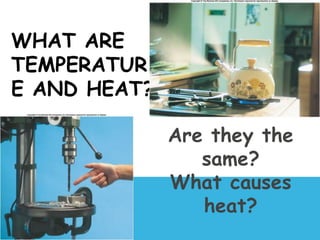
WHAT ARE
TEMPERATUR
E AND HEAT?
Are they the
same?
What causes
heat?
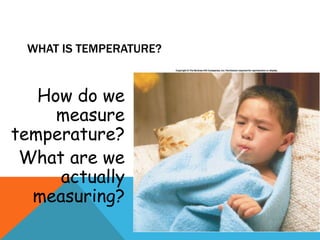
How do we
measure
temperature?
What are we
actually
measuring?
WHAT IS TEMPERATURE?
TEMPERATURE AND ITS MEASUREMENT
How do we measure temperature?
Thermometer: Device with a physical
property that changes with temperature
and can be easily measured quantitatively.
If two objects are in contact with one another
long enough, the two objects have the
same temperature (thermal equilibrium).
Two or more objects in thermal equilibrium
have the same temperature.
Zeroth law of thermodynamics.
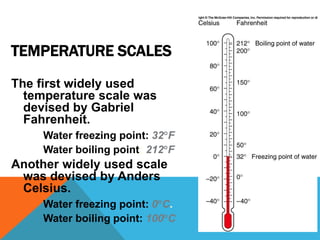
TEMPERATURE SCALES
The first widely used
temperature scale was
devised by Gabriel
Fahrenheit.
Water freezing point: 32F
Water boiling point: 212F
Another widely used scale
was devised by Anders
Celsius.
Water freezing point: 0C.
Water boiling point: 100C
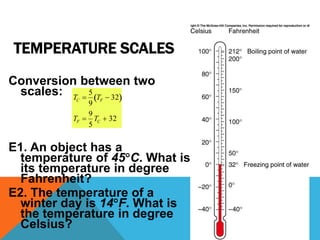
TEMPERATURE SCALES
Conversion between two
scales:
E1. An object has a
temperature of 45C. What is
its temperature in degree
Fahrenheit?
E2. The temperature of a
winter day is 14F. What is
the temperature in degree
Celsius?

TC 
5
9
TF  32
 
TF 
9
5
TC  32
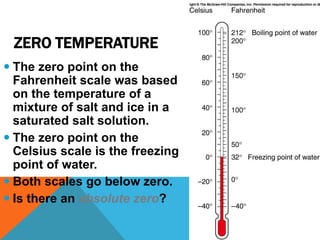
ZERO TEMPERATURE
 The zero point on the
Fahrenheit scale was based
on the temperature of a
mixture of salt and ice in a
saturated salt solution.
 The zero point on the
Celsius scale is the freezing
point of water.
 Both scales go below zero.
 Is there an absolute zero?
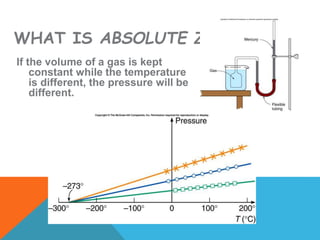
WHAT IS ABSOLUTE ZERO?
If the volume of a gas is kept
constant while the temperature
is different, the pressure will be
different.
THE THIRD TEMPERATURE SCALE
Absolute Temperature Scale (Kelvin Scale)
Example
Water freezing point: 0C =273.2 K.
Water boiling point: 100C = 373.2 K

TK  TC  273.2
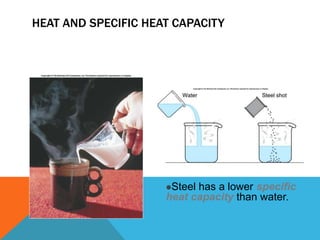
HEAT AND SPECIFIC HEAT CAPACITY
Steel has a lower specific
heat capacity than water.
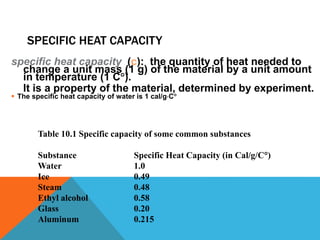
SPECIFIC HEAT CAPACITY
specific heat capacity (c): the quantity of heat needed to
change a unit mass (1 g) of the material by a unit amount
in temperature (1 C).
It is a property of the material, determined by experiment.
 The specific heat capacity of water is 1 cal/gC
Table 10.1 Specific capacity of some common substances
Substance Specific Heat Capacity (in Cal/g/C)
Water 1.0
Ice 0.49
Steam 0.48
Ethyl alcohol 0.58
Glass 0.20
Aluminum 0.215
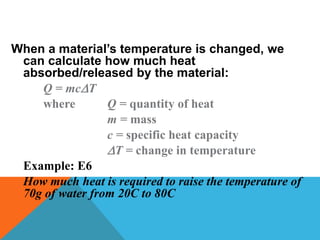
When a material’s temperature is changed, we
can calculate how much heat
absorbed/released by the material:
Q = mcT
where Q = quantity of heat
m = mass
c = specific heat capacity
T = change in temperature
Example: E6
How much heat is required to raise the temperature of
70g of water from 20C to 80C
HEAT AND TEMPERATURE
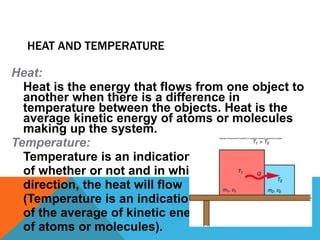
Heat:
Heat is the energy that flows from one object to
another when there is a difference in
temperature between the objects. Heat is the
average kinetic energy of atoms or molecules
making up the system.
Temperature:
Temperature is an indication
of whether or not and in which
direction, the heat will flow
(Temperature is an indication
of the average of kinetic energy
of atoms or molecules).
PHASE CHANGE AND LATENT HEAT
When an object goes through a change of phase
or state, heat is added or removed without
changing the temperature. Instead, the state of
matter changes: solid to liquid, for example.
The amount of heat needed per unit mass to
produce a phase change is called the latent
heat (L)
 The latent heat of fusion of water is 80 cal/g (Lf = 80 cal/g is 80 cal/g): it takes 80
calorie of heat the melt 1 g of ice at 0C to become water at 0C.
 The latent heat of vaporization of water is 540 cal/g (Lv = 540 cal/g): it takes 540
calories of heat to turn one gram of water at 100 C into steam at 100 C.
IF THE SPECIFIC HEAT CAPACITY
OF ICE IS 0.5 CAL/GC°, HOW MUCH
HEAT WOULD HAVE TO BE ADDED
TO 200 G OF ICE, INITIALLY AT A
TEMPERATURE OF -10°C, TO
(A) RAISE THE ICE TO THE MELTING
POINT?
(B) COMPLETE MELT THE ICE?
Example Box 10.1
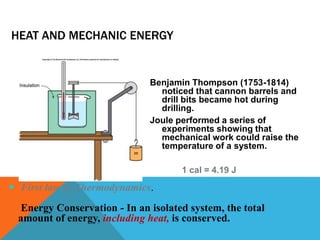
HEAT AND MECHANIC ENERGY
Benjamin Thompson (1753-1814)
noticed that cannon barrels and
drill bits became hot during
drilling.
Joule performed a series of
experiments showing that
mechanical work could raise the
temperature of a system.
1 cal = 4.19 J
 First law of Thermodynamics.
Energy Conservation - In an isolated system, the total
amount of energy, including heat, is conserved.
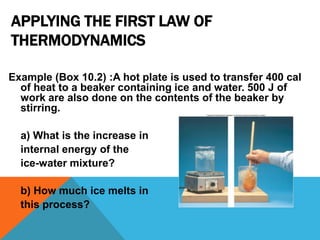
APPLYING THE FIRST LAW OF
THERMODYNAMICS
Example (Box 10.2) :A hot plate is used to transfer 400 cal
of heat to a beaker containing ice and water. 500 J of
work are also done on the contents of the beaker by
stirring.
a) What is the increase in
internal energy of the
ice-water mixture?
b) How much ice melts in
this process?
COUNTING FOOD CALORIES
Calories in Physics and in food:
 In Physics: 1 calories is the amount of energy needed to raise the
temperature of 1 g of water 1 C.
 In food: 1 Calories is the amount of energy needed to raise the
temperature of 1 kg water 1 C
1 Cal =1,000 cal
Normal body maintenance uses up about 15 calories per day
for each pound of body weight.
You must consume about 3500 calories to gain a pound of
weight.
To burn off 500 calories you would have to run 5 miles, bike
15 miles, or swim for an hour.
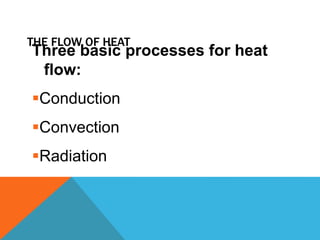
THE FLOW OF HEAT
Three basic processes for heat
flow:
Conduction
Convection
Radiation
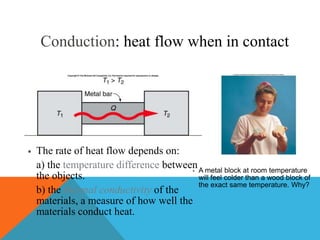
 A metal block at room temperature
will feel colder than a wood block of
the exact same temperature. Why?
 The rate of heat flow depends on:
a) the temperature difference between
the objects.
b) the thermal conductivity of the
materials, a measure of how well the
materials conduct heat.
Conduction: heat flow when in contact
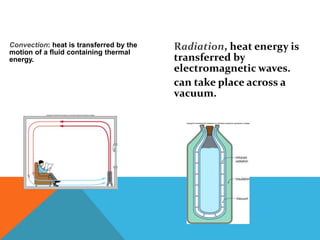
Convection: heat is transferred by the
motion of a fluid containing thermal
energy.
Radiation, heat energy is
transferred by
electromagnetic waves.
can take place across a
vacuum.
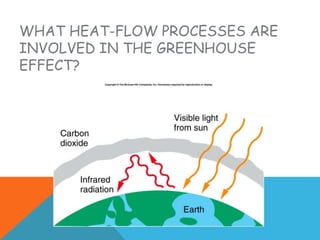
WHAT HEAT-FLOW PROCESSES ARE
INVOLVED IN THE GREENHOUSE
EFFECT?
LAB T4. MEASUREMENT OF THE SPECIFIC
HEAT
Example: Suppose that you have 100 g of water at
the temperature of 20 C, and you have 50 g of a
metal at the temperature of 100 C. If you put the
metal into the water, and the final temperature is
30 C when the mix of water and aluminum reaches
a thermal equilibrium, what is the specific capacity
of the metal?
50
LIQUEFACTION OF AIR
ADIABATIC DEMAGNETISATION
51
CRYOGENICS
Cryogenics is a branch of Physics that deals with
the production and effects of very low temperatures.
In the early history of thermometry, ice was
considered to be the coldest and its temperature was
taken as the lowest temperature.
It was Fahrenheit, who first experimentally
demonstrated that a mixture of ice with common salt
gives a lower temperature of the order of –18oC.
Later, temperatures lower than this temperature could
be attained.
The general principle of production of low
temperature is to remove the heat content from a body.
52
LIQUEFACTION OF GASES
For a long time it was thought that air remains in the gaseous state at
all temperatures.
But Andrew’s experiments on CO2 led to the discovery of critical
temperature.
The critical temperature is the temperature below which a gas can be
liquefied by mere application of pressure.
But it cannot be liquefied above the critical temperature, however,
larger may be the applied pressure.
Below the critical temperature, the gas is termed as vapour and above
the critical temperature it is called a gas.
53
LIQUEFACTION OF GASES
So, the liquefaction of gases is linked with the
production of low temperatures.
The substances which are gaseous at ordinary
temperatures can be converted into liquid state if
sufficiently cooled and simultaneously subjected to a high
pressure.
There are various methods of liquefaction of gases.
In this section, let us see three methods of liquefaction
of gases, in detail.
54
CASCADE PROCESS
The cascade process can be used to produce very low
temperatures.
The basic principle is that when a liquid evaporates at reduced
pressure, it cools.
Evaporation causes cooling, because when a liquid evaporates
it takes up the latent heat either from the liquid itself or from the
surrounding vessel.
Oxygen and Nitrogen can be liquefied by cascade process. In
this case a series of liquids with successively lower boiling point
is employed, so that the desired low temperature is attained.
55
LINDE’S PROCESS – LIQUEFACTION OF AIR
Linde in 1896 liquefied air using Joule –
Thomson effect (or Joule – Kelvin effect)
and regenerative cooling technique.
Before going into detail about this
process, it is essential to understand the
Joule - Thomson effect and regenerative
cooling technique
56
JOULE THOMSON EFFECT
If a gas is allowed to expand through a fine
nozzle or a porous plug, so that it issues
from a region at a higher pressure to a region
at a lower pressure there will be a fall in
temperature of the gas provided the initial
temperature of the gas should be sufficiently
low.
This phenomenon is called Joule –
Thomson effect.
57
REGENERATIVE COOLING
The principle of regenerative cooling
consists in cooling the incoming gas by the
gas which has already undergone cooling
due to Joule – Thomson effect.
58
CONSTRUCTION AND WORKING
The compresses C1 air to a pressure of about 25
atmosphere and is passed through a tube surrounded
by a jacket through which cold water is circulated.
This compressed air is passed through KOH solution
to remove CO2 and water vapour.
This air, free from CO2 and water vapour is
compressed to a pressure of 200 atmospheres by the
compresses C2.
This air passes through a spiral tube surrounded by a
jacket containing a freezing mixture and the
temperature is reduced to -20oC
59
CONSTRUCTION AND WORKING
60
CONSTRUCTION AND WORKING
This cooled air at high pressure is allowed to come
out of the nozzle V1.
At V1, Joule – Thomson effect takes place and the
incoming air is cooled to -70oC.
This cooled air is circulated back into the
compresses C2 and is compressed.
It passes through the nozzle V1 and is further cooled.
Then it is allowed to pass through the nozzle V2
from high pressure to low pressure, and is further
cooled.
61
CONSTRUCTION AND WORKING
Then it is allowed to pass through the nozzle V2 from high
pressure to low pressure, and is further cooled.
As the process continues, after a few cycles, air gets cooled
to a sufficiently low temperature well below its critical
temperature of -170oC and after coming out of the nozzle V2,
gets liquefied and is collected in the Dewar’s Flask. The
unliquefied air is again circulated back to the compresses C1
and the process is repeated.
The whole apparatus is packed with cotton wool to avoid
any conduction or radiation.
By applying the principle of Joule – Thomson effect and
regenerative cooling, Hydrogen and Helium can also be
liquefied.
62
ADIABATIC DEMAGNETIZATION PROCESS
This process is used to reduce the temperature of paramagnet
it salts nearer to ‘0’ K.
We know that the molecular dipole magnetic moments of a
paramagnetic specimen are randomly oriented at thermal
equilibrium.
In this state there is maximum disorderliness of the system
and its entropy is maximum.
By the application of an external field, all the magnetic
dipoles are aligned themselves in a common direction and
hence there is an orderliness of the system.
So, the entropy of the system decreases and there is a
rejection of energy.
63
ADIABATIC DEMAGNETIZATION PROCESS
The heat rejected by the specimen when it is magnetised is taken
away by the surroundings and the original thermal equilibrium is
restored.
Therefore the thermal motion of the molecules is unaffected.
If the specimen is now thermally insulated from its surroundings
and the external magnetic field is switched off, (i.e. adiabatically
demagnetised) the magnetic dipoles again get random orientation
in order to reach equilibrium which is a state of maximum
disorder.
Therefore the entropy of the system increases.
64
ADIABATIC DEMAGNETIZATION PROCESS
When the entropy increases due to disorderly
orientation of magnetic dipoles, there should be a
corresponding decrease in entropy of disorderly
thermal motion because the total energy in entropy
during an adiabatic process should be zero.
Thus there is a reduction in thermal energy of the
molecules and therefore the temperature of the
specimen falls.
65
ADIABATIC DEMAGNETIZATION PROCESS
Usually gadolinium sulphate, which is a paramagnetic
salt is used. It is placed in a tube which is immersed in
liquid helium bath of about 1K and magnetised by the
application of a strong magnetic field.
By insulating the tube from the surrounding bath and
evacuating the tube, the specimen is adiabatically
demagnetised.
Now, the temperature of the specimen is very much
reduced. Temperatures of the order of 0.002K can be
attained by this process.
66

Heat transfer

  • 1.
  • 2.
    HEAT TRANSFER Heat alwaysmoves from a warmer place to a cooler place. Hot objects in a cooler room will cool to room temperature. Cold objects in a warmer room will heat up to room temperature.
  • 3.
    QUESTION If a cupof coffee and a red popsickle were left on the table in this room what would happen to them? Why? The cup of coffee will cool until it reaches room temperature. The popsickle will melt and then the liquid will warm to room temperature.
  • 4.
  • 5.
    HEAT TRANSFER METHODS Heattransfers in three ways: Conduction Convection Radiation
  • 6.
    CONDUCTION When you heata metal strip at one end, the heat travels to the other end. As you heat the metal, the particles vibrate, these vibrations make the adjacent particles vibrate, and so on and so on, the vibrations are passed along the metal and so is the heat. We call this? Conduction
  • 7.
    METALS ARE DIFFERENT Theouter e______ of metal atoms drift, and are free to move. When the metal is heated, this ‘sea of electrons’ gain k_____ energy and transfer it throughout the metal. Insulators, such as w___ and p____, do not have this ‘sea of electrons’ which is why they do not conduct heat as well as metals. lectrons inetic ood lastic
  • 8.
    WHY DOES METALFEEL COLDER THAN WOOD, IF THEY ARE BOTH AT THE SAME TEMPERATURE? Metal is a conductor, wood is an insulator. Metal conducts the heat away from your hands. Wood does not conduct the heat away from your hands as well as the metal, so the wood feels warmer than the metal.
  • 9.
    CONVECTION What happens tothe particles in a liquid or a gas when you heat them? The particles spread out and become less dense. This effects fluid movement. What is a fluid? A liquid or gas.
  • 10.
    FLUID MOVEMENT Cooler, mored____, fluids sink through w_____, less dense fluids. In effect, warmer liquids and gases r___ up. Cooler liquids and gases s___. ense armer ise ink
  • 11.
    WATER MOVEMENT Hot water rises Cooler watersinks Convection current Cools at the surface
  • 12.
    WHY IS ITWINDY AT THE SEASIDE?
  • 13.
    COLD AIR SINKS Whereis the freezer compartment put in a fridge? Freezer compartment It is put at the top, because cool air sinks, so it cools the food on the way down. It is warmer at the bottom, so this warmer air rises and a convection current is set up.
  • 14.
    THE THIRD METHODOF HEAT TRANSFER How does heat energy get from the Sun to the Earth? There are no particles between the Sun and the Earth so it CANNOT travel by conduction or by convection. ? RADIATION
  • 15.
    RADIATION Radiation travels instraight lines True/False Radiation can travel through a vacuum True/False Radiation requires particles to travel True/False Radiation travels at the speed of light True/False
  • 17.
    EMISSION EXPERIMENT Four containerswere filled with warm water. Which container would have the warmest water after ten minutes? Shiny metal Dull metal Dull black Shiny black The __________ container would be the warmest after ten minutes because its shiny surface reflects heat _______ back into the container so less is lost. The ________ container would be the coolest because it is the best at _______ heat radiation. shiny metal radiation dull black emitting
  • 18.
    ABSORPTION EXPERIMENT Four containers wereplaced equidistant from a heater. Which container would have the warmest water after ten minutes? The __________ container would be the warmest after ten minutes because its surface absorbs heat _______ the best. The _________ container would be the coolest because it is the poorest at __________ heat radiation. dull black radiation shiny metal absorbing Shiny metal Dull metal Dull black Shiny black
  • 19.
    CONVECTION QUESTIONS Why are boilersplaced beneath hot water tanks in people’s homes? Hot water rises. So when the boiler heats the water, and the hot water rises, the water tank is filled with hot water. Why does hot air rise and cold air sink? Cool air is more dense than warm air, so the cool air ‘falls through’ the warm air.
  • 20.
    RADIATION QUESTIONS Why are housespainted white in hot countries? White reflects heat radiation and keeps the house cooler. Why are shiny foil blankets wrapped around marathon runners at the end of a race? The shiny metal reflects the heat radiation from the runner back in, this stops the runner getting cold.
  • 21.
    1. Which ofthe following is not a method of heat transfer? A. Radiation B. Insulation C. Conduction D. Convection
  • 22.
    2. In whichof the following are the particles closest together? A. Solid B. Liquid C. Gas D. Fluid
  • 23.
    3. How doesheat energy reach the Earth from the Sun? A. Radiation B. Conduction C. Convection D. Insulation
  • 24.
    4. Which isthe best surface for reflecting heat radiation? A. Shiny white B. Dull white C. Shiny black D. Dull black
  • 25.
    5. Which isthe best surface for absorbing heat radiation? A. Shiny white B. Dull white C. Shiny black D. Dull black
  • 28.
    WHAT ARE TEMPERATUR E ANDHEAT? Are they the same? What causes heat?
  • 29.
    How do we measure temperature? Whatare we actually measuring? WHAT IS TEMPERATURE?
  • 30.
    TEMPERATURE AND ITSMEASUREMENT How do we measure temperature? Thermometer: Device with a physical property that changes with temperature and can be easily measured quantitatively. If two objects are in contact with one another long enough, the two objects have the same temperature (thermal equilibrium). Two or more objects in thermal equilibrium have the same temperature. Zeroth law of thermodynamics.
  • 31.
    TEMPERATURE SCALES The firstwidely used temperature scale was devised by Gabriel Fahrenheit. Water freezing point: 32F Water boiling point: 212F Another widely used scale was devised by Anders Celsius. Water freezing point: 0C. Water boiling point: 100C
  • 32.
    TEMPERATURE SCALES Conversion betweentwo scales: E1. An object has a temperature of 45C. What is its temperature in degree Fahrenheit? E2. The temperature of a winter day is 14F. What is the temperature in degree Celsius?  TC  5 9 TF  32   TF  9 5 TC  32
  • 33.
    ZERO TEMPERATURE  Thezero point on the Fahrenheit scale was based on the temperature of a mixture of salt and ice in a saturated salt solution.  The zero point on the Celsius scale is the freezing point of water.  Both scales go below zero.  Is there an absolute zero?
  • 34.
    WHAT IS ABSOLUTEZERO? If the volume of a gas is kept constant while the temperature is different, the pressure will be different.
  • 35.
    THE THIRD TEMPERATURESCALE Absolute Temperature Scale (Kelvin Scale) Example Water freezing point: 0C =273.2 K. Water boiling point: 100C = 373.2 K  TK  TC  273.2
  • 36.
    HEAT AND SPECIFICHEAT CAPACITY Steel has a lower specific heat capacity than water.
  • 37.
    SPECIFIC HEAT CAPACITY specificheat capacity (c): the quantity of heat needed to change a unit mass (1 g) of the material by a unit amount in temperature (1 C). It is a property of the material, determined by experiment.  The specific heat capacity of water is 1 cal/gC Table 10.1 Specific capacity of some common substances Substance Specific Heat Capacity (in Cal/g/C) Water 1.0 Ice 0.49 Steam 0.48 Ethyl alcohol 0.58 Glass 0.20 Aluminum 0.215
  • 38.
    When a material’stemperature is changed, we can calculate how much heat absorbed/released by the material: Q = mcT where Q = quantity of heat m = mass c = specific heat capacity T = change in temperature Example: E6 How much heat is required to raise the temperature of 70g of water from 20C to 80C
  • 39.
    HEAT AND TEMPERATURE Heat: Heatis the energy that flows from one object to another when there is a difference in temperature between the objects. Heat is the average kinetic energy of atoms or molecules making up the system. Temperature: Temperature is an indication of whether or not and in which direction, the heat will flow (Temperature is an indication of the average of kinetic energy of atoms or molecules).
  • 40.
    PHASE CHANGE ANDLATENT HEAT When an object goes through a change of phase or state, heat is added or removed without changing the temperature. Instead, the state of matter changes: solid to liquid, for example. The amount of heat needed per unit mass to produce a phase change is called the latent heat (L)  The latent heat of fusion of water is 80 cal/g (Lf = 80 cal/g is 80 cal/g): it takes 80 calorie of heat the melt 1 g of ice at 0C to become water at 0C.  The latent heat of vaporization of water is 540 cal/g (Lv = 540 cal/g): it takes 540 calories of heat to turn one gram of water at 100 C into steam at 100 C.
  • 41.
    IF THE SPECIFICHEAT CAPACITY OF ICE IS 0.5 CAL/GC°, HOW MUCH HEAT WOULD HAVE TO BE ADDED TO 200 G OF ICE, INITIALLY AT A TEMPERATURE OF -10°C, TO (A) RAISE THE ICE TO THE MELTING POINT? (B) COMPLETE MELT THE ICE? Example Box 10.1
  • 42.
    HEAT AND MECHANICENERGY Benjamin Thompson (1753-1814) noticed that cannon barrels and drill bits became hot during drilling. Joule performed a series of experiments showing that mechanical work could raise the temperature of a system. 1 cal = 4.19 J  First law of Thermodynamics. Energy Conservation - In an isolated system, the total amount of energy, including heat, is conserved.
  • 43.
    APPLYING THE FIRSTLAW OF THERMODYNAMICS Example (Box 10.2) :A hot plate is used to transfer 400 cal of heat to a beaker containing ice and water. 500 J of work are also done on the contents of the beaker by stirring. a) What is the increase in internal energy of the ice-water mixture? b) How much ice melts in this process?
  • 44.
    COUNTING FOOD CALORIES Caloriesin Physics and in food:  In Physics: 1 calories is the amount of energy needed to raise the temperature of 1 g of water 1 C.  In food: 1 Calories is the amount of energy needed to raise the temperature of 1 kg water 1 C 1 Cal =1,000 cal Normal body maintenance uses up about 15 calories per day for each pound of body weight. You must consume about 3500 calories to gain a pound of weight. To burn off 500 calories you would have to run 5 miles, bike 15 miles, or swim for an hour.
  • 45.
    THE FLOW OFHEAT Three basic processes for heat flow: Conduction Convection Radiation
  • 46.
     A metalblock at room temperature will feel colder than a wood block of the exact same temperature. Why?  The rate of heat flow depends on: a) the temperature difference between the objects. b) the thermal conductivity of the materials, a measure of how well the materials conduct heat. Conduction: heat flow when in contact
  • 47.
    Convection: heat istransferred by the motion of a fluid containing thermal energy. Radiation, heat energy is transferred by electromagnetic waves. can take place across a vacuum.
  • 48.
    WHAT HEAT-FLOW PROCESSESARE INVOLVED IN THE GREENHOUSE EFFECT?
  • 49.
    LAB T4. MEASUREMENTOF THE SPECIFIC HEAT Example: Suppose that you have 100 g of water at the temperature of 20 C, and you have 50 g of a metal at the temperature of 100 C. If you put the metal into the water, and the final temperature is 30 C when the mix of water and aluminum reaches a thermal equilibrium, what is the specific capacity of the metal?
  • 50.
  • 51.
    51 CRYOGENICS Cryogenics is abranch of Physics that deals with the production and effects of very low temperatures. In the early history of thermometry, ice was considered to be the coldest and its temperature was taken as the lowest temperature. It was Fahrenheit, who first experimentally demonstrated that a mixture of ice with common salt gives a lower temperature of the order of –18oC. Later, temperatures lower than this temperature could be attained. The general principle of production of low temperature is to remove the heat content from a body.
  • 52.
    52 LIQUEFACTION OF GASES Fora long time it was thought that air remains in the gaseous state at all temperatures. But Andrew’s experiments on CO2 led to the discovery of critical temperature. The critical temperature is the temperature below which a gas can be liquefied by mere application of pressure. But it cannot be liquefied above the critical temperature, however, larger may be the applied pressure. Below the critical temperature, the gas is termed as vapour and above the critical temperature it is called a gas.
  • 53.
    53 LIQUEFACTION OF GASES So,the liquefaction of gases is linked with the production of low temperatures. The substances which are gaseous at ordinary temperatures can be converted into liquid state if sufficiently cooled and simultaneously subjected to a high pressure. There are various methods of liquefaction of gases. In this section, let us see three methods of liquefaction of gases, in detail.
  • 54.
    54 CASCADE PROCESS The cascadeprocess can be used to produce very low temperatures. The basic principle is that when a liquid evaporates at reduced pressure, it cools. Evaporation causes cooling, because when a liquid evaporates it takes up the latent heat either from the liquid itself or from the surrounding vessel. Oxygen and Nitrogen can be liquefied by cascade process. In this case a series of liquids with successively lower boiling point is employed, so that the desired low temperature is attained.
  • 55.
    55 LINDE’S PROCESS –LIQUEFACTION OF AIR Linde in 1896 liquefied air using Joule – Thomson effect (or Joule – Kelvin effect) and regenerative cooling technique. Before going into detail about this process, it is essential to understand the Joule - Thomson effect and regenerative cooling technique
  • 56.
    56 JOULE THOMSON EFFECT Ifa gas is allowed to expand through a fine nozzle or a porous plug, so that it issues from a region at a higher pressure to a region at a lower pressure there will be a fall in temperature of the gas provided the initial temperature of the gas should be sufficiently low. This phenomenon is called Joule – Thomson effect.
  • 57.
    57 REGENERATIVE COOLING The principleof regenerative cooling consists in cooling the incoming gas by the gas which has already undergone cooling due to Joule – Thomson effect.
  • 58.
    58 CONSTRUCTION AND WORKING Thecompresses C1 air to a pressure of about 25 atmosphere and is passed through a tube surrounded by a jacket through which cold water is circulated. This compressed air is passed through KOH solution to remove CO2 and water vapour. This air, free from CO2 and water vapour is compressed to a pressure of 200 atmospheres by the compresses C2. This air passes through a spiral tube surrounded by a jacket containing a freezing mixture and the temperature is reduced to -20oC
  • 59.
  • 60.
    60 CONSTRUCTION AND WORKING Thiscooled air at high pressure is allowed to come out of the nozzle V1. At V1, Joule – Thomson effect takes place and the incoming air is cooled to -70oC. This cooled air is circulated back into the compresses C2 and is compressed. It passes through the nozzle V1 and is further cooled. Then it is allowed to pass through the nozzle V2 from high pressure to low pressure, and is further cooled.
  • 61.
    61 CONSTRUCTION AND WORKING Thenit is allowed to pass through the nozzle V2 from high pressure to low pressure, and is further cooled. As the process continues, after a few cycles, air gets cooled to a sufficiently low temperature well below its critical temperature of -170oC and after coming out of the nozzle V2, gets liquefied and is collected in the Dewar’s Flask. The unliquefied air is again circulated back to the compresses C1 and the process is repeated. The whole apparatus is packed with cotton wool to avoid any conduction or radiation. By applying the principle of Joule – Thomson effect and regenerative cooling, Hydrogen and Helium can also be liquefied.
  • 62.
    62 ADIABATIC DEMAGNETIZATION PROCESS Thisprocess is used to reduce the temperature of paramagnet it salts nearer to ‘0’ K. We know that the molecular dipole magnetic moments of a paramagnetic specimen are randomly oriented at thermal equilibrium. In this state there is maximum disorderliness of the system and its entropy is maximum. By the application of an external field, all the magnetic dipoles are aligned themselves in a common direction and hence there is an orderliness of the system. So, the entropy of the system decreases and there is a rejection of energy.
  • 63.
    63 ADIABATIC DEMAGNETIZATION PROCESS Theheat rejected by the specimen when it is magnetised is taken away by the surroundings and the original thermal equilibrium is restored. Therefore the thermal motion of the molecules is unaffected. If the specimen is now thermally insulated from its surroundings and the external magnetic field is switched off, (i.e. adiabatically demagnetised) the magnetic dipoles again get random orientation in order to reach equilibrium which is a state of maximum disorder. Therefore the entropy of the system increases.
  • 64.
    64 ADIABATIC DEMAGNETIZATION PROCESS Whenthe entropy increases due to disorderly orientation of magnetic dipoles, there should be a corresponding decrease in entropy of disorderly thermal motion because the total energy in entropy during an adiabatic process should be zero. Thus there is a reduction in thermal energy of the molecules and therefore the temperature of the specimen falls.
  • 65.
    65 ADIABATIC DEMAGNETIZATION PROCESS Usuallygadolinium sulphate, which is a paramagnetic salt is used. It is placed in a tube which is immersed in liquid helium bath of about 1K and magnetised by the application of a strong magnetic field. By insulating the tube from the surrounding bath and evacuating the tube, the specimen is adiabatically demagnetised. Now, the temperature of the specimen is very much reduced. Temperatures of the order of 0.002K can be attained by this process.
  • 66.