
CHAPTER - 4
HEAT
BY SHIVAM PARMAR
(ENTREPRENEUR & TEACHER)
HEAT
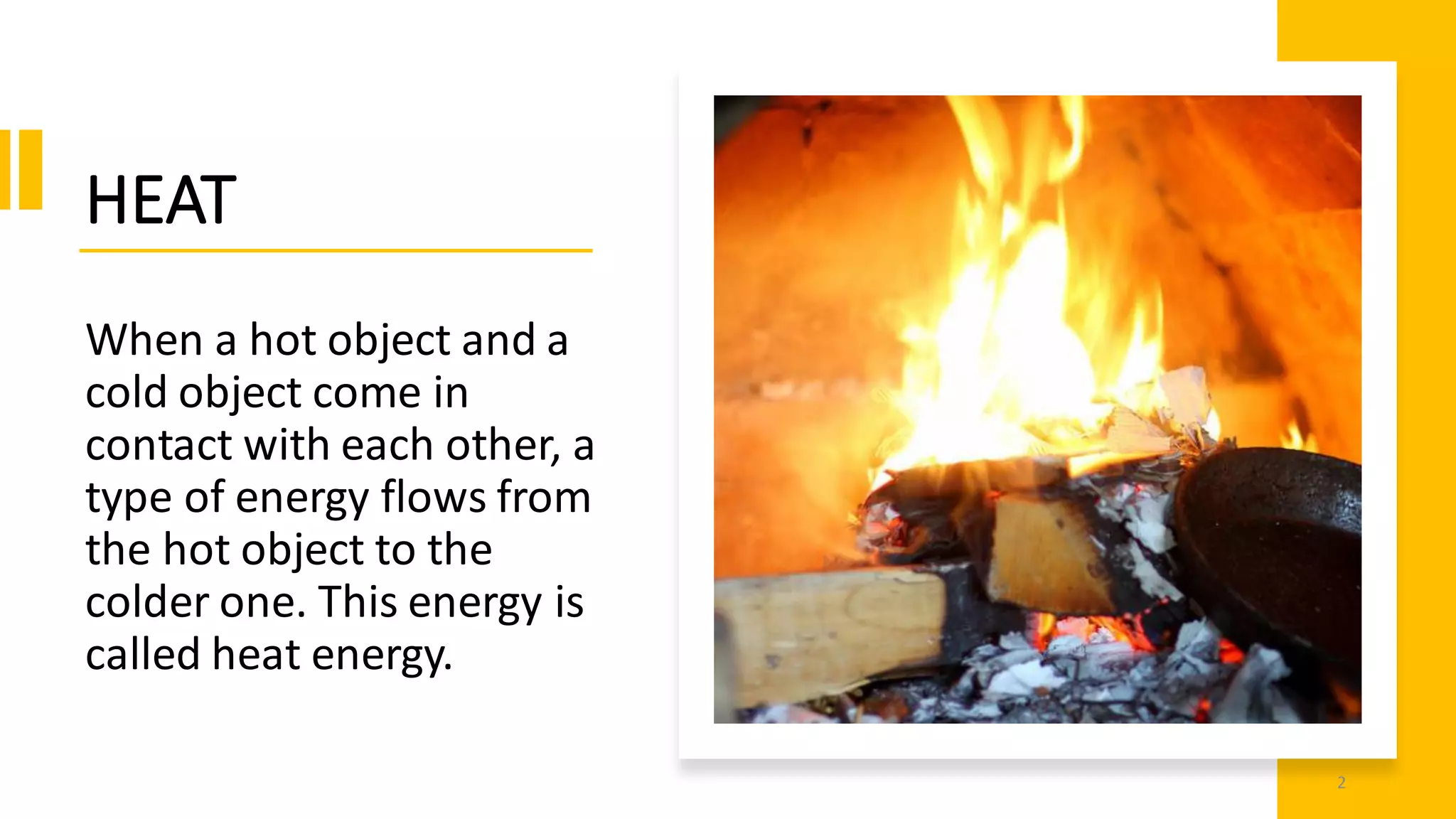
When a hot object and a
cold object come in
contact with each other, a
type of energy flows from
the hot object to the
colder one. This energy is
called heat energy.
2
HOT AND COLD
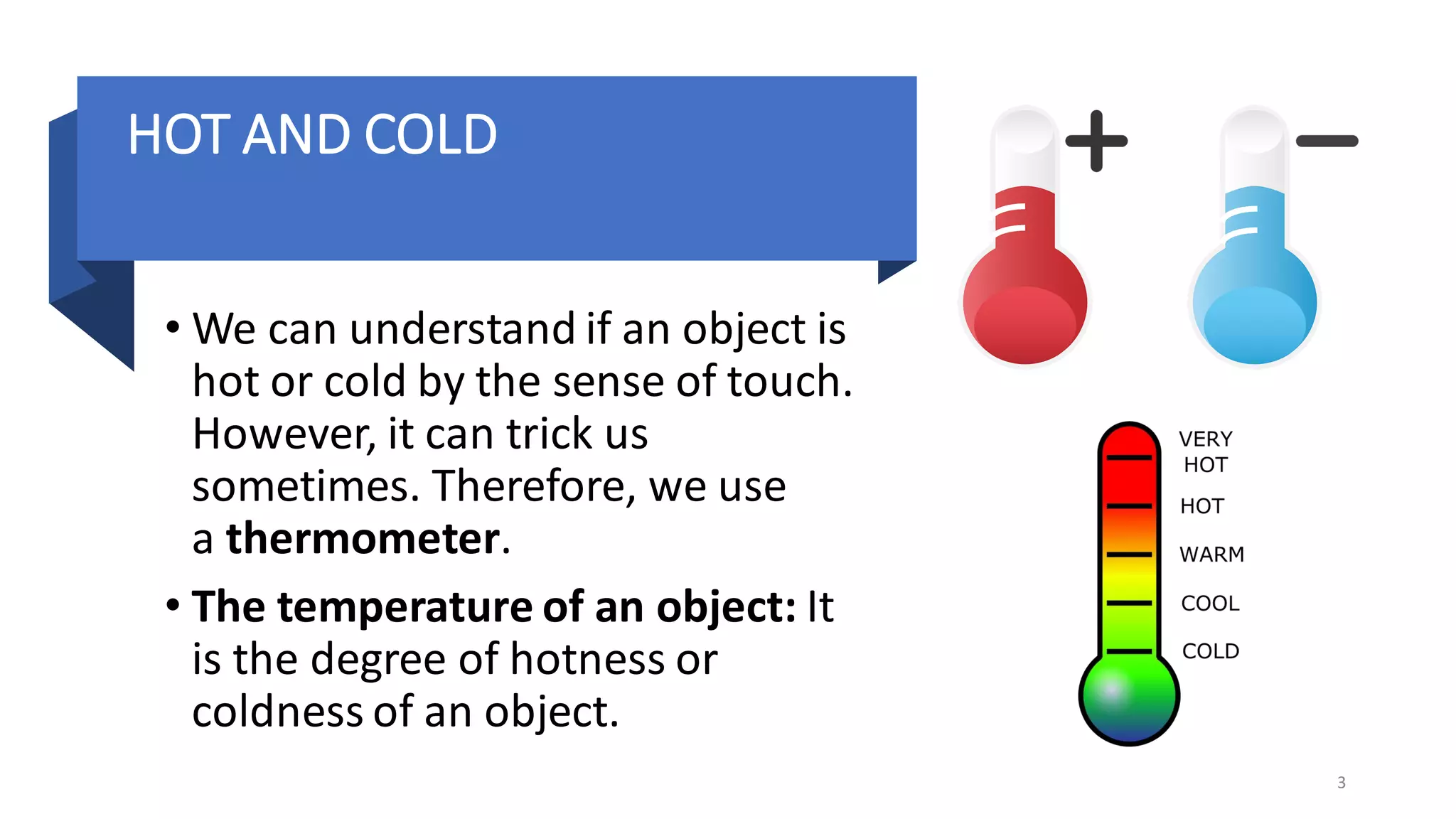
• We can understand if an object is
hot or cold by the sense of touch.
However, it can trick us
sometimes. Therefore, we use
a thermometer.
• The temperature of an object: It
is the degree of hotness or
coldness of an object.
3
THERMOMETER
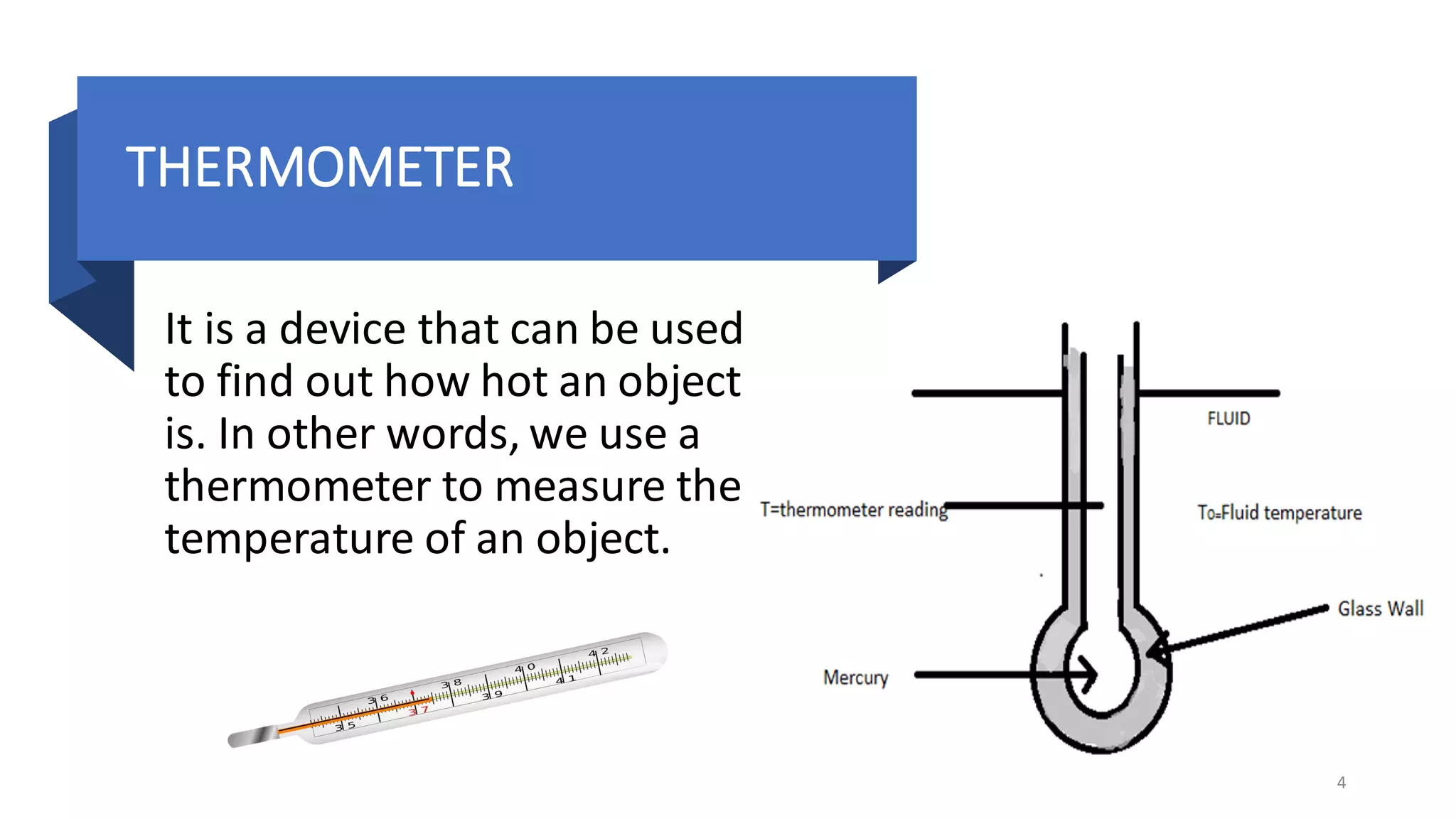
It is a device that can be used
to find out how hot an object
is. In other words, we use a
thermometer to measure the
temperature of an object.
4
CLINICAL
THERMOMETER
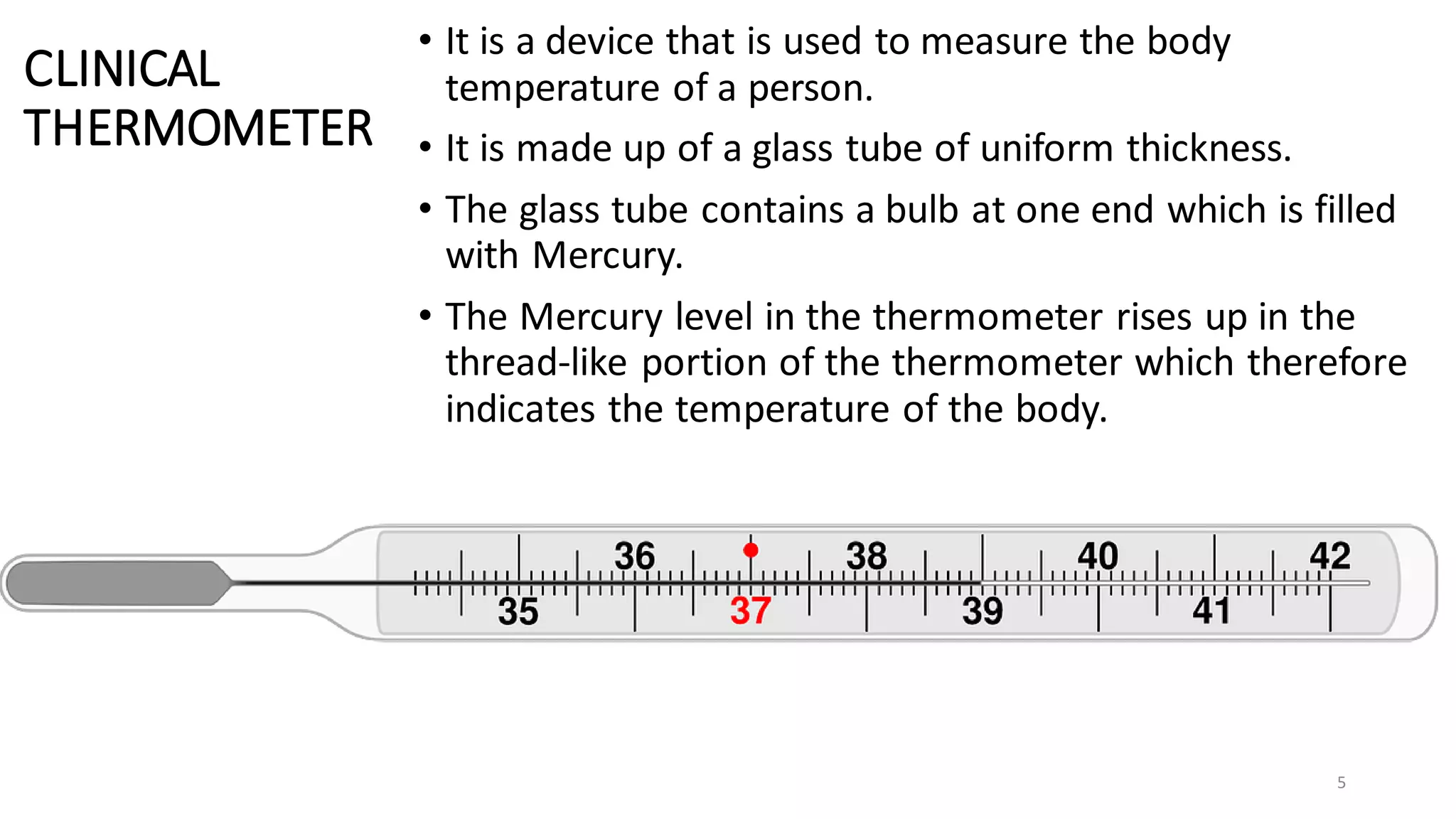
• It is a device that is used to measure the body
temperature of a person.
• It is made up of a glass tube of uniform thickness.
• The glass tube contains a bulb at one end which is filled
with Mercury.
• The Mercury level in the thermometer rises up in the
thread-like portion of the thermometer which therefore
indicates the temperature of the body.
5
CLINICAL
THERMOMETER
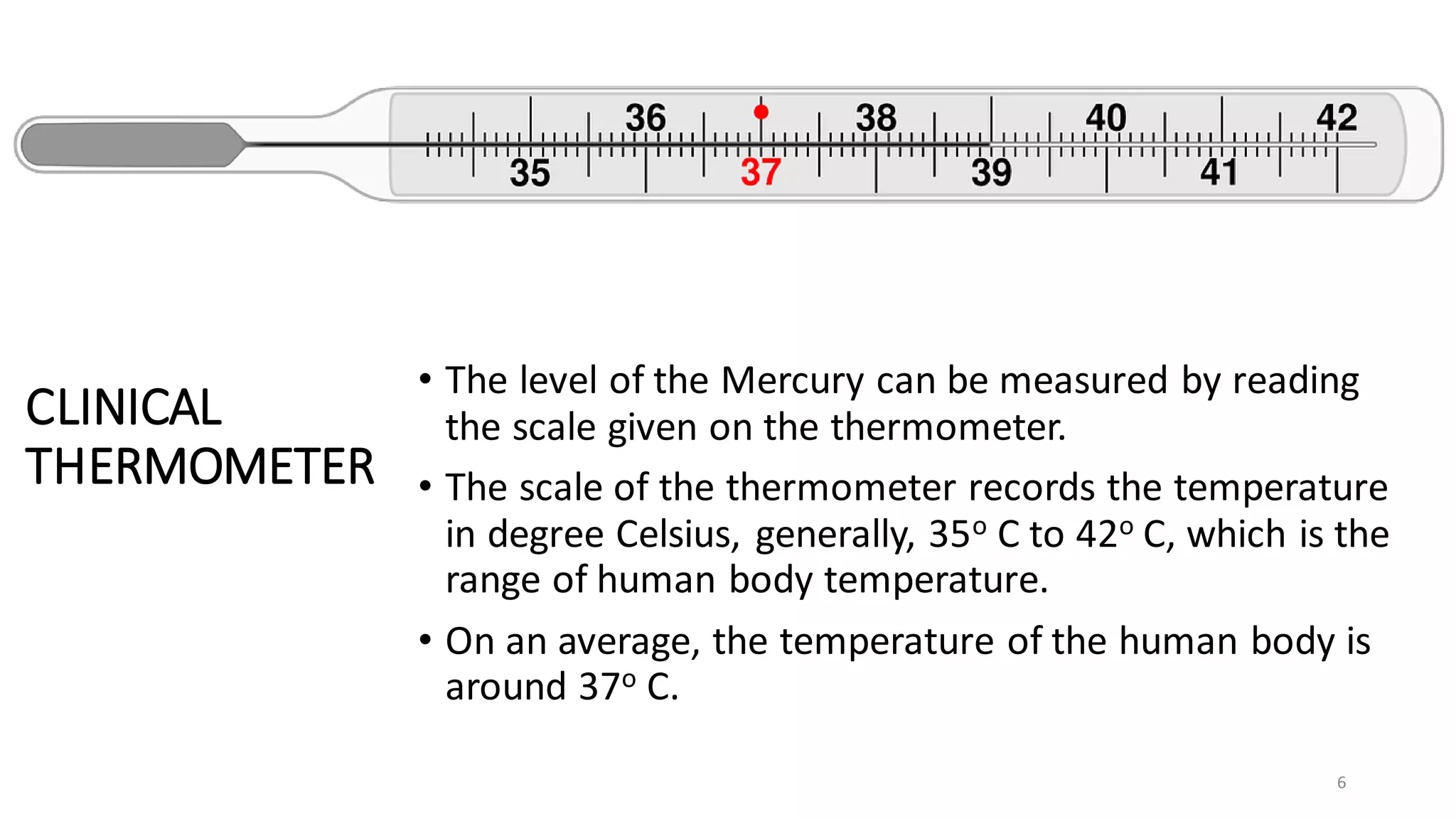
• The level of the Mercury can be measured by reading
the scale given on the thermometer.
• The scale of the thermometer records the temperature
in degree Celsius, generally, 35o C to 42o C, which is the
range of human body temperature.
• On an average, the temperature of the human body is
around 37o C.
6
HOW TO USE
THE CLINICAL
THERMOMETER
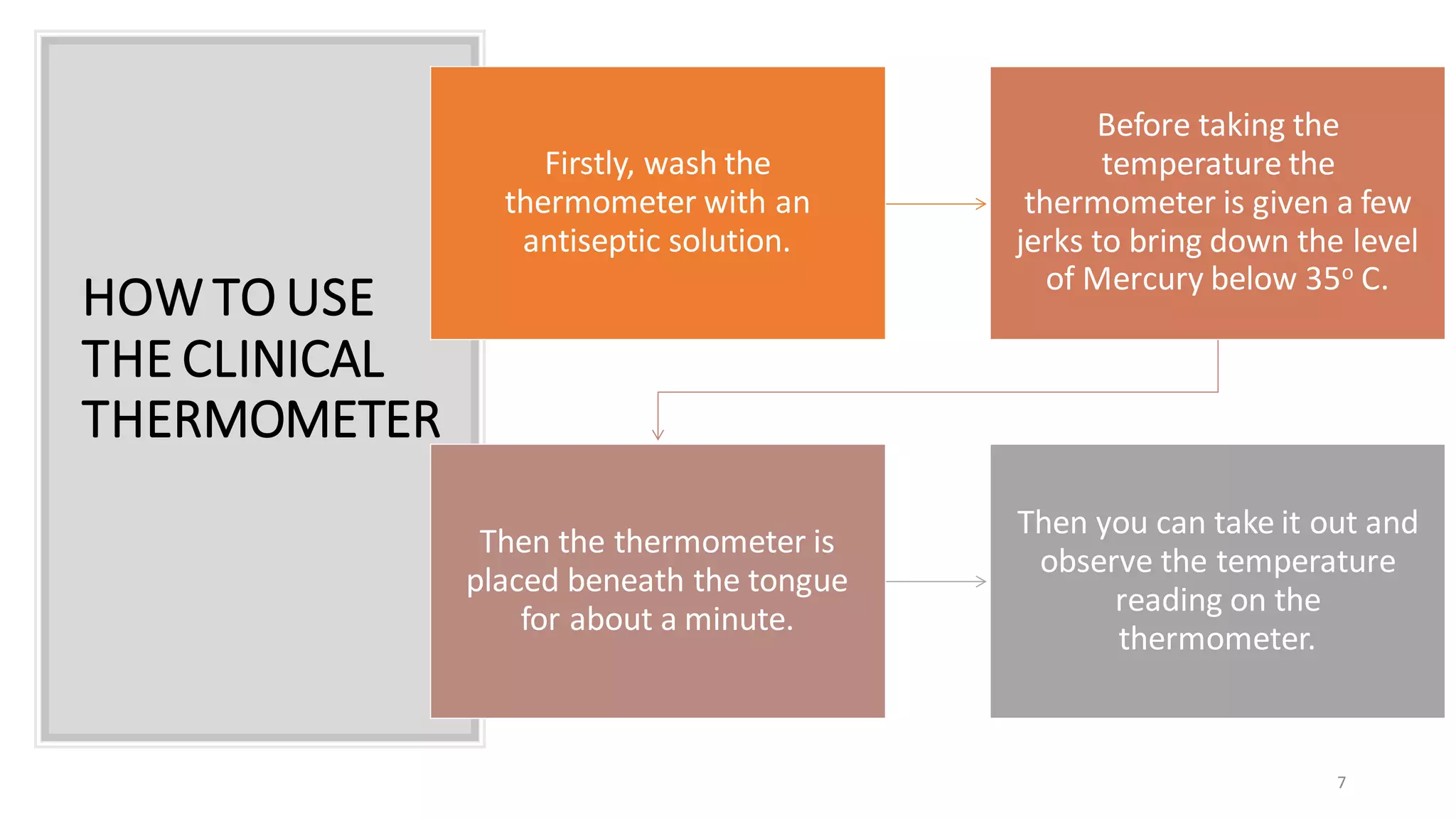
Firstly, wash the
thermometer with an
antiseptic solution.
Before taking the
temperature the
thermometer is given a few
jerks to bring down the level
of Mercury below 35o C.
Then the thermometer is
placed beneath the tongue
for about a minute.
Then you can take it out and
observe the temperature
reading on the
thermometer.
7
WHILEUSINGA CLINICALTHERMOMETER,THE
FOLLOWINGPRECAUTIONSSHOULD BE TAKEN:
• The thermometer should be washed before and
after use preferably with an antiseptic solution.
• It should be handled with care.
• The bulb of the thermometer should not be
touched while taking a reading. Hold the
thermometer by its glass body.
• It should be ensured that before use, the mercury
level is below 35 degree Celsius.
8
LABORATORY THERMOMETER
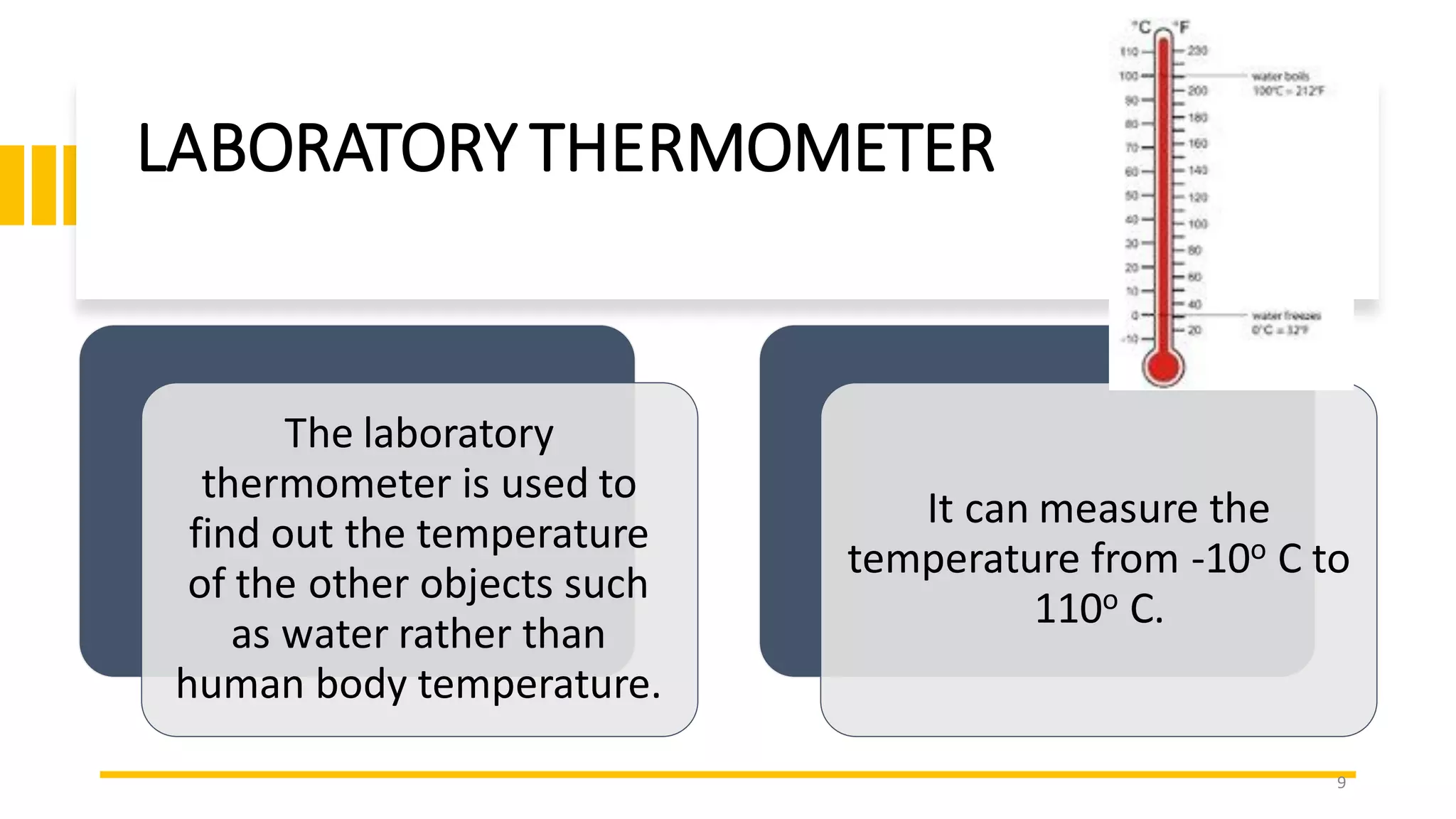
The laboratory
thermometer is used to
find out the temperature
of the other objects such
as water rather than
human body temperature.
It can measure the
temperature from -10o C to
110o C.
9
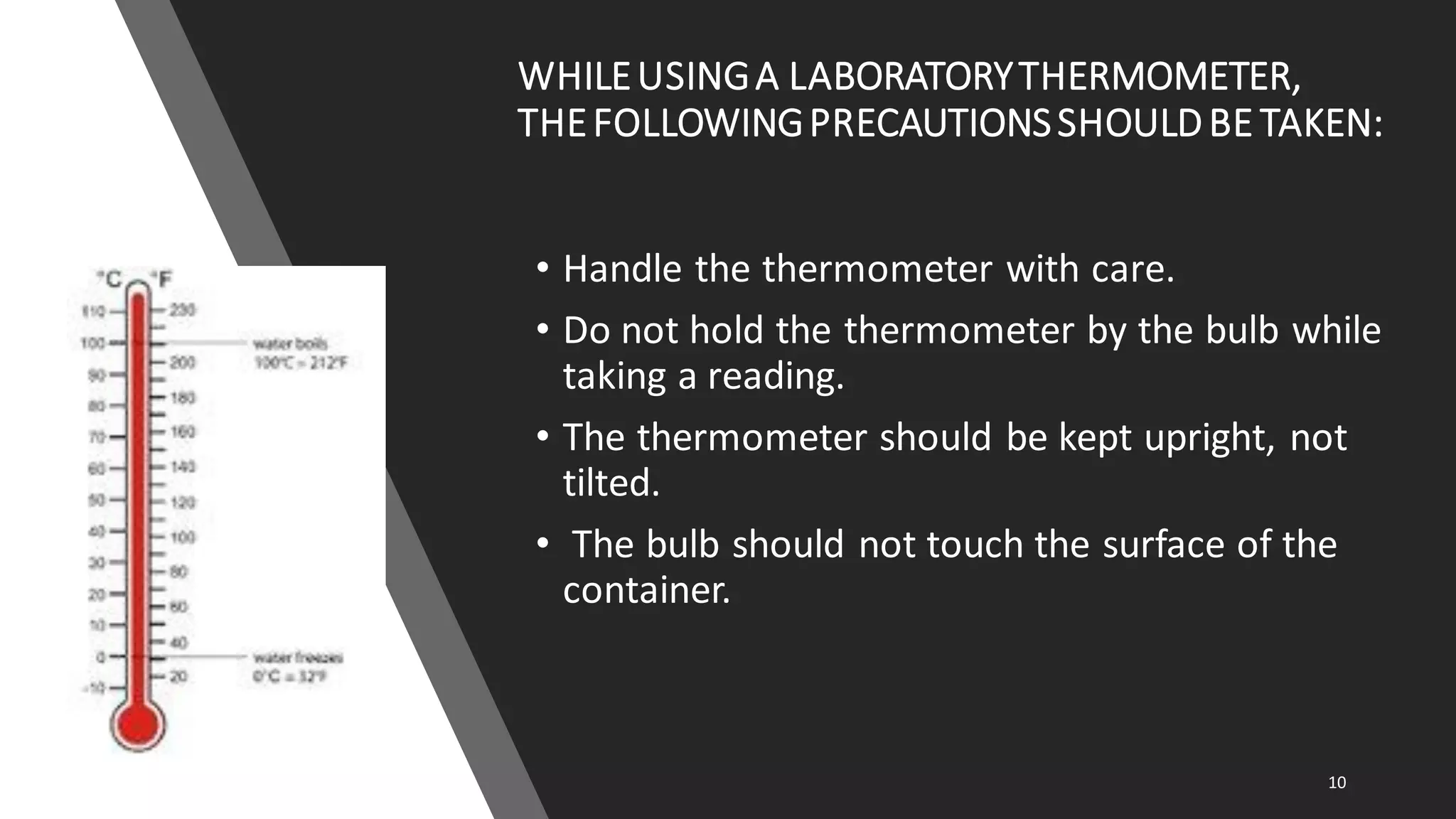
WHILEUSINGA LABORATORYTHERMOMETER,
THEFOLLOWINGPRECAUTIONSSHOULDBE TAKEN:
• Handle the thermometer with care.
• Do not hold the thermometer by the bulb while
taking a reading.
• The thermometer should be kept upright, not
tilted.
• The bulb should not touch the surface of the
container.
10
DIGITAL THERMOMETER
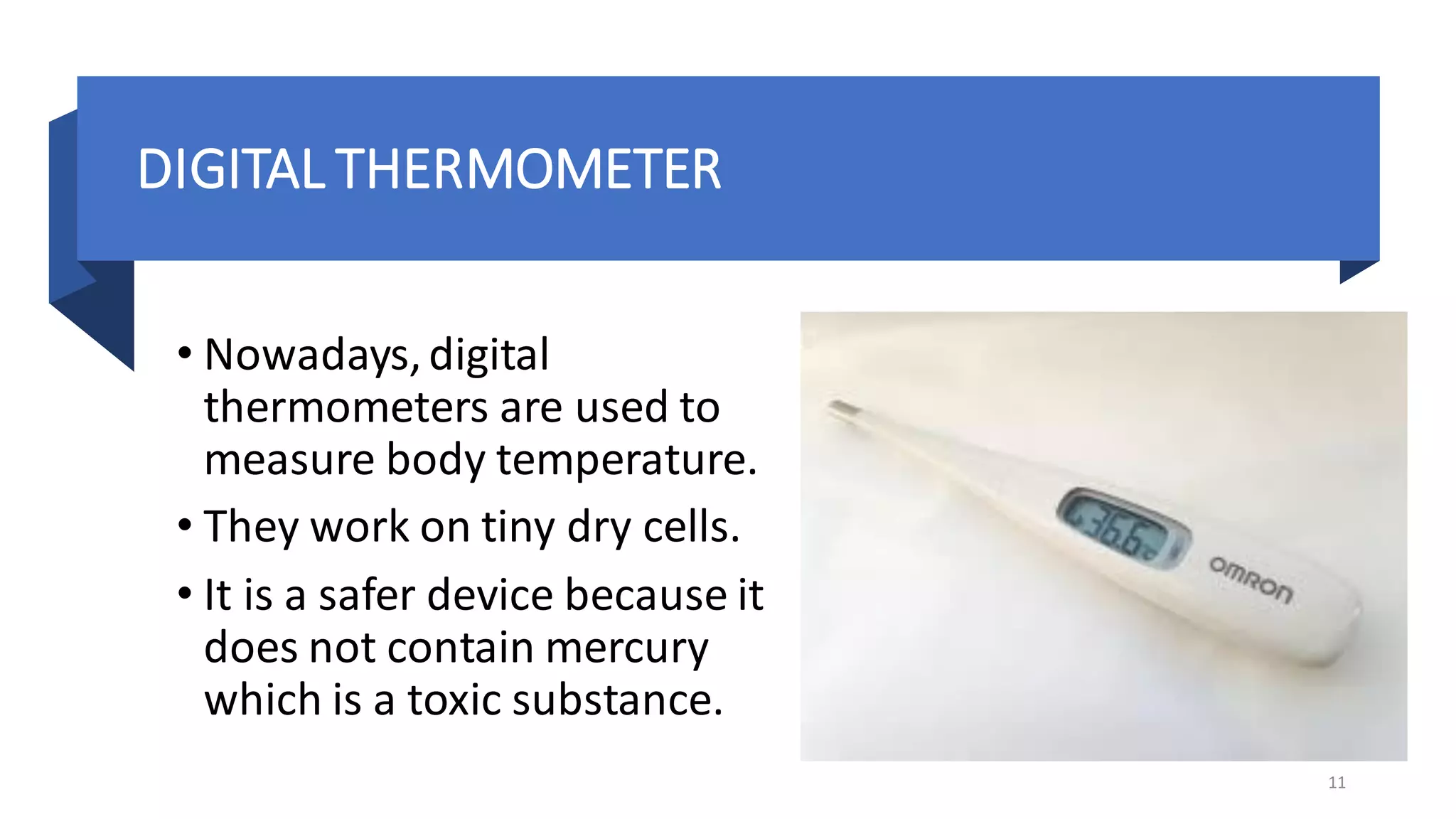
• Nowadays,digital
thermometers are used to
measure body temperature.
• They work on tiny dry cells.
• It is a safer device because it
does not contain mercury
which is a toxic substance.
11
TRANSFER OF HEAT
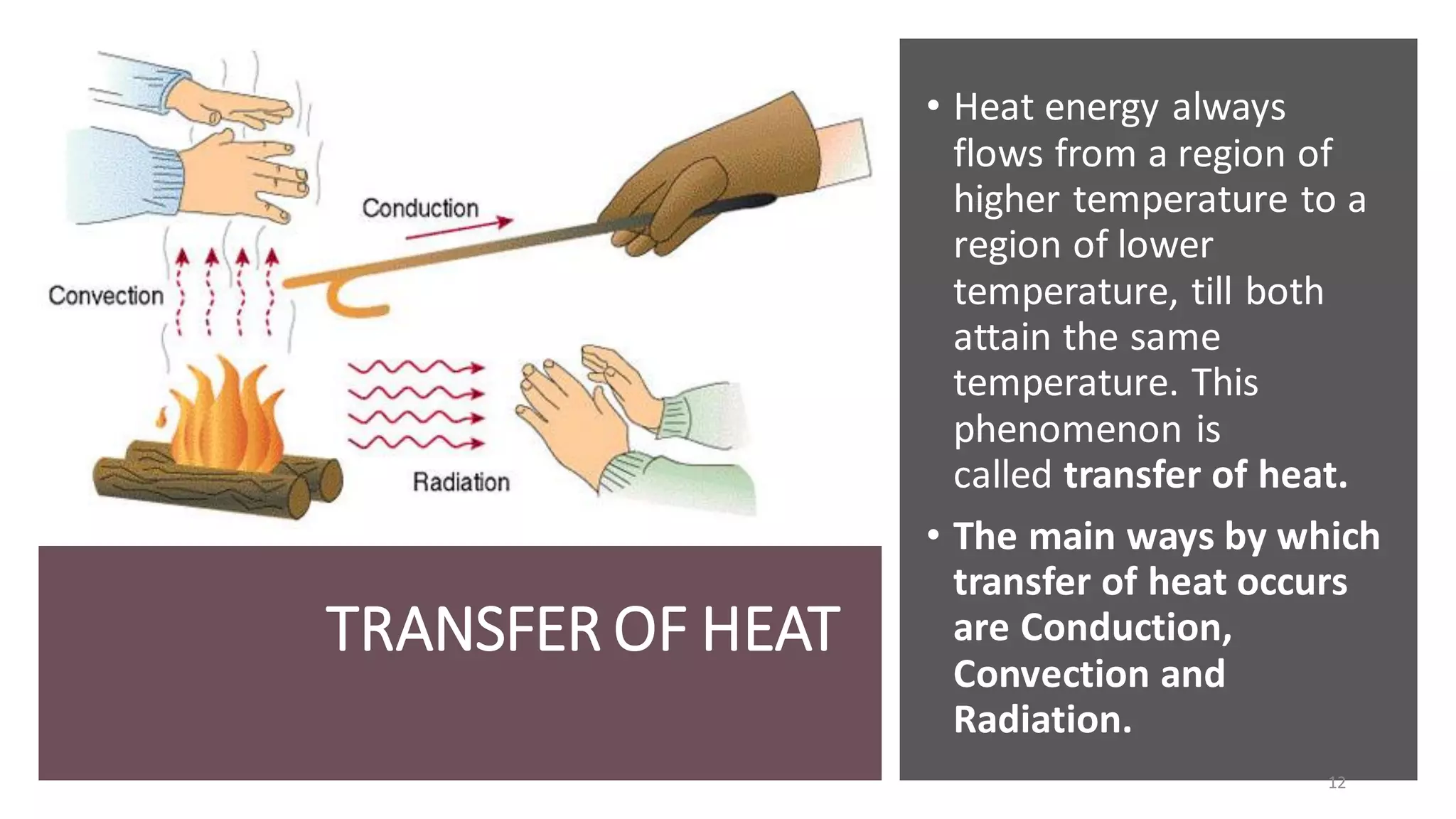
• Heat energy always
flows from a region of
higher temperature to a
region of lower
temperature, till both
attain the same
temperature. This
phenomenon is
called transfer of heat.
• The main ways by which
transfer of heat occurs
are Conduction,
Convection and
Radiation.
12
CONDUCTION
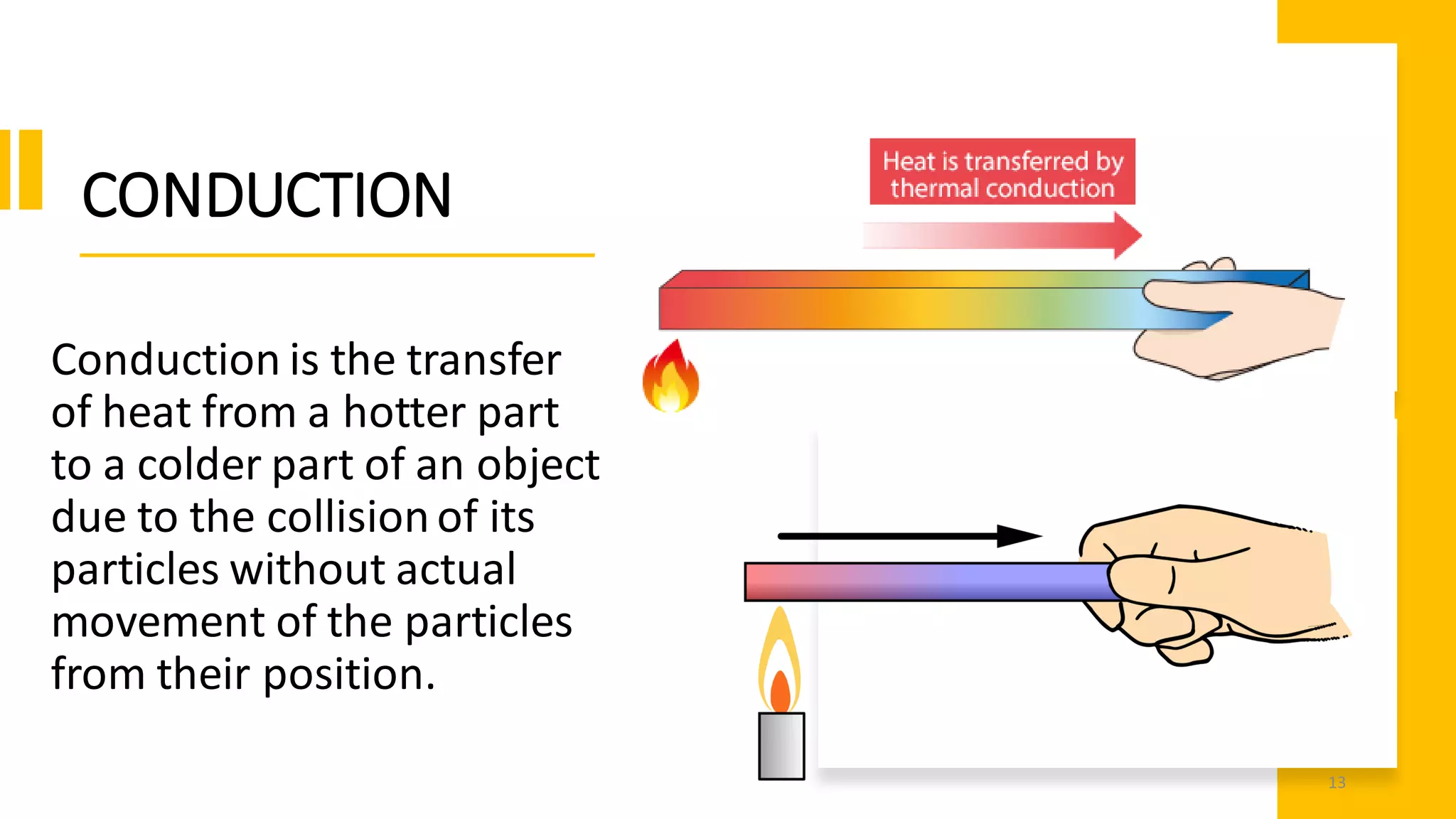
Conduction is the transfer
of heat from a hotter part
to a colder part of an object
due to the collisionof its
particles without actual
movement of the particles
from their position.
13
CONDUCTORS
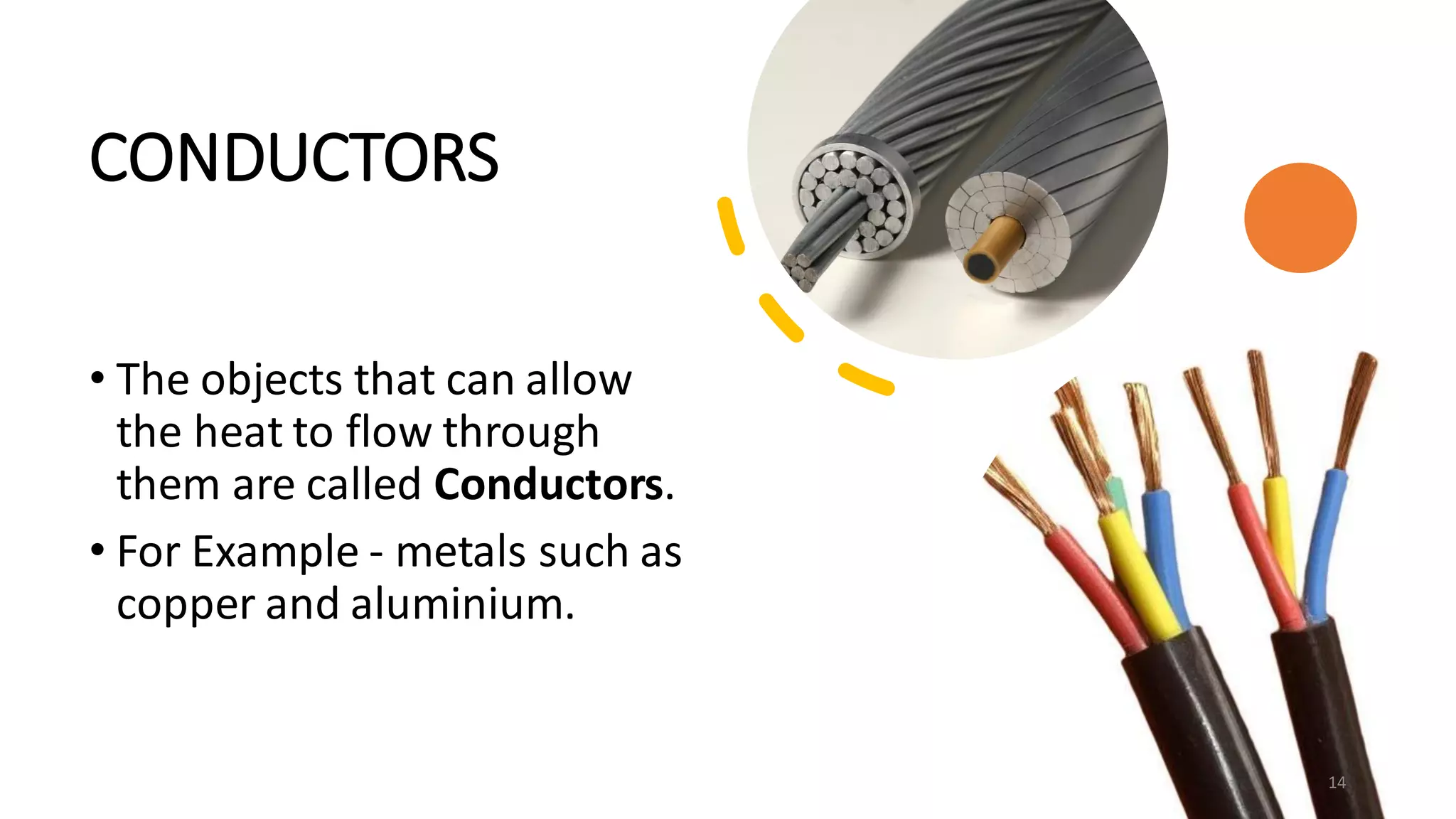
• The objects that can allow
the heat to flow through
them are called Conductors.
• For Example - metals such as
copper and aluminium.
14
INSULATORS
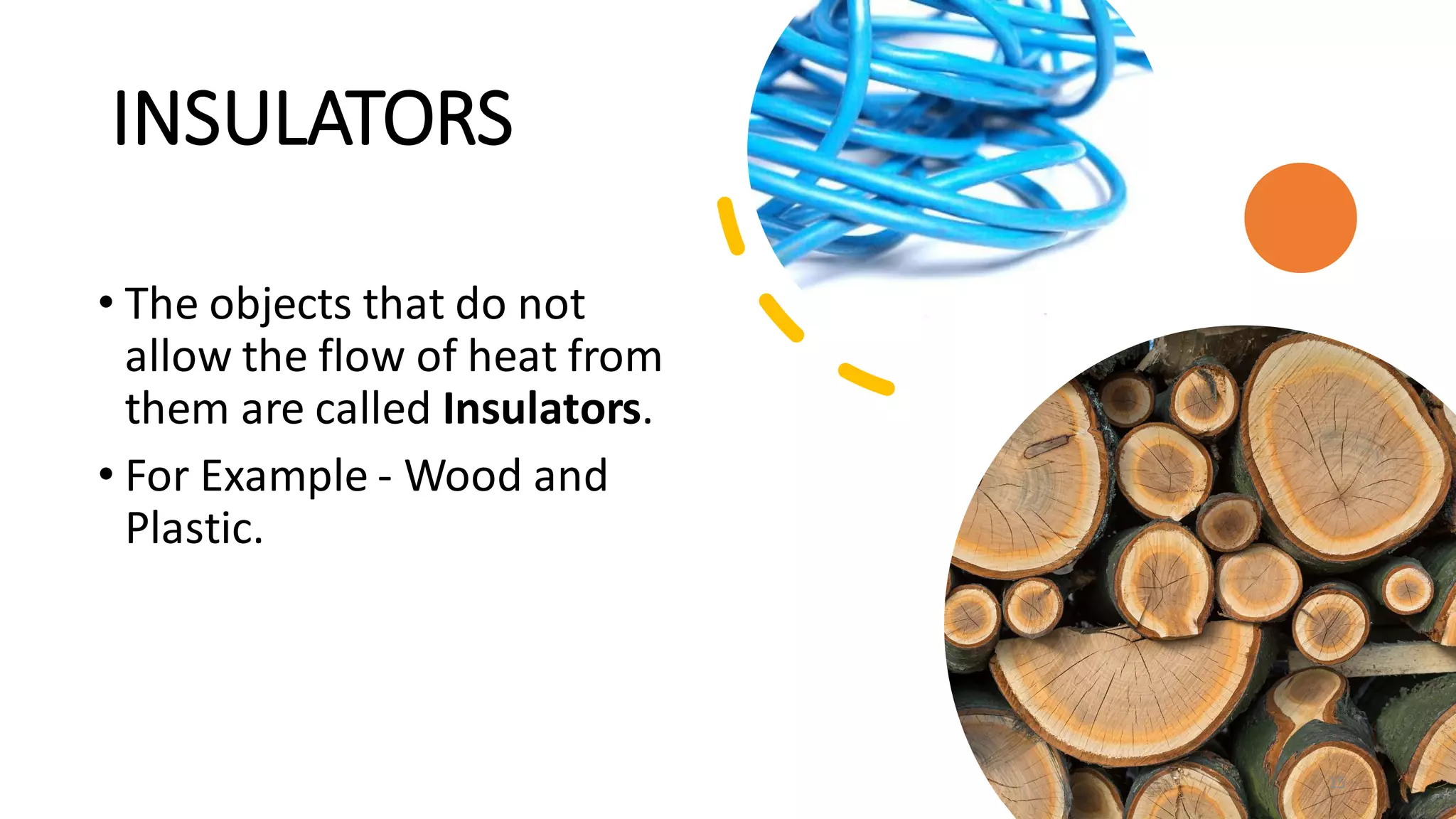
• The objects that do not
allow the flow of heat from
them are called Insulators.
• For Example - Wood and
Plastic.
15
CONVECTION
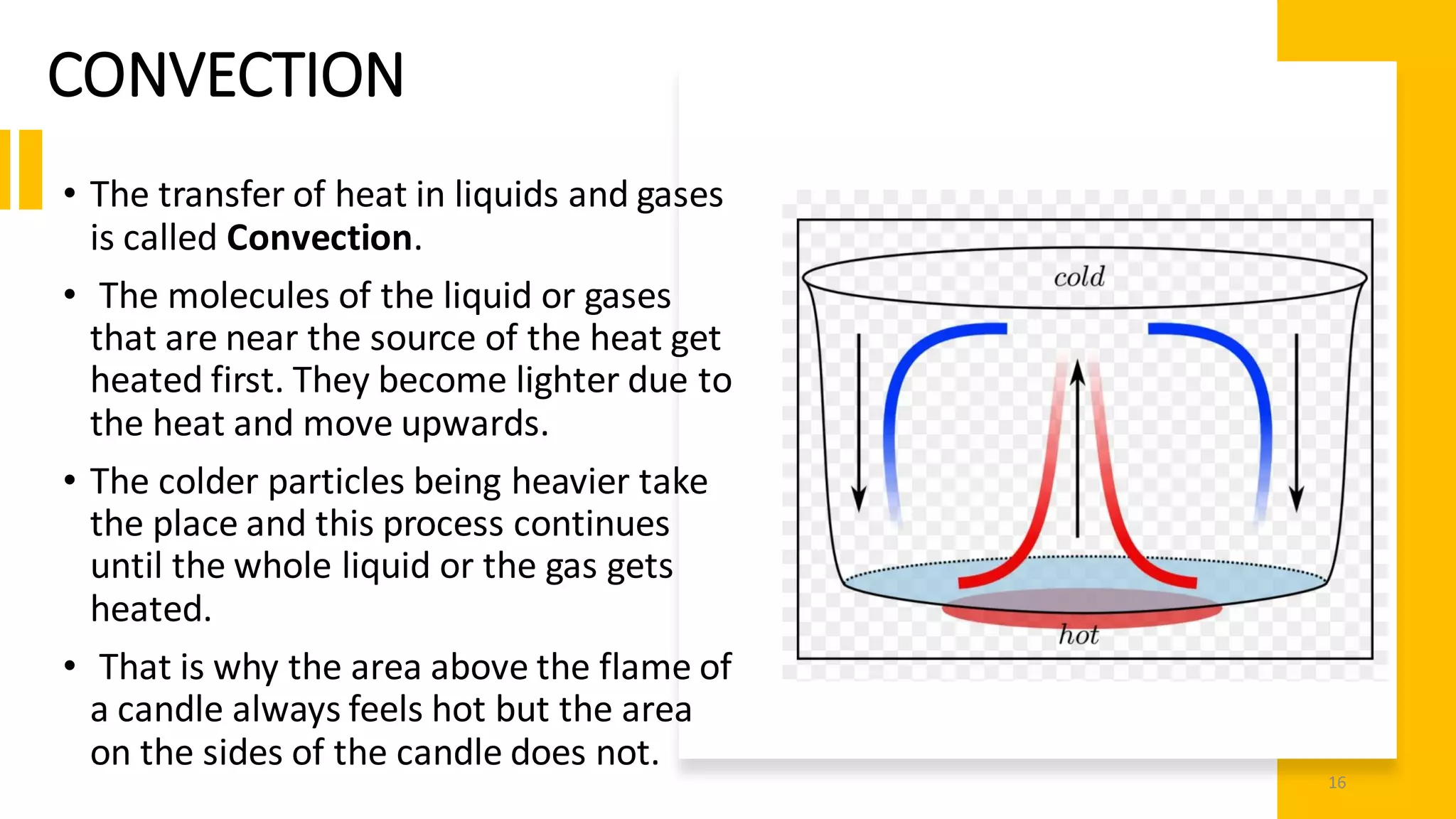
• The transfer of heat in liquids and gases
is called Convection.
• The molecules of the liquid or gases
that are near the source of the heat get
heated first. They become lighter due to
the heat and move upwards.
• The colder particles being heavier take
the place and this process continues
until the whole liquid or the gas gets
heated.
• That is why the area above the flame of
a candle always feels hot but the area
on the sides of the candle does not.
16
RADIATION
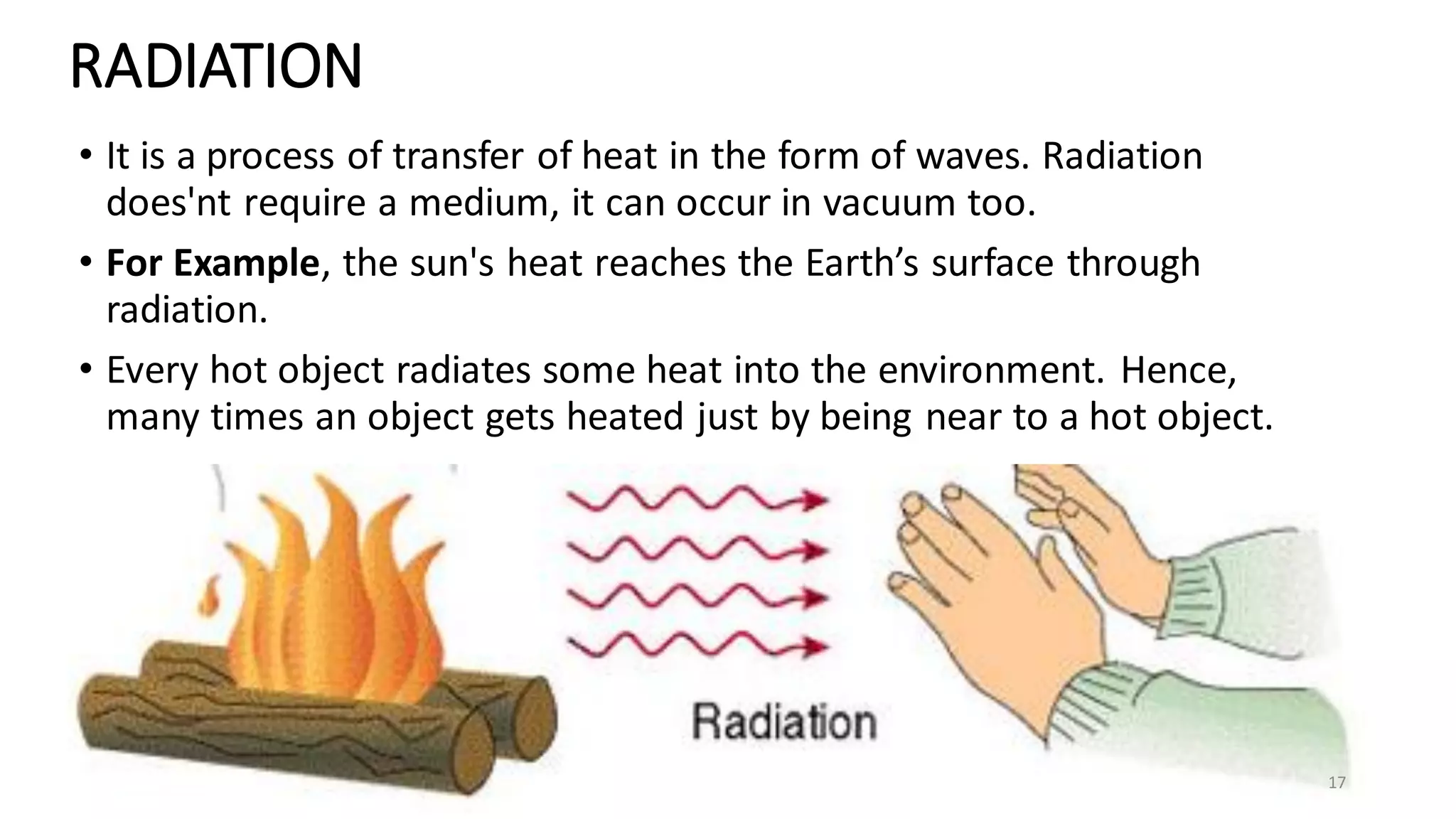
• It is a process of transfer of heat in the form of waves. Radiation
does'nt require a medium, it can occur in vacuum too.
• For Example, the sun's heat reaches the Earth’s surface through
radiation.
• Every hot object radiates some heat into the environment. Hence,
many times an object gets heated just by being near to a hot object.
17
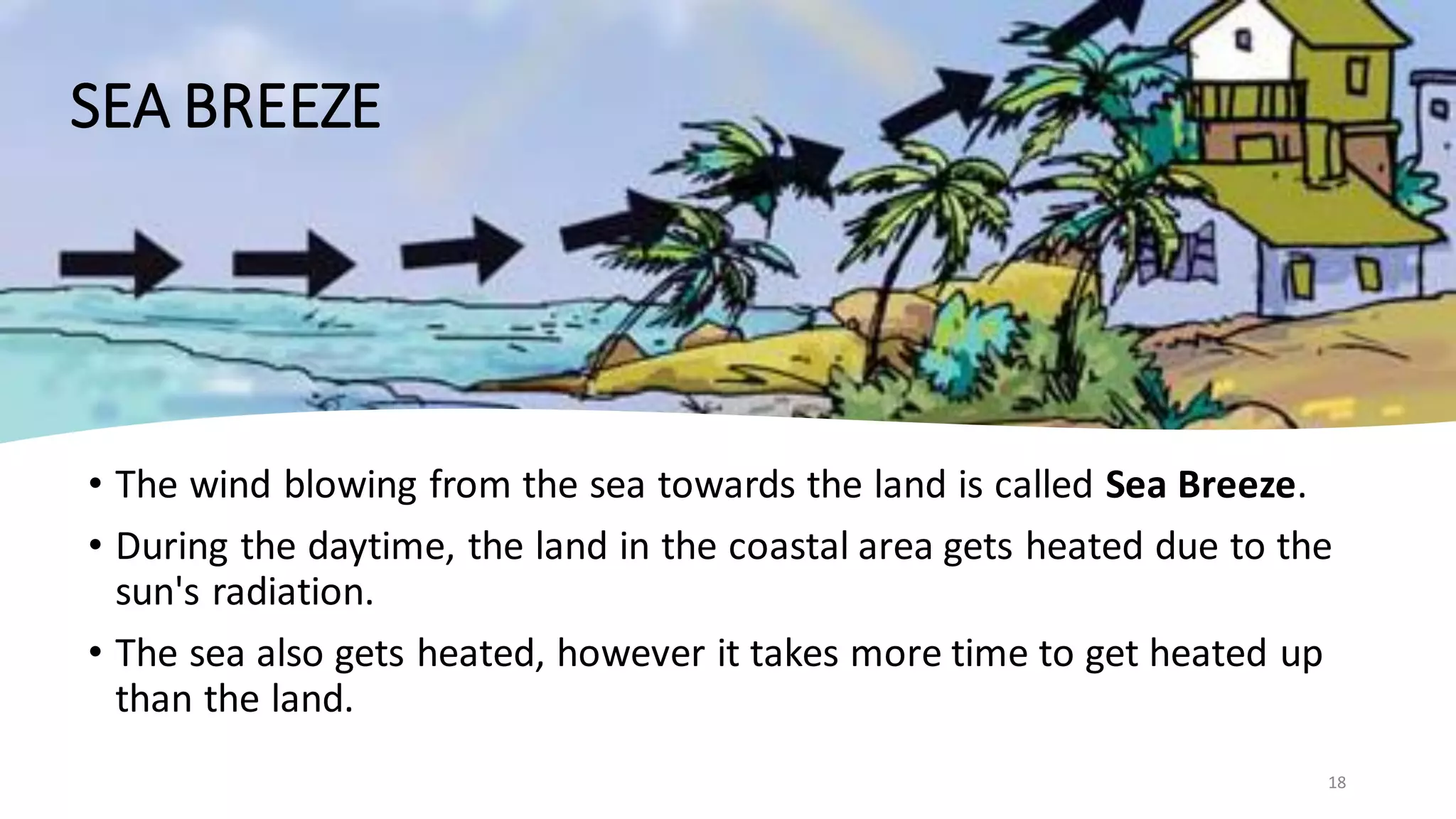
• The wind blowing from the sea towards the land is called Sea Breeze.
• During the daytime, the land in the coastal area gets heated due to the
sun's radiation.
• The sea also gets heated, however it takes more time to get heated up
than the land.
SEA BREEZE
18
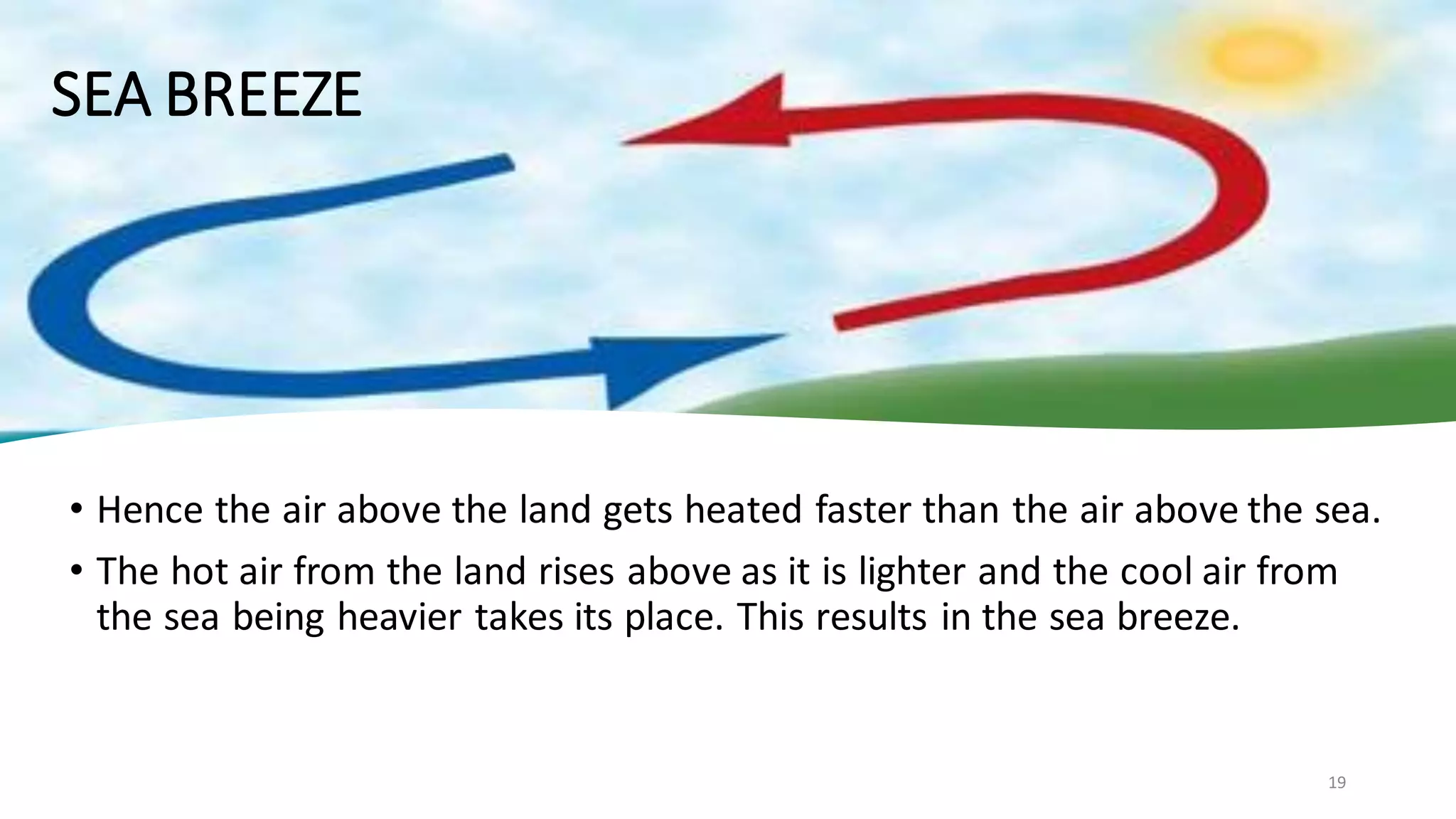
• Hence the air above the land gets heated faster than the air above the sea.
• The hot air from the land rises above as it is lighter and the cool air from
the sea being heavier takes its place. This results in the sea breeze.
SEA BREEZE
19
LAND BREEZE
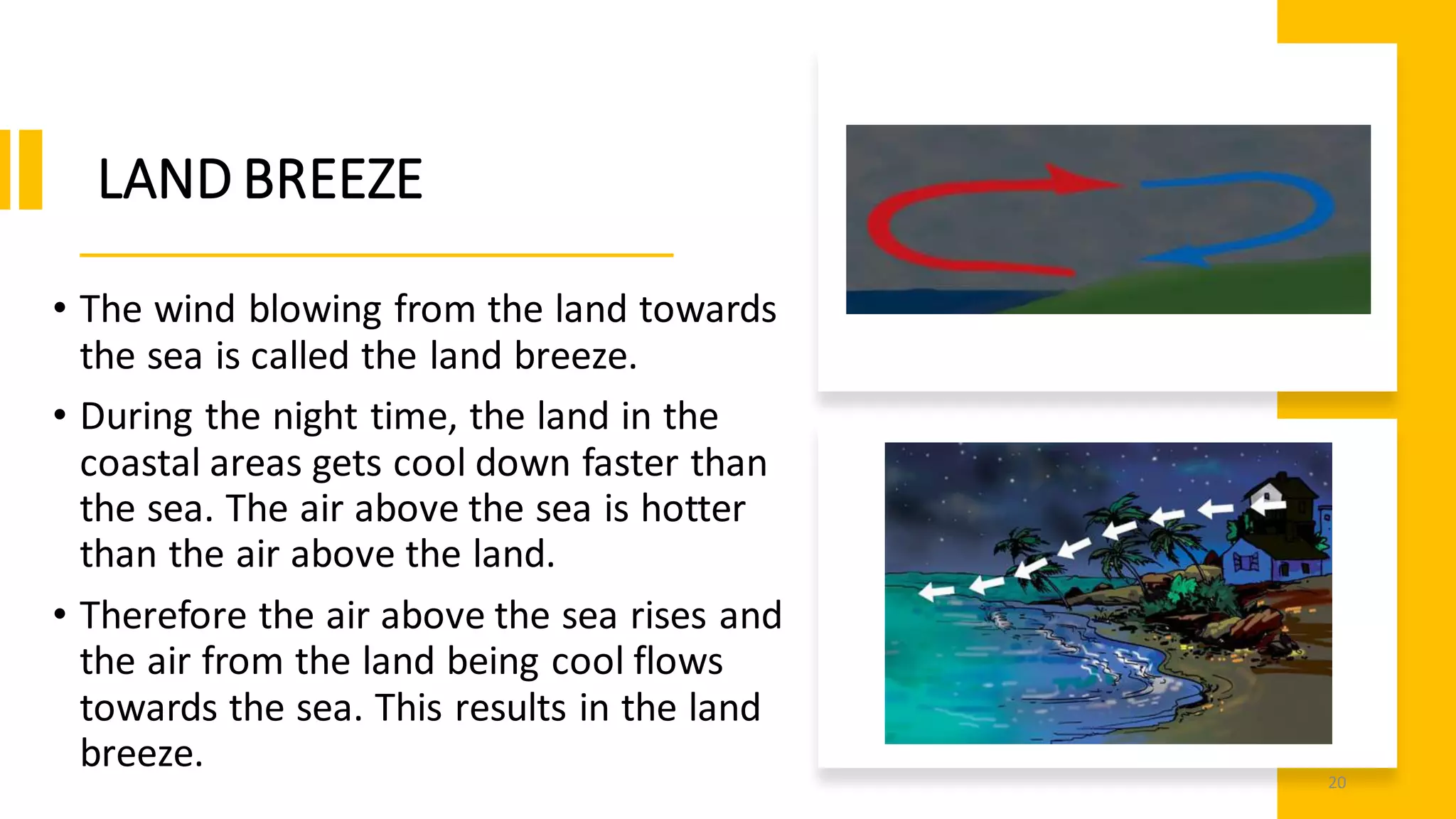
• The wind blowing from the land towards
the sea is called the land breeze.
• During the night time, the land in the
coastal areas gets cool down faster than
the sea. The air above the sea is hotter
than the air above the land.
• Therefore the air above the sea rises and
the air from the land being cool flows
towards the sea. This results in the land
breeze.
20
CLOTHES IN WINTERS
AND SUMMERS
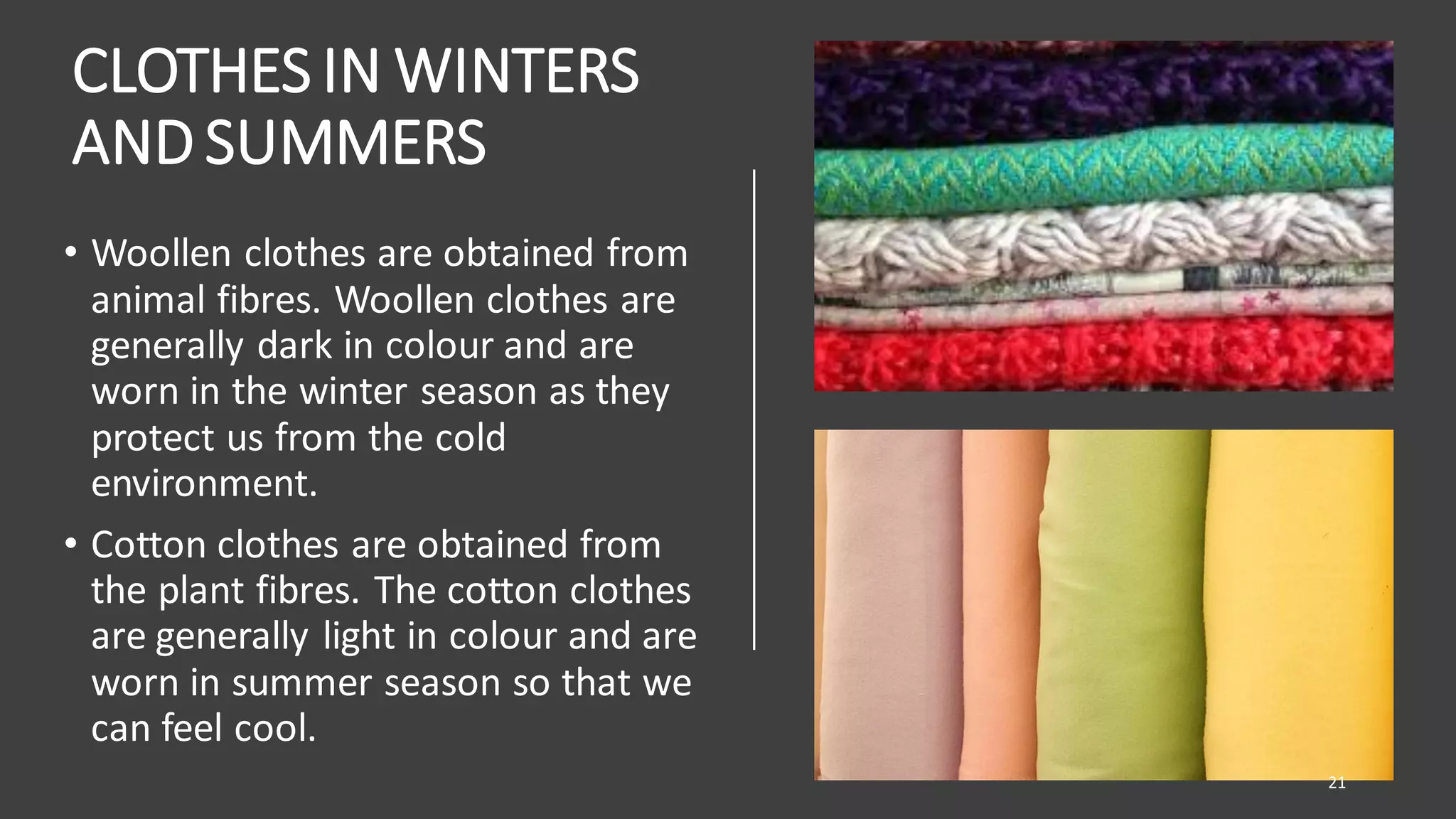
• Woollen clothes are obtained from
animal fibres. Woollen clothes are
generally dark in colour and are
worn in the winter season as they
protect us from the cold
environment.
• Cotton clothes are obtained from
the plant fibres. The cotton clothes
are generally light in colour and are
worn in summer season so that we
can feel cool.
21
HOW DO WOOLLENCLOTHES
KEEP US WARM?
• The woollen clothes are a bad conductor of heat.
• Therefore they do not allow the heat from the body to
move out in the environment.
• As a result, the air present between the woollen clothes
and our body becomes hot and this makes us feel
warm.
• Similarly, two thin blankets provide more heat than one
thick blanket because air can be trapped between the
two thin blankets.
22
THANK YOU
23

Chapter - 4, Heat, Science, Class 7

  • 1.
    CHAPTER - 4 HEAT BYSHIVAM PARMAR (ENTREPRENEUR & TEACHER)
  • 2.
    HEAT When a hotobject and a cold object come in contact with each other, a type of energy flows from the hot object to the colder one. This energy is called heat energy. 2
  • 3.
    HOT AND COLD •We can understand if an object is hot or cold by the sense of touch. However, it can trick us sometimes. Therefore, we use a thermometer. • The temperature of an object: It is the degree of hotness or coldness of an object. 3
  • 4.
    THERMOMETER It is adevice that can be used to find out how hot an object is. In other words, we use a thermometer to measure the temperature of an object. 4
  • 5.
    CLINICAL THERMOMETER • It isa device that is used to measure the body temperature of a person. • It is made up of a glass tube of uniform thickness. • The glass tube contains a bulb at one end which is filled with Mercury. • The Mercury level in the thermometer rises up in the thread-like portion of the thermometer which therefore indicates the temperature of the body. 5
  • 6.
    CLINICAL THERMOMETER • The levelof the Mercury can be measured by reading the scale given on the thermometer. • The scale of the thermometer records the temperature in degree Celsius, generally, 35o C to 42o C, which is the range of human body temperature. • On an average, the temperature of the human body is around 37o C. 6
  • 7.
    HOW TO USE THECLINICAL THERMOMETER Firstly, wash the thermometer with an antiseptic solution. Before taking the temperature the thermometer is given a few jerks to bring down the level of Mercury below 35o C. Then the thermometer is placed beneath the tongue for about a minute. Then you can take it out and observe the temperature reading on the thermometer. 7
  • 8.
    WHILEUSINGA CLINICALTHERMOMETER,THE FOLLOWINGPRECAUTIONSSHOULD BETAKEN: • The thermometer should be washed before and after use preferably with an antiseptic solution. • It should be handled with care. • The bulb of the thermometer should not be touched while taking a reading. Hold the thermometer by its glass body. • It should be ensured that before use, the mercury level is below 35 degree Celsius. 8
  • 9.
    LABORATORY THERMOMETER The laboratory thermometeris used to find out the temperature of the other objects such as water rather than human body temperature. It can measure the temperature from -10o C to 110o C. 9
  • 10.
    WHILEUSINGA LABORATORYTHERMOMETER, THEFOLLOWINGPRECAUTIONSSHOULDBE TAKEN: •Handle the thermometer with care. • Do not hold the thermometer by the bulb while taking a reading. • The thermometer should be kept upright, not tilted. • The bulb should not touch the surface of the container. 10
  • 11.
    DIGITAL THERMOMETER • Nowadays,digital thermometersare used to measure body temperature. • They work on tiny dry cells. • It is a safer device because it does not contain mercury which is a toxic substance. 11
  • 12.
    TRANSFER OF HEAT •Heat energy always flows from a region of higher temperature to a region of lower temperature, till both attain the same temperature. This phenomenon is called transfer of heat. • The main ways by which transfer of heat occurs are Conduction, Convection and Radiation. 12
  • 13.
    CONDUCTION Conduction is thetransfer of heat from a hotter part to a colder part of an object due to the collisionof its particles without actual movement of the particles from their position. 13
  • 14.
    CONDUCTORS • The objectsthat can allow the heat to flow through them are called Conductors. • For Example - metals such as copper and aluminium. 14
  • 15.
    INSULATORS • The objectsthat do not allow the flow of heat from them are called Insulators. • For Example - Wood and Plastic. 15
  • 16.
    CONVECTION • The transferof heat in liquids and gases is called Convection. • The molecules of the liquid or gases that are near the source of the heat get heated first. They become lighter due to the heat and move upwards. • The colder particles being heavier take the place and this process continues until the whole liquid or the gas gets heated. • That is why the area above the flame of a candle always feels hot but the area on the sides of the candle does not. 16
  • 17.
    RADIATION • It isa process of transfer of heat in the form of waves. Radiation does'nt require a medium, it can occur in vacuum too. • For Example, the sun's heat reaches the Earth’s surface through radiation. • Every hot object radiates some heat into the environment. Hence, many times an object gets heated just by being near to a hot object. 17
  • 18.
    • The windblowing from the sea towards the land is called Sea Breeze. • During the daytime, the land in the coastal area gets heated due to the sun's radiation. • The sea also gets heated, however it takes more time to get heated up than the land. SEA BREEZE 18
  • 19.
    • Hence theair above the land gets heated faster than the air above the sea. • The hot air from the land rises above as it is lighter and the cool air from the sea being heavier takes its place. This results in the sea breeze. SEA BREEZE 19
  • 20.
    LAND BREEZE • Thewind blowing from the land towards the sea is called the land breeze. • During the night time, the land in the coastal areas gets cool down faster than the sea. The air above the sea is hotter than the air above the land. • Therefore the air above the sea rises and the air from the land being cool flows towards the sea. This results in the land breeze. 20
  • 21.
    CLOTHES IN WINTERS ANDSUMMERS • Woollen clothes are obtained from animal fibres. Woollen clothes are generally dark in colour and are worn in the winter season as they protect us from the cold environment. • Cotton clothes are obtained from the plant fibres. The cotton clothes are generally light in colour and are worn in summer season so that we can feel cool. 21
  • 22.
    HOW DO WOOLLENCLOTHES KEEPUS WARM? • The woollen clothes are a bad conductor of heat. • Therefore they do not allow the heat from the body to move out in the environment. • As a result, the air present between the woollen clothes and our body becomes hot and this makes us feel warm. • Similarly, two thin blankets provide more heat than one thick blanket because air can be trapped between the two thin blankets. 22
  • 23.