WELCOME TO MY CLASS
Mr. Souvik Chatterjee
M.Sc (Physics)&B.Ed
PHYSICAL QUANTITY &
MEASUREMENT
Measurement of volume(3D Concept) Concept Of
unit volume
Measurement of area: Estimate the area of
irregular shape objects using graph paper
Measuirement of density of regular solids: Basic
concepts, Formula, Simple Numericals (S.I unit
not required
Calculation of speed: Basic Concept, Formula,
Simple Numericals (S.I unit not required)
KEY POINTS
 Measurement is a process of comparision of the given unknown
quantity with a fixed known quantity of the second kind called unit
 Magnitude= Number of times the unit is contained in the quantity X
Unit
 Length is the distance between two points. Its S.I unit is metre (m).
It is measured with the help of a metre rule or measuring tape.
 Mass is the quantity of matter contained in the body. Its S.I unit is
kilogram (kg). It is measured by a beam balance or an electronic
balance.
 Time is the interval of occurrence of an event. Its S.I unit is second
(s). It is measured with the help of a pendulum clock or a stop watch
or stop-clock
 Temperature is a quantity which measures the hotness and coldness
of a body. Its S.I unit is kelvin (K). It is measured using a
thermometer.
MEASUREMENT OF VOLUME
 The space occupied by an object is called volume
 S.I unit of volume is cubic metre (m3)
 Cubic metre is the volume of a cube with each side 1 meter
long
 1 m3 = 1m X 1m X 1m
 Cubic centimetre is the volume of cube with each side 1
centimeter
 1 cm3 = 1 cm X 1 cm X 1 cm
 1 m3 = 1 m X 1 m X 1 m = 100 cm X 100 cm X 100 cm
=1000000 cm3 = 10 6 cm3
 The volume of a liquids is generally expressed in litre (L)
 1 litre = 1000 cm3
 1 cm3 = 1 mL

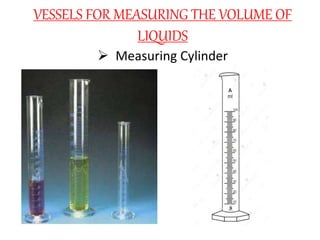
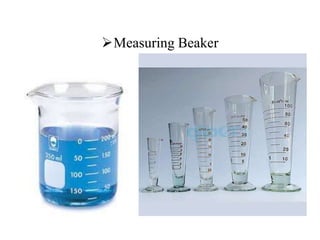
VESSELS FOR MEASURING THE VOLUME OF
LIQUIDS
 Measuring Cylinder
Measuring Beaker
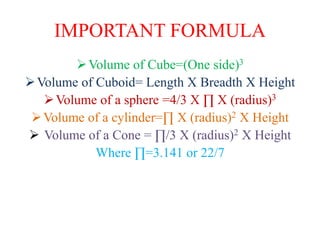
IMPORTANT FORMULA
Volume of Cube=(One side)3
Volume of Cuboid= Length X Breadth X Height
Volume of a sphere =4/3 X ∏ X (radius)3
Volume of a cylinder=∏ X (radius)2 X Height
 Volume of a Cone = ∏/3 X (radius)2 X Height
Where ∏=3.141 or 22/7
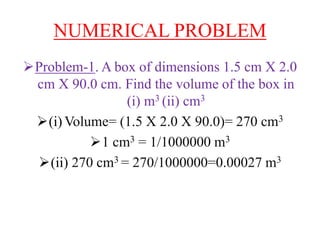
NUMERICAL PROBLEM
Problem-1. A box of dimensions 1.5 cm X 2.0
cm X 90.0 cm. Find the volume of the box in
(i) m3 (ii) cm3
(i) Volume= (1.5 X 2.0 X 90.0)= 270 cm3
1 cm3 = 1/1000000 m3
(ii) 270 cm3 = 270/1000000=0.00027 m3
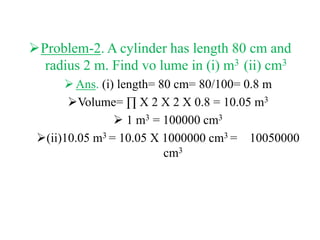
Problem-2. A cylinder has length 80 cm and
radius 2 m. Find vo lume in (i) m3 (ii) cm3
Ans. (i) length= 80 cm= 80/100= 0.8 m
Volume= ∏ X 2 X 2 X 0.8 = 10.05 m3
 1 m3 = 100000 cm3
(ii)10.05 m3 = 10.05 X 1000000 cm3 = 10050000
cm3
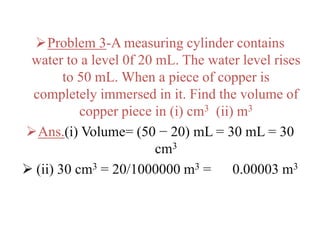
Problem 3-A measuring cylinder contains
water to a level 0f 20 mL. The water level rises
to 50 mL. When a piece of copper is
completely immersed in it. Find the volume of
copper piece in (i) cm3 (ii) m3
Ans.(i) Volume= (50 − 20) mL = 30 mL = 30
cm3
 (ii) 30 cm3 = 20/1000000 m3 = 0.00003 m3
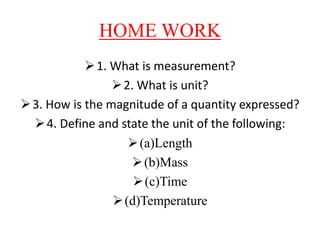
HOME WORK
1. What is measurement?
2. What is unit?
3. How is the magnitude of a quantity expressed?
4. Define and state the unit of the following:
(a)Length
(b)Mass
(c)Time
(d)Temperature
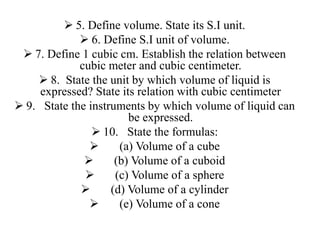
 5. Define volume. State its S.I unit.
 6. Define S.I unit of volume.
 7. Define 1 cubic cm. Establish the relation between
cubic meter and cubic centimeter.
 8. State the unit by which volume of liquid is
expressed? State its relation with cubic centimeter
 9. State the instruments by which volume of liquid can
be expressed.
 10. State the formulas:
 (a) Volume of a cube
 (b) Volume of a cuboid
 (c) Volume of a sphere
 (d) Volume of a cylinder
 (e) Volume of a cone
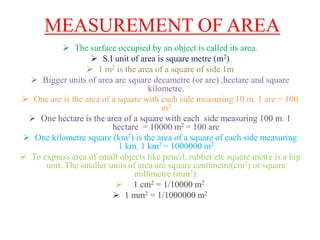
MEASUREMENT OF AREA
 The surface occupied by an object is called its area.
 S.I unit of area is square metre (m2)
 1 m2 is the area of a square of side 1m
 Bigger units of area are square decametre (or are) ,hectare and square
kilometre.
 One are is the area of a square with each side measuring 10 m. 1 are = 100
m2
 One hectare is the area of a square with each side measuring 100 m. 1
hectare = 10000 m2 = 100 are
 One kilometre square (km2) is the area of a square of each side measuring
1 km. 1 km2 = 1000000 m2
 To express area of small objects like pencil, rubber etc square metre is a big
unit. The smaller units of area are square centimetre(cm2) or square
millimetre (mm2).
 1 cm2 = 1/10000 m2
 1 mm2 = 1/1000000 m2
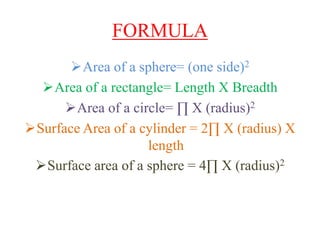
FORMULA
Area of a sphere= (one side)2
Area of a rectangle= Length X Breadth
Area of a circle= ∏ X (radius)2
Surface Area of a cylinder = 2∏ X (radius) X
length
Surface area of a sphere = 4∏ X (radius)2
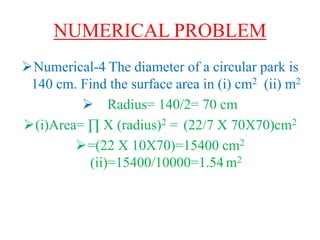
NUMERICAL PROBLEM
Numerical-4 The diameter of a circular park is
140 cm. Find the surface area in (i) cm2 (ii) m2
 Radius= 140/2= 70 cm
(i)Area= ∏ X (radius)2 = (22/7 X 70X70)cm2
=(22 X 10X70)=15400 cm2
(ii)=15400/10000=1.54 m2
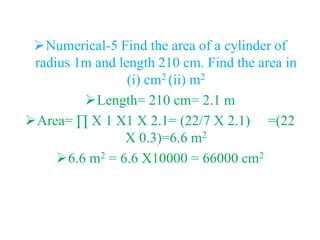
Numerical-5 Find the area of a cylinder of
radius 1m and length 210 cm. Find the area in
(i) cm2 (ii) m2
Length= 210 cm= 2.1 m
Area= ∏ X 1 X1 X 2.1= (22/7 X 2.1) =(22
X 0.3)=6.6 m2
6.6 m2 = 6.6 X10000 = 66000 cm2
DENSITY
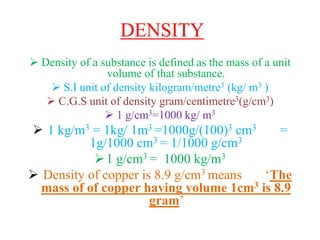
 Density of a substance is defined as the mass of a unit
volume of that substance.
 S.I unit of density kilogram/metre3 (kg/ m3 )
 C.G.S unit of density gram/centimetre3(g/cm3)
 1 g/cm3=1000 kg/ m3
 1 kg/m3 = 1kg/ 1m3 =1000g/(100)3 cm3 =
1g/1000 cm3 = 1/1000 g/cm3
1 g/cm3 = 1000 kg/m3
 Density of copper is 8.9 g/cm3 means ‘The
mass of of copper having volume 1cm3 is 8.9
gram’
NUMERICAL PROBLEM
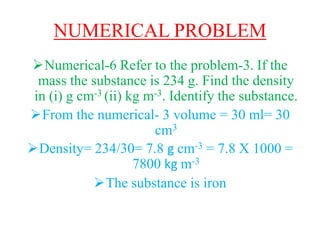
Numerical-6 Refer to the problem-3. If the
mass the substance is 234 g. Find the density
in (i) g cm-3 (ii) kg m-3. Identify the substance.
From the numerical- 3 volume = 30 ml= 30
cm3
Density= 234/30= 7.8 g cm-3 = 7.8 X 1000 =
7800 kg m-3
The substance is iron
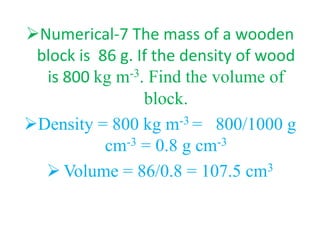
Numerical-7 The mass of a wooden
block is 86 g. If the density of wood
is 800 kg m-3. Find the volume of
block.
Density = 800 kg m-3 = 800/1000 g
cm-3 = 0.8 g cm-3
 Volume = 86/0.8 = 107.5 cm3
SPEED
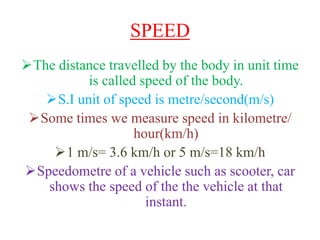
The distance travelled by the body in unit time
is called speed of the body.
S.I unit of speed is metre/second(m/s)
Some times we measure speed in kilometre/
hour(km/h)
1 m/s= 3.6 km/h or 5 m/s=18 km/h
Speedometre of a vehicle such as scooter, car
shows the speed of the the vehicle at that
instant.
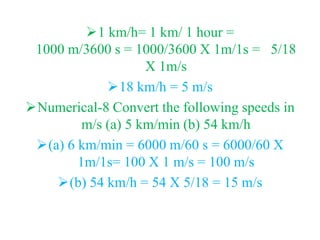
1 km/h= 1 km/ 1 hour =
1000 m/3600 s = 1000/3600 X 1m/1s = 5/18
X 1m/s
18 km/h = 5 m/s
Numerical-8 Convert the following speeds in
m/s (a) 5 km/min (b) 54 km/h
(a) 6 km/min = 6000 m/60 s = 6000/60 X
1m/1s= 100 X 1 m/s = 100 m/s
(b) 54 km/h = 54 X 5/18 = 15 m/s
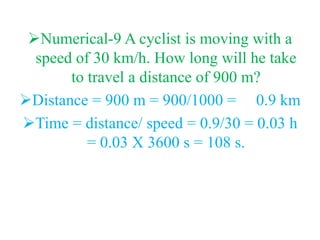
Numerical-9 A cyclist is moving with a
speed of 30 km/h. How long will he take
to travel a distance of 900 m?
Distance = 900 m = 900/1000 = 0.9 km
Time = distance/ speed = 0.9/30 = 0.03 h
= 0.03 X 3600 s = 108 s.
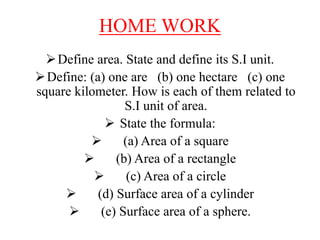
HOME WORK
Define area. State and define its S.I unit.
Define: (a) one are (b) one hectare (c) one
square kilometer. How is each of them related to
S.I unit of area.
 State the formula:
 (a) Area of a square
 (b) Area of a rectangle
 (c) Area of a circle
 (d) Surface area of a cylinder
 (e) Surface area of a sphere.
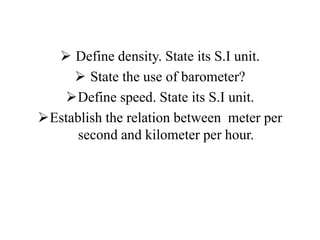
 Define density. State its S.I unit.
 State the use of barometer?
Define speed. State its S.I unit.
Establish the relation between meter per
second and kilometer per hour.
NUMERICALS FROM CONCISE
PHYSICS
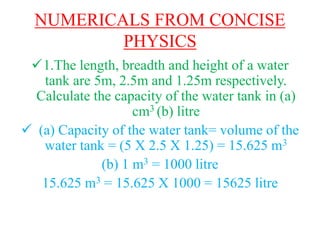
1.The length, breadth and height of a water
tank are 5m, 2.5m and 1.25m respectively.
Calculate the capacity of the water tank in (a)
cm3 (b) litre
 (a) Capacity of the water tank= volume of the
water tank = (5 X 2.5 X 1.25) = 15.625 m3
(b) 1 m3 = 1000 litre
15.625 m3 = 15.625 X 1000 = 15625 litre
2.A solid silver piece is immersed in water
contained in a measuring cylinder. The level of
water rises from 50 ml to 62 ml. Find the volume
of silver piece.
Ans. Volume of the silver piece = (62 − 50) [1 ml
= 1 cm3 ] = 12 ml = 12 cm3
3.Find the volume of a liquid present in a dish of
dimensions 10 cm X 10 cm X 5 cm.
Ans. Volume of liquid = Volume of dish =
(10 X 10 X 5) = 500 cm3
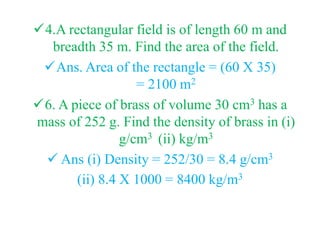
4.A rectangular field is of length 60 m and
breadth 35 m. Find the area of the field.
Ans. Area of the rectangle = (60 X 35)
= 2100 m2
6. A piece of brass of volume 30 cm3 has a
mass of 252 g. Find the density of brass in (i)
g/cm3 (ii) kg/m3
 Ans (i) Density = 252/30 = 8.4 g/cm3
(ii) 8.4 X 1000 = 8400 kg/m3
 7.The mass of an iron ball is 312g. The density of iron
is 7.8 g/cm3 . Find the volume of the ball.
 Ans. Volume of the ball = 312/7.8 = 40 cm3
 8. A cork has volume 25 cm3. The density of the cork
0.25 g/cm3. Find the mass of the cork.
 Ans. Mass of the cork = (25 X 0.25) = 6.25 g.
 9. Mass of 5 litre of water is 5 kg. Find the density of in
g/cm3.
 Volume = 5 L = 5000 ml = 5000 cm3
 [1 ml = 1 cm3 ]
 Mass = 5 kg = 5000 g
 Density = 5000/5000 = 1 g/cm3
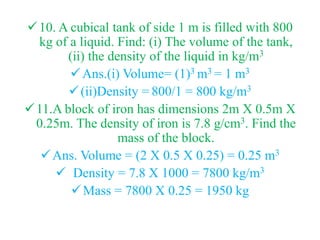
10. A cubical tank of side 1 m is filled with 800
kg of a liquid. Find: (i) The volume of the tank,
(ii) the density of the liquid in kg/m3
Ans.(i) Volume= (1)3 m3 = 1 m3
(ii)Density = 800/1 = 800 kg/m3
11.A block of iron has dimensions 2m X 0.5m X
0.25m. The density of iron is 7.8 g/cm3. Find the
mass of the block.
Ans. Volume = (2 X 0.5 X 0.25) = 0.25 m3
 Density = 7.8 X 1000 = 7800 kg/m3
Mass = 7800 X 0.25 = 1950 kg
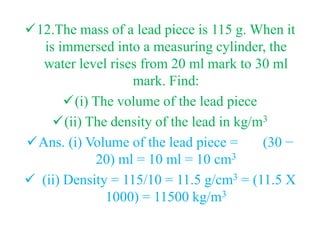
12.The mass of a lead piece is 115 g. When it
is immersed into a measuring cylinder, the
water level rises from 20 ml mark to 30 ml
mark. Find:
(i) The volume of the lead piece
(ii) The density of the lead in kg/m3
Ans. (i) Volume of the lead piece = (30 −
20) ml = 10 ml = 10 cm3
 (ii) Density = 115/10 = 11.5 g/cm3 = (11.5 X
1000) = 11500 kg/m3
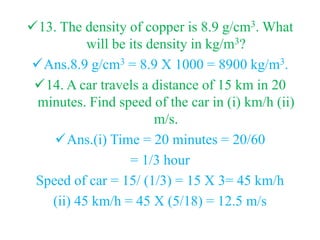
13. The density of copper is 8.9 g/cm3. What
will be its density in kg/m3?
Ans.8.9 g/cm3 = 8.9 X 1000 = 8900 kg/m3.
14. A car travels a distance of 15 km in 20
minutes. Find speed of the car in (i) km/h (ii)
m/s.
Ans.(i) Time = 20 minutes = 20/60
= 1/3 hour
Speed of car = 15/ (1/3) = 15 X 3= 45 km/h
(ii) 45 km/h = 45 X (5/18) = 12.5 m/s
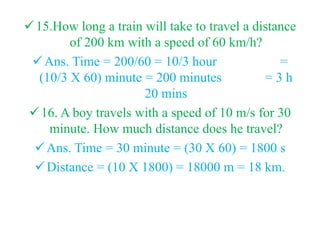
15.How long a train will take to travel a distance
of 200 km with a speed of 60 km/h?
Ans. Time = 200/60 = 10/3 hour =
(10/3 X 60) minute = 200 minutes = 3 h
20 mins
16. A boy travels with a speed of 10 m/s for 30
minute. How much distance does he travel?
Ans. Time = 30 minute = (30 X 60) = 1800 s
Distance = (10 X 1800) = 18000 m = 18 km.
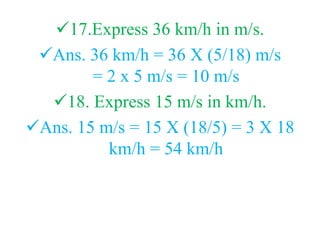
17.Express 36 km/h in m/s.
Ans. 36 km/h = 36 X (5/18) m/s
= 2 x 5 m/s = 10 m/s
18. Express 15 m/s in km/h.
Ans. 15 m/s = 15 X (18/5) = 3 X 18
km/h = 54 km/h
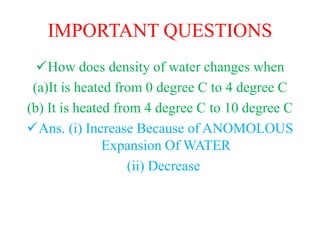
IMPORTANT QUESTIONS
How does density of water changes when
(a)It is heated from 0 degree C to 4 degree C
(b) It is heated from 4 degree C to 10 degree C
Ans. (i) Increase Because of ANOMOLOUS
Expansion Of WATER
(ii) Decrease
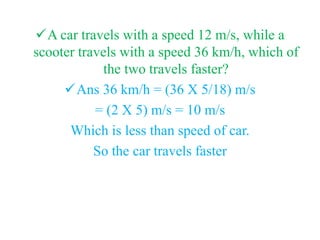
A car travels with a speed 12 m/s, while a
scooter travels with a speed 36 km/h, which of
the two travels faster?
Ans 36 km/h = (36 X 5/18) m/s
= (2 X 5) m/s = 10 m/s
Which is less than speed of car.
So the car travels faster
THANK
YOU

Class 7 PHYSICAL QUANTITY & MEASUREMENT

  • 1.
    WELCOME TO MYCLASS Mr. Souvik Chatterjee M.Sc (Physics)&B.Ed
  • 2.
    PHYSICAL QUANTITY & MEASUREMENT Measurementof volume(3D Concept) Concept Of unit volume Measurement of area: Estimate the area of irregular shape objects using graph paper Measuirement of density of regular solids: Basic concepts, Formula, Simple Numericals (S.I unit not required Calculation of speed: Basic Concept, Formula, Simple Numericals (S.I unit not required)
  • 3.
    KEY POINTS  Measurementis a process of comparision of the given unknown quantity with a fixed known quantity of the second kind called unit  Magnitude= Number of times the unit is contained in the quantity X Unit  Length is the distance between two points. Its S.I unit is metre (m). It is measured with the help of a metre rule or measuring tape.  Mass is the quantity of matter contained in the body. Its S.I unit is kilogram (kg). It is measured by a beam balance or an electronic balance.  Time is the interval of occurrence of an event. Its S.I unit is second (s). It is measured with the help of a pendulum clock or a stop watch or stop-clock  Temperature is a quantity which measures the hotness and coldness of a body. Its S.I unit is kelvin (K). It is measured using a thermometer.
  • 4.
    MEASUREMENT OF VOLUME The space occupied by an object is called volume  S.I unit of volume is cubic metre (m3)  Cubic metre is the volume of a cube with each side 1 meter long  1 m3 = 1m X 1m X 1m  Cubic centimetre is the volume of cube with each side 1 centimeter  1 cm3 = 1 cm X 1 cm X 1 cm  1 m3 = 1 m X 1 m X 1 m = 100 cm X 100 cm X 100 cm =1000000 cm3 = 10 6 cm3  The volume of a liquids is generally expressed in litre (L)  1 litre = 1000 cm3  1 cm3 = 1 mL 
  • 5.
    VESSELS FOR MEASURINGTHE VOLUME OF LIQUIDS  Measuring Cylinder
  • 6.
  • 7.
    IMPORTANT FORMULA Volume ofCube=(One side)3 Volume of Cuboid= Length X Breadth X Height Volume of a sphere =4/3 X ∏ X (radius)3 Volume of a cylinder=∏ X (radius)2 X Height  Volume of a Cone = ∏/3 X (radius)2 X Height Where ∏=3.141 or 22/7
  • 8.
    NUMERICAL PROBLEM Problem-1. Abox of dimensions 1.5 cm X 2.0 cm X 90.0 cm. Find the volume of the box in (i) m3 (ii) cm3 (i) Volume= (1.5 X 2.0 X 90.0)= 270 cm3 1 cm3 = 1/1000000 m3 (ii) 270 cm3 = 270/1000000=0.00027 m3
  • 9.
    Problem-2. A cylinderhas length 80 cm and radius 2 m. Find vo lume in (i) m3 (ii) cm3 Ans. (i) length= 80 cm= 80/100= 0.8 m Volume= ∏ X 2 X 2 X 0.8 = 10.05 m3  1 m3 = 100000 cm3 (ii)10.05 m3 = 10.05 X 1000000 cm3 = 10050000 cm3
  • 10.
    Problem 3-A measuringcylinder contains water to a level 0f 20 mL. The water level rises to 50 mL. When a piece of copper is completely immersed in it. Find the volume of copper piece in (i) cm3 (ii) m3 Ans.(i) Volume= (50 − 20) mL = 30 mL = 30 cm3  (ii) 30 cm3 = 20/1000000 m3 = 0.00003 m3
  • 11.
    HOME WORK 1. Whatis measurement? 2. What is unit? 3. How is the magnitude of a quantity expressed? 4. Define and state the unit of the following: (a)Length (b)Mass (c)Time (d)Temperature
  • 12.
     5. Definevolume. State its S.I unit.  6. Define S.I unit of volume.  7. Define 1 cubic cm. Establish the relation between cubic meter and cubic centimeter.  8. State the unit by which volume of liquid is expressed? State its relation with cubic centimeter  9. State the instruments by which volume of liquid can be expressed.  10. State the formulas:  (a) Volume of a cube  (b) Volume of a cuboid  (c) Volume of a sphere  (d) Volume of a cylinder  (e) Volume of a cone
  • 13.
    MEASUREMENT OF AREA The surface occupied by an object is called its area.  S.I unit of area is square metre (m2)  1 m2 is the area of a square of side 1m  Bigger units of area are square decametre (or are) ,hectare and square kilometre.  One are is the area of a square with each side measuring 10 m. 1 are = 100 m2  One hectare is the area of a square with each side measuring 100 m. 1 hectare = 10000 m2 = 100 are  One kilometre square (km2) is the area of a square of each side measuring 1 km. 1 km2 = 1000000 m2  To express area of small objects like pencil, rubber etc square metre is a big unit. The smaller units of area are square centimetre(cm2) or square millimetre (mm2).  1 cm2 = 1/10000 m2  1 mm2 = 1/1000000 m2
  • 14.
    FORMULA Area of asphere= (one side)2 Area of a rectangle= Length X Breadth Area of a circle= ∏ X (radius)2 Surface Area of a cylinder = 2∏ X (radius) X length Surface area of a sphere = 4∏ X (radius)2
  • 15.
    NUMERICAL PROBLEM Numerical-4 Thediameter of a circular park is 140 cm. Find the surface area in (i) cm2 (ii) m2  Radius= 140/2= 70 cm (i)Area= ∏ X (radius)2 = (22/7 X 70X70)cm2 =(22 X 10X70)=15400 cm2 (ii)=15400/10000=1.54 m2
  • 16.
    Numerical-5 Find thearea of a cylinder of radius 1m and length 210 cm. Find the area in (i) cm2 (ii) m2 Length= 210 cm= 2.1 m Area= ∏ X 1 X1 X 2.1= (22/7 X 2.1) =(22 X 0.3)=6.6 m2 6.6 m2 = 6.6 X10000 = 66000 cm2
  • 17.
    DENSITY  Density ofa substance is defined as the mass of a unit volume of that substance.  S.I unit of density kilogram/metre3 (kg/ m3 )  C.G.S unit of density gram/centimetre3(g/cm3)  1 g/cm3=1000 kg/ m3  1 kg/m3 = 1kg/ 1m3 =1000g/(100)3 cm3 = 1g/1000 cm3 = 1/1000 g/cm3 1 g/cm3 = 1000 kg/m3  Density of copper is 8.9 g/cm3 means ‘The mass of of copper having volume 1cm3 is 8.9 gram’
  • 18.
    NUMERICAL PROBLEM Numerical-6 Referto the problem-3. If the mass the substance is 234 g. Find the density in (i) g cm-3 (ii) kg m-3. Identify the substance. From the numerical- 3 volume = 30 ml= 30 cm3 Density= 234/30= 7.8 g cm-3 = 7.8 X 1000 = 7800 kg m-3 The substance is iron
  • 19.
    Numerical-7 The massof a wooden block is 86 g. If the density of wood is 800 kg m-3. Find the volume of block. Density = 800 kg m-3 = 800/1000 g cm-3 = 0.8 g cm-3  Volume = 86/0.8 = 107.5 cm3
  • 20.
    SPEED The distance travelledby the body in unit time is called speed of the body. S.I unit of speed is metre/second(m/s) Some times we measure speed in kilometre/ hour(km/h) 1 m/s= 3.6 km/h or 5 m/s=18 km/h Speedometre of a vehicle such as scooter, car shows the speed of the the vehicle at that instant.
  • 21.
    1 km/h= 1km/ 1 hour = 1000 m/3600 s = 1000/3600 X 1m/1s = 5/18 X 1m/s 18 km/h = 5 m/s Numerical-8 Convert the following speeds in m/s (a) 5 km/min (b) 54 km/h (a) 6 km/min = 6000 m/60 s = 6000/60 X 1m/1s= 100 X 1 m/s = 100 m/s (b) 54 km/h = 54 X 5/18 = 15 m/s
  • 22.
    Numerical-9 A cyclistis moving with a speed of 30 km/h. How long will he take to travel a distance of 900 m? Distance = 900 m = 900/1000 = 0.9 km Time = distance/ speed = 0.9/30 = 0.03 h = 0.03 X 3600 s = 108 s.
  • 23.
    HOME WORK Define area.State and define its S.I unit. Define: (a) one are (b) one hectare (c) one square kilometer. How is each of them related to S.I unit of area.  State the formula:  (a) Area of a square  (b) Area of a rectangle  (c) Area of a circle  (d) Surface area of a cylinder  (e) Surface area of a sphere.
  • 24.
     Define density.State its S.I unit.  State the use of barometer? Define speed. State its S.I unit. Establish the relation between meter per second and kilometer per hour.
  • 25.
    NUMERICALS FROM CONCISE PHYSICS 1.Thelength, breadth and height of a water tank are 5m, 2.5m and 1.25m respectively. Calculate the capacity of the water tank in (a) cm3 (b) litre  (a) Capacity of the water tank= volume of the water tank = (5 X 2.5 X 1.25) = 15.625 m3 (b) 1 m3 = 1000 litre 15.625 m3 = 15.625 X 1000 = 15625 litre
  • 26.
    2.A solid silverpiece is immersed in water contained in a measuring cylinder. The level of water rises from 50 ml to 62 ml. Find the volume of silver piece. Ans. Volume of the silver piece = (62 − 50) [1 ml = 1 cm3 ] = 12 ml = 12 cm3 3.Find the volume of a liquid present in a dish of dimensions 10 cm X 10 cm X 5 cm. Ans. Volume of liquid = Volume of dish = (10 X 10 X 5) = 500 cm3
  • 27.
    4.A rectangular fieldis of length 60 m and breadth 35 m. Find the area of the field. Ans. Area of the rectangle = (60 X 35) = 2100 m2 6. A piece of brass of volume 30 cm3 has a mass of 252 g. Find the density of brass in (i) g/cm3 (ii) kg/m3  Ans (i) Density = 252/30 = 8.4 g/cm3 (ii) 8.4 X 1000 = 8400 kg/m3
  • 28.
     7.The massof an iron ball is 312g. The density of iron is 7.8 g/cm3 . Find the volume of the ball.  Ans. Volume of the ball = 312/7.8 = 40 cm3  8. A cork has volume 25 cm3. The density of the cork 0.25 g/cm3. Find the mass of the cork.  Ans. Mass of the cork = (25 X 0.25) = 6.25 g.  9. Mass of 5 litre of water is 5 kg. Find the density of in g/cm3.  Volume = 5 L = 5000 ml = 5000 cm3  [1 ml = 1 cm3 ]  Mass = 5 kg = 5000 g  Density = 5000/5000 = 1 g/cm3
  • 29.
    10. A cubicaltank of side 1 m is filled with 800 kg of a liquid. Find: (i) The volume of the tank, (ii) the density of the liquid in kg/m3 Ans.(i) Volume= (1)3 m3 = 1 m3 (ii)Density = 800/1 = 800 kg/m3 11.A block of iron has dimensions 2m X 0.5m X 0.25m. The density of iron is 7.8 g/cm3. Find the mass of the block. Ans. Volume = (2 X 0.5 X 0.25) = 0.25 m3  Density = 7.8 X 1000 = 7800 kg/m3 Mass = 7800 X 0.25 = 1950 kg
  • 30.
    12.The mass ofa lead piece is 115 g. When it is immersed into a measuring cylinder, the water level rises from 20 ml mark to 30 ml mark. Find: (i) The volume of the lead piece (ii) The density of the lead in kg/m3 Ans. (i) Volume of the lead piece = (30 − 20) ml = 10 ml = 10 cm3  (ii) Density = 115/10 = 11.5 g/cm3 = (11.5 X 1000) = 11500 kg/m3
  • 31.
    13. The densityof copper is 8.9 g/cm3. What will be its density in kg/m3? Ans.8.9 g/cm3 = 8.9 X 1000 = 8900 kg/m3. 14. A car travels a distance of 15 km in 20 minutes. Find speed of the car in (i) km/h (ii) m/s. Ans.(i) Time = 20 minutes = 20/60 = 1/3 hour Speed of car = 15/ (1/3) = 15 X 3= 45 km/h (ii) 45 km/h = 45 X (5/18) = 12.5 m/s
  • 32.
    15.How long atrain will take to travel a distance of 200 km with a speed of 60 km/h? Ans. Time = 200/60 = 10/3 hour = (10/3 X 60) minute = 200 minutes = 3 h 20 mins 16. A boy travels with a speed of 10 m/s for 30 minute. How much distance does he travel? Ans. Time = 30 minute = (30 X 60) = 1800 s Distance = (10 X 1800) = 18000 m = 18 km.
  • 33.
    17.Express 36 km/hin m/s. Ans. 36 km/h = 36 X (5/18) m/s = 2 x 5 m/s = 10 m/s 18. Express 15 m/s in km/h. Ans. 15 m/s = 15 X (18/5) = 3 X 18 km/h = 54 km/h
  • 34.
    IMPORTANT QUESTIONS How doesdensity of water changes when (a)It is heated from 0 degree C to 4 degree C (b) It is heated from 4 degree C to 10 degree C Ans. (i) Increase Because of ANOMOLOUS Expansion Of WATER (ii) Decrease
  • 35.
    A car travelswith a speed 12 m/s, while a scooter travels with a speed 36 km/h, which of the two travels faster? Ans 36 km/h = (36 X 5/18) m/s = (2 X 5) m/s = 10 m/s Which is less than speed of car. So the car travels faster
  • 36.

Editor's Notes

  • #8 Copy the formulas