PHYSICAL QUANTITIES
AND MEASUREMENT
UNIT 1
INSIGHTS OF PHYSICS
LEARNING OUTCOMES
Describe the role of physics in science, technology and society.
 Explain with examples that science is based on physical quantities which consist of numerical magnitude and a
unit.
 Differentiate between base and derived physical quantities.
 List the seven units of system international (SI) along with their symbols and physical quantities (standard
definitions of SI units are not required).
 Interconvert the prefixes and their symbols to indicate multiples and sub-multiples for both base and derived
units.
 Write the answer in scientific notation in measurements and calculations.
 Describe the working of Vernier caliper's and screw gauge for measuring length.
 Identify and explain the limitations of measuring instruments such as meter rule, Vernier caliper's and screw
gauge.
Describe the need using significant figures for recording and stating results in the laboratory.
INSIGHTS OF PHYSICS
Physical Quantities and Measurement UNIT 1
CONTENTS
1.1 Introduction to physics
1.2 Physical quantities
1.3 International system of units
1.4 Prefixes (multiples and sub-multiples)
1.5 Scientific notation/ standard form
1.6 Measuring instruments
• meter rule
• Vernier calipers
• screw gauge
• physical balance
• stopwatch
• measuring cylinder
1.7 An introduction to significant figures
INSIGHTS OF PHYSICS
Physical Quantities and Measurement UNIT 1
SCIENCE, TECHNOLOGY AND SOCIETY CONNECTION
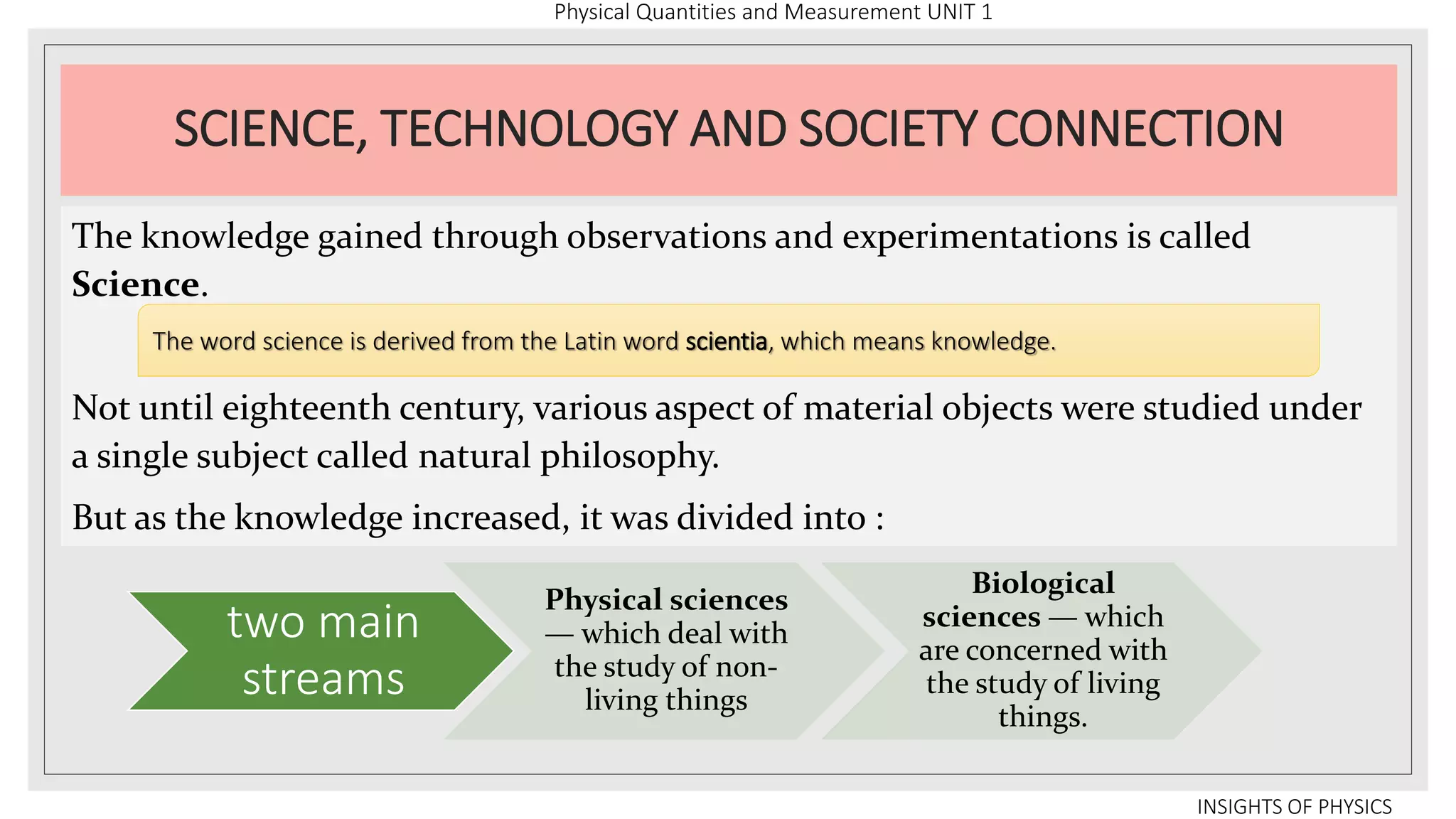
The knowledge gained through observations and experimentations is called
Science.
Not until eighteenth century, various aspect of material objects were studied under
a single subject called natural philosophy.
But as the knowledge increased, it was divided into :
The word science is derived from the Latin word scientia, which means knowledge.
two main
streams
Physical sciences
— which deal with
the study of non-
living things
Biological
sciences — which
are concerned with
the study of living
things.
INSIGHTS OF PHYSICS
Physical Quantities and Measurement UNIT 1
INTRODUCTION TO PHYSICS
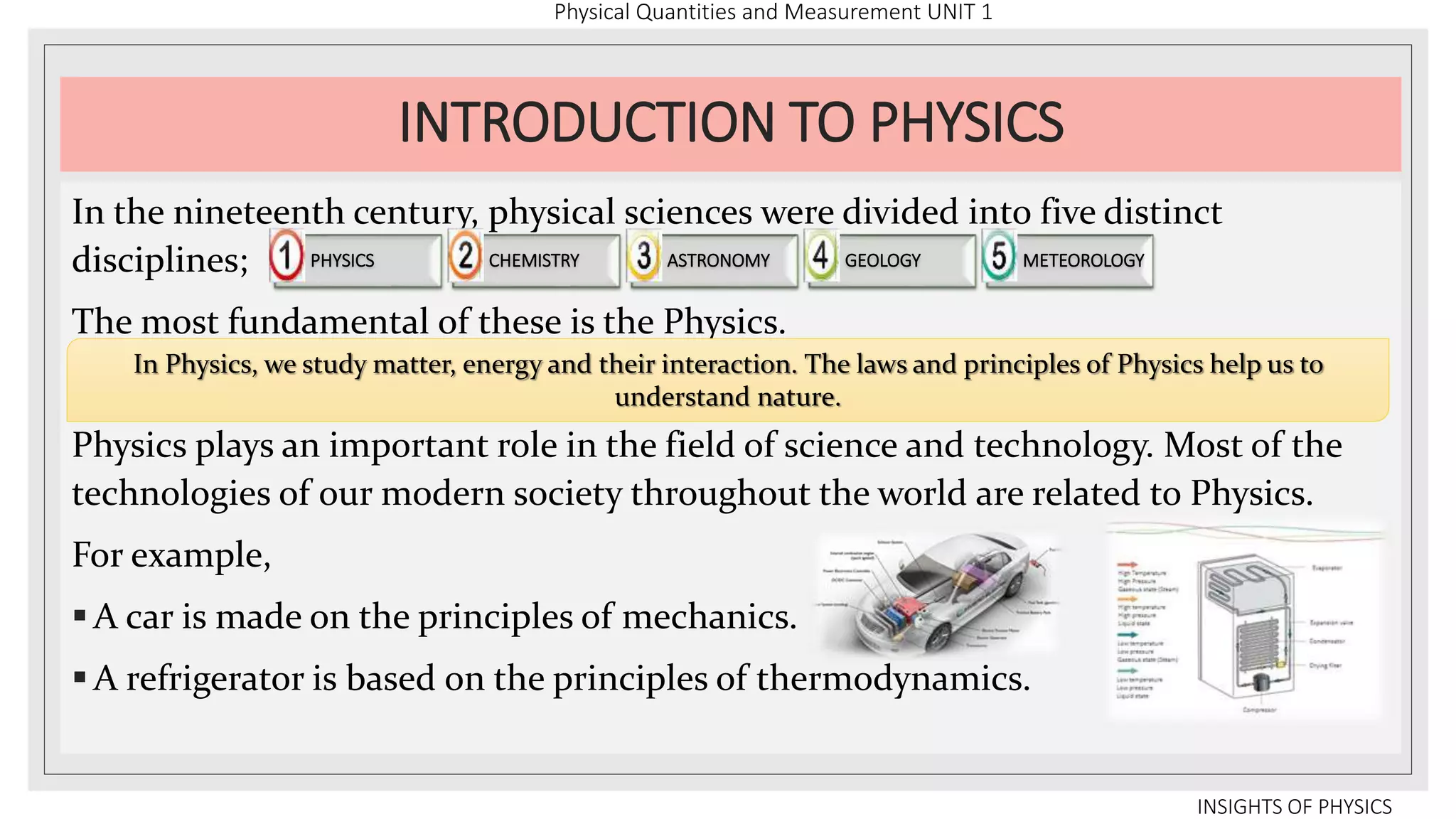
In the nineteenth century, physical sciences were divided into five distinct
disciplines;
The most fundamental of these is the Physics.
Physics plays an important role in the field of science and technology. Most of the
technologies of our modern society throughout the world are related to Physics.
For example,
A car is made on the principles of mechanics.
A refrigerator is based on the principles of thermodynamics.
PHYSICS CHEMISTRY ASTRONOMY GEOLOGY METEOROLOGY
In Physics, we study matter, energy and their interaction. The laws and principles of Physics help us to
understand nature.
INSIGHTS OF PHYSICS
Physical Quantities and Measurement UNIT 1
In our daily life, Physics is everywhere.
Pulleys that make it easy to lift heavy loads.
Electricity is used not only to get light and heat but also mechanical energy that
drives fans and electric motors etc.
Means of transportation such as car and aero planes
Domestic appliances such as air conditioners, refrigerators, vacuum-cleaners,
washing machines, and microwave ovens etc. Similarly the means of
communication such as radio, TV, telephone and computer are the result of
applications of physics.
INSIGHTS OF PHYSICS
INTRODUCTION TO PHYSICS
Physical Quantities and Measurement UNIT 1
For example,
Think of what a mobile phone smaller than our palm?
It allows us to contact people anywhere in the world and to get latest worldwide
information. We can take and save pictures, send and receive messages of our
friends. We can also receive radio transmission and can use it as a calculator as
well.
However, the scientific inventions have also caused harms and destruction of
serious nature. One of which is the environmental pollution and the other is the
deadly weapons.
INSIGHTS OF PHYSICS
INTRODUCTION TO PHYSICS
Physical Quantities and Measurement UNIT 1
BRANCHES OF PHYSICS
Mechanics
Heat
Sound
Light
(Optics)
Electricity
and
Magnetism
Atomic
Physics
Nuclear
Physics
Plasma
Physics
Geophysics
INSIGHTS OF PHYSICS
Physical Quantities and Measurement UNIT 1
BRANCHES OF PHYSICS
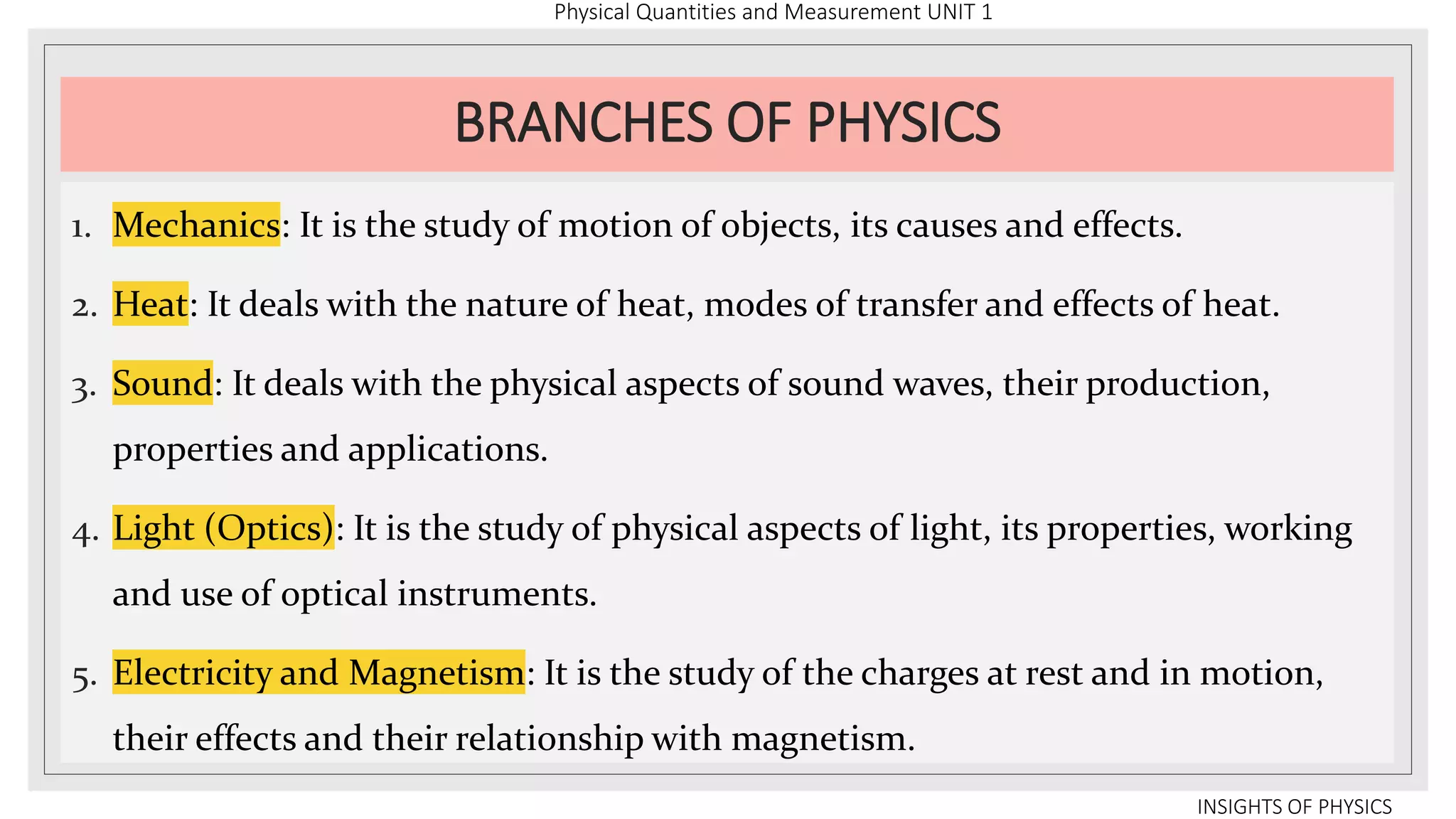
1. Mechanics: It is the study of motion of objects, its causes and effects.
2. Heat: It deals with the nature of heat, modes of transfer and effects of heat.
3. Sound: It deals with the physical aspects of sound waves, their production,
properties and applications.
4. Light (Optics): It is the study of physical aspects of light, its properties, working
and use of optical instruments.
5. Electricity and Magnetism: It is the study of the charges at rest and in motion,
their effects and their relationship with magnetism.
INSIGHTS OF PHYSICS
Physical Quantities and Measurement UNIT 1
BRANCHES OF PHYSICS
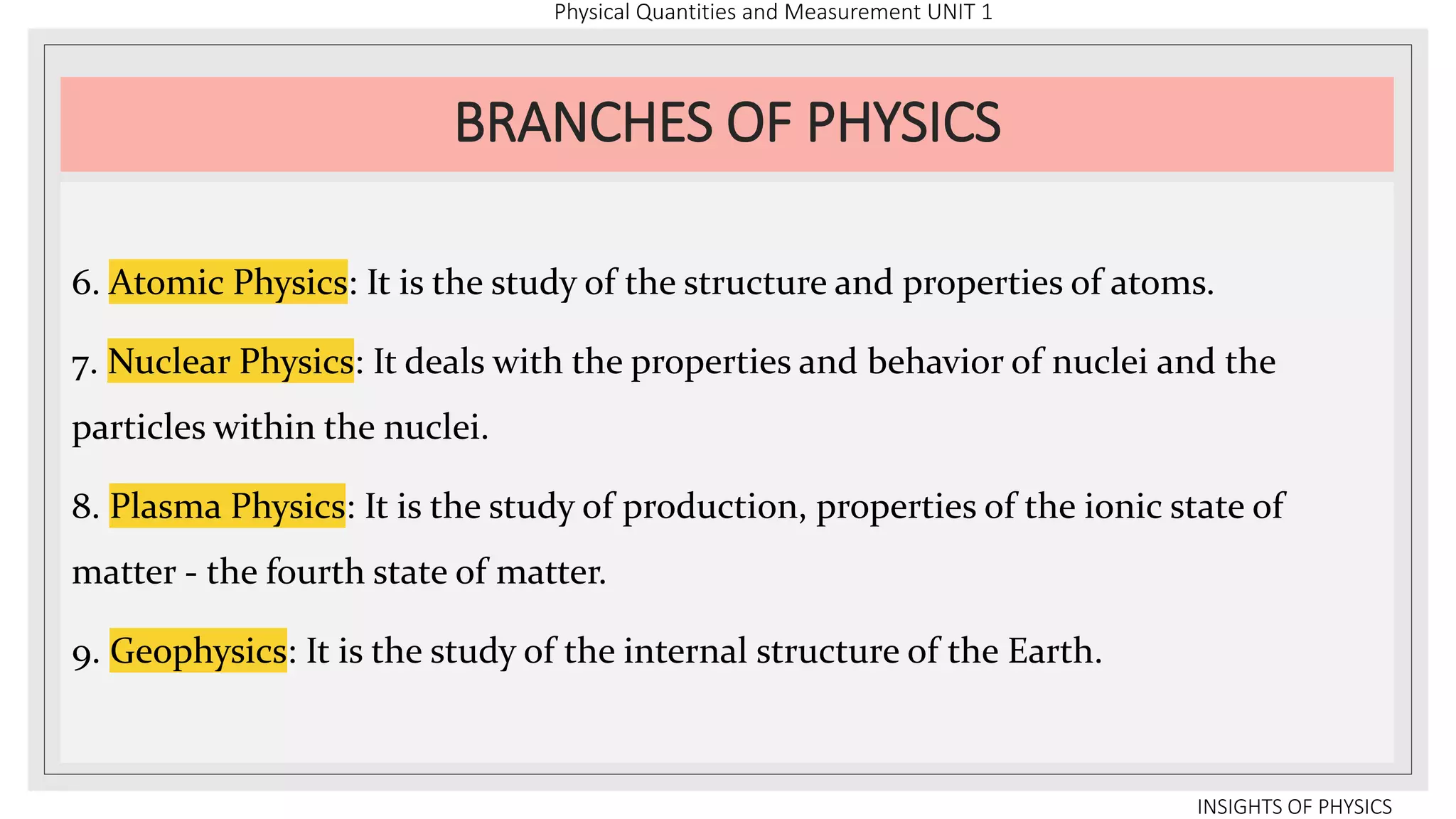
6. Atomic Physics: It is the study of the structure and properties of atoms.
7. Nuclear Physics: It deals with the properties and behavior of nuclei and the
particles within the nuclei.
8. Plasma Physics: It is the study of production, properties of the ionic state of
matter - the fourth state of matter.
9. Geophysics: It is the study of the internal structure of the Earth.
INSIGHTS OF PHYSICS
Physical Quantities and Measurement UNIT 1
FOR YOUR INFORMATION
Andromeda is one of the
billions of galaxies of known
universe.
Wind turbines are used to
produce pollution free
electricity
INSIGHTS OF PHYSICS
Physical Quantities and Measurement UNIT 1
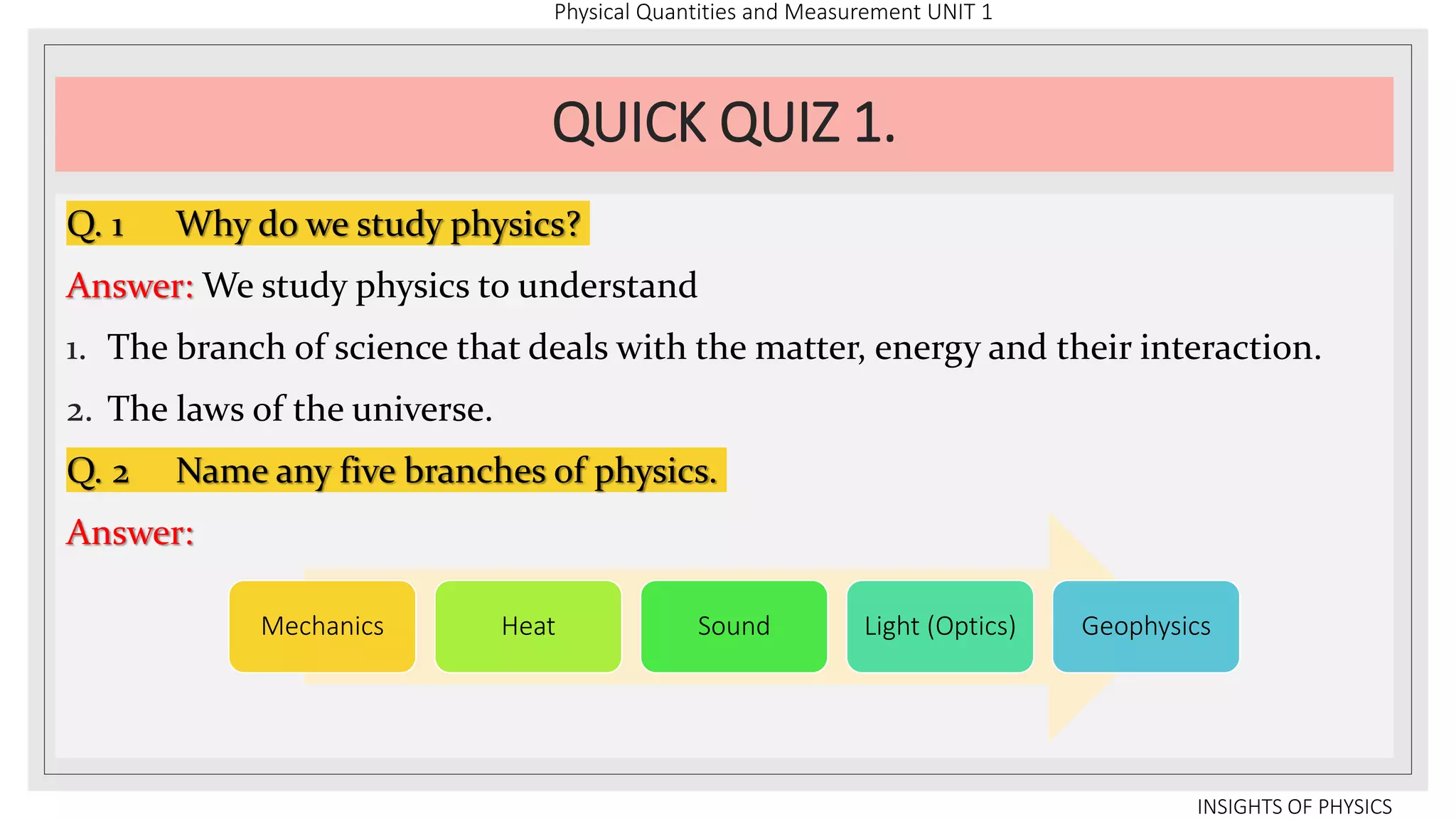
QUICK QUIZ 1.
Q. 1 Why do we study physics?
Answer: We study physics to understand
1. The branch of science that deals with the matter, energy and their interaction.
2. The laws of the universe.
Q. 2 Name any five branches of physics.
Answer:
INSIGHTS OF PHYSICS
Physical Quantities and Measurement UNIT 1
Mechanics Heat Sound Light (Optics) Geophysics
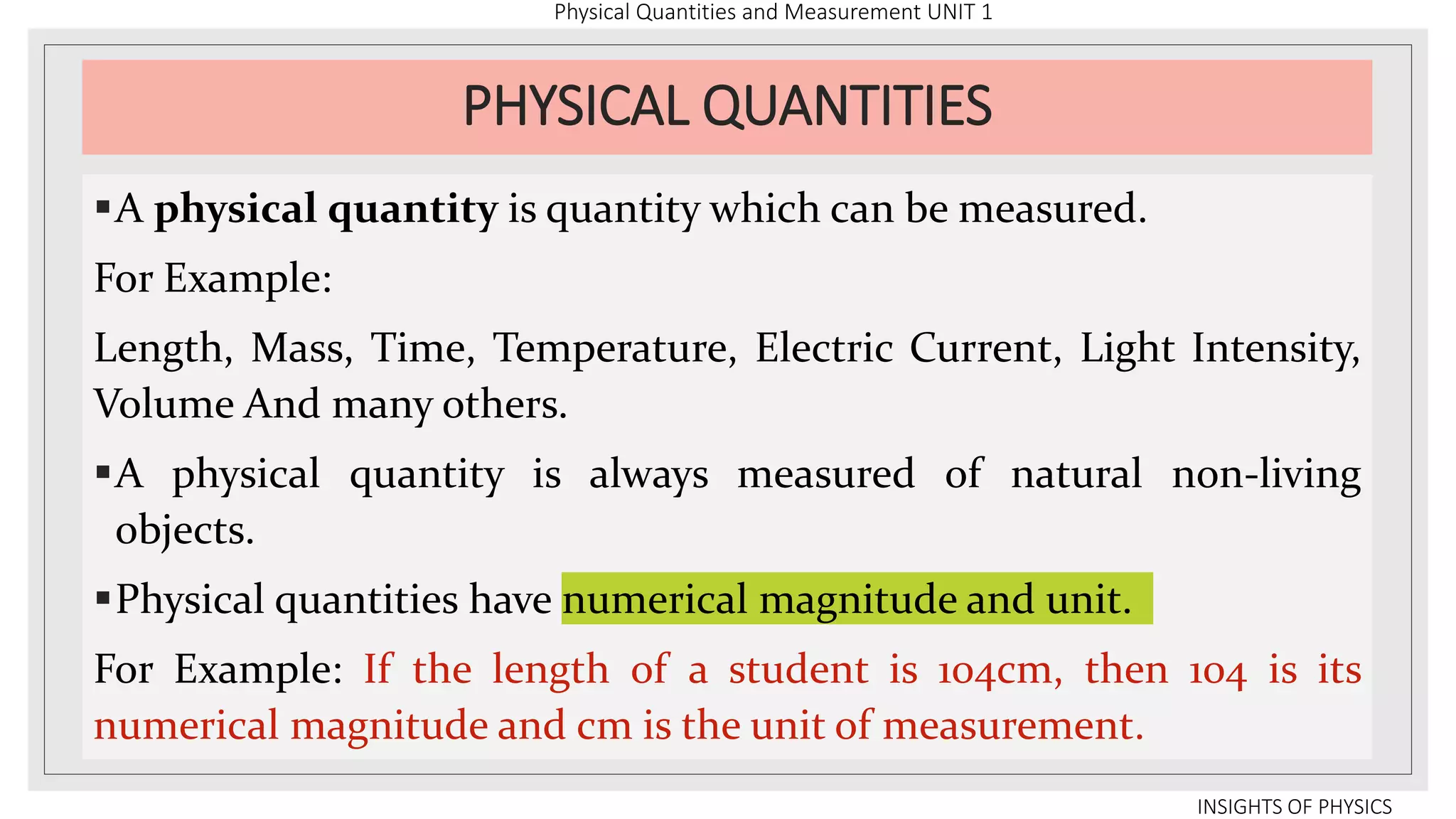
A physical quantity is quantity which can be measured.
For Example:
Length, Mass, Time, Temperature, Electric Current, Light Intensity,
Volume And many others.
A physical quantity is always measured of natural non-living
objects.
Physical quantities have numerical magnitude and unit.
For Example: If the length of a student is 104cm, then 104 is its
numerical magnitude and cm is the unit of measurement.
INSIGHTS OF PHYSICS
PHYSICAL QUANTITIES
Physical Quantities and Measurement UNIT 1
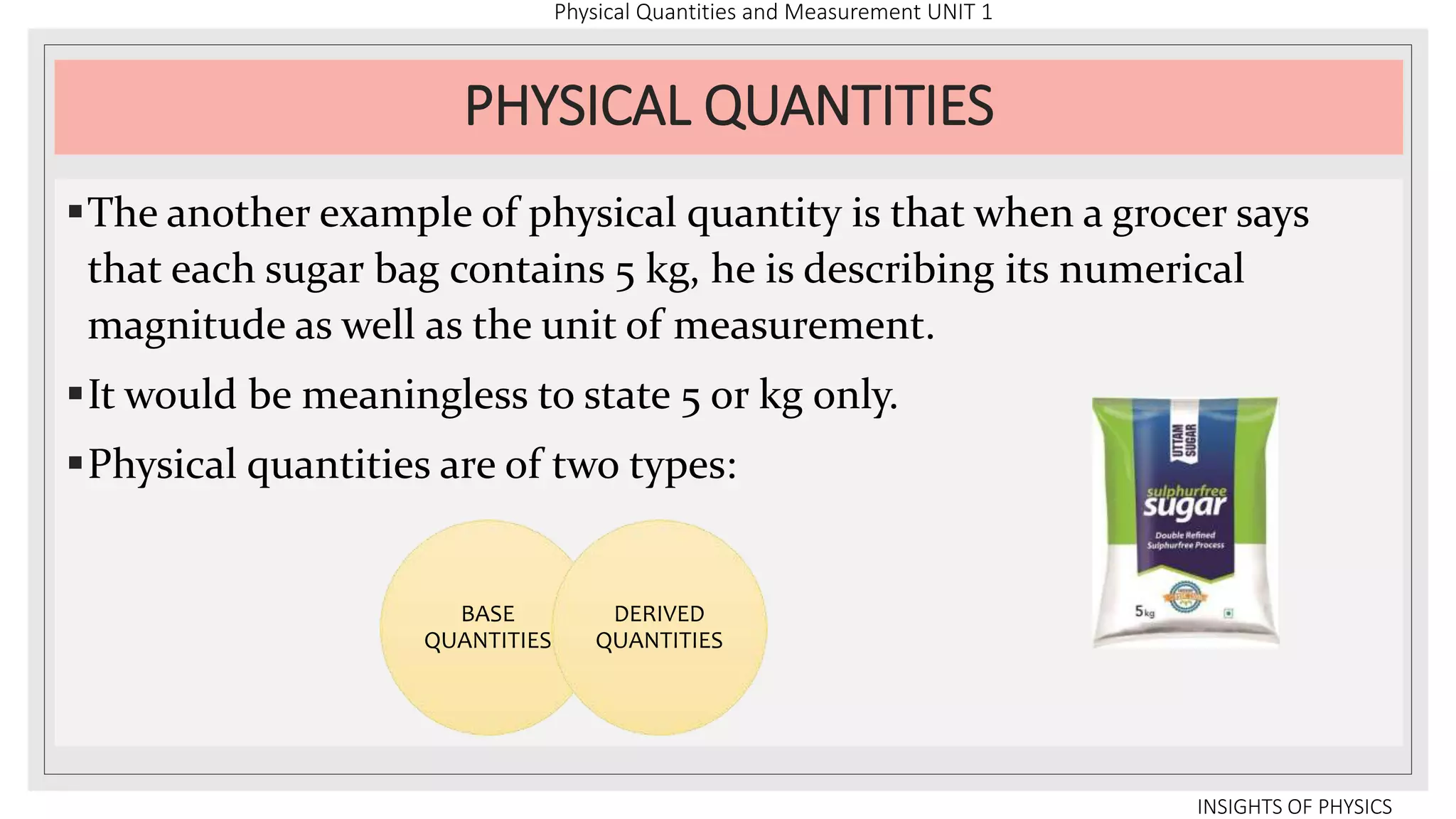
The another example of physical quantity is that when a grocer says
that each sugar bag contains 5 kg, he is describing its numerical
magnitude as well as the unit of measurement.
It would be meaningless to state 5 or kg only.
Physical quantities are of two types:
INSIGHTS OF PHYSICS
PHYSICAL QUANTITIES
Physical Quantities and Measurement UNIT 1
BASE
QUANTITIES
DERIVED
QUANTITIES
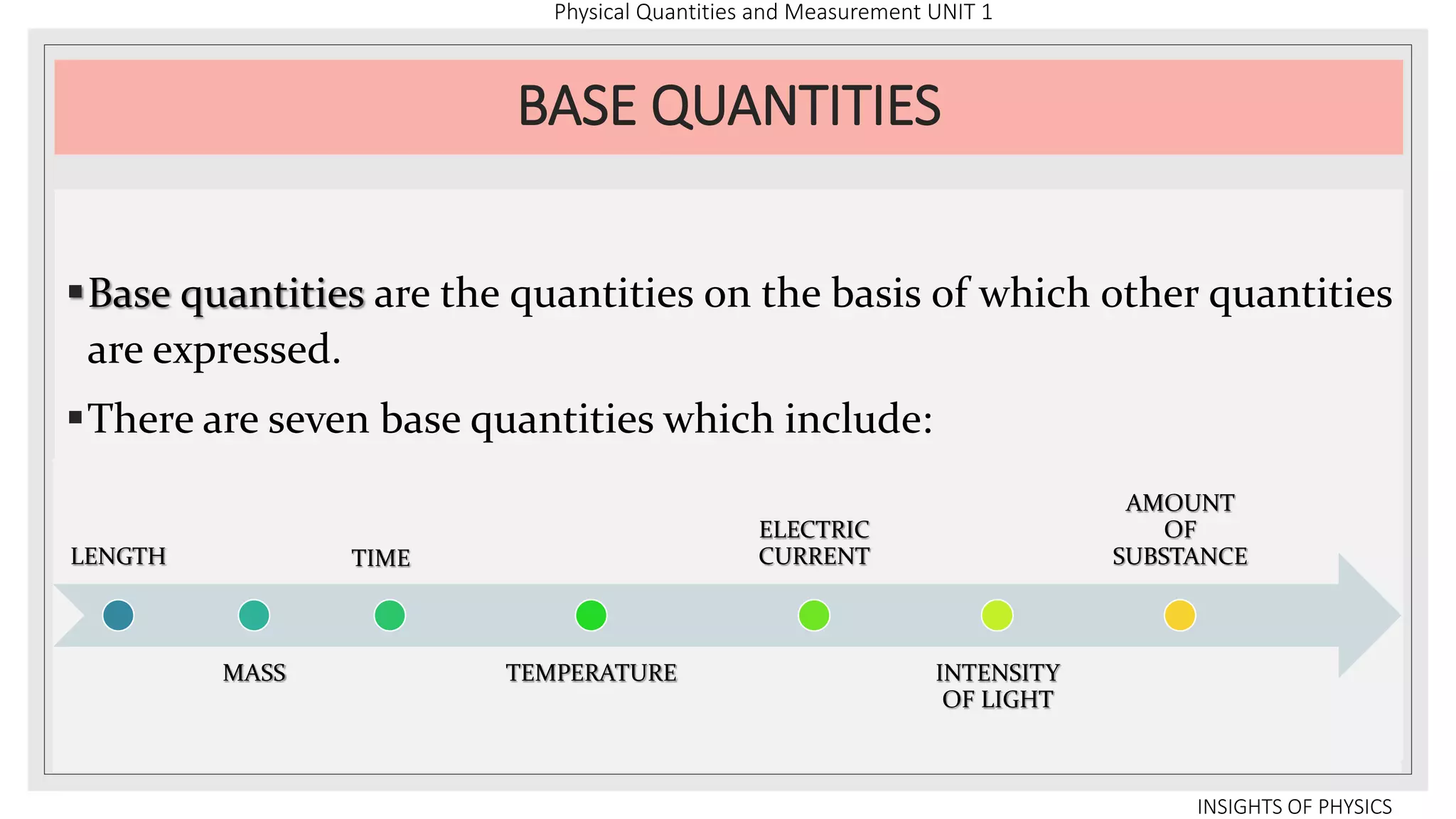
Base quantities are the quantities on the basis of which other quantities
are expressed.
There are seven base quantities which include:
INSIGHTS OF PHYSICS
BASE QUANTITIES
Physical Quantities and Measurement UNIT 1
LENGTH
MASS
TIME
TEMPERATURE
ELECTRIC
CURRENT
INTENSITY
OF LIGHT
AMOUNT
OF
SUBSTANCE
Derived quantities are the quantities which are expressed in terms of
base quantities.
These include:
INSIGHTS OF PHYSICS
DERIVED QUANTITIES
Physical Quantities and Measurement UNIT 1
AREA
VOLUME
SPEED
FORCE
WORK
ENERGY
POWER
ELECTRIC
CHARGE
What is unit?
Once a standard is set for quantity then it can be expressed in terms of
that standard quantity. This standard quantity is called a unit.
The eleventh General Conference on Weight and Measures held in Paris
in 1960 adopted a world-wide system of measurements called
International System of Units.
The International System of Units is referred as SI.
INSIGHTS OF PHYSICS
SI UNITS- International System of Units
Physical Quantities and Measurement UNIT 1
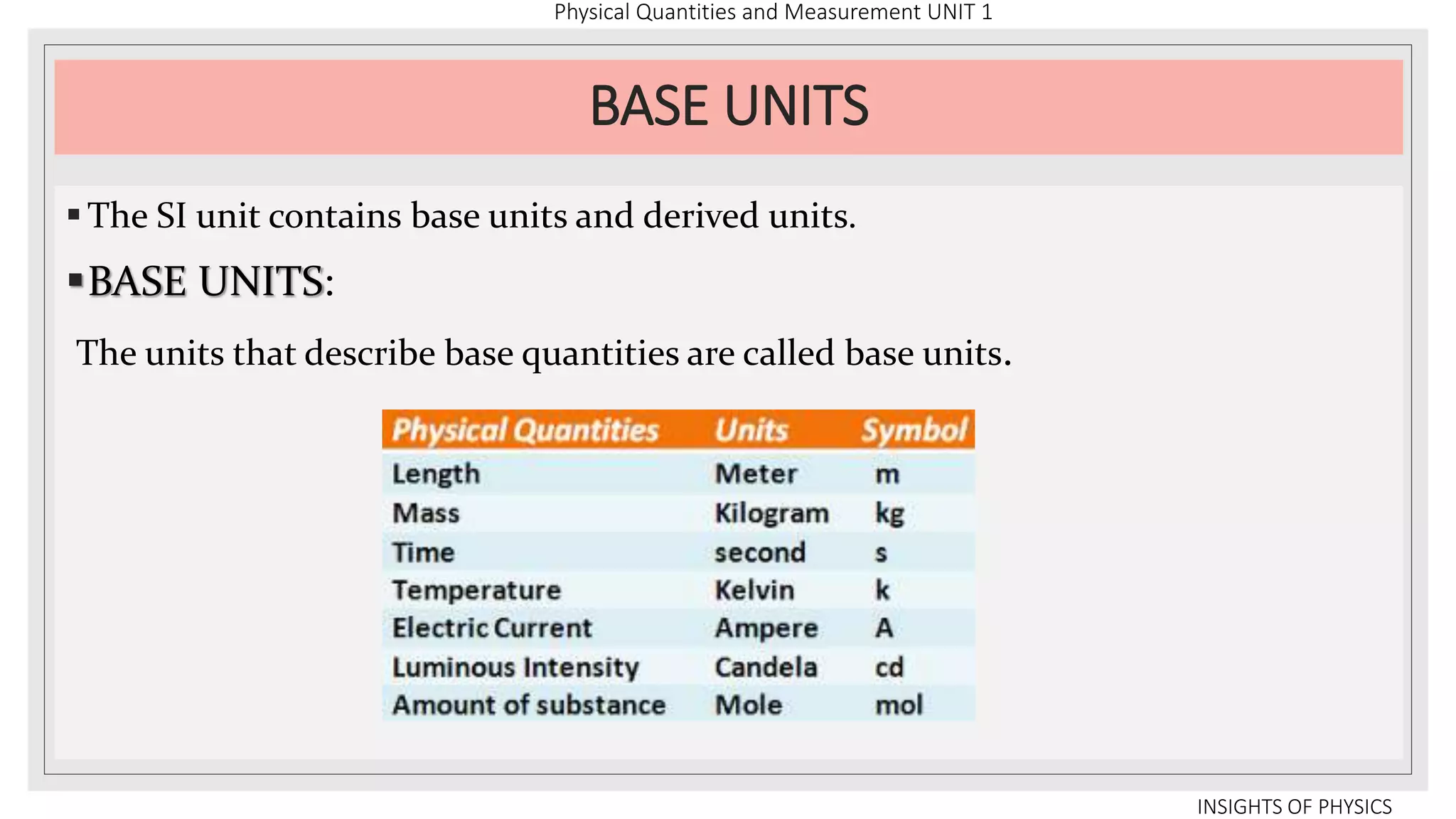
The SI unit contains base units and derived units.
BASE UNITS:
The units that describe base quantities are called base units.
INSIGHTS OF PHYSICS
BASE UNITS
Physical Quantities and Measurement UNIT 1
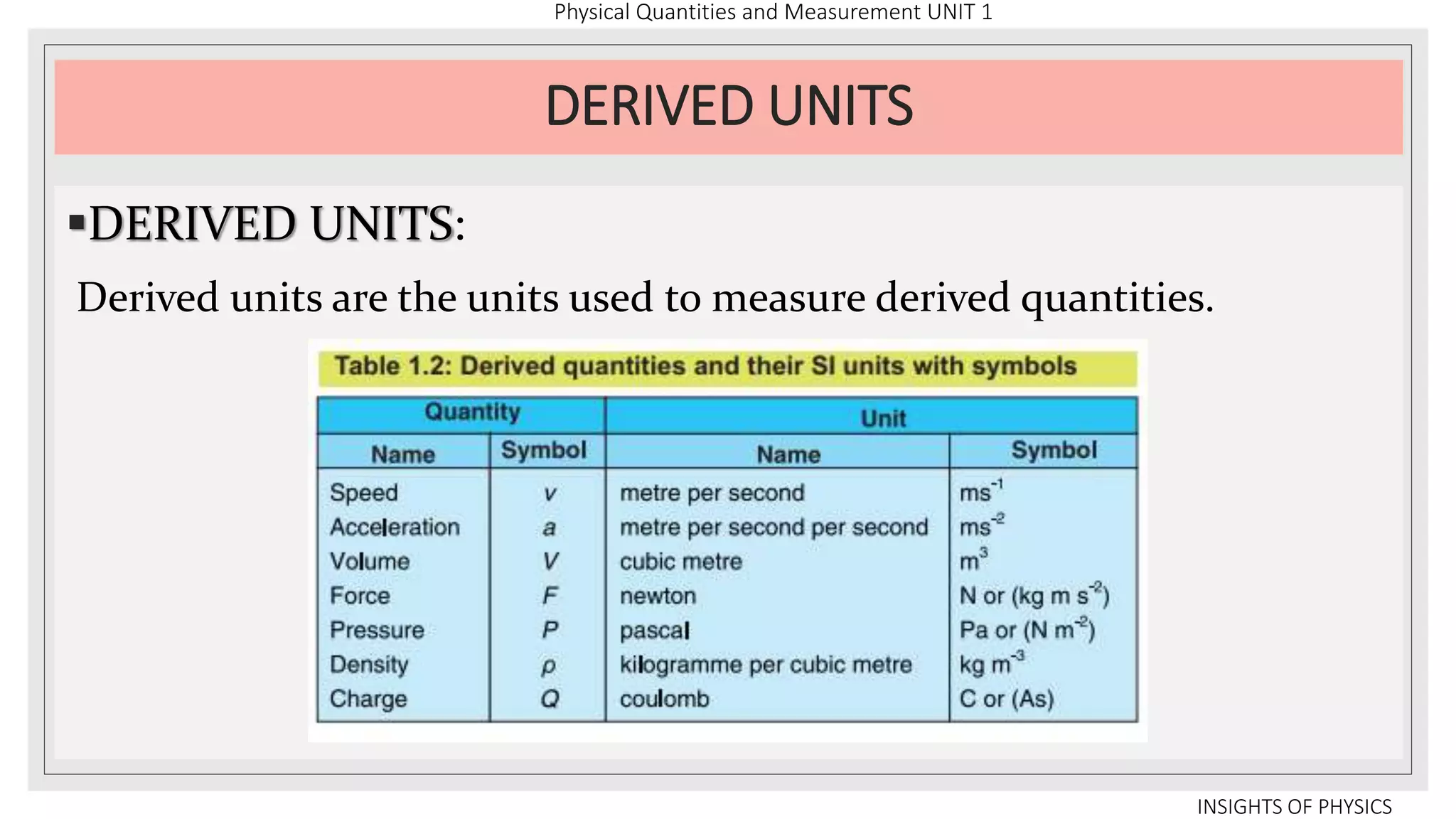
DERIVED UNITS:
Derived units are the units used to measure derived quantities.
INSIGHTS OF PHYSICS
DERIVED UNITS
Physical Quantities and Measurement UNIT 1
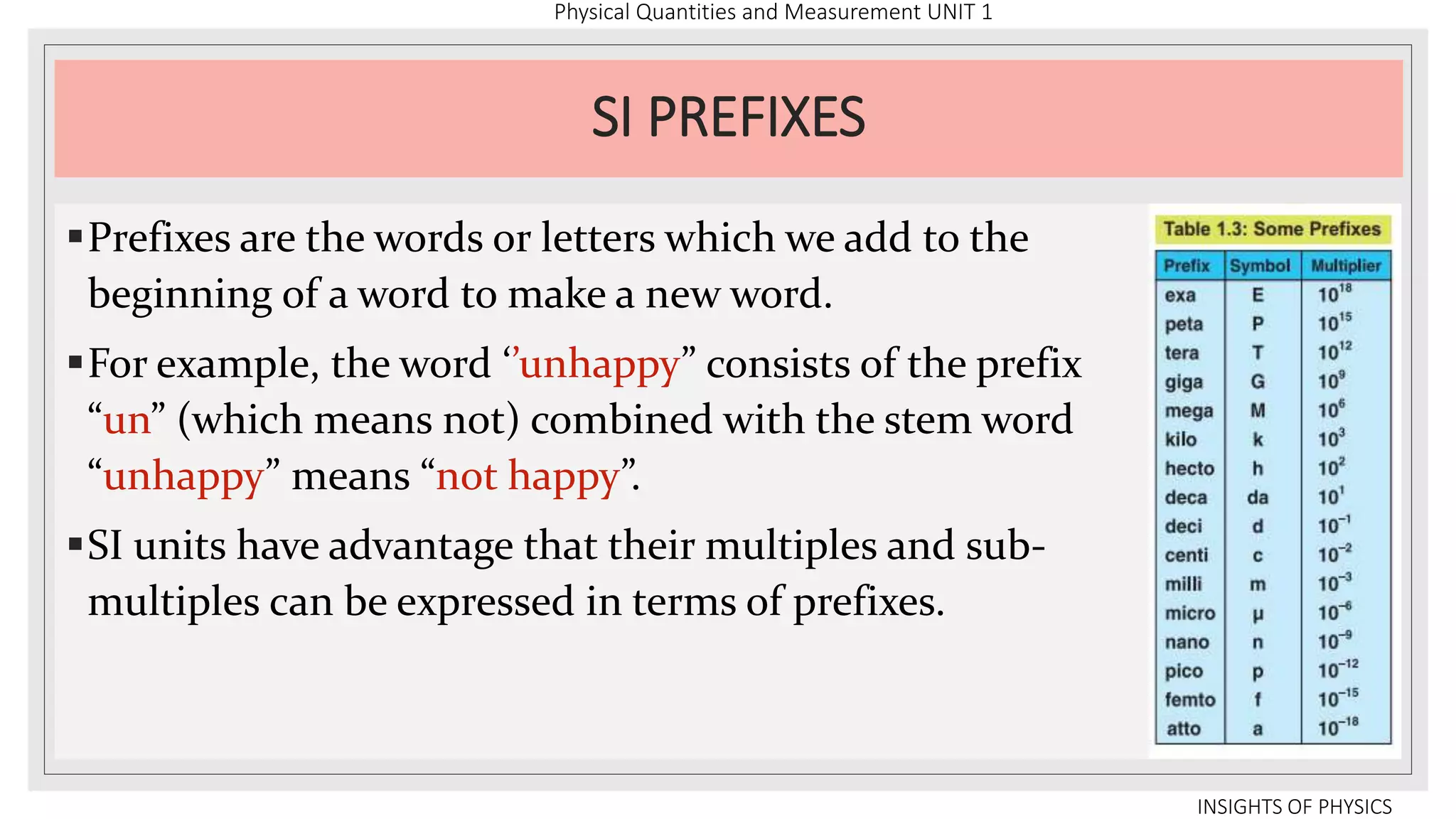
Prefixes are the words or letters which we add to the
beginning of a word to make a new word.
For example, the word ‘’unhappy” consists of the prefix
“un” (which means not) combined with the stem word
“unhappy” means “not happy”.
SI units have advantage that their multiples and sub-
multiples can be expressed in terms of prefixes.
INSIGHTS OF PHYSICS
SI PREFIXES
Physical Quantities and Measurement UNIT 1
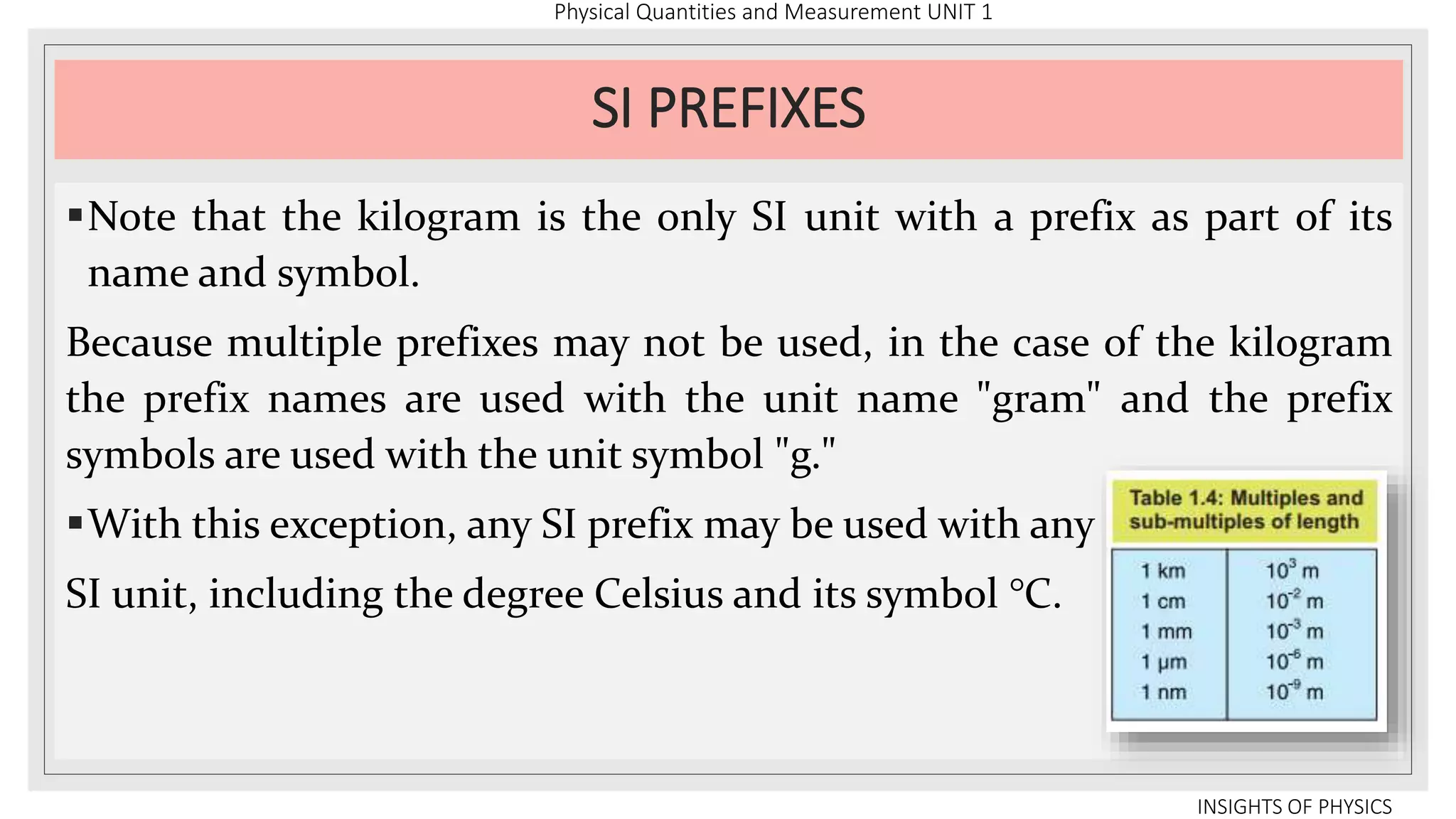
Note that the kilogram is the only SI unit with a prefix as part of its
name and symbol.
Because multiple prefixes may not be used, in the case of the kilogram
the prefix names are used with the unit name "gram" and the prefix
symbols are used with the unit symbol "g."
With this exception, any SI prefix may be used with any
SI unit, including the degree Celsius and its symbol °C.
INSIGHTS OF PHYSICS
SI PREFIXES
Physical Quantities and Measurement UNIT 1
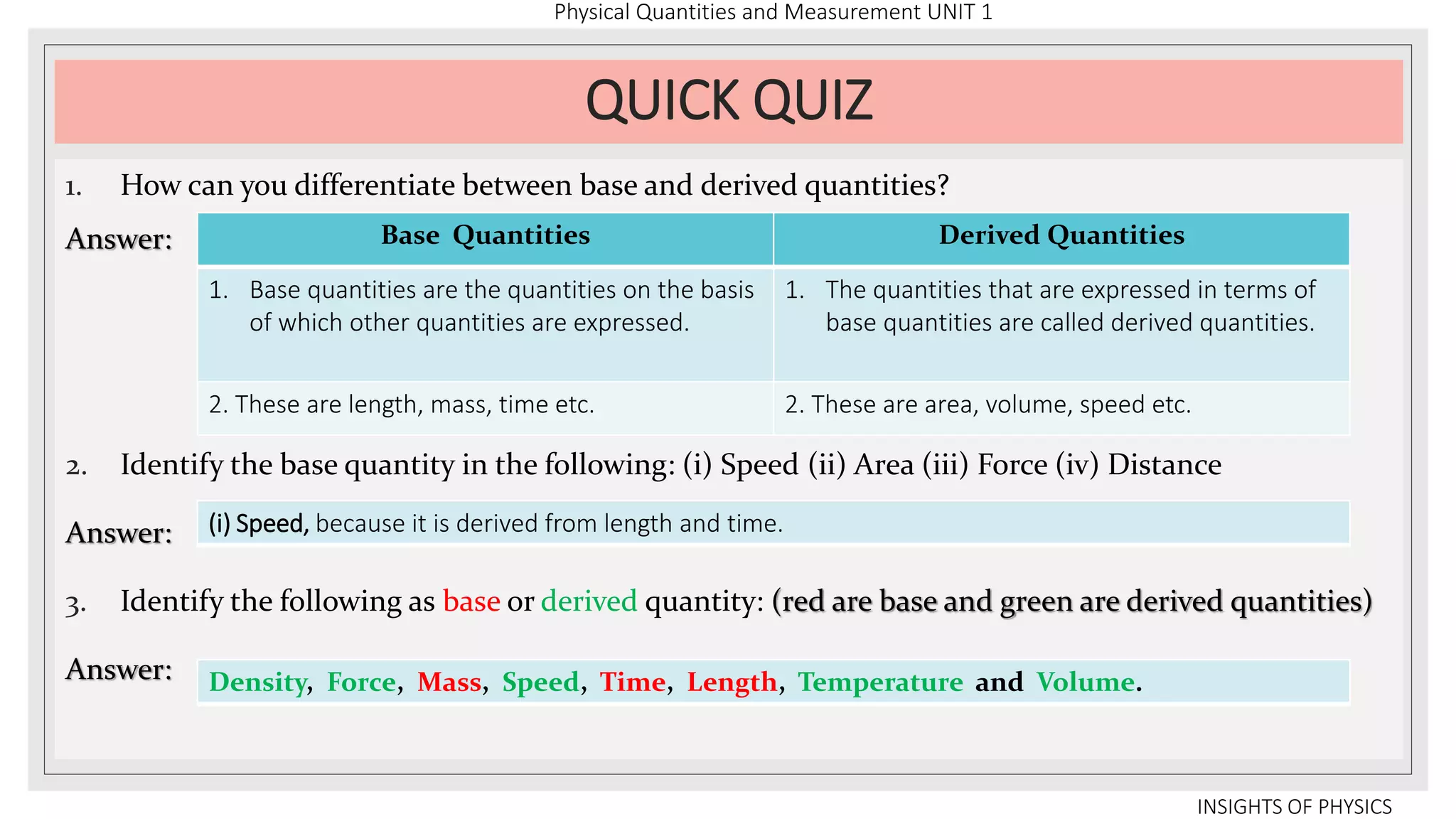
1. How can you differentiate between base and derived quantities?
Answer:
2. Identify the base quantity in the following: (i) Speed (ii) Area (iii) Force (iv) Distance
Answer:
3. Identify the following as base or derived quantity: (red are base and green are derived quantities)
Answer:
INSIGHTS OF PHYSICS
QUICK QUIZ
Physical Quantities and Measurement UNIT 1
Base Quantities Derived Quantities
1. Base quantities are the quantities on the basis
of which other quantities are expressed.
1. The quantities that are expressed in terms of
base quantities are called derived quantities.
2. These are length, mass, time etc. 2. These are area, volume, speed etc.
(i) Speed, because it is derived from length and time.
Density, Force, Mass, Speed, Time, Length, Temperature and Volume.
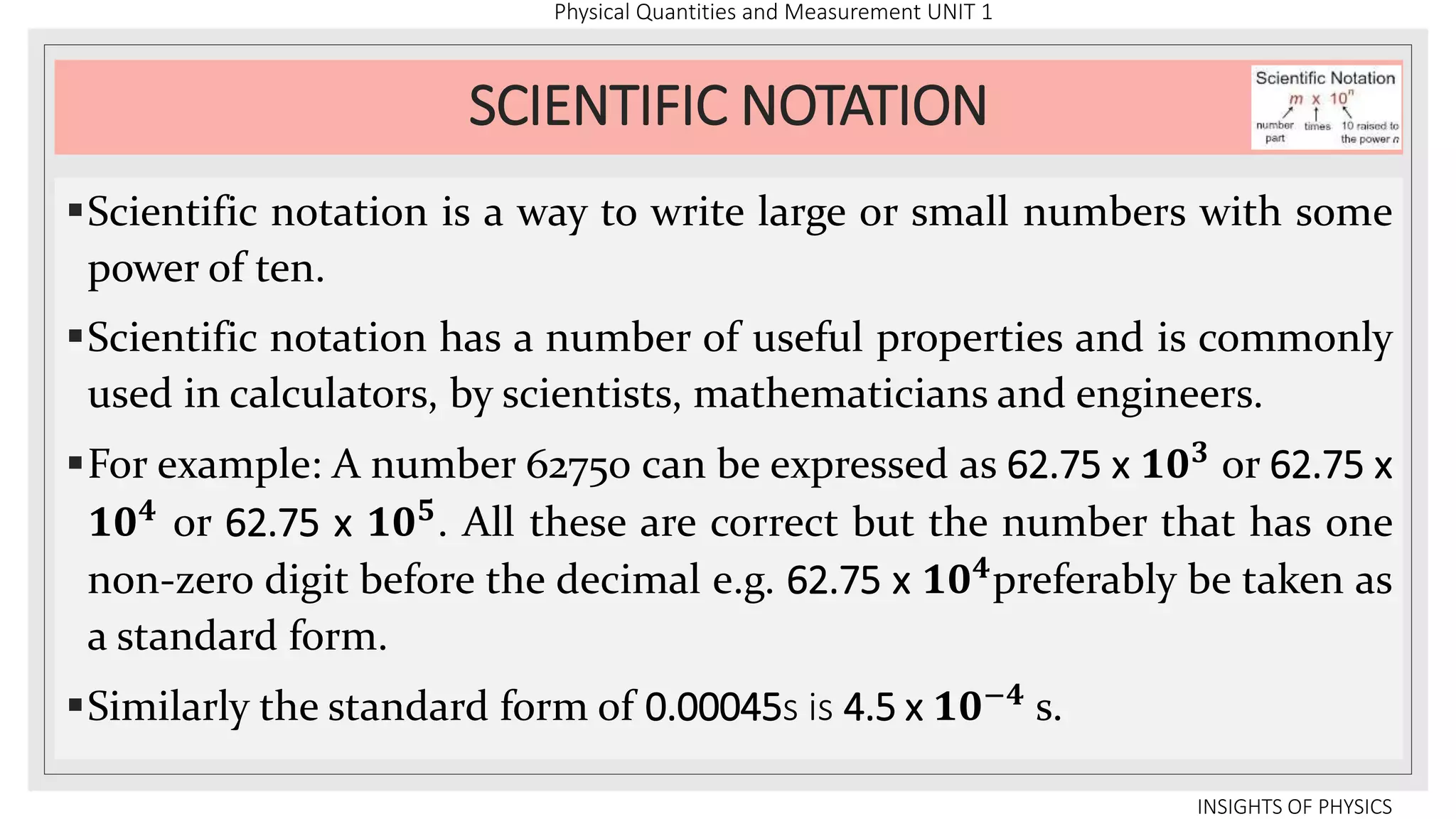
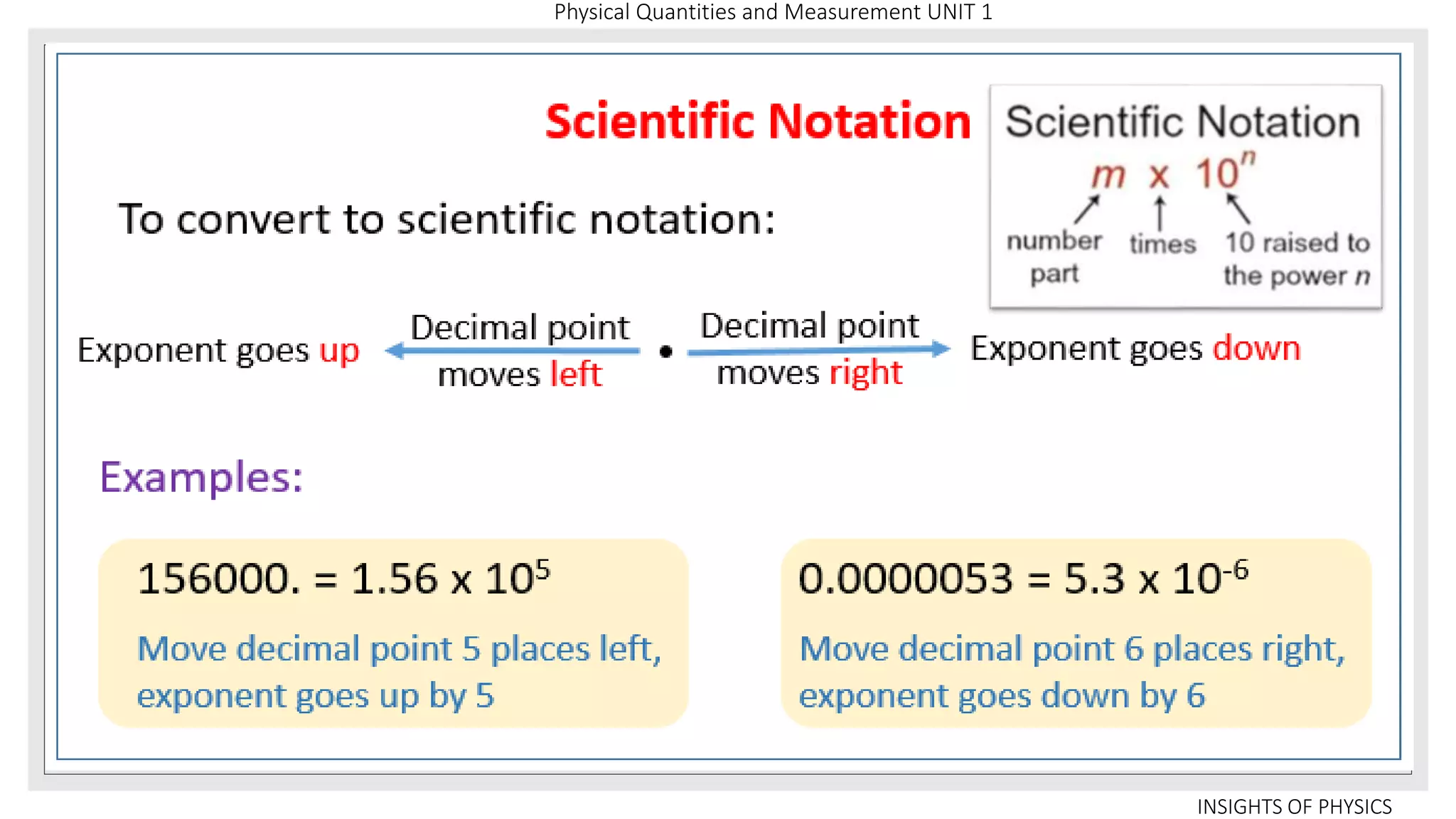
Scientific notation is a way to write large or small numbers with some
power of ten.
Scientific notation has a number of useful properties and is commonly
used in calculators, by scientists, mathematicians and engineers.
For example: A number 62750 can be expressed as 62.75 x 𝟏𝟎 𝟑 or 62.75 x
𝟏𝟎 𝟒
or 62.75 x 𝟏𝟎 𝟓
. All these are correct but the number that has one
non-zero digit before the decimal e.g. 62.75 x 𝟏𝟎 𝟒preferably be taken as
a standard form.
Similarly the standard form of 0.00045s is 4.5 x 𝟏𝟎−𝟒
s.
INSIGHTS OF PHYSICS
SCIENTIFIC NOTATION
Physical Quantities and Measurement UNIT 1
INSIGHTS OF PHYSICS
Physical Quantities and Measurement UNIT 1
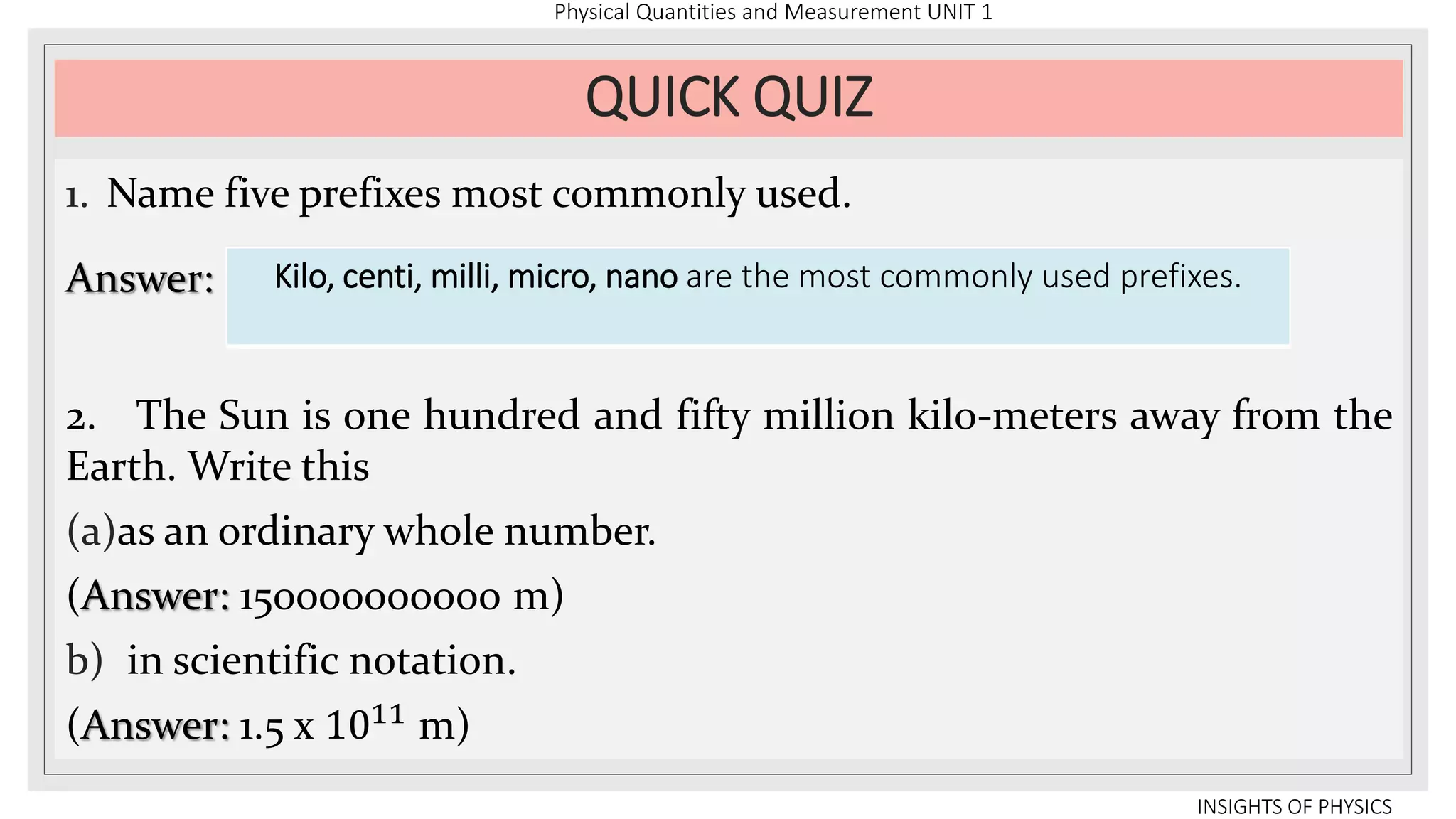
1. Name five prefixes most commonly used.
Answer:
2. The Sun is one hundred and fifty million kilo-meters away from the
Earth. Write this
(a)as an ordinary whole number.
(Answer: 150000000000 m)
b) in scientific notation.
(Answer: 1.5 x 10¹¹ m)
INSIGHTS OF PHYSICS
QUICK QUIZ
Physical Quantities and Measurement UNIT 1
Kilo, centi, milli, micro, nano are the most commonly used prefixes.
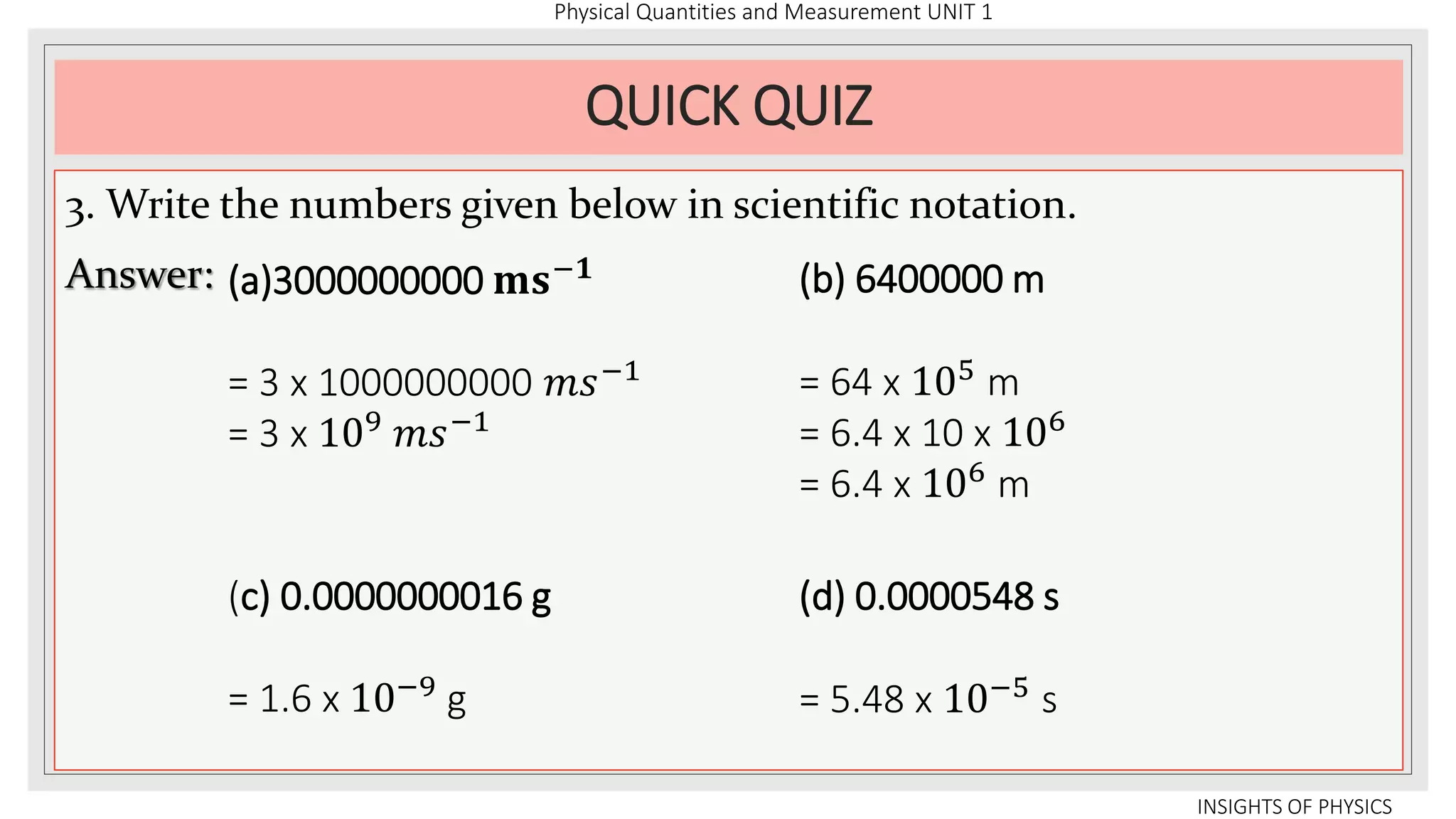
3. Write the numbers given below in scientific notation.
Answer:
INSIGHTS OF PHYSICS
Physical Quantities and Measurement UNIT 1
(a)3000000000 𝐦𝐬−𝟏
= 3 x 1000000000 𝑚𝑠−1
= 3 x 10⁹ 𝑚𝑠−1
(b) 6400000 m
= 64 x 105 m
= 6.4 x 10 x 106
= 6.4 x 10⁶ m
(c) 0.0000000016 g
= 1.6 x 10⁻⁹ g
(d) 0.0000548 s
= 5.48 x 10⁻⁵ s
QUICK QUIZ
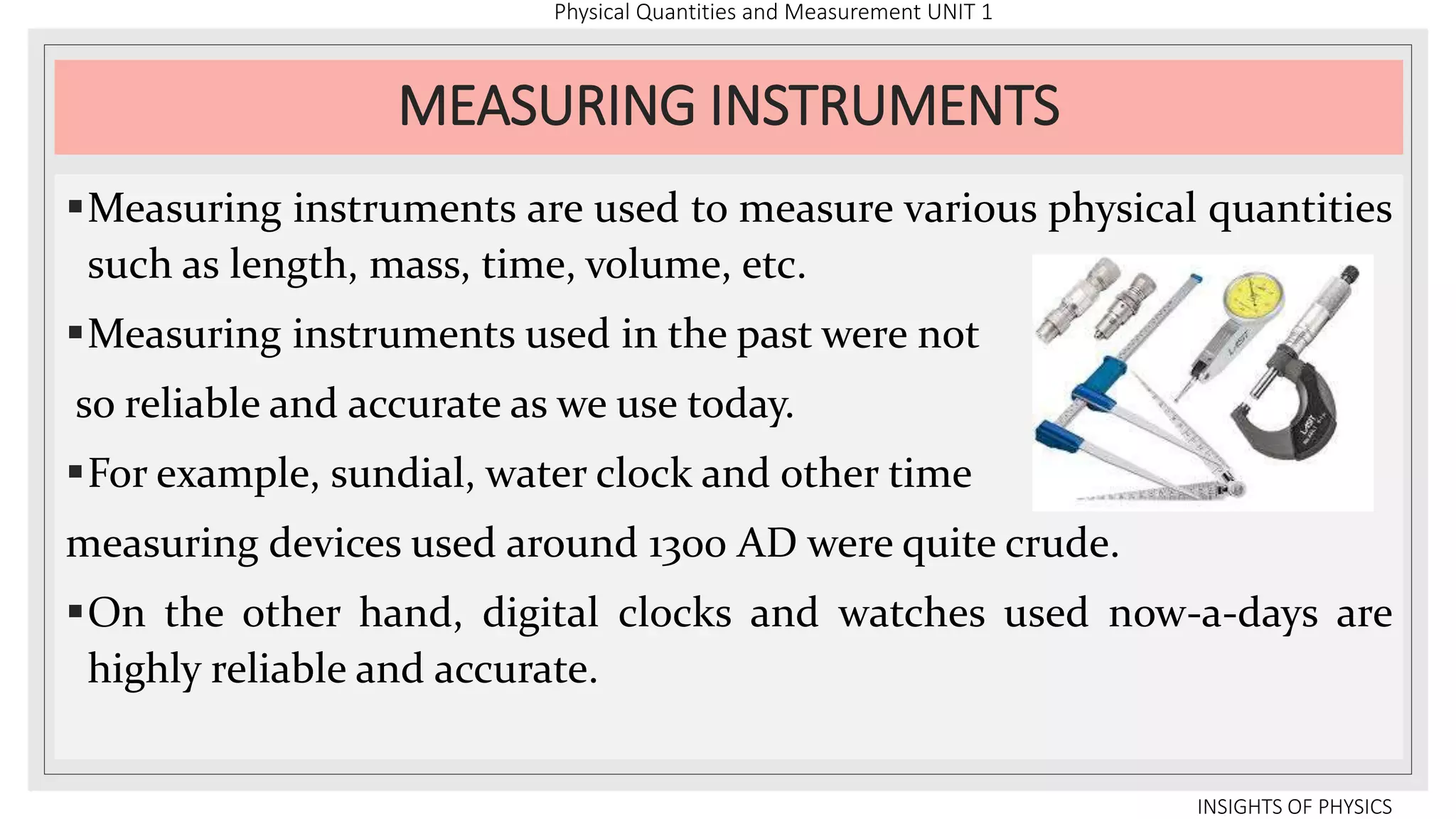
Measuring instruments are used to measure various physical quantities
such as length, mass, time, volume, etc.
Measuring instruments used in the past were not
so reliable and accurate as we use today.
For example, sundial, water clock and other time
measuring devices used around 1300 AD were quite crude.
On the other hand, digital clocks and watches used now-a-days are
highly reliable and accurate.
INSIGHTS OF PHYSICS
MEASURING INSTRUMENTS
Physical Quantities and Measurement UNIT 1
A meter rule is a length measuring instrument. It is commonly used in the
laboratories to measure length of an object or distance between two points.
It is one meter long which is equal to 100 centimeters. Each centimeter (cm) is
divided into 10 small divisions called millimeter (mm). Thus one millimeter is the
smallest reading that can be taken using a meter rule and is called its least count.
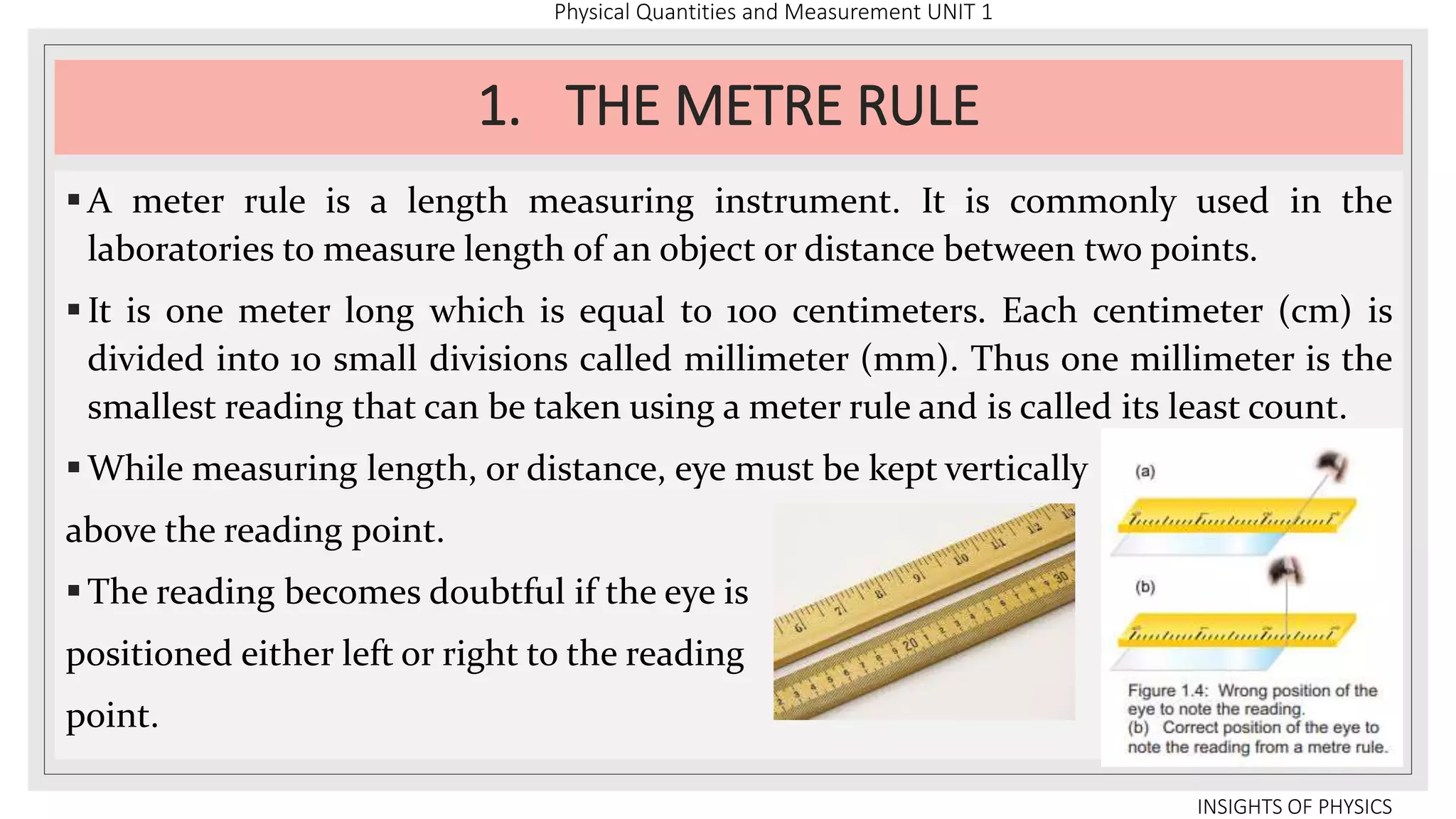
While measuring length, or distance, eye must be kept vertically
above the reading point.
The reading becomes doubtful if the eye is
positioned either left or right to the reading
point.
INSIGHTS OF PHYSICS
1. THE METRE RULE
Physical Quantities and Measurement UNIT 1
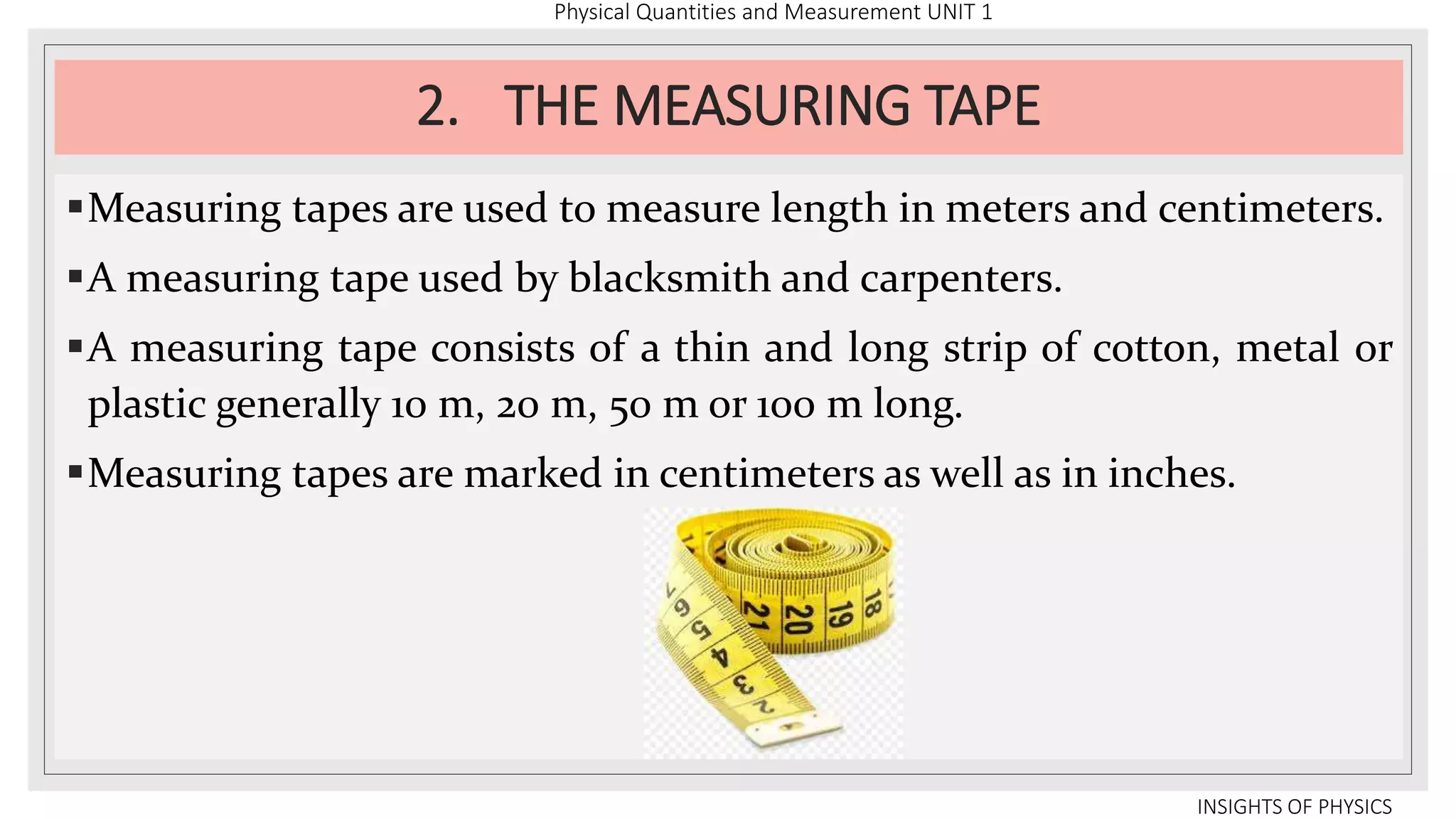
Measuring tapes are used to measure length in meters and centimeters.
A measuring tape used by blacksmith and carpenters.
A measuring tape consists of a thin and long strip of cotton, metal or
plastic generally 10 m, 20 m, 50 m or 100 m long.
Measuring tapes are marked in centimeters as well as in inches.
INSIGHTS OF PHYSICS
2. THE MEASURING TAPE
Physical Quantities and Measurement UNIT 1
INSIGHTS OF PHYSICS
Thank you
Physical Quantities and Measurement UNIT 1

Physical quantities and measurement

  • 1.
  • 2.
    LEARNING OUTCOMES Describe therole of physics in science, technology and society.  Explain with examples that science is based on physical quantities which consist of numerical magnitude and a unit.  Differentiate between base and derived physical quantities.  List the seven units of system international (SI) along with their symbols and physical quantities (standard definitions of SI units are not required).  Interconvert the prefixes and their symbols to indicate multiples and sub-multiples for both base and derived units.  Write the answer in scientific notation in measurements and calculations.  Describe the working of Vernier caliper's and screw gauge for measuring length.  Identify and explain the limitations of measuring instruments such as meter rule, Vernier caliper's and screw gauge. Describe the need using significant figures for recording and stating results in the laboratory. INSIGHTS OF PHYSICS Physical Quantities and Measurement UNIT 1
  • 3.
    CONTENTS 1.1 Introduction tophysics 1.2 Physical quantities 1.3 International system of units 1.4 Prefixes (multiples and sub-multiples) 1.5 Scientific notation/ standard form 1.6 Measuring instruments • meter rule • Vernier calipers • screw gauge • physical balance • stopwatch • measuring cylinder 1.7 An introduction to significant figures INSIGHTS OF PHYSICS Physical Quantities and Measurement UNIT 1
  • 4.
    SCIENCE, TECHNOLOGY ANDSOCIETY CONNECTION The knowledge gained through observations and experimentations is called Science. Not until eighteenth century, various aspect of material objects were studied under a single subject called natural philosophy. But as the knowledge increased, it was divided into : The word science is derived from the Latin word scientia, which means knowledge. two main streams Physical sciences — which deal with the study of non- living things Biological sciences — which are concerned with the study of living things. INSIGHTS OF PHYSICS Physical Quantities and Measurement UNIT 1
  • 5.
    INTRODUCTION TO PHYSICS Inthe nineteenth century, physical sciences were divided into five distinct disciplines; The most fundamental of these is the Physics. Physics plays an important role in the field of science and technology. Most of the technologies of our modern society throughout the world are related to Physics. For example, A car is made on the principles of mechanics. A refrigerator is based on the principles of thermodynamics. PHYSICS CHEMISTRY ASTRONOMY GEOLOGY METEOROLOGY In Physics, we study matter, energy and their interaction. The laws and principles of Physics help us to understand nature. INSIGHTS OF PHYSICS Physical Quantities and Measurement UNIT 1
  • 6.
    In our dailylife, Physics is everywhere. Pulleys that make it easy to lift heavy loads. Electricity is used not only to get light and heat but also mechanical energy that drives fans and electric motors etc. Means of transportation such as car and aero planes Domestic appliances such as air conditioners, refrigerators, vacuum-cleaners, washing machines, and microwave ovens etc. Similarly the means of communication such as radio, TV, telephone and computer are the result of applications of physics. INSIGHTS OF PHYSICS INTRODUCTION TO PHYSICS Physical Quantities and Measurement UNIT 1
  • 7.
    For example, Think ofwhat a mobile phone smaller than our palm? It allows us to contact people anywhere in the world and to get latest worldwide information. We can take and save pictures, send and receive messages of our friends. We can also receive radio transmission and can use it as a calculator as well. However, the scientific inventions have also caused harms and destruction of serious nature. One of which is the environmental pollution and the other is the deadly weapons. INSIGHTS OF PHYSICS INTRODUCTION TO PHYSICS Physical Quantities and Measurement UNIT 1
  • 8.
  • 9.
    BRANCHES OF PHYSICS 1.Mechanics: It is the study of motion of objects, its causes and effects. 2. Heat: It deals with the nature of heat, modes of transfer and effects of heat. 3. Sound: It deals with the physical aspects of sound waves, their production, properties and applications. 4. Light (Optics): It is the study of physical aspects of light, its properties, working and use of optical instruments. 5. Electricity and Magnetism: It is the study of the charges at rest and in motion, their effects and their relationship with magnetism. INSIGHTS OF PHYSICS Physical Quantities and Measurement UNIT 1
  • 10.
    BRANCHES OF PHYSICS 6.Atomic Physics: It is the study of the structure and properties of atoms. 7. Nuclear Physics: It deals with the properties and behavior of nuclei and the particles within the nuclei. 8. Plasma Physics: It is the study of production, properties of the ionic state of matter - the fourth state of matter. 9. Geophysics: It is the study of the internal structure of the Earth. INSIGHTS OF PHYSICS Physical Quantities and Measurement UNIT 1
  • 11.
    FOR YOUR INFORMATION Andromedais one of the billions of galaxies of known universe. Wind turbines are used to produce pollution free electricity INSIGHTS OF PHYSICS Physical Quantities and Measurement UNIT 1
  • 12.
    QUICK QUIZ 1. Q.1 Why do we study physics? Answer: We study physics to understand 1. The branch of science that deals with the matter, energy and their interaction. 2. The laws of the universe. Q. 2 Name any five branches of physics. Answer: INSIGHTS OF PHYSICS Physical Quantities and Measurement UNIT 1 Mechanics Heat Sound Light (Optics) Geophysics
  • 13.
    A physical quantityis quantity which can be measured. For Example: Length, Mass, Time, Temperature, Electric Current, Light Intensity, Volume And many others. A physical quantity is always measured of natural non-living objects. Physical quantities have numerical magnitude and unit. For Example: If the length of a student is 104cm, then 104 is its numerical magnitude and cm is the unit of measurement. INSIGHTS OF PHYSICS PHYSICAL QUANTITIES Physical Quantities and Measurement UNIT 1
  • 14.
    The another exampleof physical quantity is that when a grocer says that each sugar bag contains 5 kg, he is describing its numerical magnitude as well as the unit of measurement. It would be meaningless to state 5 or kg only. Physical quantities are of two types: INSIGHTS OF PHYSICS PHYSICAL QUANTITIES Physical Quantities and Measurement UNIT 1 BASE QUANTITIES DERIVED QUANTITIES
  • 15.
    Base quantities arethe quantities on the basis of which other quantities are expressed. There are seven base quantities which include: INSIGHTS OF PHYSICS BASE QUANTITIES Physical Quantities and Measurement UNIT 1 LENGTH MASS TIME TEMPERATURE ELECTRIC CURRENT INTENSITY OF LIGHT AMOUNT OF SUBSTANCE
  • 16.
    Derived quantities arethe quantities which are expressed in terms of base quantities. These include: INSIGHTS OF PHYSICS DERIVED QUANTITIES Physical Quantities and Measurement UNIT 1 AREA VOLUME SPEED FORCE WORK ENERGY POWER ELECTRIC CHARGE
  • 17.
    What is unit? Oncea standard is set for quantity then it can be expressed in terms of that standard quantity. This standard quantity is called a unit. The eleventh General Conference on Weight and Measures held in Paris in 1960 adopted a world-wide system of measurements called International System of Units. The International System of Units is referred as SI. INSIGHTS OF PHYSICS SI UNITS- International System of Units Physical Quantities and Measurement UNIT 1
  • 18.
    The SI unitcontains base units and derived units. BASE UNITS: The units that describe base quantities are called base units. INSIGHTS OF PHYSICS BASE UNITS Physical Quantities and Measurement UNIT 1
  • 19.
    DERIVED UNITS: Derived unitsare the units used to measure derived quantities. INSIGHTS OF PHYSICS DERIVED UNITS Physical Quantities and Measurement UNIT 1
  • 20.
    Prefixes are thewords or letters which we add to the beginning of a word to make a new word. For example, the word ‘’unhappy” consists of the prefix “un” (which means not) combined with the stem word “unhappy” means “not happy”. SI units have advantage that their multiples and sub- multiples can be expressed in terms of prefixes. INSIGHTS OF PHYSICS SI PREFIXES Physical Quantities and Measurement UNIT 1
  • 21.
    Note that thekilogram is the only SI unit with a prefix as part of its name and symbol. Because multiple prefixes may not be used, in the case of the kilogram the prefix names are used with the unit name "gram" and the prefix symbols are used with the unit symbol "g." With this exception, any SI prefix may be used with any SI unit, including the degree Celsius and its symbol °C. INSIGHTS OF PHYSICS SI PREFIXES Physical Quantities and Measurement UNIT 1
  • 22.
    1. How canyou differentiate between base and derived quantities? Answer: 2. Identify the base quantity in the following: (i) Speed (ii) Area (iii) Force (iv) Distance Answer: 3. Identify the following as base or derived quantity: (red are base and green are derived quantities) Answer: INSIGHTS OF PHYSICS QUICK QUIZ Physical Quantities and Measurement UNIT 1 Base Quantities Derived Quantities 1. Base quantities are the quantities on the basis of which other quantities are expressed. 1. The quantities that are expressed in terms of base quantities are called derived quantities. 2. These are length, mass, time etc. 2. These are area, volume, speed etc. (i) Speed, because it is derived from length and time. Density, Force, Mass, Speed, Time, Length, Temperature and Volume.
  • 23.
    Scientific notation isa way to write large or small numbers with some power of ten. Scientific notation has a number of useful properties and is commonly used in calculators, by scientists, mathematicians and engineers. For example: A number 62750 can be expressed as 62.75 x 𝟏𝟎 𝟑 or 62.75 x 𝟏𝟎 𝟒 or 62.75 x 𝟏𝟎 𝟓 . All these are correct but the number that has one non-zero digit before the decimal e.g. 62.75 x 𝟏𝟎 𝟒preferably be taken as a standard form. Similarly the standard form of 0.00045s is 4.5 x 𝟏𝟎−𝟒 s. INSIGHTS OF PHYSICS SCIENTIFIC NOTATION Physical Quantities and Measurement UNIT 1
  • 24.
    INSIGHTS OF PHYSICS PhysicalQuantities and Measurement UNIT 1
  • 25.
    1. Name fiveprefixes most commonly used. Answer: 2. The Sun is one hundred and fifty million kilo-meters away from the Earth. Write this (a)as an ordinary whole number. (Answer: 150000000000 m) b) in scientific notation. (Answer: 1.5 x 10¹¹ m) INSIGHTS OF PHYSICS QUICK QUIZ Physical Quantities and Measurement UNIT 1 Kilo, centi, milli, micro, nano are the most commonly used prefixes.
  • 26.
    3. Write thenumbers given below in scientific notation. Answer: INSIGHTS OF PHYSICS Physical Quantities and Measurement UNIT 1 (a)3000000000 𝐦𝐬−𝟏 = 3 x 1000000000 𝑚𝑠−1 = 3 x 10⁹ 𝑚𝑠−1 (b) 6400000 m = 64 x 105 m = 6.4 x 10 x 106 = 6.4 x 10⁶ m (c) 0.0000000016 g = 1.6 x 10⁻⁹ g (d) 0.0000548 s = 5.48 x 10⁻⁵ s QUICK QUIZ
  • 27.
    Measuring instruments areused to measure various physical quantities such as length, mass, time, volume, etc. Measuring instruments used in the past were not so reliable and accurate as we use today. For example, sundial, water clock and other time measuring devices used around 1300 AD were quite crude. On the other hand, digital clocks and watches used now-a-days are highly reliable and accurate. INSIGHTS OF PHYSICS MEASURING INSTRUMENTS Physical Quantities and Measurement UNIT 1
  • 28.
    A meter ruleis a length measuring instrument. It is commonly used in the laboratories to measure length of an object or distance between two points. It is one meter long which is equal to 100 centimeters. Each centimeter (cm) is divided into 10 small divisions called millimeter (mm). Thus one millimeter is the smallest reading that can be taken using a meter rule and is called its least count. While measuring length, or distance, eye must be kept vertically above the reading point. The reading becomes doubtful if the eye is positioned either left or right to the reading point. INSIGHTS OF PHYSICS 1. THE METRE RULE Physical Quantities and Measurement UNIT 1
  • 29.
    Measuring tapes areused to measure length in meters and centimeters. A measuring tape used by blacksmith and carpenters. A measuring tape consists of a thin and long strip of cotton, metal or plastic generally 10 m, 20 m, 50 m or 100 m long. Measuring tapes are marked in centimeters as well as in inches. INSIGHTS OF PHYSICS 2. THE MEASURING TAPE Physical Quantities and Measurement UNIT 1
  • 30.
    INSIGHTS OF PHYSICS Thankyou Physical Quantities and Measurement UNIT 1